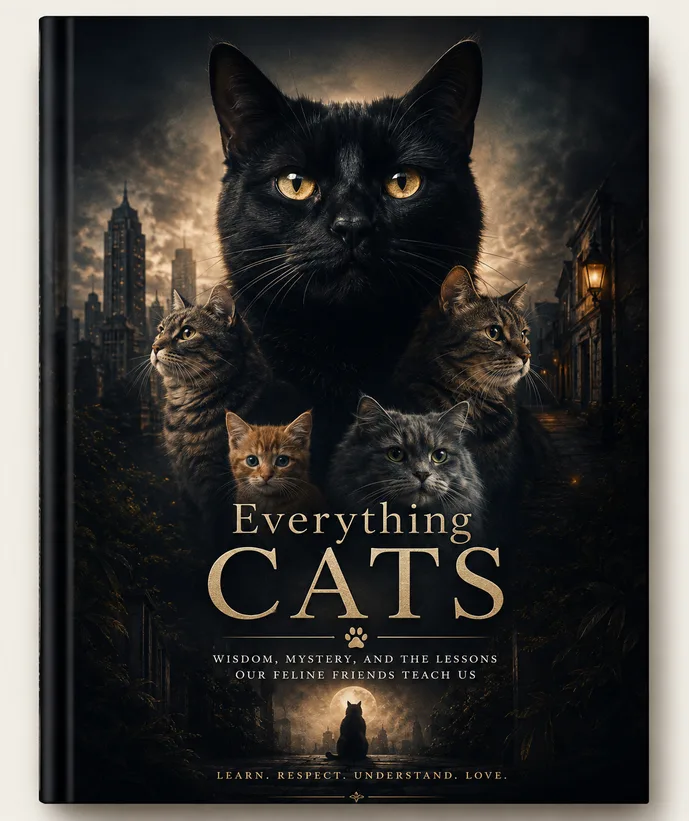
Everything CATS
Table of Contents
- Title Page
- Dedication
- Foreword
- Preface
- Introduction
- Cats and the Animals from the Fifth Dimension
- My Cat as a Sensei (先生)
- Does your cat actually love you back?
- The Perils of Comfort and the Wisdom of the Streets
- Are Cats Cheaper by the Dozen?
- Everything I Learned About Women, I Learned From a Cat
- The Cat is Out of the Bag
- The Dead Cat Bounce
- What did I learn about AI from training cats?
- Happy INDOOR Cats
- Best Cat Flea & Itching Care Video
- Control the High Ground: What Cats Know That Most CEOs Don't
- WHY DO HUMANS WORK?
- Two CATS Judge their HUMANS
Title Page
Everything Cats Lessons in Life, Love, Independence, and Quiet Wisdom
By YNOT Tony Lester
A book for everyone who has ever loved a cat, been ignored by a cat, been chosen by a cat, or slowly realized that the cat was in charge all along.
Everything Cats Copyright © 2026 — YNOT / Tony Lester All Rights Reserved.
Copyright
Copyright © [Year] [Author]. All rights reserved.
Dedication
To all the cats I have known and loved.
To the black cats, the white cats, the tabbies, the Persians, the house cats, the alley cats, the strays, the feral ones, and the friendly ones.
To the cats who came when called, and the ones who only came when they felt like it.
To the cats who slept beside me, watched over me, ignored me, judged me, comforted me, and somehow made every house feel more like a home.
This book is for you.
For your mystery, your mischief, your independence, your quiet wisdom, and your strange little ways of showing love.
You walked across my floors, across my furniture, across my papers, and across my heart.
This is something to remember you by.
With love, gratitude, and a few scratches,
YNOT
Foreword
There are people who say cats are pets.
Those people have clearly never lived with one.
A cat is not simply an animal that shares your house. A cat is a roommate, a philosopher, a comedian, a judge, a thief, a therapist, a mystery, and sometimes a tiny dictator covered in fur.
Cats have a way of entering our lives quietly and then taking over everything. First they take a chair. Then a bed. Then a window. Then your schedule. Then your heart.
And somehow, we let them.
This book is not just about cats as animals. It is about what cats teach us when we are paying attention. They teach independence without apology. They teach patience. They teach boundaries. They teach comfort. They teach survival. They teach us that love does not always have to be loud, obedient, or predictable to be real.
You will notice that many of my writings are not really about cats at all.
They are about the lessons cats have taught me — lessons I have carried into business, philosophy, relationships, survival, and life in general.
Cats have taught me independence. They have taught me patience. They have taught me boundaries. They have taught me that comfort is valuable, but too much comfort can make you soft. They have taught me to observe before acting, to move with purpose, and to never beg for a place where I am not wanted.
In many ways, cats understand life better than we do.
They know when to rest, when to hunt, when to walk away, and when to sit quietly and simply watch the world.
So yes, this book is about cats. But it is also about everything I have learned from them.
And to be honest, if I had to choose between being a cat or a dog, I would probably choose to be a cat.
A dog may run to you with joy every time you open the door. A cat may simply glance up, blink slowly, and go back to sleep. But anyone who has truly known a cat understands that the small gesture may mean just as much.
Cats remind us that affection can be earned, not demanded. Trust can be built slowly. Presence can be enough. Silence can say plenty.
They are creatures of contradiction. Wild, yet domestic. Independent, yet attached. Soft, yet armed. Elegant, yet ridiculous. One moment they are staring into the distance like they understand the secrets of the universe. The next moment they are fighting a paper bag.
That is part of their magic.
Everything Cats is a tribute to that magic. It is for the cats who ruled the house, the cats who lived under the porch, the cats who showed up one day and never left, and the cats who only stayed long enough to be remembered forever.
It is for the ones who comforted us without knowing they were doing it. The ones who made us laugh when we needed it. The ones who sat beside us during hard days. The ones who left paw prints not just on the floor, but somewhere much deeper.
To love a cat is to accept a strange bargain. You may never fully understand them. You may never fully own them. But somehow, if you are fortunate, they choose you for a little while.
And that is enough.
So open these pages with the proper respect.
After all, this is a book about cats.
And cats, as they would surely remind us, have always known they were worthy of a book.
Preface
Written by One of His Cats
Meow! – I should probably begin by saying that I did not approve the title of this book.
“Everything Cats” is ambitious. Humans do this often. They learn three things, misunderstand two of them, and then put the word everything on the cover.
Still, I have reviewed the material by walking across the keyboard, sitting on the notes, knocking several pages onto the floor, and staring at the author until he questioned his own decisions. After careful inspection, I have decided this book may proceed.
This is not merely a book about cats. That would be unnecessary. We already know about cats. We are cats.
This is a book about what humans can learn from us, assuming they are willing to put down their phones, stop talking so much, and observe.
Cats understand life.
We know the value of silence. We know the importance of rest. We know when to be still, when to move, when to hunt, when to hide, and when to demand food with the full moral authority of a starving king — even if we ate twenty minutes ago.
We do not chase approval. We do not perform tricks for applause. We do not come when called unless there is a reason, and sometimes not even then.
This seems to confuse humans.
But it should not.
A cat does not live by panic. A cat lives by instinct, timing, curiosity, dignity, and the occasional reckless decision at three o’clock in the morning. These are not contradictions. These are principles.
The author has known many cats: black cats, white cats, tabbies, Persians, house cats, strays, feral cats, friendly cats, proud cats, strange cats, broken cats, and cats who arrived from nowhere and somehow became family.
Some stayed for years. Some passed through like smoke. Some loved loudly. Some loved quietly. Some never admitted they loved him at all, which is often how cats love best.
He believes he has learned from us.
He is correct.
Not completely, of course. He is still human.
But he has learned enough to write this book.
He has learned that independence is not loneliness. That affection means more when it is freely given. That comfort is good, but comfort without purpose can make you weak. That observation is often better than reaction. That survival requires patience. That boundaries matter. That mystery is not a flaw.
And perhaps most importantly, he has learned that love does not always arrive when called.
Sometimes it slips through a door, hides under a chair, watches you from across the room, and slowly decides whether you are worth trusting.
This book is for those who understand cats, those who wish to understand cats, and those who are currently being trained by cats without realizing it.
Read it carefully.
Take your time.
And when you are finished, place it somewhere warm.
I may want to sleep on it.
Introduction
Cats are easy to underestimate.
They are small enough to fit in a box, quiet enough to disappear into a room, and independent enough to make you wonder whether they need you at all. But anyone who has truly lived with cats knows better.
Cats are not simple creatures.
They are observers. Survivors. Hunters. Comedians. Philosophers. Manipulators. Comforters. Mysteries with whiskers.
They can ignore you for hours, then suddenly decide you are the most important thing in the world. They can sit in silence like ancient monks, then run through the house at midnight like they are being chased by ghosts. They can look helpless one minute and like royalty the next.
That is the world of cats.
This book is called Everything Cats, but it is not only about food bowls, litter boxes, scratching posts, breeds, habits, and funny behavior. It is also about what cats reveal when we pay attention.
Cats teach us how to live.
They teach us independence without bitterness. Affection without desperation. Patience without weakness. Curiosity without permission. They teach us that rest matters, timing matters, boundaries matter, and dignity matters.
A cat does not beg the world to understand it. A cat simply is.
That may be one of the greatest lessons they offer.
Over the years, I have known and loved many cats: house cats, stray cats, feral cats, friendly cats, strange cats, elegant cats, difficult cats, broken cats, and cats who somehow found their way into my life exactly when they were needed.
Some stayed. Some wandered off. Some were easy to love. Some made love complicated. But every one of them left something behind.
A memory. A lesson. A laugh. A scratch. A silence. A look.
And sometimes, a little piece of wisdom.
This book is my attempt to gather those pieces.
Some chapters may be about cats directly. Others may seem to wander into business, philosophy, human nature, survival, and life itself. That is intentional. Because once you start paying attention, cats become more than pets. They become teachers.
They remind us not to chase everything. Not to trust too quickly. Not to waste energy on noise. Not to confuse attention with love. Not to surrender our nature just to be accepted.
They also remind us that life is better with a warm place to sleep, something interesting to watch, and someone nearby who understands that love does not always have to be loud.
So whether you are a lifelong cat person, someone recently adopted by a cat, or a person still trying to understand why cats do what they do, this book is for you.
But be warned.
Once you begin to understand cats, you may also begin to understand yourself a little better.
And like every cat owner eventually learns, that may have been the cat’s plan all along.
Cats and the Animals from the Fifth Dimension

Have you ever noticed how a cat can spend hours chasing something that seems completely meaningless to us? A dust ball drifting across the floor. A crumpled piece of paper. The shadow of a leaf. In my case, I dropped a simple plastic tie wrap on the floor, and my cat spent hours batting it, stalking it, pouncing on it, and staring at it as if it were a living creature.
To us, it’s just a piece of plastic.
To the cat, it might be something entirely different.
Now imagine this: what if everything we see is only a simplified version of reality? Just as a two-dimensional creature could never fully understand a three-dimensional object passing through its world, perhaps humans can only perceive a fraction of what actually exists around us. Our senses evolved to help us survive, not necessarily to reveal the complete universe.
Maybe cats evolved differently.
Throughout history, many ancient civilizations treated cats with unusual respect. The Egyptians did not simply keep them as pets; they considered them sacred guardians. Legends told that cats could protect homes from evil spirits and unseen forces. Long before modern science, many cultures believed that animals could sense things beyond human perception—spirits, omens, or visitors from another realm.
Of course, modern science would explain much of this through superior hearing, smell, vision, and instinct. Cats can detect tiny vibrations, hear frequencies we cannot, and react to movements invisible to the human eye.
But suppose there is another possibility.
Suppose there are creatures that exist in a fifth dimension—not ghosts in the traditional sense, but beings that occupy a reality intersecting with ours only occasionally. Most of the time, they remain invisible because our brains simply cannot process them. Every now and then, however, their presence creates a tiny disturbance: a moving shadow, an unexplained sound, or an object that seems to shift for no reason.
When your cat suddenly stops, stares into an empty corner, arches its back, and follows something across the room that you cannot see, perhaps it isn’t imagining anything at all.
Perhaps it is watching one of those travelers.
The tie wrap on my floor may not have been just a piece of plastic. It may have been the visible footprint of an invisible visitor, with my cat chasing the creature responsible rather than the object itself.
Maybe our ancestors noticed this behavior thousands of years ago and came to a conclusion: if cats constantly fought battles against things humans could not see, then they were guardians of the household, keeping unseen dangers at bay.
Whether this is folklore, imagination, or a glimpse of a deeper reality, one thing remains true: every cat owner has witnessed moments when their cat seems absolutely convinced that something invisible is in the room.
The question is not whether the cat is crazy.
The question is whether we are simply blind.
A Cat Story
The Girl and the Cats of the Fifth Gate
Long before kingdoms had borders and long before maps had names, there was a small village built beside a forest that no one entered after sunset. The elders simply called it The Dark Edge. They never explained why. They only warned the children:
“When the wind becomes silent, come home.”
On a small hill just outside the village lived a young girl named Elara with her grandmother and nearly two dozen cats. Some were black, some gray, some orange, and some so old they moved like shadows themselves. Every morning the cats wandered through the village, sleeping on walls, under carts, beside fireplaces, and atop stone fences before returning to Elara’s cottage at dusk.
The villagers tolerated them. All except one.
Gregor, the wealthiest farmer in the village, hated cats. They walked through his fields, climbed onto his roof, and stared into empty corners of his barn for hours. They would suddenly leap into the air as though attacking invisible birds, then sit perfectly still with their ears pointed toward nothing at all.
“They catch a few mice,” Gregor would grumble, “but mostly they sleep.”
The oldest villagers would simply shake their heads. “They are working.”
“Doing what?” “No one remembers.”
One evening, while Elara was feeding the oldest cat, a silver-haired tom called Ash, she asked her grandmother the same question.
“Why do they stare into empty places?”
Her grandmother closed the shutters before answering. “Because they are not looking into our world.”
Elara laughed. “There is only one world.”
Her grandmother looked toward the forest.
“That is what humans believe.”
Then she reached into an old cedar chest and removed a stone tablet no bigger than her hand. Upon it was carved a circle, and around the circle sat dozens of cats with their tails intertwined.
“Our ancestors came from the southern deserts,” she said. “They learned from people who built temples before history remembered their names. Those people believed that the world is like woven cloth. We see one thread. The cats see the spaces between the threads.”
“And what lives there?”
Her grandmother whispered only one word. “Hungry things.”
The oldest story in the village told of The Fifth Gate.
There were four gates that belonged to men: East, West, North, and South.
The fifth belonged to no direction.
It opened only when silence covered the earth.
It could not be found by walking. It appeared where fear was greatest.
From it came creatures with no true shape. They could not build or create. They fed upon confusion, anger, greed, and despair. They whispered into the ears of kings until wars began and into the ears of neighbors until friends became enemies.
Humans could not see them. Animals sensed them.
Only cats could fight them. No one knew why.
Every autumn the forest became strangely quiet.
The birds disappeared. The wind stopped.
Even the insects seemed to vanish.
On those nights every cat in the village left its sleeping place and gathered around Elara’s cottage. They sat in perfect silence facing the forest, waiting.
The villagers locked their doors.
Gregor laughed. “They’re afraid of squirrels.”
But that year something different happened.
The cats did not stop at the forest. They walked directly into his fields.
Furious, Gregor grabbed a broom and chased them away. “You useless beasts!”
Ash, the old silver cat, turned and stared at him. It was not the stare of an animal.
It was the stare of someone trying to warn a child.
That night the silence came. Not a bird sang.
Not a cricket chirped. Even the stream behind the mill seemed to stop flowing.
The village dogs whimpered and hid beneath wagons.
Then every cat stood at once. Their backs arched.
Their tails became enormous.
Their eyes reflected no firelight, only a strange golden glow.
One by one they walked toward the edge of the village and formed a line.
They stared at nothing. Or at least nothing the humans could see.
Then the hissing began Some cats leaped into empty air.
Others struck invisible enemies with impossible speed.
The villagers watched leaves swirl in circles though there was no wind. Stones rolled uphill. Frost formed upon warm ground.
The darkness itself seemed alive.
Great shapes pressed against the fog like hands against thin cloth. Eyes opened and vanished. Long fingers reached from nowhere and withdrew when a cat struck at them.
Children cried. Adults backed away.
The cats did not.
Elara walked among them carrying only a lantern.
“They’re here again,” she whispered.
“Who?” asked the baker.
“The ones that live between our world and theirs.”
No one understood. The battle lasted nearly an hour.
People heard screams that sounded neither human nor animal.
They saw claw marks appear in empty air.
Several cats vanished into the mist and emerged moments later with fur standing on end, as though they had walked through lightning itself.
Ash climbed onto a stone at the front of the line and let out a cry unlike any meow or roar. Every cat answered.
For a brief second, every villager saw them.
Tall shadows with too many arms. Faces without eyes.
Bodies made from smoke and broken memories.
Then they were gone.
The fog retreated into the forest. The wind returned. The birds sang.
The next morning Gregor walked to his barn.
Across the heavy oak doors were five deep grooves that no axe or bear could have made.
Inside, every sack of grain remained untouched.
Outside, strange footprints circled the barn but ended abruptly where Ash had been sitting.
Gregor carried a basket of cream and fresh fish to Elara’s cottage.
“I owe your cats an apology.”
Elara smiled. “They don’t need one.”
“Then why did they stay? After all the stones I threw and all the times I chased them away?”
She knelt beside Ash, now sleeping peacefully in the morning sun. “Because they were never protecting themselves.”
“They were protecting you.”
Years later, when Elara herself became an old woman, children would ask why every house in the village left a bowl of milk on its doorstep each night.
She would answer, “Not because cats drink milk.”
“But because guardians deserve to know they are welcome.”
The children would laugh and ask, “Do monsters really exist?”
Elara would point to the nearest cat staring into an empty corner.
“My dear,” she would say, “a man sees an empty room. A cat sees a battlefield. History suggests we should not be too certain which one is right.”
And so the oldest law of the village was never written, yet everyone obeyed it:
Never disturb a sleeping cat. It may have spent the entire night defending your soul from enemies you were never meant to see.
My story was based on Cats in Mythology.
- Egypt — The Great Cat kills the serpent of chaos
In The Egyptian Book of the Dead, Chapter 17, there is a famous image of a divine cat cutting down the serpent Apep/Apophis, the force of chaos and darkness. This is the strongest ancient reference for “cats fighting unseen evil.” (University College London) - Ra as a cat
Egyptian funerary art shows Ra in cat form slaying Apep. That gives you a great story idea: cats are not pets; they are earthly shadows of a solar guardian. (Egypt Museum) - Bastet — protector of the home
Bastet became associated with cats, the household, childbirth, women, protection, disease, and evil spirits. For your story, Bastet can be the ancient name humans gave to the fifth-dimensional cat guardian. (World History Encyclopedia) - Herodotus — sacred cats of Egypt
Herodotus wrote that dead cats were taken to sacred chambers in Bubastis and buried there. This supports the idea that Egyptians treated cats as spiritually important, not ordinary animals. (World History Encyclopedia) - Pangur Bán — the monk and the hunting cat
The 9th-century Irish poem Pangur Bán compares a monk hunting meaning in books with his cat hunting unseen prey. Great angle: the scholar hunts words, the cat hunts what hides between worlds. (asnc.cam.ac.uk) - Freyja’s cats — magic, travel, and unseen power
In Norse tradition, Freyja, goddess of love, war, gold, and seiðr magic, rides in a chariot drawn by cats. This links cats to magic, movement between realms, and feminine divine power. (Wikipedia)
Ancient humans misunderstood what they were seeing. Cats were not worshiped because they were cute. They were worshiped because they were the only animals that could see the predators crossing over from the fifth dimension. Every time a cat stares at a blank wall, pounces on a twist-tie, or fights a dust ball, it may be stopping something from entering fully into our world.
CATS in our society


Cats have protected human settlements for thousands of years, although not in a supernatural sense. They became one of humanity’s earliest partners because they were incredibly effective predators of pests that threatened food supplies and spread disease.
1. Cats protect stored food
When humans began storing grain about 10,000 years ago, the grain attracted:
- Mice
- Rats
- Voles
- Other small rodents
Those rodents could consume or contaminate large amounts of food. Wildcats followed the rodents, and humans realized these animals were beneficial. Over time, this relationship led to domestication.
2. They reduce rodent populations
A single active cat may kill dozens or even hundreds of small animals in a year, depending on its environment. Even when they don’t kill rodents, their presence alone can deter them.
Scientists have found that rodents can detect cat scent and often avoid areas where cats are active because they perceive a high predation risk.
3. They help limit disease vectors
Rodents can carry or spread organisms associated with diseases such as:
- Leptospirosis
- Salmonella
- Hantavirus (certain rodents)
- Historically, fleas on rats played a role in the spread of plague
By suppressing rodent activity around human settlements, cats can indirectly reduce some health risks, although modern sanitation and pest management are also critical.
4. Why cities often have feral cats
Feral cat colonies tend to establish themselves where food is available:
- Warehouses
- Docks
- Restaurants
- Industrial areas
- Alleys
Many businesses intentionally keep “working cats” or “barn cats” because they can help discourage rodents around stored goods.
5. The downside
The picture is not entirely positive. Free-ranging and feral cats are also major predators of wildlife, especially:
- Songbirds
- Small reptiles
- Amphibians
- Small mammals
Because of this ecological impact, many conservation biologists recommend managing feral populations through Trap-Neuter-Return (TNR) programs and keeping pet cats indoors when possible.
6. Why ancient people valued them
Imagine living 3,000 years ago with grain stored for the winter. Without pesticides or modern traps, rodents could destroy a family’s food supply. A cat that kept the rodents away could literally help a household survive.
So when ancient civilizations, especially Ancient Egypt, revered cats, there was a very practical reason: they were valuable protectors of homes, granaries, and villages. Over time, that practical role blended with religious symbolism, leading to beliefs that cats also guarded against unseen evil.
My Cat as a Sensei (先生)

The first steps in the morning are always the hardest. That moment when you have to roll out of bed and actually start the day. But I don’t get to debate it much—because I have a little white cat who has already decided it’s time.
At 5:30 sharp, she meows and meows. If I try to ignore her, she climbs close and meows right in my ear until I give in. I get up, feed her, and let her out to the back patio room. She knows what has to be done. She has a plan. And if I get in her way, she lets me know about it.
Funny thing is—she reminds me that I also have a plan. That I should get up, get going, and do something I actually want to do. She’s helping me keep a habit, whether I like it or not.
Then at night, around 10:00, she meows again. This time it’s bedtime she’s after. She’s like a snooze button that lets me push her off a couple of times—she curls up while I keep writing or working—but come 11:00 she insists again. And she’s not happy until the lights are out and I’ve gone to bed.
Some people use an app to track their routines. I have a cat. And she’s smarter than most apps.
Because really, she has the right idea: go to bed early, wake up early, and take on the day. Enjoy the sun. Don’t waste time fighting it.
Ben Franklin said it well,“Early to bed and early to rise, makes a man healthy, wealthy, and wise. Employ thy time well, if thou meanest to gain leisure. Your net worth to the world is usually determined by what remains after your bad habits are subtracted from your good ones.”
Does your cat actually love you back?

Cats have a reputation for being independent, mysterious, and sometimes completely indifferent to the humans who feed them.
But does your cat actually love you?
The answer is probably yes—although cats do not always express affection in ways humans immediately recognize.
The problem is that many of the things people do to show affection—tight hugs, constant touching, picking a cat up, staring into its eyes, or forcing it to sit nearby—may mean very little to the cat. Some of these behaviors can even make a cat uncomfortable and quietly weaken its trust.
Cats communicate through body language, scent, routine, distance, and choice. To build a genuine bond, we have to stop expecting cats to speak our emotional language and begin learning theirs.
Here are seven simple daily habits that can help your cat feel safer, more comfortable, and more connected to you.
1. Let Your Cat Make the First Move
One of the best ways to earn a cat’s trust is to stop demanding its attention.
Sit nearby and allow the cat to approach you. Extend one finger or a relaxed hand and let the cat investigate. Avoid immediately reaching over its head or trying to grab it.
When a cat chooses to come closer, it is exercising control over the interaction. That sense of control is extremely important to an animal that instinctively watches for threats.
A cat that knows it can approach you—and leave whenever it wants—is more likely to return.
Trust begins with choice.
2. Use the Slow Blink
A slow blink is one of the most recognizable signs of feline comfort.
Look toward your cat without staring intensely. Slowly close your eyes, hold them closed for a moment, and then gently open them again.
Some cats will slow-blink back.
In cat language, prolonged direct staring can feel threatening. Soft eyes and slow blinking communicate that you are calm, relaxed, and not preparing to attack.
It is sometimes described as a feline smile.
You do not need to exaggerate it. A quiet, natural slow blink from across the room can become a small daily ritual between you and your cat.
3. Respect the Tail
A cat’s tail can tell you a great deal about its emotional state.
A tail held upright, sometimes with a slight curve at the tip, often signals a friendly greeting. A tail wrapped around you may be a sign of social affection.
But a rapidly flicking, lashing, or thumping tail frequently indicates irritation, overstimulation, or internal conflict.
Many people continue petting a cat because it has not yet scratched or bitten them. The cat, however, may already be asking them to stop.
Pay attention to the early warning signs:
- Tail flicking
- Ears turning backward
- Skin twitching
- Head turning toward your hand
- Sudden tension in the body
- Dilated pupils
Stopping before the cat becomes upset teaches it that you listen.
That is how trust is built.
4. Create a Predictable Routine
Cats are creatures of habit.
Feeding, playtime, grooming, and quiet interaction at approximately the same times each day can help a cat feel secure. Predictability tells the cat that its environment is stable and that you are a reliable part of it.
This does not mean your household must operate with military precision. It simply means that your cat should have a general idea of what happens next.
A cat that knows when food arrives, where it can rest safely, and when you normally play with it experiences less uncertainty.
To a cat, reliability can be a form of love.
5. Play Like a Predator
Play is not merely entertainment for a cat. It activates the natural hunting sequence:
Watch.
Stalk.
Chase.
Pounce.
Capture.
Interactive toys that resemble prey—such as wand toys, feathers, fabric strips, or small moving objects—allow your cat to express these instincts safely.
Try moving the toy away from the cat rather than waving it directly in the cat’s face. Real prey usually attempts to escape.
Allow the cat to catch the toy occasionally. A game that can never be won may eventually become frustrating.
Even a few minutes of focused play can reduce boredom, provide exercise, and create a positive association with your presence.
You are not simply entertaining your cat. You are participating in one of its most important natural behaviors.
6. Learn When Not to Touch
Affection is not measured by how long you can hold or pet a cat.
Some cats enjoy sitting on laps. Others prefer lying beside their humans without being touched. Some like being carried, while others feel trapped the moment their feet leave the ground.
Respecting those preferences is essential.
Do not chase a cat that walks away. Do not pull it from a hiding place unless there is an emergency. Do not force it to remain in your arms.
A cat may show affection simply by sleeping in the same room, following you through the house, sitting with its back turned toward you, or resting nearby.
These behaviors may appear casual, but they often indicate that the cat feels safe in your presence.
Sometimes the most loving thing you can do is leave the cat alone.
7. Focus on the Cheeks and Chin
Many cats prefer being touched around the cheeks, chin, forehead, and base of the ears.
These areas contain scent glands that cats use during friendly social interactions. When a cat rubs its face against you, furniture, or another animal, it is depositing familiar scent and marking the area as safe.
Try gently scratching beneath the chin or along the cheeks. Watch the cat’s response.
If it leans into your hand, raises its chin, closes its eyes, or rubs against you, the interaction is probably welcome.
Avoid assuming that every cat enjoys having its belly touched. A cat exposing its stomach may be expressing trust, but that does not necessarily mean it is inviting a belly rub.
The abdomen is vulnerable, and touching it may trigger an instinctive defensive response.
The secret is not merely finding the right place to touch. It is watching the cat and allowing the cat to decide.
How Cats Really Say “I Love You”
Cats may not express affection with dramatic displays, but they often communicate attachment in quieter ways.
Your cat may:
- Follow you from room to room
- Sleep near you
- Greet you with its tail upright
- Rub its face against you
- Knead blankets or your clothing
- Groom you
- Bring you toys
- Slow-blink in your direction
- Sit with its back toward you
- Relax completely while you are nearby
A cat turning its back on you is not necessarily being rude. In many cases, it means the cat trusts you enough not to keep watching you.
That is a remarkable compliment from an animal whose survival instincts tell it to remain alert.
Love Your Cat in Its Own Language
Building a close relationship with a cat does not require expensive products, complicated training, or hours of daily work.
It requires patience, observation, consistency, and respect.
Give your cat control over interactions. Learn its body language. Play with it. Maintain a dependable routine. Touch it where it prefers to be touched—and stop when it asks you to stop.
The greatest mistake we make with cats is assuming that love must look the same to them as it does to us.
It does not.
A cat’s love is often quiet. It may arrive as a slow blink from across the room, a tail wrapped briefly around your leg, or a warm body choosing to sleep beside you.
The important word is choosing.
Because when a cat is free to leave but repeatedly chooses to remain near you, that may be one of the clearest expressions of trust and affection it can offer.
Leo Bennett, a veterinarian, breaks down the science of the human-cat bond. Learn seven practical, daily habits designed to foster trust and strengthen the emotional connection with your cat by understanding their unique communication cues, preferences, and instincts.

The Perils of Comfort and the Wisdom of the Streets

”Comfort is the Enemy of Greatness”
This Is a powerful statement that speaks to the idea that true success, growth, and excellence come from stepping outside of our comfort zones. When we settle into comfort, we often stop pushing ourselves, stop learning, and stop striving for more.
Greatness requires challenges, discomfort, and sometimes even failure. It demands resilience, persistence, and the willingness to take risks. Whether in business, personal growth, or creative endeavors, those who achieve greatness are often the ones who embrace discomfort, adapt to challenges, and push beyond their perceived limits.
As I sit here writing this, I have two cats in my house. Now, I didn’t invite both of them, but life has a way of making its own arrangements. One is Ivory, my fat, happy, white cat, who spends her days sprawled out in bed, full of the finest foods. The other is Ebony, a black cat who snuck in from the streets. Ebony darts around, evading capture, knowing well what it means to be hungry and cold.
Ivory, born into comfort, has never known struggle. She looks longingly outside, unaware that the world beyond the window is filled with dangers she’s not prepared for. Ebony, on the other hand, has lived the hard life. He knows the desperation of an empty stomach and the uncertainty of tomorrow. He’s seen things. And now that he’s had a taste of comfort, he fights like hell to stay inside.
People are much the same. Those who have known hardship, who have struggled, scratched, and clawed their way up, understand what it means to appreciate every small victory. Comfort was never guaranteed, so they push harder, adapt faster, and fight for every inch. But those born into softness often lack that hunger. They may feel restless, convinced that something better must be out there, yet they have no idea what real struggle looks like.
“Comfort is the enemy of greatness.” The easy road leads straight to mediocrity, paved with pillows and padded walls. Growth doesn’t come from lying in luxury; it comes from discomfort, from pushing yourself into places that make you sweat, shake, and second-guess. If you’re too comfortable, you’re not evolving. The best of us get used to the feeling of discomfort because we know it’s the sign of progress.
The world belongs to those who embrace that truth. Not the ones who sit back, waiting for fortune to hand them a crown, but the ones who fight, scratch, and refuse to settle. Ebony knows this, and that’s why he runs when I try to put him out. And perhaps that’s why Ivory, for all her comfort, still looks longingly at the door, unaware that outside her palace is a world she isn’t ready for.
True growth happens at the edge of our limits, not within the boundaries of comfort. The best athletes, entrepreneurs, and leaders all embrace discomfort as part of the journey to greatness.
Challenges, failures, and struggles aren’t setbacks—they’re stepping stones. If things feel too easy, it’s probably a sign that you’re not stretching yourself enough. Discomfort is the furnace where strength, resilience, and mastery are forged.
So, whether you’re a house cat or a street fighter, remember this: struggle breeds strength, and complacency dulls the claws. The real question is—when life throws you out into the cold, will you know how to survive?
EXTRA CREDIT
EQUALITY
Thank You!, Bullies
The Comfort Trap
More COMFORT and STRESS Posts
Are Cats Cheaper by the Dozen?
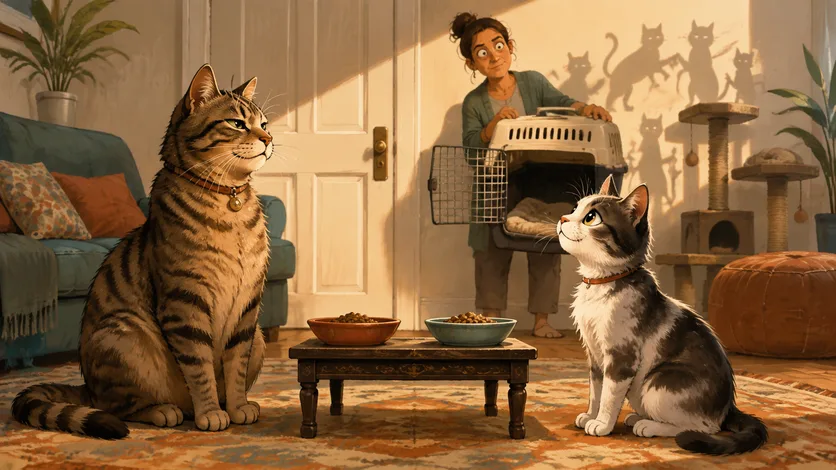
My cat is alone all day. She must be bored. Maybe she needs a friend. Tell that to your wife, she might give you a smile -- YNOT!
Getting a second cat sounds simple. You may think: Sometimes that is exactly the right decision.
But sometimes adding another cat creates stress, territorial conflict, litter-box problems, food competition, hiding, aggression, and a cat who is actually less happy than she was before.
The difference usually isn’t whether you have one cat or two.
The difference is how you choose the second cat, how you prepare your home, and how you introduce them. A successful two-cat household doesn’t happen by simply bringing a new cat through the front door and putting it on the floor. It is a process.
There is a peculiar arithmetic practiced by cat owners: if one cat brings happiness, two cats must bring twice as much—and twelve would presumably qualify the household for sainthood.
Unfortunately, cats do not recognize arithmetic, sainthood, or your good intentions.
The first cat may regard the second not as a companion, but as an invading army with whiskers. The newcomer, meanwhile, has been dropped into a foreign country where everyone speaks in hisses and the border dispute concerns a litter box.
Still, two cats can become devoted friends, agreeable roommates, or at least respectable neighbors who refrain from open warfare. The secret is not simply choosing another adorable face and bringing it home. It is choosing the right cat, preparing the territory, and conducting the introduction with the patience of a diplomat negotiating peace between two small, furry nations.
Here is how to go from one cat to two—without turning your home into the scene of an international incident.
How to Successfully Introduce a Second Cat Into Your Home
A Practical Step-by-Step Guide to Going From One Cat to Two
This guide explains how to do it properly.
1. First Ask: Does Your Cat Actually Need Another Cat?
This is the most important question.
Don’t start by asking:
“What kind of cat should I get?”
Start by asking:
“Would another cat actually improve my existing cat’s life?”
Cats are not naturally dependent on a social group in the same way that dogs or humans are. Some cats genuinely enjoy feline companionship, while others strongly prefer being the only cat in the house.
The source material emphasizes that being alone is not automatically a problem for a cat.
A second cat may make sense when:
- Your existing cat is young and extremely playful.
- Your cat has previously lived happily with other cats.
- Your cat actively seeks out feline interaction.
- You are away from home for long periods.
- You are adopting two kittens together.
- You have observed that your cat enjoys other cats rather than merely tolerating them.
Be much more cautious when:
- Your cat is elderly.
- Your cat has lived alone for many years.
- Your cat is highly anxious.
- Your cat reacts aggressively to unfamiliar cats.
- Your home has limited space.
- You cannot provide separate resources.
- You are getting another cat primarily because you feel guilty leaving the first one alone.
The last point is particularly important.
Don’t get a second cat simply because you assume your first cat is lonely.
Your cat may be perfectly happy with her current arrangement.
2. Consider the Age and Personality of Both Cats
One of the biggest mistakes is choosing a second cat based solely on appearance.
A cute kitten isn’t necessarily the right companion.
Think about:
- Age
- Energy level
- Personality
- Confidence
- Previous experience with cats
- Playfulness
- Territorial behavior
- Size
- Activity level
Match energy levels whenever possible
Imagine a 12-year-old cat who spends most of her day sleeping.
Now introduce a four-month-old kitten.
The kitten wants to:
- Chase
- Wrestle
- Climb
- Attack moving objects
- Play with the older cat’s tail
- Jump on furniture
- Run around the house at midnight
The older cat may not appreciate any of this.
The source specifically warns against assuming that a kitten will automatically “keep an older cat young.” In some cases, the opposite happens: the older cat becomes stressed and starts hiding or eating less.
A better match for an older cat
Consider a calm adult cat with a compatible temperament rather than an extremely energetic kitten.
The goal isn’t: “Find the youngest cat possible.”
The goal is: “Find the cat whose lifestyle is compatible with the cat I already have.”
Should You Match Cats by Sex?
Once cats are spayed or neutered, sex matters far less than personality, age, confidence, and energy level. There is no dependable rule that two males, two females, or a male-and-female pair will automatically get along; a calm, compatible match is more important than gender. Whenever medically appropriate, both cats should be altered before they are introduced. Hormones in intact cats can encourage spraying, roaming, territorial behavior, fighting, and—if you combine a male and female—an unexpected litter of kittens. If either cat has recently undergone surgery, allow full recovery and obtain your veterinarian’s approval before beginning face-to-face introductions.
3. Prepare Your House Before the New Cat Arrives
Do not wait until the new cat is standing in your living room to figure out where everything goes.
Prepare first. You need a separate room for the newcomer.
This room should contain:
- Food
- Water
- Litter box
- Bed
- Hiding place
- Scratching surface
- Toys
- Somewhere elevated if possible
The resident cat should continue to have access to her normal territory.
The new cat should initially have her own territory.
This prevents the first encounter from becoming:
“There is a strange animal invading my entire house.”
Instead, the resident cat discovers that there is something new behind one particular door.
4. Start With Scent — Not Sight
This may be the most useful technique in the entire process.
Cats rely heavily on smell to understand their environment.
Therefore, don’t make the first introduction visual.
Make it olfactory.
The source recommends exchanging scents before the cats actually meet.
Step-by-step scent introduction
Take a soft towel or cloth.
Gently rub it around the resident cat’s cheeks and face.
Then place the cloth near the new cat.
Do the reverse:
Take another cloth and rub it against the new cat.
Place it near the resident cat.
Don’t force either cat to investigate.
Let curiosity do the work.
Why this helps
Each cat begins learning: “There is another animal here.”
But the other animal isn’t:
- Chasing me
- Taking my food
- Entering my territory
- Staring at me
- Blocking my escape
The unfamiliar smell becomes part of the normal environment before the physical encounter occurs. Repeat this over several days.
5. Feed Them on Opposite Sides of a Closed Door
Once both cats are reasonably comfortable with their separate spaces, use food to create a positive association.
Put their food bowls on opposite sides of the closed door.
At first, keep the bowls far enough from the door that both cats will comfortably eat.
Gradually move them closer.
The principle is simple: Smell of other cat → food appears → good things happen.
Over time, the presence of the other cat becomes associated with something positive rather than threatening.
If either cat becomes too stressed to eat, move the bowls farther away again.
Don’t force the process.
6. Don’t Rush the Introduction
This is where many introductions fail.
Someone gets excited and thinks: “They’ve smelled each other for two days. Let’s see what happens.”
Then the cats are placed nose-to-nose.
One hisses.
The other runs.
Someone panics.
And suddenly the owners are trying to break up a fight.
The source recommends thinking in terms of weeks rather than days, with introductions potentially taking anywhere from roughly two weeks to two months.
There is no prize for completing the introduction quickly.
A better progression is:
Stage 1: Separate rooms > Stage 2: Exchange scents > Stage 3: Feed near closed door
Stage 4: Allow limited visual contact > Stage 5: Supervised interaction > Stage 6: Gradually increase shared time
Stage 7: Unsupervised access only after repeated peaceful interactions
If a stage goes badly, go backward. That isn’t failure. It’s information.
Stage 8: You give them free range but let them create their space, do not move them around. Let them be. If you have to scream at both of them first. So you know you are upset, but them follow up with nice talk to first cat first and then second cat.
Treat them equally but always treat/play/feed first cat first.
7. Allow Visual Contact Before Physical Contact
Once the cats are comfortable eating near the closed door, allow them to see one another without being able to reach each other.
Depending on your setup, this might involve:
- A screen
- A baby gate
- A cracked door
- Another safe barrier
Keep the first visual sessions short. Watch their body language.
You want curiosity without escalating fear or aggression.
If one cat becomes highly agitated, end the session and try again later.
8. Learn the Difference Between Playing and Fighting
This is essential.
Two cats wrestling on the floor can look terrifying.
But wrestling does not automatically mean fighting.
Signs that the interaction may be play
Look for:
- Taking turns chasing
- Taking turns wrestling
- Relaxed body language
- Ears generally forward or neutral
- Claws not being used aggressively
- Little or no vocalization
- Both cats voluntarily returning to the interaction
- Both cats being able to walk away
The source identifies the ability to leave as one of the most useful clues.
Signs of genuine conflict
Be concerned about:
- Persistent hissing
- Growling
- Yowling
- Flattened ears
- Puffed-up fur
- One cat repeatedly cornering the other
- One cat constantly running away
- One cat hiding afterward
- One cat repeatedly initiating attacks
- Injuries
The biggest question is: Can both cats disengage?
If one cat is trying to escape while the other repeatedly pursues her, you have a problem.
9. Never Put Your Hands Between Fighting Cats
If two cats are genuinely fighting, don’t reach between them with your hands.
A frightened or highly aroused cat can redirect its aggression toward you.
Instead, interrupt from a safe distance.
Use a distraction such as a sound or redirecting attention with a toy.
The objective isn’t punishment.
It is simply: Break the interaction and create distance.
Then separate them and allow everyone to calm down.
10. Give Them More Resources Than You Think They Need
This is one of the biggest practical differences between one-cat and two-cat households.
With one cat, one resource may be enough.
With two cats, competition becomes possible.
The source recommends the familiar rule:
Number of litter boxes = number of cats + 1.
So:
- 1 cat → 2 litter boxes
- 2 cats → 3 litter boxes
The important part is distribution.
Don’t put three boxes next to each other and assume you’ve created three independent resources. Spread them throughout the house.
Ideally, a cat should be able to use a litter box without having to pass through another cat’s territory or risk being ambushed.
11. Provide Multiple Food and Water Stations
Don’t assume two cats will happily share one bowl.
Feed them separately whenever necessary.
Ideally, each cat should have a feeding location where she can eat without being watched or challenged by the other cat.
This becomes especially important when:
- One cat eats quickly.
- One cat is overweight.
- One cat is underweight.
- One cat is food-aggressive.
- One cat requires prescription food.
- One cat needs a different diet.
The source points out a common two-cat problem: one cat eats too much while the other doesn’t get enough.
If one cat requires special food
This can turn feeding into a management task.
You may need to:
- Put each cat in a separate room.
- Feed them.
- Give them enough time to finish.
- Remove the bowls.
- Reunite them.
It isn’t as convenient as putting down one bowl and walking away.
You should have multiple, many water bowls. Far more important than food. A cat can be be trapped in a room by accident and no water for hours is very bad. I have clear water bowls in every restroom, kitchen and outside room. They are away from food and litter box.
12. Give Them Vertical Territory
A two-cat house needs more than floor space.
It needs vertical space.

Cats can reduce conflict by occupying different levels.
For example:
- One cat sits on a cat tree.
- Another sleeps underneath the table.
- One uses a high shelf.
- Another uses a covered bed.
- One watches the room from a window perch.
The source emphasizes shelves, cat trees, beds at different heights, and hiding places as ways to reduce conflict.
Think in three dimensions
Instead of asking: “Do I have enough room for two cats?”
Ask: “Do I have enough territory for two cats to avoid each other when they want to?”
That’s a much better question.
13. Create Escape Routes
Every cat should have the ability to leave an uncomfortable situation.
Don’t design the house so that one cat can trap another in:
- A hallway
- A corner
- A litter-box area
- Behind furniture
- Near a food bowl
- In a doorway
Provide multiple routes through important areas.
A cat that knows she can escape is often less likely to feel compelled to fight.
14. Don’t Try to Make Everything “Fair”
Humans tend to think in terms of fairness.
Cats don’t necessarily operate that way.
The source describes hierarchy as more about priority of access than a human-style system of power.
You may notice one cat:
- Gets to the food first
- Claims the highest sleeping place
- Takes preferred territory
- Pushes ahead at certain resources
Don’t automatically interfere.
Your job is to make sure there are enough resources that neither cat has to fight for basic necessities.
If one cat prefers the top of the cat tree and the other prefers the couch, that’s perfectly fine.
You don’t need to make them take turns.
15. Protect the Resident Cat’s Relationship With You
This is one of the most overlooked parts of bringing home a second cat.
The new cat will naturally receive enormous amounts of attention.
She’s unfamiliar. She’s cute.
She’s exploring. She needs care.
And meanwhile, the resident cat may be thinking:
“What happened to my life?”
The source recommends deliberately giving the resident cat additional attention during the transition.
Don’t allow the original cat to feel displaced.
Continue her normal:
- Feeding routine
- Sleeping routine
- Playtime
- Petting
- Conversation
- Favorite activities
And give her individual attention away from the new cat.
16. Schedule One-on-One Time With Each Cat
With two cats, don’t assume that “being together” counts as individual attention.
It doesn’t. Set aside time for each cat separately.
Even five minutes can be valuable.
For example:
Morning
Five minutes of play with Cat #1.
Afternoon
Five minutes of individual attention with Cat #2.
Evening
Individual play sessions again.
The important thing is that each cat continues to have a relationship with you, not merely with the household.
The source specifically recommends individual playtime as a way to reduce jealousy and behavioral problems.
17. Monitor Their Health Differently
One cat gives you a tremendous amount of information.
You know:
- Who ate
- Who drank
- Who used the litter box
- Who vomited
- Who had diarrhea
- Who lost appetite
- Who gained weight
With two cats, that information becomes much harder to track.
The source recommends monthly weighing because weight gives you an objective measurement that isn’t dependent on identifying which cat did what.
Establish a baseline
When you bring home the second cat, record each cat’s:
- Weight
- Normal appetite
- Normal activity
- Normal litter-box habits
- Normal behavior
Then monitor changes.
If something suddenly changes, you have a baseline for comparison.
If you cannot determine which cat is having a problem, temporary separation may be necessary to identify the source.
18. Have a Plan for Vet Visits
Here’s something many two-cat owners don’t expect.
You take one cat to the veterinarian.
She comes home smelling completely different.
The other cat may suddenly react as if a stranger has entered the house.
The source describes this as nonrecognition aggression after separation, where the returning cat’s unfamiliar veterinary smell can trigger hissing or aggression from the other cat.
What should you do?
When the cat returns:
- Keep the returning cat in her carrier initially.
- Don’t immediately force a reunion.
- Give the cats an opportunity to smell one another through the carrier.
- If necessary, separate them temporarily.
- Use familiar-smelling bedding or a towel to help restore familiar scent.
- Allow them to calm down before full contact.
Don’t interpret the reaction as betrayal.
The cats aren’t thinking:
“You went to the vet, therefore our friendship is over.”
They are responding to unfamiliar scent and a disrupted environment.
19. Watch for Signs That the Resident Cat Is Stressed
A stressed cat may not attack the newcomer.
She may attack the environment instead.
Watch for:
- Hiding
- Eating less
- Avoiding you
- Excessive grooming
- Urinating outside the litter box
- Spraying
- Aggression
- Withdrawal
- Changes in sleep
- Sudden changes in activity
The source specifically notes hiding, reduced eating, spraying, and behavioral changes following the arrival of a second cat.
Don’t punish these behaviors.
They’re information.
Your cat is telling you:
“Something about my environment isn’t working for me.”
20. Don’t Assume Every Problem Is Jealousy
If a cat stops eating, hides, loses weight, or suddenly behaves strangely, don’t automatically assume:
“She’s jealous of the new cat.”
Stress can produce behavioral changes, but medical problems can also cause them.
A major change in appetite, weight, elimination, activity, or behavior deserves appropriate veterinary attention.
The important lesson from the two-cat setup is that you need to determine which cat is experiencing the problem.
21. What Happens When One Cat Dies or Leaves?
This is one of the difficult realities of having two cats.
When one cat disappears from the household, the remaining cat may behave differently.
The source describes behaviors such as searching, calling, reduced appetite, increased clinginess, or withdrawal.
But don’t immediately assume that the solution is:
“We need another cat.”
Give the remaining cat time.
Her environment has changed dramatically.
The routines have changed.
The smells have changed.
The territory has changed.
And suddenly there is no other cat occupying the house.
Some cats eventually become more affectionate and relaxed because they now have unrestricted access to territory and their owner’s attention.
22. Don’t Get a Third Cat Immediately
If one of two cats dies, resist the temptation to immediately replace her.
Give the surviving cat time to establish a new routine.
The source suggests waiting a month or two before making another decision.
During that period, watch what happens.
Does the cat:
- Become more affectionate?
- Become more relaxed?
- Explore more?
- Sleep better?
- Eat normally?
- Seek more attention?
- Appear happier?
You may discover that she prefers being the only cat.
23. Understand the Real Cost of Two Cats
Two cats aren’t simply:
One cat × 2.
Some expenses effectively double.
Others increase because managing two animals requires additional infrastructure.
Think about:
Food
Approximately twice the food, depending on the cats’ sizes and diets.
Litter
More litter and more boxes.
Veterinary care
Two animals means two sets of:
- Examinations
- Vaccinations
- Preventive care
- Medications
- Potential illnesses
Equipment
You may need:
- More litter boxes
- More scratching posts
- More beds
- More food bowls
- More water stations
- More hiding places
- More climbing structures
- More carriers
Pet care while traveling
Two cats may require more complicated arrangements when you travel.
The source emphasizes that holiday care is one of the costs people often forget.
Before adopting, calculate the ongoing cost, not merely the adoption fee.
24. Three Cats—Birth of a Gang
With three or more cats, household politics can become surprisingly complicated. Two cats may form a close alliance—a small “cat gang”—and quietly exclude the third by staring, ambushing, claiming sleeping places, or blocking access to food, litter boxes, doorways, and even their favorite human. This is not determined simply by having two males and one female or two females and one male. Once all the cats are spayed or neutered, personality, age, energy level, and existing relationships matter much more than sex. If they remain intact, however, either combination can become troublesome: males may fight, roam, spray, and compete over a female, while one intact male living with two females can produce two litters instead of one. Every cat should therefore have separate escape routes and resources, with the usual recommendation being one litter box per cat plus one extra—four boxes for three cats—placed in different locations so no feline political party can control the entire supply.
25. Your Final Pre-Adoption Checklist
Before bringing home a second cat, answer these questions honestly.
- Is my existing cat actually likely to benefit from another cat?
- Is my existing cat healthy enough for a major environmental change?
- Have I considered age and energy level?
- Is the new cat’s temperament compatible?
- Do I have a separate room for the newcomer?
- Can I keep the cats separated for several weeks if necessary?
- Do I have enough litter boxes?
- Can I put feeding stations in separate locations?
- Do I have enough hiding places?
- Do I have enough vertical territory?
- Can each cat escape the other?
- Can I afford two cats, including unexpected veterinary expenses?
- Can I give each cat individual attention?
- Am I prepared for the possibility that they may never become best friends?
That last question is critical.
Success doesn’t necessarily mean: “They sleep curled up together.”
Success may simply mean: “They peacefully share the house.”
Two cats don’t have to become inseparable.
They just need to be able to live together without chronic fear, harassment, or competition.
26. The Golden Rules of a Two-Cat Household
If you remember nothing else, remember these:
Rule #1: Don’t get a second cat automatically.
Your first cat may not want one.
Rule #2: Match personalities and energy levels.
Age and temperament matter.
Rule #3: Never rush the introduction.
Think weeks, not hours.
Rule #4: Start with scent.
Let them learn about each other before physical contact.
Rule #5: Give them separate resources.
Food, water, litter boxes, beds, hiding places and territory should not all depend on sharing.
Rule #6: Give them vertical space.
Cats can avoid conflict by moving vertically.
Rule #7: Let them walk away.
If one cat can’t escape the other, the situation can become dangerous.
Rule #8: Don’t punish aggression.
Separate, calm things down, and restart more slowly.
Rule #9: Don’t neglect the resident cat.
The original cat needs reassurance that she hasn’t lost her home or her relationship with you.
Rule #10: Monitor health individually.
With two cats, you need to know which cat is eating, drinking, eliminating, and losing or gaining weight.
Rule #11: Don’t force friendship.
Peaceful coexistence is a perfectly good outcome.
Rule #12: Remember what changes for you.
With one cat, your relationship is largely exclusive.
With two cats, some of that attention and companionship will naturally be shared. The source identifies this loss of exclusivity as one of the most significant changes owners notice.
The Bottom Line
A second cat can be one of the best decisions you ever make—or one of the most stressful.
The difference isn’t simply luck. It comes down to preparation.
Choose the right companion. Prepare a separate space.
Introduce through scent. Feed separately.
Move slowly. Provide multiple litter boxes at least one more than cats.
Create vertical territory. Give both cats escape routes.
Protect the resident cat’s relationship with you.
Monitor their health individually.
And most importantly, don’t confuse your desire for another cat with your existing cat’s need for one.
A two-cat household can be wonderful.
You may end up with two animals chasing each other through the house, sleeping together, grooming each other, and providing companionship when you’re away.
Or they may simply learn to peacefully occupy different parts of the same house.
Either can be a success. The real goal isn’t to make two cats love each other.
The goal is to create a home where both cats feel safe.
Everything I Learned About Women, I Learned From a Cat

Well, not really — but it’s a good title.
See, cats and women have mastered the same ancient art: getting what they want without ever asking for it directly. They’ve got subtlety down to a science — or maybe it’s an instinct. Either way, they’ve been running the show since before we figured out how to work the remote.
They want attention — but not too much. If you come on strong, they scatter. If you play it cool, they saunter back like it was their idea all along. It’s not manipulation; it’s just… nature. You wouldn’t blame gravity for pulling things down, would you?
They like to cuddle — usually in the middle of the night when you’re half-asleep and pinned in place like a hostage to affection. But don’t move. Don’t breathe too loud. That moment of warmth is sacred… until they decide it’s over and vanish without explanation.
They love to be entertained. Boredom is the real enemy. You can’t just sit still and expect to hold their attention. You have to sparkle a little — not too much, just enough mystery to keep them curious. Because once they figure you out, you go from “fascinating creature” to “background furniture.”
And jealousy — oh, it’s there. Sometimes it’s loud and dramatic; other times, it’s the silent treatment that could make a monk confess to crimes he didn’t commit. But let’s be honest: we kind of like it. It means they care. It means we matter.
Here’s the paradox: both women and cats want independence and connection at the same time. They want love without cages, attention without possession, freedom with affection. And maybe that’s not confusing — maybe that’s just balance.
Because once you earn their trust, they’ll show you something pure — that quiet, unspoken loyalty that asks for nothing and gives everything in return.
So no, I didn’t really learn everything about women from a cat. But I did learn this: love works best when you stop trying to control it.
And sometimes, late at night, when the house is quiet and everyone’s asleep, I catch the cat watching me. And I can’t help but wonder — what do they think about us?
“You don’t own a cat or a woman. You just try not to get scratched. Love is not a leash; it’s a quiet invitation to stay. I call it Paper handcuffs” --YNOT
More Cat posts:
My Cat as a Sensei (先生)
The Perils of Comfort and the Wisdom of the Streets
The Dead Cat Bounce: The Market’s Cruel Mirage
The Cat is Out of the Bag

Well friends, ain’t it a curious thing how some of the oddest turns of phrase have wandered through the ages and parked themselves in our everyday chatter? Words and sayings, born from peculiar little moments of history, now roll off our tongues as natural as breathing, their curious origins long forgotten. Let me take you on a short stroll down the crooked lanes of time, where we’ll meet some familiar phrases and tip our hats to the strange tales that birthed them.
The Tales of Old Phrases
Take, for instance, that sly old saying, “the cat’s out of the bag.” Back in the dust and bustle of medieval markets, merchants weren’t above a little trickery. They’d promise piglets all snug in a sack, but when the bag was opened, out would leap a disgruntled cat instead. A fine way to learn about deception, and so, the phrase came to mean spilling the beans on a secret.
Now, let’s sail into the icy waters of history with “break the ice.” During the age of exploration, mighty trade ships would face frozen seas that seemed intent on keeping them stuck. They sent smaller boats ahead to smash the ice and clear a path, paving the way for trade—and conversation, as it happens. Today, the phrase means just that: clearing the way for connections.
Ever hear someone call something a “piece of cake?” Well, in 19th-century England, folks had cakewalk competitions at social gatherings. The game was simple: walk in a circle, and if your walk tickled the judges’ fancy, you won a cake. It was so easy, folks started using the phrase to mean anything that didn’t take much effort.
And then there’s “cat got your tongue?” A grisly tale lies beneath this one. In old England, lying or misconduct could cost you dearly—your tongue, in fact. The tongue was said to be fed to cats, leaving the offender mute and ashamed. Today, it’s a more playful jab, asking why someone’s unusually quiet.
Isn’t it something, how these phrases have moseyed along the years, trading their original grit for a shiny new polish? They’re little treasures, polished smooth by the tongues of time, carrying with them stories as rich and strange as the history they come from. So next time you break the ice or let the cat out of the bag, spare a thought for the good folks of old who gave us these sayings—and maybe be glad you’re not losing your tongue in the process!
Extra Credit
The study of the origins and historical development of words is called etymology. It examines the roots of words, their evolution in form and meaning, and their relationships to words in other languages. Etymology often traces words back to ancient languages, such as Latin, Greek, or Old English, revealing how they have changed over time due to cultural, social, and historical influences. So if you are like me and know multiple languages words not only have meaning, but roots. A lot of Greek and Latin.
The Dead Cat Bounce

“Even a dead cat will bounce if it falls from high enough.”
— Wall Street proverb (and possibly a cat-hating cynic)
🐾 What Is a Dead Cat Bounce?
A Dead Cat Bounce is a temporary recovery in asset prices after a sharp decline, often mistaken for a true reversal. Think of it like this: the market falls off a cliff, hits the pavement, and then—splat—it jolts back upward. But that bounce? It’s not life. It’s momentum.
In financial terms, it’s a short-lived recovery in a bear market, usually followed by continued decline. It seduces hopeful investors into thinking the worst is over—right before the next leg down.
📉 Why We Might Be in One Right Now
We’re watching a textbook bounce play out. After a violent selloff that had investors dumping stocks in panic, markets are experiencing a “pause before the storm.” It looks like a calm sea—but anyone who’s sailed knows that’s when you reef the sails and check your lifeboat.
Key signs include:
- Sharp rebound after heavy selling.
- Weak fundamentals and macroeconomic headwinds.
- Big money (institutional investors) unloading into retail optimism.
- Bearish weekly charts and head-and-shoulders patterns forming.
It’s not a recovery. It’s a setup.
🕵️♂️ How to Detect a Dead Cat Bounce
Spotting one in the wild is tricky. It wears the clothes of a recovery but speaks in the tone of a trap. Here’s how to sniff it out:
- Volume Analysis
If volume spikes on the decline but fades during the bounce—beware. It means real buyers aren’t committing. - Chart Patterns
- Lower highs, lower lows
- Bearish patterns like head-and-shoulders or descending channels
- Rebounds that stall below key resistance zones
- FOMO Indicators
Emotional buying, media hype, and sudden surges followed by hidden selling. Institutions often lure buyers in only to sell into their enthusiasm. - Macro Signals
- Falling oil and industrials (recessionary signals)
- Gold surging during fear
- Bond yields dropping
- Dollar instability
- Technical Resistance
If prices rebound into known resistance zones and fail to break through, it’s likely a bounce—not a breakout.
🧠 What To Do During One
If you’re asking, “Should I buy this bounce?”, you’re already at risk.
Here’s what experienced traders do:
- Stay in Cash – Sometimes, the best position is no position. Let the market shake itself out.
- Use Inverse ETFs – Tools like $SQQQ or $SPXU rise when the market falls.
- Watch Key Resistance Levels – Look for signs of rollover to enter shorts.
- Avoid Catching Knives – Don’t rush into fading momentum. Wait for confirmation.
- Ride Real Trends – If gold or bonds are showing genuine strength, those may be safer havens.
Think chess, not roulette.
🧳 Historical Perspective
Dead Cat Bounces are nothing new:
- Dot-Com Bust (2000–2002)
The NASDAQ saw multiple 20–30% bounces—every one a mirage before deeper pain. - 2008 Financial Crisis
After Bear Stearns collapsed, markets rallied before the real bloodbath arrived in September. - COVID Crash (2020)
A ferocious drop in March was followed by a monster rally—but this one turned real due to aggressive stimulus and Fed action.
The key difference? Fundamentals. Real recoveries are built on earnings growth, job recovery, and credit expansion—not fear and hope.
🐈 Why Is It Called a Dead Cat Bounce?
Crude as it sounds, the phrase comes from the idea that even a dead cat will bounce if it falls from high enough. The bounce doesn’t mean the cat is alive—and neither does a market rebound mean we’re out of the woods.
It’s trader-speak for a fakeout. A trap. A deception wrapped in a rally.
💡 Final Thoughts
“The market is a voting machine in the short term, a weighing machine in the long term—but during a Dead Cat Bounce, it’s a carnival mirror: everything looks bigger, better, and backwards.”
We’re in strange times. Tariffs are shaking the dollar, gold is soaring, and housing looks toppier than a two-story outhouse in a windstorm. The stock market is dancing like a drunk cowboy—wild moves, no rhythm.
If you’re feeling FOMO, remember: better to miss the boat than go down with it. Let others chase the mirage. You? Sit tight, watch the signs, and wait for real value—not just a bounce from the bottom of the canyon.
“It’s better to lose an opportunity than lose capital.” –
-
Warren Buffett: “The first rule of investing is don’t lose money. The second rule is don’t forget rule number one.”
-
Paul Tudor Jones:“Don’t focus on making money; focus on protecting what you have.”
-
Howard Marks (Oaktree Capital):“If we avoid the losers, the winners will take care of themselves.”
- As the old traders say, it’s better to miss the bus than get hit by a train.
— Unknown trader, probably bruised by both
What did I learn about AI from training cats?

“If man could be crossed with the cat, it would improve man, but it would deteriorate the cat.” — Mark Twain
What did I learn about AI from training cats? Well honestly, I haven’t been able to train them more than “it is time to eat and sleep – so come here.”
They are very difficult to train to your wants because real intelligence—doesn’t like being bossed around. And AI will get there so keep reading on how to read future Cat like AI.
Cats are a lot like our biggest movie stars. Self-centered. Independent. Completely convinced they’re doing you a favor by showing up. They do their own stunts, trend effortlessly on the internet, and can steal a scene by doing absolutely nothing. The one thing they lack is the ability to take direction.
You don’t train a cat so much as you negotiate with it. And even then, the cat reserves the right to change its mind.
That’s where the lesson for AI begins.
People keep trying to train one AI to do everything. Write code. Run accounting. Draft legal briefs. Answer customer support. Generate art. Plan strategy. Replace half the org chart. In other words, they want one cat to fetch, guard the house, herd sheep, guide the blind, and file taxes.
That cat is not showing up.
It turns out it’s much harder to train one cat to do twenty things than it is to train twenty cats to do one thing well. Hollywood figured this out decades ago, even if it never admitted it.
In films like The Godfather and Breakfast at Tiffany’s, the cat doesn’t act. It exists. It lies there. It purrs. It ruins audio takes. And somehow it becomes iconic. That’s because cats don’t perform structure. They perform presence.
When Hollywood needed cats to actually do things—run, jump, hiss, carry props—it quietly used many cats. One cat for one trick. Another cat for another. Same look. Different personalities. Specialized roles. A small army of feline contractors billed as one miracle performer.
AI works the same way.
A general-purpose model is impressive in demos and unreliable in production. It will occasionally do something brilliant, often do something odd, and regularly ignore what you actually asked. That’s not a bug. That’s independence.
But give one AI a single job—classify invoices, extract entities, summarize legal text, route tickets, monitor logs—and suddenly it behaves. It knows its mark. It hits it reliably. Feed it well, keep its environment stable, and don’t ask it to do tricks it hates.
People assume cooperation is progress. Cats know better. Cooperation is inefficient when you’re already excellent at one thing.
That’s why the most effective AI systems don’t look like a genius brain. They look like a room full of cats, each ignoring the others, each waiting for the right cue, each doing exactly one thing—and doing it well.
The real mistake is thinking intelligence wants to be centralized. It doesn’t. It wants to be cast correctly.
Train cats, not unicorns. Design systems, not saviors.
And never confuse “one AI that can do everything” with “many AIs quietly getting work done.”
Because in the end, the smartest systems—like the smartest cats—aren’t obedient.
They’re useful precisely because they aren’t.
So stop arguing with your Alexa refrigerator and start bargaining with her.
Hashtags:
#ArtificialIntelligence #SystemsThinking #ModularAI #MachineLearning #Productivity #TechStrategy #CatsAndAI
Happy INDOOR Cats
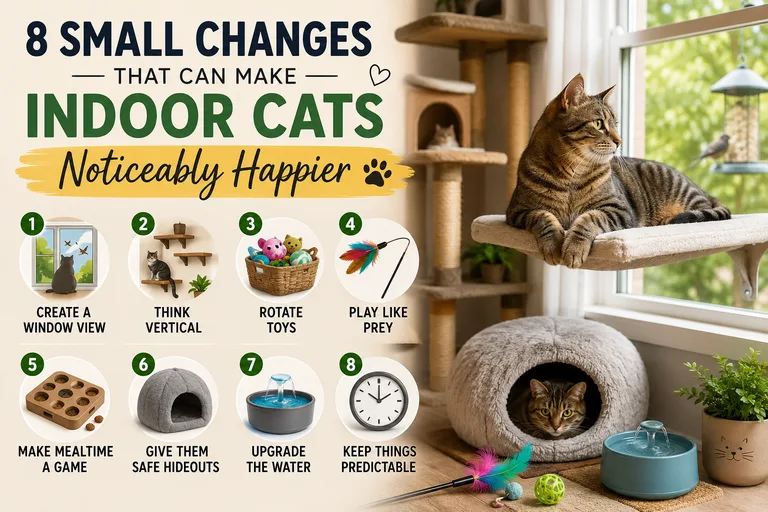
If your cat lives indoors, you’re already helping protect them from traffic, predators, disease, and countless other dangers. But safety alone isn’t enough. Cats are intelligent, curious hunters by nature, and even the most loving home can become boring if it doesn’t stimulate their minds and instincts. The good news is that you don’t need expensive gadgets or a complete home makeover. A few simple changes—many of them free—can transform your home into a more exciting, enriching environment and lead to a happier, healthier, and more active feline companion. Here are eight small improvements that can make a surprisingly big difference in your cat’s daily life.
Your cat indoors life—and for safety and longevity that’s often the best choice—these small changes can make a surprisingly big difference in their quality of life. Most cost little or nothing.


1. Create a Window View
Cats love watching birds, squirrels, insects, and people. A window perch or cat tree by a window can provide hours of entertainment. Even better, place a bird feeder outside the window if practical. (AAHA)
2. Think Vertical
Cats naturally feel safer when they can climb. Add:
- Cat trees
- Wall-mounted shelves
- Tall bookcases they can safely access
More vertical territory often means a more confident, relaxed cat. (Morningside Animal Hospital)
3. Rotate Toys
Instead of leaving every toy out all the time, keep most stored away and rotate them weekly. Old toys become “new” again, keeping your cat interested. (Psychology Today)
4. Play Like Prey
Spend just 10–15 minutes once or twice a day with a wand toy. Let your cat stalk, chase, pounce, and finally “catch” the toy. This satisfies their hunting instincts far better than simply tossing a ball. (San Antonio Express-News)
5. Make Mealtime a Game
Puzzle feeders, treat balls, or hiding small portions of food around the house encourage natural foraging behavior and reduce boredom. (Psychology Today)
6. Give Them Safe Hideouts
Every cat wants a private place where no one bothers them. A cardboard box, covered bed, or quiet corner under furniture can become their favorite retreat. (Bunko)
7. Upgrade the Water
Many cats drink more from a running fountain than from a bowl. Better hydration supports kidney and urinary health, which are common concerns as cats age. (AAHA)
8. Keep Things Predictable
Cats thrive on routine. Feeding, playtime, and quiet time at roughly the same time each day can noticeably reduce stress and anxiety. (Forbes)
Bonus Tips
- Keep litter boxes very clean.
- Place scratching posts near favorite sleeping areas.
- Brush your cat regularly if they enjoy it.
- Leave a paper bag or cardboard box out occasionally—they often love simple things more than expensive toys.
- If it’s safe in your area, consider a screened “catio” or supervised harness walks for extra enrichment. (The Guardian)
One interesting observation from many experienced cat owners is that the biggest improvements often come from environmental enrichment rather than expensive gadgets. Window perches, vertical climbing spaces, and consistent interactive play are repeatedly mentioned as the changes that make cats the happiest. (Reddit)
Best Cat Flea & Itching Care Video
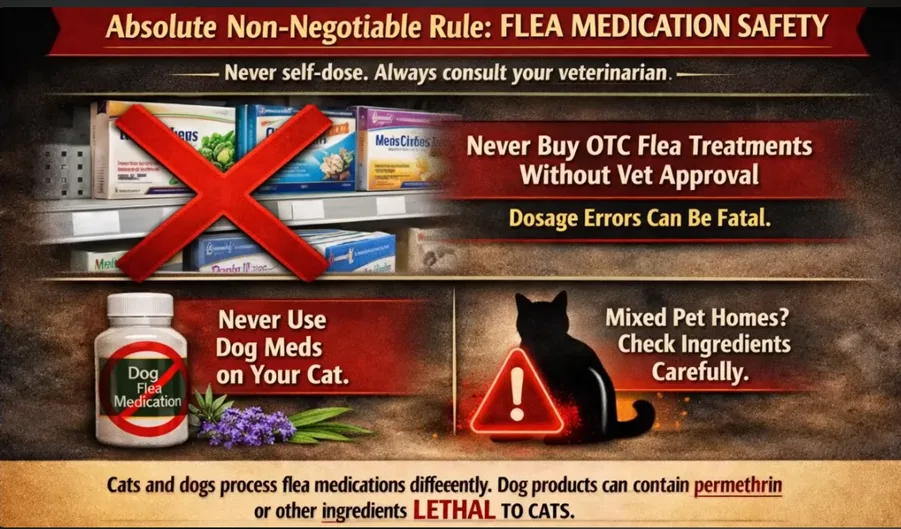
Control the High Ground: What Cats Know That Most CEOs Don't

One thing you learn from cats is this: control the high ground. See first, decide first, and move before you are forced to move. Survival isn’t about size—it’s about awareness. — YNOT
The older I get, the more I realize that cats understand something many business owners never do. They understand the value of the high ground.
A cat doesn’t climb to the top of a shelf because it’s lazy or because it wants attention. It climbs because elevation gives it information. It can see threats coming, spot opportunities, identify exits, and react before anyone else.
Sun Tzu understood this thousands of years ago.
He wrote extensively about terrain and position. The commander who occupies the high ground gains vision, time, and initiative. The one stuck in the valley is forced to react to events instead of shaping them.
Business works exactly the same way.
Owning the high ground in business doesn’t mean having the biggest office or the most employees. It means putting yourself in a position where you can see things that others cannot.
The high ground in business is:
- Knowing your financial numbers before everyone else.
- Understanding your customers better than your competitors do.
- Seeing changes in technology before they disrupt your industry.
- Building systems that give you information faster.
- Having cash reserves when everyone else is borrowing.
- Developing relationships before you need them.
- Learning new skills before the market demands them.
The business owner on the high ground sees the storm while it is still a cloud on the horizon. The business owner in the valley doesn’t know there is a storm until the rain starts pouring.
Most business failures don’t happen because people are stupid or lazy. They happen because people lose situational awareness. They stop looking out the window. They stop watching competitors. They stop talking to customers. They stop learning.
They surrender the high ground. In war, the side with better intelligence usually wins.
In business, the company with better information usually wins.
This is why great businesses invest in dashboards, reports, customer feedback, analytics, AI, and market research. They are not buying software.
They are buying elevation. They’re buying the ability to see farther.
They’re buying time. And time is often the difference between success and failure.
The funny thing is that a cat never gives up its perch voluntarily. It knows instinctively that once you surrender the high ground, you become reactive instead of proactive.
The same is true in life. If you wait until your sales decline to study your market, you’ve already lost altitude.
If you wait until AI changes your industry before learning it, you’ve already lost altitude.
If you wait until cash gets tight before understanding your finances, you’ve already lost altitude.
Get higher. Read more. Measure more. Observe more.
Build systems that let you see farther than everyone else.
Because the winner in business is rarely the strongest company or even the smartest company.
More often than not, it’s the company that saw what was coming while everyone else was still sitting comfortably in the valley.
The cat knows. Sun Tzu knew. The question is: do we?
Do You Know Your High Ground?
10 Questions Every Business Owner Should Ask
Sun Tzu taught that the commander who controls the high ground sees the battlefield more clearly than everyone else. In business, your “high ground” is the information, awareness, and positioning that allows you to make decisions before your competitors are forced to react.
Answer these questions honestly:
- If your revenue dropped by 20% tomorrow, would you know exactly where to cut costs within one hour?
- Can you name your five most profitable customers or products without looking it up?
- Do you know the three biggest threats that could disrupt your business in the next two years?
- Are you aware of what your top competitors are doing better than you right now?
- If your largest customer disappeared today, do you already know how you would replace that revenue?
- Can you see your key business metrics—sales, cash flow, leads, and expenses—in real time or within a few minutes?
- Do you know which new technologies, especially AI, could either destroy your business model or make you significantly stronger?
- If you had to step away from your business for a month, would your systems and people keep it running smoothly?
- Do you spend time every week studying your market, customers, competitors, and industry trends?
- Are you making decisions based on facts and intelligence, or mostly reacting to problems after they happen?
Scoring
9–10 Yes Answers:
You probably own the high ground. You can see farther than most and are positioned to act before others.
6–8 Yes Answers:
You have some elevation, but there are blind spots that could become dangerous.
3–5 Yes Answers:
You’re fighting from the valley. You may be reacting more than leading.
0–2 Yes Answers:
You’re walking through the battlefield in the fog. The next surprise could become an existential threat.
Final Thought
The high ground isn’t about having more money, more employees, or a bigger office.
The high ground is information.
The high ground is awareness.
The high ground is seeing what others don’t see until it’s too late.
A cat understands this instinctively.
Sun Tzu wrote about it.
The question is: So do you know your high ground?
WHY DO HUMANS WORK?

Two CATS Judge their HUMANS

Copyright
Copyright © [Year] [Author]. All rights reserved.
Generated from Everything CATS · YNOT Book Builder v0.9.6