
SMART REAL ESTATE
Table of Contents
- Dedication
- Foreword
- Preface
- Introduction
- Home Ownership vs Real Estate as an Investment
- When to Buy a House! 🎯
- How to Buy a Home and Avoid Costly Mistakes
- 10 Rules of Real Estate to Know
- The Good, the Bad, and Ugly of Renting Homes
- 5-Minute House Buying Checklist
- Build Your Team Before You Look
- Major things to look at before an offer
- The Fake Deal - Liers everywhere
- Real Estate Is IDEAL—But It Is Not Perfect
- The Housing Market Is Changing Fast
- Sole Proprietor, LLC or Corporation?
- Real Estate Is a Great Investment to Avoid Taxes
- RE Crashing means Opportunity is coming knocking
- A Market Correction or a Golden Opportunity?
- The Future for Most People Is Renting
- The Higher the Risk -the Higher the Reward
- Paying Less Than It’s Worth it is a Mindset
- The Nicest House is Lying to You
- Affordable Living
- Learn About Money Or Stay Broke Forever
- The Next Five Years
- What to Do to a Home Before You Rent It or Sell It
- Basics: Income vs. Net Worth:
- Use Partnerships to Make Real Wealth
- Think Like a Millionaire in 4 Simple Steps
Title Page
Smart Real Estate Investing
Buy the House Right
The Practical Guide to Residential Real Estate, Smart Buying, and Avoiding Expensive Mistakes
Knowledge Today. Wealth Tomorrow. Freedom Forever.
By
YNOT
Residential Real Estate • Home Buying • Rental Property • Wealth Building
Published by In Search of Your Passions
© [Year] [Author Name]. All rights reserved.
Copyright
Copyright © 2026- YNOT – Tony Lester. All Rights Reserved.
This book is for educational and informational purposes only and should not be considered financial, investment, legal, tax, or real estate advice; always consult qualified professionals before making any real estate or financial decision.
This book is made available in the hope that it will be read, shared, discussed, and enjoyed.
You are welcome to download this book, keep a copy for yourself, and share the original, unaltered PDF with friends, family, classrooms, libraries, veterans' organizations, or anyone else who might appreciate it. No permission is required for non-commercial sharing.
However, this work may not be altered, sold, republished, translated, incorporated into another publication, or used for commercial purposes without the author's written permission.
Motion picture, television, streaming, theatrical, audiobook, podcast dramatization, gaming, and all other adaptation rights are expressly reserved. If these stories inspire a film, television series, documentary, or other commercial production, I'd love to have that conversation first.
The characters, original stories, and creative expression contained in this work are protected by copyright, even where they are inspired by historical events or real-life experiences.
Stories are meant to be shared. Great stories deserve to be told well.
Dedication
To the millions of people who bought their homes wisely, held steady through the years, and proved that residential real estate can still be one of the great wealth-building tools for ordinary families.
To those who did it right.
Who bought with discipline.
Who lived within their means.
Who improved what they owned.
Who paid down debt.
Who survived the hard markets.
Who watched patience turn into equity.
This book is also dedicated to all the people who helped me along the way: the inspectors, realtors, appraisers, carpenters, handymen, mortgage brokers, and every professional who became part of my team. Real estate is often talked about as if one person does it alone, but the truth is, the right people can save you from bad decisions, teach you what to look for, and help turn a property into an opportunity.
And last, but certainly not least, this book is dedicated to my mom and dad.
My mom taught me to never give up and showed me the power of knowledge.
My dad taught me how to fix anything.
Between the two of them, I learned two lessons that apply to almost every part of life, and especially to real estate: keep learning, keep going, and when something is broken, figure out how to fix it.
You do not get rich by buying any house.
You build wealth by buying the right house, the right way.
Foreword
Real estate has a strange way of exposing people.
It exposes what they know.
It exposes what they do not know.
And most of all, it exposes whether they are thinking clearly or just reacting emotionally.
A house is never just a house. To one person, it is shelter. To another, it is status. To another, it is a retirement plan, a tax strategy, a rental machine, a mistake waiting to happen, or the best financial decision they will ever make. The danger is that too many people buy real estate without knowing which one they are actually buying.
They fall in love with the kitchen.
They ignore the roof.
They stretch the payment.
They trust the wrong person.
They confuse approval from a bank with affordability.
They assume the market only goes up.
They buy because everyone else is buying.
Then, years later, they wonder where the money went.
This book was written for people who want to think before they sign.
Residential real estate can build wealth. It can protect families. It can create income. It can reduce taxes. It can give a person leverage, stability, and opportunity. But only when it is approached with discipline. The money is not made when everything is easy and obvious. The money is made when you understand value before the crowd sees it. The money is protected when you know what can go wrong before it does.
That is why the title matters. This is not just a book about buying a house. It is about buying the house right.
A good real estate decision starts long before the closing table. It starts with understanding the difference between a home and an investment. It starts with knowing your numbers. It starts with asking what happens if interest rates rise, if rents fall, if repairs cost more than expected, if the neighborhood changes, or if you need to sell sooner than planned.
Most people are taught to ask, “Can I afford this?”
That is not enough.
A smarter buyer asks:
“Is this the right property?”
“Is this the right price?”
“Is this the right time?”
“Is this the right deal for my actual life?”
“And what happens if I am wrong?”
The goal of this book is not to scare you away from real estate. Quite the opposite. The goal is to give you enough practical knowledge so that you can move with confidence instead of hope.
You do not need to be a Wall Street analyst to buy property intelligently. You do not need to be a contractor, banker, attorney, appraiser, or landlord on day one. But you do need to understand the basic rules of the game. You need to recognize the traps. You need to know when a pretty house is lying to you. You need to know when a bad market is creating an opportunity. You need to know when paying less is not worth it, and when paying more is actually the smarter move.
Real estate rewards patience, preparation, and clear thinking. It punishes fantasy.
The pages ahead are written in plain language for real people: first-time buyers, future landlords, small investors, working families, and anyone who wants to use residential real estate as a tool instead of becoming a victim of it.
Use this book as a field guide. Read it before you buy. Revisit it before you make an offer. Keep it close when the market gets loud, when everyone has an opinion, and when emotion starts pretending to be wisdom.
Because in real estate, one good decision can change your life.
And one bad one can follow you for years.
Preface
I wrote this book because too many people are taught to buy real estate backwards.
They are taught to start with the dream.
The dream house.
The dream neighborhood.
The dream kitchen.
The dream backyard.
The dream of owning something that proves they finally made it.
But real estate does not care about dreams.
Real estate cares about numbers, timing, debt, maintenance, taxes, insurance, location, cash flow, interest rates, repairs, market cycles, and human behavior. Ignore those things, and the dream can become a very expensive lesson.
That does not mean real estate is bad. In fact, residential real estate is one of the most powerful wealth-building tools available to ordinary people. You do not need to be born rich to use it. You do not need to inherit a company. You do not need to understand every corner of finance. But you do need to learn how the game works before you put your name on a mortgage, hand over your down payment, or become responsible for a property that can either feed you or eat you alive.
The purpose of this book is simple: to help you buy smarter.
Not fancier.
Not bigger.
Not because someone told you that “renting is throwing money away.”
Not because your friends are buying.
Not because a bank approved you for more than you should actually spend.
Smarter.
This book is written for the person who wants to own a home without becoming house-poor. It is written for the person thinking about rental property but who does not yet understand what separates a good deal from a trap. It is written for the person who wants to build wealth slowly, carefully, and realistically. It is also written for the person who has already made a few mistakes and wants to stop repeating them.
I am not writing this as a theory book. This is not meant to impress professors, bankers, or real estate insiders. It is meant to be useful. The goal is to give you practical ways to think before you buy, before you borrow, before you make an offer, and before you convince yourself that a bad deal is somehow a good one.
Real estate can make you money.
But it can also make you broke with a smile on your face.
That is why you must learn to separate appearance from value. A beautiful house can be a terrible investment. An ugly house can be a great opportunity. A low price can still be too expensive. A high price can sometimes be justified. A hot market can be dangerous. A bad market can be a gift.
The difference is not luck.
The difference is judgment.
As you read this book, do not think of it as a collection of rules carved in stone. Think of it as a toolbox. Some chapters will help you avoid emotional decisions. Some will help you understand numbers. Some will help you think about taxes, debt, renting, buying, market crashes, affordability, and long-term wealth. Some may challenge things you have heard your whole life.
That is good.
A smart buyer should challenge every assumption.
The biggest lesson in this book is this: you make your money when you buy. Not when you sell. Not when the market magically goes up. Not when a realtor gives you a hopeful estimate. You make your money by buying the right property, at the right price, with the right structure, for the right reason.
Everything after that becomes easier.
This book will not make every decision for you. No book can. Every property is different. Every market is different. Every buyer has a different life, income, tolerance for risk, and long-term goal. But this book can help you ask better questions, avoid obvious traps, and look at real estate with clearer eyes.
And clear eyes are worth money.
So read carefully. Take notes. Argue with the ideas. Apply them to your own situation. Then, when the time comes to buy, do not buy because you are excited.
Buy because you understand.
That is how you buy real estate right.
Introduction
Most people do not really buy real estate.
They buy emotion.
They buy the feeling they get when they walk through the front door. They buy the kitchen with the nice counters. They buy the backyard where they imagine family parties. They buy the neighborhood because it feels safe. They buy the dream because the dream is easier to understand than the numbers.
Then the numbers show up later.
The mortgage shows up. The insurance shows up. The taxes show up. The repairs show up. The maintenance shows up. The tenant problems show up. The market correction shows up. The unexpected bill always shows up.
That is when people discover the truth: real estate is not just about ownership. It is about responsibility.
A house can be one of the best financial decisions you ever make. It can also be one of the worst. The difference is rarely the house itself. The difference is how you bought it, why you bought it, what you paid for it, how you financed it, and whether you understood what you were getting into before you signed your name.
This book is about learning to buy with your eyes open.
Residential real estate is powerful because it sits at the intersection of life and money. Everyone needs a place to live. That gives housing real value. But because housing is personal, people often make financial decisions with emotional logic. They justify bad numbers because they love the house. They overlook warning signs because they want the deal to work. They stretch their budget because the bank says they can. They assume appreciation will fix every mistake.
That is not investing.
That is hoping.
Hope is not a strategy, and it is definitely not a good way to buy property.
The goal of this book is to help you think like a buyer, an investor, and a realist at the same time. You do not need to remove emotion completely. A home should matter to you. It should fit your life. It should feel like a place you want to live. But emotion should not be driving the car. Emotion can sit in the passenger seat. The numbers need to hold the wheel.
There are two main ways people approach residential real estate.
The first is as a homeowner. In that case, the property is mainly a place to live. It may build wealth over time, but its first job is shelter, stability, and quality of life.
The second is as an investor. In that case, the property has a job to do. It must produce income, appreciate in value, reduce taxes, create leverage, or position you for a better financial future.
The mistake many people make is confusing the two.
They buy a personal home and call it an investment, even when it drains their income every month. Or they buy a rental property based on emotion, as if they are the one who has to love living there. They do not separate lifestyle from return. They do not separate price from value. They do not separate a good house from a good deal.
Those differences matter.
A beautiful house can be a bad investment. A plain house can be a great investment. A cheap house can be expensive. An expensive house can be worth it. A good market can still produce bad deals. A bad market can create life-changing opportunities.
That is why real estate requires judgment.
This book is not written for people looking for hype. It is not a promise that real estate will make you rich overnight. It is not telling you to buy any property at any price because “they are not making any more land.” That kind of advice is how people get trapped.
Real estate can build wealth, but only when you respect it.
You need to respect debt. You need to respect repairs. You need to respect market cycles. You need to respect cash flow. You need to respect taxes and insurance. You need to respect bad tenants, bad roofs, bad plumbing, bad timing, and bad assumptions.
The market does not care what you meant to do. It only cares what you actually did.
If you overpay, you overpay. If you borrow too much, you borrow too much. If the property does not cash flow, it does not cash flow. If you skip inspections, the problems do not disappear. If you buy without reserves, one repair can become a crisis.
This does not mean you should be afraid to buy. Fear is not the goal. Clarity is the goal.
A smart buyer is not afraid of problems. A smart buyer expects problems and prices them into the deal. A smart buyer knows that every property has flaws. The question is not whether a house is perfect. The question is whether the flaws are manageable, whether the price reflects them, and whether the deal still makes sense after reality is included.
That is the mindset this book is designed to build.
You will learn to look at residential real estate from several angles: as a home, as an investment, as a tax tool, as a rental, as a long-term wealth vehicle, and as a potential trap. You will learn why timing matters, but why waiting forever can also cost you. You will learn why the nicest house is not always the best house. You will learn why paying less is not always smart, and why paying more is not always foolish.
Most importantly, you will learn to ask better questions.
Before you buy a house, ask:
Can I truly afford this, or did the bank simply approve it? What happens if my income changes? What happens if insurance rises? What happens if repairs are needed immediately? What is the real monthly cost after taxes, insurance, utilities, maintenance, and reserves? Would this still be a good decision if prices did not go up for five years? Am I buying value, or am I buying emotion?
Before you buy an investment property, ask:
What is the actual cash flow? What are the realistic rents, not the fantasy rents? What will repairs cost? What is the vacancy risk? What kind of tenant will this property attract? What is my exit strategy? Am I making money when I buy, or am I depending on the future to rescue me?
Those questions are not complicated, but most people do not ask them early enough.
They ask them after the contract is signed. After the inspection period is over. After the tenant stops paying. After the air conditioner breaks. After the market changes.
This book is meant to move those questions to the front of the process.
The central idea is simple: you make your money when you buy.
That does not mean the profit appears instantly. It means the quality of the decision is mostly determined at the beginning. The purchase price, financing terms, property condition, location, rent potential, tax position, and margin of safety are all built into the deal before you ever own it.
A good buy gives you room to survive. A bad buy gives you no room for error.
And real estate always requires room for error.
No one predicts the future perfectly. Interest rates change. Neighborhoods change. Laws change. Insurance markets change. Construction costs change. Your own life changes. That is why the smartest buyers do not build their plans on perfect conditions. They build them on realistic assumptions.
This book will not tell you that every person should buy a house right now. It will not tell you that renting is always bad. It will not tell you that homeownership automatically creates wealth. Those are lazy ideas.
The truth is more useful.
Sometimes buying is smart. Sometimes renting is smart. Sometimes waiting is smart. Sometimes moving quickly is smart. Sometimes the best deal is the one you walk away from.
The purpose of this book is to help you know the difference.
Real estate is not magic. It is a tool. Like any tool, it can build something valuable or it can hurt you if you use it the wrong way. The more you understand the tool, the better your results will be.
So read this book with one goal in mind: not just to buy real estate, but to buy it intelligently.
Do not chase the market. Do not worship the dream. Do not trust easy advice. Do not confuse motion with progress. Do not let excitement replace analysis.
Buy with discipline. Buy with patience. Buy with numbers. Buy with a plan.
That is how real estate becomes more than a house.
That is how it becomes a foundation.
Home Ownership vs Real Estate as an Investment

Now, I ain’t saying real estate’s a bad idea, not at all, but don’t fall into the trap that all real estate is good either, some are a lot better than others. They hear “investment” and think they’ve struck gold, but more often than not, they’ve just bought themselves a money pit with pretty curtains. A house ain’t a treasure chest—it can be a leaky bucket, and if you are not careful, you’ll spend your life plugging holes with dollar bills. Now, don’t get me wrong, there’s money to be made in real estate, but it isn’t where most people think. Let’s clear up some of the nonsense and get to the truth of the matter.
The Reality of Homeownership
Many consider their home their greatest investment, but unfortunately, most don’t treat it as such. Homebuyers often choose a house they like, only to realize later that they overpaid and underestimated the costs of maintenance. A home typically costs more to maintain than it produces in value, making it less of an investment and more of a living expense.
Property taxes, insurance, and maintenance—such as replacing a roof every twenty years—can erode appreciation. While paying a mortgage might be preferable to renting due to tax advantages, these savings don’t translate into direct financial gains. Moreover, if you’re not paying significant taxes, the mortgage deduction provides little benefit.
The Wealth Gap in Homeownership
The rich own homes, often large ones, but they balance their wealth wisely. A wealthy individual with a net worth of $5 million might own a $1 million home, with the house making up just a fraction of their total assets. In contrast, a person with a $150,000 home and only $10,000 in net worth is putting a significant portion of their financial resources into their home. This often leads to a situation where they are working to afford their home, rather than having their money work for them elsewhere.
This isn’t to say you shouldn’t buy a home, but rather to acknowledge it as a cost rather than an investment. Some argue that homeownership has tax advantages, but those savings don’t necessarily put more money in your pocket—they simply shift spending from one place to another.
A Smarter Residential Investment Approach
A better approach, if circumstances allow, is to buy a duplex or a multi-unit property. This allows you to turn your home into a business, leveraging tax breaks, generating rental income, and benefiting from property appreciation. Such investments provide true tax advantages and positive cash flow. Personally, I haven’t done this due to resistance from partners, but as I approach retirement, and with property prices adjusting, it may be an idea worth revisiting. Notably, rental properties tend to hold their value better than single-family homes during market downturns, as their positive cash flow keeps them in demand.
The Highs and Lows of Commercial Real Estate
Commercial real estate offers the potential for high returns but also significant risks. Market cycles in commercial real estate are faster and more volatile, requiring deep financial reserves to weather downturns.
In my experience, I made substantial gains in residential real estate over a decade, allowing me to purchase a luxury waterfront home in Miami Beach. I also partnered in a commercial property investment, acquiring land for under $50,000 and constructing a building with an $800,000 loan. At one point, we had over $800,000 in equity. However, when the commercial real estate market crashed, we lost our tenant and couldn’t find a replacement for over a year. The $30,000 monthly carrying cost drained our savings, and ultimately, we had to return the building to the bank in lieu of foreclosure. The bank wasn’t thrilled either, as the property was worth only what we owed, and it took them five years to sell it.
Conversely, my waterfront home in Miami Beach proved to be a better investment, though I eventually sold it due to rising taxes and insurance costs. This experience reinforced a critical lesson: Location, Location, Location is key in real estate. Buy a property you will enjoy, but be cautious about considering it an investment.
The Costs and Considerations of Real Estate
Real estate comes with carrying costs—maintenance, taxes, insurance, and cleaning, among others. Investing in land can be a lower-cost alternative with long-term potential, as it requires minimal upkeep. Regardless of the type of investment, thorough research is essential. You make your money when you buy, not when you sell. The key is purchasing below market value.
For example, if you buy a $150,000 house for $75,000, invest $25,000 in renovations, and sell it, you’ve gained $50,000. However, if you buy it at market value and hold onto it, you may only break even or even lose money over time due to carrying costs.
Timing and Market Cycles
Real estate markets are cyclical, with periods of high demand and rising prices followed by downturns. Understanding market trends is crucial before making an investment.
Additionally, financing plays a significant role. Traditional bank loans are common, but alternative options like crowdfunding and Real Estate Investment Trusts (REITs) offer flexibility and potentially higher returns—though they also carry added risks and fees.
Understanding Local Markets and Ongoing Costs
A successful investment requires knowledge of the local market and careful evaluation of the property itself. Factors such as location, property condition, and rental income potential should be thoroughly assessed before making a purchase.
Moreover, real estate investments require ongoing maintenance and management. Factoring in these costs is crucial when calculating potential returns.
Conclusion
Real estate ain’t dead, but right now it may looks like a dead cat on the side of the road—one that might twitch a little before coming back to life. Now may be the time to buy. Markets go up, markets go down, but the principles stay the same: buy smart, don’t fall for illusions, and make your money when you buy, not when you sell.
Stick around, because this isn’t the last you’ll hear from me on real estate. There’s more to dig into, and as the dust settles, I’ll be back with more insight, more hard-earned lessons, and hopefully, fewer tales of lost fortunes. Until then, keep your eyes open and your pockets tight—real estate is a game of patience, not panic or hubris.
When to Buy a House! 🎯

So I was talking with lady friend in her 40s the other day—really sharp. She already owned a home, had no debt, was putting money into her 401k, and was asking all the right questions about retirement.
Then we got into the topic of college for the kids, and what life looks like after work. You know, the big questions. She asked, “Are we doing enough?”
And I said, “You’re doing great—but if you want to really lock in long-term wealth, just add this one move: Buy a fixer-upper every five years.”
She looked at me like I just handed her a secret playbook. But it’s not magic—it’s just strategy. You live in one, rent out another, and roll your equity forward smartly—using depreciation, tax deferment, and compound growth to your advantage. You make your money when you buy.
Ask any old paratrooper and they’ll tell you: “One to show, one to go.”
Same rule applies here: one home for you, and one that works for you. If you can snag a duplex and live in one side? Even better. That’s when it really starts to snowball.
Look—retirement doesn’t have to be this giant mystery. You don’t need to win the lottery or hope the stock market plays nice. You just need a plan and a little consistency.
Every time you buy and improve a property, you’re building more than just equity—you’re building freedom.
It’s not about flipping houses or chasing trends. It’s about owning smart, buying steady, and leveraging what the tax code already gives you.
This is the first part of a series where we’ll walk through exactly how to:
- Find the right properties
- Use your primary residence and investment home to your advantage
- Roll equity forward without paying taxes
- And build real wealth without burning out
So if you’re ready, let’s start with the first move:
Buy smart. Think long-term. Own two.
Live in one. Rent the other. And if it’s a duplex—well, now you’re playing chess while everyone else is still learning checkers.
When Is the Best Time to Buy a House?
The perfect time to buy a house isn’t about waiting for the market to crash or mortgage rates to drop. It’s when you’re financially ready—when you have enough for a down payment, understand your budget, and are prepared for the responsibilities of homeownership.
Trying to perfectly “time the market” can lead to analysis paralysis and missed opportunities. Housing prices, interest rates, and demand fluctuate constantly, making predictions unreliable. Instead, focus on your personal financial readiness and use smart buying strategies to get the best deal possible.
Ways to Get Better Deals on Real Estate
Once you’re financially prepared, use these proven tactics to improve your odds of scoring a great deal:
1. Buy During the Off-Season
- Real estate activity slows down in fall and winter, especially in colder climates.
- Sellers during this time are often more motivated and open to negotiation.
- There’s typically less competition from other buyers.
2. Look for Cosmetic Fixers in Good Neighborhoods
- Many buyers avoid homes that need simple updates like paint or flooring.
- These homes are often undervalued but easy and affordable to improve.
- Focus on homes with good bones, layout, and location.
- You make your money when you buy.
3. Target Motivated Sellers
- Look for keywords in listings like “price reduced,” “must sell,” “relocating,” or “estate sale.”
- These sellers may be in a hurry and more likely to accept a lower offer.
- You make your money when you buy.
4. Explore Foreclosures and Auctions
- Bank-owned properties and public auctions can offer below-market prices.
- They often require cash or quick financing and may need repairs.
- Always research liens, back taxes, and condition before bidding.
5. Work With a Local Real Estate Agent
- A well-connected agent can alert you to hidden gems, off-market properties, or homes about to be listed.
- They can also help craft competitive offers and spot overpriced listings.
6. Expand Your Search Area
- Consider neighborhoods just outside hot zones—these often offer similar amenities at lower prices.
- Watch for areas with signs of growth: new schools, restaurants, or transit upgrades.
7. Make Offers on Stale Listings
- Homes that have been on the market for 60 days or more may be overdue for a price cut.
- Sellers might be more open to offers well below asking price, especially if the home needs updates.
- You make your money when you buy.
8. Get Pre-Approved and Be Ready to Move
- Sellers prefer buyers who are financially ready.
- Pre-approval from a lender shows you’re serious, and being prepared helps you move fast when the right home appears.
- If you have the cash, or bank letter in hand, you can make real offers, not matter how low.
9. Look for Off-Market Opportunities
- Network with property owners, investors, and real estate wholesalers.
- Some of the best deals never make it onto public listing sites.
- You make your money when you buy.
10. Consider Owner Financing or Rent-to-Own
- These options are good for buyers with non-traditional finances or credit issues.
- They can also be a way to buy with less money upfront and more flexible terms.
Bottom Line
The right time to buy isn’t about market timing—it’s about your readiness and smart strategy. When you’re financially prepared and understand how to spot value, the odds of making a great purchase improve dramatically. You make your money when you buy.
🏡 Step-by-Step Home Buying Plan
STEP 1: Define Your Goals
Before looking at homes, ask yourself:
- What’s the purpose? (Primary residence, rental, vacation home?)
- Where do you want to live? (City, neighborhood, commute distance?)
- What features matter most? (Size, number of bedrooms, outdoor space, school district?)
💡 Tip: Write down your must-haves, nice-to-haves, and deal-breakers.
STEP 2: Assess Your Financial Readiness
- Check your credit score. Aim for 620+ for conventional loans (higher = better terms).
- Determine your budget. Use online calculators or meet with a lender.
- Save for a down payment. Most lenders require 3%–20% down.
- Prepare for closing costs. Typically 2%–5% of the home price.
- Build an emergency fund. Have 3–6 months of expenses saved for safety.
💡 Tip: Don’t max out your budget—leave room for repairs, taxes, insurance, and life.
STEP 3: Get Pre-Approved for a Mortgage
- Choose a lender and submit financial documents (pay stubs, tax returns, debts, assets).
- Get a pre-approval letter—this strengthens your offer when you find a home.
- Compare rates and terms from multiple lenders before committing.
💡 Tip: Pre-approval is different from pre-qualification—pre-approval is stronger.
STEP 4: Hire a Real Estate Agent (Optional but Recommended)
- Choose a buyer’s agent who knows your desired area well.
- They’ll help you find listings, schedule viewings, negotiate offers, and handle paperwork.
- Before you start looking at homes find an agent you would like to work with and who will, ultimately save you money.
💡 Tip: Now, just like the seller signs a contract with an agent Buyers need to find an agent before they can look at a home with a buyer’s agent. That buyer’s agent has to get a contract signed before they show you a house. It is a nationwide rule now that was agreed by the NAR (National Association of Realtors®) and the Federal Court. Buyer’s can now end up paying their own commission. So it is more important than ever to get a good real estate agent with strong negotiating skills. If you are paying some or all of the commission, perhaps you can lower then sale price by what is coming out of your pocket! All commissions are negotiable. However, if you find an agent who will accept 1% or 2%, they are perhaps not very good at negotiating. If the seller isn’t paying your buyer’s agent commission consider asking the seller to pay for an Interest buy down or pay for closing costs!
NOTE: I have bought and sold more than a dozen homes in my life, so I am experienced. I would not buy or sell a property without a Realtor. The reasons may not be what you think, I will talk about this in a future post. For NOW, make sure you get a good one, they are worth their cost.
STEP 5: Start House Hunting
- Browse listings online and visit open houses.
- Your agent can send you listings and set up private tours.
- Take notes and pictures to compare homes later.
💡 Tip: Visit homes at different times of day to get a feel for lighting, traffic, and noise.
STEP 6: Make an Offer
- Once you find the right home, your agent will help craft an offer based on:
- Recent comparable sales (“comps”)
- The home’s condition and days on market
- Seller motivation
- Include contingencies (e.g., inspection, appraisal, financing).
💡 Tip: Be ready to negotiate price, closing costs, and repairs.
STEP 7: Get a Home Inspection
- Hire a licensed inspector to check the home’s structure, roof, electrical, plumbing, HVAC, etc.
- Use the report to request repairs or a price reduction.
💡 Tip: Even if the home looks great, never skip this step.
STEP 8: Appraisal and Loan Finalization
- Your lender orders an appraisal to confirm the home’s value.
- If the appraisal is low, renegotiate or make up the difference.
- Submit any final paperwork to your lender and wait for final loan approval.
STEP 9: Close the Deal
- You’ll do a final walk-through to make sure the home is in agreed condition.
- At closing:
- Sign mortgage and title paperwork
- Pay your down payment and closing costs
- Get your keys!
💡 Tip: Bring a government-issued ID and double-check wire transfer details to avoid scams.
STEP 10: Move In and Protect Your Investment
- Set up utilities and change your address.
- Deep clean, paint, and make any small repairs.
- Consider home security and maintenance plans.
- Review homeowners insurance annually.
💡 Tip: Start a home maintenance checklist and calendar for routine upkeep.
✅ Summary Checklist:
- 🧭 Define Your Goals
- 💰 Get Financially Ready
- 🏦 Get Pre-Approved
- 🧑💼 Choose a Buyer’s Agent
- 🔍 House Hunt
- ✍️ Make an Offer
- 🛠️ Inspect the Home
- 📊 Appraisal & Loan Approval
- 🗝️ Close & Get the Keys
- 🏡 Move In & Maintain
ONE LAST COMMENT just in case you didn’t get it yet:
You make your money when you buy.
Other posts on REAL ESTATE
How to Buy a Home and Avoid Costly Mistakes

Buying a home is one of the biggest financial decisions you’ll ever make. It’s not just about finding the right house—it’s about making smart financial moves to ensure you don’t overpay, get trapped by rising costs, or fall victim to hidden expenses.
I’ve bought and sold over 20 homes in my life, and I’ve learned that most people focus too much on the wrong things—like the list price—when the real money is made (or lost) in the negotiation, financing, taxes, and insurance.
If you’re looking to buy a home the right way, here’s everything you need to know.
Step 1: Know the Neighborhood Before the House
Too many people fall in love with a house before they even know if they’ll love the neighborhood. Big mistake.
How to Evaluate a Neighborhood Like a Pro
✅ Visit at Different Times of Day
- Morning (5-7 AM): Check rush hour traffic, school bus routes, and early-morning activity.
- Midday (Noon-2 PM): See if the area is too quiet, too busy, or just right.
- Evening (6-9 PM): Look for noise levels, people outside, and how the neighborhood feels at night.
- Weekends: See if it’s a family-friendly environment or if there are wild parties every weekend.
✅ Talk to the Neighbors
- Ask “How do you like living here?” instead of “Is this a good neighborhood?”
- Find out about crime, noise, HOA problems, and local politics.
- If multiple people are selling in the same area, red flag—something might be wrong.
✅ Check Local Amenities
- Closest grocery stores, gas stations, and hospitals.
- Look at parks, gyms, coffee shops, and shopping centers.
- Test your commute at rush hour—Google Maps isn’t always accurate.
🚨 Pro Tip: If possible, talk directly to the seller when the agent isn’t around. You might learn things the realtor would never tell you.
Step 2: Build Your Homebuying Team
A smart homebuyer doesn’t do this alone—you need experts.
Your Essential Team Members
🔹 Home Inspector (Your Detective) – Finds hidden issues like bad plumbing, electrical problems, roof issues, and foundation cracks.
🔹 Insurance Agent (Your Gatekeeper) – Ensures the home is insurable at a reasonable price before you commit.
🔹 Mortgage Lender (Your Money Man) – Helps you get the best loan terms and ensures financing doesn’t fall apart last-minute.
🔹 Realtor (Your Negotiator) – Not just to show homes, but to negotiate the best price and terms.
🔹 Contractor & Decorator (Your Reality Check) – Before you buy, know how much renovations will cost.
🚨 Pro Tip: Never use the seller’s inspector. Get your own.
Step 3: Secure the Best Loan Terms
The loan terms are more important than the loan amount. If you can get a 3% fixed loan with no prepayment penalty, you’re in great shape.
What to Look for in a Mortgage
✔ Fixed interest rate – No adjustable-rate mortgage (ARM) traps.
✔ No prepayment penalty – So you can pay off early or refinance without fees.
✔ No excessive fees – Avoid FHA fees, unnecessary points, and overpriced closing costs.
✔ Assumable mortgage – A huge benefit if rates rise, allowing you to sell your home with a low-interest loan intact.
✅ Biggest Mortgage Mistake: Stretching your budget too thin. Always have at least 6 months of cash reserves after closing.
Step 4: Keep Property Taxes Low
Property taxes can double or triple over time, even if your mortgage stays the same.
How to Prevent a Tax Nightmare
✅ File Your Homestead Exemption Immediately
- This keeps your taxable value from rising too fast.
- If you forget, you’ll pay thousands more per year (I made this mistake once).
✅ Challenge Your Property Tax Assessment
- If your home’s assessed value jumps significantly, appeal it.
- Use comparable home values, needed repairs, and recent sales as evidence.
✅ Delay Permit Closures to Avoid Reassessments
- A little-known trick: Assessments happen when permits are closed, not when they’re opened.
- Keeping a permit open can delay a tax increase (though some areas are cracking down on this).
🚨 Pro Tip: Never over-improve your home if you want to keep property taxes low.
Step 5: Manage Homeowners Insurance Costs
In some areas, insurance costs more than the mortgage. You have to be proactive.
How to Get the Best Insurance Rate
✅ Shop Before Hurricane Season
- Insurance companies freeze new policies when a storm is approaching.
- If your policy expires during hurricane season, renew it early.
✅ Compare Quotes Every Year
- Never auto-renew—companies raise rates quietly.
- Sometimes switching companies as a new customer saves thousands.
✅ Increase Your Deductible
- If you have a $1,000 deductible, consider raising it to $5,000 or $10,000 to save on premiums.
✅ Get Discounts for Upgrades
- New roof = big insurance discount.
- Impact windows, hurricane doors, and security systems lower premiums.
🚨 Pro Tip: If you miss a payment and your insurance lapses, your mortgage company can force-place insurance at a crazy price. Never let this happen.
Step 6: Don’t Let Escrow Costs Sink You
Lenders control your escrow account, and they often overcharge to “cover future increases.”
How to Keep Escrow Costs Down
- Request an escrow analysis—you might be owed a refund.
- If allowed, pay taxes & insurance yourself instead of using escrow.
- Keep an eye on increases—if your escrow jumps, investigate why.
Step 7: Plan for the Future (The 50% Mortgage Rule)
- The goal isn’t to pay off your mortgage fast—it’s to keep a 50% loan-to-value ratio.
- Example:
- Buy a $300K house with a $250K loan.
- 5 years later, house is worth $500K, loan is still $250K → 50% mortgage-to-value ratio.
- If the market drops 10-15%, you’re still safe.
🚨 Biggest Mistake: Paying down a low-interest mortgage too fast instead of keeping cash for other investments.
Final Thought: Homeownership is a Strategy, Not Just a Purchase
Most people blindly focus on price and mortgage payments. Smart homeowners focus on:
✅ Neighborhood quality & resale potential
✅ Loan terms, not just loan size
✅ Long-term tax and insurance costs
✅ Maintaining financial flexibility
You make money when you buy smart, not when you sell. Follow these steps, and you’ll build real wealth through homeownership.
How to Negotiate the Purchase of a Home Like a Pro
Negotiating a home purchase isn’t just about offering less than the asking price—it’s about understanding the seller’s motivations, using the inspection strategically, and controlling the negotiation process to get the best deal. Here’s how to negotiate smartly and win.
1. Understand the Seller’s Motivation
- Why are they selling? Job relocation, divorce, financial hardship, estate sale?
- Have they had other offers fall through?
- Is the house sitting too long on the market?
- Does the seller need a fast closing or extra flexibility?
✅ Pro Tip: Your realtor can pry this information out of the seller’s agent. If the seller is desperate, you have leverage.
2. Start with a Strong, Fair Offer (Not a Lowball)
- Don’t make an insulting offer—sellers will tune you out.
- Offer a price slightly below market value to keep the negotiation open.
- Use comps from similar homes to justify your price.
🚨 Pro Move: If it’s a buyer’s market, ask for seller-paid closing costs or rate buydown incentives instead of just a lower price.
3. The Inspection is Your Best Negotiation Tool
- Never waive the inspection—this is where you make money.
- Use the report to negotiate a price drop or demand repairs.
- Even if the house looks perfect, the inspection will find issues you can leverage.
🚨 Pro Tip: Rather than asking for repairs, ask for a price reduction or escrow credit—this keeps control in your hands.
4. Create a “Take It or Leave It” Moment
- Once the seller mentally commits to the sale, they won’t want to start over.
- If they’re on the fence, stay firm on your final counteroffer.
- Many sellers will cave rather than risk losing the deal.
🚨 Pro Tip: Remind them that you’re a serious buyer and can close quickly if they accept your terms.
5. Use Psychology – Let Them Think They Won
- Let the seller “win” a small point (like keeping appliances) so they feel they got a deal.
- If they counter your offer, wait a day before responding to make them sweat.
- Always be ready to walk away—the best deals come when you have no emotional attachment.
6. Use Your Realtor to Negotiate the Offer for You
Your realtor is your best weapon in negotiation—not just for handling paperwork, but for getting inside information and pushing for a better deal.
- Realtors talk to each other—your agent can get a sense of how desperate the seller is.
- The seller’s agent wants to close the deal, so they may reveal what the seller is really willing to accept.
- Your agent can frame your offer strategically, making it seem like the best option without scaring off the seller.
✅ Pro Move: Give your realtor a price range and let them feel out the seller’s response before locking in a final number. Many times, a seller will counter lower than expected just because your agent presented the offer correctly.
🚨 Warning: Even though you know a lot about the market, avoid negotiating directly with the seller—let your realtor handle it so they can push for a better price while keeping emotions out of it.
✅ Final Thought: You make money when you buy, not when you sell. The key is negotiating not just price, but terms, repairs, and seller concessions to make the deal work in your favor.
10 Rules of Real Estate to Know

I’ve watched enough folks lose their shirt — and their Sunday dinner — to say this with some confidence: Real estate is a game where the sharp make money when they buy, and the dull get educated when they sell. The stories are always the same — someone bought a dream, ignored the plumbing, forgot to check the neighbors, and ended up living next to a howling dog and a meth lab. So I wrote down a few rules — not from a textbook, but from the good old School of Hard Knocks — to keep you from mistaking a money pit for a mansion. In real estate, as in life, the worst mistake you can make is believing the painted porch without checking what’s rotting underneath. Buy with your eyes open, your calculator loaded, and your common sense engaged. Because if there’s one thing the old-timers and the savvy investors agree on, it’s this:
You make your money when you buy.
And if that offends your instincts or your ego — well, maybe you’re just not ready to play the game. Because this ain’t Monopoly. This is real life. And the bank doesn’t give you $200 for passing Go — it charges you interest and sends you a bill for lawn care.
Rule #1: You make your money when you buy.
Profit isn’t just made when you sell — it’s locked in the day you close. A good deal upfront gives you equity, options, and peace of mind down the road. REMEMBER: You make your money when you buy – repeat it after every rule.
Rule #2: Your home is not an investment property.
It’s your primary residence. It’s where you live, raise your family, and build your life. It’ll cost you money, but that’s the price of not paying rent and building roots. Don’t confuse it with cash-flow property.
Rule #3: Location, Location, Location — Past, Present, and Future.
Where it’s been, where it is now, and where it’s going. A good location holds value and attracts growth. Think long-term: schools, jobs, transit, development plans. I typically spend days hanging around the neighborhood of a house I’m considering. I visit the grocery store, fast food joints, the nearest gas station, and talk to neighbors. Find out everything… BEFORE you BUY!
Rule #4: The 1% Rule.
Want a quick way to judge an investment property? Multiply the price by 1%. If the house is $300K, it should rent for around $3,000/month. Can it? If not, dig deeper — the math may not work. Walk away!
Rule #5: Cash Flow.
Figure out your costs — mortgage, taxes, insurance — then add a cushion for maintenance. Now figure out your rent and income. You want positive cash flow. If you can’t get it, why do you want the property?
Rule #6: Know your numbers before you buy.
I’m surprised how many times I ask someone who just bought or is buying a house and they don’t know their property tax, insurance cost, or even their mortgage numbers. If the numbers do not work….Run away.
Rule #7: Fix the problems first, then do cosmetics.
Don’t remodel the kitchen and then discover you have to tear it out to fix the plumbing. Make a budget of needed repairs before you buy. Use your inspectors not just to find problems but also to negotiate your price down. If the numbers and budget can’t work… What do you do? Walk away.
Rule #8: Know your buyer before you buy or remodel.
Figure out who might want to buy your house — the price range, the location, and their needs. That should guide your remodeling choices. Don’t put a $50,000 kitchen in a $300,000 home or a $10,000 one in a million-dollar home.
Rule #9: Interest rates don’t matter if you buy cheap enough.
If you buy a $300K home for $200K, do you really care if the interest is 10%?
Rule #10: Don’t buy someone else’s dog with fleas.
Always talk to the seller and find out why they’re selling. I like buying from older people moving out — they cared for their property and might give you a better deal if they like you. If someone is selling because they gave up on tenants or remodeling, there could be hidden issues. Maybe they’re a flipper who overpaid, or worse — maybe the house has skeletons in the basement. If they are running away from their house, you should too.
🔧 EXTRA CREDIT
Your price, my terms… Your terms, my price. If I’m negotiating with you and you want full price, I’ll negotiate on time, expenses, points, inspection terms — even ask you to carry the paper on part of the mortgage.
If you want quick terms for cash, I know something’s wrong with the seller or the property — and I’ll start 30% below asking. If not …. I WALK AWAY.
**You make your money when you buy.
Wimps need not apply **
The Good, the Bad, and Ugly of Renting Homes

Folks talk about real estate like it’s a goose that lays golden eggs. And maybe it is—if the goose don’t die, run off, or stop laying. Truth is, owning rental property ain’t the lazy man’s road to riches. It’s more like marrying into a family you don’t like, but you’re stuck fixing their roof anyway.
You’ll hear all kinds of tales from people who’ve “made a killing” in real estate—though they rarely mention the times it nearly killed them. So before you dive in headfirst with dreams of mailbox money and sipping lemonade on a porch you rent to someone else, let’s take a proper look at the whole picture: the good, the bad, and the downright ugly of owning and renting homes. Owning rentals can make you money, make you crazy, or make you broke, depending on how well you read the fine print of reality. Real estate is a bit like a mule: it’ll carry a load and get you far, but only if you feed it right and don’t ignore the kicking end. Investing in real estate can be one of the most rewarding financial decisions you’ll ever make—but only if you go into it with eyes wide open, a calculator in your hand, and a strong pair of boots. Because while the road to riches may run through real estate, it sure as thunder ain’t paved smooth. Still, for those with grit, sense, and a strong enough back—there’s gold in them there rentals Let’s break it down—the good, the bad, and the ugly of owning and renting homes.
The Good
1. Steady Income Potential
One of the biggest attractions of rental properties is the potential for consistent, recurring income. When everything is running smoothly, monthly rent payments can cover the mortgage and generate profit.
2. Property Appreciation
Over time, real estate generally increases in value. While the market may fluctuate, smart long-term investments in good locations can result in significant equity gains.
3. Tax Benefits
Owners can take advantage of tax deductions for mortgage interest, property taxes, repairs, maintenance, insurance, and even depreciation. These deductions can help lower taxable income and improve net returns.
4. Inflation Hedge
Real estate is often a strong hedge against inflation. As the cost of living increases, so can rental rates—while fixed-rate mortgage payments stay the same, increasing your cash flow over time.
5. Long-Term Wealth Building
Real estate isn’t just about short-term gains. Over the long run, it can be a powerful way to build wealth through equity, appreciation, and strategic refinancing or reinvestment.
The Bad
6. Vacancies and Turnovers
There will be months where your property sits empty. Every day without a tenant is lost income—plus, tenant turnover brings additional costs like cleaning, repairs, and marketing.
7. Unpredictable Maintenance Costs
Roofs leak, HVAC systems fail, and appliances break. Maintenance isn’t optional, and if you don’t budget for it, you’ll be caught off guard. Tip: A common rule is to set aside 2% of the property’s value annually for repairs. Don;t spend those deposit checks, you might need them later.
8. Tenant Troubles
Even after screening, tenants can miss payments, damage property, or cause headaches. Evictions are time-consuming, expensive, and emotionally draining.
9. Hands-On Management
Unless you hire a property manager (which reduces profit), you’ll be handling everything—rent collection, repairs, complaints, and emergencies. Owning a rental is often far from “passive.”
10. Leverage Can Backfire
Using borrowed money to buy property can boost returns—but also magnifies risk. If rents drop or expenses rise, high leverage can quickly turn an asset into a liability. Try to get your equity up and your debt down over time. The goal should be 50%
The Ugly
11. Unrealistic Expectations
The biggest mistake novice investors make is assuming that rent checks will come in every month, without fail, and that properties will always appreciate. This overly optimistic mindset leads to underestimating expenses and overestimating income.
12. Market Shifts
Property values and rental demand can change dramatically due to local economic shifts, zoning laws, or national downturns. An area that looks great today might not be profitable tomorrow.
13. Legal and Regulatory Nightmares
Landlord-tenant laws can vary dramatically by city or state, and failing to understand them can lead to fines or lawsuits. Rent control, eviction bans, and tenant protections add layers of complexity.
14. Liability and Insurance Risks
Without proper insurance, one incident—like a tenant injury or natural disaster—can be financially devastating. Umbrella policies and forming an LLC can help protect personal assets, but many landlords skip these steps.
15. Over-reliance on Tax Benefits
Yes, depreciation and write-offs are nice—but they can be wiped out with policy changes or recaptured upon sale. Never buy solely for the tax perks.
Final Thoughts: Know Before You Buy
Real estate can be a powerful wealth-building tool, but it’s not a game for the unprepared. Investors need to analyze numbers, plan for the worst, and manage actively (or pay someone who will). The key is balance—choosing properties with solid fundamentals, preparing for the bumps along the way, and thinking long-term. Owning and renting homes isn’t always glamorous. Sometimes it’s profitable, sometimes it’s painful, and occasionally it’s downright ugly. But for those who do their homework, stay disciplined, and manage wisely—it can also be one of the most rewarding paths to financial freedom.
EXTRA CREDIT
P.S. I was always buying houses that nobody wanted. Eventually realize that the best house to buy is the superflciously ugly house that can be cleaned, painted and fixed for minimum money. You want a house with good bones that can be fixed up with some make-up. You don’t want to have to rebuild the house. Anyway, we will talk about house selection on this next post in this series More on REALESTATE
5-Minute House Buying Checklist

This is the first in a series of guides designed to help you master the art of smart real estate decisions. NO I am not a Realtor and I am not trying to sell anything. I have bought more a few houses, and want you to avoid the pain of buying a bad one.
Most folks will spend more time picking out a new pair of shoes than they will sizing up the house they plan to spend the next thirty years paying for.
A house isn’t just walls and a roof — it’s likely the biggest financial decision a person will ever make, outside of marrying the wrong spouse. And just like with courtship, a little clear-eyed judgment at the start can save you a lifetime of regret.
Spend five honest minutes looking for the ugly truths — the cracks, the leaks, the silent killers — and you might just save yourself fifty thousand dollars, a busted roof, a crooked foundation, and a whole lot of heartache.
The house doesn’t care how excited you are. It either is solid, or it isn’t.
Your job is to know the difference before you fall in love. The trouble with buying a house is that hope blinds faster than sunlight.
You step onto a pretty porch, smell some fresh paint, and suddenly you forget to notice the roof sagging like a hammock. But hope won’t fix a cracked foundation. Dreams don’t pay for flooded basements.
Five minutes of sharp eyes and cold reason — that’s all it takes to separate the sweet-talking losers from the sturdy keepers. A good house will stand proud under a hard look. A bad one will wince and wither if you know what signs to spot.
So take your time, trust your senses, and remember:
A man doesn’t drown by falling in the water — he drowns by staying there.
Same goes for bad houses. Walk away early, and live better later.
🏡 5-Minute House Evaluation Checklist
✅ Before Visiting:
- Check FEMA website to see if house is in a flood zone.
- If yes, check flood insurance cost before visiting.
✅ While Driving to the House:
- Assess neighborhood vibe:
- Are neighbors’ homes well maintained?
- Garbage, clutter, or junk in yards?
- Bad odors like sewage smells?
- Excessive noise or nearby factories?
- Drive around the neighborhood, don’t just go straight to the house.
✅ When Arriving (Curbside View):
- Check curb appeal:
- Lawn maintained?
- Exterior paint fresh or faded?
- Cracks in driveway or walkway?
- Look for big trees (especially oaks):
- Are branches hanging over house (“widow makers”)?
- Check for wide-spreading roots on the ground.
- Check for potential tree root damage to sewer lines.
- Look at the roof from driveway:
- Sagging roof?
- Missing or curled shingles?
- Faded, cracked, or old-looking roof?
- Wavy or uneven appearance (could mean compromised structure)?
✅ Walk Around the Outside:
- Gutters:
- Proper slope?
- No water pooled around foundation?
- Grading:
- Ground slopes away from the house?
- No water funneling toward the foundation?
- Foundation:
- No horizontal or large cracks?
- No obvious settlement issues?
- Check for sinkhole activity in the area (lots of settlement issues = red flag).
- Walk around entire house twice (clockwise and counterclockwise).
- Check the windows:
- Frame type (wood, vinyl, aluminum)?
- Rot or deterioration?
- Are windows single pane or older inefficient ones?
- Any signs of water damage around frames?
- Consider cost of replacing with impact/hurricane windows if needed.
✅ Inside the House:
- Check front door:
- Opens and closes smoothly?
- Seals tight (no sunlight visible through gaps)?
- Door frame level and square?
- Odor test:
- Moldy, musty, cigarette smell?
- Excessive air fresheners or plugins hiding odors?
- Ceilings and corners:
- Any cracks or signs of past water leaks?
- Water stains, especially in closets?
- Floor inspection:
- Walk perimeter and center of each room.
- Listen/feel for squeaks, soft spots, unevenness.
- Electrical panel:
- Check brand (Federal Pacific, Zinsco, Sylvania = red flags).
- Check if breakers look mismatched or outdated.
- Outlets:
- Are there two-prong outlets (indicates older, ungrounded wiring)?
- Air Conditioner (AC):
- Look at outside condenser:
- Rust, corrosion, or visible damage?
- Check serial number to determine age (usually first 2 digits or 3rd/4th digit).
- Inspect indoor air handler:
- Signs of black spots (mold) or corrosion?
- Look at outside condenser:
- Water pressure:
- Turn on faucets in bathrooms and kitchen.
- Check under sinks for leaks or corrosion.
- Attic inspection (if accessible):
- Peek inside for:
- Cloth wiring?
- Open junction boxes?
- Signs of leaks or pests?
- Peek inside for:
✅ Bonus Tip:
- Prefer block construction over wood frame (especially in Florida).
- Block homes are more durable, resist termites, and better for storms.
- How to tell quickly:
- Flush windows = likely wood frame.
- Recessed windows = likely block construction.
- If wood frame:
- Plan to get a WDO (wood destroying organism) inspection (termite inspection).
🎯 Final Advice
Remember, you’re not just buying four walls and a roof — you’re buying a lifestyle, a risk level, and future costs.
Use this checklist to stay sharp, protect your emotions, and focus on the critical bones of the property: structure, roof, drainage, plumbing, electrical, HVAC.
A beautiful kitchen can’t fix a cracked foundation. A fancy bathroom won’t save you from a sagging roof.
Inspect first, fall in love later.
The more houses you walk through with a clear, disciplined eye, the faster you’ll spot hidden problems — and the better your decisions will be.
Every bad house teaches you how to find the good ones faster. Trust the process.
Buying a house is like dating to get married — you want to see all your options, spot the red flags early, and make a smart choice. Because once you say yes, you’ll be sleeping there for a long, long time.
Build Your Team Before You Look

Real estate may look like a one-man decision, but the smart buyer knows better. A good team sees what you miss, questions what you assume, and protects you from the deal that looks good until it becomes yours. — YNOT
[I AM STILL ADDING TO THIS POST]
Most people think buying real estate is a solo mission.
They picture themselves finding the house, making the offer, signing the papers, and walking away with the keys like they just won the game.
But real estate does not work like that.
A house is too big, too expensive, too complicated, and too full of hidden problems for one person to know everything. The smartest buyers are not the ones who pretend they know it all. The smartest buyers are the ones who build the right team before they buy.
Because in real estate, the wrong house can cost you thousands.
But the wrong advice can cost you even more.
Before you buy the home, you need people around you who can see what you cannot see.
You need a good realtor who understands the market, the neighborhood, the pricing, and the negotiation. Not just someone who wants a commission, but someone who is willing to tell you the truth, even if the truth means walking away from the deal.
You need an inspector who is not afraid to crawl, climb, test, check, question, and point out every ugly detail. A good inspector does not kill deals. A good inspector keeps you from buying a problem disguised as a dream.
You need an appraiser who understands value. Not emotion. Not hype. Not what the seller hopes the property is worth. Real value. Market value. Comparable value. Replacement value. The kind of value that protects you from overpaying.
You need a mortgage broker or lender who can explain the loan clearly. Someone who does not just tell you what you qualify for, but helps you understand what you can actually afford. There is a big difference between being approved and being financially safe.
You need a title agent who makes sure the ownership is clean, the paperwork is right, and the property can actually transfer without hidden title problems. A house can look perfect from the curb, but if the title is a mess, the deal can become a nightmare.
You need a real estate lawyer who can protect you from contracts you do not fully understand, bad clauses, legal traps, boundary issues, liens, disclosures, and situations where everyone else is rushing but you need someone thinking defensively.
You need an accountant who understands how the purchase affects your taxes, deductions, rental income, depreciation, capital gains, expenses, and long-term financial plan. Real estate is not just a property decision. It is a tax decision, a cash-flow decision, and a wealth-building decision.
You need carpenters, contractors, handymen, plumbers, electricians, roofers, and people who know how homes actually work. Because every house has two prices: the price you pay to buy it, and the price you pay to fix what you did not understand.
That second price is where people get hurt.
Real estate is often talked about as if one person does it alone. That is nonsense. Nobody builds wealth in real estate completely alone. Behind almost every smart purchase is a group of people who helped someone avoid mistakes, see the truth, estimate repairs, understand risk, and make a better decision.
Your team is not just there to help you buy.
Your team is there to protect you from buying wrong.
A good team can save you from the pretty house with the bad roof.
The cheap house with the expensive plumbing.
The investment property with fake cash flow.
The neighborhood that looks good today but is moving the wrong direction.
The mortgage payment that fits on paper but strangles your life.
The seller story that sounds nice but does not match the facts.
The contract clause that gives away your protection.
The title issue nobody noticed until it was almost too late.
The tax mistake that turns profit into pain.
The right people can slow you down when you are too excited. They can push you to look deeper when something feels off. They can give you numbers when all you have is emotion.
That matters.
Because buying real estate is not just about finding a house.
It is about finding the truth before the closing.
Once you close, the problems become yours. The roof is yours. The termites are yours. The bad wiring is yours. The old air conditioner is yours. The bad loan terms are yours. The taxes, insurance, repairs, maintenance, legal issues, and accounting consequences are yours.
That is why you do not build the team after you buy.
You build the team before.
Before the offer.
Before the inspection.
Before the loan.
Before the appraisal.
Before the title search.
Before the contract becomes a trap.
Before the closing table.
The amateur asks, “Do I like this house?”
The professional asks, “Who do I need to help me understand this house?”
That is the difference.
A good real estate team does not guarantee success, but it gives you something far more valuable than confidence. It gives you judgment. It gives you perspective. It gives you protection.
And sometimes, the most valuable thing your team will ever do is not help you buy a property.
It is help you walk away from one.
That is real wisdom.
Because you do not make money by buying every house.
You make money by buying the right house, the right way, with the right people around you.
Build your team before you buy the home.
Because the house may be the investment, but the team is what protects it.
Do It Like This
If you want people to take you seriously, you have to start by taking yourself seriously.
That does not mean pretending to be rich.
It does not mean renting a fancy office.
It does not mean acting like some big-shot investor when you are just getting started.
It means presenting yourself like someone who is serious, organized, and ready to do business.
Start simple.
Go to your local Office Depot, Staples, print shop, or whatever type of business supply store is near you, and make yourself a basic business card.
Nothing fancy.
Put your name on it.
Put a business name on it.
Put your phone number on it.
Put your email address on it.
That is enough.
You are not trying to impress anyone with gold letters, raised ink, or some luxury logo. You are trying to communicate one thing:
I am serious enough to be organized.
That matters more than people think.
It is also a good idea to create a separate email address for your real estate activity. Not your regular personal email. Not the email you use for shopping, family, bills, and everything else. Create one specifically for real estate.
That way, when messages come in, you know what they are connected to. Realtor emails, lender emails, inspector reports, title company documents, appraiser questions, insurance quotes, contractor estimates — they all go to one place.
Simple organization saves confusion.
Whether you start a corporation, LLC, or formal business entity is a different discussion. That depends on your goals, your state, your tax situation, your liability exposure, and the advice of your accountant or attorney.
That is not the point here.
The point is mindset.
I want you to take the process seriously, and I want other people to take you seriously too.
When I first wanted to buy a house, I was 19 years old. Everyone laughed at me. They looked at me like I was a kid playing grown-up. They did not believe I was serious. They did not believe I could do it. They judged me before they even heard the plan.
So I learned something important.
I learned to show up differently.
I learned to dress properly. I learned to wear a suit. I learned to carry a business card. I learned to speak like I was there to do business, because I was there to do business.
And you know what happened?
They only figured out my age after I had already signed the paperwork.
That was a lesson I never forgot.
People respond to signals. They respond to presentation. They respond to confidence. They respond to organization. They respond to the way you carry yourself before they ever know your full story.
Is that fair?
Maybe not.
Is it reality?
Absolutely.
So use reality.
Do not walk into the real estate world looking confused, casual, and unprepared. Walk in looking like someone who has a plan. You do not have to know everything yet. Nobody does. But you do have to look and act like someone who is willing to learn, follow through, and make decisions.
Once you have your basic business card, your separate email, and your professional attitude, start building your team.
Start talking to real estate agents. Not just one. Talk to several. You are not looking for the friendliest person. You are looking for someone competent, honest, experienced, and willing to tell you the truth.
Then talk to bankers and mortgage brokers. Find out what loan programs exist. Find out what you may qualify for. Find out what documents they need. Find out what kind of buyer you look like on paper.
Many times, a good mortgage broker can introduce you to useful contacts. They may know appraisers, inspectors, insurance agents, title companies, and other professionals who work around real estate every day.
Those connections can be valuable.
But be careful.
I would not typically use the realtor’s picks for everything.
That does not mean every realtor is dishonest. Many are excellent. But you must remember how the incentives work. The realtor usually wants the deal to close. That is how they get paid. So when they recommend an inspector, contractor, or other professional, you need to ask yourself one question:
Is this person here to protect me, or to help the deal move along?
Those are not always the same thing.
You want people on your team who are willing to slow the deal down if something is wrong. You want an inspector who is not afraid to find problems. You want an attorney who is not afraid to question contract language. You want a mortgage broker who explains the real payment, not just the approval number. You want an accountant who tells you the tax truth before you make assumptions.
You are building a team, not collecting names.
There is a difference.
A name is someone who hands you a card.
A team member is someone who helps you make a better decision.
So do it like this:
Create a simple business identity.
Use a separate email.
Get basic business cards.
Dress and speak like you are serious.
Start meeting realtors, bankers, and mortgage brokers.
Ask for referrals, but verify everyone yourself.
Build your own list of inspectors, appraisers, lawyers, title agents, accountants, contractors, carpenters, and handymen.
Do not depend on one person’s network.
Do not let anyone rush you.
Do not confuse friendliness with competence.
This is not about pretending to be bigger than you are.
It is about becoming the kind of person who can handle real estate properly.
Because buying property is serious business.
So act like it.
Major things to look at before an offer

Second Impressions are important both to check for problems and for you to help set a price. The more it smells the lower the price, but sometimes you don’t want a smelly house.
Here’s a a practical checklist based on years of buying homes. Cosmetic upgrades are often used to cover up serious problems, especially in flipped homes. The goal is to recognize red flags and inspect deeper than the surface.
Home flippers and some sellers often use superficial cosmetic upgrades to hide significant issues. These changes can fool buyers at first glance, but a sharp eye can uncover what lies beneath the surface. This checklist reveals the most common tricks, how to spot them, and what to do next. I will keep more to it as I go, this is still first draft of this.
These are some of things I check. I do it naturally I don’t carry a check list, per se. I walk around an make note. I them add up how much it is going to cost to fix this. And I do the math Selling Price plus repairs. If I am still interested in buying the house, I will make an offer. If accepted I will a professional inspector go through find even more problems. I then renegotiate the price again. But the is the subject of my next post…. How to negotiate the buying price of a house.
✅ Home Inspection Red Flags Checklist
1. Fresh Paint Everywhere
- Red Flag: Used to cover stains, water damage, or smoke.
- What to Check: Look inside closets, garages, and behind shelves for hidden stains. Search for cans of Kilz or stain-blocking primer. Sometimes they leave them in closets, or kitchen and bathroom cabinets
- Pro Tip: Moisture meter can confirm past water intrusion.
2. New Flooring Over Old
- Red Flag: Especially carpet or vinyl in older homes.
- What to Check: Walk the entire area for soft spots, uneven floors, or dips.
- Pro Tip: Carpet can hide warped subfloors, termite damage, or moisture. New Carpet is a sign of issues that are cheaply covered.
3. Overuse of Caulk or Patching
- Red Flag: Excessive patchwork and fresh caulk, especially on walls or corners.
- What to Check: Press into caulked areas—if it’s tacky, it’s new. Ask what caused the original crack.
- Pro Tip: Cracks can signal foundation issues.
4. Lots of Air Fresheners
- Red Flag: Used to mask odors—pet urine, smoke, or mildew.
- What to Check: Sniff around. Remove fresheners and wait a few minutes.
- Pro Tip: Odors may return post-closing when HVAC is off or plugs are removed.
5. Staging Furniture in Key Areas
- Red Flag: Large furniture covering walls, floors, or ceilings.
- What to Check: Peek behind mirrors, pictures, couches, and rugs.
- Pro Tip: Inspect what the furniture may be hiding—like a crack or mold patch.
6. Cheap New Kitchen Cabinets
- Red Flag: Low-quality, hastily installed cabinets.
- What to Check: Look underneath for plumbing or electrical shortcuts.
- Pro Tip: Bad cabinets can hide worse infrastructure.
7. Fresh Landscaping or Thick Mulch
- Red Flag: Used to hide foundation issues, tree root damage, or termite evidence.
- What to Check: Look for freshly cut stumps, buried roots, or low grading near the foundation.
- Pro Tip: Remove mulch near the foundation and check for cracks or rot.
8. Sloppy Exterior Paint Jobs
- Red Flag: Chalking, filler over rot, or inappropriate materials used outdoors.
- What to Check: Probe wood fascia and trim with a screwdriver for softness or rot.
- Pro Tip: Rotten wood hidden by paint may cost thousands to replace.
9. New Electrical Outlets & Covers
- Red Flag: May be a disguise for old, ungrounded wiring.
- What to Check: Have an inspector test if outlets are truly grounded.
- Pro Tip: 3-prong outlets don’t guarantee safe wiring—verify with a circuit tester.
10. Attic Has Fresh Blown-In Insulation
- Red Flag: Often hides mouse droppings, bad wiring, or roof issues.
- What to Check: Move some insulation and inspect what’s underneath.
- Pro Tip: Look for junction boxes, cloth wiring, or signs of pest infestation.
11. New Sewer Line Cleanout Cap
- Red Flag: Suggests recent sewer work, often partial fixes.
- What to Check: Ask for repair records. Consider a sewer scope.
- Find out where sewage line is, and check for tree around it.
- Pro Tip: Tree roots, especially from removed trees, can crack pipes under the house.
12. Historical Google/Bing Map Inconsistencies
- Red Flag: Major landscape changes like missing trees or added structures.
- What to Check: Compare current condition to older satellite images especially roof.
- Pro Tip: Removed trees near foundations often spell plumbing or structural trouble.
13. ROOF – How Problems Are Hidden
- Spray Painting or Cleaning Shingles: Makes old shingles look new but doesn’t fix underlying wear or rot Shingles have a life span both real and perceive. For example, I bought a house with 12 years singles that are in great shape, I had several insurance companies not want to insurance house because of it. So I will probably have to replace roof way before the rood is actually failing.
- Multiple layers of shingles. Each layer is a new nail on roof, I have seen roofs with 3 layers. Really all things considered if you see multiple layers of singles on a roof I would seriously thinking there is something wrong. Perhaps roof was redone by homeowner without a permit.
- Replacing Only Visible Shingles: Patchwork repairs on the front side only, leaving the back or less visible slopes deteriorated.
- Hidden Flashing Issues: Replacing shingles without repairing or resealing flashing around chimneys or vents.
- Covering Rotting Fascia with Paint: Rotten wood at roof edges painted over or covered with vinyl trim.
- Walk around inside the house and look at the ceilings. If some ceiling have popcorn and others don’t or if the ceiling drywall has bumps or stains, then there was leak. Make sure it was repaired probebly . But heck you found it, inspector will probably see it too.
- Permits – If you redid your roof without a registered permit, your insurance company will not give you credit for it. I used to do my own roofs, can’t do it any more if I want insurance. It may also be a problem when you sell the house.
- If you are concerned, pay someone that inspects roofing, not a roofer, to check out your roof, and when you at it, check your attic ventilation. Without proper ventilation you may be get excess moisture and heat in attic that will cause your house to rot.
What to do: Inspect roof edges, look for mismatched shingles, and always check the attic for signs of leaks. Roofing is expensive so a bad roof could be deal breaker. I want at least 5 years from a roof of a house that I buy,
14. PLUMBING – How Problems Are Hidden
- Drywall Repairs or Paint to Hide Water Stains: Patches around ceilings or baseboards could hide prior leaks.
- New Fixtures on Old Pipes: Shiny new faucets on rusted or outdated plumbing systems. Go to home depot, and if you see your faucets there on the cheap aisle then you know what they did. They replaced and old faucet with a cheap one from HD.
- Bleaching/Masking Musty Smells: Mildew smell from old leaks may be temporarily masked with air fresheners.
- Fresh Caulk Around Tubs/Sinks: Often used to hide cracked grout, leaking seals, or rotted wood underneath.
- If your shower or tub are on second story which floor structure area is probably made of wood, make sure there are no issues. Otherwise you might have a tub fall down one day.
- Depending on age of house and type of construction, you have to check for leaks in the slab.
What to do: Look under sinks, around baseboards, and behind access panels. Ask about pipe material and age. Figure there will be some minor issues $500
15. ELECTRICAL – How Problems Are Hidden
- You need to know the manufacture of the main panel, the year, the total capacity and breakers install. If houses electrical panel has not been replaced in the last 20 years, you will probably have to replace it. Why because insurance company will want it, the inspector will flag it, and you will need a permit. Then the building department will want the rest of the system brought up to code. If you have aluminum wires coming into house they may to be replaced. You panel on outside will probably have to be replaced and the one inside will probably have to be replaced. This whole thing will cost you from $1500 to $5000. But I will show later how to do at no cost to you.
- Painted-Over Electrical Panels: May suggest lack of recent service or attempts to hide label dates and modifications.
- New Outlets with Old Wiring: 3-prong outlets added to ungrounded systems just for appearance.
- Loose or Decorative Fixtures: Hanging fixtures with no secure mount or wire nuts hidden behind drywall.
- Overstuffed Junction Boxes: Not visible unless inspected, but a common flipper shortcut.
What to do: Test outlets for grounding, inspect the meter and breaker panel, and ask for permits for electrical upgrades. You can also check county website for permit info.
16. HVAC – How Problems Are Hidden
- Cosmetic Cleaning of Vents and Filters: Makes it look like the system is maintained, even if it’s decades old.
- Painted or Polished Outdoor Condensers: A fresh coat of paint doesn’t equal functionality.
- Disguising Short-Cycling: Flippers might only run the system briefly, hiding signs of frequent cycling or poor performance.
- Disabling System During Showings: To mask noise, smell, or erratic performance.
- If system has a heater, test both the cooling and heating.
What to do: Check the age of the unit, thermostat function, airflow consistency, and inspect ductwork for mold or debris. I kind of write off unit right-away anyway, figure you are going to have to spend $2-3k, if not you are lucky
17. Exterior Walls – Are They Really Concrete or Stucco?
- Stucco Over Wood Frame: Makes it look like solid block construction, but can hide termite damage or rot.
- Surface Sealing to Hide Cracks: Cracks patched and painted over without addressing movement or structural issues.
- Faux Stone or Brick Veneer: Used to disguise cracks or flawed framing behind.
- Masonry Coating Used on Wood: Creates a false illusion of concrete or durability.
- Believe or Not: I know three people that bought stucco covered homes in South Florida and did not know they where buy wood framed homes. The houses had been remodeled, they look great, and only realized after they had get some work done. The house had some CBS and was listed as CBS, perhaps even the Real estate agent did not know.
- One easy way to tell is look around windows. Block homes the windows are indented more. Typically wood frame the house is on the outside of wall.
What to do: Tap walls to differentiate block vs. frame, check property records or blueprints, and look for stucco bulging or separation.
Here are things to check regarding seawalls (or the lack of them) when buying waterfront property — especially in coastal or canal-front areas like Florida, where seawalls play a critical role in protecting your home from erosion, flooding, and structural instability.
18. SEAWALLS (or the Lack of Them)
✅ If a Seawall Exists:
- Visible Cracks or Leaning
- Look for horizontal or stair-step cracks, or if the wall is bowing or leaning — signs of age or soil pressure.
- Erosion Behind the Wall (Washout)
- Check if soil behind the seawall is sinking or soft — this indicates water is breaching the wall.
- Rust Stains from Tie-Backs or Rods
- May indicate steel components are corroding, weakening the structural integrity.
- Deteriorated Cap or Missing Coping
- The top portion (cap) of the seawall should be solid and sealed. Crumbling or broken caps let water in.
- Barnacle Build-Up or Gaps at the Base
- Excessive marine growth or gaps where water meets wall could mean the wall is being undermined.
- Water Seeping Through the Wall
- During high tide or storms, any water seepage is a red flag that the wall has compromised joints.
⚠️ If No Seawall Exists:
- Shoreline Erosion
- Is the land receding? Are trees leaning toward the water? This could spell future loss of land or even the structure.
- Storm Surge Vulnerability
- Without a seawall, the property may be highly exposed to storm surge or king tides — especially in hurricane-prone zones.
- Vegetation Near the Edge
- Is vegetation used to “stabilize” the edge? Roots may slow erosion, but they don’t replace a seawall. Are they like Mangroves that are protected?
- Insurance Implications
- Some insurers may charge more or refuse coverage without proper shoreline reinforcement.
- Local Code Requirements
- In many coastal areas, seawalls are required or heavily regulated. You may be responsible for installing one if none exists. In many cases they may require you to increase the height of the seawall at even greater expense.
- Neighboring Seawalls
- If neighboring lots have seawalls, their water deflection could accelerate erosion on your lot.
- Ask for permits or engineering reports if a seawall was recently installed or repaired. Unpermitted or DIY work may not hold up — and you’ll be stuck with the bill when it fails. Truth is… repairs are just cosmetic most of the time.
🛠 BONUS TIP:
I had a Marine Construction company for many years and could write a book on this subject alone. Typical costs for seawall replacement is $1000 a liner foot. yes 1k per foot. So a 100foot wall removal of old one, permits, mitigation and replacement, all things considered about $100k.They typically last 20-25 years. After that your mileage may vary.
So if your are looking at $600k house, and the seawall is heeling, and it is going. It needs to be replaced. If it breaks, perhaps after a storm, not only is it going to be more expensive, you might also get fined.
I also had a customer who bought a beautiful piece of waterfront land, and he made the mistake of cutting down some mangroves, luckily he did not go to jail. But he was fined and never allowed to build on the land.
I bought a house without a seawall, but it had major issues. I had holes in backyard. But I knew the business. I restored edge of canal, planted coconut trees to help anchor everything and fill in problem areas. I bought the house below market because of this. I knew this was something I could repair myself without permits. Waterfront house are great but it is just another thing to worry about.
🧠 Final Tip:
“Trust but verify.” Everything might look pretty on the surface, but a good home inspector sees through the makeup. When tens of thousands are on the line, knowing what to look for can save you a fortune. BTW, you should always have a home inspector that works for you no matter how good you are at finding issues.
The Fake Deal - Liers everywhere

Everybody lies. -- Dr. House -- TV Show "HOUSE"
When I was young and a little too eager for my own good, I’d wander into open houses like a stray dog looking for a new home. I’d find a place I liked, talk to the real estate agent, and—like clockwork—they’d hit me with the line: “We’ve already got a full-price offer,” or “Someone’s coming in this afternoon with a cash bid, so if you’re serious, you’d better come in strong.” And like a fool with a checkbook and a dream, I believed them.
I didn’t know then what I know now—that most of the time, they were more than bluffing, they were making it up, lying. Not all of them, mind you. I’m not painting every agent with the same brush. Just a few, here and there, playing poker with a deck full of Jokers. And the kicker? It’s not even illegal. Just business. Just “strategy.”
And you know what? That kind of bluffing isn’t just for selling houses. It’s everywhere—on the sales floor, in the boardroom, international tariff negotiations or at your cousin’s used car lot behind the Waffle House. Folks smile, shake hands, and lie right through their teeth because, well, that’s the game. Wall Street could not exist without people basically lying about future earnings.
That’s the lesson: when you’re negotiating, remember the other fella across the table might be charming, might be offering you coffee, but he’s not your buddy—he’s your competitor. And if he can get you to spend more or sell for less with a well-timed fib, he’ll sleep just fine that night.
Now, I won’t talk about Trump—except to say the man didn’t just “write” The Art of the Deal; he seems to be drafting a sequel called The Art of the Fake Deal. And whatever you think of him, you’ve got to admit—it’s selling.
As for me, I’ve always been a little too honest, and that probably cost me a few dollars. But it earned me something better: trust. Especially from investors. Could I have made more money by bending the truth? Probably. But I sleep just fine knowing I never had to keep track of which lies I told last week because I can’t remember anyway.
“Everybody lies. Sellers lie. Buyers lie. Pictures lie. Numbers lie when people want them to. That is why you build a team before you do the deal.” — YNOT
What Is a Fake Deal?
A fake deal isn’t necessarily illegal—it’s just not what it seems. It might be:
- A memorandum of understanding (MOU) that’s all fluff, no funding.
- A strategic partnership announced with great fanfare that quietly dissolves without a trace.
- A non-binding letter of intent signed to boost a stock price, impress a board, or distract from a scandal.
It’s the business equivalent of saying “we’re talking about getting married” to pump your dating profile.
Why Fake Deals Happen
- Stock Market Theater – Public companies love the optics of momentum. A splashy deal announcement can send shares soaring—even if the deal never closes.
- Negotiation Leverage – Pretending you’ve got a better offer in hand can move the needle with a real partner.
- Distraction & Deflection – When you can’t show results, show potential. It’s the corporate magician’s misdirection: “Look over here!”
- Ego & Image Management – Executives love being seen as dealmakers. A fake deal can buy temporary prestige.
How to Spot a Fake Deal
- Buzzwords over details: “synergy,” “disruption,” “strategic alignment”—but no clear plan or numbers.
- No money down: If nobody’s putting up real cash, it’s probably vapor.
- Pattern of announcements with no follow-up: Some companies survive off press releases alone.
- Unnamed partners or deals “subject to regulatory approval” that never comes.
Famous Examples (Allegedly)
- WeWork’s early IPO hype was built on wild valuations, questionable partnerships, and grandiose projections.
- SPAC-mania (2020–2021) saw countless companies announce “mergers” with private firms, most of which collapsed or never delivered.
- Elon Musk’s “funding secured” tweet—a masterclass in how a sentence can move billions (and cause a $40 million SEC fine).
The Real Damage
Fake deals are not victimless:
- They waste investor and employee trust.
- They distort markets.
- They create bubbles.
- They erode real business values like integrity, transparency, and accountability.
The Real Lesson
In a world of fakes, your real deal will shine—but only if you resist the urge to inflate, exaggerate, and embellish. Long-term trust beats short-term buzz. If you want to play the game, fine—but don’t sell the scoreboard.
Lying is lying. I always say—if you’re going to lie, at least have the decency to be honest with yourself about it. The real danger isn’t in fooling others—it’s when you start believing your own nonsense. That’s when the line between ambition and delusion gets real blurry. Elon Musk, cough cough.
In the end, the world doesn’t need more deals—it needs more truth. But truth doesn’t always close fast, and it rarely comes with a signing bonus. The fake deal, on the other hand, is fast, flashy, and flattering. It’s the carnival barker of capitalism, promising a miracle for the price of your good sense.
So the next time someone says, “You’d better act fast, there’s a lot of interest,” smile politely, check your wallet, and ask yourself one thing: Is this a deal… or just a very expensive illusion wrapped in urgency?
And remember—if someone’s selling the Brooklyn Bridge or a stock with a very high PE, sometimes it is better to walkway. As J.P. Morgan once said, “I’d rather lose an opportunity than lose capital.” And I’d add: especially when the opportunity was dressed up in glitter, smoke, and a fake signatures.
Real Estate Is IDEAL—But It Is Not Perfect

Real estate is not perfect—it is IDEAL only when income survives the expenses, equity survives the market, appreciation beats inflation, and leverage works for you instead of against you. -- YNOT!
Many people describe real estate as the perfect investment. It is not.
Real estate can produce wealth, cash flow, tax advantages, and long-term financial security. It can also consume cash, conceal problems, trap equity, and magnify losses.
Real estate is not perfect—but under the right circumstances, it can be IDEAL.
IDEAL is an acronym that has circulated among real estate investors for years:
- I — Income
- D — Depreciation
- E — Equity
- A — Appreciation
- L — Leverage
Each one represents a potential advantage of owning real estate. The important word is potential. None of these benefits is automatic, and every one of them comes with limitations.
I — Income
Income is probably the most misunderstood part of real estate investing.
People look at the monthly rent and call it income. But rent is not profit. Rent is gross revenue.
Before you have real income, you must subtract:
- Mortgage interest
- Property taxes
- Insurance
- Repairs
- Maintenance
- Property management
- Utilities paid by the owner
- Vacancy
- Legal and accounting expenses
- Capital expenditures
- Unexpected disasters
A property collecting $4,000 a month is not necessarily producing $4,000—or even $1,000—a month in spendable income.
Real estate is actually very good at hiding income.
That can be frustrating when you need cash, but it can also be beneficial at tax time. A property may generate positive cash flow while reporting considerably less taxable income after deductible operating expenses and depreciation are considered.
This is one of the unusual characteristics of real estate: cash flow and taxable income are not always the same thing.
The same general principle can affect investors in real estate investment trusts, or REITs. REIT distributions may be classified as ordinary income, capital gains, or return of capital, each with different tax treatment.
Income is therefore not simply the rent check that arrives every month. It is what remains after the property has paid its bills, maintained itself, survived vacancies, and prepared for future expenses.
D — Depreciation
Depreciation is one of the most powerful—and most confusing—advantages of real estate.
For tax purposes, the government recognizes that buildings and their components wear out over time. Roofs fail. Air-conditioning systems break. Plumbing deteriorates. Kitchens become outdated. A 20-year-old building usually has more physical deterioration than a five-year-old building.
Depreciation allows an investor to deduct a portion of the building’s cost over time, even when the total market value of the property may be increasing.
Under current federal tax rules, residential rental buildings are generally depreciated over 27.5 years, while most nonresidential real property is depreciated over 39 years. Land itself is not depreciated.
That creates an apparent contradiction.
According to the accounting records, the building is losing value every year.
According to the market, inflation, land scarcity, construction costs, population growth, and neighborhood demand may be pushing the property’s total value higher.
Both can be true at the same time.
Depreciation is sometimes called an accounting trick, but it is not a trick in the dishonest sense. It is a legally recognized, noncash expense reflecting the fact that physical buildings deteriorate.
However, depreciation is not necessarily free money forever.
When you sell a depreciated property for a gain, part of that gain may be attributable to depreciation previously claimed. That portion can be subject to depreciation-recapture rules, including a federal tax rate of up to 25% for certain unrecaptured Section 1250 gains.
This is one reason commercial property owners sometimes hesitate to sell. A property may be producing income, carrying favorable financing, and sheltering part of its cash flow from current taxation. Selling it may trigger capital-gains taxes, depreciation-related taxes, transaction costs, and the loss of an attractive mortgage.
Sometimes selling makes sense.
Sometimes it makes more sense to keep collecting rent.
Either way, eventually the taxes must be considered. Depreciation usually postpones taxation; it does not necessarily eliminate it.
E — Equity
Equity is the difference between what the property is worth and what you owe against it.
If your property is worth $500,000 and your mortgage balance is $300,000, you appear to have $200,000 in equity.
But be careful.
Equity is not the same as cash in a bank account.
Your estimated equity depends on several things:
- The price a buyer will actually pay
- The condition of the property
- The strength of the market
- The time available to sell
- Brokerage commissions and closing costs
- Unpaid taxes, liens, or assessments
- The remaining loan balance
- Repairs required before or after an inspection
You might believe that you have $200,000 in equity during a strong market. If you suddenly need to sell during a recession, after a hurricane, or when interest rates have reduced buyer demand, that equity may shrink quickly.
You may still have $100,000 in equity, but not the $200,000 you expected.
Urgency changes value.
Deferred maintenance also changes value. A property that needs a new roof, electrical work, plumbing repairs, and air-conditioning systems is not worth the same amount as an identical property with those improvements already completed.
Cash flow can affect equity as well. If the property does not produce enough money to maintain itself, you may have to borrow against it. Every additional dollar of debt reduces your equity.
Equity is valuable, but it is not necessarily liquid, guaranteed, or immediately accessible.
It is wealth trapped inside an asset until you sell, refinance, or borrow against it.
A — Appreciation
Most investors expect real estate to appreciate over long periods.
Often it does.
Land is limited. Construction costs rise. Populations change. Rents increase. Inflation reduces the purchasing power of money. In desirable areas, these forces can push property values higher.
But appreciation is not guaranteed.
A neighborhood can deteriorate. A major employer can leave town. Insurance costs can become unbearable. Environmental problems can be discovered. Zoning rules can change. A building can become functionally obsolete. A condominium association can face enormous assessments.
There is also an important distinction between nominal appreciation and real appreciation.
Suppose you bought a property 20 years ago for $100,000 and it is now worth $200,000.
You might say:
“I made $100,000.”
Yes, the property doubled in nominal value.
But how much of that increase represents genuine purchasing-power growth, and how much merely reflects inflation?
If the cost of food, labor, construction, insurance, vehicles, and almost everything else also increased substantially during those 20 years, your property may not have doubled in real economic value.
You could have owned gold, farmland, livestock, stocks, or another scarce asset and also experienced nominal appreciation.
That does not make appreciation meaningless. It simply means that investors should distinguish between becoming wealthier and merely owning an asset whose price rose along with everything else.
True appreciation should be measured against inflation, carrying costs, improvements, and the opportunity cost of the money invested.
L — Leverage
Leverage may be the most powerful feature of real estate.
It is also the most dangerous.
With stocks, federal Regulation T generally allows a brokerage firm to lend an investor up to 50% of the purchase price of eligible margin securities. In other words, the investor generally must supply at least half of the initial purchase price.
Real estate can sometimes be purchased with considerably less equity.
Suppose you buy a $300,000 property with a $30,000 down payment.
You control a $300,000 asset with $30,000 of initial equity.
If the property appreciates by 10%, its value rises by $30,000.
That $30,000 increase equals 100% of your original $30,000 down payment—before accounting for interest, repairs, taxes, closing costs, selling expenses, and other carrying costs.
That is leverage working in your favor.
But remember that the down payment is not your total investment.
If you put down $30,000 and spend another $15,000 on closing costs, inspections, repairs, reserves, and loan fees, you have actually invested $45,000. Your return must be calculated against the full amount of money you contributed—not merely the down payment.
Leverage also works in reverse.
If the same $300,000 property falls by 5%, it loses $15,000 in value.
That $15,000 decline represents half of your original $30,000 down payment. Your mortgage did not fall by 5% simply because the property value declined. The lender is still owed the same principal balance.
Leverage magnifies gains, but it also magnifies losses.
The interest rate matters too.
I have owned properties financed at approximately 3% and leveraged at around 90%. With financing that inexpensive, the property can feel like a money-making machine. You collect rent, pay down the loan, allow inflation to reduce the real burden of the debt, and wait.
But I have also owned properties with mortgage rates closer to 10% that did not appreciate at all.
The same property can be an excellent investment at one point in the economic cycle and a terrible investment at another.
Purchase price matters.
Interest rate matters.
Rent matters.
Expenses matter.
Timing matters.
IDEAL Does Not Mean Perfect
Real estate can be IDEAL:
- Income can provide recurring cash flow.
- Depreciation can reduce current taxable income.
- Equity can create long-term wealth.
- Appreciation can increase the property’s value.
- Leverage can multiply the return on the investor’s capital.
But every advantage has a corresponding risk.
Income can disappear into repairs and vacancies.
Depreciation can create taxes when the property is sold.
Equity can evaporate when you need to sell quickly.
Appreciation may merely keep pace with inflation.
Leverage can multiply losses just as quickly as it multiplies gains.
Real estate is not magic. It is a business.
You must understand the property, the financing, the neighborhood, the tenants, the expenses, the tax consequences, and your place in the economic cycle.
Most importantly, always remember the oldest rule in real estate:
You make your money when you buy—not when you sell.
The selling price is determined by the future market.
Your purchase price is the part you can negotiate today.
Buy with enough margin for mistakes, repairs, vacancies, market declines, and surprises. If the investment works only under perfect assumptions, it is not an ideal investment.
It is a gamble disguised as real estate.
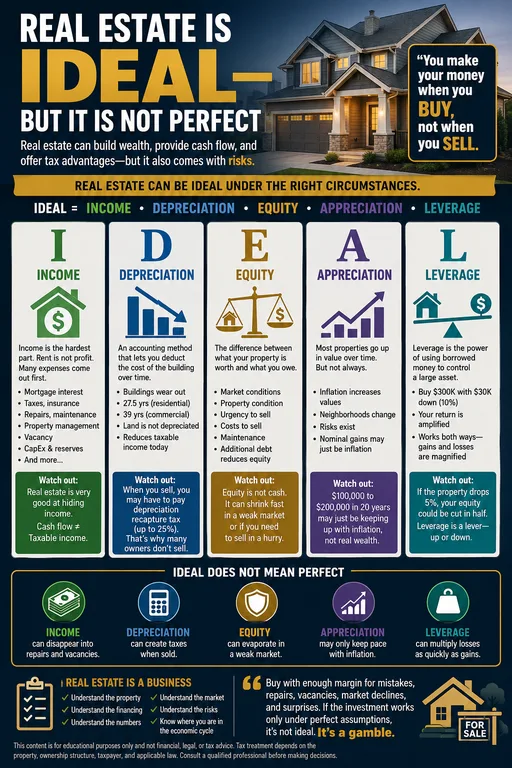
This article is for general educational purposes. Tax treatment depends on the property, ownership structure, taxpayer, and applicable law. Consult a qualified tax professional before making investment or disposition decisions. Use a Realtor, they can be an asset, Build your team before you buy anything. And, No I am not a Realtor, but I have bought and sold more RE than most of them.
The Housing Market Is Changing Fast

Back in my day, a handshake sealed a deal, a dollar bought you lunch and a newspaper, and a house was something you lived in — not something you bid for like a Picasso at Sotheby’s. But now? Well, welcome to 2025, where buying a house is about as simple as brain surgery during a bumpy stagecoach ride.
The housing market’s got more twists than a rope you left in the trunk of your car twenty years ago — and just about as trustworthiness. Realtors are squabbling over commissions, websites are gatekeeping listings and the folks who just want a place to call home are left wondering if they need a law degree, a crystal ball, and a small inheritance just to make an offer.
It is a brave new market, the game’s changed — but the stakes remain the same: freedom, stability, and maybe a quiet porch to sit and watch the world go mad.
Let’s dive deeper into this topic.
1. The Old Way of Buying a Home (Pre-August 2024)
-
Traditionally, the seller paid the commissions for both their own listing agent and the buyer’s agent.
-
A standard 6% commission was split — 3% to the listing agent, 3% to the buyer’s agent.
-
Buyers didn’t directly pay their agents, making it easy to hire one.
2. The New Rule (Post-August 2024)
-
A legal shift now requires buyers and sellers to negotiate separately with their own agents.
-
Buyers must pay their agents out-of-pocket, typically 3% of the purchase price.
-
On a $500,000 home, that’s $15,000, now paid by the buyer.
-
3. Buyers Push Back
-
Many buyers now opt to skip buyer agents to save money.
-
They use platforms like Zillow and Redfin to search for homes themselves.
-
The perceived value of a buyer’s agent has diminished, unless the agent offers significant negotiation skill or saves time.
🧩 Realtor Workarounds and the Tech Pushback
4. Realtors Try to Regain Control
-
Some agents exclusively listed homes on the MLS (only accessible to agents), and delayed listings on public sites like Zillow or Redfin.
-
This move was designed to steer buyers back to agents for access to listings.
5. Zillow and Redfin’s Response
-
Both platforms declared they will no longer list homes that are not publicly shared through the MLS first.
-
Their stance: all buyers deserve equal access to all listings.
-
This increases pressure on realtors to stop playing “access control” games.
📉 A Market Already Struggling
6. Sales Volume Has Collapsed
-
From 6.1 million home sales in 2021 to around 4 million in 2024 — a 33% drop.
-
Fewer sales = less income for realtors.
-
Market slowdown stems from high prices, high mortgage rates, and limited affordable inventory.
💰 The Affordability Crisis
7. Prices and Mortgage Rates Have Exploded
| Year | Median Price | Mortgage Rate | Monthly Payment |
|---|---|---|---|
| 2020 | $329,000 | ~3% | ~$1,380 |
| 2024 | $420,000 | ~7% | ~$2,800 |
-
Mortgage payments have more than doubled, while median incomes rose ~20%.
-
Result: Massive affordability gap for new buyers.
🚫 Why People Aren’t Selling
8. Locked-In Low Rates
-
Many homeowners refinanced or bought when rates were 2–4%.
-
They’re reluctant to give up low rates for today’s 7% loans — creating a “golden handcuff” effect.
-
Homeowners stay put → low inventory.
🧱 Builders Face Hurdles Too
9. New Construction Is Slowing
-
Builder confidence has fallen to a 7-month low.
-
Causes:
-
Tariffs on imported building materials (like Canadian lumber).
-
Labor shortages, worsened by worker deportations.
-
Rising construction costs → fewer affordable new homes.
-
🧨 The Perfect Storm
10. Agents Under Siege
-
Agents now face:
-
Legal pressure from commission lawsuits.
-
Market pressure from slower home sales.
-
Competitive pressure from buyers skipping agents.
-
Platform pressure from Zillow and Redfin enforcing transparency.
-
🧠 Key Takeaways for Buyers and Sellers
11. Smart Home Buying Principles
-
Don’t buy based on emotion — buy when you can truly afford it.
-
Requirements:
-
20% down payment.
-
Ability to save and invest while paying your mortgage.
-
Budget for furnishing, moving, and upgrades.
-
-
A home is not an investment — it’s a liability unless rented out.
-
Want to build wealth? Buy rental properties, not personal residences.
-
12. Understanding Supply and Demand
-
More demand than supply → prices rise.
-
More supply than demand → prices drop.
-
Right now? Low supply, especially for affordable homes, is propping up prices even as buyers struggle.
🌐 Global Factors in the Background
-
Tariffs and trade tensions (especially with China) are driving up material and borrowing costs.
-
Bond yields are rising (partly from concerns over China dumping U.S. debt), which pushes mortgage rates up.
💡 Final Thoughts (Expanded Wisdom)
-
The real estate game has changed. Buyer agents are now a luxury, not a given.
-
Digital platforms have become gatekeepers, forcing transparency in a once-exclusive world.
-
If you’re a buyer: wait for the right house, but don’t try to time the market.
-
If you’re an investor: own assets that generate income and appreciate over time — that’s where the real wealth is.
-
Above all, stay informed, because every aspect — from policy to international economics — is now woven into the American dream of homeownership.
Sole Proprietor, LLC or Corporation?

Don’t form an LLC to look like a real estate investor. Form one when the numbers, the liability, and the future plan say it actually makes sense. — YNOT
Maybe. That is the honest answer.
A lot of people think forming an LLC or corporation makes them look more professional, more serious, or more “official.” But real estate does not care about your ego. The numbers care. The bank cares. The tax rules care. Liability cares.
Before you rush to form a company, talk to your tax advisor and maybe even a real estate attorney. There are times when it makes sense.
If you already have another business and you are going to put an office there, the structure might help.
If you are serious about buying more homes in the future, building a portfolio, tracking expenses, separating liability, and treating this like a real business, then yes — the extra paperwork, bookkeeping, and cost may be worth it.
But do not form an LLC just because it sounds fancy.
Do not do it because you want to impress your friends.
Do not do it because some guy on the internet told you “real investors have LLCs.”
The question is not, “Does this make me look like a real estate investor?”
The question is, “Does this actually protect me, save me money, organize my business, or help me grow?”
If the answer is yes, do it properly.
If the answer is no, keep it simple until the business demands more structure.
Real estate rewards smart decisions, not fancy paperwork.
Real Estate Is a Great Investment to Avoid Taxes

If the government taxed the air, I reckon we’d all be holding our breath by now. But since they haven’t figured out how to meter that just yet, they’ll settle for taxing your sweat, your savings, and anything that dares to grow in value—including your humble little home.
That’s where real estate comes in. It’s one of the few places where the system tips in favor of the folks who read the rules instead of just signing the checks. The wealthy don’t dodge taxes by hiding—no sir—they dodge them by investing smart and letting the tax code work like a loyal bloodhound on their trail, sniffing out every last deduction.
But beware: not every so-called expert is selling wisdom—some are just hawking shiny nonsense wrapped in hashtags and hype. Real estate can help you avoid taxes, but only if you know which levers to pull and which ones might blow up in your face.
Real estate isn’t a magic trick—it’s a craft. And like any craft, it takes time, tools, and a good teacher to get it right. You don’t build wealth by chasing TikTok tax hacks; you build it one brick, one tenant, one well-timed depreciation schedule at a time.
So invest wisely. Run your numbers like a banker, read the tax code like a lawyer, and buy property like someone planning to hold it through a storm. If you do it right, your tenants will pay the mortgage, Uncle Sam will tip his hat and walk on by, and your future self will thank you—probably from a porch swing paid for by equity and tax savings.
Just remember: don’t buy the barn for the write-off—buy it because it feeds the whole farm. And if the tax tail wags the dog, you might be barking up the wrong investment.
🏡 Why Real Estate Is a Great Investment to Avoid Taxes — With Some Important Details
✅ Why Real Estate Is So Powerful
Real estate isn’t just about “getting rich” or avoiding taxes. It builds wealth in four powerful ways:
- Appreciation – Your property value increases over time.
- Leverage – You control a large asset with a small down payment.
- Mortgage Paydown – Your tenant reduces your debt for you.
- Cash Flow – Monthly income after expenses.
- Tax Benefits – Depreciation and deductions reduce your taxable income.
⚠️ But It’s Not Magic: The Tax Rules Matter
You’ll hear some influencers say, “Buy real estate and never pay taxes again!” — but that’s an exaggeration. Here’s what you really need to know to make real estate work for you.
🔍 The 4 Main Real Estate Tax Strategies
| Strategy | Key Benefit | Real Estate Pro Status Required? | Key Notes |
|---|---|---|---|
| 1. Long-Term Rental (LTR) | Depreciation & losses | ✅ Yes | Passive losses only become active if you’re a qualified Real Estate Professional |
| 2. Short-Term Rental (STR) | Full write-offs via loophole | ❌ No | Must materially participate (e.g., 100+ hours/year) |
| 3. Syndication Investment | Depreciation (but usually passive) | ✅ Yes (to claim losses) | Great passive investment, but tax benefits are limited unless active |
| 4. Self-Rental to Your Biz | Depreciation & rent paid to yourself | ❌ No | Use with S-Corp or LLC. Great tax play if structured properly |
🧑🔧 What Is a Real Estate Professional (RE Pro)?
To qualify for RE Pro tax benefits, you must:
- Spend 750+ hours/year in real estate activities
- It must be your primary occupation
- Be materially involved (not just passive ownership)
If you meet all three, real estate losses can offset your W-2 or business income. Powerful!
🧮 Example: $200K Rental Property with $20K Down
Let’s break down how real estate builds wealth from multiple angles:
| Return Type | Amount | ROI on $20K Down |
|---|---|---|
| Appreciation (5%) | $10,000/year | 50% |
| Mortgage Paydown | $4,000/year (via tenant) | 20% |
| Cash Flow | $2,000/year ($167/month) | 10% |
| Tax Savings | ~$6,000/year (Depreciation) | 30% |
| Total Return | $22,000/year | 110% |
→ You invested $20K and created over $22K in annual return
This is why real estate is such a compounding wealth-building machine.
⚠️ Don’t Fall for the Hype
Many “gurus” exaggerate the tax savings. You shouldn’t buy a property only for the write-offs.
- A bad deal stays bad no matter the deductions.
- First analyze the cash flow, appreciation, and debt paydown.
- THEN factor in tax strategy.
👉 Never let the tax tail wag the investment dog.
🎯 Bonus Tip: Rent Property to Your Own Business
One of the best strategies is owning property in an LLC or trust and renting it to your own S-Corp or business.
- No RE Pro status needed
- You can still depreciate it
- You keep the rent in your own pocket
- You avoid payroll taxes on that rent
Win-win.
📈 1031 Exchange: Sell Without Paying Tax (Yet)
Want to sell a property but avoid capital gains? Use a 1031 Exchange to reinvest proceeds into another property of equal or greater value — and defer taxes legally.
🔚 Conclusion: The Big Picture
Real estate is one of the most powerful tools for wealth creation and tax planning, but only when used with:
- The right strategy
- The right structure
- And the right mindset
It’s not about avoiding all taxes forever. It’s about stacking advantages—equity, leverage, cash flow, and tax savings.
Don’t buy real estate just to dodge taxes—buy it to build freedom, and let the tax perks be your bonus. Talk to a tax advisor that knows all your facts- don’t take anyone’s opinion on the internet.
RE Crashing means Opportunity is coming knocking

If there’s one thing I’ve learned watching human nature—and I’ve done a fair bit of that in 60 times around the sun—it’s that folks will panic at the first creak of a floorboard and then sleep like babies through an earthquake. So now, in 2025, some are panicking that the housing market’s crashing, commercial buildings are dying, and the world as we know it is ending, again. But hold your horses. Truth, like real estate, tends to settle after the dust clears. Let’s take a walk through the neighborhoods of housing, stroll past the empty halls of commercial towers, and peek into the buzzing warehouses where industry hums. You might just find the story ain’t quite what the headlines promised.
Housing Market Analysis 2025 – So Far
So, Is the housing market crashing in 2025? No, however, the data tells a more nuanced story. Redfin reports that nationwide home prices were up 3.1% year-over-year in February, even though the number of homes sold fell by 5.7%. Essentially, while prices have risen slightly due to inflation, fewer homes are actually being purchased, and more properties are being listed.
This isn’t a crash but rather a market that is experiencing seasonal fluctuations. Typically, prices peak in June and bottom out in December—a pattern similar to the hotel industry. Additionally, many homeowners have locked in long-term, low-interest loans (20 to 30 years) and are reluctant to sell, since doing so would mean giving up those favorable rates. Why would I sell my house with a 3%, 30-year mortgage?
Given the current climate—where interest rates hover around 7%, and property taxes and insurance costs are rising—it might not be the best time to buy a house, especially if you’re looking for affordability. Instead, if you can afford it, buy multi-unit properties, which could allow you to live rent-free or generate cash flow.
Sale rose to 12.4%, so basically we got homes going up slightly in price, but fewer homes are being bought and more homes are going on the market. Is it a crash? No, it’s not a crash, and residential is a market that just keeps going. We had a crash way back in 2008 because they handed out too much money to people who couldn’t pay it. It was—how many loans do you write each month? Who needed income or a job? I just leave the income section blank. That’s why we had a crash. Is that happening right now? I don’t believe so. It’s all about interest rates being higher and fewer people buying because, in many cases, it’s cheaper to rent. The current median sale price is $425,000, unless you’re in some real crappy place that no one wants to live in.
In conclusion, homes are going up because of inflation, but can we afford them because of T&I.
Commercial Real Estate
The situation in commercial real estate, particularly in office buildings and retail locations, presents a different picture. A dramatic drop in occupancy has led to a steep decline in value. For instance, an office building that sold for $200 million in 2016 was sold for just $6.25 million in January 2025—a staggering 97% discount. This severe drop is attributed to a major financial advisory company consolidating its operations and returning the property to the bank. Now, the bank is burdened with a vacant building that incurs ongoing expenses such as maintenance, taxes, and insurance.
In commercial real estate, loans typically have shorter durations compared to residential ones. When these loans come due, they must be refinanced at current interest rates, which are significantly higher than in previous years. If a property cannot generate enough income to cover its increased debt service, it loses value quickly. This dynamic is prompting a broader concern: even well-performing properties might face downward pressure when their loans mature and interest rates reset.
Can the property maintain the higher interest rate? In many cases, no. Well, if the property can’t make enough money to pay the mortgage, the taxes, the insurance, and all the bills it has—or if it gets to the point where it has zero NOI—why is anybody going to buy a property? They can’t make any money on that; that doesn’t make sense either, and they’re going to give the keys back to the bank. Now, the bank’s sitting on a piece of property they don’t want and their loan is out the window, so what happens? The bank wants it gone quick, so what do they do? They have to discount it, get as much money as they can right off the loss they took, and move on. Hopefully, the bank won’t have too many of those loans. But if they do, a bank is only worth the value of its loans. If a bank has bad loans, it’s a bad bank, and you know what happens to bad banks—it happened in 2008, why? Because the loans were bad. Now they’re bad for another reason—they’re bad because the rates went up. There’s already hundreds of billions of dollars of loans out there that they’re keeping quiet. It’s called prey and delay; they’re praying that the interest rates will go down and the properties will generate more income.
Now, I will tell you: rents have gone up because fewer people are buying homes due to the high interest rate, causing rents to go up, which means they’re making more money to help pay the higher interest rate. That’s going to happen in a lot of cases, but there are going to be properties that just can’t afford to meet their debt ratio. Right now, we’re seeing the depression growing. I’m starting to see the dogs come to the market first; it’s always the dogs that come first, and then the real estate gets better and better and better as it goes on. So right now, I’m starting to see the signals.
The hot market, I believe, will be commercial-to-residential conversions; that is what I would be doing if I were hungrier and younger.
Industrial Real Estate – The Forgotten One
Industrial real estate, in case you didn’t know, primarily comprises warehouses, manufacturing facilities, and distribution centers supporting production and logistics. Industrial real estate is currently performing very well and has been one of the strongest sectors, largely driven by the surge in e-commerce and the growing need for efficient supply chain and distribution networks. Demand for warehouses, distribution centers, and logistics facilities remains robust, resulting in low vacancy rates and healthy rental growth. While broader economic uncertainties can impact various real estate segments, industrial properties tend to be more resilient due to their critical role in modern commerce.
Here are some well-known industrial REITs along with approximate year-to-date return estimates for 2025 (please note that returns can vary based on data source and market conditions):
- Prologis (PLD): Around a 9% YTD return.
- First Industrial Realty Trust (FR): Approximately 7% YTD.
- STAG Industrial (STAG): Roughly a 6% YTD return.
Keep in mind that these figures are approximate and subject to change. They are not recommendations, just examples.
Conclusion and Advice
In summary, while the residential market remains steady with seasonal fluctuations and pockets of opportunity, the commercial sector—especially office buildings—is showing clear signs of distress. The key takeaway is to prepare financially by securing appropriate financing and keeping an eye out for quality deals. Whether you’re considering residential or commercial investments, it’s crucial to know your financial limits and act when a good opportunity arises.
For those needing personalized advice or further guidance, consulting with a seasoned real estate professional with decades of experience can be invaluable.
It’s always a good time to prepare for opportunity or a crash. You have to be prepared, stash your cash, have your financing lined up, and start looking for deals, and if you find a deal, you lowball it. You lowball it because you can always go up, but you can’t go down. This isn’t 2020; this is 2025, and there are going to be some people desperate to sell, but the market is not crashing; it’s going up.
So there you have it—houses holding steady, office towers tumbling, and warehouses working. If you’ve got eyes to see, you’ll notice: the game hasn’t changed, just the scoreboard. The wise man doesn’t chase the market like a gambler at closing time—he sharpens his shovel, watches the weather, and digs when the ground is soft. Prepare for the storm or the sunshine, whichever shows up first, and when you find a deal, don’t offer your best number—whisper your worst and smile like you meant it. After all, it’s not about timing the market—it’s about not getting trampled in the stampede. And if you can’t tell which way the herd’s running, best stay on the porch ‘til the dust settles.
A Market Correction or a Golden Opportunity?

The real estate market in 2025 is shaping up to be one of the most significant shifts in years. After a period of high home prices and rising interest rates, we’re now seeing the potential for a 20-30% drop in home values in many areas.
For homebuyers, investors, and sellers, this isn’t just a downturn—it’s an opportunity. If you know how to play the market right, 2025 could be the year you buy low, invest smart, and secure long-term wealth.
Why Home Prices May Drop 20-30% in 2025
A combination of economic factors, interest rates, and supply-demand shifts is pushing home values lower. Here’s why:
1. High Mortgage Rates Have Slowed the Market
- The Federal Reserve raised interest rates, making mortgages more expensive.
- Fewer buyers can afford high monthly payments, reducing demand.
- Homes sit longer on the market, forcing sellers to lower prices.
✅ What This Means for Buyers: Less competition, better negotiating power, and lower prices.
2. The Pandemic Housing Boom is Unwinding
- From 2020-2022, home prices exploded due to low rates and high demand.
- Investors bought aggressively, driving prices above sustainable levels.
- Many of these investors are now selling, leading to more supply and lower prices.
✅ What This Means for Buyers: Some markets will correct more than others—watch for overvalued cities to drop the most.
3. Rising Foreclosures & Distressed Sales
- Some homeowners who bought at peak prices are struggling with high mortgage payments.
- Adjustable-rate mortgage (ARM) resets are pushing payments even higher.
- Job losses or economic downturns could force more people to sell at a discount.
✅ What This Means for Buyers: Short sales, foreclosures, and distressed properties could hit the market at steep discounts.
4. More Homes Are Hitting the Market
- New construction has increased after supply chain issues resolved.
- Baby boomers are downsizing, adding to inventory.
- Investors are cashing out due to high holding costs and lower profits.
✅ What This Means for Buyers: A buyer’s market means you can shop carefully and negotiate better deals.
How to Take Advantage of Falling Home Prices in 2025
If home prices drop 20-30%, smart buyers and investors will seize the opportunity—but only if they plan strategically.
1. Be Patient – The Best Deals Are Coming
- Sellers still expect 2023-24 prices, but reality is setting in.
- Many will panic-sell once they realize prices won’t recover quickly.
- By mid-to-late 2025, deals will be at their lowest.
🚨 Pro Tip: Don’t rush—let the market work in your favor. The longer a home sits unsold, the more negotiation power you have.
2. Secure the Best Financing (or Buy in Cash)
- Even if home prices drop, mortgage rates may stay high—so get the best terms possible.
- If you can, buy in cash or put down a large deposit to negotiate better terms.
- Look for seller financing options—some sellers will offer low-interest deals just to close the sale.
🚨 Pro Tip: If you find a home with an assumable mortgage, you could take over a low-interest loan instead of getting a new one.
3. Target the Right Markets
Not every area will drop equally. The best deals will be in places where:
- Home prices spiked too high during the pandemic.
- Investors are offloading multiple properties.
- Job losses or economic shifts are forcing more sales.
🚨 Markets to Watch:
- Overpriced metro areas (think California, Seattle, Austin).
- High foreclosure states (Florida, Nevada, Arizona).
- Suburbs that overbuilt and now have too much supply.
4. Negotiate Like a Pro
- Lowball offers will work again—don’t be afraid to go 10-20% below asking.
- Use the inspection to knock even more off the price.
- Ask for seller-paid closing costs or interest rate buy-downs to save money upfront.
🚨 Pro Tip: If the home has been sitting on the market for months, the seller is desperate. Use that to your advantage.
5. Avoid the Biggest Mistake: Overpaying Too Soon
- Some buyers will jump too early when prices haven’t bottomed yet.
- Home values could drop even more in 2026, depending on economic conditions.
- If you buy too soon, you may see your home lose value before it gains.
🚨 What to Do Instead: Track price trends, foreclosure filings, and inventory levels—the best deals will come when sellers can’t afford to hold out any longer.
What This Means for Sellers in 2025
If you’re selling a home in 2025, you need to act fast and price smart.
1. Price Your Home Realistically
- Overpricing in a declining market will leave your home sitting unsold.
- The longer it stays on the market, the worse it looks to buyers.
- Price slightly below comps to attract serious offers fast.
✅ Best Move: Be aggressive with pricing—it’s better to sell quickly before the market drops further.
2. Offer Incentives to Buyers
- Cover closing costs to make your home more attractive.
- Buy down the buyer’s interest rate to offset mortgage costs.
- Consider seller financing to attract buyers struggling with high loan rates.
✅ Best Move: Make it easy for buyers to say yes—flexible terms can close deals faster.
3. If You Don’t Need to Sell, Wait
- If you don’t have to sell, it may be better to hold until the market stabilizes.
- Renting out your property can provide cash flow while you wait for prices to recover.
✅ Best Move: If you have a low-interest mortgage, it might make sense to keep your home and wait it out.
Final Thoughts: 2025 is a Buyer’s Market – But Only for the Smartest Buyers
Home prices may drop 20-30%, but only those who plan ahead will take advantage of the opportunity.
- If you’re buying, wait for the right moment, negotiate hard, and secure the best financing.
- If you’re selling, price competitively, offer incentives, and move quickly before prices drop further.
- If you’re investing, watch for distressed properties, short sales, and foreclosure deals.
Additional thoughts
1. Mortgage Rates and Affordability
- Interest rates are high, making monthly payments more expensive.
- If rates drop in the future, refinancing could be an option to lower costs.
- Higher rates have reduced buyer competition, potentially leading to better deals.
2. Housing Inventory
- Housing supply remains tight, which keeps home prices elevated.
- More listings are expected in spring and summer, which could increase options for buyers.
- New construction is helping to boost inventory but mainly for higher-priced homes.
3. Home Prices and Market Trends
- Prices remain high but are stabilizing in some areas.
- Some markets may see price drops, but widespread declines are unlikely unless there’s a major economic downturn.
- Regional differences matter: Prices vary widely depending on location.
4. Competition and Negotiation Power
- In some markets, sellers are more willing to negotiate due to reduced demand.
- Cash buyers have an advantage in securing better deals in a high-interest-rate environment.
5. Long-Term vs. Short-Term Perspective
- If you plan to stay in a home for 5+ years, buying now could make sense.
- If rates drop, more buyers will enter the market, possibly driving prices higher again.
2025 could be the best time in years to buy real estate at a discount. But never be in a hurry to spend money. FOMO will kill you in RE just like the stock market.
The decision depends on your personal finances, market conditions in your area, and how long you plan to stay in the home. If you can afford it and find a good deal, buying now could be a smart move before demand rises again. If affordability is a concern, waiting may be a better choice.
Are you ready to make the most of it?
EXTRA CREDIT
MORE ON REAL ESTATE
The Future for Most People Is Renting

The American Dream isn’t dead—it’s just been rented out at a premium.
Folks, I’ve lived long enough to see the American Dream shrink down from a white picket fence to a monthly rent check. Once upon a time, a man could buy a house with a steady job and a little grit. Today, he needs a six-figure income, a spotless credit score, and the patience of Job just to be told “sorry, you don’t qualify.” The big builders figured it out before the rest of us did: they don’t care if you can buy anymore. They’ve decided it’s a whole lot easier to rent you back the dream, one month at a time, at a premium. That ain’t a bug in the system—it’s the system.
Prediction:
Real estate prices are going to keep climbing—not because homes are scarce, but because scarcity itself has become the business model. Builders discovered they can earn more by holding and renting than by selling. And Wall Street is more than happy to bankroll the shift. If you thought housing was expensive now, just wait until the rent checks start feeling like mortgage payments.
So here we are, staring at a future where “home sweet home” comes with a landlord’s lock and key. The rich will own the houses, the rest will rent them, and the builders will laugh all the way to the bank. Maybe you’ll call it progress, maybe you’ll call it robbery—but either way, you’ll be paying for it every 30 days. The American Dream isn’t gone—it’s just been put up for lease.
Summary: Berkshire’s Bet on Build-to-Rent Housing
Berkshire Hathaway has taken a billion-dollar position in Lennar (LAR) and D.R. Horton (DHI)—but the play isn’t about selling homes to families. It’s about the explosive rise of Build-to-Rent (BTR), where homebuilders construct entire neighborhoods of single-family homes and sell them in bulk to institutional investors instead of individual buyers.
Key Points
- Shift in Business Model: Builders like D.R. Horton and Lennar are becoming landlords (directly or via Wall Street buyers) rather than relying on traditional home sales.
- Market Explosion:
- BTR sector up 270% since 2019, with 350,000+ homes now controlled by builders.
- By 2025, 9% of single-family construction is BTR (vs. 3% pre-2008).
- Occupancy rates average 97% with strong rent premiums.
- Affordability Crisis:
- Mortgage rates >6.5%.
- Median home price $435K; buyers need $126K annual income to qualify.
- Only 6 million of 46 million renters can afford a median home.
- Result: Renting becomes the default option, fueling demand for BTR.
- Institutional Buyers:
- Wall Street players (Blackstone, Invitation Homes, Progress Residential, etc.) are buying entire developments.
- Example: D.R. Horton sold $313M worth of rental homes in one quarter—directly to investors, not families.
- Strategic Advantage for Builders:
- If homes don’t sell to individuals, they’re converted to rentals.
- Institutional investors value cash flow over quality, lowering build standards but keeping returns high.
- Builders now have an “escape valve” that prevents housing prices from crashing.
- Demographics & Demand:
- Millennials (64% of BTR demand) have lower homeownership and weak savings.
- Gen Z is even less likely to buy, ensuring long-term rental demand.
- Hot markets: Phoenix, Dallas-Fort Worth, Atlanta, Florida, Carolinas, Texas.
- Valuation & Outlook:
- Horton and Lennar trade at value-friendly P/Es (~9–13).
- Analysts rate them as “Buy” with solid balance sheets.
- Fed rate cuts (expected 2025–2026) will make capital cheaper for BTR expansions.
- Institutional ownership of rentals projected to double by 2025 and dominate by 2030.
Bottom Line
Berkshire isn’t betting on a housing crash or quick rebound—it’s betting on the transformation of housing itself. The new model: subscription-style living where Americans rent from institutional landlords at a premium. For investors, this could be the “smartest housing play of the decade.” For families, it signals the erosion of traditional homeownership.
FINAL REALITY CHECK:

BTW, before anyone says, “If interest rates drop, homes will be more affordable”—that’s only half the story. Yes, lower rates make borrowing cheaper, but they also bring more buyers into the market. More demand means higher prices. And here’s the real kicker: as home prices rise, so do property taxes, insurance, and maintenance costs. So unless you can comfortably handle $3,000+ a month, your only realistic option may be renting for around $2,500.
The Higher the Risk -the Higher the Reward

Back in the day, a fellow could stash his money under a mattress and sleep easy. No market crashes, no bankers speculating with his hard-earned savings, no fancy terms like “diversification” or “hedging.” Just a good night’s rest on top of a lumpy fortune. But times have changed, and so has the art of making – and losing – money.
Nowadays, you can double your money overnight, or lose it all before breakfast, depending on whether you believe the right salesman. But if there’s one thing that hasn’t changed, it’s this: If someone promises you easy money, you’d best count your fingers after shaking hands with them.
Let’s talk about risk and reward – the age-old dance between fortune and folly.
The Reality of Risk and Reward
Ever heard the phrase, “you don’t get anything for free”?
The idea of “the higher the risk, the higher the reward” suggests that if you want to make big money, you have to be willing to take big chances. You might invest in something promising a 12% annual return, and maybe it delivers—until the day it doesn’t. Or you can get 5% per day with “minimal risk” (a phrase that usually means you just haven’t spotted the scam yet).
You’ve probably heard the usual suspects:
- A “surefire” investment with guaranteed high returns.
- Bonds – safe, steady, and as exciting as watching paint dry.
- Gold – touted as a hedge against catastrophe but loaded with hidden costs.
- Currency trading – where your odds can be better than 50%, assuming you’re the house.
Each of these has its place, but each is also riddled with pitfalls, usually crafted by people who profit whether you win or lose. Investing isn’t about finding the one “perfect” asset; it’s about understanding how different assets work and how to avoid the smooth-talking sharks circling the waters.
Gold and Precious Metals: The Eternal Mirage
Gold, jewelry, and precious metals are often sold as “safe havens”—a store of value immune to economic swings. But the reality is more complicated.
You walk into a jewelry store and buy a gold ring for $2,000, thinking you’ve made an investment. The truth? The ring is likely worth closer to $800, thanks to a 200-300% retail markup. But that’s not even the worst part—because when you need to sell it, the buyer will offer even less.
Consider this:
- Your mother leaves you a gold bracelet bought when gold was $200 an ounce.
- She probably overpaid for it at retail prices.
- Now gold is at $2,900 an ounce, and you need to sell.
- The pawn shop offers you far less than its weight in gold, citing “market fluctuations.”
And that’s the game: Jewelers, brokers, and pawn shops control their profits by buying low and selling high. They don’t care about “fair market value”—they care about their bottom line.
If you think a gold broker is your friend, you might as well pull out all your teeth and hand them to the Tooth Fairy. At least she only takes them once.
So, does gold have a purpose? Sure—if you’re looking for a discreet way to store wealth or hide money. But if you think you’ll get rich from it, you’re in for a rude awakening. Emergencies force you to sell at the worst times, and when the bubble pops, gold drops like a rock. It’ll never be worth zero—neither will a chicken—but that doesn’t mean it’s a good investment.
The wealthy buy commodities from the poor and sell them at a premium to those desperate enough to believe in the next big surge. If they truly thought gold was heading for $4,000 an ounce, they’d be hoarding, not selling.
The Truth About “Value”
Nothing has inherent value—only what we collectively agree it’s worth. Money, stocks, gold, and real estate don’t have absolute value; they fluctuate based on perception. That’s why they’re great for trading but not necessarily for long-term ownership.
Think about it:
- A stock is only worth what the next person is willing to pay for it.
- Real estate fluctuates with interest rates, demand, and economic cycles.
- Gold may rise in price, but it doesn’t produce income—it just sits there, waiting for someone else to believe in it more than you do.
In the grand casino of life, the house always wins—unless you learn the rules of the game. Every investment carries risk, and the ones promising no risk at all? Those are the ones most likely to take you to the cleaners.
You can make money in any market—stocks, gold, real estate, or bonds—if you’re patient, informed, and not suckered in by get-rich-quick schemes. But if you believe the pitch of the smooth talker selling you “guaranteed” wealth, well, there’s a bridge I’d love to sell you.
So before you bet the farm, ask yourself: Do you really know the game, or are you just another player at the table, hoping luck is on your side?
Because if it’s the latter, you might as well hand your wallet to the nearest gold broker and save yourself the suspense.
BTW, when I first wrote this post about 3 years ago gold was $1,400 and I owned no gold.
Today, March 2025, it is close to $3,000, and I have most of my money not in stocks but Gold Etfs since I believe inflation will be blossoming for a bit, and the stock market is tanking . I sold almost everything after Trump was sworn in. This is not investment advise or a sales pitch of any kind. By the time you read this I may have sold everything again.
I typical do the opposite of what most people do, and in today’s world you have to be fast.
Read these other articles on Gold and Risk
Paying Less Than It’s Worth it is a Mindset

YOU MAKE YOUR MONEY WHEN YOU BUY, YOU COLLECT WHEN YOU SELL!
Wall Street is a lot like a carnival—bright lights, fast talkers, and plenty of ways to part a fool from his money. Every new generation thinks it has discovered gold in the form of some shiny stock, only to learn later it was nothing more than gilded brass. The secret, as old as commerce itself, is simple: don’t pay a dollar fifty for a dollar bill. Value investing isn’t about chasing the parade—it’s about waiting patiently by the roadside, tipping your hat only when a bargain walks by.
“In the long run, the market is a voting machine only for the impatient and a weighing machine for the wise. The trick isn’t to outshout the crowd, but to outlast it. Buy what is solid, pay less than it’s worth, and let time do the heavy lifting. For in the quiet arithmetic of compounding, the patient man always has the last laugh.”
💬 Warren Buffett Quotes on Value Investing
- “Price is what you pay. Value is what you get.”
- “It’s far better to buy a wonderful company at a fair price than a fair company at a wonderful price.”
- “Be fearful when others are greedy, and greedy when others are fearful.”
- “The stock market is designed to transfer money from the Active to the Patient.”
Core Principle
- Valuation matters more than hype.
- A great business can still be a poor investment if you pay too high a price.
Are the Magnificent Seven a good Deal right now?
Most People have the what is called the magnificent seven in their portfolio, whether directly or indirectly via SP500. But are they a good deal. Let’s take a “deeper” dive.
Rankings (Worst → Best)
7. Tesla (TSLA)
- Issue: 90%+ revenue still from cars → essentially a car company.
- Hype risk: Investors value it like software/robotics, but sales multiples are wildly higher than Ford, Honda, or VW (13x vs. 0.25–0.3x).
- Valuation: Current ~$340 vs. intrinsic ~$50–363.
- Projected IRR: ~-1% under mid assumptions.
- Takeaway: Overvalued; avoid until a much deeper pullback.
6. Amazon (AMZN)
- Strength: Massive revenue/profit growth, $1T+ revenue expected by 2029.
- Issue: Stock has been flat despite growth (valuation drag).
- Valuation: Current ~$225 vs. intrinsic ~$73–282.
- Projected IRR: ~4% mid case.
- Takeaway: Strong business, but price too high for value investors now.
5. Microsoft (MSFT)
- Strength: $3.7T market cap, $65B free cash flow, strong growth/acquisitions.
- Issue: Current price already prices in future earnings.
- Valuation: Current ~$505 vs. intrinsic ~$240–600.
- Projected IRR: ~5.3% mid case.
- Takeaway: Great company, but little upside unless price dips.
4. Apple (AAPL)
- Strength: $100B free cash flow average, growing subscription margins.
- Issue: Slower revenue growth ahead (already huge scale).
- Valuation: Current ~$236 vs. intrinsic ~$120–277.
- Projected IRR: ~5.8% mid case.
- Takeaway: Still strong, but wait for a correction before buying.
3. Nvidia (NVDA)
- Strength: AI chip leader, $72B free cash flow in latest year.
- Issue: Growth slowing, valuation at extreme levels.
- Valuation: Current $1,200+ vs. intrinsic ~$73–290.
- Projected IRR: ~7.5% mid case (with aggressive assumptions).
- Takeaway: Phenomenal company, but price is unsustainably high. Only interesting on a large pullback.
2. Google (GOOGL)
- Strength: $65B free cash flow, strong margins, global ad dominance.
- Issue: Stock already ran up 20%+ YTD.
- Valuation: Current ~$150–160 vs. intrinsic ~$130–350.
- Projected IRR: ~8.25% mid case.
- Takeaway: More reasonable than peers; a solid buy candidate if it pulls back closer to $130–140.
1. Meta (META)
- Strength: Huge ad revenue base, untapped international monetization (WhatsApp, Instagram, Facebook, 3.5B users).
- Valuation: Current ~$735 vs. intrinsic ~$466–1,137.
- Projected IRR: ~9.2% mid case.
- Takeaway: Best positioned among the 7, still slightly rich at current price, but top of the list to buy on a pullback.
Big Picture
- Even the best-case returns averaged only 3–7% annually for most, meaning these stocks are likely overpriced today.
- On meaningful pullbacks:
- Top Targets: Meta (#1), Google (#2).
- Second Tier: Nvidia (#3), Apple (#4), Microsoft (#5).
- Avoid for now: Amazon (#6), Tesla (#7).
- If no big pullback occurs, a low-cost S&P 500 ETF might offer similar returns with less risk.
📊 Magnificent 7 Buy Price Watchlist
| Rank | Company | Current Price* | Intrinsic Value Range | Mid-Case Value | Target Entry (Margin of Safety) | Notes |
|---|---|---|---|---|---|---|
| 1 | Meta (META) | ~$735 | $466 – $1,137 | $750 | < $600 | Strongest upside; global ad monetization not fully tapped. |
| 2 | Google (GOOGL) | ~$155 | $130 – $350 | $216 | < $150 (ideal $130–140) | Reasonable valuation, high free cash flow. |
| 3 | Nvidia (NVDA) | ~$1,200+ | $73 – $290 | $150 | < $300 | Amazing company, but priced for perfection. Only attractive far lower. |
| 4 | Apple (AAPL) | ~$236 | $120 – $277 | $180 | < $180 | Slower growth, but subscription business helps margins. |
| 5 | Microsoft (MSFT) | ~$505 | $240 – $600 | $375–410 | < $400 | Durable business, limited near-term upside. |
| 6 | Amazon (AMZN) | ~$225 | $73 – $282 | $150 | < $150 | Fantastic business, but price already bakes in growth. |
| 7 | Tesla (TSLA) | ~$340 | $50 – $363 | $144 | < $150 | Overvalued vs. peers; mostly still a car company. |
*Prices are rounded and approximate.
📝 Key Takeaways
- Best Buy Candidates (on pullback) → Meta, Google.
- Second Tier (need a steeper drop) → Microsoft, Apple, Nvidia.
- High Risk / Overhyped → Amazon, Tesla.
- ETF Alternative: If these don’t hit target entry levels, an S&P 500 index fund could deliver similar 5–7% returns without timing risk.
Personally, I don’t hold any of these stocks right now. At the moment, I keep about 50% of my accounts in cash, with the rest in metals—mainly gold and some silver, some minerals, and miners which I plan to hold a bit longer. As they say, I’m keeping some powder dry for the expected correction, at which point I’ll start buying from the list above, little by little.
This isn’t investment advice—if anything, think of it more as an investment warning. Don’t rush to buy anything. Take your time, study each stock, and wait for the right price. If you’re young, you can afford mistakes and even a 15-year wait holding the S&P 500. But the older you get, the more you should focus on protecting capital and limiting risk. At the end of the day, investing is about managing risk. Remember—it’s not how much you make, it’s how much you keep.
The Nicest House is Lying to You

A friend invited me to look at a house he wanted to buy.
On the surface, it looked great—bright, clean, freshly flipped, and begging to be loved.
That’s exactly when my instincts kicked in.
Here’s a rule I’ve learned the expensive way: a house never lies, but flippers often do—politely, with paint.
Before we start, one public-service announcement that should be tattooed on every buyer’s forehead:
Always make a home inspection part of the offer. Always.
Bring a disinterested third party. Visit the house at least three times, at three different times of day. Houses behave differently in the morning, afternoon, and evening—much like people.
Now, here are the 10 cosmetic fixes that often hide major problems, plus two bonus red flags almost nobody checks.
1. Fresh Paint Everywhere
Fresh paint isn’t a crime. It’s a clue.
When I see it, I head straight to garages and closets. That’s where the evidence hides. Stain-blocking primers usually mean water stains, smoke, mold, or smells someone didn’t want you meeting.
Paint doesn’t fix problems.
It just puts a smile on them.
2. Brand-New Carpet
Carpet is excellent at one thing: hiding uneven floors.
I walk every inch. If it feels soft, sloped, or bouncy, something underneath is waving for help. In Florida especially, carpet is suspicious. Heat, humidity, and termites don’t exactly respect it.
3. Excessive Caulking
Some caulk is maintenance.
A lot of caulk is fear.
If it’s still tacky, it’s fresh. And if it’s fresh, someone didn’t want you seeing what cracked in the first place. Caulk is the house version of makeup applied in a moving car.
4. Too Many Air Fresheners
One or two says, “We tried.”
Ten says, “Run.”
Smells matter. Pet urine, smoke, mold—these don’t disappear. They hibernate. When summer hits, they come roaring back like a bad decision you thought time would forgive.
5. Heavy Staging Furniture
Staging is fine. Over-staging is camouflage.
Furniture placed just right often blocks cracks, bad walls, warped floors, or cabinet sins. Look behind mirrors. Peek behind couches. The truth usually lives right there.
6. Cheap New Kitchen Cabinets
Shiny cabinets can hide bad plumbing and sketchy wiring.
Pressboard looks great for about three years—right up until it doesn’t. Always look underneath. New cabinets don’t mean new infrastructure. Sometimes they mean, “Please don’t look back there.”
7. Fresh Landscaping with Thick Mulch
Curb appeal is one thing. Five inches of mulch is another.
Mulch can hide foundation cracks, wood rot, low spots, or old tree stumps that once bullied the plumbing. Landscaping shouldn’t look like it’s trying to bury evidence.
8. Painted-Over Exterior Wood
Rot doesn’t fear paint.
If fascia boards feel soft when poked, they’re already done. Flippers love filler and paint—indoors and outdoors. Wood that’s dying always feels different. Trust your fingers.
9. All New Electrical Outlets
New outlets in an old house raise questions.
Were the originals ungrounded? Were two-prong outlets replaced with three-prong lies? New doesn’t always mean safer—it sometimes means quieter. Have them tested.
10. The Electrical Panel, the AC Unit, and the Paper Trail Nobody Checks
This one separates buyers from gamblers.
Go straight to the electrical panel.
Is it old or new? Does it look original—or suspiciously shiny?
Read the brand name. Then Google it.
Some panels have long, documented histories of failure, recalls, or insurance refusals. Others are fine. The panel will tell you which one it is—if you ask.
Next, check the AC unit.
Look at the manufacture date, brand, and model. A clean unit doesn’t mean a new unit. Sometimes it just means someone wiped it down and hoped you wouldn’t notice it’s living on borrowed time.
Now do what almost nobody does:
Pull the permit history.
Online. Every permit. Every repair.
- What work was done?
- When?
- By who?
- Was it inspected?
- Was it closed out properly?
Major electrical or HVAC work without permits isn’t a bargain—it’s a liability.
Permits pulled but never closed? That’s a conversation you want before closing, not after.
A flipped house often tells two stories:
The one you see…
and the one hiding in the panel, the AC tag, and the city database.
Bonus Red Flags Nobody Talks About
Bonus #1: Fresh Blown-In Attic Insulation
This one is huge.
New insulation can hide old wiring, open junction boxes, rodent infestations, and plumbing sins. I’ve moved insulation and found mouse cities, cloth wiring, and “we’ll deal with it later” decisions buried like time capsules.
Bonus #2: A Brand-New Sewer Cleanout Cap
If an older house suddenly has a shiny new sewer cap, ask why—then scope it.
Tree roots don’t politely stop at repaired sections. Often the worst pipe—the one under the house—gets ignored. Sewer problems are expensive, emotional, and never funny.
The Real Lesson
Flippers aren’t evil. They’re efficient.
But efficiency and honesty rarely share a lunch table.
A beautiful house can still be sick.
And the prettiest fixes are often the ones whispering, “Please don’t ask questions.”
The smartest buyers don’t fall in love at first sight.
They listen. They poke. They smell. They inspect.
Because a house, much like a person, will eventually tell you the truth—
the only question is whether it does it before or after you sign the papers.
———————–
So Does Any of This Mean I’d Walk Away From These Houses? Not a Chance.
Here’s the part most people miss.
Does everything above mean I won’t buy a house with these problems?
No. Quite the opposite.
I love houses with problems.
I used to joke that my favorite houses “Stunk”
The Dogs ruined the carpet.
Kitchens were stuck in another decade.
Electrical was questionable.
AC was tired.
Paint had seen better centuries.
As long as the issues weren’t truly structural—and as long as the roof wasn’t so bad the house couldn’t be financed—I was interested. Very interested.
Because here’s the truth:
Problems don’t kill deals. Pricing lies do.
The house I live in right now had electrical issues.
We didn’t argue about it.
We documented it.
The electrician’s quote—about $3,000—went straight into the closing paperwork.
That amount came off the price of the house.
Older roof? Discounted.
Aging AC? Discounted.
Other deferred maintenance? Discounted.
The house was already priced low—and by the time we were done being honest, it was another $20,000 cheaper. Period.
This is the mistake buyers make:
They think the problem is what’s wrong with the house.
It’s not.
The real problem is how you deal with it.
You have two choices:
- Pay for the problems after you buy the house
- Or use those problems before closing to reduce the price
That’s why I always made offers contingent on inspection.
First, you negotiate the price.
Then you inspect.
Then you negotiate again—this time with leverage.
At that point, you already have a contract, and you already have the right to walk away. The seller knows it. The clock is ticking. Now the truth has weight.
Houses don’t magically heal after closing.
They don’t forgive denial.
They just send invoices.
The goal isn’t to find a perfect house.
Those are overpriced fairy tales.
The goal is to understand the problems, price them accurately, and make the seller pay for them—on paper—before you ever move in.
Ignore problems, and they grow expensive.
Understand them, and they become negotiating tools.
And that’s the difference between buying a house…
and buying a mistake that smiles at you on closing day.
Hashtags:
#HomeInspection #RealEstateTruth #BuyerBeware #HouseFlipping #HiddenDefects #PermitsMatter #CommonSense
Affordable Living

“Once, a man could build a house to live in —now he needs permission to afford one.” -- YNOT!
In a tale as well-worn as the three little pigs and their ill-fated architecture, folks gather ‘round to lament the high price of a roof, all the while stepping neatly over the plain truth: cheap shelter ain’t a new invention—it’s a forgotten one. We didn’t stumble into expensive housing by accident; we built the fence and then charged admission. There exists, for instance, a humble contraption called the Quonset hut—born in the industrious days of the Second World War—plain as a tin cup and twice as sturdy. It goes up quick, stands firm against wind and wrath, and asks little from a man but a patch of land and a mind to build. Yet somehow, this honest solution is treated like a scandal at a church picnic. The powers that be—builders, bankers, and their well-dressed cousins—look upon it with a frown, for it threatens a most profitable arrangement. Imagine the mischief: a man buys a modest plot, sets up his own dwelling for the price of a used automobile, and calls himself settled. Why, that would never do.
Now, as for these fashionable wooden palaces—barndominiums, they call them—they may look proud until the wind gets a notion otherwise. Engineers, being less sentimental and more acquainted with gravity, will tell you a curved steel shell handles trouble better, passing the strain straight into the earth like a well-trained mule. No need for fussy inner walls or costly skeletons—it stands on its own merits and for a fraction of the cost. And yet, wouldn’t you know it, such practicality is hemmed in by committees and codes, labeled “unsuitable” unless you plan to house a tractor in it. This polite obstruction ensures that ordinary folks keep signing their names to mortgages large enough to make a banker smile in his sleep, all for houses that creak at a stiff breeze.
But it wasn’t always so. Once upon a not-so-distant war, these Quonset huts stood not as curiosities but as homes—decent ones—for ordinary, working people. The military made them by the thousands, used them without complaint, and left plenty behind when the dust settled. So before we pass judgment or pass by, it might be worth a look at how such a sensible idea came to be misplaced. But first—have a look at the story itself.

🏗️ Companies making Quonset huts today
Here are a few real, active manufacturers and suppliers:
- Quonset Kits (get a quote)
A network that connects you with U.S. manufacturers. They offer fully customizable steel hut kits—different sizes, styles, insulation, doors, etc. (Quonset Kits) - Steel Commander Corp
A Florida-based company (not far from you, actually) that sells factory-direct steel Quonset kits for homes, garages, and commercial buildings. (Steel Commander Corp) - SteelMaster Buildings
One of the bigger names—DIY prefab kits used for everything from houses to aircraft hangars. (SteelMaster) - Powerbilt Steel Buildings
Offers heavy-gauge steel Quonset kits with long warranties and straightforward assembly. (Power Bilt Buildings) - Shed Girls (residential kits)
Focuses more on residential and southern-climate applications. (Shed Girls)
🧠 The important truth (that people miss)
Modern “Quonset huts” are usually sold as steel building kits, not turnkey homes.
That means:
- You’re buying the shell (arched steel structure)
- You still need:
- Foundation
- Insulation
- Interior framing (if you want rooms)
- Plumbing, electrical, permits
That’s part of why they feel rare—they’re not sold like cookie-cutter houses.
⚖️ Why you don’t see them everywhere (short version)
Even though they’re still made:
- Zoning laws often restrict them as residential structures
- HOAs / review boards block them for aesthetics
- Banks don’t love financing non-traditional homes
- Builders make less money on them
So supply exists—but access is bottlenecked.
🧭 Bottom line
Yes—there are plenty of companies making Quonset huts right now, and they’re not hard to buy.
What’s hard is: getting permission to live in one.
🏗️ Real examples (current listings)
Small Quonset Hut Kit (28×16)
$5,370.00
Mid-size Quonset Hut Kit (35×18)
$6,224.00
20×40 Quonset Hut Kit
$3,225.00
40×40 Workshop Quonset
$21,200.00
Large 50×100 Quonset Hut Kit
$33,640.00
💰 What you’ll actually pay
🧱 1. The kit itself (just the steel shell)
- Small (garage/shed size): $3,000 – $10,000
- Medium (livable size shell): $10,000 – $25,000
- Large (house / warehouse size): $25,000 – $50,000+
👉 Real examples above:
- Small kits around $3k–$8k
- Mid-size around $7k–$16k
- Bigger structures $20k–$33k+
🏠 2. Fully built (turning it into a house)
This is where reality kicks in:
- $20 – $50 per sq ft total (HomeGuide)
- Typical finished home-sized hut:
- $50,000 – $120,000+ (HomeGuide)
That includes:
- Foundation (concrete slab)
- Assembly labor
- Insulation
- Electrical, plumbing
- Interior walls/finishing
🧠 The key thing people miss
That “$10,000 house” idea you heard?
👉 That’s just the metal shell, not a livable home.
To actually live in it, you’ll usually spend:
- 2× to 4× the kit price
⚖️ Simple breakdown (realistic scenario)
Let’s say you go modest:
- Land: $10k–$30k
- Quonset kit: $12k
- Foundation + build: $20k–$40k
- Interior finish: $15k–$40k
👉 Total: ~$60k – $120k
Still WAY cheaper than a typical $300k house—but not quite the $20k dream.
🧭 Bottom line
- Yes, you can buy a Quonset hut for under $10k
- But a livable home is usually:
$60k–$120k+ all-in
Alright—here’s the real, Florida-specific breakdown of whether you could actually pull this off near you (Coconut Creek / South Florida). This is where the idea either works… or gets shut down fast.
🧭 1. The biggest gatekeeper: zoning (this is EVERYTHING)
In Florida, Quonset huts are not illegal by default.
But zoning decides:
- What type of structure you can build
- What it can be used for (home vs storage)
- Where it can sit on the lot (Quonset Kits)
👉 And here’s the key:
- They’re usually allowed in:
- Agricultural zones
- Industrial zones
- Rural residential areas
- They are often restricted in city residential neighborhoods (Quonset Kits)
That’s why:
You can build one easily on rural land…
but get blocked inside most suburban neighborhoods.
🏙️ 2. In your area (Broward County / Coconut Creek reality)
This is the blunt truth:
❌ Inside cities / suburbs (like Coconut Creek)
- Zoning is usually R-1 (single-family residential)
- These areas often have:
- Architectural rules
- HOA restrictions
- “aesthetic” requirements
👉 Result:
- A Quonset hut is often labeled:
- “accessory structure”
- “storage building”
- or just not allowed at all
This matches a broader pattern:
Many places restrict them simply because they look “different” (Clever Moderns)
✅ Where it does work nearby
You’ve got better odds in:
- Western Broward (more rural pockets)
- Hendry County
- Okeechobee County
- Parts of central Florida
👉 Basically:
The further you get from dense suburbs, the easier it gets.
🏗️ 3. Florida building code (this part is non-negotiable)
Even if zoning allows it…
Your Quonset hut must meet Florida Building Code (FBC) like any house.
That means:
- Must handle hurricane wind loads
- Must meet:
- Minimum room sizes
- Ceiling heights
- Plumbing requirements (PropertyChecker)
👉 Important:
Quonset huts are not exempt—they’re treated like normal buildings (Quonset Kits)
🌪️ 4. Florida actually likes them structurally
Here’s the ironic twist:
- Steel Quonset huts are:
- Hurricane-resistant
- Termite-proof
- Durable in humidity
Some suppliers even market them specifically for Florida conditions (Steel Commander Corp)
👉 So the issue is NOT safety
👉 It’s mostly zoning + appearance rules
💰 5. What it would realistically take (Florida version)
Scenario A — suburban lot (like yours)
- ❌ Very hard / likely denied
- You’d need:
- Variance approval (rare)
- No HOA
- Custom engineering plans
👉 Translation: long fight, low odds
Scenario B — rural/ag land (best path)
- ✅ Much more realistic
Typical path:
- Buy land zoned agricultural or rural residential
- Submit engineered plans
- Get building permit
- Build like a normal home
👉 Cost (Florida adjusted):
- Land: $10k–$50k
- Kit: $10k–$25k
- Foundation (hurricane-rated): $15k–$40k
- Full build: $60k–$150k total
⚖️ 6. The “hidden rule” nobody tells you
In Florida, many counties quietly enforce this:
You can’t live in an “accessory structure” unless there’s a primary house first
So even if the hut is allowed:
- It might only be approved as:
- Garage
- Workshop
- Barn
🧠 Bottom line (Florida reality check)
- ✅ You can legally build and live in a Quonset hut
- ❌ You usually cannot do it in suburban neighborhoods
- ✅ You can do it on rural/agricultural land
- ⚠️ The biggest barrier is zoning, not engineering
🚀 If you actually want to do this
Here’s the smartest move (seriously):
- Look for land zoned:
- “AG”
- “RR” (Rural Residential)
- Call the county zoning office BEFORE buying
- Ask: Can I build a steel arch (Quonset-style) home as a primary residence?”
That one question saves you thousands.
WHY MODERN HOMES ARE CRAP-
Learn About Money Or Stay Broke Forever

The Hard Truth About Money That No One Told You
If there’s one thing more common than mosquitoes in summer, it’s people making bad money decisions. Now, I don’t mean the occasional overpriced latte or buying a gym membership you’ll never use. I mean the kind of financial ignorance that keeps folks working paycheck to paycheck, never quite sure why they can’t get ahead.
Money itself isn’t the enemy. It’s a tool, like a hammer. You can use it to build a house or smash your own foot—your choice. But if you don’t take the time to learn how money works, you’ll be at its mercy forever.
Rule #1: Stop Blaming Money for Your Problems
A lot of people like to say, “Money is the root of all evil.” That’s nonsense. Ignorance about money is the real problem. Money doesn’t care if you understand it or not—it just obeys those who do. The rich aren’t smarter than you; they just know the rules of the game. And guess what? The game isn’t fair, but you still have to play.
Rule #2: Save, But Don’t Just Save
If your entire financial plan is stuffing money under your mattress or hoarding it in a low-interest savings account, you’re not saving—you’re slowly losing. Inflation eats away at your cash like termites in an old barn. Smart saving means putting your money in places where it grows, like investments, real estate, or even a business.
Rule #3: Learn to Multiply Your Money
The secret of the wealthy isn’t just hard work—it’s leverage. They make their money work for them. Every dollar should be an employee, out in the world earning more dollars for you. Stocks, index funds, rental properties, side businesses—these are the tools of those who refuse to stay broke.
If you’re just working for money, you’re stuck. If your money is working for you, you’re free.
Rule #4: Stay Away from Money Traps
Debt can be a tool or a trap. Using a loan to buy a rental property? Smart. Using credit cards to buy things you don’t need? Foolish. The system is designed to keep you in debt because that’s how banks make their money. If you can’t pay off a purchase within a month, ask yourself if you really need it—or if you’re just trying to impress people who don’t care.
Rule #5: Start Now—Not Later
The biggest mistake people make with money is waiting. Waiting until they make more. Waiting until next year. Waiting until they “figure it out.” But money has a funny way of punishing procrastinators. The earlier you start learning, saving, and investing, the easier your future becomes.
Final Thought: The Rich Aren’t Special—They Just Learned Sooner
If you walk away with one lesson, let it be this: money isn’t mysterious, and it isn’t just for “other people.” The difference between the rich and the broke isn’t luck—it’s knowledge.
Some folks spend their lives complaining about how unfair the system is. Others learn how to beat it at its own game.
You get to choose which one you’ll be
Read this next
Money as a Tool for Freedom in 2025
EXTRA CREDIT
10 Ways To Grow Your Money in 2025
Making Money – Easy 10 Step plan
Why Do People Accept Poverty?
How to Budget in 2025
Life, Investing, and Baseball: Winning by Avoiding Mistakes
MONEY
The Next Five Years

Don't buy where prices have already risen. Buy where the reasons for rising prices are just beginning. — YNOT
Everyone wants to know where real estate prices are going next.
The better question is: Why do some places continue to create wealth while others stagnate?
Too many investors chase yesterday’s winners. They see headlines about cities where home prices doubled over the past five years and assume the trend will continue indefinitely. Sometimes it does. Often it doesn’t.
Real estate has always rewarded those who understand fundamentals rather than those who follow the crowd.
People Create Value
Houses don’t become more valuable simply because they exist.
They become valuable because people want to live there.
That means the first question every investor should ask is:
“Why are people moving here?”
If a city is attracting new residents because of expanding industries, better schools, lower taxes, quality of life, or new infrastructure, housing demand tends to grow steadily. Demand eventually pushes both rents and property values higher.
Population growth is often one of the strongest leading indicators of future appreciation.
Jobs Come Before Home Prices
A healthy housing market usually starts with a healthy job market.
Cities attracting employers in healthcare, technology, logistics, manufacturing, defense, and financial services tend to develop a stable economic base. Those jobs create incomes, incomes create homebuyers, and homebuyers create long-term appreciation.
Speculation may drive prices for a while.
Employment keeps them there.
Follow Infrastructure
One of the oldest investment principles is to watch where governments and businesses spend billions before the public notices.
New highways. Airport expansions. Ports.
Industrial parks. Universities. Hospitals.
Large corporate campuses.
These investments often signal decades of future growth rather than just a few years of excitement.
Infrastructure is expensive. Communities rarely build it unless they expect people and businesses to follow.
Cash Flow Beats Hope
Many investors become obsessed with appreciation.
Experienced investors often think differently.
A property that produces positive monthly cash flow while slowly increasing in value is usually a stronger investment than one that only works if prices continue climbing.
Cash flow gives you options. Hope does not.
Don’t Ignore the Hidden Costs
Two homes with identical purchase prices can produce dramatically different returns.
Insurance. Property taxes. HOA fees.
Flood risk. Maintenance.
State regulations. Landlord laws.
These expenses determine whether an investment remains profitable during both good markets and difficult ones.
A growing market with reasonable operating costs often outperforms a hotter market burdened by rapidly increasing expenses.
Buy the Trend, Not the Hype
The best investment locations over the next five years are unlikely to be determined by social media influencers or television personalities.
They will be determined by migration, employment, affordability, infrastructure, and economic opportunity.
The names of the cities matter less than the reasons they are growing.
When you understand those reasons, you’ll often discover opportunities long before they become tomorrow’s headlines.
Real estate has always been about more than buying land.
It’s about understanding where the future is being built—and getting there before everyone else does.
You Make Your Money When You BUY!
One of the oldest sayings in real estate is also one of the truest: you make your money when you buy, not when you sell. The selling price is influenced by the market, interest rates, and factors outside your control.
The purchase price, however, is where your skill as an investor comes into play. Buying below market value, negotiating favorable terms, choosing a property with hidden potential, or purchasing in an area before it becomes popular gives you an immediate advantage.
A great deal can survive a bad market. A bad deal rarely becomes a great investment simply because time passes. Successful investors spend far more time researching, negotiating, and evaluating a purchase than they do dreaming about what it might someday be worth.
Profit isn’t created at the closing table when you sell—it begins the day you decide what you’re willing to pay.
The major themes for 2026–2030 are:
- Population growth – People moving into an area creates long-term housing demand.
- Job creation – Especially technology, healthcare, manufacturing, logistics, and defense.
- Housing shortages – Limited supply tends to support both rents and home values.
- Infrastructure investment – New highways, ports, airports, and transit often precede appreciation.
- Affordability – Markets that are still reasonably priced have more room to grow than already-overheated areas.
Some markets that repeatedly appear across forecasts include:
- Raleigh
- Charlotte
- Nashville
- Indianapolis
- Kansas City
- Boise
- San Antonio (more selective than a few years ago)
- Parts of Florida that continue to benefit from migration, though some Florida markets have cooled after their pandemic boom.
REMEMBER: Cash Flow First, Appreciation Second, You Make your Money when You BUY!
What to Do to a Home Before You Rent It or Sell It

When you are buying, ugly can be opportunity. But when you are selling or renting, ugly is expensive. Present the home like it deserves top dollar, because the market pays for what it can see, feel, and believe. — YNOT
There are some things in life you have to be honest about.
You have to know what you are good at, and you have to know what you are not good at.
This is one of those areas where I will admit something right up front: I am not naturally great at staging a home. I am not the guy who walks into a room and instantly knows which pillow, which curtain, which smell, which color, and which little table in the corner is going to make the whole thing feel perfect.
That is not my gift.
But I am good at understanding value.
And I am very good at understanding that presenting a home properly can make you money.
That is the point.
You do not have to be good at everything. But you do have to be smart enough to know when something matters. And when it matters, you either learn it or you get someone to help you.
So when it comes time to rent or sell a home, get another set of eyes on it. Get a friend with good taste. Get a realtor who knows what buyers respond to. Get someone whose opinion you trust. Get a professional stager if the property justifies it.
Because real estate is not just about what the house is.
It is about what people feel when they walk through the door.
I have always said: you make your money when you buy.
But here is the other side of that truth:
You can lose money when you sell if you do not present it right.
A house is like a job interview. You do not go to a job interview wearing your worst suit. You do not show up looking like you just rolled out of bed. You clean yourself up. You put on your best clothes. You fix your hair. You present yourself like someone who deserves the opportunity.
A house is no different.
When people walk in, you do not want them to have a heart attack. You do not want them stepping over clutter, smelling last night’s dinner, staring at old wallpaper, or wondering what happened in that carpet.
You want them to walk in and think:
“I could live here.”
Or, if they are renting:
“I want to rent this.”
Or, if they are buying:
“This feels like a good home.”
That feeling matters.
Now, let me explain the difference between buying and selling.
When I buy, I like ugly.
I like overcrowded houses.
I like houses that smell bad.
I like houses with old wallpaper.
I like houses that look like they have been stuck in the same decade for thirty years.
I like houses where people cannot see past the mess.
Why?
Because I know that stuff can be fixed.
Bad paint can be fixed.
Ugly curtains can be fixed.
Old carpet can be fixed.
Clutter can be removed.
Smells can be cleaned.
Wallpaper can come down.
Rooms can be opened up visually.
Those things scare off emotional buyers. That creates opportunity for a practical buyer.
That is how you buy cheap.
But when you are selling or renting, you are on the other side of the table.
Now you are not looking for a discount.
Now you are trying to get top dollar.
So do not present the house like the kind of house I would want to buy cheap.
Present it like a house someone wants to pay more for.
That does not mean you need to spend a fortune. It does not mean marble counters, designer furniture, or a complete remodel. This post is not about structure, roofs, plumbing, electrical, inspections, or major repairs. That is a different conversation.
This is about aesthetics.
This is about presentation.
This is about making the house look, feel, and smell like a place someone can imagine living in.
1. Remove the Personal Junk
The first step is simple: get your personal junk out of the house.
And yes, we all have junk.
Family photos everywhere.
Stacks of papers.
Old magazines.
Random decorations.
Closets packed to the ceiling.
Bathroom counters full of bottles.
Kitchen counters covered with appliances.
Garage shelves overflowing with things you forgot you owned.
When a buyer or renter walks through the house, they should not feel like they are walking through your life. They should feel like they are walking into their future.
That is the psychology of staging.
You want them imagining their couch, their bed, their children, their holidays, their morning coffee, their life.
If the house is full of your stuff, their imagination has to work harder.
Do not make them work harder.
Declutter everything.
Counters should be mostly clear. Closets should look usable. Bedrooms should feel calm. Bathrooms should look clean and simple. The garage should look like there is actually room to store things.
You are not just cleaning.
You are creating mental space.
2. Make the House Smell Right
This one is huge.
A house can look beautiful, but if it smells bad, people will remember the smell more than the kitchen.
Bad smells kill deals.
Pet smell.
Moldy smell.
Smoke smell.
Old carpet smell.
Cooking smell.
Musty closed-up-house smell.
Dirty laundry smell.
You may not even notice it because you live there. That is why you need someone honest to walk in and tell you the truth.
And do not just cover smells with cheap air freshener. That can make it worse. People know when you are hiding something.
Clean the source.
Wash the curtains. Clean the carpets. Scrub the bathrooms. Clean the garbage disposal. Replace old filters. Open the windows. Remove pet bedding. Clean the refrigerator. Mop behind things. Get rid of anything that holds odor.
A home should smell clean, light, and fresh.
Not like perfume.
Clean.
3. Paint Is Your Best Cheap Weapon
Paint is one of the cheapest ways to change the feeling of a house.
Old paint makes a house feel tired. Dirty walls make a house feel neglected. Strange colors make buyers think about work they have to do.
You may love bright red, purple, neon green, or dark brown walls.
The market may not.
When selling or renting, the house is not about your favorite colors anymore. It is about broad appeal.
Use neutral colors. Light, clean, warm, simple colors usually work best. You want the rooms to feel bigger, brighter, and easier to imagine.
Fresh paint tells people the house has been cared for.
And that matters.
4. Light Matters More Than People Think
Dark houses feel smaller.
Dark houses feel older.
Dark houses feel less inviting.
Before you show or photograph a property, open the blinds. Clean the windows. Replace dead bulbs. Use matching bulb colors. Add lamps where needed. Make the house feel bright.
Natural light sells.
Good lighting changes mood. It makes rooms feel larger, cleaner, and more comfortable. Bad lighting makes even a good house feel depressing.
You do not need to turn the house into a showroom. But you do need people to see it clearly and feel good inside it.
5. Clean Like You Are Being Judged — Because You Are
When someone comes to see a house, they are judging everything.
They may not say it out loud, but they are judging.
The baseboards.
The corners.
The bathrooms.
The kitchen sink.
The stove.
The refrigerator.
The floors.
The windows.
The ceiling fans.
The air vents.
A dirty house makes people wonder what else has been neglected.
If the shower is dirty, they start wondering about the plumbing. If the kitchen is greasy, they start wondering about pests. If the floors are filthy, they start thinking about replacement costs.
Clean is not optional.
Clean is money.
6. Fix the Small Ugly Things
This post is not about major structural repairs. But small visible problems matter.
Loose doorknobs.
Missing outlet covers.
Crooked blinds.
Broken switch plates.
Stained caulk.
Peeling paint.
Loose cabinet handles.
Doors that squeak.
Drawers that stick.
Light bulbs that do not work.
These little things tell a story.
They either say, “This home has been cared for,” or they say, “There are probably more problems hiding here.”
You do not want buyers or renters building a negative story in their heads.
Fix the little ugly things.
They are often cheap, but they change the feeling of the house.
7. Make the Front Door Count
The first impression starts before they walk inside.
The yard, walkway, porch, front door, mailbox, and entry area all matter.
Cut the grass. Trim the bushes. Sweep the walkway. Remove spider webs. Clean the front door. Replace the old doormat. Add a simple plant if it fits.
The front door is the handshake.
If the outside looks neglected, people walk in already suspicious.
If the outside looks clean and cared for, they walk in with a better attitude.
That is worth money.
8. Stage the Home for the Buyer, Not for Yourself
This is where people make mistakes.
They decorate for themselves instead of the person they are trying to attract.
If you are renting to a family, make the house feel functional, clean, safe, and livable.
If you are selling to a first-time buyer, make the house feel easy and manageable.
If you are selling an investment property, make it feel durable, rentable, and low-maintenance.
You are not trying to show your personality.
You are trying to show the home’s potential.
That means less personal taste and more universal appeal.
9. Do Not Overfill the Rooms
Too much furniture makes rooms look smaller.
Too much decoration makes rooms feel busy.
Too much stuff makes people feel crowded.
Sometimes the best staging decision is removing things.
One couch may be better than two. One table may be better than three. A simple bedroom may be better than a room packed with dressers, baskets, and boxes.
Space sells.
People want to feel like the home has room for their life.
Show them room.
10. Make the Kitchen and Bathrooms Look Their Best
Kitchens and bathrooms carry a lot of emotional weight.
They do not always have to be brand new, but they must feel clean.
Clear the counters. Clean the grout. Replace stained caulk. Polish fixtures. Remove old shower curtains. Put away personal products. Make the mirrors shine. Make the sink shine. Make the toilet look spotless.
In the kitchen, remove clutter from the counters. Clean the appliances. Empty the sink. Take magnets and papers off the refrigerator. Make it feel open and usable.
A clean kitchen says comfort.
A clean bathroom says care.
Dirty kitchens and bathrooms cost you money.
11. Use Simple, Neutral Decor
You do not need much.
A clean table.
A simple plant.
Fresh towels.
Neutral bedding.
A few tasteful pieces of wall art.
A clean rug if the floor needs warmth.
Do not overdo it.
The goal is not to decorate every inch. The goal is to make the house feel alive without making it feel personal.
Think simple, clean, calm, and welcoming.
12. Get Better Photos
Most people see the house online before they ever see it in person.
That means your first showing is not at the front door.
Your first showing is on a screen.
Bad photos make a good house look bad. Dark photos, crooked photos, messy rooms, closed blinds, cluttered counters — all of it hurts you before anyone even calls.
Clean the house before photos. Open the blinds. Turn on lights. Remove clutter. Shoot from angles that show space. Use professional photos if the property justifies it.
You are not just selling a house.
You are selling the desire to come see the house.
13. Ask Someone Who Will Tell You the Truth
This may be the most important part.
Do not only ask people who will be nice.
Ask someone who will tell you the truth.
Ask them:
Does the house smell?
Does anything look ugly?
Does this room feel crowded?
Would this turn off a buyer?
What would you change first?
What looks old?
What looks dirty?
What feels wrong?
You may not like the answers.
Good.
The market will give you those answers anyway, but the market gives them by offering you less money.
Better to hear the truth before you list it.
Final Thought
When you are buying, ugly can be opportunity.
When you are selling or renting, ugly can be expensive.
That is the difference.
If you are the buyer, you may want to find the house that smells bad, looks old, has too much furniture, ugly wallpaper, bad paint, and no imagination. That is where discounts live.
But when you are the seller or landlord, do not be the discount.
You want the house to feel clean, open, fresh, bright, and easy to live in.
You do not need to be a design expert. You do not need to have perfect taste. You do not need to spend a fortune.
But you do need to care.
And if you are not good at this part, admit it and get help.
There is no shame in that.
The shame is losing money because you were too proud to ask someone with better eyes.
You make your money when you buy.
But you protect your money when you present the property right.
I ran across a guy on the internet who is a material designer, and the more I watched his videos, the more I realized he made a lot of sense. Sometimes you need somebody like that to remind you that design is not just “making things look pretty.” It is color, texture, lighting, spacing, flow, proportion, and how people feel when they walk into a room. Take a look at people like that. Watch their videos. Study what they point out. You might get some good ideas — or at the very least, you may discover what I discovered: maybe you do not know what you are doing in this area, and maybe it is worth getting some help before you rent or sell the house.
Basics: Income vs. Net Worth:

Most folks spend their lives chasing income, believing that the more they make, the richer they’ll be. But the ultra-wealthy play a different game altogether. They don’t chase income; they build net worth. And the best part? They do it while sidestepping the tax bill that weighs down the rest of us.
Take Elon Musk, Jeff Bezos, or Donald Trump—billionaires who can legally pay little to no income taxes. How? They don’t have taxable income in the way most people do. Instead of earning wages, they let their assets grow unrealized—avoiding taxes while still living like kings.
Income vs. Net Worth: What’s the Difference?
- Income is what you actively earn—wages, profits, dividends. It’s what the IRS loves to tax.
- Net Worth is everything you own (stocks, real estate, businesses) minus debts. It grows without triggering taxes.
For example, if you earn $100,000 a year, the IRS takes a nice bite. But if you own $100 million in stock and it gains $20 million in value, you’re richer—but you don’t owe a dime in taxes unless you sell.
Unrealized Gains: The Illusion of Wealth
Now, let’s be clear—unrealized gains are not real money. Anyone who has ever watched their stock portfolio or real estate values soar, only to crash later, knows this too well. That “wealth” can disappear in an instant.
For the ultra-wealthy, this doesn’t matter much because they don’t live off selling their stocks—they live off borrowing against them.
How Billionaires Avoid Income Taxes
Instead of selling and realizing taxable income, billionaires use a strategy called “Buy, Borrow, Die”:
- Buy Assets – They invest in stocks, businesses, or real estate, which increase in value over time.
- Borrow Against Wealth – Instead of selling stock (and paying capital gains tax), they take low-interest loans against their holdings. Loans aren’t taxed.
- Die and Pass It On – When they pass away, their heirs inherit the assets tax-free thanks to the stepped-up basis loophole.
It’s perfectly legal. And it’s why billionaires can have billions in assets but report almost no taxable income.
Why Musk & Bezos Can’t Just Sell Everything
A common argument is: “Why don’t they just sell their stock and pay their fair share?”
Here’s the catch—if someone like Musk or Bezos sells a massive chunk of their stock, it causes a market panic. Their company’s stock price could crash overnight, meaning:
- Their net worth would plummet—because much of their wealth is tied up in the stock’s price.
- Other investors (including pension funds, 401(k) accounts, and retail investors) would lose money.
- They’d still owe a massive tax bill on what they did sell.
For this reason, they borrow against their stock instead of selling it.
Why You Should Focus on Net Worth, Not Just Income
Most people think, “If I just earned more money, I’d be set.” But the real key to financial security is building assets—stocks, real estate, businesses—not just a bigger paycheck.
Meanwhile, tax laws favor those who own appreciating assets. If you work for a living, you’ll be taxed heavily. If you live off investments, the system cuts you a break. That’s why two people can both be worth $1 million—one through wages, one through assets—but the asset-holder pays far less in taxes.
The Game Is Rigged, So Play It Right
“The lack of money is the root of all evil.” – Mark Twain
The tax system isn’t broken—it’s working exactly as designed. It just wasn’t designed for you.
If you’re chasing a bigger paycheck, you’re in a high-tax trap. If you’re building net worth, you’re playing the game the way the rich do. The question isn’t whether the system is fair—the question is, how do you adapt?
Because the wealthy aren’t losing sleep over taxes. They’re too busy figuring out how to borrow against their billions while keeping Uncle Sam out of their pockets.
EXTRA CREDIT
MORE POSTS on BUILDING YOUR WEALTH
Use Partnerships to Make Real Wealth

Diversifying is admitting you’re smart enough to invest… and humble enough to know you can still be wrong. --YNOT!
Most people think wealth is built by a lone genius sitting in a garage with a laptop and caffeine addiction. That story gets told because it sounds romantic.
The truth is usually less glamorous and a whole lot more profitable.
Most serious wealth in history was built through partnerships.
Banks. Law firms. Real estate empires. Insurance companies. Construction firms. Investment groups. Shipping companies. Private equity. Even organized crime figured this out before half the internet influencers did.
One person brings money. Another brings knowledge. Another brings relationships. Another brings execution.
And when it works correctly, everybody makes more together than they ever could alone.
That is the real power of partnership. Not just shared money. Shared leverage.
A smart partnership lets you multiply:
- Capital
- Experience
- Networks
- Credibility
- Labor
- Influence
- Opportunities
- Risk tolerance
One man may know construction. Another understands finance. Another knows politicians, permits, zoning, investors, suppliers, or customers.
Separately they struggle. Together they build a skyline.
That is how the real world works. And here’s something else people completely miss:
Sometimes your biggest partner is not even a person.
It can be a platform.
A supplier.
A distributor.
A lender.
Even your customers.
When you build a business on YouTube, Amazon, Shopify, TikTok, Uber, Airbnb, or Apple’s App Store, you are leveraging somebody else’s infrastructure, traffic, credibility, and systems. You are partnering with ecosystems far larger than yourself.
YouTube already built the audience and advertising machine. Amazon already built the warehouses, payment systems, customer trust, logistics, and traffic. A supplier may finance inventory or extend terms that effectively fund your growth. A customer may prepay contracts that allow you to scale without borrowing money.
That is still partnership.
A smart entrepreneur constantly asks: “What assets already exist that I can align with instead of rebuilding from scratch?” Because the fastest way to grow is often attaching yourself to an existing river instead of digging your own canal with a spoon.
The wealthiest people in the world understand leverage at every level:
- Leveraging platforms
- Leveraging systems
- Leveraging distribution
- Leveraging audiences
- Leveraging capital
- Leveraging relationships
- Leveraging reputation
The average person says: “I built this myself.”
The truth is usually: “No you didn’t. You learned how to connect yourself intelligently to larger systems.”
And there is no shame in that. Civilization itself is one giant partnership.
Now before you run off and start a business with your cousin Ricky who still owes everybody money from fantasy football, let me explain something important:
A bad partnership is worse than a bad marriage. At least in divorce court the judge eventually lets you leave. A bad business partnership can drain your money, your sanity, your reputation, and ten years of your life before you even realize the building is on fire.
So let’s talk about how intelligent partnerships actually work.
First: Know What Each Person Brings
Every partner must bring something measurable.
Not “good vibes.” Not “ideas.” Not “motivation.”
Everybody has ideas. Half the country has podcasts. That does not make them business partners.
A real partner contributes:
- Capital
- Sales ability
- Technical skills
- Industry knowledge
- Customer access
- Management ability
- Operations
- Strategic connections
- Execution
And the ugly truth nobody likes hearing:
The person who executes consistently is usually worth more than the person with the original idea. Ideas are common. Execution is rare.
Second: Put Everything in Writing
Human beings are wonderful creatures right up until money arrives.
Then suddenly memories change. The man who said: “We’re brothers, we don’t need paperwork,” is often the same man later explaining why he deserves 80%.
Every serious partnership needs:
- Ownership percentages
- Roles
- Decision authority
- Profit distribution
- Exit clauses
- Buyout terms
- Death/disability provisions
- Non-compete rules
- Expectations of work and time
Good contracts preserve friendships. Bad assumptions destroy them.
Third: Partnerships Are About Leverage
This is where people miss the point completely. The real magic is not simply sharing profits. It’s multiplying opportunities.
One experienced real estate developer may know banks willing to lend millions. One investor may have money but no deals. One contractor may know how to build cheaper and faster. One marketer may know how to fill the building with customers.
Suddenly the group can do projects none of them could touch individually. That is leverage.
You are borrowing:
- Other people’s money
- Other people’s knowledge
- Other people’s infrastructure
- Other people’s reputation
- Other people’s influence
And if done correctly, you can get paid based on results instead of hours. That is how people escape the trap of trading time for money. Employees often earn once.
Owners and partners can earn repeatedly. A salary feeds you today.
Equity and partnership can feed your family for decades.
Fourth: Reputation Matters More Than Talent
A mediocre honest partner beats a brilliant dishonest one every single time. You can survive mistakes. You cannot survive broken trust.
A partnership without trust turns every meeting into a courtroom.
People begin hiding information. Protecting territory. Watching bank accounts. Second-guessing motives.
The business slowly suffocates under paranoia.
The best partnerships are boring in one important way: Everybody knows the other person will do what they said they would do.
That reliability becomes an asset all by itself.
Fifth: Do Not Partner Out of Desperation
Desperation creates terrible deals. A man drowning financially will often give away half his future just to survive the month. That usually ends badly.
The best partnerships happen when:
- Both sides have value
- Both sides respect each other
- Both sides understand the mission
- Both sides gain from growth
Not because one side is panicking.
Sixth: Understand Performance-Based Wealth
This is the part schools almost never teach. True wealth is often tied to performance participation.
Meaning: “If this grows, I grow.”
That is why partnerships can become extraordinarily powerful.
A great salesman who gets percentage points.
A project manager with equity participation.
A real estate operator sharing in appreciation.
An investor taking a piece of upside.
That structure changes human behavior completely. People fight harder for things they partially own.
And that is why many of the wealthiest organizations in the world are partnerships:
- Investment firms
- Law firms
- Hedge funds
- Real estate groups
- Private equity firms
- Insurance groups
Because everybody at the top participates in results. Not just attendance.
Finally: Choose Partners Carefully
A business partner should not merely impress you socially. They should improve your probabilities.
Do they:
- Make good decisions under pressure?
- Tell the truth?
- Handle money responsibly?
- Stay calm during setbacks?
- Work consistently?
- Respect others?
- Solve problems?
- Finish what they start?
Because eventually every partnership gets tested.
Markets crash. Deals fail. People panic. Money gets tight.
That is when character stops being motivational poster material and becomes survival equipment. The biggest myth in modern culture is the “self-made millionaire.”
Almost nobody builds anything meaningful entirely alone.
Behind most success stories is a hidden network: Partners. Mentors. Investors. Employees. Advisors. Customers. Relationships.
That is not weakness. That is civilization itself.
And the people who understand how to build intelligent partnerships usually discover something surprising:
The fastest way to become valuable… is becoming valuable enough that other successful people want to build with you.
#Business #Partnerships #Wealth #Entrepreneurship #Leadership #Investing #Success #SelfImprovement #BusinessWisdom #Networking #RealEstate #PrivateEquity #GrowthMindset #HumanNature
Think Like a Millionaire in 4 Simple Steps

Back in my day—and I mean yesterday—a man’s fortune was measured in cattle, land, Ferrari’s or how many folks just showed up to his funeral. Nowadays, it’s dashboards, index funds, and your ability to pretend avocado toast didn’t sabotage your retirement plan.
But here’s the truth, plain and simple: Millionaires don’t stumble into wealth like tripping over a sack of gold. They plan, they track, and most importantly—they save like their freedom depends on it. and your freedom does to.
So, before you scroll off to the next dopamine hit, let me hand you four numbers that rich folks monitor like hawks. Learn them, live them, and someday you might just wake up free—not because you hit the lottery, but because you built your own damn nest egg.
Now, I’ve seen folks spend more time choosing a phone case than planning for retirement. That’s like fussing over a steering wheel when your car’s got no engine. Truth is, becoming a millionaire isn’t magic—it’s math and mindset. Indeed being a millionaire is no big deal anymore,
Start living below your means, let your money do some heavy lifting, and give your future self a chance to sit on a porch swing someday without wondering how you’ll pay for groceries. Wealth, after all, ain’t about yachts and champagne—it’s about options.
So keep your wits sharp, your expenses dull, and your assets loud. The road to wealth may be slow, but it’s steady—and it sure beats walking in circles with a bucket full of debt.
It starts with knowing the numbers, your numbers, the truth.
If you know and can admit to the problem – then you can fix it.
Here’s how to do it:
🔢 Step 1: Know Your Monthly Income
What to track:
- Wages (W-2)
- Rental income
- Dividends
- Interest
- Royalties
- Capital gains
- Retirement account distributions (IRAs, 401Ks, etc.)
✅ Pro Tip: Only count money you actually control—cash that hits your bank or investment accounts.
💸 Step 2: Know Your Monthly Expenses
Include everything:
- Rent/Mortgage
- Utilities, car, insurance
- Groceries and dining
- Subscriptions and credit card bills
- Fun spending (yep, Netflix too)
💡 Rule of Thumb: Keep expenses under 70% of your income. The rest becomes your path to wealth.
📊 Step 3: Apply the 70/30 Rule Like a Millionaire
Break down the remaining 30% like this:
- 20% to pay down debt (especially high-interest like credit cards). Once you have no debt use this money for retirement
- 10% to Cash, Stocks, anything that you can sell easy if you need the money. It is your cushion. Keep it under your mattress if you don’t have any other option. BUT SAVE
💥 Start with simple investments—liquid, low-cost, diversified. Real estate is great but not always easy to sell in a crisis.
💰 Step 4: Track Your Net Worth
The millionaire mindset isn’t just about income—it’s about building net worth over time.
Net Worth = Assets – Liabilities
✅ Assets:
- Investments that generate income (stocks, rentals, royalties)
- Businesses or partnerships
- Anything that puts money in your pocket
❌ Liabilities:
- Debt on your home or car
- Credit card debt
- Loans for “stuff” that doesn’t earn money
🚫 Count your house as an asset but the goal long term is to have many more. Millionaires don’t rely on their primary home as a wealth builder.
🚀 Bonus Tip: Infinite Wealth Goal
Your ultimate goal? Let your assets pay for your lifestyle.
If your cash flow from assets covers 100% of your expenses, you’ve reached financial freedom—you never have to work again unless you want to.
📘 Want More?
Take my totally free and no obligation Next-Level 60-Day Life Improvement Plan (START HERE) You don’t even have to register just read.
✅ Summary: Millionaire Mindset Checklist
| 🔢 Area | ✅ What to Do |
|---|---|
| 💵 Income | Track all cash you control monthly |
| 💸 Expenses | Cap at 70% of income |
| 📊 70/30 Rule | 10% give, 10% pay debt, 10% invest |
| 📈 Net Worth | Focus on cash-flowing assets, not stuff |
💬 Final Thought:
Millionaires don’t guess. They track, plan, and invest consistently—not just when they feel inspired. Even school teachers have become millionaires just by following this strategy.
You don’t need to earn like a millionaire—you just need to think like one.
💼 Extra Credit: Retirement Accounts – Your Secret Tax Weapon
Millionaires don’t just grow wealth—they protect it from taxes and bad timing. You can do the same using these tools:
✅ 401(k) – Employer-sponsored plan that lets you invest pre-tax income and often comes with a matching contribution. That’s free money, folks.
✅ IRA/Roth IRA – Traditional IRAs let you deduct contributions today and pay taxes later. Roth IRAs flip the script: pay taxes now, grow tax-free forever.
✅ HSA (Health Savings Account) – The only triple-tax-advantaged account:
-
Contributions are tax-deductible
-
Growth is tax-free
-
Withdrawals for medical expenses? Also tax-free
💡 Use these to lower your tax bill now, and grow an emergency or retirement cushion for later.
Even if you’re not rolling in dough, maximizing these accounts is like digging a well before you’re thirsty. Rich folks love them. So should you.
I know this all sound vague, in my post I will try to be more specific on each and expand on the techniques to build them.
Copyright
Copyright © 2026- YNOT – Tony Lester. All Rights Reserved.
This book is for educational and informational purposes only and should not be considered financial, investment, legal, tax, or real estate advice; always consult qualified professionals before making any real estate or financial decision.
This book is made available in the hope that it will be read, shared, discussed, and enjoyed.
You are welcome to download this book, keep a copy for yourself, and share the original, unaltered PDF with friends, family, classrooms, libraries, veterans' organizations, or anyone else who might appreciate it. No permission is required for non-commercial sharing.
However, this work may not be altered, sold, republished, translated, incorporated into another publication, or used for commercial purposes without the author's written permission.
Motion picture, television, streaming, theatrical, audiobook, podcast dramatization, gaming, and all other adaptation rights are expressly reserved. If these stories inspire a film, television series, documentary, or other commercial production, I'd love to have that conversation first.
The characters, original stories, and creative expression contained in this work are protected by copyright, even where they are inspired by historical events or real-life experiences.
Stories are meant to be shared. Great stories deserve to be told well.
Generated from SMART REAL ESTATE · YNOT Book Builder v0.9.6