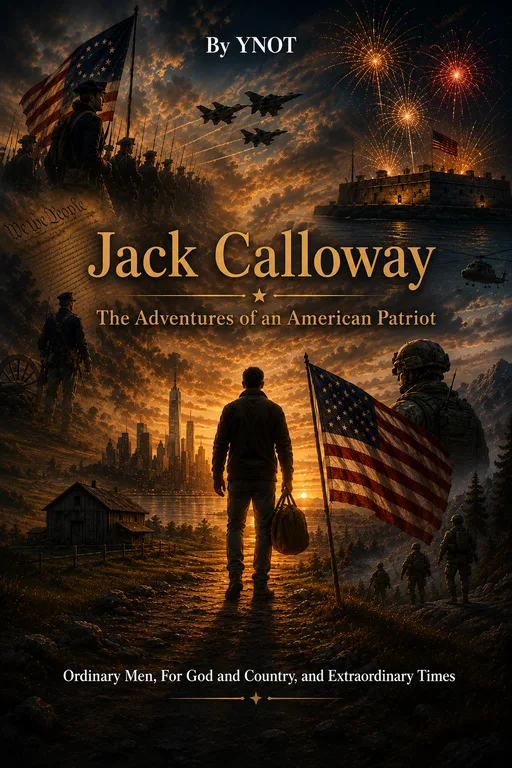
Jack Calloway
By YNOT
Table of Contents
- Foreword
- Dedication
- Introduction
- The Name We Carry
- We do what others can't or won't do
- Poppy Wars
- Operation Valhalla
- No Pardon from Death
- Pain - The Weight of War
- Shadow Doctrine and Moral Flexibility
- The Shadow Economy
- A Tale of Two Ghosts
- The Shadow Reel
- What to Do If You Get Shot
- The Candy Striper Who Saved My Life
- How to Nuke an Ant
- The Gullwing Affair
- The Secrets of the Deep Web
- Foghorn when there is Silence in the Fog
- Tri-Border Shadows Hezbollah’s ATM
- The Bar at the End of the Empire
- Another Thursday at the Pub - USAID
Title Page
The Price of Freedom
Jack Calloway: The Adventures of an American Patriot.
Foreword
Every family has stories.
Some are documented. Some are remembered. Some are polished by time until fact and legend begin to share the same chair.
This story belongs somewhere in that space.
I cannot tell you with certainty that there was a Jack Calhoun who marched with Washington, nor can I prove that a man from his line stood at Fort McHenry beneath the rockets’ red glare.
But men like him did. They stood in the cold. They stood in the dark. They stood when standing was dangerous, uncomfortable, and often unrewarded. History remembers the generals, the presidents, and the great speeches. But countries are carried forward by ordinary people whose names rarely survive the journey.
Jack Calhoun represents those people.
This opening story is more fictional than most of the others in this series. It is meant to set the tone, establish the inheritance, and explain the burden of a name.
The stories that follow are different. Some are fiction.Some are memory.Some are history with the names changed, the edges softened, and the doors left slightly closed.
Many of the events behind Jack Calhoun come from real places, real work, real dangers, real conversations, and real decisions made by real people who were never looking to become characters in a book.
How much is true? That is not always the most important question.
A better question may be: what kind of truth survives after the names are changed?
Jack Calhoun is not presented as a superhero. He is not a mythic warrior or a flawless patriot. He is a man shaped by duty, pressure, mistakes, instinct, loyalty, and consequence.
In other words, he is human.
And America has always depended on humans like that.
Not perfect people.
Not famous people.
Not people who knew, in the moment, that history would care what they did.
Just people who showed up when the situation required it.
As America reaches 250 years, it is worth remembering that a nation is not sustained by documents alone. A Constitution can create a framework. A flag can create a symbol. A government can create institutions.
But people must carry the weight.
Every generation receives the country unfinished.
Every generation decides what to protect, what to repair, what to forgive, and what to pass on.
These are the stories of one man called Jack Calhoun.
Or perhaps more than one.
Perhaps that is for the reader to decide.
Welcome to the adventures of an American patriot.
Copyright
Copyright © 2026- YNOT – Tony Lester. All Rights Reserved.
This book is made available in the hope that it will be read, shared, discussed, and enjoyed.
You are welcome to download this book, keep a copy for yourself, and share the original, unaltered PDF with friends, family, classrooms, libraries, veterans’ organizations, or anyone else who might appreciate it. No permission is required for non-commercial sharing.
However, this work may not be altered, sold, republished, translated, incorporated into another publication, or used for commercial purposes without the author’s written permission.
**Motion picture, television, streaming, theatrical, audiobook, podcast dramatization, gaming, and all other adaptation rights are expressly reserved.** If these stories inspire a film, television series, documentary, or other commercial production, I’d love to have that conversation first.
The characters, original stories, and creative expression contained in this work are protected by copyright, even where they are inspired by historical events or real-life experiences.
Stories are meant to be shared. Great stories deserve to be told well.
Dedication
Dedicated to the men and women who, over the past 250 years, have stood watch over the United States of America.
To those who left home so others could remain safely in theirs.
To those who stood on distant shores, sailed unknown seas, flew into hostile skies, patrolled lonely frontiers, and walked into danger so their fellow Americans would not have to.
To those who answered the call, whether by choice or by duty.
To those who carried burdens they could never fully explain.
To those who returned forever changed.
To those who never returned at all.
Freedom has never been free.
Its cost has been measured not only in lives lost, but in years spent far from family, in sacrifices never seen by the public, in wounds both visible and invisible, and in the quiet weight carried long after the fighting ended.
Every one of them paid a price.
Some paid with time.
Some with health.
Some with peace.
Some with everything.
This book is dedicated to all who accepted that burden so that future generations might inherit a nation where liberty could endure.
May we never forget that the blessings we enjoy today were purchased by the courage, sacrifice, and devotion of ordinary Americans who chose to do what others did not have to.
Their names may not all be recorded.
Their service is written into the history of our nation.
May God bless them all.
Preface
Every now and then someone asks me a simple question.
How much of Jack Calloway is fiction?… and how much is memory? That mystery becomes part of the experience. It also keeps me out of legal problems.
Where do you get your stories?” The answer is both simple and complicated.
Some come from history. Some come from conversations that happened decades ago. Some come from places I have been fortunate—or unfortunate—enough to see.
Some come from events that are part of the public record. Others are the kinds of stories that are only told quietly among friends long after they happen.
Jack Calloway was born because I needed someone who could walk through all of those worlds. He is not a superhero. He is not always right. He is not fearless.
He makes mistakes. He trusts the wrong people. He carries burdens he doesn’t always understand.
Sometimes he succeeds. Sometimes he pays for his decisions. Like all of us. And he has the scares to prove it.
Over the years I have learned something about history. The people who make the greatest difference are rarely the people whose names appear in headlines.
Most are ordinary men and women doing difficult jobs extraordinarily well. Teachers. Police officers. Soldiers. Engineers. Farmers. Pilots. Intelligence officers.
And also Parents. Neighbors. Citizens.
History remembers the famous. Civilization survives because of everyone else.
Jack Calloway represents those people. As you read these stories, you may occasionally find yourself wondering,
“Did that really happen?” Sometimes the answer will be yes. Sometimes it will be may be.
Sometimes the answer is more interesting than either. I will leave it to you to decide which is which.
That mystery is part of the journey. This series is not intended to rewrite history. Nor is it intended to glorify war.
War is rarely glorious. It is expensive. Messy. Heartbreaking.
Those who have experienced it understand that better than anyone.
Instead, these books are about something much older than war.
Duty. Honor. Friendship. Sacrifice. Responsibility.
The quiet choices that define a person’s character long before history notices.
As America begins its next 250 years, we are once again living in extraordinary times.
Technology is changing faster than society can absorb it.
The world seems both larger and smaller than ever before. Old enemies have returned.
New challenges appear almost daily.
Yet one thing has not changed. Every generation inherits a country built by those who came before.
Every generation must decide what kind of country it will leave behind.
That is the burden—and the privilege—of freedom.
If Jack Calloway reminds us of anything, I hope it is this:
Great nations are not preserved by extraordinary people alone.
They are preserved by ordinary people who refuse to abandon extraordinary principles.
Thank you for taking this journey with me.
I hope that somewhere along the way you find a piece of your own story in Jack’s.
After all…
Every family carries a name. Every name carries a story. And every generation decides what that story will become.
YNOT
Introduction
There are two kinds of heroes.
The first are the ones history remembers.
Their names are carved into monuments, taught in classrooms, and spoken during ceremonies. Presidents, generals, explorers, and statesmen occupy the pages of our history books, and rightly so. Their leadership helped shape the course of our nation.
The second kind are seldom remembered.
They are the men and women who quietly answered the call when their country asked something of them. They served without expecting recognition. They accepted hardship without asking for applause. They carried responsibilities they could never fully explain and, in many cases, burdens they would carry for the rest of their lives.
Their names rarely appear in history books.
Yet without them, there would be no history worth writing.
Jack Calloway represents those Americans.
Whether standing beside a frozen campfire during the Revolution, walking the deck of a warship, serving in distant lands, or navigating the quiet conflicts that never make the evening news, Jack reminds us that the strength of America has never rested solely in its leaders. It has always rested in the character of ordinary citizens willing to do extraordinary things when duty required it.
The stories you are about to read are works of fiction.
And they are not.
The names have been changed. Conversations have been reconstructed. Timelines occasionally compressed. Some events have been woven together to protect the privacy of those whose service was never intended for public attention.
Yet beneath the storytelling lies a foundation built upon real places, real events, real decisions, and experiences that could only have been written by someone who understands that history is often far more complicated than it appears from the outside.
That is what makes these stories compelling.
They are not tales of invincible heroes.
They are stories about imperfect people faced with impossible decisions.
About loyalty.
Duty.
Sacrifice.
And the quiet courage that rarely receives public recognition.
The America of today did not simply happen.
It was built one generation at a time by citizens who believed that preserving liberty required more than words. It required commitment. Sometimes inconvenience. Sometimes hardship. Occasionally everything.
Every generation inherits that responsibility.
The challenges may change. The uniforms may change. The technology certainly changes. But the essential question remains the same:
When your country, your family, or your principles require something difficult of you, what will you do?
Jack Calloway offers no easy answers.
Instead, he reminds us that freedom has always depended upon ordinary Americans who chose duty over comfort, service over recognition, and principle over convenience.
As our nation begins its next chapter, these stories invite us to remember those who came before us—not only the famous names found in every history book, but the countless others whose quiet service made those histories possible.
If these pages leave you with a greater appreciation for the price of liberty, a deeper respect for those who have served, and a renewed sense of your own responsibility to those who will follow, then they will have accomplished their purpose.
The story begins with one man.
In the end, it is about all of us.
The Name We Carry

The fireworks had not yet begun.
The evening air was still, the kind of July heat that lingered long after the sun had disappeared below the horizon. Across the neighborhood, American flags stirred lazily in the breeze. Somewhere in the distance a marching band rehearsed one last patriotic tune before darkness would bring the celebrations.
Jack Calloway sat on the porch exactly where he had sat every Fourth of July for nearly thirty years. His grandchildren knew the routine.
When Grandpa sat in that chair with a glass of iced tea and the old walnut box beside him, there would be stories.
Not fairy tales. Not stories about dragons or pirates. Stories about America.
Stories about ordinary people who found themselves living through extraordinary times.
The youngest, Emily, climbed onto the porch rail.
“Grandpa… why do you always tell us these stories on the Fourth of July?”
Jack smiled without taking his eyes off the flag hanging from the porch.
“Because freedom has a funny way of becoming invisible.”
The children looked puzzled.
“You don’t notice electricity until the lights go out. You don’t notice clean water until you don’t have it. And you don’t usually notice freedom until someone starts taking it away.”
He paused.
“That’s why every generation has to remind the next one what it cost.”
The children grew quiet.
Jack rested his hand on the old walnut box. “This belonged to my father.”
He opened it carefully.
Inside were faded letters, a tarnished brass button, an old powder horn tip, and a folded piece of yellowed paper covered with names written in careful handwriting.
“This,” he said softly, “is where our family begins.”
Tommy leaned closer.
“Our first known ancestor in America was another Jack Calloway.”
“He wasn’t important.” “He wasn’t wealthy.”
“He wasn’t one of the men whose portraits hang in museums.”
“He was simply a farmer.” “A man with rough hands.”
“A wife.” “A few children.” “A patch of land.”
“And then history knocked on his door.”
Jack looked toward the horizon.
“People sometimes imagine the American Revolution as if everyone agreed that independence was a wonderful idea.”
He chuckled quietly.
“It wasn’t like that at all.” “Families argued.”
“Neighbors stopped speaking.”
“Churches divided.” “Some remained loyal to the King.”
“Others wanted independence.”
“Most simply wanted to be left alone.”
He looked at his grandchildren.
“History is rarely as neat as textbooks make it sound.”
“When the shooting started, no one knew if the colonies could win.”
“In truth, most people thought they would lose.”
“So why fight?” Emily asked.
Jack nodded. “That’s the right question.”
He leaned forward. “Our ancestor didn’t fight because victory was guaranteed.”
“He fought because there are moments in history when a man must decide whether comfort is more valuable than principle.”
“There are moments when doing nothing is also a choice.”
“And he decided.” “He picked up his musket.”
“He kissed his wife.” “He left his farm.”
“And he marched to join General George Washington.”
Jack’s voice grew quieter. “You’ve all heard of Washington.”
“But here’s something history often forgets.”
“Washington did not win America by himself.”
“He couldn’t.” “He was one man.”
“Behind every famous commander stood thousands of anonymous men whose names history almost forgot.”
“Cold.” “Hungry.” “Poorly clothed.” “Often unpaid.”
“They buried friends.” “They marched anyway.”
“They lost battles.” “They came back.”
“They lost again.” “They came back again.”
Jack stopped. “That is what won the Revolution.”
“Not one great battle.” “Persistence.”
The children listened without interrupting.
“Our family story says Jack Calloway survived Valley Forge.”
Jack looked toward the stars beginning to appear overhead.
“If you’ve ever wondered what courage looks like, don’t imagine a man charging into battle.”
“Imagine a soldier whose shoes have fallen apart.”
“Imagine wrapping bloody feet with strips of cloth.”
“Imagine eating almost nothing for days.”
“Imagine watching disease carry away your friends one by one.”
“And then imagine standing in formation the next morning anyway.”
He let the silence settle. “That is courage.”
Not excitement. Not anger. Not shouting. Simply refusing to quit.
Several moments passed before Tommy asked,
“Did he ever meet Washington?”
Jack smiled. “I don’t know.” “He probably saw him.”
“Washington rode among his men often.”
“I’ve sometimes imagined our Jack standing there in the snow as Washington rode past.”
“No grand speech.” “No handshake.” “Just a brief moment.”
“But perhaps that was enough.”
Years later, family records become uncertain.
Some names disappear. Some dates conflict. But one story survives.
Another generation. Another war. Another Jack Calloway.
This time during the War of 1812.
He found himself among the defenders of Fort McHenry.
“The British believed they could break American resistance by taking Baltimore.”
“So they anchored their ships and bombarded the fort through the night.”
Jack looked toward the darkening sky.
“You’ve all sung the National Anthem.” “‘The rockets’ red glare…'”
He nodded slowly. “Those weren’t poetic decorations.”
“They were eyewitness testimony.” “British Congreve rockets screaming through the darkness.”
“Bombs exploding over the harbor.” “The sky flashing red all night long.”
“Smoke so thick men could barely see.” “The defenders didn’t know if the walls would hold.”
“They didn’t know if morning would ever come.”
“They couldn’t even see their own flag most of the night.”
He paused.
“And that is why Francis Scott Key kept looking.”
“He wasn’t searching for a beautiful sunrise.” “He was searching for proof that America was still standing.”
Jack’s voice dropped almost to a whisper. “When dawn finally broke…”
“…there it was.” “Not perfect.” “Not untouched.” “Not clean.”
“The flag had survived exactly as the nation had survived.”
“Damaged.” “Scarred.” “But still standing.”
The first firework burst across the night sky.
The children watched the colors bloom overhead.
Jack watched them instead.
“Every generation believes its problems are unique.”
“They’re usually not.” “The tools change.” “The uniforms change.”
“The technology changes.”
“But the questions remain the same.” “What is freedom worth?”
“What are you willing to sacrifice to preserve it?”
“What kind of country will you leave your children?”
He looked each grandchild in the eye.
“The greatest danger to a republic isn’t always an army crossing the border.”
“Sometimes it’s a people who forget why the republic existed in the first place.”
“The Constitution doesn’t defend itself.” “Freedom doesn’t maintain itself.”
“Character doesn’t pass automatically from one generation to the next.”
“Someone has to teach it.” “Someone has to live it.”
He gently closed the walnut box.
“I’ve spent my whole life trying to be worthy of carrying the name Jack Calloway.”
He smiled softly. “I don’t know if I’ve succeeded.”
“But now…” “…one day…”
“That responsibility will belong to one of you.”
The fireworks began in earnest now, echoing across the summer sky.
The grandchildren no longer looked at the explosions.
Instead, they looked at the old man sitting quietly beneath an American flag that moved gently in the evening breeze.
For the first time, they understood that they had not inherited a name.
They had inherited a duty.
If this story captured your imagination, there’s much more to discover. Read the complete series in book form HERE
We do what others can't or won't do

It was a Tuesday night in a dive so worn-out, even the neon sign had given up halfway through spelling “Saloon”. Inside, the jukebox wheezed out a Hank Williams tune like it was on life support, and four men sat around a battered oak table—the kind of men who don’t talk much, unless they’ve bled for it.
Each one bore the mark: a scar, a twitch, a thousand-yard stare dulled by time and just enough whiskey.
The Navy SEAL tipped his glass and said, “I slipped out of a torpedo tube like a damn fish with grenades. Swam four miles in dark water, popped up behind enemy lines, and tagged a missile truck before sunrise. No one even knew we were there.”
The Green Beret chuckled. “Cute. I hiked in through the jungle, drank goat milk with the warlord, taught his boys how to use their AKs right, and led a coup before the State Department figured out who was running the country.”
The Ranger grinned like a wolf. “Y’all do warm-ups. I drop from a bird into hell. Hit the target, clear a village, extract a hostage, and light the sky up so clean that even the satellites clap.”
The Air Force PJ finally leaned in, calm and solemn. “And when you break or bleed, I patch you up, drag you out, or carry what’s left. I don’t make headlines. I clean them up.”
They laughed, a kind of laughter only earned in places too far from home to ever explain.
But then the old bartender—silent until now, polishing a glass so hard it looked like it owed him money—looked up and said:
“Yeah, that’s all well and good… but the CIA guy was there two weeks before any of you, sabotaged the radar, compromised the computers, bought off the colonel’s mistress, and told you exactly where to go.”
The four men turned, a little surprised—but not really—and nodded slowly.
The bartender wasn’t done
“I wasn’t always an old bartender. Hell, I probably killed more people than the four of you combined. Diem, Trujillo, Allende, Guevara, Schneider… I didn’t just hear of ’em—I knew ’em. Some too well.”
The room went quiet.
Even the jukebox stopped mid-twang like it didn’t want to interrupt history.
He poured four bourbon shots from a dusty bottle no one had seen him touch all night.
“On the house,” he said. “For the ones who didn’t make it back.”
They each raised a glass—not in toast, but in tribute—because for all the missions and medals, the best they’d ever done was make it home to tell the tale.
And somewhere between the third beer and the fourth round, they stopped being legends… and went back to being brothers.
Now, I ain’t saying war makes a man wise—but it sure tells you who knows what matters. And sometimes, it turns out, the fella wiping the bar knows more about life, death, and coups than the boys bragging over beers.
Because in the end, all legends fade, missions blur, and medals collect dust.
But a good story?
That’ll live on—especially if the bartender lived long enough to tell it.
Here is a breakdown of all the US Special Forces and Special Operations that I can remember.
May be there are more lately.
The United States has a wide array of special operations forces (SOF), each with specialized missions, training, and organizational structures. These elite units operate under various branches of the military and are primarily overseen by U.S. Special Operations Command (USSOCOM).
Here’s a structured breakdown of U.S. Special Forces and Special Operations Units:
🔰 U.S. Army Special Operations
1. Green Berets (U.S. Army Special Forces)
- Primary Missions: Unconventional warfare, foreign internal defense, direct action, counterterrorism, special reconnaissance.
- Structure: Organized into 5 active-duty Special Forces Groups (1st, 3rd, 5th, 7th, 10th) and 2 National Guard groups (19th and 20th).
- Known For: Working “by, with, and through” indigenous forces.
2. 75th Ranger Regiment
- Primary Missions: Direct action raids, airfield seizures, personnel recovery.
- Structure: 3 Ranger battalions + Regimental HQ & Special Troops Battalion.
- Known For: Fast-paced, large-scale special operations.
3. Delta Force (1st SFOD-D)
- Primary Missions: Counterterrorism, hostage rescue, high-value target capture.
- Structure: Highly classified; operators drawn from Army, especially Rangers and Special Forces.
- Known For: One of the most secretive and elite units globally.
🛩 U.S. Air Force Special Operations
4. Air Force Special Tactics (AFSOC)
- Sub-units:
- Combat Controllers (CCT): Coordinate air support in hostile environments.
- Pararescuemen (PJs): Elite medics trained in combat search and rescue.
- Special Reconnaissance (SR): Formerly Special Operations Weather Technicians.
- Known For: Precision targeting, rescue missions, and battlefield air traffic control.
⚓ U.S. Navy Special Operations
5. SEAL Teams (Sea, Air, Land)
- Primary Missions: Direct action, special reconnaissance, counterterrorism, hostage rescue.
- Structure: SEAL Teams 1–10 + SEAL Delivery Vehicle Teams + DEVGRU (SEAL Team Six).
- Known For: High-profile operations (e.g., bin Laden raid).
6. SEAL Team Six (DEVGRU)
- Primary Missions: Tier 1 CT and HVT capture/kill missions.
- Known For: The most elite and secretive SEAL unit, often operating under CIA or JSOC command.
7. Special Warfare Combatant-Craft Crewmen (SWCC)
- Primary Missions: Infiltration/exfiltration of SEALs, coastal reconnaissance, riverine operations.
- Known For: Operating high-speed boats in dangerous environments.
🦅 U.S. Marine Corps Special Operations
8. Marine Raiders (MARSOC – Marine Forces Special Operations Command)
- Primary Missions: Direct action, special reconnaissance, counterinsurgency, foreign internal defense.
- Structure: Marine Raider Battalions.
- Known For: Combining Marine toughness with SOF mission adaptability.
🛰 Joint Special Operations Command (JSOC)
9. JSOC – Tier 1 Units
- Oversees: Delta Force, SEAL Team Six, 24th STS (Air Force), and intelligence/support elements.
- Primary Role: Execute the most sensitive and classified missions.
- Known For: Direct action, CT, and global manhunting operations.
📡 Support and Intelligence Units
10. 160th SOAR (Night Stalkers)
- Branch: Army
- Mission: Helicopter transport for special operations; fly under the radar, at night, in any condition.
- Aircraft: MH-60 Black Hawk, MH-47 Chinook, AH-6 Little Bird.
- Known For: Supporting Delta, SEALs, and Rangers.
11. Intelligence Support Activity (ISA)
- Nickname: The Activity / Gray Fox.
- Mission: Signals and human intelligence collection; often operates before or alongside Tier 1 units.
- Known For: Extremely classified; specializes in surveillance and target development.
🧭 Command and Oversight
12. USSOCOM (U.S. Special Operations Command)
- Location: MacDill AFB, Florida.
- Role: Oversees all SOF operations, planning, and budgeting.
13. SOCOM Service Components
- USASOC (Army)
- NAVSPECWARCOM (Navy)
- AFSOC (Air Force)
- MARSOC (Marines)
- JSOC (Joint Tier 1 Command)
🕵️♂️ Covert & Clandestine U.S. Special Operations Units
14. CIA Special Activities Center (SAC)
Formerly: Special Activities Division (SAD)
SAC is divided into:
A. Special Operations Group (SOG)
- Role: Paramilitary operations, covert action, sabotage, assassination, raids, training insurgents.
- Personnel: Often former Tier 1 SOF (e.g., Delta, SEAL Team 6) who now work as civilians for CIA.
- Notable for: Operations in Afghanistan pre-2001 invasion, bin Laden tracking, black ops globally.
B. Political Action Group (PAG)
- Role: Covert influence, election manipulation, regime change, psychological warfare.
Known For:
- Operating outside the DoD chain of command.
- Missions require presidential authorization and often carry plausible deniability.
- SAC/SOG operators may blend in with civilians, use false identities, and work in non-permissive environments (no U.S. military footprint).
15. CIA Ground Branch / Maritime Branch / Air Branch
- Ground Branch: Similar to Delta/SEALs—handles land-based covert operations.
- Maritime Branch: Infiltration/exfiltration via water, often trained with Navy SEALs.
- Air Branch: Operates clandestine aircraft for insertions, surveillance, or extractions.
- These units are staffed with elite former SOF operatives and are highly compartmentalized. They are not publicly acknowledged in detail but are widely known within defense/intel communities.
16. NSA’s Tailored Access Operations (TAO)
- Role: Cyber infiltration, hacking foreign governments, sabotage via malware.
- Relevance: While not boots-on-ground, these cyber “operators” may soften the battlefield for kinetic operations.
17. FBI Hostage Rescue Team (HRT)
- Role: Domestic counterterrorism, hostage rescue, high-risk arrests.
- Comparable to: Tier 1 operators, but for U.S. soil; they train with SEALs and Delta.
- Operates under DOJ, not DOD or CIA.
🕳️ Black Budget Projects and “Other Government Agencies”
- The term “Other Government Agency (OGA)” often refers to the CIA in special operations parlance.
- “Black” units may exist under non-attributed cover: e.g., fake corporations, foreign flags, or front NGOs.
- These units carry out the dirtiest, most politically sensitive missions, including:
- Sabotage behind enemy lines
- Assassinations of HVTs
- Arming and training militias (e.g., the Syrian rebels, anti-Taliban forces pre-2001)
⚖️ Key Differences Between Military and CIA SOF
| Aspect | Military SOF | CIA SAC/SOG |
|---|---|---|
| Chain of Command | Department of Defense | Central Intelligence Agency |
| Oversight | Congress / DoD | Intelligence Oversight Committees |
| Legal Framework | Title 10 of U.S. Code | Title 50 of U.S. Code |
| Admitted Presence | Usually declared | Usually denied (plausible deniability) |
| Operational Cover | Military uniforms | Civilian cover, often without ID |
| Use Cases | War zones, foreign internal defense | Deniable missions, pre-war intelligence |
🎖️ Joint Operations (CIA + Military)
- Example: During the raid on Osama bin Laden’s compound, SEAL Team Six operated under CIA authority.
- Why? To provide plausible deniability and avoid declaring an act of war on Pakistan.
🪖 U.S. Special Operations & Covert Forces Comparison Chart
| Unit | Agency/Branch | Tier | Primary Role | Notable Missions | Distinctive Traits |
|---|---|---|---|---|---|
| Delta Force (1st SFOD-D) | U.S. Army (JSOC) | Tier 1 | Hostage rescue, CT, HVT capture | Somalia (Black Hawk Down), ISIS HVTs | Extreme secrecy, elite Army recruits only |
| SEAL Team Six (DEVGRU) | U.S. Navy (JSOC) | Tier 1 | Maritime CT, raids, HVT capture/kill | bin Laden raid, Maersk Alabama | Operates under JSOC or CIA, elite SEALs only |
| CIA SAC/SOG | CIA | Black/Ops | Covert ops, sabotage, assassinations, arming rebels | Afghanistan 2001, Phoenix Program, Syria | Plausible deniability, no uniforms, non-attributable |
| CIA Ground Branch | CIA | Black/Ops | Paramilitary land ops | Afghanistan, Iran pre-operations | Ex-Delta/SEALs, works behind enemy lines |
| Green Berets | U.S. Army Special Forces | Tier 2 | Unconventional warfare, train foreign forces | Vietnam (Montagnards), Afghanistan 2001 | Language skills, work with locals, indigenous forces |
| 75th Ranger Regiment | U.S. Army | Tier 2 | Direct action, airfield seizures, raids | Panama, Iraq, Syria | Light infantry with special ops capability |
| Marine Raiders (MARSOC) | U.S. Marine Corps | Tier 2 | CT, FID, direct action | Africa, Afghanistan, Philippines | Newest SOF component, Marine ethos |
| Air Force PJs & CCTs | U.S. Air Force (AFSOC) | Tier 2 | Combat rescue (PJs), air control in battle (CCTs) | All major conflicts, MEDEVACs | Dual-skilled as medics, air controllers |
| 160th SOAR (Night Stalkers) | U.S. Army Aviation | Tier 2/Support | Air transport for SOF in hostile conditions | bin Laden raid, countless insertions | Flies under radar, blacked-out choppers |
| SWCC | U.S. Navy | Tier 2 | Small boat insertion/extraction for SEALs | Drug interdictions, SEAL support | Fast-attack boats, riverine stealth |
| CIA Maritime Branch | CIA | Black/Ops | Infiltration/exfiltration via sea | Unknown/Unconfirmed | Operates like SWCC but covert |
| CIA Air Branch | CIA | Black/Ops | Air insertions, extractions, surveillance | UAV ops, covert flights in Pakistan, Iran | Clandestine aircraft, unmarked missions |
| FBI HRT | DOJ / FBI | Tier 1 (Domestic) | Hostage rescue, CT, high-risk arrests (U.S.) | Waco Siege, D.C. snipers | Domestic only, works closely with JSOC sometimes |
| NSA TAO | NSA | Cyber | Offensive cyber warfare, intelligence collection | Stuxnet (with Israel), China hacking campaigns | No boots-on-ground, battlefield preparation |
| ISA (The Activity) | DoD (JSOC-linked) | Tier 1/Intel | Signal and human intel, target tracking | bin Laden surveillance, Colombia rescues | “Find, fix, finish” support for Delta, SEAL 6 |
🔒 Tier System (Simplified)
| Tier | Meaning | Examples |
|---|---|---|
| Tier 1 | Elite, national-level missions | Delta Force, SEAL Team Six |
| Tier 2 | High-skill, conventional SOF | Rangers, Green Berets, regular SEAL Teams |
| Tier 3 | Conventional forces | Infantry, Marines, etc. (sometimes supporting SOF) |
📌 Key Definitions
- Tier 1: National-level direct action forces (ultra-elite, secretive).
- Tier 2: Highly trained, theater-level special forces with broader roles.
- Black/Ops: Unacknowledged units working under Title 50 (CIA) or Presidential Directive.
- FID: Foreign Internal Defense (training allied forces).
- CT: Counterterrorism.
- HVT: High-Value Target.
Poppy Wars

The heat in Kandahar was the kind that made men reconsider their choices in life. Jack Calloway sat in the humvee, watching Senator Richard Halford wipe sweat from his forehead with the kind of silk handkerchief only a politician would carry.
“This better be worth it, Calloway,” Halford muttered, adjusting his aviators. “I didn’t fly halfway around the world just to confirm what I already know.”
Jack didn’t respond. He was just the assistant. His job was to observe, take notes, and—when needed—keep the senator alive.
The convoy rolled to a stop near a vast valley. Miles of opium poppy stretched in every direction, the delicate flowers almost beautiful in the warm glow of the sun. A billion-dollar industry, all under U.S. occupation.
Their guide, a young State Department official, squirmed in his seat. “Listen, , I know you want to see the fields, but there are protocols—”
Halford cut him off. “I don’t give a damn about protocols. I’m here to find out why American taxpayers are funding a heroin empire.”
The convoy reached a barren stretch of land where, as far as the eye could see, green stalks of opium poppy swayed in the breeze. Farmers toiled under the sun, irrigation channels carrying stolen river water to nourish the cash crop. J
Halford took a slow breath. “Jesus Christ.”
A local farmer, old and hunched with a lifetime of labor, approached cautiously. The translator stepped forward, and Halford adopted his concerned statesman look.
“Ask him why he grows poppy instead of food, he could grow food twice a year,” Halford said.
The old man hesitated, his eyes darting to the military escort nearby. “Men in uniform. They said if we helped them find the Arabs, we could grow all the poppy we wanted.”
Jack barely had time to process the implications before a firm hand gripped his shoulder. A soldier from his security detail. “Sir, we need to go. Now.”
“Not yet.”
“Now,” the soldier growled, his voice edged with something Jack didn’t like—fear.
The farmer answered again in a whisper. When the translation came, Jack saw Halford’s jaw tighten.
“The Americans told us we could, they gave us money to grow it”
Halford glanced at Jack, then at the military escort. “Which Americans?”
The farmer hesitated, his eyes darting nervously. “The ones who came in 2001,” he finally said. “They told us—help them find the Arabs, and we got trucks and generators.”
Silence.
Jack didn’t have to look at Halford to know what was going through his head. The senator had expected corruption. Maybe even black-market dealings.
But this?
This was policy.
“Let’s go,” Halford said abruptly.
The military escort didn’t argue. Within minutes, they were back in the Vees, speeding toward the airbase.
The Trap
They were supposed to be on a plane back to Washington. That was the plan.
Except plans change.
Halfway through the flight, the aircraft made an unscheduled descent, touching down at a remote airstrip that Jack knew wasn’t on any official map.
The engines hummed as the plane taxied to a stop. Halford leaned toward Jack. “What the hell is going on?”
Jack didn’t answer.
A man in civilian clothes, tall and built like a soldier, stepped onto the plane. He carried himself with the calm authority of someone who never had to explain himself.
“Senator Halford,” the man greeted, his voice smooth as silk. “We need to have a chat.”
Halford didn’t move. “And if I say no?”
The man smiled. “Then we talk here. But I doubt you want that.”
Jack exhaled. He could already tell this wasn’t a request. He glanced at Halford, who gave a reluctant nod.
“Let’s get this over with,” the senator muttered.
They stepped onto the tarmac, the desert wind kicking up dust. The man led them to a makeshift office inside a small, windowless building. A single table, three chairs, and a file already waiting.
Halford sat down. Jack remained standing.
The man flipped open the file. “You’ve seen things, Senator. Heard things. I imagine you have questions.”
“You could say that,” Halford said. “Like why the U.S. military is allowing Afghanistan to produce enough heroin to drown the world.”
The man tapped the file with two fingers. “Because we control where it goes.”
Halford’s hands clenched into fists. “Let me guess. Russia and Iran?”
The man nodded. “It weakens them. Keeps their populations docile. Their economies strained. You understand geopolitics, Senator. This isn’t just tolerated—it’s strategic.”
Halford let out a dry, humorless chuckle. “You people are insane.”
The man’s expression didn’t change. “We’re realists. The world isn’t about good and bad. Just bad and worse.”
Halford shook his head. “So what now? You make me disappear?”
The man smiled again. “Not yet. We’re offering you a choice. You can return to Washington, resume your work, and forget this ever happened. Or…”
He didn’t finish the sentence. He didn’t have to.
Halford met Jack’s gaze. Jack didn’t say a word, but he didn’t need to.
Finally, the senator stood. “This conversation never happened.”
The man nodded. “A wise decision.”
They walked back toward the plane in silence.
As they reached the steps, Halford muttered under his breath, “I should’ve never come here.”
Jack followed, pausing only for a moment before replying:
“Some wars just aren’t worth getting involved in.”
The engines roared to life.
Jack had the sinking feeling this war was already lost.
There’s more truth in this story than in the JFK files. It’s a true story—research it. But the names? Well, no one will admit to anything. We did our best to avoid torturing any kittens, but we can’t take responsibility for anything else. Your mileage may vary, so surf responsibly.
Operation Valhalla
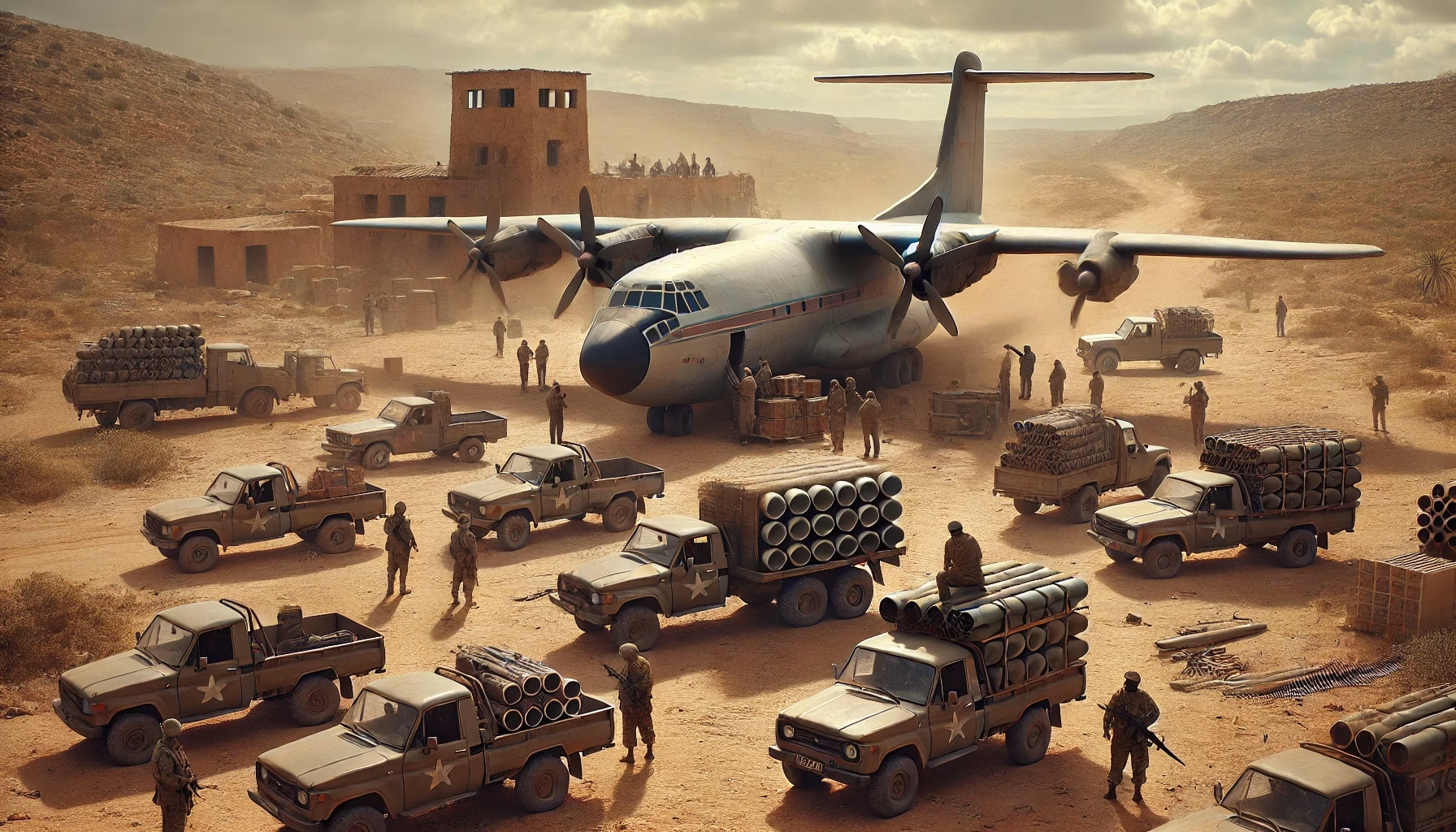
Around 2000, we were flying into Somalia in a big old four-turboprop converted Russian cargo plane from Yemen. We had just heard that the USS Cole had been hit.
We heard the pilot say, “We are getting ready to land in five minutes, put everything away and put on your seat belts. Please make sure your livestock is tied down. We will be spiraling down for a landing and coming in quickly to avoid Surface-to-Air Missiles.”
As we spiraled down, we could hear the chickens and goats screaming.
Five minutes later, we were down on a desert strip whose only building was a small structure made from rocks that also doubled as a jail.
Before we even fully landed, dozens of pickup trucks, many with .50 cals mounted in the back, came to the plane. We didn’t know why they were there.
Before we could even get off the plane, the belly of the beast opened, and everything was being unloaded. Some items were long cylindrical tubes, all kinds of parts, and of course, our equipment too. Finally, we were escorted to our jeep, and we ran across the desert in the jeep caravan with .50 cals in front and back. I don’t know if I felt secure or not with them there. But we had no choice. We were on our way somewhere hidden.
Jack Calloway was no longer in the Navy. Now, he was a private citizen, a businessman, a spy. His new mission: locate the Drug Lords hidden among the War Lords. For two months, he had traveled across Pakistan and Afghanistan, slipping through the cracks, blending into the chaos. He had met with smugglers, bribed informants, and shadowed his targets through dusty streets and sprawling bazaars.
Before we could get to the next stage in our mission, we had to recover. The heat was unbearable, and it takes its toll little by little. We had to trust our partners in Somalia, or we’d be dead already. So there was no point in worrying about it. We had to sleep, cool off, and get hydrated for tomorrow.
The job was to set up servers in the local phone companies of this town and others to provide them with dial-up internet and monitor telephone calls. It is very simple to bug or listen in to someone’s call in NYC, or if they call someone in Dallas from Somalia, since the calls come in through NYC. But what if they call Manchester or Lisbon and then patch the call to Hollywood, Florida? That is what Al-Qaeda was doing. So what is a three-letter agency to do? Put servers in Somalia. All they had to do was find someone crazy enough with the knowledge to do it.
So that is what we did over the next three months. We traveled all over Somalia and other places installing equipment purchased by warlords to spy on the warlords. Win/Win/Win—except for the terrorists. We thought it was about drugs, and there were plenty of drugs and weapons, but we didn’t know about 9/11. 9/11 was just months away.
We didn’t know what part of the search for The Sheikh, the mystery man behind the World Trade Center bombing and the U.S. embassy bombings in Kenya and Tanzania, we were helping with. To find someone, you don’t search where he is; you search where he was or where he isn’t. This is how you gather data on where he could be. Besides, he might double back, and UBL was the great possum with plenty of caves—literal and figurative—to hide, play dead, and disappear.
This part of our mission complete, we left Somalia, spending a boring week in Dubai becoming civilized again. We were all dying to eat an good American hamburger, we were tired of eating goat for months. We paid nearly $100 for a couple of burgers at Tony Roma’s in Dubai. The flight back from Dubai on that big Malaysian 777 was paradise—no more military cargo planes or worse, Soviet mixed cargo planes without a toilet.
But Jack’s mission was complete. Time to relax for a while. Then 9/11 happened.
Some months later, he got a mysterious call. They had found their man—the man who mattered—and it was passed on to Washington.
Now, it was time for action.
As the rumble of an MQ-1 Predator drone loomed overhead and the pilots raced to their target . A chaotic and fragmented engagement involving U.S. special forces, CIA paramilitary units, local Afghan militias, and al-Qaeda fighters closed in. Numbering in the hundred this small team had a complex mission to do, with reliance on natives that could switch sides or not fight at any time. The US Military brass decide not to commit to large US ground forces, just bombs.
Jack Calloway watched the fireball rise into the night sky on surveillance footage. Another mission complete. Massive B-52s, F-15s dropped thousands of pounds of bombs. It was like killing cockroaches with hand grenades. He hoped everyone made it out—everyone except the enemy, of course. The Sheikh escaped however. We all knew all too well—this war was far from over.
Because it relied heavily on airstrikes and Afghan proxy forces, and because many al-Qaeda fighters escaped into Pakistan.
There were at least 6-8 major operational plans specifically targeting Osama bin Laden between 1998 and 2011, not counting smaller intelligence operations, aborted plans, and missed opportunities.
NOTE: Most of this story is true, some is a bit fiction to keep from being boring. This operation had no official name. Everyone wants to forget it, but at least NO Americans died. The Battle of Tora Bora did happen, let’s not forget it. All characters are fictional to protect the innocent, as they say.
No Pardon from Death

Lieutenant Jack Calloway had survived war zones, covert operations, and near-impossible missions. But nothing had prepared him for this—captivity in a Somali prison, a crumbling compound near an airstrip in the middle of nowhere, where the sun baked the earth to a relentless 120 degrees.
His capture had been swift. An ambush during a classified reconnaissance mission left his team scattered—some dead, some captured, and some still unaccounted for. Now, he was here, locked in a sweltering cell where the air felt thick enough to choke on.
Every day, the guards came. They demanded information. He gave them nothing. They beat him. He endured.
But Jack knew one truth: You can always be rescued from prison. You can’t from a pine box.
And rescue was coming. It had to.
One night, as the oppressive heat barely lifted, a guard slipped him a note. A single line written in rough English:
“Truck comes Tuesday at 3 AM. Be ready.”
Jack studied it, his pulse steady despite the storm brewing inside him. A trap? A chance? He had played this game before—timing, patience, precision. One mistake, and he’d never leave this place.
For the next two days, he watched. The guards’ shifts. The patrol routes. The airport’s movements beyond the razor wire. Then, Tuesday arrived.
At 2:55 AM, he moved, silent as a shadow. The truck idled near the gate, dust swirling in its headlights. Two guards stood nearby—not the usual ones. Something felt… wrong.
Then, a voice behind him.
“You sure about this, Lieutenant?”
Jack turned. It was Ahmed, another prisoner—a former Somali soldier who had been rotting here even longer than Jack.
“You can always be rescued from prison,” Jack muttered. “You can’t from a pine box.”
Ahmed’s expression darkened. “Then don’t step inside one.”
Jack hesitated. A flicker of movement in the truck’s shadows—then he saw it. The muzzle of a rifle, barely visible through the slats.
He stepped back. A moment later, the guards grabbed another prisoner, shoving him toward the truck. The doors slammed. The engine roared to life.
A muffled gunshot rang out. Then silence.
Jack exhaled slowly. The note had been a setup. He had almost stepped into his own grave.
At sunrise, another note appeared beneath his cell door.
“Smart choice.”
Jack folded it, his mind already shifting to a new plan. He wasn’t getting out today. But he was getting out.
And when he did, there would be no pardon for the men who put him here.
Survival isn’t just about escaping—it’s about endurance, patience, and knowing when to strike. If you live through today, you still have a chance to change the outcome tomorrow.
Pain - The Weight of War

Lieutenant Jack Calloway was very familiar with pain.
He had known it in every form—sharp and immediate, like the searing bite of a bullet; explosive and deafening, like the shockwave of an IED hurling him into the dust; slow and agonizing, like the broken ribs he once had to set himself in the middle of a firefight.
He had seen pain on the faces of his brothers-in-arms as they bled out in the dirt, their hands gripping his like he could hold them to life. He had seen it in the eyes of his enemies—some defiant, some pleading, some already gone before they hit the ground.
Then there was the pain that didn’t come with blood or bruises. The kind that settled deep in the bones, never healing. The pain of watching his world unravel. The wreckage of his own life—promises broken, loved ones lost, a past he could never go back to.
Pain was something he understood, just like he understood everything else. Some pains were temporary. Some faded with time. Others, you could drink away or bury under the next mission, the next fight, the next kill.
And then there were the pains that stayed. The ones that haunted you every day, every night. The ones that whispered in the silence, that clung to you like a ghost, waiting in the shadows.
He had learned to live with all of them.
Because in war, pain wasn’t something you feared. It was something you carried.
The Roulette of Bullets
Bullets are a funny thing.
They never really know where they’re going to go.
It’s often said that the only thing that stops a bullet is a human body. That’s not really true. Sometimes a bullet rips right through flesh and muscle, a clean exit, leaving little more than a hole. Other times, it hits just wrong—clips a bone, ricochets inside, turning a single shot into a death sentence.
It’s all about the angle, the speed, the type of round, and just plain luck.
Luck.
That’s what it always comes down to. Whether you’re standing at the end of a barrel or behind the trigger, survival is just a game of inches.
The other thing that’s funny about bullets—even in the human body—is the smell.
That cauterizing stench.
It’s not like the movies, where bullets just punch holes clean through and people drop silently. No, when a round tears into flesh, the heat burns. The blood sizzles. There’s this sharp, metallic tang in the air, mixed with the iron scent of blood, sweat, and gunpowder.
You never forget that smell.
It lingers. Clings to your clothes, your skin, your memory. It’s the smell of war, of pain, of men who were standing a second ago and now aren’t.
Once you’ve smelled it, you know.
You know what death smells like.
The Fateful Day in Colombia
So I digress.
On that fateful day, our delegation was arriving at the Colombian Embassy—a massive structure in the middle of Bogotá, surrounded by high walls and a towering gate. From the outside, it was just concrete and steel, a fortress tucked into the city.
We pulled up in front of it, four vehicles in a tight formation. The streets were lined with buildings, perfect vantage points. Too perfect.
Then, it happened.
Gunfire. Heavy gunfire.
Windows shattered. Metal tore apart. Our van was getting ripped up before we even knew what was happening. Bullets screamed through the air, and in an instant, our four-vehicle convoy was down to one.
Somehow, we all ended up in a ditch—scrambling, bleeding, pinned down under relentless fire.
It was dark. Chaos. No one knew how bad it was. How many attackers? How many wounded? How many dead?
We were unprepared. Caught in the open. Most of us had taken a bullet. Some were luckier than others.
But in that moment, luck didn’t mean much.
No One to Trust
Colombia was a funny place back then.
It was a time when the FARC and the government were locked in a war that had no rules and no mercy. Every day, people were gunned down in shopping malls, blown apart on the streets, or simply disappeared without a trace. Death was routine, and fear was the currency everyone traded in.
You couldn’t drive from one town to the next without risking your life. A simple trip could end with you in the hands of guerrillas, tied to a tree, waiting for a ransom that might never come. Or worse, left in a ditch with a bullet in your skull.
And the worst part? You didn’t know who was more dangerous—the drug lords or the communists.
The cartels ruled with money and blood, carving out their empires in cocaine and corpses. The FARC fought under the banner of revolution, but in the end, they weren’t much different—both dealt in death, both thrived on fear.
I don’t really trust the police or the military either.
They work for both sides.
One day, they’re fighting the guerrillas, raiding jungle camps, burning coca fields, and hunting down rebels. The next, they’re taking a cut from the cartels, turning a blind eye at roadblocks, or worse—helping the same people they’re supposed to be fighting.
Loyalty wasn’t to the law. It was to whoever paid more.
In Colombia, everyone had their price. And if you didn’t have one, you were either already dead or just waiting your turn.
The Cowards Behind the Desk
War is pain.
Humans like to inflict pain.
They dress it up in flags, in speeches, in duty and honor. But at its core, war is about suffering—who can endure it, who can inflict it, and who can survive it.
And the ones who start wars? The ones who send men to die?
Most of them never feel a thing.
They sit behind desks, in air-conditioned offices, pushing buttons and signing orders. Their wars are fought on screens, their battles measured in numbers. They don’t bleed. They don’t hear the screams. They don’t smell the burnt flesh or feel the weight of a dying man in their arms.
Their hopes for greater glory are carried on the backs of others.
And when the war is over, they write the history. The medals go on their chests. The dead are buried, and the survivors—well, they just keep carrying the pain.
Full Circle
So we come full circle.
Pain is here to teach us. To remind us. To warn us. It carves its lessons into our flesh, etches them into our minds, hoping we’ll learn—hoping we won’t make the same mistakes again.
But we seldom listen.
Instead, we march forward, blind to the past, deaf to the warnings. The world spins, wars rage, men fight, men die. And those who survive? They collect their scars like medals, stacking them higher with each passing day.
Some medals are pinned to a uniform. Others are invisible.
But all of them are earned in blood.
Post Game
The Price of Survival
Jack Calloway lay flat in the ditch, his breathing steady despite the chaos around him. The gunfire had died down, but it hadn’t stopped. It never really stopped in places like this. The echoes of bullets still bounced off the embassy walls, fading into the distance, swallowed by the night.
They had been unprepared, caught in an ambush just feet from supposed safety. Four vehicles had rolled up to the embassy gate. Now, only one remained, riddled with holes, its occupants either dead, wounded, or cowering behind whatever cover they could find.
Jack turned his head slightly and saw him—Reese. His buddy. His teammate. The guy who was always first through the door, always had a joke before a mission, always seemed untouchable.
Not tonight.
Reese was lying on his back, staring up at the sky. His breathing was shallow, his chest rising and falling like a slowing tide. Jack had seen the wound—gut shot. Ugly. Deep. The kind that no medic could fix in the field.
Jack pressed hard on the wound, trying to stop the bleeding, knowing it wouldn’t be enough.
“Hang in there, man,” Jack muttered, though his voice was void of the usual lies soldiers told each other in moments like this. There was no you’re gonna be fine or help’s on the way. Just pain.
Reese coughed, a wet, gurgling sound. “Didn’t see that one coming…” he managed, his voice barely above a whisper.
The others had managed to crawl out of the line of fire. Some had bullet wounds, but they would live. Reese, though… he was slipping. Jack could feel it in the way his body grew heavier, how his grip on Jack’s wrist weakened.
He should have felt something—rage, sorrow, desperation. But all he felt was the weight.
Reese blinked slowly, his eyes unfocused. “Tell my kids, wife, sister… I—”
The words never came.
Jack didn’t need to hear them. He already knew.
He sat there for a moment, listening to the last breath leave his friend’s body. The distant gunfire seemed dull now, as if it were happening in another world.
War wasn’t about who lived or who died.
It was about who carried the pain.
Jack exhaled, grabbed Reese’s tags, and closed his friend’s eyes. Then, without another word, pushed down the ache in his chest, and prepared to keep moving.
Because in war, pain wasn’t something you feared.
It was something you carried.
But this was not the painful part.
The real pain came later.
It came when he stepped onto Canadian soil, when he knocked on the door of a house he had never been to before but knew too well.
It came when Reese’s sister opened the door and froze at the sight of him, they had somewhere to go.
It came when he met Reese’s kids.
They were too young to understand. A girl and a boy, standing close to their mother, staring up at the man in uniform who had come to take them to where no child should ever go. Jack had stood there, stiff, medals on his chest, dog tags in his palm, mouth dry.
What do you say?
What words could possibly explain why their father was never coming home?
There were no articles, no breaking news reports, no recognition beyond a quiet military funeral. Reese was Canadian. His death was buried under bureaucracy, sealed away in classified reports, forgotten by the media.
There would be no headlines. No national mourning. No honor beyond what his family and teammates carried in their hearts. He was buried like any other guy in a field of other people.
Jack Calloway had been in gunfights, had survived hellish firefights, had seen more death than any man should.
But standing in front of Reese’s family, seeing the pain in their eyes, hearing the quiet sniffles of a mother holding back tears, that was the hardest battle of all.
And it was one he could never win.
Shadow Doctrine and Moral Flexibility

Jack Calloway sat in a dimly lit classroom at The Farm, the CIA’s legendary training ground. The air smelled faintly of coffee and gun oil, the usual perfume of the place. Instructors took turns briefing the recruits on covert operations, their voices even and deliberate, the kind of tone used by men who had seen too much and felt too little.
Today’s lesson: Title 50 and Moral Flexibility.
At the front of the room, an instructor—a former case officer with eyes like steel—tapped the whiteboard. “There’s an old saying that when diplomacy fails, and war is too messy, the good folks in Washington simply pretend the rules don’t exist. Now, this might come as a surprise to those still believing in bedtime stories about justice and international law, but the truth—like an uninvited tax collector—has a way of showing up when you least expect it.”
Jack listened, his focus unwavering, but next to him sat something far more distracting than the lecture—a woman. A beautiful woman, dark-haired, poised, and far too calm for someone in a place like this. Mossad? Shin Bet? He wasn’t sure, but the way she absorbed every word, without so much as a twitch, told him she was either exceptionally trained or exceptionally dangerous—possibly both.
“Title 50,” the instructor continued, “is the legal sleight of hand that allows the United States to do all manner of things while pretending it doesn’t. Officially, assassination is a no-no—why, Executive Order 12333 says so in plain English! But don’t let that fool you. The trick, dear students, is that what the president wants is often far more important than what the law says. And if a law doesn’t fit the occasion, well, there’s always a clever lawyer around who can stretch it until it does.”
The instructor walked to the other side of the board. “Now, let’s talk about the Third Option in U.S. foreign policy:”
- Diplomacy (the first option)
- Conventional war (the second option)
- Covert action, including assassinations (the third option)
He let the words settle before turning back. “When diplomacy fails and war is impractical, the U.S. turns to covert operations under Title 50. These actions are deniable, they are lethal, and they are absolutely necessary.”
Jack caught a slight smirk from the woman beside him. She knew all of this already.
“Title 50 vs. Title 10,” the instructor continued. “Title 10 governs military operations—open, legal warfare. Title 50 is what lets us play dirty in places we’re not supposed to be.”
- Title 50 allows the CIA to conduct deniable operations, including assassinations, in countries where the U.S. is not officially at war.
- Title 10 applies to the military (DoD), limiting it to declared war zones unless forces are sheep-dipped into the CIA for covert missions, like SEAL Team 6 in the Bin Laden raid.
“In short,” the instructor said, “Title 50 gives us the ability to act without getting caught. That means operators like you will never wear a uniform. Your weapons won’t have serial numbers. Your existence will be a whisper in the dark.”
Jack leaned forward slightly. He understood the stakes. He had spent years in the shadows as a soldier, but this was different. This was the deep end.
Moral Flexibility
“Now, let’s talk about what we’re really here for—moral flexibility.” The instructor’s tone changed. More serious now. “The CIA doesn’t need perfect soldiers. It needs men and women who can live in gray areas.”
Jack had heard it before. But here, in this room, it had a different weight.
“Moral flexibility isn’t just being able to lie. It’s understanding that some lies are necessary. That sometimes, you have to look a man in the eye, shake his hand, and tell him everything is fine—only for him to disappear an hour later. It’s about sitting across from a terrorist, a warlord, a child-trafficker, playing along, earning trust, getting them into a situation where they can be neutralized.”
Jack’s thoughts drifted for a moment. Could he do that? Could he sit across from a monster and smile, knowing that moments later, he’d end them?
“And then,” the instructor continued, “you go home. You kiss your daughter on the forehead. You eat a pork chop. You sleep soundly. Because it had to be done.”
The woman beside Jack didn’t react. Cold as steel.
Legal Cover for Assassinations
- Executive Order 12333 bans assassinations.
- Presidential Findings under Title 50 override this, making targeted killings legally permissible.
- Instead of saying “assassination,” the official language is “targeted killing” or “executive action” for political cover.
The instructor smirked. “It’s all about the paperwork.”
Examples of Title 50 Operations
- Bin Laden Raid (2011): SEAL Team 6 was temporarily assigned to the CIA to legally operate in Pakistan.
- Imad Mughniyeh Assassination (2008): A CIA-Mossad joint operation took out Hezbollah’s chief in Damascus.
- Drone Strikes: The CIA uses Title 50 to conduct drone strikes in countries where the U.S. is not at war.
Jack took notes. He’d need them.
Years later, in the field, he would know exactly why they had tested him the way they did. When you’re standing over a man who was seconds away from killing innocents, hesitation meant death.
The woman beside him finally spoke, her voice smooth, unshaken. “So basically,” she said, “it’s about knowing when to break the rules.”
The instructor chuckled. “It’s about knowing which rules were meant to be broken.”
Jack exhaled. He was ready.
Authors Comment: This is not Sci-fi, for better or worse this is how the world works for every President of the United States since 1947. Since its passage, Title 50 has been amended and expanded to govern national defense, intelligence activities, covert operations, and emergency powers. It is the legal foundation for the CIA’s covert actions, including assassinations, drone strikes, and other deniable missions.
While determining the exact number of individuals killed under operations authorized by Title 50 of the U.S. Code is challenging due to the covert nature of these missions and the lack of comprehensive public records. However, historical data from specific programs and operations provide some insight:
-
Phoenix Program (Vietnam War): Between 1968 and 1972, this CIA-led initiative aimed to dismantle the Viet Cong infrastructure. Reports indicate that approximately 26,369 individuals were killed during this period. Wikipedia
-
Operation Condor (South America): Active from 1975 to 1983, this campaign involved coordinated efforts by right-wing South American governments, with alleged U.S. support, to suppress left-wing opposition. Estimates suggest that between 60,000 to 80,000 people were killed as a result.
-
Drone Strikes (2009–2016): During President Obama’s administration, 563 drone strikes targeted regions in Pakistan, Somalia, and Yemen. These strikes resulted in the deaths of an estimated 384 to 807 civilians.
These figures, while significant, represent only a portion of the casualties associated with covert operations under Title 50. The secretive nature of such missions means that the full extent of fatalities remains undisclosed and potentially higher than reported.
BTW, I am Pro-American and I realize that sometimes you have to take out the garbage. We fall back into Moral Flexibility. May God have mercy on our souls.
The Shadow Economy

It was the summer of 1990-something, and in Miami, it was said that 30% of small businesses laundered drug money, another 30% were involved in espionage for Cuba, and yet another 30% had ties to the CIA. The remaining 10%? They were just broke. Jack Calloway had worked with all of them at some point. And when his phone rang that summer, he knew before answering—this wasn’t a social call.
The number belonged to a businessman he had worked with before, so he answered. On the other end was his old FBI contact, asking if he’d be open to a conversation.
They met at a Jewish deli on 41st Street, where Jack was introduced to Mr. L. The exchange was formal, polite—too polite. Mr. L handed Jack his card and invited him to his house in a few days to meet some business associates. Jack already knew where this was going. They wanted him to run an operation. Something neither side wanted to be directly tied to, something that required deniability.
Mr. L lived in an old Miami Beach mansion, the kind with bulletproof windows and a wine cellar worth more than most people’s homes. He was well-known in the community, though Jack could never quite recall what his official business was. But tonight, there were more familiar faces in the room—including Ariel, the petite Mossad operative he had met back at CIA training. She was probably Mossad, and just as dangerous as she was lovely.
On the table? Pictures of Victor, a Peruvian-Chinese businessman running an import-export business that dealt in computers and high-end electronics from China and Taiwan. At first glance, it all seemed legitimate. But Jack knew better.
The problem was deeper than smuggling tech. The operation was laced with money laundering, counterfeiting, and illegal weapons sales. The FBI wanted to take down Victor, but they did not have enough evidence. If they moved too early, the entire network would scatter. Mossad, on the other hand, didn’t want to get caught in the mess publicly, nor did they want to spook any bigger players they might be tracking. And the CIA? Well, Jack wasn’t sure where Langley stood on this one.
None of the evidence was enough for a clean search warrant—at least, not one that wouldn’t be torn apart by lawyers. The only option was to get inside the operation.
They needed someone local to befriend the targets and gather intel on their activities. This was the 1990s, before the internet revolutionized banking and before wire transfers left an easy trail. Surveillance wasn’t as advanced, and wiretaps were risky. The FBI had little actionable intelligence beyond suspicions and whispers.
To infiltrate, Jack and his team became customers. They already had corporations set up to buy and sell computer equipment. It was easy enough to make small purchases, build trust, and become regulars. Over two or three months, they gained access to offices, warehouses, and employees. That’s when they started piecing together the real picture.
They noticed products being sold at or below cost, a classic sign of money laundering. They identified shell companies and offshore accounts. They followed employees who moonlighted at other suspicious locations. But they needed more evidence.
That’s when the garbage operation began.
Dumpster Diving for Espionage
Back then, businesses were careless with their trash. Since most records were still on paper, every evening, they discarded bags full of financial statements, invoices, and receipts. Legally, it was fair game.
So, at 6:00 PM, when the offices emptied out, Jack and his team would grab the trash bags, toss them into a car, and disappear before security took notice. They would then spend hours sorting through documents, identifying bank statements, wire transfers, and shipment records.
Some nights, it was just junk. Other nights, they hit gold.
They found shipping manifests labeled as “agricultural equipment” and “machinery parts.” But the destinations didn’t make sense. Small port cities in Central America. Conflict zones in Africa and the Middle East. Finally, export paperwork to Carlos the Greek, a known supplier of weapons to the PLO.
Jack had seen enough. They weren’t just laundering money.
They were running weapons.
The Setup
The FBI and Mossad needed more. A paper trail wasn’t enough—they needed undeniable proof of illegal arms deals and potential human trafficking connections. The next step was finding the warehouse where the real shipments were happening. The paper trail was strong, but raiding a location without physical evidence would be a disaster. They needed to catch the operation in motion. That meant getting closer.
And that meant risk.
Which is how Jack found himself sitting across from Victor again, this time in a private lounge at a Cuban restaurant near the airport. To his left sat Victor, the Peruvian-Chinese businessman. And to his right? Ariel. They had posed as high-risk buyers looking to move large amounts of high-end electronics through discreet channels.
Victor smirked, swirling his drink. “You want product? You want good prices?” He leaned in. “Then you need to be the kind of people who don’t ask questions.”
Jack passed him an envelope with more cash than most people make in a year. Victor thought he was in control. That was his first mistake.
Victor slid an address across the table. “Pick-up is in three days. Don’t be late.”
Jack glanced at Ariel. They had him.
The Aftermath
The bust played out like a spy thriller—except it was all too real. The FBI seized assets overnight, freezing accounts before anyone could react. Shell companies collapsed, bank accounts disappeared, and middlemen vanished. Employees—most of whom had no idea what they were a part of—were arrested or quietly deported.
But the real shocker? The general, Victor’s brother.
His car “accident” had all the hallmarks of a warning. Peru wasn’t known for winding cliffside roads, and men in his position didn’t just lose control of a vehicle.
Someone higher up had decided he was a liability. The Peruvian government? A rival cartel? Mossad ensuring no loose ends?
Jack never got an answer. Ariel, of course, would never confirm or deny.
A Final Meeting in Madrid
A few months later, Jack ran into Ariel at a small café in Madrid. She was sitting in the corner, sipping espresso, looking as if she had never left the game. When she saw him, she smirked.
“Small world,” she said, setting down her cup.
“Yeah, too small sometimes,” Jack replied, taking the seat across from her.
They talked in circles, the way operatives do when neither wants to reveal too much. She didn’t say what she had been up to, and he didn’t ask. But one thing was clear—this operation had been just one piece of a much larger game.
The arms deals, the laundering, the intelligence connections—this wasn’t just about one business in Miami.
It was part of a global chessboard, with players far above Jack’s pay grade.
As they finished their drinks, Ariel leaned in slightly.
“You did good,” she said. “For what it’s worth, they won’t be coming after you. The ones who mattered got their message.”
Jack stirred his coffee. They weren’t coming after him today. But tomorrow? That was a different story.
Most of this story is true, but you won’t know which parts—to cover our legal disclaimers. No puppies or kittens were harmed in the making of this story.”
A Tale of Two Ghosts

As Memorial Day approaches, I find myself thinking about the forgotten names etched into the wall. Somewhere out there, missing men and women remain in the shadows—some still held by communist regimes, perhaps in China, Russia, or North Korea.
We often hold onto our enemies, quietly, strategically—hoping one day to exchange them for those we’ve lost, if someone is ever willing to admit they exist. These stories are true, even if the names are not. And tragically, they are not the only ones.
Chapter 1: Echoes into the Red Veil
Tom Easton and Michael Vale were the kind of men who could blend into a crowd in Hong Kong, whisper Mandarin to a smuggler in Shanghai, then disappear into the folds of the mountains without a trace. They weren’t soldiers. They weren’t diplomats. They were something in between, grey men—invisible instruments of American ambition.
The operation was hastily drawn. Their mission: extract a compromised asset from deep within a newly shrouded interior of some communist country out there. The political tides had turned. The regime had just undergone a revolution. A new order with iron fists and red flags now hunted traitors like wolves in a dark forest.
The asset, a former nationalist officer turned informant, held intelligence the CIA deemed vital. Tom and Michael crossed the border at night, their passage covered by friendly farmers and an old network from wartime. But halfway through the journey, something changed. The safehouse was cold. The contact was missing. And before dawn, they were surrounded.
Dragged from a barn at gunpoint, blindfolded, and thrown into the back of a military truck, they were swallowed by the country they’d tried to slip into. From that moment, Tom and Michael ceased to exist.
Chapter 2: Forgotten Men
At first, their captors demanded confessions. Names. Locations. Methods. They were fed scraps, interrogated under searing lamps, beaten until their ribs cracked and their teeth rattled. But Tom and Michael knew how to endure. They had been trained for worst-case scenarios—but not for how long it would last.
The years blurred. The two Americans became whispers among guards, myths passed between recruits. At one point, they were split and kept in different facilities, unaware if the other still lived. Sometimes, a rat would be their only companion. Other times, they would be allowed a book—but only propaganda.
Then, after a long stretch of silence, a shift occurred. Guards began calling them “guests.” They received blankets. Clean water. A letter each—not from home, but from bureaucrats. The implication was clear: they might have value again.
Meanwhile, the CIA kept quiet. Back home, their families held funerals. Their names were carved into marble as fallen heroes. Their files were redacted or buried entirely. Those who asked questions were told to stop. It was easier for the world to pretend they had died honorably than to admit they had been abandoned.
Chapter 3: Back to a World That Moved On
When the regime saw diplomatic advantage in releasing the two forgotten men, it wasn’t out of mercy. It was strategy. Tom and Michael were ushered out of their cells like relics from another era. They were cleaned, clothed, and flown to a neutral country before arriving home to a land that no longer remembered them.
Michael’s mother had died believing her son was buried beneath a flag. Tom’s wife had remarried. His daughter, once a child, was now a grown woman with no memory of his voice.
Reporters snapped photos. The Agency handed them medals, back pay, a ceremony, and a prepared speech. Tom stood stiffly in his suit, a man who had memorized survival, not applause. Michael declined most interviews and returned to a quiet cabin in Vermont.
Behind the curtain, the same operatives who had signed off on their mission now greeted them with handshakes and veiled smiles.
Chapter 4: The Ghost Protocol
Years later, a new analyst from Langley named Lena Royce came to visit Tom, now a university lecturer in obscure Asian history. She came with questions, not apologies.
“Was it right, what we did? Leaving you there?” she asked.
Tom regarded her over his cup of tea. “Right and wrong aren’t words that hold weight in our world,” he said. “The question is: would you do it again?”
Lena didn’t answer. But her silence spoke volumes.
Michael, still off the grid, never responded to the Agency’s outreach. Rumors swirled. Some said he wrote a memoir under a pseudonym. Others believed he had disappeared once more, this time by choice. May be one day he starts a Youtube Channel, but who would believe him.
Chapter 5: Unwritten Pages
Tom and Michael became internal case studies—lessons for future officers. Their mission wasn’t listed in textbooks, but it was whispered at the Farm. Their fate became a cautionary tale about what happens when men become pawns in a game with no end.
On a marble wall deep within headquarters, there’s a star without a name. It is meant to honor the unknown. Some say it belongs to them.
But ask the old hands, and they’ll tell you:
“They weren’t just agents. They were the cost.” The grey men of the past.
The Agency still trains men like Tom and Michael. And somewhere in the world, right now, there is another set of names being quietly erased, another mission left to rot, another ghost being born.
Because in the shadows where silence is strategy, vanishing is sometimes the job.
And people are recycled by the great machines that makes everything happen.
——–
If this story captured your imagination, there’s much more to discover. Read the complete series in book form HERE
The Shadow Reel

Jack Calloway was retired. At least, that’s what he told himself. The name “Jack Calloway” belonged to a past life, a history buried under layers of deception, burned bridges, and the kind of stories no one believed unless they had seen them firsthand. Now, he went by John Callahan—a quieter, more unassuming name. It wasn’t entirely false. John was his real name, after all, just wrapped in a more forgettable package. The people who knew him now—bartenders, hotel managers, and the occasional old contact—knew only John Callahan, a semi-retired film consultant who occasionally dabbled in business.
But deep down, Jack—John—knew the truth. No one ever really retired from this life. You just waited for the past to catch up with you. And tonight, the past had a name: Lynn.
The Spy Named Lynn
Whenever there was a Chinese spy, they always seemed to be called Lynn. This Lynn was no exception. Jack met her at a film festival, where the elite of Hollywood and China’s new film investors mingled over champagne and backroom deals. She arrived on the arm of one of the festival’s directors but never stayed in one place for too long. A butterfly, floating effortlessly from conversation to conversation, always laughing, always listening.
Then, she landed near Jack.
He had a camera in his hand, snapping candid shots, when she asked, “Would you take my picture?”
Lynn was gorgeous in an ageless way. She could have been 30, maybe 40, possibly older. It didn’t matter. What mattered was that Jack knew the drill. The moment she locked eyes with him, he recognized the look—assessing, calculating. She was too good to be true. They parted with a kiss on the cheek and the promise of meeting again, but Jack wasn’t some Hollywood idiot dazzled by a pretty face. He had gotten something from her—a name, a company, and fragments of her real identity.
By the time he got home, he had done his homework.
Lynn was no ordinary businesswoman.
Her ownership traced back to a chain of massage parlors in Palm Beach County, all tied to a network of illicit businesses. Prostitution, human trafficking, money laundering—she had been arrested before but never for anything major. Her immigration status was unknown, yet she had valid corporations. A man appeared in her paperwork—sometimes listed as her husband, sometimes her brother, sometimes something else entirely. It was a classic intelligence front.
Spy. Entrepreneur. Criminal.
Lynn was playing a different game, and Jack was now in her orbit.
Keeping Enemies Closer
Jack knew that information was power. If Lynn was what he suspected, keeping an eye on her wasn’t just smart—it was necessary.
Massage parlors operated seven days a week, but even spies liked to take Friday nights off to unwind. Jack had figured out where she would be that night. The trick was following her without getting caught.
She left one of her high-end spas in Palm Beach at precisely 9:45 PM. She was dressed for the night—sleek black dress, diamond earrings, heels that belonged in a corporate boardroom rather than a backroom criminal empire. Two men in tailored suits walked beside her. Not bodyguards—businessmen.
Jack followed at a safe distance as they drove down A1A, eventually pulling into an exclusive waterfront club. The kind where foreign investors, politicians, and the ultra-wealthy mingled without scrutiny.
Inside, Lynn took a private booth. The conversation was low, serious. Jack couldn’t hear much, but he caught one word that sent a chill down his spine: Funding.
Lynn was talking about film funding.
Jack suddenly understood. The movie industry wasn’t just about propaganda. It was a laundering machine—Chinese money flowing into Hollywood, not just to shape narratives but to clean dirty cash and buy influence where it mattered.
Then, something made his stomach drop.
A fourth man joined them—a U.S. congressman.
Jack swore under his breath. This wasn’t just some underworld operation. This was political.
Then, Lynn turned. Their eyes met.
She smiled. She knew he was there.
The Yacht in Fort Lauderdale
Jack followed her car as it left the club and headed south toward a famous marina in Fort Lauderdale. This was no ordinary meeting spot. The docks were lined with luxury yachts, the kind owned by oligarchs and oil barons.
But Lynn’s destination was something different.
She approached a massive, classical-style yacht—not one of the sleek modern superyachts, but an old-world vessel with wooden decks, brass fixtures, and a towering smokestack. The name was elegantly painted on the stern, but Jack couldn’t quite make it out.
The boat was flagged out of Hong Kong.
No party. No celebration. Just business.
Lynn stepped aboard and, within minutes, dropped off a small parcel and picked up a bag. That was it. No lingering. No second thoughts. Just a transaction.
Jack didn’t need to know what was in the package or the bag. He already understood the game. It wasn’t his problem.
Sometimes, it’s best to let rabid dogs lie.
He slipped away before anyone noticed, fading into the neon lights of Fort Lauderdale’s nightlife.
Whatever was happening on that yacht, it wasn’t his fight.
At least, not yet. Besides he was retired after all…
Certain businesses have long been associated with shady dealings. They often serve as fronts for money laundering and as operational hubs where foreign entities exert leverage over their targets. NGOs, Non-Profits, Airport bars, tobacco shops, massage parlors, and even internet VPN services—many of them are run or influenced by both foreign and domestic intelligence agencies. And then, of course, there’s Epstein. One day, when time allows, we’ll dive into that topic.
For now, I’ll leave you with an old saying—one that I’ll keep PG: Be careful where you plant your flag; you might never reclaim it.
What to Do If You Get Shot

Jack Calloway lay flat in the ditch, dust in his teeth, gunfire snapping overhead and pinging off concrete. The ambush had been clean and professional—one second their convoy was rolling toward the American Embassy gate in Bogotá, the next it was getting carved apart by high-velocity rounds.
The sniper’s first real hit wasn’t a tire or an engine.
It was Jimmy.
Jack heard the crack, that sharp, confident report of a rifle with a good shooter behind it. Jimmy jerked like someone had yanked a cable through his spine, then folded. No scream. Just a short, shocked grunt and a sudden weight collapsing sideways.
Jack caught him and dragged them both into a shallow drainage cut as bullets stitched the road where they’d just been.
Jimmy’s eyes were wide, unfocused. His breath came in short, wet pulls.
“Talk to me,” Jack said.
“Didn’t… see that one…” Jimmy managed.
Jack ripped his shirt open.
High left torso. No exit wound. Which means only one hole to worry about. Blood welling fast, spreading in a black-red pool under his back. The wound was above the heart so best to elevate as much as possible until you can control bleeding..
Jack didn’t have time to feel anything. Just steps. Training. Muscle memory.
Step One: Stop the Bleeding
First thought: Pressure.
Jack grabbed what he had—Jimmy’s own shredded shirt, bunched it into a thick pad, and pressed it straight into the wound.
Jimmy snarled in pain and tried to jerk away.
“Stay with me,” Jack snapped. “Breathe. In. Out.”
He pressed harder. This wasn’t a gentle hand. This was “keep him alive another thirty seconds” pressure. Blood pushed through the fabric anyway, hot against Jack’s fingers.
He wanted to lift the cloth to see how bad it was and clean it.
He didn’t, best to stop the bleeding and wait, it should not be long before we can get help.
You never peel back your only plug. You hold and you keep holding.
A round slammed into the concrete lip of the ditch, spraying grit over them. Jack ignored it. The only war that mattered in that second was between his hand and the blood trying to get out.
Step Two: Decide on a Tourniquet
Torso wound. No limb. No easy tourniquet.
For half a second he ran the logic tree anyway, fast and automatic:
- Arterial?
Not a spraying hose, but heavy, steady flow. Deep. - Location?
Upper torso. No place to cinch above it without killing everything. - Tourniquet?
Useless here. Might make it worse.
So he skipped it.
No belt around the chest. No improvised strap. Just more pressure and the next step.
Step Three: Pack the Wound
Pressure alone wasn’t winning. He needed internal pressure—packing.
“Jimmy, listen to me,” Jack said. “This is going to hurt.”
“Already… hurts,” Jimmy whispered.
“Good. Means you’re still in the game.”
Jack tore away cleaner strips of fabric from his own undershirt, twisting them into tight rolls. With one hand he kept the main pad pressed; with the other he started to feed the strips into the wound, layer by layer.
Not jamming. Not punching. Just firm, deliberate stuffing. Filling the cavity from the deepest point he could reach.
Jimmy arched up, breath hissing. Jack pushed him back down with his forearm.
“I know,” Jack said. “Stay with me. Look at me. Eyes here.”
The bleeding slowed. Not stopped. But slowed.
That was the first tiny win.
Step Four: Hold the Line Against Shock
Jimmy was starting to fade.
Skin going pale. Lips taking on that bluish tinge Jack knew too well. Breath shallow. Fingers cold.
Shock.
“Jimmy,” Jack said, sharper now. He slapped his cheek lightly. “Stay awake.”
Jimmy’s eyes rolled, then snapped back to him.
“There you go,” Jack said. “You’re not done yet.”
He wanted to get Jimmy’s legs elevated, but the small ditch and the incoming fire made that a luxury. So he compromised—kept Jimmy as flat as possible, kept him warm with what little fabric was left, and focused on the one thing he could control:
Keep the wound packed. Keep the pressure constant. Don’t let his mind drift into the dark.
“Breathe with me,” Jack said. “In. Out. In. Out.”
Another shot cracked overhead.
Step Five: The Door That Wouldn’t Open
The Embassy gate was about thirty feet away. It might as well have been thirty miles.
Jack looked up from the ditch and yelled, “OPEN THE DOOR!”
No movement.
He shouted again, voice raw.
A guard peeked over the barrier. Then ducked back.
Somebody in there was talking on a radio, asking the wrong questions: Who is he? Is it safe? Are we cleared?
Jimmy coughed, red foaming at the edge of his lips.
“They’re… they’re gonna let me die out here, Jack,” he rasped.
“No,” Jack said. “They’re not in charge of that. I am.”
He tightened the packing one last time. The bleeding was down to a seep. It would hold—for a while.
Bullets hit closer. The sniper was walking rounds in.
Time was gone.
Step Six: Move or Die
Jack slung Jimmy’s arm over his own neck, kept one hand pressed over the packed wound, and started dragging him out of the ditch.
The world narrowed to three things: the weight of Jimmy, the distance to the door, and the sniper somewhere above them.
Every step was a negotiation between gravity and will.
Ten feet.
Fifteen.
Twenty.
Jack could hear the Embassy guards shouting now. A buzzer finally sounded. The heavy gate began to shift.
“About time,” Jack muttered through clenched teeth.
Two Marines rushed out, grabbed Jimmy under the shoulders, and hauled him the rest of the way in. Jack stumbled in behind them.
The steel door slammed shut.
A final round smacked into the outside with a flat, angry ring.
Step Seven: Hand-Off
Inside the compound, the world changed tones. Fluorescent lights. Clean walls. The smell of disinfectant. A different kind of war.
The medics met them halfway, hands already gloved, kits already open.
Jack kept his palm over the wound until the last possible second, then lifted it for them to see: fabric packed deep, dressing pressed flat, bleeding mostly controlled.
One of the medics glanced at him, eyebrows raised.
“Nice work,” he said. “You bought him time.”
They cleaned the wounds with hydrogen peroxide to take crap out first, and they pour in something that look like honey, and then a patch. IV’s came and he was safe.
Jack just nodded and stepped back, hands slick with Jimmy’s blood.
Time was all he had to give.
Jimmy lived for now.
Not because the Embassy was safe. Not because the door eventually opened. He lived because step by step, in a filthy ditch under sniper fire, Jack did everything a man could do with torn fabric, two hands, and the refusal to let a friend die alone in the street.
It was about knowing the steps, taking them anyway, and carrying the weight of those moments long after the blood is washed off your hands.
———
If this story captured your imagination, there’s much more to discover. Read the complete series in book form HERE
The Candy Striper Who Saved My Life

The pub was nearly empty when Evan found Jack Calloway staring through the front window, coffee in one hand and an expression that usually meant trouble.
“You look like you’ve seen a ghost,” Evan said.
Jack smiled.
“Maybe I did.”
He pointed across the street.
“You see that young woman with the canvas bag?”
Evan looked. She couldn’t have been more than twenty-five. She wore jeans, sneakers, and had the hurried walk of someone trying to get somewhere important.
“What about her?”
“For about thirty seconds,” Jack said, “I thought I knew her.”
“You did?”
“I don’t know.”
Jack leaned back.
“Funny thing about memory. It doesn’t fade like an old photograph. It fades like broken glass. You only remember the pieces that cut you.”
He watched her disappear around the corner.
“Come to think of it…maybe I owe her my life.”
Now let me interrupt the story for a second.
People think surviving an explosion is the hard part.
It isn’t. The explosion is over in seconds.
It’s everything that comes afterward that tries to kill you.
You survive the blast. Then you fight the blood loss.
Then the 9 surgeries. Then the infections.
Then your own mind. Nobody tells you that.
Movies end when the helicopter flies away.
Real life starts when the helicopter lands.
Twenty years earlier.
Somalia.
Jack’s convoy was moving down what looked like another dusty road that every intelligence briefing had already declared “mostly secure.”
Jack laughed.
“Whenever someone tells you a road is mostly secure, you’re about thirty seconds away from finding out what ‘mostly’ means.”
The explosion lifted the vehicle into the air. Metal became confetti.
Glass became bullets. Time stopped making sense.
Jack remembered noise. Then silence.
Then nothing. Still can’t remember anything.
He woke up weeks later. At least that’s what people told him.
When you’re heavily sedated, days don’t exist.
You open your eyes and assume yesterday happened.
Then someone says, “You’ve been here eighteen days.”
Eighteen days?
Your brain can’t process that.
You don’t even know what month it is.
For the first month, pain becomes your entire universe.
Every movement hurts. Breathing hurts. Thinking hurts.
You aren’t planning your future.
You’re negotiating with the next five minutes.
Then something worse happens.
You start getting better. That sounds backwards, but it isn’t.
The first month you’re surviving.
The second month you’re thinking.
And thinking is dangerous.
That’s when the questions arrive.
Will I walk again?
Will I ever work again?
Will anyone hire me?
Will people treat me differently?
What if this bed becomes my address?
Doctors can prescribe antibiotics.
They can’t prescribe hope.
Here’s another interruption.
Hospitals are magnificent at keeping your body alive.
They are not always equipped to keep your spirit alive.
Medicine has machines.
Psychology often has fifteen rushed minutes and a clipboard.
The people who fill the gap are usually volunteers.
They don’t wear rank. They don’t carry authority. They just show up.
And sometimes that changes everything.
There was a young candy striper.
She couldn’t have been more than seventeen.
She probably volunteered for college credit.
Maybe community service. Maybe because her parents told her it would build character.
I never asked.
She would stop by for a few minutes.
She’d tell me what the weather was like outside.
She’d tell me people were arguing over baseball.
She’d tell me the cafeteria coffee was terrible.
She’d tell me the world was still spinning.
None of it mattered. And somehow every bit of it mattered.
She treated me like a person instead of a project.
When everyone else saw broken bones and medical charts, she saw someone who still belonged in the world.
There were days when I dreaded physical therapy.
She’d smile and say, “You’ll get there.”
She probably had no idea whether that was true.
Neither did I.
But sometimes faith is simply borrowed from someone else until you can manufacture your own.
Back in the present, Jack finished his coffee.
Evan finally spoke. “So that girl outside…”
“I don’t know if it was her.”
“You should have stopped her.”
Jack shook his head. “That was twenty years ago, she be 40 now”
He stood and adjusted his jacket.
Jack smiled. “Then she already got her reward.”
“What reward?”
Jack looked directly at the reader. Yes, you.
People think history is changed by presidents, generals, billionaires, and spies.
Sometimes it is. But sometimes history changes because a seventeen-year-old volunteer sits beside a broken man for fifteen minutes and convinces him that tomorrow is worth showing up for.
I don’t remember her name. I don’t know where she is.
Maybe she’s a doctor now. Maybe she’s a teacher.
Maybe she’s retired somewhere, never realizing that one of the thousands of patients she visited still remembers her.
If by some miracle she ever reads this…
Thank you. You probably thought you were donating a few hours of your day.
What you were really doing – was giving me the rest of my life.
The story is 95% True, except it happen 40 Years ago., I saw the girl yesterday.
How to Nuke an Ant

The rain pelted the windshield in rhythmic fury, matching the chaos inside my head. I gripped the steering wheel tighter, knuckles whitening, as I replayed the last few hours over and over—trying to find the moment where everything went wrong.
I wasn’t a hero. I never pretended to be. But I believed in lines—rules that separated me from the monsters I hunted. And now, here I was, with a choice that would blur that line forever.
He was out there. Somewhere in the dark. Dangerous. Unpredictable. And if I didn’t stop him, someone else would die. Maybe more than one. Maybe someone I cared about.
I checked the glovebox. The cold steel was still there, wrapped in an old rag. A tool. A final option.
I closed my eyes. Just for a second. Just long enough to hear the echo of my instructor’s voice from all those years ago:
“The day you stop caring is the day you become what we’re trained to stop.”
But this wasn’t about caring anymore. This was survival.
I wasn’t proud of it. But pride had nothing to do with it. This was arithmetic—if I didn’t act, he would. It was him or me. Simple math.
He wasn’t just a killer. He was chaos wrapped in skin, with connections that ran deeper than I could trace. The kind of man the agency pretended didn’t exist while feeding him enough rope to hang a continent. But things had changed. He’d gone rogue, or maybe he’d always been rogue. It didn’t matter anymore.
I had a window—three days. That’s when he’d be in Madrid, staying at a safehouse so far off-grid even the agency’s satellites blinked trying to find it. But I knew it. I helped design it. I knew the codes, the layout, the weaknesses.
This wasn’t going to be an accident. It wasn’t going to be clean either. It was going to be final.
I opened the black notebook I kept under the false bottom of my suitcase. No names. Just places, habits, patterns. And a page labeled only one word: Redemption.
Yeah. This time, I was crossing the line. But I wasn’t going to run from it.
I was going to own it.
PLANNING THE KILL
They say when you plan a killing, it kills a part of you, too.
I felt that now—every minute that passed, every step I took toward the inevitable. I wasn’t the man I used to be. And I damn sure wasn’t the man he remembered. But maybe he wasn’t, either. Maybe that’s the real tragedy here—neither of us had come out of this business clean.
I sat in the dark, one eye on the streetlight flickering outside the window, the other on the faded photo I kept in my wallet. It was the five of us—me, him, and the others—back when we still smiled like we meant it. Back before blood got spilled. Before favors turned into blackmail, and missions turned into power plays.
He changed. Greed got him. Or fear. Or maybe it was just the inevitable outcome for men like us—living by the gun, by secrets, by shifting loyalties.
But I still remembered the look on his kid’s face when I handed him that soccer ball for Christmas. The way his wife always made too much food. The stories, the laughter. The illusion.
Now I had to destroy all that. Not just the man. But the memory of him. The part of me that still gave a damn.
I closed the wallet, shoved it back in my pocket, and stood. The plan was already in motion. No turning back.
I whispered the words to myself—not for courage, but for truth.
“This isn’t revenge. This is survival.”
Then I walked out into the night.
HOW IT ALL STARTED
So let’s start the story from the beginning.
I met him through a mutual friend.
At the time, I didn’t know that friend was a CIA operative. They placed him close to me on purpose, part of some quiet op that I was never meant to fully understand. He came with a business proposal—something about helping to fund Cuban revolutionaries in Miami. That part was vague, shadowy, and labeled “not your concern.”
The main idea, though? It was solid.
Building computer systems. Selling them nationwide. Creating a chain of stores under a single brand made sense in 1996. That part I knew. That part was real. I had the know-how to make it happen—tech, logistics, marketing, everything. All I needed was capital.
He brought the capital, I didn’t realize at the time he had no money, but had some a childhood friend that did.
He brought in the people who had the money. Investors, or so I thought. He handled the money. I built the business. Six months of blood and sweat—I opened stores, stocked inventory, built the brand from scratch. We were making real progress. I thought we were partners. At the time we were competing with DELL and Gateway that were opening stores.
What I didn’t know is that he had a side operation.
He was skimming the money. Embezzling funds. Using it to buy weapons and drugs, then flipping it all on the black market. Worse, he’d ripped off a cartel in Venezuela. Even worse than that, he was framing me for the whole thing.
That’s when I found out who he really was—a mercenary. Ex-CIA, like the friend who introduced us. But this one had gone rogue. He’d planted bombs, pulled triggers, toppled governments. Now he was off the leash and off the grid.
By the time the accusations hit me—embezzlement, money laundering—I finally started paying attention. I reached out to the other partners, tried to warn them, show them the truth.
But they trusted him more.
Then came the threat.
Not just to me, but to my kids. And I knew he’d do it. I saw it in his eyes. He didn’t bluff. Not ever.
So there it was: fall for the setup, or make sure I survived. Because once he threatened my children, this stopped being business. It wasn’t about right and wrong anymore.
It was about survival.
PROOF I WASN’T GUILTY
Luckily, I never really handled the money.
That was going to make the embezzlement charges harder to stick—at least if it came down to a courtroom. But I wasn’t about to leave my fate up to a judge, a jury, or worse, a federal agency that might be just as dirty as he was.
So I started lining up my ducks.
I gathered every document I could find. Emails, bank records, internal memos—anything that proved who handled what, and when. I met with a lawyer I trusted, off the books, just in case things went sideways. I even spoke—quietly—with a couple of former agency contacts I’d known back when I did a little contracting myself. Just to feel out the temperature.
The message was the same, every time: This guy is dangerous. If you’re in his crosshairs, you don’t wait around to see how it ends. I knew as a fact he had killed multiple people and even planted a bomb. He was a mercenary and even crossed the drug cartels, and they wanted him killed because he stole money from them.
So I started looking at my options. And sitting right there at the top of the list, no matter how many times I tried to reshuffle it, was the one I didn’t want to face.
Get rid of him.
Not scare him. Not threaten. Not negotiate. No. That wouldn’t work. He was too smart, too trained, too used to the kill-or-be-killed world. You get one shot with a guy like that. If you fail, you don’t get a second one.
I wasn’t a killer. Not in the way he was. But I’d seen enough. Done enough. I knew how to do it if I had to.
And now, I had to.
HOW TO DO IT!
So I started thinking about how to do it.
A little surveillance. Nothing too obvious. I knew where he lived—I’d been there. I’d sat at his table. Had Christmas dinner with his family. I knew the layout of the house, the way he parked his car, how often he left his phone unattended. I played the memories over in my head, over and over.
Then I saw it.
His weakness. The same as mine.
Our families.
Neither of us cared what happened to ourselves—not really. We’d both made peace with that a long time ago. But drag our families into it? That was a different story. We carried guilt just for involving them in our lives, even from the sidelines.
So—would I threaten his family?
No. That wouldn’t solve anything. It’d just turn it into a stalemate. We’d both dig in. And that was a losing game.
Then it hit me.
There were plenty of people who wanted him gone—the Venezuelans, the Cubans, even some Colombian cartels. He’d ripped them off too. He was a walking dead man already, just waiting for the wrong person to find him.
All I had to do… was help them find him.
So I built a trigger mechanism—nothing fancy. But if I ever went missing, or got hit, or even felt a shadow too close, it would activate. I made it look like an innocent ad in a Venezuelan paper that everyone down there reads. Just a few words:
“Are you looking for O.J.? He’s hiding in the United States.”
It could have said much more. But it didn’t need to. The message was clear.
I printed out a copy. Delivered it to him in person. Looked him dead in the eye and said, “If anything happens to me, or my family… if I so much as hear your name again… the rest of your details go public next.”
That was the last time I ever saw him.
The accusations disappeared. He came clean to the partners. Paid them off quietly. I think he knew the line had been crossed—and this time, I wasn’t bluffing.
I call that move Nuking an Ant.
It works. Because partial solutions don’t. You can’t swat at poison—you have to purge it.
Just know this: you only nuke an ant if you’re prepared to live with the fallout. If you’re lucky, you walk away. If not… well, ashes don’t talk.
And one last thing—don’t go around nuking ants just because you can.
The damage you do, it circles back eventually. It always does.
EPILOGUE
MOST OF THIS STORY IS 95% True – scary but true. When you face yourself and come back then you know who you are. I was naive back then, now I learn not to trust anyone or anything. Now I walk into every business with my nukes ready to go. It does not make me an evil person, just prepared for human nature. BTW, I also do it 100% legally.
Another moral of the story: there are always other solutions to every problem. So don’t be rash.
I saw OJ a couple of times after this many years later and we said a cold hello.
Each acknowledging the other one was there. He is/was a few years older than me, I don’t know if he is still alive.
The Gullwing Affair
Back in the late ’80s, when the Cold War was on life support and everyone was scrambling for a piece of the Soviet world, Jack Calloway found himself knee-deep in a Cuban supply chain that officially didn’t exist.
Technically, nothing Jack did was illegal. Technically. He had the right contacts, the right papers, and plausible deniability—plus a moral compass calibrated more for usefulness than legality. At the time, he was moving rigged computer equipment, photocopiers, and electronics into Cuba through Panama—disguised as Air Conditioners if anyone asked. But it wasn’t the cargo that made this story interesting. It was the man who flew it.
Juan “Puma” Pérez—not his real name—was the president of a surprisingly well-funded Panamanian airline. Calloway met him during one of his quieter operations, and the two struck up a working relationship that grew into a strange sort of friendship. Puma was short, loud, always impeccably dressed, and never seen without his signature mustache. Not much of a looker, but money can work wonders—and Puma had more than enough of that.
He had an apartment in Aventura, Florida, where he liked to stay when business brought him north. That’s where Calloway got to know him better. The man had the life—airplanes, cash, family… and a mistress.
She was stunning. Blonde, tall—strikingly similar to Michelle Pfeiffer in Scarface. Jack always wondered if it really was Pfeiffer. Puma set her up in a high-rise condo and paid her bills, no questions asked. But questions eventually came. She was a stewardess and they would meet wherever their flights crossed paths.
One night, she told Puma to leave his wife and marry her.
He laughed.
She didn’t.
The fallout was swift. She didn’t just make a scene—she went nuclear. She took a hammer to Puma’s prized possession: a 1957 silver Mercedes-Benz 300SL Roadster convertible that was in the condo parking garage and broke everything it. Mirrors, windows, dash board, AC vents, every light, every detail, every panel. She was very detailed and goal oriented. Back then, it was worth $90,000. Today? North of a million. But this one had history. It was a gift from his wife’s father, the true power behind the airline.
When the wife and then old man found out what happened to his car, it wasn’t just a domestic spat anymore—it was war. Puma’s wife gave him a clear ultimatum: clean up your mess, fix my father’s car with your own money, and keep your damn mistress out of the headlines.
That’s when Jack got the call. Not for smuggling. For parts. Rare, impossible-to-find Mercedes parts scattered across the globe. It started with a favor, then a call to Germany, then a container out of Argentina. Piece by piece, Jack helped rebuild the roadster while watching Puma’s world fall apart.
Meanwhile, the shipments to Cuba slowed down. Soviet coordination broke down. Deals died on the tarmac. All because a blonde with a hammer shattered more than just glass—she cracked open the whole operation.
And that’s how Jack learned: in the shadow world of espionage, smuggling, and off-the-books diplomacy, it’s never the politics that get you. It’s the people.
EPILOGUE
I never saw Michelle, Juan, or the car afterward. I lost track of Them. As always the names of the innocent and not-so-innocent have been changed. This story is 95% true as best I remember, except for the names of course. As far as I know, they all lived to a ripe old age—including the car. Or maybe the wife’s father had him whacked. Such is life.
SIDEBAR
Though his car was not the Gull-Wing, that is what we used to call it la GAVIOTA. A bad omen if they fly inland or act unusually—possibly signaling a storm or death at sea. If you killed a seagull, it brings bad luck because they carry the souls of lost sailors.
If this story captured your imagination, there’s much more to discover. Read the complete series in book form HERE
The Secrets of the Deep Web

Jack Calloway wasn’t your average Operator, you might even mistakenly call him a spy. Nothing too exciting here, no Aston Martin, no shaken martini. He didn’t smoke cigars, didn’t wear a trench coat, and didn’t slap anyone around for answers, or even carry a gun— after all he was retired from anything too exciting. He operated in a different kind of jungle—one with no streets, only firewalls, backdoors , breadcrumbs and cold coffee. An agent of the post-truth era. You didn’t find Jack in a bar; you found him behind six VPNs and a custom distro named “Paranoid Penguin.”
So when an old agency buddy slid an encrypted message across the quantum line, Jack felt that twitch. The itch you get when something’s not quite illegal but definitely smells like it.
“Need you to dig. Not Google. Not DuckDuck. Dig. DOJ archives. Espionage case. Operation Red Lantern.”
Jack poured a splash of black coffee—he never trusted cream. “Time to take a stroll through the internet’s shadowed alleys,” he muttered, spinning up his air-gapped laptop.
The Layers of the Net
Most people think the internet ends at the second page of search results. Jack knew better. He knew the Internet was just the lobby. The Deep Web was the staff-only section. And the Dark Web? That was the basement with no lights and a sticky floor.
He dove into the deep web, past the indexes, into public-but-obscure archives. Government sites built like 2005 had never ended. PDFs named “DOJ_Summary_742b_final_REDACTED_v6.pdf”. It wasn’t illegal, just… forgotten. Like dusty files in a filing cabinet labeled “Open, But Don’t.”
Jack always told rookies:
“The deep web ain’t where the monsters live, it’s where the footprints are. The dark web’s where they sell the boots.”
He found what he was looking for—barely legible scan logs of an old sting operation. It wasn’t classified, but it was sensitive. Who was there. What they drove. Even the brand of chewing gum on the dash—Juicy Fruit, in case you’re curious.
That kind of detail gets people paranoid. Sometimes with good reason.
Enter the Shadows
Jack was smart enough never to go into the dark web without full armor. Tor browser, Tails OS, five proxies, and a burner machine that he planned to microwave after. The glow from his monitor flickered like a candle in a crypt. Jack leaned in, the digital void staring back.
“People think it’s anonymous,” Jack said aloud. “That’s how they get caught.”
He wasn’t shopping for guns or narcotics or the latest ransomware kit. He just wanted to listen. Because in the dark web, the real currency isn’t Bitcoin—it’s secrets. And everyone trades in them.
He joined a forum where the avatars were skulls and the usernames sounded like rejected Marvel villains. One thread caught his eye:
“Red Lantern op details leaked?” — user: CyanideTooth88
Another reply:
“CIA doesn’t break into the dark web. They ARE the dark web.”
Jack smirked. Classic conspiracy candy. But some truths wear the mask of absurdity.
Jack turned on his Russian translator just in time to get flooded with Mandarin, pointing to a child porn site. Surely this would be use for extortion later. Logged the server and the route—someone, somewhere would weaponize that evil. That wasn’t Jack’s war anymore, but someone needed to burn it down.”
Jack’s Rulebook for the Curious (and the Careless)
Jack walked away that night with a story—and a lesson. Maybe two.
- The Deep Web is real. It’s not dangerous, but it’s not easy. It’s full of knowledge you weren’t supposed to forget, but somehow did.
If you know how to ask the right questions, you’ll find truth. You have to know to look where someone forgot to close the doors. - The Dark Web is dangerous. Not just because of what’s there, but because of what it does to you. The worst virus isn’t malware—it’s disillusionment. Once you see certain things, you can’t unsee them. It is like seeing everything evil about humanity for sale in the mall.
- Nothing is private. Your phone’s listening. Your car’s watching. Your apps are leaking more than a gossip at a family barbecue.
There’s no such thing as true anonymity. Just levels of noise. Everywhere you go you leave fingerprints. - Redaction is the new censorship. You can request government records, but don’t be surprised if they come back looking like they lost a knife fight with a black marker.
Jack’s Last Sip
Jack leaned back, sipping the last of his cold coffee, watching as the DOJ page loaded byte by byte like it was 1999 again. Time was ticking by, he is spending too much time on this, and time is your enemy. He is either going have to get out or redirect all his nodes in his VPN chain.
He chuckled, shaking his head, “They’re serving me latency as a service now… Truly bleeding-edge sabotage. Time to go”
“Most folks are worried about being hacked,” he said to no one. “They should be worried about being watched while feeling safe.”
He closed the laptop, lit a cinnamon toothpick, and disappeared into the bandwidth. He will back tomorrow from a different place. The dark web world keeps spinning, oblivious.
Because in Jack Calloway’s world, truth wasn’t always encrypted. But it was always buried.
Foghorn when there is Silence in the Fog

The fog rolled off the Thames like it had secrets to keep. Jack Calloway sat in a half-empty diner tucked between a tube station and a butcher shop that hadn’t changed hands since Churchill. The kind of place where the tea came black, strong, and indifferent—just like the waitress who brought it.
He wasn’t here for the tea.
Across from him sat a man whose face you forget the moment he walks away. Let’s call him Eddie Reilly—not his real name.
“They made you in Havana,” his friend from MI5 muttered.
Jack didn’t flinch.
“Let ‘em try. That was five names and three passports ago.”
“But they’re talking,” Eddie Reilly said, tapping ash into a saucer. “The Cubans. The Russians. Even the Chinese. They’re comparing notes. And your prints are starting to rhyme.”
Jack sighed, rubbing the stubble on his chin.
“So they’re doing what we don’t.”
The Brit smirked, but there was no humor in it.
Reilly had broken the rules by telling him what his own people would not tell him. In the Cone of Uncertainty many times you are the last to know the truth about were you stand.
Jack knew the game. American intelligence played it like poker: closed hands, bad bluffs, and no sharing of chips. The CIA didn’t trust the FBI. The FBI barely tolerated Homeland. NSA wouldn’t share a breadcrumb unless it was wrapped in encryption and stamped Top Secret.
He remembered when the Arizona flight school memo hit desks years back. Middle Eastern men wanting to learn how to take off—but not land. That memo got passed around like a cold. Nobody read it. And nobody said anything.
“The towers fell,” Jack muttered. “But nobody lost their clearance.”
Jack drained his cup and stood. Fog pressed against the windows like a thief testing locks. Outside, the rain was fine but constant, misting the yellow glow of the streetlamps and hissing off the cobbles.
He didn’t notice the figure right away.
Two blocks in, he caught the echo—footsteps syncing too perfectly with his own. Too practiced. Jack took a left down an alley by a bookshop and listened.
The sound followed.
“You’re either brave or stupid,” he said aloud without turning around.
Silence.
He ducked behind a delivery van, boots silent on the slick stone. When the figure passed—a tall man in a charcoal coat—Jack stepped out of the shadows.
“You lost, mate?”
The man froze. Jack pressed the flat of a knife against his coat.
“Let me guess,” Jack said, voice low. “You’re not MI6. You’re not FSB. But you’ve been in a room with both.”
The man said nothing.
“Tell whoever sent you that Jack Calloway doesn’t play guessing games. He plays to win.”
Jack disappeared back into the London night, the kind of silhouette the fog welcomed like an old friend. Behind him, the city kept breathing—lights flickering, secrets shuffling from one alley to the next.
The agencies still weren’t talking.
But Jack was.
Two days later, Jack was back in Central London, but this time not in a diner. He was in the shadows of St. James’s Park, pacing the edge of a bench with a thermos in one hand and bait in the other.
The bait wasn’t fish.
It was a USB drive with a falsified transcript of a Russian mole embedded in GCHQ—just real enough to scare the Brits, just vague enough to spark American paranoia. It was the kind of document that could start a turf war or shut one down—depending on who saw it first.
Jack made sure both sides did.
He emailed it to a junior liaison at MI6, a woman too green to sit on it. Then he dropped an anonymous package through the back door of the U.S. Embassy, labeled:
“Read this before Langley does.”
The storm took only hours to start.
By midnight, MI6 and CIA operatives were facing each other in a private room below a fake antiques shop in Mayfair—one of Jack’s safehouses. It smelled like books and dust and betrayal.
Jack sat in the center of the room, feet up on a tea crate, watching both sides squirm.
“You son of a—” the CIA man started.
Jack held up a hand.
“Before you say something you’ll regret—and I record—let me be clear: this wasn’t for fun.”
“You risked a diplomatic disaster!” the MI6 woman snapped.
“No,” Jack said. “I created an opportunity.”
He leaned forward, voice low.
“You two have been playing telephone with blindfolds. Russia, China, Cuba—they’re trading intel like football cards. Meanwhile, you two can’t even agree on what you’re not telling each other.”
Jack slid two real files across the table—intel neither agency had. One from Havana. One from Minsk.
“You want more?” he asked. “Then you work together. Not because your bosses told you to, but because if you don’t, the other side wins.”
The door creaked open. And there she was—Ariel. Petite, deadly, and unforgettable. Mossad’s finest, and the last person anyone expected. Jack just smiled.
Jack said, ‘The Gang is all here’
There was a long silence. A shifting of weight. A crack in the armor.
“So,” Jack said, standing, “consider this my gift. My price?”
“There’s always a price,” the CIA man said bitterly.
“Just this,” Jack replied, slipping on his coat. “Next time someone like me sends you a warning—read it.”
Jack said, ” If I go down, you all go down”
He left them in that room, surrounded by their own egos and the slow, creeping realization that the only ghost they couldn’t track… was the one forcing them to talk.
Outside, London was still wet. Still cold. Still silent.
But for once, the agencies weren’t. It wasn’t magic. It was math.
Jack didn’t believe in luck—only in leverage. And he knew exactly what pressure points to press in both agencies, because he’d installed most of them himself.
He knew they’d come for one simple reason: no one wants to be the one who didn’t show up.
He’d learned that back in Kandahar, when two rival warlords received the same fake tip that the Americans were coming. Neither wanted to believe it—but neither dared stay home. They both showed up with their militias at the same crossroads, and Jack watched the whole thing unfold from a rooftop with a thermos and a sniper rifle he never had to fire.
Same game. Different map.
See, Jack knew MI6 would bite because of Charlotte—the “junior liaison” he sent the email to.
She wasn’t green. She was his plant, years in the making. He’d once pulled her out of a bad situation in Istanbul when she was still an analyst—gave her a new name, a clean file, and a reason to owe him.
As for the Americans? That was easier. The embassy has a dozen points of entry—but only one where the new digital surveillance gear hadn’t been updated. Jack made sure of that two months ago, when he posed as a telecom repairman and swapped a junction chip with one he’d customized.
He knew who picked up the package, and how fast it would be logged—and how quickly Langley would get wind of it and panic.
“They always come when they think the other side might learn something first,” Jack said to himself, watching the Mayfair windows from across the street.
He took a sip of lukewarm tea and smiled.
“Spies don’t fear enemies. They fear being the last to know.”
That’s how he knew. That’s why it worked. And that’s why, when Jack walked away that night, he didn’t need to look back.
He already knew what they were saying in that room.
Because he wrote the script. Success is a science; if you have the conditions, you get the result
🔍 The Cone of Uncertainty in Reverse
-
The “cone of uncertainty”, typically used in forecasting (e.g. hurricanes), is here repurposed to describe anonymity in covert operations.
-
When you start operating anonymously, you’re at the wide end of the cone—many places to hide.
-
But as operations increase across different regions (e.g., Russia, Cuba, Ecuador, etc.), patterns emerge.
-
Eventually, your anonymity narrows—foreign governments start sharing information, connecting the dots.
-
Individually, countries may not be able to track you, but collectively, they can. You leave Breadcrumbs no matter what you do, you meet people. If you meet them twice you are made.
Oh this is going to make this popular… LOL…
|
Agency Name |
Country | Primary Mission | Approximate Number of Agents | Domestic Focus | Estimated Annual Budget (USD, B) |
|---|---|---|---|---|---|
| Central Intelligence Agency (CIA) | United States | Foreign intelligence and covert operations | 20000 | No | 15.0 |
| Federal Bureau of Investigation (FBI) | United States | Domestic intelligence and law enforcement | 35000 | Yes | 10.0 |
| National Security Agency (NSA) | United States | Signals intelligence and cybersecurity | 30000 | No | 11.0 |
| Defense Intelligence Agency (DIA) | United States | Military intelligence | 16500 | No | 3.0 |
| National Geospatial-Intelligence Agency (NGA) | United States | Geospatial intelligence | 14500 | No | 4.0 |
| National Reconnaissance Office (NRO) | United States | Satellite reconnaissance | 3000 | No | 3.0 |
| MI6 (Secret Intelligence Service) | United Kingdom | Foreign intelligence | 3200 | No | 3.5 |
| MI5 (Security Service) | United Kingdom | Domestic security and counterintelligence | 4000 | Yes | 2.8 |
| Government Communications Headquarters (GCHQ) | United Kingdom | Signals intelligence and cybersecurity | 5900 | No | 2.5 |
| Mossad | Israel | Foreign intelligence and covert operations | 7000 | No | 3.0 |
| Shin Bet (Shabak) | Israel | Internal security and counterterrorism | 5000 | Yes | 1.5 |
| Inter-Services Intelligence (ISI) | Pakistan | Military and foreign intelligence | 10000 | No | 2.0 |
| Research and Analysis Wing (RAW) | India | Foreign intelligence | 8000 | No | 2.0 |
| Intelligence Bureau (IB) | India | Domestic intelligence and security | 25000 | Yes | 1.8 |
| Ministry of State Security (MSS) | China | Foreign and domestic intelligence | 100000 | No | 7.0 |
| Federal Security Service (FSB) | Russia | Domestic security and counterintelligence | 200000 | Yes | 10.0 |
| Foreign Intelligence Service (SVR) | Russia | Foreign intelligence | 13000 | No | 5.0 |
| Main Intelligence Directorate (GRU) | Russia | Military intelligence | 15000 | No | 8.0 |
| Bundesnachrichtendienst (BND) | Germany | Foreign intelligence | 6500 | No | 1.5 |
| Federal Office for the Protection of the Constitution (BfV) | Germany | Domestic security and counterintelligence | 3000 | Yes | 1.2 |
| Direction Générale de la Sécurité Extérieure (DGSE) | France | Foreign intelligence | 5000 | No | 1.8 |
| Direction Générale de la Sécurité Intérieure (DGSI) | France | Domestic security and counterintelligence | 3500 | Yes | 1.3 |
| General Intelligence Directorate (GID) | Jordan | National security and intelligence | 10000 | Yes | 1.2 |
| Australian Secret Intelligence Service (ASIS) | Australia | Foreign intelligence | 1500 | No | 0.5 |
| Australian Security Intelligence Organisation (ASIO) | Australia | Domestic security and counterintelligence | 2000 | Yes | 0.8 |
| Canadian Security Intelligence Service (CSIS) | Canada | National security and intelligence | 3000 | Yes | 0.6 |
| Communications Security Establishment (CSE) | Canada | Signals intelligence and cybersecurity | 2500 | No | 0.4 |
| National Intelligence Service (NIS) | South Korea | National security and intelligence | 5000 | Yes | 1.0 |
| General Intelligence Presidency (GIP) | Saudi Arabia | National security and intelligence | 10000 | Yes | 1.5 |
| National Intelligence Organization (MIT) | Turkey | National security and intelligence | 8000 | Yes | 1.2 |
| National Intelligence Agency (NIA) | Nigeria | National security and intelligence | 5000 | Yes | 1.0 |
| Ministry of Intelligence (MOIS / VEVAK) | Iran | Internal security, foreign espionage, counterintelligence | 30000 | Both | 2.5 |
| IRGC Intelligence Organization | Iran | Strategic intelligence and foreign ops | 15000 | Both | 1.5 |
| Directorate of Intelligence (DI) | Cuba | Foreign intelligence and regional espionage | 10000 | Both | 1.2 |
| Ministry of the Interior (MININT) | Cuba | Internal security and political control | 20000 | Yes | 2.0 |
| General Directorate for External Security (DGE) | Algeria | Foreign intelligence and counterterrorism | 5000 | Both | 1.5 |
| National Intelligence Centre (CNI) | Spain | Foreign and domestic intelligence | 3500 | Both | 1.0 |
| State Intelligence Service (SIS) | Egypt | Internal and foreign political security | 10000 | Both | 0.8 |
| State Security Committee (KGB) | Belarus | Domestic and foreign intelligence | 10000 | Both | 1.1 |
| National Intelligence Directorate (DNI) | Colombia | Counterinsurgency and internal intelligence | 2500 | Yes | 0.7 |
| General Directorate for Intelligence (DGI) | Morocco | National security and foreign intelligence | 3000 | Both | 0.5 |
| National Intelligence Directorate (DINE) | Chile | Domestic security and military intelligence | 2000 | Yes | 0.6 |
| National Intelligence Service (EYP) | Greece | Foreign and domestic intelligence | 2000 | Both | 0.6 |
| Military Intelligence Service (VZ) | Czech Republic | Military intelligence | 1000 | No | 0.3 |
Tri-Border Shadows Hezbollah’s ATM

The night air outside Ciudad del Este felt thick as river fog. Neon signs flickered over cracked sidewalks where electronics shops stayed open past midnight, hawking everything from flat-screens to Hezbollah flags. Jack Calloway brush the sweat and dust off his hat, its once-crisp hat now not looking so good after the long hours and dangerous company.
He’d come to the Tri-Border Area chasing whispers — rumors of an old network in South America, one that made more money in a week than a Vegas casino. This wasn’t a gambling syndicate. It was Hezbollah’s cash machine.
His boots scuffed across the uneven pavement as he passed shops with Nasrallah’s portrait pinned beside new iPhones. Inside, families haggled over prices while, in back rooms, stacks of cash changed hands. Jack had seen this pattern before: black markets hiding blacker secrets. Here, in the lawless knot of Paraguay, Argentina, and Brazil, the world’s worst could slip between borders like smoke. A place where Fidelistas, Chavistas, Iranians, your random Brazilian Esquerdistas and of course Hezbolah could trade. You could even find a handful of Chinese ‘traders’ too.
He met his contact in a half-lit café above a textile shop. Diego, Jack’s mind flickered: ‘This fixer better be worth the risk.’ a fixer with a face cut from the same cloth as the city — worn, shadowed, hard. Over bitter coffee, Diego sketched the picture: a local Lebanese businessman collecting “donations,” millions flowing through hawala channels to Beirut. Shops acting as fronts. Electronics shipped with padded invoices. Cocaine money washed clean alongside counterfeit jeans and knockoff phones. Jack thought to himself, ‘Is this really a good idea? Will I regret this? Will I get out of this place alive? Oh well, I have to finish it. It’s more dangerous to back out now.’
“They call it Hezbollah’s ATM,” Diego muttered, eyes darting to a pair of uniformed officers flirting with waitresses downstairs. “Money laundering, smuggling, fake passports — all of it.”
This place was more than a den of petty crooks; it was a spider’s web pulling in cartels, corrupt officials, and terrorist financiers. Hezbollah’s presence here wasn’t just about hiding; it was a linchpin connecting South America’s underworld to the Middle East’s wars.
He thought of the geopolitical storm brewing. Washington fretted over how this nexus strengthened criminal empires and fed conflicts oceans away. Tel Aviv saw every dollar flowing out of Ciudad del Este as another bullet waiting for an Israeli border. Meanwhile, local governments couldn’t — or wouldn’t — stem the tide.
Jack knew what made this place perfect for men like him — and worse men: three countries meeting at rivers that didn’t care about lines on a map, a population divided by language and poverty, and police willing to look the other way for a cut.
He finished his coffee, slipping Diego a folded envelope with paperwork on the next shipment of communication equipment, and some cash so he could disappear afterward. Jack was selling high-end equipment to Hezbollah in return for an LOC Payment Guaranteed from the Vatican Bank minus their percent as usual. All illegal and all perfectly legal.
Either way, Jack Calloway was present and ready, a lifetime in the world’s shadows — and the Tri-Border Area was darker than most Amazingly, all in the open — but. His next move would take him deeper, from dusty electronics stalls to hidden warehouses. Somewhere beyond the lights of Ciudad del Este, the trail would either lead him to the heart of Hezbollah’s Latin empire… or straight into an unmarked grave. No time for site seeing waterfalls.
The next step the freight forwarders did their jobs, everything else happened at Hezbollah time, they took care of distributing to all their people in the Americas. \
Epilogue
When I traveled through the Middle East or South America, I either went as an American Business man dress to the Tee, or as a guy that had not shaved for 3 week, or taken a shower with one set of clothes, a trader from Italy or Spain. Many times I would change personas in Dubai. And I always had the paperwork and story to match. This story is 90% true though. I left out much more detail on purpose to protect the innocent. I don’t know how much this area is still being used by Hezbollah in 2025.
Some facts:
Hezbollah was formed in 1982 by Iran’s Revolutionary Guard Corps, they are one of their proxies. It is mostly controlled by IRAN.
The Vatican Bank has a long, colorful history of scandals — including money laundering allegations, connections to organized crime (e.g., Banco Ambrosiano scandal in the 1980s), and poor financial oversight. They did not directly fund Hezbollah, but was used by many as a transfer bank for ‘Legal’ banking operations.
Of course — here’s a clear, concise rundown of how Hezbollah’s financing and money laundering networks actually operate, based on credible investigations and intelligence assessments:
How Hezbollah Funds Itself
- Iranian State Support
- Iran remains Hezbollah’s single largest financial backer, providing an estimated $100–200 million per year (though estimates vary) in cash, weapons, and training.
- Donations from the Lebanese Diaspora
- Communities in Africa, South America, and elsewhere with strong Lebanese ties provide millions annually in donations. Some give willingly; others are pressured.
- Charitable Fronts
- Organizations posing as charities collect money ostensibly for humanitarian causes but funnel funds to Hezbollah. These fronts operate globally.
Money Laundering Methods
- Hawala Networks
- An informal transfer system common in the Middle East and South Asia. Money is handed to a broker in one country, who instructs a counterpart elsewhere to pay the recipient. Transactions leave little or no paper trail, making it nearly impossible for authorities to track.
- Trade-Based Money Laundering (TBML)
- Over- or under-invoicing shipments of consumer goods (electronics, used cars, textiles) to move money across borders. For example, electronics shops in the Tri-Border Area ship goods with inflated invoices, laundering illicit funds.
- Drug Trafficking Profits
- Hezbollah operatives or affiliates partner with South American cartels, especially in cocaine smuggling. Profits are laundered through legitimate businesses or complex international networks.
- Real Estate and Business Investments
- Proceeds from illegal activities are invested in hotels, construction, supermarkets, and other ventures to integrate dirty money into the legal economy.
- Banking and Exchange Houses
- Some Lebanese banks (e.g., the now-defunct Lebanese Canadian Bank) were implicated in laundering hundreds of millions in drug money tied to Hezbollah before being shut down under U.S. sanctions.
- Diamond and Precious Metals Trade
- Operations in West Africa involve smuggling and trading diamonds or gold to transfer value outside the formal financial system.
Why It’s Effective
- Complex networks: Hezbollah’s laundering operations combine multiple methods — hawala, trade, shell companies — making them resilient.
- Local corruption: In regions like the Tri-Border Area, bribes and weak enforcement let operations run freely.
- Cultural ties: Close-knit diaspora communities and clan networks offer protection and discretion.
The Bar at the End of the Empire

Jack Calloway found the bar by accident, which was the only honest way to find a decent bar anymore.
It sat between a shuttered travel agency and a luxury watch store that never seemed to sell anything. No sign worth remembering. No music loud enough to chase away thought. Just a brass lamp over the door, a bartender who knew when not to talk, and a back wall lined with bottles older than some democracies.
Jack chose the corner booth out of habit.
Back to the wall. View of the door. Reflection of the room in the smoked mirror behind the bar. Old habits did not die. They simply got arthritis.
He ordered bourbon. Two fingers. No ice.
The bartender placed it down without ceremony.
“Waiting for someone?” she asked.
“No,” Jack said.
That was when the door opened.
The man who walked in was younger than Jack by twenty-five years, but older than he had any right to look. Tall, lean, gray at the temples, with the careful posture of someone who had spent too many years pretending not to be watching everything.
Jack knew him before the man saw him.
Evan Mercer.
Once upon a time, Evan had been a kid from Ohio with clean shoes, clean hands, and the ridiculous belief that the world could be made safer by smart people with classified badges. Jack had trained him during one of those strange interludes when the CIA still pretended it knew the difference between intelligence and war.
Evan spotted him.
For a moment, neither man moved.
Then Evan smiled.
Not a happy smile. Not quite. More the smile of a man who had found an old photograph in a burned house.
“Jack Calloway,” Evan said.
“Evan Mercer,” Jack replied. “Either you’re following me, or this country has run out of bars.”
Evan slid into the booth across from him.
“Maybe both.”
Jack lifted his glass.
“To institutional decline.”
Evan laughed once.
“I see prison didn’t soften you.”
“No,” Jack said. “But it did improve my opinion of silence.”
The bartender appeared.
“Same as him,” Evan said.
When she left, Evan leaned back and looked around the room.
“You still sit where you can see the exits.”
“You still notice.”
“You taught me.”
“I taught you a lot of things. Some of them were probably wrong.”
Evan studied him. “You really believe that?”
Jack looked into his glass.
“I believe every generation thinks it has learned the final lesson. Then the next generation arrives with new machines and makes old mistakes faster.”
The bartender brought Evan’s bourbon.
He raised it.
“To old mistakes.”
They drank.
For a while, they said nothing.
Outside, rain began tapping against the front window. The streetlights blurred into yellow ghosts. A delivery truck hissed by on wet pavement.
Finally, Evan said, “I heard you were writing.”
“I heard you were promoted.”
“That sounded like an accusation.”
“It was.”
Evan smiled faintly. “Deputy director for emerging threats.”
Jack let out a low whistle.
“Emerging threats. That sounds expensive.”
“It is.”
“And meaningless.”
“Mostly.”
Jack leaned back.
“So what are they afraid of now?”
Evan’s face changed. Not much, but enough. The bar disappeared from his eyes and somewhere else took its place. A room without windows. Screens on walls. Lawyers at the edges. People in expensive suits inventing language to hide fear.
“Everything,” Evan said.
Jack nodded.
“That’s usually when empires start making bad decisions.”
Evan turned his glass slowly between both hands.
“The old model is dead, Jack.”
“The old model was always dying. That was its charm.”
“No. I mean really dead. The passport games. The aliases. The business covers. The safe meetings. The surveillance detection routes. All of it. You can’t move through a modern city anymore without leaving fingerprints in the air.”
Jack said nothing.
Evan continued.
“Facial recognition at airports. Gait analysis in train stations. Payment trails. Cell tower handoffs. Hotel cameras. Doorbell cameras. Cars that report their own location. Every idiot tourist uploads street video in real time. Half the world is building a surveillance state by accident, and the other half is building one on purpose.”
Jack smiled.
“When I started, we worried about a man in a parked car reading a newspaper.”
“Now the newspaper reads you.”
Jack liked that line and hated that he liked it.
“So what’s the answer?” Jack asked. “More machines?”
“That’s what they think.”
“They?”
“The children who run strategy now.”
Jack looked amused. “Children always run strategy. Adults are too busy cleaning up.”
Evan took a drink.
“They want AI officers. Not analysts using AI. Not case officers assisted by systems. I mean synthetic operational personas. Digital ghosts. Online identities that can live for years, speak twelve languages, build trust, move money, recruit, manipulate, persuade, and never sleep.”
Jack’s expression hardened.
“That isn’t espionage.”
“It may be the future of espionage.”
“No,” Jack said. “That’s mass manipulation wearing a trench coat.”
Evan looked at him carefully.
“You sound like the Senate report.”
“I sound like a man who has seen what happens when agencies fall in love with tools and forget people.”
Evan sighed.
“Human sources are harder now.”
“They were always hard.”
“They’re nearly impossible in some places.”
“Good,” Jack said.
“Good?”
“Difficulty is a moral filter. If something is hard, expensive, slow, and dangerous, adults have to think before doing it. When something becomes easy, cheap, invisible, and automated, everybody becomes brave.”
Evan sat with that.
The rain thickened.
At the bar, a man in a navy suit laughed too loudly into his phone. Jack glanced once at the mirror, filed him away, then returned to Evan.
“You remember what I told you at the Farm?” Jack asked.
“You told me a lot of things.”
“I told you intelligence is not stealing secrets.”
Evan nodded slowly.
“You said intelligence is understanding human beings before they do something stupid.”
“Exactly.”
“You also said most bureaucracies prefer secrets because understanding people is harder.”
Jack smiled.
“I was smarter then.”
“No,” Evan said. “You were angrier.”
“I had better knees.”
Evan looked down into his bourbon.
“We’re drowning in information now. More than any service in history. Signals, images, intercepts, financial flows, social networks, biometric data, satellite persistence, machine translation. We can watch a man leave a house in one country and predict where he’ll be in another by dinner.”
“And yet?”
“And yet we understand less.”
Jack nodded once.
“That’s because information is not judgment.”
“No,” Evan said. “It’s not.”
“And machines do not have judgment. They have appetite.”
Evan looked up.
“That’s a good line.”
“It cost me thirty months.”
The joke landed hard.
Evan’s face tightened. “I should have written.”
“You were inside.”
“That’s not an excuse.”
“No,” Jack said. “It’s a condition.”
Evan looked away.
“I believed them at first.”
“Everyone does.”
“I thought you had crossed a line.”
“I had.”
Evan looked back at him.
“I crossed the right one.”
There it was. The old Jack Calloway. Not loud. Not theatrical. Just a stone dropped into deep water.
Evan swallowed.
“They teach your case now.”
Jack laughed.
“That’s unfortunate.”
“Not officially. Not by name. But they teach it. The whistleblower problem. The media exposure problem. The internal dissent problem.”
“Of course they do. They learned the wrong lesson.”
“What was the right lesson?”
“That torture corrupts the torturer before it breaks the prisoner. That secrecy without law becomes monarchy. That every agency eventually confuses protecting the country with protecting itself.”
Evan did not answer.
Jack leaned forward.
“Tell me something, Evan. In your emerging threats kingdom, do they still talk about law?”
“Constantly.”
“That’s bad.”
“Why?”
“When honest men obey the law, they don’t have to chant about it.”
Evan gave a small, tired smile.
“You haven’t changed.”
“Yes, I have. I used to think reform was possible.”
“And now?”
“Now I think reform is possible for people. Not institutions.”
“That’s bleak.”
“That’s history.”
Evan looked toward the rain-streaked window.
“The CIA is changing whether we like it or not.”
“The CIA has always changed. OSS cowboys became Cold War chess players. Cold War chess players became counterterrorism hunters. Counterterrorism hunters became drone managers. Now you’re becoming data priests.”
“Data priests?”
“You sit before glowing screens, interpret signs no ordinary citizen can see, and demand trust.”
Evan chuckled despite himself.
“That’s not entirely unfair.”
“It’s entirely fair. That’s why it hurts.”
Evan finished his bourbon and signaled for another.
Jack watched him.
“What are you really doing here?”
Evan’s hand stopped halfway back to the table.
“You always did that.”
“What?”
“Cut through the room.”
“I’m old. I don’t have time to wander through hallways.”
The second drink came. Evan waited until the bartender walked away.
“They asked me to build a unit,” he said.
“What kind?”
“One that combines human operations with artificial intelligence systems. Recruitment targeting. Risk scoring. Deep cover support. Counter-surveillance modeling. Foreign influence mapping.”
“Sounds like a machine built to remove conscience from the chain.”
“That’s what worries me.”
“Then don’t build it.”
“It will be built.”
“Then don’t be the man who gives it manners.”
Evan looked sharply at him.
“That’s easy for you to say.”
“No,” Jack said. “It is not.”
For the first time, the old pain moved visibly across Jack’s face. Not self-pity. Something harder. The memory of concrete walls, steel doors, lawyers, headlines, friends who vanished, men who lied under oath and slept well.
“I know exactly what things cost,” Jack said. “That’s why I’m careful when I tell a man not to sell his soul in installments.”
Evan rubbed his forehead.
“The argument is that if we don’t build it, someone worse will.”
“That argument has justified every wicked invention since the rock.”
“It’s also sometimes true.”
“Yes,” Jack said. “That’s what makes it dangerous.”
Evan leaned back.
“So what would you do?”
Jack looked toward the bottles behind the bar.
“I’d begin by admitting what the machine cannot know.”
“Which is?”
“Shame. Mercy. Doubt. The look in a man’s eyes when he wants to go home. The tremor in his voice when he talks about his children. The difference between a fanatic and a frightened boy repeating slogans because he has nowhere else to sleep.”
Evan was silent.
Jack continued.
“The future of espionage is not AI replacing human intelligence. That’s fantasy. The future is whether human beings can remain human while surrounded by systems that reward inhuman conclusions.”
Evan whispered, “That’s what I’m afraid of.”
“Good. Fear is useful. Panic is not.”
“You think there’s a way to do it right?”
Jack exhaled.
“Yes. But no bureaucracy will like it.”
“Tell me anyway.”
Jack counted on his fingers.
“First, AI never makes the final call on life, death, detention, recruitment, or designation. Never. Not once. Not in emergencies. Not under pressure. Not because some assistant deputy undersecretary needs a clean slide for a meeting.”
Evan nodded.
“Second, every model used in intelligence needs an adversarial review by people whose careers do not depend on approving it.”
“That will be difficult.”
“Then it might work.”
Evan almost smiled.
“Third, separate collection from interpretation. Machines are good at finding patterns. They are terrible at knowing which patterns matter.”
“That’s true.”
“Fourth, stop expanding the word terrorist until it means everyone you dislike. Once you do that, the machinery built for foreign enemies turns inward. It always does.”
Evan stared at him.
“You know that fight is already happening.”
“I assumed. Governments are predictable. They build cannons for dragons and eventually aim them at peasants.”
The man in the navy suit at the bar laughed again. Jack ignored him this time.
“Fifth,” Jack said, “remember that sources are people, not assets.”
Evan looked down.
“You never liked that word.”
“No. Asset is what accountants call furniture.”
“That word is not going away.”
“Neither is stupidity.”
Evan shook his head, smiling faintly.
“You really haven’t changed.”
Jack took the last sip of his bourbon.
“Sixth, teach officers history. Not PowerPoint history. Real history. Coups. Blowback. Lies that became policy. Operations that succeeded tactically and failed morally. Make them read the files nobody wants opened.”
“That would destroy morale.”
“No,” Jack said. “It would destroy vanity. People confuse the two.”
The rain softened.
For a moment, the bar seemed suspended outside time. Two men in a booth. Two glasses. One country outside the window, still powerful, still afraid, still telling itself stories about necessity.
Evan said, “You know what scares me most?”
“That you may be good at it.”
Evan looked up.
Jack’s face was calm.
“That’s always the trap,” Jack said. “Bad men are easy to refuse. Bad ideas wearing good intentions are harder. But the hardest thing in the world is being useful to a system you no longer trust.”
Evan’s voice was low.
“I joined because of you.”
“No, you didn’t.”
“I did.”
“No,” Jack said. “You joined because you wanted the world to make sense. I was just standing near the door.”
Evan laughed softly, then stopped.
“They want me to bring in outside advisors,” he said. “Ethics people. Technical people. Former officers.”
Jack saw where it was going.
“No.”
“I haven’t asked.”
“You were about to.”
“We need someone who knows both sides.”
“You need a priest with a criminal record.”
“We need someone who understands what happens when the CIA loses its soul.”
Jack looked at him for a long time.
Then he said, “The CIA does not have a soul. People do.”
“That’s why I’m asking you.”
Jack turned his glass in a slow circle on the table.
Years ago, he had walked into rooms where men were chained to tables. He had seen fear dressed as patriotism. He had watched lawyers make language kneel. He had learned that democracies do not usually fall in one glorious explosion. They rot by memo.
And yet across from him sat Evan Mercer, once a kid with clean shoes, now a tired man with power and doubt.
Doubt mattered.
Doubt was the last guardrail before the cliff.
“I won’t work for them,” Jack said.
Evan’s face fell.
“But I’ll talk to you.”
Evan looked up.
“Privately?”
“Publicly, if necessary.”
“That may make things harder.”
“Good.”
“You keep saying that.”
“Because easy is how they get you.”
Evan sat back and breathed out, as if he had been carrying something heavy and had not known where to set it down.
The bartender came by.
“Another round?”
Evan looked at Jack.
Jack shook his head.
“No,” Jack said. “We should leave before this starts feeling like nostalgia.”
They stood.
At the door, Evan paused.
“Jack.”
Calloway turned.
“Do you think the CIA can survive the future?”
Jack looked out at the wet street, at the cameras above the traffic lights, at the phones glowing in passing cars, at the great invisible net humming over everything.
“No,” he said.
Evan frowned.
Jack opened the door.
“But it may deserve to become something smaller, quieter, and more honest.”
“That sounds impossible.”
Jack stepped into the rain.
“So did catching terrorists without becoming one.”
Evan followed him outside.
For a moment they stood beneath the brass lamp, two shadows from different wars.
Then Jack put on his hat and walked away, not quickly, not dramatically, just steadily, like a man who had spent his life leaving places before the trap closed.
Behind him, Evan Mercer watched.
The future of espionage would arrive with satellites, algorithms, drones, synthetic voices, and machines that could remember everything except why restraint mattered.
But for one night, at least, one man inside the system had remembered enough to ask the right question.
And Jack Calloway, against his better judgment, had answered.
Another Thursday at the Pub - USAID

Evan Mercer found Jack Calloway in the same booth, in the same corner, with the same glass of bourbon sitting in front of him like evidence.
The pub was quiet. Rain scratched against the windows. An old ceiling fan turned lazily above them, moving nothing but cigarette ghosts from a time when men were allowed to kill themselves indoors.
Evan stopped at the edge of the booth.
Jack did not look up.
“Another Thursday,” Evan said.
Jack lifted his glass.
“I guess you come here every Thursday,” Evan said.
Jack finally looked at him.
“What are you, following me?”
Evan smiled. “I could ask you the same thing.”
“I was here first.”
“You were probably here before the building was.”
Jack gestured to the seat across from him.
“Sit down before you say something useful.”
Evan slid into the booth. He looked tired again. That was becoming his natural condition. Washington did that to a man. It took bright young officers and slowly converted them into mahogany furniture.
The bartender brought Evan a bourbon without being asked.
Jack noticed.
“Well, look at that,” he said. “You’re becoming a regular.”
“That should worry both of us.”
“It does.”
They drank.
For a few minutes, they watched the rain.
Then Evan said, “I’ve been reading old files.”
“That is how idealism dies.”
“USAID files.”
Jack’s face did not change, but something behind his eyes shut a door.
Evan noticed.
“So it’s true.”
“What’s true?”
“That USAID was used as a CIA slush fund.”
Jack gave a tired little laugh.
“That sentence is wrong in three different ways, which means it’s perfect for television.”
Evan leaned forward.
“Then fix it.”
Jack turned his glass slowly on the table.
“USAID was not the CIA in a cheap suit,” he said. “That’s the first thing. Most USAID people were exactly what they claimed to be. Development officers. Agriculture people. Health people. Engineers. Food-aid people. A lot of them were decent, overworked, underpaid, and trying to keep children from starving while idiots in Washington moved colored pins around a map.”
“But?”
“But USAID operated in the same weather system as the CIA.”
Evan nodded slowly.
“Same storm, different umbrellas.”
“Exactly.”
Jack took a drink.
“USAID was the public hand. The CIA was the hidden hand. During the Cold War, both hands often reached for the same throat.”
Evan sat back.
“That’s one hell of a line.”
“It’s not a line. It’s a confession.”
The bartender passed by. Jack waited until she moved away.
“People imagine a slush fund like some secret bank account marked CIA murder money,” Jack said. “That’s childish. The real world is cleaner and dirtier than that. Money doesn’t have to be covert to be useful. It just has to move people, build access, create dependence, and open doors.”
“So how did it work?”
Jack pointed at him.
“Careful.”
“I’m not asking for a manual.”
“Yes, you are. You just don’t know it.”
Evan held up both hands.
“Then give me the version that won’t get either of us indicted.”
Jack smiled faintly.
“That version still has teeth.”
“Good.”
Jack leaned back.
“Think of a country in 1964. Poor. Unstable. Maybe there’s a leftist student movement. Maybe unions are getting loud. Maybe the military is nervous. Maybe some colonel is telling our embassy that Moscow is sniffing around. Washington looks at the country and says, ‘We need influence there.’”
“So USAID comes in.”
“USAID comes in smiling,” Jack said. “Food programs. Road projects. School construction. Agricultural modernization. Public health. Police training. Civil society grants. Radio equipment. Scholarships. Technical advisors. Consultants with nice briefcases and bad marriages.”
Evan smiled.
“And the CIA?”
“The CIA comes in through the cracks those programs create.”
Jack tapped the table once.
“USAID gives you legitimacy. The CIA needs access. USAID can meet ministers, mayors, police chiefs, university leaders, journalists, church groups, farmers, labor organizers, and military-adjacent bureaucrats without looking like a burglary in progress.”
“So the aid program becomes the map.”
“The aid program becomes the map, the road, the hotel, the introduction, and sometimes the excuse.”
Evan was quiet.
Jack continued.
“Let’s say USAID funds a rural development project. Wells, clinics, seed distribution, road surveys. All legitimate. All useful. But now Americans and contractors are moving through villages nobody at the embassy could otherwise visit. They learn who has power. Who hates the government. Who takes bribes. Who has cousins in the guerrillas. Who drinks too much. Who wants his son in an American university. That information may never be written as an intelligence report, but it becomes atmosphere. And atmosphere is what case officers breathe.”
Evan said, “That sounds almost accidental.”
“Sometimes it was. Sometimes it wasn’t.”
Jack’s voice dropped.
“The best cover in the world is something that is mostly true.”
Evan looked at him.
“That’s the rule?”
“That’s the oldest rule.”
Jack held up a finger.
“If you pretend to be a doctor and can’t take a pulse, you’re finished. If you pretend to be an aid worker and don’t understand food distribution, you’re finished. But if there’s a real aid program, with real trucks, real grain, real doctors, real engineers, then influence can ride along without wearing a name tag.”
Evan turned his glass between his palms.
“Give me an example.”
Jack nodded.
“Police training.”
“Office of Public Safety.”
Jack looked almost impressed.
“You did read.”
“Some.”
“Then you know. USAID ran police and internal security assistance in allied countries. Public Safety. Sounds harmless, doesn’t it? Like crossing guards and traffic whistles.”
“It wasn’t harmless.”
“No,” Jack said. “Because in unstable countries, police are not just police. They are the nervous system of the regime. They know dissidents. Students. Priests. Labor leaders. Smugglers. Informants. Guerrillas. Opposition politicians. They know who sleeps where and who whispers after midnight.”
“So if you train the police…”
“You are helping build the state’s eyes and ears.”
“And if the CIA wants sources?”
“Foreign police officers make excellent sources,” Jack said. “Not always good men. But useful ones. They have access. They have files. They know who is afraid. They know who can be bought. They know who is already compromised.”
Evan looked uncomfortable.
Jack noticed.
“Good,” Jack said.
“What?”
“That look. Keep it. It means you still understand consequences.”
Evan took a drink.
“So USAID trains police. CIA spots possible assets.”
“Sometimes directly. Sometimes indirectly. Sometimes the same policy machine simply benefits from the same program. Don’t make it too neat. History is not a filing cabinet. It’s a junk drawer with blood on the handle.”
Evan exhaled.
“And Congress shut that down.”
“Eventually. Congress occasionally wakes up, looks around, and asks why the kitchen is on fire.”
Jack leaned forward.
“The reason they restricted foreign police training wasn’t because everybody suddenly discovered morality. It was because these programs were getting too ugly to defend. You cannot preach democracy while helping some interior ministry build a better cage.”
Evan stared at the table.
“That’s the part nobody wants to say.”
“No,” Jack said. “They prefer words like stabilization.”
“Stabilization.”
“One of the most dangerous words in government. It means we found a local bastard and decided he is our bastard.”
Evan laughed despite himself.
Jack did not.
“Example two,” Jack said. “Laos.”
Evan’s smile faded.
“Air America.”
Jack nodded.
“Laos was where humanitarian aid, covert war, logistics, refugees, anti-communism, and plausible deniability all got thrown into the same blender. You had aircraft moving people, supplies, wounded men, friendly forces, not-so-friendly forces, rice, radios, ammunition, and God knows what else through mountain country most Americans couldn’t find on a map.”
“USAID and CIA side by side.”
“Side by side, over side, under side. Not every aid worker was CIA. Not every pilot was doing the same mission. But the ecosystem was blended. Refugee support over here. Covert logistics over there. Anti-communist tribal forces in the middle. Washington loved arrangements where everyone could deny the part they didn’t officially control.”
Evan said, “So the aid gave the war a humanitarian face.”
“Sometimes. And sometimes the humanitarian work was real and necessary. That’s what makes it morally poisonous. The food might be real. The medicine might be real. The refugees might be desperate. But if the same machinery also supports covert war, then the enemy stops seeing aid workers as aid workers.”
“They become targets.”
“They become suspected spies,” Jack said. “And sometimes they are. Sometimes they aren’t. The bullet does not care.”
The rain tapped harder against the glass.
Evan said, “You said money doesn’t have to be covert to be useful.”
“That’s right.”
“Explain that.”
Jack looked at him for a long moment.
“Fine. But this is not a how-to. This is a how-it-went-wrong.”
Evan nodded.
Jack held up his hand and counted with his fingers.
“One. Grants. You fund local organizations. Newspapers, civic groups, labor education centers, election monitors, youth programs. Some are legitimate. Some are cutouts. Some begin legitimate and become useful later.”
“Useful to whom?”
“To whoever controls the funding stream.”
Jack raised a second finger.
“Two. Contractors. Contractors are the great fog machine of empire. USAID hires a contractor. Contractor hires a subcontractor. Subcontractor hires local staff. Local staff knows everyone. Money moves legally, but influence moves quietly.”
A third finger.
“Three. Training programs. Bring foreign officials to seminars. Police, judges, journalists, agriculture ministers, telecom regulators, election officials. Teach them something real. Also learn who they are. Who is ambitious. Who hates his boss. Who wants a visa. Who can be invited back.”
A fourth.
“Four. Infrastructure. Radios, vehicles, clinics, warehouses, airstrips, communications gear. Every piece of infrastructure changes who has power. A radio tower is not just a radio tower. A road is not just a road. A warehouse is not just a warehouse. In the right country, logistics is politics.”
A fifth.
“Five. Humanitarian access. Disasters open doors war cannot. Earthquakes, famines, epidemics, floods. Aid workers arrive first. Then security people. Then advisors. Then assessments. Then permanent programs. Everyone says temporary. Nothing is more permanent than a temporary government program with a budget line.”
Evan was silent for several seconds.
“That sounds like empire by invoice.”
Jack smiled grimly.
“You’re learning.”
Evan said, “And Cuba?”
Jack nodded.
“Cuba is the modern cautionary tale. Not Cold War jungle stuff. Digital influence. USAID-backed contractors built a communications platform. Looked like a social network. Text messages. Youth culture. Connectivity. But the suspicion was that it could be used to build political opposition or push unrest.”
“ZunZuneo.”
“Cuban Twitter,” Jack said. “A stupid nickname for a serious problem.”
“The government said it wasn’t covert.”
“Governments say many things. Sometimes they are even true by the legal definition they wrote for themselves.”
Evan smiled faintly.
“That’s cynical.”
“That’s experience with a better vocabulary.”
Jack leaned forward.
“The Cuba case matters because it shows the new model. You don’t need a jungle airstrip anymore. You build a platform. You gather users. You map relationships. You identify influencers. You test messages. You create a channel the target government does not control. Then one day, if policy requires it, that channel can become political.”
“Soft power with a detonator.”
Jack pointed at him.
“That one’s yours. Keep it.”
Evan looked almost pleased, then serious again.
“But where is the CIA in that?”
“Maybe nowhere directly. Maybe nearby. Maybe watching. Maybe advising through another office. Maybe just benefiting from the same policy objective. That’s the point. People want a clean villain. Real systems create dirty alignment. USAID, State, CIA, Defense, contractors, NGOs, local elites — all moving in the same direction because the president or the national security crowd wants pressure on a regime.”
“So USAID becomes a platform.”
“USAID becomes permission,” Jack said. “Permission to enter. Permission to fund. Permission to ask questions. Permission to build networks. Permission to stay.”
Evan took that in.
“Was there ever an actual slush fund?”
Jack smiled.
“You keep wanting the movie version.”
“I want the truth.”
“The truth is more boring and worse. A slush fund doesn’t have to be a suitcase of cash. It can be a development budget flexible enough to pay for things nobody wants to describe honestly.”
“Such as?”
“Conferences that are really recruitment pools. Media programs that are really influence operations. Agricultural surveys that are really political mapping. Police modernization that is really internal security support. Democracy grants that favor one side of a country’s politics. Communications projects that create channels around a hostile government. Technical assistance that lets you place people close to ministries.”
Evan said nothing.
Jack said, “And before you get too morally pure, remember something. The Soviets were doing their version. The Chinese do theirs now. The Iranians. The Russians. The Turks. The Gulf states. Everybody uses money, aid, religion, infrastructure, scholarships, media, and business as instruments of power.”
“That doesn’t make it right.”
“No,” Jack said. “It makes it normal. Those are not the same thing.”
The pub door opened. Cold wet air rolled in. A couple entered laughing under one umbrella. Jack watched them in the mirror until they sat by the window.
Evan noticed.
“You still do that.”
“Do what?”
“Track every door.”
“I’m not dead yet.”
Evan looked down at his glass.
“What was the worst part?”
“Of USAID?”
“Of mixing aid and intelligence.”
Jack answered immediately.
“The contamination.”
Evan waited.
“Real aid depends on trust,” Jack said. “A doctor walks into a village with vaccines. A food worker hands out grain. An engineer repairs a water system. Those people need the local population to believe they are there for the reason they claim.”
“And if the CIA uses the same ecosystem…”
“Then every doctor becomes suspect. Every food truck becomes a Trojan horse. Every school program becomes indoctrination. Every vaccination team becomes a spy ring in somebody’s imagination. And sometimes, because we were clever, it wasn’t imagination.”
Evan winced.
Jack’s face hardened.
“That is the cost nobody puts on the budget. You spend credibility like cash. Then one day the account is empty and everyone acts surprised.”
Evan said, “So should USAID and intelligence have been completely separate?”
“Yes.”
“You don’t hesitate.”
“No.”
“But foreign aid is always foreign policy.”
“Of course it is. I’m not naïve. Aid will always serve national interest. But there is a difference between aid that reflects policy and aid that becomes cover.”
Evan said, “Where’s the line?”
Jack tapped the table.
“The line is deception.”
“That simple?”
“That hard. If you build a clinic because healthy countries are more stable and less vulnerable to hostile powers, fine. That’s policy. If you build a clinic because you want a reason to move officers, collect names, or support a political faction, then the clinic is bait.”
Evan sat back.
“That’s brutal.”
“No,” Jack said. “Brutal is what happens when the village figures it out.”
For a while, neither man spoke.
The bartender changed the music to something old and low. Saxophone. Maybe Coltrane. Maybe not. Jack had never trusted jazz musicians enough to identify them.
Evan finally said, “You know what bothers me?”
“Many things, I hope.”
“My generation inherited the machinery, but not the confidence.”
“Good.”
“You keep saying good.”
“Confidence is overrated. The most dangerous man in Washington is the one who thinks history started when he got clearance.”
Evan gave a tired laugh.
Jack continued.
“You should be suspicious. Suspicion is healthy. The CIA should be suspicious of itself. USAID should be allergic to covert entanglement. Congress should be nosy. Journalists should be rude. Citizens should be difficult. That is how republics survive their own security services.”
“And if they aren’t?”
“Then the security services become the republic.”
Evan looked at him.
“Do you think that happened?”
Jack looked into his glass.
“No,” he said. “But I think we rehearsed.”
That landed between them.
Evan shifted.
“I need this conversation for something.”
“I assumed.”
“I’m testifying next month. Closed session.”
“About?”
“Foreign assistance authorities. Influence operations. Whether development agencies should be used in strategic competition.”
Jack laughed softly.
“There it is.”
“I want to say it cleanly.”
“Then say this: USAID should be an instrument of American values, not a costume closet for American intelligence.”
Evan repeated it quietly.
“An instrument of American values, not a costume closet for American intelligence.”
Jack nodded.
“And say this too. When humanitarian aid is used as cover, it may win an operation and lose a generation.”
Evan wrote that down on a napkin.
Jack frowned.
“You’re really writing on a napkin?”
“It feels appropriate.”
“It feels prosecutable.”
Evan put the pen away.
“You ever use USAID cover?”
Jack’s expression went still.
“No.”
Evan waited.
Jack said, “But I knew people who moved near it. Around it. Through the same doors. You could smell the overlap. Embassy country team meetings. Development officers talking about stability. Political officers talking about reform. Station people listening for names. Military attachés talking about capacity building. Everybody pretending their lane was painted in bright white lines.”
“But it wasn’t.”
“No. It was chalk in the rain.”
Evan looked out the window.
“Did the good outweigh the bad?”
Jack stared at him for a long time.
“That is the question bureaucrats ask when they want forgiveness without confession.”
Evan looked back.
“What question should they ask?”
Jack leaned forward.
“Would we accept another country doing it to us?”
Evan said nothing.
Jack continued.
“If China funded American police training, youth media, activist networks, communications platforms, agricultural surveys, labor groups, local newspapers, and political reform organizations, would we call it development?”
“No.”
“What would we call it?”
“Foreign subversion.”
Jack nodded.
“Now you understand.”
The rain began to slow.
Evan finished his drink.
“So what do I do with this?”
“Tell the truth carefully.”
“That sounds cowardly.”
“No,” Jack said. “Carelessly telling the truth can be vanity. Carefully telling it can be strategy.”
Evan smiled.
“There’s the old case officer.”
“There’s the old convict.”
They both laughed, but only briefly.
Evan stood.
“I’ll see you next Thursday?”
Jack looked up at him.
“What are you, following me?”
“Maybe.”
Jack lifted his glass.
“Then learn something.”
Evan put on his coat.
At the door, he turned back.
“Jack.”
“What?”
“Was America the good guy?”
Jack looked tired now. Very tired.
“Sometimes,” he said.
Evan waited.
Jack looked at the rain on the glass.
“But good guys don’t stay good by assuming they are.”
Evan nodded once and stepped out into the wet street.
Jack stayed in the booth, alone with the bourbon and the old ghosts.
Outside, the city glittered under surveillance cameras, traffic lights, bank towers, charity offices, federal buildings, and flags soaked dark by the rain.
The empire still knew how to smile.
That had always been the trick.
UPDATE 06/22/2026

Copyright
Copyright © 2026- YNOT – Tony Lester. All Rights Reserved.
This book is made available in the hope that it will be read, shared, discussed, and enjoyed.
You are welcome to download this book, keep a copy for yourself, and share the original, unaltered PDF with friends, family, classrooms, libraries, veterans’ organizations, or anyone else who might appreciate it. No permission is required for non-commercial sharing.
However, this work may not be altered, sold, republished, translated, incorporated into another publication, or used for commercial purposes without the author’s written permission.
**Motion picture, television, streaming, theatrical, audiobook, podcast dramatization, gaming, and all other adaptation rights are expressly reserved.** If these stories inspire a film, television series, documentary, or other commercial production, I’d love to have that conversation first.
The characters, original stories, and creative expression contained in this work are protected by copyright, even where they are inspired by historical events or real-life experiences.
Stories are meant to be shared. Great stories deserve to be told well.
Generated from Jack Calloway · YNOT Book Builder v0.9.6