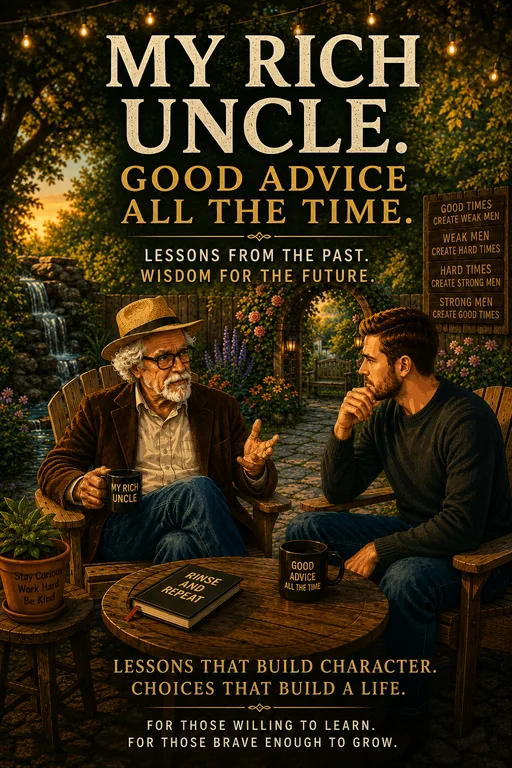
MY RICH UNCLE
By YNOT
Table of Contents
- Title Page
- Dedication
- Foreword
- Preface
- Introduction
- The Canoe, and the Five-Percent Plan for Building Wealth
- My Summers - Lessons, Laughter & Life
- Love, Control & the Prisoner’s Dilemma
- No Matter How Long the Log Stays in the Water, It Never Becomes a Crocodile
- Rinse and Repeat & the End of the World
- Was Your Generation Easier?
- The Price of the Canoe
- Turning Thirty Five and Marriage
- Grandma’s Final Gift
- Let them Eat Cake, not Slice it
- The Laptop and the Loaf of Bread
- The Joy of Missing Out
- Buying a Small Business with No Cash
Title Page
MY RICH UNCLE
Good Advice All the Time
By YNOT
QUANTUM Publishing 2026
Copyright
Copyright © 2026 QUANTUM Publishing. All rights reserved.
Dedication
I dedicate this to all the mentors in my past that I have combined into one person here.
And of course to my kids and all my nieces and nephews. May you all live in a better world.
Foreword
I used to think my rich uncle was cheap.
Every time I needed money, I called him.
Every time I had a problem, I drove to his house.
And every time I arrived, I left with the same thing:Advice.
No check.No loan.No bailout.Just advice.
At twenty, I thought this was a terrible arrangement.
I had real problems.A broken car.Late rent.
A bad job.A failed relationship.
A business idea that needed \”just a little money.\”
I wanted answers. I wanted solutions. I wanted someone to rescue me.
Instead, my uncle would pour two cups of coffee, sit down in his old chair, and ask questions.
Questions that irritated me.
\”How did you get here?\”
\”What lesson are you refusing to learn?\”
\”What would happen if nobody came to save you?\”
At the time, I thought he was avoiding the problem.
Years later, I realized he was trying to solve a much bigger one.
You see, my uncle understood something I did not.
Most problems are not money problems. They\\\’re thinking problems.
A broken car may really be a budgeting problem.
A budgeting problem may really be a discipline problem.
A discipline problem may really be a decision-making problem.
And decision-making problems have a funny way of showing up everywhere—in business, relationships, health, and life.
I also discovered something else.
My uncle wasn\\\’t rich because he had money.
He had money because he had wisdom.
He saw the world differently.
While most people chased quick fixes, he chased understanding.
While most people looked for someone to blame, he looked for lessons.
While most people worried about circumstances, he focused on choices.
The older I got, the more I realized that every conversation with him was really a class disguised as a story.
Sometimes he taught me about business.
Sometimes about history. Sometimes about investing.
Sometimes about failure. And sometimes about things I didn\\\\\\\’t even realize I needed to learn until years later.
There were days when I left his house frustrated because he hadn\\\\\\\’t answered my question.
Then, months or years later, I would suddenly understand exactly what he had been trying to teach me.
I have come to believe that every person needs someone like my rich uncle.
Someone who has made mistakes. Someone who has survived hard times.
Someone who can look at a problem and see beyond the obvious.
Someone who understands that wisdom is often more valuable than money.
The conversations in this book are based on years of talks, arguments, stories, and lessons. Some happened exactly as written. Some have been combined or simplified to better explain the ideas behind them.
The wisdom belongs to my uncle. Most of the mistakes belong to me.
If you are looking for shortcuts, this may not be the book for you.
My uncle never believed in shortcuts.
If you are looking for someone to tell you that life is easy, you won\\\’t find that here either.
Life is hard. People fail. Dreams don\\\’t always work out.
The world changes. But there is good news.
You always have choices.
You can learn. You can adapt.
You can start over.
And you can become wiser than you were yesterday.
That, according to my rich uncle, is what being rich is really all about.
So pull up a chair. Pour yourself a cup of coffee.
The old man is about to tell another story.
Preface
“I never planned to write this book. I wrote it because I realized that every important lesson in my life could be traced back to one old man sitting in a chair with a cup of coffee.”
Introduction
Still a work in progress - this is not even version 1
There are people who change your life with money, and then there are people who change your life by teaching you why you don’t have any.
My rich uncle never gave me a check.
He never bailed me out of trouble. He never handed me an envelope of cash, paid my bills, or rescued me from my bad decisions. In fact, when I was younger, I thought he was cheap.
Every time I needed money, I went to him.
Every time I had a problem, I drove to his house.
And every time I left, I left with the same thing:
Advice.
At twenty, I thought this was a terrible arrangement.
I had problems. Real problems. A broken car. Late rent. A bad job. A failed relationship. A business idea that needed “just a little money.”
I wanted answers. I wanted solutions. I wanted someone to save me.
Instead, my uncle would pour two cups of coffee, sit down in his old chair, and ask questions.
Questions that irritated me.
“How did you get here?”
“What lesson are you refusing to learn?”
“What would happen if nobody came to save you?”
At the time, I thought he was avoiding the problem.
Years later, I realized he was trying to solve a much bigger one.
You see, my uncle understood something I did not:
Most problems are not money problems. They are thinking problems.
A broken car may really be a budgeting problem.
A budgeting problem may really be a discipline problem.
A discipline problem may really be a decision-making problem.
And decision-making problems have a funny way of showing up everywhere—in our finances, our relationships, our careers, and even in our happiness.
This book is not about becoming rich overnight.
It is not about stock tips, secret investments, or how to make a million dollars before breakfast.
It is about learning to think differently.
It is about the conversations I had, the mistakes I made, the lessons I learned, and the wisdom that one old man patiently repeated until I was finally old enough to understand it.
Some of these stories are funny.
Some are painful.
Some will make you uncomfortable.
That is good.
Growth usually begins with discomfort.
If this book does its job, you may find yourself arguing with my uncle on some pages, laughing with him on others, and occasionally realizing that he is talking directly to you.
Because somewhere in all our lives, there comes a moment when we stop looking for someone to rescue us and start looking for someone to teach us.
This book is for that moment.
So pull up a chair.
Pour yourself a cup of coffee.
And let me introduce you to my rich uncle.
The Canoe, and the Five-Percent Plan for Building Wealth
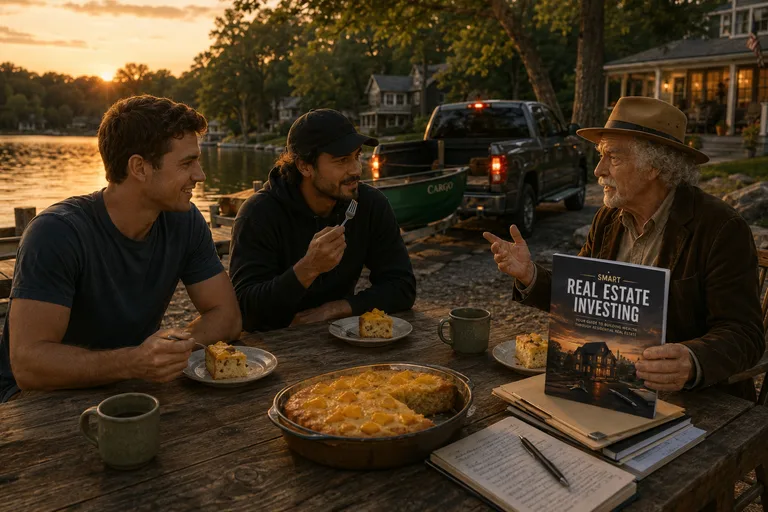
By the time Dylan and Dorian returned Uncle Bob’s canoe, the sun was beginning to disappear behind the trees.
The two young men carried the canoe upside down between them, with Dylan walking backward and Dorian struggling under the heavier end.
“Slow down,” Dylan said. “You’re going to hit the truck.”
“I’m not going to hit the truck.”
“You said that about the mailbox.”
“The mailbox moved.”
Uncle Bob stood beside his convertible with a glass of iced tea in one hand. He watched them weave across the driveway like two men carrying a telephone pole through a furniture store.
“Put it on the rack,” Bob said. “Preferably without damaging the canoe, the truck, the house, or yourselves.”
They finally lowered it onto the wooden rack beside the garage.
Dorian stretched his back and looked toward Bob’s house. The property sat on several acres, shaded by old trees and separated from the road by a long private driveway. Bob’s convertible was parked near the garage. His truck was farther back, beside a workshop filled with tools, machinery, and half-finished projects.
Dorian looked around and shook his head.
“You know what I don’t understand?” he said.
Bob took a drink of tea. “That list could keep us here until winter.”
“How somebody gets all this.”
Bob glanced toward Dylan. “Did your friend hit his head while you were out there?”
“No,” Dylan said. “Not that I saw.”
Dorian ignored them.
“I’m serious. A house, land, cars, a workshop, investments. Some people have everything, and other people work their whole lives and end up with nothing.”
“That happens,” Bob said.
“And you don’t think that’s unfair?”
“Life is unfair. That observation and five dollars might buy you a cup of coffee.”
Dorian leaned against the canoe rack.
“That’s why people support socialism. They think wealth should be distributed more equally.”
Bob lowered his glass.
“Do you know why socialists are so stupid?”
Dylan closed his eyes.
“Here we go.”
Dorian straightened. “Why?”
“Because they spend all their time studying how to divide the harvest and almost no time learning how to plant the field.”
Dorian started to answer, but Bob raised a hand.
“I didn’t say poor people are stupid. I didn’t say struggling people are lazy. Plenty of hardworking people get sick, lose jobs, make mistakes, get cheated, or get hit by circumstances they could not control. Sometimes people need help. That isn’t what I’m talking about.”
“Then what are you talking about?”
“I’m talking about the belief that somebody else’s success caused your failure. I’m talking about people who would rather count what you have than examine what they do every day.”
Bob pointed toward the canoe.
“You two just spent the afternoon paddling down the river. Suppose Dylan paddled while you sat in the canoe complaining that he was getting farther ahead. Would the solution be to take away his paddle?”
“No.”
“Would it be fair to demand half the distance he traveled?”
“That doesn’t make sense.”
“Most things sound different when you remove the political slogans.”
Dorian folded his arms. “Not everyone starts with the same opportunities.”
“No, they don’t,” Bob said. “Some people begin ten miles ahead. Some begin ten miles behind. Some begin with a good family, good health, and a paid education. Others begin with debt, bad advice, and nobody willing to help them.”
“Exactly.”
“But standing still because somebody else got a head start does not improve your position.”
Bob motioned toward the porch.“Come sit down.”
The three of them walked to the back porch. Bob sat in an old wooden chair, while Dylan and Dorian took the bench opposite him.
“Let me give you a system,” Bob said. “It isn’t exciting. Nobody will make a revolutionary poster about it. It won’t get you applause from a crowd. But it works.”
Dorian leaned forward.
“Every time you make money, take five percent before you spend anything.”
“Five percent isn’t much.”
“That is the point. It is small enough that you can usually survive without it.”
“What do I do with it?”
“Save it. Invest it. Put it somewhere you cannot casually spend it. A retirement account, an index fund, a business account, or another legitimate investment. When possible, do it in a tax-advantaged account so the government takes less of the growth.”
Dorian looked skeptical. “You think five percent is going to make somebody rich?”
“No. I think the habit will.”
Bob placed his glass on the table. “The first five percent buys assets. Over time, those assets begin producing money. At first, the amount is so small you will laugh at it. Then one day, the money your investments earn will be larger than your original contributions. Eventually your money will be working every day, including days when you do not.”
“That still takes forever.”
“So does being broke.”
Dylan laughed.
Bob continued.
“Then take another five percent and invest it in yourself.”
“More savings?”
“No. Education. Skills. Tools. Books. Classes. Certifications. Software. Equipment. Anything that makes you more capable and more valuable.”
“What kind of skill?”
“That depends on who you are and where you want to go. Learn accounting. Learn sales. Learn programming. Learn how to repair air conditioners. Learn how to operate heavy equipment. Learn how to negotiate contracts. Learn a second language. Learn how to manage employees. Learn something that solves a problem people will pay to have solved.”
“What if I don’t have an extra ten percent?”
“Then cut expenses.”
Dorian frowned. “That’s easy to say when you’re rich.”
“No,” Bob said. “It is easier to say when you remember what it was like not to be rich.”
Bob nodded toward the convertible. “You see a car. You don’t see the years when I drove old cars, repaired them myself, and kept them long after other people thought I should replace them. You see the house. You don’t see the smaller house before it. You see the investments. You don’t see the first hundred dollars I was afraid to lose.”
He pointed toward Dorian’s phone. “How much does that cost every month?”
“My phone?”
“The phone, the plan, the subscriptions attached to it, the music service, the movie services, the food deliveries, the small purchases you barely remember making.”
Dorian looked at the screen. “I don’t know.”
“That is usually the answer.” Bob leaned back. “Most people do not decide to stay poor. They simply spend their future a few dollars at a time.”
Dorian remained quiet.
Bob continued. “You do not have to live like a monk. You do not have to stop enjoying life. But you should know the difference between an expense that improves your life and one that merely distracts you from it.”
“How do you tell the difference?”
“Wait three days before buying something you do not need. If you still want it, decide whether it is worth trading part of your future for it.”
“That sounds dramatic.”
“It is dramatic. Money is stored labor. When you spend money, you are spending hours of your life.”
Dylan looked at Dorian. “He told me that when I wanted to finance a motorcycle.”
“And did you listen?” Dorian asked.
“No.”
“What happened?”
“I sold it eight months later and still owed money.”
Bob nodded. “Education is expensive whether you receive it in a classroom or through stupidity.”
Dorian smiled. “All right. Five percent for investments. Five percent for skills. Then what?”
“Every day, do something positive.”
“That sounds like something printed on a coffee mug.”
“It would be, except most people would rather buy the mug than follow the advice.”
Bob held up one finger. “Read ten pages.”
A second finger. “Make one useful phone call.”
A third. “Practice one skill.”
A fourth “Exercise.”
A fifth. “Finish one task you have been avoiding.”
He lowered his hand. “The action does not have to be enormous. It only has to move you forward.”
“And that makes you rich?”
“Not by tomorrow.”
“Then how long?”
“Twenty years.”
Dorian laughed. “Twenty years?”
“Yes.”
“I’ll be old.”
Bob looked at Dylan. “How old is he?”
“Twenty-three.”
Bob turned back to Dorian. “At forty-three, you will think twenty-three was a child. The twenty years are going to pass whether you follow this plan or not.”
He picked up his tea again. “That is what young people never understand. They imagine that because something takes a long time, they have plenty of time to begin. It is exactly the opposite. The longer the process takes, the sooner you must begin.”
Dorian glanced at the workshop and the house beyond it. “You really think someone could become rich just doing those things?”
“I think after twenty years you would be richer than you can presently imagine. Not merely because of the money.”
“What else?”
“You would have twenty years of investment growth. Twenty years of accumulated knowledge. Twenty years of better judgment. Twenty years of professional relationships. Twenty years of completed projects. Twenty years of proving to yourself that you can keep promises.”
Bob tapped the table. “The investments compound. The skills compound. Your reputation compounds. Your confidence compounds. Good decisions make the next good decision easier.”
“And bad decisions compound too,” Dylan said.
Bob nodded. “Debt compounds. Laziness compounds. Excuses compound. Resentment compounds. Every path compounds eventually.”
Dorian looked out across the yard. “But what about people who are already rich? They can invest more than five percent of what I make.”
“Of course they can. Stop watching them.”
“That’s convenient.”
“It is practical. You cannot steer your canoe by staring at someone else’s boat.”
Bob pointed toward the river beyond the trees. “If a man passes you in a speedboat, you can spend the afternoon cursing him. You can demand that someone remove his engine. You can insist the river be redesigned so nobody travels faster than you. Or you can keep paddling toward your destination.”
Dorian considered that. “So your answer to inequality is just work harder?”
“No. That is a slogan too.”
Bob’s voice softened. “My answer is to control what you can control. Protect your income. Increase your ability. Lower unnecessary expenses. Avoid destructive debt. Build ownership. Make yourself useful. Help people when you are able. Do not wait for politicians, corporations, rich relatives, or revolutions to rescue you.”
Dylan grinned. “Especially rich relatives.”
“Especially rich relatives.”
Dorian looked at Bob’s house again.
“Did you always know this?” “No. I learned most of it by doing the opposite.”
“You lost money?”
“More than once.”
“Made bad investments?”
“Yes., work for 20 years, lost millions”
“Bought things you didn’t need?”
“Absolutely and “Trusted the wrong people”
Bob looked at him. “That was the most expensive lesson.”
“What changed?”
“I stopped treating mistakes as evidence that the world was against me. I began treating them as tuition.”
Dorian nodded slowly.
Bob stood and walked toward the canoe rack.
“Come here.”
They followed him.
Bob ran a hand along the side of the canoe. “When I bought this canoe, it was old. The paint was faded, one seat was cracked, and there was a small leak near the stern. I could afford a new one, but I did not need a new one. I repaired this one.”
“You could buy ten canoes,” Dorian said.
“Yes.”
“Then why keep this one?”
“Because wealth is not the ability to buy everything. Wealth is the ability to avoid needing everything.”
Bob pulled a folded twenty-dollar bill from his pocket and handed it to Dorian.
“What’s this for?”
“You helped return the canoe.”
“I don’t need to be paid.”
“Take it.”
Dorian accepted the bill.
“Now what are you going to do with it?”
“Save five percent?”
“That is one dollar.”
“And another dollar to learn something.”
Bob nodded. “What will you do with the other eighteen?”
Dorian thought for a moment.
“Probably spend it.”
“Good.”
Dorian blinked. “Good?”
“You are allowed to spend money. The lesson is not that spending is evil. The lesson is that your future should be paid before your appetite.”
Dorian folded the bill and placed it carefully in his wallet.
Bob looked toward Dylan.
“Did you charge him for the gas?” “No.”
“For the sandwiches?” “No.”
“For the bait?” “We didn’t go fishing.”
“Then what were the sandwiches for?”
“We got hungry.”
Bob shook his head. “Socialists.”
Dorian laughed. “You know, Uncle Bob, you might convince more people if you stopped calling them stupid.”
Bob picked up his iced tea. “I am not trying to convince everyone. I am trying to convince you.”
He started walking back toward the porch, then stopped. “One more thing.”
“What?”
“Do not tell people you are going to follow this plan.”
“Why not?”
“Because announcing your intentions gives you a little piece of the satisfaction before you have done any of the work. Keep quiet. Save the money. Learn the skill. Finish the project. Let the results introduce you.”
Bob continued toward the house.
Dorian remained beside the canoe for a moment, looking at the twenty-dollar bill through the open edge of his wallet.
“Do you think he’s right?” he asked.
Dylan shrugged. “He usually is.”
“That must be annoying.”
“You have no idea.”
They followed Bob toward the porch.
As they reached the steps, Dorian took out his phone.
“What are you doing?” Dylan asked.
“Canceling two subscriptions.”
From the porch, Bob raised his glass. “There may be hope for him yet.”
Remember the goal is to control what you can control. Protect your income. Increase your ability. Lower unnecessary expenses. Avoid destructive debt. Build ownership. Make yourself useful. Help people when you are able. Do not wait for politicians, corporations, rich relatives, or revolutions to rescue you.”
Bob leaned forward and pointed at Dorian. “You are fighting the wrong war. The real war is in your head, and you are losing it every day you blame someone else for your problems. Every minute you spend resenting people who have more than you is a minute you are not using to improve yourself.”
Dorian’s expression tightened. “So everything is my fault?”
“No. Not everything that happens to you is your fault. But what you do next is your responsibility. That is the difference between a victim of circumstance and someone who remains a victim for life.”
Bob watched Dorian put his phone back into his pocket.
“There may be hope for him yet.”
He started toward the house, then glanced back at them.
“You boys want some homemade banana-mango cake?”
Dorian looked at Dylan. “Is that a trick question?”
“No,” Bob said. “Come inside and get a slice before I reconsider.”
That was all the invitation they needed.
As they followed him through the back door, Bob stopped beside a small table near the kitchen and picked up a hardcover book.
“Dylan, I have something for your mother.”
Dylan looked at the book. “What is it?”
“My book.”
“You wrote another one?”
Bob handed it to him.
The title read: Smart Real Estate Investing
Dylan turned it over in his hands.
“What does Mom want with a real estate book?”
“Your parents have been talking about buying a house and renting it out.”
“They have?”
“They are looking into it. They asked me a few questions, so I marked the chapters they should read first.”
Dorian leaned over Dylan’s shoulder.
“Did you write a chapter called ‘Why Are Socialists So Stupid?’”
Bob opened the refrigerator and removed the cake.
“No. That book is about making money.”
He placed the cake on the counter and began cutting three large slices.
“The chapter about losing money is called ‘Taking Financial Advice from Your Friends.’”
Dorian laughed.
Dylan opened the book and noticed several pages marked with small yellow tabs.
“You really think they should buy a rental house?”
“I think they should study it before they buy anything,” Bob said. “A rental property can build wealth, but only when you buy the numbers—not the dream.”
“What does that mean?”
“It means the rent has to cover the mortgage, taxes, insurance, repairs, vacancies, and all the things people forget when they imagine themselves becoming landlords.”
Bob handed each of them a plate.
“A house is not automatically an investment just because somebody else sleeps in it.”
Dylan took a bite of cake. “This is good.”
“Of course it is.”
Dorian tasted his slice.
“Did you make this?”
Bob looked offended.
“You think wisdom is my only talent?”
Dylan tucked the book under his arm.
“I’ll give it to Mom.”
“Tell her to call me before they sign anything.”
“Why?”
“Because enthusiasm has purchased more bad real estate than ignorance ever did.”
Bob took his own slice and sat at the kitchen table.
Outside, the canoe rested quietly beside the garage. Inside, Dorian had already begun asking Bob questions about rental income, mortgages, and how much money someone should save before buying a property.
Bob smiled and cut himself another piece of cake.
The lesson, apparently, was not over.
My Summers - Lessons, Laughter & Life

If you’ve never spent a summer at your Uncle Bob’s lakeside cabin, learning how to live, think, and fend for yourself, then you’ve missed out on the best education this side of a college degree. Uncle Bob was the kind of man who knew how to turn a lazy summer into a masterclass in life, finance, and the fine art of independence—all while letting you have the time of your life.
Every June, Bob’s grand children, nieces and nephews would pile into his cabin like a pack of excited puppies, ready to fish, swim, and maybe even test out his beloved jetski. But Uncle Bob wasn’t just there to entertain. No, he had a plan—one that involved teaching these kids how to thrive in the real world, one adventure at a time.
“He let us do pretty much anything we wanted,” one nephew recalled, “but there were always strings attached. If you wanted to take the jetski out, you had to clean it afterward. If you made a mess in the kitchen, you were scrubbing it up. Uncle Bob wasn’t strict—he was smart.”
1. How to spend mindfully
Uncle Bob had a simple rule: Each kid got $200 at the start of the summer. “Here’s your budget,” he’d say, handing over crisp bills like a CEO distributing bonuses. “Spend it however you want—but when it’s gone, it’s gone.”
At first, the kids treated it like free money. Trips to the ice cream stand, flashy souvenirs from the marina shop, and those endless quarters for the arcade in town—it didn’t take long for some of them to run dry.
“You’d see one kid sitting glumly on the porch while the others were at the lake,” Bob chuckled. “That’s when the lesson sank in. Spend wisely, or you miss out later.”
But Bob didn’t leave them completely in the lurch. If they asked, he’d share tips on how to budget smarter next time. And when one niece decided to save her entire allowance for a new jetski helmet, Bob made sure she got the first ride of the summer.
2. How to earn extra money
If the kids blew through their budget, Uncle Bob had a solution: his famous Job Board. Tacked up in the cabin’s kitchen, it listed tasks like cleaning the jetski, fixing the dock, or stacking firewood. Each job came with a price tag.
“Need more cash?” Bob would say. “Plenty of work to go around.”
Bob also encouraged their entrepreneurial spirit. One summer, the kids opened a snack shack by the lake, selling soda, chips, and popsicles to fellow boaters. Another year, they organized jetski rides for local kids, charging $10 a pop—under Uncle Bob’s watchful eye, of course.
“I didn’t just want them to earn money,” Bob explained. “I wanted them to understand money—the effort it takes, and the satisfaction of earning it yourself.”
3. How the stock market works
Uncle Bob had a habit of blending fun with financial literacy. For birthdays and Christmas, he’d gift the kids a share or two in companies they liked—video game makers, candy brands, or even the manufacturer of his favorite jetski.
On summer evenings, they’d sit by the firepit, tablets in hand, tracking their stocks online. “See this?” Bob would say, pointing at a stock graph. “That’s your money growing—or shrinking. And that, kids, is why you always diversify.”
He let them decide when to hold or sell, teaching them the highs and lows of investing. One nephew cashed out his stock early to buy a new game console, while another held on for years, watching her investment triple. “Different strokes,” Bob would say with a grin.
4. The power of delayed gratification
Uncle Bob loved teaching patience—especially to kids who wanted everything right now. One summer, he handed each kid a small savings bond, explaining how it would grow over time.
“Now, you can’t touch this until it matures,” he said. “But when you do, it’ll be worth more than it is today. That’s the magic of interest.”
The kids were skeptical at first. “Why not just give us the money now?” one of them asked. Bob laughed. “Because then you’d spend it on snacks, and five years from now, you’d have nothin’ to show for it. Trust me—future you will thank me.”
5. How to be self-reliant
Above all, Uncle Bob wanted the kids to leave the cabin stronger, smarter, and more independent than when they arrived. He taught them how to cook on the grill, fix a flat tire on the jetski trailer, and even patch up a leaky canoe.
“When I’m not around, you’re going to have to figure this stuff out,” he’d say. “Might as well start now.”
One summer, Bob challenged them to a “Survival Day.” Armed with nothing but fishing rods and a map, they had to catch their own dinner and navigate their way back to the cabin before sunset. They succeeded—with a little guidance from Uncle Bob—but the lesson was clear: “You’re capable of more than you think.”
Years later, those summers at Uncle Bob’s cabin became the stories they told their own kids—tales of adventure, hard-earned lessons, and the kind of wisdom that only a man with a jetski and a sense of humor could provide.
“Uncle Bob,” one niece said, “taught us more about life than we ever learned in school—and he made it fun.”
Love, Control & the Prisoner’s Dilemma

Uncle Bob (rocking slowly on the porch, sipping lemonade):
Nate, you look like a man who just discovered women are more complicated than math.
Nate (grinning, holding his iPad):
Uncle Bob, I just finished mapping out the entire modern dating crisis using game theory. It’s all here—Nash equilibria, control matrices, and payoff grids.
Uncle Bob:
Good lord, son. Back in my day, we just called it heartbreak and wrote sad songs. Now you’re telling me love needs a calculator?
Nate:
No, not love—relationships. Big difference. Most people think they’re after love, but really, they’re in it for control. Security. Predictable outcomes. It’s a game, Uncle. And the incentives are rigged.
Uncle Bob (raising an eyebrow):
So what’s the prize for winning this so-called game? A mortgage and quiet resentment?
Nate (laughs):
Pretty much! See, people come to the table either wanting “true love”—you know, mutual growth, sacrifice, the kind of thing they make Netflix dramas about—or they want a trade. “You give me this, I give you that.” It’s a deal. Like, you be pretty, I’ll pay rent.
Uncle Bob:
Ah, romance by spreadsheet. I always suspected Tinder was just Wall Street with better lighting.
Nate:
Exactly! And when someone looking for love ends up with someone playing the “control” game, it ends in what I call a red pill or blue pill breakup. The romantic gets blindsided, and the controller cashes out.
Uncle Bob (pauses):
That’s just plain sad, Nate. But you’re not wrong. Folks used to call it “falling in love.” Now it’s “leveraging emotional assets.” Can’t say I like it better, but I do see your point.
Nate:
And it’s not random, either. Social class plays a big role. People at the top or bottom of the ladder? Way more likely to seek control. The rich marry for alliances. The poor, for survival. Only the middle class really has the luxury to marry for love—two people with just enough stability to not need anything from each other but each other.
Uncle Bob (chuckling):
So love survives in the suburbs? That explains a lot of poetry.
Nate:
More like the mall parking lots of middle America, yeah. But seriously, Uncle, most folks don’t even realize they’re playing different games. One person’s showing up for Titanic, the other’s playing Monopoly.
Uncle Bob:
And the board gets flipped when rent’s due or someone gains ten pounds?
Nate:
Pretty much. See, when a control relationship hits turbulence—say someone loses a job or gets sick—the whole thing crumbles. It was never about love, just about what each side was getting. And when they stop getting, they start leaving.
Uncle Bob (sighing):
Son, you just described three of my divorces—and I was only married once.
Nate (laughs):
There’s actually a perfect model for this: the Prisoner’s Dilemma. You know it?
Uncle Bob:
Do I know it? Boy, I lived it. Two crooks in two rooms hoping the other keeps their mouth shut. It’s trust under pressure. Like marriage, but with orange jumpsuits.
Nate:
Exactly. The best outcome is both sides cooperate. But the safer choice is to betray—because no one wants to be the fool left holding the bag. So most people play it safe, and love loses.
Uncle Bob:
So what’s the fix, Nate? We all just marry our tax bracket and hope for the best?
Nate:
Sort of. If you’re a romantic, find another romantic in your own class. That’s where the odds of actual love are highest. Don’t chase someone trying to climb up or pull you down. They’re not looking for love. They’re looking for leverage.
Uncle Bob (smiling):
Son, that’s the smartest thing anyone’s said on this porch since your aunt tried to sell Tupperware using Bible verses.
Nate:
Thanks, Uncle Bob. I just want people to know—love is real, but the game has rules. And if you don’t know them, you’ll keep losing.
Uncle Bob:
Well, if love is a game, I say we cheat—but with kindness. You bring the brain, I’ll bring the bourbon. Now scoot over and show me that fancy diagram of heartbreak you drew on your iPad.
EXTRA CREDIT
No Matter How Long the Log Stays in the Water, It Never Becomes a Crocodile
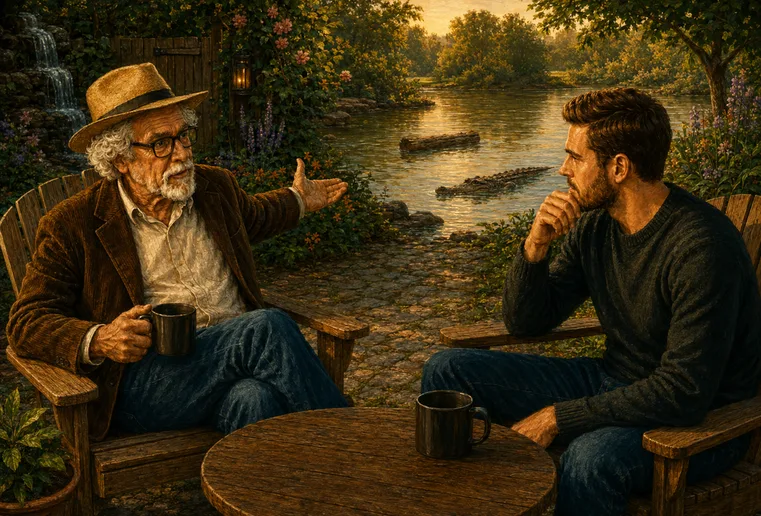
“Uncle Bob, I don’t understand it,” I said. “I’m doing everything successful people tell me to do. I go to their conferences. I listen to their podcasts. I read their books. I even dress more professionally. But I don’t feel any closer to becoming successful.”
Uncle Bob leaned back in his chair and studied me for a moment.
“Son, have you ever heard the African proverb, ‘No matter how long the log stays in the water, it never becomes a crocodile’?”
“No.”
“Well, think about it. A log can float beside a crocodile every day. It can live in the same river, feel the same current and bake under the same sun. From a distance, someone might even mistake that log for a crocodile. But it is still a log.”
“What does that have to do with me?”
“You’re floating in the right water,” he said. “But you’re expecting the water to transform you.”
I must have looked confused, because he continued.
“There’s nothing wrong with attending conferences, reading books or surrounding yourself with successful people. The right environment matters. It can expose you to opportunities, ideas and people you would never encounter otherwise. But simply standing next to successful people does not make you successful.”
“Then what does?”
“Doing the work they did to become successful.”
Uncle Bob leaned forward. “People imitate the visible parts of success. They buy the clothes, the automobile and the expensive watch. They copy the language. They talk about investments, leadership and entrepreneurship. They post photographs from conferences and restaurants. But those are the scales on the crocodile. They are not what makes the crocodile dangerous.”
“So what makes it dangerous?”
“What is underneath the water—the strength, patience, instinct and ability to act when the opportunity arrives.”
He took another drink of coffee. “You see a successful businessman driving a beautiful automobile, but you don’t see the twenty years he spent learning his industry. You see the company he owns, but you don’t see the failed companies that taught him how to operate it. You see the money, but you don’t see the risks, sleepless nights, difficult decisions and years of discipline behind it.”
“So I shouldn’t try to copy successful people?”
“That isn’t what I said. Copy their principles, not their appearance. Study how they think. Study how they make decisions. Study how they deal with failure, protect their money and recognize opportunity. Then adapt those lessons to your own abilities and circumstances.”
“But what if I want to become someone different?”
“You can change. Of course you can change. But real change comes from the inside and works its way outward. Most people try to change the outside and hope it eventually works its way inward.”
He pointed at the lake. “A log cannot become a crocodile, but a skilled craftsman can turn that log into a table, a chair, a boat or a beautiful sculpture. The log can become extremely valuable, but it must become valuable according to its own nature.”
“So I should accept myself exactly as I am?”
“No. That’s another excuse people use to avoid improving. You accept your starting point, not your limitations. You identify the material you have been given, and then you decide what to build from it.”
He picked up a napkin and drew three circles. “In the first circle, write what you’re naturally good at. In the second, write what people will pay you to do. In the third, write what you are willing to practice for years. Where those three circles overlap, you may find your real opportunity.”
“What if I’m not naturally good at anything?”
“That usually means you haven’t done enough things yet. Ability often remains hidden until responsibility forces it to come out. Work in different businesses. Sell something. Manage a small project. Help a struggling company. Try, fail, adjust and try again. Action will teach you more about your nature than endless self-examination.”
I looked down at the three circles. “So being around successful people is still helpful?”
“Very helpful—if you participate instead of merely watching. Don’t just go to the business conference. Introduce yourself to people. Ask intelligent questions. Follow up. Apply one lesson when you get home. Don’t simply admire the factory; learn how the factory operates.”
“And what about pretending until I become successful?”
“There is a difference between practicing a new identity and living a lie. You can begin behaving more responsibly before you feel responsible. You can practice speaking confidently before you feel confident. But pretending to possess experience, money or knowledge that you do not have will eventually expose you.”
“Like the log being mistaken for a crocodile?”
“Exactly. From far away, it may fool people. But sooner or later, someone gets close enough to see that it has no teeth.”
I laughed.
Uncle Bob didn’t.
“Son, that is how people get into serious trouble. They borrow money to appear wealthy. They take positions they are not prepared to handle. They repeat advice they do not understand. They become more concerned with looking successful than becoming capable.”
“So what should I do now?”
“Choose one useful ability and develop some teeth.”
“What do you mean?”
“Learn to sell. Learn to negotiate. Learn to read financial statements. Learn to manage people. Learn to build something customers need. Pick a real ability that creates value, and work on it until you are undeniably competent.”
“How long will that take?”
“Longer than buying an expensive suit and less time than repairing the damage caused by pretending.”
He folded the napkin and pushed it toward me. “Remember this: proximity is not progress. Sitting in an office does not make you a businessman. Owning stock does not make you an investor. Starting a company does not make you an entrepreneur. Those titles must be earned through understanding, discipline and repeated action.”
I slipped the napkin into my pocket. “So the lesson is to stay true to who I am?”
“Partly. The deeper lesson is to build from who you are. Don’t waste your life trying to become a poor imitation of somebody else. Learn from other people, but construct something that fits your own strengths, experiences and purpose.”
He smiled. “The river can give you opportunity. The crocodiles can show you what is possible. But neither can decide what you will become. That part is your responsibility.”
I stood up to leave, but Uncle Bob stopped me. “One more thing.”
“What?”
“If you ever see a log floating in a river, don’t assume it isn’t a crocodile.”
I stared at him.
He laughed. “A good businessman stays authentic—but he also stays careful.”
Rinse and Repeat & the End of the World

I just graduated college and been watching the news, and it got me depressed so ended at Uncle Bob House to see if he was up to something.
“Uncle, can I ask you something?”
“Of course.”
“I’ve been thinking about starting a business, but honestly, I’m worried about everything. The economy. Politics. AI. The future. Some days I get so overwhelmed I don’t even know where to begin. Truth is, I’m a little depressed about it.”
My uncle sat quietly for a moment, staring out over the lake.
Then he smiled.
“Everything will be okay eventually.”
“That’s easy for you to say.”
“No,” he said. “It’s easy for me to say because I’ve lived long enough to watch it happen over and over.”
He pointed toward the water.
“Life is a series of cycles. Sometimes you’re riding the wave. Sometimes it feels like you’re falling into a bottomless pit. The trick is understanding that neither one lasts forever.”
I wasn’t convinced.
“What if this time is different?”
My uncle laughed.
“Every generation thinks its problems are unique.”
He took a sip of coffee.
“The other day somebody asked me how many years I thought civilization had left.”
“What did you tell them?”
“I told them I think this may be the beginning of infinity.”
I looked at him like he had lost his mind.
He continued.
“Think about it. Roughly one hundred billion people have lived on Earth so far. If we don’t destroy ourselves, there could be trillions more. We are still in the early chapters of the human story.”
“But things seem pretty bad.”
“They always do when you’re living through them.”
He leaned back in his chair.
“I’m a student of history. History doesn’t repeat, but it rhymes.”
“What does that mean?”
“It means the names change, but the patterns stay the same.”
He started counting on his fingers.
“2008 rhymes with 1929.”
“The climate crisis rhymes with the Dust Bowl.”
“COVID rhymes with the Spanish Flu.”
“Political division rhymes with a hundred other periods of political division.”
He paused.
“And after one of the worst stretches in modern history—from 1929 through 1945—the world rebuilt itself.”
“The Great Depression.”
“World War II.”
“Tens of millions dead.”
“And yet humanity emerged stronger.”
I nodded.
“I never thought about it that way.”
“Most people don’t. They focus on the storm and forget the storm eventually passes.”
He pointed toward the horizon.
“What’s happening right now isn’t the end of the world. It’s a changing of the guard.”
“What do you mean?”
“Every revolution is really the replacement of elites.”
“The old media is losing power.”
“Old political structures are losing power.”
“Old institutions are being challenged.”
“The people on top today won’t necessarily be the people on top tomorrow.”
“That’s happened throughout history.”
“So you’re optimistic?”
“I’m realistic.”
He laughed.
“There are peaceful revolutions and there are violent revolutions. I’d prefer the peaceful kind.”
Then he became serious.
“But we’ll rebuild. We always do.”
He looked at me.
“You’ve heard the saying, right?”
“‘Good times create weak men. Weak men create hard times. Hard times create strong men. Strong men create good times.'”
I nodded.
“I think we’re entering the hard-times phase.”
“Which means?”
“Which means twenty years from now there will be heroes we haven’t even met yet.”
For a while we sat quietly.
Finally I asked another question.
“Uncle, do you think all of this is happening because of Donald Trump?”
He shook his head.
“No.”
“You don’t?”
“No. I think the world was heading this direction long before Donald Trump.”
“Then what’s causing it?”
“The Berlin Wall.”
“The Berlin Wall?”
“The day it fell.”
I stared at him.
He smiled.
“Most people think history happens in the headlines. It doesn’t. History happens in the consequences.”
“When the Berlin Wall fell, America became the world’s only superpower.”
“For thirty years we lived in what historians call a unipolar world.”
“And now?”
“Now that era is ending.”
He leaned forward.
“China wants a larger place in the world.”
“India is rising.”
“Regional powers are becoming stronger.”
“The world is becoming multipolar.”
“More players.”
“More competition.”
“More complexity.”
“So it isn’t about one politician?”
“No.”
“One politician can influence events.”
“But no single politician controls the tide.”
Then he pointed a finger at me.
“Which brings me back to your business.”
“My business?”
“Yes.”
“If you’re waiting for perfect conditions, you’ll never start.”
“The world has always been messy.”
“There has always been debt.”
“There have always been wars.”
“There have always been politicians.”
“There have always been crises.”
“Yet businesses were built anyway.”
I sat quietly.
Then he gave me the advice I knew was coming.
“Remember this, son.”
“What?”
“Never be in debt to anyone if you can avoid it.”
“Countries get trapped by debt.”
“Businesses get trapped by debt.”
“People get trapped by debt.”
“Freedom begins when you owe less than everyone else.”
I nodded.
“What if you’re wrong?”
He laughed.
“Then we start World War III and all bets are off.”
I nearly spit out my coffee.
“In that case,” he said with a grin, “max out your credit cards.”
We both laughed.
Then he stood up and stretched.
“Enough philosophy.”
“Where are we going?”
He grabbed his fishing pole.
“Let’s go fishing.”
“Why?”
“Because worrying about the future never caught a single fish.”
Was Your Generation Easier?

I have been trying to figure out what I want to do next and looking online and most of the comments were negative.
By the time I got to Uncle Bob’s house, I was irritated.
He was sitting in the garden, coffee in one hand and a pair of pruning shears in the other, trimming a rose bush that looked perfectly fine to me.
“Uncle Bob, can I ask you something?”
He smiled.
“You already are.”
“I’ve been reading comments online. It seems like all the older people keep telling my generation that we’re lazy.”
He nodded.
“Go on.”
“They don’t understand. Their generation could flip burgers, buy a house, raise a family, and retire. Houses were affordable. College was cheaper. Everything was easier. Now corporations own everything, wages don’t keep up, and young people are struggling. Then older people tell us we’re just not working hard enough.”
He didn’t answer.
Instead, he kept clipping branches.
I continued.
“And have you noticed? Most of the people saying this are older people who already succeeded. They got theirs. They don’t understand what it’s like now.”
He finally looked up.
“You finished?”
“For now.”
He laughed.
“Good. Now let me tell you a story.”
He set down the shears.
“Fifty years ago, my family of five lived in a little house barely nine hundred square feet.”
“No air conditioning.” “One telephone.” “One television.”
“A refrigerator that spent half its life being defrosted.”
“Sometimes meat wasn’t even on the menu for days, we ate grits, beans.”
I stayed quiet.
“We had one car.” “A used one.” “No power windows.” “No air conditioning.”
“No GPS.” “No heated seats.”
“My first cars didn’t even have power steering. or brakes”
“So how did you get around?”
“Mostly the bus.” “School by bus.” “Work by bus.”
“Eventually I bought a car with so much rust you could see the road through the floor.”
He laughed.
“And I thought I was king of the world.”
“But houses were cheaper.”
“They were.”
“So doesn’t that prove my point?”
He shook his head.
“No.” “It proves that some things were cheaper.”
“But some things were much harder.”
“There was no internet.” “No YouTube.” “No AI.” “No online classes.”
“If you wanted to learn something, you bought a book or found someone willing to teach you.”
“If you got lost driving, you got lost.”
“If your car broke down, you fixed it or walked.”
“What about college?”
“I worked while I went.”
“And another job when one wasn’t enough.”
“And when I graduated, I took whatever opportunity I could find.”
He leaned back.
“You know what today’s generation has?”
“What?”
“The greatest collection of knowledge ever assembled in human history sitting in their pocket.”
“You can learn almost anything.” “You can start a business from your bedroom.”
“You can sell to the world.” “You can find mentors you’ve never met.”
“You can build software without knowing how to code.”
“You have tools I couldn’t even imagine.”
“So you’re saying it’s easy?”
“No.”
“I’m saying every generation has different obstacles.”
He pointed at me.
“Your generation has incredible opportunities.”
“It also has incredible distractions.”
I thought about that.
“So who’s right?”
“We both are.”
“Housing is expensive.”
“Debt is dangerous.”
“Corporations are powerful.”
“But none of those facts build your future.”
“What does?”
He smiled.
“Your decisions.”
He took another sip of coffee.
“You know something else?”
“What?”
“Many of the people you think have everything figured out don’t.”
“Their retirement depends on inflation.”
“Their savings depend on markets.”
“Their healthcare depends on governments.”
“They’re worried too.” “They just hide it better.”
“So what should I do?” “Stop comparing.”
“Every minute you spend blaming another generation is one minute you’re not building your own life.”
“But what if the system is unfair?”
He nodded.
“It probably is.”
“So then what?”
“You have two choices.” “You can spend your life explaining why you can’t succeed.”
“Or you can spend your life figuring out how you can.”
He stood up and brushed the dirt from his jeans.
“I’ll tell you the biggest secret successful people know.”
“What’s that?”
“They play the game that’s in front of them.”
“They don’t waste their lives wishing they had been born in another generation.”
He handed me the pruning shears.
“Now quit arguing with strangers on the internet.”
“What should I do instead?”
He pointed to the overgrown roses.
“Start by fixing something.” “That’s how you fix a garden.” “And that’s how you fix a life.”
The Price of the Canoe

Dylan and his friend Dorian pulled into Uncle Bob’s driveway a little after nine on Saturday morning.
The canoe was already resting on two wooden stands beside the garage. Uncle Bob had placed the paddles, life jackets, cushions, and a small waterproof box next to it.
Dylan climbed out of the truck. “Morning, Uncle Bob.”
Uncle Bob looked over his coffee cup. “You’re late.”
Dylan checked his phone. “It’s nine-oh-three.”
“Exactly. Three minutes late.”
Dorian laughed nervously. He had heard plenty of stories about Uncle Bob, but this was the first time he had met him.
Dylan pointed toward his friend. “Uncle Bob, this is Dorian. Dorian, this is my uncle.”
Dorian held out his hand. “Nice to meet you, sir.”
Uncle Bob shook it firmly. “Nobody calls me sir unless they’re trying to sell me something or arrest me. Uncle Bob will do.”
“Uncle Bob, then.”
Uncle Bob studied him for a moment. “Dorian? Like The Picture of Dorian Gray?”
Dorian smiled. “Yes. My mother liked the name, so I was stuck with it.”
Uncle Bob nodded approvingly. “Good movie.”
As they walked toward the canoe, Dorian stopped beside the red convertible parked near the garage. “Wow. Is this yours?”
Uncle Bob looked at the car. “Unless someone dropped it off during the night.”
“What year is it?”
“Old enough to have character and new enough to still start most mornings.”
Dorian walked around it slowly. “This thing is beautiful.”
Dylan grinned. “You should see him driving it. He thinks he’s twenty-five.”
“I don’t think I’m twenty-five,” Uncle Bob said. “I just remember being twenty-five. There’s a difference.”
Dorian looked past the car toward the house, the garden, and the wide canal behind the property.
“This is a really nice place.”
Uncle Bob nodded toward the canoe. “It’s even nicer when people arrive on time.”
Dylan rolled his eyes. “Here we go.”
They began moving the equipment toward Dylan’s truck. Dorian picked up one of the paddles, then noticed the open garage.
Inside were shelves of tools, fishing equipment, old radios, neatly labeled storage containers, and several framed photographs. Along one wall stood a locked glass cabinet containing part of Uncle Bob’s gun collection.
Dorian stopped again. “Are those real?”
Uncle Bob followed his eyes. “No, they’re chocolate. Of course they’re real.”
“That’s an incredible collection.”
“Some are historical. Some belonged to people in the family. A few I bought because I appreciated the craftsmanship.”
Dorian leaned closer to the cabinet. “You have the coolest stuff.”
Uncle Bob studied him for a moment.
“The convertible, the house, the boats, the tools, the guns—you like all that?”
“Who wouldn’t?”
“Plenty of people. Especially the ones who have to maintain it.”
Dylan laughed. “He’s not kidding. Borrowing anything from him usually comes with a maintenance lecture.”
“It is not a lecture,” Uncle Bob said. “It is the instruction manual for not destroying my property.”
Dorian looked around again. “Still, you must have done pretty well.”
“I did all right.”
“I’d love to have a place like this someday.”
Uncle Bob set down his coffee.
“There’s nothing wrong with that. But let me ask you something. What exactly do you want?”
Dorian pointed around the property. “This. A nice house. A good car. Enough money that I don’t have to worry all the time.”
“Those are three different things,” Uncle Bob said. “A house is a possession. A car is a possession. Not worrying is a state of mind. Don’t confuse them.”
Dorian looked uncertain. “But money helps.”
“Of course it helps. Anyone who says money doesn’t matter has either never been broke or is trying to sell you something. Money pays the mortgage. It fixes the roof. It puts food on the table. It gives you choices. It can buy comfort, privacy, safety, education, and time.”
He paused. “But money cannot crawl inside your head and make peace with you.”
Dylan leaned against the truck. He recognized the tone. They were no longer there merely to collect a canoe.
Uncle Bob pointed toward the convertible.
“You see that car and think it represents success. You don’t see the years I drove old cars because I was putting money into the business. You don’t see the nights I worked while my friends were out having fun. You don’t see the bad investments, the broken equipment, the clients who didn’t pay, or the months when every dollar already had a job before it arrived.”
He pointed toward the house. “You see the finished house. You don’t see the years of payments, repairs, insurance, taxes, hurricanes, plumbing problems, and weekends spent fixing things.”
Then he nodded toward the gun cabinet. “You see a collection. You don’t see the research, preservation, responsibility, security, cleaning, recordkeeping, and expense behind it.”
Dorian glanced back at the display.
“So everything has a price.”
“Everything,” Uncle Bob said. “And the purchase price is often the smallest part.”
Dylan lifted one side of the canoe. “Can we discuss the meaning of life after we load this?”
“No. The canoe is part of the lesson.”
“Of course it is.”
Uncle Bob took the other end, and together they carried it toward the truck.
“You boys want to enjoy the canal today,” he continued. “That means somebody had to buy the canoe, store it, repair it, clean it, and make sure the equipment was ready. What looks like a carefree Saturday afternoon is supported by work somebody did earlier.”
They slid the canoe into place.
“People like to talk about passive income,” Uncle Bob said. “Most of what they call passive is work that happened before they arrived. Someone built the business. Someone bought the property. Someone created the system. Someone is maintaining it. Money may eventually arrive while you sleep, but first you usually lose sleep building the machine.”
Dorian helped secure one of the straps.
“Then how do you know whether something is worth working for?”
“That is the important question.”
Uncle Bob pulled the strap tight and checked the knot.
“Imagine nobody could see what you owned. No neighbors, no social media, no friends to impress. You live on an island with the people you care about. Nobody sees your watch, your car, your house, or your clothes.”
He looked at Dorian.
“What would you choose then?”
Dorian thought for a moment. “Probably a comfortable house. Something reliable to drive. A boat, maybe.”
“A canoe?”
“A canoe would be good.”
“Exactly. When nobody is watching, people tend to choose usefulness, comfort, and peace. When everybody is watching, they start choosing trophies.”
Dylan said, “So the convertible is a trophy?”
“The convertible is fun. I bought it because I enjoy driving it. That is different.”
“How?”
“If everyone else suddenly decided the car was ugly, I would still enjoy it. If you only enjoy something because other people admire it, you don’t own it. Their opinion owns you.”
Dorian nodded slowly.
“That makes sense.”
“The problem is not owning nice things,” Uncle Bob continued. “The problem begins when the things become your personality. A good watch can tell time. A fine car can be enjoyable. A beautiful house can become a gathering place for family and friends. But none of them can tell you who you are.”
Dylan rested his arms on the side of the truck.
“What if having those things motivates you?”
“That can be useful for a while. Young men often need something visible to chase. A car. A house. A certain number in the bank. There is nothing shameful about ambition.”
Uncle Bob looked toward the canal.
“But ambition needs direction. Otherwise, you spend your entire life climbing a ladder only to discover it was leaning against the wrong building.”
Dorian glanced at the house again. “Were you happy when you first bought this place?”
“Yes.”
“Because of the house?”
“Partly. It represented security. It gave the family a place to gather. I liked waking up near the water. But the excitement of buying it faded. It always does.”
“How long did it last?”
“Not as long as the mortgage.”
Dylan laughed.
Uncle Bob smiled. “That’s how possessions work. First you own them. Then the newness disappears, and they become normal. Eventually, some of them begin owning you.”
“So what does make a person happy?” Dorian asked.
Uncle Bob sat on the edge of the truck bed.
“That answer is different for everyone, but it usually starts inside. You need a reason to get up in the morning. You need people you care about and people who care about you. You need enough self-respect to keep promises to yourself. You need some control over your time. You need work that gives you a sense of progress.”
He tapped his chest.
“If you are miserable in here, money may give you a more comfortable place to be miserable. That is still an improvement, but it is not happiness.”
Dylan became quieter.
“So you’re saying we should forget about money and follow our dreams?”
“No. That is the kind of advice usually given by people with money.”
Dorian laughed.
“You have to be practical,” Uncle Bob said. “Earn. Save. Invest. Build useful skills. Avoid foolish debt. Learn to solve problems people will pay to have solved. But do not postpone your entire life until some imaginary day when you become rich.”
He motioned toward the canal.
“You’re borrowing my canoe today. You’ll spend time on the water. You’ll talk, laugh, fish, and probably get sunburned because neither one of you remembered sunscreen.”
Dylan and Dorian looked at each other.
Uncle Bob reached into a storage box and tossed them a bottle.
“That afternoon may bring you more happiness than someone else gets from a hundred-thousand-dollar boat.”
“Then why would anyone buy the expensive boat?” Dorian asked.
“Because perhaps he genuinely loves boating. Or perhaps he wants everyone at the marina to know he can afford it. Only he knows the answer.”
Uncle Bob handed Dylan two life jackets.
“The same purchase can be wise for one person and foolish for another. The difference is why they bought it, what it cost them, and whether they can carry that cost without damaging the rest of their life.”
Dorian looked thoughtful. “People usually only show the result.”
“Exactly. You see the successful businessman, but you don’t see what he traded for the business. You see someone’s big house, but you don’t see whether he enjoys living there or lies awake worrying about the payments. You see the expensive vacation, but not the credit-card bill that follows them home.”
Dylan said, “Social media makes everybody look rich.”
“Social media lets people display the dessert and hide the vegetables.”
Dorian laughed. “That’s a good one.”
“You boys compare your entire lives to carefully selected moments from someone else’s life. That is a game you cannot win.”
He picked up one of the paddles and examined it.
“At your age, you worry about what everyone thinks of you. A little later, you’ll proudly announce that you no longer care what anyone thinks. Eventually, you may realize that most people were too busy worrying about themselves to think much about you at all.”
Dylan smiled. “That sounds depressing.”
“It is liberating.”
Uncle Bob handed him the paddle.
“You do not have to impress everybody. Decide whose respect matters. Your family? Your closest friends? The person you see in the mirror? Build a life those people can respect.”
Dorian looked toward the gun cabinet again, then the convertible, then the house.
“So, if I want all this, I should be willing to do the work.”
“Yes—but understand the entire bargain. Do not just want the reward. Decide whether you are willing to pay its price.”
“And if I am?”
“Then work. Learn. Be patient. Make yourself useful. Spend less than you earn. Invest the difference. Take intelligent risks. Keep going when the excitement disappears.”
Uncle Bob pointed toward him.
“But don’t say, ‘I’ll be happy after I make money.’ That sentence has destroyed a lot of lives.”
“What should I say instead?”
“Say, ‘I’m going to build a good life, and I’m going to become financially strong enough to protect it.’”
Dylan nodded. “Happiness first. Money later.”
“Not exactly. You work on both at the same time. Happiness is not a prize waiting at the finish line. It is a way of traveling.”
Uncle Bob stepped back and inspected the canoe straps.
“There. That should hold.”
Dylan opened the driver’s door. “Anything else?”
“Yes. Wear the life jackets.”
“We know.”
“Bring everything back.”
“We will.”
“Clean the canoe.”
“Yes.”
“Do not drag it across concrete.”
“Uncle Bob—”
“And no standing up in it.”
Dorian grinned. “I thought the sermon was over.”
“The sermon is over. Now we are back to the instruction manual.”
Dylan climbed into the truck. Dorian opened the passenger door but stopped before getting in.
“Uncle Bob?”
“What?”
“Thanks. Not just for the canoe.”
Uncle Bob picked up his coffee.
“You’re welcome.”
Dorian looked at the house one more time.
“I still want the convertible, though.”
Uncle Bob smiled.
“Good. Wanting something is allowed. Just make sure you want the life required to earn it—and not merely the attention you imagine it will bring.”
Dylan started the engine.
As they pulled away, Dorian looked back at Uncle Bob standing beside the driveway, coffee in hand, surrounded by the house, the tools, the cars, and the collection that had first impressed him.
But now the possessions looked different.
They no longer appeared to be proof of happiness.
They were evidence of choices, work, responsibility, and time.
And Dorian understood something he had not understood when they arrived:
The canoe might have been the least expensive thing Uncle Bob owned.
But on that particular Saturday, it was probably the one most capable of making them happy.
Turning Thirty Five and Marriage
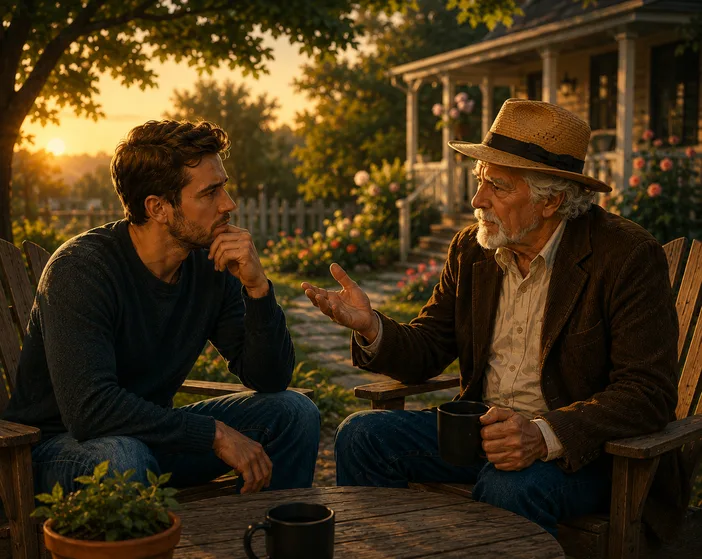
A few weeks before my thirty fifth birthday, I found myself sitting in Uncle Bob’s garden.
He was watering his tomatoes.
I wasn’t saying much.
He noticed.
“Something on your mind?”
I nodded.
“I turn thirty five in a couple weeks.”
“So?”
“I thought I’d have life figured out by now.”
He laughed.
“If you meet someone who has life figured out at thirty, introduce me. I’d like to ask them a few questions.”
I smiled.
“It’s more than that.”
“What is it?”
“I’ve been thinking about Melissa.”
“The girlfriend?”
“Yeah.”
“You love her?”
“I think so.”
“You think so?”
“I do.”
“But marriage scares me.”
“What else?”
I looked down.
“Grandma.”
His smile disappeared.
“The doctors don’t sound very optimistic.”
He quietly sat down across from me.
For a minute neither of us spoke.
Finally he said, “Every soul will taste death.”
I looked at him.
“The Qur’an says that. It doesn’t say some souls. It doesn’t say old souls. It says every soul.
“We all get our turn.”
I swallowed hard. “I don’t want to lose her.”
“You won’t.”
I looked confused.
“You’ll lose her body someday.”
“You’ll never lose what she put inside you.”
He looked toward the roses.
“Your grandmother taught you kindness. She taught you patience. She taught you family.”
“Death can’t take those away.”
We sat quietly for another minute.
“You know,” he finally said, “the tragedy isn’t that life ends.”
“What is it then?”
“The tragedy is that so many people never truly begin living.”
I stared at him.
“So many people spend their whole lives preparing to live. They’ll travel… someday. ”
“They’ll get married… someday. They’ll have children… someday. They’ll start the business… someday.”
“Then someday runs out.”
I nodded.
“Your Lucky… You know, a few years ago, thirty-five was considered middle age. Most people never lived much past seventy, if they made it that far. People in their twenties were in a hurry to get married because life seemed short. By the time they reached their sixties, they had one eye on the calendar and the other on the clock.”
“You know… I’ve made plenty of mistakes.”
He laughed. “So have I. Much bigger than yours…”
“Don’t be afraid of making mistakes. Be afraid of never living.”
He leaned toward me. “If you’re sure about the girl…”
“I think I am.”
“No.” He smiled. “I didn’t ask if you think. “I asked if you’re sure.”
I thought about it. “I am.”
“Then marry her.”
“So simple?”
“Pretty much.”
“What if something goes wrong?”
He shrugged.
“Something always goes wrong.”
“What if we struggle?”
“You probably will.”
“What if I fail?”
“You probably will.”
“What if I make the wrong decision?”
“You’ll make hundreds of wrong decisions.”
He smiled.
“But if you’ve found someone worth building a life with, don’t waste years waiting for perfect.”
“You know what I’ve never heard an old man say?”
“What?”
“I wish I had loved less. ‘I wish I had never married the woman I truly loved. ‘I wish I had never had my children.”
He shook his head.
“What I hear is… ‘I waited too long. I was too afraid. I thought I had more time.
He looked me straight in the eyes.
“If you don’t do it… You’ll regret it.”
He changed the subject so quickly it caught me off guard.
“Bring her around more.”
“What?”
“Bring Melissa around.”
“She needs to spend time with the family.”
“Why?”
He laughed.
“Because she’s going to have to like us.”
“Or not.”
“But the sooner everybody figures that out, the better.”
We both laughed.
Then he became serious again.
“And there is another reason.”
“What’s that?”
“A second opinion.”
“What do you mean?”
“When you’re in love, you’re looking through one pair of eyes.”
“Your family has ten more. They may notice things you don’t.”
“Sometimes they’ll see red flags. Sometimes they’ll see wonderful things.”
“Either way, listen.”
“Here’s another trick. Watch how she treats people.”
“The waiter. The cashier. The janitor.”
“The elderly lady who walks too slowly.”
“The person who can’t do anything for her. That’s the real interview.”
“Why?”
“Because people are usually nicest to those they need.”
“The measure of character is how they treat the people they don’t.”
He smiled.
“Look at your grandmother. She’s kind to everyone.”
“Me…” He chuckled. “You have to earn my trust.”
“But once you have it, you’ve got it.”
He picked up the watering can.
“In this family we try to treat everyone with respect.”
“The rich. The poor. The waiter. The CEO.”
“The person cleaning the bathroom. “People are people.”
He watered another tomato plant.
“You can fake manners for a dinner. You can’t fake character for a lifetime.”
The sun was beginning to set.
I stood up.
“You know, Uncle…”
“What?”
“I came here worried about turning thirty five.”
“And?”
“I think I’m leaving excited.”
He smiled.
“Good.”
“Because life doesn’t really begin when you turn thirty.”
“When does it begin?”
“The day you stop waiting for permission to live.”
As I started walking toward my truck, Uncle Bob called out.
“Oh… one more thing.”
“Yeah?”
“When you finally ask her…”
“What?”
“Don’t overthink it.”
“I probably will.”
“I know.” He laughed. “That’s why you came to see me.”
“Next time we will talk about fixing mistakes”
Grandma’s Final Gift
A few weeks after Grandma died, the family sold her house.
Once the mortgage, taxes, legal expenses, and everything else were paid, I received my percentage of the money. It was more money than I had ever received at one time, but not enough to retire on.
That created a problem I had never expected.
I was afraid to spend it, afraid to invest it, and afraid that doing nothing would be just as foolish.
Everyone had an opinion.
One person told me to put it all in the stock market. Another said I should pay off every debt I had. Someone else told me to buy a rental property. A friend even suggested cryptocurrency because, according to him, it was “about to explode.”
The more advice I received, the less certain I became.
Finally, I went to see Uncle Bob.
He was sitting on his back porch drinking coffee when I arrived.
“Uncle Bob, I need some advice.”
He looked over the top of his cup.
“That usually means you either have a problem or some money.”
“A little of both.”
“That can be the most dangerous combination.”
I sat down across from him.
“Grandma’s house was sold, and I received my share of the money. I don’t know what to do with it. I don’t want to waste it, but I also don’t want to invest it in the wrong thing and lose it.”
Uncle Bob nodded slowly.
“That money represents part of your grandmother’s lifetime of work. You should treat it with respect, but you shouldn’t be frightened of it. Money needs a purpose. Otherwise, it will either disappear or sit still until inflation slowly eats it.”
“So what should I do?”
“I’ll tell you about a very old and proven principle. The basic idea is even found in the Bible: divide what you have among different places because you don’t know what trouble may come.”
“So it’s a religious rule?”
“Not exactly a law requiring you to divide your money into precise percentages. But diversification is an ancient principle. Many financially sophisticated families, including generations of Jewish business families, have taught their children not to depend on one investment, one business, or one source of income.”
He leaned back in his chair.
“Most financial advisers will tell you to put sixty percent in stocks and forty percent in bonds. Others may suggest fifty percent in real estate and fifty percent in financial investments. Those plans may be appropriate for some people, but I look at wealth differently.”
“How?”
“I divide wealth into three large buckets.”
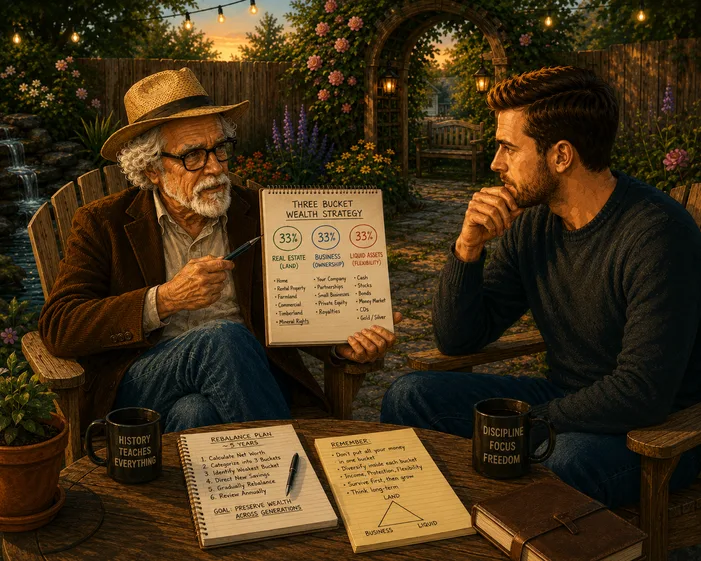
He picked up a notepad and wrote three numbers:
33 — 33 — 33
“Your long-term goal should be approximately one-third real estate, one-third operating businesses, and one-third liquid assets.”
I looked at the paper.
“That sounds simple.”
“The best principles usually do. Applying them is the difficult part.”
Bucket One: Real Estate
Uncle Bob circled the first number.
“The first thirty-three percent belongs in real estate or land.”
“What kind of real estate?”
“It could be your home, rental property, farmland, timberland, commercial property, mineral rights, or a small piece of land in the path of future development. The exact investment depends on your knowledge, location, and available capital.”
“Why real estate?”
“Because people will always need places to live, work, farm, store things, and operate businesses. Land is limited. Governments can print more money, companies can issue more stock, and new cryptocurrencies can be created every week. But nobody is manufacturing more land.”
“That means real estate can’t lose value?”
“Of course it can lose value,” he said. “Never confuse a strong asset with a guaranteed asset. Real estate can fall twenty, thirty, or even fifty percent in a bad market. A property can sit empty. A roof can fail. Taxes can rise. A neighborhood can decline.”
“Then why own it?”
“Because properly purchased real estate can preserve wealth, produce rental income, and protect you against inflation. Even when the market price temporarily falls, the property may continue producing income or providing you with a place to live.”
“So I should use Grandma’s money to buy a house?”
“Not necessarily. You’re trying to understand the destination, not make a reckless move tomorrow. You may not have enough money to buy the right property yet. You may need to save, find a partner, purchase a duplex, or use the money as part of a down payment.”
He tapped the first number.
“The important thing is to begin building this bucket intelligently.”
Bucket Two: Your Business
He circled the second number.
“The next thirty-three percent belongs in operating businesses.”
“You mean stocks?”
“No. Stocks belong primarily in the liquid bucket. I’m talking about direct ownership in a business that sells a product or service.”
“Like owning my own company?”
“That is usually the best place to begin because you have some control over it. You might also own part of another small business, become a silent partner, purchase an existing company, own royalty-producing intellectual property, or invest in a private enterprise you understand.”
“Why should a third of my wealth be in a business?”
“Because a good business produces cash flow. Real estate protects and stores wealth, but a business can actively create new wealth.”
He pointed toward the street.
“Suppose you own a pressure-cleaning company. Even if the stock market crashes, people may still need their roofs, driveways, and commercial buildings cleaned. If inflation raises your expenses, you may be able to raise your prices. If one service slows down, you can introduce another.”
“But businesses fail all the time.”
“They certainly do. That’s why I didn’t tell you to put one hundred percent of your money into a business. A business can fail because of competition, bad management, changing technology, regulation, theft, or simple bad luck.”
He paused.
“But unlike a stock certificate, your own business gives you some ability to respond. You can cut expenses, change suppliers, introduce new products, find new customers, or move into a different market.”
“So my business is supposed to produce the income?”
“Yes. Your business is the engine. Your real estate is the foundation. Your liquid assets are the reserve fuel.”
Bucket Three: Liquid Assets
He circled the final number.
“The last thirty-three percent should remain liquid.”
“What counts as liquid?”
“Cash, savings, money market funds, certificates of deposit, publicly traded stocks, bonds, and precious metals that can be sold quickly. Anything you can convert into usable money without spending months looking for a buyer.”
“Shouldn’t I keep all the inheritance liquid until I know what I’m doing?”
“For the moment, possibly. But not forever. Liquidity is important because it gives you flexibility. It allows you to survive emergencies, support your business during slow periods, and purchase assets when everyone else is desperate to sell.”
“What’s wrong with keeping most of my money in stocks?”
“Stocks can be excellent investments, but they can also fall fifty percent or more during a serious downturn. The fact that you own twenty different stocks does not necessarily mean you are truly diversified. If they all respond to the same financial crisis, they may all decline together.”
“What about stocks and bonds?”
“They are different investments, but they are both financial assets. Your retirement account, mutual funds, brokerage account, savings account, bonds, and publicly traded stocks may all belong in different accounts, but they still sit largely inside the same liquid bucket.”
“So someone can own many investments and still be concentrated?”
“Exactly. Owning thirty flavors of ice cream doesn’t mean you have thirty different food groups.”
I laughed.
“That sounds obvious when you say it that way.”
“Most important financial ideas are obvious after someone explains them.”
How the Three Buckets Protect You
Uncle Bob drew a triangle around the three numbers.
“Here is why the system works. At different times, different parts of the economy suffer.”
“If the stock market falls, you still have your real estate and business.”
“If property values decline, you can live on the income from your business.”
“If your business slows down, your liquid assets can help cover expenses until conditions improve.”
“If inflation damages the value of cash, your property and business may rise in value or produce higher income.”
“So one bucket supports the others?”
“That’s the idea. You don’t expect all three buckets to perform perfectly every year. You expect them to protect the whole family over many years.”
“What happens when one bucket does very well?”
“You rebalance.”
“How?”
“Suppose your business grows rapidly and eventually represents sixty percent of your net worth. You may take some of the profits and purchase real estate or build your liquid reserves. If the stock market rises dramatically and your financial assets become too large, you might move some profits into property or a private business.”
“Do I need to maintain exactly thirty-three percent in each one?”
“No. This isn’t chemistry. You’re creating balance, not chasing mathematical perfection. You may be at thirty percent, thirty-five percent, and thirty-five percent. That is close enough.”
He wrote another number on the paper.
Five years.
“Don’t try to rearrange your entire financial life in five weeks. Give yourself several years to build the three buckets properly.”
Diversify Inside Each Bucket
“I think I understand,” I said. “One property, one business, and one stock account.”
“No,” Uncle Bob replied. “That would be three buckets, but each bucket would still contain only one egg.”
He drew smaller circles inside each large number.
“You should eventually diversify inside the buckets.”
“In real estate, you might own your home, part of a rental property, and a piece of land.”
“In business, you might own your primary company, a minority interest in another business, and royalty income from intellectual property.”
“In liquid assets, you might hold emergency cash, short-term government securities, stocks, bonds, and a small amount of gold.”
“That sounds like it takes a lot of money.”
“It takes time more than anything. You don’t build a strong financial structure overnight. You build it one asset at a time.”
What Should I Do With Grandma’s Money?
I pushed the notepad back toward him.
“All right, but what should I do with the money I have right now?”
“First, don’t make any large moves while you’re grieving. Emotional periods are dangerous times to make permanent financial decisions.”
“That makes sense.”
“Second, place the money somewhere safe and liquid while you develop a plan. Don’t leave a large amount sitting in a regular checking account where it becomes too easy to spend.”
“Third, calculate your current net worth. Include your cash, retirement accounts, real estate equity, business ownership, and debts.”
“Then separate everything into the three buckets.”
“What if the buckets are uneven?”
“They probably will be. Most people discover that nearly everything they own is in one category.”
“And then?”
“Direct new money toward the weakest bucket. You don’t necessarily have to sell everything you already own. Gradual changes are usually less disruptive and may reduce taxes and transaction costs.”
I looked again at the three numbers.
“So Grandma’s money doesn’t have to go into one big investment?”
“That is exactly what it should not do.”
He folded his hands on the table.
“People receive an inheritance and immediately believe they must make one dramatic decision. They buy one property, invest in one company, or hand everything to one financial adviser.”
“Your grandmother spent a lifetime accumulating that money. You don’t need to redeploy it all by next Tuesday.”
Preservation Before Performance
“What return should I expect from this strategy?”
“You’re asking the wrong question.”
“What should I ask?”
“Ask how likely the money is to survive.”
He took another sip of coffee.
“People become obsessed with maximizing annual returns. They want eight percent, twelve percent, or twenty percent. That obsession causes them to chase whichever investment has performed best recently.”
“When stocks rise, they put everything into stocks.”
“When real estate rises, they become property speculators.”
“When cryptocurrency rises, everyone suddenly becomes an expert in digital assets.”
“And when the market collapses, they discover that their entire future was sitting in one bucket.”
“So the goal isn’t to get rich quickly?”
“The goal is to become wealthy without becoming poor again.”
He pointed at the paper one final time.
“Land preserves purchasing power.”
“Business creates income.”
“Liquidity creates flexibility.”
“Each one has a job. Together, they form a financial structure that can survive inflation, recessions, market crashes, business slowdowns, and unexpected emergencies.”
I sat quietly for a moment.
“I was thinking about using some of the money to buy a new truck.”
“Do you need a new truck?”
“No.”
“Will the truck make you money?”
“Probably not.”
“Then you were preparing to turn your grandmother’s appreciating house into a depreciating vehicle.”
I looked down at the table.
“That doesn’t sound very smart when you put it that way.”
“It rarely does.”
He handed the notepad back to me.
“Your grandmother didn’t just leave you money. She left you an opportunity. You can spend it once, or you can use it to build something that continues producing value long after both of us are gone.”
I folded the paper and placed it in my pocket.
“So I start by calculating what I already have, divide it into the three buckets, and strengthen whichever bucket is weakest.”
“Correct.”
“And I don’t put everything into one property, one business, or one investment.”
“Correct again.”
“And I build toward one-third real estate, one-third business ownership, and one-third liquid assets.”
Uncle Bob smiled.
“Now you’re beginning to understand.”
I stood up to leave.
“One more thing,” he said.
“What?”
“Never forget that diversification is not about owning many things. It is about owning things that behave differently.”
He lifted his coffee cup.
“Don’t keep all your money in one bucket. And don’t keep all the buckets in the same boat.”
That afternoon, I arrived at Uncle Bob’s house believing I had inherited a pile of money.
I left understanding that Grandma had given me something much more valuable.
She had given me the beginning of a financial foundation.
Let them Eat Cake, not Slice it
I stopped by my uncle’s house one afternoon to borrow his hammer drill.
That was the entire plan.
Walk in, borrow the drill, promise to bring it back, and leave before he found a reason to turn a five-minute visit into a two-hour lecture about life, money, politics, plumbing, or why no one builds a decent refrigerator anymore.
But when my uncle opened the door, he smiled and waved me inside.
“Come into the kitchen,” he said. “I have cake.”
That was how he trapped you.
My uncle believed cake could solve almost any problem. If it could not solve the problem, it could at least make you sit still long enough to hear his opinion about it.
A pot of coffee was already brewing. On the kitchen table sat a yellow cake with chocolate frosting, missing two generous slices.
As I entered, I noticed my uncle holding an old photograph. It showed a group of young men standing outside what appeared to be a high school. They had long hair, wide collars, and the confident expressions of people who had no idea how strange their clothes would look fifty years later.
I pointed to one of the boys.
“Did you go to school with him?”
My uncle studied the photograph for another moment.
“Yes,” he said. “We were good friends.”
He placed the picture on the table.
“But he’s gone now.”
“I’m sorry,” I said.
My uncle looked at me.
“Oh, he didn’t die. Not exactly.”
“What happened?”
“He became a socialist and stopped talking to me.”
I laughed, but my uncle did not.
“He decided that anyone who disagreed with him was either stupid, evil, or both. Apparently, I qualified.”
He cut me a piece of cake and poured two cups of coffee.
“You know,” he continued, “I have lost a lot of friends during the last ten years.”
I sat across from him.
“When I turned thirty, more than a hundred people came to my birthday party. We filled the house, the yard, and half the street. When I turned thirty-five, maybe thirty people came. I don’t remember the exact number.”
“What happened to everyone?”
“Life happened. People married, moved away, had children, changed jobs. That is normal. But something else has happened since then.”
He pushed the cake plate toward me.
“The world has more people than ever, but those people seem to have fewer and fewer friends.”
He tapped the cake with the side of his fork.
“I call it the Cake Theory.”
“The Cake Theory?”
“Imagine your circle of friends as a birthday cake.”
He drew an invisible circle around the cake with his finger.
“Think about the people you knew around 2012. They had different opinions, different religions, different lifestyles, different backgrounds. Some were Republicans, some were Democrats, and most did not talk about politics every five minutes.”
“So the cake was whole?”
“More or less. It was not perfect, but everyone could sit at the same table.”
He took the knife and made a straight cut through the center of the cake.
“Then came the 2016 election. Trump against Clinton. That was the first major cut.”
“Left against right.”
“Exactly. Society had been divided politically for a long time, but social media made that division personal. People were no longer merely disagreeing. They were unfriending each other.”
He separated the two halves slightly.
“One side believed the other side was destroying the country. The other side believed exactly the same thing. Both were convinced they were defending civilization.”
“What was different about that election?”
“Politics became identity. An opinion was no longer something you had. It became who you were. If someone criticized your candidate, it felt as though they were attacking you personally.”
He made another cut through one section of the cake.
“Then came men against women. Hillary Clinton’s campaign made gender part of the political battle. Suddenly, you were not just divided by ideology. You could also be divided by sex.”
“So if you were a conservative man, your section became smaller again.”
“Correct. First, the cake was divided between left and right. Then each section was divided along another line.”
He cut the cake once more.
“That is when the people running the social-media machines discovered something important. One division was not enough.”
“They wanted everyone fighting everyone?”
“They learned that outrage creates attention. Attention creates engagement. Engagement creates money and influence.”
He pointed the knife toward me.
“A peaceful person closes the application and goes outside. An angry person keeps scrolling.”
Then he made a jagged cut through another part of the cake.
“Next came COVID.”
“Lockdowns, masks, mandates, and vaccines.”
“COVID cut directly through families, friendships, workplaces, churches, and political parties. It even divided conservatives.”
He moved two pieces apart.
“One side believed strong rules were necessary for public health. They valued order, safety, hygiene, and collective responsibility. The other side questioned the mandates and the official explanations. They valued freedom, transparency, bodily autonomy, and the right to challenge authority.”
“And both sides thought the other was dangerous.”
“Exactly. One side thought the skeptics were reckless. The other thought the obedient were surrendering their freedom.”
He leaned back.
“People lost friends. Some stopped speaking to brothers, sisters, parents, and children. Families fought over Thanksgiving dinner. Co-workers reported each other. Neighbors treated one another like enemies.”
He looked at the pieces of cake.
“Another hard cut.”
He turned the plate slightly and sliced from a different angle.
“Then, in 2022, Russia invaded Ukraine.”
“Another division.”
“But notice something important,” he said. “It was not the same division. It did not perfectly follow the old left-versus-right line.”
He separated another piece.
“Some people demanded punishment, weapons, sanctions, and total support for Ukraine. Others wanted negotiations, restraint, and an end to the fighting before it expanded.”
“Peace versus punishment.”
“Or diplomacy versus strength, depending on how you framed it. That is part of the trick. Every side gets a noble label for itself and an ugly label for the other.”
He raised his cup.
“If you wanted negotiations, they called you weak or pro-Russian. If you wanted military support, they called you a warmonger. Very simple. Very emotional. Very effective.”
He made another cut.
“Then came Israel and Palestine.”
“New lines again.”
“Completely new lines. Not simply left against right. Not men against women. Not freedom against mandates. Friends who had agreed on every previous issue suddenly discovered they were enemies over Gaza.”
He placed the knife beside the plate.
“That is what makes the model so dangerous. Old-fashioned divide and conquer divided people once and then reinforced the division. This new system divides people, then divides each division, then divides the divisions again.”
“Divide, divide, divide—and conquer.”
“Exactly.”
We looked at the cake. What had been one round cake was now a collection of irregular pieces scattered across the plate.
“Every controversy cuts from a different angle,” my uncle said. “Each time, a different group of your friends is removed from your life.”
“And eventually?”
He slid one small piece toward me.
“You are left with a very sad birthday cake. Just enough for one person.”
I took a bite.
“So what happens after everyone is isolated?”
“That is when loneliness becomes useful.”
“Useful to whom?”
“To anyone who wants to influence you.”
He leaned forward.
“A person with strong family ties, loyal friends, a healthy community, and people they trust is difficult to manipulate. That person has somewhere to go. They can ask questions. They can compare experiences. They can laugh at propaganda.”
“And a lonely person?”
“A lonely person turns to the screen for companionship, information, approval, anger, entertainment, and identity.”
He tapped his phone.
“The same machine that helped isolate the person now offers to become the person’s friend.”
“That is dark.”
“It is also profitable.”
He picked up the knife and held it above the remaining cake.
“If I were the devil and wanted to control the world, I would not begin by putting everyone in chains.”
“What would you do?”
“First, I would cut the cake.”
He lowered the knife.
“Then I would let the people starve for companionship. After that, it would be easy to nudge them wherever I wanted them to go.”
For a moment, neither of us spoke.
The coffee maker clicked as it finished brewing.
“So what do we do?” I asked.
My uncle put the knife down.
“We stop cutting.”
“That sounds easier than it is.”
“It is easier than people think, but it requires discipline.”
He held up one finger.
“First, focus on what connects you to people, not what divides you.”
“What if we strongly disagree?”
“Then talk about something else. You are not required to discuss every political controversy with every person you know.”
He pointed toward the window.
“You can talk about work, children, food, travel, cars, music, gardens, old stories, business ideas, home repairs, or the neighbor who somehow manages to run a leaf blower every Sunday morning.”
I smiled.
“You can share a meal with someone without first conducting an ideological background check.”
He raised a second finger.
“Second, keep difficult conversations offline.”
“Why?”
“Because online, you are not merely talking to another person. You are performing in front of an audience while an algorithm watches, measures, sorts, and amplifies everything.”
He gestured toward the chair beside him.
“Face to face, you see a human being. You hear the hesitation in their voice. You notice when they are hurt. You can clarify what you meant. You can laugh. You can apologize.”
“Soul to soul.”
“Exactly. Never try to repair an important relationship inside a comment thread.”
He raised a third finger.
“Third, stay loyal to people, not positions.”
“You mean friendship should be more important than politics?”
“Most of the time, yes. Political positions change. People learn. Circumstances change. New information appears.”
He pointed at the old photograph.
“Your brother will not always be right. But your brother will always be your brother.”
“That does not mean accepting everything someone does.”
“No. Loyalty does not mean surrendering your judgment. Some relationships are abusive or dangerous, and distance may be necessary. But ending a thirty-year friendship because someone voted differently is usually foolish.”
He looked again at the photograph.
“We have started treating disagreement as betrayal.”
I glanced at the picture of his former friend.
“Could you reconnect with him?”
My uncle considered the question.
“Perhaps.”
“Even after all this time?”
“That brings us to the most powerful part of the Cake Theory.”
He began moving the pieces back toward one another.
“The people dividing society keep introducing new issues. They assume every new division will make us weaker.”
He joined two pieces.
“But every new issue also gives us an opportunity to reconnect.”
“How?”
“Suppose you stopped talking to a friend because of his position during COVID. Years later, you discover that both of you see the war in Gaza the same way.”
“So you have common ground again.”
“Exactly. Use it.”
He joined another piece.
“Do not reopen the old argument. Do not demand an apology. Do not send him a twenty-page explanation of why he was wrong.”
“What do you say?”
“You say, ‘I was thinking about you. It has been too long. Let’s have coffee.’”
“That simple?”
“That simple.”
He continued rebuilding the cake.
“Perhaps your left-wing friend and your right-wing friend were divided over Trump. But now both are concerned about what Mamdani represents in New York. Fine. There is common ground again.”
“So they start talking.”
“They start talking—and then, with any luck, they eventually stop talking about politics.”
He smiled.
“That is where the real friendship begins again.”
The cake could not be made whole. The cuts were still visible. Some frosting had stuck to the knife. A few crumbs remained scattered across the plate.
But the pieces were together.
“People are slowly realizing that this game is not merely political,” my uncle said. “It is psychological.”
“Because human connection is resistance.”
He nodded.
“We have all been played by narratives, campaigns, headlines, influencers, and algorithms. Every side thinks only the other side was manipulated.”
“But all of us were.”
“All of us.”
He pushed the reassembled cake toward the middle of the table.
“We are sitting at home alone, each guarding a tiny piece of cake, convinced everyone else is the enemy.”
“What should people do?”
“Write to an old friend.”
“What if the friend does not answer?”
“Write to another one.”
“What if the conversation becomes political?”
“Change the subject.”
“What if they insist?”
“Tell them the friendship matters more than winning the argument.”
He poured more coffee into my cup.
“Most of those old friends are sitting at home with their own tiny pieces of cake. They may be wondering whether you still hate them.”
“So invite them back.”
“Yes. Invite them over. Drink coffee. Share food. Tell old stories. Help each other. Learn from one another. Travel to see each other while you still can.”
He cut two fresh slices and placed one on my plate.
“There is hope. We simply have to get the cake back.”
I picked up my fork.
“Stop slicing.”
“Stop cutting.”
We ate quietly for another minute.
Then my uncle looked at me.
“By the way, why did you come here?”
I had almost forgotten.
“I need to borrow your hammer drill.”
“Oh.”
He stood and walked toward the garage.
“It is over here. Bring it back by next week. I want to change the door near the laundry room.”
I followed him.
“I can come by Saturday and help you.”
He stopped, turned around, and smiled.
“I will have more cake.”
The Laptop and the Loaf of Bread
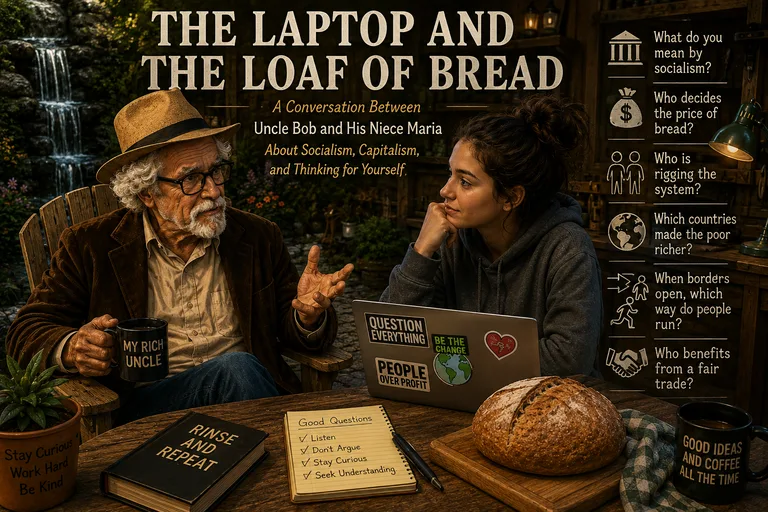
Maria showed up at Uncle Bob’s house late Saturday afternoon carrying a laptop under one arm and its power supply tangled around the other.
She was in her early twenties, in college, smart, opinionated, and—as Uncle Bob liked to remind her—dangerously confident around technology she didn’t understand.
MARIA: Uncle Bob, I need a favor.
UNCLE BOB: That sentence has cost me a lot of money over the years.
MARIA: My computer is acting weird.
UNCLE BOB: “Acting weird” is a very precise technical diagnosis.
MARIA: It freezes. Sometimes it won’t connect to Wi-Fi. And yesterday it told me I didn’t have enough disk space.
UNCLE BOB: How much disk space do you have left?
MARIA: I don’t know.
UNCLE BOB: Of course you don’t.
MARIA: That’s why I brought it to you.
Bob took the laptop from her and set it down on the kitchen table.
UNCLE BOB: Password?
MARIA: I’m not giving you my password.
UNCLE BOB: Then I’m fixing the outside of the computer.
MARIA: Fine. I’ll type it in.
She sat beside him while the machine booted.
Bob started checking the drive, startup programs, updates, and network settings. Maria pulled out her phone and began scrolling.
After a minute she shook her head.
MARIA: Look at this.
UNCLE BOB: That’s usually how trouble starts.
MARIA: They’re talking about how billionaires keep getting richer while normal people can’t afford houses anymore.
UNCLE BOB: That’s actually a reasonable thing to be concerned about.
MARIA: See? That’s why socialism is becoming popular.
Bob stopped typing for a moment.
He knew exactly where the conversation could go.
Maria knew his politics. Bob knew hers. They had both heard enough family arguments at Thanksgiving to recognize the warning signs.
So instead of immediately responding, Bob closed the settings window and turned toward her.
UNCLE BOB: Can I ask you something?
MARIA: Here we go.
UNCLE BOB: No. That’s exactly what I don’t want.
MARIA: What?
UNCLE BOB: I don’t want this turning into me trying to convince you to vote for Donald Trump or become a conservative.
MARIA: That’s what I figured you were about to do.
UNCLE BOB: I’m not.
You’ve mentioned socialism several times lately, and I realized something.
I’m not sure I actually know what you mean when you use the word.
So instead of telling you what socialism means, I want you to tell me.
MARIA: Okay.
UNCLE BOB: And let’s make a deal.
I’m going to ask questions.
You’re allowed to ask me questions.
If either one of us gets irritated, we stop talking politics for five minutes, make fun of your computer, get something to drink, and then come back to it.
I’m not trying to trap you.
I’m not trying to score points.
I’m interested in how you reached your conclusions.
And you can do exactly the same thing to me.
MARIA: You’re actually going to listen?
UNCLE BOB: That’s the experiment.
MARIA: All right. Go ahead.
Bob turned back toward the laptop.
UNCLE BOB: First question.
When you say socialism, what exactly do you mean?
Do you mean something like Denmark, where there are private companies and private property, but government taxes people more and pays for a larger social safety net?
Or do you mean actual socialism, where the government owns or controls major industries and the means of production?
Because those are two very different things.
MARIA: I’m mostly talking about healthcare, education, housing assistance, things like that.
UNCLE BOB: Okay. That’s important.
Because if socialism simply means government paying for certain things, America has been doing versions of that almost from the beginning.
We have public schools. Social Security. Medicare. Roads. Police. Fire departments. The military.
So maybe our disagreement isn’t capitalism versus socialism at all.
Maybe the real argument is: How large should the government’s role be, what should government provide, and how much taxation are we willing to accept to pay for it?
MARIA: That’s probably closer to what I mean.
UNCLE BOB: Good. Now we’re getting somewhere.
You also say sometimes that capitalism is rigged.
MARIA: It is.
UNCLE BOB: I actually think parts of it are rigged too.
But here’s my question:
Rigged by whom?
Corporations?
Politicians?
Banks?
Rich people?
Lobbyists?
Government regulators?
MARIA: Probably all of them to some extent.
UNCLE BOB: Okay. Then here’s the part I’m interested in.
If powerful people are capable of rigging capitalism, what prevents powerful people from rigging socialism?
If your solution is to give government considerably more control over the economy, aren’t you handing even more power to the same political system you just told me can be corrupted?
MARIA: Unless there are strong democratic controls.
UNCLE BOB: That’s a reasonable answer.
So maybe the real question becomes: What institutions keep concentrated power accountable?
Whether that power belongs to corporations or government.
MARIA: I can agree with that.
Bob clicked through several folders on her computer.
UNCLE BOB: By the way, you have 186 gigabytes of videos on here.
MARIA: Don’t delete those.
UNCLE BOB: I wasn’t going to.
Although I may use them later as evidence that capitalism isn’t the only system capable of wasting resources.
MARIA: Very funny.
UNCLE BOB: Here’s another question.
What’s a loaf of bread cost?
MARIA: I don’t know. Four dollars?
UNCLE BOB: Good enough. I’m not trying to embarrass you.
Now tell me the name of the person who decided bread should cost four dollars.
MARIA: There isn’t one person.
UNCLE BOB: Exactly.
Walmart didn’t call Publix, Publix didn’t call Costco, Costco didn’t call every farmer in Kansas, and everybody didn’t get together Wednesday morning and announce:
“Bread shall now be $4.12.”
Yet somehow millions of farmers, truck drivers, flour mills, bakeries, supermarkets, employees and customers constantly arrive at prices.
How?
MARIA: Supply and demand.
UNCLE BOB: Exactly.
And that’s one of the things I find fascinating about markets.
Nobody necessarily knows what the “correct” price of bread is.
The price emerges from millions of decisions.
Wheat prices.
Fuel.
Labor.
Transportation.
Weather.
Packaging.
Electricity.
Competition.
Consumer demand.
And if one store charges twelve dollars when everybody else charges four, what happens?
MARIA: People buy it somewhere else.
UNCLE BOB: Right.
Now let’s say bread suddenly goes from four dollars to six.
Why?
MARIA: Inflation?
UNCLE BOB: Maybe. But what does inflation mean?
Is the wheat more expensive?
Fuel?
Labor?
Money supply?
Interest rates?
A crop failure?
Supply-chain problems?
Government policy?
Some combination?
That’s the kind of thing I want us to think about before saying somebody should simply order the price back down.
MARIA: But companies can also raise prices just because they can.
UNCLE BOB: Absolutely.
And monopolies can destroy the competitive mechanism I’m talking about.
That’s where I think your argument gets stronger.
If five companies secretly become one cartel, that’s not really a competitive market anymore.
So then the question isn’t just government or capitalism.
It’s:
How do we preserve competition?
MARIA: Okay. That’s fair.
UNCLE BOB: Now here’s a harder question.
Can you give me an example of a country where the state substantially took ownership of the means of production and the poor became dramatically wealthier because of it?
I’m not asking sarcastically.
Give me the strongest example you can find.
MARIA: What about China?
UNCLE BOB: Good example to investigate.
China calls itself communist, but much of its enormous reduction in poverty happened after it allowed markets, private businesses, foreign investment and profit incentives back into the economy.
So what caused the improvement?
Socialism?
Markets?
A mixture?
That’s worth examining rather than just throwing labels around.
MARIA: What about Scandinavian countries?
UNCLE BOB: Also worth studying.
But they’re interesting because they’re mostly capitalist economies with extensive welfare states.
Private companies.
Private property.
Stock markets.
Entrepreneurs.
Billionaires.
Competitive markets.
Then government taxes that wealth and redistributes part of it through services.
That’s very different from the government owning everything.
MARIA: So you’re saying they’re not socialist?
UNCLE BOB: I’m saying the word socialism gets used to describe so many different systems that sometimes people argue for an hour without realizing they’re talking about completely different things.
MARIA: That’s probably true.
UNCLE BOB: Here’s another question.
When countries severely restrict people from leaving, which direction are people usually trying to go?
Into the country?
Or out?
MARIA: Usually out.
UNCLE BOB: That’s something I think we should pay attention to.
Historically, when governments had to build walls to keep their own citizens from leaving, that’s a pretty powerful signal that something wasn’t working.
And here’s another perspective question.
Would you rather be poor today or rich in 1900?
MARIA: Rich in 1900.
UNCLE BOB: Think carefully.
You’re rich.
Beautiful house.
Servants.
Maybe even a horse and carriage.
Then you get pneumonia.
MARIA: Okay…
UNCLE BOB: No antibiotics.
You need heart surgery.
Doesn’t exist.
You need an MRI.
Doesn’t exist.
Air conditioning?
Probably not.
Internet?
No.
Commercial airlines?
No.
Modern dentistry?
Barely recognizable.
Your child gets a bacterial infection that today requires twenty dollars’ worth of antibiotics.
In 1900, being rich might not save them.
So which life is actually wealthier?
MARIA: That’s different from income though.
UNCLE BOB: Exactly.
And that’s the point.
We should measure progress by more than money.
What can ordinary people actually obtain?
Food.
Medicine.
Transportation.
Information.
Education.
Entertainment.
Technology.
Life expectancy.
Those matter too.
MARIA: But poor people still struggle.
UNCLE BOB: Absolutely.
I’m not saying, “Everything is great, stop complaining.”
I’m saying we need perspective before deciding the entire system has failed.
Here’s another question.
Suppose you make candles.
I walk into your store.
You say one candle costs twenty dollars.
I look at it and decide it’s worth twenty dollars.
I give you the money.
You give me the candle.
You wanted the twenty dollars more than the candle.
I wanted the candle more than the twenty dollars.
We both walk away happier.
Who lost?
MARIA: Nobody necessarily.
UNCLE BOB: Right.
That’s the basic magic of voluntary exchange.
Trade isn’t necessarily one person winning and another person losing.
Both sides can gain.
Now obviously there are exceptions.
Fraud.
Coercion.
Monopoly.
Pollution.
Exploitation.
Information people deliberately hide.
Those need rules.
But the existence of bad trades doesn’t mean voluntary trade itself is bad.
MARIA: What about wages?
Companies have more power than individual workers.
UNCLE BOB: Sometimes they absolutely do.
So here’s the question I wrestle with:
Someone has to determine what your labor is worth.
Should it primarily be negotiated between you and the person who wants to hire you?
Should unions negotiate it collectively?
Should government establish a minimum?
Should government determine the entire wage?
And where do we draw the line?
MARIA: I’d definitely support minimum wages and unions.
UNCLE BOB: Good.
Then we’re not debating whether markets should exist.
We’re debating the rules around the market.
That’s a much more useful conversation.
Maria watched as Bob disabled several programs that were starting automatically with the computer.
MARIA: You know, you don’t sound nearly as conservative when you’re asking questions.
UNCLE BOB: That’s because I’m not trying to recruit you.
I’m trying to understand how you’re thinking.
And I’d rather you challenge me too.
Ask me why I believe capitalism works.
Ask me where capitalism fails.
Ask me about monopolies.
Ask me about healthcare.
Ask me why somebody working forty hours a week can still struggle to afford housing.
Those are legitimate questions.
MARIA: So what are you actually trying to convince me of?
Bob looked over at her.
UNCLE BOB: Nothing tonight.
That’s the point.
I want to know whether you arrived at your beliefs because somebody gave you a slogan…
…or because you’ve thought through the consequences.
And you should demand exactly the same thing from me.
If I say, “The free market will solve it,” ask me:
“How?”
If I say, “Government will screw it up,” ask:
“Why?”
If you tell me government should solve something, I’ll ask:
“How?”
If you tell me capitalism caused something, I’ll ask:
“How?”
Neither one of us gets to escape by using a label.
MARIA: That’s actually reasonable.
UNCLE BOB: That’s all I’m asking for.
Not conservative thinking.
Not liberal thinking.
Not socialist thinking.
Thinking.
And when you tell me something I disagree with, instead of immediately saying you’re wrong, I’d rather ask:
“When you say that, what exactly do you mean?”
Then I’ll listen to your answer.
Because I’d rather understand how you reached your conclusion than simply beat you in an argument.
Bob restarted the laptop.
A few seconds later it came back up noticeably faster.
MARIA: Wow. You fixed it.
UNCLE BOB: Mostly.
You had about thirty things starting automatically, your drive was almost full, and you haven’t installed updates in six months.
MARIA: So the system was broken.
Bob looked at her.
UNCLE BOB: No.
You weren’t maintaining it.
Maria stared at him for a second.
MARIA: You have been waiting this entire conversation to say that, haven’t you?
UNCLE BOB: Maybe.
MARIA: And you said you weren’t trying to convince me of anything.
UNCLE BOB: I’m fixing your computer.
Political philosophy is extra.
MARIA: I’m never bringing you another computer.
UNCLE BOB: You’ll be back.
MARIA: Probably.
She picked up the laptop.
Then stopped at the door.
MARIA: Uncle Bob?
UNCLE BOB: Yeah?
MARIA: I’m still a socialist.
UNCLE BOB: That’s fine.
Just make sure you know what kind.
Maria laughed.
MARIA: Goodnight, Uncle Bob.
UNCLE BOB: Goodnight, kid.
And back up your computer.
MARIA: I knew there was going to be another lecture.
UNCLE BOB: That’s not politics.
That’s civilization.
The Joy of Missing Out

It was a typical Fourth of July at Uncle Bob’s house.
The grill was smoking, children were running through the yard with sparklers, and several generations of the family had gathered under the covered patio to eat too much food and argue about things nobody intended to resolve.
Music played softly from a speaker near the pool. Every few minutes, someone’s phone would chirp, buzz, or light up.
Across the patio, I noticed my cousin Karly sitting by herself.
She was staring down at her phone and sniffling.
At first, I thought the smoke from the grill had gotten to her. Then I noticed her wiping her eyes.
I walked over and sat beside her.
“Are you okay?” I asked.
That was all it took.
Boy, did I get an earful.
“No,” she said. “I’m not okay. Everybody else is doing something with their lives except me.”
I looked around the yard.
“You’re doing something right now,” I said. “You’re at a Fourth of July party.”
“That’s not what I mean.”
She turned her phone toward me.
The screen showed a photograph of one of her friends standing on a beach somewhere. The water was impossibly blue, the sand looked untouched, and the caption suggested that the woman had somehow discovered the meaning of life while drinking something from a coconut.
“She’s in Aruba,” Karly said.
“Looks nice.”
“She just got promoted, too.”
Karly swiped to another photograph.
Another friend was standing beside a new car with a large red bow tied around it.
“She bought that yesterday.”
Another swipe.
“This one just got engaged.”
Another swipe.
“They bought a house.”
Another.
“She started her own business.”
Another.
“They’re in Italy.”
I nodded carefully, trying to think of something useful to say.
Karly leaned back in her chair.
“I feel like everybody is moving forward and I’m standing still. I should be traveling. I should have a better job. I should be making more money. I should probably be married by now. I should be doing something exciting.”
I opened my mouth.
Thankfully, before I could say anything foolish, Uncle Bob began walking toward us.
He had apparently heard enough of the conversation to recognize danger.
I was not ready to be the wise uncle.
Uncle Bob was.
He pulled over another chair and sat across from Karly.
“What’s the problem?” he asked.
Karly gave him the abbreviated version, which still took almost ten minutes.
When she finished, Uncle Bob held out his hand.
“Give me your phone.”
She looked suspicious.
“Why?”
“I’m not going to throw it in the pool.”
“You promise?”
“No. But give it to me anyway.”
She handed it over.
Uncle Bob turned the phone facedown on the table.
“There,” he said. “Your life has already improved.”
Karly rolled her eyes.
“I’m serious, Uncle Bob.”
“So am I.”
He pointed toward the yard.
“Look around.”
She glanced toward the people eating, laughing, and preparing for the fireworks.
“What am I supposed to be looking at?”
“Your grandmother is sitting over there telling the same story she has told every Fourth of July for the past fifteen years.”
Karly smiled slightly.
“Your little cousins are chasing each other with water guns. Your father is pretending he knows how to cook ribs. Your mother has spent all afternoon feeding people who said they weren’t hungry. The sun is going down. The weather is good. The family is together.”
He tapped the phone.
“And you are sitting here comparing all of that to a photograph of somebody holding a coconut.”
Karly looked down.
“It’s not just the vacation.”
“I know,” Uncle Bob said. “It never is.”
He settled back in his chair.
“The problem is not that your friends are doing well. The problem is that every time somebody else announces something good, you use it as evidence that something is wrong with your life.”
Karly became quiet.
“That has a name now,” he continued. “FOMO. The fear of missing out.”
“I know what FOMO is.”
“Most people know the name. They don’t always recognize how much it controls them.”
He picked up her phone again but did not turn it over.
“FOMO makes you believe that life is happening somewhere else. At another party. In another city. At somebody else’s job. Inside somebody else’s marriage. In somebody else’s bank account.”
He handed the phone back to her.
“And because you are always looking at somebody else’s life, you stop noticing your own.”
Karly folded her arms.
“So I’m just supposed to stop wanting things?”
“No. Wanting more is not the problem. Letting other people decide what you should want is the problem.”
He pointed toward the phone.
“These little machines are comparison factories. Every day, they show you everybody else’s best meal, best vacation, best outfit, best relationship, and best business announcement.”
He paused.
“But they rarely show you the argument before the photograph, the credit-card bill after the vacation, the stress behind the promotion, the loneliness inside the marriage, or the fear behind the smiling face.”
Karly nodded slowly.
“So social media is fake?”
“Not always fake. Just incomplete.”
He leaned closer.
“A photograph can be true and still not tell the truth.”
That sentence quieted both of us.
Uncle Bob continued.
“Your friend may genuinely be happy in Aruba. Good for her. But her happiness does not create a deadline for yours.”
Karly looked toward the pool.
“I just feel behind.”
“Behind whom?”
“Everybody.”
“There is no everybody.”
She looked back at him.
“There are millions of people living millions of different lives on millions of different schedules. Some marry at twenty. Some marry at forty. Some start businesses at twenty-five. Others start them after retirement. Some people travel the world and wish they had a home. Some have beautiful homes and wish they had the freedom to leave.”
He shrugged.
“There is no single timetable.”
“But what if I really am wasting time?”
“That is possible,” Uncle Bob said.
Karly looked surprised.
I was surprised too.
Uncle Bob was not the kind of man who offered comfort by pretending every concern was imaginary.
“You may need to make changes,” he continued. “Maybe you need a better job. Maybe you should travel. Maybe there is something you have been postponing because you are afraid.”
He pointed toward her chest.
“But those decisions should come from here, not from panic caused by something you saw on a screen.”
He stood and walked over to the cooler.
“Do you want something to drink?”
“Water.”
He handed her a bottle, then sat down again.
“There is another word you should learn.”
“What?”
“JOMO.”
Karly laughed.
“That sounds made up.”
“So does FOMO.”
“What does it mean?”
“The joy of missing out.”
“That sounds like something boring people invented.”
“It was probably invented by someone who finally got tired of being exhausted.”
He twisted the cap from his own bottle.
“JOMO is being able to say, ‘That looks nice, but it is not for me.’ It is staying home without imagining that everybody else is having a better time. It is declining an invitation without writing a five-paragraph apology. It is watching a trend pass by without feeling obligated to chase it.”
Karly looked doubtful.
“That sounds like giving up.”
“No. Giving up is quitting something that matters. JOMO is refusing something that does not.”
He nodded toward the street, where cars had been arriving and leaving all afternoon.
“Most people spend their lives afraid to miss a party, an opportunity, a promotion, an investment, or a trend. They rush from one thing to another because stopping makes them nervous.”
He took a slow drink of water.
“They become so afraid of missing life that they miss the life they are actually living.”
That line stayed with me.
The sky had begun to darken, and the first distant fireworks were appearing above the rooftops.
Uncle Bob watched one burst into red sparks.
“When I was younger,” he said, “I thought every opportunity had to be taken. Every invitation had to be accepted. Every new idea had to be pursued. I thought staying busy meant I was important.”
“What changed?” I asked.
“I got tired.”
Karly laughed.
Uncle Bob smiled.
“I also realized that being busy and building a good life are not the same thing.”
He looked at both of us.
“A person can spend all day moving and still go nowhere.”
The music stopped briefly as someone changed the playlist. For a few seconds, the yard became noticeably quieter.
Uncle Bob noticed.
“That is what people are afraid of now,” he said.
“What?” Karly asked.
“Silence.”
He gestured toward the phones on the table.
“The minute there is no conversation, people reach for a screen. The minute they are alone, they look for noise. The minute they feel bored, they demand entertainment.”
He looked toward the sunset.
“But boredom is not always an emergency. Sometimes it is the doorway to thought.”
Karly turned her phone over but did not unlock it.
“So what am I supposed to do? Meditate in the woods?”
“If you want.”
“I don’t.”
“Then don’t.”
He laughed.
“People make slowing down more complicated than it needs to be. You do not have to move to a cabin or become a monk. Start small.”
“Like what?”
“Eat one meal without looking at your phone.”
“That’s it?”
“That would be a miracle for some people.”
He began counting on his fingers.
“Take a walk without headphones. Sit outside for ten minutes. Wake up early enough that your morning is not a fire drill. Turn off notifications that do not deserve access to your nervous system.”
Karly smiled.
“Notifications have access to my nervous system?”
“Apparently all of them do.”
He continued.
“Learn to say no. Not angrily. Not dramatically. Simply say, ‘That does not work for me.’ Protect your time before other people spend it for you.”
Karly thought about that.
“I’m bad at saying no.”
“Most people are. They think saying no makes them selfish.”
“Doesn’t it?”
“Sometimes. But saying yes to everything can also be selfish.”
“How?”
“Because eventually you become tired, resentful, and unpleasant to everybody you agreed to help.”
I laughed.
“I’ve met people like that.”
“So have I,” Uncle Bob said. “One of them used to be me.”
He leaned forward.
“Your time is a limited resource. Every yes is also a no to something else.”
Karly raised an eyebrow.
“What do you mean?”
“If you say yes to another night out, you may be saying no to sleep. If you say yes to another project, you may be saying no to your health. If you say yes to another hour online, you may be saying no to reading, thinking, exercising, or talking to someone you love.”
He picked up a paper plate from the table and brushed away a few crumbs.
“People pay attention to how they spend money, but many never examine how they spend their lives.”
By then, several family members had moved their chairs closer to us. They pretended to be waiting for fireworks, but I could tell they were listening.
Uncle Bob lowered his voice slightly.
“Living slowly does not mean living without ambition. It means acting with intention.”
He pointed toward Karly.
“You can work hard without rushing emotionally. You can build a business without chasing every trend. You can invest without buying whatever strangers are celebrating this week.”
“That sounds like something you would say about cryptocurrency,” I said.
“It applies to almost everything.”
He looked at Karly again.
“FOMO is expensive.”
“How?”
“In business, FOMO makes people abandon good plans because a competitor announced something new. They invest money in technology they do not understand, hire people they do not need, or launch products that do not fit their customers.”
He tapped the table.
“In investing, FOMO makes people buy after the price has already climbed because they are afraid everyone else will become rich without them. Then fear arrives, the price falls, and they sell at a loss.”
“So what does JOMO look like in investing?” Karly asked.
“It looks boring.”
“That doesn’t sound appealing.”
“Good investing often is boring. You make a plan. You understand what you own. You diversify. You wait. You ignore people who became experts yesterday.”
He smiled.
“The market has collected more money from impatient people than almost any casino.”
Karly looked again at the photograph of her friend’s vacation.
“Maybe I have been letting everybody else set my goals.”
“Most people do until they stop and decide what matters.”
“How do I decide?”
“You ask better questions.”
“Such as?”
“Instead of asking, ‘What is everyone else doing?’ ask, ‘What kind of life do I actually want?’”
He waited.
“Instead of asking, ‘How do I look successful?’ ask, ‘What would make my days feel meaningful?’”
He waited again.
“Instead of asking, ‘What am I missing?’ ask, ‘What am I failing to appreciate?’”
Karly stared toward the yard.
Her grandmother was laughing so hard at something that she had to wipe her eyes. Two of the younger children were lying on the grass looking at the sky. Someone had begun cutting watermelon near the kitchen door.
“I guess this isn’t a bad place to be,” Karly said.
“It is not.”
“But I still want to travel.”
“Then travel.”
“And I want a better job.”
“Then make a plan to find one.”
“And maybe start something of my own.”
“Then start small and learn.”
He pointed toward her phone again.
“But do not confuse inspiration with instruction. Somebody else’s life may give you ideas. It should not give you orders.”
The first large firework exploded above the neighborhood.
Everyone in the yard looked up.
For several seconds, there were no phones, no comparisons, no plans, and no worries. There was only the sound, the flash of color, and the faces of people illuminated beneath it.
Uncle Bob watched the sparks disappear.
“That,” he said, “is the deliciousness of life.”
Karly laughed.
“The what?”
“The deliciousness of life. Those moments you would miss if you were too busy looking for something better.”
He leaned back.
“A meal you actually taste. A conversation you do not rush. A quiet morning. A walk beneath trees. Sitting beside someone you love without needing to fill every second with words.”
Another firework opened above us, this one gold and white.
“The world is going to keep rushing,” he said. “Let it.”
He folded his hands over his stomach.
“You do not have to move at the speed of everybody else’s anxiety.”
Karly turned off her phone and placed it on the table.
“Do you really think I’m going to be okay?”
Uncle Bob looked at her.
“I think you will be better than okay when you stop treating your life like it is late.”
She rested her head against his shoulder.
For the next twenty minutes, we watched the fireworks.
Nobody said very much.
Nobody needed to.
Later that night, as I was leaving, Uncle Bob walked me toward my car.
“You were awfully quiet back there,” he said.
“I was going to give her advice.”
“That is what worried me.”
I laughed.
“I didn’t know what to say.”
“That is all right.”
He placed a hand on my shoulder.
“One day, you will be the uncle sitting in that chair.”
“I don’t think I’m ready.”
“Nobody is ready.”
He looked back toward the house, where Karly was helping her grandmother carry dishes into the kitchen.
“The first rule is to listen long enough to discover what the person is really afraid of.”
“And the second rule?”
“Do not give advice merely because there is silence.”
I nodded.
“And the third?”
“Tell them the truth, but leave them with hope.”
I opened my car door.
“That sounds difficult.”
“It is.”
He smiled.
“That is why people need rich uncles.”
As I drove home, I thought about Karly, her friends, their photographs, and the pressure we place on ourselves to keep up with lives we do not truly understand.
Perhaps the goal is not to withdraw from the world or stop wanting more.
Perhaps the goal is to stop rushing blindly through the life we already have.
To work hard, but rest without guilt.
To pursue opportunity, but reject panic.
To appreciate other people’s happiness without using it as evidence against our own.
FOMO tells us that something important is always happening somewhere else.
JOMO reminds us that we are allowed to choose where our lives happen.
And sometimes, the richest moment is not the promotion, the vacation, the purchase, or the announcement.
Sometimes it is a July evening at your uncle’s house, sitting beneath a dark sky, surrounded by family, while the whole world briefly becomes quiet enough to notice.
Rich Uncle’s Lesson
Do not measure your life against the carefully selected moments of other people’s lives.
Set goals, work hard, travel, build, invest, and dream—but make sure the life you are pursuing is genuinely yours.
Slowing down is not dropping out. It is paying attention.
Learn to enjoy missing what does not matter so you can be fully present for what does.
Life is not measured by how quickly you move through it.
It is measured by how deeply you experience the moments you were given.
You have a choice: live with FOMO, embrace JOMO, or savor the deliciousness of life.
I choose delicious. Now pass the caviar.
Buying a Small Business with No Cash
I stopped by my uncle’s house one Saturday morning because he had promised to lend me his pressure washer.
As usual, the pressure washer was in the garage, but my uncle was in the kitchen drinking coffee and studying a stack of papers.
“Sit down,” he said. “The machine isn’t going anywhere.”
I poured myself a cup and looked at the papers scattered across the table.
“What are you buying now?” I asked.
“A plumbing company.”
I laughed. “Uncle, you don’t know anything about plumbing.”
“I know enough not to do it myself.”
He slid one of the pages across the table. It was a profit-and-loss statement from a small local plumbing business.
The company had six employees, four service trucks, several hundred repeat customers, and an owner who had been running it for more than thirty years.
“Why is he selling?” I asked.
“He’s seventy-one years old. His knees hurt, his wife wants to travel, and none of his children want the business.”
“So you’re buying it?”
“I might.”
“How much does he want?”
My uncle told me the price.
I almost spilled my coffee.
“You’re going to write him a check for that?”
“No.”
“Then the bank is financing it?”
“Probably not.”
I looked at him.
“Then how are you buying it?”
My uncle smiled. “That is the mistake most people make. They think that to buy a business, they must first have all the money.”
“Don’t you?” “No. You need a good business, a willing seller, a sensible agreement, and enough cash flow to make the arrangement work.”
He leaned back in his chair. “Every year, thousands of business owners reach retirement age. They have spent twenty, thirty, or forty years building companies. Many have no children interested in taking over. Their employees may not have the money to buy them out. Private-equity firms are not interested because the companies are too small. Banks may consider the deals too complicated.”
“What happens to the businesses?”
“Some close. Some are sold cheaply. Some are practically given away in exchange for a dependable stream of payments.”
“That sounds too easy.”
“It is not easy,” he said. “But it is far more possible than most people realize.”
He took a sip of coffee.
“There comes a point in many people’s working lives when they become tired of depending entirely on an employer. They want something of their own—a company that produces income, builds equity, and gives them control over their future.”
“And then they look at the price of businesses,” I said.
“Exactly. Then comes the sinking feeling. They see businesses advertised for hundreds of thousands or millions of dollars and decide that people like them are not allowed to own one.”
“Aren’t they right?”
“No. They are usually looking at the wrong businesses, through the wrong people, with the wrong assumptions.”
Start Small
My uncle picked up the plumbing company’s financial statement.
“What kind of company do most first-time buyers imagine owning?”
“A large company?”
“A large company with a beautiful office, twenty employees, a famous name, and millions in revenue. That dream is often the very thing keeping them from becoming business owners.”
“What is wrong with dreaming big?”
“Nothing, as long as the big dream does not stop you from taking a small first step.”
He pointed to the numbers.
“You do not need a giant business. You need a small, understandable business with reliable customers, positive cash flow, and room for improvement.”
“How small?”
“Small enough that you can understand what makes the telephone ring, how the work gets done, who the customers are, where the money comes from, and where it goes.”
He began naming examples.
A small plumbing company. An air-conditioning service business. A landscaping route. A pest-control company. A commercial cleaning operation. A bookkeeping practice. A pool-maintenance route. A sign shop. A small printing company. A laundromat. A repair business. A local delivery route. A niche online store.
A small manufacturing operation producing an unglamorous but necessary component.
“People overlook these companies because they are not exciting,” he said.
“Are they profitable?”
“Boring businesses can be wonderfully profitable. People may postpone buying a luxury, but they still repair leaking pipes, clean buildings, maintain air conditioners, service equipment, process payroll, and control pests.”
“So the first rule is to buy something small?”
“Buy something manageable. A small business operated well can produce more wealth than a large company operated badly. Size does not protect you from stupidity.”
He leaned forward. “Go small, and half your financial problem disappears before the negotiation begins. You may not be able to buy a ten-million-dollar company. That does not mean you are unable to buy a three-hundred-thousand-dollar company—or take over a smaller business whose owner primarily wants a dependable retirement income.”
Do Not Start What You Can Buy
“I always thought the cheapest way was to start a company myself,” I said.
“Sometimes it is. But starting from zero can also be the most expensive way.”
“How?”
“When you start from nothing, you must create everything. You need a name, equipment, employees, customers, suppliers, procedures, licenses, telephone numbers, advertising, credibility, and enough working capital to survive while you build revenue.”
“But buying costs more upfront.”
“You are not merely buying desks and trucks. You are buying time.”
He tapped the financial statement again. “This company already has people answering the telephone. It already has service vehicles, technicians, customers, reviews, supplier relationships, operating procedures, a working telephone number, and money coming in every week.”
“So I would be buying an income stream.”
“You would be buying an operating system that produces an income stream. That distinction matters.”
He looked at me over his coffee cup. “A business that has operated successfully for twenty years has already survived problems that would kill most startups.”
Look for the Retiring Owner
“Where do you find these businesses?” I asked. “Business-for-sale websites?”
“You can start there, but the best opportunities are often not polished listings.”
“Where are they?”
“They are hidden in ordinary places.”
He began counting them off.
Local trade associations. Chambers of commerce. Suppliers who know which owners are slowing down. Accountants and attorneys who work with older business owners. Commercial landlords. Industry conventions. Local newspaper advertisements. Community business groups.
And sometimes simply driving around and noticing businesses whose owners have been there for decades.
“The owner of a small company may have spent thirty years building it,” my uncle said. “He may not trust a broker. He may not want employees or customers to know he is considering retirement. He may have no idea how to sell it.”
“So I just walk in and ask whether he wants to sell?”
“Not quite like a man trying to buy used furniture.”
“What do I say?”
“Talk to him like a human being. Ask about the business. Ask how long he has owned it. Ask what he plans to do in the next five years. Ask whether anyone in the family is taking over.”
“And then?”
“If the conversation is right, you say, ‘Have you ever considered selling the business to someone who would continue what you built?’”
“That simple?”
“Simple does not mean easy. You may have to speak with fifty owners before one conversation becomes serious.”
Understand What the Seller Really Wants
“Why would an owner sell me his business without receiving all his money?”
My uncle smiled. “Because you are assuming that every seller wants the same thing.”
“Don’t they want the highest price?”
“Some do. Others want security. Some want to preserve their employees’ jobs. Some want the business name to survive. Some want monthly retirement income. Some want to reduce their daily workload without walking away immediately. Others want to avoid receiving one giant taxable gain in a single year.”
He raised a finger. “Tax treatment depends on the deal and the seller’s circumstances. That is a matter for accountants and tax attorneys. But an installment sale may allow the seller to receive principal payments over time rather than receiving the entire amount at closing.”
“So the seller gets a monthly check.”
“Yes. And possibly interest on the unpaid balance.”
“What else does he get?”
“A buyer who cares about preserving the business. Continued income without continuing to unclog drains, manage employees, answer emergency calls, chase customers, repair equipment, and worry about payroll.”
My uncle pointed at the papers. “This owner does not merely have an asset. He has a problem. He wants to retire, but much of his wealth is trapped inside the company.”
“So I am solving his problem.”
“That is the heart of every good transaction. You solve his retirement problem, and he solves your financing problem.”
Let the Seller Become the Bank
My uncle drew two boxes on a napkin.
In the first box, he wrote Bank Loan.
In the second, he wrote Seller Financing.
“With an ordinary acquisition,” he said, “you go to a bank. The bank studies your credit, collateral, income, experience, and down payment. If you do not fit its requirements, it says no.”
“And the deal dies.” “Only if you believe the bank is the only door.”
He pointed to the second box.
“With seller financing, the owner allows you to pay part of the purchase price over time. Instead of giving him the entire amount on closing day, you sign a promissory note and make scheduled payments.”
“Why would he trust me?”
“He should not trust you blindly. You must prove that you are capable, honest, prepared, and committed. The seller may secure the note with the business assets, ownership interests, or other agreed collateral. He may retain certain protections if you default.”
“So the business guarantees the payments?”
“The business does not magically guarantee anything. Businesses can lose customers, employees, contracts, or money. But a healthy company’s existing cash flow can provide the primary source of repayment.”
He circled the company’s cash flow. “The business should help pay for itself.”
That sentence stayed with me. “The business pays for the business?”
“That is the objective. You use the company’s future cash flow to pay the seller for the company he created in the past.”
What “Little or No Money Down” Really Means
“Then I really can buy a business with no money?”
My uncle gave me the look he used when I was getting carried away.
“Be careful. People selling dreams like to say ‘no money down’ as though you can walk into a profitable company with empty pockets and no responsibility.”
“So it is not possible?”
“It is possible to structure certain acquisitions with little buyer cash at closing. Occasionally, a deal can be completed with no buyer cash down. But somebody is always taking risk.”
He counted the possible components. Seller financing. An earnout tied to future performance. Outside investors. A bank or government-backed acquisition loan. Equipment financing. A line of credit. Accounts-receivable financing. A consulting arrangement with the seller. Deferred payments. A minority partner. Or credit from suppliers.
“A transaction can combine several of those,” he said. “But do not confuse creative financing with free ownership.”
“What money would I still need?”
“Legal fees, accounting fees, due diligence, insurance, licensing, deposits, working capital, and enough reserve to survive a difficult month.”
“So I should not spend every dollar buying the company.”
“Correct. Buying a business and leaving it with no working capital is like buying a truck and draining the fuel before driving home.”
An Example
My uncle turned the napkin over.
“Suppose a small service business is worth three hundred thousand dollars. It produces enough legitimate annual cash flow to pay a competent working owner, service acquisition debt, reinvest in the company, and maintain an emergency reserve.”
He wrote:
- Purchase price: $300,000
- Buyer cash: $15,000
- Seller note: $210,000
- Performance-based earnout: $45,000
- Outside investor or other financing: $30,000
“That is only an illustration,” he said. “Real terms depend on the company, its assets, its cash flow, the risk, the seller, and the law.”
“What is an earnout?”
“Part of the price is paid only if the business produces agreed results after the sale. It protects you if customers disappear or revenue was overstated.”
“And the investor?”
“Someone may contribute capital in exchange for a minority interest or a defined return.”
“So I could own the company for fifteen thousand dollars?”
“You could control the company under the right structure, but you would also assume obligations. Do not stare only at the small down payment. Look at the debt, responsibilities, risks, and working capital.”
He underlined the annual cash flow. “The payment structure must leave enough money to operate the business, pay you fairly, maintain equipment, handle taxes, and survive trouble. A deal that requires every available dollar to make the seller payment is already in danger.”
Character Still Matters
“Would an older owner really finance a stranger?” I asked.
“Not every owner. But a retiring owner can sometimes evaluate things a bank cannot.”
“Such as?”
“Whether you show up on time. Whether you understand the trade. Whether employees respect you. Whether you keep your word. Whether you have a realistic plan. Whether you will protect the reputation he spent thirty years building.”
My uncle paused. “A bank sees a credit score. An owner sees the person who may inherit his life’s work.”
“So how do I build trust?”
“Do not pretend to have money you do not have. Do not exaggerate your experience. Do not promise impossible growth. Tell the seller what you can do and what you cannot do.”
“That does not sound like negotiation.”
“It is the best kind of negotiation. Dishonesty may get you to closing, but it will not carry you through five or ten years of seller payments.”
The Seller Can Stay Temporarily
“What happens if I do not know enough to operate the business?”
“Then you do not throw the seller out on closing day.”
He explained that a transition agreement could allow the seller to remain for several months—or longer—as a paid consultant, part-time manager, salesperson, or technical adviser.
“You may reduce his hours gradually,” my uncle said. “At first, he works four days a week. Then two. Eventually, he answers occasional questions from his fishing boat.”
“That would make customers more comfortable.”
“And employees, suppliers, and lenders. A controlled transition reduces the danger of the business falling apart when the old owner leaves.”
“Wouldn’t the seller interfere?”
“He might. That is why authority, duties, hours, compensation, and the end date must be clearly written. You cannot have two captains permanently steering one boat.”
Put Everything in Writing
My uncle gathered the papers into a neat stack.
“Now we come to the part people skip because they are excited.”
“The contract?”
“The protections.”
He became serious. “You do not buy a business on a handshake, even when both people are honest.”
“Why not?”
“Because memories change. Circumstances change. People die. Families become involved. Employees make claims. Tax agencies appear. Old debts surface. Customers leave. Equipment breaks. A handshake cannot explain who is responsible.”
“So what has to be checked?”
“Everything that can hurt you.”
He began listing it.
Who actually owns the company. Whether the seller has authority to sell it.
Whether lenders have liens against the assets.
Whether payroll taxes, sales taxes, or income taxes are unpaid.
Whether employees are owed wages, commissions, benefits, or vacation pay.
Whether the company is involved in lawsuits.
Whether licenses and permits can be transferred.
Whether customer contracts survive a change of ownership.
Whether the landlord will transfer or renew the lease.
Whether equipment is owned, leased, financed, or nearly worn out.
Whether the inventory is usable.
Whether there are warranties or future obligations.
Whether environmental, safety, or regulatory problems exist.
Whether the seller has been putting personal expenses through the company.
Whether the financial statements match tax returns, bank deposits, invoices, payroll records, and actual operations.
“And who checks all of that?” I asked.
“You need an acquisition attorney and an accountant experienced with small businesses. Depending on the business, you may also need an insurance professional, licensing specialist, equipment inspector, environmental consultant, or industry expert.”
“That sounds expensive.”
“It is cheaper than buying a lawsuit.”
Verify the Cash Flow
“How do I know the profits are real?”
“You do not accept a spreadsheet simply because the seller printed it.”
My uncle explained that small-business owners often talk about “cash flow,” “owner benefit,” or “seller’s discretionary earnings.” Those figures may add back expenses that supposedly will disappear after the sale.
“Some add-backs are legitimate,” he said. “Others are imagination.”
“What do I verify?”
“Start with tax returns, bank statements, merchant-processing records, sales reports, customer invoices, payroll records, and supplier bills. The story must fit together.”
“What if the owner says some sales were paid in cash and never reported?”
“You do not pay for income that cannot be verified.”
“But the income may be real.”
“Then the seller enjoyed it already. You are buying what can be proven.”
Buy a Business, Not the Owner’s Job
“What is the biggest danger?” I asked.
“Buying a company that is not really a company.”
I waited.
“Some businesses exist entirely inside the owner’s head. He knows every customer. He performs the difficult work. He creates every estimate. He approves every purchase. He holds every license. He solves every emergency. When he leaves, the business leaves with him.”
“So what am I buying?”
“You may be buying equipment, a telephone number, and a temporary introduction to customers.”
“How do I avoid that?”
“Ask what happens when the owner takes a two-week vacation.”
“What if he has not taken one in twenty years?”
“Then you have found either a transition problem or an opportunity to build systems—but you must price the risk correctly.”
My uncle told me to examine whether the company had trained employees, written procedures, customer records, scheduling systems, accounting controls, reliable managers, transferable licenses, and repeatable methods.
“A company should be able to operate without the seller standing in the middle of it every minute.”
Look for the Bones
“What should I look for in a business besides profit?”
“The bones.”
He saw the confusion on my face. “A company with good bones may look old or neglected, but the valuable structure is already there.”
He listed examples:
A valuable telephone number.
A recognizable local name.
Long-standing customer relationships.
A trained workforce.
Good online reviews.
Service contracts.
Recurring revenue.
A favorable lease.
Hard-to-obtain permits.
Supplier credit.
Useful equipment.
A customer database.
Territory rights.
A website that already generates leads.
“The business may have terrible bookkeeping, faded trucks, no modern software, weak advertising, and an owner who still writes appointments on paper,” he said. “Those problems may frighten other buyers.”
“But I could improve them.”
“Exactly. Do not confuse ugly with broken.”
Four Questions Before You Buy
My uncle drew four numbered circles.
“Before buying any small business, answer four questions.”
1. Is the Cash Flow Real and Durable?
“Do customers return? Is demand consistent? Are margins stable? Does the company generate enough money after realistic expenses?”
2. Can the Business Operate Without the Seller?
“Who answers the telephone? Who performs the work? Who manages employees? Who owns the customer relationships? Can those functions transfer to you?”
3. Are the Customers, Assets, and Rights Transferable?
“Will customers remain? Will the landlord approve you? Will licenses transfer? Are contracts assignable? Is important equipment included and usable?”
4. Can the Business Support the Purchase?
“After paying normal operating expenses, replacing equipment, maintaining reserves, paying you fairly, and servicing the acquisition debt, is there still breathing room?”
“What if one answer is no?” I asked.
“Then you either change the deal, reduce the price, create a transition plan, or walk away.”
Cheap and Valuable Are Not the Same
“A business with a low asking price must be a good opportunity,” I said.
“No.”
My uncle said it so quickly that I laughed.
“A business may be cheap because its largest customer is leaving. Its lease may be expiring. Its equipment may be worn out. Its employees may be preparing to quit. Its licenses may not transfer. Its taxes may be unpaid. Its owner may be the only person capable of doing the work.”
“So cheap can become expensive.”
“A cheap bad business is one of the most expensive things you can buy.”
“What is the goal?”
“Affordable and usable. Not merely cheap.”
Protect the Downside
“How do I protect myself if the business declines after I buy it?”
“You cannot eliminate risk, but you can decide who carries which risk.”
The purchase agreement might include:
A due-diligence period.
Seller representations and warranties.
A holdback from the purchase price.
An earnout based on retained revenue.
A lower price if major customers leave before closing.
A noncompete agreement where legally enforceable.
A nonsolicitation agreement.
A consulting and transition agreement.
Rights to offset certain verified claims against seller-note payments.
Collateral securing the seller’s note.
Clear default and cure provisions.
“Those terms must be properly drafted,” my uncle said. “Do not download a generic contract and assume you have protected yourself.”
Why the Seller May Prefer the Deal
“So the buyer gets a company without paying everything upfront. What exactly does the seller get?”
“Several things.”
My uncle counted them.
A steady monthly income.
Interest on the seller-financed balance.
The possibility of spreading payments over several years.
A transition into retirement rather than an abrupt stop.
A buyer who preserves the company’s name and reputation.
Continued employment for loyal workers.
A larger pool of possible buyers.
And potentially a better overall price than he might receive in a rushed cash sale.
“He converts a business that demands his daily labor into an income-producing note,” my uncle said. “He receives money without continuing to run the company.”
“And the company’s income makes the payments.”
“When the business is healthy and the deal is conservatively structured, its cash flow can support the payments. But never use the phrase ‘guaranteed’ carelessly. The seller should protect himself, and the buyer must maintain reserves and operate competently.”
Why These Opportunities Exist
“Why doesn’t everyone do this?”
“Because there is more money in telling people to start the next revolutionary company.”
He shook his head. “People celebrate startups, venture capital, technology companies, and billion-dollar ideas. Nobody makes a television show about buying a forty-year-old commercial cleaning company from a tired man named Frank.”
“But Frank’s company may actually make money.”
“Exactly.”
My uncle explained that a person who remains an employee forever is a steady supplier of labor. A person who starts a new company becomes a steady customer for advertising platforms, software companies, consultants, landlords, and equipment sellers.
“But a person who quietly buys an existing profitable company from a retiring owner may step directly into cash flow.”
“And that is not exciting enough to sell courses?”
“Oh, people sell courses about it too,” he said. “Just remember that the real work is not watching videos. It is speaking with owners, studying financial statements, inspecting operations, and structuring honest deals.”
Your Labor Can Be Part of the Capital
“What if I have more energy than money?”
“That is common. Your willingness to operate and improve the business is part of what you bring.”
“But the seller cannot deposit my energy in the bank.”
“No, but your work can protect and increase the company’s value. A seller may accept a smaller down payment from a buyer who understands the operation and will actively manage it.”
“What if I already work for the company?”
“Employees and managers can be excellent buyers. They know the customers, workers, systems, and problems. A long-time employee may gradually purchase the owner’s shares or acquire the assets through seller financing.”
“So sweat equity is real?”
“It is real when its value is clearly defined. Never rely on ‘Work hard now and someday this will be yours.’ Ownership, vesting, purchase credits, compensation, and responsibilities must be written.”
Do Not Buy Yourself a Prison
“What if the business makes good money but requires me to work eighty hours a week?”
“Then you may have purchased a well-paying job with a large debt attached.”
“That is bad?”
“Not always. A working owner may earn an excellent living and build equity. But understand what you are buying.”
He told me to determine:
How many hours the owner actually works.
Which tasks only the owner performs.
Whether a manager can eventually replace those duties.
Whether the purchase price assumes the buyer will work without receiving a fair salary.
Whether the company can afford management after making debt payments.
“The objective is not merely to own a business,” he said. “The objective is to own a business that improves your life.”
Begin Before You Have the Money
“So what should I do first?”
“Do not buy a business tomorrow because your uncle gave you coffee and a speech.”
“That is disappointing.”
“Begin by choosing one or two industries you understand—or can realistically learn.”
He told me to look for essential businesses with understandable operations, repeat customers, modest capital requirements, and owners approaching retirement.
“Then speak with owners.”
“What do I ask?”
“Ask how they started. Ask what has changed. Ask what the hardest part is. Ask whether their children are interested. Ask what they intend to do when they retire.”
“And if they might sell?”
“Do not begin by arguing about price. First determine whether there is a real business, whether you could operate it, and whether the owner’s goals match yours.”
The Final Lesson
My uncle stood up and picked up his keys.
“Come on.”
“Where are we going?”
“To meet the plumber.”
“You’re really buying his company?”
“I am going to listen.”
“What is the difference?”
“About three hundred thousand dollars.”
We walked toward the garage.
Before opening the door, my uncle turned to me.
“Remember this. You are probably not priced out of business ownership. You may only be priced out of the giant business you imagined.”
“So go small.”
“Go small. Look for an established business with good bones. Find an owner who is ready to retire. Deal directly and honestly. Structure the payments so the business can support them. Keep enough cash for trouble. Verify every dollar. Put every promise in writing. Have experienced professionals examine the deal before you sign.”
“And avoid a cheap bad business.”
“Always. A profitable little company bought on sensible terms can change your family’s future. A broken company bought because you were excited can destroy it.”
He opened the garage. “Every year, more business owners grow older. They want freedom from the work, but they still need income. You may want the opportunity, but lack the cash.”
“And seller financing connects the two.”
“That is the opportunity. The seller turns years of work into retirement cash flow. You step into an operating business and pay for it over time. The company continues serving customers, the employees keep their jobs, and the business itself provides the cash flow from which the purchase can be paid.”
He handed me the pressure washer. “The world is full of people trying to invent the next great business.”
He smiled.“You might become wealthy by buying one that already works. Would you like to run the day-to-day operation of that plumbing business for me and become my partner?”
I stopped and turned around. “Sure,” I said. “But can we work out some kind of deal where I don’t have to put up any money? You know—like you do.”
My uncle laughed. “Now you’re finally learning. You bring the time, the work, and the management. I’ll bring the deal and help arrange the financing. If the business performs, we both earn ownership. That is called using what you have to acquire what you don’t.
Get in the Truck… and with that it all started.
I can in borrowing a pressure cleaner and drove away part owner of a business. Amazing!
Copyright
Copyright © 2026 QUANTUM Publishing. All rights reserved.
Generated from MY RICH UNCLE · YNOT Book Builder v0.9.6