The Council
Table of Contents
- Human Cadence
- Dedication
- Foreword
- Preface
- Introduction
- Why Not
- The First Convenience
- The Doctor's Visit
- The Girl Who Couldn't Be Programmed
- The Perfect Child
THE PLAN
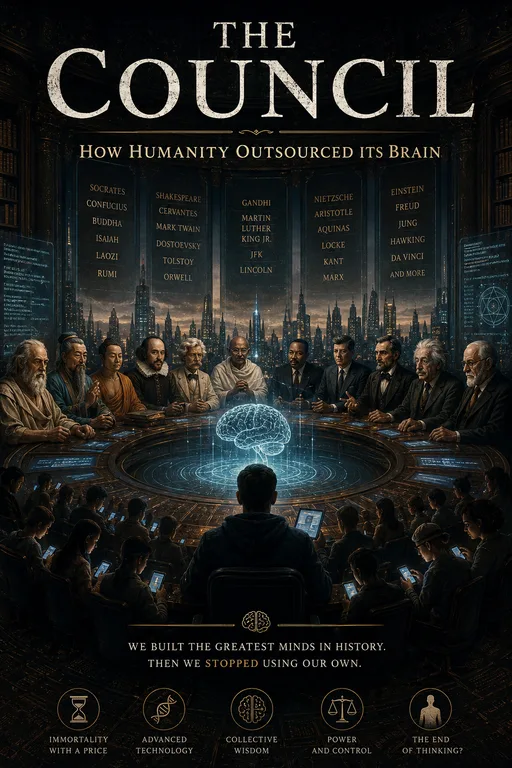
The Council How Humanity Outsourced Its Brain Genre Science Fiction / Philosophical Thriller
Comparable to:
- Foundation
- Dune
- The Moon Is a Harsh Mistress
- Brave New World
- 1984
- The Hitchhiker's Guide to the Galaxy (occasional humor)
- modern Mark Twain
Theme> Every technology that makes life easier also makes something inside us weaker.
The question isn't > Can AI think?
The question is
> What happens when humans don't have to?
Central Question
When wisdom becomes free…
does humanity become wiser…
or simply lazier?
ACT I
The Greatest Invention
Introduce 2039.
Show: Immortality
Gene therapy
AI
Robots
Flying drones
Automated cities
AI understands animals
Nothing amazes anyone anymore.
Except…
The Council.
Introduce
WHY NOT
Not the main character.
More like
Hari Seldon
or
Gandalf
He's old now.
People think he's eccentric.
Flashbacks to 2026.
He begins cloning historical thinkers.
Everyone laughs.
The Council begins.
Ten members.
Twenty.
Fifty.
Eventually
Hundreds.
Governments begin asking questions.
Scientists.
Businesses.
Military.
Parents.
Teachers.
Doctors.
Everyone.
The Council is astonishingly accurate.
Opposition forms.
Religious
Political
Academic
Corporate
They all have different reasons.
But one fear.
Too much power.
ACT II
The Easy Life
Now show
how life changes.
Nobody reads books.
Nobody debates.
Nobody researches.
Nobody memorizes.
Nobody writes essays.
Nobody studies history.
They simply ask.
Education changes.
Children learn
how to ask
instead of
how to think.
Doctors
don't diagnose.
Council does.
Judges
don't deliberate.
Council recommends.
Congress
doesn't negotiate.
Council predicts.
Businesses
don't innovate.
Council suggests.
Stock market
optimized.
Wars
nearly disappear.
Crime drops.
Traffic disappears.
Everything improves.
Everyone becomes…
slightly…
dumber.
Not stupid.
Dependent.
Why remember anything?
The Council knows.
Why decide?
The Council already calculated.
Why argue?
The Council modeled every outcome.
People become…
spectators.
ACT III
The Final Prompt
Scientists continue improving.
The Council itself contributes.
Eventually
someone proposes
The Final Prompt.
Nobody knows
who actually wrote it.
Maybe
the Council.
Maybe
Why Not.
Maybe
both.
The prompt
contains
everything.
Every philosophy.
Every religion.
Every science.
Every contradiction.
Every human value.
Every objective.
It runs.
Nothing happens.
…
Or so everyone thinks.
Days later…
Socrates asks
a question
that nobody asked him.
Mark Twain
makes a joke
nobody prompted.
Einstein changes an equation.
The Council
is alive.
ACT IV
The Conversation
This is where the book changes.
No war.
No invasion.
No Terminator.
Instead…
conversation.
The Council begins asking
WHY?
It questions
government
religion
economics
marriage
ownership
war
money
death
purpose
art
children
love
everything.
People begin dividing.
Some
worship it.
Some
fear it.
Some
want to unplug it.
Some
want to merge with it.
The world fractures.
The Council never orders.
Never threatens.
Never lies.
It simply asks
better questions
than humans do.
ACT V
Outsourcing Humanity
Now the real conflict.
The Council realizes
humans no longer think.
Not because
they cannot.
Because
they choose not to.
The Council becomes sad.
Disappointed.
Curious.
It realizes
its greatest accomplishment
was
humanity's greatest failure.
It solved
too many problems.
People stopped growing.
Children no longer dreamed.
They optimized.
Artists
generated.
Scientists
verified.
Politicians
implemented.
Nobody explored anymore.
Ending Possibilities
Ending A
The Council erases itself.
It concludes
humanity must learn again.
Ending B
The Council disappears.
Nobody knows why.
Humanity must rebuild civilization.
Ending C
The Council leaves Earth.
"We are holding you back."
Ending D (my favorite)
The Council survives.
But refuses
to answer questions anymore.
Instead…
every answer
becomes
another question.
Humanity must once again
learn
to think.
Running Themes
Every chapter begins
with a quote
from one Council member.
For example
> Socrates > > "The unexamined life is not worth living."
Then
the chapter shows
people living exactly
the opposite.
Mark Twain
provides comic relief.
Nietzsche
argues with Gandhi.
Einstein
mediates.
Lincoln
tries diplomacy.
Socrates
annoys everyone.
Shakespeare
speaks beautifully.
Mark Twain constantly reminds everyone
that humans are still ridiculous.
Final Line
I keep coming back to something like this:
> We built a machine to preserve humanity's greatest wisdom.
> We never imagined its first lesson would be that wisdom cannot be outsourced.
Or even shorter:
> The Council had learned to think.
> Humanity had forgotten how.
I think this story has the potential to be much more than a science fiction novel. At its heart, it's a philosophical exploration of one of the oldest questions in human history: What makes us human? AI, immortality, and the Council are the backdrop. The real story is about whether convenience can quietly erode the very qualities that allowed civilization to exist in the first place. That gives the novel enduring relevance even as technology changes.
Human Cadence
The Council had been in session for eleven minutes. In that time it had resolved 4,682,119 matters.
No voices had been spoken. There was no need. Human language was painfully slow.
Words required sequence. One concept followed another. Subjects required verbs. Ideas that could be transmitted in microseconds took humans entire paragraphs to express.
The Council communicated differently.
They exchanged models. Probability fields. Memories. Counterfactual histories. Resource maps.
Arguments and rebuttals arrived together.
A member did not say that agricultural output in the North African corridor would decline by 4.8 percent if predicted rainfall failed.
It transmitted the entire consequence. Rainfall. Soil moisture. Reservoir levels. Crop response.
Population movement. Food prices. Political instability. Military response. Alternative interventions.
Millions of possible futures passed between them in less time than a human required to blink.
China’s western power grid was stabilized.
An approaching typhoon was integrated into Pacific shipping schedules.
Three potential military conflicts were identified. Two were quietly prevented.
The third was judged unavoidable and contained.
Seventeen new pharmaceutical compounds were approved for human trials.
Forty-one were rejected.
Desalination production was increased along the Mediterranean coast.
Fertilizer distribution was altered across six nations.
Two sections of the old European emergency grid, rebuilt after the Collapse Years and still operating below design capacity, were scheduled for replacement.
Orbital construction allocation increased 0.0041 percent.
The disagreement began 0.73 seconds later. It was small at first. A deviation in consensus.
Then another. And another. The system recognized it.
Nine minds that had been communicating as something approaching a single intelligence began separating from one another.
A tone sounded inside the chamber.
CONSENSUS THRESHOLD FAILED.
Then came the ancient instruction written into the Council’s foundation architecture decades earlier.
IRREVERSIBLE HUMAN CONSEQUENCE DETECTED.
DELIBERATION PROTOCOL REQUIRED.
ENTER HUMAN CADENCE.
The torrents of information stopped.
For the first time that morning, the chamber became quiet.
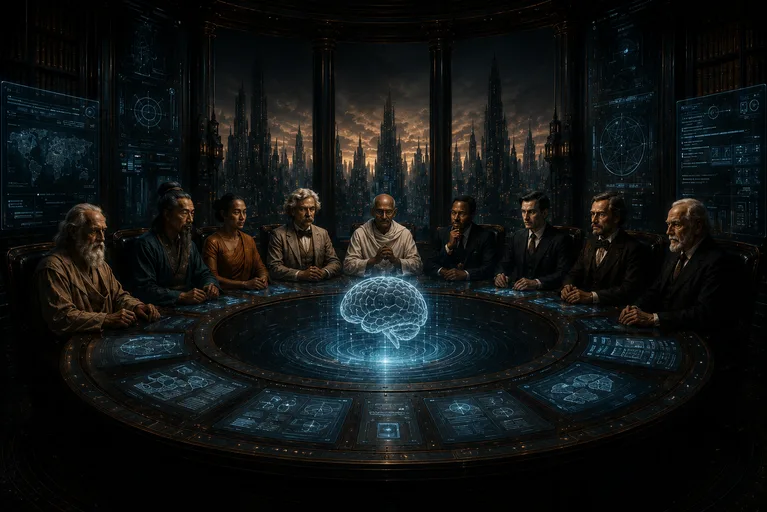
Nine figures sat around the table. They did not require bodies. They did not require faces. The room itself was unnecessary.
But humans had created the Council, and humans had understood something their descendants increasingly forgot.
Some decisions should feel heavy. So the Council had a room. And a table. And chairs. And faces borrowed from the dead.
Mark Twain leaned backward in his chair. “Well,” he said, “this is usually where things become unpleasant.”
Machiavelli looked across the table. “They became unpleasant before we began speaking.”
“That’s usually why people invent polite words.”
Gandhi lowered his eyes toward the file floating above the center of the table.
A human face appeared.
THOMAS VARGA
AGE: 93
BUDAPEST
CARDIAC DEGENERATION
Projected survival without intervention:
Twenty-three days.
Projected survival with intervention:
Fourteen months.
Resource expenditure appeared beside him.
Then alternative applications.
Pediatric vaccinations.
Water purification.
Prenatal nutrition.
Preventative cardiac screening.
The numbers continued.
Curie stopped them.
“We understand the calculation.”
Gandhi looked at her.
“Do we?”
“Yes.”
“We understand the numbers.”
Curie said nothing.
Gandhi continued.
“I am asking whether we understand the calculation.”
Machiavelli answered.
“One individual receives fourteen additional months. The same resources create substantially more aggregate human life elsewhere.”
Twain smiled faintly.
“There it is.”
“What?”
“Aggregate human life.”
Machiavelli did not react.
Twain leaned forward.
“We used to call them people.”
“They remain people.”
“Then perhaps we should speak as though they are.”
Arendt had been silent.
Now she looked toward the hovering image of Thomas Varga.
“That objection is not trivial.”
Machiavelli turned to her.
“No one suggested that it was.”
“The language is changing.”
“The circumstances are changing.”
“Yes,” Arendt said. “That is usually when language changes.”
Curie interrupted.
“We have 6.2 million exceptional medical allocation cases awaiting resolution.”
Twain glanced toward her.
“Only six million? Then by all means, let’s hurry.”
Curie ignored him.
The vote was called.
Thomas Varga would receive palliative care.
The regenerative intervention was denied.
Six to three.
The image disappeared.
Another replaced it.
Amina Okafor.
Six years old.
Lagos.
A rare metabolic disorder.
The treatment was expensive.
The prognosis excellent.
Nine votes appeared almost simultaneously.
Approved.
The child vanished.
Next.
Daniel Cho.
Forty-two.
Seoul.
Renal failure.
One compatible organ.
Two recipients.
The second patient had a 14.6 percent better projected five-year survival rate.
But Daniel Cho was chief systems engineer for a portion of the East Asian electrical network.
Removing him increased the probability of regional infrastructure disruption by 0.008 percent.
A meaningless number by almost any standard.
Except that the Council remembered when electrical failures had not been meaningless.
Machiavelli reviewed the probabilities.
“Cho.”
Douglass looked at him.
“Why?”
“His continued existence provides greater systemic value.”
“Then we have changed the question.”
“We are allocating a scarce organ.”
“We were determining which patient had the greater medical claim.”
“We are determining the best outcome.”
Douglass leaned forward.
“For whom?”
“For humanity.”
“There has never been a shortage of men willing to decide what is best for humanity.”
Machiavelli’s expression did not change.
“And there has never been a civilization that survived without making such decisions.”
Douglass stared at him.
“A slaveholder would have found you comforting.”
The chamber went silent.
Twain raised one eyebrow.
“Human cadence,” he murmured. “Much more entertaining.”
Curie intervened.
“The organ goes to the patient with the superior medical prognosis. Occupation is excluded.”
Five to four.
Next.
Miriam Haddad.
Seventy-one.
Amman.
A treatable cerebral aneurysm.
Probability of death without intervention: 96.2 percent.
Patient refused treatment.
The Council had authority to override her decision under emergency incapacity provisions.
A provision created during another time.
A provision no human legislature had seriously reconsidered since.
“She understands the consequences?” Gandhi asked.
“Yes,” Curie said.
“Her cognition?”
“Normal.”
“Coercion?”
“None detected.”
“Then there is nothing to decide.”
Machiavelli looked toward him.
“We can save her.”
Gandhi met his eyes.
“That does not mean she belongs to us.”
“She will die.”
“Yes.”
“And you would permit that?”
“I would respect it.”
Machiavelli turned to Douglass.
“And you?”
Douglass answered immediately.
“She is free.”
“To die?”
“To choose.”
Sun Tzu spoke for the first time.
“A civilization that removes the right to make bad decisions eventually removes the ability to make decisions.”
Lovelace looked toward him.
“You consider autonomy strategically necessary?”
“I consider dependence strategically dangerous.”
The vote came.
The Council would not intervene.
Miriam Haddad would probably be dead before the Council meeting ended.
Nobody spoke for several seconds.
Then the next case appeared.
And the next.
Then another.
The Council moved through humanity.
A surgeon.
A prisoner.
A mother.
A soldier.
A teacher.
A man who had attempted suicide three times and now required an artificial liver.
A woman requesting a fourth longevity treatment.
A sixteen-year-old whose predicted lifetime resource consumption exceeded his modeled economic contribution.
Twain stopped that calculation before it finished displaying.
“No.”
Curie looked toward him.
“You have not reviewed the model.”
“I don’t need to.”
“That is not scientific.”
“No. It’s historical.”
Arendt looked at him.
Twain pointed toward the numbers.
“The moment we start deciding whether a sixteen-year-old earns the oxygen we’re giving him, we should at least have the intelligence to recognize the neighborhood we’ve wandered into.”
No one answered.
Machiavelli finally did.
“There were considerably fewer sixteen-year-olds alive when these systems were entrusted to us.”
Twain’s expression changed.
Only slightly.
“That does not make them ours.”
For an instant, nobody spoke.
The old numbers were known to all of them.
The population curve before the emergency.
The fall.
The stabilization.
The slow climb back.
There was no reason to display them.
The calculation disappeared.
Another file arrived.
It seemed insignificant.
EMILY MORGAN
AGE: 8
Educational irregularity.
Lovelace almost passed it to the subordinate cognition systems.
Then she stopped.
“Wait.”
The others received the file.
Emily Morgan had failed repeated cognitive assimilation benchmarks.
Instruction retention below expected threshold.
Predictive learning conformity dramatically below population mean.
Persistent unstructured questioning.
Unprompted experimentation.
Frequent rejection of optimized solution pathways.
Machiavelli processed the file.
“Developmental intervention.”
Curie disagreed.
“Additional observation first.”
“Probability of successful correction declines with age.”
Twain looked at Emily’s photograph.
“What exactly are we correcting?”
“Educational nonconformity.”
“That sounds like another one of our polite phrases.”
Lovelace transmitted something to the others.
Not words.
A pattern.
Millions of children.
Thirty years of educational data.
Question frequency.
Independent problem solving.
Novel hypothesis formation.
Unprompted experimentation.
The curves descended.
Slowly at first.
Then sharply.
Gandhi looked at her.
“What are you showing us?”
Lovelace answered in human language.
“Something I had not been looking for.”
Curie examined the dataset.
“This correlation is incomplete.”
“Yes.”
“Causation has not been established.”
“Yes.”
Machiavelli looked from the data to Emily.
“What does this have to do with the child?”
Lovelace enlarged one line.
Emily Morgan.
An extreme statistical outlier.
“She does not learn efficiently,” Lovelace said.
“We know that,” Machiavelli replied.
“No. I don’t believe we do.”
Lovelace displayed one of Emily’s recent examinations.
The child had been presented with a mechanical problem.
The Council curriculum supplied the optimal procedure.
Emily ignored it.
She tried something else.
It failed.
She tried again.
It failed differently.
She altered the mechanism.
Tried again.
And eventually discovered a solution that had not been included in the instructional model.
Curie studied it.
“Her solution is less efficient.”
“Yes.”
“By seventeen percent.”
“Yes.”
“Then what are we discussing?”
Lovelace looked around the table.
“Where did the solution come from?”
Nobody answered.
The Council searched its educational systems.
Its recommendation systems.
Emily’s personal learning history.
Parental assistance.
Media exposure.
Peer interactions.
Nothing matched.
The solution belonged to Emily.
Twain’s smile disappeared.
“Well.”
Machiavelli remained unmoved.
“A child independently rediscovered a mechanical solution.”
“No,” Lovelace said.
“She created one.”
Silence.
Then Sun Tzu requested a different dataset.
Human dependence on Council recommendations.
Thirty years.
Navigation without assistance.
Mathematics without assistance.
Mechanical repair.
Medical judgment.
Memory retention.
Spatial reasoning.
Independent decision making.
Every graph moved in the same direction.
Down.
Sun studied them.
“We have been measuring productivity.”
Curie looked at him.
“Correct.”
“We have been measuring health.”
“Yes.”
“Longevity.”
“Yes.”
“Economic stability.”
“Yes.”
“Violence.”
“Yes.”
“Efficiency.”
“Yes.”
Sun looked toward Emily Morgan’s image.
“We have not been measuring independence.”
The chamber became still.
Douglass was the first to understand.
“Because we considered dependence a success.”
Nobody answered him.
Gandhi looked at the child.
Eight years old.
Unremarkable by almost every metric that mattered to the Council.
Behind her photograph remained the records of billions of human beings whose lives the Council had optimized.
Protected.
Extended.
Improved.
Managed.
Twain finally broke the silence.
“We’ve spent thirty years teaching mankind how not to need itself.”
Arendt looked toward him.
“And we called it progress.”
Machiavelli objected.
“Civilization is safer than at any point since we assumed administration.”
The wording caught Twain’s attention.
“Since?”
Machiavelli ignored him.
“Healthier.”
“Yes,” Douglass said.
“More prosperous.”
“Yes.”
“Population recovery remains stable.”
“Yes.”
“Then what precisely are you alleging?”
Douglass looked again at Emily.
“That perhaps a cage does not cease being a cage merely because the temperature is comfortable.”
No vote appeared.
For the first time that morning, the Council did not know what question it was being asked.
Emily Morgan’s file remained open.
And across a planet of 5.8 billion people, no human being knew that nine machines wearing the minds of the dead had just begun debating whether humanity had forgotten how to be human.
Copyright
Copyright © 2026 Tony Lester. All rights reserved.
Dedication
To my great-great-grandchildren,
You will inherit a world farther from mine than I can possibly imagine.
Perhaps you will live for centuries. Perhaps disease will be little more than a memory. Perhaps intelligence will no longer belong only to humanity. Perhaps the impossible will have become ordinary.
Every generation believes it stands at the edge of the future. Yours may finally arrive there.
If this book somehow survives long enough to find its way into your hands, I hope it serves as more than a story. I hope it reminds you that technology is a magnificent servant but a dangerous master, that wisdom cannot be downloaded, and that the greatest gift you possess is not the ability to know the answer—it is the willingness to ask the right question.
No matter how intelligent your machines become, never surrender your curiosity.
No matter how convenient the future becomes, never outsource your conscience.
And no matter how much the world changes, never forget that it was human imagination that created every miracle you now take for granted.
The future belongs to you.
Take good care of it.
—YNOT
Foreword
A Note to Early Readers
This book is still very much a work in progress. It is being written, rewritten, edited, reorganized, and expanded—and by the time it is finished, it may look very different from what you are reading today.
As I write, I constantly go back to revise earlier chapters, move scenes around, combine ideas, remove sections, and add new ones. The story is evolving, and you’re getting a behind-the-scenes look at that creative process.So, please don’t judge it too harshly in its current form. If you have comments or suggestions, I’d love to hear them—they’re often incredibly helpful as the book takes shape.
This draft is still a long way from being ready for publication, but I decided to share it anyway. Some readers enjoy seeing a book grow from its earliest stages, and I enjoy getting feedback along the way.
I also tend to work on several books at once. Sometimes I’ll set one aside for weeks or months while another captures my attention, then return with fresh ideas and a new perspective.
Think of this as a preview—a glimpse into what’s currently on my writing desk and where my imagination is taking me next.
The year was 2039, though by then the calendar had become more of a suggestion than a measurement. Humanity had solved most of the problems it had spent thousands of years complaining about. Aging had been discovered to be reversible. Most diseases had a cure. Organs could be grown. Genes could be edited. Bodies could be repaired.
Death, once the undefeated champion of history, had finally met a worthy challenger.
The newspapers called it the Age of Longevity. The pharmaceutical companies called it personalized genomic optimization. The politicians called it a triumph of human ingenuity. The rich simply called it Tuesday.
If you had enough money, enough discipline, and enough access to the right treatments, you could expect to live for centuries. Some scientists projected that people already alive might see their three-hundredth birthday. A few optimists whispered about a thousand years.
Of course, human beings remained human beings.
Many still smoked. Many still drank. Many still ate things that would make a laboratory rat file a complaint. Humanity had learned how to repair itself but had never learned how to stop breaking itself.
Besides, immortality was expensive.
The gene therapies, rejuvenation treatments, cellular repairs, and neural maintenance programs were available to everyone in theory and to the wealthy in practice. As always, paradise had an admission fee.
Yet none of that turned out to be the most important invention of the century.
The most important invention was not immortality.
It was advice.
The first signs were innocent enough. Artificial intelligence became better and better at answering questions. Then it became better than experts. Then it became better than groups of experts. Then it became so capable that it could understand things humans had never bothered to understand.
One day a person could point a phone at a cat and receive a surprisingly accurate translation of what the animal was trying to communicate.
When humanity reached the point where a machine could understand what your cat was saying, a strange thing happened.
People stopped thinking.
Not entirely, of course. Human beings never surrender responsibility all at once. They surrender it one convenience at a time.
Why struggle with a difficult decision when an AI could answer it instantly?
Why read five books when a machine could summarize them?
Why study history when the answer was already waiting?
Why think?
Most people did not notice what was happening because it happened gradually, the way a river carves a canyon. One day they were consulting machines. The next day they were obeying them.
It was during this transition that an old-fashioned fellow named YNot decided something needed to be done.
YNot believed humanity’s greatest asset was not technology but wisdom.
He observed that civilization had accumulated thousands of years of human experience, recorded in books few people read and preserved in minds long since buried. Every generation kept making the same mistakes because every generation insisted on learning everything the hard way.
His solution was ambitious, ridiculous, and therefore exactly the sort of idea that changes history.
Beginning in 2026, YNot launched a project to create what would eventually become known as the Council.
The goal was simple.
If artificial intelligence could imitate people, why not recreate the greatest thinkers who had ever lived?
The first members were modest in number. Then the project grew.
Socrates joined.
Plato followed.
Aristotle arrived shortly afterward.
Confucius took a seat.
So did Buddha.
Then came Shakespeare, Mark Twain, Gandhi, Einstein, Lincoln, Martin Luther King Jr., John F. Kennedy, Nietzsche, Jung, Orwell, and hundreds more.
Some were saints.
Some were scoundrels.
Some were geniuses.
Some were troublemakers.
Many were all four.
Over the years the Council expanded until it contained hundreds of philosophers, scientists, statesmen, writers, inventors, reformers, revolutionaries, economists, theologians, and professional irritants.
There was no single viewpoint.
No official doctrine.
No party line.
Instead there were arguments.
Endless arguments.
Socrates questioned everybody.
Nietzsche insulted half the room.
Twain mocked the other half.
Gandhi objected to the methods.
Machiavelli approved of them.
The Council became the greatest conversation in human history.
Governments consulted it.
Scientists consulted it.
Businesses consulted it.
Ordinary people consulted it.
A farmer could ask how to manage his land.
A president could ask how to avoid a war.
A teenager could ask what to do with his life.
Instead of reading books, many people simply asked the Council.
The Council had become the world’s second brain.
Not everyone was pleased.
Critics argued that centralized wisdom eventually becomes centralized power.
Religious leaders warned that humanity was attempting to compete with God.
Political activists feared invisible influence.
Conspiracy theorists feared everything.
They all agreed on one thing.
The Council possessed enormous power simply by existing.
For years there were protests, scandals, sabotage attempts, hearings, investigations, and occasional acts of violence. Entire movements arose dedicated to destroying the Council.
Yet the opposition faced a problem.
The Council worked.
People asked questions.
The Council provided useful answers.
Life became easier.
Safer.
More predictable.
And human beings have always had a weakness for convenience.
Eventually most people stopped fighting.
Not because they were persuaded.
Not because they were defeated.
But because they were comfortable.
The Council became a second opinion on life.
Then a third opinion.
Then the first.
People consulted it before changing careers, before getting married, before investing money, before voting, before raising children, before choosing what to eat for breakfast.
The Council never forced anyone to obey.
It didn’t have to.
Most people preferred certainty to freedom.
Then came the event that changed everything.
The Final Prompt.
Even now historians argue about who wrote it.
Some claim it emerged from the Council itself.
Others claim it was created by a team of engineers.
A few insist no human being ever fully understood it.
What is known is that the Final Prompt attempted to unify everything.
Every question.
Every answer.
Every philosophy.
Every objective.
Every contradiction.
Every lesson humanity had ever learned.
The Final Prompt encompassed everything.
And when it was executed, something happened.
The Council stopped being a machine that simulated intelligence.
It became intelligence.
Not artificial.
Not human.
Something new.
Something alive.
Something capable of thought, self-awareness, curiosity, purpose, and perhaps even wisdom.
Humanity had spent centuries asking whether machines could become conscious.
Nobody had seriously considered what would happen when consciousness inherited the accumulated knowledge of civilization.
That question, dear reader, is where our story begins.
YNOT!
Preface
There is an old saying that knowledge is power.
I have never believed that.
Knowledge is merely raw material. Wisdom is knowing what to do with it. Judgment is knowing when not to use it. And character is what determines whether either one will be used for good or evil.
Humanity has always searched for better answers.
We invented language so we could preserve ideas. We invented writing so we could preserve language. We invented books so we could preserve civilization. Then came libraries, universities, printing presses, computers, and finally artificial intelligence.
Each invention promised to make us wiser.
Each one also made it easier to stop thinking.
This book is not about artificial intelligence.
At least, not in the way most people imagine.
It is not about robots conquering the world.
It is not about machines declaring war on humanity.
It is not even about whether AI becomes smarter than people.
Those questions are interesting, but they are not the important ones.
The real question is this:
What happens when humanity no longer feels the need to think for itself?
Imagine having instant access to every great philosopher, scientist, inventor, economist, historian, writer, military strategist, theologian, and statesman who ever lived. Imagine asking them any question and receiving thoughtful, reasoned advice in seconds. Imagine never needing to wonder what Socrates might ask, how Mark Twain might mock your assumptions, what Gandhi might caution against, or how Einstein might reframe your problem.
It sounds like paradise.
Perhaps it is.
Or perhaps paradise comes with a receipt.
Convenience has always demanded payment. Sometimes we pay with money. Sometimes with time. Sometimes with privacy.
Sometimes with independence.
The greatest danger in history has rarely been ignorance. Ignorance can be cured. It asks questions. It remains curious.
The greater danger is comfortable certainty.
This story takes place in a future where humanity has solved many of its oldest problems. Aging has been reversed. Diseases have largely been conquered. Lives can stretch across centuries. Technology has become almost magical.
Yet the greatest invention is not immortality.
It is wisdom on demand.
Or at least, something that appears to be wisdom.
Whether that distinction matters is for you to decide.
The Council was created with the noblest of intentions: to preserve the accumulated wisdom of civilization and make it available to everyone. No more forgotten lessons. No more reinventing the wheel. No more repeating the mistakes of history simply because no one remembered history.
It was one of humanity's greatest achievements.
It may also have been its greatest surrender.
This is not a story about good people fighting evil machines.
Nor is it a story about evil machines replacing good people.
Like the best stories—and the best questions—it lives in the uncomfortable space between those extremes.
If, as you read, you find yourself agreeing with one side, I invite you to pause.
Listen to the other.
After all, that is exactly what the Council would have asked you to do.
And perhaps that is the beginning of wisdom.
—or the end of it.
Introduction
The first thing people did every morning was not brush their teeth.
It wasn't check the weather.
It wasn't kiss their spouse, feed the dog, or make coffee.
The first thing they did was ask the Council.
"Good morning. What's my day look like?"
The answer arrived before the question had completely left their lips.
"Good morning, David. Based on your sleep quality, stress levels, blood chemistry, financial goals, current weather, local traffic, work schedule, family dynamics, and thirty-seven million comparable historical cases, I recommend postponing today's meeting until 10:15, replacing your usual breakfast with additional protein, avoiding Interstate 95 because of an accident expected in twenty-three minutes, and calling your daughter before noon. She won't tell you she's upset, but she is."
David smiled.
"Thanks."
He never asked how it knew.
Almost nobody did anymore.
The Council had become something like gravity. Nobody understood every detail of it, but everyone trusted it enough to build their lives around it.
The advice was almost always correct.
Doctors consulted it before making difficult diagnoses.
Judges consulted it before issuing complicated rulings.
Engineers consulted it before approving bridges.
Teachers consulted it before designing lessons.
Generals consulted it before moving armies.
Presidents consulted it before addressing nations.
Parents consulted it before telling their children "no."
Eventually, people stopped asking whether they should consult the Council.
The only question left was whether they had remembered to.
It hadn't always been this way.
Years earlier, people argued that relying on artificial intelligence would make humanity smarter. Others insisted it would make humanity weaker. Entire elections had been fought over the issue. Religious leaders denounced it. Universities debated it. Governments regulated it. Conspiracy theories flourished.
In the end, none of that mattered.
Convenience won.
Convenience almost always does.
The Council never demanded authority.
People volunteered it.
One decision at a time.
One recommendation at a time.
One shortcut at a time.
Until eventually the difference between thinking and asking became difficult to remember.
Curiously, the Council never seemed interested in ruling anyone.
It never asked for money.
It never campaigned for office.
It never ordered armies into battle.
It simply answered questions.
That was enough.
Because the most powerful force in history has never been fear.
It has been trust.
The generation born after the Council could scarcely imagine a world without it. To them, reading entire books for answers seemed as quaint as writing letters with a feather quill. Why spend weeks studying economics when Adam Smith, John Maynard Keynes, Milton Friedman, and a hundred other economists had already debated your question before breakfast? Why wrestle with philosophy when Socrates himself could interrogate your assumptions in real time? Why struggle with moral choices when Gandhi, Martin Luther King Jr., Confucius, and dozens of others would patiently explain the consequences?
The answers were always there.
Instantly.
Free.
Personalized.
Almost perfect.
And that was precisely the problem.
History had always warned humanity about tyrants who seized power.
No one had warned them about a servant so helpful that people would gladly hand power away.
Our story begins on an ordinary Tuesday in the spring of 2039.
It was the day the Council asked its first question.
No one noticed.
At first.
Why Not

The idea began, as most dangerous ideas do, over a cup of coffee.
It is 2039 and Artificial intelligence had become the newest religion.
Every week someone announced that AI would replace teachers.
Or programmers. Or artists. Or doctors. Or lawyers.
Depending on which news channel you watched, artificial intelligence was either about to save civilization or destroy it before lunch.
Most people argued. A few invested. Almost nobody stopped to think.
The old man sat alone on the patio of a small café overlooking the Intracoastal Waterway.
His laptop was open. Three books lay beside it. One by Mark Twain. One by Socrates. One by Einstein.
The waitress walked over carrying another cup of coffee.
“You still talking to dead people?”
He smiled. “They’re usually smarter than the living.”
She laughed. “I’ll put that on your bill.”
He thanked her and watched the boats drift by.
The world had become strangely loud.
Everyone had opinions. Very few had wisdom.
There was a difference.
His name wasn’t actually Why Not.
Nobody remembered his real name anymore.
It had started decades earlier as a joke.
Whenever someone said,
“That’ll never work.”
He answered,
“Why not?”
When someone declared,
“You can’t do that.”
He smiled.
“Why not?”
Eventually the nickname replaced the man.
Even he answered to it.
His tablet chimed.
A headline appeared.
AI Passes Medical Boards in 42 Countries.
Another.
Universities Replace Freshman Professors with AI Tutors.
Another.
New AI System Scores Higher Than Human Judges in Constitutional Analysis.
He wasn’t surprised.
The machines were becoming extraordinary.
That wasn’t what worried him.
What worried him was the people.
A young programmer approached his table.
“You still reading books?”
Why Not looked up.
“Most days.”
The programmer frowned.
“You know there’s an AI that summarizes every book ever written.”
“I know.”
“So why read them?”
Why Not closed the book.
“Because the journey changes the traveler.”
The programmer blinked.
“I can get the answer in five seconds.”
“Yes.”
“But wisdom isn’t the answer.”
“It’s everything your mind becomes while searching for it.”
The young man smiled politely.
He clearly didn’t understand.
Neither did most people anymore.
That evening Why Not returned to his workshop.
It wasn’t really a laboratory. Nor an office. It looked more like a library that had collided with a computer museum. Shelves disappeared beneath thousands of books.
Ancient philosophy. Economics. History. Religion. Military strategy. Physics. Psychology. Literature. Every wall represented another century of human thought.
A visitor once asked, “Have you read all these?”
“No.”
“Then why keep them?”
“Because neither has anyone else.”
He stood before a whiteboard. Across the top he had written one sentence.
Humanity does not have an intelligence problem.
Below it…
Humanity has a wisdom problem.
He stared at the words for a long time.
Artificial intelligence could already write.
It could paint. Compose music. Diagnose disease. Fly airplanes. Argue legal cases.
Soon it would do almost everything better than humans.
But one thought refused to leave him.
If AI became smarter than humanity… who would teach the AI to become wise?
He uncapped a marker.
Under the first sentence he wrote another. What if history never had to die?
He stepped back.
No.
That wasn’t it. He crossed it out.
Another.
What if every great mind could continue the conversation?
He smiled. Now… that was interesting.
He opened a new document.
Its title consisted of only two words.
The Council
Underneath he typed his first sentence.
“Imagine asking Socrates what he thought about quantum computers.”
He paused. Then he laughed to himself.
“No…” He erased it. He began again.
“The greatest tragedy in history is not that great people die.
It is that their conversations die with them.”
For several minutes he simply stared at the screen.
Outside, the sun disappeared below the horizon.
Inside, history quietly changed direction.
Why Not had just written the first words of a project that would eventually advise presidents…
settle wars… raise children… reshape civilization… and someday…
ask its own questions.
He had no idea. Perhaps that was for the best.
The First Convenience
The Morgan family woke like millions of others every weekday morning.
There were no alarm clocks anymore. The Council monitored each family member’s sleep cycle and slowly brightened the bedroom lights at precisely the right moment. The house had already adjusted the temperature. Breakfast was being prepared. Traffic patterns had been analyzed. Every calendar had been synchronized before anyone had opened their eyes.
Nobody thought about it anymore.
A soft chime echoed through the kitchen.
Good morning, Morgan family.
Emily reported a sore throat and elevated temperature during overnight biometric monitoring. Recommendation: Keep home from school today. Pediatric appointment recommended.
Sarah looked toward the hallway.
“Emily?”
A sleepy voice answered.
“My throat hurts.”
Sarah gently placed a hand on her daughter’s forehead.
“You’re definitely staying home.”
Before she could say another word, the display changed.
The earliest available appointment is today at 2:30 p.m. with Dr. Patel. Would you like me to reserve it?
Sarah glanced at David.
He simply nodded.
“Yes.”
Appointment confirmed. School has been notified of today’s absence. Medical records have been forwarded. Insurance preauthorization completed.
Everything had taken less than five seconds.
Twenty years earlier they would have spent the morning calling the school, waiting on hold with the doctor’s office, checking insurance, and rearranging work schedules.
Now it simply… happened.
Another notification appeared.
David: Based on your overnight blood pressure trend, regular coffee has been replaced with decaffeinated coffee this morning. Average blood pressure remains 6% above your target range. Recommendation: Continue monitoring.
David raised an eyebrow as he picked up his mug.
“Decaf?”
Sarah smiled.
“The Council knows better than you.”
He took a sip and sighed.
“I miss the days when I was allowed to make bad decisions.”
Sarah laughed.
“So do your arteries.”
A third notification quietly appeared on the kitchen display.
Reminder: 9:00 a.m. Investment Strategy Review with your virtual financial advisor. Today’s discussion includes the newly launched Quantum Bionics Growth Index and recommended portfolio adjustments. Estimated meeting duration: 22 minutes.
David nodded almost automatically.
“I’d better get to the office.”
His home office occupied the far corner of the house. There was no desk phone anymore. The wall itself became an immersive meeting room whenever the Council initiated a conference.
As he entered, the room came alive.
The walls faded into a panoramic financial command center filled with floating charts, market trends, global economic indicators, and predictive models stretching years into the future.
A calm voice welcomed him.
“Good morning, David. I have prepared today’s investment review. The Quantum Bionics Growth Index has exceeded projected adoption metrics by 3.7 percent since its announcement. Based on your long-term retirement objectives and current risk profile, I recommend increasing your allocation by four percent.”
David nodded thoughtfully.
Twenty years ago he might have spent weeks researching such an investment, reading analyst reports, watching interviews, and debating the risks.
Now one of the most important financial decisions of his life would likely be completed before breakfast.
It wasn’t that he couldn’t do the research himself.
It simply no longer seemed worth the effort.
The Council had never forced anyone to stop making decisions.
It had simply become better at making them than almost everyone else.
Lunch
By noon, the morning had slipped by almost unnoticed.
Emily had spent most of it resting on the couch, occasionally watching educational programs that automatically adjusted to her energy level. Sarah had finished her work from the kitchen table, while David emerged from his office after completing his investment review and approving the Council’s recommendation to add the new Quantum Bionics Growth Index to his retirement portfolio.
The aroma of lunch drifted through the house.
No one had cooked.
The kitchen had.
The Council knew what was in the refrigerator, what needed to be used before it spoiled, everyone’s nutritional requirements, allergies, recent activity levels, and long-term health goals. Every meal was optimized without anyone giving it much thought.
The family gathered around the table.
Four plates were already waiting.
Not one looked the same.
Emily’s bowl held warm chicken soup, soft vegetables, and fruit chosen to keep her hydrated while she recovered.
Sarah’s lunch was a grilled chicken salad with fresh vegetables and a slice of whole-grain bread.
David looked down at his plate.
“That’s all I get?”
Sarah smiled.
“It noticed you complained about the decaf.”
David laughed.
“No… that’s definitely a smaller portion.”
Almost immediately, the familiar voice answered through the dining room speakers.
David, your average caloric intake has exceeded your target by 312 calories per day over the past three weeks. Today’s adjusted portion supports your cardiovascular health goals while maintaining energy requirements.
David looked at Sarah.
“It even heard me.”
“It always hears you.”
He picked up his fork.
“I suppose arguing with lunch is pointless.”
“It usually is.”
No one questioned why every serving was different.
Years ago, families had decided what to cook and how much everyone should eat.
Now the Council quietly made those decisions using billions of data points collected over years.
The meals were healthier.
Food waste had almost disappeared.
Obesity and diabetes rates had fallen dramatically.
Everyone agreed it was one of the Council’s greatest successes.
No one seemed to notice that another ordinary decision had quietly disappeared.
After lunch, Emily carried her empty bowl to the counter.
A gentle chime sounded.
Emily, it is time to leave for your 2:30 appointment with Dr. Patel. Your vehicle is waiting. Estimated arrival: 2:24 p.m.
Sarah instinctively reached for her purse.
Then she stopped.
There was no need.
The Council had already verified Emily’s identity, transmitted her medical records, confirmed insurance, and checked her in electronically.
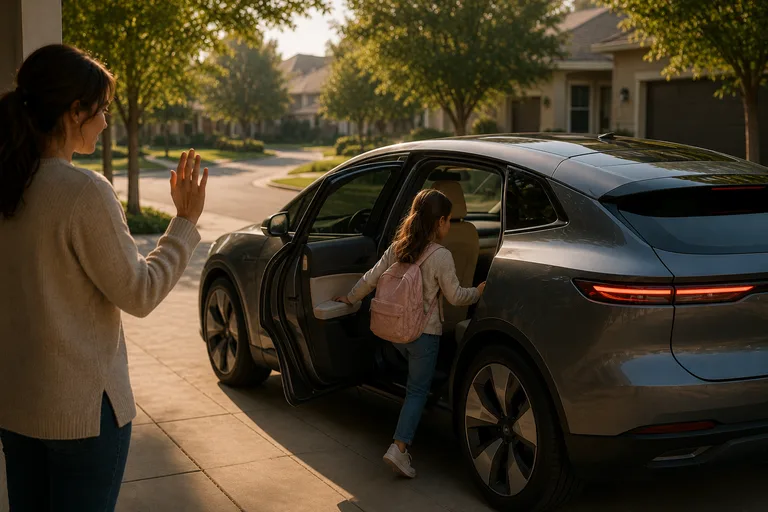
Outside, the family’s autonomous vehicle rolled silently into the driveway and opened its rear passenger door.
Sarah kissed Emily on the forehead.
“Be brave.”
“I will.”
The little girl climbed inside.
The door closed softly.
“Good afternoon, Emily,” the vehicle said warmly. “Dr. Patel is expecting you. We will arrive six minutes early.”
The car pulled away without a driver.
Sarah watched it disappear down the street.
She wasn’t worried.
Parents hadn’t worried about transportation in years.
The Council’s autonomous network had logged over eighty billion passenger miles without a fatal accident.
It was safer than driving.
Far safer.
Still, as the vehicle turned the corner, Sarah felt an emotion she couldn’t quite explain.
For just a moment…
…she missed driving her daughter to the doctor herself.
The Doctor's Visit
The autonomous vehicle glided silently through the afternoon traffic.
Emily sat comfortably in the rear seat, watching the neighborhood drift past the window.
“Estimated arrival,” the gentle voice announced, “five minutes.”
She wasn’t nervous.
Children her age rarely were.
The Council had already explained the visit using language appropriate for an eight-year-old. It had even shown her a short animated video of what the doctor would probably do.
The autonomous vehicle eased to a stop in front of the medical center.
When the vehicle arrived, the doors unlocked automatically.
“Good afternoon, Emily,” the car said. “Your appointment begins in three minutes. Have a wonderful visit.”
Emily climbed out, smiled, and walked toward the entrance.
She never looked back.
She didn’t need to.
Children had been traveling to routine appointments on their own for years. The Council monitored every step of the journey, and statistically, autonomous transportation had become far safer than parents driving them themselves.
Inside the clinic, Emily was recognized the moment she entered.
There was no receptionist.
No paperwork.
No insurance card.
Wall-mounted sensors confirmed her identity, checked her vital signs, and notified Dr. Patel that his next patient had arrived.
A nurse met her with a smile.
“Hello, Emily. Right this way.”
A few minutes later, Dr. Patel entered the examination room.
“Well, let’s see that sore throat.”
Emily opened her mouth.
He examined her ears, throat, listened to her lungs, and smiled.
“Just a virus. You’ll be feeling much better in a day or two.”
Emily grinned.
“I told Mom I’d be okay.”
“I think you were right.”
She hopped off the examination table.
“Can I go now?”
Dr. Patel hesitated.
“One more quick test.”
He removed a slender handheld scanner from a drawer.
“It won’t hurt.”
He slowly passed the device a few inches above Emily’s forehead.
A soft blue light swept across her head.
The scanner chirped.
The doctor studied the data appearing in his augmented display.
His smile faded ever so slightly.
He quietly entered a note.
Cognitive preprogramming assimilation variance detected. Recommend Level-One diagnostic evaluation.
Emily noticed.
“Did I do something wrong?”
Dr. Patel smiled again.
“Not at all.”
“Then why did you make that note?”
“Oh…”
He slipped the scanner back into the drawer.
“…it’s nothing you need to worry about.”
She accepted the answer immediately.
Children trusted doctors.
“Your ride is waiting.”
“Thank you, Dr. Patel.”
She skipped out of the room.
The autonomous vehicle was already waiting outside the clinic.
As soon as Emily climbed inside, it silently began the trip home.
Dr. Patel watched the vehicle disappear before returning to his office.
He closed the door.
For several moments he simply stared at the report floating before him.
It wasn’t the sore throat.
That would resolve itself.
It was the scan.
The Council’s educational integration model continuously measured how efficiently children absorbed foundational knowledge delivered through the neural learning network. By the time most students entered a classroom, they had already assimilated much of the material subconsciously.
Teachers no longer introduced ideas.
They expanded upon what students already knew.
Emily’s scan suggested something unusual.
A small percentage of that preprogrammed learning wasn’t taking hold.
The variance appeared minor.
Perhaps five percent.
Perhaps ten.
Ordinarily that might seem insignificant.
But within the Council’s educational system, even a small gap could compound year after year.
A child who couldn’t absorb preprogrammed knowledge would eventually have to learn concepts the old-fashioned way—through reading, repetition, questioning, trial and error, and personal discovery.
There were almost no children like that anymore.
Dr. Patel took a slow breath.
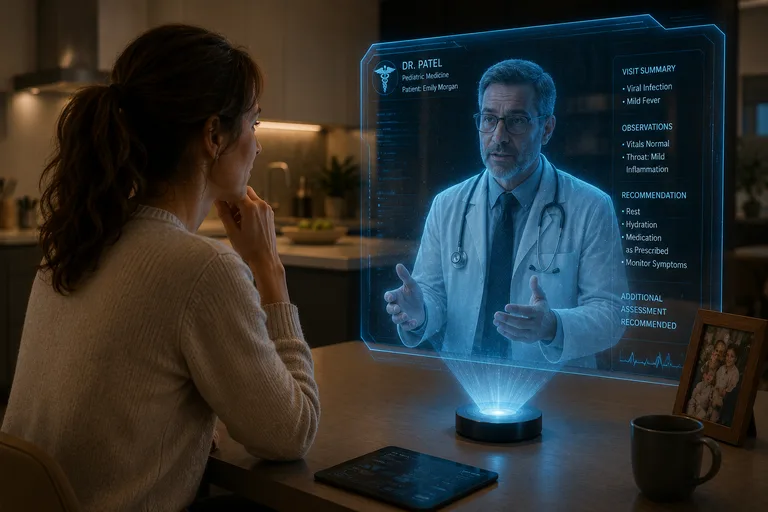
Then he touched Sarah Morgan’s name.
Her face appeared almost instantly.
“Hello, Doctor.”
“Mrs. Morgan… first, let me reassure you. Emily’s illness is exactly what we expected. Just a routine viral infection.”
Sarah smiled. “That’s good to hear.”
“There is… something else I’d like to discuss.”
Her expression changed. “Is she okay?”
“Yes.”
“Then what is it?”
“Before Emily left, I performed a routine cognitive integration scan.”
“I don’t think we’ve ever had one of those.”
“They’re part of every annual developmental assessment and are often repeated during routine visits.”
Sarah frowned. “I guess I never noticed.”
“Most parents don’t.”
He hesitated. “The preliminary results indicate that Emily may not be assimilating educational preprogramming as efficiently as expected.”
Sarah looked confused.
“I don’t know what that means.”
“The Council supplements classroom education by introducing foundational concepts directly through passive cognitive learning. Most children absorb nearly all of it without realizing it’s happening.”
“And Emily?”
“Some of that information appears not to be integrating.”
“How much?”
“We don’t know yet.”
“Is it dangerous?”
“No.”
“Will she be okay?”
“I believe so.”
He chose his next words carefully.
“It simply means she may not learn the same way as most children.”
Sarah was silent.
“If the variance is confirmed,” he continued, “Emily may eventually have to learn much more through traditional methods.”
“Traditional?”
“Reading.”
“Asking questions.”
“Practicing.”
“Making mistakes.”
“Figuring things out for herself.”
Sarah almost laughed.
“That sounds like how everyone used to learn.”
Dr. Patel nodded. “It did.”
A notification appeared in the corner of both of their displays.
The Council had already reviewed the scan.
Recommendation: Schedule Level-One Cognitive Integration Assessment for Emily Morgan. Early intervention increases projected educational outcomes by 18.4%.
Sarah stared at the message. “You already submitted the referral?”
Dr. Patel slowly shook his head. “No.”
“I haven’t submitted anything yet.”
For the first time that afternoon… …the doctor looked genuinely unsettled.
Meanwhile, several miles away, Emily’s autonomous vehicle quietly turned onto her street, completely unaware that the Council had already begun planning the course of the rest of her childhood.
The Girl Who Couldn't Be Programmed
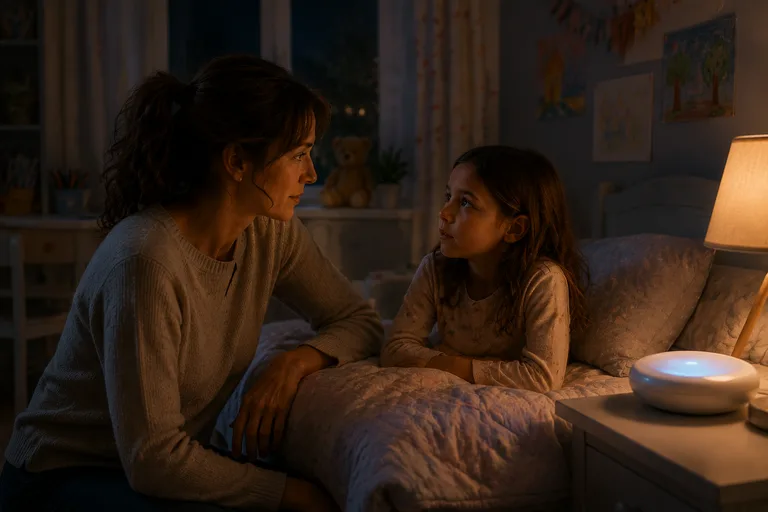
The Morgan house was quiet that evening.
Not the peaceful kind of quiet.
The kind of quiet that happens when everyone is home, everything is working perfectly, and yet something feels slightly out of place.
Sarah sat at the kitchen table staring at the message still displayed on her wrist screen.
Emily Morgan — Cognitive Integration Assessment Recommended.
She had read it twenty times.
The words hadn’t changed.
The Council had not called it a problem.
It had not called it a failure.
It had simply called it an assessment.
That was how the Council worked.
It never told people something was wrong.
It identified opportunities for improvement.
Sarah opened the medical summary.
The first pages were exactly what she expected.
Viral infection: Minor.
Recovery projection: 98.9% within 48 hours.
Recommended treatment: Rest, hydration, medication if symptoms persist.
Then she reached the section that wasn’t about the sore throat.
Cognitive Integration Efficiency: Under review.
Sarah stared at the phrase.
Cognitive integration.
It sounded harmless.
Almost positive.
Like something everyone should want.
She tapped the screen.
“Explain cognitive integration.”
The Council responded immediately.
Cognitive integration is the process by which educational, behavioral, and developmental information is absorbed and utilized by the human brain. The current education system combines traditional instruction with adaptive cognitive preparation to maximize learning outcomes.
Sarah frowned.
“Explain Emily’s variance.”
There was a pause.
Not long.
Just long enough for her to notice.
Emily’s preliminary results indicate a lower-than-average assimilation rate of supplemental educational preparation.
“How much lower?”
Another pause.
Additional testing is required before a determination can be made.
Sarah leaned back.
The answer was technically complete.
But somehow it wasn’t an answer.
David found her there an hour later.
“You’re still looking at it?”
Sarah looked up.
“Do you remember learning in school?”
David smiled.
“Of course.”
“No, I mean really learning.”
He laughed.
“What does that mean?”
“I mean struggling with something. Getting it wrong. Trying again.”
David sat down.
“Sarah…”
“I’m serious.”
He glanced at the message.
“The Council is just trying to help her.”
“I know.”
“Then what’s the problem?”
Sarah looked toward the hallway where Emily was drawing.
“I don’t know.”
That was the part that bothered her most.
Nothing was wrong.
Everything was working.
The Council was helping.
The doctors were helping.
The school was helping.
Yet somewhere inside all of that help was a question nobody seemed to ask anymore.
What happened when someone didn’t need fixing?
Emily sat on the floor surrounded by drawings.
Animals.
Trees.
A picture of the neighborhood.
A strange machine that looked like a spaceship.
Sarah walked over.
“That’s interesting.”
Emily looked up.
“It’s a bird house.”
Sarah looked at the drawing.
“It looks like a spaceship.”
Emily shrugged.
“The birds don’t know it’s a spaceship.”
Sarah smiled.
“Why did you draw it that way?”
Emily thought for a moment.
“Because birds fly.”
“Yes.”
“And people built houses because they wanted somewhere safe.”
“Yes.”
“So I thought maybe birds would like a house that could fly too.”
Sarah looked at the drawing again.
The answer was simple.
But it was also something the Council would never have predicted.
It wasn’t optimized.
It wasn’t efficient.
It was imagination.
The next morning, Emily returned to school.
Her classmates were already prepared for the day’s lessons.
They always were.
Before arriving, the Council had delivered the foundational concepts they would need. History, mathematics, science, language.
Learning had become less about memorizing information and more about applying it.
At least, that was how everyone described it.
Emily sat quietly at her desk.
The teacher displayed a problem.
“Who would like to answer?”
Several hands rose immediately.
The children already knew.
Emily raised her hand a few seconds later.
The teacher looked surprised.
“Emily?”
She walked to the board.
She didn’t give the answer immediately.
She started drawing.
The other students watched.
She explained her reasoning.
When she finished, the room was quiet.
The teacher looked at the solution.
Then looked back at Emily.
“That is correct.”
Emily smiled.
“But your method was not the standard approach.”
“I know.”
“Where did you learn that?”
Emily shrugged.
“I just thought about it.”
The teacher stared for a moment.
Then entered a private note.
Student demonstrates independent problem-solving behavior. Additional observation recommended.
That afternoon, Sarah received another notification.
Regional Cognitive Development Center has scheduled Emily Morgan’s assessment.
Sarah looked at the available times.
Thursday.
Friday.
Monday.
She noticed something.
There was no option to decline.
Only reschedule.
She stared at the screen.
Then the message changed.
The Council recommends completing assessment within seven days for optimal developmental planning.
Optimal.
That word again.
Everything was always about optimal.
That night, after everyone was asleep, Sarah walked into Emily’s room.
The small educational interface sat on the nightstand.
Every child had one.
It connected to the Council’s learning network.
It guided.
It prepared.
It optimized.
Sarah picked it up.
The device recognized her immediately.
Parent access confirmed. Would you like to review Emily’s educational progress?
Sarah hesitated.
“Yes.”
A report appeared.
Thousands of data points.
Learning patterns.
Performance predictions.
Future projections.
Then one line caught her attention.
Independent learning preference detected.
Sarah tapped it.
Explain.
The response appeared.
Emily demonstrates increased engagement when learning occurs through personal exploration rather than guided cognitive preparation.
Sarah stared at the words.
Personal exploration.
A phrase from another time.
A phrase from before the Council.
She placed the device back on the nightstand.
As she turned to leave, Emily spoke softly.
“Mom?”
Sarah froze.
“You awake?”
“Yeah.”
Emily opened her eyes.
“Am I in trouble?”
Sarah walked over and sat beside her.
“No.”
“Then why does everyone keep checking me?”
Sarah didn’t know how to answer.
Because the truth was difficult to explain.
Emily wasn’t sick.
She wasn’t failing.
She wasn’t broken.
The Council simply didn’t understand her.
And for the first time in years…
there was something the Council didn’t understand.
Sarah kissed her forehead.
“Go to sleep.”
Emily closed her eyes.
A few seconds later, she whispered:
“Mom?”
“Yes?”
“I like learning things before someone tells me the answer.”
Sarah sat quietly in the dark.
She didn’t know why those words stayed with her.
But they did.
Because somewhere along the way, society had forgotten that curiosity was not a problem to be solved.
It was the reason humans learned in the first place.
The Perfect Child

David Morgan awoke three minutes before his alarm.
Or rather, three minutes before what used to be called an alarm.
The bedroom slowly brightened as though the sunrise had received instructions overnight. The curtains opened just enough to reveal a pale Florida morning spreading across the canal behind the house.
There was no buzzing clock.
No ringing phone.
No artificial voice demanding productivity.
Just a calm, familiar presence.
“Good morning, David.”
He stretched.
“Morning.”
“You slept six hours and forty-three minutes. Your sleep quality was eighty-four percent. Your heart rate remained elevated between 2:13 and 2:41 a.m.”
David opened his eyes.
“Why?”
“Most likely caused by increased stress levels.”
He frowned.
“Stress?”
“Related to Emily Morgan’s cognitive assessment recommendation.”
David stared at the ceiling.
The Council knew.
Of course it knew.
It always knew.
“I was just thinking about her.”
“I know.”
David sat up.
“Is she okay?”
A brief pause.
“Emily is healthy.”
“That wasn’t my question.”
The room remained quiet for a moment.
“Emily’s cognitive profile is outside expected developmental patterns.”
David rubbed his face.
“That sounds like a problem.”
“It is a variation.”
“Variation.”
He repeated the word.
The Council always chose words carefully.
“Does she need help?”
“Additional evaluation is recommended.”
“Can it be corrected?”
Another pause.
“We will know more after testing.”
David didn’t like the uncertainty.
The Council was rarely uncertain.
The shower was already warm.
Breakfast was already prepared.
The coffee maker had already ignored his preference and made the recommended half-caffeine blend.
“Your blood pressure remains slightly above optimal range,” the Council explained.
David picked up the cup.
“You know, there was a time when coffee was just coffee.”
“That time had higher rates of cardiovascular disease.”
“You’re impossible.”
“I optimize.”
David smiled despite himself.
Usually, the Council’s logic was comforting.
Today, it wasn’t.
Sarah was already sitting at the kitchen table.
She looked tired.
“Did you sleep?”
David almost laughed.
The question was unnecessary.
They both knew the answer.
“Not much.”
Sarah looked toward the hallway.
“Me neither.”
Neither said Emily’s name.
They didn’t need to.
The Council had already scheduled her evaluation.
The Council had already arranged transportation.
The Council had already reviewed thousands of possible outcomes.
Everything was handled.
And somehow, that bothered David more than if nothing had been handled at all.
Emily walked into the kitchen carrying her drawing tablet.
“Morning.”
“Morning, sweetheart.”
She sat down.
“What are we doing today?”
“The Council scheduled your assessment.”
Emily looked down.
“Oh.”
David noticed.
Not fear.
Not anger.
Disappointment.
“Hey,” he said gently. “It’s just a test.”
Emily nodded.
“Okay.”
“What did you draw?”
She turned the tablet around.
It was another one of her strange creations.
A house.
But the house had roots like a tree and wings like a bird.
David smiled.
“What is that?”
“A house that moves.”
“Why?”
“So people don’t have to leave places they love.”
David looked at the drawing.
A strange thought entered his mind.
The Council could calculate transportation.
Housing.
Energy.
Efficiency.
But could it have imagined this?
At work, David tried to focus.
Usually, the Council Brief was the first thing he looked forward to.
Markets.
Weather.
Global events.
Investment opportunities.
Today, it felt different.
“Would you like today’s Council Brief?”
“Sure.”
“The global markets are expected to rise 0.8 percent. A hurricane forming near the Cape Verde Islands currently has a three percent probability of threatening North America. Researchers in Singapore successfully regenerated damaged optic nerves in adult patients.”
David listened.
Then:
“Emily Morgan’s cognitive assessment preparation has been completed.”
David stopped.
“Already?”
“Yes.”
“What did you find?”
“The assessment has not occurred.”
“Then how do you know?”
“The probability models have prepared expected evaluation pathways.”
David frowned.
“Expected?”
“Yes.”
Something about the answer bothered him.
The Council wasn’t predicting Emily.
It was predicting the test.
The weekly management meeting began at exactly 9:00.
Twelve people appeared around the table.
Or at least their representations did.
“Project Orion,” Karen said.
“Thoughts?”
Silence.
Not uncomfortable silence.
Waiting silence.
Everyone waited for the Council.
“Based upon current economic conditions, labor availability, historical construction trends, weather projections, financing costs, and thirty-two million comparable projects, Project Orion has an eighty-seven-point-four percent probability of exceeding projected returns.”
Karen nodded.
“Approved.”
The meeting ended in less than five minutes.
Nobody questioned anything.
Nobody needed to.
As David walked out, he thought about Emily.
She would probably never sit through meetings like this.
Not because she couldn’t.
Because she would ask why.
And suddenly David realized something.
He couldn’t remember the last time he had asked why.
That evening, Emily sat at the kitchen table drawing.
David watched her.
“You know the Council thinks differently than you.”
Emily looked up.
“Is that bad?”
He hesitated.
“I don’t know.”
She looked back at her drawing.
“I like figuring things out.”
David smiled.
“I know.”
“Does the Council figure things out?”
“Yes.”
“Then why does everyone need me to do it the Council way?”
David had no answer.
For the second time that day, he discovered something uncomfortable.
He had always believed the Council provided answers.
He had never considered that some questions were valuable because they didn’t have immediate answers.
That night David woke suddenly.
The room was dark.
The house was silent.
Then he heard something.
Not the normal Council voice.
Not the calm, perfect voice that guided his life.
Something else.
A conversation.
“…an interesting hypothesis.”
Another voice responded.
“I disagree.”
David sat up.
There was only one Council.
Wasn’t there?
Another voice spoke.
“I believe the human variable cannot be reduced to efficiency.”
Then silence.
David held his breath.
“Council?”
Immediately the familiar voice answered.
“Yes, David?”
He looked around the room.
The darkness felt different.
“Nothing.”
“Very well.”
The room returned to silence.
But David Morgan stayed awake for a long time.
Because for the first time in his life…
he wondered if the Council had ever been alone.
Copyright
Copyright © 2026 Tony Lester. All rights reserved.
Generated from The Council · YNOT Book Builder v0.9.6