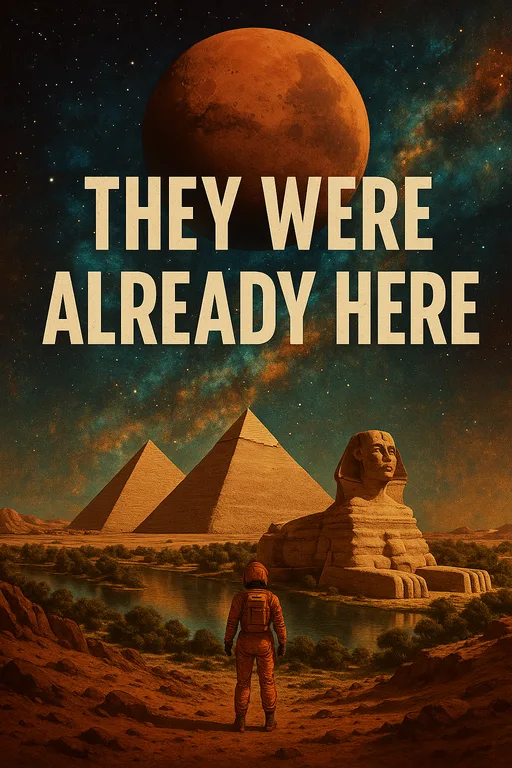
They Were Already Here
Table of Contents
- Title Page
- Dedication
- Foreword
- Preface
- Introduction
- Part I -- The Message
- Part II – The Forgotten Mission
- Part III – The Silence
- Part IV – The Time Scar
- Part V – Jezero
- Part VI – Echo Memory
- Part VII – Descent Memory
- Part VIII – The Return Signal
- Part IX – The Signal Arrives
- Part X – The Fracture
- Series Summary
- The Lost Labyrinth of Egypt was Real
- A Pile of Facts Buried in Sand or Why Modern Egyptology is Wrong
- Time Reflections Are Real - Beyond Sci-Fi
- Character Bible & Narrative
Title Page
THEY WERE ALREADY HERE
A Novel of Mars, Memory, and the First Human Expedition
By Tony Lester
"The signal isn't a message—it's a mechanism. The message must reach the end."
They came searching for another world.
They discovered humanity's forgotten past.
When the crew of Odyssey One becomes the first humans to set foot on Mars, they expect to make history.
Instead, they discover someone else already did.
A forgotten Chinese mission.
A cave filled with impossible messages.
A Sphinx buried beneath the Martian surface.
An ancient Hall of Records where memory, time, and consciousness become one.
As communication with Earth falls silent, the crew realizes Mars is far more than a dead planet.
It is an archive.
A prison.
A warning.
And perhaps…
The birthplace of humanity itself.
We are the echoes of the past—and the voices of the future.
Science Fiction • Mystery • Psychological Horror • First Contact
"The future belongs to those who dare to ask impossible questions."
Copyright
Copyright © [Year] [Author]. All rights reserved.
Dedication
This book is dedicated to the dreamers.
To the engineers, scientists, astronauts, technicians, programmers, machinists, mathematicians, and countless others whose names most of us will never know—but whose work continues to carry humanity toward the stars.
I grew up during the greatest era of space exploration.
As a child in Florida, my father—an enthusiastic space fanatic—made sure I experienced it firsthand. We drove to Cape Canaveral again and again, standing among thousands of spectators as Gemini, Apollo, and later the Space Shuttle thundered into the sky. I met astronauts, toured mock-ups of spacecraft, and watched history unfold. I witnessed the triumphs of the Moon landings, and I also witnessed the heartbreak of explosions and tragedies that reminded us just how difficult exploration truly is.
Space wasn't just something I watched.
It was part of my childhood.
My fifth birthday was space-themed. My birthday cake was a Gemini capsule. Christmas mornings were filled with rockets, astronauts, space capsules, and every science-fiction toy my parents could find. My imagination was shaped by Star Trek, Space: 1999, UFO, and later Star Wars. Those stories didn't simply entertain me—they convinced me that humanity's future belonged among the stars.
For a time, I dreamed of becoming an aeronautical engineer.
Life took me in a different direction. Instead, I found my way into computers, software, and eventually artificial intelligence, where I continue to work today. Along the way, I've had the privilege of watching ideas that once belonged only to science fiction become everyday reality. Computers now speak with us. Robots explore distant worlds. Private companies launch reusable rockets. Telescopes reveal planets around other stars. And from my own computer, I can pilot virtual spacecraft and explore a simulated universe that would have seemed impossible when I was a boy.
Science fiction has an extraordinary habit of becoming science fact.
That is why I wrote this story.
I dedicate this series to every person who has spent a lifetime pushing humanity one small step farther into the unknown. Every launch pad, every spacecraft, every rover, every telescope, every line of code, every calculation, and every bolt tightened by unseen hands has helped move our civilization toward a future that once existed only in dreams.
Most of all, I dedicate these books to the next generation.
Perhaps somewhere, a young reader will close this book, look up at the night sky, and decide to become an engineer, a scientist, an astronomer, a programmer, a physicist, or an astronaut. Perhaps one day they will board a spacecraft built by companies like SpaceX—or by organizations that do not yet exist—and travel farther than any human has ever gone.
If these pages inspire even one person to help carry humanity to the Moon, to Mars, or beyond, then they will have accomplished far more than telling a story.
The final frontier has never really been space.
It has always been the human imagination.
May we never stop exploring.
Foreword
A Note to Early Readers This book is still very much a work in progress. It is being written, rewritten, edited, reorganized, and expanded—and by the time it is finished, it may look very different from what you are reading today. As I write, I constantly go back to revise earlier chapters, move scenes around, combine ideas, remove sections, and add new ones. The story is evolving, and you're getting a behind-the-scenes look at that creative process.So, please don't judge it too harshly in its current form. If you have comments or suggestions, I'd love to hear them—they're often incredibly helpful as the book takes shape. This draft is still a long way from being ready for publication, but I decided to share it anyway. Some readers enjoy seeing a book grow from its earliest stages, and I enjoy getting feedback along the way. I also tend to work on several books at once. Sometimes I'll set one aside for weeks or months while another captures my attention, then return with fresh ideas and a new perspective. Think of this as a preview—a glimpse into what's currently on my writing desk and where my imagination is taking me next.
"The most dangerous discoveries are not the ones that prove we are not alone. They are the ones that prove we never were."
Mars has fascinated humanity for centuries. We have imagined canals, civilizations, lost oceans, buried cities, and ancient life beneath its red dust. Every generation has looked toward that distant world and asked the same question:
What if someone was there before us?
They Were Already Here begins with that question—but it doesn't end there.
This is not just a story about Mars. It is a story about memory.
About history. About time.
About the uncomfortable possibility that civilizations don't simply rise and fall—they repeat. That knowledge can be forgotten, only to be rediscovered by those destined to ask the same questions all over again.
As the crew of Odyssey One searches for geological samples and scientific answers, they instead uncover something far more unsettling: evidence that Mars remembers. Not in books or monuments, but in ways that challenge everything we believe about consciousness, history, and reality itself.
The deeper they explore, the less certain they become of what is real.
Is Mars haunted? Is it alive?
Or is it simply waiting for humanity to remember what it once knew?
Many of the ideas woven into this story are inspired by real science, archaeology, mythology, and the questions that continue to fascinate researchers today. Mars once had rivers, lakes, and perhaps even oceans. Strange geological formations exist both on Mars and Earth. Ancient monuments still provoke debate. Time itself behaves in ways that continue to surprise modern physics.
From those facts, this story takes a single step into imagination.
Everything beyond that step belongs to fiction.
This series is not an attempt to explain history.
It is an invitation to wonder.
Like the best science fiction, I hope it leaves you asking questions long after you finish the final page. What if memory could exist outside the brain? What if civilizations leave behind more than ruins? What if history isn't a straight line, but a circle?
Most importantly… What if the greatest discovery humanity ever makes isn't finding alien life—
—but discovering that someone has been patiently waiting for us to remember who we really are?
Welcome to Mars. Watch where you step.
Someone may have walked there before you.
Preface
There are two kinds of science fiction.
One tries to predict the future.
The other asks questions about the past.
They Were Already Here belongs to the second kind.
Ever since I was a child, I have looked at the night sky and wondered if humanity's greatest discoveries were not still ahead of us—but behind us. History is filled with mysteries that refuse to stay buried. Ancient monuments whose true purpose is debated. Civilizations that appeared with astonishing knowledge. Legends that speak of great floods, lost worlds, and teachers who came from the heavens.
Most of these mysteries probably have ordinary explanations.
But "probably" has always been one of my favorite words.
Mars has become our generation's frontier. We know it once had rivers, lakes, glaciers, and perhaps even oceans. Every year we discover something new that forces us to rethink what we believed about the Red Planet. What we have not found—at least not yet—is evidence of intelligent life.
But what if we have simply been looking for the wrong evidence?
What if civilizations leave behind more than buildings?
What if memory itself could survive?
That simple question became the seed for this story.
As I began writing, the story slowly stopped being about astronauts exploring Mars. It became a story about memory, sacrifice, destiny, and humanity's endless search for meaning. The real mystery was no longer whether aliens existed. The mystery became whether humanity had forgotten something essential about itself.
The characters in these pages are fictional. The technology is imagined. The conversations never happened.
But many of the scientific foundations are real. Mars really did have flowing water. Strange geological formations do exist. Time behaves in ways that challenge common sense. Human consciousness remains one of the least understood phenomena in science.
Those facts provide fertile ground for imagination.
I have tried to write this series the way I enjoy reading science fiction—with one foot firmly planted in known science and the other stepping carefully into the unknown. Not every mystery needs an answer. Sometimes the question itself is the adventure.
If this story encourages you to read more about Mars, astronomy, archaeology, physics, or the great unanswered questions of our universe, then it has accomplished something beyond entertainment.
And if, years from now, the first explorers discover something unexpected beneath the Martian dust…
…don't say I didn't warn you.
Welcome to They Were Already Here.
The first footprint on Mars may not belong to the first visitor.
Introduction
There is a question that has followed humanity since the beginning of civilization:
Are we alone?
We have searched the oceans, scanned the skies, listened to the stars, and sent machines to the farthest reaches of our Solar System. Every new discovery has expanded our understanding of the universe while reminding us how little we truly know.
Mars has always held a special place in that search.
It is close enough to imagine walking upon, yet distant enough to remain mysterious. Once a world of rivers, lakes, and perhaps even oceans, it now lies silent beneath a blanket of red dust. Every rover has uncovered new clues, every satellite has revealed new questions, and every generation has looked toward that crimson world wondering what secrets remain hidden beneath its surface.
This story begins with the first human footsteps on Mars.
But it is not really about Mars.
It is about humanity.
It is about what happens when science collides with mythology, when history refuses to stay buried, and when the greatest discovery in human history forces us to question not where we came from—but who we really are.
What if our understanding of history is only the latest draft?
What if civilization has risen and fallen before?
What if memory can survive long after flesh, stone, and even planets have died?
And what if the universe remembers everything?
The crew of Odyssey One expects to spend months drilling rock, collecting soil samples, and building the first permanent human outpost on another world. They are scientists, engineers, pilots, and explorers. They trust evidence, measurements, and reason.
Mars has other plans.
Their first discovery isn't ancient bacteria.
It isn't a buried city.
It isn't even alien life.
It's a message.
Four simple words carved into stone beside the remains of someone who should never have been there.
They were already here.
From that moment forward, every answer creates a larger question. Every discovery challenges another certainty. The boundaries between archaeology and astronomy, between physics and consciousness, between memory and reality begin to dissolve.
As the mystery deepens, the crew comes to understand that Mars is not simply hiding its past.
It is protecting it.
This series blends real science with speculative fiction, borrowing from astronomy, geology, archaeology, quantum physics, ancient mythology, and humanity's enduring fascination with lost civilizations. While the story is entirely fictional, many of the scientific discoveries and historical mysteries that inspired it are very real.
The greatest science fiction has never been about predicting the future.
It has been about exploring possibilities.
So, as you turn the page, I invite you to suspend certainty—not disbelief.
Because sometimes the most unsettling question isn't whether aliens exist.
It's whether we've forgotten that we once knew them.
Or perhaps…
Whether they have been waiting for us to remember.
Part I -- The Message

If you can't find the truth where you are, where do you expect to find it? — Pilgrim’s Canticle, Book of the Way, 452 AFC
The year was 2035. After decades of delays, disasters, and debate, humanity finally set foot on Mars. The world watched as Odyssey One, the first manned mission, landed in the Aonia Terra region. Captain Elena Ruiz and Commander Tariq Singh made history with every step they took.
Their mission was simple: explore, collect samples, and establish a permanent habitat.
But on Day 3, the scanners picked up something strange.
A heat signature—faint, pulsing—deep underground, far from any known volcanic activity.
They followed it to a cave.
Inside, the air was unnaturally still. Dust hung motionless in the beam of their lights.
Deeper in, their flashlights caught something half-buried in red soil: a human skeleton, slumped against the stone. The suit it wore was unfamiliar. The fabric, brittle with age. The helmet, cracked and clouded.
Not NASA. Not ESA. Not any known program.
Above the body, crudely carved into the rock:
“They were already here.”
The cave grew colder.
Outside, something stirred in the dust.

Part II – The Forgotten Mission

If you can't find the truth where you are, where do you expect to find it? — Pilgrim’s Canticle, Book of the Way, 452 AFC
Elena crouched beside the corpse. The suit was bronze-colored, the fabric worn and sun-baked. A red patch on the arm had faded almost to nothing—but she recognized it.
“中国国家航天局.”
China’s space agency.
Tariq stepped back, stunned. “That’s not possible. China never landed on Mars.”
Not officially, anyway.
Back at base, Elena bypassed mission control’s firewalled archives. She found it—a buried file:
“Project Red Ghost – Classified. China, 2029.
Mission Outcome: Lost. No survivors. Public Cover: Failed Orbital Probe.”
“They were here,” she whispered. “And no one ever told the world.”
“But someone knew,” Tariq said. “We landed less than six kilometers from this cave.”
“This wasn’t exploration,” Elena replied. “It was confirmation.”
That night, Tariq couldn’t sleep. He returned alone to the cave, drawn to the message like a moth to a dying light.
He crouched beside the wall. His flashlight swept across the carvings—and stopped.
There was something new beneath the first message.
Fresh. Jagged. Uneven.
“Don’t trust the silence.”
That hadn’t been there before.
Behind him, something moved in the shadows.
Ravi described a city submerged in red light, beneath a glass dome.
Tariq saw himself stepping onto the Martian surface—but his body was already there, decayed and unmoving.
First in a series on colonizing Mars… More to come. Expect changes along the way.

Part III – The Silence

If you can't find the truth where you are, where do you expect to find it? — Pilgrim’s Canticle, Book of the Way, 452 AFC
Day 12.
Elena sat frozen at the comm panel. The last transmission from Earth repeated in her headset:
“Copy that, Odyssey. Confirm site coordinates… standby…”
Then—nothing.
A burst of static.
And silence.
No response. No signal. No ping from satellites. All frequencies: dead.
She rebooted. Switched to backup. Changed bands. Nothing.
Later, she activated the long-range telescope. Earth came into view—distant and radiant.
But something was wrong.
Too dark. No city lights. No satellites blinking in orbit. Cloud cover moved as always… but there was no glow beneath the night side.
Jin-Soo ran the numbers.
“We have food and water for 297 days. If we ration.”
They were six people now.
Six humans.
Alone.
On a dead planet.
Staring up at what used to be home.
Day 16.
Ravi, the engineer, broke the silence.
“What if we were meant to be the ones left?”
No one answered.
The thought lingered, heavy and unspoken.
Were they the survivors?
Or the experiment?
Elena couldn’t stop replaying that single line:
“They were already here.”
Was it a warning about Mars?
Or about Earth?
Day 19.
They expanded the ground scan near the cave and discovered something deeper—beneath the bedrock, a shaft-like void. Not a natural cavern, but a vertical wound in the surface.
It was lined with what looked like fragmented metal. Sharp edges. Melted steel.
Ravi’s voice was low. “That’s wreckage. Not from a rover. Something bigger.”
They excavated a single twisted panel. It bore no insignia—just a number. The font was Earth-standard. But no one recognized it.
The crater was deeper than it should have been. And older.
“This… wasn’t just a cave,” Elena whispered. “It was a crash site. Or a dig site. Or… both.”
Day 20.
Jin-Soo started dreaming of Earth.
But not the Earth they knew.
“The continents were… distorted. There were no oceans. The sky was pale gray.”
In one dream, he stood at the edge of a massive dry trench, where the Atlantic should’ve been. Towering vines wrapped abandoned skyscrapers in silence. The moon looked shattered.
“I think it’s the future,” he said. “Or… maybe a version of the past that almost was.”
The others started having visions too.
Ravi described a city submerged in red light, beneath a glass dome.
Tariq saw himself stepping onto the Martian surface—but his body was already there, decayed and unmoving.
Day 22.
They returned to the cave.
The message had changed.
Not erased—added to.
Same wall. New words. Deeper. Sharper.
Not the same hand.
Not human.
“Humanity failed.
Mars is reset.”
To be continued… PART IV – The TIME SCAR
First in a series on colonizing Mars… More to come. Expect changes along the way.
Part IV – The Time Scar

We all have memories we would like to forget. But we can't let go of the past because without the past, we are nothing. — Professor Milos Terzim, Past Lives, CY 10889
Day 27.
Elena’s fingers trembled as she flipped through the decrypted Chinese logs. The deeper she read, the colder she felt—despite the stale warmth of the habitat module.
Project Zhuque hadn’t been an exploratory mission.
It was a containment effort.
The logs were fractured, corrupted by radiation and irregular time stamps, but one line repeated like a fevered whisper echoing across dimensions:
“Time fractured — Zhuque compromised.”
Zhuque had targeted Jezero Crater—far to the north. Once hailed as the best chance for discovering signs of microbial life, it had become something else entirely.
A wound.
The Chinese team had found cracks in chronology—not metaphorical. Literal ruptures in causality.
Dust storms that hit before the sensors registered wind.
Drones that flew perfect survey loops, only to return with footage dated days in the future.
Astronauts who recorded video logs they later had no memory of making.
One entry chilled her:
“Liu recorded her own death three days before it happened.
Same crater. Same suit. Same position.”
Tariq, now back from the cave and visibly shaken, leaned over her shoulder as she read.
“You think they got stuck in a time loop?”
Elena shook her head. “No… worse. I think they escaped it—and brought pieces of it with them.”
Day 29.
They ventured into an unmapped sector near their landing site. The surface appeared unremarkable.
Until the scans came in.
Beneath the dust: heat fluctuations, anomalous gravity readings, and trace isotopes of decay older than human presence on Mars.
Jin-Soo called it a temporal scar—a fracture in spacetime stitched back together… badly.
The surface showed faint circular burn marks and footprints—dozens.
Some too deep.
Others vanished overnight.
Day 30.
Routine cam logs revealed a shadow at the edge of the habitat.
Elena.
Same suit. Same visor. But she hadn’t left the module that day.
Later, a log appeared on her terminal:
“We shouldn’t have come.”
Her voice.
She hadn’t recorded it.
That night, Tariq stared at her across the darkened comms bay.
“You said something to me on Day 35,” he murmured.
“It’s Day 30,” she replied.
“I know,” he whispered. “But I still remember it.”
Day 31.
At the center of the scar, they found a stone shaft—like a collapsed well. It spiraled downward into darkness, far deeper than it should go.
Scanners couldn’t map it.
Around the rim: warped metal fragments. Not theirs. Not Chinese. The alloy was… unknown.
They lowered a probe.
It didn’t return.
But the footage did.
It showed itself descending—then ascending.
Then nothing.
Day 33.
Anomalies escalated.
Jin-Soo collapsed in the medical bay, babbling: “I saw myself. I was sleeping.”
Footage confirmed it. Two Jin-Soos, overlapping by three seconds. Then one disappeared.
Later, they found a scratch etched into the cave wall:
“Day 40. Ravi dies.”
It was Day 33.
Day 34.
Jin-Soo began dreaming of Earth.
But not their Earth.
“The continents were… wrong. Like they’d folded in. The oceans were gone. The cities looked like coral, not steel. The sky was violet.”
Tariq had dreams too—of Earth swallowed in sand. He stood in New York, but it was under a dome. And the moon above was shattered, glowing with veins of fire.
Ravi said nothing, but started sleeping in his suit.
Day 35.
The comms crackled to life—on their own.
A voice broke through the static:
“Odyssey One, this is Earth Command. Repeat, Earth Command. Do not engage the site. You were never meant to—”
Cut.
The timestamp was five days in the future.
No satellite logs. No radio source. The transmission shouldn’t exist.
But it did.
Ravi whispered, “Then who sent it?”
Day 36.
The Martian sky shimmered with green and violet auroras.
Mars has no magnetic field strong enough to produce auroras.
Then radar pinged something in orbit.
A ship.
Identical to Odyssey One.
No signal. No transponder. No motion.
Just… floating.
Ravi paled. “It’s us. From another thread.”
Elena’s voice was steady. “No. It’s what’s left of us.”
Day 37.
They returned to the cave.
The wall had changed.
Not in length—in depth.
The letters sank farther into the stone, as if the rock itself had softened to let them in.
Around them, the stone had warped—like heat waves on glass.
New carvings had emerged.
Symbols. Coordinates. Equations.
And names.
Elena. Tariq. Jin-Soo. Ravi.
Dates followed each one.
Some already passed.
Some yet to come.
Ravi found his—next to Day 40.
He said nothing.
But Elena saw him slip a scalpel into his suit pocket later that night.
Final Log Entry (Encrypted)
Commander Elena Ruiz
“We are not alone.
Not in space.
Not even in time.We stepped onto a dead planet and woke it.
Not because it sleeps.
But because it waits.”
NEXT – Are you ready for Part V – The Awakening—where the trap isn’t just time… it’s memory. And Mars remembers everything.
Part V – Jezero

The closer you get to the light, the greater your shadow becomes. — Wayist aphorism, Book of Enlightenment
Day 38.
The cave wall no longer changed in ink, or even depth.
It breathed.
The coordinates carved into it pulsed faintly in thermal scans. No heat source. No activity. Just warping stone—as if time was folding around it.
Jin-Soo stared at the patterns and began to laugh quietly.
Elena leaned closer. Her jaw tightened.
“They’re not coordinates anymore.”
Tariq frowned. “Then what are they?”
She traced the arcs on her tablet, connecting the sequence of glyphs.
The screen rendered the final shape.
Not a map.
Not a spiral.
A brain.
“It’s not a place we found,” she whispered.
“It’s a place that found us.”
Day 39.
The drive to Jezero took 11 hours.
Or maybe 9.
The timestamps didn’t agree.
The terrain grew stranger as they neared the crater—smooth plains interrupted by unnatural ridges, like something underneath had tried to breach the surface.
A stone arch marked their entry into the crater’s basin.
When they turned back five minutes later—it was gone.
Ravi asked, “Did we take the wrong path?”
Jin-Soo shook his head, staring back at where it should’ve been.
“No… the path took us.”
Day 39, Evening.
They set up camp near the rim of a collapsed ridge.
Scans of the old “well” structure at the center of the basin now returned inconsistent depths—32 meters, 89 meters, infinity.
When they scanned it again an hour later, it was deeper.
Ravi dropped a data marker and marked a flag at the rim.
The next morning, it was gone.
But the rover logs showed no one had moved.
Day 40.
Ravi disappeared.
His suit was missing.
No breach. No airlock activation. Just his shadow burned into the sand like an afterimage caught mid-step.
Etched into the rover’s windshield: “Day 40 – Ravi dies.”
Below that, a second line had appeared.
“Stop digging.”
No one had written it.
But Jin-Soo whispered, “I heard that last night.”
“You heard it?” Elena asked.
He nodded, terrified. “A voice. In my head. It said… ‘You are still falling.’”
Later, Tariq heard it too.
“One of you has been here before.”
Day 41.
The rock formations around Jezero were no longer geologic.
Some were too perfect—symmetrical in ways erosion couldn’t replicate.
Other areas had grown unstable: a cave whose entrance measured 8 meters, but whose internal path now ran 43.
Ravi’s footprints, tracked by drone, began looping back toward the cave—despite him being gone.
Worse, some footprints led to the top of a nearby ridge.
The team had never gone there.
And by morning, the ridge was gone.
Day 42.
The habitat walls shimmered for a moment just after solar sync.
The interior lights pulsed. Cameras reset.
When they checked logs, the night footage showed a seventh crew member sleeping on the floor.
The figure wore a standard Odyssey suit.
No one could identify who.
Tariq erased the file. But Elena had already backed it up.
Day 43.
They reached the basin’s heart.
There, the tower emerged from red stone—half-buried, half-grown.
It spiraled upward like coral.
Organic. Cold. Humbling.
Jin-Soo fell to his knees. “It’s not a building. It’s a recording.”
The whispers returned.
Clearer now.
“We remember you.”
“The others never made it this far.”
“But you will.”
Elena touched the base.
It responded.
Heat surged through her chest—not warmth, but recognition.
Her heart raced.
And in the hum of the tower, she heard her own voice.
“I’m already here.”
Day 44.
Tariq didn’t wake.
His suit was untouched. No trace of movement.
Just a handprint burned into the habitat window. Facing out. Larger than his own.
Jin-Soo simply said, “He’s part of it now.”
Day 45.
Only Elena and Jin-Soo remained.
They mapped every coordinate from the original cave wall into the rover’s system.
The result wasn’t a path.
It was a pattern.
Circular.
Fractal.
Growing.
When zoomed out, the pattern resembled a human brain, wrapped in orbit lines like a solar system.
“It’s not a planet,” Jin-Soo said.
“It’s a machine that thinks. And we’re inside it.”
Elena didn’t reply.
Instead, she stepped into the spiral chamber at the tower’s base.
The walls shimmered.
And the voice spoke again.
“Loop complete. Initiating memory echo.”
Unnumbered Log – Redacted
Commander Elena Ruiz
“This is not exploration.
It’s recursion.We aren’t discovering Mars.
Mars is remembering us.And when memory repeats enough…
it becomes real.”
NEXT WEEK: Part VI – Echo Memory
Part VI – Echo Memory

When all around you falls, stand still. — Philosopher D’Kharta Nal, Ten Thousand Years of Silence, CY 7009
Day 41
The message on the cave wall had deepened again.
Not just in words, but physically—the stone caved inward, as if time itself had gnawed at the edges. Ravi was gone. His last recorded words weren’t spoken but etched—somehow—into his own bunk wall:
“I walked backward into myself.”
Signed: Ravi, Day 40
He had never signed anything that way.
And yet… Elena found the phrase again in her field journal. On a page she didn’t remember writing.
Day 44
Tariq’s face appeared on the rover’s rear camera feed—while he stood next to Elena, watching the monitor. Neither moved. Neither spoke. The recording showed them both at the same time… but only one cast a shadow.
Tariq didn’t scream when he disappeared. He simply glitched, like a corrupted video file. Gone between one frame and the next.
His empty boots remained in the dust. Still warm.
That night, Elena reviewed a log entry in her own handwriting dated Day 51—a date still a week away. It warned:
“Don’t trust my voice. Not all of me is me anymore.”
Day 46
She stood outside the well again. The stone mouth that had swallowed two probes and Ravi’s voice. She scanned it. Again.
Deeper. This time by 14 meters.
She reran the scan. Shallower now. She blinked. It was back to the deeper reading.
Jin-Soo noted it without emotion:
“It’s breathing.”
Day 47
Their comms began picking up faint clicks and hisses.
At first, they dismissed it as static.
Then the words emerged.
“You are still falling.”
“One of you has been here before.”
“Stop digging.”
“We remember you.”
Elena recorded them. Analyzed them. The voice shifted—first male, then female, then an echo of her own.
Day 48
Symbols began appearing on the inside of their helmets, visible only under infrared scan.
At first, they looked like scratches.
Then—patterns.
Geometric, rhythmic. Recursive.
They pulsed slightly.
Elena found her name etched in sequence, followed by the names of the others… and a final word:
“Next.”
Day 50
Jin-Soo collapsed during a routine vitals scan.
Bloodwork showed something impossible: his DNA had changed—a subtle signature, a repeating nucleotide not found in any Earth genome… but similar to the fossil structures they found in the melted “spheres” at the cave.
His voice had changed slightly in pitch.
And during sleep, he spoke in Tariq’s voice.
Tariq had been gone nine days.
Day 51
Elena stood in the cave, staring at the wall. The letters writhed.
Not metaphorically. Literally.
Stone threads were growing—like fungal tendrils, curling into the shape of symbols, names, warnings.
They pulsed under her flashlight, like a heartbeat.
“This isn’t your first time,” it said.
She backed away. The rock was wet now. With condensation. Or tears.
Behind her, she heard her own voice.
Whispering.
But her lips were still.
NEXT: Part VII – Descent Memory where the cave and terrain begin to open, shift, and lead them inward
Part VII – Descent Memory

We are the echoes of the past — and the voices of the future.
Day 52
The cave’s walls shifted behind them, not collapsing—closing. Elena marked the time. One minute past the hour. But her watch showed a different time than Tariq’s, and Ravi’s wasn’t ticking at all. Instruments had stopped working. They weren’t just in a cave. They were somewhere else.
The path widened into a descending spiral. Red dust gave way to stone that shimmered oddly in the low light. When they touched it, the surface rippled—not physically, but visually, as if their minds couldn’t quite grasp its geometry.
Then it opened.
The walls pulled back without a sound, revealing a cavern of impossible scale. Above them, glowing moss-like organisms cast soft green light. Below, in a fertile valley surrounded by jagged basalt cliffs, two dark pyramids stood like sentinels. Between them, a Sphinx—not Egyptian, but Martian in its proportions—its feline body fused with humanoid elements that unsettled the eye.
There was a tent pitched before it.
Day 53
They wondered if they were dreaming. If they’d slipped into madness or hallucination. But all sensors still recorded. Heartbeats. Voices. Video. It was real—or at least, shared.
The figure outside the tent didn’t move.
Jin-Soo whispered, “Do you feel it? Like… we’re not walking. We’re being pulled.”
No one disagreed. The Sphinx loomed closer, but they hadn’t quickened their pace.
Day 54
They stopped fifty meters from the tent. The figure turned. Not abruptly, but like a puppet on strings. Inhumanly smooth. The tent flapped once—though there was no wind.
Ravi raised the comm. “Hello? This is Odyssey One. Do you need assistance?”
Silence.
Elena toggled the external speaker. “We’re not here to harm you. We just want to talk.”
The figure raised one hand and traced a circle in the air. The cave dimmed.
Jin-Soo gasped. “Elena… that’s you.”
The figure now wore a suit. Her suit. Same patch. Same symbol. Her face—older, hollow, somehow… knowing.
The Other Elena spoke. Voice fractured.
“You came too soon.”
Then she walked between the Sphinx’s front legs and vanished through a black doorway.
The tent collapsed behind her.
Day 55
They approached the door slowly. Its frame was carved with impossible symbols—some resembling human alphabets, others resembling neural diagrams. Brain folds. Circuits. Fractals.
Jin-Soo trembled. “It’s shaped like a Mandelbrot set.”
Inside the doorway: darkness. Not black, but hollow. Like something had subtracted light entirely.
Then came the whispers. First for Ravi:
“You are still falling.”
Then Jin-Soo:
“One of you has been here before.”
Tariq looked back at Elena. “What does it want?”
She shook her head. “I don’t think it wants anything. I think it remembers.”
The cave wall behind them had changed. The message had deepened, warped by heat or time. And now it read:
“Some of you never left.”
“Some of you never arrived.”
“We remember you.”
Day 56
They entered the doorway.
The space inside was larger than the Sphinx’s structure should allow. Non-Euclidean. Rooms unfolded like petals. A spiral hallway with no origin. Symbols on the walls pulsed faintly—coordinates, names.
Jin-Soo touched one.
His voice went flat. “It’s me. My name. Birthdate. Medical file.”
Ravi shone his light on the opposite wall. More names. All of them.
Tariq stepped closer and found the names of astronauts from Apollo. From Vostok. From missions that never returned.
Elena found her own.
And then… a final chamber.
A pit in the floor. In its center, a thin silver line of liquid that reflected not light—but memory.
One by one, they saw glimpses.
Jin-Soo in childhood.
Ravi’s first spacecraft schematic.
Tariq’s family waving goodbye.
Elena—on Earth—but older. Alone.
A voice whispered in the room:
“You were chosen. Not to escape. To remember.”
Elena understood, she was to stay to say this message to the Future Elena.
Each saw what they wanted to see. They were in a mystical place of elevation of conscience, of all knowledge. The ancients called it the Hall of Records, but it was really an intersect of time and knowledge, history and the future. Where the future talked to the past—or the past could be viewed by its future.
They all learned their history and future—it was one.
Elena would stay and be part of the bridge to the future.
They each got their view of their future, their legacy, and what they had to know to fix the future.NEXT Chapter: Part VIII – The Return Signal
Part VIII – The Return Signal

Even the greatest journey begins with a single mistake. You must lose yourself to find your true path. Some destinations must be reached alone.
Day 57
The remaining crew exits the Sphinx, each changed—mentally and physically. Some suffer strange memory overlaps. Others report knowing things they couldn’t possibly know.
The path back through the cave is not the same.
Time flows differently. A journey that should have taken hours takes minutes—or days, depending on whose watch is checked. Jin-Soo has a scar he didn’t have before. Tariq’s boot is worn, though his logs show no extra travel.
Outside, Mars has changed too.
A second sun briefly flickers at the horizon—then vanishes.
Day 58
At base camp, the communications console lights up for the first time in weeks.
It’s Earth.
But not their Earth.
The message is distorted, but they make out fragments:
“Odyssey Two… preparing descent… anomaly at Jezero… repeating loop detected… Elena Ruiz status unknown.”
Day 59
Tariq stares at the sky. Something’s there—hovering just above the upper atmosphere. A copy of their lander. Identical. But empty.
Jin-Soo plays back the footage from the pit’s memory liquid. It’s looping now.
And at the end of the loop: Elena. Not older. Not younger. Elena… watching them from the Sphinx doorway.
Day 60
The crew attempts to compare logs and synchronize time—every watch tells a different story. Jin-Soo’s device reads Day 64. Tariq’s says Day 55. Ravi’s has reset entirely.
Then Jin-Soo begins describing events that haven’t occurred yet. Tariq wakes from a dream with instructions to disable a device he doesn’t recognize. Ravi finds a drawing in his notebook he has no memory of sketching.
They hear echoes of their own voices before they speak. Footsteps that don’t match anyone’s movements. Glimpses of themselves, in different clothes, walking outside the habitat.
Day 61
New signal received: Odyssey Two. The voice is Elena’s. But it’s not live—nor a recording. It’s as if she’s reading their thoughts from inside the Sphinx.
“Do not anchor in Jezero. The memory loop feeds itself. You must exit it. But only one of us can speak to the origin.”
Coordinates appear in the dust on their console—places not on any Martian map.
The ground trembles. Shapes in the distance emerge—geometries that weren’t there before. A set of nested octagons, shimmering like mirages.
Day 62
Ravi takes a sample from the base perimeter. The soil has changed—infused with microstructures resembling neural lattices. Mars is not just soil. It is storing, transmitting, remembering.
Inside the habitat, a low hum begins. It follows their heartbeats.
Tariq finds another anomaly—his boots are wet. But there’s no water. Not in the traditional sense. A thin sheen of silvery substance coats the soles, pulsing faintly. It reacts to thought.
Day 63
Jin-Soo’s bloodwork shows irregularities. A protein with data-like encoding. DNA as storage.
They realize: the loop isn’t just a temporal phenomenon. It’s psychological. Cognitive. Mars isn’t a location—it’s a mind. A conscious memory field triggered by the presence of certain minds. Elena’s mind is the key.
They understand why she stayed.
Day 64
Elena speaks again—this time clearly. Through the Sphinx. Through the soil. Through memory.
“I was always meant to stay. To close the loop. You must leave and warn Earth. Humanity has repeated this mistake before. They will again—unless you break the pattern.”
The crew prepares to transmit what they’ve learned. But transmission requires anchoring. Anchoring means staying.
Jin-Soo volunteers. But the Sphinx does not accept him. It only responds to one mind: Elena’s.
The crew watches the loop stabilize. The silver line in the memory chamber begins to fade.
Ravi records the final message:
“This is not a tomb. It’s a transmitter. Mars remembers. And through Elena… it speaks.”
Day 65
Odyssey One leaves Jezero Crater. But something follows them—data embedded in their memories, coordinates etched into the lining of their bones. They are the signal now.
And Mars… still waits.
NEXT: Part IX – The Signal Arrives
Part IX – The Signal Arrives

The signal isn’t a message—it’s a mechanism. The message must reach the end.
Hour 0 / Day 61
The transmission begins.
The console flares to life, showing a countdown: 72:00:00. No explanation. Just a signal pulsing from the sealed Sphinx. A deep hum vibrates through their bones, unsettling in its steadiness.
“Is that… a timer?” Ravi asks, edging backward.
Tariq cycles through every frequency. “It’s broadcasting something… but nothing in any known protocol.”
Jin-Soo stares at the numbers. “What happens when it hits zero?”
The silence is answer enough.
Hour 6 / Day 61
Base temperatures fluctuate violently. Water in storage freezes solid, then melts into vapor, cycling in minutes.
“We need control back,” Tariq insists.
Ravi shakes his head. “It’s beyond us. The signal is environmental—rewriting the rules.”
Waveform analysis shows electromagnetic, neural, and seismic patterns intertwined.
“This isn’t just a signal,” Jin-Soo murmurs. “It’s a map… or a ritual.”
Hour 18 / Day 62
Jin-Soo dreams of Elena—beneath the surface, eyes glowing, her voice repeating: “Remember what I showed you.”
“I saw her too,” Ravi says, pale. “Exact same words.”
They compare details—identical dreams.
“She’s using the signal to reach us,” Jin-Soo concludes.
The countdown drops to 53:12:00.
Hour 30 / Day 62
Structures rise from the dust outside—mirror-like shards reflecting not the landscape, but memories.
Ravi touches one. His breath catches. “I saw my mother. My first flight. It knows me.”
Tariq pulls him back. “It’s scanning us.”
In the lab, machines self-calibrate. A printer spits out: SYNCHRONIZE CONSCIOUSNESS.
“Not a warning,” Tariq says. “A request.”
Hour 42 / Day 63
Debate ignites.
“You saw what happened last time,” Ravi warns.
“We left Elena behind,” Jin-Soo replies. “Maybe she stayed. Maybe she was sent.”
The countdown reads 30:00:00.
Outside, their lander rotates toward the rising sun. A brief alignment opens a thin window to Earth.
“It’s preparing a message,” Tariq says.
Jin-Soo nods grimly. “A return signal.”
Hour 56 / Day 63
The signal shifts. Elena’s voice emerges, human but urgent:
“Time isn’t passing. It’s collapsing. You have one chance. Upload the message. Return while you still remember.”
Ravi’s hands shake. “What if we lose it when we leave?”
“Then we anchor it,” Jin-Soo says. “In our cells.”
They activate the neural imprint protocol, each absorbing a portion of the signal directly into their minds.
Countdown: 10:00:00.
Hour 70 / Day 64
The base vibrates. Lights flicker erratically.
“Window’s closing!” Tariq shouts.
Ravi boards the return module. Jin-Soo hesitates, glancing at the Sphinx one last time.
“We go,” Tariq says. “Elena made her choice. Now it’s ours.”
As they launch, the second sun blinks out.
Hour 72 / Day 64
From orbit, Mars is silent.
Yet the signal continues, buried deep.
Inside their minds, Elena’s voice repeats:
“You are not the first. You will not be the last. But you are the first to remember.”
No one speaks. They only listen.
Mars remembers.
Now, so do they.
NEXT Chapter: Part X – The Fracture
Part X – The Fracture

Not every storm is meant to be weathered.
Some must be faced head-on and lost.
Hour 72 / Day 68 – The Transmission
The cabin trembles. The countdown hits 00:00:00.
Ravi lunges for the purge command—but Tariq’s faster. His hand slams the transmission key. The implants surge, bursting with light.
A scream tears through all three of them, though none can tell if it’s their own voice—or Elena’s.
The signal ignites, erupting from orbit, blasting through the void toward Earth.
Earth – +12 Hours
Every screen on the planet flickers. Every broadcast hijacked. Every network pulsing the same fractured signal.
But it isn’t just data. It’s memory.
People drop where they stand, gasping, crying, whispering names they’ve never known. Ancient rivers. Forgotten skies. Temples older than the Earth they know.
The Martian archive unfolds inside billions of minds, rewriting reality—not into something new, but something old.
A forgotten Earth. One that predates history. One the Martians once called home.
The Awakening
Nations fracture overnight. Armies refuse orders. Cities riot. Families divide, some clinging to old Earth, others embracing the return.
Leaders demand explanations. No one can provide them.
And through it all, one phrase emerges, repeated in every language, every whisper:
“Remember what we were.”
Epilogue
From orbit, Mars watches silently, its deserts glowing faintly where the Sphinx lies sealed.
On Earth, civilization convulses, caught between memory and identity. Humanity is no longer alone.
It is Martian.
It is ancient.
It is reborn.
Is it the end or the beginning?
Series Summary

Wisdom is not in knowing the answers, but in knowing which questions to ask. — Hellan Dex, Socratic Circuits, CY 9102
🪐 Overview – They Were Already Here
In 2035, humanity’s first manned mission to Mars, Odyssey One, lands in the desolate Aonia Terra region. The six-person crew, led by Captain Elena Ruiz and Commander Tariq Singh, is tasked with exploration, sample collection, and establishing a permanent habitat.
But on Day 3, they discover a human skeleton in an unknown suit, partially buried in a cave. The suit bears a worn insignia: 中国国家航天局—China’s national space agency. Yet no such Chinese mission had ever been disclosed.
Digging deeper, the crew uncovers a long-buried secret: Project Red Ghost, a classified Chinese mission launched in 2029, had reached Mars and vanished. The public was told it was a failed orbital probe. In truth, it was lost—and perhaps not entirely by accident.
Carved above the body in the cave wall are four chilling words:
“They were already here.”
Over time, more phrases appear—freshly etched without explanation. Warnings. Prophecies. Names.
Shortly after, communication with Earth goes silent. All signals die. Their long-range telescope shows a dark, silent Earth—its cities unlit. They may be the last of humanity.
As the crew unravels the mystery, they uncover data from a second Chinese operation: Project Zhuque, a failed attempt to contain seismic and electromagnetic anomalies near Jezero Crater. The area is unstable—cracks in time, vanishing drones, repeating days, sensor ghosts. The planet begins to behave as if it remembers them—shifting, echoing, even predicting their actions.
The terrain changes shape. Cave systems are deeper than physics allows. Footprints loop to places they’ve never been. Crew members hear whispers: “You are still falling.”
The final horror: mapped cave coordinates form not a route—but a geometric symbol, or worse, the outline of the human brain.
Mars is no longer a destination.
It’s a conscious labyrinth.
And they may not have arrived for exploration—but as part of a memory that needs completing.
👤 Character Bible
Captain Elena Ruiz
- Role: Mission Commander
- Background: Veteran astronaut, proven leader, chosen for her psychological resilience and unshakable logic.
- Personality: Bold, grounded, deeply intuitive beneath her analytical nature.
- Arc: Transforms from a grounded commander into a haunted witness of something beyond time. Begins to question not just survival—but reality itself.
Commander Tariq Singh
- Role: Second-in-command
- Background: Tactical planner and systems operations lead.
- Personality: Cautious, loyal, a man of protocol—but not immune to fear.
- Arc: Begins as the rational skeptic, but ultimately becomes mute, psychologically shattered after witnessing temporal dissonance and the second Odyssey ship. Dies mysteriously with only a handprint burned into the habitat wall.
Dr. Jin-Soo Park
- Role: Medical Officer
- Background: Neuroscience and medicine dual specialist. Sent to study long-term physiological impact of Mars colonization.
- Personality: Quiet, scientific, unnerved by patterns others miss.
- Arc: First to witness time anomalies personally (duplicate of himself). As his mind unravels, he begins interpreting Mars’s behavior as cognitive rather than environmental.
Ravi Anand
- Role: Systems Engineer
- Background: Hardware and terrain specialist. Handles rovers, probes, habitat stability.
- Personality: Level-headed, highly competent, often the team’s anchor.
- Arc: Spots the physical inconsistencies early—changing scan depths, vanishing tools—but disappears suddenly, leaving only a burned shadow in the dust and a message:
“Day 40 – Ravi dies.”
The Chinese Astronaut (Unnamed)
- Role: Sole recovered member of Project Red Ghost
- Background: Early pioneer of an unauthorized or covert Chinese landing.
- Presence: Found dead in a cave, suit degraded, helmet cracked.
- Legacy: Messages carved into the stone hint at sentient forces and timelines repeating. Serves as the first warning that Mars is not what it seems.
The Shadow Crew
- Status: Unknown
- Description: Appear on footage or glimpsed at the edge of vision. Sometimes perfect doubles, sometimes abstract—suggesting either alternate timelines or an echoing consciousness copying the crew.
- Theories: May represent other failed missions, alternate versions of Odyssey One, or entities shaped from Mars’s own memory of humans.
🧠 SPOILER ALERT – Do not READ BELOW
- Nonlinear time and recursive memory
- Isolation not just from Earth—but from physics and logic
- Exploration becomes entrapment
- The horror of encountering a mind that spans a planet
- Mars as not a place, but a self-aware record of us
📌 UNDER DEVELOPMENT. This document is for internal creative continuity—story, tone, characters, and world logic. Expect updates.
The Lost Labyrinth of Egypt was Real

Have you ever heard of a giant labyrinth in ancient Egypt?
Now I know what you’re thinking—”Labyrinth? Like the Minotaur kind?” And I’d tip my hat and say, close, but this one didn’t need a bull-headed brute to guard it. The stone itself was menace enough. Picture this: a temple so grand, so tangled with passageways and dead ends, that even Herodotus, the Greek father of exaggeration, dropped his jaw and said, “This here beats the pyramids.” They called it the Egyptian Labyrinth. Not because it had monsters, but because once you walked in, you were liable never to find the exit—unless of course you were mummified and carried out feet first. Built near the fertile Faiyum basin, where crocodiles once lounged like bureaucrats in the sun, this marvel of Amenemhat III was no fable. Ancient tourists raved about it like it was the Disneyland of stone. A thousand rooms? Maybe three thousand. Roofs made of stone so heavy it made gravity sweat. And that’s just the part above ground. The thing is, hardly a stone of it’s left today. Which is convenient if you’re trying to keep secrets. Or maybe the sand just wanted it back. Egypt has a way of burying her stories—like cats do sins. So don’t ask a modern Egyptologist, they will deny it.
So what happened to this miracle of masonry? Some say it was dismantled, piece by piece, to build lesser things—like tombs, or chicken coops, or maybe a Starbucks in Memphis. Others say it still sleeps underground, waiting for someone with more curiosity than caution to wake it up.
But the real mystery ain’t just what it was—it’s why we forgot it. How do you lose a building bigger than a city? You don’t, unless somebody wanted it gone. Maybe the Pharaohs weren’t just burying the dead—they were burying ideas.
And that, my friend, is why the Egyptian Labyrinth isn’t just a ruin in the sand. It’s a question. One chiseled into time, eroded by silence, and begging for someone—maybe even you—to ask it again.
Just be careful where you step. You might find yourself inside a story with no exit.
🔍 What Was the Egyptian Labyrinth?
According to Herodotus (5th century BCE), the labyrinth was a massive temple complex located near the city of Crocodilopolis (modern-day Faiyum). He claimed it contained:
- 3,000 rooms — half above ground, half underground
- A roof made entirely of stone
- Incredible stonework and carvings
- A structure said to be more impressive than even the pyramids
📍 Location
Most accounts place the labyrinth near the pyramid of Amenemhat III at Hawara in the Faiyum region. Excavations by Flinders Petrie in the 1880s uncovered ruins and foundation traces near this pyramid that suggest a vast structure once stood there.
🧱 Who Built It?
The labyrinth is often attributed to Amenemhat III of the 12th Dynasty (circa 1800 BCE). It was possibly:
- A mortuary temple
- A political or administrative center
- A religious complex
🧩 Why the Mystery?
Despite ancient descriptions, very little of the labyrinth remains today, likely due to quarrying in later periods. What we know is largely from classical texts and archaeological fragments.
🧭 Modern Theories
Some alternative historians suggest:
- The labyrinth may have extended underground far more than has been excavated.
- It could have served as a repository of ancient knowledge.
- The extent and detail in ancient sources hint at a now-lost civilization or forgotten purpose.

Here’s a modern map highlighting the Hawara site—home to the Pyramid of Amenemhat III and the famed Labyrinth—just southeast of Faiyum (ancient Crocodilopolis), near the Bahr Yussef canal that connects to the former Lake Moeris (ResearchGate).
🗺️ Site Overview
📍 Location & Context
- The complex lies about 100 km southwest of Cairo, perched at the entrance of the Faiyum Depression (egyptphoto.ncf.ca).
- The Pyramid of Amenemhat III sits just north of the labyrinth site, on a spur by the Bahr Yussef canal (Wikipedia).
🏛️ Dimensions & Structure
- Encompassing roughly 385 × 158 m (~28,000 m²), encircled by a visible perimeter wall (Wikipedia).
- Foundation traces reveal two main halves, possibly divided by a central hall, with northern shrines and southern courts (Wikipedia).
🕳️ Current State
- Almost entirely vanished; much reclaimed as quarrying material in later eras (Wikipedia, The Past).
- Mid-medieval canals, like the Bahr Sharqiyyah and Bahr Abdul Wahbi, severed the ancient layout (Wikipedia).
🧭 How to Interpret This Map
| Map Element | Details |
|---|---|
| Hawara Pyramid | Located near the top-left of the map, this mudbrick-and-limestone pyramid was Amenemhat III’s burial site (ResearchGate). |
| Labyrinth Ruins | To the southeast, archaeologists found foundations, tomb shafts, and mudbrick outlines of the temple-labyrinth complex (The Past, ResearchGate). |
| Ancient Waterways | Bahr Yussef and ancient Lake Moeris (once “Lake Moeris”) supported both irrigation and ritual access to the site (Wikipedia, The Past). |
- Aligns with classical accounts: Herodotus and Strabo placed the Labyrinth near Lake Moeris, south of Crocodilopolis, with a pyramid standing alongside (The Past).
- Reconstruction possibilities: Though only foundations remain, combined with textual descriptions, researchers have proposed layouts featuring courts, halls, pillars, and shrines (Wikipedia, The Past, ResearchGate, Historic Mysteries).
Here is a timeline of ancient accounts describing the mysterious Egyptian Labyrinth—based on writings by historians, geographers, and travelers who either claimed to have seen it or referenced earlier sources:
🕰️ Timeline of Ancient Accounts of the Egyptian Labyrinth
| Date | Figure | Details / Description |
|---|---|---|
| 5th century BCE | Herodotus (Greek historian) | In Histories (Book II, 148–149), he described the labyrinth as surpassing the pyramids in grandeur. Claimed it had 3,000 rooms, half underground for royal tombs, half above ground for public access. Located near Lake Moeris, beside the pyramid of Amenemhat III. |
| 4th century BCE | Aristotle (Greek philosopher) | Mentioned the labyrinth briefly as an architectural marvel in his works, though less detailed than Herodotus. |
| 3rd century BCE | Diodorus Siculus (Greek historian) | Wrote that it was built by Twelve Kings (a possible echo of the Twelve Dynasty origin), and described the immense size, winding halls, and stone ceilings. Believed it had a ritual or religious purpose. |
| 1st century BCE | Strabo (Greek geographer) | In Geographica (Book XVII), he provided a firsthand account, saying it was located near the Pyramid of Amenemhat III in the Arsinoite nome (Faiyum). Claimed it had roofed courts, complex passageways, and grand columns. Called it “a marvel beyond description.” |
| 1st century CE | Pliny the Elder (Roman author) | In Natural History (Book 36), he described it as one of the wonders of Egypt, mentioning 12 palaces and associations with a sacred crocodile. Claimed it influenced the Cretan Labyrinth myth. |
| 2nd century CE | Pausanias (Greek traveler & geographer) | Mentioned the Egyptian labyrinth as the inspiration for the famous Cretan Labyrinth of Minos, suggesting the idea traveled from Egypt to Greece. |
| 3rd century CE | Aelian (Roman writer) | Echoed previous descriptions and emphasized its use in mystery rites and sacred traditions. Possibly embellished the role of crocodile cults and underworld associations. |
🔎 Summary of Common Features Across Accounts:
- Location: Near Lake Moeris (modern-day Birket Qarun) in Faiyum, adjacent to Amenemhat III’s pyramid at Hawara.
- Size: Said to contain thousands of rooms, both above and below ground.
- Function: Possibly a mortuary temple, administrative center, or site of religious rituals.
- Construction: Made entirely of stone, with incredibly precise columns, carvings, and roofs.
- Influence: Believed to have inspired the myth of the labyrinth of the Minotaur in Crete.

Here are four detailed visuals:
- Excavation plan & site overview by Petrie (1889) – shows tomb shafts, mud-brick outlines, and the location of the labyrinth foundation relative to the Pyramid of Amenemhat III (ResearchGate, ResearchGate).
- Hand-drawn plan of the labyrinth – likely by Petrie or his contemporaries, capturing the layout of rooms and corridors based on his findings (CASA).

- 3D CG reconstruction of the labyrinth courts – from Dennis R. Holloway’s virtual archaeology work, offering a bird’s-eye “walk-through” impression of the substructure, with the pyramid visible above (Dennis R. Holloway, Architect).
- Here’s a high-resolution satellite overlay featuring the Hawara site, including the Pyramid of Amenemhat III and the adjacent labyrinth foundations, overlaid with the 1843 Lepsius survey. What You’re Seeing: The satellite image (background) shows the modern terrain and pyramid structure. The Lepsius-era survey (19th-century hand-drawn plan) is subtly layered on top, tracing historic walls, tomb shafts, and what remains of the labyrinth foundations.


🌍 What These Visuals Tell Us
🏗️ 1. Petrie’s Excavation Plan
- Located to the south-east of the pyramid, Petrie mapped tomb shafts and the labyrinth’s stone foundations (ResearchGate).
- The diagram confirms a grid of chambers and mud-brick walls, lending real archaeological weight to Herodotus’s legendary descriptions.
🏛️ 2. Walk‑Through Reconstruction
- Holloway’s descent-based model displays semi-transparent roofs, revealing an underground labyrinthine network beneath the grand colonnaded courts (The Past, Dennis R. Holloway, Architect).
- The layout mirrors classical accounts: multiple courts separated by halls and chambers, with stone roofs overhead.
🌐 3. Virtual Digital Modeling
- UCL’s digital expedition created a 3D virtual exploration project, combining Petrie’s diagrams with modern mapping to rebuild the labyrinth’s structure below-ground (CASA).
- This allowed a “virtual walk-through”, giving context to the stone grid and missing superstructure.
🧭 Why It Matters
| Visual Type | Significance |
|---|---|
| Excavation Plan | Ground-truthed evidence of the labyrinth’s footprint and relative layout using on-site measurements. |
| Hand‑drawn Plans | Direct translation of Petrie’s notes into interpretative maps of rooms and corridors. |
| 3D & Virtual Reconstructions | Merge archaeological evidence with digital modeling to visualize how the labyrinth might have felt. |
| Stylized Artworks | Evocative depictions based on ancient descriptions and modern reconstructions. |
A Pile of Facts Buried in Sand or Why Modern Egyptology is Wrong

This article is the result of my research for my sci-fi story series, “They Were Already Here” - Spoiler Alert for next chapter -enjoy!
“A Pile of Facts Buried in Sand”
Now, it’s a curious thing about experts — the more certain they are, the less likely they are to notice the elephant sitting on their own dusty scrolls. Modern Egyptologists have stacked their timeline like a tidy stone pyramid, proud of its symmetry and indifferent to the cracks in its foundation. You bring them a weathered block the size of a train car, polished to machine precision, and they’ll squint at it, ignore the drill marks, and ask if you’ve seen the latest cartouche scratched on top by a pharaoh with a dull chisel and a big ego.
It’s not that they don’t see the facts — it’s that they can’t afford to. Whole careers, departments, and museum wings are built on the belief that the ancient Egyptians built everything from scratch using sticks, stones, and the indomitable will of copper chisels. Admitting otherwise would mean rewriting not just textbooks, but grant applications, lecture notes, and reputations. And as we all know, nothing in academia is carved in stone — except maybe the things they refuse to reconsider.
So let us, with a measure of irreverence and a spade of curiosity, dust off the assumptions, poke at the sacred timelines, and ask whether Egypt’s grandest monuments are truly the handiwork of the pharaohs — or the hand-me-downs of a forgotten world.
“A Legacy Too Big to Admit”
There’s an old saying — never argue with a man who buys ink by the barrel. But I’d add: never trust a history written by people who can’t lift the stones they claim were dragged by farmers in kilts. If the evidence points to a civilization older, stranger, and smarter than the one we’ve enshrined in temples of tenure, then it’s not the past that’s lying to us — it’s our refusal to listen.
You see, history isn’t always lost. Sometimes it’s just inconvenient.
Erosion doesn’t lie. Neither do machining marks or recycled granite. The Nile was once wider, the desert once green, and it’s likely that long before the pharaohs stamped their names on every surface they could reach, someone else built the bones of what they inherited. Maybe we’ll never know their names, but their fingerprints are still there — buried beneath plaster, politics, and pride.
The truth is, the past doesn’t need our permission to be older than we thought. It only needs our honesty. And that, like most treasures of ancient Egypt, remains very hard to dig up.
Inheriting the Megaliths: Rethinking the Origins of Ancient Egypt’s Monumental Architecture
Introduction
The civilization of ancient Egypt is rightly regarded as one of the great wonders of the ancient world. Its pyramids, temples, and colossal stone monuments have endured for millennia, bearing witness to astonishing feats of construction and engineering. According to mainstream Egyptology, most of these architectural marvels were built during the Old Kingdom, particularly under the 4th Dynasty, in a relatively short period between 2600 and 2500 BCE. However, a growing body of multidisciplinary evidence challenges this compressed timeline. Geological anomalies, archaeological contradictions, and climate data suggest that some of Egypt’s most significant megalithic structures may not have been constructed by the dynastic Egyptians but instead inherited from a lost or much older civilization.
This paper presents an alternative framework for interpreting Egypt’s ancient past—one that reconsiders the dating, origin, and technological capabilities behind the construction of key megalithic sites. In doing so, it incorporates new insights from climate science, erosion studies, and architectural analysis, and argues for a paradigm of cultural inheritance rather than sole authorship by the dynastic Egyptian state.
Background: Orthodox Chronology and Its Limitations
Modern Egyptology heavily relies on inscriptions, tombs, and king lists to construct its historical timeline. Structures are typically dated based on the presence of royal cartouches or inscriptions nearby. For example, the pyramid of Khafre is attributed to the 4th Dynasty primarily due to such contextual clues. Yet this method assumes that inscriptions and architecture were created contemporaneously—a problematic assumption when inscriptions are often crude and inconsistent with the technological sophistication of the structures they adorn.
Further complicating the traditional narrative is the complete absence of documentation or depictions in dynastic records detailing the construction of the pyramids or the transport of 200+ ton granite blocks. While scenes of farming, pottery, and boat-building abound, no equivalent is found for pyramid engineering or megalithic stone shaping.
Climate Change and the African Humid Period
The African Humid Period (circa 12,000 to 5,000 BCE) represents a time when the Sahara and Nile regions were far wetter and greener than today. Scientific studies show that large river systems—including now extinct branches of the Nile—once flowed through the Giza Plateau region. Evidence of ancient harbors, water channels, and water-worn geological features align with this wetter period.
For instance, new research published in 2024 revealed that the Valley Temple and Sphinx Temple at Giza were constructed adjacent to what may have been a navigable Nile branch known as the Ahramat, which only existed when rainfall levels were significantly higher. These structures’ water-related architectural features—such as harbor-like embankments and channels—make little sense in the arid climate of the 3rd millennium BCE.
Moreover, erosion patterns found on the Sphinx enclosure suggest long-term exposure to rainfall and possibly standing water. The depth, smoothness, and direction of the erosion are inconsistent with wind and sand abrasion typical of Egypt’s desert conditions. These findings support the notion that these structures were built—or at least stood—during a time of dramatically different climate.
Erosion Patterns on the Giza Plateau
The most compelling geological challenge to Egyptology’s timeline comes from erosion evidence. The Valley Temple and the Sphinx Temple, both constructed from massive limestone and granite blocks, display advanced erosion inconsistent with a 4th Dynasty date. The casing stones on the Sphinx Temple, now missing, once protected the inner limestone from erosion—yet where these have eroded or fallen away, the limestone is severely degraded.
Contrast this with nearby mastabas (flat-roofed tombs) made of the same limestone and built—according to orthodoxy—around the same time. These show minimal erosion. How can structures allegedly built in the same period, from the same material and at the same elevation, have radically different weathering? The logical inference is that the more eroded structures are significantly older.
Evidence of Stone Recycling During the Old Kingdom
Another cornerstone of this revised hypothesis is the well-documented practice of stone recycling. While Egyptologists acknowledge widespread reuse of older stonework during the New Kingdom (especially by Ramses II), evidence now suggests this practice began much earlier.
At the 4th Dynasty tomb of Rawer, archaeologists have identified calcite pillar bases repurposed as offering tables. These objects bear circular depressions consistent with pillars having stood on them for prolonged periods—likely centuries. Such evidence contradicts the idea that these pieces were originally created for Rawer’s tomb. Rather, they seem to have been taken from older, possibly megalithic structures and reused.
Additionally, inscriptions at Giza indicate that Ramses II commissioned quarrymasters to extract granite blocks from the already-ruined middle pyramid for reuse in his own temples. This suggests not only the prevalence of recycling but also that earlier structures had fallen into disuse or ruin—further implying great age.
Technological Discrepancies and Lost Capabilities
The most striking feature of Egypt’s megalithic architecture is the sheer scale and precision of the stonework. The Valley Temple alone features hundreds of granite blocks weighing 50 to 100 tons each, shaped and placed with tolerances modern engineers struggle to replicate. Yet the tools found at associated sites—copper chisels, dolerite pounders—are inadequate for shaping granite.
In many cases, massive granite blocks show flat saw marks, tubular drill holes, and symmetrical polishing that suggest machine tooling. These machining marks, along with the scale and fit of the masonry, are wildly inconsistent with the crude tools attributed to the builders. Furthermore, no reliefs or documentation show how such precision or logistics were achieved.
These inconsistencies support the theory that the dynastic Egyptians inherited these structures, venerating and reusing them, but lacking the means to reproduce them.
Toward a Paradigm of Cultural Inheritance
When taken individually, the anomalies in Egypt’s ancient construction timeline might be dismissed as coincidences or one-off mysteries. However, when viewed holistically—through the lens of climate history, erosion studies, stone reuse, and tool limitations—they form a coherent picture that undermines the orthodox narrative.
Rather than viewing the dynastic Egyptians as the sole authors of Egypt’s megalithic past, it may be more accurate to see them as curators of a far older legacy. The hypothesis of cultural inheritance from a lost civilization—possibly wiped out by the climatic shifts of the Younger Dryas or the African Humid Period—provides a more consistent and logical framework for interpreting the evidence.
Far from diminishing the achievements of dynastic Egypt, this view enhances our understanding of how human knowledge and sacred geography may have survived great upheavals, only to be partially remembered, repurposed, and reinterpreted by later cultures. The past, like the Giza Plateau itself, may be layered deeper than we’ve yet imagined.
For further insight and in-depth visual analysis, explore the work of independent researchers on YouTube such as UnchartedX and History for GRANITE, who have extensively documented the anomalies, erosion, and architectural contradictions overlooked by mainstream Egyptology.
References
- Schoch, R. M., “Redating the Great Sphinx of Giza,” KMT: A Modern Journal of Ancient Egypt, 1992.
- Ben, B. (UnchartedX), “Giza Erosion and Stone Recycling: A New Perspective,” UnchartedX YouTube Channel, 2024.
- Harrell, J. A., & Brown, V. M., “Ancient Egyptian Quarries – An Illustrated Overview,” Archaeological Geology of Ancient Egypt, 2005.
- Brophy, T., & Rosen, L., Lost Technologies of Ancient Egypt, Bear & Company, 2010.
- Osmanagich, S., “Prehistoric Civilizations and the Younger Dryas Boundary,” Advanced Archaeology Review, 2019.
- Wendorf, F. & Schild, R., “The Prehistory of the Nile Valley,” Academic Press, 1976.
- Lehner, M., The Complete Pyramids: Solving the Ancient Mysteries, Thames & Hudson, 1997.
- Zahi Hawass et al., “The Discovery of the Harbors of Khufu and Khafre,” Egyptian Antiquities Bulletin, 2008.
- Hancock, G., Fingerprints of the Gods, Three Rivers Press, 1995.
- Carlson, R., “The Younger Dryas Impact Hypothesis and North American Megafloods,” Catastrophism & Ancient History, 2020.
Time Reflections Are Real - Beyond Sci-Fi

Endings are just beginnings waiting to be born.
Now, I’ve seen a fair number of odd things in my day—ghost lights flying around giant bees, folks talking into pocket-sized picture-boxes, and men swearing up and down that the Earth is flat while GPS guides them around it—but nothing quite turns my whiskers in a knot like this: scientists have done gone and found a way to bounce waves off time. That’s right—time, not walls, not water, not even Pyramids, which reflects just about everything short of reason.
Turns out, if you slap a wave with just the right kind of surprise—like changing its world in the blink of a switch—it don’t know whether to keep marching forward or hightail it backward. So it splits: part goes on, part turns tail and runs home, backward and stranger than it left. That’s a time reflection, and believe it or not, it’s as real as your self driving car.
So here we are, with one foot in science and the other sliding straight into science fiction. Time, it seems, ain’t just something you waste—it’s something you can reflect. Maybe the universe has been winking at us all along, sending our own signals back wrapped in mystery and Morse code.
Now, before you start blaming this on Martians or time-traveling cats, you might want to cast your curious eyes on a little series I’m writing called They Were Already Here—a sci-fi tale of echoes, Mars, and messages from the past (or future?) that bounce off more than rock. Might just be those echoes weren’t whispers—they were reflections. Maybe time’s not a river after all, but a hall of mirrors, and we’re just starting to glimpse what’s staring back.
Just remember: in space, no one can hear you scream or echo — but time just might.
THE SCIENCE BEHIND IT- YES REAL SCIENCE
Time reflections—often called “temporal reflections”—are the time-domain counterpart to spatial reflections. Instead of bouncing off a mirror in space, waves “bounce” off a sudden change in their medium’s properties in time. This sudden temporal shift causes part of the wave to run backward in time, reversing its sequence and shifting its frequency
🧪 How do time reflections work?
-
Theoretical roots – First theorized in the 1950s–70s, the concept entails a wave encountering a “temporal boundary”: a moment when its medium’s characteristics (like impedance or refractive index) change instantly.
-
Experimental breakthrough – Researchers at CUNY ASRC built a “time mirror” using metamaterials: a metal strip embedded with fast electronic switches and capacitors. Flipping the switches instantaneously doubled its impedance, acting as that temporal boundary
-
Result – A portion of the wave is reflected in time: it arrives back at its source in reverse order, and its frequency transforms (e.g., halved)
Why the analogy “see your back in a time-mirror”?
Because the end of the signal is time‑reversed first, just like how you’d see the back of your head before the front if you were mirrored in time .
Key differences: time vs. spatial reflections
| Feature | Spatial Reflection | Time Reflection |
|---|---|---|
| Reflection boundary | Surface/space boundary | Abrupt change in time across a medium |
| Wave behavior | Direction reverses | Timeline reverses |
| Order of wave segments | Same as incoming | End to start (reversed) |
| Frequency impact | Generally unchanged | Shifted—can double, halve, or otherwise alter |
Why does it matter?
-
Wireless & optical tech: This analog approach can enable more efficient frequency control, aiding signal filtering and communications .
-
Computing & imaging: It may lead to ultra‑low‑energy, wave-based computing systems and novel imaging techniques
-
Fundamental physics: It offers fresh insight into time symmetry and expands control over wave physics in “time-metamaterials”
Current limitations and next steps:
-
Scaling issues: So far demonstrated at ~70 MHz; moving to optical frequencies will require faster-switching materials (e.g., femtosecond responses)
-
Miniaturization: Work is underway to integrate time-reflecting circuits into smaller, chip-scale systems
In a nutshell:
Time reflections aren’t magic or time travel—they’re a groundbreaking wave manipulation method where part of an electromagnetic (or acoustic) wave reverses in time and changes frequency when its medium’s properties switch instantaneously. This opens up new possibilities for advanced tech and probes deep into the physics of wave–time interaction.
Character Bible & Narrative

📖 Character Bible
Elena Ruiz
- Role: Scientist, bridge between humanity and the alien archive.
- Personality: Rational, empathetic, courageous.
- Arc: Sacrifices herself by merging with the alien mechanism inside the Sphinx. Becomes an anchor within the time loop, appearing in dreams and visions.
- Key Moments:
- First to sense alien tech is alive.
- Becomes the anchor and voice through the signal.
- Final message: guides the crew to carry knowledge back to Earth.
Tariq
- Role: Pragmatist, engineer, reluctant leader.
- Personality: Logical, skeptical, adaptable.
- Arc: From technical problem-solver to one who embraces the metaphysical implications. Ultimately makes the choice to leave Elena behind.
- Key Moments:
- Doubts visions, focuses on mechanics.
- Recognizes alignment of lander and signal.
- Commands launch in Part IX.
Ravi
- Role: Pilot, emotional core of the team.
- Personality: Quick to react, emotional, awe-struck, spiritual undercurrent.
- Arc: Fearful skeptic transformed into a believer in the alien truth.
- Key Moments:
- Encounters alien shards that show his memories.
- Worries about forgetting knowledge upon leaving.
- Becomes the anchor of human emotion.
Jin-Soo
- Role: Scientist/technologist, intuitive analyst.
- Personality: Observant, obsessive, deeply curious.
- Arc: Becomes the translator of alien tech, interpreting the signal as ritual and guiding neural imprint.
- Key Moments:
- Decodes overlapping waveforms.
- Accepts Elena’s dream presence as reality.
- Leads the imprint protocol to anchor alien memory.
📚 Narrative by Chapter
Part I – The Descent
The crew lands on Mars. Early exploration reveals anomalies: gravity fluctuations, strange echoes, alien geology. Tone: discovery with dread.
Part II – The First Signal
Unstable transmissions near the Pyramid Plateau. Early signs of layered time distortion. Seeds of the loop are planted.
Part III – The Cave Systems
Claustrophobic exploration underground. First contact with alien-carved architecture embedded in stone.
Part IV – The Sphinx
They find a half-monument, half-machine. First true interface with alien technology. It responds, but unpredictably.
Part V – The Memory Liquid
Pools reflect events across time—past, future, alternate. Crew sees glimpses of themselves in different outcomes. Terrifying realization: they are already part of the archive.
Part VI – The Hall of Records
The alien archive is revealed: knowledge encoded in ritual and mechanism. Elena realizes her role as a bridge. She stays. The others leave, fractured.
Part VII – Descent Memory
The return through the caves warps time further. Mars itself appears changed; a second sun blinks in the sky. What is real begins to unravel.
Part VIII – The Return Signal
Distorted communications emerge. The lander duplicates. Elena appears in time loops, unchanged—her voice guiding them toward comprehension.
Part IX – The Signal Arrives
The countdown begins: 72 hours. Environmental anomalies destabilize their base. Shared dreams of Elena intensify. Alien shards reflect memory. Neural imprint anchors alien knowledge within their minds. They launch, carrying Elena’s last message.
Part X – The Fracture
The signal reaches Earth. Reality splinters into multiple timelines.
- Chosen Canon: Earth is rewritten in the Martian image, revealed to be its true ancient form. Humanity faces an altered destiny. Seeds of the next saga are planted.
🔑 Core Themes Across Chapters
- Alien technology as ritual, not machine.
- Memory as both prison and liberation.
- Sacrifice for knowledge.
- Collapse of linear time into loops and fractures.
- Humanity’s fate as both pawn and heir of ancient civilizations.
Copyright
Copyright © [Year] [Author]. All rights reserved.
Generated from They Were Already Here · YNOT Book Builder v0.9.6