Think of it as Yoga for the brain, we are going to stretch a bit.
The Kitten Killer You Carry Home on Your Shoes
A kitten’s worst enemy does not have claws, or teeth, or a mean streak. It has a ride home on the bottom of your shoe.
— YNOT!
There is a virus in the cat world with a name like a law firm — feline panleukopenia — and a reputation like a house fire. Old-timers call it feline distemper. Vets call it FPV, feline parvovirus, a close cousin of the parvo that goes after puppies. Whatever name it travels under, it is the single most efficient kitten killer most people have never heard of, and the reason they have never heard of it is the happiest part of this story: the vaccine works so well that the disease has become rare where cats are vaccinated. Where they are not — shelters, feral colonies, porch strays, and that surprise kitten somebody hands you in a cardboard box — it is still out there, patient as rust.
WHAT THIS VIRUS DOES TO A CAT
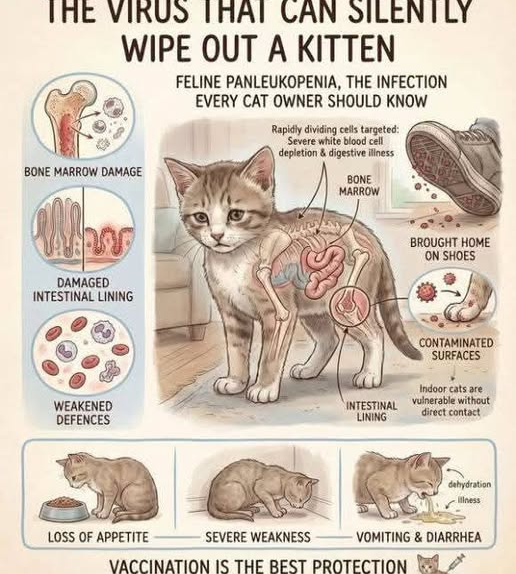
The name is the diagnosis. Pan-leuko-penia means, roughly, “all the white cells are gone,” and that is the virus’s whole strategy. It hunts the fastest-dividing cells in the body, and in a cat those live in two places that cannot afford visitors: the bone marrow, where white blood cells are made, and the lining of the intestines. It wrecks both at the same time. The gut lining fails, so food and water go straight through in vomiting and diarrhea. The marrow fails, so the immune system runs out of soldiers in the middle of the war. A kitten’s body is nothing but fast-dividing cells and big plans, which is why kittens take the worst of it.
In a pregnant cat it can reach the unborn kittens and damage the cerebellum, the part of the brain that handles balance. Those kittens are born wobbly — cerebellar hypoplasia — and stay wobbly for life. They are otherwise healthy, happy cats who walk like sailors on shore leave, but it is a lifelong receipt for an infection that happened before they were born.
HOW IT GETS INTO YOUR HOUSE
Here is the part that should rearrange your thinking: your cat does not have to meet a sick cat to catch this. The virus leaves the body in feces, urine, and saliva, and it lands on the world — food bowls, litter boxes, bedding, hands, clothing, and shoes. Then it waits. This is one of the hardiest viruses known to veterinary medicine. It can survive a year or more in the environment, through heat and cold, and it shrugs off most household disinfectants like rain off a duck.
So the classic case is not a cat fight in an alley. It is a person who petted a stray at the gas station, or walked through a shelter, or stepped somewhere a sick cat had been, and then came home and picked up their indoor kitten. Indoor cats are not safe from this virus. They are only safe from meeting other cats. The virus does not need the other cat. It needs your shoe.
One thing does kill it: bleach. Ordinary cleaners will not reliably do the job. If this virus ever enters your house, the drill is to clean away every trace of organic matter first, then disinfect with a bleach solution and let it sit wet for ten to fifteen minutes before rinsing. It is not glamorous work. Neither is a fire extinguisher, and both belong in the same category of things you are grateful for exactly once.
THE SIGNS YOU MUST NOT WAIT ON
From exposure to illness usually takes two to seven days. Then the picture comes on fast: fever, a cat who goes quiet and dull, food refused, vomiting, diarrhea, and dehydration that you can see in sunken eyes and dry gums. A sick kitten may sit hunched in front of the water bowl for long stretches, wanting to drink and not managing it. In the youngest kittens — under five months is where the deaths concentrate — the disease can skip the warning signs entirely and present as a kitten who was fine at breakfast and gone by supper.
Without medical care, up to ninety percent of cats who come down with this disease may die, and the ones who die, die of dehydration and the infections that walk through the door the virus opened. That is the bad arithmetic. The good arithmetic is that speed changes it. A kitten who gets to a veterinarian at the first dull day has a fighting chance. A kitten who gets there on the third day is in a much harder fight. With this one disease, “let’s see how he is tomorrow” is the most expensive sentence in cat ownership.
THERE IS NO CURE — THERE IS A FIGHT
No drug kills this virus. What the veterinarian does is keep the cat alive while the cat’s own immune system finishes the war: intravenous fluids to reverse the dehydration, medicine against the nausea, antibiotics — not for the virus, which ignores them, but for the bacterial infections that rush in when the white cells are gone — warmth, nutrition, and isolation from every other cat in the building. The illness usually runs five to seven days. It is intensive, it is not cheap, and it saves cats who would otherwise certainly be lost. Recovered cats can shed the virus in their feces for up to six weeks afterward, so a survivor still gets the quarantine treatment at home for a while. He earned his rest. Give him the room.
THE SHOT THAT MAKES THIS A NON-EVENT
And now the chapter’s whole point, which fits in one sentence: this catastrophe is preventable with one of the cheapest, safest, most proven vaccines in all of medicine. Panleukopenia is covered by the FVRCP shot, the core combination vaccine every cat is supposed to get. Kittens start at six to eight weeks old and get boosters every three to four weeks until they are past sixteen weeks or so, because a mother’s antibodies protect them early and interfere with the vaccine on a schedule nobody can see from outside. Then a booster at one year, and for the injectable vaccine, every three years after that.
Notice the gap in that schedule, because the gap is where this disease lives. A kitten who got one shot at seven weeks and never went back is not a vaccinated kitten — he is a kitten whose protection clock ran out. The series is the vaccine. Finish the series. And until it is finished, keep the kitten away from unknown cats, strange floors, and the friendly stray on the porch, however loud he sings. New cats coming into a house with kittens get quarantined first and vaccinated on the way in. That is not cold-heartedness. That is the whole lesson of this chapter wearing a false moustache.
I am not a veterinarian, and this chapter is a map, not a driver. If a kitten in your care goes dull, stops eating, and starts vomiting, the map says one thing: go now, and let the vet do the driving.
The cheapest miracle in cat medicine costs less than the pizza you ordered while reading this. It comes in a syringe, it takes ten seconds, and it turns the deadliest kitten disease on earth into a story somebody else’s grandfather tells.
— YNOT!
Sources: Cornell Feline Health Center, “Feline Panleukopenia Virus”; Merck Veterinary Manual, “Feline Panleukopenia”; American Veterinary Medical Association, feline panleukopenia brochure.