Think of it as Yoga for the brain, we are going to stretch a bit.
Radio On, No Sound — The Amplifier
The radio lights up, the stations change, the display does everything a healthy radio does — and the speakers produce absolutely nothing. No music, no hiss, no pop, no crackle. On a Crossfire with the Infinity system, that exact silence is a diagnosis half-finished before you touch a tool: the head unit is alive, and everything it plays is supposed to pass through one box before it reaches a speaker. When the box is silent, the car is silent. The box is the amplifier.
Where the Amplifier Actually Lives
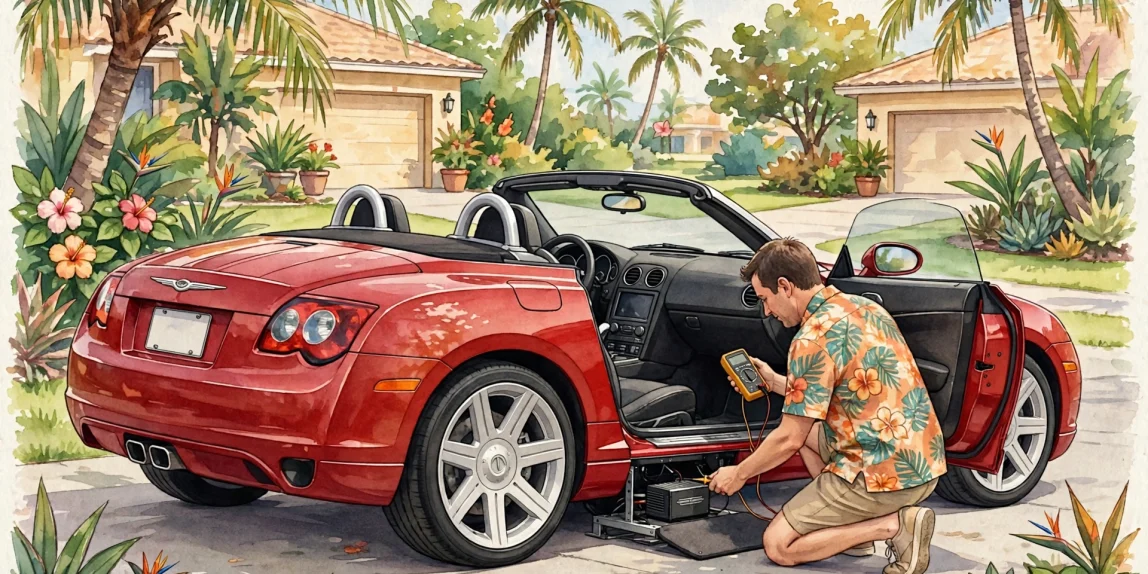
Start by unlearning a wrong answer that circulates with great confidence: the amplifier is not in the trunk. The factory removal procedure puts it in the passenger footwell — un-tuck the carpeting in the passenger footwell, the manual begins — mounted low and forward on a bracket, in the same footwell real estate the Transmission Control Module occupies behind its base plate. Coupe and convertible alike, per the procedure. It is a damp neighborhood by automotive standards: the lowest point of the cabin’s front corner, downstream of every windshield, cowl, and top-seal leak the car will ever have, which is why these amplifiers die the way they do — quietly, of moisture and corrosion, while the radio above them carries on looking innocent.
The Fuse the Manual Names — and the One It Doesn’t
Advice about this system usually sends owners to a dash fuse said to feed radio and amplifier together. The factory diagnostic for the power amplifier names a different one, and the factory wins: the amplifier’s diagnostic test begins, before any connector is touched, with a note to inspect Fuse 23 in the Underhood Accessory Fuse Block — if that fuse is open, repair the cause before continuing. The amplifier is fed by a fused ignition switch output circuit, which also corrects a second piece of folklore: its power is ignition-switched, so testing for voltage at the amp with the key off and finding none proves nothing. Key on, then measure.
And there is no factory inline fuse hiding in the amplifier’s harness. Owners go hunting for one — a fuse holder spliced into the red wire a few inches from the connector — because other cars have them. The Crossfire’s amp circuits run direct from the fuse block through the harness. If the harness in the footwell is uncut factory weave, stop looking for a fuse that was never installed, and spend the time on the tests that decide the question.
The Factory’s Test, in the Factory’s Order
The manual’s diagnostic for a dead amplifier is admirably short, and it ends where most of these stories end. Disconnect the amplifier’s harness connectors in the footwell. First, measure voltage on the fused ignition switch output circuit — the manual checks it at two cavities of the smaller connector. Voltage present with the ignition on means the amp is being fed. Second, measure the ground circuits — checked at two cavities of the larger connector — for resistance to ground; the amplifier grounds through its bracket area, and a corroded or loose ground is the one cheap fault that imitates a dead amp perfectly. Third: power present, grounds good, and still no sound — the manual’s instruction is to replace the power amplifier. That is the whole tree. It does not wander, and neither should you.
The symptom logic that gets you to the footwell in the first place deserves one paragraph, because it rules things out for free. Total silence — not weak sound, not one dead speaker, not crackle — means the failure is common to every channel, and the only component common to every channel is the amplifier and its power, ground, and wake-up. A radio that lights and tunes has already testified that its own display and tuner circuits live. One dead speaker is a speaker. All dead speakers is an amplifier event until the meter says otherwise.
Before You Buy the Amplifier
Run the cheap checks in order. Fuse 23 under the hood, pulled and eyeballed, not just glanced at in place. The footwell itself: pull the carpet back and look at the amp and its connectors with your eyes before the meter — green corrosion, water tracks, and a damp carpet are confessions. The ground: unbolt, clean to bright metal, re-tighten. The connectors: the manual’s own note says check them, clean and repair as necessary, and in a footwell that has been wet, connector pins are a chapter of their own. Only when power, ground, and connectors have all passed does the amplifier itself take the blame — and on a convertible that has ever leaked into that footwell, it usually earns it.
The Bottom Line
Radio on, no sound at all: think amplifier, think footwell, think water. The amp lives under the passenger carpet, not in the trunk; its fuse is Fuse 23 in the underhood accessory block, not a dash fuse; its power arrives with the ignition, not around the clock; and no inline fuse exists to be found. Feed it, ground it, and if it still will not sing, the factory’s verdict is the owner’s verdict: replace the amplifier — and fix the leak that killed it, or you will be buying the next one on the same schedule.