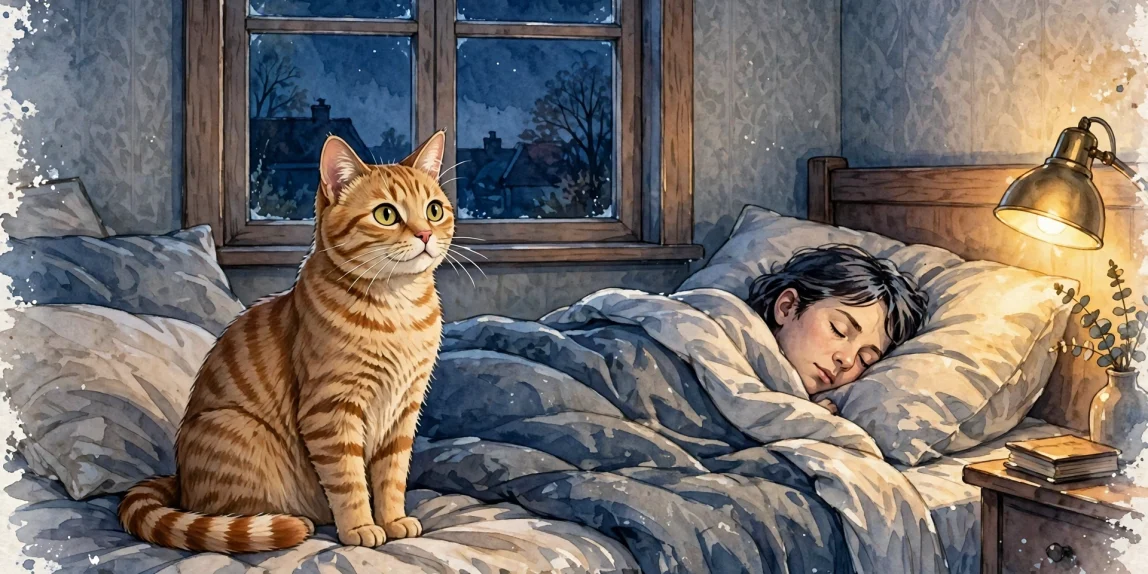
Think of it as Yoga for the brain, we are going to stretch a bit.
Your Cat Runs on Cat Time — The Strange Schedule, Explained
You do not own a cat with a broken clock. You own a clock that was never set to your time in the first place — and as far as the cat is concerned, yours is the strange schedule. -- YNOT!
There is a poster going around the internet that accuses the cat of keeping outrageous hours: asleep all day while you work, awake the moment you go to bed, and demanding an audience at 3 AM, full of energy precisely when the whole house is exhausted. It is funny because every cat owner recognizes it. It is also, in the way of posters, about three-quarters true — and the quarter it gets wrong is the interesting part. Your cat is not nocturnal, is not lazy, and is not running a conspiracy against your sleep. Your cat is running on cat time, an older timetable than yours, and once you can read it, you can negotiate with it. Where the cat sleeps is another chapter’s argument. This one is about when.
CREPUSCULAR: A FANCY WORD FOR TWILIGHT
The correct label is crepuscular — from the Latin for twilight — and it means the cat’s rush hours are dawn and dusk. Not the middle of the night: true night-shift animals, the owls and raccoons, work the full dark. Not the middle of the day either, which is your shift. The cat works the two edges, and the reason is dinner. Dawn and dusk are when the prey is moving — birds starting up, rodents heading out and coming home — and the cat’s eyes are built for exactly that light: a reflective layer behind the retina, the same one that glows back at you in photographs, squeezes a second use out of every scrap of dim light. A cat cannot see in total darkness; nobody can. But in twilight, the cat can see and the mouse mostly cannot, and that margin is the whole business model.
So the wild schedule is not strange. It is a hunter’s timetable, set by the hours when hunting paid, and your housecat inherited it the way it inherited the whiskers.
THE FINE PRINT: THE CLOCK BENDS
Now the quarter the poster gets wrong. When researchers put activity monitors on cats, the tidy twilight rhythm held up best in cats with real outdoor lives. Indoor cats bent — measurably — toward their owners. House cats tend to be busiest around the times their people get up and come home, and feeding times are among the strongest cues of all: serve breakfast at six for a month and you have built a cat who believes, in his bones, that five-thirty is dawn. Artificial light blurs the edges further. The cat is not a slave to the twilight wiring; it is a negotiator with twilight tendencies.
Which means the 3 AM board meeting is partly real and partly rounding. The genuine peaks are dusk — which runs long into your evening, so the cat seems to wake up exactly when you lie down — and dawn, which in cat time starts around four or five in the morning. A sleeping human, woken at four-thirty by a paw and an announcement, rounds it to 3 AM and files it under malice. The deep middle of the night is actually one of the cat’s quieter stretches: a patrol, a snack, a thoughtful stare at nothing. The poster exaggerates for comedy. This book merely exaggerates for emphasis, which is entirely different.
SIXTEEN HOURS OF SLEEP, MOSTLY WITH ONE EAR OPEN
Then there is the sheer tonnage of sleep. An adult cat sleeps somewhere between twelve and sixteen hours a day; kittens and old cats can push toward twenty. It does not arrive in one block, the way yours does. Cats are installment sleepers — dozens of naps strung across the day, which is why the word catnap is ours now — and roughly three-quarters of it is light dozing, muscles half-ready, ears swiveling to sounds, a sentry resting rather than a building closed. Only about a quarter is the deep sleep, in short stretches, the twitching-paw dreaming kind. That ratio is why the cat who appeared to be dead asleep on the couch heard the can opener from two rooms away. Most of the sleep was surveillance.
So the daytime cat, asleep while you work, is not lazy and is not depressed. The hunting shifts are at the edges of the day; midday is simply off-duty, and a professional rests between shifts. What deserves your attention — the same rule this book applies to the water bowl — is not the amount. It is a change in the pattern.
THE EVENING TREATY: HUNT, CATCH, EAT, GROOM, SLEEP
Here is the useful part, because cat time can be negotiated, and the treaty terms are written into the cat itself. Left alone, a cat’s activity runs in a fixed little loop: hunt, catch, eat, groom, sleep. You cannot delete the loop, but you can schedule it. An hour or so before your own bedtime, run a proper play session — ten or fifteen minutes with a wand toy, made to dart and hide and freeze the way prey does, and let the cat actually catch it at the end, because a hunt that never lands just winds the spring tighter. Then, immediately, serve the last and largest meal of the day.
What follows is not training. It is sequence. A cat that has hunted and eaten grooms — you can watch the wash start — and a cat that has groomed sleeps, deeply and at length, right through the hours you were hoping to sleep through yourself. You have not fought the dusk rush hour. You have loaded its cargo into the evening and let it arrive at your bedtime instead of the cat’s. Owners who keep the routine for a week or two of evenings report the 3 AM summit quietly adjourning. Keep the routine consistent — the cat calibrates to routine the way it calibrates to breakfast.
THE RULES OF THE 3 AM SUMMIT
Two supporting clauses. First, the dawn problem, which is usually hunger wearing a clock costume: a cat whose last meal was at six in the evening is genuinely empty by five in the morning, at exactly the hour its wiring says get up. The late meal after play helps. The masterstroke is an automatic feeder set to deliver a small breakfast just before the usual wake-up time. The machine cannot be negotiated with, cannot be guilted, and cannot be woken by a paw — and once breakfast comes from the machine, waking you stops being the mechanism that produces food.
Second, the hardest rule in the house: at 3 AM, pay nothing. Any response is a wage. Getting up to feed is a wage, petting is a wage, and scolding — this is the part nobody believes — is also a wage, because to a bored cat at 3 AM, an annoyed human is still entertainment that arrived on request. Be a statue. Be furniture. Expect a few worse nights before the better ones, because a behavior that used to work gets tried harder before it gets retired. And give the cat a day worth sleeping off: a cat left alone in a silent house will sleep sixteen hours straight and present you with the entire energy budget at dusk. Play sessions, a window worth watching, a puzzle feeder — daytime business is what makes nighttime peace affordable.
WHEN AN OLD CAT’S NIGHTS CHANGE, IT ISN’T THE CLOCK
The book’s usual turn, and it matters here: a young cat’s strange schedule is comedy, but a sudden change in an older cat’s nights is information. Cornell’s Feline Health Center flags new nighttime restlessness and yowling in senior cats as a symptom to work up, not a habit to fix — because the causes are medical and several are treatable. An overactive thyroid revs the whole cat, appetite, voice, and sleep alike. High blood pressure can drive restlessness. Pain — arthritic joints ache worst lying still — can keep a cat up and moving. And cats get a version of dementia, cognitive dysfunction, whose calling cards include a scrambled sleep-wake cycle and loud calling in the night, most often in cats past ten.
So the rule is the book’s rule, one more time: know your cat’s normal, and treat a change from it as a message. A healthy cat lobbying at dawn is a negotiation. An old cat who has newly taken to wandering and crying at 2 AM is not being difficult — he is filing a report, in the only department open at that hour. Take it to the veterinarian, thyroid and blood pressure first, and let the schedule go back to being funny.
The cat will never keep your hours, and you will never quite keep the cat’s. The treaty is in the middle: a hunt before bed, a feeder that fills itself at dawn, and two species sleeping through most of the same night — each dreaming the other one finally understands. — YNOT!