Think of it as Yoga for the brain, we are going to stretch a bit.
The Water Bowl Is a Health Report — How Much Should a Cat Actually Drink?
A dog drinks because it is thirsty. A cat drinks because it has decided to — and when the decision changes, the cat is telling you something. -- YNOT!
The water bowl is the least-read document in the average cat house. You fill it, you wash it, you step over it in the dark, and that is the whole relationship. That is a waste, because the bowl keeps a daily record of the cat’s health, written in water level, and it publishes whether you read it or not. This chapter — the full treatment of a subject “How to Be a Good Cat Parent” could only wave at on its way past — is about learning to read it: how much a cat needs, why the bowl can sit nearly untouched and still be fine, and why a bowl that empties too fast is some of the earliest news a sick cat ever sends.
THE DESERT CAT AT THE WATER BOWL
Start, as always, with the design. The domestic cat descends from the African wildcat, a desert hunter, and the desert wrote the plumbing. A wildcat’s prey — mouse, bird, lizard — is roughly seventy percent water, and a successful hunt delivered the day’s drinking already inside the dinner. Standing water was scarce and frequently foul, so evolution never bothered installing a strong thirst. The modern housecat has inherited the arrangement entire: efficient kidneys that concentrate urine like a miser concentrates money, and a thirst drive so quiet that a cat can be mildly short of water and feel no urge to fix it.
A cat is not a small dog with a drinking problem. It is a desert animal living in a house, expecting its water to arrive inside its food — and then we hand it dry food and act surprised at the arithmetic.
THE NUMBERS, SUCH AS THEY ARE
Here is the guideline, and it comes with its most important word attached: total. A cat needs three and a half to four and a half ounces of water a day for every five pounds of cat — Cornell’s Feline Health Center rounds it to about four ounces per five pounds — counting every source — the bowl, yes, but also the moisture in the food. Run the table and it stays simple: a five-pound cat needs about three and a half to four and a half ounces a day; a ten-pound cat, seven to nine — call it a cup; a fifteen-pounder, ten and a half to thirteen and a half; a twenty-pound cat, fourteen to eighteen.
Two honest footnotes. First, the figure follows the lean cat underneath — the weight the veterinarian thinks the cat ought to be. Fat does not drink, and a cat carrying extra upholstery does not need water for the upholstery. Second, these are weather reports, not train schedules: heat, activity, age, and health all move the number. What the numbers are really for is not measuring. It is giving you a sense of scale, so that “seems like a lot lately” can become “that is, in fact, a lot.”
WHY THE WET-FOOD CAT BARELY VISITS THE BOWL
Now the arithmetic that confuses owners most. Wet food is seventy to eighty percent water — dinner carrying its own drink, packaged the way the desert intended. Dry food runs about ten percent. So a cat eating mostly wet food may barely touch the bowl, and that is not a symptom; it is a cat that has already had its water. The bowl level barely moves because the can did the bowl’s job at breakfast.
The dry-food cat has the opposite assignment: nearly the whole day’s water has to come from drinking, out of a bowl, on the initiative of an animal whose ancestors declined to develop that initiative. Such cats do drink more than wet-fed cats — but studies find they do not drink enough more to fully close the gap, and their urine runs more concentrated for it, which is one reason veterinarians push wet food for cats with urinary histories. None of this makes kibble a crime. It makes the wet-food cat’s untouched bowl normal, and the dry-food cat’s water supply your department.
THE LESTER RULE: MORE BOWLS THAN CATS
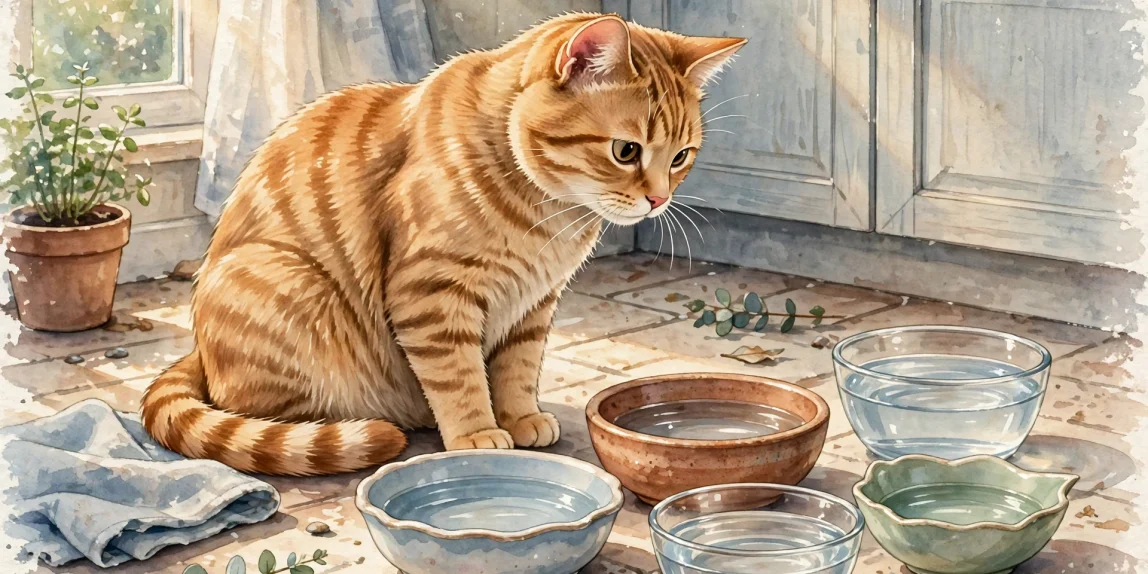
Which brings us to this book’s house rule, from the author’s own floor plan rather than any chart: keep more water bowls than you have cats. One cat, two bowls. Three cats, four or five. It sounds like a joke about a man outnumbered by crockery, and it is, but it is a working joke. Cats have preferences about water the way they have preferences about chairs — the kitchen bowl is acceptable, the hallway bowl is correct, the bowl by the window is an insult — and a cat that dislikes the only bowl on offer does not complain. It just drinks less, quietly. Bowls in several places, and the cat chooses; the choosing is the point. Preference is data, and more bowls collect more of it.
The supporting cast of the rule is standard practice. Put the stations around the home, on the cat’s routes, and set them away from the food and well away from the litter box — a cat’s instincts file drinking water, dinner, and toilet as three separate addresses, and so should you. Fill fresh daily and wash the bowls; a slimy bowl is a review the cat acts on by abstaining. Some cats seem to dislike deep, narrow bowls that crowd the whiskers, and while the evidence for full-blown whisker fatigue is thinner than the internet admits, the preference itself is real and a wide, shallow bowl costs nothing to offer. And some cats want the water moving — the fountain drinkers and the tap loyalists, waiting by the sink like customers at a bar. To desert wiring, running water reads as fresh water, and a fountain is a reasonable bribe. The Lester Rule just makes sure there is always something on the ballot.
WHEN THE BOWL STARTS TALKING
Here is where the bowl becomes a health report. The healthy pattern is a boring one: steady drinking, steady litter box, a cat active and itself. Boring is the goal. What you are watching for is change — and the change that matters most arrives as more. A cat that suddenly drinks noticeably more than it used to, and urinates more to match, is a cat whose body is spending water it used to keep, and the usual spenders are three of the great senior diseases: kidneys that can no longer concentrate urine and let the water run through; a thyroid running hot, burning fuel and water alike; and diabetes, where sugar in the urine drags water out with it. Veterinarians keep a rough line for it — drinking beyond about a hundred milliliters per kilo of cat a day counts as too much — but you will not need the math. You will see the bowl emptying faster and the litter clumps getting bigger, and that is the report.
The rest of the watch list travels with it: weight sliding off while the appetite stays or even grows, vomiting, a cat going quiet and lethargic. Any of those beside a rising water bill is a vet appointment, not a wait-and-see — and here is the mercy in it: kidney disease, thyroid trouble, and diabetes are the diseases where early is a different illness from late. The bowl often knows weeks before the cat looks sick, because the cat’s religion is not looking sick. A daily glance is the entire monitoring system: normal is steady; watch is a slight change, noted and checked again tomorrow; alert is a large or sudden one. It costs one second, at the speed of filling a kettle.
THE OTHER DIRECTION — AND THE ONE TRUE EMERGENCY
Changes run downhill too. A cat drinking notably less, or stopping, deserves the same attention. The home checks for a dry cat: gums that feel tacky or dry instead of slick when you lift the lip; skin between the shoulder blades that, gently lifted, settles back a beat slow instead of snapping home — with the caveat that an older cat’s skin loses its snap with age and can lie to you; eyes that look sunken; a cat gone lethargic and off its food. Kittens and seniors dehydrate fastest and forgive it least. A cat showing those signs, or one that has simply stopped drinking alongside feeling unwell, is a phone call the same day.
And one item in this chapter gets no comedy at all, because it has no time for any. A cat — above all a male cat — that keeps going to the litter box, straining, and producing little or nothing is not constipated and is not being dramatic. That is a urinary blockage until a veterinarian says otherwise: the pipe is shut, the bladder is filling, and it can kill within a day or two. It is the one emergency in this book where “first thing in the morning” is the wrong answer. The answer is now, tonight, on the way to the emergency clinic while somebody else drives. The water chapter ends on it: the bowl reports what goes in, the box reports what comes out, and a good cat parent reads both.
You cannot make a cat drink. You can only put good water everywhere the cat already goes, and pay attention when the pattern changes. Do those two things, and the plainest object in your house becomes the earliest warning system you own. — YNOT!