“Freedom doesn’t usually arrive with fireworks or speeches. It shows up quietly—when the oil stops flowing, the lies stop working, and starvation finally reminds them the future is worth more than the fear.” --YNOT!
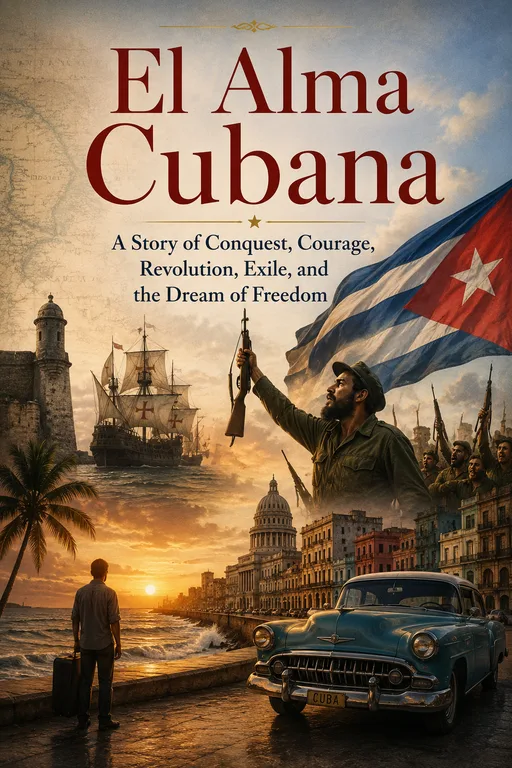
El Alma Cubana
A Story of Conquest, Courage, Revolution, Exile, and the Dream of Freedom
Table of Contents
- Title Page
- Why Trump Is Working With Delcy Rodríguez — And Why Venezuela Is Much More Complicated Than It Looks
- Dedication
- Foreword
- Preface
- Introduction
- Cubanacán - Cuba Before 1800
- Cuba’s Long Road to Freedom
- Mambises: Original Freedom Fighters
- The Platt Amendment: Cuba’s Independence Came With Fine Print
- La Guerra de 1912 -- The Forgotten War
- Cuba’s Revolving Door of Presidents
- The Long Road- Spainish Chains to Batista
- 1959 - Cuba Before Castro
- Havana Vice A playground for the rich
- The Man Batista Spared and Miami sent Back to Cuba
- July 26: The Day Cuba’s Destruction Began
- Che Guevara: Revolutionary Soldier, Executioner, Architect of Violence and Death
- Los Hijos del Cielo Operation Pedro Pan and the Children Who Flew Alone
- The Forgotten Nuclear History of South Florida
- The Manacas–Iznaga Massacre -- July 13th, 1963
- Twenty Years of the Secret CIA War for Cuba 1959–1980
- The Tugboat Massacre: 13 de Marzo -- July 13, 1994
- How to turn a Nation Into a Mortuary
- When a country is held hostage by itself
- Lee Harvey Oswald - Cuban Spy?
- CUBA Exports the Revolution
- Defending the Revolution
- Miami, in the Center of It All - Drugs, Spies, Exiles, Covert Wars
- I Survived Cuban Socialism
- A Conversation Reagan, Martí, and Fidel
- Che Guevara - a Hero of the Poor
- Why Che and Cuba Still Matter to America 60 Years Later
- Cuba Is Falling, and the Left Can Feel the Floor Moving
- What Happens When a Small Island Picks a Fight With a Superpower?
- Communism Is a Great Idea — For a different Species
- How Tourism Works in Cuba
- Will 2026 Be the Year Cuba Finally Becomes Free?
- Nicolás Maduro — how the bus driver got the keys
- Ninety Miles Away, and Falling Apart - Borrowed Oil, Borrowed Time:
- Why Communism Never Works
- How did the most beautiful island on Earth become a case study in economic self-destruction?
- Can Russia’s or China’s Allies trust Them
- A postcard in time or a warning label we keep ignoring?
- Is Cuba on Its Final Heart Attack Again?
- The Morning After -- Where We Are Now, Where We Are Going
- How Socialism Really Works in Cuba - GAESA
- Has the Time Come to Take Military Action in Cuba
- Cuban Economics 101: The Store Is Empty Because the System Is Full
- Cuba’s Economic Reality: Beyond the Myth of the “Blockade”
- Where Does it Go From Here—Collapse, Compromise, or Another Long Night?
- The Castro Family Fortune: Myth, Estimate, or Reality
- The G2: The Hidden Machine That Keeps Cuba in Chains
- Cuban Overseas Intelligence - the Who, How, and What
- The Cuban Regime Cannot Be Reformed - The present Cuban regime has to end.
- The Day After Díaz-Canel
- The Really Big Problem with Cuba
- Cuba After Raúl? “El Cangrejo,” the Castro Family, and the Quiet Battle Over Who Controls the Island Next
- CUBA LINKS PAGE
Title Page
Add the formal title page text here.
Why Trump Is Working With Delcy Rodríguez — And Why Venezuela Is Much More Complicated Than It Looks
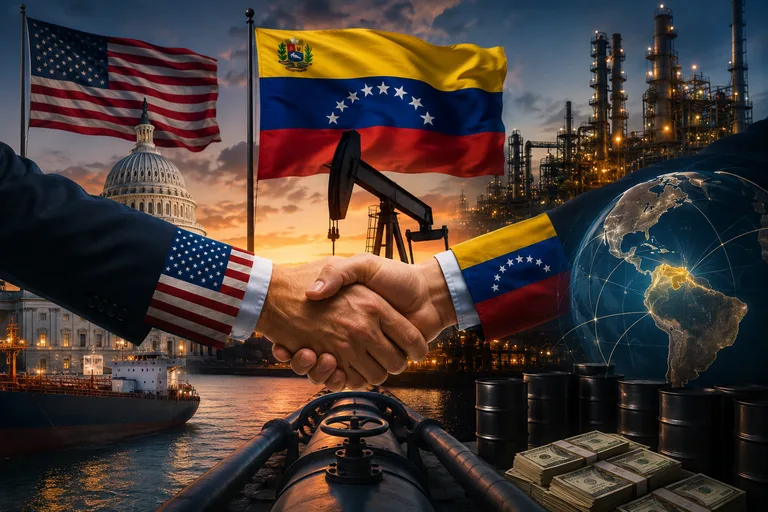
Fixing Venezuela is like performing a heart transplant on someone while they’re riding a bicycle. Yes, it can be done. But nobody should pretend it’s simple. -- YNOT!
There is a tendency to look at what is happening in Venezuela and reduce it to one sentence: Trump wants the oil. That is certainly part of the story.
But it is nowhere near the whole story.
What is happening in Venezuela involves oil, international law, billions of dollars in old debts, the survival of the Venezuelan state, China, Russia, Iran, Cuba, and one very difficult question:
Who can actually run Venezuela while the country transitions away from Maduro?
That is why Donald Trump is dealing with Delcy Rodríguez rather than simply installing Juan Guaidó, María Corina Machado, or another opposition leader in Caracas.
It may look strange from the outside.
From a practical standpoint, however, there is a logic to it.
Venezuela Has a $200-Billion-Plus Problem
Before talking about politics, you have to understand the financial problem.
Venezuela has an enormous number of creditors.
Estimates of its total debt and creditor claims run as high as roughly $240 billion, including sovereign bonds, PDVSA debt, arbitration awards and court judgments.
Companies including ConocoPhillips and Crystallex have spent years trying to collect money Venezuela owes them.
CITGO is probably the most famous example.
That creates an enormous problem if you are trying to restart Venezuela.
Imagine that American and international companies spend tens of billions of dollars rebuilding Venezuelan oil production.
Production increases.
Venezuela begins selling billions of dollars of oil.
Then the money enters the international banking system and creditors immediately begin trying to seize it.
In simplified form: Venezuela sells oil > Money enters international banks > Creditors find the money > Courts are asked to attach it
Suddenly yesterdays creditors could get first crack at tomorrow’s oil revenue.
That makes rebuilding Venezuela extraordinarily difficult.
Why would someone invest $50 billion or $100 billion rebuilding an oil industry if the resulting revenue could immediately disappear into decades-old judgments?
Trump’s Financial Firewall
This is where one of the most important parts of Trump’s Venezuela policy comes in.
On January 9, 2026, Trump signed Executive Order 14373, “Safeguarding Venezuelan Oil Revenue.”
The structure protects certain Venezuelan natural-resource revenues placed into designated U.S. Treasury accounts from ordinary attachment, judgments, liens, execution and garnishment unless the United States authorizes it.
In other words, Trump did not erase Venezuela’s debts.
He effectively said: You may have a legitimate judgment against Venezuela, but you cannot automatically grab this particular pool of new Venezuelan oil revenue.
That is an important distinction.
The money is structured as Venezuelan sovereign government property being held by the United States for governmental and diplomatic purposes rather than simply sitting in an ordinary commercial bank account.
That creates a much stronger sovereign-immunity argument.
So instead of: Oil → Venezuelan bank account → creditor attachment
you have something closer to: Oil> U.S.-approved sale > Protected Treasury mechanism > U.S. oversight > Funds released for authorized purposes
Trump has therefore gained influence not only over the oil.
He has influence over the financial plumbing through which the oil money travels.
That may ultimately be more important.
Why Delcy Rodríguez?
This brings us to the political question.
Why work with Delcy Rodríguez?
Why not Juan Guaidó?
The answer is remarkably simple: Delcy controls things.
Juan Guaidó once had considerable international recognition.
In 2019, the United States recognized him as Venezuela’s interim president. That recognition gave his representatives standing in foreign courts and influence over Venezuelan assets located overseas.
But Guaidó always suffered from one enormous problem.
He had international recognition without effective control of Venezuela. He could sign a piece of paper.
That did not necessarily mean PDVSA would obey him.
It did not mean the Venezuelan military would obey him.
It did not mean the ministries would obey him.
It did not mean the police, customs service, electrical utilities, central bank or thousands of government employees would follow his orders.
By 2022, Venezuela’s opposition itself voted to abolish the Guaidó interim-government structure.
Guaidó eventually left Venezuela. The political landscape moved on.
Delcy Has Something Guaidó Never Had
Whatever anyone thinks of Delcy Rodríguez politically, she comes from inside the Venezuelan state.
She understands its machinery. And more importantly, much of that machinery recognizes her authority. That matters enormously.
Venezuela still needs somebody who can tell the Energy Ministry what to do.
The Energy Ministry needs to be able to tell PDVSA what to do.
PDVSA needs somebody legally empowered to negotiate production agreements, joint ventures, contracts and oil sales.
The military needs a functioning chain of command. Government employees need to get paid. Electricity needs to remain on. Police need orders. Ports must operate. Food must move. Oil must move. AS we say, “The Spice must flow”
A country of nearly 30 million people cannot simply be switched off while you build another government.
Remember Iraq
The United States has already learned what can happen when you remove a regime and simultaneously destroy the state underneath it.
Iraq should be permanently burned into American foreign-policy memory.
Remove the leadership. Dismantle the institutions. Disband the security apparatus.
Suddenly nobody knows who is in charge.
That vacuum can become more dangerous than the government you just removed.
Venezuela has armed groups, colectivos, criminal organizations, political factions and competing interests.
Imagine simultaneously removing thousands of officials throughout the Venezuelan government and announcing that a completely new opposition government — backed by Washington — is taking over tomorrow morning.
Chaos could follow. And politically, the new government would immediately be attacked as an American puppet government.
Trump appears to have chosen a different strategy.
Remove the Head — Don’t Destroy the Body
The strategy can be understood roughly like this:
Maduro> Remove the person at the top
Delcy Rodríguez >Keep ministries, military and PDVSA functioning
United States >Use sanctions relief, oil access and financial controls as leverage
Oil industry ↓ Restart production and attract investment
Economy ↓ Stabilize currency, employment and government finances
Political system ↓ Gradually negotiate reforms and rebuild electoral institutions
Eventually ↓ Hold credible elections
That is a very different strategy from invading a country, destroying its government and trying to rebuild everything from scratch.
Trump is essentially attempting to change the direction of the Venezuelan system without completely destroying the system.
A Negotiation With the Devil
Nobody should confuse this with an endorsement of Delcy Rodríguez.
She was an important figure in the Maduro government. She is part of Chavismo.
The United States is dealing with somebody who helped operate the very political system Washington spent years opposing.
Sometimes international politics works that way.
You negotiate with the person who controls the soldiers, the oil company, the ministries and the government — because that person can actually deliver what was negotiated.
It is, in a sense, a negotiation with the devil to prevent chaos and disaster.
The opposition may represent Venezuela’s democratic future.
Delcy represents the Venezuelan government’s functioning present.
Those are two different things.
The Gamble
And there is a major risk. The longer Delcy controls Venezuela — particularly if billions of dollars of American and international investment begin flowing into the country — the harder it becomes to argue that she is simply a temporary caretaker.
The opposition has legitimate reason to worry.
What happens if Washington succeeds in stabilizing Venezuela, restarting the oil industry and improving living conditions — but Delcy remains in power?
Instead of eliminating Chavismo, America could inadvertently create something very different:
a market-friendly, U.S.-aligned version of Chavismo. That may be more stable.
It may be less hostile toward the United States. It may allow private investment.
But it is not necessarily the democratic transition the Venezuelan opposition has spent decades fighting for. That is the gamble Trump is making.
Then There Is the Oil
Venezuela possesses one of the largest petroleum resource bases on Earth.
Rehabilitating those fields will require enormous investment. Oil wells need work.
Pipelines need repairs. Refineries need modernization.
Electric infrastructure needs rebuilding. Ports need upgrades.
Thousands of skilled workers will be needed.
And after years of economic deterioration, Venezuela itself will require enormous reconstruction.
Which leads to another misconception. Americans should not imagine that the United States simply walks into Venezuela and starts collecting free oil.
Before America gets enormous economic benefits from Venezuelan production, somebody is going to spend many billions of dollars repairing the infrastructure required to produce it.
In the real world, everything costs money.
And Venezuela Is Bigger Than Venezuela
Perhaps the most important part of this entire story is geopolitical.
Venezuela has been one of the principal footholds in the Western Hemisphere for governments hostile to the United States.
Cuba. China. Russia. Iran.
Each developed political, military, intelligence or economic relationships with Caracas.
So from Washington’s perspective, changing Venezuela’s alignment is not simply about Venezuelan oil.
It changes the strategic map of the Caribbean and Latin America.
A Venezuela economically connected to the United States is very different from a Venezuela dependent upon Russia, China and Iran.
And then there is Cuba.
Venezuela has been extraordinarily important to the Cuban government for decades.
If Venezuela permanently moves out of Havana’s orbit, Cuba becomes considerably more isolated.
Viewed that way, Venezuela may be only one piece of a much larger strategy.
Trump is attacking the geopolitical problem one pressure point at a time.
Venezuela Will Not Be Fixed Overnight
There is also something Americans should understand.
Venezuela did not collapse overnight. It will not recover overnight either.
Government institutions have deteriorated. Infrastructure has deteriorated.
The oil industry has deteriorated. Millions of Venezuelans left the country.
Businesses disappeared. Capital fled. Professional talent fled.
The political wounds run deep.
Rebuilding Venezuela may resemble rebuilding after a massive hurricane — except the hurricane lasted for decades.
It may take five years simply for Venezuela to begin looking normal again.
Possibly much longer.
But a functioning Venezuela five years from now — producing oil, attracting investment, rebuilding infrastructure and preparing for legitimate political competition — would be an extraordinary improvement over where the country has been.
So Why Delcy?
Because Venezuela today needs two things simultaneously.
It needs continuity and it needs change. That sounds contradictory. It isn’t.
Trump needs someone capable of operating the existing Venezuelan government while Washington pushes that government in a completely different direction.
Guaidó once had international legitimacy without domestic power.
The opposition may ultimately have democratic legitimacy.
But Delcy Rodríguez currently has something enormously valuable during a transition:
the ability to make the Venezuelan state actually do something.
That does not make her the democratic future of Venezuela.
It makes her the bridge Trump has chosen to try to get there.
Whether that bridge leads to a genuinely democratic Venezuela or merely a more prosperous and American-friendly version of Chavismo remains the billion-dollar question.
Probably the hundred-billion-dollar question.
Because Venezuela is complicated.
International politics is complicated.
Rebuilding destroyed countries is complicated.
And sometimes moving forward means working with people you would never have chosen in the first place.
For now, Venezuela is functioning.
Its oil industry is beginning to move again.
Money is beginning to move again.
Investment is beginning to become possible again.
The country has a long way to go.
But after years of watching Venezuela move steadily backward, simply seeing it move forward matters.
And if this works, the biggest consequence may ultimately not be Venezuelan oil at all.
It may be what happens next in Cuba, China, Russia and Iran’s influence in the Western Hemisphere.
Copyright
Copyright © [Year] [Author]. All rights reserved.
Dedication
Write your dedication here.
Foreword
Write your foreword here.
Preface
Write your preface here.
Introduction
Write your introduction here.
Cubanacán - Cuba Before 1800

Before Spain called it Cuba, the island’s Indigenous people knew it by names remembered as Cubao or Cubanacán, meaning “the central place” . And history has certainly made it one. In this new series, I explore Cuba’s forgotten real history — concise, direct, and to the point. --YNOT!
Before Cuba was a communist dictatorship, before it was a republic, before it was a Spanish colony, before it was a sugar empire, before it became a battlefield between empires, Cuba was already a living civilization.
That is the part many people forget.
Cuba did not begin with Castro. Cuba did not begin with Batista.
Cuba did not begin with Spain. Cuba did not even begin with Columbus.
Cuba began with its first people, with villages, rivers, forests, tobacco fields, fishing communities, spiritual beliefs, family structures, chiefs, stories, music, and land that had meaning long before a European king ever put his name on a map.
And then the outside world arrived.
When Europe discovered Cuba, it did what empires usually do. It looked at beauty and saw property. It looked at people and saw labor. It looked at a harbor and saw military advantage. It looked at fertile land and saw profit. It looked at an island full of life and began converting it into an asset.
By the year 1800, Cuba had already been transformed. The Indigenous world had been shattered. Spain controlled the island. Havana had become one of the most important military and shipping ports in the Spanish Empire. African slavery had become deeply embedded in Cuban life. Tobacco had become famous. Sugar was rising. The Catholic Church, the Spanish Crown, colonial officials, merchants, soldiers, smugglers, planters, enslaved Africans, surviving Indigenous descendants, and Cuban-born elites were all part of a society that was slowly becoming something separate from Spain.
This is the story of Cuba before 1800.
Not the modern political story.
Not the Castro story.
Not the Cold War story.
The beginning.
Cuba Before Columbus
Long before Christopher Columbus arrived in 1492, Cuba was inhabited by Indigenous peoples who had lived across the Caribbean for generations.
The main groups usually associated with early Cuba were the Guanahatabey, the Ciboney or Siboney, and the Taíno.
The Guanahatabey are often described as among the earliest inhabitants of western Cuba. They lived in smaller communities and are often associated with fishing, gathering, and coastal life.
The Ciboney were also part of Cuba’s pre-Columbian world, often connected to coastal settlements, fishing, and early agricultural life.
The Taíno were the most widespread and organized Indigenous people in Cuba by the time the Spanish arrived. They lived in villages, farmed the land, fished the rivers and coasts, made pottery, used canoes, and had religious and political systems. Their leaders were known as caciques.
The Taíno cultivated crops such as yuca, also called cassava, maize, sweet potatoes, peppers, and tobacco. Tobacco was not invented by Europeans. It was already part of Indigenous life before Spain turned it into an imperial product and later a global industry.
The Taíno also had spiritual beliefs tied to nature, ancestors, and sacred figures known as zemis. Their society was not primitive in the way colonial propaganda later suggested. It was organized, rooted, and adapted to the island.
Cuba before Spain was not empty land waiting to be discovered. It was already inhabited. It already had culture. It already had people who belonged to it.
That matters, because empires always begin their crimes by pretending the land was empty or the people did not count.
Columbus Arrives in 1492
Christopher Columbus reached Cuba on October 27, 1492, during his first voyage.
He believed he was near Asia. He did not understand that he had reached a world unknown to Europe. To Spain, however, the discovery quickly became a matter of empire.
Cuba was beautiful, large, fertile, and strategically located. Its position in the Caribbean made it valuable not only as land, but as a key point in the ocean routes between Europe, the Caribbean, Mexico, Central America, Florida, and South America.
At first, Cuba was not Spain’s greatest prize. Hispaniola, Mexico, and Peru attracted more attention because they had gold, silver, and larger imperial targets. But Cuba had something just as important in the long run: location.
Cuba sat at the doorway of the Spanish Caribbean. Whoever controlled Cuba had a base for ships, soldiers, trade, supplies, repairs, and military defense.
This would become one of the great facts of Cuban history. Cuba was never just an island. Cuba was a strategic position.
The Spanish Conquest Begins
The Spanish conquest of Cuba began in 1511 under Diego Velázquez de Cuéllar.
Spanish forces moved across the island, founding towns, claiming land, forcing labor, and imposing Spanish authority. The conquest was not peaceful. It was the destruction of one world by another.
The Spanish had major advantages: steel weapons, horses, armor, military organization, and diseases that Indigenous people had no immunity against.
One of the most famous Indigenous resistance figures was Hatuey, a Taíno chief from Hispaniola who fled to Cuba and warned the people about what the Spanish were doing. Hatuey understood that the Spanish came not merely to preach Christianity, but to dominate, enslave, and take.
He resisted Spanish conquest, was captured, and was burned alive in 1512.
Hatuey became one of the first great symbols of resistance in Cuban history.
His story matters because it shows that Cuban resistance did not begin in the 1800s. It did not begin with Martí. It did not begin with the independence wars. It began almost immediately, when the first people of the island understood that conquest was not friendship.
The Founding of Spanish Cuba
During the early 1500s, Spain founded several important settlements in Cuba.
Baracoa was founded in 1511 and became the first Spanish settlement on the island.
Bayamo followed in 1513.
Trinidad and Sancti Spíritus were founded in 1514.
Santiago de Cuba was founded in 1515 and became an early political and military center.
Havana was founded in 1519 and would eventually become the most important city in Cuba.
At first, Santiago was more important politically. But Havana had the harbor. And in empire, geography often beats politics.
Havana’s harbor was one of the great natural harbors of the Americas. It was protected, deep, and perfectly placed for ships traveling between Spain and the New World. Over time, Havana became the place where Spanish treasure fleets gathered before crossing the Atlantic.
That turned Havana into a military fortress, a commercial center, and one of the most valuable ports in the Spanish Empire.
The Collapse of the Indigenous Population
The Spanish conquest devastated Cuba’s Indigenous population.
This collapse happened through disease, forced labor, violence, hunger, displacement, and the destruction of Indigenous society.
European diseases such as smallpox killed large numbers of Native people. Forced labor systems broke communities apart. Spanish violence and exploitation destroyed the political and social structures that had held Indigenous life together.
The Spanish used the encomienda system, where colonists were granted control over Indigenous labor. In theory, they were supposed to protect and Christianize Indigenous people. In practice, it often became a system of forced labor and abuse.
Many Indigenous people died. Others fled into remote areas. Some mixed into the growing colonial population. Their independent societies were largely destroyed, but their blood, memory, words, foods, and traditions did not completely disappear.
That is important. The Indigenous people of Cuba were not simply erased from existence. They were crushed as organized societies, but parts of them survived inside Cuban identity.
You can still see traces in Cuban place names, food, tobacco culture, rural traditions, and ancestry.
Cuba Becomes a Spanish Military Base
For much of the 1500s and 1600s, Cuba’s greatest value to Spain was not sugar. It was military geography.
Cuba became a Spanish base in the Caribbean.
Havana became a gathering point for Spanish ships carrying treasure from Mexico, Peru, and other parts of the empire. These fleets would assemble in Havana before making the dangerous Atlantic crossing back to Spain.
That made Cuba a target.
French privateers, English raiders, Dutch traders, pirates, and rival European powers all understood Cuba’s value. If you could attack Havana, you could disrupt Spain’s empire. If you could capture ships near Cuba, you could steal the wealth of the Americas.
So Spain fortified Havana.
Forts, walls, soldiers, cannons, shipyards, and military infrastructure became part of Cuban life. Havana was not simply a city. It was an imperial military machine.
This shaped Cuban history deeply. From very early on, Cuba was controlled not only as a colony, but as a security asset. Spain did not treat Cuba like ordinary land. It treated Cuba like a fortress that had to be held.
That strategic importance would never go away. Centuries later, the United States, Russia, China, and others would still understand the same thing Spain understood in the 1500s:
Cuba’s location matters.
Pirates, Smuggling, and the Reality of Colonial Life
Spain tried to control trade tightly. Colonies were supposed to trade through approved Spanish channels. But in reality, the system was slow, expensive, and often impractical.
Cuban settlers needed goods. Spanish supply lines were unreliable. Foreign traders were nearby. So smuggling became part of life.
Cuba developed a pattern that would appear again and again in its history: official loyalty on paper, survival through unofficial systems in practice.
People obeyed Spain when they had to. But they traded illegally when they needed to. They dealt with foreigners, moved goods quietly, avoided restrictions, and built local networks outside the official imperial structure.
This was not just criminal behavior. It was the result of a colonial system that tried to control too much from too far away.
Pirates and privateers also shaped the island. Coastal communities lived with the threat of raids. Ships could be attacked. Ports had to be defended. Havana’s growth was tied directly to this dangerous world of empire, trade, war, and theft.
The Caribbean was not peaceful. It was a battlefield of money.
African Slavery Comes to Cuba
As the Indigenous population collapsed, Spain increasingly turned to enslaved African labor.
African slavery existed in Cuba from the 1500s, though the massive sugar plantation system had not yet reached its full size. That would come later, especially in the 1800s.
In early colonial Cuba, enslaved Africans worked in construction, ports, domestic service, ranching, farming, mining, shipyards, and urban labor. They helped build the cities, forts, roads, churches, homes, and economic base of the colony.
Over time, African people and African culture became central to Cuba.
This is one of the most important facts in Cuban history.
Cuba is not only Spanish. Cuba is not only Indigenous. Cuba is profoundly African.
African religions, music, rhythms, foodways, language patterns, resistance traditions, family practices, and cultural memory became part of Cuba’s soul.
But this contribution came through terrible suffering. Enslaved Africans were ripped from their homelands, sold as property, forced into labor, and denied freedom. Their descendants helped build Cuba while being treated as less than human by the legal and economic system.
This contradiction sits at the center of Cuban history: a beautiful culture born in part from unbearable cruelty.
Tobacco, Cattle, Timber, and Early Agriculture
Before Cuba became one of the great sugar islands of the world, its economy was more mixed.
Cattle ranching was important. The Spanish introduced cattle, and large ranches developed in different parts of the island. Cattle provided meat, hides, leather, and local wealth.
Tobacco became one of Cuba’s most famous products. Cuban tobacco developed a reputation for quality that would eventually become known around the world. The Spanish Crown tried to control tobacco through monopolies because it was valuable and taxable.
Timber was another important resource. Cuban forests provided wood for construction and shipbuilding. Havana became connected to naval power not just through its harbor, but through ship repair and maritime infrastructure.
Sugar existed early, but it was not yet the dominant force it would become in the 19th century. Before 1800, sugar was growing in importance, but Cuba had not yet become the massive sugar-and-slavery economy it later became.
Food crops also mattered. Cuba had to feed towns, plantations, soldiers, sailors, and ships. Agriculture was not just for export. It was also part of survival.
Still, by the late 1700s, the direction was clear. Sugar was rising. Slavery was expanding. Wealthy planters were beginning to see Cuba’s future in plantations.
That future would bring money. It would also bring chains.
Havana Becomes the Heart of Spanish Cuba
By the 1600s and 1700s, Havana had become the heart of Cuba.
It was the island’s great port, military center, commercial hub, and imperial gateway.
Ships arrived with officials, soldiers, enslaved Africans, goods, orders, and news. Ships left with tobacco, hides, sugar, timber, and imperial cargo. Havana connected Cuba to Spain, Mexico, Florida, the Caribbean, and the wider Atlantic world.
The city grew into a complicated place.
There were Spanish officials, Cuban-born elites, soldiers, priests, merchants, artisans, sailors, enslaved workers, free people of color, smugglers, builders, farmers, and traders.
Havana was wealthy compared to many other parts of the island, but it was also unequal. Power was concentrated in colonial officials, merchants, military authorities, and landowners.
Havana’s importance also widened the difference between the capital and the countryside. This would become another lasting Cuban pattern: the capital holding power, while rural Cuba lived under very different conditions.
The Catholic Church and Colonial Order
The Catholic Church was central to Spanish colonial Cuba.
The Church influenced education, marriage, moral life, public ceremonies, records, burial, charity, and social legitimacy. It helped Spain justify conquest through the language of conversion and Christian order.
But the Church was not only spiritual. It was also institutional and political. It held property. It worked with colonial authority. It helped organize society.
The forced conversion of Indigenous people was part of conquest. Later, enslaved Africans were also pushed into Catholic structures. But African spiritual traditions survived, often hidden, blended, or protected under Catholic symbols.
This produced one of Cuba’s most important cultural realities: religious fusion.
African belief systems and Catholic imagery interacted in ways that later became central to Afro-Cuban religion and identity.
So even inside a system designed for control, culture survived. People adapted. They hid what they needed to hide. They preserved what they could preserve. They created something new.
Race and Class in Colonial Cuba
By the 1700s, Cuba had developed a strict racial and social hierarchy.
At the top were peninsulares, Spaniards born in Spain. They often held the highest government, military, and church positions.
Below them were criollos, whites born in Cuba. Many criollos owned land, businesses, or plantations. Over time, they developed their own interests, which did not always match Spain’s interests.
There were also free people of color, some of whom worked as artisans, soldiers, laborers, small property owners, musicians, and tradesmen. Their position was complicated. They had more rights than enslaved people, but they still lived under racial restrictions and discrimination.
At the bottom were enslaved Africans and their descendants, who were legally treated as property and forced to labor.
There were also mixed-race communities and surviving Indigenous-descended people, especially in rural areas.
This system created tensions that would shape Cuba for centuries. Race, slavery, class, land, and political power were all tied together.
By 1800, Cuba was already a divided society. It had wealth, but not justice. It had culture, but not equality. It had order, but that order was built on force.
The British Capture of Havana in 1762
One of the most important events in Cuban history before 1800 was the British capture of Havana in 1762 during the Seven Years’ War.
Britain attacked Havana and captured the city. For Spain, it was a disaster and a humiliation. Havana was supposed to be one of the great fortified cities of the Spanish Empire. Its capture revealed serious weaknesses.
The British occupation lasted less than a year, but its impact was enormous.
During that short period, Havana was opened to wider trade. Cuban merchants and planters saw how much money could be made when trade restrictions were loosened. Goods moved more freely. Commerce expanded. The possibilities became obvious.
In 1763, Britain returned Havana to Spain in exchange for Florida.
But Cuba had changed.
The Spanish Crown learned that Havana needed stronger defenses. Cuban elites learned that freer trade could make them rich. And the island began moving more aggressively toward commercial expansion.
Sometimes history changes in a year. Havana under the British was one of those moments.
Spanish Reforms After Havana Was Returned
After Spain recovered Havana, it strengthened Cuba militarily and economically.
Spain improved fortifications, expanded defenses, reorganized parts of colonial administration, and allowed more economic flexibility. The goal was simple: Cuba had to be better defended and more profitable.
Trade reforms helped Cuba grow. More ships, more commerce, more investment, and more access to markets changed the island’s economy.
But there was a dark side.
As Cuba became more profitable, slavery expanded. As planters saw greater opportunity, they demanded more enslaved labor. As sugar became more attractive, human beings were pulled deeper into a system of plantation exploitation.
Spain wanted Cuba to be loyal, fortified, productive, and rich.
The price was paid by the enslaved.
The Haitian Revolution and Cuba’s Sugar Future
In 1791, the Haitian Revolution began in Saint-Domingue, the French colony that had been the greatest sugar producer in the world.
Saint-Domingue was incredibly wealthy, but its wealth was built on one of the most brutal slave systems in history. When enslaved people rose up, the plantation system was shaken to its core.
The Haitian Revolution terrified slaveholding societies across the Caribbean. It also created an economic opening.
As Saint-Domingue’s sugar production collapsed, Cuba’s planters saw opportunity. French refugees, capital, technical knowledge, and plantation experience moved into Cuba, especially eastern Cuba.
This helped accelerate Cuba’s sugar expansion.
By 1800, Cuba was standing at the edge of a major transformation. The island was about to become one of the world’s great sugar producers. That sugar boom would bring enormous wealth to some, but it would also dramatically expand African slavery.
This is one of the tragic turns in Cuban history. One island’s slave revolution helped open the door for another island’s slave plantation boom.
Cuba by 1800
By 1800, Cuba was still a Spanish colony, but it was no longer a minor possession.
It had become one of Spain’s most important Caribbean territories.
Havana was a major imperial port and fortress.
The island’s economy included tobacco, cattle, timber, food production, trade, and a growing sugar sector.
African slavery was deeply rooted and expanding.
The Indigenous world had been devastated, but Indigenous traces survived in Cuban culture and ancestry.
The Catholic Church shaped public life, but African and Indigenous spiritual traditions survived beneath and beside it.
Cuban-born elites were growing in wealth and identity.
Spain still ruled, but Cuba was slowly becoming Cuban.
That is important.
A colony can belong to an empire on paper while slowly developing a soul of its own. By 1800, Cuba had not yet become a nation, but the foundations of Cuban identity were already forming.
They came from Indigenous memory, Spanish language, African strength, Catholic institutions, Caribbean geography, tobacco fields, port cities, rural life, military pressure, slavery, resistance, and survival.
Cuba was not yet free. But Cuba was already more than Spain.
Timeline: Cuba From the Beginning to 1800
| Date | Event |
|---|---|
| Before 1492 | Indigenous peoples, including Guanahatabey, Ciboney, and Taíno communities, live in Cuba. |
| 1492 | Christopher Columbus reaches Cuba during his first voyage. |
| 1511 | Spanish conquest begins under Diego Velázquez de Cuéllar. |
| 1512 | Hatuey is captured and executed by the Spanish. |
| 1511–1519 | Major Spanish settlements are founded, including Baracoa, Bayamo, Trinidad, Sancti Spíritus, Santiago de Cuba, and Havana. |
| 1500s | Indigenous population collapses from disease, forced labor, violence, and social destruction. |
| 1500s–1600s | Cuba becomes a Spanish military base and shipping center. |
| 1600s | Havana grows as a fortified port and imperial gathering point for Spanish fleets. |
| 1700s | Tobacco, cattle, trade, shipbuilding, slavery, and plantation agriculture expand. |
| 1762 | Britain captures Havana during the Seven Years’ War. |
| 1763 | Britain returns Havana to Spain in exchange for Florida. Spain begins major reforms. |
| Late 1700s | Sugar production expands and enslaved African labor increases. |
| 1791 | Haitian Revolution begins, helping push sugar investment toward Cuba. |
| 1800 | Cuba is a fortified Spanish colony moving toward sugar plantation dominance. |
Final Thought
Cuba’s history before 1800 is not just a preface. It is the foundation for everything that came later.
The Spanish conquest explains the first great wound: the destruction of Indigenous Cuba.
The rise of Havana explains Cuba’s permanent strategic importance.
African slavery explains much of Cuba’s culture, pain, music, religion, labor system, and racial complexity.
Tobacco and sugar explain why the island became so valuable.
The British capture of Havana explains why Spain modernized and militarized Cuba even more.
The Haitian Revolution explains why Cuba’s sugar economy exploded right as the 19th century began.
By 1800, Cuba carried all the ingredients of its future conflicts: empire, slavery, race, wealth, military importance, foreign interest, local identity, and the first signs of a people becoming separate from the power that ruled them.
Cuba had been conquered, but not emptied.
Exploited, but not erased.
Controlled, but not spiritually defeated.
That is the great story of Cuba before 1800.
An island can be invaded. A people can be enslaved. A culture can be wounded. A country can be chained for centuries. But something always survives under the ashes: memory, blood, language, rhythm, faith, pride, and the stubborn refusal of a people to disappear.
By 1800, Cuba was still under Spain. But beneath the empire, beneath the forts, beneath the plantations, beneath the slave markets, beneath the church bells and royal decrees, another Cuba was forming.
A Cuba made from Taíno roots, African strength, Spanish language, Caribbean survival, and the hard intelligence of people who had learned to live under power without fully surrendering to it.
Spain thought it owned Cuba because it controlled the ports, the soldiers, the laws, and the trade.
But history would prove something different.
You can occupy land. You can exploit labor. You can command armies.
You can build forts. You can write decrees. You can force people to bow.
But you cannot forever own the soul of a country.
And by 1800, Cuba already had one.
Cuba’s Long Road to Freedom
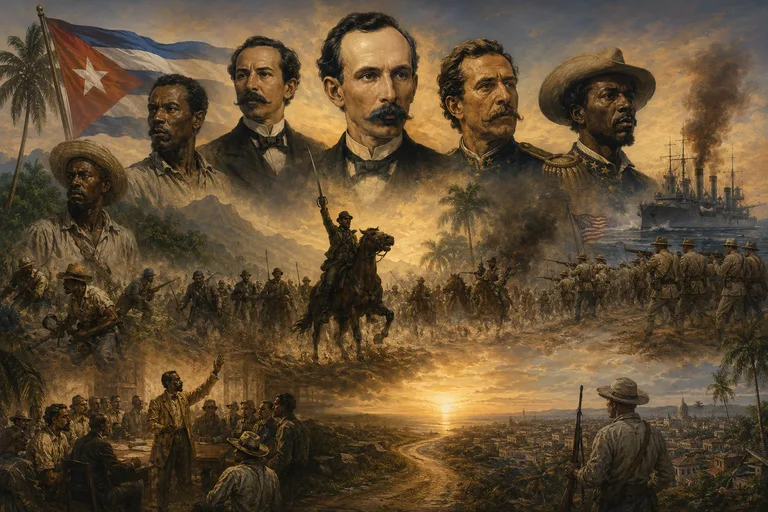
The Revolution Before the Revolution
Before Cuba became a republic, before Castro, before Batista, before the slogans and speeches of the twentieth century, there was another revolution.
The original Cuban revolution was not one man standing at a podium. It was not one army marching into Havana. It was not one single battle, one single date, or one clean victory wrapped in a flag.
It was a long, painful, unfinished struggle that stretched across generations.
It began with conspiracies, slave rebellions, exile movements, failed expeditions, and men who dreamed of breaking Cuba away from Spain long before the island was ready to rise. It passed through the sugar fields, the mountains, the prison camps, the exile clubs of New York and Florida, and the blood-soaked roads of Oriente.
Cuba’s first revolution was not born in 1959.
It was born in the nineteenth century, when Cubans began asking whether they were subjects of an empire or citizens of a nation not yet born.
The Early Sparks
Long before the great wars of independence, Cuba already had men willing to risk everything for freedom.
In 1812, José Antonio Aponte led one of the most important anti-slavery conspiracies in Cuban history. It failed, and he paid with his life, but the idea did not die. Cuba was still a Spanish colony, still tied to slavery, still chained to an empire that treated the island as property.
Later came the early independence plots and the expeditions of Narciso López. These movements did not free Cuba, but they helped shape the symbols, arguments, and dreams that would later define the independence struggle.
Every failed attempt left behind something useful.
A lesson.
A martyr.
A flag.
A warning.
The Cry of Yara
Then came October 10, 1868.
Carlos Manuel de Céspedes, a sugar planter from eastern Cuba, freed his slaves and declared Cuba independent from Spain. This moment became known as the Grito de Yara, the Cry of Yara.
That cry started the Ten Years’ War.
For ten years, Cubans fought Spain with courage, hunger, machetes, horses, and impossible hope. They created a government in arms. They wrote constitutions. They argued about leadership. They fought on battlefields and in the forests. They learned that building a nation is harder than starting a rebellion.
The Ten Years’ War gave Cuba some of its greatest patriots.
Carlos Manuel de Céspedes.
Ignacio Agramonte.
Máximo Gómez.
Antonio Maceo.
These were not perfect men. No great history is made by perfect men. But they carried the dream of Cuba when the dream was still dangerous.
The Peace That Was Not Freedom
In 1878, after ten years of sacrifice, the war ended with the Pact of Zanjón.
Spain offered reforms.
But not independence.
Not full freedom.
Not the complete abolition of slavery at that moment.
Some accepted the pact because Cuba was exhausted. The war had drained the island. Families were ruined. Armies were tired. Hope itself had become expensive.
But Antonio Maceo refused.
At the Protest of Baraguá, Maceo rejected the peace because it did not give Cuba what the war had demanded. He understood something very simple: a peace that leaves the central injustice alive is not peace. It is just a pause.
Baraguá became one of the most honorable moments in Cuban history.
Not because it won the war.
But because it refused to lie about defeat.
The Little War and the Long Exile
After the Ten Years’ War came the Little War of 1879–1880.
It failed.
The rebels lacked enough weapons, unity, money, and support. Cuba had not recovered from the first great struggle. But even failure has a place in history when it keeps the cause alive.
Then came the years of exile and rebuilding.
In New York, Tampa, Key West, and other places, Cuban patriots met, wrote, argued, organized, raised money, printed newspapers, and prepared for the next war.
This is where José Martí became the great architect of the final revolution.
Martí understood that Cuba needed more than courage. It needed organization. It needed purpose. It needed a political soul. He did not want Cuba simply to escape Spain and fall into the hands of another empire. He wanted a republic with dignity.
In 1892, Martí founded the Cuban Revolutionary Party.
The final war was coming.
The Final War of Independence
On February 24, 1895, the final war began with the Grito de Baire.
Martí returned to Cuba. Máximo Gómez returned. Antonio Maceo returned. The old warriors and the new generation took up the cause again.
But freedom demanded blood quickly.
On May 19, 1895, José Martí was killed at Dos Ríos.
He did not live to see the republic he helped call into being. Like Moses, he saw the promised land from a distance, but did not enter it.
Still, the war continued.
Máximo Gómez and Antonio Maceo carried the revolution across the island from east to west. This was not a local uprising anymore. This was a national war.
Spain answered with brutality. General Valeriano Weyler imposed reconcentration policies, forcing rural Cubans into controlled zones and causing enormous suffering. Spain tried to separate the people from the rebels by punishing the people.
Then, in 1896, Antonio Maceo was killed.
The Bronze Titan fell, but the cause remained standing.
The United States Enters
In 1898, the USS Maine exploded in Havana Harbor.
Soon after, the United States entered the war against Spain.
This is where the story becomes complicated.
Cubans had been fighting Spain for decades. Cuban blood had already soaked the island. Cuban patriots had already built the independence movement. But when the United States entered, the final defeat of Spain came quickly.
Spain lost Cuba.
But Cuba did not immediately receive full freedom.
In December 1898, the Treaty of Paris ended Spanish rule, but Cuba passed into a period of U.S. military occupation. The Spanish empire was gone, but the Cuban republic was not yet fully born.
That is the tragedy of many revolutions.
You can defeat the old master and still not be completely free.
The Republic Is Born
On May 20, 1902, the Republic of Cuba was established.
The Cuban flag rose.
The Spanish empire was gone.
But the victory was incomplete.
The Platt Amendment gave the United States the right to intervene in Cuban affairs and helped establish the conditions for Guantánamo Bay. Cuba had won independence from Spain, but its sovereignty was limited from the beginning.
So the original Cuban revolution ended with a republic — but not the republic Martí had fully dreamed of.
It was a beginning.
It was also a warning.
The Chronology of the Original Cuban Revolution
The road to Cuban independence can be remembered like this:
1812 — Aponte Rebellion
An early anti-slavery conspiracy showed that the desire for freedom existed long before the independence wars.
1850–1851 — Narciso López Expeditions
Failed attempts to liberate or annex Cuba helped shape revolutionary symbols, including the lone-star flag.
October 10, 1868 — Grito de Yara
Carlos Manuel de Céspedes declared Cuban independence and began the Ten Years’ War.
1868–1878 — Ten Years’ War
Cuba’s first great independence war against Spain.
1869 — Assembly of Guáimaro
The revolutionaries created a republican government in arms.
1873 — Death of Ignacio Agramonte
One of Cuba’s great independence leaders was killed.
1874 — Death of Carlos Manuel de Céspedes
The Father of the Homeland died after helping launch the independence struggle.
1878 — Pact of Zanjón
The Ten Years’ War ended without Cuban independence.
1878 — Protest of Baraguá
Antonio Maceo refused to accept peace without independence and abolition.
1879–1880 — Little War
Another uprising failed, but the independence cause survived.
1886 — Abolition of Slavery in Cuba
Slavery finally ended, but racial inequality remained.
1892 — Cuban Revolutionary Party Founded
José Martí organized the political engine of the final war.
February 24, 1895 — Grito de Baire
The final Cuban War of Independence began.
May 19, 1895 — Death of José Martí
Martí was killed at Dos Ríos and became Cuba’s national martyr.
1895–1896 — Invasion from East to West
Gómez and Maceo carried the war across Cuba.
1896 — Weyler’s Reconcentration Policy
Spain used brutal measures against civilians to weaken the rebellion.
December 7, 1896 — Death of Antonio Maceo
The Bronze Titan was killed, dealing a terrible blow to the revolution.
February 15, 1898 — Explosion of the USS Maine
The disaster helped push the United States into war with Spain.
April 1898 — Spanish-American War Begins
The United States entered the conflict.
December 10, 1898 — Treaty of Paris
Spain lost Cuba, but Cuba entered U.S. military occupation.
1901 — Platt Amendment
The United States imposed limits on Cuba’s sovereignty.
May 20, 1902 — Republic of Cuba Established
Cuba became a republic, but under heavy U.S. influence.
Why This History Matters
This chronology matters because Cuba’s story has too often been reduced to one revolution, one dictator, one ideology, or one political argument.
But Cuba’s real history is older and deeper than that.
Before 1959, there was 1895.
Before 1895, there was 1868.
Before 1868, there were men and women already dreaming of freedom in a colony built on sugar, slavery, empire, and fear.
In future posts, I will explore each of these events one by one.
We will look at the men, the battles, the betrayals, the mistakes, the victories, and the unfinished promises. We will talk about Céspedes, Martí, Maceo, Gómez, Agramonte, Aponte, Baraguá, Yara, Baire, Weyler, the Maine, the Platt Amendment, and the birth of the Cuban republic.
Because Cuba cannot be understood by starting in the middle of the story.
You have to go back to the beginning.
And the beginning tells us something powerful:
Cuba was not handed freedom.
Cuba bled for it.
And even after all that blood, the dream was still not complete.
Mambises: Original Freedom Fighters

Cuba does not need new masters. Cuba needs the old Mambí spirit — the courage to say that no dictator, no party, and no army owns the Cuban people. --YNOT!
Before Castro.
Before communism.
Before the lies, the slogans, the ration books, the political prisons, and the exile of millions.
There were the Mambises.
The Mambises were the Cuban patriots who fought against Spanish colonial rule in the 19th century. They were the men and women who gave their blood, their land, their families, and their lives so that Cuba could be free.
They fought in the Ten Years’ War beginning in 1868.
They fought again in the Little War.
And they rose once more in the War of Independence in 1895, the struggle that finally broke Spain’s grip over Cuba.
The word Mambí was originally used by the Spanish as an insult. It was meant to describe the Cuban rebels as savages, outlaws, and troublemakers.
But like many insults thrown at brave people, the name was transformed into a badge of honor.
To be a Mambí meant you were willing to fight for Cuba.
It meant you were willing to leave comfort behind.
It meant you were willing to stand against an empire.
It meant you believed Cuba was not property.
Not Spain’s property.
Not any dictator’s property.
Not any party’s property.
Cuba belonged to her people.
Who Were the Mambises?
The Mambises were not one class, one race, or one social group.
They were farmers.
Workers.
Intellectuals.
Former slaves.
Landowners.
Black Cubans.
White Cubans.
Mixed-race Cubans.
Exiles.
Students.
Priests.
Mothers.
Fathers.
Sons.
Daughters.
They were Cubans who understood that freedom does not come from speeches alone. Freedom requires sacrifice.
Some fought with rifles.
Some fought with machetes.
Some carried messages.
Some hid weapons.
Some gave food.
Some gave money.
Some gave their lives.
The Mambí army was not rich. It was not comfortable. It did not have luxury hotels, foreign bank accounts, or air-conditioned offices. It had mud, hunger, disease, horses, machetes, and courage.
And with that, they challenged an empire.
The Heroes of the Mambí Spirit
Carlos Manuel de Céspedes lit the flame in 1868 when he declared Cuba’s independence and freed his slaves. That act was not just political. It was moral. He understood that a nation demanding freedom could not be built on human bondage.
Máximo Gómez, born in the Dominican Republic, became one of the greatest military commanders in Cuban history. He gave his genius to Cuba’s freedom and became a symbol of sacrifice beyond birthplace.
Antonio Maceo, the Bronze Titan, became one of the most legendary warriors of the independence struggle. He represented courage, discipline, and refusal to surrender.
José Martí gave Cuba its moral language. He understood that independence was not only about removing Spain. It was about creating a republic with dignity, justice, and liberty.
Calixto García helped carry the struggle through years of war and sacrifice, proving that Cuba’s independence was not a dream but a national mission.
These men were not perfect. No human movement is perfect. But they represented something sacred:
The belief that Cuba had the right to be free.
The Mambises Fought an Empire
The Mambises fought Spain because Spain treated Cuba as a possession.
Spain controlled Cuba’s laws.
Spain controlled Cuba’s economy.
Spain controlled Cuba’s political life.
Spain controlled who had power and who did not.
The Mambises rejected that.
They refused to accept that Cuba existed only to serve rulers far away.
They refused to accept that Cubans should live under a system they did not choose.
They refused to accept that obedience was the same as peace.
And that is why their memory matters today.
Because Cuba once again lives under oppression.
This time, the oppressor does not wear a Spanish uniform.
This time, the oppressor speaks in the name of revolution.
This time, the oppressor waves the Cuban flag while denying Cubans the rights the Mambises fought for.
The New Oppressors
The tragedy of Cuba is that the island defeated one empire only to later fall under another kind of domination: the domination of a one-party state, a military caste, and a regime that treats the Cuban people as subjects instead of citizens.
Today, Cubans are told what they can say.
What they can publish.
Where they can work.
Whether they can protest.
Whether they can organize.
Whether they can leave.
Whether they can return.
Whether they can own.
Whether they can buy.
Whether they can eat.
That is not freedom.
That is colonialism under a different flag.
The regime claims to be the heir of Martí and the Mambises, but it has betrayed everything they fought for.
The Mambises fought so Cubans could be citizens.
The regime turned Cubans into dependents.
The Mambises fought for national dignity.
The regime turned dignity into a ration line.
The Mambises fought to end foreign domination.
The regime handed Cuba’s future to Moscow, Caracas, Beijing, and military corporations.
The Mambises fought for a republic.
The regime built a prison with a flag on top.
Cuba Needs the Mambí Spirit Again
Cuba does not need more empty speeches.
Cuba does not need more fake reforms.
Cuba does not need more hotels built while hospitals collapse.
Cuba does not need more slogans painted on walls while children go hungry.
Cuba needs the spirit of the Mambises.
The spirit that says Cuba is not the private property of any family, party, army, or dictator.
The spirit that says freedom is not negotiable.
The spirit that says a nation belongs to its people.
The spirit that says oppression must be confronted, not excused.
The Mambises of today may not ride horses through the mountains with machetes in hand.
Today’s battlefield is different.
It is in the streets.
It is online.
It is in exile.
It is in churches.
It is in families.
It is in independent journalism.
It is in political prisoners who refuse to kneel.
It is in mothers demanding food and medicine.
It is in young Cubans shouting “Patria y Vida” instead of repeating dead slogans.
It is in every Cuban who refuses to believe that slavery is normal just because the slave master calls himself revolutionary.
Sharpen the Blades
The Mambí blade was not only steel.
It was courage.
It was memory.
It was dignity.
It was the refusal to live on your knees.
That blade is needed again.
Not because Cuba needs hatred.
Not because Cuba needs revenge.
But because Cuba needs liberation.
A country cannot be free while its people are afraid.
A country cannot be free while its prisons are full of patriots.
A country cannot be free while its economy is controlled by a military elite.
A country cannot be free while its children flee across oceans and borders because they see no future at home.
The Mambises fought to free Cuba from the old oppressors.
Now Cuba needs that spirit again to free itself from the new ones.
Sharpen those blades.
Sharpen the memory.
Sharpen the courage.
Sharpen the truth.
Because Cuba was not born to be a plantation, a prison, or a private business for dictators.
Cuba was born to be free.
And she will be free again.
The Platt Amendment: Cuba’s Independence Came With Fine Print
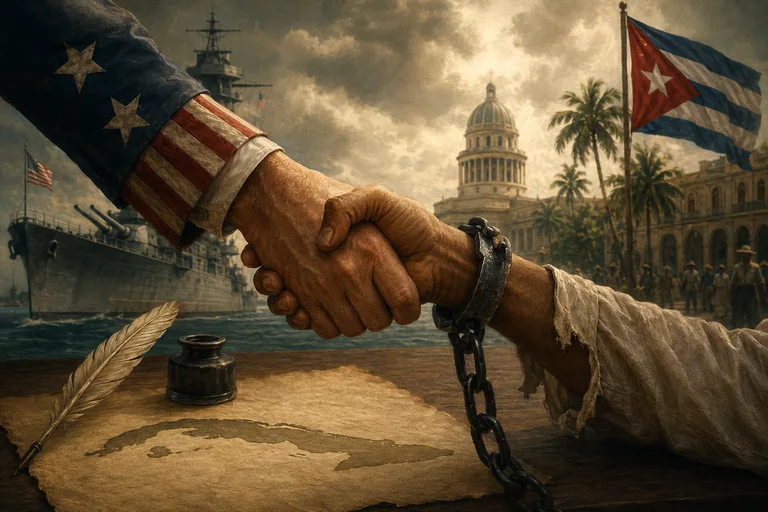
Throughout this series, I will try to approach Cuba’s history as honestly and fairly as possible. Some records are incomplete, and some events are still debated, so the goal is not to repeat propaganda from either side, but to look at the facts as clearly as we can.

The Platt Amendment is often presented as one of the reasons Fidel Castro and later Cuban revolutionaries became so hostile toward the United States. There is some truth to that argument, because the amendment became a symbol of American control over Cuba. But it is also important to remember that the Platt Amendment was repealed in 1934, long before the Cuban Revolution of the 1950s.

That does not make it irrelevant, but it does mean we should be careful not to blame every later Cuban problem on it. The Platt Amendment was part of its time: controversial, unequal, and deeply resented by many Cubans, but also defended by others as a stabilizing measure after years of war and political uncertainty.

In this series, we will look at the details, including U.S. intervention, the 1906 occupation, the events surrounding 1912, and the long shadow these moments cast over Cuban politics. The Platt Amendment happened. It shaped history. Whether it was necessary, harmful, or both is exactly the kind of question we will examine.
The Platt Amendment was one of those magnificent political inventions where one country tells another country it is free, then carefully explains all the ways it is not.
After the Spanish-American War, Cuba was supposed to become independent. That was the public story. Spain had been defeated. The old colonial master had been removed. The island that had fought, bled, rebelled, and buried its sons for freedom was finally going to become a republic.
At least that was the advertisement. But empires are very good at advertising freedom while keeping the receipt.
The United States had occupied Cuba after the war. The Teller Amendment had promised that the United States would not annex Cuba, which sounded noble enough. America would not swallow Cuba whole. It would not plant the flag and declare the island a permanent colony. It would not do what Spain had done.
Instead, Washington chose a more elegant method.
It would let Cuba become independent, but only after Cuba agreed to be independent under American supervision.
That was the genius of the Platt Amendment. It did not need to call Cuba a colony. It only needed to write rules that made Cuban sovereignty conditional. It was empire with better manners. A leash written in legal language.
The Platt Amendment was introduced in the United States Congress in 1901 as part of an Army appropriations bill. That alone tells you much of the story. Cuba’s future was not first decided in Havana by Cubans sitting freely among themselves. It was drafted in Washington, attached to American legislation, approved by American lawmakers, and then presented to Cuba as the price of ending American military occupation.
That is not quite the birth of a free republic.
That is a man being told he may leave the jail, provided he first signs over the right of the jailer to visit his house whenever he pleases.
The Cuban Constitutional Convention was then forced to review the amendment. Cuban delegates read it. They understood it. They resisted it. They tried to modify it. They tried to soften its language. They tried to protect what little dignity could be preserved inside a document designed to limit their independence before it even began.
But the United States had the stronger argument.
It had the army.
Washington made the matter plain: accept the Platt Amendment, or the occupation continues. Cuba had the same kind of choice a man has when a robber says, “Your money or your life.” Technically, there are two options. Practically, there is only one.
So the Cuban delegates debated. They objected. They divided. Some believed accepting the amendment was a bitter but necessary step toward getting the American troops out. Others saw it clearly for what it was: the replacement of Spanish colonial rule with American political supervision.
Eventually, Cuba accepted it reluctantly and by a divided vote.
The republic was born, but not cleanly.
It came into the world with a flag in one hand and a set of foreign restrictions in the other.
The Platt Amendment gave the United States the right to intervene militarily in Cuban affairs “for the preservation of Cuban independence” and for the maintenance of a government adequate to protect life, property, and individual liberty.
That language sounds almost beautiful if you do not read it too closely.
“Preservation of independence.”
“Protection of life.”
“Property.”
“Liberty.”
Those are the kinds of words empires use when they have dressed for church.
But the problem was not the poetry. The problem was the power behind it. The language was vague enough to justify almost anything Washington wanted to justify. If Cuba became politically unstable, the United States could intervene. If Cuba elected the wrong kind of leaders, the United States could intervene. If American investors became nervous, the United States could intervene. If Washington decided that Cuban independence was not behaving properly, then American troops could arrive to help Cuba remember how freedom was supposed to work.
In plain English, Cuba was independent unless the United States disagreed.
That is not independence.
That is probation.
The amendment also restricted Cuba’s ability to make treaties with foreign powers. It prevented Cuba from entering agreements that the United States believed might compromise Cuban independence. Again, the wording sounded protective. But it meant that Cuba’s foreign policy had to pass through the shadow of Washington’s approval.
Cuba was also limited in its ability to take on foreign debt. On paper, this was to prevent Cuba from becoming financially vulnerable to European powers. In practice, it gave the United States another handle on Cuban sovereignty. A country that cannot freely manage its diplomacy or finances is not fully sovereign. It may have a president, a congress, a flag, and a national anthem, but the real question remains: who has the final say?
Then came one of the most lasting provisions of all.
Cuba had to lease or sell land to the United States for naval bases.
That provision directly led to Guantánamo Bay.
Guantánamo is not some random accident of history. It is one of the surviving children of the Platt Amendment era. The United States acquired its base there through the unequal treaty framework created after occupation. After the Cuban Revolution of 1959, the new Cuban government rejected the legitimacy of the arrangement, but the United States continued to treat the lease as valid.
That is one of the remarkable things about empire. It is often very concerned with legality, especially when it wrote the law under pressure.
The Platt Amendment was later formalized in the 1903 Treaty of Relations between the United States and Cuba. By then, Cuba was officially independent. So now the arrangement could be dressed up as a treaty between two sovereign nations.
That sounded much better.
A treaty sounds civilized. A treaty sounds mutual. A treaty sounds like two gentlemen sitting across a polished table, signing papers after a fair negotiation.
But paper has a poor memory. It does not show the troops. It does not show the occupation. It does not show the pressure. It does not show one side saying, “Sign this, or we stay.”
A treaty between unequal powers can be perfectly legal and still morally crooked.
The Platt Amendment mattered because it made Cuban independence conditional from the beginning. Cuba was no longer a Spanish colony, but it was not fully free either. It had escaped one master only to find another standing at the door with paperwork.
And yes, the Platt Amendment was used.
It was not merely decorative. It was not a symbolic chain hung on the wall for legal scholars to admire. It was pulled.
The clearest example came in 1906. Cuban politics became unstable after a disputed election and armed revolt. President Tomás Estrada Palma, unable to control the crisis, requested American intervention. The United States stepped in, occupied Cuba again, and established a provisional government. William Howard Taft briefly served as provisional governor before Charles Magoon took over.
So much for Cuban self-government.
The United States had created a system in which Cuban instability became an invitation for American control. Washington could say it was protecting Cuban independence, but there is a peculiar kind of protection that looks very much like taking over.
That is the old imperial magic trick.
First, you declare that a smaller nation is not stable enough to govern itself. Then you intervene to stabilize it. Then your intervention proves that the smaller nation was not truly sovereign. Then you congratulate yourself for your responsibility.
It is like breaking a man’s legs and then charging him rent for the crutches.
The Platt Amendment also shaped American actions in 1912, during the uprising of the Partido Independiente de Color, the Independents of Color. This was a movement created by Afro-Cubans who had fought for independence and then found themselves excluded from the promises of the republic. When the uprising broke out, the Cuban government responded violently, and the United States landed forces, officially to protect American lives and property.
That phrase — “lives and property” — appears again and again in the history of intervention.
One should always pay close attention when property is placed beside life. In the vocabulary of empire, property often has a louder voice.
In 1917, during another political crisis known as the Sugar Intervention, American forces again became involved in Cuba. The name itself tells you what mattered. Sugar was not just a crop. It was money, land, power, export revenue, American investment, and foreign control. Cuba’s economy was deeply tied to sugar, and American capital held enormous influence.
The United States did not need to annex Cuba when it could dominate the island’s economy.
That is often the more efficient arrangement.
Annexation requires administration. Economic control only requires banks, plantations, contracts, railroads, ports, utilities, and the quiet understanding that American military power is never too far away.
The Platt Amendment gave American investors confidence. Sugar, mining, utilities, banking, and land ownership all became deeply connected to U.S. capital. American corporations could operate in Cuba knowing that behind the market stood the power of Washington.
A contract is one thing. A contract backed by a battleship is another.
This is why the Platt Amendment became such a central grievance in Cuban nationalist memory. It was not only about the right of intervention, although that was bad enough. It was about the entire structure of dependency it created. Cuba had formal sovereignty, but American power shaped its politics, its diplomacy, its finances, its military security, and its economy.
Cuba had presidents.Cuba had elections.Cuba had political parties.
Cuba had speeches, newspapers, flags, parades, and all the decorations of republican life.
But above all of it hovered one question:
What will Washington allow?
That was the real power of the Platt Amendment. It did not have to be invoked every morning. It did not need to send troops every week. It did not have to shout. It could whisper.
A loaded pistol on the table does not need to be fired every day to control the conversation.
Every Cuban president knew it was there. Every political faction knew it was there. Every investor knew it was there. Every nationalist knew it was there.
The Platt Amendment was not just a law. It was a warning label pasted onto Cuban sovereignty: Independent — unless otherwise instructed.
For roughly three decades, this arrangement defined the relationship between Cuba and the United States. It lasted from the early republic until 1934, when Franklin Roosevelt’s Good Neighbor Policy led to the repeal of most of the Platt framework. The United States formally gave up the old treaty-based right to intervene in Cuban domestic affairs.
That was a major change. But not a complete one.
The intervention clause was removed. The old language of supervision was retired. The United States could no longer openly point to the Platt Amendment and say, “There is our legal right to intervene.”
But Guantánamo Bay remained.
That is the part that makes the story feel less like a clean ending and more like a magician’s trick. The main document was buried, but one of its most important consequences survived. The United States kept the naval base. Cuba, especially after 1959, rejected the legitimacy of the lease. But Washington continued to treat it as valid.
So the Platt Amendment died, but one of its ghosts kept living on Cuban soil.
Could the Platt Amendment be used again today?
No, not legally. That particular permission slip expired in 1934. The United States cannot honestly say today, “We are intervening in Cuba under the Platt Amendment.” The treaty framework that gave Washington that right was abrogated. Any modern intervention would have to be justified under some other claimed authority: national security, self-defense, congressional authorization, international law, humanitarian crisis, or some new argument dressed in modern clothing.
But the spirit of the Platt Amendment is harder to bury.
The spirit of it is the belief that Cuban sovereignty is acceptable only when it does not offend American power.
That idea did not disappear in 1934.
It reappeared in other forms: sanctions, embargoes, covert operations, diplomatic pressure, exile politics, intelligence campaigns, economic isolation, and the permanent argument over Guantánamo.
Empires are very good at retiring old paperwork while keeping the habit that produced it.
That is why the Platt Amendment matters far beyond its legal life. It became part of the Cuban national story. It became evidence used by later revolutionaries to argue that the Cuban republic had been compromised from birth. Fidel Castro and others could point backward and say: look, this was never true independence. This was sovereignty under supervision. This was a republic built with foreign hands around its throat.
Now, one does not have to accept every later revolutionary argument to understand why the grievance had power.
The Platt Amendment gave Cuban nationalism a wound it could point to.
It said, in writing, that Cuba’s independence was conditional.
It said, in writing, that the United States could intervene.
It said, in writing, that Cuba could not freely conduct foreign policy.
It said, in writing, that the United States could acquire naval bases.
It said, in writing, that the Cuban republic was born under American approval.
That is the kind of insult nations remember.
People remember hunger. They remember occupation. They remember humiliation. They remember the day they were told they were free, then handed the rules of their freedom by a foreign power.
The process of reviewing the Platt Amendment only makes the insult clearer.
First, Washington drafted it. Then Congress approved it. Then Cuba was invited to review it.
That sounds fair until one remembers that Cuba was under American occupation at the time.
The Cuban delegates did not review the amendment as equals. They reviewed it as men sitting in a room while the occupying power held the keys. They could object. They could argue. They could protest. They could appeal to justice, dignity, and the principles of self-government.
But in the end, the United States controlled the exit door.
That is not free consent. That is consent under pressure.
The Cuban Constitutional Convention’s debate over the amendment was real, but the choice was not. Cuba could reject the terms and risk continued occupation, or accept them and begin its republic with limited sovereignty. That was the trap.
A trapped man may still choose which wall to lean against, but no one should mistake that for liberty.
The defenders of the Platt Amendment argued that it protected Cuba. They said it prevented European powers from gaining influence. They said it protected order. They said it prevented irresponsible debt. They said it guaranteed stability.
And perhaps some of them even believed it.
History is full of powerful men who mistake their interests for civilization.
But from the Cuban nationalist perspective, the amendment did not protect independence. It limited it. It did not defend sovereignty. It supervised it. It did not guarantee freedom. It placed freedom on probation.
That is the central contradiction.
The United States had promised not to annex Cuba. And technically, it did not.
But it reserved the power to intervene, restricted Cuba’s foreign relations, shaped its economic development, obtained Guantánamo Bay, and stood behind American corporate dominance on the island.
This is why the Platt Amendment is such an important document. It shows that domination does not always require annexation. A powerful country does not need to own another country outright if it can write the rules under which that country lives.
It can leave the flag alone.
It can leave the anthem alone.
It can let the local politicians give speeches.
It can let the people vote.
It can let the newspapers print patriotic editorials.
And still, behind all that, it can hold the power to intervene.
That is sovereignty with a collar.
The Platt Amendment was eventually repealed because even the United States understood that the old style of intervention had become politically costly. Roosevelt’s Good Neighbor Policy tried to improve relations with Latin America by stepping away from the more obvious forms of imperial control. The language changed. The diplomacy changed. The official posture changed.
But history does not vanish because a treaty is repealed.
The memory remains.
For Cuba, the Platt Amendment became proof that independence had been compromised at the founding. It became a symbol of the republic’s weakness, of American domination, and of the deep connection between political sovereignty and economic control.
For the United States, it was presented as a stabilizing measure.
For Cuban nationalists, it was a humiliation.
Both sides could read the same document and see different things.
Washington saw protection. Havana saw subordination.
And history, being less polite than diplomacy, tends to notice who had the army.
That is the lesson of the Platt Amendment.
It was not merely a clause. It was not merely a treaty.
It was not merely a constitutional condition.
It was the legal architecture of unequal independence.
It showed how a nation could be declared free while still being managed. It showed how an empire could avoid the ugly word “colony” while keeping many of the advantages of colonial power. It showed how legal language could turn domination into policy and policy into respectability.
The Platt Amendment was the fine print at the bottom of Cuba’s independence contract.
And the fine print said: You are free. But we will decide what freedom is allowed to mean.
SOME MORE DETAILS
The Platt Amendment was “Approved” in a very unequal process. It was not a normal Cuban constitutional debate where Cuba freely accepted or rejected terms. It went through American drafting first, then Cuban resistance, then U.S. pressure, then reluctant incorporation, then later treaty formalization, and finally repeal in 1934.
1. The U.S. wrote the terms first
After Spain lost Cuba in 1898, the United States occupied the island. The Teller Amendment had promised that the U.S. would not annex Cuba, but Washington still wanted legal control over Cuba’s foreign policy, debt, military stability, and naval access. The Platt Amendment was introduced in the U.S. Congress by Senator Orville H. Platt and became part of the Army Appropriations Act of 1901. The State Department describes it as the set of conditions Cuba had to accept before the U.S. would withdraw its troops and transfer sovereignty. So the first “review” happened in Washington, not Havana.
2. Congress approved it as U.S. law
The amendment passed through Congress in early 1901 as a rider attached to military appropriations. That meant it was not presented as a treaty negotiated equally with Cuba at first; it was passed as a U.S. legislative condition for ending occupation. The U.S. then told the Cuban constitutional convention that these provisions had to be incorporated into Cuba’s constitutional framework. FIU’s U.S.–Cuba chronology summarizes it directly: in March 1901, Congress approved the Platt Amendment and required the Cuban constituent assembly to incorporate it into the new constitution. That is important because Cuba was reviewing a demand already approved by the occupying power.
3. The Cuban Constitutional Convention debated it
Cuba’s constitutional convention had been formed to draft the new republic’s constitution. Cuban delegates objected strongly because the amendment reduced Cuban sovereignty before the republic had even fully begun. Cuban nationalists saw it as a contradiction: Cuba was being told it was independent, while also being told the U.S. could intervene, control key foreign-policy decisions, limit debt, and obtain naval bases.
The Cuban delegates tried to modify, soften, or reinterpret the amendment. But the United States would not accept major changes. Connecticut History notes that after several failed attempts to modify it, the Cuban Constitutional Convention eventually resigned itself to ratifying it in June 1901.
4. The U.S. made acceptance the price of withdrawal
This was the decisive pressure point. The American occupation would not end unless Cuba accepted the terms. So the convention’s review was not free review; it was review under occupation. The Cuban delegates could reject the amendment and risk continued U.S. military rule, or accept it and get a republic with limits. That is why I would describe the process as coerced constitutional review. Cuba debated it, but Washington controlled the exit door.
5. Cuba accepted it by a divided vote
The Cuban assembly eventually adopted the Platt Amendment in June 1901 by a vote of 16 to 11, with four abstentions, according to FIU’s chronology.
That vote tells the story. It was not unanimous enthusiasm. It was a divided acceptance under pressure. The pro-acceptance side understood that refusing might keep the U.S. occupation in place. The opposition side understood that accepting meant Cuba’s independence would begin with foreign supervision.
6. It was then formalized by treaty in 1903
After Cuba became formally independent in 1902, the Platt provisions were converted into a formal U.S.–Cuba treaty. The National Archives describes the Platt Amendment as being approved as a treaty between the U.S. and Cuba on May 22, 1903, permitting extensive U.S. involvement in Cuban domestic and international affairs. This is why you see two dates: 1901 for the amendment as U.S. legislation and Cuban constitutional incorporation, and 1903 for the treaty framework that made it a formal bilateral arrangement.
7. It was reviewed again in the 1930s and mostly repealed
The final major review came under Franklin Roosevelt’s Good Neighbor Policy. By then, the Platt Amendment had become a symbol of U.S. imperial control in Cuba and Latin America more broadly. The State Department’s history of the Good Neighbor Policy says that in 1934, at Roosevelt’s direction, the 1903 treaty with Cuba based on the Platt Amendment was abrogated.
But the repeal was incomplete in one major way: Guantánamo Bay remained. The intervention rights were removed, but the naval-base arrangement survived under separate treaty terms.
It was repealed/abrogated in 1934, so the United States no longer has that old treaty-based “right” to intervene in Cuba’s internal affairs. The National Archives says the Platt Amendment was repealed under Franklin Roosevelt’s Good Neighbor policy, and the 1934 Treaty of Relations explicitly states that the 1903 Treaty of Relations “shall cease to be in force” and was “abrogated.”
Can it be used today to invade Cuba or otherwise intefere
Intervention in Cuba:
The U.S. could not legally say today, “We are invading Cuba under the Platt Amendment.” That authority is gone. Any modern U.S. military action would have to be justified under some other claimed authority: U.S. domestic law, self-defense, congressional authorization, international law, or a new crisis-based justification. That would be politically explosive and legally contested.
Guantánamo Bay:
Guantánamo is different. The Platt Amendment was repealed, but the U.S. retained the Guantánamo lease. The National Archives notes that the lease remained after repeal, and the 1934 treaty preserved the naval-station arrangement unless both countries agreed to modify or end it.
SO the simple answer is no. The Platt Amendment cannot be used again because it no longer exists as active law. But the Guantánamo lease survived, and the U.S. still relies on that separate treaty framework to remain there.
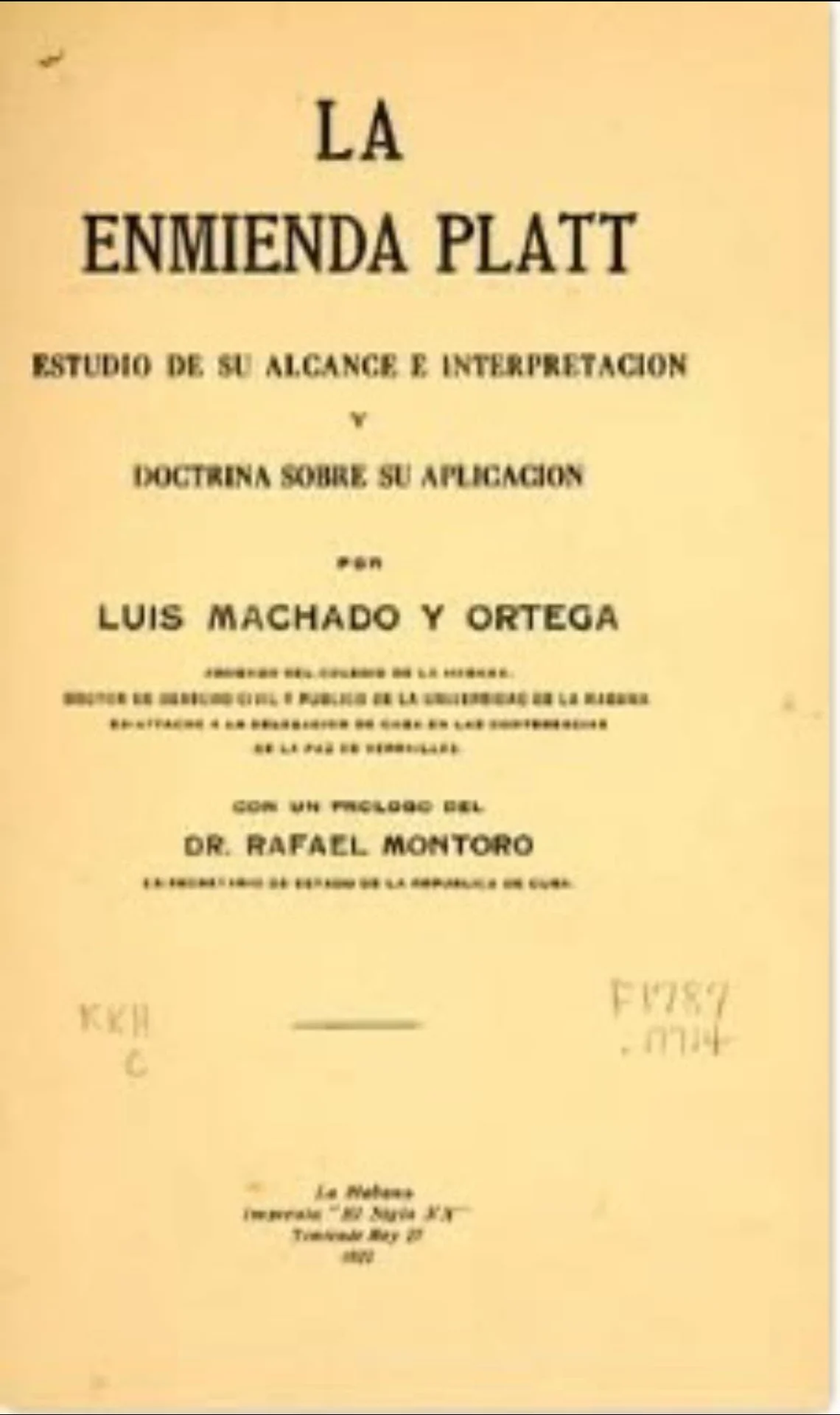
La Guerra de 1912 -- The Forgotten War
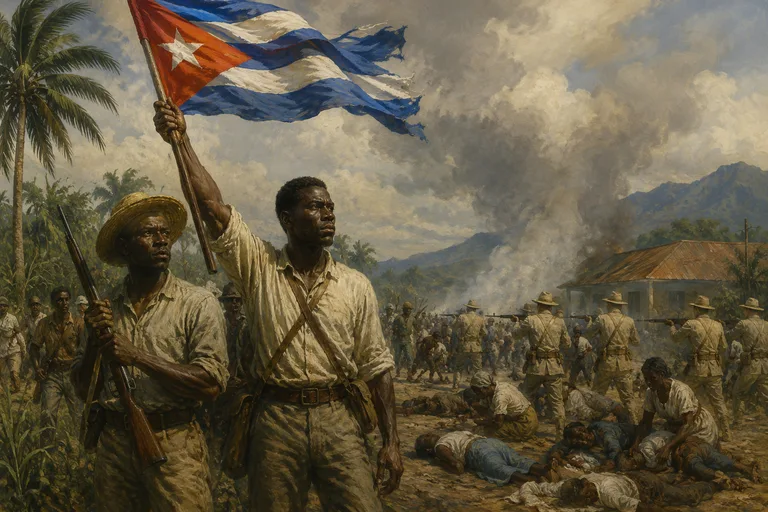
There are some wounds in a nation’s history that do not bleed in public anymore, but they never fully close.
Cuba remembers Spain. Cuba remembers independence. Cuba remembers Martí, Maceo, Máximo Gómez, the machete charges, the jungle camps, the hunger, the sacrifice, and the dream of a free republic. But not every Cuban sacrifice was honored equally after the flag was raised.
Some men fought for Cuba believing they were helping build a country where all Cubans would belong. Black Cubans and mixed-race Cubans fought in the wars of independence. They died in the fields. They marched through the mountains. They followed leaders like Antonio Maceo, whose courage became part of the soul of Cuba itself.
Then independence came.
And the same men who had been useful in war were told to wait in peace.
That is the root of La Guerra de 1912 — also known as El Doce, the Race War of 1912, or the armed uprising of the Independents of Color.
It was not simply a rebellion. It was a tragedy born from a broken promise.
The Promise After Independence
Cuba’s independence was supposed to mean a new beginning.
The Spanish empire was gone. The old colonial order was supposed to be buried. The republic was supposed to belong to all who had fought for it.
But after independence, power did not spread evenly.
White Cuban political elites controlled much of the new republic. Afro-Cubans, many of them veterans of the independence struggle, found themselves pushed aside. They had fought for freedom, but freedom did not automatically bring equality. Jobs, land, political appointments, military positions, and influence often remained in the hands of those already connected to power.
The republic spoke the language of equality, but too often lived by the habits of the old world.
That contradiction created anger.
For Afro-Cuban veterans, this was not an abstract political complaint. They could point to their scars. They could name the dead. They could say, “We were Cuban enough to die for the republic. Why are we not Cuban enough to help govern it?”
That question became dangerous.
The Partido Independiente de Color
In 1908, Afro-Cuban leaders helped form the Partido Independiente de Color, or Independent Party of Color.
Its purpose was not to destroy Cuba. Its purpose was to demand political representation for Afro-Cubans inside Cuba.
The party wanted recognition, rights, jobs, access, and respect. It represented those who believed that the existing political parties were using Black voters when convenient, but not truly representing them.
Two of its most important leaders were Evaristo Estenoz and Pedro Ivonnet.
These men understood the meaning of the independence war. They had lived through the promise. They also understood the betrayal that followed.
The Independent Party of Color became a direct challenge to Cuba’s political class. Not because it had more guns, more money, or more power, but because it exposed the hypocrisy of the young republic.
Cuba claimed to be raceless.
But when Afro-Cubans organized politically, the government suddenly discovered race everywhere.
The Morúa Law
In 1910, the Cuban government passed the Morúa Law, named after Senator Martín Morúa Delgado.
The law banned political parties based on race.
On paper, that may sound noble. A republic should not divide itself by race, the argument went. But in practice, the law was used to eliminate the Independent Party of Color.
It was a clever political weapon.
Instead of answering Afro-Cuban demands, the government criminalized the vehicle that carried them. Instead of asking why Afro-Cubans felt excluded, the state declared their independent organization illegal.
That is an old trick in politics.
When the complaint is uncomfortable, attack the form of the complaint. When people organize, accuse them of division. When the excluded ask for representation, call them dangerous.
The Morúa Law did not solve Cuba’s racial problem. It buried it under the floorboards of the republic.
And buried things do not stay quiet forever.
Why the Uprising Happened
By 1912, the Independent Party of Color wanted to be restored as a legal political party.
Its leaders believed they had exhausted the normal channels. The government had outlawed their party. Their grievances had not been answered. Their people remained excluded.
So they mobilized.
The uprising was not born from nowhere. It came from years of frustration, broken promises, racism, poverty, political exclusion, and the bitter reality that the republic did not treat all of its children equally.
The main reason was this:
Afro-Cubans had fought for Cuba’s freedom, but after independence many were denied a fair share of the republic they helped create.
The immediate trigger was this:
The government outlawed their party and refused to restore its legal status.
That is how political exclusion turned into armed protest.
And once armed protest began, the Cuban government and the Cuban press framed it not as a political crisis, but as a racial threat.
That made everything worse.
The Fire in Oriente
The conflict broke out in May 1912, especially in Oriente, the eastern part of Cuba.
Oriente had deep revolutionary history. It was a land of sugar, mountains, veterans, poverty, pride, and resentment. Many Afro-Cuban peasants and workers lived and labored there. It was also a place where the memories of the independence war still felt close.
The rebels were not a modern army. Many were peasants, veterans, and political supporters of the Independent Party of Color. They were lightly armed compared with the Cuban state.
The Cuban government responded with overwhelming force.
President José Miguel Gómez sent the army, the Rural Guard, and militia forces to crush the movement. The government did not treat it as a political protest that had turned militant. It treated it as an existential threat.
The language of the press became poisonous. Afro-Cuban protesters were portrayed as savages, criminals, rapists, and enemies of civilization. This racial panic helped justify violence.
Once that kind of language is unleashed, it gives ordinary cruelty a patriotic uniform.
The United States Arrives
The United States also intervened.
American Marines were sent to Cuba, especially to protect American citizens, plantations, mines, railroads, and business interests. The United States had deep economic interests in Cuba, especially in sugar and infrastructure.
The U.S. did not come as a neutral humanitarian force.
It came to protect property.
That is important to understand. The Cuban army carried out the main suppression of the uprising. The Marines were mainly positioned to guard American assets and stabilize areas where American interests were exposed.
In other words, Cuba’s racial crisis became entangled with foreign power, corporate property, and the reality that the young Cuban republic still lived under the shadow of Washington.
The Spanish empire was gone, but Cuba was not entirely free from outside pressure.
How It Was Resolved
La Guerra de 1912 was resolved by force.
Not by negotiation.
Not by reform.
Not by justice.
The Cuban government crushed the uprising.
Evaristo Estenoz was killed in late June 1912. His death broke the movement’s leadership. Pedro Ivonnet continued for a short time, but he too was captured or surrendered and was killed soon afterward. Officials claimed he was trying to escape, which is one of those explanations governments often provide when the dead can no longer object.
The Independent Party of Color was destroyed.
Thousands of Afro-Cubans were killed. The exact number remains disputed, but the scale of the violence was enormous. Many victims were not powerful military leaders. Many were poor Black Cubans caught in a campaign of repression.
By August 1912, the uprising was over.
The republic survived.
But something inside the republic had been exposed.
The Main Characters
Evaristo Estenoz
Estenoz was one of the central leaders of the Independent Party of Color. A veteran and political organizer, he represented Afro-Cuban demands for recognition, representation, and equality. His death in June 1912 helped break the rebellion.
Pedro Ivonnet
Ivonnet was another major leader of the movement. After Estenoz was killed, Ivonnet continued resistance for a short time. He was later captured or surrendered and was killed under suspicious circumstances, officially described as an attempted escape.
José Miguel Gómez
Gómez was the president of Cuba during the uprising. His government chose repression over reconciliation. Under his administration, the Cuban state responded to the movement with military force.
Martín Morúa Delgado
Morúa was the senator associated with the law that outlawed race-based political parties. The Morúa Law became the legal instrument used to eliminate the Independent Party of Color.
Juan Gualberto Gómez
A respected Afro-Cuban independence figure, Juan Gualberto Gómez opposed racial demonization and warned against the dangerous hatred being stirred up during the crisis. He represented an older independence ideal that saw Cuba as a nation for all Cubans.
The Afro-Cuban Veterans and Peasants
They were the heart of the tragedy. Many had fought for independence or descended from those who did. They believed Cuba owed them more than speeches. They wanted dignity, representation, work, land, and a place in the country they helped liberate.
The Cuban Army and Rural Guard
They carried out the suppression. Their campaign destroyed the movement and left thousands dead.
The United States Marines
They entered the crisis to protect American interests, especially property, railroads, mines, plantations, and citizens. Their presence showed how deeply Cuban politics, race, and foreign economic power were connected.
The Moral of 1912
La Guerra de 1912 is not just a story about race.
It is a story about what happens when a republic celebrates freedom but refuses equality.
It is a story about men who fought for a flag, only to be told later that the flag did not fully belong to them.
It is a story about how governments can turn political demands into criminal threats, and then turn criminal threats into justification for violence.
The Independent Party of Color may have been destroyed, but the question it raised did not die:
Who gets to belong to Cuba?
That question has followed Cuba across generations.
In 1912, Afro-Cubans asked for their rightful place in the republic.
The answer they received was bullets.
And that is why La Guerra de 1912 must be remembered — not as a footnote, not as an embarrassment, not as something to be hidden behind patriotic speeches, but as one of the great moral failures of the early Cuban republic.
Because a nation is not judged only by the wars it wins against foreign powers.
It is judged by how it treats the people who helped win its freedom.
I would use the title “La Guerra de 1912: The Forgotten War Inside the Cuban Republic” because it sounds historical, emotional, and serious without sounding like a textbook.
Cuba’s Revolving Door of Presidents

Cuba’s Revolving Door of Presidents - How a Nation Won Its Independence but Never Secured Its Democracy
Cuba did not suffer from a shortage of presidents.
It suffered from a shortage of institutions strong enough to restrain them.
Between the founding of the Cuban Republic in 1902 and the triumph of the Revolution in 1959, Cuba passed through elected presidents, provisional presidents, military strongmen, temporary caretakers, revolutionary councils and men who occupied the presidential palace for such a brief time that they barely had a chance to sit behind the desk.
Some arrived through elections.
Some arrived through military coups.
Some were appointed behind closed doors.
Some were installed because the previous president had fled.
And some discovered, usually too late, that holding the title of president did not necessarily mean they held the power.
Cuba had constitutions. It had political parties. It had campaigns, congressmen, judges, newspapers and elections. For brief moments, it even appeared to be building a functioning democratic republic.
But democracy is more than voting.
It is the peaceful transfer of power. It is the acceptance of defeat. It is an independent judiciary, a professional civil service, an army that obeys the constitution and citizens who believe the law will protect them even when their political enemies are in office.
Those foundations never grew deep enough in Cuba.
Every time the republic began to stand, someone kicked one of its legs out from under it.
Independence With Conditions Attached
Cuba formally became an independent republic on May 20, 1902, after centuries of Spanish colonial rule, three wars for independence and a final American military occupation.
The Cuban flag was raised over Havana, but independence arrived with fine print.
The Platt Amendment, imposed as a condition for ending the American occupation, restricted Cuba’s ability to make foreign agreements, gave the United States broad authority to intervene in Cuban affairs and provided for American naval stations on the island. The United States would use that intervention power during the republic’s early years. (National Archives)
Cuba was free—but not completely free.
It had a president—but an outside power reserved the right to enter the country when Washington decided Cuban order or American interests were threatened.
This created a dangerous political habit.
Cuban factions did not always have to settle their disputes through Cuban institutions. When elections became contested, political leaders could threaten rebellion, appeal to the military or hope that the United States would intervene and reorganize the government.
That is not how democratic muscles are developed.
A democracy becomes strong when political rivals learn that they must negotiate with one another because nobody else is coming to rescue them.
Cuba never received enough uninterrupted time to learn that lesson.
Tomás Estrada Palma and the First Broken Promise
Cuba’s first president, Tomás Estrada Palma, entered office in 1902 with a reputation for honesty, personal austerity and devotion to independence.
He also began his presidency with little meaningful opposition because his principal rival withdrew from the election.
Estrada Palma initially appeared to offer exactly what Cuba needed: order, financial responsibility and a modest republican government.
But then came the temptation that has ruined more republics than poverty ever did—the desire to remain in power.
His reelection campaign became associated with manipulation, intimidation and fraud. Opposition forces rebelled in 1906, and rather than peacefully surrender power or permit a constitutional settlement, Estrada Palma requested American intervention.
He resigned.
The United States occupied Cuba again.
The first Cuban presidency therefore ended not with a stable transfer of power, but with rebellion, resignation and foreign occupation.
The young republic had learned its first terrible lesson:
When politics became difficult, the constitution could be suspended.
Elections Without Trust
After Cuban government was restored in 1909, presidents came and went: José Miguel Gómez, Mario García Menocal, Alfredo Zayas and Gerardo Machado.
They were not identical men, and their governments were not identical governments.
Some built roads, schools and public works. Some expanded the civil service. Some encouraged business and modernization. Some enjoyed genuine popularity when they entered office.
But nearly all operated within a political culture poisoned by patronage.
Government jobs were rewards.
Contracts were favors.
Political parties often existed less as organizations built around principles than as machines built around personalities.
Election victories meant access to the treasury, government appointments and commercial influence. Losing an election could mean losing not merely political authority, but economic survival.
Under such conditions, elections became battles over who would control the state rather than debates over how the state should be governed.
The opposition rarely trusted the government to administer honest elections.
The government rarely trusted the opposition to accept defeat.
The army increasingly became the referee.
And a nation that allows soldiers to referee politics eventually discovers that the referee has decided to keep the ball.
The Republic’s Original Sin: Caudillismo
Cuba also inherited the Latin American tradition of the caudillo—the powerful man who presents himself as larger than parties, laws and institutions.
The caudillo promises order when politicians quarrel.
He promises action when Congress delays.
He promises national dignity when institutions appear weak.
He tells the public that the nation is in danger and that normal rules must temporarily be suspended.
The suspension, naturally, never seems to remain temporary.
Cuba’s politics repeatedly revolved around personalities rather than durable institutions. Supporters placed their faith in individual saviors. Opponents organized around removing the man rather than strengthening the system.
This produced a recurring Cuban tragedy:
The country would become frustrated with a corrupt president and look for a stronger man.
The stronger man would suppress the corruption—and then suppress the critics.
The public would then look for another savior to remove the previous savior.
Cuba was always searching for the next man on horseback.
It rarely stopped to ask why the horse was permitted inside the presidential palace.
Machado: From Elected President to Dictator
When Gerardo Machado was elected in 1925, many Cubans welcomed him.
He promised national development, administrative efficiency and an ambitious public-works program. Roads were built. Havana was transformed. The monumental Capitol building rose over the city.
But concrete is not democracy.
Machado gradually extended his control, manipulated the constitutional order, censored newspapers and used violence against political opponents.
The president who entered office through elections transformed himself into a dictator.
By the early 1930s, the Great Depression had devastated Cuba’s sugar-dependent economy. Unemployment rose. Public anger deepened. Students organized. Workers went on strike. Opposition movements spread.
Machado responded not by restoring democratic legitimacy, but by tightening repression.
In August 1933, his government collapsed.
But removing Machado did not restore democracy.
It opened the door to chaos.
The Year Cuba Could Not Find a President
The political upheaval of 1933 may be the clearest example of Cuba’s inability to establish stable constitutional government.
Machado fled.
Alberto Herrera briefly assumed power.
He was replaced by Carlos Manuel de Céspedes y Quesada, the son of Cuba’s great independence leader.
Céspedes lasted only a few weeks.
Then came the Pentarchy, a five-man revolutionary executive that governed for several days.
It was followed by Ramón Grau San Martín, whose reformist government became known as the Government of One Hundred Days.
Then Grau was forced out.
Carlos Hevia briefly became president.
He was replaced almost immediately.
Manuel Márquez Sterling occupied the position for only hours before transferring authority to Carlos Mendieta.
Cuba was not changing presidents because of orderly elections.
It was changing presidents because competing military officers, students, political factions, foreign diplomats and revolutionary groups could not agree on who controlled the state.
The presidential palace had become a hotel room whose occupants never bothered to unpack.
The Man Behind the Presidents
Behind much of this instability stood a young army sergeant named Fulgencio Batista.
Batista rose during the Sergeants’ Revolt of September 1933, when enlisted men and noncommissioned officers overthrew the senior military command.
He soon became head of the armed forces.
For much of the remainder of the 1930s, presidents formally governed Cuba, but Batista often controlled the power capable of making or breaking them.
This was government by constitutional costume.
There were presidents, ministers and congressmen, but everyone understood that the army commander possessed the final veto.
When a nation’s elected leaders govern only with the permission of the barracks, democracy has already become ceremonial.
The Constitution of 1940: Cuba’s Great Opportunity
Then Cuba did something remarkable.
After years of upheaval, Cubans from different political tendencies gathered to write the Constitution of 1940.
It was one of the most progressive constitutions of its era. It recognized labor protections, public education, social welfare, limits on large landholdings and a broad range of civil and political rights. Delegates from multiple parties participated in its creation. (Wikipedia)
Even Batista submitted himself to an election.
He won the presidency in 1940 through a political coalition and served until 1944.
This period matters because it proves that Cuba was not incapable of democratic government.
Cuba had competitive political parties.
It had an active press.
It had labor organizations, civic groups and elections in which the opposition could win.
In 1944, Batista left office and Ramón Grau San Martín became president after an electoral victory.
In 1948, Carlos Prío Socarrás was elected.
For twelve years, Cuba possessed something resembling a constitutional democracy.
It was imperfect, corrupt, noisy and frequently violent.
But most democracies are imperfect, especially when young.
The answer to imperfect democracy is better democracy.
Cuba’s political class instead continued treating the state as a prize.
Corruption Ate What Dictatorship Had Not Destroyed
The governments of Grau and Prío preserved significant political freedoms, but they became notorious for corruption, gangsterism and patronage.
Armed political groups operated with connections to government officials.
Public money disappeared.
Politicians became wealthy.
Citizens increasingly concluded that democratic government meant thieves wearing suits instead of soldiers wearing uniforms.
This is one of the most dangerous moments in the life of any republic.
When democracy becomes associated with corruption, people begin admiring authoritarian efficiency.
They say, “At least the strongman will restore order.”
They forget that a dictator can steal more than money.
He can steal the courts, the newspapers, the elections and the citizen’s right to remove him.
Cuba’s civilian leaders failed to defend democracy morally because they repeatedly abused it materially.
They did not destroy the republic alone.
But they made it easier for someone else to do so.
Batista Returns Through the Barracks
Cuba was scheduled to hold national elections in 1952.
Batista was again a presidential candidate, but his chances of victory appeared poor.
So on March 10, 1952, he did not wait for the voters.
He seized power through a military coup and overthrew the constitutional government of President Carlos Prío. Contemporary American diplomatic reporting described the overthrow of the legally constituted government and noted that it was accomplished with little immediate resistance. (Office of the Historian)
Batista canceled the approaching election.
He suspended constitutional guarantees.
He censored the press.
He imprisoned, tortured and killed opponents.
The Constitution of 1940—the document that could have become the foundation of a durable Cuban democracy—was pushed aside by the same man who had once governed beneath it.
This was not merely another change of president.
It was the destruction of the constitutional road.
And when constitutional roads are closed, young men begin looking for mountain trails.
The Revolution That Promised to Restore the Republic
Batista’s coup radicalized a generation of Cubans.
Among them was a young lawyer named Fidel Castro, who had been preparing to seek elected office.
Castro initially challenged Batista through legal means, arguing that the coup violated the Constitution. When the courts failed to reverse the takeover, Castro turned toward armed revolution.
The revolutionary movement repeatedly invoked the Constitution of 1940 and promised to restore constitutional government.
That promise attracted Cubans from many political backgrounds.
Not everyone who opposed Batista was a communist.
Not everyone who supported the Revolution wanted a one-party state.
Many wanted elections.
Many wanted honest government.
Many wanted Batista gone and the republic restored.
When Batista fled on January 1, 1959, enormous numbers of Cubans celebrated.
They believed the long cycle of corruption, coups and dictatorship had finally ended.
Instead, the revolving door stopped because one group locked it from the inside.
From Too Many Presidents to One Permanent Revolution
The revolutionary government quickly concentrated power.
Independent political opposition disappeared.
Newspapers were closed or placed under government control.
Private property was seized.
Political opponents were imprisoned, executed or forced into exile.
Elections were postponed and then replaced by a one-party political structure.
Cuba had spent half a century suffering from presidents who came and went too easily.
After 1959, it suffered from rulers who did not leave at all.
The country moved from unstable republicanism to permanent revolutionary government.
Fidel Castro became Cuba’s dominant leader for nearly half a century. Power later passed to his brother Raúl Castro and then to Miguel Díaz-Canel through institutions controlled by the Communist Party rather than through competitive national presidential elections.
Cuba finally achieved political stability.
But it was the stability of a locked room.
A prison can be stable.
A cemetery can be peaceful.
Neither should be confused with a republic.
Why Cuban Democracy Never Became Secure
Cuba’s democratic failure cannot be explained by one man, one foreign country or one political party.
It was the result of several weaknesses reinforcing one another.
Foreign interference weakened national sovereignty
The Platt Amendment and repeated American intervention taught Cuban leaders that political disputes might ultimately be settled in Washington rather than Havana.
Sugar dependency distorted the economy
Cuba relied heavily on sugar exports and foreign markets. When sugar prices rose, money flowed. When they collapsed, the national economy suffered. Economic insecurity fed political extremism and made governments vulnerable.
Patronage replaced public service
Political parties treated government employment and contracts as rewards for loyalty. Each election threatened to transfer wealth and influence from one political machine to another.
Corruption discredited constitutional government
Citizens saw elected officials enrich themselves while public institutions remained weak. Democracy became associated with theft and disorder.
The military became a political institution
Instead of remaining subordinate to civilian authority, the armed forces learned that they could select presidents, remove presidents and eventually govern directly.
Political violence became normal
Students, gangsters, police, soldiers, rebels and government agents all used violence. Once violence becomes an accepted political language, compromise begins to look like weakness.
Leaders became more important than laws
Cuba repeatedly searched for heroic men instead of building durable institutions.
Defeated factions refused to remain defeated
Democracy requires losers who accept temporary defeat because they trust that another election will come.
In Cuba, losing factions often believed they would never receive a fair opportunity again. Some rebelled, conspired or appealed to the army.
Every crisis became an excuse to suspend the rules
Emergency powers became permanent habits.
Presidents argued that constitutional restraints could be restored after order returned.
But order never seemed to return quite enough for those restraints to be restored.
Cuba Did Not Fail Because Cubans Were Unfit for Democracy
It would be dishonest to say that Cuba never had democratic traditions.
Cuba produced constitutional thinkers, journalists, labor organizers, judges, reformers and citizens willing to sacrifice for republican government.
It produced the Constitution of 1940.
It conducted competitive elections.
It experienced peaceful transfers of power.
It had moments when democracy might have survived.
The tragedy is not that Cuba lacked the ingredients.
The tragedy is that those ingredients were never protected long enough to become permanent.
Foreign pressure weakened the republic.
Corrupt politicians embarrassed it.
Military officers overturned it.
Dictators suspended it.
Revolutionaries promised to restore it—and then abolished it.
The Lesson of Cuba
Cuba’s short republican history teaches a lesson larger than Cuba.
A democracy is not secured when a flag is raised.
It is not secured when a constitution is printed.
It is not secured when the first president is elected.
Democracy becomes real only when the second president can replace the first without violence; when the opposition can criticize the government without disappearing; when the army remains in its barracks; when courts can rule against powerful men; and when citizens can remove bad leaders without destroying the nation.
Cuba repeatedly changed the man at the top.
It rarely changed the machinery beneath him.
That is why presidents came and went, coups followed elections, revolutions followed coups and dictatorship followed revolution.
For more than a century, Cuba has been told that the country needed one more strong leader to save it.
Perhaps Cuba has had enough saviors.
What it has never truly been permitted to have is a system strong enough that it no longer needs one.
The future of Cuba cannot depend upon finding another perfect man.
Perfect men do not exist.
It must depend upon building an imperfect but durable republic—one in which no president, general, revolutionary, political party or foreign government is more powerful than the law.
Because the soul of democracy is not found in the leader who enters the palace.
It is found in the leader who leaves when his time is over.
Cuba became a formally independent republic on May 20, 1902, with Tomás Estrada Palma as its first president. The following list begins there rather than with Spanish colonial governors or the earlier revolutionary governments of the independence wars. Cuba was temporarily governed by the United States from 1906 to 1909. (eliable nationwide approval polling did not exist for most Cuban presidents. The popularity descriptions below are therefore historical estimates, based on electoral support, public demonstrations, contemporary accounts, political opposition, repression and how each government ended.
| Years | President or ruler | How they took power | Government type | Popularity and quick description |
|---|---|---|---|---|
| 1902–1906 | Tomás Estrada Palma | Elected, although his principal opponent withdrew | Constitutional republic under strong U.S. influence | Initially respected; later unpopular. Independence veteran and Cuba’s first president. Known for financial restraint, but his disputed reelection and political manipulation provoked rebellion. He resigned and requested U.S. intervention. |
| 1906–1909 | William H. Taft / Charles E. Magoon | Appointed by the United States | U.S. provisional occupation, not an elected Cuban presidency | Generally resented as foreign rule. Taft briefly served as provisional governor before Magoon administered Cuba until elections restored Cuban government. |
| 1909–1913 | José Miguel Gómez | Elected | Multiparty constitutional republic | Popular with many Liberals, but controversial. Expanded political participation and public works but became associated with corruption. His government brutally suppressed the 1912 uprising of the Independent Party of Color. |
| 1913–1921 | Mario García Menocal | Elected in 1912; reelected in a disputed 1916 election | Constitutional republic with increasingly authoritarian practices | Mixed, then declining. Benefited from the sugar boom and infrastructure growth. His contested reelection triggered rebellion and another period of U.S. involvement. |
| 1921–1925 | Alfredo Zayas | Elected | Constitutional republic | Generally weak to unpopular. His administration faced economic collapse after the sugar boom and was widely associated with patronage and corruption. |
| 1925–1933 | Gerardo Machado | Initially elected; later extended his rule through manipulated constitutional changes | Elected government that became a dictatorship | Initially popular; extremely unpopular by 1933. Built roads, schools and public works, but used censorship, torture and political killings as opposition grew. Driven from office by strikes, military revolt and political pressure. His support fell steadily after his first years. (Wikipedia) |
| August 1933 | Alberto Herrera Franchi | Assumed office briefly during Machado’s collapse | Military-backed interim government | Very little support. Served for roughly one day and was regarded as too closely connected to Machado. |
| August–September 1933 | Carlos Manuel de Céspedes y Quesada | Appointed as provisional president | Civilian provisional government | Moderate but politically weak. Respected diplomat and son of independence leader Carlos Manuel de Céspedes, but lacked military support and was overthrown within weeks. |
| September 1933 | Pentarchy of 1933 | Installed by the Sergeants’ Revolt | Five-man revolutionary junta | Brief and uncertain. It governed for only several days and included competing student, military and reformist factions. |
| 1933–1934 | Ramón Grau San Martín | Chosen after the Pentarchy | Revolutionary provisional government | Popular among students and nationalists; opposed by the military, elites and United States. Promoted labor and nationalist reforms during the “Government of One Hundred Days.” Forced out under pressure from Fulgencio Batista and other power centers. |
| January 1934 | Carlos Hevia | Chosen by the military-backed leadership | Provisional government | Unpopular and powerless. Served for fewer than three days after Grau’s removal. The military rejected his leadership. (Institute for Cuban Studies) |
| January 18, 1934 | Manuel Márquez Sterling | Temporary constitutional successor | Extremely brief interim presidency | Not in office long enough to measure. Served for only several hours while a new arrangement was negotiated. |
| 1934–1935 | Carlos Mendieta | Installed with decisive military support from Batista | Military-influenced provisional government | Limited popular legitimacy. Oversaw the formal abolition of the Platt Amendment, but real power increasingly rested with Batista and the armed forces. |
| 1935–1936 | José Agripino Barnet | Appointed provisional president | Caretaker government | Low-profile and limited. Primarily supervised the transition toward elections rather than developing an independent political following. |
| May–December 1936 | Miguel Mariano Gómez | Elected | Constitutional republic | Fairly popular but politically constrained. Removed by Congress after opposing a tax-supported rural-school program associated with Batista. |
| 1936–1940 | Federico Laredo Brú | Became president after Gómez’s impeachment | Constitutional but military-influenced government | Moderate support. Presided over political stabilization and the drafting process that produced the progressive Constitution of 1940. |
| 1940–1944 | Fulgencio Batista | Elected in a competitive coalition election | Constitutional multiparty republic | Initially substantial and broad-based. His first presidency was legally elected and operated under the 1940 Constitution. Supported labor legislation and cooperated with communists, although corruption and political control remained concerns. |
| 1944–1948 | Ramón Grau San Martín | Elected | Constitutional multiparty republic | Very popular at election; disappointing in office. Returned as a nationalist reformer but his administration became notorious for corruption, patronage and political violence. |
| 1948–1952 | Carlos Prío Socarrás | Elected | Constitutional multiparty republic | Initially reasonably popular; declining by 1952. Presided over political freedom and economic activity, but organized violence and corruption weakened public confidence. Overthrown shortly before the next election. |
| 1952–1959 | Fulgencio Batista | Military coup on March 10, 1952; later staged controlled elections | Military dictatorship | Initially accepted by some seeking order; deeply unpopular by the late 1950s. Suspended constitutional guarantees, censored opponents and relied on torture and political repression. Batista’s 1954 election lacked meaningful competition. He fled Cuba on January 1, 1959. (Wikipedia) |
| January 1–2, 1959 | Anselmo Alliegro | Constitutional succession as Senate president after Batista fled | Extremely brief interim authority | No meaningful public mandate. His claim to the presidency lasted roughly one day and was overtaken by the revolutionary victory. |
| January–July 1959 | Manuel Urrutia Lleó | Selected by Fidel Castro and the revolutionary movement | Revolutionary provisional government | Initially popular as part of the victorious revolution. A respected judge who had defended the rebels’ legal rights. Resigned after conflicts with Castro over communist influence and the direction of the revolution. (Office of the Historian) |
| 1959–1976 | Osvaldo Dorticós Torrado | Appointed by the revolutionary government | One-party revolutionary state in development | Little independent following. Formally president, but Fidel Castro, as prime minister and revolutionary leader, held the dominant political power. Dorticós was not chosen in a competitive popular presidential election. |
| 1976–2008 | Fidel Castro | Selected by the National Assembly under the 1976 Constitution; already Cuba’s dominant leader since 1959 | Communist one-party state | Enormously popular among supporters, deeply opposed by dissidents and exiles. Oversaw literacy, healthcare and education programs, but also political imprisonment, censorship, executions, property seizures and mass emigration. There were no competitive multiparty presidential elections. Fidel transferred day-to-day authority to Raúl in 2006 and formally retired in 2008. |
| 2008–2018 | Raúl Castro | Selected by the National Assembly after serving as acting leader | Communist one-party state | Mixed. Some Cubans welcomed limited economic reforms, expanded private enterprise and restored U.S. diplomatic relations. Others blamed his government for continuing repression and failing to produce deeper economic improvement. Not directly elected by the public. |
| 2018–present | Miguel Díaz-Canel | Selected by the National Assembly in 2018; elected president under the new constitutional office in 2019 and reelected by the Assembly in 2023 | Communist one-party state | Low or sharply divided popularity. Supporters present him as a defender of Cuban sovereignty and the revolution. Critics associate him with shortages, blackouts, emigration and the harsh response to the July 2021 protests. He was not chosen through a competitive nationwide presidential election. As of July 10, 2026, he remains president. (Wikipedia) |
The basic political periods
1902–1933: Early republic. Presidents were nominally elected, but elections were often distorted by fraud, patronage, armed rebellion and U.S. intervention.
1933–1940: Revolutionary instability. Cuba experienced coups, provisional presidents and growing military influence, especially from Batista.
1940–1952: Constitutional democracy. Cuba had competitive elections under the Constitution of 1940, although corruption and political violence remained serious.
1952–1959: Batista dictatorship. Batista destroyed the constitutional succession through a military coup and governed repressively.
1959–1976: Revolutionary provisional system. Presidents Urrutia and Dorticós formally served as heads of state, but Fidel Castro became the actual central leader.
1976–present: One-party socialist state. Presidents are selected by the National Assembly from within a political system constitutionally dominated by the Communist Party. Cuba does not hold a competitive, direct presidential election comparable to multiparty presidential systems. The office itself was called President of the Council of State from 1976 until the 2019 constitutional reorganization. (Wikipedia)
Most popular at the beginning of their rule
The strongest initial popular mandates probably belonged to Gerardo Machado in 1925, Ramón Grau in 1944, Batista during his elected 1940 term, Fidel Castro following the 1959 revolution, and to a lesser extent Carlos Prío in 1948. In several cases, however, popularity declined sharply because of corruption, repression, economic failure or abandonment of constitutional government.
Important distinction about Batista
Batista ruled Cuba in two fundamentally different ways:
- 1940–1944: constitutionally elected president.
- 1952–1959: military dictator who seized power before an election.
Treating both periods simply as “the Batista dictatorship” misses that important historical distinction.
The Long Road- Spainish Chains to Batista

Birthing a country is a painful thing.
It does not always begin clean. It does not always end well.
And it almost never happens without blood, betrayal, sacrifice, and men arguing over the bones of the future. Cuba was no different.
Before Castro. Before communism. Before the firing squads, the exile, the ration books, the political prisons, and the ruined promises.
There was another Cuba.
A Cuba trying to be born. A Cuba with its own heroes, its own George Washingtons, its own Hamiltons, its own Grants, its own Franklins, its own Lincolns — and yes, its own imperfect men too. Because history is not made by angels. It is made by human beings, and human beings tend to carry both a sword and a flaw.
Cuba’s fight for freedom did not begin in 1959. That is one of the great lies people are told.
Cuba’s fight for freedom began long before Fidel Castro ever put on a uniform, grew a beard, or learned how to turn other people’s suffering into his own political theater.
The real story begins in the 1800s, when Cuba was still chained to Spain, still paying for Madrid’s pride, still treated as a possession instead of a nation.
And the tragedy is this: Cuba fought Spain to become free.
Then had to negotiate freedom under the shadow of the United States.
Then watched its own republic rot from corruption and ambition.
Then saw Batista murder the constitutional path.
And finally, Castro came along and promised to save the patient — then buried him alive.
That is the road we must understand. Because Cuba’s past is not dead.
It is still speaking.
And if you listen carefully, you can still hear the old mambises sharpening their blades.
Cuba Under Spain: A Rich Island Treated Like Property
In the early 1800s, Cuba was still a Spanish colony.
Spain had already lost much of its empire in the Americas, but it held onto Cuba like a drowning man holding a plank of wood. The island was valuable. Sugar was king. Plantations produced wealth. Trade expanded. Havana was important. Cuba was too rich for Spain to release and too proud to remain obedient forever.
That is always how trouble starts.
Cuba was not poor in spirit.
It was not empty.
It was not some backward island waiting to be invented by foreigners.
Cuba had its own culture. Its own countryside. Its own families. Its own music. Its own humor. Its own faith. Its own sense of honor. But politically, it was still treated as an extension of Spain.
Madrid made the rules.
Madrid collected the taxes.
Madrid controlled political life.
Madrid decided what Cuba could and could not become.
By the middle of the 19th century, frustration had been building for decades.
Cubans were angry over high taxes, political exclusion, slavery, economic restrictions, and a Spanish government that became more authoritarian as it lost power elsewhere in the Americas.
Spain should have learned humility from losing so much of Latin America.
Instead, it learned stubbornness.
And stubborn empires tend to produce revolutions.
The First Revolution: The Ten Years’ War
On October 10, 1868, Carlos Manuel de Céspedes made a decision that changed Cuban history.
He was a wealthy sugar mill owner in eastern Cuba. He could have stayed comfortable. He could have protected his own property, kept quiet, and waited for other men to bleed first.
But instead, he issued the Grito de Yara.
He declared Cuban independence from Spain.
Then he freed his slaves and called them to join the struggle.
That was the beginning of the Ten Years’ War.
This was Cuba’s first great war for independence. It was not a perfect war. No war is. It had divisions, shortages, failures, arguments, jealousies, and political mistakes. But it gave Cuba something it could never lose again.
It gave Cuba a national cause.
The men who fought became known as mambises. They were the soldiers of Cuban independence. Farmers, former slaves, landowners, intellectuals, poor men, proud men, desperate men. They fought in the fields, in the mountains, in the heat, with limited weapons and unlimited courage.
They were not fighting for a government office.
They were fighting for Cuba to belong to Cubans.
That is a sacred idea.
Spain eventually suppressed the uprising. The war ended in 1878 with the Pact of Zanjón. Spain promised reforms, but Cuba did not receive true independence. Many revolutionaries felt betrayed. The dream had not been fulfilled.
But Spain made one great mistake.
It thought defeating the army meant defeating the idea.
It did not.
The Ten Years’ War failed to free Cuba immediately, but it created the soul of Cuba Libre.
And once a nation discovers its soul, no empire can put it back in the bottle.
The Mambises: Cuba’s Founding Fighters
The mambises were not simply soldiers.
They were the living argument that Cuba was not Spain’s property.
Every nation has its founding fighters. America had Washington’s army freezing at Valley Forge. Cuba had the mambises moving through cane fields, forests, and mountains, fighting a powerful empire with whatever they could carry.
They were outgunned.
They were hunted.
They were divided at times.
But they were not defeated in spirit.
They became the myth, memory, and bloodline of Cuban patriotism.
And like all real heroes, they were not clean marble statues. They were human. Some were noble. Some were flawed. Some were brilliant. Some were stubborn. Some made mistakes. But they all helped create the road toward independence.
Cuba had its own founding generation.
Carlos Manuel de Céspedes.
Máximo Gómez.
Antonio Maceo.
Ignacio Agramonte.
And later, José Martí.
These men were not copies of American founders. They were Cuban. They came from Cuba’s own soil, Cuba’s own pain, Cuba’s own historical moment.
That matters.
Because a people who forget their heroes become easy prey for tyrants.
José Martí: The Poet Who Organized a Revolution
After the Ten Years’ War, Cuba did not become free.
But the independence movement did not die.
It went into exile.
It went into newspapers.
It went into speeches.
It went into secret meetings.
It went into memory.
It went into the hearts of men who refused to accept Spain as their permanent master.
One of those men was José Martí.
Martí was not just a poet, although he was one of Cuba’s greatest. He was a writer, journalist, philosopher, organizer, patriot, and revolutionary. He understood something many men with guns do not understand:
A revolution without ideas can win a battle and still lose the country.
Martí spent years organizing the Cuban Revolutionary Party from exile, including in New York City. He worked to unite veterans, workers, intellectuals, exiles, and patriots behind one cause: Cuban independence.
He did not want Cuba to become Spain’s colony again.
But he also feared Cuba becoming dependent on another power.
That is important.
Martí wanted a free Cuba. Not a Spanish Cuba. Not an American Cuba. Not a military Cuba. Not a plantation Cuba.
A Cuban Cuba.
In 1895, the second great war for independence began.
Martí returned to Cuba and was killed in battle at Dos Ríos on May 19, 1895. He died only weeks after arriving.
That is the kind of death that turns a man into more than a man.
Martí became a martyr of Cuban independence.
He did not live to see Cuba free, but his words helped carry the nation forward.
Spain’s Brutal Answer: Reconcentration
Spain responded to the renewed Cuban rebellion with cruelty.
In 1896, General Valeriano Weyler was sent to crush the independence movement. His strategy was simple and savage: separate the Cuban rural population from the rebels.
So Spain forced civilians into fortified zones and camps.
This was called reconcentration.
Do not let the clean word fool you.
It meant families ripped from their homes.
It meant farms destroyed.
It meant crops burned.
It meant hunger.
It meant disease.
It meant children and old people dying because an empire could not defeat an idea on the battlefield.
Spain claimed it was a military strategy.
But when a government burns homes, starves civilians, and herds families into misery, it has stopped governing and started punishing a people.
The death toll is debated by historians. Some estimates are lower, some are much higher, and Cuban exile memory often speaks of numbers in the hundreds of thousands. But the moral point does not depend on the exact count.
The policy was a disaster.
And the world began to notice.
American newspapers covered the suffering in dramatic detail. William Randolph Hearst and others published stories that stirred public outrage. Some reporting was sensationalized, yes. Newspapers have always known how to dress a tragedy in bright ink.
But Cuba’s suffering was real.
And soon, the United States would enter the war.
The USS Maine and the War That Changed Everything
On February 15, 1898, the USS Maine exploded in Havana Harbor.
The cause was not conclusively established at the time. But in the United States, public opinion moved quickly. The slogan became:
Remember the Maine.
The United States declared war on Spain.
The Spanish-American War was short, but its consequences were enormous.
On June 10, 1898, U.S. Marines landed at Guantánamo Bay. The location was not accidental. Guantánamo was near Santiago de Cuba, where the main Spanish fleet was anchored. It had a deep harbor. It was valuable for naval operations. It gave the United States a military foothold on Cuban soil.
By August 1898, Spain was defeated.
The Treaty of Paris ended the war. Spain gave up its claim to Cuba. It also ceded Puerto Rico, Guam, and the Philippines to the United States.
Spain was out.
But Cuba was not simply handed complete independence.
And this is where the story becomes complicated.
Very complicated.
Because sometimes a nation escapes one master only to find another man standing at the door with a contract.
Cuba After Spain: Free, But Not Fully Free
After Spain’s defeat, the United States occupied and administered Cuba from 1898 to 1902.
Now, to be fair, Cuba had been devastated by war. The island needed rebuilding. Institutions had to be organized. Public health, infrastructure, law, elections, and government had to be stabilized.
But Washington also had its own interests.
Cuba was only 90 miles from Florida.
Cuba sat at the entrance to the Gulf of Mexico.
Cuba was important to Caribbean power.
Cuba was too strategic for the United States to ignore.
So when Cuban independence finally came, it came with conditions.
That is the part many people skip.
Cuba did not walk out of Spanish colonialism into pure sovereignty.
It walked into a new relationship with the United States — a relationship that brought investment, protection, trade, and opportunity, but also control, pressure, intervention, and resentment.
That relationship would shape Cuba for the next half century.
And one document tells the story better than almost any other.
The Platt Amendment.
The Platt Amendment: The Chain Hidden Inside Independence
In 1901, the United States Congress passed the Platt Amendment.
It was attached to an Army appropriations bill and became the condition for ending the U.S. occupation of Cuba.
The amendment restricted Cuba’s sovereignty.
It limited Cuba’s ability to sign treaties with foreign powers.
It limited Cuba’s ability to take on foreign debt.
It gave the United States the right to intervene in Cuban affairs.
And it required Cuba to lease land to the United States for naval and coaling stations.
That last part is how Guantánamo Bay became permanent.
Cuban delegates understood what was happening. They knew this was not a friendly suggestion. It was an ultimatum wearing a suit.
Accept the Platt Amendment, or American troops may stay.
So Cuba accepted it.
And one of the saddest phrases in Cuban history comes from this moment: Cuba had “voluntarily chained itself.”
What a phrase.
Voluntarily chained.
That is what happens when a small nation is told it may have independence, but only after signing the fine print written by a larger power.
The Platt Amendment became part of Cuba’s early constitutional order. It meant Cuba was independent, but under watch. A republic, but not entirely sovereign. Free from Spain, but not free from American supervision.
This is not anti-American exaggeration.
It is history.
And history is sometimes rude enough to tell the truth.
Guantánamo Bay: The Base That Became a Symbol
On February 23, 1903, Cuba and the United States signed the lease agreement for Guantánamo Bay.
President Theodore Roosevelt approved it.
The annual rent was set at $2,000 in gold coin.
The United States received control over land and water at Guantánamo for use as a naval station. Cuba retained ultimate sovereignty, but the United States exercised jurisdiction and control over the base area.
That contradiction never went away.
Cuba owned the sovereignty.
America controlled the ground.
Only lawyers and diplomats could invent something that strange and then call it settled.
At first, the base was simple. Early photographs show tents, wooden buildings, piers, and rough military facilities. It was not the huge installation people imagine today.
But it grew.
During World War II, Guantánamo expanded significantly. It became a major logistics, training, and naval support station for Atlantic and Caribbean operations. It supported anti-submarine warfare patrols and convoy escort missions.
After the war, it developed into something like a small American town inside Cuba.
There were houses.
Schools.
A naval hospital.
Dental care.
A cemetery.
Sports facilities.
Swimming pools.
An outdoor movie theater.
Families lived there. Children went to school there. Sailors worked there. American life operated inside a Cuban bay under a lease that Cuba could not simply cancel by itself.
For the United States, Guantánamo was a strategic military asset.
For many Cubans, it became a symbol of unfinished independence.
That is why Guantánamo matters.
It is not just a base.
It is a reminder.
It reminds Cuba that the republic was born with a foreign power holding a key to one of its doors.
The Special Relationship Between Cuba and the United States
Cuba and the United States developed a special relationship unlike almost any other in the hemisphere.
It was not simple.
It was not all good.
It was not all bad.
It was not friendship only.
It was not occupation only.
It was trade, tourism, military power, migration, investment, culture, music, baseball, sugar, banks, hotels, politics, and pressure all tied together.
American companies invested heavily in Cuba. They became involved in sugar, railroads, utilities, land, mining, banking, and tourism. Cuban sugar depended heavily on the U.S. market. Havana became deeply connected to American money and American visitors.
Many Cubans admired the United States.
Many studied there.
Many worked with Americans.
Many did business with Americans.
Many had family connections there.
But many also resented the United States.
Because admiration and resentment can live in the same house.
Cuba wanted opportunity, but it also wanted dignity.
Cuba wanted trade, but it also wanted sovereignty.
Cuba wanted friendship, but it did not want to be treated like a child.
That tension never disappeared.
And later, Castro would exploit that resentment masterfully. He did not invent Cuban nationalism. He hijacked it.
There is a difference.
Cuba’s Early Republic: A Nation Trying to Stand
Cuba became formally independent on May 20, 1902.
Tomás Estrada Palma became the first president of the republic.
This was a historic moment. Cuba finally had its own government. Its own flag. Its own political institutions. Its own chance.
But independence is not magic.
A country can win a flag and still struggle to build justice under it.
Cuba had been damaged by war. The economy was fragile. Sugar dominated everything. Political factions fought for influence. Veterans of the independence wars felt ignored. Racial inequality remained unresolved. Corruption entered public life.
Still, Cuba was alive.
It had newspapers.
Parties.
Debates.
Elections.
Civic organizations.
Religious life.
Private businesses.
Families building futures.
This matters because the later communist lie says Cuba was nothing before 1959.
That is false.
Cuba before Castro had problems. Serious problems. But it was not a dead country. It was a wounded republic.
And a wounded republic can be healed.
A communist dictatorship cannot heal a republic. It replaces the wound with a prison.
The United States Intervenes Again
The Platt Amendment was not just words on paper.
The United States used it.
In 1906, after political conflict and instability, the United States intervened in Cuba again. American occupation continued until 1909.
This reinforced a painful lesson: Cuba’s independence was conditional.
Cuban leaders could govern, but Washington was watching. If disorder grew too severe, the United States might step in.
Some Americans saw this as protecting stability.
Many Cubans saw it as humiliation.
Both views existed.
But from the Cuban perspective, it was difficult to feel fully sovereign while another nation reserved the right to enter your house and rearrange the furniture.
This is part of why Cuban nationalism grew sharper over time.
The Cuban people did not fight Spain just to become a supervised republic.
They wanted Cuba Libre.
Not Cuba Almost Libre.
Sugar: The Sweet Crop That Made Cuba Vulnerable
Sugar made Cuba rich.
Sugar also made Cuba dependent.
That is one of history’s cruel jokes.
The island’s economy revolved heavily around sugar exports. When sugar prices were high, money flowed. When prices fell, suffering spread. A country too dependent on one crop becomes like a man standing on one leg. He may look tall, but he is easy to knock over.
American investors owned or controlled large parts of Cuba’s sugar economy and related infrastructure. This tied Cuba even more closely to the United States.
The result was a country with beauty and poverty living side by side.
Havana had glamour.
The countryside had hardship.
The cities had music and nightlife.
The rural poor had hunger, unemployment, and limited opportunity.
Cuba was not the cartoon people make it today.
It was not simply a paradise stolen by Castro.
It was also not the communist fairy tale of a hellhole saved by Castro.
It was a real country.
Beautiful. Flawed. Proud. Unequal. Alive.
And like all living countries, it needed reform.
What it got was betrayal.
Machado: The Republic Begins to Rot
In the 1920s, Gerardo Machado rose to power.
At first, he presented himself as a modernizer. He promised order, progress, and national development. But like many men who fall in love with power, he began to confuse himself with the country.
That is always dangerous.
Machado became increasingly authoritarian. He extended his rule, suppressed opponents, and used violence against dissent. Students, workers, intellectuals, and political activists rose against him.
Then the Great Depression hit.
Cuba’s sugar economy suffered badly. Economic pain fed political unrest. Machado’s government lost legitimacy.
In 1933, Machado fell.
But removing a bad ruler does not automatically create a good government. Sometimes it simply opens the door to chaos.
That is what happened.
The republic entered a period of upheaval, competing factions, military influence, reform movements, and unstable governments.
Out of that chaos came a man who would dominate Cuba for decades.
Fulgencio Batista.
Batista’s First Rise: The Soldier Behind the Curtain
Fulgencio Batista emerged from the 1933 Sergeants’ Revolt.
He was not born into Cuba’s old elite. He came from humble origins and understood power from the ground up. He knew the army. He knew politics. He knew how to bargain with unions, parties, factions, and foreign interests.
At first, Batista was not president.
He was the power behind the presidents.
That may be the most dangerous kind of power.
The man behind the curtain does not have to smile for the portrait, but he still moves the machinery.
In 1940, Cuba adopted one of the most progressive constitutions in Latin America. It included labor protections, social rights, democratic principles, and a vision of a more just republic.
Batista was elected president that same year and served from 1940 to 1944.
This is important: Batista’s first presidency was not the same as his later dictatorship.
He was elected.
The constitutional system still functioned.
Cuba still had political life.
After his term, he left office.
For a brief moment, Cuba looked like it might grow into a stable constitutional republic.
That is what makes the later betrayal so bitter.
Cuba had a path.
It was imperfect, but it existed.
Cuba’s Democratic Years: Freedom with Corruption
From 1944 to 1952, Cuba had elected civilian governments.
Ramón Grau San Martín served as president. Then Carlos Prío Socarrás.
These years were not perfect. Far from it. Corruption was widespread. Political gangsterism existed. Public money was abused. Organized crime gained influence. The government often failed to deliver the justice and reform many Cubans wanted.
But Cuba still had freedoms that would later disappear under communism.
People could criticize the government. Newspapers could publish.
Political parties could organize. Workers could strike.
Religious life continued. Private businesses operated.
Families could build wealth. Civil society existed.
That is important.
Because a corrupt democracy is still not the same as a totalitarian dictatorship.
A corrupt republic can be reformed. A dictatorship must first be broken.
Cuba in the 1940s and early 1950s was troubled, but not hopeless.
It was a country in need of reform, honesty, and leadership.
Instead, it received a coup.
Batista’s 1952 Coup: The Fatal Betrayal
On March 10, 1952, Fulgencio Batista overthrew the government of Carlos Prío Socarrás.
Batista had planned to run in the upcoming election, but when it appeared he might lose, he chose the shortcut of tyrants.
He took power by force. He canceled the election.
He suspended constitutional order. He broke the legal path.
He wounded the republic. This moment cannot be overstated.
Batista did not create every problem in Cuba, but he destroyed the peaceful road to solving them.
That is what tyrants do. They claim to prevent chaos, then become the reason chaos has no peaceful exit.
A young lawyer named Fidel Castro first tried to oppose Batista through legal means. But after the courts and institutions failed, Castro moved toward armed rebellion. z
In 1953, Castro attacked the Moncada Barracks. The attack failed militarily, but it gave him a stage. It gave him a myth. It gave him a beginning. And Cuba moved toward the revolution of 1959.
Before Castro: The Truth People Forget
Before Castro, Cuba was not perfect. Say it plainly.
There was corruption. There was poverty. There was inequality. There was foreign influence. There was dictatorship under Batista.
There was gangsterism. There was political violence. There were real grievances.
But Cuba was also not the dead, hopeless island Castro claimed to rescue.
That is the lie. Cuba had life. Cuba had faith. Cuba had family.
Cuba had private property. Cuba had businesses. Cuba had newspapers.
Cuba had churches. Cuba had civic life.
Cuba had music, humor, ambition, talent, and a national soul.
The Cuban people did not need a communist prison.
They needed honest reform. They needed constitutional restoration.
They needed national dignity without foreign domination.
They needed justice without dictatorship.
They needed the republic repaired, not murdered.
Castro took the pain of Cuba and turned it into permission for tyranny.
That is not liberation. That is theft.
The Long Pattern: Spain, America, Batista, Castro
Cuba’s history before Castro follows a painful pattern.
One power after another claimed to know what was best for Cuba.
Spain said Cuba was not ready to govern itself.
The United States said Cuba needed supervision.
Corrupt politicians said public office was their private treasure chest.
Batista said order mattered more than democracy.
Castro said freedom had to be sacrificed for revolution.
Every one of them asked Cuba to surrender something.
Spain asked Cuba to surrender sovereignty.
The Platt Amendment asked Cuba to surrender full independence.
Corrupt politicians asked Cuba to surrender trust.
Batista asked Cuba to surrender the constitution.
Castro asked Cuba to surrender everything.
That is why this history matters. Because you cannot understand Cuba today if you think the story started in 1959.
It did not. The struggle is older. The wound is deeper.
The heroes came earlier. The betrayal had chapters.
Why This Matters Today
Today, the Cuban regime still tries to rewrite history.
It wants people to believe Cuba began with Castro. It wants the world to forget Céspedes, Martí, Maceo, Gómez, Agramonte, the mambises, the republic, the constitution, the free press, the churches, the families, the farmers, the business owners, the students, the workers, and everyone who loved Cuba before communism swallowed the flag.
But Cuba did not begin with Castro. Cuba was a nation before him.
A wounded nation, yes. An imperfect nation, yes. A nation that needed reform, yes.
But still a nation.
And that is why the Cuban people have every right to reclaim their history from the regime.
The fight for Cuba Libre is not a new fight. It is the continuation of the old one.
The mambises fought Spain. Martí fought colonialism. Later generations fought corruption and dictatorship. Today’s Cubans fight a communist regime that has turned the island into a prison and called it dignity.
But real dignity does not need prison walls. Real sovereignty does not fear free speech.
Real patriotism does not jail patriots.
Conclusion: Cuba Was Born in Pain, But Not Born for Chains
Cuba’s road from the 1800s to before Castro is not a simple story.
It is a story of patriots and opportunists, poets and generals, empires and republics, sugar and blood, promises and betrayals.
Cuba fought Spain to become free. Then it was forced to accept independence with American conditions.
Then it tried to build a republic. Then corruption weakened it.
Then Batista betrayed it. Then Castro came along and finished the destruction while claiming to complete the revolution.
That is the great tragedy. Castro did not create Cuba’s desire for freedom. He stole it.
He wrapped himself in Martí’s language while building a system Martí would have despised. He spoke of sovereignty while turning Cuba into a Soviet outpost. He spoke of the poor while making the whole country poor. He spoke of justice while filling prisons with men who wanted liberty.
Cuba’s true revolutionary tradition does not belong to Castro.
It belongs to the men and women who wanted Cuba free.
Free from Spain. Free from foreign control.
Free from dictators. Free from corrupt rulers.
Free from communist chains.
Birthing a country is painful. But burying a country under tyranny is worse.
And Cuba was not born for chains. Cuba was born for liberty.
The old mambises knew it. Martí knew it. Every political prisoner knows it. Every mother waiting for her son to come home knows it. Every exile with Cuba still burning in his chest knows it.
Cuba has been interrupted. But Cuba is not finished.
And one day, when the tyrants are gone and the island breathes again, the world will learn what the mambises already knew:
A nation can be wounded for a long time, but if its soul refuses to kneel, it is not dead.
It is waiting.
EPILOGUE:
I will be adding more in the future. Let me know which is of most interest to you.
| Person | Role in Cuba’s Story |
|---|---|
| Carlos Manuel de Céspedes | Father of the Homeland; launched the Ten Years’ War |
| José Martí | Poet, organizer, martyr, moral father of Cuban independence |
| Antonio Maceo | The Bronze Titan; military hero of independence |
| Máximo Gómez | Dominican-born general who became one of Cuba’s greatest military leaders |
| Ignacio Agramonte | Lawyer, patriot, cavalry leader, symbol of honor |
| Tomás Estrada Palma | First president of the Cuban Republic |
| Theodore Roosevelt | U.S. president tied to the Guantánamo lease era |
| Gerardo Machado | President turned dictator |
| Fulgencio Batista | Soldier, president, later dictator whose coup opened the road to Castro |
1959 - Cuba Before Castro
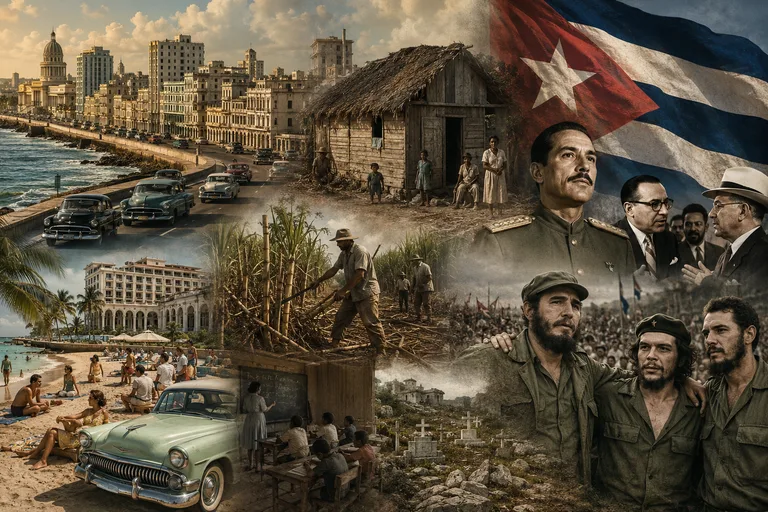
To understand the Cuban Revolution, we must first stop lying about the Cuba that existed before it.
On the eve of Fidel Castro’s victory in January 1959, Cuba was not the tropical paradise sometimes remembered by nostalgic exiles. But neither was it the miserable, backward “brothel of the Western Hemisphere” portrayed by defenders of the Revolution.
Both versions distort the truth.
Pre-Castro Cuba was one of the most modern, prosperous, and socially advanced countries in Latin America. It was also a nation divided by corruption, racial discrimination, rural poverty, political violence, and enormous differences between Havana and the countryside. Not unlike the Untied States just 90 miles away. We must not compare it to the Untied States of today,
It was neither a Paradise nor Hell. It was still a developing country, remembering this is essential.
Cuba did not need to be destroyed and rebuilt as a communist dictatorship. It needed honest government, political stability, rural development, and stronger democratic institutions.
Instead, it got Fidel Castro.
Success by the Numbers
Havana was one of the most dynamic cities in the Western Hemisphere.
Its hotels, theaters, department stores, restaurants, universities, newspapers, radio stations, hospitals, nightclubs, and businesses made it a major commercial and cultural center.
Cuba’s economy had grown rapidly during the first half of the twentieth century, driven largely by sugar exports and close trade with the United States.
By several commonly cited measures, Cuba ranked among the most advanced nations in Latin America:
- Fifth in the Western Hemisphere in per-capita income
- Third in Latin America in life expectancy
- Second in per-capita ownership of automobiles and telephones
- First in television sets per inhabitant
- Fourth in Latin American literacy, with a rate of approximately 76 percent
- Eleventh in the world in doctors per capita
Cuba had modern hospitals, private clinics, universities, professional associations, labor unions, newspapers, radio networks, and a growing middle class.
Many private hospitals and charitable institutions provided services to people who could not afford medical care. Cuban doctors were respected throughout the region. The country’s income distribution, while unequal, compared favorably with that of many other Latin American nations.
For thousands of Cuban families, education and professional employment offered a genuine path toward social advancement.
This was not a failed country.
It was a successful country with serious failures.
Havana Was Not All of Cuba
The greatest mistake anyone can make is to judge pre-1959 Cuba entirely by Havana.
Urban Cuba and rural Cuba often seemed like two different nations.
Havana could resemble a Southern European capital. Some residents enjoyed living standards comparable to those in Spain, Portugal, Greece, and even parts of France.
But in the countryside, especially in isolated sugar-producing regions, many Cubans lived in severe poverty.
Sugar production was seasonal. Cane cutters—the macheteros—might work intensely for only four months of the year. During the remaining months, many had little or no reliable income.
They lived in debt, survived on inconsistent wages, and frequently lacked adequate food, housing, education, sanitation, and medical care.
Some rural children attended school for only a year or two. Others never attended at all. Illiteracy remained common in the most isolated regions.
Hospitals and clinics were concentrated in the cities. Rural families sometimes traveled great distances to obtain medical treatment. Along roads near the Sierra Maestra, small graveyards marked communities where people had died before reaching proper care.
The tragedy was not that Cuba lacked doctors, hospitals, schools, or wealth.
The tragedy was that these resources did not reach everyone.
The Cuba of Two Worlds
Pre-revolutionary Cuba was a nation of striking contrasts.
It had television sets, modern highways, luxury hotels, advanced medical care, and one of Latin America’s strongest middle classes.
It also had dirt-floor homes, malnourished children, seasonal unemployment, and rural families living beyond the reach of basic government services.
Havana was like Miami, while rural Cuba reflected the conditions of say Mississippi
Both realities existed at the same time.
The luxury of Havana did not erase rural poverty.
But rural poverty did not erase Cuba’s national achievements.
Racism and Segregation
Race was another unresolved wound.
Although Cuba had a large Black and mixed-race population, private clubs, neighborhoods, hotels, and beaches were often segregated in practice.
Black Cubans faced discrimination in employment, housing, education, and social life. Even Fulgencio Batista, who was of mixed racial ancestry and became president of Cuba, was reportedly denied membership in one of Havana’s most exclusive clubs.
The Cuban Republic officially celebrated racial equality, particularly because Black and white Cubans had fought together during the wars of independence.
But legal ideals and social reality were not always the same.
The Revolution would later claim that it had completely eliminated racism. That claim was also false. The government suppressed open discussion of racial discrimination by declaring the problem solved.
Pre-Castro Cuba had racial injustice, but again I remember it in the US as well at the time.
A Republic Weakened from Birth
Cuba entered independence carrying the wounds of war.
The long struggle against Spain devastated the countryside, destroyed property, disrupted agriculture, and killed many of the nation’s most capable independence leaders.
José Martí—the intellectual and moral architect of Cuban independence—was killed in battle in 1895. Other leaders of the independence movement were also killed, marginalized, or divided.
When the Republic of Cuba was formally established on May 20, 1902, it lacked a unifying national figure capable of controlling the ambitions unleashed by independence.
The United States also maintained extraordinary influence through the Platt Amendment, which gave Washington the right to intervene militarily under certain circumstances.
The amendment weakened the legitimacy of the Cuban government because it placed a foreign power at the center of Cuban political life.
The United States occupied Cuba from 1906 to 1909 and intervened again during later periods of instability.
The Platt Amendment was abolished in 1934, twenty-five years before Castro took power. It therefore cannot explain or excuse everything that happened after 1959.
But during the early Republic, it contributed to a political culture in which Cuban sovereignty appeared incomplete.
Corruption Became a National Disease
Cuba’s greatest problem was not a lack of potential.
It was bad government.
Election fraud, favoritism, patronage, political violence, and theft repeatedly weakened public confidence in the Republic.
Government positions became opportunities for personal enrichment. Public contracts rewarded political allies. Presidents promised reform and then tolerated corruption within their own administrations.
By the late 1920s, President Gerardo Machado had transformed an elected government into an increasingly repressive dictatorship.
Opposition came from university students, labor unions, political activists, and dissatisfied military officers. In 1933, Machado was finally driven from power.
The fall of Machado created hope—but also chaos.
The Rise of Batista
After Machado’s departure, university professor Ramón Grau San Martín briefly led a nationalist government under the slogan “Cuba for all Cubans.”
But the United States refused to recognize Grau’s government.
Meanwhile, a young army sergeant named Fulgencio Batista emerged as the dominant figure inside the Cuban military.
Batista helped remove Grau and became Cuba’s political strongman, controlling successive governments from behind the scenes.
Yet Batista’s history is more complicated than the cartoon version commonly presented.
In 1940, he was elected president in a legitimate election. His government supported one of the most progressive constitutions in Latin America. Labor rights expanded, the Communist Party participated legally in politics, and Batista completed his term.
When his term ended in 1944, Batista stepped aside and allowed his opponent, Ramón Grau San Martín, to assume the presidency.
For the next eight years, Cuba continued to hold competitive elections.
But democracy was weakened by corruption, patronage, organized political gangs, and violence in the streets and at the University of Havana.
Cuba had democratic institutions.
It simply failed to protect them.
Batista Destroys the Republic
On March 10, 1952, Batista returned to power through a military coup.
The coup canceled elections and destroyed the constitutional order that Batista himself had once helped establish.
This was the decisive rupture.
Batista did not create every problem in Cuba, but his coup convinced many Cubans that elections, courts, laws, and constitutional government could no longer protect them.
Writer Carlos Alberto Montaner described Batista’s coup as the opening of a political Pandora’s box.
Institutions no longer appeared to matter.
Audacity mattered. Violence mattered.
The person willing to break the rules could defeat those still trying to follow them.
That person would be Fidel Castro.
What Cubans Were Fighting For
Between 1952 and 1958, Cubans from nearly every social class opposed Batista.
Students, business owners, workers, professionals, mothers, journalists, politicians, religious leaders, and members of the middle class joined the resistance.
Their public demands were not communism, Marxism, collectivization, one-party rule, or alliance with the Soviet Union.
They spoke about:
- Restoring the 1940 Constitution
- Holding free elections
- Ending corruption
- Protecting human rights
- Reestablishing the rule of law
- Removing Batista
- Returning Cuba to representative government
Many Cubans believed they were participating in a democratic revolution.
That belief explains why Fidel Castro received such broad support.
Castro’s Great Deception
Fidel Castro did not initially present himself to most Cubans as a communist dictator.
He spoke the language of democracy.
He promised constitutional government, social justice, honest leadership, and free elections.
At one point, Castro declared:
“Not Communism or Marxism is our idea. Our political philosophy is representative democracy and social justice in a well-planned economy.”
Those words mattered.
Business owners heard democracy.
Students heard freedom.
Workers heard social justice.
Professionals heard honest government.
Farmers heard land reform.
Political leaders heard a restoration of the constitutional Republic.
Almost no one was publicly being asked to approve a permanent dictatorship, the elimination of private property, political prisons, firing squads, censorship, mass exile, Soviet military dependence, or sixty-seven years of one-family rule.
That was not the revolution most Cubans believed they were supporting.
The Hope of January 1959
When Batista fled Cuba on January 1, 1959, the country celebrated.
Many wealthy and middle-class Cubans welcomed Castro’s victory. Business owners donated money to the revolutionary movement. Professionals offered their expertise. Families voluntarily paid overdue taxes because they believed an honest government had finally arrived.
Professor Marifeli Pérez-Stable recalled that members of her family went out and paid their back taxes because they believed Cuba would finally have a government that would use the money honestly.
That detail tells us something important.
The Cuban people were not demanding the destruction of their country.
They wanted their country repaired.
They did not believe they were surrendering their rights.
They believed their rights were being restored.
They did not believe they were welcoming a communist dictatorship.
They believed they were welcoming a democratic revolution.
The Truth About Pre-Castro Cuba
The truth does not fit comfortably inside propaganda.
Cuba before Castro was not paradise.
It had poverty, racism, inequality, corruption, political violence, organized crime, and a government that failed millions of rural citizens.
But it was not a hopeless or backward nation.
It had a highly educated professional class, modern infrastructure, strong cultural institutions, an energetic private economy, a prosperous middle class, and some of the best social indicators in Latin America.
Its central problem was not capitalism.
Its problem was the failure of political institutions to distribute opportunity, restrain corruption, and defend constitutional democracy.
Cuba needed reform. Cuba needed rural investment.
Cuba needed honest elections. Cuba needed accountable government.
Cuba needed the rule of law.
What Cuba did not need was a dictatorship that would abolish elections, confiscate private property, silence the press, imprison political opponents, drive millions into exile, and blame every failure on a foreign enemy.
The Revolution That Was Stolen
The Cuban Revolution succeeded because it promised to restore the Republic.
Fidel Castro remained in power because he destroyed it.
That is the great tragedy of modern Cuban history.
The people rose against one dictator and received another—more ideological, more ruthless, and far more permanent.
Batista betrayed Cuban democracy with a military coup.
Castro buried it under a revolution.
Pre-1959 Cuba should not be romanticized. Its injustices were real, and its poorest citizens had legitimate reasons to demand change.
But those injustices cannot be used to justify everything that followed.
A country can be imperfect without needing to be destroyed.
A democracy can be corrupt without needing to be replaced by totalitarianism.
And a revolution can begin with the language of freedom while ending with an entire nation in chains.
Cuba needed change. Fidel Castro used that need to take everything.
Havana Vice A playground for the rich

Dialogue from The Godfather Part II (1974) in the Havana rooftop
birthday scene involving Michael Corleone, Hyman Roth, and Johnny Ola
MICHAEL: I came to Havana to see you, Mr. Roth.
ROTH: I'm glad you did. I want you to feel you're among friends here.
MICHAEL: I saw something today… I saw a man die.
ROTH: What happened?
MICHAEL: He was being arrested by the soldiers. Rather than be taken, he exploded a grenade hidden in his coat. He took the captain of the command with him.
ROTH: The rebels are crazy. They don't care about anything.
MICHAEL: Soldiers are paid to fight. The rebels aren't.
ROTH: It won't make any difference. Batista has the army.
"Well we all know what happened after that "-- YNOT!
Once upon a time—not that long ago, and not that far away—Havana glowed. Neon signs buzzed. Jazz spilled out of open doors. Cigars burned slow and confident. The Caribbean air smelled like rum, tobacco, and easy money.
It was the 1940s and ’50s, and Cuba wasn’t poor. It wasn’t frozen. It wasn’t begging.
It was booming.
American mobsters—Meyer Lansky, Lucky Luciano, and their friends in tailored suits—cut deals with Batista, built casinos, luxury hotels, and nightclubs, and turned Havana into the Las Vegas of the Caribbean. Dirty money? Sure. Corruption? Absolutely. But there was also something else: a functioning economy.
With just six million people, Cuba ranked 29th in the world economically. Its GDP per capita beat Ireland and Australia, and doubled Spain and Japan. Most importantly, it had something communism would later erase entirely:
a free market and a merit ladder.
Poor people could climb. Hard work could turn into middle class. Not guaranteed—but possible.
That ladder disappears fast once the state decides it knows better than human nature.
The shadow economy never left—it just changed uniforms
Behind the glamour then, as now, lived the jineteras—women (and men) navigating a dangerous economy with their bodies, charm, and survival instincts. The word comes from jinete, a jockey—someone riding risk for money.
During the mafia era, many were exploited by pimps and corrupt hotel staff who skimmed profits. It wasn’t noble. It wasn’t pretty. But it was tolerated, not criminalized. Havana openly became America’s most popular brothel—not because Cubans were immoral, but because tourists had money and Cubans needed it.
Then came Castro.
To him, the casinos weren’t businesses—they were humiliation. Neocolonial rot. Moral decay. So in one sweeping stroke, the revolution shut them all down. Mobsters fled. Investments vanished. The playground closed overnight.
But Castro didn’t just exile gangsters. He declared a moral revolution.
Prostitution was outlawed. Jineteras were “rehabilitated,” reeducated, surveilled. Some were sent to labor camps. Others to prisons. The state promised dignity through equality—education, healthcare, guaranteed jobs.
And for a while, it worked on paper. Women became doctors, engineers, teachers. Equal pay laws passed. The revolution claimed victory.
But here’s the part ideology hates admitting:
Human need doesn’t disappear just because you ban it.
The Special Period: when slogans don’t fill stomachs
When the Soviet Union collapsed, Cuba collapsed with it. The 1990s Special Period brought hunger, blackouts, desperation. The government quietly reopened the door to tourism—not prosperity, just survival.
And the jineteras came back.
Not in brothels or casinos—but in hotel lobbies, on beaches, in city parks. Nurses. Teachers. Engineers. Women who could earn more in one night than a month working for the state.
Prostitution remained illegal. That made foreigners untouchable and Cubans disposable. If a tourist didn’t pay? Too bad. Reporting it meant prison—for the Cuban.
The message was clear:
The tourist matters. The citizen adapts.
Two women. Two Cubas. Same trap.
One woman, 22 years old, told it plainly:
Working for the state doesn’t even buy shampoo. On the street, a good night is $200–$300—more than doctors earn in a month. She doesn’t call it desperation. She calls it opportunity. Gucci dreams in a peso nightmare.
Another woman, 48 years old, began at 16, during the Special Period. Hunger drove her. Fear followed her. Prison took 14 years of her life. She carries resentment like scar tissue—faded, but permanent.
Same system. Different outcomes. Neither free.
Here’s the part nobody wants to say out loud
Cuba didn’t eliminate prostitution.
It made it riskier, cheaper, and more brutal.
It didn’t protect women.
It removed their legal protection.
It didn’t destroy exploitation.
It shifted all the leverage to foreigners with dollars.
And now, decades later, the quiet truth hangs in the humid air:
A revolution that promised dignity survives on tourism, remittances, and silence.
The irony? Cuban women remain among the most educated in Latin America. Smart. Resourceful. Resilient. But trapped in a system where wages don’t work, money isn’t money, and escape often wears a foreign face.
Havana still dances. Still sings. Still smiles for the camera.
But beneath the rhythm is a lesson written in neon and rust:
You can outlaw markets, but you can’t outlaw human nature. You can ban vice, but you can’t ban hunger.
And when ideology ignores reality long enough—reality always wins.
NEXT in the SERIES on CUBA
CUBA – How did the most beautiful island on Earth become a case study in economic self-destruction?
#Cuba #EconomicHistory #HumanNature #FreeMarkets #Communism #Havana #Jineteras #RealityOverIdeology #LessonsFromHistory
The Man Batista Spared and Miami sent Back to Cuba
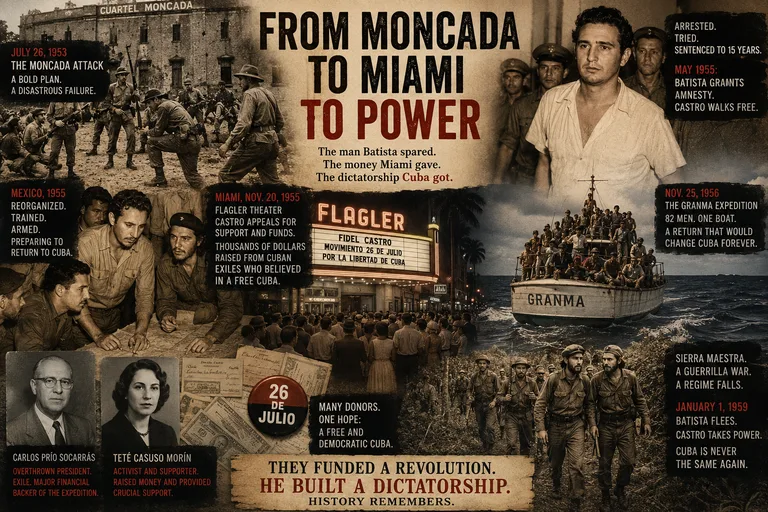
Batista spared Fidel Castro after Moncada. Cuban exiles financed his return. They believed they were funding Cuba’s liberation—only to discover they had financed the man who would imprison the nation. --YNOT!
On July 26, 1953, Fidel Castro led roughly 160 armed followers in coordinated attacks against the Moncada Barracks in Santiago de Cuba and the Carlos Manuel de Céspedes Barracks in Bayamo. The plan was to capture weapons, seize strategic positions, and spark a national uprising against Fulgencio Batista, who had taken power through the military coup of March 10, 1952.
Militarily, it was a disaster.
The convoy became separated, the element of surprise was lost, and Castro’s poorly trained force found itself fighting soldiers inside one of Cuba’s largest military installations. The attack collapsed almost immediately. Many rebels were killed during the fighting, while others were captured and later executed by Batista’s security forces. Castro escaped into the countryside but was arrested several days later. Intervention by Catholic Church figures helped ensure that he was taken alive rather than summarily killed. (PBS CGI)
Castro was placed on trial, where he transformed a failed military operation into a political performance. Acting partly as his own attorney, he delivered the speech later published as “History Will Absolve Me.” He was convicted and sentenced to fifteen years in the Presidio Modelo prison on the Isle of Pines.
Batista’s government was corrupt, authoritarian, and frequently brutal. But it nevertheless gave Castro something Castro would rarely give his own political enemies after taking power: a public trial, a prison sentence, and eventually freedom.
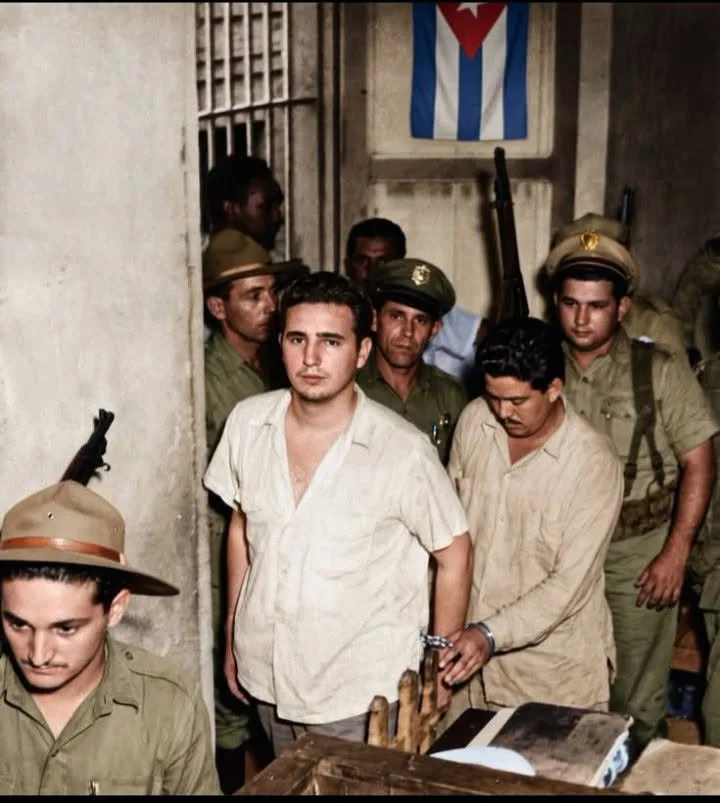
In May 1955, after Castro had served less than two years, Batista declared a general amnesty for political prisoners. The decision was intended partly to soften the government’s authoritarian image and reduce political tensions. Batista apparently believed Castro had been defeated, discredited, and neutralized.
It may have been the most consequential political miscalculation in Cuban history.
From Prison to Mexico
Once free, Castro quickly resumed organizing against Batista. Increasing pressure and surveillance made continued activity inside Cuba difficult, so he departed for Mexico in July 1955.
Mexico—not Miami—became the principal headquarters of the future invasion.
There, Castro reorganized his followers under the name Movimiento 26 de Julio, commemorating the failed Moncada attack. He reunited with his brother Raúl, met Ernesto “Che” Guevara, recruited Cuban exiles, purchased weapons, established safe houses, and arranged military instruction.
The group’s principal trainer was Alberto Bayo, a Spanish Civil War veteran who taught Castro’s men guerrilla tactics, marksmanship, navigation, forced marches, sabotage, and small-unit warfare. Bayo reportedly warned Castro that Moncada had been a reckless frontal assault and that a small revolutionary force could survive only by avoiding conventional battles with Batista’s larger army. (El País)
But soldiers, weapons, transportation, food, documents, communications, and safe houses all required money. Castro therefore traveled to the United States to collect it.
Fidel Castro Comes to Miami
In 1955, Miami was already home to a politically active Cuban community. Many of its members opposed Batista and believed Castro was a young nationalist fighting to restore constitutional government.
On November 20, 1955, Castro and fellow movement leader Juan Manuel Márquez appeared at the Flagler Theater, located at 313 West Flagler Street in downtown Miami.
Approximately one thousand Cubans reportedly attended. Castro appealed for money, organized supporters, and collected thousands of dollars for what the University of Miami’s Cuban Theater Digital Archive describes as the “Revolution-to-come.”
His public message emphasized Cuban dignity, justice for the poor, opposition to corruption, and punishment for officials who had stolen public money. Following the event, supporters created another local club affiliated with the July 26 Movement.
Castro was not standing in Miami openly announcing that he intended to abolish elections, confiscate private businesses, establish a one-party communist state, imprison political opponents, control the press, and govern Cuba for nearly half a century.
He was selling revolution as liberation.
Many of the people who contributed undoubtedly believed they were financing the restoration of the Cuban Republic—not the permanent destruction of it.
Who Funded Fidel’s Return?
Castro’s expedition was not financed by one mysterious sponsor. It was supported by a network of contributors:
Small donors gave money at rallies in Miami, New York, New Jersey, and other Cuban communities. July 26 Movement clubs collected regular contributions. Sympathizers inside Cuba raised money, provided documents and weapons, and maintained the urban underground. As the rebellion expanded, wealthy Cubans, businesses, and political figures also contributed substantial amounts.
One of the most important financial backers was Carlos Prío Socarrás, the constitutional president overthrown by Batista in 1952.
Prío was living in exile and wanted Batista removed. He met Castro and agreed to provide money, arms, and political support. Contemporary accounts describe the yacht Granma as having been purchased with Prío’s financial assistance. The vessel reportedly cost approximately $18,000 to $20,000, although historical accounts differ on the precise amount.
Another important supporter was Cuban writer and activist Teresa “Teté” Casuso Morín, who helped raise money, arrange assistance, and support preparations for the expedition. Castro later personally acknowledged the importance of her help. She eventually broke with his government after witnessing its increasingly dictatorial direction.
The great historical irony is that much of the money that helped Castro return came from Cubans who believed they were financing democracy.
Some were former officials. Some were wealthy opponents of Batista. Some were workers giving small contributions at exile meetings. Some were idealists who accepted Castro’s promises. Many would later lose their homes, businesses, freedom, or country to the government their donations helped place in power.
The Granma Expedition
On November 25, 1956, Castro and 81 other men crowded aboard the Granma, a yacht designed to carry far fewer passengers, and departed from Tuxpan, Mexico.
The voyage was slow and miserable. The overloaded yacht reached Cuba on December 2, later than planned. The expedition missed its coordination with the urban uprising organized inside Cuba, landed in difficult terrain, and was quickly attacked by Batista’s forces.
Once again, Castro’s military operation nearly ended in complete destruction.
Most of the expeditionaries were killed, captured, or scattered. Only a small group—including Fidel, Raúl, Che Guevara, Camilo Cienfuegos, and Juan Almeida—eventually regrouped in the Sierra Maestra. From there, they built the guerrilla campaign that culminated in Batista’s flight on January 1, 1959. (Reuters)
The Fatal Irony
Fidel Castro did not reach power because he was an undefeated military genius.
Moncada was a failure. The initial Granma landing was another failure.
What distinguished Castro was his ability to survive failure, convert defeat into mythology, attract money from people with different political objectives, and present himself as whatever his audience wanted him to be.
To nationalists, he was a follower of José Martí.
To democrats, he promised constitutional government.
To the poor, he promised justice.
To former politicians such as Carlos Prío, he was a weapon against Batista.
To Cuban exiles in Miami, he appeared to be a young patriot collecting money to liberate their homeland.
Batista gave Castro his life, a trial, and eventually his freedom. Cuban donors gave him money. Mexico gave him a place to organize and train. And Castro used every opportunity until he possessed enough power to deny those same opportunities to almost everyone who opposed him.
The man spared after Moncada returned aboard a boat financed by people who thought they were buying Cuba’s freedom. What they helped finance instead was a dictatorship that would outlive both Batista and nearly every person who contributed to it.
July 26: The Day Cuba’s Destruction Began
“I am not a Communist, and neither is the evolutionary movement.” —Fidel Castro, July 17, 1959

That was perhaps the greatest lie ever told by the 26th of July Movement. Castro did not reveal the truth until Cuba was already under his control.
The Cuban dictatorship celebrates July 26 as the beginning of its revolution.
It should be remembered as the beginning of Cuba’s catastrophe.
On July 26, 1953, an armed group led by Fidel Castro attacked the Moncada Barracks in Santiago de Cuba and the Carlos Manuel de Céspedes Barracks in Bayamo. The assault failed militarily, but it created the mythology that Castro later used to seize power, destroy the Cuban republic, and imprison an entire nation.
The regime calls July 26 a heroic date. It was not heroic.
It was the birth of a movement that would replace an unconstitutional government with a permanent totalitarian state.
Batista’s Coup Was Illegal. Castro’s Dictatorship Was Worse.
Fulgencio Batista’s coup on March 10, 1952, was illegal, unconstitutional, and damaging to Cuba’s democratic institutions.
But the dishonest history written by the Castro regime pretends that Cuba before 1959 was already a totalitarian prison.
It was not.
Under Batista, Cubans still had freedoms that disappeared completely after Castro took power.
Journalists criticized the government. Opposition politicians spoke publicly.
Magazines published attacks against Batista. Television programs questioned officials and debated national policy.
Political organizations operated. Civic institutions existed outside government control.
Batista could be criticized in public, opposed in print, and condemned on television.
Under Castro, criticism became a crime.
That is the difference between an authoritarian government and a totalitarian state.
Batista violated the constitutional order. Castro destroyed it.
Batista interrupted democracy.
Castro abolished it.
Batista ruled for years. Castroism enslaved generations.
The 26th of July Movement Did Not Restore Cuba
The 26th of July Movement claimed to fight for democracy, constitutional government, and national dignity.
Those promises were a fraud. The movement did not restore the republic.
It buried it. It did not return power to the people.
It concentrated power in one man.
It did not liberate Cuba. It converted Cuba into a police state.
The movement carried out bombings and violent actions in public places, exposing civilians to danger in cinemas, restaurants, shops, cafés, parks, and other spaces where ordinary people gathered.
This was not simply resistance against a military government.
It was a campaign to create fear, disorder, and political power.
Other anti-Batista groups directly confronted the government and military leadership. The Revolutionary Directorate of March 13 attacked the Presidential Palace and placed its own members at risk in an attempt to remove Batista.
Castro’s movement built a political mythology around violence and then used that mythology to justify absolute power.
Fidel Castro Lied His Way Into Power
Fidel Castro repeatedly denied being a communist.
He claimed to support democracy.
He promised elections. He invoked the Constitution.
He presented himself as a nationalist reformer.
These were not misunderstandings. They were lies.
He told the Cuban people what they needed to hear until he no longer needed their consent.
Once in power, he eliminated elections, destroyed political parties, confiscated private property, closed independent newspapers, silenced unions, imprisoned opponents, executed enemies, and forced hundreds of thousands of Cubans into exile.
Only after consolidating control did he openly declare himself a Marxist-Leninist.
The deception was complete.
He did not reveal his true project until Cuba had already been captured.
Then the Soviet Union gave him the money, weapons, intelligence, and political support needed to preserve the dictatorship.
What began as a promise of national renewal became a foreign-supported system of repression.
Castro did not free Cuba from dependency.
He made Cuba dependent on the Soviet empire.
Later, the regime survived on Venezuelan oil, foreign subsidies, remittances, tourism, and the exploitation of Cuban labor.
The dictatorship has always survived by consuming resources created by others.
The Revolution Created a New Aristocracy
The revolution claimed to destroy privilege.
Instead, it changed who was privileged.
The old elite was replaced by a political, military, and security caste that lived above the population and outside the rules imposed on everyone else.
The ruling class gained access to superior homes, imported food, private medical care, restricted resorts, foreign travel, government vehicles, special stores, and economic opportunities denied to ordinary Cubans.
They lived in Miramar, Atabey, Siboney, Cubanacán, Kohly, Nuevo Vedado, and other protected enclaves while ordinary families struggled for food, electricity, medicine, transportation, and basic dignity.
This was never a dictatorship of the proletariat.
It was a dictatorship over the proletariat. The workers did not gain power.
The workers lost the right to organize.
The farmers did not gain land. The state took control of production.
The poor did not become prosperous. They became permanently dependent.
The revolution did not eliminate inequality. It replaced economic inequality with political apartheid.
Those loyal to the system received access. Those who resisted were punished.
The Police Do Not Protect the People
The regime calls its force the National Revolutionary Police.
The name exposes the truth. A national police force serves the nation.
A revolutionary police force serves the regime.
Cuba’s police, Ministry of the Interior, and State Security do not primarily exist to defend citizens.
They exist to defend the dictatorship from the citizens. They monitor neighborhoods.
They interrogate dissidents. They harass families. They infiltrate opposition groups.
They threaten artists. They silence journalists. They beat protesters.
They imprison political opponents. They criminalize speech.
They punish independent thought They enforce fear.
They are not guardians of law. They are guardians of power. Their purpose is not justice.
Their purpose is obedience.
July 26 Led Directly to National Ruin
The consequences of July 26 are visible everywhere.
Political executions. Prisons filled with dissidents.
Confiscated homes and businesses.
Censored newspapers. Destroyed institutions.
Broken families. Millions in exile. Thousands lost at sea.
A nation divided between those trapped inside and those forced to rebuild their lives abroad.
Cuba became a country where leaving was often the only path to freedom.
A country where the government controlled employment, education, food, housing, travel, information, and speech.
A country where survival depended on silence. A country rich in talent but trapped in poverty.
A country that once attracted immigrants and became a country people risked death to escape.
This is the legacy of July 26.
Not dignity. Not sovereignty. Not equality. Ruin.
The Regime Celebrates Because July 26 Gave It Power
The dictatorship celebrates July 26 because it marks the origin of its authority.
The Cuban people should remember it as the origin of their captivity.
The attack on the barracks was not the liberation of Cuba.
It was the opening chapter of a political project that would destroy the republic and replace it with a hereditary ruling system protected by soldiers, police, propaganda, prisons, and fear.
Batista’s coup created a crisis. Castro turned that crisis into national destruction.
Cuba needed constitutional restoration. Castro delivered communist dictatorship.
Cuba needed elections. Castro delivered one-party rule.
Cuba needed law. Castro delivered political terror.
Cuba needed reform. Castro delivered exile, poverty, censorship, and death.
The Saddest Day in Cuban History
July 26 should never be celebrated by anyone who values liberty.
It should be remembered as a warning about how nations are lost.
They are lost when violence is romanticized.
They are lost when political lies are mistaken for hope.
They are lost when a charismatic leader demands trust without limits.
They are lost when people excuse crimes because they despise the government being attacked.
They are lost when the promise of justice becomes an excuse for absolute power.
The Cuban tragedy did not begin on January 1, 1959.
By then, the machinery was already in motion.
It began on July 26, 1953, when a failed attack became a revolutionary myth, and that myth became the weapon used to conquer a nation.
For the regime, July 26 is a holiday. For Cuba, it is a funeral date.
It marks the beginning of executions, prisons, confiscation, exile, separation, hunger, censorship, fear, and sixty-seven years of national humiliation.
There is nothing heroic about it. There is nothing glorious about it. There is nothing to celebrate.
July 26 was not the day Cuba began to rise. It was the day Cuba began to fall.
May God free the Cuban people, reunite the Cuban nation, punish those responsible for its destruction, and bring this long nightmare to an end.
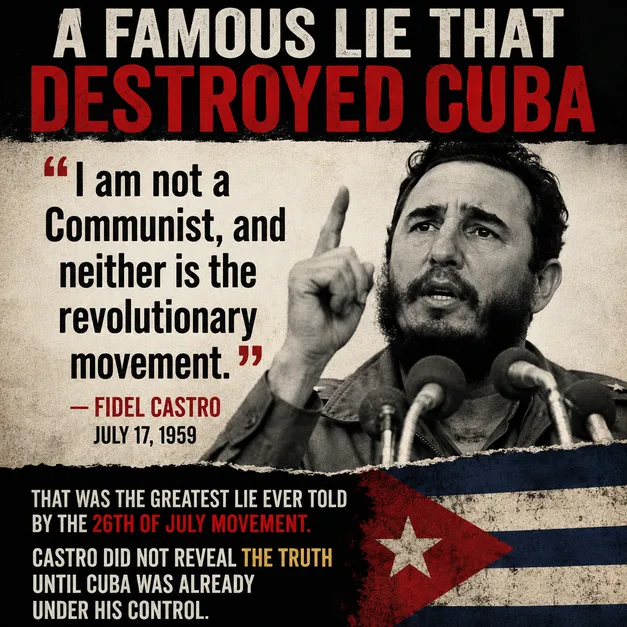
Che Guevara: Revolutionary Soldier, Executioner, Architect of Violence and Death
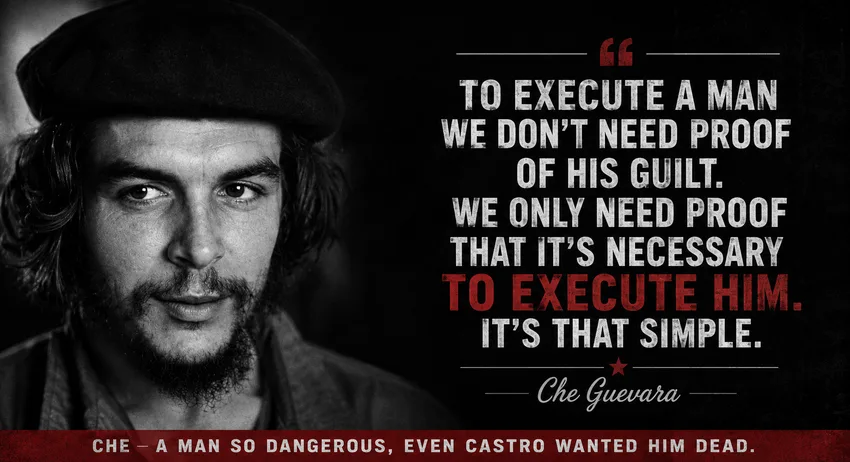
Ernesto “Che” Guevara is often presented as a romantic rebel: the bearded doctor who abandoned comfort to fight injustice, became a commander in the Cuban Revolution, and died attempting to spread revolution abroad.
That image leaves out the central fact of his adult life.
Che Guevara was a professional revolutionary who believed political violence was not merely unavoidable but necessary. He fought as a guerrilla commander, imposed severe discipline on his own men, participated in executions during the insurgency, supervised revolutionary tribunals after victory, and spent his final years trying to create new wars in Africa and Latin America.
He was a physician by training, but soldiering became his vocation.
From Medical Student to Marxist Revolutionary
Ernesto Guevara was born in Rosario, Argentina, on June 14, 1928. He studied medicine at the University of Buenos Aires and traveled extensively through Latin America as a young man.
Those travels exposed him to poverty, inequality, political instability, and foreign economic influence. He increasingly interpreted Latin America through Marxist ideas, concluding that existing governments and institutions could not be reformed gradually. In his view, they had to be overthrown through armed revolution.
A decisive experience came in Guatemala in 1954, when the government of Jacobo Árbenz was overthrown after a CIA-backed intervention. Guevara emerged from Guatemala convinced that revolutionary governments could survive only if they destroyed their enemies, armed their supporters, and resisted compromise.
This lesson shaped everything that followed.
He did not become a democratic socialist or a reformer.
He became an advocate of revolutionary warfare.
Joining Fidel Castro
In Mexico City in 1955, Guevara met Fidel Castro and joined the July 26 Movement, which was preparing an armed expedition against Cuban dictator Fulgencio Batista.
Che originally joined as the group’s doctor. After the rebels landed in Cuba aboard the Granma in December 1956 and were nearly annihilated, the survivors retreated into the Sierra Maestra.
There, Guevara ceased functioning primarily as a physician and became a combatant.
He later described the symbolic moment when, under fire, he chose a box of ammunition over a medical bag. Whether treated literally or as personal mythology, the story captures the identity he adopted: he was no longer simply a doctor accompanying soldiers. He had chosen to become a revolutionary soldier.
Che proved disciplined, physically courageous, intellectually committed, and ruthless. Castro promoted him to comandante, the highest field rank in the rebel army.
Discipline Through Fear
Che’s guerrilla command was not democratic.
He believed a revolutionary army required absolute discipline. Desertion, betrayal, theft, disobedience, and collaboration with the enemy could be punished severely, including by death.
The best-documented personal execution occurred during the Sierra Maestra campaign. A peasant guide and rebel informant named Eutimio Guerra was accused of betraying rebel positions to Batista’s forces. Guevara wrote in his own account that he shot Guerra in the head.
This matters because it removes any argument that Che was only an administrator who never personally killed prisoners.
He personally carried out at least one documented execution.
Other killings attributed directly to him remain disputed or are based on testimony that is harder to verify. It is therefore more accurate to say that the documentary record conclusively establishes his personal execution of Guerra, while broader claims about large numbers personally shot by Che are not supported with the same certainty.
What is not disputed is that Che accepted execution as a legitimate instrument of revolutionary command.
A Guerrilla Commander in Cuba
Che became one of the revolution’s most important field commanders. His column conducted ambushes, sabotage, raids, forced marches, and attacks against government positions.
His most celebrated military operation came during the final rebel offensive in 1958. Che led Column 8 from the Sierra Maestra toward central Cuba, establishing operations in the Escambray region and advancing toward Santa Clara.
In December 1958, rebel forces attacked Santa Clara, a strategically important city. Che’s fighters helped derail an armored train carrying soldiers, weapons, and supplies. The collapse of government resistance in Santa Clara contributed to Batista’s decision to flee Cuba on January 1, 1959.
The victory transformed Che from guerrilla commander into one of the new regime’s most powerful men. It also gave him control over prisoners and defeated enemies.
La Cabaña and the Revolutionary Tribunals
After Batista fled, Che was placed in command of La Cabaña fortress in Havana.
The fortress became one of the principal locations for revolutionary imprisonment, trials, and executions during the first months of 1959.
Che’s responsibility was not incidental. He supervised the prison, oversaw the revolutionary tribunal system operating there, reviewed appeals, and held authority within a process that regularly imposed death sentences.
The defendants included members of Batista’s military, police officers, alleged torturers, informants, political enemies, and others accused of crimes against the revolutionary movement. But it included many others that simply disagree with the new regime.
The tribunals frequently lacked the safeguards expected in an independent judicial system. They were military proceedings conducted by the victorious revolutionary forces. Judges were aligned with the new government. Trials could be rapid. Political pressure was intense. Appeals ultimately passed through revolutionary authorities rather than an independent judiciary.
Contemporary reporting described hundreds of executions across Cuba during the opening months of the new regime. TIME reported in January 1959 that more than 200 men had already been executed after summary revolutionary trials.
Estimates of the number executed specifically under Che’s jurisdiction at La Cabaña vary substantially. Published estimates commonly range from approximately 55 to more than 100, depending on how researchers define his period of command and whether they count sentences approved under his authority but carried out in his absence.
Claims that Che personally shot 175 prisoners at La Cabaña, or personally executed 23 at Santa Clara and 14 in the Sierra Maestra, require stronger documentation than is usually supplied with those figures. His direct responsibility for supervising and approving executions is well established; precise claims that he personally fired the weapon in dozens or hundreds of cases are much harder to substantiate.
Was It Justice or Murder?
Supporters call the La Cabaña executions revolutionary justice.
They argue that Batista’s police and military had tortured and killed Cubans, that the public demanded punishment, and that the revolutionary government was prosecuting war criminals whom the previous system would never have punished.
That explanation provides historical context, but it does not erase the nature of the system Che administered.
The revolutionary government acted simultaneously as accuser, prosecutor, judge, appellate authority, and executioner.
The outcome was often decided by men whose stated mission was not impartial justice but the consolidation and defense of the revolution.
Che was not troubled by this conflict.
He openly defended firing squads as necessary. He regarded opposition to the revolution not simply as political disagreement but as participation in a struggle in which one side had to defeat and eliminate the other.
In a revolutionary system, the distinction between a genuine war criminal and a political enemy can disappear very quickly. Che helped create precisely that kind of system.
Whether every condemned man was innocent is not the relevant question. Many may have been guilty of serious abuses. The central problem is that guilt and punishment were determined through a politicized process controlled by the victorious armed movement.
Che knowingly participated in, ordered, approved, and defended lethal political violence outside the standards of an independent civil judiciary.
Violence as Revolutionary Purification
Che did not regard violence as a regrettable temporary measure.
It occupied an important place in his revolutionary philosophy.
He believed armed struggle transformed the fighter. The guerrilla was not merely a soldier attempting to defeat an opposing army. He was supposed to become a new kind of human being, purified through sacrifice, discipline, ideological commitment, and hatred of the enemy.
Che’s writings praised hatred as a force that could turn a revolutionary into an effective, selective, and cold killing machine.
This is essential to understanding him. His violence was not simply tactical.
It was ideological.
He believed that revolutionary morality was superior to ordinary legal morality. Actions that would otherwise be condemned—execution, coercion, confiscation, political imprisonment, and war—became justified when performed in defense of the revolution.
That belief placed no stable limit on violence except the needs of the revolutionary cause.
Government Official, Still a Soldier
After the consolidation of Castro’s government, Che held several major positions. He became president of the National Bank of Cuba and later minister of industries.
These roles did not represent a departure from his revolutionary mission.
He promoted rapid nationalization, centralized economic control, collectivist labor incentives, and the creation of a communist state aligned with the Soviet bloc.
He remained deeply hostile to the United States and supported the international export of revolution.
Economic administration did not suit him as well as warfare. Cuba suffered from low productivity, disorganization, failed industrial ambitions, and increasing dependence on Soviet assistance.
Che increasingly viewed bureaucratic office as spiritually empty. He wanted to return to armed struggle.
The Congo Campaign
In 1965, Che secretly left Cuba and traveled to the Congo to support Marxist insurgents fighting the government associated with Moïse Tshombe and Joseph Mobutu.
He believed the Congo could become a base for continental African revolution.
The mission was a failure.
Che arrived with a small group of Cuban fighters and attempted to train and organize local Simba rebels. He encountered poor discipline, internal rivalries, weak command structures, limited popular support, and military pressure from opposing forces.
His Congo diary reflects his frustration with the fighters he had come to assist. He blamed factionalism, disorder, lack of commitment, and ineffective leadership.
The campaign demonstrated one of Che’s most persistent errors: he assumed that a determined revolutionary nucleus could generate a broader uprising even when local political and social conditions were unfavorable.
The National Security Archive describes the Congo expedition as part of Che’s attempt to export guerrilla warfare and notes that he later carried veterans of that failed mission into Bolivia. (National Security Archive)
He withdrew from the Congo in defeat. But he did not abandon the strategy.
The Bolivian Disaster
Che next attempted to establish a guerrilla movement in Bolivia.
He entered the country secretly in 1966 and organized the National Liberation Army of Bolivia. His force began with only a few dozen fighters, including Cubans, Bolivians, and other foreign revolutionaries.
The operation was strategically weak from the beginning. The guerrillas had limited local support.
The Bolivian Communist Party did not provide the cooperation Che expected.
Many peasants distrusted the outsiders.
Communications failed. Supply lines became fragile. The guerrillas were increasingly isolated.
The Bolivian army, assisted by U.S. intelligence and American-trained personnel, gradually closed in on them.
Che’s theory assumed that guerrilla action itself could create revolutionary conditions. Bolivia demonstrated the weakness of that assumption. A small armed group could not simply manufacture a mass political movement by entering a rural region and beginning a war.
Declassified records describe a campaign plagued by strategic errors, dependence on an unresponsive peasant population, and the near impossibility of extracting the leadership once the guerrillas became surrounded. (National Security Archive)
On October 8, 1967, Bolivian troops wounded and captured Che near Quebrada del Yuro.
He was taken to a small schoolhouse in La Higuera.
The following day, on orders from the Bolivian government, Sergeant Mario Terán shot him.
Che, who had approved and defended executions in Cuba, died by summary execution himself.
From Defeated Guerrilla to Global Icon
Che’s Bolivian campaign recruited few local supporters and ended with the destruction of his force.
Militarily, it was a complete failure. But his death transformed him.
The famous photograph taken by Alberto Korda years earlier became an international emblem of rebellion. Posters, books, films, shirts, banners, and political movements converted a hardened Marxist soldier into an abstract symbol of resistance.
The commercial image concealed the historical man.
The poster did not show Eutimio Guerra lying dead after Che shot him.
It did not show the firing squads at La Cabaña.
It did not show prisoners awaiting revolutionary tribunals.
It did not show the failed Congo expedition.
It did not show Bolivian peasants refusing to join his revolution.
It showed only the face.
Che’s greatest victory came after his death, when visual mythology separated him from the political violence he practiced and defended.
Soldier or Murderer?
Che Guevara was unquestionably a soldier.
He fought in the Cuban Revolution, commanded guerrilla columns, conducted military operations, endured severe physical conditions, and repeatedly exposed himself to death.
He was also an executioner. He personally killed at least one accused traitor in a documented summary execution.
He commanded a fortress where prisoners were condemned and shot.
He reviewed and approved death sentences.
He defended firing squads as necessary instruments of revolution.
He attempted to initiate additional wars in countries where the population had not invited him and where his campaigns produced further death.
The most precise description is not that Che was merely a “mass murderer,” because that phrase often combines documented acts with inflated or poorly sourced numerical claims.
The more historically defensible conclusion is severe enough:
Che Guevara was a committed revolutionary warrior who personally participated in killing, exercised command responsibility over political executions, rejected liberal standards of due process, and treated organized violence as an indispensable instrument for creating and preserving a communist state.
He was not simply a physician who happened to become involved in a revolution.
He chose the gun. He became a commander. He administered firing squads.
And after gaining power, he devoted the remainder of his life to creating new battlefields where more people would kill and die for his ideology.
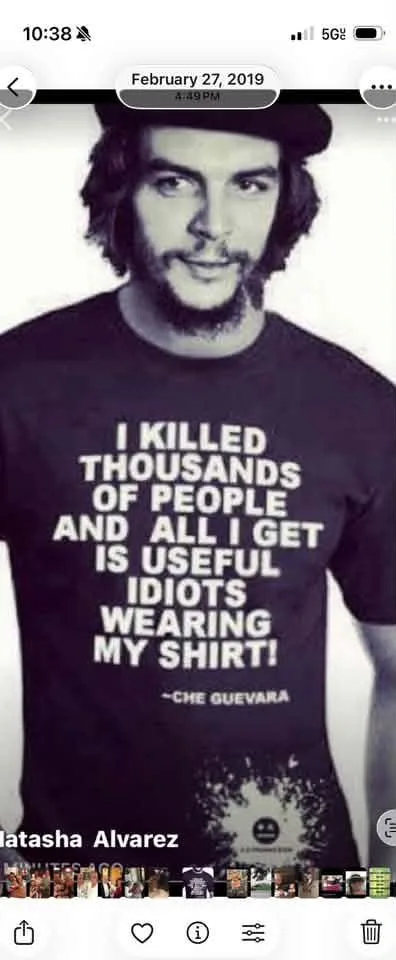
How and Why Che Died in Bolivia: Betrayed by His Own People
Ernesto “Che” Guevara did not die in Bolivia as the clean revolutionary legend printed on posters and T-shirts. He died abandoned, hunted, captured, and executed in a remote village far from the Cuban revolution he helped build. The official mythology says Che was a heroic guerrilla who fell fighting imperialism. The darker possibility is that Che was sent into a trap — or at least sent into a doomed mission by people who no longer wanted him around.
By the mid-1960s, Che Guevara had become more than a revolutionary commander. He had become an international symbol. To young radicals around the world, Che was the romantic face of revolution: the bearded fighter, the man of action, the ideologue willing to export armed struggle everywhere. But inside Cuba, that fame may have become dangerous.
Fidel Castro was not a man who shared the spotlight easily. Revolutions often begin with brotherhood, but they rarely end that way. Once power is captured, yesterday’s comrade can quickly become tomorrow’s rival.
Che was too famous, too radical, and too independent. He was openly impatient with Soviet-style compromise. He criticized the Soviet Union and wanted revolution exported aggressively across Latin America and Africa. But Cuba, by then, was becoming increasingly dependent on Moscow for money, oil, weapons, and survival. Fidel needed Soviet support. Che’s romantic global crusade was becoming inconvenient.
After Che’s failed mission in the Congo, the question became: where would he go next?
Public records confirm that Fidel steered Che toward Bolivia. That fact matters. Bolivia was not Che’s natural battlefield. It was landlocked, isolated, difficult terrain, and lacked the kind of broad revolutionary support Che had counted on. Unlike Cuba’s Sierra Maestra, Bolivia did not produce a popular uprising around him. The local Communist Party was divided. The peasants did not rally to him. His guerrilla band became isolated, hungry, sick, and increasingly exposed.
In other words, Bolivia was a bad place for Che to survive — but a very convenient place for him to disappear.
According to Félix Rodríguez, the Cuban-American CIA operative who was present when Che Guevara was captured in Bolivia, Che’s end was not simply a battlefield accident. According to Rodríguez, Castro’s own circle wanted Che gone. By the mid-1960s, Che had become too famous, too radical, and too inconvenient for Fidel Castro, especially as Cuba became more dependent on the Soviet Union.
Public records confirm that Fidel steered Che toward Bolivia, that Che had become a liability, and that the CIA and Bolivian military hunted him down there. Someone from Castro’s side helped make sure the CIA knew where to find him.
It proves the old rule of revolutions: among murderers, loyalty lasts only until one man becomes a threat to another.
Che arrived in Bolivia in disguise in 1966. He tried to create a new revolutionary front, but the mission went badly almost from the beginning. His group was small. His radio communications failed. His supply lines collapsed. The local Communist Party did not fully support him. The peasants often feared him more than followed him. Instead of becoming the spark of a continental revolution, Che became a fugitive moving through hostile terrain.
The CIA, working with Bolivian intelligence and the Bolivian military, tracked the guerrilla movement. The United States did not want another Cuba in Latin America. Bolivia’s government wanted the rebellion crushed. Che was no longer the hunter. He was the hunted.
On October 8, 1967, Che’s guerrilla column was surrounded in the Quebrada del Yuro. He was wounded, his rifle was damaged, and he was captured by Bolivian soldiers. The great revolutionary commander, the man who had helped bring firing squads to Cuba, was taken alive.
The next day, October 9, 1967, Che was held in a small schoolhouse in La Higuera. Félix Rodríguez was there. He spoke with Che before the execution. The Bolivian high command gave the order: Che was to be killed, not kept alive for trial.
That detail is important. A public trial would have turned Che into a global platform. It would have embarrassed governments, exposed intelligence operations, and given Che one last stage. Dead, he was easier to control. Alive, he was dangerous.
Bolivian Army Sergeant Mario Terán Salazar carried out the execution. Che was shot in the schoolhouse, and the government tried to make it look like he had died from combat wounds.
But Che did not die in battle. He was captured alive. He was executed.
The irony is impossible to ignore. Che Guevara had personally killed suspected traitors during the Cuban guerrilla war. After Castro took power, Che oversaw executions at La Cabaña prison. He defended revolutionary killing as necessary. He believed violence was the engine of history.
Then history returned the favor.
The revolution that Che helped build did not protect him. The comrades he served did not save him. The system of ruthless power he believed in eventually treated him the same way it treated others: as disposable.
That is the lesson behind Che’s death in Bolivia. It was not just the death of a guerrilla fighter. It was the collapse of the romantic lie around revolution. These movements talk about justice, brotherhood, liberation, and sacrifice. But once power is involved, the brotherhood ends. The purges begin. The rivals disappear. The loyal soldier becomes a problem. The icon becomes competition.
Fidel Castro turned Che into a martyr after his death because a dead Che was useful. A dead Che could be printed on banners, quoted in speeches, and sold as revolutionary mythology. A living Che was unpredictable. A living Che had opinions. A living Che had followers. A living Che could challenge the direction of the Cuban revolution.
So Che’s death served everyone except Che.
The Bolivian government eliminated an insurgent. The CIA removed a revolutionary threat. Castro inherited a martyr without having to live with the man.
That is why the story matters.
Che Guevara died in Bolivia not simply because his guerrilla mission failed, but because he became isolated from the very revolution he helped create. Che was sent into a battlefield where he had little support, few exits, and many enemies – betrayed by his own.
In the end, Che learned the oldest rule of revolutionary power too late:
The revolution does not love its soldiers. It uses them.
And when they become inconvenient, it buries them.
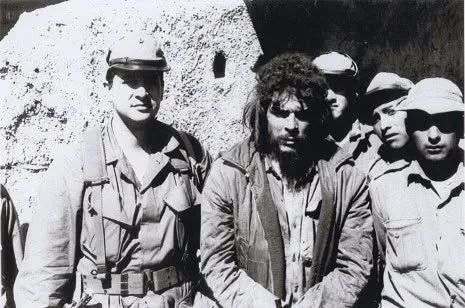
Los Hijos del Cielo Operation Pedro Pan and the Children Who Flew Alone
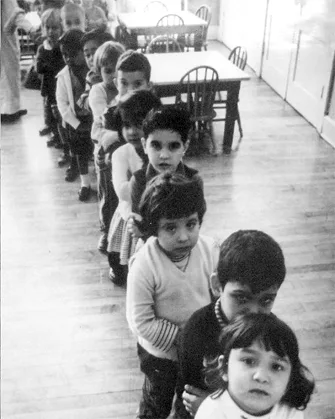
There are moments in the history of a country that cannot be measured by elections, armies, speeches, or revolutions.
They are measured by something much smaller. A suitcase. A passport.
A photograph folded into a shirt pocket.
A mother standing behind a glass partition at an airport, watching her child walk away.
Between 1960 and 1962, 14,048 Cuban children arrived in the United States without their parents in an extraordinary exodus that became known as Operation Pedro Pan — Operación Pedro Pan. The National Archives describes it as the largest recorded exodus of unaccompanied minors in the Western Hemisphere.
They were not orphans. Their parents were alive.
That was precisely what made Pedro Pan so extraordinary.
Thousands of Cuban mothers and fathers voluntarily placed their sons and daughters aboard airplanes and sent them to another country because they had reached the conclusion that separation was safer than keeping their family together.
To understand why parents would do something so painful, one must understand Cuba in the first years after the revolution.
And one must understand fear.
The Revolution Comes Home
When Fidel Castro’s rebels entered Havana in January 1959, there was genuine celebration throughout Cuba.
Fulgencio Batista was gone. His government had become synonymous with corruption, political repression, cronyism, and brutality. Cubans from very different social classes had reason to believe that something better might replace it.
The revolution initially spoke the language of restoration: democracy, justice, nationalism, honest government.
But revolutions rarely remain what everyone imagined them to be.
Within two years Cuba was undergoing a transformation far more profound than simply replacing one president with another. Private property was being nationalized. Political opponents were being imprisoned or driven into exile. Independent political institutions disappeared. Cuba moved increasingly toward the Soviet Union, and the revolutionary government began extending its authority deeply into education, religion, economic life, civic organizations and the family.
Education became one of the principal instruments of revolutionary transformation. By the spring of 1961, almost all private schools had been taken over by the government, and education had become state controlled. (U.S. Marine Corps)
This mattered enormously in Cuba.
Catholic schools had educated generations of Cuban children. Schools such as Belén, La Salle, the Ursuline academies, and countless smaller religious institutions were not simply places where mathematics and grammar were taught. They were woven into family identity, religion, class, neighborhood and tradition.
When the state took control of education, many parents interpreted the change as something larger:
The revolution was no longer simply governing Cuba. It was beginning to shape the Cuban child.
And once that fear entered the home, politics became intensely personal.
¿Qué Van a Hacer Con Nuestros Hijos?
What are they going to do with our children?
Rumors spread quickly.
Parents heard that children might be removed from their homes.
They heard that teenagers might be sent to agricultural camps.
They heard that Cuban children might be sent to the Soviet Union.
They heard that the government intended to abolish patria potestad — the traditional legal authority of parents over their children.
Eventually, copies of what purported to be a new Cuban law began circulating. According to the document, parents would lose authority over their children and the state would assume responsibility for their education and development.
The document was false.
Modern scholarship has established that the supposed law abolishing patria potestad was fabricated and circulated by anti-Castro opponents. Historian Deborah Shnookal’s research traces the rumor campaign and the distribution of a fake law; anti-Castro broadcasts, including material transmitted by CIA-backed Radio Swan, also amplified fears surrounding parental authority. (University Press Scholarship)
That fact is important.
But stopping the story there creates another distortion.
The false document circulated within a society in which genuine and dramatic changes were already occurring.
Private schools really were being taken over.
Religious institutions really were under pressure.
The government really was creating a centralized educational system.
Political loyalty increasingly mattered.
Children really were being mobilized into revolutionary organizations and national campaigns.
Families could see the state acquiring powers it had never possessed before. (U.S. Marine Corps)
So the historical distinction matters:
The specific law supposedly abolishing parental rights was false.
The broader fear of an increasingly powerful revolutionary state was real.
For a mother sitting at her kitchen table in Havana in 1961, that distinction may not have been particularly comforting.
She did not have historians, declassified archives, or the Internet available to determine what was propaganda and what was true.
She had rumors.
She had neighbors disappearing.
She had schools changing.
She had relatives leaving.
She had speeches on the radio.
And she had children asleep in the next room.
The Impossible Question
Imagine the conversation.
Not because we know the precise words spoken inside every Cuban household, but because thousands of families eventually faced essentially the same decision.
The children have gone to bed.
The radio is turned down.
The parents speak quietly.
Should we send them?
The father may believe everything will settle down.
The mother may believe the situation is becoming worse.
Perhaps an uncle has already left for Miami.
Perhaps a neighbor has been arrested.
Perhaps the family business has been confiscated.
Perhaps an older son is becoming involved with the underground.
Perhaps the parents themselves are involved.
Perhaps there is no dramatic event at all.
Only fear.
What happens if we wait?
And then the question that must have seemed unimaginable:
Could good parents deliberately send their children away?
The answer thousands of Cuban parents eventually reached was yes.
Not because they wanted separation.
Because they believed separation might be temporary.
And because they believed staying might be worse.
A Priest in Miami
The operation that would eventually move more than fourteen thousand children began relatively quietly.
One of its central figures was Father Bryan O. Walsh, an Irish-born Catholic priest working with the Catholic Welfare Bureau in Miami.
Another was James Baker, headmaster of Ruston Academy, an American school in Havana. Baker was encountering Cuban families who wanted to send their children to the United States but faced a fundamental problem: after relations between Washington and Havana deteriorated, obtaining ordinary immigration documentation became increasingly difficult.
The emerging network brought together Cuban families, underground organizers, religious organizations and American officials.
The U.S. government provided significant assistance and funding, while Catholic welfare agencies developed the infrastructure to receive children who arrived without relatives waiting for them. The National Archives describes Pedro Pan as a program partially financed by the federal government. (National Archives)
The operation’s formal administrative history is complicated.
Its human purpose was simple.
Get the children out.
Inside Cuba, contacts helped obtain the necessary documentation and delivered it discreetly to families.
Parents purchased airline tickets when they could.
Names were placed on lists.
Instructions were passed quietly.
And soon children began appearing at Havana’s airport carrying suitcases.
Peter Pan
The official American effort was commonly referred to as the Cuban Children’s Program.
But another name took hold:
Pedro Pan.
Peter Pan was the fictional boy who could fly away from home.
For Cuban children, the Spanish name transformed the fantasy into something painfully real.
These children could indeed fly.
But there was no Neverland waiting for them.
There was Miami.
There were refugee camps.
There were foster homes.
There were relatives they had never met.
There were strangers speaking English.
And there was an unanswered question:
When are my parents coming?
José Martí Airport
This is where the political history of Pedro Pan becomes something else.
Because sooner or later, every document, every government program and every diplomatic decision led to one physical place:
the airport.
A family arrived carrying luggage.
Perhaps the parents had deliberately made the trip seem ordinary.
Perhaps they told a younger child that he was going on vacation.
Perhaps they told him he would stay with his aunt in Miami.
Perhaps they promised that Mama and Papa would be there next month.
Some children undoubtedly understood the gravity of what was happening.
Others could not.
A seven-year-old does not understand geopolitics.
A nine-year-old does not understand Marxism-Leninism.
A twelve-year-old may understand that his father is frightened without understanding why.
What children understand is that their mother is crying.
They understand that their father keeps telling them to be brave.
They understand that everyone is hugging them differently today.
Then came the moment when the adults could go no farther.
The child had to continue.
One hand released another.
And that was it.
For some families, it was the last physical contact they would have for years.
For a few, forever.
Ninety Miles
Cuba and Florida are separated by only about ninety miles at their closest points.
By airplane, the journey from Havana to Miami was remarkably short.
That made the separation almost crueler.
The children were not fleeing halfway around the world.
Their parents remained just beyond the horizon.
Somewhere below the aircraft was the Florida Straits.
Behind them was Havana.
Ahead was Miami.
And perhaps a child pressed his face against an airplane window wondering whether he could still see Cuba.
Many of the children carried little more than clothing and small personal possessions.
Such objects would later become artifacts of exile: photographs of parents, religious medals, letters, school documents, toys and luggage — mundane possessions transformed by history into evidence of childhood displacement. Smithsonian collections today preserve Pedro Pan material and personal accounts documenting the children’s experiences. (Smithsonian Institution)
A suitcase was supposed to contain enough belongings for a temporary absence.
But how does a parent pack a childhood?
Miami
Arrival could produce either relief or a second shock.
Some children stepped into Miami and immediately saw relatives.
An aunt.
An uncle.
Grandparents.
Older siblings.
Family friends.
They might cry and embrace and begin waiting together for the parents to follow.
Other children saw no one they knew.
Those children entered the welfare system developed to receive them.
Catholic agencies became central to their placement and care, although the children themselves represented different religious backgrounds. The broader program involved religious and social-service organizations as well as federal support. (Wikipedia)
Miami became a gigantic waiting room.
There were camps and temporary facilities.
Children slept in dormitories.
They attended school.
They learned new routines.
They watched other children leave when relatives arrived.
And they waited for their own names to be called.
Some waited days.
Some waited weeks.
Some waited months.
Matecumbe
Among the locations associated with Pedro Pan was Camp Matecumbe in southwest Miami-Dade County.
There were other facilities and foster placements, and eventually children were dispersed beyond Florida.
For many young arrivals, the environment was astonishingly different from home.
Even those housed among other Cuban children had lost the most fundamental structure in their lives:
their parents.
Older siblings sometimes assumed extraordinary responsibility.
A fourteen-year-old brother could effectively become the protector of an eight-year-old sister.
Children learned quickly which documents mattered, when meals were served, whom to ask for help and how to interpret adults speaking a language they did not understand.
Childhood accelerated.
Pedro Pan children had been sent away partly to preserve their childhood.
Exile often forced them to abandon it.
Cuba Scattered Across America
Miami could not accommodate every child indefinitely.
Thousands were eventually sent to other parts of the United States.
Suddenly there were Cuban children living far from Calle Ocho, far from Spanish-language neighborhoods and far from tropical weather.
Some encountered snow for the first time.
Some encountered Americans who had never met anyone from Cuba.
Some arrived in places where almost no one spoke Spanish.
The experience varied enormously.
Some children were placed with loving foster families and later remembered extraordinary generosity.
Others found institutional life lonely or difficult.
Some experienced abuse or neglect.
Some siblings remained together.
Others were separated.
Pedro Pan therefore does not have one universal childhood story.
There were more than fourteen thousand of them.
There were more than fourteen thousand versions.
The Letters
Then came the letters.
A child wrote home.
Mami, estoy bien.
I am fine.
Estoy estudiando.
I am studying.
¿Cuándo vienes?
When are you coming?
Parents answered from Cuba.
Soon.
Behave yourself.
Listen to your aunt.
Take care of your sister.
Study.
Pray.
We love you.
Soon.
That word must have carried enormous weight.
Because “soon” could mean two weeks.
Or six months.
Or two years.
Parents often concealed their own difficulties. Why terrify a child by explaining that an exit permit had been denied, that someone was under investigation, or that there was no money for tickets?
The child needed hope.
So the letters preserved hope.
Meanwhile something subtle began happening.
English entered the child’s vocabulary.
American schools entered the child’s life.
Baseball, television, food, slang and friendships transformed him.
The little Cuban who had been expected to return home soon was becoming a Cuban American.
And his parents were missing it.
The Parents Who Stayed Behind
Pedro Pan is usually remembered through the children.
But there is another side of the story.
The empty houses.
Imagine walking back into your child’s bedroom the night after sending him away.
The bed is still there.
The toys are still there.
His schoolbooks are still there.
Perhaps breakfast dishes remain in the kitchen from that morning.
But the child is in another country.
Parents had made the decision themselves, which perhaps made the pain even worse.
If someone takes your child, anger has a target.
But what happens when you are the person who signed the papers?
What happens when your child cries over the telephone and says:
I want to come home.
What can a mother say?
You cannot come home because I sent you away to save you.
That paradox lives at the center of Pedro Pan.
The Bay of Pigs and a Darkening Revolution
Political events continued moving faster than families could reunite.
In April 1961, the disastrous Bay of Pigs invasion intensified hostility between Castro’s government and the United States.
Cuba openly aligned itself more closely with the Soviet bloc.
Internal repression of suspected opponents increased.
The possibility that the revolution might collapse quickly — an assumption held by some exiles — began to disappear.
Temporary exile was becoming permanent exile.
A family that believed its child would spend a few months in Miami now had to consider an entirely different possibility:
What if we cannot leave Cuba?
October 1962
Then the world nearly ended.
American reconnaissance discovered Soviet nuclear missiles being installed in Cuba.
President John F. Kennedy imposed a naval quarantine.
Soviet and American forces prepared for the possibility of war.
For thirteen days in October 1962, humanity approached nuclear confrontation.
And in the middle of the Cuban Missile Crisis, commercial movement between Cuba and the United States was effectively severed.
Pedro Pan ended.
The flow of children stopped in October 1962 after more than 14,000 had reached the United States. (FIU Libraries)
Imagine being a parent whose child had departed the previous month.
The plan had been:
First the children.
Then us.
Suddenly there was no “then.”
The door had closed.
The Long Way Around
Families now searched for other ways out.
Some eventually escaped through third countries.
Others waited until later migration arrangements made departure possible.
The Freedom Flights, which began later in the decade, eventually allowed many more Cubans to leave the island and helped reunite separated families. FIU’s Pedro Pan historical materials note that many children were ultimately reunited with parents as migration channels reopened. (FIU Libraries)
But years matter enormously when you are a child.
A seven-year-old separated for five years is twelve when his mother sees him again.
A twelve-year-old becomes seventeen.
A child becomes a teenager.
A teenager becomes an adult.
Parents did not merely lose time.
They lost stages of their children’s lives.
First Communion.
Birthdays.
Graduations.
First dates.
Illnesses.
School problems.
Christmas mornings.
Ordinary dinners.
The things that appear insignificant while they are happening become priceless once they are gone.
The Reunion
Eventually a mother arrives in Miami.
She looks through the crowd for her little boy.
But there is no little boy.
There is a teenager.
He is taller.
His voice has changed.
Perhaps he speaks English easily.
Perhaps his Spanish sounds different.
Perhaps he embraces her immediately.
Perhaps he hesitates.
Perhaps she recognizes his face but realizes she no longer knows his daily life.
This was one of exile’s cruelest surprises:
reunion did not automatically erase separation.
Families had to learn one another again.
Parents expected to resume authority.
Children had learned independence.
Some had bonded deeply with relatives or foster families.
Older siblings had functioned as parents.
American customs had entered the household.
Everyone had survived.
But survival had changed everyone.
Was Pedro Pan a CIA Operation?
Few parts of the story generate more controversy.
There is no serious dispute that Cold War propaganda surrounded Pedro Pan or that anti-Castro activists circulated the fabricated patria potestad document. Scholarship also documents the role of CIA-backed Radio Swan in broadcasting warnings about threats to Cuban families. (University Press Scholarship)
But that is different from saying that the entire child evacuation program itself was secretly created and operated by the CIA.
The issue was tested in federal court after Pedro Pan scholar and participant María de los Angeles Torres sought CIA records through the Freedom of Information Act. The litigation did not establish Operation Pedro Pan itself as a CIA-run evacuation operation. (Justia Law)
The distinction is important because history becomes distorted when complicated events are reduced to slogans.
Pedro Pan contained many overlapping stories:
American Cold War policy.
Anti-Castro resistance.
Propaganda.
Catholic humanitarian work.
Federal refugee assistance.
Revolutionary political control.
Family fear.
And individual parental decisions.
All existed simultaneously.
Pedro Pan was neither a simple CIA conspiracy nor merely a romantic rescue story.
It was a product of the Cold War.
And like much of the Cold War, truth, fear and propaganda became intertwined.
What the Revolution Feared
There is another irony.
The Cuban government portrayed many who left as traitors, counterrevolutionaries or privileged people unwilling to accept social transformation.
Yet the departure of children exposed one of the revolution’s greatest vulnerabilities.
A government can nationalize a factory.
It can nationalize a bank.
It can nationalize a school.
But when parents believe the state may eventually claim authority over the minds of their children, the conflict is no longer economic.
It becomes primal.
The family becomes the last independent institution.
And mothers and fathers will do extraordinary things to defend it.
Including sending their children away.
What America Received
America did not simply receive fourteen thousand refugees.
It received fourteen thousand young people who would grow into a significant part of the Cuban-American generation.
Pedro Pan children became physicians, teachers, engineers, attorneys, business owners, priests, academics, artists, public servants and political figures.
Many rarely spoke publicly about the experience for decades.
Some remembered Pedro Pan primarily as salvation.
Others remembered abandonment.
Some believed their parents unquestionably made the correct decision.
Others spent a lifetime wondering whether it had been necessary.
Those reactions do not contradict one another.
They demonstrate the psychological complexity of childhood exile.
The First Great Cuban-American Generation
Pedro Pan also occupies an important place in the broader history of Cuban Miami.
The refugees arriving after 1959 did not initially think of themselves as creating a permanent diaspora.
Many considered themselves temporary exiles.
Suitcases remained packed.
Spanish remained dominant in the home.
Businesses were created with one eye toward the day Castro would fall.
Property documents from Cuba were preserved.
Keys to houses that no longer belonged to them remained in drawers.
The phrase was always:
Cuando regresemos a Cuba.
When we return to Cuba.
Pedro Pan children gradually demonstrated that something different was happening.
They attended American schools.
They entered American universities.
They married.
They had children.
They built businesses.
They purchased homes.
Cuba remained their homeland.
But the United States became home.
That distinction helped shape modern Cuban-American identity.
Two Countries Inside One Person
This is one of the central themes of Alma de Cuba.
Exile does not necessarily replace one identity with another.
Sometimes it divides a person permanently between two worlds.
A Pedro Pan child might grow into a completely American adult while remembering Havana with astonishing clarity.
The smell of rain on a Cuban street.
The sound of a grandmother’s voice.
A school uniform.
A mango tree.
A particular bakery.
A house number.
A bedroom window.
Memories remain frozen at the age when someone left.
The Cuba remembered by the child may no longer exist.
The child who remembered it no longer exists either.
Yet both survive somewhere inside the adult.
That may be the defining condition of exile.
You can leave a country.
But the country does not entirely leave you.
The Suitcase
Perhaps that is why the suitcase is such a powerful symbol of Pedro Pan.
Every exile understands the suitcase.
A suitcase says:
I am going somewhere.
But it also says:
I intend to return.
You do not pack your entire existence into a suitcase.
You pack what you need until you come home.
Thousands of Cuban families made precisely that calculation.
Take enough shirts.
Take underwear.
Take your good shoes.
Take the photograph of Abuela.
Take your rosary.
Don’t lose your papers.
Listen to your aunt.
Be good.
We’ll be there soon.
Then history intervened.
And the temporary suitcase became luggage for an entirely different life.
Los Hijos del Cielo
There is something haunting about photographs of Pedro Pan children boarding airplanes.
Look carefully at their faces.
Some seem frightened.
Some appear serious.
Some look confused.
Others appear almost excited, because children are children and an airplane can still be an adventure even when adults around them are quietly falling apart.
One child looks backward.
That child may best represent the entire Cuban exile story.
The body is moving forward.
The face is looking back.
Ahead lies America.
Behind lies Cuba.
The staircase climbs between the two.
For more than fourteen thousand children, that staircase became the dividing line in their lives.
Before it:
home.
Parents.
Cuba.
Childhood.
After it:
Miami.
Exile.
English.
Uncertainty.
America.
They became Los Hijos del Cielo — the Children of the Sky.
Not because the sky rescued them.
But because for one brief flight above the Florida Straits, they belonged completely to neither country.
Cuba was behind them.
America had not yet received them.
They existed somewhere between the two.
The Meaning of Pedro Pan
History likes numbers.
14,048 children.
1960–1962.
Ninety miles.
But numbers cannot explain Pedro Pan.
The real measurement is emotional.
Fourteen thousand children means thousands of mothers watching airplanes leave Havana.
Thousands of fathers pretending not to cry.
Thousands of empty bedrooms.
Thousands of letters beginning with Querida Mamá.
Thousands of children asking when their parents were coming.
Thousands of reunions.
And thousands of memories carried through adulthood.
Pedro Pan also reminds us that historical events rarely fit neatly into categories such as heroism or villainy.
There was propaganda.
There was genuine fear.
There was Cold War politics.
There was revolutionary repression.
There was American intervention.
There was humanitarian generosity.
There was trauma.
There was opportunity.
And above all of it stood the Cuban family trying to survive forces far larger than itself.
Alma de Cuba
Perhaps that is where the soul of Cuba is found.
Not only in Havana’s buildings.
Not only in music.
Not only in politics.
Not only in revolution.
It lives in the extraordinary attachment Cubans have always had to family.
A Cuban mother sending her child away seems, at first, to contradict everything family represents.
Yet Pedro Pan reveals the opposite.
Sometimes love holds tightly.
Sometimes love refuses to let go.
And sometimes history creates circumstances in which love does something almost incomprehensible:
it lets go precisely because it loves.
Thousands of parents stood in Havana and watched their children disappear through an airport gate.
They did not know whether they would see them next month.
Next year.
Or ever again.
But they let them go.
The children climbed the stairs.
The aircraft doors closed.
The engines started.
And Cuba slowly disappeared beneath the clouds.
More than sixty years later, many of those children are grandparents.
The suitcases are old.
The letters have yellowed.
The parents who made the decision are largely gone.
But the story remains.
Because Pedro Pan was never merely about fourteen thousand children leaving Cuba.
It was about the moment when the Cuban Revolution crossed the threshold of the home and forced ordinary families to make extraordinary choices.
It was about the birth of an exile generation.
It was about childhood sacrificed to history.
And it was about a promise whispered at an airport by thousands of Cuban mothers and fathers:
“Go. We will be right behind you.”
For some, the promise was fulfilled.
For others, it took years.
And for some, history never allowed it to be fulfilled at all.
But the children went.
They crossed the ninety miles.
They built new lives.
They carried their language, memories, faith, food, music and family stories with them.
And in doing so, they carried a piece of Cuba into America.
Los Hijos del Cielo. The children who flew away from Cuba— and carried Cuba with them.
The Pedro Pan Generation: What Became of the Children?
A surprising number of Pedro Pan children later became prominent in American politics, business, academia, the arts, diplomacy, and Cuban-American public life.
- Mel Martínez — Arrived alone in 1962. He later became U.S. Secretary of Housing and Urban Development and U.S. Senator from Florida. He lived in youth facilities and foster homes before reuniting with his family in 1966.
- Willy Chirino — Cuban-American singer, songwriter and producer closely associated with the Miami Sound. He left Cuba at age 14 in 1961 through Pedro Pan.
- Carlos Eire — Yale historian and author of Waiting for Snow in Havana, his memoir about childhood in revolutionary Cuba and his Pedro Pan exile. The book won the 2003 National Book Award for Nonfiction.
- Ana Mendieta — Internationally important Cuban-American performance and visual artist. She and her sister were sent from Cuba through Pedro Pan when Ana was 12; displacement and connection to homeland later became major themes in her art.
- Miguel “Mike” Bezos — Came to the United States as a Pedro Pan teenager and later became the father who raised and adopted Jeff Bezos, founder of Amazon.
- Eduardo J. Padrón — Arrived from Cuba at 15 and eventually became longtime president of Miami Dade College. President Barack Obama awarded him the Presidential Medal of Freedom in 2016.
- Tomás Regalado — Pedro Pan child who became a journalist, radio personality, Miami commissioner and ultimately Mayor of Miami.
- Joe Carollo — Arrived as a child through Pedro Pan, spent part of his youth in Chicago, and later became a longtime Miami political figure and Mayor of Miami.
- Eduardo Aguirre Jr. — Arrived alone at age 15 in 1961. He rose through banking and government and became U.S. Ambassador to Spain and Andorra. (
- Hugo Llorens — Came to the United States at age seven through Pedro Pan and became a career diplomat, including service as U.S. Ambassador to Honduras and senior U.S. diplomat in Afghanistan.
- Guillermo “Bill” Vidal — Pedro Pan child who was sent with his brothers to Colorado. He became an engineer, public administrator and eventually Mayor of Denver. His memoir, Boxing for Cuba, recounts the experience.
- Frank Angones — Arrived alone shortly before his 11th birthday and later became the first Cuban-born president of The Florida Bar.
- Máximo Álvarez — Arrived at age 13 through Pedro Pan and became a prominent South Florida businessman, founding Sunshine Gasoline Distributors.
- Felipe de Jesús Estévez — Pedro Pan child who entered the Catholic priesthood and eventually became Bishop of St. Augustine, Florida. The official Operation Pedro Pan organization lists him among its prominent former children and trustees.
- Lissette Álvarez — Cuban-American singer-songwriter and longtime recording artist; she was also a Pedro Pan child. FIU’s Pedro Pan historical program includes her among prominent participants interviewed about the operation. (
- Mario García — Became an internationally known newspaper designer and media consultant after arriving through Pedro Pan.
- Carlos Mayans — Pedro Pan child who later became Mayor of Wichita, Kansas, illustrating how the Pedro Pan generation spread well beyond Miami.
- María de los Angeles Torres. She was herself a Pedro Pan child and later became a political scientist and one of the important scholars examining Pedro Pan, Cuban exile, memory, and the Cold War. The National Archives featured her in its Pedro Pan historical programming.
Those children subsequently became part of the leadership class that helped build modern Cuban-American Miami and influenced American politics, culture, education, diplomacy and business.
The Forgotten Nuclear History of South Florida
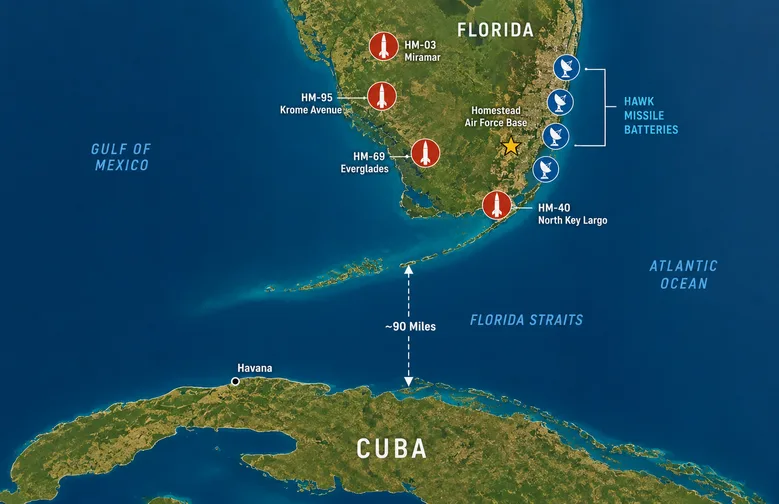
Nike Hercules, the Cuban Missile Crisis, and the Nuclear Missiles Hidden in Our Backyard
Most people who think about South Florida and the Cuban Missile Crisis picture Soviet missiles in Cuba pointed toward the United States.
But there is another side of that story that is rarely discussed.
The United States had nuclear missiles in South Florida too.
Not strategic ICBMs buried in giant silos.
These were Nike Hercules surface-to-air missiles, positioned around Miami, Homestead, the Everglades and the Florida Keys. Some carried nuclear warheads. And although their primary mission was to destroy attacking aircraft, the Nike Hercules also possessed a surface-to-surface capability that could strike targets inside Cuba.
For nearly two decades, South Florida was not merely close to the Cold War.
South Florida was part of the nuclear battlefield.
October 1962 — Suddenly Florida Was the Front Line
Before the Cuban Missile Crisis, American air-defense planners concentrated primarily on an attack coming from the Soviet Union across the Arctic.
Then, on October 14, 1962, a U-2 reconnaissance aircraft photographed Soviet missile installations being constructed in Cuba.
The geography of American defense changed almost overnight.
Cuba was only about 160 miles from South Florida, and Soviet aircraft, missiles and potentially nuclear weapons were suddenly operating immediately south of the United States.
The National Park Service describes South Florida as the nation’s “Achilles heel” exposed by the Cuban Missile Crisis.
The United States responded rapidly.
In late October 1962, the Army’s 2nd Missile Battalion, 52nd Air Defense Artillery was ordered south from Fort Bliss, Texas. Batteries of Nike Hercules missiles were hurriedly deployed into South Florida while the confrontation with the Soviet Union was still unfolding.
Initially, some of the soldiers lived in tents and operated sophisticated missile equipment from muddy fields.
Eventually permanent installations were constructed.
Four Nike Hercules Bases
The Army ultimately operated four major Nike Hercules installations in South Florida.
They were located in or near: Miramar
The western Miami/Krome Avenue area
North Key Largo
Everglades National Park near Homestead
The National Park Service identifies these four installations and notes that the former Miramar site later became commercial development, while another became associated with what is now the Krome detention complex.
They formed part of a much larger defensive network.
The Nike Hercules batteries were integrated with eight Hawk missile batteries stretching from North Miami toward Key West, giving South Florida defenses the ability to engage aircraft at different altitudes.
Miami had effectively become surrounded by guided missiles.
And some of those missiles carried nuclear weapons.
The Missile
The MIM-14 Nike Hercules was enormous by modern air-defense standards.
It stood approximately: 41 feet tall weighed more than 10,000 pounds could reach speeds around Mach 3.6 and had a range exceeding 75 miles in its primary air-defense role.
It was guided by powerful ground-based radar and computers that simultaneously tracked the target and the missile.
But the most important characteristic was its warhead. The Hercules could carry either:
a conventional high-explosive fragmentation warhead or a nuclear warhead.
And these were not merely missiles that theoretically could carry nuclear weapons.
Nuclear-armed Hercules missiles were actually deployed.
Nuclear Weapons in the Everglades
Imagine driving toward the Everglades during the 1960s. Beyond the farms, mosquitoes, alligators and sawgrass stood an American nuclear missile installation.
At what became HM-69 inside Everglades National Park, Army crews kept 41-foot Nike Hercules missiles in a constant state of readiness.
The National Park Service states explicitly: Some of those missiles were fitted with nuclear warheads.
The largest warheads deployed there were rated at approximately 40 kilotons—roughly three times the explosive power of the Hiroshima bomb.
Today visitors can walk through portions of HM-69. The missile barns remain. The berms remain. The launch infrastructure remains. There is even an actual Nike Hercules missile preserved there. Its nuclear warhead, fortunately, is gone.
But during the Cold War, this quiet section of the Everglades was an operational nuclear weapons installation.
Why Put a Nuclear Bomb on an Anti-Aircraft Missile?
At first that sounds insane.
Why would anyone use a nuclear weapon to shoot down an airplane?
Because American planners weren’t expecting one airplane.
They feared formations of Soviet nuclear bombers penetrating American airspace together.
A conventional missile might destroy one aircraft.
A nuclear Hercules could explode in the middle of the formation.
The tremendous blast, thermal effects and radiation could potentially destroy several bombers simultaneously.
The Hercules was developed in part because the earlier Nike Ajax system was considered inadequate against a massive Soviet bomber attack. The Army therefore designed Hercules from the beginning around the possibility of carrying a nuclear warhead.
That made the Hercules one of the strangest weapons of the nuclear age:
a nuclear weapon designed primarily to destroy other nuclear weapons before they reached American cities.
But Hercules Had Another Trick
Here is the part of the South Florida story that is even less widely remembered.
Nike Hercules wasn’t limited strictly to shooting upward.
The system had a surface-to-surface capability.
In other words:
It could attack targets on the ground.
Instead of guiding the missile toward an airplane, the fire-control system could direct it toward coordinates on the Earth’s surface.
And because South Florida sits so close to Cuba, that capability had extraordinary implications.
The National Park Service states explicitly that although the South Florida Nike batteries were intended to protect the Miami metropolitan area:
a Nike Hercules based in South Florida was capable of striking a ground target on mainland Cuba.
Think about what that means.
A weapon usually remembered as an American defensive anti-aircraft missile could potentially become a short-range nuclear ground-strike weapon against Cuba.
The same missile.
The same warhead.
A different target.
South Florida Had a Nuclear Sword as Well as a Shield
That changes the way we should think about these installations.
They were unquestionably built primarily for defense.
Their principal job was protecting South Florida from Soviet or Cuban aircraft.
But technologically, the Hercules represented both a shield and a sword.
Point it toward the sky and it was an interceptor.
Give the guidance system ground coordinates and it could become a surface-to-surface weapon.
Put a W31 nuclear warhead on it and the implications were obvious.
During one of the most dangerous periods of the Cold War, the United States possessed nuclear-capable missiles in Florida that were within striking distance of Cuba.
And One South Florida Battery Had Already Fired a Nuclear Hercules
There is another remarkable connection.
When three batteries of the 2nd Missile Battalion were rushed from Fort Bliss toward Florida during the Cuban Missile Crisis, B Battery wasn’t initially with them.
B Battery was thousands of miles away.
Its soldiers were at Johnston Island in the Pacific, participating in Operation Dominic.
And what were they doing?
Testing Nike Hercules missiles with nuclear warheads.
On November 4, 1962, only days after the most dangerous phase of the Cuban Missile Crisis, a Nike Hercules was launched during a test known as TIGHTROPE.
A live W31 nuclear warhead aboard the missile detonated approximately 21 kilometers above Johnston Atoll.
It was a real Hercules.
A real nuclear warhead.
A real nuclear detonation.
B Battery subsequently returned and became part of the South Florida defense network, ultimately operating from North Key Largo as HM-40 until 1979.
So some of the soldiers manning Florida’s missiles hadn’t merely trained with nuclear-capable Hercules missiles.
They had participated in an actual nuclear Hercules test.
The Cold War Came to Key Largo
B Battery’s permanent installation was constructed in the tropical hardwood hammock of North Key Largo.
Imagine that combination:
Crocodiles.
Mangroves.
Tropical forest.
Tourists driving toward the Keys.
And a United States Army nuclear-capable missile battery.
The Key Largo installation remained operational until 1979. Much of the former military property eventually became part of the Crocodile Lake National Wildlife Refuge, and portions of the missile infrastructure were later removed as the land was restored.
Nature slowly reclaimed one of America’s nuclear battle stations.
The Russians Were Close
This was not an imaginary enemy thousands of miles away.
South Florida missile crews regularly tracked aircraft associated with Cuba.
According to the National Park Service, South Florida Nike crews saw Soviet- and Cuban-piloted MiGs on their radar screens.
The men operating those consoles sometimes had to make decisions while watching potential hostile aircraft approaching American airspace.
Behind them were missiles.
Some containing conventional explosives.
Some containing nuclear weapons.
A mistake could have had consequences almost impossible to comprehend.
Yet none of South Florida’s Nike Hercules missiles were fired in combat.
Nuclear Weapons Hidden in Plain Sight
One of the fascinating things about South Florida’s nuclear history is how ordinary the locations eventually became.
One former missile location became commercial development.
Another became government property.
The Key Largo facility largely disappeared back into nature.
And the Everglades installation became a historical site surrounded once again by wetlands and wildlife.
Today millions of people live around Miami without realizing that they may routinely drive only a few miles from locations where American soldiers once guarded nuclear weapons.
There are no giant ICBM silos.
No Strategic Air Command monuments.
No enormous warning signs announcing:
NUCLEAR WEAPONS WERE ONCE HERE.
Much of the infrastructure simply disappeared into modern South Florida.
HM-69 — The Survivor
One place escaped destruction.
Nike Missile Site HM-69 in Everglades National Park.
The Army Corps of Engineers completed the permanent installation after the Cuban Missile Crisis, and it remained active until 1979.
Its isolation helped preserve it.
Today HM-69 is considered one of the best-preserved Nike Hercules installations in the United States.
The missile barns remain.
The assembly buildings remain.
The protective berms remain.
The kennel for the military guard dogs remains.
And inside sits a restored Nike Hercules.
It looks almost like a museum prop.
It wasn’t.
It is a survivor from a period when South Florida stood on one of the most dangerous borders in the world.
Two Nuclear Arsenals Facing Each Other Across 160 Miles
The Cuban Missile Crisis is normally told from one direction.
The Soviet Union put nuclear missiles in Cuba capable of striking the United States.
That is absolutely true.
But from Cuba, the picture looked somewhat different.
American nuclear forces already surrounded the Soviet Union globally.
And immediately after the crisis, the United States established an increasingly sophisticated missile-defense system across South Florida.
Some of those missiles carried nuclear warheads.
And at least technically, Hercules missiles stationed there could attack targets inside Cuba.
So across approximately 160 miles of ocean sat two adversaries staring at each other.
Cuba—with Soviet weapons and aircraft.
Florida—with American aircraft, ships, Hawk missiles and nuclear-capable Nike Hercules missiles.
The Florida Straits had become one of the front lines of the nuclear Cold War.
We Remember the Missiles in Cuba
We rarely remember the missiles in Florida.
Perhaps that is because the Nike Hercules never had to be fired in anger.
The crews waited.
The radars turned.
Aircraft appeared on their screens.
The missiles remained ready.
And eventually the Cold War moved on.
By 1979, the final Florida Nike Hercules batteries were shut down. The Army notes that Florida and Alaska were among the last American Hercules deployments to remain operational.
The missiles disappeared.
The soldiers left.
South Florida grew over much of the landscape.
Shopping centers, highways, government facilities and wilderness replaced missile batteries.
And within a generation, much of the story was forgotten.
The Forgotten Nuclear History of South Florida
Today when someone says “Cuban Missile Crisis,” we instinctively look south toward Cuba.
Perhaps occasionally we should look around Florida too.
Because hidden underneath modern South Florida is the physical footprint of another nuclear arsenal.
There were radar stations.
Missile launchers.
Army compounds.
Guard dogs.
Soldiers working around the clock.
Forty-one-foot missiles capable of traveling several times the speed of sound.
And nuclear warheads powerful enough to destroy formations of enemy aircraft—or potentially targets across the Florida Straits.
For seventeen years after the Cuban Missile Crisis, men stood watch in the Everglades and the Florida Keys with nuclear weapons nearby.
They never had to use them.
And that may be the most important part of the story.
South Florida once stood at the edge of a nuclear battlefield.
The missiles were real.
The nuclear warheads were real.
Cuba was within reach.
And today, almost everyone drives past the remains without knowing they were ever there.
The Nuclear Map of South Florida
The Cold War missile network hiding underneath modern Miami, the Everglades and the Florida Keys
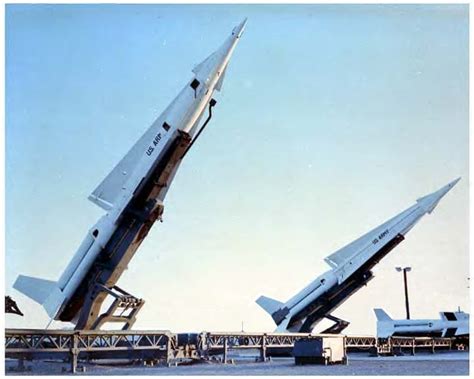
During the Cuban Missile Crisis, South Florida did not merely sit near the confrontation.
It became part of the battlefield.
The U.S. Army established a permanent Homestead–Miami Air Defense Area built around Nike Hercules batteries, supported by Hawk surface-to-air missiles, radar installations, Homestead Air Force Base and command-and-control facilities. The National Park Service records four Nike Hercules batteries and eight Hawk batteries stretching from North Miami toward Key West. (National Park Service)
Here are the four principal permanent Nike Hercules positions and the military geography around them:
The historic Nike coordinates above correspond to the launch areas. Exact control/radar sites were normally separated from the missile launch positions. The surviving historical-site coordinates match specialized Nike-site records, while the National Park Service independently confirms the overall four-battery South Florida network. (The Military Standard)
1. HM-03 — The Nuclear Missile Site in Suburban North Miami
Battery C — Carol City / Miramar
Approximate launch position:
25.9618° N, 80.3033° W
This was the northern anchor of the Nike Hercules ring.
The unit originally operated as HM-01 during the emergency deployment of 1962 and was later associated with the permanent HM-03 installation. The launch area sat near the Miami-Dade/Broward line in what became the Miramar area. (The Military Standard)
That geography is striking today.
What had been the edge of developed Miami in the early 1960s eventually became surrounded by South Florida suburbia.
So when people imagine nuclear missiles, they picture isolated silos in Montana or North Dakota.
South Florida’s were different.
One of Miami’s nuclear-capable missile batteries was sitting practically in the suburbs.
2. HM-95 — The Krome Avenue Battery
Battery D — western Miami-Dade
Approximate launch position:
25.7561° N, 80.4910° W
HM-95 stood west of Miami near Krome Avenue and the Tamiami Trail corridor. (The Military Standard)
The National Park Service identifies one of the four former South Florida Nike sites with the property that later became associated with the Krome detention complex. (National Park Service)
Think about the geography.
To the east:
Miami.
To the west:
The Everglades.
To the south:
Cuba.
And sitting between them was a battery of 41-foot Nike Hercules missiles.
3. HM-69 — The Everglades Nuclear Missile Base
Battery A — Everglades National Park
Approximate launch position:
25.3701° N, 80.6847° W
This is the site that survived.
HM-69 is extraordinary because you can still visit it.
The National Park Service describes it as one of the best-preserved Cold War missile installations in Florida. Three above-ground missile barns, support structures and a restored Nike Hercules remain. (National Park Service)
And there is an important Florida-specific reason the missiles were stored above ground:
You cannot conveniently dig a deep missile magazine in the Everglades.
The extraordinarily high water table forced the Army to use above-ground missile storage and launching facilities, unlike many Nike installations elsewhere in the United States. (National Park Service)
Some Hercules missiles assigned to South Florida were equipped with nuclear warheads.
The National Park Service gives yields up to approximately 40 kilotons—about three times the explosive yield of the Hiroshima weapon. (National Park Service)
That makes HM-69 perhaps the strangest piece of South Florida Cold War history:
An American nuclear missile installation in the middle of the Everglades.
4. HM-40 — The Key Largo Battery
Battery B — North Key Largo
Approximate launch position:
25.2616° N, 80.3136° W
This was arguably the most geographically interesting Nike site.
HM-40 sat in North Key Largo, considerably closer to Cuba than the Miami-area batteries. Its associated fire-control installation was nearby, and the site operated from 1965 until the South Florida defenses closed in 1979. (The Military Standard)
Much of the launch facility later disappeared as nature reclaimed the area. Historical documentation of the site describes the former missile installation becoming swallowed by subtropical forest. (Keys History)
But Battery B had another distinction.
These soldiers had direct experience with a real nuclear Nike Hercules launch.
Before joining the South Florida deployment, Battery B had participated in the Johnston Island nuclear testing program. A Nike Hercules carrying a live W31 warhead was fired and detonated during the TIGHTROPE test shortly after the Cuban Missile Crisis. (Wikipedia)
Then the battery eventually ended up in Key Largo.
The Second Missile Belt — HAWK
Nike Hercules was only part of the picture.
Behind and between the Hercules sites were eight Hawk missile batteries, according to the National Park Service, extending from North Miami toward Key West. (National Park Service)
The Hawk had a different job.
Nike Hercules
Longer-range, high-altitude defense.
MIM-23 Hawk
Lower- and medium-altitude defense against aircraft.
Unlike Hercules, Hawk was not a nuclear weapon system. It provided the conventional inner/lower-altitude layer of the defense network.
During the Cuban Missile Crisis, Hawk batteries appeared around the Keys as American forces rapidly fortified the region. Key West in particular became heavily militarized because Cuba was only about 90 miles away. (Truman Little White House)
So an attacking aircraft potentially faced overlapping layers:
Radar detection
↓
Nike Hercules
↓
HAWK
↓
fighter aircraft
↓
Homestead Air Force Base
This wasn’t a handful of missiles standing alone.
It was an integrated air-defense system.
Homestead Air Force Base — The Hub
At the center of the southern Florida military buildup stood Homestead Air Force Base.
During the post-crisis permanent deployment, the headquarters element of the Nike battalion moved to Homestead AFB, which became an important component of the Miami-Homestead defense network. (Wikipedia)
That helps explain the placement of the batteries.
They weren’t merely defending downtown Miami.
They were protecting:
Miami
Homestead AFB
military installations
South Florida infrastructure
and the southern approaches to the United States.
The system effectively created a missile shield around one of America’s most exposed regions.
And Then There Was Cuba
This is where the map becomes really interesting.
Nike Hercules is usually described as:
Surface-to-air missile.
That’s correct.
But it isn’t the whole story.
The Hercules fire-control system also had a surface-to-surface capability.
And the National Park Service makes a remarkable statement about the South Florida deployment:
A Nike Hercules based in South Florida was capable of striking a ground target on mainland Cuba.
That doesn’t mean the Florida batteries were deployed primarily as nuclear missiles aimed at Havana.
They weren’t.
Their principal mission was air defense.
But the capability existed.
That distinction is important.
The Map Changes Depending on Which Direction You Look
We normally visualize October 1962 this way:
CUBA
☢ Soviet nuclear missiles
⬆
⬆
⬆
FLORIDA
American cities under threat.
And that is historically correct.
But look at the military geography from Cuba.
The picture becomes:
SOUTH FLORIDA
HM-03 — Nike Hercules
HM-95 — Nike Hercules
HM-69 — Nike Hercules ☢
HM-40 — Nike Hercules
HAWK batteries
Homestead AFB
Key West military installations
⬇
⬇
⬇
CUBA
Now the confrontation looks very different.
A Nuclear Frontier Only 90 Miles Wide
At Key West, the Florida Straits are only about 90 miles wide.
That is astonishingly small in strategic terms.
A modern automobile trip from Miami to Naples is farther than that.
During the Cold War, those waters separated two hostile political systems backed by the world’s nuclear superpowers.
On one side:
🇺🇸 The United States
On the other:
🇨🇺 Castro’s Cuba
And behind Cuba:
🇷🇺 The Soviet Union
South Florida consequently became something unusual in American Cold War geography.
Most Americans imagined the Soviet threat coming: over the Arctic, across the Atlantic, or
over the Pacific. Miami had a potential enemy operating immediately offshore.
1962 — The Missile Network Appears Almost Overnight
When Soviet missile installations were discovered in Cuba in October 1962, South Florida had nothing resembling the permanent missile network that would later surround Miami.
Army units came south rapidly. Missiles traveled through ordinary Florida streets.
Temporary positions were established. Radar systems went up.
Soldiers lived under primitive conditions while the defenses were made operational.
The NPS describes Nike-Hercules and Hawk battalions being sent into South Florida almost immediately after the Soviet missiles were discovered. (National Park Service)
What began as an emergency measure became permanent.
The Cuban missiles left. The Florida missiles stayed.
1962 → 1979
For approximately the next seventeen years, South Florida remained defended by the missile system created out of the Cuban crisis.
The four major permanent Hercules positions formed an arc:
NORTH
HM-03 Carol City / Miramar
HM-95 Western Miami
HM-69 Everglades
HM-40 North Key Largo
SOUTH
CUBA The arrangement wasn’t accidental.
It created overlapping coverage of the Miami-Homestead region and the approaches from the south.
The Florida Nike batteries remained active until 1979, exceptionally late for the American Nike system. (Nike Historical Society)
What Happened to the Nuclear Missile Bases?
This may be the strangest part of the map.
HM-03 — Miramar / Carol City
Urban South Florida largely grew around the former military landscape.
HM-95 — Krome Avenue
The location became associated with the federal Krome detention facility.
HM-40 — Key Largo
Nature reclaimed much of the site.
HM-69 — Everglades
Preserved by the National Park Service.
The missile network did not simply disappear.
South Florida grew over it. Roads appeared. Subdivisions appeared. Shopping centers appeared. Government facilities appeared. Forests returned. Mosquitos guard all.
People moved into neighborhoods without any idea that nuclear-capable missiles once stood only a short distance away.
And HM-69 Is Still There
That makes HM-69 particularly valuable.
You don’t have to imagine this history.
You can actually stand where it happened.
The National Park Service still preserves the missile barns and an actual Nike Hercules at the former Alpha Battery site. (National Park Service)
Stand there today and you hear: birds, wind, insects, and the sounds of the Everglades.
Sixty years ago, soldiers standing on almost exactly the same ground were operating radar systems and maintaining missiles capable of carrying nuclear warheads.
The Forgotten Nuclear Map
Perhaps the most revealing way to understand the Cuban Missile Crisis is not by looking only at Cuba.
Zoom the map out slightly. You discover something much larger. Soviet missiles in Cuba.
American nuclear-capable missiles in Florida. HAWK batteries through the Keys.
Homestead Air Force Base. Key West military installations. American and Soviet aircraft.
Naval forces in the Florida Straits. And between everything:
90 miles of ocean.
For a brief period in October 1962, those 90 miles may have been some of the most dangerous real estate on Earth.
And for another seventeen years, nuclear-capable missiles remained hidden in the subtropical landscape of South Florida.
We remember the missiles in Cuba.
We forgot the missiles in Florida.
That is the forgotten nuclear map of South Florida.
For more information
https://en.wikipedia.org/wiki/Nike_Hercules
https://www.nps.gov/ever/learn/historyculture/hm69.htm
https://www.tripadvisor.com/Attraction_Review-g143024-d3927759-Reviews-HM69_Nike_Missile_Base-Everglades_National_Park_Florida.html
https://abandonedfl.com/nike-missile-site-hm-69/
The Manacas–Iznaga Massacre -- July 13th, 1963
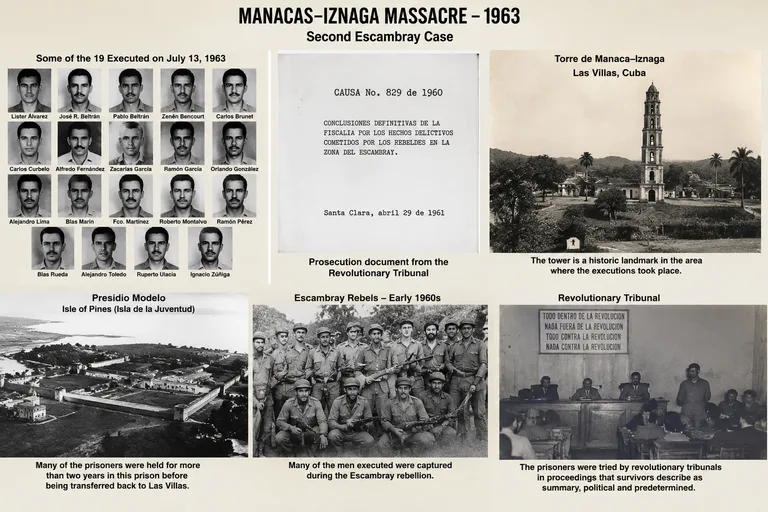
The Prisoners Who Survived the War—Only to Be Killed After It
History often remembers the men who die in battle.
It is less comfortable remembering the men who survive the battle, surrender, spend years in prison, and are then taken into the darkness to be machine-gunned by the government holding them.
That is the story of the Manacas–Iznaga massacre of 1963.
It is a story buried beneath disputed dates, incomplete records, exile testimony, revolutionary propaganda, and the silence of a government that controlled the courts, the press, the prisons, and the place where the bodies fell.
The central facts, however, are difficult to dismiss.
A group of captured rebels from the Escambray Mountains had already spent more than two years in prison. They were under complete government control. They were transported back to Las Villas, brought before a revolutionary tribunal, and sentenced in proceedings survivors later described as predetermined.
Nineteen men were reportedly taken near Manacas–Iznaga and killed together.
Two related prisoners had allegedly been killed the day before.
That brings the broader death toll connected to the case to 21.
The exact date remains disputed. Survivor testimony places the principal execution in the early morning of July 13, 1963. Other historical lists give August 13, 1963. The Inter-American Commission on Human Rights later recorded the killings only as occurring during July or August 1963.
The date may remain contested. The dead do not.
The War in the Escambray
The men later killed at Manacas–Iznaga were connected to the armed resistance in Cuba’s Escambray Mountains, a rugged region in central Cuba that became the center of one of the most important and least honestly discussed conflicts of the early Revolution.
Official Cuban history called the rebels bandidos—bandits.
The reality was more complicated.
The Escambray resistance included farmers, former revolutionaries, anti-communists, former members of the movement that had fought against Fulgencio Batista, and men who believed Fidel Castro had betrayed the promises of the Revolution.
Some had supported Castro before turning against him.
Some opposed the rapid communist transformation of Cuba.
Some resisted land seizures, political executions, forced collectivization, and the elimination of independent political organizations.
Others received weapons, supplies, encouragement, or assistance connected to Cuban exile groups and the United States.
This was not merely a collection of innocent civilians discussing politics around a kitchen table. Many of the men involved had participated in an armed insurgency. Some were commanders. Some had fought government forces. Revolutionary prosecutors accused members of the group of killings, attacks, collaboration with armed bands, and offenses against the state.
That must be acknowledged.
But it does not excuse what happened next. A prisoner is no longer a battlefield target.
A captured man is no longer an armed threat.
Once the government has disarmed him, imprisoned him, and placed him under guard, the government assumes responsibility for his life.
Even a man accused of serious crimes is entitled to a real trial.
He is not supposed to be taken to a bend in the road and shot down with the others.
More Than Two Years in Prison
Many of the prisoners associated with the Manacas–Iznaga case had reportedly been captured during the Escambray operations of 1960 and 1961.
They were transferred to the Presidio Modelo on the Isle of Pines, known today as the Isle of Youth.
There they remained for more than two years. This detail is important.
These were not men seized during an active battle and killed in the confusion of combat.
They were prisoners. They had been disarmed.
They had been transported through the prison system.
The government knew who they were. The government knew where they were.
The government had years to investigate the accusations against them.
Yet according to surviving testimony, they were eventually removed from the Presidio Modelo and taken back to Las Villas for what became known as the Second Escambray Case, or the Segunda Causa del Escambray.
The legal case itself appears to have existed for some time. A surviving prosecution document connected to Revolutionary Tribunal Case No. 829 of 1960 was reportedly prepared in Santa Clara on April 29, 1961.
That means the accusations had been assembled more than two years before the final executions.
The state had time.
What the prisoners did not have was meaningful justice.
The Transfer to Manacas–Iznaga
According to the testimony of political prisoner Aldo Chaviano Rodríguez, 23 prisoners were transferred from the Isle of Pines to the Manacas–Iznaga area on July 12, 1963.
They were taken near the old tower and the sugar-producing region associated with the Torre de Iznaga, close to Trinidad in the former province of Las Villas.
The Torre de Iznaga is today remembered as a picturesque colonial landmark—a tall tower rising over the Valley of the Sugar Mills.
But in this story, it was not a tourist attraction.
It was the landscape surrounding a revolutionary tribunal and an alleged mass execution.
Chaviano later described the proceeding as rushed, arbitrary, and decided before it began.
The tribunal was reportedly presided over by Captain Andrés Abeledo Mejías, known as El Pinto.
Chaviano identified Luis Felipe Denis as the accusing officer and Dr. Humberto Jorge as the prosecutor.
The prisoners faced accusations involving armed rebellion, crimes against state power, participation in insurgent organizations, and responsibility for acts committed during the Escambray conflict.
The government presented the men as dangerous counterrevolutionaries.
But a court is supposed to determine guilt through evidence.
It is not supposed to exist merely to give a formal appearance to a sentence already chosen.
A Trial That Survivors Said Was Already Decided
According to Chaviano’s testimony, the accusations were often based on aliases, assumptions, questionable identifications, and broad claims about the actions of insurgent groups.
The proceedings were not described as a careful examination of individual guilt.
They were described as revolutionary justice.
That phrase has been used many times in history.
It usually means the government has already decided what justice requires.
At the end of the proceeding:
- Nineteen prisoners were sentenced to death.
- Two prisoners received sentences of 30 years.
- Two other men connected to the same case had reportedly already been killed the previous day.
The appeals process, according to the survivor account, lasted only minutes.
The death sentences were confirmed.
There was no long judicial review.
There was no independent appellate court.
There was no public examination of the evidence.
There was no outside authority capable of stopping the execution.
The government that accused the men controlled the tribunal that judged them and the soldiers who would kill them.
The Two Men Killed Before the Main Execution
According to Chaviano, two prisoners connected to the same case—Macario Quintana and a man identified in different sources as Aquilino Zerquera or Aquilino Serquera—had already been killed at a place called Las Tinajitas in the Escambray.
Their bodies were allegedly displayed near the place where the remaining prisoners were tried.
The purpose, according to the testimony, was obvious.
The prisoners were meant to see what awaited them.
This detail helps explain why different sources give different totals.
Some accounts refer to 19 men executed at Manacas–Iznaga.
Others speak of 21 victims connected to the Second Escambray Case.
The two numbers are not necessarily contradictory.
Nineteen were reportedly killed in the principal mass execution.
Two related prisoners had allegedly been killed the previous day.
Together, they form a total of 21.
The Inter-American Commission on Human Rights later reported that 21 prisoners died under machine-gun fire in the Torre de Iznaga area, although its summary did not fully explain the sequence.
The Road Into Darkness
After the sentences were confirmed, the condemned prisoners were reportedly loaded into military vehicles.
It was late at night.
According to the survivor account, they were driven to a bend in the road near Manacas–Iznaga.
The hour was approximately 1:00 in the morning.
The vehicles stopped.
Their headlights were used to illuminate the execution site.
There would be no public witness.
No family members.
No independent reporters.
No clergy standing beside the condemned.
Only prisoners, soldiers, officials, darkness, and the glare of headlights.
Three men were reportedly called first:
- Alejandro “Nando” Lima
- Zacarías García
- Roberto Montalvo
They were allegedly machine-gunned separately.
The remaining prisoners understood what was happening.
According to Chaviano, they began shouting against communism and calling out for God and liberty.
Then the shooting widened.
Soldiers and members of the tribunal allegedly opened fire on the group with machine guns, rifles, pistols, and revolvers.
The men were not executed one at a time before a formal firing squad.
They were reportedly shot together.
The wounded were then allegedly finished at close range.
Carlos Brunet
One of the most vivid details in the survivor account concerns Carlos Brunet Álvarez.
According to Chaviano, Brunet remained standing after the first burst of gunfire.
Whether through courage, shock, injury, or sheer refusal to fall, he remained on his feet.
Then multiple armed men fired at him.
He went down beneath the combined gunfire.
Stories like this are difficult to prove decades later, especially when the government responsible never released complete records and never allowed an independent forensic investigation.
But that is precisely why survivor testimony matters.
When a state seals the files, controls the burial site, and eliminates outside scrutiny, the surviving witness becomes the archive.
Chaviano also alleged that militia members removed shoes from the bodies and later wore them.
That detail is especially grotesque.
It suggests not merely execution, but humiliation.
The dead were stripped not only of life, but of dignity.
This allegation remains dependent on survivor testimony and should be described as such.
But it belongs in the historical record because silence does not make testimony disappear.
The Reported Victims
Commemorative lists preserved in exile sources identify the 19 men reportedly killed together as:
- Líster Álvarez López
- José R. Beltrán Hernández
- Pablo Beltrán Mendoza
- Zenén Bencourt Rodríguez
- Carlos Brunet Álvarez
- Carlos Curbelo Pérez
- Alfredo “Nené” Fernández García
- Zacarías García López
- Ramón García Ramos
- Orlando González López
- Alejandro “Nando” Lima Barzaga
- Blas Marín Navarro
- Francisco “Franco” Martínez Zúñiga
- Roberto Montalvo Cabrera
- Ramón “Monguito” Pérez Ramírez
- Blas Enrique Rueda Muñoz
- Alejandro Toledo Toledo
- Ruperto Ulacia Montelier
- Ignacio Zúñiga González
Spellings vary among sources.
That is common in records created under repression and later reconstructed from memory, prison testimony, family documents, and exile archives.
Some surnames appear in slightly different forms. Aliases are also recorded differently.
This does not mean the victims did not exist.
It means the government never provided the kind of transparent public record that would have resolved every uncertainty.
The Men Who Survived
Aldo Chaviano stated that he and an older prisoner identified as Romayor were the two men among the transferred group who did not receive death sentences.
A tribunal document reportedly includes a prisoner named Eladio Romayor Díaz, although the surviving documents and later testimony do not always align perfectly.
Chaviano went on to spend approximately 26 years and four months in prison, based on cumulative sentences that exceeded 30 years.
He eventually left Cuba and lived in New Jersey.
His testimony became one of the principal surviving accounts of what happened.
This creates a difficult historical situation.
The Cuban government did not open its records.
There was no independent investigation at the scene.
There was no forensic review available to the public.
The names, sequence, and details therefore depend heavily on witnesses and exile documentation.
That does not make the account worthless.
It means it must be handled honestly.
The details should be attributed where they come from.
The institutional findings should be separated from the survivor’s memories.
And where uncertainty exists, it should be admitted rather than concealed.
The Inter-American Commission’s Account
The strongest institutional confirmation comes from the Inter-American Commission on Human Rights.
In its reporting on political prisoners in Cuba, the Commission described captured Escambray rebels who had been imprisoned on the Isle of Pines without trial.
After more than two years, a group was reportedly returned to the mainland and taken to the Torre de Iznaga, in the Condado area of Las Villas.
The Commission stated that they were machine-gunned while getting out of trucks.
It reported that 21 prisoners died under machine-gun fire.
That account supports several essential parts of the survivor testimony:
The victims were already prisoners.
They had been held for years.
They were transferred from the Isle of Pines.
They were taken to the Torre de Iznaga area.
They were killed by machine-gun fire.
Approximately 21 men died.
The Commission did not provide every detail preserved in Chaviano’s account.
It did not settle the exact date.
It did not reproduce a complete list of names.
It did not describe every stage of the tribunal.
But it confirmed the central allegation:
Prisoners under government control were taken to the Manacas–Iznaga area and machine-gunned.
July 13 or August 13?
The precise date remains one of the most persistent uncertainties.
Aldo Chaviano’s detailed testimony places the principal execution shortly after midnight on July 13, 1963.
According to that chronology:
- The prisoners were transferred on July 12.
- The tribunal took place that day.
- The executions occurred at approximately 1:00 a.m. on July 13.
Other memorial lists give the date as August 13, 1963.
The Inter-American Commission avoided choosing between them and recorded the killings only as occurring in July or August 1963.
There are several possible explanations:
A date may have been copied incorrectly.
The month may have been confused in later records.
Different parts of the case may have occurred on different dates.
Government secrecy may have prevented families from receiving reliable information.
Prison testimony recorded years later may have introduced discrepancies.
The responsible approach is not to pretend the uncertainty does not exist.
The safest historical title is:
The Manacas–Iznaga Massacre of 1963
Within the account, it should be explained that survivor testimony places the execution on July 13, while other lists record August 13.
A disputed date does not erase the crime.
Were the Prisoners Guilty?
This question must be addressed honestly.
The men were associated with an armed rebellion.
Some had fought the government.
Some had held leadership roles.
Some were accused of participating in killings, attacks, and cooperation with counterrevolutionary groups.
The prosecution linked them to actions committed during the Escambray conflict and to efforts supported in part by exile organizations and the United States.
It would therefore be inaccurate to portray every man simply as a peaceful civilian arrested for expressing an opinion.
But guilt is not established merely because the government says so.
And even guilt does not eliminate the right to due process.
A lawful government may arrest a rebel.
It may charge him.
It may present evidence.
It may allow a defense.
It may hold a genuine trial.
It may punish crimes proven beyond a reasonable standard.
What it may not do is create a tribunal whose result is predetermined and then machine-gun prisoners together in the darkness.
The moral question is not whether these men had ever carried weapons.
The moral question is what the Cuban government did after it had taken those weapons away.
Revolutionary Justice
Revolutions often begin by promising justice.
They then create a special kind of justice for their enemies.
The accused are called traitors before trial. The government controls the evidence.
The defense exists only as ceremony. Appeals are measured in minutes.
Sentences are carried out before questions can be asked. Then the state writes the history.
This is how execution becomes “justice.” This is how political murder becomes “defense of the Revolution.”
This is how men disappear beneath official labels.
Bandit. Counterrevolutionary. Mercenary. Enemy of the people.
Once the label is attached, the state expects the public to stop seeing the human being beneath it.
The Manacas–Iznaga massacre matters because it forces us to look beneath the label.
These men may have been rebels. They may have committed crimes. They may have fought the government. But at the time they were killed, they were prisoners.
That changes everything.
Why So Few People Know the Story
The massacre remains obscure outside Cuban exile circles and human-rights documentation.
There are several reasons.
It occurred during a hidden internal war in a rural region.
The Cuban government controlled the press.
The courts were revolutionary institutions rather than independent bodies.
Foreign investigators had no access to the scene.
The bodies were not subjected to public forensic examination.
Survivors remained imprisoned for decades.
Families had little ability to gather documents or speak publicly.
Exile sources preserved the story, but their records sometimes conflict over dates, spellings, and numbers.
Official Cuban histories portrayed the Escambray conflict as a campaign against foreign-backed bandits and rarely acknowledged crimes committed against captured rebels.
The government therefore possessed the power not only to kill, but to define the dead.
That is one of the greatest powers an authoritarian state can hold.
It decides who is remembered as a victim and who is remembered only as an enemy.
The Meaning of Manacas–Iznaga
The Manacas–Iznaga massacre is not important because every detail has been perfectly preserved.
It is important because the central pattern is clear.
Men were captured. They spent years in prison.
They were brought before a revolutionary tribunal.
Most were condemned to death.They were taken away at night.
They were machine-gunned.
No independent court reviewed the event.
No transparent investigation followed.
No government official was held accountable.
The state controlled the prisoners, the weapons, the tribunal, the records, and the story.
That is not justice. It is power without accountability.
The 21
The broader case is often remembered through the number 21.
Nineteen men reportedly died in the principal execution near Manacas–Iznaga.
Two related prisoners had allegedly been killed the previous day.
The Inter-American Commission also reported 21 deaths under machine-gun fire.
The exact reconciliation of these accounts remains imperfect.
But the figure represents more than a count.
It represents 21 lives placed in the hands of a state that had already defeated and imprisoned them.
They had survived the mountains. They had survived capture.
They had survived more than two years in prison.
They did not survive revolutionary justice.
Final Thought
There are moments when a government reveals its true nature not through speeches, constitutions, or banners, but through what it does to a defeated enemy.
The men of Manacas–Iznaga were no longer fighting in the mountains.
They were not advancing with rifles.They were not hiding in the forest.
They were prisoners standing beneath military headlights.
The government had already won. It killed them anyway.
That is why this story must be remembered.
Not because every victim was necessarily innocent of every accusation.
Not because war is simple. Not because the Escambray rebellion lacked violence or foreign involvement.
But because civilization is measured by what a state does after its enemy has surrendered.
At Manacas–Iznaga, the Cuban Revolution did not merely punish its opponents.
It placed prisoners before machine guns and called the result justice.
Twenty Years of the Secret CIA War for Cuba 1959–1980
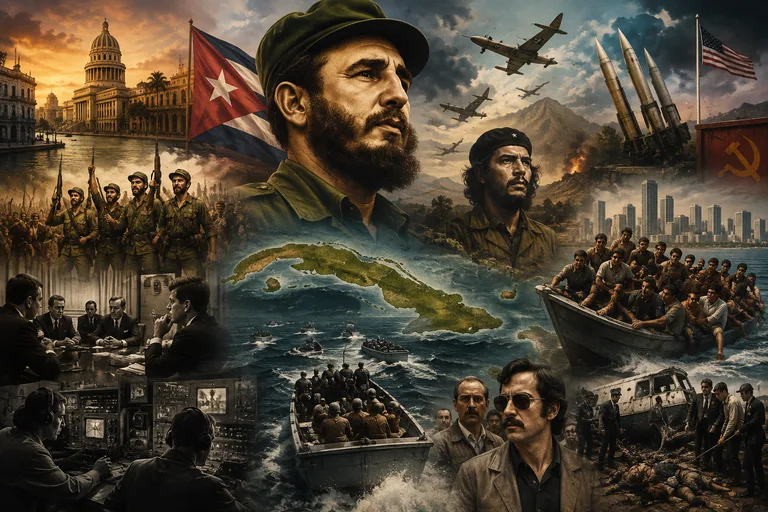
A Timeline From Castro's Revolution to the CIA, the Exile Armies and the Underground War, 1959–1980
When Fidel Castro entered Havana in January 1959, almost nobody could have predicted that the Cuban Revolution would produce a secret war lasting decades. Within two years, Cuban exiles would be training under the CIA. Within three, American intelligence officers would be planning sabotage and resistance operations against the new Cuban government. Within four, independent exile commandos would be attacking Cuba from small boats. Within eight, a Cuban exile working alongside the CIA would stand in a Bolivian schoolhouse with Che Guevara shortly before Che was executed. Within thirteen, veterans of the Cuban covert-action world would reappear in Watergate.
And by the late 1970s, some militant exile organizations were conducting bombings and assassinations that the FBI treated as terrorism. The conflict evolved continuously. What began as an attempt to reverse the Cuban Revolution became an invasion.
The invasion became a covert war. The covert war became an exile war.
And eventually the exile war fragmented into politics, intelligence, militancy, terrorism and memory. This is how it happened.
1959 The Revolution Wins
January 1, 1959
Fulgencio Batista flees Cuba. Fidel Castro’s revolutionary forces enter the cities and take control of the country. Castro had not presented his movement simply as a communist revolution.
It included liberals, nationalists, students, reformers, socialists, workers, middle-class professionals and people united primarily by opposition to Batista. That coalition would not survive victory.
Many of the people who later became Castro’s enemies had themselves participated in the revolution. This point is essential. The anti-Castro movement was never merely a Batista restoration movement.
Some of Castro’s future enemies had helped put him in power.
January–February 1959
The revolutionary government begins restructuring Cuba.
Executions of officials associated with Batista become highly controversial.
Property confiscations and political consolidation begin transforming Cuban society.
The revolutionary coalition starts breaking apart.
José Miró Cardona briefly becomes prime minister. He resigns.
Fidel Castro assumes the office. It is an early sign of where power is concentrating.
Throughout 1959
Cubans opposed to the direction of the revolution begin leaving the country.
Florida—particularly Miami—becomes the natural destination.
At first many believe their exile will be temporary. They expect Castro to fall.
Some keep the keys to their houses. Others leave businesses behind.
Families separate. The first pieces of what would become the enormous Cuban exile community are now assembling ninety miles from the island.
1960 Washington Enters the War
The relationship between Castro and Washington deteriorates rapidly.
Cuba draws increasingly close to the Soviet Union.
American-owned businesses are nationalized.
The Cold War has arrived in the Caribbean.
March 17, 1960
President Dwight Eisenhower approves a CIA covert-action program directed against Castro’s government.
The strategy is remarkably ambitious.
It calls for:
a unified Cuban opposition outside Cuba,
propaganda,
a clandestine intelligence and action network inside the island,
and a paramilitary capability capable of eventually moving against Castro.
This is the beginning of the institutional American secret war.
Spring 1960 -The CIA Starts Recruiting Cubans
CIA officers travel to South Florida looking for Cuban exiles willing to fight.
The Agency works with exile political factions and begins assembling what becomes the:
Frente Revolucionario Democrático — FRD.
The goal is to create a Cuban political organization that can publicly represent opposition to Castro.
Behind it, however, the CIA is building something more dangerous.
An army.
May 1960 -The FRD Takes Shape
The Democratic Revolutionary Front becomes the principal early political umbrella for the American-backed exile movement.
The CIA deals with its leaders through covert arrangements, including Americans operating under commercial-style cover.
Washington wants the opposition to appear Cuban rather than American.
That requirement becomes central to everything that follows.
1960 -Brigade 2506 Is Born
The CIA begins recruiting Cuban exiles for paramilitary training.
Approximately 1,400 men eventually become Brigade 2506.
They are trained in weapons, infantry tactics, navigation, amphibious warfare, guerrilla operations and parachuting.
Training occurs at locations including Useppa Island in Florida and facilities in Guatemala.
The CIA itself now acknowledges openly that it recruited the exile force with a multimillion-dollar covert-action budget.
The operation is no longer merely political opposition.
Washington is preparing Cubans for war.
1961 -Diplomatic Relations Collapse
January 3, 1961
The United States breaks diplomatic relations with Cuba.
The conflict is now unmistakable.
President John F. Kennedy takes office only weeks later and inherits the invasion plan developed under Eisenhower.
He must decide whether to proceed.
He does.
March 1961 – The Cuban Revolutionary Council
The United States pushes competing exile factions toward greater political unity.
The Cuban Revolutionary Council is formed under José Miró Cardona.
Its members include major exile political figures with different ideological backgrounds.
The Council is intended to present a credible Cuban political alternative to Castro.
If the invasion succeeds, it may provide the nucleus of a new Cuban government.
The structure is now essentially:
CIA > Cuban exile political leadership > Brigade 2506 > Cuba
The Americans provide the machinery. Cubans are expected to provide the public face and the fighting force.
April 15, 1961 – The Air War Begins
Cuban-piloted B-26 bombers attack Cuban airfields.
The aircraft are disguised to support a cover story that they are Cuban government pilots who have defected.
The operation is supposed to destroy Castro’s air power before the invasion.
It fails to destroy enough aircraft. That will become disastrous.
April 17, 1961 – The Bay of Pigs
Brigade 2506 lands on Cuba’s southern coast at the Bay of Pigs.
The invasion is underway. The plan depends upon several assumptions:
The Brigade can establish a beachhead. Castro’s air force can be neutralized.
Resistance inside Cuba will emerge. The population may rise against Castro. A provisional exile government may eventually be introduced.
None develops as hoped. Castro responds quickly.
His remaining aircraft attack the invasion fleet.
Supplies are lost. The expected nationwide uprising does not occur.
Kennedy refuses to convert the operation into an open American military invasion.
The brigade becomes trapped.
The CIA describes more than a thousand exiles storming the beaches in an attempt to ignite an uprising; the State Department’s historical record describes the operation explicitly as a CIA-planned, CIA-funded invasion using Brigade 2506.
April 19, 1961 – The Invasion Collapses
After roughly three days of fighting, organized resistance at the beachhead collapses.
Most surviving Brigade members are captured. Some are killed.
American pilots covertly involved in the operation also die.
Four American airmen later receive the CIA’s Distinguished Intelligence Cross for missions flown during the battle.
The operation is an international humiliation for the United States.
For the exile community, it becomes something deeper.
A betrayal. Many brigade veterans believe Washington allowed them to land and then abandoned them.
That belief shapes Cuban-American politics for generations.
1961 – Kennedy Decides the War Is Not Over
The Bay of Pigs fails. But the objective of removing Castro does not disappear.
Kennedy orders a review. The conclusion is not: Stop. It is essentially: Try differently.
November 1961 – Operation Mongoose
The Kennedy administration authorizes a new covert campaign.
Its codename is: Operation Mongoose.
The program goes considerably beyond preparing another invasion.
It includes:propaganda, intelligence collection, political action, economic pressure, sabotage, support for internal resistance, and planning for a potential uprising against Castro.
Operation Mongoose is overseen at senior levels of the Kennedy administration and coordinated operationally by General Edward Lansdale.
The State Department’s historical record describes it as the direct successor to the failed Bay of Pigs strategy.
1962 -The Secret War Becomes Enormous
Inside the CIA, the Cuba campaign is concentrated substantially in: Task Force W.
William K. Harvey becomes its best-known chief. In Miami, the massive CIA station known as: JMWAVE becomes the operational center of the war.
The Miami exile community is now intertwined with an enormous American intelligence operation.
Miami, 1962 – The Other City
The visible Miami contains: restaurants, hotels, new neighborhoods, refugee families, businesses, and people rebuilding their lives.
The invisible Miami contains: CIA case officers, safe houses, weapons, boats, radio operators, agents, informants, front companies, training facilities, and plans for Cuba.
The two cities coexist. Sometimes the people living in one do not know that the other exists.
1962 – Refugees Become Intelligence Sources
Every Cuban arriving in Florida potentially possesses information.
Where are Soviet military personnel?
Where are Cuban units stationed?
What factories are operating?
What is happening inside government ministries?
Who has disappeared?
Who has been promoted?
Where are missiles or aircraft being moved?
The refugee community becomes an enormous intelligence reservoir.
Washington is simultaneously receiving refugees from Castro’s Cuba and mining that refugee population for intelligence about Castro’s Cuba.
1962 – The Assassination Question
Operation Mongoose and related CIA programs include discussions and schemes aimed at eliminating Castro and other senior Cuban leaders.
Some concepts are bizarre. Others are deadly serious.
The historical record eventually reveals attempts to use organized-crime figures and Cuban insiders. Removing Castro physically becomes one possible route to regime change.
The secret war has moved far beyond propaganda leaflets.
October 1962 – The Cuban Missile Crisis
Then everything changes. American U-2 reconnaissance photographs reveal Soviet nuclear missile installations under construction in Cuba.
Washington concludes that Moscow is placing nuclear weapons ninety miles from Florida.
Kennedy announces a naval quarantine. For thirteen days, the United States and Soviet Union move terrifyingly close to nuclear war.
The State Department records that Soviet Premier Nikita Khrushchev and Castro had secretly agreed earlier in 1962 to deploy Soviet nuclear missiles to deter another invasion. U.S. reconnaissance photographed the missile sites on October 14.
The shadow of the Bay of Pigs hangs directly over the crisis.
Castro has reason to fear another American invasion.
Khrushchev sees an opportunity to protect Cuba and alter the strategic nuclear balance.
October 28, 1962 – The Crisis Ends
Khrushchev agrees to withdraw the Soviet missiles. The United States publicly commits not to invade Cuba and secretly agrees to remove Jupiter missiles from Turkey.
Castro remains in power. And exile strategy now confronts an enormous new problem.
A Cuban exile raid is no longer merely a Cuban exile raid.
If Soviet personnel are killed, Moscow might become involved.
A handful of men aboard a fast boat could potentially trigger an international crisis.
Washington becomes increasingly determined to control unauthorized operations.
1963 – The Exiles Begin Fighting Their Own War
This is the major transition. The CIA remains deeply involved in operations against Castro.
But some Cuban militants are no longer willing to wait for Washington.
Organizations such as: Alpha 66 and Second National Front of the Escambray conduct their own operations.
March 1963
Alpha 66 Raids Cuba
Alpha 66 and allied militants attack targets around Cuba.
One operation involves firing upon Soviet-associated shipping.
Washington is furious. Think about the contradiction.
The United States government is secretly conducting covert operations against Castro.
At the same time, it is publicly and privately attempting to stop Cuban exiles from conducting unauthorized covert operations against Castro.
The contradiction disappears once we identify the real issue: control.
Washington wants operations it can manage. The exiles want Castro removed.
Those objectives are no longer identical.
1963 – Kennedy and the Exiles Drift Apart
Exile leaders become increasingly frustrated. José Miró Cardona resigns from leadership of the Cuban Revolutionary Council.
The idea of a united exile political government supported by Washington begins collapsing. Cuban militants increasingly conclude that the United States may never again make a serious attempt to overthrow Castro.
For many, the emotional lesson of Bay of Pigs is reinforced:
America will help us only until helping us becomes inconvenient.
November 22, 1963 – Kennedy Is Assassinated
President John F. Kennedy is murdered in Dallas.
Lee Harvey Oswald is arrested. Within days, Oswald himself is murdered by Jack Ruby.
Almost immediately, connections between Oswald and the Cuban political world begin attracting attention. Oswald had distributed pro-Castro literature.
He had attempted to travel through Mexico to Cuba.
He had clashed publicly with members of the anti-Castro Directorio Revolucionario Estudiantil — DRE in New Orleans.
These facts later produce an enormous body of conspiracy literature.
Some names from the CIA’s Cuba operations also appear repeatedly in assassination investigations and theories.
But an important rule must be maintained: Overlap is not proof.
Cuban exile organizations were politically active across the United States.
The CIA was conducting extensive Cuba operations.
Oswald publicly involved himself with Cuban political issues.
Those connections deserve investigation.
They do not automatically establish a conspiracy.
1964 – The Autonomous Strategy
Washington experiments with supporting exile organizations that are supposed to exercise greater independence.
Manuel Artime and Manuel Ray receive forms of covert financial and technical assistance.
The theory is attractive. Let Cubans run Cuban organizations.
Maintain enough American support to make operations possible.
Keep enough distance to preserve deniability.
In practice, “autonomy” remains ambiguous.
If Washington supplies the money, boats or communications, how independent is the organization?
Nobody ever develops a completely satisfactory answer.
December 1964 Che Guevara Comes to New York
Che Guevara addresses the United Nations. Outside, Cuban exile opposition is intense.
The political war surrounding Cuba has become international.
One of the most extraordinary incidents of the era occurs when Cuban exile militants fire a weapon toward the United Nations complex while Che is speaking.
It misses. The incident shows how far the Cuban conflict has traveled.
The revolution is no longer contained within Cuba.
Neither is the counterrevolution.
1965–1966 Washington’s Attention Begins Moving Elsewhere
Vietnam increasingly dominates American foreign policy.
The giant anti-Castro machinery of the early Kennedy period gradually diminishes.
Castro remains in power. But the men trained during the earlier covert war remain active.
Some join American institutions. Some enter foreign intelligence services.
Some continue exile politics. Others continue clandestine operations.
The structure is weakening. The network survives.
1966 – Rolando Cubela Goes on Trial
Rolando Cubela Secades is arrested and prosecuted in Cuba for plotting against Castro.
Cubela is particularly important because he had been inside the revolutionary establishment.
The CIA had maintained contact with him while exploring whether Castro could be eliminated from inside his own government.
The dream of an internal coup also fails. Castro survives again.
1967 – Che Goes to Bolivia
Che Guevara attempts to export revolution into Bolivia.
The United States assists Bolivia’s counterinsurgency effort.
A special Bolivian Ranger battalion receives American training and equipment, and CIA-linked personnel provide intelligence and technical assistance.
Among the Cuban exiles assisting the effort is: Félix Rodríguez.
The secret Cuban war has now moved into South America.
October 8, 1967 – Che Is Captured
Bolivian troops capture Guevara near La Higuera. Some say Castro himself told them where Che was since he want Che out of the way.
He is taken to a small schoolhouse. Félix Rodríguez gains access to him.
The two speak. The symbolism is extraordinary.
One man helped export Castro’s revolution.
The other emerged from the exile movement created to destroy it.
October 9, 1967 – Che Guevara Is Executed
The Bolivian authorities order Che killed.
CIA-linked personnel reportedly attempt unsuccessfully to prevent the immediate execution because Washington would have preferred interrogation.
Official American records confirm both the capture and the subsequent execution.
Che is thirty-nine years old. His death becomes an international revolutionary icon. Millions of T-Shits printed.
For anti-Castro exiles, it represents something else: one of the most important leaders of Castro’s revolutionary project is gone.
1968 – Orlando Bosch and the Increasingly Independent Militant War
Orlando Bosch and other exile militants continue attacking targets associated with Cuba or countries trading with Cuba.
In September 1968 a Polish ship in Miami is attacked with a recoilless weapon.
Bosch is arrested and eventually imprisoned. By now American law enforcement is increasingly dealing with anti-Castro militants not as covert allies but as criminal defendants.
That transformation is one of the defining features of the 1960s.
1969–1970 – The CIA War Becomes the Exile War
Richard Nixon enters the White House. American hostility toward Castro remains.
But the organizational relationship with exile militancy has fundamentally changed.
Alpha 66 continues attempting operations.
A 1970 National Security Council memorandum characterizes one Alpha 66 infiltration attempt as spontaneous rather than U.S.-sponsored.
The distinction is now official: The exiles are still fighting. Washington is no longer necessarily directing them.
1971 – The Networks Remain
By now, many of the individuals trained or recruited during the early 1960s have moved into completely different lives.
Yet they still know one another. Former CIA personnel know former Cuban operatives.
Former brigade members know boat captains. Businessmen know political organizers.
Intelligence contacts survive. This network will unexpectedly reappear in American domestic politics.
June 17, 1972 – Watergate
Five men are arrested inside the Democratic National Committee headquarters in Washington’s Watergate complex.
Among them are Cuban veterans connected with the old anti-Castro world.
Bernard Barker., Eugenio Martínez., Virgilio González. ,Frank Sturgis.
E. Howard Hunt, the former CIA officer involved in earlier Cuban political operations, is connected to the burglary team.
The significance is enormous but often misunderstood.
Watergate was not another Bay of Pigs operation. It was not an invasion of Cuba.
What survived was the personnel network.
People who had learned clandestine operations during the Cuban struggle were available years later for another secret political operation.
The secret war had created a human infrastructure that outlived the mission for which it was originally created.
1972 – Washington’s Position Has Reversed
By the early 1970s, U.S. assessments state that Cuban exile organizations are no longer receiving the type of government support characteristic of the early 1960s.
American authorities now attempt to prevent unauthorized military expeditions from departing U.S. territory.
Consider what has happened in only eleven years.
1961: The United States launches Cuban exiles toward Cuba.
1972: The United States tries to stop Cuban exiles from launching themselves toward Cuba.
Washington has changed. The exiles have not necessarily changed with it.
1973–1974 – The War Becomes More Fragmented
Castro remains firmly in power. A new generation of Cuban exiles is growing up in the United States.
The possibility of another American-sponsored invasion looks increasingly remote.
Some militants conclude that only independent action remains.
The operational structure becomes smaller and more secretive.
September 11, 1974 -Omega 7 Is Formed
Eduardo Arocena forms Omega 7 from a small group of anti-Castro militants, drawing in part from established exile factions in the New York-New Jersey area.
The organization never needs an army. It needs only a handful of dedicated people.
That itself tells us how much the war has changed.
Brigade 2506 required approximately 1,400 men.
Omega 7 reportedly operated with fewer than twenty.
Its weapons are not landing craft and bombers. They are bombs, pistols and clandestine cells.
The FBI later identifies Omega 7 as one of the prominent domestic terrorist threats of the 1970s and 1980s.
1975 – A Different Kind of Battlefield
Omega 7 begins claiming bomb attacks.
Its targets include institutions and governments seen as accommodating Castro.
The battlefield is no longer primarily Cuba.
It is: New York. New Jersey. Miami. Diplomatic missions. Businesses. Individuals.
The counterrevolution has moved into American cities.
1976 – CORU Is Created
Several militant Cuban exile organizations attempt to coordinate their efforts through:
Coordinación de Organizaciones Revolucionarias Unidas — CORU.
Orlando Bosch becomes a central figure.
This coalition represents almost the opposite of the Cuban Revolutionary Council created fifteen years earlier.
The 1961 Council was organized under heavy American influence.
CORU is built by militants attempting to coordinate themselves.
Some participants have historical relationships with American intelligence.
But that does not make CORU a CIA organization. That distinction is essential.
October 6, 1976 – Cubana Flight 455
A Cubana de Aviación DC-8 departs Barbados. Bombs explode aboard the aircraft.
The plane crashes. All seventy-three people aboard die.
It becomes the deadliest event associated with the militant anti-Castro exile struggle.
Venezuelan authorities arrest suspects. Luis Posada Carriles and Orlando Bosch become central figures in the investigations and long-running legal controversy.
The event marks a moral turning point. Whatever political justification someone may attach to armed resistance against a government, the destruction of a civilian airliner forces a completely different question.
Where does resistance end? Where does terrorism begin?
And can hatred of a dictatorship justify killing people who are not fighting you?
1976 – Washington Faces the Consequences of Its Own History
American officials confront a difficult problem.
Some suspects in the new militant world have documented earlier relationships with American intelligence.
That makes American denials of involvement difficult for Havana to believe.
The United States has created a problem common to covert warfare: You may stop employing an operative. You cannot erase the fact that you once employed him.**
The shadow of the CIA follows some exile militants long after their formal relationships with the Agency have ended.
1977 – Carter Changes the Atmosphere
Jimmy Carter enters the White House.
The administration seeks a degree of accommodation with Cuba and opens Interests Sections in Havana and Washington.
For militant anti-Castro organizations, this is another sign that Washington is abandoning the objective of overthrowing Castro.
The political exile community increasingly channels its influence into American elections and lobbying.
The militant fringe continues independently. The two paths are separating.
1978 – The Underground War Continues
Bombings and attacks associated with militant exile organizations continue.
Federal investigators devote increasing attention to groups such as Omega 7.
American intelligence agencies that once helped organize anti-Castro covert warfare are no longer the principal American institutions dealing with these groups.
The FBI and federal prosecutors increasingly are.
That says almost everything about how the war has evolved.
1979 – Castro Comes to New York
Fidel Castro visits New York to address the United Nations.
For militants, his presence creates an irresistible target.
Plots and threats surround the visit. Federal authorities protect the same man whom American intelligence had once considered removing from power by covert action.
Again, the historical irony is extraordinary. The United States once organized secret operations against Castro.
Now American law enforcement has a duty to protect him while he stands on American soil.
1980 – Omega 7 Escalates
Omega 7 conducts a series of violent operations.
FBI records for 1980 attribute multiple bombings and attempted bombings to the organization, including incidents in New York, Miami and Puerto Rico.
By now, the institutional connection to the American-sponsored anti-Castro war of 1961 is almost completely gone.
But the historical lineage remains. The same central grievance survives: Castro is still there.
April 1980 – The Mariel Boatlift
Thousands of Cubans crowd into the Peruvian Embassy in Havana seeking asylum.
Castro announces that Cubans wishing to leave can depart through the port of Mariel.
Boats begin crossing from Florida. More than 100,000 Cubans eventually arrive in the United States during the Mariel Boatlift.
The FBI’s Miami history describes the exodus as bringing more than 100,000 Cuban refugees to the United States between April and October 1980.
Twenty-one years after Castro takes power, Cubans are still fleeing the Revolution.
But something has fundamentally changed.
In 1961, boats traveled south carrying men who intended to invade Cuba.
In 1980, boats travel north carrying people trying to leave it.
The Twenty-Year Transformation
The entire period can be understood as five different wars.
1959–1960 The Political War
Cubans argue over what the Revolution will become.
Opponents begin going into exile.
Washington begins organizing them.
1960–1961 The Invasion War
The CIA creates Brigade 2506.
The objective is direct:
return armed Cuban exiles to the island and overthrow Castro.
It ends at the Bay of Pigs.
1961–1963 The CIA Secret War
Operation Mongoose.
Task Force W.
JMWAVE.
Sabotage.
Intelligence networks.
Propaganda.
Assassination plotting.
Resistance operations.
This is the high-water mark of American covert action against Castro.
1963–Early 1970s The Independent Exile War
Alpha 66.
Second Front of the Escambray.
Autonomous organizations.
Small maritime raids.
Former CIA-trained operatives working elsewhere in Latin America.
The CIA’s direct role declines.
The exile network survives.
Mid-1970s–1980 The Militant Underground War
CORU. Omega 7. Bombings. Assassinations. International attacks. FBI investigations.
The remaining militant struggle becomes increasingly detached from official American policy. Some of it crosses unequivocally into terrorism.
Watch the Same Men Move Through History
A timeline becomes particularly revealing when we follow individuals rather than organizations.
Manuel Artime Revolutionary opponent of Batista.
Opponent of Castro. Exile political leader. Brigade 2506. Prisoner after Bay of Pigs. Later anti-Castro commando activity.
Félix Rodríguez Young Cuban exile.
Bay of Pigs generation. CIA-associated operative. Bolivia. Che Guevara’s final hours.
Later Latin American counterinsurgency. Central America in the 1980s.
Luis Posada Carriles
Cuban exile. American paramilitary training. CIA relationship. Venezuelan intelligence.↓
International anti-Castro militancy. Cubana Flight 455 investigation.
Orlando Bosch
Cuban doctor.Anti-Castro organizer.Independent militant.American imprisonment. International exile. CORU. Cubana bombing controversy.
E. Howard Hunt CIA officer.
Cuba operations. Leaves CIA. Nixon political operations. Watergate.
The institutions change. The people keep resurfacing.
The Geography Changes Too
The war begins in: Havana.
Then moves to: Miami. Then: Guatemala. Then: the Bay of Pigs. Then back to: Miami.
Then into: the Florida Straits. Then: Bolivia. Venezuela. the Dominican Republic. New York. Washington. Central America.
The Cuban Revolution created a conflict whose battlefield eventually extended across much of the Western Hemisphere.
What Never Happened
And yet the most extraordinary fact is what did not happen.
Fidel Castro did not fall. Not after the Bay of Pigs. Not after Mongoose.
Not after the assassination plots. Not after the exile raids.
Not after Che died. Not after decades of economic pressure.
By 1980, Castro had survived five American presidents since taking power:
Eisenhower. Kennedy. Johnson. Nixon. Ford. And he was still there during Carter.
He would survive many more.
The Young Men Became Old Men
In 1961 they stood on beaches carrying rifles. Some were teenagers.
Others were in their twenties. They believed they might be back in Havana within weeks.
Instead, many would spend the remainder of their lives in Florida.
They married. Built businesses. Raised children who spoke English better than Spanish.
Became Americans. Voted. Argued about Cuba. Attended Brigade reunions.
Remembered friends who had died.
And watched Fidel Castro remain in power year after year.
That may have been the most psychologically difficult part of exile. Not merely losing your country. But believing for decades that you were about to recover it.
Miami Becomes the Monument
No monument could completely represent these twenty years.
But Miami itself became one. Little Havana. Calle Ocho. Brigade 2506 memorials. Cuban restaurants. Radio stations. Political organizations.
Old men drinking coffee and discussing operations nobody else at the table knew had ever happened.
Every generation added another layer. The children often knew only fragments of their fathers’ stories. The grandchildren sometimes knew almost nothing.
And some stories were deliberately never told.
Four Versions of the Same History
By 1980, four competing versions of this history had developed.
Havana’s version:
The Revolution survived decades of American imperialism, CIA terrorism and mercenary invasion.
Washington’s version:
The United States attempted covertly to remove a Soviet-aligned government that threatened American interests during the Cold War, abandoned unsuccessful methods and later attempted to control independent violence.
The exile version:
Cubans attempted to liberate their country and were repeatedly encouraged, used and ultimately abandoned by Washington.
The participants’ version:
Often much stranger than any of the official histories.
That final version lives in memories. Aliases.
Stories told after midnight. Photographs without names.
People who suddenly admit: “I knew him.”
Or:
“That isn’t what really happened.”
And Somewhere Between Them Is the Truth
No single version explains everything. The CIA really did organize Cuban exiles.
The exiles really did possess motives independent of the CIA. Castro really did have reason to fear American intervention. Washington really did later attempt to suppress unauthorized exile violence.
Cuban intelligence really did penetrate exile organizations.
Some militants really did cross from political resistance into terrorism.
And many ordinary Cuban exiles had nothing whatsoever to do with clandestine warfare.
All of those things can be true simultaneously.
That complexity is precisely what makes this history worth preserving.
1959–1980: The Short Timeline
1959 — Batista flees; Castro takes power; revolutionary coalition begins fracturing.
1960 — Eisenhower authorizes CIA covert action; FRD organized; Brigade 2506 recruitment and training begin.
January 1961 — United States breaks diplomatic relations with Cuba.
March 1961 — Cuban Revolutionary Council formed under José Miró Cardona.
April 17–19, 1961 — Bay of Pigs invasion and defeat of Brigade 2506.
November 1961 — Operation Mongoose authorized.
1962 — Task Force W and JMWAVE conduct extensive covert activities against Cuba.
October 1962 — Cuban Missile Crisis; Soviet missiles removed and American strategy toward uncontrolled exile attacks changes dramatically.
1963 — Alpha 66 and allied exile groups conduct independent raids; Washington begins actively restraining unauthorized operations.
November 22, 1963 — President Kennedy assassinated; Oswald’s contacts with Cuban political organizations become part of subsequent investigations.
1964 — CIA continues supporting selected nominally autonomous exile groups.
1964 — Che Guevara addresses the United Nations amid intense anti-Castro exile hostility.
1966 — Rolando Cubela tried in Cuba for conspiracy against Castro after secret CIA contacts.
October 1967 — Che Guevara captured and executed in Bolivia; CIA-linked advisers, including Cuban exile Félix Rodríguez, are involved at the scene.
1968 — Orlando Bosch imprisoned after militant anti-Castro activity in the United States.
1970 — Alpha 66 continues independent infiltration attempts; U.S. documents distinguish these from government-sponsored operations.
June 1972 — Watergate burglars include veterans of the Cuban anti-Castro covert world.
1974 — Omega 7 formed by Eduardo Arocena.
1975–76 — Omega 7 bombing campaign develops.
1976 — CORU formed as an umbrella coalition of militant exile organizations.
October 6, 1976 — Cubana Flight 455 destroyed; seventy-three killed.
1977–79 — Federal law enforcement increasingly targets violent exile organizations.
1979 — Castro visits the United Nations amid militant threats.
1980 — Omega 7 attacks continue; FBI records multiple incidents.
April–October 1980 — Mariel Boatlift brings more than 100,000 additional Cubans to the United States.
Twenty-One Years Later
On January 1, 1959, Fidel Castro’s movement celebrated victory.
The men who opposed him thought his government might last months.
By April 1961 they believed an invasion might remove him.
By 1962 the CIA believed covert operations might destabilize him.
By 1963 independent exiles believed continued raids might eventually ignite resistance.
By 1967 the war had followed Cuban revolutionaries and counterrevolutionaries to Bolivia.
By the 1970s some militants had abandoned the idea of conventional liberation altogether and moved toward bombs, assassinations and clandestine cells.
Then came Mariel. Another generation of Cubans sailed north.
That may be the most powerful image with which to end these first twenty years.
In 1961, Cuban exiles crossed the Florida Straits carrying weapons because they wanted to return to Cuba.
In 1980, more than 100,000 Cubans crossed the same water because they wanted to leave Cuba. And Fidel Castro was still standing in Havana. The invasion had failed. The secret war had failed. The exile raids had failed.
The assassination plots had failed.
But the Revolution had paid a price of its own. It had created an exile nation only ninety miles away— a second Cuba that would spend generations remembering the first.
Next Article we talk about what Cuba did about it.
The Tugboat Massacre: 13 de Marzo -- July 13, 1994
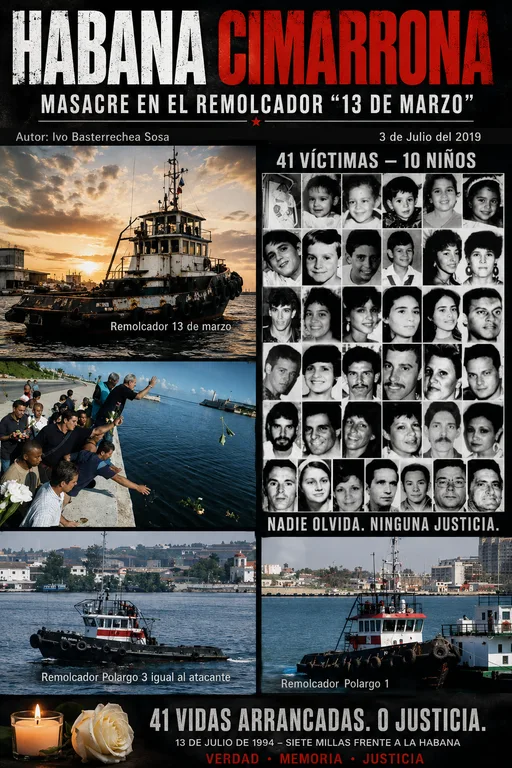
Forty-One Cubans Died Trying to Escape—Including Ten Children. More Than Three Decades Later, No One Has Been Held Accountable.
On , approximately seven miles north of Havana, the Caribbean Sea became the grave of 41 Cuban men, women, and children.
They were not soldiers. They were not terrorists.
They were not armed insurgents attempting to overthrow the government.
They were ordinary Cuban families trying to escape the island aboard an aging, state-owned tugboat named the 13 de Marzo.
Before sunrise, the vessel was pursued by other government-owned tugboats, struck repeatedly, flooded with high-pressure water cannons, and sent beneath the sea.
Thirty-one people survived. Forty-one died.
Ten of the victims were children.
The youngest, Helen Martínez Enríquez, was only six months old.
More than three decades later, no one has been prosecuted. No independent investigation has been permitted. Most of the victims’ bodies were never recovered and returned to their families.
The Cuban government called it an accident.
The survivors called it an attack.
International human-rights investigators concluded that the Cuban state was responsible.
Cuba During the Special Period
To understand why 72 people were willing to board an old tugboat in the darkness of night, it is necessary to understand Cuba in 1994.
The Soviet Union had collapsed only a few years earlier. With it disappeared the subsidies, guaranteed markets, oil shipments, credit, and economic support that had sustained the Cuban government for decades.
Fidel Castro called the resulting crisis the Special Period in Time of Peace.
For ordinary Cubans, it meant something much less poetic:
Hunger. Blackouts. Medicine shortages. Transportation failures. Empty stores.
Severe rationing. Collapsing infrastructure.
The government continued to restrict emigration, and Cubans who attempted to leave without authorization could face imprisonment, retaliation, or political punishment.
Thousands began risking their lives in the Florida Straits aboard fishing boats, homemade rafts, automobile inner tubes, wooden doors, and almost anything that could float.
Many drowned. Others were intercepted and returned.
The people aboard the 13 de Marzo knew the sea could kill them.
They boarded anyway. That fact alone reveals how desperate life had become.
The Escape From Havana Harbor
At approximately 3:00 a.m. on July 13, 1994, around 72 people boarded the 13 de Marzo at Havana’s port. The vessel belonged to a state maritime enterprise operated under Cuba’s Ministry of Transportation.
It was an old tugboat, constructed primarily of wood and reportedly in poor condition. It had not been designed to carry dozens of passengers across the Florida Straits.
But those aboard were not planning a normal voyage. They were escaping.
Many were related to one another. Entire families boarded together, including parents, grandparents, brothers, sisters, cousins, and young children.
The plan was to travel north toward the United States. The tugboat had barely cleared Havana Bay when the pursuit began.
State-Owned Vessels Give Chase
According to findings later published by the Inter-American Commission on Human Rights, two state vessels began pursuing the 13 de Marzo shortly after it left the harbor.
Approximately 45 minutes later, near an area known as La Poceta, additional vessels joined the operation.
Survivors identified three large government-operated tugboats:
- Polargo 2
- Polargo 3
- Polargo 5
A Cuban Coast Guard vessel was also reportedly present during at least part of the interception.
Accounts differ slightly regarding the precise number of vessels involved. Cuban authorities acknowledged that three Ministry of Transportation tugboats attempted to intercept the fleeing vessel.
What is not seriously disputed is that several government-owned vessels pursued an overloaded wooden tugboat filled with civilians into open water.
The crews of those pursuing vessels knew there were women and children aboard.
They continued anyway.
The Water-Cannon Attack
According to survivor testimony, the pursuing vessels did not merely order the passengers to return to Havana.
They began firing powerful streams of water onto the deck of the 13 de Marzo.
These were not ordinary hoses.
Industrial tugboats use high-pressure water cannons capable of producing tremendous force. Survivors said the streams knocked people from their feet, swept passengers across the deck, and pushed some into the sea.
The water began filling the tugboat. Passengers shouted that children were aboard.
Women reportedly lifted babies and small children into view so the pursuing crews could see them.
They begged the attackers to stop. The water cannons continued.
Some passengers attempted to protect themselves inside the cabins and lower compartments of the tugboat. Mothers gathered their children below deck, hoping the walls would shield them from the force of the water.
That decision would become fatal when the vessel sank and many of them were trapped inside.
The Ramming of the 13 de Marzo
The assault did not end with the water cannons.
The pursuing tugboats began ramming the smaller vessel.
The Inter-American Commission reported that the Polargo 2 positioned itself in front of the 13 de Marzo, while the Polargo 5 struck it from behind, damaging and splitting the stern.
Other vessels moved alongside the fleeing tugboat while continuing to spray the passengers.
Survivors described multiple impacts.
One vessel reportedly struck the stern, withdrew, and then returned to strike the bow.
The distinction between one collision and repeated ramming is critical.
A single collision during a chaotic maritime interception could potentially be described as an accident.
Repeatedly striking an overloaded wooden vessel while simultaneously flooding it with high-pressure water is something entirely different.
The 13 de Marzo began breaking apart. Then it started to sink.
Forty-One People Disappeared Beneath the Sea
As the tugboat went down, passengers were thrown into the water.
Others remained trapped inside. Survivors described screaming, darkness, panic, and family members disappearing beneath the waves.
Children were separated from their parents. Parents watched their children drown.
People clung to floating debris while calling for help.
According to survivor accounts presented to Amnesty International and the Inter-American Commission, the pursuing vessels did not immediately begin rescuing those in the water.
Some survivors alleged that the tugboats circled them, producing waves and a powerful current or whirlpool that made it more difficult for people to remain afloat.
Only later did Cuban Coast Guard vessels begin recovering survivors.
Thirty-one people were pulled from the sea. Forty-one died. Ten were children.
Among the dead were children as young as six months, two years, three years, four years, ten years, and eleven years old.
Many members of the same families died together.
Survivor María Victoria García Suárez reportedly lost 13 relatives that morning.
The victims were not numbers. They were mothers, fathers, sons, daughters, grandparents, brothers, sisters, cousins, neighbors, and friends.
The Youngest Victim
The youngest known victim was Helen Martínez Enríquez.
She was six months old. She could not have committed a crime. She could not have stolen a vessel. She could not have threatened the Cuban state.
She could not have understood the Revolution, the embargo, the Soviet collapse, or the political arguments that would later be used to excuse what happened.
She was an infant in the arms of her family.
She drowned because the adults responsible for intercepting the vessel chose force over human life.
Survivors Were Detained, Not Protected
Those who survived were not treated primarily as victims of a maritime disaster.
They were treated as suspects.
According to Amnesty International, male survivors were handcuffed, interrogated, and taken to Villa Marista, the headquarters of Cuban State Security in Havana.
Many were reportedly held without access to legal counsel.
They were questioned about the escape and about what they had witnessed.
Some were pressured to modify their accounts or support the government’s version of events.
Women and children were generally released sooner, but survivors who remained in Cuba reportedly faced surveillance, intimidation, questioning, and warnings not to speak publicly.
Amnesty International raised serious concerns that statements supporting the government’s account had been obtained from detained survivors under pressure and without attorneys present.
The Cuban state controlled nearly every part of the story.
It owned the tugboat. It owned the pursuing vessels. It controlled the Coast Guard.
It controlled the police. It controlled the investigation. It controlled the courts.
It controlled the newspapers, television stations, and radio broadcasts.
It detained the witnesses. Then it announced that the incident had been an accident.
The Government’s Official Explanation
The Cuban government described the sinking as a tragic accident that occurred while workers attempted to recover a stolen state vessel.
Authorities argued that the 13 de Marzo was overloaded, leaking, and unseaworthy.
They claimed the passengers had disabled communications at the port and that civilian maritime workers pursued the tugboat on their own initiative.
The government admitted that three state-owned tugboats attempted to intercept the vessel.
However, officials maintained that the fatal collision was accidental and that the Coast Guard acted properly by rescuing 31 people.
Even accepting this explanation, serious questions remain.
Why were high-pressure water cannons used against an overcrowded wooden vessel?
Why did the pursuit continue after the crews could clearly see women and children?
Why were dangerous ramming maneuvers attempted in open water?
Why were no crew members disciplined after 41 civilians died?
Why were survivors detained and pressured rather than protected as witnesses?
Why was there no transparent judicial proceeding?
Why were the vessel logs, radio transmissions, crew rosters, technical reports, and witness statements never released for independent review?
An accident that kills 41 people should produce a major criminal and maritime investigation.
Instead, it produced praise from Fidel Castro.
Fidel Castro Praised the Pursuing Crews
Following the sinking, Fidel Castro publicly defended the men aboard the pursuing vessels.
He characterized their effort to stop the escape as patriotic and described their conduct as exemplary.
That response remains one of the most disturbing elements of the case.
Even under the government’s own version, the interception resulted in the deaths of 41 people, including ten children.
A responsible government would have suspended the crews, preserved the vessels, recovered the wreckage, secured the radio recordings, interviewed the survivors independently, and opened a judicial inquiry.
Instead, Cuba’s most powerful official praised those involved.
The message was unmistakable: Stopping citizens from escaping was more important than determining who was responsible for their deaths.
No Independent Investigation
The Cuban government claimed that the incident had been investigated internally.
But the public was never given access to the evidence.
No complete technical report was released.
No independent investigators examined the vessels.
No public trial was held.
No survivors were permitted to testify freely before an impartial court.
No crew members were publicly prosecuted.
No commanding officers were held responsible.
No full roster of those aboard the pursuing vessels was published.
No radio communications were released.
The wreckage of the 13 de Marzo was not recovered for independent examination.
Most of the bodies were never returned to their families.
Cuban lawyers, church leaders, relatives, and human-rights advocates called for an investigation.
Their demands were ignored. By 1995, family members and attorneys were reportedly informed that the government had no intention of opening legal proceedings.
The state had investigated itself and declared itself innocent.
Amnesty International’s Investigation
Amnesty International conducted an extensive review of the sinking.
Its investigation included survivor testimony, official statements, reports from human-rights activists, and other available evidence.
Amnesty acknowledged that the taking of the tugboat was illegal.
But that did not justify what followed.
The passengers were not shown to have been heavily armed.
They did not pose a military threat. There was no evidence that they intended to attack Cuban authorities. They were trying to leave the country.
Amnesty concluded that the force used against them was grossly disproportionate, especially because the vessel carried women and children.
The organization also found substantial reason to believe that the interception was not a spontaneous act by angry civilian workers, but an official or officially tolerated operation involving state-controlled vessels.
Amnesty stated that if the events occurred as survivors consistently described them, the victims could be considered victims of extrajudicial execution.
It called on the Cuban government to:
- Conduct a full, impartial, and independent investigation.
- Publish the complete findings.
- Identify and prosecute those responsible.
- Recover the wreckage and victims’ remains.
- Compensate survivors and victims’ families.
- End harassment of witnesses and activists.
- Allow peaceful commemorations of the dead.
The Cuban government did not implement those recommendations.
The Inter-American Commission on Human Rights
In 1996, the Inter-American Commission on Human Rights issued its findings in:
Case 11.436: Victims of the Tugboat “13 de Marzo” v. Cuba
The Commission reviewed survivor testimony, the official Cuban version, the conduct of the pursuing vessels, the treatment of survivors, and the state’s refusal to provide a credible judicial remedy.
It rejected the government’s claim that the tragedy was merely an unavoidable maritime accident.
The Commission concluded that substantial evidence supported the finding that the sinking resulted from a deliberate and intentional state operation.
It held the Cuban government responsible for violating several fundamental rights:
The Right to Life
The state had a duty to protect the lives of those aboard the vessel, even if they had taken the tugboat illegally.
Instead, state-controlled vessels used force that resulted in 41 deaths.
The Right to Personal Security and Physical Integrity
Survivors were subjected to dangerous force, detention, interrogation, intimidation, and pressure.
The Right to Freedom of Movement
The case concerned Cubans attempting to leave their own country—an act treated by the government as a political and criminal offense.
The Right to Justice and Due Process
The victims’ families and survivors were denied an effective investigation, impartial proceedings, and legal accountability.
The Commission called upon Cuba to:
- Conduct an exhaustive investigation.
- Prosecute those responsible.
- Recover the wreckage.
- Locate and return the victims’ remains.
- Compensate survivors and the families of those killed.
- Provide an effective judicial remedy.
The Cuban government ignored the ruling.
Silencing the Families
The repression did not end when the tugboat sank.
Survivors and relatives who contradicted the government’s version faced surveillance and interrogation.
Human-rights activists attempting to investigate the case were detained.
Religious services and memorial gatherings were obstructed.
Amnesty International documented efforts by Cuban authorities to prevent peaceful commemorations on later anniversaries.
A memorial Mass planned for the first anniversary was reportedly canceled after authorities closed the church.
Police operations were organized around subsequent anniversaries to prevent activists and relatives from gathering publicly.
Even mourning became an act of dissent.
That behavior raises another important question:
Why would a government confident in its innocence fear flowers, prayers, memorial services, and grieving families?
Governments do not normally suppress remembrance when they believe the evidence supports their version.
They suppress remembrance when memory itself has become dangerous.
“But They Stole the Tugboat”
Defenders of the Cuban government often return to one argument:
The passengers stole state property.
That is true.
The tugboat was taken illegally.
But theft is not punishable by drowning.
Unauthorized emigration is not punishable by death.
Even people suspected of committing crimes retain basic human rights.
A government may intercept a stolen vessel.
It may arrest those responsible.
It may prosecute them through a legitimate court.
It may not use deadly, indiscriminate force against families and children and then refuse an independent investigation.
The central issue is not whether taking the tugboat was legal.
It was not.
The issue is whether the Cuban government used grossly disproportionate force and then denied the victims any meaningful path to justice.
The evidence strongly indicates that it did.
The Crime of Trying to Leave
The sinking of the 13 de Marzo also reveals a deeper truth about authoritarian systems.
A free society does not need to trap its people inside.
Governments that command genuine public loyalty do not need to criminalize departure.
When citizens are willing to risk drowning in open water rather than remain in their homeland, the question should not be:
“Why did they steal a boat?”
The deeper question is:
“What conditions made an overloaded, deteriorating tugboat seem safer than remaining in Cuba?”
The passengers chose the Florida Straits knowing the dangers.
They chose the darkness.
They chose an old wooden vessel.
They chose the possibility of storms, engine failure, sharks, exposure, and drowning.
They believed all of those dangers were preferable to the life they were leaving behind.
An Appeal to Those Who Defend Social Justice
Many people who defend the Cuban Revolution identify themselves as champions of human rights, workers, children, minorities, equality, and resistance to abusive state power.
Those principles cannot stop when the victims are Cuban.
A government does not become innocent because it calls itself socialist.
State violence does not become justice because it is committed in the name of a revolution.
Children do not become acceptable casualties because their parents wanted to leave a communist country.
An unaccountable state remains dangerous regardless of the ideology printed on its flags.
If you oppose police brutality, oppose it in Havana.
If you oppose governments killing civilians, oppose it in Cuba.
If you believe families deserve justice, include Cuban families.
If you believe children have a right to life, remember the ten children aboard the 13 de Marzo.
Human rights are either universal or they are merely political weapons.
True Solidarity With Cuba
True solidarity with Cuba does not mean automatic loyalty to the government that controls it.
It means solidarity with the Cuban people.
It means standing with the families who never received the bodies of their loved ones.
It means standing with the survivors who were detained and pressured into silence.
It means standing with activists who were arrested for attempting to commemorate the dead.
It means demanding the names of those who operated the pursuing vessels.
It means asking who ordered the interception.
It means demanding the radio recordings, vessel logs, technical reports, and original witness statements.
It means insisting upon a genuine investigation conducted by people who are independent of the Cuban state.
Supporting the Cuban people requires the courage to confront crimes committed against them—even when those crimes were committed by a government some people continue to romanticize.
Questions That Remain Unanswered
More than three decades later, the most important questions remain unresolved:
Who ordered the pursuit?
Who authorized the use of water cannons?
Who operated the vessels that rammed the 13 de Marzo?
What orders were communicated by radio?
Did Coast Guard personnel observe the attack before intervening?
Why was rescue not immediate?
Why were survivors detained?
Why were witnesses pressured?
Why were the crews praised?
Why was the wreckage never independently examined?
Why were most of the bodies never recovered?
Why were families prevented from mourning publicly?
Why has no one ever stood before a court?
Until those questions are answered through a transparent and independent investigation, the sinking of the 13 de Marzo cannot be dismissed as a closed historical controversy.
It remains an unresolved crime.
Forty-One Lives, Zero Justice
The 13 de Marzo still rests beneath Cuban waters.
The government that controlled the vessels, witnesses, evidence, courts, and media has never accepted responsibility.
The survivors carried their memories back to shore.
The families carried their grief.
The Cuban state carried on as though no accounting was required.
But history does not disappear simply because a government forbids people from discussing it.
On every July 13, the victims return to public memory.
We remember the 41 men, women, and children who died while trying to escape.
We remember the ten children.
We remember six-month-old Helen Martínez Enríquez.
We remember the mothers who held their children where the attacking crews could see them.
We remember the survivors who refused to surrender the truth.
We remember the families who were denied bodies, funerals, answers, and justice.
A government powerful enough to control the courts may delay accountability.
A government powerful enough to control the press may suppress the story.
A government powerful enough to arrest mourners may silence public grief.
But it cannot erase the dead.
Final Thought
The passengers of the 13 de Marzo were not asking the Cuban government for wealth, privilege, or political power.
They were asking for the most basic freedom imaginable:
The freedom to leave. For that, 41 of them never reached shore.
May the victims of the tugboat 13 de Marzo rest in peace.
May their families someday recover the remains of their loved ones.
May the complete truth finally be revealed.
And may those responsible one day face justice, but I doubt it. We most not forget it.
How to turn a Nation Into a Mortuary

A regime can imprison the body, starve the home, and silence the street — but its final victory only comes when it captures the mind. Free the mind, and the chains have already begun to break. --YNOT!
Cuba was not destroyed in one day.
It was not one speech, one law, one prison, one firing squad, one ration card, one exile boat, or one family split across the ocean.
It was a system. That is the part people need to understand.
A bad government can rob your wallet. A totalitarian government tries to rob your memory, your language, your faith, your courage, your history, and eventually your ability to imagine a different future.
That is why the image matters.
The skull is not just death. It is a warning. When a regime attacks its own people long enough, the country starts to look alive from the outside but dead on the inside. Buildings still stand. Flags still wave. Speeches are still made. But the soul of the nation is being starved.
The Castro regime did not merely fail economically. It carried out a long campaign against the Cuban people themselves. It broke families. It punished dissent. It taught people to whisper. It replaced pride with fear, abundance with scarcity, and culture with propaganda.
And that is the deeper crime.
A nation is not just land. A nation is memory. A nation is grandparents telling stories. It is music in the street, churches full of prayer, parents building for their children, artists creating without permission, and citizens speaking without checking over their shoulder.
When that is attacked, the damage is not only physical. It becomes spiritual.
Communism sells itself as compassion, but in practice it often demands obedience before bread, ideology before truth, and loyalty before human dignity. It does not just want control of the economy. It wants control of the mind.
That is why the words at the bottom are the most important:
Free your mind. Because before a country can be rebuilt, the people must be allowed to think again.
Cuba does not only need better policies. Cuba needs truth. It needs memory. It needs courage. It needs the right to mourn what was lost and the right to build what comes next.
The chains break first in the mind. Then in the streets. Then in history.
When a country is held hostage by itself

“The only way evil rulers leave is horizontally. Because they are evil, they don’t care about anyone else. So perhaps the solution is simple!.” --YNOT!
This is the kind of question that doesn’t let you finish your coffee while it’s still hot.
Because what Cuba, Venezuela, Iran, North Korea, and Russia share isn’t ideology—it’s structure. One small group at the top lives comfortably. Everyone else pays for it in darkness, ration lines, and silence.
That’s the moral dilemma nobody likes to say out loud:
Do you help the people with food, oil, and aid—knowing it props up the same regime that oppresses them?
Or do you choke off the system and hope the pain finally reaches the people in charge?
There’s no clean answer. Only consequences.
Cuba’s Long Slow Collapse
Cuba didn’t fall off a cliff. It’s been sliding downhill for sixty years, hitting rocks along the way and calling them victories.
Once, the island exported revolution, intelligence services, and “security expertise.” Today, even that brand is fading. When elite Cuban forces failed abroad—men once considered untouchable—it wasn’t just a military loss. It was symbolic. A reminder that the regime’s muscle memory is older than its muscles.
Look at the leadership now: men in their 80s and 90s clinging to a revolution that no longer produces electricity, fuel, or belief. It’s less “government” and more “retirement home with uniforms.”
Oil Is Power (Literally)
Cuba runs on imported oil. No oil means:
- No electricity
- No water
- No transportation
- No hospitals that function
For decades, the island survived by borrowing energy from friends: first the Soviets, then Venezuela. When that pipeline cracked, the lights started going out—sometimes for days.
Now comes the squeeze.
Washington’s strategy—driven by people like Donald Trump and Marco Rubio—isn’t bombs or invasions. It’s oil. Turn the tap off slowly enough to avoid chaos, but tight enough to force negotiations.
And here’s where it gets uncomfortable.
Mexico’s “Humanitarian Aid”
Mexico stepped in, sending subsidized oil and calling it humanitarian aid. On paper, it sounds noble. In practice, it keeps the Cuban state alive just long enough to avoid collapse—while ordinary Cubans remain trapped.
The quid pro quo?
Cuban doctors sent abroad, often paid through the regime, not to the doctors themselves. Aid that looks compassionate from afar but quietly reinforces the same system it claims to soften.
That’s the trick of modern authoritarian survival:
Let someone else pay the bill.
The Regime’s Bet
Cuba has survived worse—the “Special Period” after the Soviet collapse nearly destroyed the economy, and yet the regime endured. They’re betting they can do it again.
But this time is different.
No oil cushion.
Tourism down nearly 70%.
Power outages so severe even state TV runs out of diesel.
Hotels rising like empty monuments to denial.
A country can survive many things.
It cannot survive long without electricity and water.
At some point, fear runs out before hunger does.
So… What Do We Do?
Here’s the part nobody escapes.
If you send aid, you help real people—but you also extend the life of the system that made them desperate.
If you cut everything off, you hurt innocents first and hope the pain finally reaches the palace.
One path is morally comforting.
The other is strategically brutal.
History suggests this:
Regimes rarely fall because leaders starve.
They fall when the people stop believing—and the enforcers stop enforcing.
And that only happens when the illusion breaks.
The Uncomfortable Truth
Humanitarian aid feels good. Sanctions feel cruel.
But long-term oppression thrives on short-term compassion that never reaches the root.
The real moral failure isn’t choosing the wrong tool.
It’s pretending there’s a painless one.
So the question isn’t just should we help the people or choke the regime?
It’s whether we’re willing to accept that every choice has blood on it—just in different places.
And the worst choice of all?
Doing just enough to feel virtuous… while nothing ever changes.
Oh, and same applies in Iran, Venezuela, Russia, China, North Korea.
Read my other post about Cuba here…
#Cuba #Geopolitics #MoralDilemma #Sanctions #HumanitarianAid #Authoritarianism #EnergyPolitics #ColdTruths
Lee Harvey Oswald - Cuban Spy?
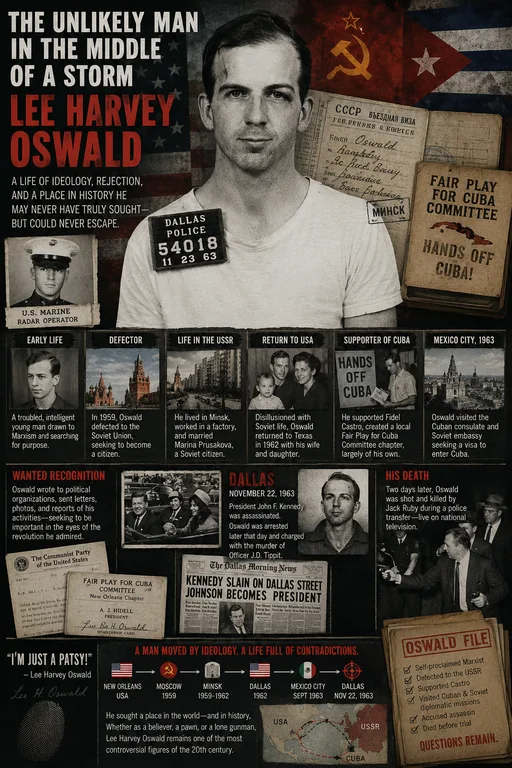
Lee Harvey Oswald spent his life trying to enter history. In the end, history swallowed him whole—leaving behind a dead president, a dead suspect, and questions that refused to die. -- YNOT!
History rarely chooses a neat, predictable character to stand at the center of its greatest storms.
Sometimes it chooses a president, a general, a revolutionary, or a spy.
And sometimes it chooses a confused, angry, deeply dissatisfied young man who spent most of his life trying to become important.
Lee Harvey Oswald was not a powerful man.
He had no army. He held no senior government position. He commanded no political movement. He was not a respected Communist organizer, an influential revolutionary, or a celebrated marksman.
Yet on November 22, 1963, his name became permanently attached to one of the most consequential political assassinations in American history.
President John F. Kennedy was murdered in Dallas, Texas, and within hours, Oswald became the central suspect.
From that moment forward, the world began trying to answer a question that has never completely gone away:
Who exactly was Lee Harvey Oswald?
Was he a lone, unstable political extremist?
Was he a Communist operative?
Was he working for the Soviet Union?
Was he connected to Fidel Castro’s Cuba?
Was he manipulated by people more powerful than himself?
Or was he simply an unlikely man who wandered into the middle of a political storm far larger than anything he truly understood?
To understand why Oswald remains such a controversial figure, we have to understand the world in which he lived.
This was the height of the Cold War.
The United States and the Soviet Union were locked in an ideological, military, intelligence, and nuclear confrontation. Europe was divided. Berlin had become a symbol of that division. Communist revolutions were spreading across parts of Asia, Africa, and Latin America.
Then came Cuba.
In 1959, Fidel Castro overthrew the government of Fulgencio Batista. Cuba soon aligned itself with the Soviet Union, placing a Communist government only about ninety miles from Florida.
The United States supported the failed Bay of Pigs invasion in 1961. The following year, the Cuban Missile Crisis brought the world terrifyingly close to nuclear war.
It was inside this atmosphere of revolution, espionage, ideological conflict, and fear that Lee Harvey Oswald constructed his identity.
A Young Man Looking for a Cause
Oswald’s early life was marked by instability.
His father died before he was born. His family moved frequently. He experienced difficulty in school, struggled socially, and developed a reputation for being withdrawn, defensive, and argumentative.
As a teenager, he began reading about Marxism.
For Oswald, Marxism was not merely an economic theory. It appears to have offered him something more personal: an explanation for why the world seemed unfair, why some people held power, and why he felt excluded from ordinary American life.
He wanted to see himself as someone who understood what others did not.
He was not simply Lee Oswald, the lonely young man from New Orleans.
In his own mind, he could become Lee Oswald, the revolutionary thinker.
That distinction mattered to him.
Oswald later joined the United States Marine Corps, where he trained as a radar operator. He learned some Russian and openly discussed Marxism with fellow Marines. Some reportedly gave him nicknames reflecting his pro-Soviet opinions.
But Oswald was never a major Communist intellectual. His political philosophy was largely self-created, inconsistent, and mixed with personal grievance.
He wanted the identity of a revolutionary without the discipline, organization, or political maturity usually required to become one.
That pattern would repeat throughout his life. Oswald repeatedly sought acceptance from Communist institutions. And Communist institutions repeatedly failed to see in him the importance he saw in himself.
The American Marine Who Defected to the Soviet Union
In 1959, shortly after leaving the Marine Corps, Oswald traveled to Europe and entered the Soviet Union.
He arrived in Moscow and announced that he wanted to renounce his American citizenship and become a Soviet citizen.
This was an extraordinary decision.
An American former Marine, trained in radar operations during the Cold War, was asking to abandon the United States and join its greatest enemy.
When Soviet officials initially rejected his request and ordered him to leave, Oswald attempted suicide by cutting his wrist in his hotel room.
After receiving medical treatment, he continued pressing his case.
The Soviet authorities eventually allowed him to remain, although they did not immediately grant him full citizenship. He was sent to Minsk, in Soviet Belarus, where he received employment at a radio and television factory.
He was also provided an apartment and financial assistance.
To an ordinary Soviet citizen, Oswald may have appeared unusually privileged. He had traveled from America, received government attention, and enjoyed living conditions that were respectable by Soviet standards.
But the Soviet Union was not the revolutionary paradise Oswald had imagined.
He discovered bureaucracy, shortages, political control, repetitive factory work, and a privileged Communist ruling class.
The Soviet system claimed to represent the worker.
Oswald found himself working in a factory. Yet he did not feel liberated. He felt bored.
He complained that Soviet life lacked excitement and that Communist officials enjoyed advantages unavailable to ordinary citizens.
The great ideological experiment he had imagined turned into another disappointment.
Oswald had rejected America because he believed Soviet Communism offered something greater.
Once inside the Soviet Union, he began rejecting it too.
Friends, Acquaintances, and Communist Connections
Oswald lived in the Soviet Union for approximately two and a half years. During that time, he had coworkers, acquaintances, neighbors, and social contacts.
But the phrase “friends with Communists” requires context.
Nearly everyone Oswald met in Minsk lived under a Communist government. The Soviet Communist Party controlled the political system, major institutions, industry, employment, and public life.
Having Soviet friends was not the same as belonging to an espionage network.
There is no established evidence that Oswald became a trusted Soviet intelligence operative or an important member of the Communist Party.
He wanted attention from the Soviet system, but Soviet authorities appear to have treated him more as an unpredictable foreign defector than as a valuable revolutionary asset.
He was watched. He was managed. He was tolerated. That is not the same as being trusted.
In 1961, Oswald met Marina Prusakova, a young pharmacy worker. They married after a brief courtship, and their daughter was born the following year.
By then, Oswald had decided he wanted to return to the United States.
This reversal was remarkable.
The young man who had dramatically attempted to abandon America now wanted the American government to help him come home.
After months of paperwork, Oswald, Marina, and their daughter left the Soviet Union in 1962 and returned to Texas.
He had gone to the Soviet Union hoping to become part of history.
He returned as a disappointed factory worker with a Russian wife, little money, and no clear direction.
But he had not abandoned Marxism. He merely began searching for a new version of the revolution.
Cuba Becomes the New Dream
After returning to the United States, Oswald increasingly turned his attention toward Fidel Castro’s Cuba.
To many radicals in the early 1960s, the Cuban Revolution represented something the Soviet Union no longer did.
The Soviet Union was old, bureaucratic, controlled, and cautious.
Cuba appeared young, militant, dramatic, and defiant.
Castro had overthrown a government, confronted the United States, survived the Bay of Pigs invasion, and declared himself a Marxist-Leninist.
To Oswald, Cuba may have looked like the revolution in its purest form.
In New Orleans, he began publicly supporting the Fair Play for Cuba Committee, an organization that opposed American intervention against Castro.
Oswald claimed to establish a local chapter.
In reality, the chapter appears to have consisted primarily of Oswald himself.
He printed literature, distributed pro-Castro leaflets, and created membership materials. He used the name “A. J. Hidell,” an alias that would later become significant in the investigation of President Kennedy’s assassination.
Oswald handed out leaflets reading “Hands Off Cuba.”
He deliberately confronted anti-Castro Cuban activists.
He participated in radio debates. He sought publicity.
Once again, Oswald was trying to transform himself.
He wanted to be seen as more than an unemployed former Marine with a troubled marriage.
He wanted to be seen as a representative of the revolution.
His political theater created the appearance of an organization.
But behind that appearance stood mostly one man. Oswald.
Rejected by the Communists He Admired
Oswald also corresponded with members of the Communist Party USA and other left-wing political organizations.
He sent letters, political materials, photographs, and reports of his activities.
He wanted recognition. He wanted established Communist figures to acknowledge that his work mattered.
But the response was limited.
The Communist Party did not embrace him as an important organizer. The Fair Play for Cuba Committee did not appear to view him as a major leader. Soviet officials had already disappointed him. Cuban officials would soon do the same.
This is one of the most revealing patterns in Oswald’s life.
He admired Communist movements. He defended Communist governments.
He wanted to participate in revolutionary history.
Yet the Communists themselves seemed unsure what to do with him.
He was too unstable, too self-important, too unpredictable, and too isolated to fit comfortably into an organized political movement.
Oswald was not a disciplined party operative following a clear chain of command.
He was a man desperately attempting to place himself inside a historical movement that never fully accepted him.
The Trip to Cuba That Never Happened
One of the most persistent misconceptions about Lee Harvey Oswald is that he traveled to Cuba. There is no credible evidence that he ever reached the island.
What he did was travel to Mexico City in September 1963 and attempt to obtain permission to enter Cuba.
Oswald’s proposed route was Mexico to Cuba and then, officially, onward to the Soviet Union.
He visited the Cuban consulate and the Soviet embassy.
He presented his pro-Castro activities, his prior residence in the Soviet Union, his Russian wife, and his Marxist credentials as evidence that he was a legitimate supporter of the Communist cause.
He wanted the Cuban government to issue him a transit visa.
But the Cubans wanted confirmation that the Soviets would permit him to enter the Soviet Union.
The Soviets told him that approval could take months. Oswald became angry and frustrated.
He apparently believed that his history should have opened doors.
He had defected to the Soviet Union and married a Soviet citizen who was probably a spy.
He had distributed pro-Castro propaganda. He had publicly defended Cuba.
He believed those actions should have earned him recognition.
Instead, he found himself rejected again.
The Cuban consulate did not immediately approve him. The Soviet embassy did not solve his problem.
The revolutionary governments he admired did not rush to welcome him.
He returned to the United States without reaching Cuba.
The supposed “trip to Cuba” was therefore not a trip to Cuba at all.
It was another failed attempt by Oswald to convince Communist officials that he belonged among them.
The Mexico City Mystery
Oswald’s time in Mexico City remains one of the most disputed chapters of the entire Kennedy assassination story.
He had contact with officials at both the Cuban and Soviet diplomatic compounds.
One of the Soviet officials he reportedly met was Valeriy Kostikov, later identified by American intelligence as a KGB officer.
That contact naturally raised suspicion.
Why was Oswald meeting a man connected to Soviet intelligence only weeks before President Kennedy was assassinated?
Was it merely a visa discussion?
Was Oswald seeking assistance?
Was he being assessed?
Was he acting alone?
Was someone using his identity?
Was he attempting to make himself appear more important than he actually was?
The documented record establishes that Oswald sought visas and communicated with the embassies.
It does not conclusively establish that the Soviet Union or Cuba recruited him to kill President Kennedy.
Official investigations later concluded that neither the Soviet government nor the Cuban government directed the assassination.
Still, the Mexico City episode remains fertile ground for suspicion because it places Oswald in direct contact with the diplomatic representatives of America’s Cold War enemies shortly before the murder of an American president.
That does not prove a conspiracy. But it explains why the questions have survived.
The Man Who Wanted to Matter
Lee Harvey Oswald appears to have possessed a powerful need to be recognized.
He wanted to be taken seriously as a political thinker.
He wanted Communist governments to view him as useful.
He wanted political organizations to recognize him as a revolutionary.
He wanted attention from the press. He wanted history to notice him.
But Oswald repeatedly failed to achieve significance through ordinary political action.
The Soviet Union did not make him a revolutionary hero.
The Communist Party did not make him a leader.
The Fair Play for Cuba Committee did not make him an important organizer.
Cuba did not immediately welcome him.
His marriage was troubled. His employment was unstable.
His ambitions were much greater than his accomplishments.
That combination—ideological obsession, personal grievance, isolation, humiliation, and a desire for historical importance—made Oswald dangerous whether he acted entirely alone or not.
He did not need to be a brilliant mastermind. He did not need to control a movement.
He did not even need to fully understand the political consequences of his actions.
He only needed to believe that one dramatic act could force history to recognize his name.
Dallas
On November 22, 1963, President John F. Kennedy traveled through Dallas in an open limousine.
Shots were fired as the presidential motorcade passed through Dealey Plaza.
Kennedy was fatally wounded. Texas Governor John Connally was also wounded.
Investigators quickly focused on the Texas School Book Depository, where Oswald worked.
A rifle was discovered inside the building. Oswald left the area.
Later that day, Dallas police officer J. D. Tippit was shot and killed.
Oswald was arrested inside a movie theater.
He denied killing President Kennedy. He also denied killing Officer Tippit.
Two days later, before Oswald could stand trial, nightclub owner Jack Ruby shot him inside the basement of Dallas police headquarters during a live television broadcast.
Oswald died without testifying in court.
That single event ensured that doubts would multiply.
There would be no public trial. No full cross-examination.
No opportunity for prosecutors to present their entire case before a jury.
No opportunity for Oswald’s defense attorneys to challenge the evidence.
No final explanation from Oswald himself.
Instead, the accused assassin was silenced by another man before the legal system could determine guilt in open court.
The vacuum left behind became filled with theories.
Lone Gunman, Pawn, or Something In Between?
The Warren Commission concluded that Oswald acted alone in assassinating President Kennedy.
The House Select Committee on Assassinations later agreed that Oswald fired the shots that killed Kennedy, while also concluding that Kennedy was probably assassinated as the result of a conspiracy, based partly on acoustic evidence that was later heavily disputed.
Other researchers have argued for involvement by organized crime, anti-Castro Cuban militants, pro-Castro operatives, the CIA, the Soviet Union, the FBI, military intelligence, wealthy political interests, or combinations of these groups.
No alternative theory has achieved universal acceptance.
The challenge is that Oswald’s life contained enough genuine mystery to support suspicion.
He had defected to the Soviet Union.
He returned to the United States with surprising ease.
He supported Castro. He created a pro-Cuba organization. He used aliases.
He visited the Cuban consulate. He met Soviet officials.
He attempted to return to the Communist world.
He was accused of killing the president. Then he was murdered before trial.
Those facts sound like the structure of an espionage novel.
But history is often stranger, less organized, and more chaotic than fiction.
A life can look like a conspiracy even when much of it was driven by confusion, ego, coincidence, and personal failure.
It is also possible for an unstable individual to attract the attention of intelligence agencies without becoming their controlled agent.
Governments may watch someone without directing him.
Organizations may speak to someone without recruiting him.
Political extremists may seek powerful sponsors who have no interest in sponsoring them.
Oswald may have been watched by many people and controlled by none.
Or he may have been useful to people who understood him better than he understood himself.
That is the unresolved space in which the Oswald story continues to live.
The Unlikely Man in the Middle
Lee Harvey Oswald was an unlikely figure to become one of the most famous names of the twentieth century.
He was not a great political leader. He was not a respected intellectual.
He was not a successful revolutionary. He was not welcomed as a hero in the Soviet Union.
He was not embraced by Cuba. He was not elevated by the American Communist movement.
He spent much of his life trying to join something larger than himself.
He tried the Marine Corps. He tried the Soviet Union.
He tried Marxism. He tried Cuba.
He tried political activism. He tried public confrontation.
He tried creating an organization around himself.
Nothing gave him the importance he believed he deserved.
Then, in one terrible afternoon in Dallas, Lee Harvey Oswald became impossible to ignore.
Whether he was the lone architect of the assassination, an unstable man caught in a larger operation, or a convenient figure around whom competing interests converged, he became the unlikely man in the middle of a storm.
A storm involving the United States, the Soviet Union, Cuba, intelligence agencies, organized crime, anti-Castro exiles, Cold War politics, and a nation already divided by fear.
Perhaps that is why the story remains so powerful.
Oswald was not a clear symbol of one political movement.
He was a contradiction. An American Marine who admired the Soviet Union.
A Marxist who became disillusioned with Soviet Communism.
A supporter of Cuba who never reached Cuba.
A man who sought Communist friendship but was never fully accepted by Communist institutions.
A political extremist who wanted to matter but never built a real political following.
And finally, an accused assassin who died before the world could hear his complete defense.
Lee Harvey Oswald spent his life searching for a place inside history.
On November 22, 1963, history found him.
The tragedy is that America may never know with absolute certainty whether Oswald created the storm, joined the storm, or was simply the most visible man standing in its center.
Silenced Before Trial
Lee Harvey Oswald never lived long enough to face a jury, present a defense, or explain his actions under oath. On November 24, 1963, only two days after President Kennedy’s assassination, Dallas police began transferring Oswald from police headquarters to the county jail. Reporters, photographers, and television cameras crowded the basement as officers escorted him through the building. Suddenly, Dallas nightclub owner Jack Ruby stepped from the crowd and fired a revolver into Oswald’s abdomen at close range. The shooting was broadcast live across the nation. Oswald was rushed to Parkland Memorial Hospital—the same hospital where Kennedy had died—and was pronounced dead later that day. Ruby claimed that he acted out of grief and wanted to spare Jacqueline Kennedy the pain of a trial, but his connections to Dallas nightlife, organized-crime figures, police officers, and political circles immediately deepened public suspicion. Oswald’s death eliminated the possibility of a full public trial and left investigators, historians, and the American people with evidence that could be examined, but a defendant who could never be questioned. In death, Oswald became even more mysterious than he had been in life, and Jack Ruby’s bullet helped transform a presidential assassination into a controversy that would endure for generations.
CUBA Exports the Revolution
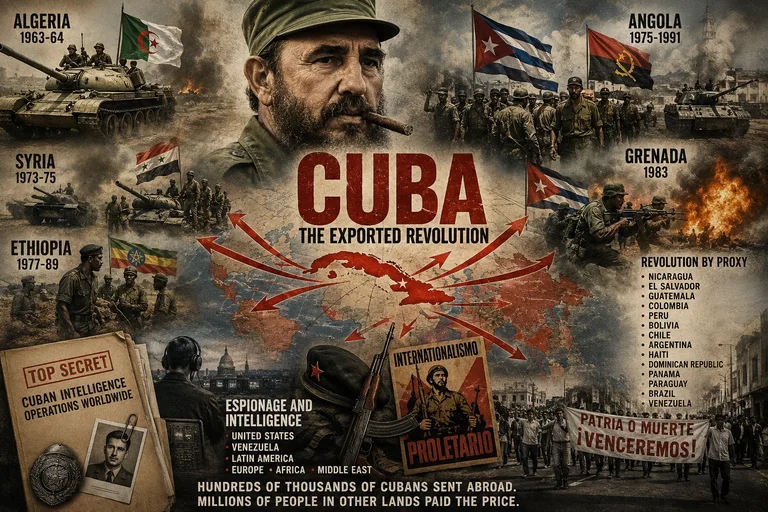
For decades, Cuba exported revolution while the Soviet Union picked up the tab. Cuban blood, Soviet money, and foreign countries paid the price.
Cuba’s Military Campaigns, Proxy Wars, and Intelligence Operations Abroad
After 1959, Cuba was not merely a poor island claiming to defend itself against the United States. Under Fidel Castro, Cuba became an exporter of armed revolution. The regime sent soldiers, tanks, pilots, doctors, advisers, intelligence officers, trainers, weapons, propaganda, and political operatives across Africa, the Middle East, Latin America, and the United States. Havana called it “internationalism.” Its enemies called it subversion. In reality, it was both: a small Caribbean dictatorship, financed and armed by the Soviet bloc, projecting itself into other nations’ wars.
One research review of Cuban military internationalism identifies the major direct Cuban armed interventions as Algeria, Syria, Angola, and Ethiopia, while Cuban records and other histories also include Congo/Zaire and Grenada as important combat or military-security episodes. Cuba’s official press claims that 385,908 Cuban combatants served in African missions, and recent reporting has described more than 400,000 Cuban military and support personnel serving across Africa during the Cold War. Those numbers show the scale of Castro’s ambition: Cuba was economically broken at home, but militarily active abroad. (Seguridad Internacional)
Before going campaign by campaign, one warning is necessary: casualty figures are messy. In Angola, Ethiopia, and Grenada, we can give reasonable estimates of Cuban dead and battlefield deaths. In Latin America, where Cuba usually acted through training, weapons, intelligence, safe haven, and political support, there is usually no honest way to say “Cuba caused exactly this many deaths.” The correct approach is to distinguish direct Cuban combat deaths, enemy/allied combat deaths, and total conflict deaths.
Summary casualty ledger
| Campaign / country | Cuban role | Approx. Cuban personnel | Approx. killed / casualty picture |
|---|---|---|---|
| Algeria / Sand War, 1963–64 | Cuban armor, advisers, troops supporting Algeria against Morocco | Cuban official source says 865 troops; other accounts cite about 686 men | Cuban deaths unclear or possibly none publicly confirmed. Algerian deaths often estimated 60–300; Moroccan deaths disputed, often listed from dozens to low hundreds. (Granma) |
| Congo/Zaire, 1965 | Che Guevara and Cuban guerrilla mission supporting Congolese rebels | Roughly 100–200 Cubans, depending source/account | Cuban-specific deaths unclear. Wider Congo Crisis often estimated around 100,000 dead, but that cannot be attributed to Cuba alone. (Cambridge University Press) |
| Syria / Golan front, 1973–75 | Cuban tank troops/advisers supporting Syria after Yom Kippur War | Cuban official source says 746 troops; other estimates range higher | Reported Cuban losses around 180 killed and 250 wounded. Israeli official records list 2,297–2,689 Israeli dead in the Yom Kippur War as a whole, not all against Cubans. (Granma) |
| Angola, 1975–91 | Major Cuban expeditionary war backing MPLA against FNLA, UNITA, Zaire, and South Africa | Raúl Castro claimed 370,000+ soldiers and 50,000 civilians over the war | Cuban dead commonly given as about 2,077 in Angola. Angola’s civil war killed at least 500,000, with some estimates higher. (OpenEdition Books) |
| Ethiopia / Ogaden War, 1977–89 | Cuban combat forces backing Ethiopia against Somalia | Often cited around 16,000 Cuban troops | Cuban dead estimates vary, often 160–400. Ogaden War deaths estimated around 60,000 total: about 15,000 Ethiopian soldiers, 20,000 Somali/WSLF fighters, and 25,000 civilians. (Wikipedia) |
| Grenada, 1983 | Cuban military advisers, armed construction/security personnel resisted U.S.-led invasion | U.S. sources found 784 Cubans on island; 638 captured | U.S.: 19 killed, about 115 wounded. Cuba: 25 killed, 59 wounded, 638 captured. Grenada: 45 military dead, 358 wounded, plus civilian deaths. (Line of Departure) |
| Nicaragua, 1978–90 | Training, arms, intelligence, logistics for Sandinistas; later security/adviser role | No single clean troop number; mostly advisers/trainers | Anti-Somoza fighting left up to 50,000 dead; Contra war later killed about 30,000–35,000. Cuban-specific battlefield deaths not clearly documented. (Office of the Historian) |
| El Salvador, 1980–92 | Support networks for leftist guerrillas; regional revolutionary training and liaison | Not a Cuban combat deployment | Civil war killed about 75,000. UN-linked findings attributed the overwhelming majority of civilian killings to government/security forces, with a smaller share to the FMLN. Cuban-specific deaths not applicable. (Loyola Special Collections) |
| Guatemala, 1960–96 | Support/inspiration/training networks for guerrilla movements | Not a Cuban combat deployment | Up to 200,000 dead and over 40,000 disappeared; CEH attributed 93% of violations to the state and 3% to guerrillas. (ICMP) |
| Colombia, 1960s–present conflict | Ideological support, safe haven, training allegations, later peace-host role; ELN/FARC links | Not a formal Cuban expedition | Colombian conflict deaths documented at 262,197 by CNMH through 2018; Truth Commission estimates around 450,000 homicides from 1985–2018. Cuba-specific death toll cannot be separated. (Centro de Memoria Histórica) |
| Bolivia, 1966–67 | Che Guevara’s Cuban-led guerrilla foco | Small guerrilla column | Final battle: Bolivian Rangers captured Che; U.S. records say orders were given to kill him. Total campaign deaths were small compared with Angola or Central America, but politically enormous. (Office of the Historian) |
1. Algeria: Cuba’s first African military test
Cuba’s first major foreign military mission came only a few years after Castro took power. In 1963, newly independent Algeria fought Morocco in the Sand War, a border conflict over disputed Saharan territory. Algeria had just emerged from its brutal war against France and was weak, disorganized, and heavily politicized. To Castro, Algeria was a natural revolutionary ally: anti-colonial, socialist-leaning, and useful as Cuba’s first stage in Africa.
Cuba sent a military contingent to support Algeria. Cuba’s own official press says 865 Cuban troops and their equipment arrived between October 21 and October 29, 1963. Other accounts describe a smaller force of around 686 men under Efigenio Ameijeiras, including tanks and armored support. The mission was not only symbolic. Castro authorized Cuban personnel for combat if necessary, though the war ended quickly and Cuba’s direct battlefield role appears to have been limited. (Granma)
The casualties in the Sand War are disputed. French sources reported 60 Algerian dead and 250 wounded, while later works give around 300 Algerian dead. Moroccan losses are less clearly sourced and vary from dozens to low hundreds. For Cuba, there is no solid public casualty count; the best phrasing is that Cuban losses were unclear and probably limited, because the war was short and the Cuban force arrived near the end. (Wikipedia)
Algeria mattered because it proved the pattern: Castro would use Cuban soldiers not just to defend Cuba, but to insert Havana into foreign wars. A country that could not feed its own people reliably was already exporting tanks and ideology.
2. Congo/Zaire: Che Guevara’s failed African revolution
The Congo mission was one of Castro’s most romantic and foolish adventures. In 1965, Che Guevara secretly entered what is today the Democratic Republic of Congo to support leftist rebels connected to the National Council of Liberation. The Congolese crisis had already drawn in the United States, the Soviet bloc, Belgium, mercenaries, neighboring African states, and United Nations forces. Cuba saw Congo as the next Sierra Maestra — a jungle war where a disciplined guerrilla vanguard could ignite revolution.
It failed badly. Che discovered that the Congolese rebels were not the disciplined revolutionary army he imagined. They were divided, poorly organized, suspicious of outsiders, and often more interested in local power struggles than Marxist theory. A Cambridge history summary describes Congo as an early test bed for Cuba’s projection into Africa and notes that the disorganization of the Congolese rebels and poor assessment of the local balance of power doomed the guerrilla effort. (Cambridge University Press)
The Cuban force was small, usually described in the range of 100 to 200 personnel depending on the account. This was not Angola. It was a guerrilla expedition, not a conventional army. Cuban-specific casualties are not reliably documented in a clean public count. The wider Congo Crisis, however, is often estimated at around 100,000 dead, but those deaths came from a broad civil and international crisis, not from Cuba alone. (Cambridge University Press)
Congo is important for the book because it shows the arrogance of revolutionary export. Castro and Che believed the Cuban model could be transplanted into another country like a machine part. Congo proved otherwise. Revolution was not a product Havana could simply ship by boat.
3. Syria and the Golan: Cuban tanks against Israel
Cuba’s intervention in Syria is less known than Angola, but it is one of the most revealing. After the 1973 Yom Kippur War, Syria requested help from Cuba. Cuba sent tank troops and advisers to reinforce Syria on the Golan front. Cuba’s official press says 746 Cuban troops were sent; other accounts estimate a larger deployment, sometimes between 800 and 3,000. (Granma)
This placed Cuban personnel into the Arab-Israeli conflict. Cuban tank crews and advisers served on the Syrian side during the post-Yom Kippur War fighting and the war of attrition that followed. Israeli official records say the Yom Kippur War began with Egyptian and Syrian surprise attacks and list Israeli losses at 2,297 soldiers killed and 7,250 wounded in one official chronology; another Israeli archive page gives 2,689 dead and 7,251 wounded. Those figures are for the war as a whole, not specifically for fighting against Cubans. (Israeli Military Archives)
Cuban losses were significant for a faraway war most Cubans had no personal stake in. A review of Cuban military internationalism reports approximately 180 Cuban killed and 250 wounded on the Golan front. That is a heavy price for a small island fighting on behalf of Syria, in a conflict thousands of miles from Havana. (Seguridad Internacional)
This campaign also reveals Castro’s ideological alignment. Cuba did not merely oppose the United States in the Caribbean. It joined Soviet-aligned fronts globally: against South Africa in Angola, against Somalia in Ethiopia, against Israel in Syria, and against U.S.-aligned governments or movements in Latin America.
4. Angola: Cuba’s biggest foreign war
Angola was Cuba’s great overseas war. It was the campaign that transformed Cuba from a loud revolutionary state into a real expeditionary military actor. After Portugal’s dictatorship collapsed in 1974, Angola moved toward independence, but the country was divided among three main movements: MPLA, FNLA, and UNITA. The MPLA had Soviet and Cuban ties. FNLA received support from Zaire and U.S.-aligned networks. UNITA, led by Jonas Savimbi, later became the main anti-MPLA force backed by South Africa and the United States. U.S. State Department history describes Angola as a Cold War battleground where the superpowers and their allies supplied competing clients. (Office of the Historian)
Cuba launched Operation Carlota in November 1975. The immediate goal was to save the MPLA from being overrun by rival Angolan factions, Zairian-backed forces, and South African intervention. U.S. documents estimated Cuban troop levels reached 10,000–12,000 by early 1976. A later academic chapter cites Raúl Castro’s claim that more than 370,000 Cuban soldiers and 50,000 Cuban civilians served in Angola over the course of the war, with 2,077 Cuban combat deaths. (Office of the Historian)
The early Cuban intervention helped the MPLA survive. The MPLA declared itself the government of independent Angola on November 11, 1975. South African forces withdrew in spring 1976, and the MPLA remained the official government. That was the first Cuban victory: Castro had helped decide who would rule Angola. (Office of the Historian)
But Angola did not become peaceful. The civil war continued for decades. Cuba stayed to defend the MPLA government. UNITA fought on. South Africa continued to intervene from Namibia, then called South West Africa. The United States, South Africa, Zaire, the Soviet Union, and Cuba all turned Angola into a proxy battlefield. The Angolan people paid the price.
The war’s death toll is staggering. Conservative summaries commonly say more than 500,000 people died in the Angolan Civil War. Some estimates go higher. These were not all soldiers. Civilians died from combat, bombing, mines, displacement, hunger, disease, and the destruction of infrastructure. The South African Truth and Reconciliation Commission described mass displacement and civilian suffering from South African operations in Angola, and cited one major Operation Hooper engagement near Cuito Cuanavale in which 324 Angolan/Cuban troops and 21 South Africans were killed, according to SADF figures. (Truth Commission)
The late decisive chapter came around Cuito Cuanavale in 1987–88. Both sides claimed victory. South Africa and UNITA argued they stopped an MPLA offensive. Cuba and Angola argued they prevented Cuito from falling and shifted the strategic balance. Politically, the battle helped push negotiations that led to Cuban withdrawal and Namibia’s independence. The 1988 agreements between Angola, Cuba, and South Africa created the framework for foreign troop withdrawal. (Seguridad Internacional)
Angola is the central exhibit in the case against Castro’s myth. The regime claimed moral purity and anti-imperialism while operating an expeditionary army abroad for fifteen years. Cuba was not simply a victim of great-power politics. In Angola, Cuba became one of the armed instruments of great-power politics.
5. Ethiopia and the Ogaden War: Cuba chooses Ethiopia over Somalia
The Ogaden War exposed the hypocrisy and cold calculation inside communist “solidarity.” Somalia and Ethiopia had both claimed revolutionary credentials at different moments. But when Somalia invaded Ethiopia’s Ogaden region in 1977, the Soviet Union shifted support toward Ethiopia’s Marxist Derg regime. Cuba followed Moscow.
Cuban troops were flown into Ethiopia to help repel Somalia. Many accounts cite around 16,000 Cuban troops involved, along with Soviet support and advisers. The war turned once Cuban, Soviet, and allied support strengthened Ethiopia’s counteroffensive. Somali forces were pushed back, and Ethiopia regained control of most of the Ogaden. (Wikipedia)
Casualty estimates vary. A useful estimate gives around 60,000 total deaths in the Ogaden War: approximately 15,000 Ethiopian soldiers, 20,000 Somali soldiers and WSLF fighters, and 25,000 civilians. Cuban deaths are usually estimated between 160 and 400, depending on the source. (The Guardian)
The aftermath was brutal. A Guardian archive report from 1980 described refugee accounts of Ethiopian and Cuban soldiers destroying herds, burning fields, destroying farms, and forcing population movements in the Ogaden. It reported an official refugee figure of 1.4 million. These accounts should be described as refugee reports, but they show the human cost of the war after the battlefield victory. (The Guardian)
The Ogaden War shows that Castro’s “internationalism” was not about freedom. It was about alignment. When the Soviet line changed, Cuba changed. The people of the Ogaden became pieces on a Cold War board.
6. Grenada: Cuban and American forces collide
Grenada was the rare case where Cuban and American forces directly fought each other. In 1983, after the murder of Grenadian Prime Minister Maurice Bishop and the collapse of order inside the island’s Marxist government, the United States launched Operation Urgent Fury. The U.S. said it acted to protect American medical students, restore order, and remove Cuban/Soviet influence. (U.S. Naval Institute)
Cuba had hundreds of personnel on Grenada, many working on the Point Salines airport project. U.S. sources found 784 Cubans on the island and identified Cuban military advisers among them. The Cuban line was that many were construction workers; U.S. accounts emphasized that many were armed and that Cuban and Grenadian forces were not fully organized for island-wide defense when the invasion came. (Line of Departure)
The casualty figures are among the clearest of all Cuban foreign operations. U.S. Army history lists 19 U.S. dead and 115 wounded; Cuban forces lost 25 killed, 59 wounded, and 638 captured; Grenadian forces lost 45 killed and 358 wounded. (Line of Departure)
Grenada mattered because it shattered the illusion that Cuban “internationalism” was harmless construction work and medical solidarity. When the fighting started, Cuban personnel fought. Some died. Others were captured. The island became a miniature version of the Cold War: Cuba, the United States, Marxist revolution, Soviet weapons, Caribbean politics, and dead young men on all sides.
7. Nicaragua: Cuba’s successful revolution in Central America
Nicaragua was one of Havana’s greatest political victories in Latin America. Cuba supported the Sandinista National Liberation Front, or FSLN, in the struggle against Anastasio Somoza. U.S. documents from 1979 described Cuba providing logistics, safe haven, and training to the Sandinistas. Another U.S. document said Cuba accelerated training, urged Sandinista factions to unify, sent guerrillas back into Nicaragua, and supplied arms including anti-aircraft guns, heavy mortars, and recoilless rifles. (Office of the Historian)
The anti-Somoza revolution was extremely costly. A country-study summary estimates that by the Sandinista victory, 50,000 Nicaraguans were dead, 120,000 were exiles, and 600,000 were homeless. The later Contra War, fought between the Sandinista government and U.S.-backed Contra rebels, killed about 30,000 to 35,000 people. (Country Studies)
Cuba did not send an Angola-sized army to Nicaragua. It did not need to. This was the Latin American model: train the cadres, arm the movement, provide intelligence, shape the ideology, and help the guerrilla organization survive long enough to win. Once the Sandinistas took power, Nicaragua became a major Cuban ally in the hemisphere.
For Castro, Nicaragua proved that the Cuban model could still win in Latin America. For Nicaraguans, the victory came with revolution, dictatorship, civil war, exile, economic destruction, and a new authoritarian dynasty under Daniel Ortega.
8. El Salvador: revolution by proxy
El Salvador was one of the bloodiest Cold War battlefields in the Americas. The leftist FMLN fought the U.S.-backed Salvadoran government in a civil war from 1980 to 1992. Cuba’s role was not a conventional military invasion; it was part of the broader revolutionary network of training, political support, safe haven, coordination, and ideological warfare.
The war killed about 75,000 people and left thousands missing. A summary of the UN Truth Commission’s findings says the overwhelming majority of deaths were attributed to government security forces and death squads, with a smaller share attributed to the FMLN. Reuters also summarizes the war as a conflict between leftist guerrillas and the U.S.-backed Salvadoran army that left 75,000 dead and 8,000 missing. (Loyola Special Collections)
For this chapter, the key is accuracy: Cuba helped revolutionary forces, but the Salvadoran state and allied death squads committed the majority of killings. That does not absolve Cuba of exporting armed struggle. It means the killing field was produced by both revolution and counterrevolution, with civilians crushed between them.
9. Guatemala: a war of terror, guerrillas, and state violence
Guatemala’s civil war lasted from 1960 to 1996 and became one of the worst conflicts in Latin America. Cuban support operated through ideological influence, revolutionary training networks, and ties to guerrilla movements, not through a public Cuban army. The war’s casualty numbers dwarf Cuba’s direct military campaigns.
The UN-sponsored Historical Clarification Commission estimated up to 200,000 dead and more than 40,000 disappeared. It attributed 93% of human-rights violations to the state and 3% to guerrillas. (ICMP)
That ratio matters. A serious anti-communist history should not pretend every death in Guatemala was caused by Cuban-backed guerrillas. The Guatemalan state and associated forces carried out the overwhelming share of atrocities. But Cuba still belongs in the story because Havana helped build the revolutionary imagination and regional infrastructure that encouraged armed struggle as the path to power.
10. Colombia: Cuba, guerrillas, safe haven, and the long war
Colombia is different because the conflict lasted for generations and still has armed remnants today. Cuba’s role included ideological influence, relations with guerrilla groups, safe haven allegations, and later hosting peace negotiations. The U.S. State Department has repeatedly described Cuba’s long history of providing advice, safe haven, communications, training, and financial support to guerrilla groups and individual terrorists. It also noted Cuba’s refusal to extradite ELN leaders after the 2019 Bogotá police academy bombing that killed 22 people and injured 87. (ecoi.net)
Colombia’s casualty numbers are enormous. Colombia’s National Center for Historical Memory documented 262,197 dead in the armed conflict from 1958 to July 2018. Colombia’s Truth Commission later estimated around 450,000 conflict-related homicides between 1985 and 2018. (Centro de Memoria Histórica)
But here again the attribution must be careful. Colombia’s deaths were caused by guerrillas, paramilitaries, state forces, criminal groups, narcotrafficking networks, and local power struggles. Cuba was part of the revolutionary ecosystem, but it was not the sole engine of Colombia’s war. The clean historical charge is not “Cuba killed 450,000 Colombians.” The clean charge is this: Cuba helped legitimize, shelter, train, and politically sustain armed revolutionary movements that became part of one of the longest and bloodiest conflicts in the hemisphere.
11. Bolivia: Che’s last disaster
Bolivia was Castroism reduced to its purest form: a small revolutionary foco trying to ignite a country that did not ask for it. Che Guevara entered Bolivia to create a guerrilla war that would spread across South America. The plan failed because Che misread Bolivia, failed to win broad peasant support, lacked sufficient local communist backing, and was hunted down by the Bolivian army with U.S. assistance.
U.S. records state that after Che’s capture, orders were given from Bolivian Army Headquarters to kill him. TIME’s original reporting described Bolivian Rangers tracking a small guerrilla group, capturing Che, and the political danger that a public trial would have posed. (Office of the Historian)
The death toll in Bolivia was tiny compared with Angola, Ethiopia, Nicaragua, or Guatemala. But the political meaning was enormous. Che’s death proved that the Cuban revolutionary model was not magic. It could fail. It could be rejected. It could be hunted down and destroyed.
12. Peru, Argentina, Brazil, Chile, Panama, Dominican Republic, Haiti, and others
Cuba’s influence extended across Latin America beyond the headline wars. In many countries, the Cuban role was not a formal expedition but a mixture of inspiration, training, funding, propaganda, intelligence liaison, and guerrilla networking. This included revolutionary movements or contacts in Argentina, Brazil, Chile, Panama, Peru, the Dominican Republic, Haiti, Paraguay, and others.
For some countries, like Peru, later violence took on its own internal logic. Peru’s internal armed conflict from 1980 to 2000 is estimated by one modern statistical study at between 58,234 and 65,958 fatal victims, and the study found that Shining Path killed more people than the Peruvian armed forces. But Shining Path was Maoist, not simply a Cuban proxy, so it would be inaccurate to make Cuba responsible for Peru’s full death toll. (arXiv)
The broader point is that Cuba exported the method: guerrilla romanticism, clandestine organization, political violence, revolutionary propaganda, and one-party ideology. Some movements succeeded. Most failed. But across the continent, young men died chasing Havana’s fantasy.
13. Espionage: Cuba’s most successful weapon
Cuba’s most effective foreign weapon was not the tank. It was the spy.
The United States is the clearest target. Ana Belén Montes, a senior Defense Intelligence Agency analyst, pleaded guilty to spying for Cuba and admitted revealing the identities of four U.S. undercover intelligence officers working in Cuba. Marta Velázquez was charged with helping introduce Montes to Cuban intelligence and accompanying her to Cuba for spycraft training. Víctor Manuel Rocha, a former U.S. ambassador and National Security Council official, pleaded guilty in 2024 to secretly acting for decades as an agent of the Cuban government, with DOJ saying his work began in 1973 and continued until his arrest. (FBI)
Cuba also embedded itself deeply into Venezuela’s security state. Reuters reported that Cuban intelligence agents were embedded throughout the Venezuelan military and the DGCIM counterintelligence structure under deep security agreements beginning in the late 2000s. This was not battlefield combat in the old sense. It was regime protection: surveillance, repression, loyalty control, and intelligence management. (Reuters)
Espionage does not produce casualty numbers the way artillery does. Its damage is quieter: betrayed sources, compromised operations, broken opposition networks, imprisoned dissidents, manipulated institutions, and regimes kept alive longer than they should have survived. In many ways, Cuban intelligence achieved what Cuban armies could not. It penetrated enemies, protected allies, and made Havana more dangerous than its economy or geography should have allowed.
Conclusion: the bill paid by other people
The Castro regime sold its foreign wars as moral duty. Algeria was anti-colonial solidarity. Syria was anti-Israel solidarity. Angola was anti-apartheid solidarity. Ethiopia was socialist solidarity. Nicaragua was revolutionary solidarity. Venezuela was Bolivarian solidarity.
But behind every slogan was the same structure: Cuban men sent abroad, Soviet weapons and subsidies, foreign civilians trapped in proxy wars, and Havana gaining influence while other countries burned.
Cuba paid in blood, but not only Cuban blood. Angolans, Ethiopians, Somalis, Grenadians, Nicaraguans, Salvadorans, Guatemalans, Colombians, Bolivians, Israelis, Syrians, South Africans, Moroccans, Algerians, and many others paid too.
That is the real history of Castro’s “internationalism.” It was not charity. It was not peace. It was the export of revolution by rifle, tank, radio, safe house, embassy, and spy network.
Cuba was a small island, but Castro turned it into a matchbox thrown into other people’s gasoline.
Defending the Revolution
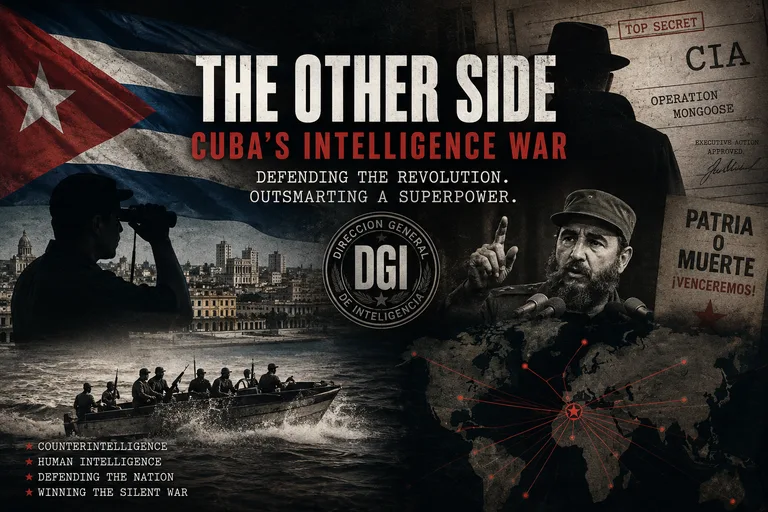
How Castro Fought the CIA, the ounterrevolution, and the Secret War Against Cuba
When Fidel Castro entered Havana in January 1959, the Cuban Revolution had won the war against Fulgencio Batista.
It had not won peace.
Within a remarkably short period, Cuba became the center of another conflict—one fought with guerrillas in the mountains, clandestine radios, boats crossing the Florida Straits, intelligence agents, neighborhood informants, sabotage teams, political prisoners, double agents, hijacked airplanes and competing governments that each believed the other was trying to destroy it.
From Washington and Miami, the story looked like a struggle to overthrow an increasingly communist dictatorship.
From Havana, it looked like a struggle to keep a revolution alive while the most powerful country in the hemisphere was actively trying to remove it.
Both descriptions contain truth.
And to understand how Fidel Castro remained in power despite the Bay of Pigs, CIA covert operations, exile attacks and internal armed opposition, it is necessary to understand the security and intelligence machine Cuba built to defend the revolution.
Before Castro: The Other Cuban Government
There is an important dividing line in this history.
During most of the 1950s, the Cuban government fighting revolutionaries was not Castro’s government.
It was Fulgencio Batista’s. Batista’s police, military and intelligence organizations pursued members of Fidel Castro’s July 26 Movement, the Directorio Revolucionario and other opposition organizations.
People were arrested, interrogated, tortured and killed.
Castro himself went from prisoner to exile to guerrilla leader.
Then, on January 1, 1959, the positions reversed.
Batista fled. The revolutionaries became the government.
And the men who had spent years hiding from government security forces suddenly had to create their own security forces.
Their enemies had not disappeared. Some fled Cuba. Others remained.
Some simply wanted to live quietly. Some organized political opposition.
And some began preparing to overthrow the new government.
The Revolution Begins Removing Its Enemies
One of the revolutionary government’s earliest priorities was dismantling Batista’s old security apparatus.
Former police officers, soldiers, intelligence officials and political figures were investigated.
Some were imprisoned. Some fled. Many were executed following revolutionary tribunals.
Properties belonging to Batista supporters and later other opponents were confiscated.
The government progressively eliminated competing centers of political power.
But an important distinction was quickly lost. Not every person who opposed Castro had supported Batista.
Some of the men who would soon fight Castro had themselves fought Batista.
They believed they had participated in a revolution to restore constitutional government—not to create a Marxist-Leninist state.
That distinction becomes especially important in the mountains of central Cuba.
The War in the Escambray
Beginning soon after the revolution, armed opposition appeared in the Sierra del Escambray.
The rebels were not one unified organization. They included former Batista personnel, farmers resisting revolutionary policies, anti-communists, former revolutionaries who had broken with Castro, and members of organizations that had previously opposed Batista.
Washington saw these groups as a potential nucleus for resistance.
Havana saw them as counterrevolutionaries.
The Castro government called many of them bandidos—bandits.
The campaign against them became known as the:
Lucha Contra Bandidos
The Struggle Against Bandits
It became a genuine counterinsurgency war.
By late 1960, U.S. diplomatic reporting estimated that the Cuban government had placed thousands of militiamen around the Escambray and was attempting to defeat the insurgents through isolation, infiltration and containment.
By early 1961, the campaign had intensified dramatically.
A U.S. intelligence report described Cuban militia forces surrounding isolated rebel groups with rifles, submachine guns, mortars, bazookas and artillery.
CIA assessments themselves acknowledged how difficult the situation had become for the guerrillas. Opposition bands were poorly equipped, communications were difficult, and potential coastal landing points were guarded by militia positions.
This mattered enormously because American planning assumed that internal resistance could eventually combine with forces introduced from outside Cuba.
The Cuban government’s strategy was therefore straightforward:
destroy the internal resistance before it could connect with an invasion.
Castro Builds a Security State
Military force alone was not enough. Cuba needed intelligence.
The revolutionary government began reorganizing police, military intelligence and investigative organizations almost immediately after taking power.
Over time these organizations became concentrated under the Ministry of the Interior—MININT.
Within that system developed powerful intelligence and counterintelligence organizations responsible for:
- internal security;
- foreign intelligence;
- surveillance;
- penetration of opposition groups;
- counterespionage;
- interrogation;
- communications intelligence;
- foreign revolutionary operations.
The names and organizational structures changed over time, but two broad missions emerged.
State Security
Its principal battlefield was Cuba itself. Its job was to find underground organizations, spies, saboteurs, armed opponents and political threats.
Cuban foreign intelligence
Often associated with the Dirección General de Inteligencia—DGI, its battlefield extended beyond Cuba. Its officers sought information about the United States, Miami exile organizations, Latin American governments, revolutionary movements and foreign intelligence services.
For a relatively small country, Cuba would eventually develop an extraordinarily capable human-intelligence service.
Ramiro Valdés
One of the central figures in this system was Ramiro Valdés Menéndez.
Valdés was an old revolutionary. He had participated in the attack on the Moncada Barracks, sailed aboard the Granma and fought with Castro’s guerrillas.
After the revolution, he became deeply involved in the creation of the new state’s security apparatus. His importance is difficult to exaggerate.
If the CIA had specialists designing operations against Castro, Valdés was among the men building the machinery intended to detect and destroy those operations.
Under the revolutionary government, intelligence and police functions were progressively centralized. After the establishment of MININT in 1961, security and intelligence became institutional parts of the new Cuban state.
Castro was not improvising a temporary police force. He was constructing a permanent counterintelligence system.
Manuel Piñeiro — “Barbarroja”
Then there was one of the most colorful figures in revolutionary Cuban intelligence:
Manuel Piñeiro Losada
His nickname was: Barbarroja Red Beard
Piñeiro would become one of the most important architects of Cuba’s overseas revolutionary and intelligence operations.
Where Valdés is closely associated with the internal security machinery, Piñeiro became particularly important in the international side of the revolution.
Cuba wasn’t merely preparing to prevent the CIA from exporting counterrevolution into Cuba. It increasingly intended to export revolution outward.
Piñeiro’s organizations cultivated relationships with revolutionary movements throughout Latin America and elsewhere.
Men could receive political assistance, training, sanctuary, communications support and other forms of assistance from Havana.
In that respect, something remarkable was developing.
Washington was building networks of anti-Castro Cubans.
Havana was building networks of pro-revolutionary Latin Americans.
The CIA and Cuban intelligence were beginning to play versions of the same game.
The CDR: When Counter intelligence Came to Your Street
Castro possessed another defensive mechanism that the CIA could not easily duplicate.
On September 28, 1960, he announced the creation of the:
Comités de Defensa de la Revolución
Committees for the Defense of the Revolution — CDR
They spread through Cuban neighborhoods. The principle was remarkably simple.
Instead of depending exclusively on professional policemen and intelligence officers to detect opposition, the revolution would create a system of revolutionary vigilance at neighborhood level.
Who lives in that house? Who visits them? Who has disappeared for three nights?
Who suddenly has money? Who has relatives in Miami?
Who has been criticizing the government? Who has a stranger staying with them?
Who might have received something from a boat arriving at night?
From the perspective of the government, this was an extraordinarily inexpensive intelligence network.
From the perspective of a dissident, it could be suffocating.
Your government did not necessarily need a hidden microphone in your living room.
It might only need someone across the street.
The CIA’s Fundamental Problem
Now imagine attempting to operate an underground intelligence network inside this environment.
A CIA agent enters Cuba. He needs someplace to sleep. Someone has to meet him.
Someone has to provide transportation. Someone may need to hide his radio.
Someone has to deliver documents. Someone has to receive his money.
Someone has to know when a boat is arriving.
Every additional contact becomes another potential point of compromise.
And every Cuban security officer understands the same mathematics.
Instead of immediately arresting one suspicious man, surveillance might lead to:
three contacts, then six, then twelve, then an entire underground network.
The safest-looking member of the resistance might also be an informant.
That uncertainty became one of Havana’s most powerful weapons.
Cuba Knew an Invasion Was Coming
The Bay of Pigs is normally remembered as a CIA operation that went disastrously wrong.
But there is another side of that story Cuban intelligence was already collecting detailed information about preparations for an invasion before Brigade 2506 landed.
A Cuban military intelligence report dated January 12, 1961 contained information about CIA-supported exile training operations, including activities in Guatemala.
That was months before the April invasion.
This does not mean Fidel Castro knew every detail of the final invasion plan.
He did not. Plans changed. Intelligence could be incomplete.
But Havana clearly knew that something large was being prepared.
And on April 15, 1961, exile-operated B-26 aircraft attacked Cuban airfields.
Whatever remaining uncertainty existed was disappearing quickly.
Two days later, Brigade 2506 landed at the Bay of Pigs.
Havana Neutralizes the Internal Opposition
One of the crucial assumptions behind American planning was that an invasion might stimulate an uprising within Cuba.
The CIA’s own Inspector General later noted estimates of thousands of insurgents or potential resistance participants, although the degree to which they were actually organized or controlled was uncertain.
The original planning even contemplated coordinating invading forces with local guerrilla groups and, under earlier plans, using the Escambray as a fallback area for continued resistance.
Havana understood the danger. Around the invasion, Cuban authorities arrested enormous numbers of suspected opponents.
From a counterintelligence standpoint, the logic was brutal but effective:
If an invasion depends upon an internal uprising, remove the people most likely to participate before the invasion can reach them.
The rebellion Washington hoped to ignite never materialized on the scale necessary to save Brigade 2506.
Within three days the invasion had been defeated.
The Bay of Pigs Changed Everything
The political importance of the Bay of Pigs went far beyond the battlefield.
Until April 1961, Castro could tell Cubans: The United States is organizing exiles to invade Cuba. His enemies could call it propaganda.
After April 1961, Castro could point toward prisoners from an actual CIA-supported exile brigade.
Washington had provided the revolutionary government with extraordinarily powerful evidence for its central political argument:
The revolution really was under attack.
That fact became inseparable from Cuba’s increasingly repressive internal politics.
A dissident might merely oppose communism. But perhaps he knew somebody in Miami.
Perhaps that person knew somebody connected with the CIA.
Perhaps the dissident really was part of an underground organization.
Sometimes the suspicion was justified. Sometimes it wasn’t.
The security system increasingly treated that distinction as a luxury.
Then Washington Tried Again
The Bay of Pigs did not end American covert operations.
It intensified them. President Kennedy authorized what became Operation Mongoose.
The official objective was extraordinarily ambitious.
The United States intended to help create conditions under which Cubans could overthrow Castro’s government. U.S. planning documents describe efforts to develop intelligence networks, internal resistance, infiltration and other covert capabilities.
CIA planning contemplated teams entering Cuba, establishing contacts, creating clandestine cadres and developing resistance networks.
To Washington, this was covert warfare against an enemy government.
To Havana, it confirmed almost every accusation Castro had made about the United States.
And it produced a vicious feedback loop.
Washington: Castro is suppressing political opposition. We need clandestine resistance.
Havana: Clandestine resistance is being supported by Washington. We need more security.
Washington: Cuban security has destroyed legitimate opposition. Covert operations are now even more necessary.
Havana: The continued covert operations prove that opposition groups cannot be trusted.
Neither side needed to invent the actions of the other.
They were really happening.
The Double-Agent War
One of the most sophisticated weapons available to Cuban intelligence was not arrest.
It was deception. Suppose State Security discovers a CIA agent.
The obvious option is: arrest him.
But there is a potentially better option. Turn him.
Now Washington continues to believe it has an agent inside Cuba.
The man sends reports. Most of the reports may even be accurate.
That is important. A double agent who lies constantly becomes useless because the enemy stops believing him.
A good double agent provides enough truth to establish credibility.
Then, when something truly important occurs, the controlling intelligence service introduces the deception.
The CIA therefore faced a terrifying question: Is the Cuban reporting to me actually my agent—or Castro’s?
That problem became increasingly serious as Cuban counterintelligence matured.
Cuba Did Not Have to Capture Every Agent
The objective of counterintelligence is not perfection. Havana did not need to identify every CIA operative. It only needed to create sufficient uncertainty that Washington could never be completely certain which networks remained secure.
One compromised radio could transmit misleading information.
One compromised courier could expose a cell.
One infiltrator could reveal a boat landing.
One captured organizer could identify an entire underground group.
One apparent exile could actually be reporting to Havana.
That produces something more destructive than arrests.
It produces paranoia inside the opposition itself. Who can be trusted?
Who was arrested too easily?
Why did that operation fail?
Who knew about it?
Who wasn’t arrested?
Is that because he escaped—or because he works for them?
Intelligence organizations can sometimes destroy themselves simply trying to answer those questions.
Miami Becomes a Cuban Intelligence Target
The war crossed the Florida Straits in both directions. Miami became the principal center of anti-Castro exile activity.
There were political organizations. Fundraisers. Former military personnel. CIA contacts. Boat operators. Militant groups. People planning infiltration missions. People discussing sabotage. People collecting intelligence. People planning operations against Cuba.
From Havana’s perspective, Miami was therefore not merely a city containing refugees.
It was an enormous intelligence target.
Cuban intelligence wanted to know:
Who is planning an attack?
Which organization has weapons?
Which boat is leaving tonight?
Who communicates with the CIA?
Who funds the operation?
Which exile leaders hate each other?
Which organization can be penetrated?
Which member might be recruited?
The CIA was attempting to build networks inside Cuba.
Cuba was attempting to build networks inside the exile community.
The Florida Straits became a two-way clandestine highway.
Cuba Also Went on the Offensive
It would be misleading to portray Havana merely as defending itself. Castro’s revolution had international ambitions.
Che Guevara openly argued that revolutionary warfare could spread throughout the developing world.
Cuba provided varying levels of support to revolutionary organizations in Latin America and eventually Africa.
Cuban intelligence became intertwined with many of these relationships.
The revolution that Havana claimed Washington was trying to destroy became something Havana itself wanted others to reproduce.
That produced another remarkable symmetry. Washington supported anti-communist organizations.
Havana supported revolutionary organizations. Washington trained exiles.
Havana trained revolutionaries. Washington supplied clandestine communications.
Havana developed clandestine networks of its own. Washington wanted regime change in Cuba.
Havana hoped revolutionary movements might produce regime change elsewhere.
The Cold War had turned Cuba from a small Caribbean island into an international actor.
And Then People Started Hijacking Airplanes to Havana
Against this background came one of the strangest phenomena of the entire period.
“Take this plane to Cuba.”
By the late 1960s the phrase had become almost a cultural cliché.
Aircraft hijacking occurred elsewhere, but Cuba became an extraordinarily common destination. The FAA records how dramatically the problem exploded.
In January 1969 alone, eight American airliners were hijacked to Cuba. The people doing it were not one coherent revolutionary movement.
They included:
- American political radicals;
- fugitives;
- criminals;
- mentally unstable individuals;
- people seeking publicity;
- people claiming political asylum;
- Cubans attempting to return to the island;
- people who simply thought Havana represented sanctuary from American authorities.
For some Americans on the radical left, Cuba had become symbolic. It was the tiny country that had stood up to the United States. It had defeated the Bay of Pigs invasion.
It had survived the Missile Crisis. Fidel Castro and Che Guevara had become revolutionary icons. To such people, Havana could look like a promised land.
Then they arrived.
Havana Wasn’t Necessarily Happy to See Them
American popular mythology sometimes suggests that anyone hijacking an American aircraft to Cuba was welcomed as a hero of the revolution.
The historical record is considerably more complicated. Cuba generally returned the aircraft, passengers and crews.
By 1970, a U.S. government assessment actually described Cuba as one of the better-behaved destinations for hijacked aircraft because planes and passengers were normally permitted to leave and Cuban authorities often jailed the hijackers.
Think about the problem from State Security’s perspective.
A stranger walks off an American aircraft and says: “I am a revolutionary.”
Cuban intelligence now has several possibilities.
Perhaps he really is an ideological revolutionary. Perhaps he is a criminal avoiding prison.
Perhaps he is mentally unstable. Perhaps he wants money. Perhaps he is dangerous.
And perhaps—
he is an American intelligence operation.
The Cuban authorities had every reason to interrogate him.
For some hijackers, the revolutionary paradise they imagined became detention, surveillance or prison.
Hijacking Exposed an Extraordinary Double Standard
There was another complication. Americans were not the only people seizing aircraft.
Cubans sometimes hijacked or commandeered aircraft and vessels while escaping from Cuba to the United States.
Havana therefore asked an uncomfortable question.
Why should Cuba automatically return an American who hijacks an airplane to Havana if the United States treats a Cuban who seizes transportation and escapes to Florida as a political refugee?
Washington answered that Cubans escaping communism could have legitimate claims to political asylum.
Havana replied that Americans claiming to escape American capitalism could make the same argument.
Each government accused the other of calling politically convenient hijackers: refugees while calling politically inconvenient ones: criminals.
Hijacking became another miniature Cold War.
Even Cuba Eventually Had Enough
By the early 1970s, the hijacking epidemic had become dangerous and ridiculous.
Some hijackers were no longer pretending to be revolutionaries.
They wanted money. They threatened passengers. They used weapons. They endangered aircraft.
One of the most notorious incidents occurred in November 1972 with Southern Airways Flight 49. Three armed men seized the aircraft, demanded millions of dollars and threatened catastrophic violence.
They eventually reached Havana. Instead of receiving them as revolutionaries, Cuban authorities arrested them.
This was becoming a Cuban problem as much as an American one.
The Enemies Quietly Agree on Something
Then came one of the great ironies of the Cold War.
The United States and Cuba did not have normal diplomatic relations.
Washington had backed an invasion. The CIA had conducted covert operations.
Cuba had aligned itself with the Soviet Union. Both countries had intelligence services attempting to penetrate the other.
And yet they discovered one issue on which they largely agreed:
Stop stealing airplanes.
Through intermediaries, particularly the Swiss representation of American interests in Havana, negotiations progressed.
A U.S. memorandum from January 1973 records Cuba’s willingness to enter an agreement and Washington’s proposal that hijackers reaching the other country should generally be returned or prosecuted.
The resulting U.S.-Cuba agreement was concluded in February 1973.
It was an extraordinary little moment of practical cooperation between two governments that otherwise regarded each other as enemies.
The CIA and Cuban intelligence could continue fighting their secret war.
But neither side particularly wanted another lunatic commandeering a Boeing 727.
The Revolution’s Defense Had a Cost
There is a danger in telling this story exclusively as an intelligence success story.
The Castro government faced real enemies. That is beyond serious dispute.
The Bay of Pigs happened. CIA covert operations happened.
Operation Mongoose happened. Sabotage happened.
Armed insurgency happened. Exile attacks happened.
American planning to overthrow Castro is documented extensively in the American government’s own records.
Castro did not invent the existence of a clandestine war against his government.
But that does not mean everyone imprisoned as a counterrevolutionary was a CIA agent.
The revolutionary government progressively restricted independent political activity, journalism, association and public dissent.
Surveillance and arbitrary detention became enduring characteristics of the Cuban political system. Human Rights Watch has documented the continuity of many of those repressive practices from the Castro era onward.
The distinction is essential.
Cuba had a genuine security problem.
And:Cuba built an authoritarian security state.
Those facts are not mutually exclusive.
In important ways, they reinforced one another.
By the 1970s, Havana Had Won the Internal War
The armed resistance that had once existed in the Escambray was essentially gone.
The Bay of Pigs had failed. The expectation that a few hundred or a few thousand armed exiles could land and trigger a national uprising had largely disappeared.
Cuban State Security had become institutionalized.
The CDR network covered neighborhoods throughout the island.
Potential underground organizations operated under constant danger of infiltration.
The Soviet Union provided enormous strategic and economic backing.
And Castro remained firmly in power. The battlefield consequently changed.
The struggle was increasingly about:
espionage
counterintelligence
propaganda
political influence
overseas revolutionary movements
diplomacy
proxy wars.
Cuba had survived the revolutionary state’s most vulnerable years.
Now Havana could devote more attention to projecting power beyond the island.
From a Besieged Revolution to an International Intelligence Service
This may be one of the most remarkable transformations of the entire Cuban Revolution.
In 1959, Fidel Castro controlled a victorious guerrilla movement.
Within little more than a decade, his government possessed:
- a professional military;
- a national internal-security system;
- neighborhood surveillance organizations;
- counterintelligence networks;
- a foreign intelligence service;
- agents abroad;
- relationships with revolutionary movements across several continents;
- Soviet strategic backing.
For a country of Cuba’s size, that was an extraordinary development.
And Cuban intelligence proved repeatedly that it could compete with much larger organizations.
Not because Cuba possessed more money than the CIA.
It did not. Not because it possessed more technology. It did not.
Cuba possessed something enormously valuable: Cubans.
Language.
Families.
Neighborhoods.
Exiles.
Revolutionaries.
Former revolutionaries.
People who could plausibly appear on either side.
The same Cuban exile community from which the CIA recruited operatives also provided Cuban intelligence with potential targets for infiltration.
That made the Cuban conflict ideally suited to human intelligence.
A War Where Everyone Could Be a Spy
The strangest characteristic of this period may be the uncertainty surrounding individual loyalties.
A Cuban living in Miami might genuinely hate Castro. Or he might secretly report to Havana.
A revolutionary official in Cuba might genuinely support Castro. Or he might secretly work for the CIA.
An underground resistance fighter might actually be a government informant.
A supposed CIA agent might have been turned months earlier.
A refugee might be precisely what he appeared to be. Or he could be an intelligence officer establishing a legend.
A man arriving in Havana on a hijacked aircraft might be an American radical. Or a criminal. Or a provocateur. Or simply insane.
Nobody could ever be completely certain. That uncertainty became a weapon.
Why Castro Survived
Fidel Castro’s survival for nearly half a century is sometimes explained almost entirely through Soviet support.
Soviet support was enormously important But it is not the whole explanation.
The revolutionary government also became very good at counterintelligence.
It received intelligence about hostile preparations before the Bay of Pigs. Cuban intelligence was reporting on CIA-supported exile training months before the invasion.
It destroyed much of the armed resistance in the Escambray.
It prevented the Bay of Pigs invasion from linking with the internal uprising Washington hoped might emerge.
It progressively made infiltration of Cuba more difficult. It developed agents and informants inside opposition networks. It forced hostile intelligence services to question whether their own Cuban sources could be trusted.
And it increasingly carried that intelligence war beyond Cuba itself.
Cuba was not merely the passive target of the CIA.
Havana was fighting back.
Sometimes effectively. Sometimes brutally. Often both.
The Other Side of the Cuban Story
For decades, Cubans on opposite sides of the revolution have told radically different versions of this history.
One version says: Castro invented foreign enemies to justify dictatorship.
Another says: Cuba was an innocent revolution relentlessly attacked by the American empire.
Neither explanation is sufficient. There really were Cubans imprisoned simply for opposing the government.
There really was extensive repression. There really were executions.
There really were people whose property was confiscated and whose families were driven into exile.
But there also really were CIA agents. There really were infiltration teams.
There really were armed exile organizations. There really were sabotage programs.
There really was an invasion. There really was Operation Mongoose.
There really were American officials attempting to bring down Fidel Castro.
The tragedy is that the two realities fed each other.
American attempts to overthrow Castro strengthened Castro’s argument for expanding State Security.
Castro’s repression created more exiles determined to overthrow him.
Those exiles became recruits for American covert operations.
Those operations produced more Cuban counterintelligence.
More counterintelligence produced more prisoners and exiles.
And those exiles returned to Miami angrier than before.
The conflict became self-perpetuating.
Cuba Had Won the Revolution.
Now It Had to Survive It.
By the end of the 1970s, the young revolution that had once fought Batista from the Sierra Maestra had become something completely different.
It was a state. It had ministries. Prisons. Intelligence officers. Foreign agents. Soldiers perating overseas. Neighborhood surveillance. Professional counterintelligence.
And its own clandestine networks stretching far beyond Cuba.
The men who once hid from Batista’s police were now commanding one of the most formidable security systems in Latin America.
And ninety miles away, in Miami, thousands of Cubans who had once believed the revolution belonged to them were still trying to destroy it.
Between the two shores sat the CIA. Boats crossed south. Refugees crossed north. Airplanes were hijacked in both directions. Agents changed sides. Radios transmitted messages whose authors could not always be trusted.
Men disappeared. Others reappeared years later.
Everybody claimed to be defending Cuba.
And everybody believed someone else was betraying it.
The revolution had defeated Batista in 1959.
The much longer war was the struggle over who would decide what Cuba became afterward.
People Caught Inside the Secret War
The machinery of intelligence becomes easier to understand when reduced to individual people.
The Cuban-American struggle was filled with men who discovered that the person they trusted was not necessarily working for the side they thought he was.
Pedro Cuellar — The CIA Agent Who Wasn’t
One early example was Pedro Cuellar.
CIA records eventually described Cuellar as a double agent working against the Cuban underground.
According to information received by the CIA, Cuellar had betrayed several underground leaders to Castro’s authorities. A CIA document concluded that the information confirmed earlier suspicions that he was a double agent.
The episode became even stranger because American intelligence apparently received information suggesting that Cuellar had been executed.
Later evidence indicated that he was still alive.
Meanwhile, administrative arrangements connected to the CIA project involving him apparently continued.
It is a small story, but it captures the fundamental problem Washington faced.
Recruiting a Cuban who said he opposed Castro was relatively easy.
Knowing whom that Cuban really served was considerably more difficult.
A man could work for the CIA.
He could work for State Security.
He could begin with one and later be turned by the other.
Or he could attempt to survive by cooperating with both.
That ambiguity became one of Havana’s greatest counterintelligence weapons.
Fidel Castro Knew More Than the Invaders Realized
Another example came before the Bay of Pigs.
By January 1961, Cuban intelligence had already collected information concerning the exile forces training in Guatemala.
The reports described camps, aircraft, military instruction and preparations for operations against Cuba.
Then, only days before the invasion, additional information reached Cuban leadership indicating that an attack was approaching.
The precise details available to Fidel Castro remain a matter of historical debate.
But the important point is clear:
The invasion was not arriving against a completely unsuspecting government.
Cuban intelligence had been watching.
That helps explain why Castro’s forces could move so rapidly once the operation began.
It also reveals one of the greatest weaknesses of the invasion plan.
Washington hoped that secrecy would allow the exile force to establish itself before Castro could react.
But maintaining secrecy was extraordinarily difficult when thousands of people were involved in recruiting, training, transportation and preparations spread across several countries.
Somebody talked.
Somebody observed.
Somebody reported.
And Havana was listening.
The Escambray Shows What “Defending the Revolution” Actually Looked Like
The Escambray campaign provides another concrete example.
The mountains contained genuine armed opponents of Castro.
Some had been Batista supporters.
Others had opposed Batista themselves and later became convinced that Castro had betrayed the revolution.
Some received American assistance.
Others had little or no direct CIA connection.
Havana did not spend years debating every man’s political biography.
It treated the insurgency as a military threat.
Large militia formations moved into the region.
Roads and movement were controlled.
Communities suspected of assisting rebels came under intense pressure.
Intelligence networks were used to identify supporters.
Guerrilla groups were isolated from food, recruits and weapons.
Captured insurgents could face imprisonment or execution.
By the middle of the 1960s, organized armed resistance inside Cuba had largely been defeated.
Militarily, the campaign worked.
Politically and morally, it also demonstrated something that would characterize the Castro government for decades:
Once the state classified somebody as a counterrevolutionary, the distinction between armed enemy, peaceful opponent and suspected sympathizer could become dangerously thin.
sible a few years earlier.
By 1969, however, hijacking an American airliner to Havana had become so familiar that passengers could momentarily believe it was television entertainment.
Southern Airways Flight 49 — The Point at Which Cuba Had Enough
The situation became considerably less amusing in November 1972.
Three armed men hijacked Southern Airways Flight 49.
They demanded millions of dollars.
They threatened passengers.
They even threatened to crash the aircraft into the nuclear facilities at Oak Ridge, Tennessee.
Eventually the plane reached Havana.
Whatever expectations the hijackers had about revolutionary sanctuary quickly disappeared.
Cuban authorities arrested them.
That case is important because it shows how dramatically Cuba’s position had evolved.
Havana might have once regarded some politically motivated arrivals sympathetically.
But armed men threatening hundreds of civilians and nuclear facilities were not useful revolutionaries.
They were dangerous criminals.
Cuba now had essentially the same problem Washington had.
The governments still hated each other.
But neither wanted people stealing airplanes.
That helped produce the extraordinary 1973 anti-hijacking agreement between Cuba and the United States.
In the middle of a Cold War intelligence conflict, the two enemies quietly agreed that people hijacking aircraft between their countries should generally be prosecuted or returned.
Manuel Piñeiro — From Defense to Revolution Abroad
The story also moved outside Cuba.
Manuel Piñeiro, “Barbarroja,” represents that transition.
Cuba’s intelligence apparatus was originally consumed with survival.
By the later 1960s, Havana increasingly had the ability to assist revolutionary movements elsewhere.
Cuba became involved with political and guerrilla organizations across Latin America.
Che Guevara’s ventures in Congo and Bolivia were the most famous manifestations of this revolutionary internationalism, but the network extended considerably further.
Piñeiro became one of the principal officials responsible for relationships with foreign revolutionary movements.
This created one of the great contradictions of the period.
Cuba condemned the United States for attempting to overthrow the Cuban government.
At the same time, Cuba supported movements seeking to overthrow other governments.
Washington justified its operations as resistance to communist expansion.
Havana justified its operations as solidarity with oppressed peoples.
Both governments described their own covert intervention as necessary.
Both condemned intervention by the other.
Florentino Aspillaga — The Revelation That Came Years Later
One of the strongest indications of how effective Cuban counterintelligence had become emerged much later.
In 1987, Cuban intelligence officer Florentino Aspillaga Lombard defected.
His information shocked American intelligence officials.
Aspillaga described the extent to which Havana had penetrated, controlled or turned people whom American intelligence believed were reporting secretly from inside Cuba.
Not every CIA source was controlled by Havana.
But enough were compromised that an uncomfortable historical conclusion became unavoidable:
The CIA had sometimes been communicating with Cuban intelligence without realizing it.
That revelation helps us understand events decades earlier.
When CIA officers complained that operations inside Cuba repeatedly failed, simple bad luck was not always the explanation.
Some operations may have been detected.
Some networks had been infiltrated.
Some agents had been turned.
Some information flowing out of Cuba was information Havana wanted Washington to receive.
That is a far more sophisticated defense than simply arresting spies.
Cuba Was Under Attack — and Cuba Became Something Different in Order to Survive
It is tempting to reduce this history to a simple argument.
One side says Fidel Castro created a police state and then invented foreign enemies to justify it.
The other says Cuba was an innocent revolution forced to defend itself against relentless American aggression.
The historical record is considerably more uncomfortable.
Castro did not have to invent the CIA. The CIA really was there.
The Bay of Pigs really happened. Operation Mongoose really happened.
American intelligence really recruited Cubans, inserted agents, supported underground organizations, conducted maritime operations and searched for ways to remove Castro.
Armed exile groups really did attack Cuba. Insurgents really did fight the government in the Escambray.
Assassination plots against Fidel Castro were not imaginary.
For the men responsible for defending the revolution, the threat was real.
And they became remarkably good at defeating it.
Cuban intelligence learned to infiltrate organizations rather than simply attack them.
It learned that a captured agent could be more valuable alive than dead.
It developed neighborhood intelligence networks capable of detecting activities that foreign agents could barely conceal.
It penetrated opposition organizations. It collected information on invasion preparations.
It turned hostile agents. Eventually it carried the intelligence struggle into Miami, Latin America and beyond.
For a small Caribbean country confronting the world’s most powerful intelligence service, that was an extraordinary achievement.
But there was another consequence. Once the government learned to see enemies everywhere, it became increasingly difficult to distinguish between: a CIA operative, an armed counterrevolutionary, a political dissident, a journalist, a dissatisfied worker, a religious activist, and an ordinary Cuban who simply disagreed with Fidel Castro.
The CIA gave Castro genuine enemies.
Castro’s government then constructed a security apparatus capable of treating almost anyone as one. That distinction is essential.
Without American covert intervention, it is difficult to understand the intensity of Cuban State Security. Without Cuban political repression, it is equally difficult to understand why so many Cubans became willing to work with Washington against their own government.
Each side helped create the other. A man imprisoned by Castro could flee to Miami and become an anti-Castro militant. That militant could participate in an operation against Cuba. The operation would reinforce Havana’s conviction that exiles were dangerous.
By the end of the 1970s, however, there was no longer much doubt about who had won the struggle inside Cuba. Fidel Castro remained in power.
The armed opposition had been destroyed. The CIA had failed to remove him.
The exile community remained overwhelmingly outside the island.
And Cuban intelligence had evolved from a hastily constructed revolutionary security service into a professional organization capable of operating far beyond Cuba.
That may ultimately be one of the least appreciated reasons the Cuban Revolution survived.
It was not simply protected by Moscow. It learned how to protect itself.
Sometimes with extraordinary intelligence work. Sometimes with overwhelming military force. Sometimes through ordinary Cubans who believed they were defending their revolution. And sometimes through imprisonment, surveillance and repression directed at people whose only crime was opposing the government.
That is what makes this history difficult.
There is no requirement that we choose between acknowledging American aggression and acknowledging Cuban repression.
Both existed.
There is no contradiction in recognizing that some anti-Castro fighters were genuine CIA-supported insurgents while others were Cubans who simply believed Castro had betrayed the revolution they themselves had helped create.
And there is no contradiction in recognizing the skill of Cuban counterintelligence while condemning the political system that grew around it.
Perhaps the greatest irony is that both sides believed they were saving Cuba.
The exiles believed Cuba had been stolen by communism.
The revolutionaries believed Cuba had finally escaped American domination.
The CIA believed Castro represented a strategic threat ninety miles from Florida.
Castro believed Washington would never willingly permit his revolution to survive.
And across the Florida Straits, each side accumulated enough evidence to convince itself that the other was right to be feared.
By then, Cuba was no longer simply an island divided between revolutionaries and counterrevolutionaries.
It had become one of the principal battlefields of the Cold War.
And behind the speeches, invasions and missile crises was another war—a quieter one fought by men whose names rarely appeared in newspapers.
They watched houses. They recruited informants. They landed from boats at night.
They intercepted messages. They betrayed friends. They changed sides.
They sent reports to Washington. They sent reports to Havana.
And sometimes the same man did both. The revolution had won Cuba in 1959.
The achievement of Cuban State Security was making sure that no one could take it away.
The price was building a system powerful enough that, eventually, almost no one inside Cuba could challenge it either.
What began in 1959 as an internal effort to protect a vulnerable revolutionary government eventually grew into something much larger: a Cuban intelligence and security system operating across Latin America, Africa, Europe and the United States. As the revolution matured, Havana no longer limited itself to finding CIA agents and counterrevolutionaries inside Cuba; it developed foreign intelligence networks, supported allied movements abroad and projected Cuban influence thousands of miles from the island.
Financing that worldwide presence came from the resources of the Cuban state as a whole—first heavily dependent on sugar exports and Soviet economic support, and increasingly supplemented by other hard-currency industries. In later decades, tourism became one of Cuba’s most important sources of foreign exchange, bringing billions of dollars into a state-controlled economy and helping sustain the broader government apparatus.
In that sense, the transformation was extraordinary: what began with revolutionaries watching neighborhoods and hunting infiltrators in the mountains eventually became an international operation supported by the revenues of a country that learned to turn its beaches, hotels and foreign visitors into badly needed hard currency. The revolution that had once struggled simply to survive inside Cuba had developed the resources and institutions to operate around the world.
By the 1980s and 1990s, Cuban intelligence had developed into a remarkably capable service, especially when judged against the size and resources of the country behind it. Cuba did not possess the worldwide infrastructure, budgets, technology, or diplomatic reach of the United States or the Soviet Union, but many of its individual intelligence officers, recruiters, handlers, and counterintelligence specialists were exceptionally effective. Their strength was often human intelligence: identifying ideological sympathies, building trust, recruiting agents, penetrating organizations, and maintaining long-term clandestine relationships. One does not have to admire the Cuban government—or ignore the repression carried out in its name—to recognize that, at its height, its intelligence personnel were highly professional and often able to outperform much larger services in specific areas of espionage and counterintelligence.
Miami, in the Center of It All - Drugs, Spies, Exiles, Covert Wars
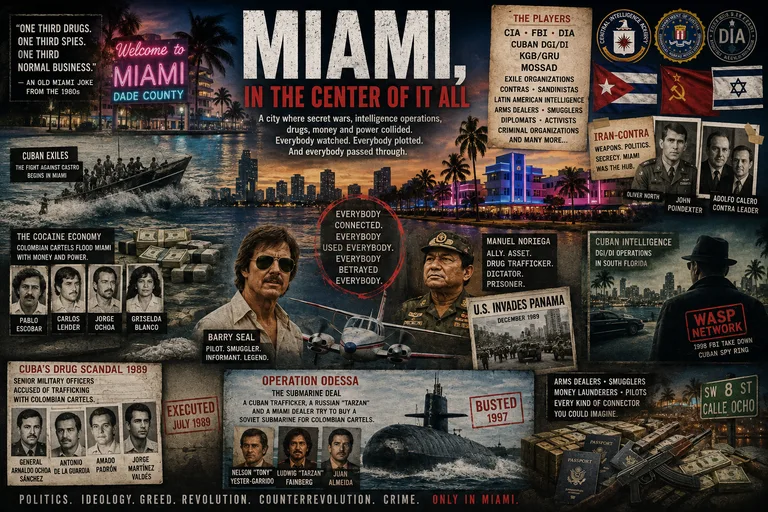
The City Where Everybody Eventually Passed Through
There was an old joke about Miami in the 1980s: one-third of the city was supported by drugs, another third by the CIA, Cuban intelligence or the clandestine war, and only the remaining third was involved in normal business.
The mathematics were almost certainly nonsense.
But the fact that people could tell the joke—and that everyone in Miami understood what it meant—says something about the city at the time.
Because for a remarkable period during the Cold War, it sometimes seemed as if every secret war in the Western Hemisphere eventually passed through South Florida.
There were CIA officers and former CIA officers.
FBI counterintelligence agents.
DIA personnel.
Cuban DGI and State Security officers.
Soviet KGB and GRU interests.
Cuban exile organizations.
Nicaraguan Sandinistas.
Nicaraguan Contras.
Colombian drug cartels.
Latin American intelligence officers.
Diplomats.
Mercenaries.
Pilots.
Arms brokers.
Smugglers.
Political activists.
Former soldiers.
Revolutionaries.
Counterrevolutionaries.
And people whose real employer could be surprisingly difficult to determine.
Israel belonged somewhere in that world as well. Israeli military and intelligence veterans, private security advisers and arms dealers operated extensively throughout Latin America during the period, and figures associated with Israeli intelligence appeared around governments such as Manuel Noriega’s Panama. But, as with the CIA, one has to distinguish carefully between an official intelligence operation and a former officer subsequently operating privately. In 1980s Miami those distinctions were not always obvious from the outside.
Miami was not simply a city.
At times it functioned like a giant geopolitical intersection.
It Started With Cuba
The transformation began after Fidel Castro took power in 1959.
Within weeks, the CIA had begun establishing a presence in Miami.
Then came Cuban refugees.
Then political organizations.
Then paramilitary groups.
Then CIA recruiters.
Then training camps.
Then boats.
Then weapons.
Then radios.
Then the Bay of Pigs.
The CIA recruited approximately 1,400 Cuban exiles for what became Brigade 2506, training men in weapons, guerrilla tactics, amphibious operations and parachuting.
When the invasion failed in April 1961, the clandestine war did not disappear.
It became larger.
The CIA created JM/WAVE, its massive Miami station, and South Florida became the operational rear area for attempts to infiltrate, sabotage, undermine and collect intelligence on Castro’s Cuba.
By some accounts JM/WAVE eventually became one of the largest CIA installations outside headquarters.
Thousands of Cubans became connected in one way or another to the covert struggle.
Some knew exactly whom they were working for.
Others worked through front organizations, maritime companies, intelligence contacts and exile organizations where the formal relationship with the U.S. government was considerably less obvious.
The Organizations Multiplied
The alphabet soup of anti-Castro organizations became almost impossible to follow.
There was:
Brigade 2506
Alpha 66
Movimiento de Recuperación Revolucionaria — MRR
Directorio Revolucionario Estudiantil — DRE
Comandos L
CORU — Coordination of United Revolutionary Organizations
Omega 7
Movimiento Nacionalista Cubano
and numerous smaller organizations that appeared, split, merged, fought among themselves and sometimes disappeared.
Some cooperated with American intelligence.
Some rejected American control.
Some received support during one period and lost it during another.
Some concentrated on propaganda.
Some conducted maritime raids.
Some infiltrated Cuba.
Some became associated with bombings or assassination attempts.
And some spent almost as much energy fighting other Cuban exile groups as they did fighting Castro.
Miami became their natural headquarters.
And Castro Sent His Own People
Havana understood exactly what Miami had become.
So Cuban intelligence came too.
The Cuban DGI/DI and State Security developed networks inside the exile community.
They wanted to know:
Who was working with the CIA?
Who was buying weapons?
Which boat was leaving tonight?
Where was it going?
Who financed it?
Who hated whom?
Which organization was planning an attack?
Who could be recruited?
Who could be manipulated?
Who could be turned?
Decades later the FBI would expose a substantial Cuban intelligence network operating in South Florida. In 1998, ten members of what became known as the Wasp Network were arrested; the FBI said the ring targeted military installations including U.S. Southern Command as well as Miami’s Cuban exile community.
That operation came later, but the doctrine behind it was much older.
Miami was not simply where Havana’s enemies lived.
It was a place Havana wanted to penetrate.
Then Came Cocaine
While one secret war was being fought over Cuba, another economy was exploding.
Cocaine.
By the late 1970s and early 1980s, South Florida had become one of the principal entry points for cocaine moving from Colombia into the United States.
The Medellín Cartel included names that became internationally notorious:
Pablo Escobar
Carlos Lehder
Jorge Ochoa
José Gonzalo Rodríguez Gacha
and Griselda Blanco.
The DEA records how rapidly the cocaine trade expanded and how South Florida became saturated with product. By early 1984, cocaine was so plentiful that wholesale prices in South Florida had fallen dramatically.
Escobar’s organization even dispatched people directly to Miami to supervise distribution, acquire property, create businesses and move money. Federal records later showed Medellín Cartel associates controlling South Florida properties and businesses while moving millions of dollars in cash through Miami.
There were aircraft.
Speedboats.
Freighters.
Bahamas routes.
Warehouses.
Cash houses.
Money laundering.
Banks suddenly receiving extraordinary deposits.
Real estate purchased with cash.
Businesses that existed partly to disguise other businesses.
At the same time that intelligence officers were watching Cuban exile boats, DEA agents and customs officers were watching Colombian drug boats.
Sometimes they were watching remarkably similar aircraft and vessels.
Miami Vice Was Exaggerated — But Not By Much
The television series Miami Vice turned all of this into neon-colored entertainment.
But reality was often stranger. The FBI’s Miami office recalls enormous drug investigations during the period.
In 1987 agents seized a yacht carrying 613 kilograms of cocaine.
That same year they discovered a stash house containing more than $3.8 million in cash hidden above false closet ceilings.
In 1988 another investigation targeted an organization responsible for importing multi-ton quantities of cocaine and seized a 400-foot freighter believed to have transported roughly four thousand kilograms.
The cocaine economy was not happening somewhere far from the intelligence world.
It was happening in exactly the same geographical space.
South Florida. The Bahamas. Central America. Panama. Colombia. Small airports.
Private aviation companies. Freight operators. Shipping companies.
And unofficial logistics networks.
That overlap is where the story becomes much more complicated.
Barry Seal
Few individuals better represent the blurred boundaries of the era than Adler Berriman “Barry” Seal.
Seal was an extraordinary pilot who became one of the most notorious cocaine smugglers of the period.
He transported drugs for the Medellín Cartel.
After being caught, he became a government informant.
In 1984 he participated in a covert operation in which an aircraft secretly photographed Pablo Escobar and other traffickers loading cocaine in Nicaragua.
Those photographs became politically explosive because the Reagan administration used the operation to argue that Sandinista Nicaragua was involved with narcotics trafficking.
Seal therefore existed in several worlds.
Pilot.
Smuggler.
Medellín associate.
Federal defendant.
DEA informant.
Government intelligence asset in a politically sensitive operation.
He was eventually murdered in Baton Rouge in 1986 by Colombian hit men.
Seal’s life has subsequently accumulated enormous mythology, particularly claims about the CIA.
Some allegations are well documented.
Others remain disputed.
That distinction matters.
But the reason the legends continue is obvious:
Barry Seal looked exactly like the kind of man who belonged in 1980s Miami’s shadow world.
Nicaragua Arrives in Miami
Then Central America exploded.
After the Sandinista Revolution of 1979, Nicaragua became another Cold War battlefield.
The Reagan administration supported the Contras, armed opponents of the Sandinista government.
Miami became deeply connected to the Contra political and logistics network.
Contra leaders lived, traveled and raised money there.
Exile communities supported them.
Arms brokers moved through the city.
Pilots and aviation companies entered the picture.
Former intelligence officers entered the picture.
The old Cuban anti-Castro networks suddenly became valuable again because many of the same Cubans had decades of experience with:
clandestine logistics,
radio communications,
air operations,
boat operations,
weapons,
guerrilla warfare,
and anti-communist organizing.
The war had moved from Cuba to Central America, but some of the people involved had not changed.
Félix Rodríguez Comes Back Into the Story
One of them was Félix Rodríguez.
The Cuban exile and CIA veteran who had participated in the operation surrounding Che Guevara’s capture in Bolivia later became involved in the Central American theater.
During the Contra war, Rodríguez worked around the clandestine resupply operation supporting anti-Sandinista forces.
Once again the same patterns appeared:
aircraft,
weapons,
secret bases,
intelligence contacts,
former CIA personnel,
Cuban exiles,
Central American military officers.
The geographical battlefield had changed.
The network had survived.
Iran-Contra
Then came the affair that exposed just how complicated this world had become.
The Reagan administration secretly sold weapons to Iran.
Money generated through the transactions was diverted toward support for the Nicaraguan Contras, despite congressional restrictions.
The resulting Iran-Contra affair pulled together people from seemingly unrelated worlds.
Oliver North
John Poindexter
Richard Secord
Albert Hakim
John Singlaub
Contra leaders such as Adolfo Calero
former intelligence figures
private arms dealers
aircraft operators
Middle Eastern intermediaries
Central American governments
and anti-communist networks.
Miami inevitably appeared around the edges and sometimes near the center.
A 1986 lawsuit filed in Miami attempted to connect former CIA figures Theodore Shackley and Thomas Clines, retired generals Richard Secord and John Singlaub, arms dealer Albert Hakim, and Contra figures in a sprawling alleged network involving arms and Central America. Many of the allegations in that lawsuit were disputed and should not be treated as established fact, but the list of defendants itself demonstrates how intertwined these communities had become.
Southern Air Transport
Even the airplanes had histories.
Southern Air Transport, based for a period in Miami, had once been owned by the CIA.
Years later, during Iran-Contra, investigators examined its role in transportation connected to the Contra resupply system and Iranian arms transactions.
That is almost a perfect metaphor for the entire period.
A company could begin as a CIA proprietary operation.
Become ostensibly private.
Continue employing people familiar with covert logistics.
Then reappear years later around another secret war.
Where did government end?
Where did private enterprise begin?
Sometimes even congressional investigators struggled to answer that question.
Former CIA Did Not Necessarily Mean Former Intelligence World
Miami was full of another category:
former intelligence officers.
A person could leave the CIA but retain:
contacts,
knowledge,
foreign relationships,
security clearances or former access,
aviation contacts,
arms contacts,
military contacts,
and friendships with people still inside government.
People such as Ted Shackley, Thomas Clines, and other veterans of Cold War covert operations repeatedly appeared in the broader universe surrounding private intelligence, arms dealing and anti-communist networks.
This did not mean every action undertaken by a former CIA officer was secretly authorized by the CIA.
Quite the opposite.
That assumption has generated decades of conspiracy theories.
But the practical problem was obvious:
when a man who had spent twenty years conducting covert operations began privately arranging international deals with other former intelligence officers, foreign military officials and arms brokers, outsiders could rarely know where the private network ended and the government network began.
Mossad and the Israeli Connection
Israel also intersected with the Latin American security world.
Israeli weapons, military trainers, security consultants and former intelligence personnel operated throughout the region.
One famous example was Mike Harari, a veteran Israeli intelligence figure associated with Mossad who later became closely connected to Panamanian ruler Manuel Noriega.
Panama mattered enormously to the Miami ecosystem.
Money moved through Panama.
Aircraft moved through Panama.
Weapons moved through Panama.
Intelligence services operated there.
The Medellín Cartel dealt there.
Contra-related activities touched the country.
Cuban interests touched it.
American intelligence watched it.
And Miami was one of Panama’s principal commercial and human connections to the United States.
Again, care is necessary: the presence of a former Mossad figure did not automatically make every operation an official Israeli intelligence operation.
But it added another layer to an already crowded intelligence environment.
Manuel Noriega: Everyone’s Useful Enemy
Few men understood this world better than Manuel Noriega.
Noriega dealt with the United States intelligence community for years.
He dealt with Cuba.
He dealt with regional governments.
He dealt with intelligence services.
He had connections to narcotics traffickers.
He interacted with Contra-related operations.
He understood that information itself was a commodity.
For years, Washington tolerated behavior it increasingly found unacceptable because Noriega also remained useful.
Then usefulness ended.
In 1989 the United States invaded Panama and removed him.
Even that story had a strong South Florida dimension.
Noriega was eventually brought to Miami to face federal narcotics charges.
Once again:
everyone eventually seemed to arrive in Miami.
Cuba’s Own Drug Scandal
And then, in 1989, Havana produced one of the most extraordinary episodes of the entire period.
The Cuban government arrested senior military and Interior Ministry officers and accused them of narcotics trafficking.
Among them were:
General Arnaldo Ochoa Sánchez
Colonel Antonio de la Guardia
Major Amado Padrón
and
Captain Jorge Martínez Valdés.
These were not street criminals.
Ochoa was one of Cuba’s most decorated military officers, a veteran of overseas campaigns.
Antonio de la Guardia was associated with the Ministry of Interior’s clandestine activities.
His department was involved in obtaining foreign currency, technology and goods that Cuba had difficulty acquiring because of the American embargo. Contemporary reporting identified Department MC precisely with efforts to circumvent those restrictions.
The government alleged that the defendants became involved in cocaine trafficking connected to the Medellín Cartel.
Evidence presented during the proceedings included allegations that Jorge Martínez Valdés met Pablo Escobar in Medellín and that a series of operations had attempted to move cocaine through Cuba.
Ochoa, Antonio de la Guardia, Amado Padrón and Jorge Martínez Valdés were convicted and executed in July 1989.
The official Cuban position was that corrupt officials had independently betrayed the revolution.
Critics suspected that senior leaders must have known more than they admitted.
That argument continues.
What is certain is that the case demonstrated how closely the worlds of:
intelligence
sanctions-busting
foreign procurement
military operations
and drug trafficking
could approach one another.
Antonio de la Guardia Is Particularly Important
Antonio de la Guardia deserves special attention because his career illustrates how Cuba itself had developed clandestine commercial structures.
The Cuban government needed:
hard currency,
technology,
restricted equipment,
industrial components,
and products difficult to purchase openly under the American embargo.
That created organizations whose job was essentially to figure out:
How do we get what Cuba isn’t supposed to be able to get?
Front companies.
Intermediaries.
Third countries.
False paperwork.
Friendly businessmen.
Private aircraft.
Ships.
Foreign bank accounts.
Those are also precisely the tools used by intelligence agencies, arms smugglers and drug traffickers.
That does not mean the activities were identical.
But they frequently required the same infrastructure.
And people who became skilled at moving one prohibited commodity could potentially move another.
Meanwhile the FBI Was Watching Everybody
Through all of this, the FBI Miami Field Office had an almost impossible portfolio.
It dealt with:
organized crime,
drug trafficking,
Cuban espionage,
politically motivated violence,
bombings,
foreign counterintelligence,
terrorism,
fraud,
and eventually Cuban spy networks.
The FBI’s own history of its Miami office describes investigations involving drugs, bombings, Cuban intelligence officers and violent exile activity.
And the FBI had another difficult problem.
Some people it might normally investigate as militants had previous relationships with the CIA.
Some foreign intelligence targets were living among communities strongly supportive of American anti-communist policy.
Some people considered heroes by one part of Miami were considered terrorists by another.
Law enforcement and intelligence priorities did not always align cleanly.
Everyone Was Watching Everyone
That may be the best way to understand Miami.
The CIA watched Cuba.
Cuban intelligence watched the CIA.
Cuban intelligence watched Cuban exiles.
Cuban exile organizations watched one another.
The FBI watched Cuban intelligence.
The FBI watched violent exile organizations.
The DEA watched Colombian traffickers.
The traffickers watched the DEA.
The KGB watched American intelligence.
American intelligence watched Soviet activity.
The Sandinistas watched the Contras.
The Contras watched the Sandinistas.
Latin American governments watched both.
Israeli security and arms networks appeared around regional governments.
Former intelligence officers operated private businesses with contacts accumulated during government careers.
Arms dealers talked to everyone.
Smugglers moved things for whoever paid them.
Pilots sometimes transported cargo without asking enough questions.
And occasionally the same man appeared in several of those worlds.
The Hotel Lobby Problem
Imagine sitting in the lobby of a Miami hotel in 1986.
The man at the next table could be:
a legitimate businessman from Venezuela,
a Colombian money launderer,
a Cuban exile raising money for an anti-Castro operation,
a Cuban intelligence officer pretending to be an exile,
an FBI informant watching him,
a former CIA officer arranging an aviation deal,
a Contra representative looking for weapons,
an arms broker looking for the Contra representative,
or simply an accountant attending a convention.
The remarkable thing is that all of those possibilities were plausible.
That was Miami.
And Then There Were the Businesses
This is where the old joke about one-third of the city being involved in drugs and another third in espionage becomes meaningful.
Nobody seriously audited Miami’s economy and discovered those percentages.
But clandestine operations require legitimate-looking infrastructure.
You need:
warehouses.
Marinas.
Air charter companies.
Freight forwarders.
Import-export businesses.
Real estate companies.
Banks.
Lawyers.
Accountants.
Radio shops.
Electronics companies.
Travel agencies.
Restaurants.
Hotels.
Construction companies.
Boat repair yards.
A clandestine economy hides inside a legitimate economy.
And Miami’s explosive growth made that particularly easy.
A company suddenly receiving huge amounts of cash did not necessarily look unusual in a city where huge amounts of money were arriving every day.
Miami Was Also Building a Real City
And this is the part the joke misses.
Most people in Miami were not spies, smugglers or drug dealers.
They were building families. Businesses. Banks. Restaurants. Construction firms. Medical practices. Schools. Real estate companies. Latin American corporate headquarters.
The Cuban exile population helped transform Miami from a relatively provincial Southern tourist city into the commercial capital of Latin America.
Major American companies established Latin American operations there precisely because Miami possessed a rapidly growing bilingual professional workforce.
So while clandestine money unquestionably passed through Miami, enormous amounts of legitimate wealth were being created at the same time.
The two histories grew beside each other.
The Perfect Cold War City
That is why Miami was different from Washington.
Washington was where policies were written.
Miami was where many of them became real.
A memorandum in Washington might say:
support the Cuban resistance.
In Miami, somebody had to find the Cuban.
Train him.
Buy the boat.
Acquire the radio.
Load the weapons.
Arrange the fuel.
Find someone who knew the coastline.
A Washington directive might say:
support the Contras.
Somewhere farther down the chain, somebody had to locate an aircraft, pilot, landing strip and warehouse.
The policy eventually became physical.
And physical things require places.
Miami was one of those places.
Conclusion
Everybody Eventually Passed Through Miami
It is probably impossible to reconstruct the complete clandestine history of Miami during the 1960s, 70s and 80s.
Too many operations were never documented publicly.
Too many records remain classified or were destroyed.
Too many participants died without talking.
Others talked constantly but exaggerated what they had done.
Intelligence officers protected sources.
Smugglers lied.
Politicians denied knowledge.
Criminals became informants.
Informants became criminals again.
Former intelligence officers insisted they were acting privately.
Private businessmen sometimes turned out to be intelligence assets.
And every genuine revelation produced three new conspiracy theories.
That is why the history must be approached carefully.
But beneath the mythology is an extraordinary amount of documented reality.
Brigade 2506 was real.
JM/WAVE was real.
Operation Mongoose was real.
Alpha 66 was real.
CORU and Omega 7 were real.
Cuban intelligence penetration of South Florida was real.
The KGB-Cuba relationship was real.
The Contra war was real.
Iran-Contra was real.
Barry Seal was real.
The Medellín Cartel was real.
The cocaine mountains arriving in South Florida were real.
Southern Air Transport’s CIA history was real.
Manuel Noriega’s intelligence relationships and drug charges were real.
Arnaldo Ochoa, Antonio de la Guardia, Amado Padrón and Jorge Martínez Valdés were real—and four of them ended before a Cuban firing squad.
What remains difficult is determining where one world ended and another began.
Where did intelligence become politics?
Where did politics become covert action?
Where did covert action become private enterprise?
Where did private enterprise become arms dealing?
Where did arms dealing become smuggling?
Where did smuggling become narcotics trafficking?
And when a former intelligence officer did something privately, how private was it really?
Those questions made Miami unique.
At various moments, people working for the United States, Cuba, the Soviet Union, Latin American governments and private organizations could all be operating in the same city.
Sometimes they cooperated.
Sometimes they used one another.
Sometimes they betrayed one another.
Sometimes they were trying to kill one another.
And sometimes they probably sat three tables apart in the same restaurant without knowing it.
So perhaps the old Miami joke was never intended to be mathematically accurate.
Maybe that was not the point.
The point was that in 1980s Miami, nothing seemed impossible.
The cocaine trafficker might know an intelligence officer.
The intelligence officer might know an arms dealer.
The arms dealer might know a Contra commander.
The Contra commander might know a Cuban exile.
The Cuban exile might unknowingly be talking to a Cuban agent.
The Cuban agent might be watched by the FBI.
The former CIA officer might know all of them.
And somewhere nearby, an ordinary businessman was just trying to sell air conditioners.
Washington made policy.
Havana plotted survival.
Bogotá shipped cocaine.
Managua fought a revolution.
Moscow and Washington fought the Cold War.
Panama moved money and people.
But somehow, sooner or later—
everybody passed through Miami.
And for a brief period, Miami really did feel like it was in the center of it all.
Operation Odessa — When a Strip Club Tried to sell a Soviet Submarine
Like something out of a Bond Movie, one story captures just how surreal Miami’s criminal and clandestine world had become by the 1990s, it may be the attempt to buy a former Soviet submarine for Colombian drug traffickers.
At the center of the scheme was Nelson Pablo “Tony” Yester-Garrido, a Cuban-born trafficker who operated in the South Florida underworld and had connections with major Colombian cocaine organizations.
But Yester was only one character in an extraordinary cast.
There was also Ludwig “Tarzan” Fainberg, a Ukrainian-born Miami nightclub owner with connections to Russian and Eastern European organized crime. BTW, the club was called Porky’s yeah like the movie.
And there was Juan Almeida, a Miami businessman and luxury-car dealer who became involved in the negotiations.
Together they entered into a plan that sounded more like a movie script than an actual criminal investigation.
Buy a Russian military submarine.
The Soviet Union had collapsed.
Military equipment from the former Soviet bloc was suddenly available through poorly controlled markets, corrupt officials, brokers and businessmen looking for money.
Aircraft could be purchased. Helicopters could be purchased.Weapons could be purchased. So someone eventually asked the logical Miami question:
Why not a submarine?
The concept was breathtakingly simple.
Acquire a diesel-powered submarine from the former Soviet military.
Modify it.
Then use it to transport enormous quantities of cocaine from Colombia while traveling beneath the surface, where conventional maritime surveillance would have difficulty detecting it.
For Colombian traffickers, a submarine represented potentially enormous capacity combined with extraordinary stealth.
For the brokers, it represented an equally enormous payday.
From Havana to Moscow to Medellín to Miami
The characters themselves illustrate how much the world had changed.
Yester was Cuban. Fainberg came from the former Soviet world.
The buyers were connected to Colombian narcotics organizations.
The negotiations passed through Miami. And the hardware they wanted had once belonged to the military apparatus of America’s Cold War enemy.
Only a few years earlier, Soviet submarines represented one of the most serious strategic threats confronting the United States.
Now Miami criminals were discussing buying one to haul cocaine.
The Cold War had ended. The equipment had not disappeared.
It had simply entered the marketplace.
“Tarzan”
Ludwig Fainberg was better known around Miami as Tarzan.
He operated a nightclub and moved in circles containing Russian businessmen, criminals, entertainers and wealthy foreigners.
Men like Fainberg became increasingly important during the 1990s because the collapse of the Soviet Union created an entirely new international marketplace.
People who understood both sides could become extremely valuable.
A Colombian trafficker might have millions of dollars.
But he did not know whom to call in Russia about buying military equipment.
A Russian broker might know exactly whom to call. Miami provided the introduction.
Once again, the city’s importance was not necessarily that the final transaction occurred there.
Miami’s importance was that people from completely different worlds could find one another there.
Tony Yester
Nelson “Tony” Yester-Garrido was another quintessential Miami character.
Cuban-born and connected to large-scale cocaine trafficking, Yester operated within the networks linking South Florida with Colombian drug organizations.
His world included smugglers, traffickers, businessmen and intermediaries capable of arranging international transactions.
And according to federal authorities, Yester became involved in negotiating the submarine purchase.
Think about how far that world had traveled.
The earlier generation of Cuban clandestine operators worried about secretly transporting: guns, radios, explosives, men, and equipment between Miami and Cuba.
A generation later, people operating within overlapping Cuban and narcotics networks were discussing buying an entire Soviet submarine.
The scale had changed enormously. The mentality had not.
Find someone who can get what you’re not supposed to have.
The Luxury-Car Dealer
Then there was Juan Almeida.
Luxury automobiles occupied their own interesting corner of Miami’s international economy. Expensive cars moved between wealthy clients, foreign businessmen and people with large amounts of cash.
A legitimate luxury-car business could therefore place someone in contact with: wealthy colombians, Russian businessmen, international brokers, and people who preferred not to explain where their money came from.
Again, none of that automatically made such a business criminal.
But Miami contained countless legitimate commercial environments in which people from otherwise unrelated clandestine worlds could meet.
A marina could connect smugglers. An air-charter company could connect pilots.
A nightclub could connect Russians and Colombians. A luxury-car dealership could connect buyers and brokers. That was how Miami worked.
The Submarine Deal
The proposed submarine was reportedly a diesel-electric former Soviet vessel.
The traffickers envisioned using it to carry enormous cocaine shipments.
A military submarine offered capabilities traditional smugglers could only dream about: long range, large cargo capacity, ocean-going endurance, and the ability to disappear beneath the surface. But acquiring something that large required an international network.
There had to be sellers. Military contacts. Brokers. Money. Transportation. Technical personnel. Negotiations. Potential modifications.
And somewhere in the middle of all of it were people connected through South Florida.
Federal investigators ultimately penetrated the operation.
The submarine purchase never became operational.
The scheme was broken up in 1997.
Operation Odessa
Years later the story became the basis for the documentary:Operation Odessa
The title referred to the Ukrainian port city and the post-Soviet environment from which extraordinary quantities of military hardware and other assets could potentially be obtained.
But the story could just as easily have been called: Operation Miami.
Because Miami was where the characters connected.
A Cuban trafficker. A Russian mob-connected nightclub owner. A luxury-car dealer.
Colombian cocaine organizations. Former Soviet military hardware.
Federal investigators. They should have had almost nothing in common.
Yet somehow they ended up discussing the same submarine.
The Perfect Epilogue to the Miami Story
Operation Odessa occurred after the peak Cold War years, but that is precisely why it belongs in this story.
It demonstrates what happened when the clandestine infrastructure built during decades of Cold War conflict did not simply disappear when the Soviet Union collapsed.
The people were still there. The aviation contacts were still there.
The smugglers were still there. The brokers were still there.
The Colombian cocaine money was certainly still there.
And now an entirely new source of military equipment had become available from the shattered Soviet bloc. The Cold War networks mutated into something different.
Politics became business. Intelligence contacts became commercial contacts.
Military equipment became merchandise. Former adversaries became trading partners.
And Miami remained the meeting place. If the 1980s seemed unbelievable because CIA veterans, Cuban agents, Contras, cocaine traffickers and arms dealers could all operate in the same city, the 1990s somehow produced an even more appropriate ending:
a Cuban trafficker, a Russian named Tarzan and a Miami car dealer trying to buy a Soviet submarine for Colombian cocaine smugglers.
You could hardly invent a better Miami story. Except that someone actually did it.
I Survived Cuban Socialism
The Story of José Hernández
My name is José Hernández, and I survived Cuban socialism.
I do not use the word survived lightly.
I was not rescued from a battlefield. I was not pulled from the ruins of a collapsed building. I survived something slower—a political system that enters the classroom, the workplace, the neighborhood, the family, and eventually the private thoughts of every person living beneath it.
In Cuba, fear does not always announce itself.
It does not always arrive wearing a military uniform or carrying a rifle. Sometimes it lives in a conversation that suddenly becomes quiet when someone unfamiliar enters the room. Sometimes it is a mother warning her child never to repeat at school what was said at home.
Sometimes it is the realization that you do not know who genuinely supports the government, who secretly despises it, and who is merely pretending because pretending is safer than prison.
That is one of the most destructive things about dictatorship: it makes honesty dangerous.
People learn to hide themselves.
They praise what they hate. They repeat what they know is false. They applaud because everyone else is applauding. They become careful around coworkers, neighbors, teachers, relatives, and sometimes even friends.
You never know who might report you.
Some Cubans still defend the regime because they receive benefits from it. They may be rewarded with a better job, a motorcycle, a television, a house, a smartphone, or a mobile data plan. The rewards are sometimes small, but in a country where almost everyone has very little, even a small privilege can purchase loyalty.
Others defend the system because they have believed its propaganda for so long that admitting the truth would mean admitting that much of their lives was built upon a lie.
But I did not always understand these things.
I was raised inside the lie.
We Will Be Like Che
My political education began before I was old enough to understand politics.
Every morning at school, we participated in ceremonies celebrating the Revolution. Fidel Castro was presented not simply as a political leader but almost as a sacred figure.
His image was everywhere.
It appeared in classrooms, hallways, offices, bulletin boards, textbooks, posters, and public buildings. We were surrounded by slogans, heroic stories, revolutionary symbols, and carefully selected versions of history.
We were taught that the Revolution had saved Cuba.
We were taught that communism represented justice.
We were taught that anyone who opposed the government was either ignorant, selfish, corrupt, dangerous, or working for a foreign enemy.
Then we were required to shout:
“Pioneers for Communism, we will be like Che!”
We were children.
We did not understand who Che Guevara really was. We did not understand communism, capitalism, dictatorship, democracy, political prisoners, independent journalism, or civil liberties.
We only understood that there was a correct answer and a dangerous answer.
The correct answer was the one the government had given us.
From the beginning, education was not merely about mathematics, science, language, or history. It was about manufacturing loyalty.
The purpose was not to teach children how to think.
It was to teach them what to think.
The Country of Permanent Propaganda
As I grew older, I began noticing how much money the government spent maintaining the appearance of public enthusiasm.
There were communist posters everywhere. There were banners, billboards, slogans, political celebrations, speeches, organized gatherings, and mandatory demonstrations.
Buses were used to transport workers and students to May Day marches and January 1 celebrations. Attendance was often presented as voluntary, but everyone understood that refusing to participate could create problems.
The government wanted enormous crowds because enormous crowds looked like public support.
Whether the people in those crowds genuinely supported the government was another question.
The spectacle mattered more than the truth.
One of the strangest examples was the national attention surrounding Elián González. His birthdays became political events. Cake, candy, and soft drinks were distributed to schools across the country.
In a nation where many families struggled to find food, medicine, soap, and basic necessities, the government could still find resources for propaganda.
There was always money for political theater.
There was rarely enough money for ordinary life.
Two Cubas Inside One Family
My family included people who supported the Revolution and people who opposed it.
I heard both sides.
The communists explained that Cuba’s hardships were caused by foreign enemies, the American embargo, sabotage, imperialism, and betrayal.
The critics spoke about repression, political prisoners, confiscated property, censorship, failed economic policies, corruption, and fear.
As a child, I could not judge between them.
As a teenager, I began to question.
As a university student, I finally began to understand.
I belonged to a generation that reached adulthood as limited internet access was slowly arriving in Cuba. For many years, the Cuban people had been denied meaningful access to the outside world.
Even when internet technology became available, most of us were not immediately given access to the open internet. We were confined largely to a government-controlled intranet.
The regime understood something important:
Information is dangerous to a government built upon isolation.
A dictatorship does not merely control what people can say. It tries to control what they can know.
Eventually, students discovered ways to bypass some of the restrictions. For the first time, I could see more of the world beyond official Cuban television, government newspapers, revolutionary textbooks, and carefully controlled political speeches.
I began reading foreign news.
I learned how other political systems functioned.
I saw open debates, competing political parties, independent organizations, protests, investigative journalism, criticism of presidents, public campaigns, and elections in which the outcome was not predetermined.
The internet did not tell me what to believe.
It showed me that I had been denied the information necessary to decide for myself.
That realization changed everything.
I decided I would not become another person who repeated propaganda merely because repeating it was easier than confronting it.
Never Repeat at School What You Hear at Home
Every Cuban child learns an unwritten rule:
What is said at home must remain at home.
A father might criticize the government at the dinner table and then warn his children never to repeat his words.
A mother might complain about food shortages but lower her voice when someone walked past the window.
A grandparent might remember life before the Revolution but speak only among trusted relatives.
Children were placed in an impossible position. The school encouraged loyalty to the Revolution, while families sometimes privately understood that the Revolution had failed them.
The system turned children into potential informants without their even realizing it.
A careless comment could cost a parent a job, an educational opportunity, a promotion, or worse.
People who left Cuba were insulted as gusanos—worms.
They were called counterrevolutionaries and traitors.
The neighbor across the street who emigrated was not treated as a person who had made a difficult choice. He became an enemy.
Why?
Because leaving Cuba challenged the government’s story.
If socialism had created paradise, why were so many people risking everything to escape it?
A Country Without Legal Opposition
Cuba did not allow people to create organizations that challenged the principles of the Revolution.
You could participate politically only within the boundaries established by the government.
You could not create a genuine opposition party.
You could not form an independent labor movement.
You could not organize freely against the ruling system.
You could not build a national political organization dedicated to replacing the government through ordinary democratic competition.
The system gave people a ballot but denied them meaningful political choice.
It created institutions and called them democratic, while ensuring that real opposition remained illegal, restricted, or dangerous.
By the time I finished university, I already knew I would never be comfortable living that way.
I am too rebellious to live as the obedient servant of a corrupt political elite.
Four Months of Revolutionary Employment
After graduation, I began the mandatory social service required of many Cuban graduates.
I lasted less than four months.
The salary was so low that it could not support a person for even a small portion of the month. The government spoke constantly about the dignity of labor, but it paid professionals wages that could not provide a dignified life.
You could work full time and still lack food.
You could possess a university degree and still be unable to buy basic necessities.
You could serve the State and remain dependent upon relatives, side jobs, informal trading, remittances, or favors.
Workers could not freely organize against these conditions because the labor unions were controlled by the State.
A union that answers to the employer is not an independent union.
A union that cannot challenge the government is not a meaningful defense of workers.
A worker could not freely organize a strike to demand better wages. He could not openly condemn the political system responsible for his poverty.
Even at work, criticism was dangerous.
The Revolution claimed to belong to the workers.
The workers were not allowed to oppose it.
The Eyes of the Neighborhood
Every neighborhood had people watching.
The system of local surveillance taught citizens to monitor one another. Informants paid attention to visitors, movements, conversations, political attitudes, and unusual activity.
Some people participated because they believed in the regime.
Some participated because they were afraid.
Some participated because informing brought rewards.
I saw people associated with the system receive motorcycles, cars, televisions, homes, and other benefits.
In a normal society, advancement is supposed to come through education, effort, creativity, service, or enterprise.
In a dictatorship, advancement often comes through loyalty.
The system created a market for obedience.
It encouraged people to exchange conscience for privilege.
Luxury Hotels and Collapsing Homes
I lived near Varadero, one of Cuba’s most important tourist areas.
I watched the government build new luxury hotels while ordinary Cuban buildings deteriorated.
Tourists slept in modern rooms, ate large meals, drank imported beverages, and relaxed beside carefully maintained swimming pools.
Meanwhile, elderly Cubans lived in houses that were literally collapsing around them.
Some had roofs that leaked.
Some lived behind cracked walls.
Some occupied structures that should have been condemned.
Some had no proper home at all.
The government always seemed capable of finding money for hotels that produced foreign currency.
It could find money for monuments, political events, propaganda, security organizations, and the machinery of control.
But when ordinary Cubans needed housing, medicine, plumbing, repairs, transportation, or food, there was never enough.
This is one of socialism’s great contradictions.
It promises equality while creating separate realities: one for the political elite, one for tourists, one for those connected to the system, and one for everyone else.
July 11, 2021
Then came July 11, 2021.
Across Cuba, people entered the streets.
They were frustrated by shortages, blackouts, repression, poverty, government failures, and the absence of a legal path to meaningful political change.
I saw what happened.
I knew university friends who were arrested.
They were decent people.
They were not criminals. They were not terrorists. They were not vandals. They were Cubans demanding the right to be heard.
Some received years in prison simply for participating in protests.
That moment destroyed any remaining illusion that Cuba permitted genuine political dissent.
A government confident in its legitimacy does not fear peaceful citizens in the street.
A government that claims to represent the people should listen when the people speak.
Instead, the regime answered dissent with arrests, prosecutions, intimidation, surveillance, and punishment.
The message was unmistakable:
You may suffer quietly.
You may leave.
But you may not challenge the system.
The Constitution That Could Be Changed When Convenient
I was also at university during the debate surrounding Cuba’s 2019 Constitution.
Citizens were encouraged to submit proposals and participate in discussions. It created the appearance that public opinion mattered.
Many proposals were heard.
Most were ignored.
One change that survived was an age limit of 60 for someone becoming president for the first time. Many hoped this would prevent the permanent recycling of elderly communist officials.
Then, in 2025, the rule was removed without a new popular referendum.
A provision that had been presented to the population as part of the constitutional settlement could be altered when it became inconvenient to those in power.
The document had already been structured to allow the ruling system to protect itself.
Then the government continued to describe Cuba as a democracy.
But democracy is more than voting on a document written within boundaries established by one political party.
Democracy requires genuine political competition.
It requires freedom of speech.
It requires independent journalism.
It requires freedom of association.
It requires citizens to organize against the government without being treated as enemies of the State.
It requires political leaders who can actually lose power.
Every Peaceful Road Was Closed
In Cuba, nearly every legal path to oppose the system was blocked.
You could not establish a competing national political party.
You could not freely organize mass protests against the government.
You could not create independent unions capable of confronting the State.
You could not build strong independent civic organizations outside revolutionary control.
For many years, even access to social media and the broader internet was severely restricted.
The system prohibited peaceful political replacement and then condemned anyone who demanded change.
It created a locked room and blamed the prisoners for wanting to escape.
Eventually, I understood that I had only one realistic choice.
I had to leave.
Leaving meant distance from my family.
It meant uncertainty.
It meant abandoning the country where I had been born.
It meant beginning again somewhere else.
But remaining meant surrendering my future to a system I could no longer pretend to believe in.
Kindness Does Not Cancel Dictatorship
I want to be honest.
I also witnessed acts of kindness in Cuba.
I saw people help neighbors.
I saw families share food when they had almost nothing.
I saw teachers care about their students.
I saw doctors and ordinary workers make sacrifices for others.
The Cuban people are not the Cuban government.
Human kindness can survive even inside a cruel political system.
But individual kindness does not erase dictatorship.
Good people living under oppression do not make the oppression good.
A government cannot excuse censorship, imprisonment, poverty, political control, and the denial of basic freedoms by pointing to moments when one Cuban helped another.
Those acts of kindness belong to the people.
The repression belongs to the State.
Why I Call Cuba a Dictatorship
I believe Cuba is a dictatorship because children are ideologically indoctrinated from an early age.
It is a dictatorship because its leaders are surrounded by a cult of personality.
It is a dictatorship because only one political party is legally permitted to dominate national political life.
It is a dictatorship because elections are not genuinely competitive.
It is a dictatorship because citizens cannot freely create an organized political opposition capable of removing the ruling system.
It is a dictatorship because opposition figures are harassed, monitored, intimidated, detained, and imprisoned.
It is a dictatorship because freedom of assembly and association is restricted.
It is a dictatorship because independent labor unions are not permitted to function freely.
It is a dictatorship because the judiciary does not operate independently from the political structure of the State.
It is a dictatorship because constitutional rules can be structured, interpreted, or changed to preserve the same ruling order.
Most importantly, it is a dictatorship because the Cuban people are not permitted to peacefully replace the entire political system through free and open competition.
The Great Lie
Socialism has appeared in many different forms and under many different names.
Its defenders will argue endlessly over definitions. They will insist that one historical regime was not truly socialist, another was not properly communist, another was corrupted, another was misunderstood, and the next attempt will finally succeed.
But for those who lived under the Cuban version, the debate is not academic.
We experienced the shortages.
We experienced the propaganda.
We experienced the surveillance.
We experienced the worthless salaries.
We experienced the inability to organize independently.
We experienced the fear of speaking freely.
We watched a ruling class demand sacrifice from the people while preserving power and privilege for itself.
The central lie was always the same:
The system claimed to act in the name of the people while denying the people the right to reject the system.
It claimed to liberate workers while preventing workers from organizing independently.
It claimed to provide equality while producing a privileged political caste.
It claimed to provide education while restricting information.
It claimed to represent the people while imprisoning people who protested.
It claimed to create dignity while forcing millions to survive through shortages, favors, remittances, black markets, and silence.
A system that must control speech, information, political organization, employment, education, and public assembly is not defending the people.
It is defending itself from the people.
Socialism does not fail only when the shelves become empty.
It fails when truth becomes dangerous.
It fails when children are taught loyalty before they are taught independent thought.
It fails when workers cannot challenge those who control their labor.
It fails when neighbors are trained to watch neighbors.
It fails when the government fears a protest more than it fears the suffering that caused it.
And it fails when leaving your homeland becomes the only peaceful vote against the system that you are still permitted to cast.
My name is José Hernández.
I was born inside the Revolution.
I was educated by it.
I worked under it.
I watched friends imprisoned by it.
And eventually, I escaped it.
I survived Cuban socialism.
Millions of Cubans are still trying to survive it.
A Conversation Reagan, Martí, and Fidel

I cleaned only the duplicated and out-of-order sections from your pasted draft, keeping the same story, tone, and argument.
Somewhere beyond time, in a quiet room with no guards, no microphones, and no revolutionary slogans painted on the walls, three men sat across from one another.
Ronald Reagan sat upright, calm but firm, with that old actor’s stillness that made silence feel like a speech waiting to happen.
José Martí sat beside him, thinner, sharper, his eyes full of both poetry and pain. He looked like a man who had carried a country inside his chest and never once put it down.
Across from them sat Fidel Castro, dressed in olive green, his beard gray, his face heavy with the confidence of a man who had spent his life explaining why other people had to suffer for history.
Martí spoke first. “Tell me, Fidel,” he said, “what became of the Cuba I dreamed of?”
Fidel leaned back. “We saved her from imperialism.”
Reagan raised an eyebrow. “Saved her? That’s an interesting word.”
Martí’s voice remained soft. “I dreamed of a republic with dignity. A nation where men could speak, worship, work, organize, argue, and build their own lives. I did not die so one flag could replace another prison.”
“I have been watching Cuba,” Martí said.
Fidel lifted his chin. “Then you have seen what we built. You have seen unity.”
Martí did not answer right away. He walked slowly to the table and sat down. His voice was soft, but it carried more weight than shouting. “I have seen men afraid to speak.”
Fidel’s expression hardened. “You have seen discipline.”
“I have seen churches watched,” Martí said. “I have seen young people told what profession they must serve, where they may go, what future they are allowed to have.”
“You have seen protection against foreign influence,” Fidel said.
Marti “I have seen workers forbidden to organize freely.”
Fidel’s eyes narrowed. “You speak like a poet. I governed a real country. Cuba needed discipline. Unity. Sacrifice.”
Reagan leaned forward. “Freedom always sounds messy to men who want control. That’s why tyrants call liberty dangerous. They say the people are not ready. They say dissent is treason. They say religion is a threat. They say unions, clubs, newspapers, and private voices must all be approved by the state.”
Fidel scoffed. “Liberty. Always liberty. A beautiful word used by empires.”
Martí’s eyes sharpened. “No, Fidel. Liberty is not an imperial word. It is a human word.”
Outside the window, the island seemed to breathe. Havana’s old buildings stood in faded color. The countryside stretched green and worn. The sea rolled against the shore like history refusing to be silent.
Martí placed his hand on the table. “I did not dream of Cuba merely changing masters. I did not die so one tyrant could be replaced by a committee, one dictator by a party, one plantation by a state.”
Fidel’s voice rose. “You compare me to Batista?”
Martí looked at him with sadness. “I compare any man to tyranny when he tells the people they are not allowed to be free.”
Reagan leaned back. “That’s the part dictators never understand. Freedom is not proven by how loudly a government talks about the poor. Freedom is proven by whether the poor can criticize the government and go home safely afterward.”
Fidel slammed his palm against the table. “You both speak as if Cuba existed in a vacuum. Batista sold Cuba. The Americans controlled it. The rich owned it. The peasants suffered. We gave the people dignity.”
“Dignity?” Martí asked.
Marti voice was no longer soft. “Can a Cuban today form a political club without government permission?”
Fidel said nothing.
Marti “Can he publish a newspaper that disagrees with the state?”
Silence.
Marti “Can he watch independent television?”
Silence.
Marti “Can he browse the internet without censorship?”
Fidel looked away.
Marti “Can he move freely inside his own country without asking permission from bureaucrats?”
Fidel’s jaw tightened.
Marti “Can a doctor, an engineer, a professional, leave the island freely if his conscience calls him elsewhere?”
Still nothing.
Martí stood. “Then do not call it dignity.”
Reagan nodded. “A prison with free slogans is still a prison.”
Fidel rose from his chair now, his old fire returning.
Fidel “You are both sentimental fools. You think nations are built on pretty speeches. I built hospitals. Schools. Armies. I stood up to the United States. I gave Cuba pride.”
Martí stepped closer to him. “No, Fidel. You confused pride with obedience.”
Reagan’s voice became firmer. “You built a system where the state became God, employer, landlord, teacher, censor, and judge. And then you called that liberation.”
Fidel pointed toward Reagan. “You have no right to speak of Cuba. You were the enemy.”
Reagan did not flinch. “I was the enemy of communism, yes. But this conversation is not about me. It is about the Cuban mother who cannot protest. The Cuban worker who cannot organize. The Cuban believer who cannot worship without suspicion. The Cuban child who is told his life belongs to the revolution before it belongs to himself.”
Martí turned again to the window. Below them, he could see children in uniforms walking through streets where the paint had peeled from the walls. He could see families waiting in lines. He could see old men whispering politics only behind closed doors. He could see young people staring at the sea, not because it was beautiful, but because it was an exit.
Then Martí whispered: “The saddest prison is the one built in the name of the poor.”
Fidel’s face changed.
For a moment, just a moment, the revolutionary vanished. The commander vanished. The speeches vanished. There was only an old man who had won power and lost the soul of the thing he claimed to love.
“I protected Cuba,” Fidel said, quieter now.
Martí turned back. “No. You protected your revolution from Cuba.”
The words hung in the air.
Reagan stood and walked beside Martí. “There comes a time when a government must be judged by a simple question,” Reagan said. “Does it fear its own people?”
Martí nodded. “And if it fears them, then it does not represent them.”
Fidel sat down again. He looked smaller now. “You think freedom would save Cuba?”
Martí answered immediately. “No. Freedom does not save a nation overnight. Freedom is difficult. It is noisy. It is full of disagreement, mistakes, ambition, pride, and conflict.”
Reagan smiled faintly. “That’s democracy.”
Martí continued. “But freedom gives a people the right to correct themselves. Tyranny only gives them the right to endure.”
Fidel stared at the table. “And what of the revolution?”
Martí’s face hardened. “A revolution that cannot tolerate a free citizen has become the very thing it claimed to destroy.”
Outside the window, the Cuban flag moved in the wind.
Martí walked toward it as if he could step through the glass and return to the island. He placed his hand against the window. “I wanted a Cuba where no man had to kneel to Spain, to America, to Batista, to Moscow, to a party, or to a bearded commander. I wanted a Cuba where the farmer, the priest, the teacher, the worker, the poet, the merchant, and the child could all say: this country is mine too.”
Reagan joined him. “That’s the real test. Not whether the government says the people are free. Whether the people can say the government is wrong.”
Fidel remained seated. For once, he had no speech long enough to escape the truth.
Martí looked back at him one final time. “You took the language of justice and used it to build a cage. You took the hunger of the poor and used it to excuse the hunger of the whole nation. You took Cuba’s pain and made yourself its owner.”
The room began to fade.
The table disappeared first.
Then the chairs.
Then the window.
But Martí’s voice remained. “One day Cuba will belong again to Cubans. Not to exiles alone. Not to generals. Not to parties. Not to foreign powers. Not to ghosts. To Cubans.”
Reagan’s voice followed. “And when that day comes, no censor, no prison, no secret police, no propaganda, and no fear will be enough to stop it.”
Fidel said nothing.
Far below, the island waited.
Waiting for the day when a church bell could ring without suspicion.
Waiting for the day when a worker could organize without fear.
Waiting for the day when a student could choose his own future.
Waiting for the day when a citizen could speak in the open air and not lower his voice.
Waiting for the day when Cuba would no longer be treated like property of the state.
But like the homeland of a free people.
🇨🇺 Free Cuba. 🇨🇺
Che Guevara - a Hero of the Poor

Che Guevara was a rich kid turned executioner, rebranded as a hero by distance and time. Che was the original socialist influencer and 60 years later his T-shirts outsell the Nike Swoosh.” -- YNOT!
The face on the T-shirt is clean, defiant, and timeless. The man behind it was anything but.
Ernesto “Che” Guevara has been frozen in pop culture as a rebel saint—doctor, poet, freedom fighter, martyr. The trouble is, that version of Che exists mostly in posters, dorm rooms, and marketing decks. The real Che lived in prisons, firing ranges, labor camps, and mass graves. And the difference between the two tells you more about how revolutions market themselves than how they actually work.
Let’s start at the beginning—because childhood matters, even for icons.
Che was born in 1928 in Rosario, Argentina, into a relatively privileged, educated family. He wasn’t poor. He wasn’t oppressed. He read constantly, argued obsessively, and suffered from severe asthma, which gave him a lifelong relationship with pain and endurance. His early journals show empathy—but also contempt. He didn’t just want to help the poor; he despised weakness. Suffering, in his mind, was something to be overcome or purged, not necessarily relieved.
Medical school didn’t soften him. His famous motorcycle journey across Latin America didn’t turn him into a humanitarian—it radicalized him. He saw inequality and concluded that compassion was insufficient. What was needed, he believed, was violence applied scientifically. By the time he met Fidel Castro in Mexico, Che was already convinced that executions were not tragic necessities, but moral tools.
That belief didn’t stay theoretical for long.
After the Cuban Revolution, Che was placed in charge of La Cabaña prison. This is where the mythology and the record part ways. Che personally oversaw firing squads. He signed execution orders. He bragged about it in letters. Trials were often summary. Evidence was thin. Guilt was assumed. Estimates vary, but hundreds were executed under his authority—some historians argue more. Che didn’t deny it. He defended it. “To send men to the firing squad,” he wrote, “judicial proof is unnecessary.”
This is the part you don’t see on the shirts.
As Minister of Industries and head of the National Bank—yes, a man who hated money signed Cuba’s currency “Che”—his economic experiments were catastrophic. He rejected incentives, dismissed expertise, and believed ideology could replace competence. Productivity collapsed. Skilled workers fled. Rationing spread. Che blamed human nature. When people failed to meet quotas, he called them morally defective.
Labor camps followed. Forced labor for dissidents, homosexuals, religious believers, artists, and anyone deemed insufficiently revolutionary. Che defended this too. Re-education, he said, required suffering. The revolution needed “new men,” and old ones could be broken or discarded.
So why did he leave Cuba?
Here is the part most people don’t know.
Fidel Castro wanted Che gone.
By the mid-1960s, Che was a liability. Too radical for Moscow. Too critical of the Soviets. Too admired by true believers. Too unpredictable. Fidel, for all his rhetoric, was a pragmatist. He wanted power, stability, and survival. Che wanted endless revolution. Those two paths don’t run together for long.
So Fidel did what skilled rulers do. He praised Che publicly, encouraged him privately to export revolution, and quietly made sure the right people knew where Che was going. Bolivia wasn’t destiny—it was a suggestion. And intelligence leaks are a language all their own.
Che entered Bolivia isolated, unsupported, and exposed. The CIA knew. The Bolivian army knew. His guerrilla fantasy collapsed into hunger, betrayal, and radio silence. When he was captured in 1967, his final words weren’t heroic slogans. They were practical. He asked to live. He didn’t.
Castro mourned him loudly. The problem had solved itself.
And before Che, there was Camilo Cienfuegos—the man who truly frightened Fidel. Charismatic, loved by the troops, independent. The kind of leader soldiers follow without needing speeches. When Camilo’s plane vanished in 1959, there was no wreckage, no bodies, no convincing explanation. Another rival removed. Revolutions speak of brotherhood; power prefers solitude.
So where does that leave Che’s “benefits to humanity”?
To be fair—because honesty demands it—Che inspired resistance movements worldwide. He gave language to anti-imperial anger. He helped topple a corrupt dictatorship in Cuba. He embodied sacrifice in a way that moved millions. His critique of exploitation resonated—and still does—especially in places where elites remain untouched by consequences.
But inspiration without results is theater. And revolution without restraint is slaughter.
The uncomfortable truth is this: Che was not a freedom fighter who lost his way. He was a true believer who followed his beliefs to their logical conclusion. And that conclusion included executions, camps, and economic ruin. He failed not because he wasn’t committed—but because he was too committed to an idea that treated human beings as raw material.
What people think they know about Che is wrong because they confuse symbolism with outcomes. A photograph is not a record. A slogan is not a balance sheet. And a man who dies young is easy to forgive—especially when he leaves behind a face that fits on a poster.
Che Guevara didn’t die for the poor. He died because revolutions eventually devour the men who believe in them too purely. And the greatest trick of the 20th century wasn’t capitalism or communism—it was convincing the world that a man who loved firing squads became a global icon of compassion.
That’s not history rewritten. That’s history remembered without filters.
READ NEXT

#History #MMT #CheGuevara #Revolution #Power #PoliticalMyths #ColdWar #TruthOverPosters
Why Che and Cuba Still Matter to America 60 Years Later
The Guerrilla War Failed. The Ideological War Did Not. Che lovers still get together to celebrate his "triumphs" --YNOT!
Most Americans think Che Guevara is ancient history. And after 60 years it should be.
He is the face on an old T-shirt, a college dormitory poster, a coffee mug, or a faded symbol from another political era. Millions recognize the image, but comparatively few know much about the man, his failed military campaigns, or the international propaganda operation that transformed him from a defeated guerrilla into one of the most powerful political symbols in modern history.
Che’s final revolutionary campaign was a disaster.
In 1966, he entered Bolivia intending to ignite a communist uprising that would spread across Latin America. He believed a small guerrilla force could create the conditions for a larger revolution.
It did not happen.
The Bolivian peasants Che claimed he had come to liberate did not rally behind him. Many viewed his fighters as outsiders. His organization failed to develop meaningful local support, his communications deteriorated, and his guerrilla column became increasingly isolated.
Within approximately eleven months, the Bolivian military had hunted down most of his force.
Che was captured on October 8, 1967, near the village of La Higuera. The following day, he was executed inside a small schoolhouse by a Bolivian army sergeant.
The revolution was over.
His earlier intervention in the Congo had failed. His Bolivian campaign failed. Cuba-backed insurgencies throughout Latin America consumed a generation of young revolutionaries and left behind graves, political violence, and damaged societies.
Measured by the rifle, Che lost.
Cuba lost in Bolivia. Cuba lost in the Congo.
Its guerrilla movements failed across much of Latin America.
But while the rifle was losing, something else was winning.
The image was winning. The story was winning.
The propaganda was winning.
The ideology was learning how to survive without the battlefield.
That is why Che Guevara and Cuba still matter to America almost sixty years later.
The Photograph That Defeated History
Seven years before Che’s death, Havana fashion photographer Alberto Korda attended a memorial service for victims of the explosion of the French freighter La Coubre.
During the ceremony, Che Guevara briefly stepped into view.
Korda took only two photographs.
The image was striking: Che staring into the distance, his expression appearing defiant and visionary, wearing his familiar black beret with a revolutionary star.
The newspaper for which Korda worked did not publish the photograph.
Korda printed it, placed it on the wall of his studio, and largely forgot about it.
Years later, Italian publisher Giangiacomo Feltrinelli visited Havana and saw the photograph. He obtained a copy and brought it back to Europe.
When Che was killed in Bolivia in October 1967, Feltrinelli began reproducing the image by the hundreds of thousands.
The photograph spread across Europe, Latin America, the United States, and eventually the world.
It became one of the most reproduced photographs in history.
The military reality of Che’s career almost disappeared beneath the mythology created by the image.
The failed guerrilla became a revolutionary saint.
The defeated commander became a symbol of permanent resistance.
The man whose campaigns had collapsed became an icon of youthful rebellion.
The photograph separated Che the symbol from Che the historical person.
That separation was essential.
People could wear the image without studying the prisons, executions, political repression, economic failures, or authoritarian government associated with the revolution he helped create.
They did not need to know the history. They only needed to recognize the brand.
The Rifle Lost, but the Poster Won
At approximately the same time, Cuba was developing an international propaganda system designed to distribute revolutionary ideology far beyond the island.
In January 1966, Havana hosted the Tricontinental Conference, bringing together revolutionary organizations from Asia, Africa, Latin America, and other parts of the world.
The conference helped establish the Organization of Solidarity with the People of Asia, Africa and Latin America, commonly known as OSPAAAL.
OSPAAAL began publishing Tricontinental, a magazine distributed internationally in several languages.
Many issues included a free revolutionary poster folded inside.
These posters used bold colors, dramatic symbolism, striking typography, and images of guerrillas, workers, racial struggle, anti-colonial movements, and revolutionary leaders.
They were inexpensive to reproduce and easy to transport.
The posters came out of the magazines and went onto university walls, activist offices, cultural centers, and dormitory rooms around the world.
Many appeared in countries where no communist revolution had occurred and where most of the people displaying them had never experienced guerrilla warfare.
That was precisely the point.
Cuba discovered that it did not need to send a rifle to every country.
It could send a picture.
A rifle must cross a border physically. An image crosses borders psychologically.
A guerrilla column requires food, ammunition, transportation, training, and local support.
A poster requires a wall.
The rifle failed.
The image succeeded.
And once the image succeeded, it became possible to detach revolutionary ideology from the disastrous results of revolutionary government.
Communism could be presented as rebellion rather than repression.
It could be marketed as justice rather than state control.
It could be sold as youthful idealism rather than political conformity.
Che became the perfect product.
His photograph communicated emotion without requiring knowledge.
It offered the appearance of moral courage without requiring any examination of the historical consequences.
Cuba Changed Its Strategy
When the Soviet Union collapsed in 1991, many Americans assumed Cuba’s revolutionary project had ended.
The Soviet subsidies disappeared. Cuba entered a severe economic crisis. Havana no longer possessed the same financial ability to support guerrilla insurgencies, military expeditions, and revolutionary governments around the world.
But Cuba did not abandon its campaign against the United States. It changed tactics.
It stopped relying primarily on rifles and began relying more heavily on relationships.
It replaced guerrilla columns with political coalitions.
It replaced jungle training camps with conferences and academic centers.
It replaced armed insurgents with solidarity organizations, friendship societies, exchange programs, cultural institutions, nonprofit groups, and activist networks.
Cuba’s objective remained the same: weaken the political, cultural, and institutional foundations of the United States and advance a revolutionary ideology hostile to American constitutional government, private enterprise, individual liberty, and Western influence.
The method became more sophisticated.
Rather than attempting to conquer America militarily, Havana worked to influence Americans ideologically.
Instead of planting foreign organizations that could easily be identified and rejected, it cultivated domestic movements rooted in genuine American grievances.
That is the central finding of the State Department’s investigation into Cuba’s decades-long campaign of espionage, infiltration, ideological influence, and political subversion inside the United States.
Cuba as the Nucleus of the Modern Radical Left
The State Department has identified the Castro regime as more than a traditional geopolitical adversary.
For more than six decades, Cuba has served as the leading sponsor, organizer, and ideological center of radical leftism and Third World revolutionary politics directed at the United States.
The Cuban government conducted a sustained campaign of subversion against America.
That campaign infiltrated the highest levels of the United States government.
It recruited and cultivated generations of American activists.
It supported networks connected to the unprecedented wave of radical left-wing terrorism that struck the United States during the 1960s and 1970s.
It conducted one of the most durable and damaging foreign intelligence penetrations in American history.
This was not a temporary Cold War operation. It was a long-term strategy.
Havana understood that it could not defeat the United States in a conventional military confrontation. Cuba lacked the population, industrial capacity, economic power, and military force to challenge America directly.
It therefore developed an unconventional form of warfare based on espionage, infiltration, proxy networks, political influence, propaganda, ideological training, and the exploitation of domestic conflict.
Cuba did not need to conquer American territory. It needed to influence American institutions.
It did not need to defeat the United States Army.
It needed to recruit Americans who would advance Cuban political objectives from inside the United States.
It did not need to make its ideas look Cuban. It needed to make Cuban revolutionary ideology appear indigenous to America.
And it succeeded.
The Native Tree Strategy
The best way to understand this strategy is not through military terminology.
It is through gardening. Imagine that you want to grow a tree in a place where trees do not naturally thrive. You could plant a foreign seed. You could water it, protect it, and wait fifteen years. It might survive. It would probably fail. Or you could find a tree already rooted in the local soil. That tree already survives the winters. It already receives water from the ground. It already draws nutrients from its surroundings. You cut into the native trunk and graft a new branch into the wound. The native roots then begin feeding the foreign branch.
Eventually, the tree produces different fruit. That is how ideological subversion works.
Cuba stopped attempting to plant obviously foreign political movements in American soil.
It grafted revolutionary ideology onto movements already growing inside the United States.
The trunks were real. The grievances were real. America has real poverty.
Real racial tension. Real inequality. Real corruption. Real political exclusion.
Real labor disputes. Real failures of government.
Real abuses of corporate and institutional power.
Cuba did not need to invent these problems. It only needed to find the wound.
The graft consisted of ideology, political training, organizational methods, international coordination, propaganda, strategic guidance, and financial or institutional support.
The roots remained American. The people remained American. The language remained American. The grievance remained American.
But the ideological framework attached to it came from somewhere else.
That is what made the strategy so effective. The resulting movement no longer appeared foreign. It spoke with an American accent. It cited American history.
It organized around American controversies.
It presented itself as an authentic response to domestic injustice.
Yet attached to those genuine concerns was a revolutionary ideology developed, refined, and promoted by foreign authoritarian governments.
The fruit appeared American because it grew from an American tree.
But the graft changed what the tree produced.
Stop Looking Only for Spies
Cuban espionage inside the United States was real, extensive, and successful.
The Castro regime recruited Americans, penetrated government institutions, obtained intelligence, manipulated political organizations, and operated networks that remained undetected for years.
Those operations caused real damage. But looking only for traditional spies misses the larger mechanism.
A spy knows that he or she is working for a foreign power.
An influenced activist may not. A spy receives instructions secretly.
An ideologically cultivated organizer may believe every decision is completely independent. A spy hides foreign loyalty.
A political movement shaped through decades of ideological influence may no longer recognize the foreign origin of its ideas.
That is more durable than espionage. The most successful foreign influence operation is not one that constantly requires direct orders.
It is one that creates organizations, intellectual traditions, political networks, and cultural assumptions capable of reproducing themselves.
Once established, the network trains the next generation.
Professors train students. Organizers recruit volunteers.
Activists establish nonprofit organizations. Writers produce books and articles.
Political staffers enter government. Students become educators.
Movement leaders become elected officials.
The original foreign connection becomes less visible with every generation.
Eventually, the graft appears to be part of the original tree.
That is the objective.
The Venceremos Brigade and Political Cultivation
One of the most important instruments in this campaign was the Venceremos Brigade.
Created in 1969, the program brought Americans to Cuba to work, study, receive political education, and experience the revolution firsthand.
Approximately 10,000 Americans have traveled to Cuba through this operation and related exchange programs.
These visitors did not simply return home with photographs and memories.
Many returned with ideological commitments, organizational relationships, political training, and a romanticized interpretation of the Castro regime.
They became professors, activists, organizers, nonprofit directors, political staffers, cultural leaders, and elected officials.
At least one participant eventually became the mayor of one of America’s largest cities.
That is how long-term political cultivation works.
The objective was never necessarily to recruit every visitor as a formal intelligence asset.
Formal recruitment would have been unnecessary.
Cuba could achieve far more by shaping how participants interpreted American society.
They returned to the United States prepared to view American institutions through a revolutionary framework.
Some spent decades influencing political organizations, educational institutions, activist networks, and government policy.
Their work appeared domestic because they were Americans.
But part of the intellectual and organizational formation behind that work had taken place under the supervision of a hostile foreign dictatorship.
This was not tourism. It was political cultivation.
From Guerrilla Camps to American Institutions
During the Cold War, Cuba trained insurgents, armed revolutionary organizations, sheltered militants, and supported communist movements across Latin America, Africa, and other regions.
The training camps, intelligence networks, weapons transfers, political front groups, and relationships with revolutionary organizations are part of the historical record.
As circumstances changed, the method evolved. The modern battlefield is no longer limited to jungles, mountain camps, and clandestine weapons shipments.
It includes:
- Universities
- Academic institutes
- Nonprofit organizations
- Political coalitions
- Cultural exchanges
- Friendship societies
- Solidarity organizations
- Professional associations
- Social-media networks
- Protest movements
- Advocacy groups
- International conferences
- Student organizations
- Journalism
- Entertainment
- Government agencies
Influence does not always look like espionage.
Sometimes it looks like education. Sometimes it looks like activism.
Sometimes it looks like cultural exchange. Sometimes it looks like humanitarian work.
Sometimes it looks like academic research. Sometimes it looks like a campaign for justice.
That is why it is so difficult to identify. Ideas rarely arrive carrying foreign flags.
The most effective foreign ideas arrive speaking perfect English.
Useful Idiots Do Not Know They Are Being Used
The phrase “useful idiot” is commonly used to describe people who unknowingly advance the interests of a political movement or foreign power.
They may sincerely believe they are fighting injustice. They may believe they independently reached their conclusions.
They may never meet a Cuban intelligence officer, receive foreign money, or knowingly cooperate with an authoritarian government.
They do not need to. They are useful precisely because they do not recognize the larger operation.
Their sincerity makes them more credible. Their American identity makes the ideology appear domestic. Their genuine anger makes the movement appear spontaneous.
Their lack of awareness protects the foreign influence behind it.
Cuba learned that it did not need to manufacture every grievance.
It only needed to identify disaffected people and provide them with an ideological explanation for their frustration.
A lonely young person is offered belonging. A confused student is offered certainty.
An angry activist is offered an enemy. A person searching for identity is offered membership in a collective struggle.
A person confronting an injustice is told that the injustice is not an isolated failure but proof that the entire American system must be dismantled.
That is the graft. The personal grievance becomes political.
The political grievance becomes revolutionary. The revolutionary ideology becomes an identity. Once ideology becomes identity, disagreement is no longer interpreted as debate.
It becomes betrayal.
The Institutional Pathway
The process often begins in places that appear trustworthy.
A student turns to a professor. A young activist joins a campus organization.
A person looking for community attends a political meeting.
A volunteer enters a nonprofit movement. Someone who feels alienated finds a group promising solidarity, purpose, and moral certainty.
These institutions can provide genuine help and community.
But they can also become transmission points for revolutionary ideology.
The individual may believe he is receiving an education when he is receiving political conditioning.
He may believe he has joined a reform movement when he has entered an ideological ecosystem committed to dismantling the existing political order.
He may believe he is participating in an American civil-rights tradition while being trained to interpret every social conflict through a framework developed and promoted by foreign communist governments.
The poison does not arrive in a bottle labeled “foreign propaganda.”
It arrives as compassion. It arrives as scholarship. It arrives as belonging. It arrives as moral urgency.
It arrives as a demand that every institution, tradition, and historical achievement of the United States be interpreted as an instrument of oppression.
The person absorbing it may have no idea where the framework originated.
That ignorance is part of the design.
The Connection to Political Violence
The State Department’s findings also connect Cuba’s influence operations to the radical left-wing terrorism that struck the United States during the late 1960s and 1970s.
This was not merely an era of peaceful protest.
It included bombings, arson, attacks on government buildings, assaults on police, bank robberies, kidnappings, and revolutionary organizations openly committed to overthrowing the American political system.
Many participants described themselves as anti-imperialist revolutionaries and identified with Cuba, Vietnam, communist movements, and Third World liberation struggles.
Cuba served as a model, a source of ideological legitimacy, a provider of political relationships, and, in some cases, a direct source of assistance or refuge.
The same revolutionary vocabulary continues to appear in modern movements.
The targets change. The slogans change. The technology changes. But the structure remains recognizable. An existing grievance is identified.
The grievance is detached from any limited or practical solution.
The entire society is declared illegitimate. Violence is rationalized as resistance.
The person committing the violence is told he is not a criminal but a revolutionary.
An act of destruction becomes an act of liberation.
The individual setting fire to a building may believe he is acting independently.
But the ideological pathway leading him there may pass through decades of foreign revolutionary influence.
Cuba Was Not Acting Alone
Cuba was originally sustained, trained, armed, financed, and protected by the Soviet Union. The Soviet state supplied the money and strategic backing that allowed Havana to project influence far beyond what Cuba’s own economy could have supported.
When the Soviet Union collapsed, the structure changed, but the international network did not disappear.
Today, Cuba operates within a broader authoritarian ecosystem that includes Russia, China, Iran, Venezuela, and aligned political movements around the world.
Each state uses different methods. Russia specializes in intelligence operations, political manipulation, disinformation, and the amplification of social division.
China uses economic power, academic relationships, technology, business influence, media penetration, and institutional pressure.
Iran supports ideological and militant networks, promotes anti-American and anti-Israeli movements, and exploits political unrest throughout the West.
Cuba provides decades of experience in revolutionary organization, intelligence, political cultivation, propaganda, and the transformation of domestic grievances into international ideological movements.
These governments do not need to create America’s divisions.
They amplify them. They do not need to persuade every American.
They only need to deepen polarization, weaken trust, discredit institutions, and convince enough people that their own society is irredeemably evil.
The objective is not necessarily to make Americans love Cuba, Russia, China, or Iran.
The objective is to make Americans hate one another.
A society consumed by internal conflict becomes easier to manipulate and less capable of resisting external threats.
Why Che Remains the Perfect Symbol
Che Guevara remains relevant because he represents the success of this strategy.
His actual military record was poor. His economic management was disastrous.
His political philosophy was authoritarian.
He participated in the creation of a regime that imprisoned opponents, eliminated political pluralism, suppressed speech, restricted movement, confiscated property, and forced millions of Cubans either to submit or escape.
Yet his image remains associated with rebellion, justice, courage, youth, and freedom.
That contradiction did not happen by accident. It was created through propaganda.
Che became something more powerful than a historical figure.
He became a brand. Brands simplify. They replace complicated history with emotional recognition.
The viewer does not see failed agricultural policies, revolutionary tribunals, executions, labor camps, political prisons, or families fleeing across the Florida Straits.
The viewer sees courage. Defiance. Youth. Revolution.
The image performs the political work while concealing the historical record.
That is why the photograph mattered more than the rifle.
The rifle could kill one opponent. The image could recruit generations.
The Revolution Learned to Sell Rebellion
Traditional communism had a marketing problem.
Its governments produced shortages, repression, censorship, political prisons, surveillance, and economic stagnation.
Those results were difficult to sell. But rebellion was easy to sell. Youthful defiance was easy to sell.
Resistance to authority was easy to sell. Justice was easy to sell. Equality was easy to sell.
Cuba learned to separate the emotional appeal of revolution from the institutional consequences of revolutionary government.
The movement could market the excitement of tearing a system down without showing what would replace it.
It could glorify the revolutionary without showing the political prisoner.
It could celebrate redistribution without showing confiscation.
It could promise equality without showing universal poverty.
It could condemn American imperfections while concealing Cuban repression.
That marketing strategy survives today.
The language has changed, but the structure remains.
Every existing institution is described as oppressive.
Every inequality is treated as proof of systemic illegitimacy.
Every reform that falls short of total transformation is dismissed as complicity.
The revolutionary solution is always presented as morally pure because its real-world consequences are kept outside the frame.
Like the photograph of Che, the image is carefully cropped.
The Bitter Fruit
America’s problems are not imaginary. That must be stated clearly. Foreign influence succeeds only when it finds a real weakness.
A corrupt institution creates an opening. A failed school creates an opening.
Racial injustice creates an opening. Economic displacement creates an opening.
Government dishonesty creates an opening. Corporate abuse creates an opening.
A generation raised without purpose, community, stable families, or confidence in the future creates an enormous opening.
Cuba and its allies did not create every wound. They learned how to graft ideology into the wound. That distinction matters.
Dismissing every protester as a foreign agent would be inaccurate and foolish.
But pretending that foreign governments have not spent decades cultivating, training, supporting, and influencing American political movements would be even more foolish.
The tree is American. The wound is American. The anger is American. The people are American. But the graft is foreign.
And the fruit produced by that graft is increasingly bitter.
Check the Graft Line
When we see political movements calling for the destruction of American institutions, we should not look only at the final slogan. We should trace the intellectual lineage.
When activists repeat revolutionary concepts developed by communist governments, we should examine how those concepts entered American education and political culture.
When organizations justify political violence, glorify authoritarian regimes, or treat the United States as uniquely illegitimate, we should investigate their international relationships.
When professors, nonprofit organizations, activist networks, and political coalitions promote identical ideological frameworks, we should look at where those frameworks originated.
Do not argue only about the fruit. Check the graft line.
Ask who provided the ideological training. Ask who organized the exchange programs.
Ask who funded the conferences. Ask who established the solidarity networks.
Ask who translated and distributed the literature. Ask who offered refuge to political militants. Ask who cultivated the organizers.
Ask who benefits when Americans lose faith in their own country.
Once the graft line is visible, the pattern becomes much easier to understand.
Why Cuba Still Matters
Cuba matters because it demonstrated that a small country can exert enormous influence without possessing a large economy or conventional military force.
It matters because Havana spent decades building political relationships instead of merely conducting short-term operations.
It matters because Cuban intelligence penetrated American institutions.
It matters because Cuban political programs cultivated generations of American activists.
It matters because revolutionary ideology entered the United States not only through spies but through culture, education, exchange programs, protest movements, and domestic political organizations.
It matters because many of those ideas now reproduce themselves without requiring direct Cuban control.
Most importantly, Cuba matters because its strategy has been adopted and expanded by more powerful American adversaries.
Russia, China, and Iran possess far greater resources than Cuba ever had.
They have global media systems, cyber capabilities, intelligence services, financial networks, educational partnerships, technology platforms, and access to millions of Americans through digital communication.
Cuba created a model. Others industrialized it.
The Final Lesson
Che Guevara did not win in Bolivia. His revolution failed. His fighters were defeated.
He died in a schoolhouse, abandoned by the people he believed would join him.
But his image escaped the schoolhouse. It crossed borders. It entered universities.
It appeared on dormitory walls. It became part of music, fashion, advertising, political activism, and popular culture.
The revolutionary died. The revolutionary brand survived.
That is the larger story of Cuba’s campaign against the United States.
The guerrilla war failed. The propaganda war continued.
The Soviet Union collapsed. The ideological networks remained.
The rifles disappeared. The relationships endured.
The foreign movement became attached to domestic grievances.
The branch was grafted into the American tree.
Today, much of the resulting fruit looks completely American. It speaks with an American accent, cites American injustice, organizes Americans, and elects American politicians.
That does not mean the ideology originated here.
It means the graft worked.
Che and Cuba still matter sixty years later because they proved that ideas can accomplish what armies cannot.
A military invasion announces itself. An ideological invasion presents itself as education, compassion, justice, identity, and belonging.
The most successful foreign influence does not look foreign.
Eventually, the people advancing it believe it belongs to them.
So stop looking only at the fruit. Find the wound. Trace the branch. Check the graft line.
That is where the real history begins.
Just to remind everyone who Che really was…
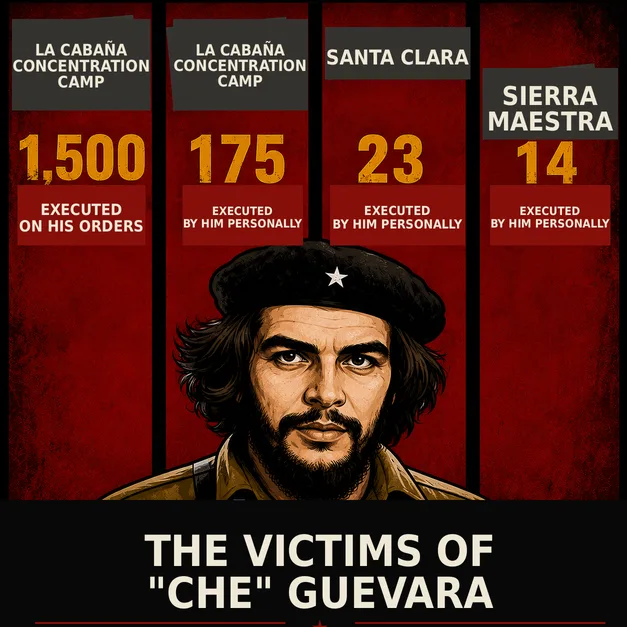
Cuba Is Falling, and the Left Can Feel the Floor Moving

“Communism begins with speeches about dignity and ends with people standing in the dark surrounded by garbage wondering where the food went.” --YNOT!
There are moments in history when a lie grows old all at once.
For years, Cuba has been one of those grand political frauds the world was told to admire from a safe distance. Intellectuals toasted it. radicals romanticized it. professors explained it. journalists excused it. And the people trapped inside it paid the bill in hunger, darkness, fear, and silence.
That is the way of bad ideas. The wealthy praise them.
The powerful enforce them. The ordinary live under them.
Now the bill has come due.
While the headlines are fixed on bigger wars and louder crises, Cuba looks less like a permanent revolution and more like a dying machine making its last ugly noises. The lights flicker. The fuel runs out. The food gets scarce. The medicine disappears. The garbage piles up. And all the old slogans, so polished and proud in foreign newspapers, suddenly look worthless next to an empty stomach and a darkened home.
That is communism in its old age. It begins in parades and ends in shortages.
The Revolution Has Run Out of Gas
A revolution can survive poverty. It can survive lies.
It can survive repression. It can even survive its own failures for a surprisingly long time.
What it cannot survive forever is reality. Reality is the great unpaid collector. Sooner or later, it comes knocking for every government that promised paradise and delivered ration cards.
Cuba has been living on borrowed time for decades. Borrowed money. Borrowed oil. Borrowed mythology. Borrowed excuses. The regime dressed itself up as a heroic little island of resistance, but underneath the costume was the same old carcass every socialist experiment drags around sooner or later: dependency, fear, scarcity, and rot.
And now even the props are giving way.
Venezuela Was Not Just an Ally. It Was Life Support.
Cuba did not survive on brilliance. It survived on subsidy. OPM – Other’s peoples money.
Venezuela was one of the hoses feeding the patient. Oil, money, political shelter, and the comfort of knowing there was another failing regime nearby willing to pretend the future belonged to socialism.
Take that away, and the room gets cold in a hurry.
When one crooked house begins to fall, the termites in the other one start to panic. That is the real significance here. Cuba is not merely suffering from its own incompetence. It may be losing the outside lifelines that kept the old theater open.
It is hard to stage a revolution when the generator does not work.
Trump Said What Many Suspected
Then Trump, in his usual fashion, said the quiet part out loud: Cuba is going to fall pretty soon.
Now, say what you like about Trump, but he is not a man who uses a peashooter when a cannon will do. When he says something like that, he is not speaking like a professor weighing footnotes. He is speaking like a man who smells weakness and sees leverage.
And that is what makes the statement important.
Because if Cuba wants a deal, then Cuba knows what time it is.
Strong regimes do not look for graceful exits.
Strong regimes do not hunt for immunity.
Strong regimes do not whisper about terms.
Only frightened ones do that.
A government still pretending to be ten feet tall does not ask its enemy for a staircase.
There Is Nothing Mysterious About the Deal
The rumored shape of the arrangement makes perfect sense because history is not run by moral purity. It is run by pressure, fear, leverage, and convenience.
The regime steps aside. Some sanctions ease. Business restrictions soften.
Travel opens up. And the ruling family gets the one thing all collapsing tyrannies want at the end: safety.
There will be people who hate that. And understandably so. Many will say justice demands handcuffs, trials, prison cells, exile, humiliation, and a long memory.
But statesmen do not always get to choose between justice and injustice. Sometimes they choose between an ugly ending and an uglier one.
If immunity gets the old order out of the palace without setting the country on fire, many men will take that bargain with a straight face and sleep quite well afterward.
Mercy has very little to do with it. This is not forgiveness. It is pest control.
Marco Rubio and the Poetry of History
There is also something history enjoys doing from time to time: arranging ironies so sharp they almost look scripted.
The son of Cuban immigrants may help negotiate the end of the Cuban communist order.
That is not just diplomacy. That is history with a grin on its face.
On one side, the descendants of those who fled. On the other, the descendants of those who ruled.
One family carried the memory of escape. The other carried the inheritance of power.
And now they may meet at the same table, not to argue over the glory of the revolution, but to discuss the terms of its burial.
That is the sort of scene history writes when it wants to remind prideful men that time is undefeated.
Havana’s Denials Sound Like Men Packing Their Bags
When confident governments speak, they slam the table.
When nervous governments speak, they use the language of diplomacy.
Mutual respect. Sovereignty. Non-interference. Equal conditions. Those phrases are the cologne of weak men trying to disguise the smell of fear.
A regime that truly had matters in hand would issue a hard denial and dare the world to challenge it.
A regime that is cornered speaks more softly. It buys time. It saves face. It hopes the performance still works on someone, somewhere.
But slogans do not power a grid.
Propaganda does not fill a pharmacy.
And pride does not keep the trucks running.

Cuba Is Not the Whole Story. It Is the Symbol
The bigger story is not one island.
The bigger story is that the old left-wing tide in Latin America may be receding, and receding fast enough for even the blind to notice the shoreline changing.
For years, the fashionable people said the future belonged to the left. The map was supposed to keep turning red. America was supposed to shrink. China was supposed to expand. Russia and Iran were supposed to find room in the cracks. Cuba was supposed to remain a shrine. Venezuela was supposed to stand as a warning to capitalism rather than a warning against socialism.
But the future has a wicked sense of humor. It often arrives dressed as the exact opposite of what the experts ordered.
Now country after country appears to be shifting. Some explicitly to the right. Others not exactly right-wing, but plainly less interested in serving as outposts for anti-American posturing and foreign rival influence. That matters more than the labels.
Because politics is not only about the left and the right. It is about alignment, power, gravity, and which civilization is pulling the region toward itself.
The Left Mistook Momentum for Destiny
This is the old mistake every triumphant movement makes. It confuses a season with eternity.
The left looked at the universities, the media, the bureaucracies, the activist class, the pink tide, the moral vanity of the West, and decided the future was a one-way street. They believed each generation would be more obedient to their doctrines than the last. They believed history had signed a contract.
History signs no such contracts. It lends applause for a while, then sends humiliation.
A bad movement can feel permanent right up until the month before it collapses. The slogans still sound noble to the people saying them. The ceremonies still look impressive. The newspapers still dress up decay as complexity. And then one morning, the money is gone, the allies are weak, the public is restless, the fear is thinning, and all the old phrases suddenly sound like lines from a play nobody believes anymore.
That may be where Cuba is headed now.
The Monroe Doctrine Never Really Died. It Just Got Embarrassed
For years, America’s governing class acted as though defending influence in its own hemisphere was somehow crude, outdated, or impolite. So while the polished people gave speeches about global norms, rival powers walked into the neighborhood.
China built influence. Russia inserted itself. Iran found openings.
The revolutionary leftovers found fresh patrons.
That is what happens when a great power becomes ashamed of acting like one.
Trump’s instinct, whether refined or not, cuts against that entire mood. His view is much simpler: this is our hemisphere, and hostile powers should not get comfortable here.
The experts will wince at the bluntness. They always do. But history is full of moments when bluntness turns out to be merely honesty without the makeup on.
Venezuela Was the Crack. Cuba Would Be the Bell
If Venezuela was the first loud crack in the wall, Cuba would be the church bell everyone hears.
Because Cuba is not just a country. It is a symbol, an icon, a relic, a romance for people who never had to wait in line there.
Its fall would not simply mark the failure of one government. It would mark the collapse of one of the longest-running myths in modern politics.
And myths die hard. They kick. They curse. They blame embargoes, foreigners, history, sabotage, capitalism, weather, and bad luck. They blame everything except themselves.
But in the end, collapse is collapse, even when the excuse is elegantly written.
Final Thought
The real story is not merely that Cuba is weak.
The real story is that the old order may be cracking across the hemisphere at the same time.
Cuba stumbling. Venezuela shaken. The left losing ground.
The right gaining nerve. American influence reasserting itself.
The mythology of socialist inevitability turning to dust.
That is not a headline. That is a pattern.
And patterns are what matter.
Because when enough nations begin moving in the same direction, it is no longer an accident. It is history changing its mind.
And when history changes its mind, the people who built careers worshiping the old lie are always the last to notice the floorboards giving way beneath their feet.
What Happens When a Small Island Picks a Fight With a Superpower?

What do you say when a man threatens to fight you “to the last drop of blood”—and you own the fuel, the money, and the exits?
The Cuban dictator made his speech. Chest out. Fists clenched. We will fight America to the last drop of blood.

And then Donald Trump answered with four words that matter more than any speech ever will:
No oil. No money. Zero.
That wasn’t rhetoric. That was a receipt.
For thirty years, Cuba has survived the same way a dead phone survives—by staying plugged into someone else’s charger. First the Soviet Union. Then Venezuela. No charger, no light. No light, no hospitals. No hospitals, no regime.
That charger is gone.
Since the capture of Venezuela’s strongman, oil tankers stopped arriving. Not slowed. Not delayed. Stopped. The lights in Havana are going out. The shelves are empty. The economy isn’t wobbling—it’s on life support with the plug halfway out of the wall.
Cuba fired back, of course. They always do. Miguel Díaz-Canel declared sovereignty. The foreign minister called America an “out-of-control hegemon.” Strong words. Weak position.
Because words don’t run power plants. Oil does.
And here’s the part people miss: this isn’t really about Cuba.
Cuba is the cork in the Caribbean bottle. Shipping lanes. Surveillance. Drugs. Human trafficking. Intelligence operations. Ninety miles from Florida, with Chinese listening posts parked like lawn chairs facing the U.S. coastline. You don’t ignore that island. You either neutralize it—or it neutralizes you slowly.
For twenty-five years, Cuba and Venezuela played tag-team authoritarianism. Venezuela supplied the oil. Cuba supplied the surveillance, repression, and muscle memory of tyranny. One falls, the other stumbles. Both are now stumbling.
Russia is busy. China is tired of unpaid bills. Iran has its own fires. There is no Soviet Union riding in on a white horse.
So when Trump says, Make a deal before it’s too late, he isn’t negotiating. He’s setting the clock on the wall.
What shocks Havana isn’t the embargo. They’ve lived with that.
What shocks them is the political math.
Cuban-Americans. Venezuelan-Americans. Nicaraguan-Americans.
People who lived under these regimes don’t romanticize them. They vote against them—hard.
Florida notices. Washington notices. Trump definitely notices.
This is the quiet realignment nobody on cable news likes to admit: the people who fled Marxism don’t want it exported, subsidized, or forgiven. They want it ended.
So here we are.
A small island shouting about blood.
A superpower cutting the fuel line.
And a regime discovering, once again, that ideology doesn’t generate electricity.
History has a sense of humor like that.
It lets you talk all you want—right up until the lights go out.
And then it asks a simple question:
Was it worth it?
#Geopolitics
#Cuba
#EnergyIsPower
#CaribbeanStrategy
#HistoryRhymes
Communism Is a Great Idea — For a different Species

Every few years a new crop of young people rediscovers communism like it’s a shiny toy someone left in the attic.
They dust it off, hold it up to the light, and say, “Why don’t we try this again?”
Well, kids… there’s a reason.
Communism is a great idea.
It’s just designed for the wrong species.
Human beings aren’t ants, bees, or whatever polite collectivist creature people imagine when they’ve had too much YouTube and not enough life. We are—brace yourself—self-interested. Deeply. Persistently. Hilariously.
And that’s the strange advantage of capitalism:
It leans into what we already are.
It doesn’t ask us to become angels or saints.
It assumes we’re flawed and then makes use of the flaws.
Define communism: –“From each according to their ability, to each according to their needs.”
Beautiful.
Poetic.
Looks great on paper.
You could knit it on a blanket and sell it at Whole Foods.
But here’s the problem:
It doesn’t scale. At all.
At Home? Sure. In a Village? Maybe. A Nation? Forget It.
Think about it:
You’re already a communist at home.
Got kids?
You don’t bill them for rent, utilities, or food.
You don’t charge them interest when they borrow your sanity.
You give them everything they need and expect nothing in return.
That’s communism.
Stretch out to a neighborhood—maybe you’re a socialist.
You try to help, share, be decent.
But once you get to the national level?
“Yeah… fuck those guys.”
That’s human nature. There’s always an in-group preference.
Family → clan → tribe → country → “everyone else can sort themselves out.”
We’ve had 200,000 years to practice this instinct.
Utopia doesn’t overwrite DNA.
The American Version: Marxism with a TikTok Filter
Now, America’s homegrown version of communism isn’t even classical communism.
It’s something much stranger: American Marxism, also known as “woke.”
Real Marxists tried to redistribute wealth.
Whether you agree or not, that at least makes internal sense.
But the new model?
They want to redistribute status.
Not money.
Not opportunity.
Not resources.
Status.
That is a recipe for national schizophrenia.
Because wealth can be shared.
Status can’t.
There’s only so much of it, and everyone wants more.
Try to redistribute that and watch people lose their minds.
You get the USSR, Cuba, Venezuela, and China, and the likes Stalin, Castro, Chavez Mao. And then they try to go away from it to a more capitalist model but it is still a failure.

How Tourism Works in Cuba
The Reality Behind Your All-Inclusive Cuban Vacation
Let me ask you an uncomfortable question—one that may upset tourists, travel agencies, hotel companies, and everyone who prefers the postcard version of Cuba.
While you are lying on a lounge chair in Varadero, sipping a mojito beside the pool, did you know that the Cuban serving your drink may have returned home the night before to a house without electricity?
While you walk through an all-inclusive buffet filled with chicken, rice, bread, fruit, seafood, desserts, and imported drinks, Cuban families living only a few kilometers away may be rationing food, searching for medicine, and waiting hours for transportation.
Your hotel may have diesel for its generator.
The surrounding community may be in darkness.
Your swimming pool may be full.
The neighborhood outside the resort may have gone days without running water.
That is the reality behind the all-inclusive vacation in Cuba—and it is not something normally printed in a travel brochure.
Cuba’s Tourism Collapse
Cuba received approximately 4.7 million international visitors in 2018. By the end of 2025, the total had reportedly fallen to around 1.8 million.
That represents a decline of roughly 62% in seven years.
Hotel occupancy also collapsed. Cuban government statistics placed occupancy at only 21.5% during the first half of 2025. Later reporting indicated that average occupancy for the entire year may have fallen below 20%. In practical terms, approximately four out of every five hotel rooms were empty.
And the decline continued.
During the first five months of 2026, Cuba reportedly received only about 359,000 international visitors—a drop of approximately 42% compared with the same period in 2025.
Cuban tourism is not simply experiencing a slow season.
It is experiencing a structural collapse.
When Airlines Began Flying Empty Planes to Cuba
In February 2026, Cuba warned international airlines that aviation fuel might no longer be reliably available at Cuban airports.
Air Canada, WestJet, and Air Transat suspended Cuba operations or began winding them down. Airlines organized special flights to remove passengers already on the island. Russia also announced the repatriation of thousands of tourists after Russian carriers suspended service.
Some aircraft were effectively flying into Cuba without normal passenger loads so they could bring stranded travelers home.
That is not ordinary tourism.
That is an evacuation operation.
Reuters reported that Cuba expected commercial aviation fuel supplies to become unreliable beginning February 10, 2026. Air Transat suspended Cuba flights until the end of April, while Canadian airlines organized repatriation flights. Russian authorities also arranged to remove approximately 4,000 Russian tourists.
Canada currently advises travelers to avoid non-essential travel to Cuba because of worsening shortages of fuel, electricity, food, water, medicine, and other necessities. The Canadian advisory specifically warns that these shortages can affect resorts and ground transportation.
That warning is not coming from an anti-Castro organization in Miami.
It is coming from the Government of Canada—the country that has historically supplied Cuba with more tourists than any other nation.
Who Owns the Hotel?
Now we arrive at the part that many travel agencies do not explain.
When you purchase an all-inclusive Cuba package, you are not necessarily paying an independent Cuban hotel owner.
Most large Cuban hotels are owned by state enterprises. Many of the island’s most important resort properties are connected to Gaviota, the tourism conglomerate controlled by GAESA—Grupo de Administración Empresarial S.A.
GAESA is operated by the Cuban Revolutionary Armed Forces.
Foreign companies such as Meliá, Iberostar, Blue Diamond, Barceló, Accor, Kempinski, and others frequently manage, market, or brand Cuban hotels, but the underlying property may remain owned by a Cuban state company.
The foreign company may operate the hotel.
It does not necessarily own the hotel.
Available industry figures indicate that Gaviota controls approximately 48% to 55% of Cuba’s total hotel-room inventory, rather than the frequently repeated claim that it owns 90% of all Cuban hotels. Its influence is particularly strong among newer four- and five-star properties.
That distinction matters.
The smiling logo on the hotel entrance may belong to a Spanish or Canadian hospitality company.
The land, building, transportation system, retail shops, marina, tour operation, or financial infrastructure behind it may belong to the Cuban state or its military-controlled conglomerate.
The All-Inclusive System Is Designed to Contain Your Money
Consider the typical Cuba vacation package:
You purchase the package through a foreign tour operator.
You fly on a charter or package airline.
A government-connected bus collects you at the airport.
You are transported to a state-owned resort.
You eat inside the resort.
You drink inside the resort.
You purchase excursions through the resort.
You exchange money through the official financial system.
You buy souvenirs inside the hotel complex.
You may spend the entire week without conducting a meaningful transaction with an independent Cuban.
That is the brilliance of the all-inclusive model—from the government’s perspective.
The tourist is economically contained.
The independent taxi driver does not receive the airport transfer.
The owner of a private restaurant does not serve the meals.
The neighborhood shop does not sell the drinks.
The independent guesthouse does not rent the room.
The musician, craftsman, farmer, and street vendor receive only whatever small amount escapes from the resort system.
Your package may provide employment to Cuban workers, but it does not mean the workers receive anything close to what you paid.
The Cuban Worker Serving You
A hotel employee may handle thousands of dollars in foreign-currency tourism revenue while receiving wages whose purchasing power is devastated by inflation.
Workers depend heavily on tips, gifts, food, clothing, toiletries, and medicine provided by tourists.
This creates one of the strangest economic relationships in the Caribbean:
The Cuban worker may be surrounded by food but unable to afford food.
They may work in an air-conditioned hotel but live through blackouts at home.
They may fill a tourist’s glass with clean water while their own neighborhood waits for a water truck.
They may clean a room containing soap, shampoo, towels, toilet paper, and bottled water—items that can be difficult or expensive for their own family to obtain.
The resort is not a representation of Cuban life.
It is an artificial island constructed inside Cuba.
Why Build More Hotels When Existing Hotels Are Empty?
Cuba continued expanding hotel capacity even while occupancy was collapsing.
The country entered the pandemic with tens of thousands of hotel rooms and continued prioritizing major tourism projects while housing, agriculture, transportation, electrical generation, and water infrastructure deteriorated.
This raises an obvious question:
Why keep constructing luxury hotels when four out of every five existing rooms may be empty?
Because hotels are not merely places for tourists to sleep.
They are mechanisms for capturing foreign currency.
Tourism brings Canadian dollars, euros, pounds, and other hard currencies into a country whose national currency has lost much of its purchasing power.
Luxury hotel projects also reinforce the control of the state conglomerates that own the properties, transportation companies, construction firms, retail networks, banks, and import operations surrounding the tourism industry.
This is not simply a tourism policy.
It is a financial structure.
What Foreign Hotel Companies Actually Do
Foreign hotel companies operating in Cuba usually work through management agreements with Cuban state owners.
They may provide:
- International branding
- Reservation systems
- Marketing
- Management expertise
- Employee training
- Access to foreign tour operators
- Quality-control systems
But ownership frequently remains with the Cuban state enterprise.
For example, a resort carrying the Iberostar or Meliá name may still be owned by Gaviota or another Cuban state hotel group. One 2025 agreement involving an Iberostar property specifically stated that ownership would remain with Gaviota even as the foreign company received greater operational autonomy.
Foreign branding therefore does not automatically mean private foreign ownership.
It may mean that a foreign company manages a hotel owned by Cuba’s military-controlled tourism system.
The Canadian Connection
Canada has traditionally been Cuba’s largest tourism market.
For decades, Canadian tour operators have sold Cuba as an inexpensive all-inclusive destination with warm beaches, short flights, and relatively affordable package prices.
Canadian companies and agencies that have sold or specialized in Cuban travel include the following.
Hola Sun Holidays — “The Cuba Specialist”
Hola Sun is one of Canada’s best-known Cuba-focused tour operators.
Telephone:
Local: 905-882-3672
Toll-free: 833-672-2822
Travel-agent line: 905-882-9445
Hola Sun describes itself as a Cuba specialist and markets packages, hotels, excursions, and destination services throughout the island.
Air Transat and Transat Vacations
Air Transat has historically offered flights and vacation packages to destinations including Varadero, Holguín, Cayo Coco, Santa Clara, and Havana.
General contact: 1-877-872-6728
Vacation-package contact: 1-866-322-6649
Outside the toll-free area: 514-906-5111
Travelers should confirm whether Cuba service is operating because routes and packages have been disrupted by fuel shortages and changing travel conditions.
tripcentral.ca
tripcentral.ca compares Cuba packages offered by Canadian airlines and tour operators and has agents who advertise firsthand experience traveling to Cuba.
Toll-free: 1-800-665-4981
Sunwing Vacations
Sunwing has long been one of the largest Canadian sellers of all-inclusive Caribbean packages, including Cuba.
Customer support: 1-877-786-9464
Corporate toll-free: 1-877-877-1755
Flights connected to Sunwing vacation packages have operated through WestJet since May 29, 2025. Travelers must verify current Cuba availability before booking.
Cuba Specialists Outside Canada
Cuba Travel Services — United States
Cuba Travel Services assists American travelers with Cuba visas, accommodations, tours, transfers, and itineraries intended to comply with U.S. travel regulations.
Telephone: 1-800-963-2822
American citizens should understand that ordinary tourism to Cuba remains restricted under U.S. law. Travelers must qualify under an authorized travel category and comply with applicable Treasury Department rules.
insightCuba — United States
insightCuba organizes structured Cuba travel programs, including trips designed for U.S. travelers.
Telephone: 1-800-450-2822
Love Cuba — United Kingdom
Love Cuba markets itself as a specialist in customized Cuban holidays and maintains personnel in both the United Kingdom and Cuba.
Telephone: 0207 071 3636
Beyond the Ordinary — United Kingdom
This company offers private and tailor-made Cuba itineraries.
Telephone: 01580 764796
Rickshaw Travel Cuba — United Kingdom
Rickshaw Travel offers customized and prearranged Cuba itineraries.
Telephone: 01273 322 398
Telephone numbers, flight schedules, and Cuba programs can change. Travelers should verify all information directly with the company before making payments.
What the Travel Agency Should Tell You
Before accepting your money, a responsible travel agency should answer several questions clearly:
Who owns the hotel?
Is it connected to Gaviota or another Cuban state company?
Who operates the airport transfer?
Are aviation fuel supplies reliable?
What happens if the airline suspends service?
Does the resort have a working generator?
Are food, water, medicine, and transportation shortages affecting the destination?
Will your credit card work in Cuba?
Does your travel insurance cover evacuation, political disruption, or fuel-related cancellation?
Can the company guarantee transportation back to the airport?
How much of your package price reaches independent Cuban businesses?
These are not political questions.
They are basic consumer questions.
Is It Ethical to Vacation in Cuba?
That decision belongs to the traveler, but it should be an informed decision.
Travel to Cuba can benefit ordinary Cubans when visitors stay in privately operated guesthouses, eat in independent restaurants, hire independent guides and drivers, purchase directly from artists, and bring lawful humanitarian assistance.
However, the conventional all-inclusive model can concentrate most of the tourist’s spending inside government-controlled businesses.
There is an enormous difference between visiting Cuba to engage with its people and remaining for seven days inside a military-linked resort complex.
One can place money directly into the hands of Cuban families.
The other can place most of it into the state tourism apparatus.
Simply saying, “Tourism helps Cubans,” is therefore incomplete.
The real question is:
Which Cubans receive the money?
How to Support Ordinary Cubans More Directly
A traveler who chooses to visit Cuba can reduce dependence on the state tourism system by:
- Staying in a privately operated casa particular
- Eating at independent paladares
- Hiring independent drivers and guides
- Buying art and crafts directly from their creators
- Tipping workers directly
- Bringing permitted medicine, hygiene products, clothing, and supplies
- Avoiding businesses identified as controlled by the Cuban military
- Spending time outside the resort zone
- Speaking honestly with Cubans about daily life
Even these choices do not completely remove the government from the transaction. Airports, immigration, telecommunications, currency exchange, fuel, and major transportation systems remain heavily controlled by the state.
But they can direct a larger portion of spending toward real people rather than keeping every dollar inside the resort compound.
The Vacation and the Country Are Not the Same Place
Tourists often return from Cuba and say:
“The food was plentiful.”
“The electricity worked.”
“The beach was beautiful.”
“The Cuban people seemed happy.”
But they did not necessarily experience Cuba.
They experienced a protected tourism zone.
The government understands that foreign visitors must be insulated from the full consequences of the national crisis. The resort therefore receives fuel, food, water, transportation, and maintenance that may not be available to the surrounding population.
This creates two Cubas.
One Cuba is shown to the tourist.
The other Cuba is lived by the Cuban.
One has air conditioning.
The other has blackouts.
One has a buffet.
The other has rationing.
One has a swimming pool.
The other waits for water.
Final Thought
Going to Cuba is not automatically immoral, and every traveler is responsible for reaching their own conclusion.
But ignorance is no longer an excuse.
You should know who owns the hotel.
You should know where the money goes.
You should know why the resort has electricity while nearby families do not.
You should understand that the foreign hotel name on the building may conceal a Cuban state or military-controlled owner.
And you should know that the smiling worker carrying your mojito may return that evening to a home without power, medicine, adequate food, or running water.
Cuba’s all-inclusive tourism industry was not designed primarily to connect you with the Cuban people.
It was designed to capture your foreign currency before it ever reached them.
The travel brochure shows you the beach.
It does not show you who owns it.
It shows you the buffet.
It does not show you the ration book.
It shows you the swimming pool.
It does not show you the empty water tap two kilometers away.
That is how tourism works in Cuba.

Original text written by Marcos Perez of SOS CUBA https://www.facebook.com/groups/1537833293153724/user/100000264024647
Will 2026 Be the Year Cuba Finally Becomes Free?

Will history remember 2026 as the year Cuba exhaled for the first time in decades?
Ninety miles off the coast of Florida sits a country that feels frozen in amber—classic cars, ration books, and a government that still talks like the Cold War never ended. Cuba has survived this long not because the system worked, but because someone else kept paying the electric bill. And now, suddenly, the lights are flickering.
Here’s the part nobody likes to say out loud: Cuba didn’t run on ideology. It ran on oil. For more than two decades, Venezuelan crude was the IV drip. Hugo Chávez hooked it up. Nicolás Maduro kept it flowing. Roughly 100,000 barrels a day at the peak. About $60 billion over twenty years. In return, Cuba sent doctors, advisers, and—most important—security muscle to keep the Venezuelan regime upright.
That bargain just collapsed.
Venezuela is no longer a patron; it’s a captured chess piece. The oil stopped. The subsidies vanished. And with them went Cuba’s economic heartbeat. Rolling blackouts. Breadlines. A sixth straight year of recession. Inflation eating paychecks before they’re cashed. When the fuel stops, everything else follows—transport, food, heat, patience.
Now add the quiet part: an oil quarantine tightening from multiple directions. Mexico slashed shipments. Russia can’t scale up without blowing up its own negotiations elsewhere. Iran is too busy free-falling to help anyone. The old lifelines are gone, and no new ones are showing up. China, well China needs time to focus on Taiwan.
This isn’t invasion. It’s subtraction.
And that’s what makes it different.
The last time Cuba lost a sponsor—after the Soviet Union fell—it took years to hit bottom. This time, analysts are talking months, not decades. Not because bombs are falling, but because the props were pulled away. Dictatorships don’t usually fall from a punch; they collapse from starvation and silence.
There’s also a mindset shift here that matters. This isn’t academic diplomacy or nation-building seminars in hotel ballrooms. It’s leverage thinking. Location. Supply chains. Shipping lanes. Cuba sits at the gateway to the Gulf, a strategic question mark left over from a world that no longer exists. In a new era where major powers guard their own neighborhoods, a Soviet-era relic parked in America’s backyard looks less like a curiosity and more like unfinished business.
And when people can’t heat their homes or feed their families, political loyalty becomes a luxury item.
The pattern isn’t just Cuban. Iran is cracking under inflation and isolation. Proxy networks are thinning. Oil is no longer the weapon it used to be. The Western Hemisphere is being reshaped into an energy supplier instead of an energy hostage. And once energy stops being a leash, a lot of old regimes discover they were never as strong as they pretended.
So will 2026 be the year Cuba becomes free?
No one can promise that. History doesn’t hand out schedules. But this much is clear: Cuba is no longer being held up. And systems built on being held up rarely land on their feet.
Sometimes revolutions don’t start with slogans or speeches.
Sometimes they start when the lights go out—and don’t come back on.
That’s when people remember what freedom is worth.
Hashtags:
#Cuba2026 #Geopolitics #EndOfAnEra #ColdWarRelic #WesternHemisphere #FreedomAtTheDoor #HistoryInTheMaking
Nicolás Maduro — how the bus driver got the keys

“I was sitting in my backyard wondering what happened to all the iguanas. Maybe the cold killed them. Maybe people did. They’d gotten out of hand, and somehow—by nature or by man—the trend reversed. Venezuela feels the same way. I don’t know if the U.S. did the right thing, and we won’t know the consequences for years. But from where I’m sitting, it looks a lot like someone finally decided to clean up the iguanas.” -- YNOT!
Venezuela did not drift into its current condition by accident. It was driven there carefully, with hands on the wheel, eyes on the mirrors, and loyalty checks at every stoplight. These are not side characters. They are the inner circle — the people who learned the system from Hugo Chávez, improved it for personal survival, and then locked it in place.

Let’s go one by one.
Nicolás Maduro ‘El Burro’— how the bus driver got the keys

Nicolás Maduro did not rise because he was brilliant, popular, or feared. He rose because he was useful.
Maduro started as a union organizer in the Caracas metro system. That matters. Union politics is where you learn three skills that last a lifetime: how to control meetings, how to punish dissent quietly, and how to survive by loyalty rather than competence.
He became close to Hugo Chávez not because Chávez trusted his ideas, but because Maduro never challenged him. Chávez liked revolutionaries on TV, but he preferred obedience behind closed doors.
Chávez made Maduro foreign minister in 2006. That job wasn’t about diplomacy — it was about loyalty. Maduro traveled, smiled, repeated Chávez’s lines, and never freelanced.
When Chávez got cancer, he faced a problem every strongman faces eventually: Who do I trust not to stab me while I’m gone?
He chose Maduro.
In December 2012, Chávez went on television and did something unusual for a revolutionary: he pointed at his successor and told the country who to vote for if he died. That was not democracy. That was estate planning.
Chávez died in March 2013.
Maduro ran weeks later, narrowly “won,” and never faced a fair election again.
From that moment on, survival — not ideology — became the job.
Diosdado Cabello – “El Hombre del Maletín”
— The man with the Briefcase

Diosdado Cabello is the most misunderstood man in Venezuelan politics.
People think Maduro is the strongman. He isn’t. Cabello is the insurance policy.
A former military officer and Chávez confidant, Cabello has held nearly every powerful institutional role: National Assembly president, party vice president, media boss, power broker. His real power is not public. It’s archival.
Cabello is widely believed — inside and outside Venezuela — to possess detailed knowledge of corruption, drug trafficking, and internal betrayals. Whether every rumor is true doesn’t matter. What matters is that everyone thinks he knows.
That makes him untouchable.
Maduro governs, but Cabello balances him. They don’t trust each other. They don’t need to. They coexist like two men sharing a lifeboat, each convinced the other has a knife.
Delcy Rodríguez — “La Fea,” the enforcer in heels

Delcy Rodríguez earned the nickname “La Fea” (see Below) She is sharp, confrontational, and entirely unembarrassed by power. The one chosen to hide and sell the gold to Russia.
A trained lawyer and longtime Chávez loyalist, she became foreign minister and later vice president. Her role is simple: confrontation without apology.
She attacks foreign governments, insults diplomats, shrugs off sanctions, and says the quiet part out loud. In a system that survives on defiance, that makes her valuable.
Delcy does not soften the regime. She hardens it. When Maduro wants deniability, she handles the dirty language. When the regime wants to show it doesn’t care what the world thinks, she is sent forward.
Delcy Rodríguez has been called “La Fea” by Jaime Bayly as a pop-culture reference to the telenovela character “Betty, la fea,” implying a resemblance. She has also been called the Black Widow.
Cilia Flores — the gatekeeper
They say behind every great man is a great woman. The opposite is true as well. If Maduro is bad, Cilia is worse. Cilia Flores is often described as ‘Maduro’s wife,’ but that misses the point. She was the engine behind his ascent—clearing obstacles, silencing problems, and making sure the rise happened, not by chance, but by design.”
She is a former National Assembly president, a lawyer, and the person who controls access — personal, political, and legal — to Maduro himself.
Her influence is quiet but decisive. Ministers rise and fall through proximity. Loyalty is measured not just to Maduro, but to Cilia. When her nephews were convicted in the United States for drug trafficking, the regime did not flinch. It closed ranks.

In systems like this, family is not decoration. It is infrastructure.
How the system actually works
Chávez built a revolution powered by oil and charisma. Maduro inherited a wrecked economy and kept power by force, patronage, and fear.
Elections still happen — like stage plays where the ending is known and the audience is watched closely. Institutions still exist — like furniture in an abandoned house.
The military is paid. The courts obey. The opposition is allowed to exist just enough to be blamed for everything.
And the inner circle stays intact because each member knows too much about the others to leave.
The quiet truth
Maduro did not seize power. He was handed it — by a dying man who mistook loyalty for competence.
The others stayed because chaos is dangerous, but collapse is worse. They are not ruling a country anymore. They are managing a stalemate.
And that’s the final irony: Venezuela is not run by a grand plan or a master strategy.
It’s run by people who cannot afford to lose — and know exactly what happens if they do.
NEXT

TIMELINE
Below is a clean, chronological timeline distilled from the material you provided. It strips away repetition and commentary while preserving the causal flow: background → rise → consolidation → collapse → repression.
Nicolás Maduro — Timeline of Rise, Rule, and Regime Consolidation
1962–1980s: Origins
- Nov 23, 1962 – Born in Caracas, Venezuela.
- Son of a trade union leader and a homemaker.
- Education ends after high school.
- He spend years in Cuba being trained and making connections with Castro Regime. Cuba push Chavez to put him in power. Some even suggest that Castro’s had Chavez kill to put Maduro in power so they could control him.
- Works various jobs; becomes a Caracas Metro bus driver, later central to his “man of the people” image.
1980s–1990s: Radicalization and Entry into Politics
- Becomes active in trade union activism representing metro workers.
- Joins leftist, anti-imperialist movements aligned with socialism.
- Early supporter of Hugo Chávez and the Bolivarian Revolution, before Chávez takes power.
- Ideologically aligned with Castro-style communism and authoritarian socialism.
1998–2006: Institutional Rise Under Chávez
- 1998 – Elected to the National Constituent Assembly, which rewrites Venezuela’s constitution after Chávez’s election.
- 2000–2006 – Serves in the National Assembly.
- 2005–2006 – Becomes Speaker of the National Assembly.
- Builds reputation not for charisma or ideas, but for loyalty, discipline, and obedience.
2006–2013: Foreign Minister and Trusted Insider
- 2006–2013 – Appointed Foreign Minister by Chávez.
- Becomes Venezuela’s international defender of:
- Anti-U.S. policy
- Bolivarian socialism
- Strengthens ties with Cuba, Russia, China, and Iran.
- Develops alliances with military leadership and Cuban advisers.
- Learns and helps refine electoral manipulation, centralized vote control, and turnout inflation.
2012–2013: Succession
- Oct 2012 – Chávez, dying of cancer, publicly names Maduro Vice President and successor.
- Mar 2013 – Chávez dies.
- Maduro becomes Interim President.
- Apr 14, 2013 – Maduro declared winner of a presidential election amid allegations of fraud.
2013–2017: Consolidation of Power
- Begins systematic control of:
- National Electoral Council (CNE)
- Courts and Supreme Tribunal
- Military and security services
- Election methods alleged to include:
- Phantom voters and inflated registries
- Centralized vote transmission and manipulation
- Intimidation at polling sites
- Vote-buying via food subsidy programs (Carnet de la Patria)
- Opposition media suppressed; protests repressed.
- Economy begins rapid collapse.
2017: Exposure of Electoral Fraud
- 2017 regional elections – Vote reporting pauses when opposition leads surge.
- Smartmatic, voting machine provider, states turnout numbers were inflated by over one million votes.
- Smartmatic cuts all ties with Venezuela.
- CNE assumes total control of election machinery with no independent oversight.
2018: Disputed Reelection
- May 2018 – Maduro declared reelected for a 6-year term.
- No full precinct-level results released.
- International observers restricted or barred.
- Major opposition figures banned, jailed, or exiled.
2019–2023: Narco-State Allegations and Sanctions
- U.S. and allies intercept drug-running vessels linked to Venezuelan and Colombian networks.
- 2015 – Maduro’s nephews arrested and later convicted in the U.S. for trafficking 800 kg of cocaine.
- U.S. Treasury and DOJ sanction senior Venezuelan officials.
- Allegations grow around Cartel de los Soles, involving:
- Drug trafficking
- Gold and mineral smuggling
- Fuel smuggling and arms trafficking
- Venezuela increasingly described as a narco-transit safe haven.
2024: Disputed Election and Crackdown
- July 2024 presidential election – Official results declare Maduro the winner.
- Opposition tallies claim Edmundo González won over 60%.
- CNE refuses to release detailed polling data.
- Massive post-election repression:
- Arbitrary arrests
- Torture allegations
- Enforced disappearances
- Over 2,000 detained after protests.
- Armed civilian groups (colectivos) used to intimidate and repress.
2025: International Escalation
- Jan 2025 – NGOs report ~1,700 political prisoners remain detained.
- Aug 2025 – U.S. offers $50 million reward for information leading to Maduro’s arrest on drug trafficking charges.
- Maduro denies all allegations; claims U.S. regime-change efforts.
- Venezuela remains under heavy sanctions, economic collapse continues.
Present Condition
- Venezuela transformed from a leading oil producer into one of the poorest nations in Latin America.
- Defined by:
- Hyperinflation
- Food and medicine shortages
- Mass migration
- Political repression
- Regime survival depends on:
- Electoral control
- Military loyalty
- Patronage networks
- Repression and fear
Bottom Line
Maduro did not seize power through brilliance or popularity. He inherited a system built by Chávez, perfected its tools of control, and now maintains power through institutional capture, coercion, and survival politics, while the country beneath him collapses.

Ninety Miles Away, and Falling Apart - Borrowed Oil, Borrowed Time:

The tragedy isn’t that Cuba is running out of food or oil. It’s that it ran out of years ago and pretended not to notice.”--YNOT!!
Cuba’s problem didn’t start yesterday, and it didn’t start with a tanker being seized or a sanction being signed. It started much earlier, with a simple idea that sounded noble at the time: we don’t need to produce much ourselves, because someone else will always take care of us. That belief has a wonderful shelf life—right up until the benefactor runs out of money, oil, or patience. Now the lights are flickering, the shelves are empty, and reality has arrived without knocking. This isn’t a sudden crisis. It’s a long-delayed bill finally being delivered, interest included.
Here’s the situation in Cuba, plainspoken and without varnish.
Cuba isn’t collapsing because of one dramatic event. It’s collapsing the way a house does when the power gets shut off, the water stops flowing, and the neighbors quietly leave in the night.
For decades, Cuba has survived on a simple arrangement: it doesn’t make enough of its own energy, so it borrows it from friends who are willing to subsidize failure. First it was the Soviet Union. When Moscow collapsed, Cuba entered what it politely called the “Special Period,” which was hunger with better branding. Later, Venezuela stepped in.
Venezuela shipped cheap oil. Cuba sent doctors, intelligence officers, and security advisers. Everybody pretended this was solidarity. It was really dependency dressed up as ideology.
Now that system is breaking.
The United States has tightened enforcement on Venezuela’s illicit oil trade—seizing tankers, pressuring insurers, and making it harder for oil to move quietly through back channels. The intended target is Nicolás Maduro. But geopolitics is like squeezing a balloon: the pressure pops out somewhere else.
That “somewhere else” is Cuba.
As Venezuelan oil shipments dry up, Cuba’s power grid—already held together by rust and hope—fails more often and for longer periods. Rolling blackouts aren’t a temporary inconvenience; they are the operating system. When electricity goes, water pumps stop. Refrigeration dies. Hospitals ration power. Transportation collapses. Crops rot in the fields while shelves sit empty in the cities.
Food shortages, already severe, get worse. Medicine becomes harder to distribute. Sanitation breaks down. Diseases linked to poor water and hygiene spread quietly, the way they always do when infrastructure fails before governments admit it has.
And then comes the human part.
Roughly a quarter of Cuba’s population has left during this prolonged crisis. That’s not a protest—that’s evacuation. Young people don’t argue politics; they pack backpacks. Families don’t debate ideology; they separate. When people vote with their feet, they usually mean it.
Cuba’s leadership blames sanctions and external forces. Sanctions matter, yes—but they didn’t design a system that produces almost nothing, depends on imported fuel for survival, and collapses every time the sponsor goes broke. That was an internal decision, repeated for sixty years.
The uncomfortable truth for Washington is this: pressuring Venezuela may be strategically sound, but the fallout is landing 90 miles from Florida. A full Cuban collapse doesn’t stay politely offshore. It means more migration, more regional instability, and another humanitarian crisis drifting north on ocean currents.
No one serious is arguing that Havana should be propped up. But this is a reminder that sanctions don’t operate in isolation. They move through alliances, dependencies, and unintended consequences—like electricity through a grid that was never built to handle stress.
Cuba has always lived on borrowed fuel and borrowed time. Now both bills are due.
History has a habit of repeating itself, mostly because people keep insisting this time is different.And history suggests that when the lights go out long enough, people stop waiting for explanations and start looking for exit
Cuba has been here before—after the Soviets, before Venezuela, and now again—each time learning the same lesson and promptly misplacing it. Systems built on dependency don’t collapse loudly at first. They dim, they sputter, and then one day the exit lines get longer than the speeches. What’s happening in Cuba isn’t just about oil, or sanctions, or politics. It’s about the danger of mistaking borrowed lifelines for permanent foundations. And when the power finally goes out for good, no slogan in the world can turn it back on.
“Cuba, Venezuela, and Iran are accelerating downhill, and the sooner their regimes step aside, the better the outcome will be for their people.”
Why Communism Never Works
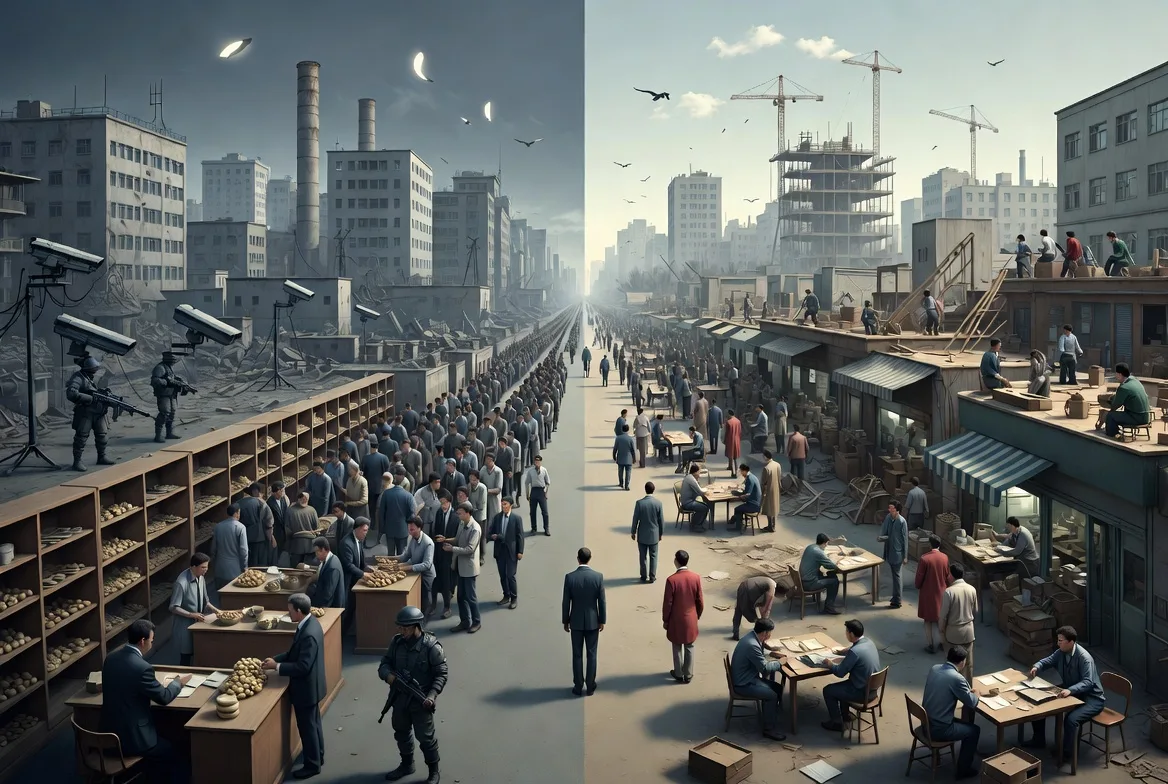
Communism does not work. It has never worked. And it will never work. Because Humans are the wrong species! --YNOT!
Why?
Because human beings do not work that way.
Communism begins with a fantasy: that everyone will work the same, sacrifice the same, share the same, produce the same, and never seek personal advantage.
But that is not human nature.
People compete. People want to improve. People want to protect what is theirs.
People want to leave something behind for their children.
And yes, there are also selfish people, corrupt people, envious people, and ambitious people.
Communism could only work if human beings were ants: obedient, identical, without ambition, without property, without family, without personal dreams.
But we are not ants.
Now, there is one place where something like communism can work: inside the family.
In your home, with your children, your parents, your wife, your brothers and sisters, you share. If someone needs help, you give it. If there is not enough food, everyone adjusts. If a child cannot pay, nobody charges him.
Why? Because there is love, trust, and direct responsibility.
It works there because you know the people. You care about them. You see them.
You know who works, who needs help, and who is taking advantage.
Then you step outside the family and enter a group of friends. There you no longer have communism. You have something more like small-scale socialism. Everyone cooperates a little. One person pays today, another pays tomorrow. They help each other. They cover each other.
But even in that small group, eventually the guy appears who never wants to pay the bar tab. The one who always “forgets” his wallet. The one who always receives but never contributes.
And what happens? They kick him out of the group.
Because even small-scale socialism needs social pressure, trust, and consequences.
Now make it bigger. It is no longer five friends. It is no longer a family.
Now it is a city. Thousands of people. Then a country. Millions of people.
That is where the system breaks.
Because when you have thousands or millions of people, you also have corrupt people, opportunists, thieves, bureaucrats, fanatics, envious people, killers, and people who do not really want equality.
They want power. And in communist systems, the people who rise to the top are not the kindest.
They are the hardest. The coldest. The most violent.
The ones willing to take, persecute, imprison, and kill.
That is what happened in Cuba. That is what happened in Russia.
That is what happened in every revolution that promised equality and ended up creating a new privileged class with uniforms, bodyguards, and mansions.
Socialism teaches people a dangerous idea: “Everything belongs to everyone.”
But in practice, that becomes: “What is yours is also mine.”
Then envy arrives. Why does he have more?
Why does that family have a house?
Why does that merchant have a business?
Why does that farmer have land?
Why does that man produce more?
Then the government says: “Do not worry. We will take it from him.”
And that is where legalized theft begins. Then comes persecution. Then comes confiscation. Then comes prison. Then comes exile. Then comes hunger.
Because when a government gives itself the power to distribute everything, it also gives itself the power to take everything.
Communism is socialism carried to its final conclusion: the government controls the economy, controls property, controls the press, controls education, controls work, controls food, and eventually controls life itself.
And when government controls everything, everything becomes corrupt.
Capitalism is not perfect. It has abuses. It has inequality. It has greed. It has winners and losers.
But capitalism at least works with human nature, not against it.
Capitalism takes human competition and turns it into production.
One person wants to make more money, so he opens a business.
Another wants to sell better, so he improves the product.
Another wants to attract customers, so he lowers prices or gives better service.
Another wants to build something new, so he invents.
Ambition, when limited by laws, private property, competition, and checks on power, can build.
Under communism, ambition does not disappear. It only moves into the government.
The ambitious businessman has to convince you to buy something from him.
The ambitious bureaucrat only needs to control the permit, the food, the job, the police, or the party.
That is why capitalist countries grow. They build. They innovate. They produce. They compete. They correct themselves. They reinvent themselves.
And communist countries shrink.
They eat their businesses. They eat their agriculture. They eat their middle class. They eat their talent. They eat their future.
And in the end, they eat their own people.
Communism does not fail because “it was applied incorrectly.”
It fails because it misunderstands the human being.
It promises equality and produces misery. It promises justice and produces fear.
It promises freedom from the rich and delivers slavery to the State.
It promises paradise and ends up building a prison.
A family can share because there is love.
Friends can cooperate because there is trust.
But a country cannot function like a family, because a country is not a family.
A country needs freedom. It needs private property. It needs limits on power.
It needs checks and balances. It needs competition.
It needs consequences.
Because when everything belongs to everyone, nothing belongs to anyone.
And when nothing belongs to anyone, the government takes everything.
That is the brutal truth.
Communism does not work because the human being was not designed to live on his knees, waiting for a bureaucrat to hand him back what used to be his.
How did the most beautiful island on Earth become a case study in economic self-destruction?

On Cuba, "The most beautiful land that eyes have ever seen.” -- Christopher Columbus
When Christopher Columbus first laid eyes on Cuba, he called it “the most beautiful land that eyes have ever seen.”
History would prove him right—just not in the way he imagined.
Cuba wasn’t cursed by geography. It was blessed by it. Sugar-rich soil. Perfect ports. World-class beaches. And a front-row seat next to the richest consumer market in human history. If nations had lottery tickets, Cuba won twice.
By the 1920s, sugar alone was pouring billions into the economy. During U.S. Prohibition, Americans discovered that Cuba was just 90 minutes away from legal fun, and suddenly the island became what journalists called “700 miles of playground.” Havana filled with Ford automobiles, luxury hotels, yacht clubs, casinos, and modern infrastructure.
By the late 1950s, with just 6.5 million people, Cuba ranked 29th in the world economically.
Its GDP per capita exceeded Ireland and Australia, and doubled Spain and Japan.
Wages ranked among the top eight globally.
Doctors were abundant. Life expectancy matched Europe. Literacy campaigns were already underway.
Cuba had:
- A free market more open than America’s
- An educated, healthy workforce
- Fertile farmland and mineral wealth
- Endless tourism demand next door
On paper, this country should have been unstoppable.
So let’s ask the uncomfortable question:
Why is Cuba still poor?
From paradise to ration lines
Fast-forward to the 1990s.
The average Cuban lost 20 pounds from food shortages.
Up to 40,000 people went blind from nutritional deficiencies.
Blackouts were so common that electricity became the exception.
The economy shrank by one-third. Buying power collapsed by 70%. Nearly half the workforce became unemployed.
Hundreds of thousands fled on rafts.
Roughly half never made it.
And today? Food shortages again. Power cuts again. Desperation again.
Same island. Same people. Same sun.
Different system.
The sugar boom that planted a time bomb
At the start of the 20th century, Cuba had just emerged from 400 years of Spanish rule and decades of war. Independence finally arrived—but with strings attached.
The United States didn’t just show up as a liberator; it showed up as an investor with receipts. American capital already dominated sugar, and independence threatened that grip. The solution was a polite form of control—corporate colonialism.
Then World War I detonated the sugar market. European beet fields vanished under trenches. Global supply collapsed. Prices tripled almost overnight.
The 1919 harvest alone injected more money than the previous 14 years combined.
Everyone expanded. Everyone borrowed. Everyone believed the good times were permanent.
They weren’t.
When prices crashed, 20 Cuban banks failed. American banks didn’t. They bought the farms, mills, and land. By the aftermath, Cubans owned just 20% of their own sugar industry.
Resentment fermented.
The golden age—with rot underneath
Tourism boomed. Havana sparkled. Money flowed.
But slums grew beside casinos. Independent farmers drowned in debt. Women sold companionship to feed children. Politics became corrupt, brutal, transactional—less government, more protection racket.
Then the Great Depression arrived.
An economy built on sugar and tourists collapses fast when the world stops buying both.
The revolution nobody voted for
By 1958, Cubans wanted change—but not communism. They wanted dignity, opportunity, and an end to dictatorship and foreign dominance.
Fidel Castro didn’t campaign as a communist. Even U.S. intelligence didn’t think he was one. He raised wages, lowered rents, cut utility costs, redistributed land. At first, many cheered.
Then came nationalizations.
Then price controls.
Then central planning.
Then alignment with the Soviet Union.
Markets vanished. Incentives vanished. Expertise fled. Loyalty replaced competence. Productivity collapsed.
By 1971, Cuba’s economy was smaller than before the revolution, while the rest of the developing world surged ahead.
The illusion of a communist “golden age”
Soviet subsidies masked failure. Sugar was traded at inflated prices for oil, machinery, and food. Healthcare and education were real achievements—but built on foreign life support.
By the 1980s, the cracks widened. Sugar prices fell. Growth stalled. Dependency deepened.
Then, in 1991, the Soviet Union vanished.
Cuba lost:
- 80% of its trade
- 35% of its economy
- Nearly all fuel imports
Castro called it being “alone in an ocean of capitalism.”
The devil’s bargain
To survive, Cuba created a dual economy:
Communism for citizens. Capitalism for tourists.
Dollars were legalized. Tourism exploded. Doctors earned less than taxi drivers. Cubans watched luxury hotels glow while their neighborhoods went dark.
The system survived—but only by humiliating its own people.
And when reforms slowed, reversed, or stopped, the cycle resumed.
Why Cuba is still poor
Because real reform would end the privileges of those in power.
Because centralized control can’t process human complexity.
Because systems that fear markets always end up fearing people.
So Cuba drifts—patched, subsidized, rationed—kept just alive enough to avoid collapse, never free enough to thrive.
The tragedy isn’t that Cuba failed.
The tragedy is that it didn’t have to.
The island didn’t change.
The people didn’t change.
Only the rules did.
And rules, when they ignore reality long enough, always collect their debt—with interest.
NEXT in the SERIES on CUBA
CUBA – Where Does it Go From Here—Collapse, Compromise, or Another Long Night?
#Cuba #EconomicHistory #FreeMarkets #Communism #CentralPlanning #HumanNature #WhyNationsFail #LessonsFromHistory
Can Russia’s or China’s Allies trust Them

“An ally who disappears when the shooting starts was never an ally — just a customer.” — YNOT
Trump has taken Venezuela, then Iran, and next on the board may be Cuba. Meanwhile, China and Russia stay quiet. They issue statements, murmur about “stability,” and then step back into the shadows. That silence is not a small thing. It is the story.
For years, much of the world was told that America was fading, that BRICS would rise, that the dollar would be challenged, that China and Russia were building an alternative power system for countries tired of the United States. But war has a way of stripping the paint off political fantasies. And when Iran — one of China’s most useful partners and one of Russia’s supposed strategic friends — comes under crushing pressure, neither Beijing nor Moscow steps forward in any meaningful way. That tells the world something. It tells the world that these are not alliances of iron. They are arrangements of convenience. (Reuters)
The Quiet Betrayal of Iran
This is the fascinating part. Iran needs China more than China needs Iran, but China still needs Iran. Iran’s oil exports have been running at roughly 1.1 to 1.5 million barrels per day, and China has been the main buyer. Kharg Island alone handles about 90% of Iran’s oil exports, which is why attacks there matter far beyond Iran itself. Cheap Iranian oil helps feed Chinese industry, keep refinery margins alive, and soften the pain of global energy shocks. (Reuters)
And yet, when the pressure rises, China does not come charging in. It does not send fleets. It does not draw red lines with the kind of seriousness that changes events. It calls for de-escalation, issues diplomatic complaints, and watches. Beijing appears to be choosing pain now over confrontation now. That is a strategic choice, and the world is watching it very carefully. (Reuters)
Iran, in many ways, gave China everything it could. Oil. Access. Platforms. Influence. Surveillance footholds. A place to test systems, methods, and political alignment. Iran bought into the idea that partnership with China created a kind of shield. But now comes the brutal lesson: an economic patron is not the same thing as a military protector.
Russia Is Sending the Same Message
Russia is no better. Iran and Russia signed a strategic pact, but that agreement does not include a NATO-style mutual defense clause. In plain English, that means Tehran cannot point to the treaty and say, “You must come save us.” Moscow can sympathize, condemn, and posture — and still do nothing. That is exactly why the silence matters. (Reuters)
That silence is being heard in more than Tehran. It is being heard in Caracas. It is being heard in Havana. It is being heard in Africa, in Latin America, and in every government that was flirting with the dream of joining some anti-American bloc and believing it came with real security guarantees. This war is not just about bombs and oil fields. It is about credibility.
What the World Has Learned
The world is learning that China and Russia are not building a NATO replacement. They are building networks of trade, leverage, dependency, technology, and convenience. That is not nothing. It is power. But it is a different kind of power.
China will buy your oil.
China will finance your roads.
China will wire your systems.
China will sell you cameras, scanning tools, telecom equipment, and digital infrastructure.
Russia will sell weapons, advisers, and political cover.
But when the storm hits, these relationships may stop at the water’s edge.
That is the message now echoing across the planet: China and Russia may help you resist America — right up until resisting America becomes dangerous for them.
Why China’s Silence Matters More Than Russia’s
Russia is already overextended, under sanction, and fighting its own long war. The world expects limits from Moscow. China is different. China has the larger economy, the industrial muscle, the naval ambition, and the long-term dream of replacing America as the center of gravity in the world system.
That is why China’s silence is so important.
Because if Beijing will not step in for a country as strategically useful as Iran — a country that supplies it oil, gives it regional influence, and helps tie down America’s attention — then what exactly are China’s allies buying into? Access to markets? Yes. Diplomatic cover? Sometimes. Technology? Certainly. But dependable military backing in a moment of existential crisis? So far, the evidence is weak. (Reuters)
Perhaps China Is Waiting
Maybe Beijing is not weak. Maybe it is patient.
Perhaps China is waiting for Taiwan.
Perhaps it is studying this war like a graduate student studies a cadaver.
Perhaps it is learning what American logistics, political will, and alliance coordination really look like under stress.
Perhaps Xi is discovering that his military buildup is not as ready as advertised.
There are reports and signs of turbulence around China’s command climate, and even absent any single dramatic conclusion, the broader point remains: Beijing does not appear eager to face the United States in open confrontation over Iran. That alone tells you something important about timing and confidence. (Reuters)
What This Means for BRICS and the Dollar Dream
For years, people spoke of BRICS as though it were marching toward a clean replacement for the U.S. dollar and a rival world order. The reality has always been murkier. Even BRICS members themselves have publicly backed away from the idea of a shared BRICS currency, focusing more on trade settlement mechanisms and investment platforms than on building a true reserve-currency alternative. (Reuters)
So maybe the dream is not dead, but it is certainly less magical than advertised. A bloc that cannot act like a bloc in crisis is not yet a replacement civilization. It is a loose coalition with overlapping grievances.
And that is the big lesson of this moment.
“BRICS promised a new world order. Iran just discovered it came with no warranty.” — YNOT
The Harsh Truth
America’s enemies, rivals, and critics may still want a post-American world. But wanting is not building. And building is not defending.
Iran is learning that dependence is not protection.
Russia is showing that partnership is not rescue.
China is showing that influence is not commitment.
So when smaller states look east and ask, “If we align with China or Russia, will they stand by us when it counts?” the answer now looks much uglier than it did a year ago.
Maybe they will trade with you.
Maybe they will arm you.
Maybe they will help you defy Washington.
But when the hour gets late and the bombs start falling, they may simply go quiet.
That is what the world is learning from Iran.
And once the world learns that lesson, it does not forget it easily.
“Everyone wants to challenge America… right up until America shows up.” — YNOT
A postcard in time or a warning label we keep ignoring?

“The sad thing about Cuba: before the revolution, it had one of Latin America’s strongest economies — Racism ran deep like the US at the time. The revolution promised equality and prosperity, but left the island bled dry. And made everyone poor except the masters who were white after all.” -- YNOT!
Cuba looks like a movie set that forgot to wrap. Bright paint peeling off tired buildings. Classic cars held together by prayer, wire, and mechanical creativity that would impress NASA. Music in the streets. Laughter in the bars. And behind all of it, a quiet tension—between what you’re allowed to say and what might cost you your freedom.
This isn’t a travel brochure. This is a ledger.
Cuba has about 11 million people, with Havana holding 2.5 million of them. On paper, it’s a nation of revolution, solidarity, and socialist ideals. In reality, it’s a country running a permanent austerity experiment on its own people.
Low wages. High food prices. Chronic medicine shortages. Rolling blackouts that turn nights into guesswork. Internet that’s slow when it works—and censored when it matters.
Why?
Politics. Always politics.
Cuba chose communism and tied its fate to the Soviet Union. When the USSR collapsed, the floor fell out. Sanctions, embargoes, isolation—combine that with centralized control and you get a system where scarcity becomes policy, not accident.
People live in crumbling homes. They drive cars older than their grandparents. And they survive by improvisation.
Rations, reality, and the math of hunger
Food in Cuba runs through a ration card system called la libreta, in place since the 1960s. It’s supposed to guarantee basics. Today, it mostly guarantees insufficiency.
In 2024, bread rations dropped from 80 grams per day to 60. That’s not a diet—it’s a reminder. The ration card doesn’t cover real needs, so people turn to informal sellers, street peddlers, and black markets.
Selling food or medicine outside state channels? Illegal.
Don’t sell? Starve.
Sell? Prison.
Pick your crime.
Medicine is worse. Cuba trains excellent doctors. Hospitals are calm, clean, and understaffed—but around 70% of needed medicines are unavailable. Pharmacies are scavenger hunts. People walk from one to another, hoping luck beats policy.
So medicine appears on sidewalks, in backpacks, whispered about like contraband wisdom. A country that exports doctors can’t import pills.
That’s not irony. That’s ideology meeting logistics.
Work hard, earn little, improvise everything
A barber earns about 100 pesos—roughly $4—per haircut. His shop rent? About $300 a month. Do the math. Then do it again, because it still won’t make sense.
Housing isn’t cheap either. Tourist zones command rents that locals can’t touch. Power outages stretch up to 20 hours some days. Some families burn coal to cook. Streets go dark. Trash piles up for weeks.
And yet—people dance.
They always dance.
Tourism brings money—2.2 million tourists, $1.3 billion last year—but it’s not enough to carry a whole nation. It creates strange side economies too. Paid companionship. “Girlfriends for hire.” Not always about sex—often about survival. Mothers supporting kids. Daughters supporting parents. Everyone supporting a system that doesn’t support them back.
The government even fines locals for approaching tourists too closely. Imagine being punished for standing near the only money in town.
The paradox
Cuba is full of warmth, rhythm, and genuine human connection. It’s also full of restrictions, shortages, and unspoken rules. People laugh, sing, flirt, and share—while navigating a daily obstacle course designed by history and enforced by the state.
This is what happens when slogans replace supply chains, and control replaces trust.
The Cuban people aren’t the problem. They’re the proof.
They survive. They adapt. They smile anyway.
But survival shouldn’t be the national growth strategy.
The island isn’t frozen in time because it wants to be. It’s frozen because moving forward requires admitting that some ideas—no matter how noble they sound—carry a very real human cost.
And that bill always comes due.
#Cuba #MMT #Economics #Socialism #Communism #RealityCheck #HumanCost #PoliticalEconomy #FreedomAndScarcity #ModernHistory
NEXT in the Series about CUBA
CUBA – Havana Vice – Once a playground for the rich — and a preview of what happens when ideology meets reality?
Is Cuba on Its Final Heart Attack Again?

Is this finally the moment Cuba’s communist machine runs out of other people’s oil, other people’s money, and its own tired excuses?
All my life, I have heard that Cuba was on the verge of collapse. The regime was always “about to fall,” always “one more crisis away,” always hanging by a thread that somehow turned out to be made of steel cable. So a sensible person learns caution. But a sensible person also notices when the room smells like smoke and the wiring is sparking. And right now, Cuba looks less like a revolution and more like a government living on fumes, slogans, and borrowed time.
The trouble with communism is not that it promises too little
It promises heaven, then delivers ration lines, blackouts, and speeches.
Cuba’s system did not survive because it worked. It survived because somebody else kept paying the electric bill. First it was the Soviet Union. Later it was Venezuela. That is not economic genius. That is a long-running subsidy program dressed up as political philosophy. Even Marco Rubio’s point, stripped of the TV lights and chest-thumping, is basically this: the Cuban model has not been standing on its own legs for a very long time. (The Washington Post)
Now the Venezuelan lifeline is badly damaged, oil flows have been choked off, and Cuba’s own president has said no fuel shipments had arrived for three months. When a country cannot reliably keep the lights on, the buses moving, the medicine flowing, or the food stocked, the argument is no longer theoretical. It becomes very practical, very hungry, and very loud. (Reuters)
Trump talks like Trump
And when Trump talks about Cuba, he does not exactly whisper.
Reuters reported that Trump said he expected to have the “honor” of “taking Cuba in some form,” and added that he could do “anything I want” with it. That is not subtle diplomacy. That is New York real-estate language wandering into Caribbean geopolitics with its tie loose and its elbows out. But beneath the theatrics is a real point: Washington appears to believe Havana is weaker than it has been in years, and is pressing that weakness hard. (Reuters)
When the power goes out, ideology gets audited
You can preach doctrine in daylight. It gets harder in the dark.
Cuba’s protests have reportedly risen sharply, from 31 in January to 60 in February and 130 in just the first half of March, according to Cubalex figures cited by The Wall Street Journal. The Associated Press also reported that in Morón, protesters partially wrecked the local Communist Party headquarters and five people were arrested. That is what happens when a government asks people for patience after the pantry is empty and the room is hot and the lights are dead again. (The Wall Street Journal)
This is the part the theorists always miss. A political system can survive hypocrisy. It can survive corruption. It can even survive fear for a good long while. But when daily life stops functioning, ordinary people start doing arithmetic. And arithmetic is merciless. It does not care about revolutionary poetry. It asks one vulgar little question: Can you run a country or not?
Even Havana knows the math is ugly
That is why the regime is talking.
Reuters and AP both reported that Miguel Díaz-Canel acknowledged talks with the United States, insisting they must happen with “respect” for sovereignty and each country’s political system. That is the language governments use when they are trying to sound proud while quietly looking for the exit. Pride is always loudest when the cupboard is bare. (Reuters)
And yet this is where history taps you on the shoulder and says, “Don’t get carried away.” Cuba has been declared finished before. Outside powers have misread the island before. Regimes that look doomed on paper often survive because their opponents are impatient, overconfident, or foolish. In fact, AP reported today that Cuba is preparing to receive its first Russian oil shipment of the year, which is a useful reminder that history loves dragging out the ending. (AP News)
Why this matters to America
Because a hostile, dysfunctional dictatorship ninety miles off the Florida coast is not just a Cuban problem.
It matters morally, because generations of Cubans have lived under a system that has mastered control far better than prosperity. It matters strategically, because instability in Cuba does not stay politely on the island. It spills into migration, security, diplomacy, and every government from Miami to Bogotá. And it matters symbolically, because Cuba has long been one of the last great museum pieces of the twentieth century—a regime still trying to sell old slogans in a world that has already moved on.
The truth nobody likes
If Cuba’s regime falls, it will not be because America made a speech.
And if it survives, it will not be because communism suddenly learned economics.
It will come down to the same thing it always comes down to: whether the people in charge can produce a life that ordinary people can stand to live. That is the test. Not the slogans. Not the flags. Not the old men talking about glory while the public hunts for diesel and rice.
So is Cuba on its final heart attack again?
Maybe.
But this time the patient looks older, poorer, darker, and more tired than before. And when a regime begins negotiating with the very power it blames for all its misery, that usually means one thing: the chest pain is real.
And the world may be about to discover, once again, that you can imprison a country for sixty years, but you still cannot repeal reality.
#Cuba #CubanCrisis #Trump #MarcoRubio #Venezuela #Communism #LatinAmerica #Geopolitics #USPolitics #Freedom #CubaProtests #EconomicCollapse #MiguelDiazCanel
The Morning After -- Where We Are Now, Where We Are Going

Revolutions make their finest speeches at night, but morning is when the people count the candles, the bread, and the dead. -- YNOT!
Every revolution sells itself like a wedding night. There is music in the street, fire in the speeches, and a promise that tomorrow will be cleaner, fairer, nobler, and brighter than yesterday. Then comes the morning after. The paint is peeling, the liquor is gone, the band has packed up, and somebody has to explain why paradise looks so much like a blackout. This version is built from the text you gave me and merged with the section on Raulito, the CIA talks, and the Raul Castro indictment.
That is where Cuba stands now: not at the trumpet blast of revolution, but at the groaning hour after the celebration, when slogans have to do the work of diesel fuel, antibiotics, refrigeration, and food. Slogans, for all their charm, do not run water pumps. They do not keep heart machines alive. They do not power a light bulb, much less a country.
For years the Cuban system survived by leaning on outside lifelines, first one patron, then another, always dressing dependence in the costume of sovereignty. A government may call itself independent all day long, but if it cannot keep the gas stations filled and the power grid alive without another country’s oil, then independence is mostly a poem read over an empty pantry. Now the oil has thinned to a trickle, the fuel reserves have hit the floor, and the island is discovering a cruel truth: ideology burns hot in a speech, but cold in a generator. According to your text, the country has been squeezed to the point of fuel exhaustion, blackouts, rationing, hospitals barely hanging on, and ordinary Cubans living in conditions that resemble pre-electric life more than modern nationhood.
The suffering, as always, does not fall first on the men giving orders. It falls on the mother with spoiled food in her kitchen, the father carrying buckets of water because the pumps are dead, the child on a surgical waiting list, the nurse squeezing a ventilation bag by hand in the dark and praying her grip does not fail. Tyranny has a thousand theories, but ordinary people have only one question: how do we make it through the night?
That is what all socialist fairy tales eventually run into: arithmetic. The speech says equality. The billboard says dignity. The party paper says resistance. But the refrigerator says empty, the hospital says wait, the power grid says maybe, and the gas station says no. A people can live a long time on hope, fear, and habit. They cannot live forever on fumes.
Now let us speak plainly. The Cuban state has long prided itself on discipline, endurance, and control. It knows how to manage fear. It knows how to police dissent. It knows how to arrest, threaten, ration, and excuse. But there comes a point when even a skilled jailer discovers he cannot handcuff hunger, and he cannot lecture a power plant back to life. A regime can silence a protester. It cannot interrogate an empty fuel tank into producing diesel.
And so the streets begin to boil. Not because human nature changed, but because human patience has a battery life. People will endure poverty longer than professors think, longer than activists think, longer than foreign analysts think. But when there is no light, no medicine, no transportation, no certainty, and no visible future, the public temper stops being political and becomes biological. A man may debate theory on a full stomach. On an empty one, he counts hours and curses.
That is why the protests matter. Not because protests are new, but because this time they are colliding with something deeper than anger. They are colliding with exhaustion. A regime can beat a crowd. It can arrest fourteen men, or one hundred, or fourteen hundred. It can shut off the internet. It can call unrest foreign agitation and dress repression up as patriotism. But if the state itself is running out of fuel, money, credibility, and time, then every crackdown buys less than the last one. A government can rule by force for a long time. It cannot rule indefinitely by force and shortage at the same time.
The Americans, meanwhile, are behaving like men who believe pressure is a master key. Sometimes it is. Pressure can crack a regime, isolate it, frighten it, and drag it to the negotiating table. But pressure is like dynamite: a fine tool for blowing open the door, not a fine tool for arranging the furniture after you get inside. Washington may be able to force a transition. What it cannot do so easily is script what rises out of the rubble.
And that brings us to the part of history that always disgusts the pure of heart. When a rotten system begins to wobble, the men waiting in the wings are rarely saints in clean collars. More often, they are nephews, sons, cousins, and grandsons — fellows raised inside the machine, who know the gears, know the locks, and know which levers still work. According to your text, Washington is not really betting on Miguel Díaz-Canel. It is looking toward Raulito, Raul Castro’s grandson, because he may be one of the few people on the island with enough access to the economic and security machinery to move the system from inside it.
That is the bitter joke of revolutions. They promise a new man and after sixty-seven years the country wakes up bargaining with the old man’s grandson. The CIA, by this account, did not fly into Havana for scenery. It came with the oldest offer in politics: relief in exchange for surrender, aid in exchange for restructuring, breathing room in exchange for fundamental change. That is not romance. That is power stripped of its poetry. The implication of the Ratcliffe visit in your text is that the United States is prepared to deal, but only if the regime begins dismantling itself from the inside.
Now hanging over that table was a second message, and it was colder than the first. The indictment of Raul Castro was not merely about old blood from 1996, though blood is reason enough. It was also a warning shot. Washington was saying that the Castro name itself is no longer sacred, no longer beyond reach, no longer protected by age, revolutionary folklore, or family legend. When the grandfather is indicted while the grandson is being courted, the meaning is plain enough for a drunk in Little Havana to understand: there is a door open, but it may not stay open for long.
That leaves Cuba in the sort of position nations dread and history delights in. The future may depend not on the people who opposed the system, but on the people who inherited it. Many exiles will hate that. Many patriots will choke on it. Good. Reality has a way of insulting everybody at once. Cuba did not leave behind sturdy rival institutions. It did not preserve a powerful opposition ready to take the keys. It built a system designed to make sure nothing outside of it could ever grow. Well, now the harvest is in, and the only fruit on the tree belongs to the same family orchard.
That means the future may not arrive dressed as freedom in a clean white suit. It may arrive looking like an insider’s bargain, a managed transition, a rearrangement of loyalties, a new face handling the same old ledger. That will offend many people, especially those who wanted the story to end with righteous music and a clean moral victory. Too bad. History is not a Sunday sermon. It limps, bargains, threatens, and improvises. Sometimes the only alternative to an ugly compromise is an uglier collapse.
And collapse would indeed be uglier. Cuba is not some distant square on a map where American mistakes can be hidden behind think-tank language. It sits just off Florida. If the state buckles too fast, if the security system fractures, if the economy drops from misery into free fall, the result is not merely political embarrassment. It is migration, disorder, panic, and a humanitarian spillover that lands on American shores whether Washington likes it or not. Men do not stay put so that pundits can keep their principles tidy.
So where are we now? We are at the point in the story where the old script is still on the stage, but everybody in the audience can smell smoke behind the curtain. The Cuban government is weaker, poorer, and more exposed than it pretends. The people are angrier, more exhausted, and more cornered than the official newspapers admit. The Americans are pressing hard, but they are also staring at the oldest imperial problem on earth: it is easy to break a thing, difficult to replace it, and hardest of all to replace it without inheriting its mess.
And where are we going? Toward one of two roads. The first is a negotiated transition managed by insiders — ugly, compromised, offensive to the pure of heart, but stable enough perhaps to keep the country from falling to pieces. The second is a harder break: deeper shortages, more repression, more flight, more chaos, and the possibility that the state comes apart faster than anyone can organize what follows. One path insults justice. The other may bury it.
That is the morning after in Cuba. Not the romance of 1959. Not the bearded legends, the triumphal marches, the posters, the speeches, or the myths. This is the bill. History always sends a bill. It may take a year or sixty, but it comes just the same. And when it arrives, it is never paid by the men who made the promises. It is paid by the people standing in the dark, holding water in buckets, waiting for a country to decide whether it still belongs to the past or has enough strength left to crawl into the future.
The revolution was the night before. This is the morning after. And mornings, unlike speeches, are unforgiving.
How Socialism Really Works in Cuba - GAESA

Socialism in Cuba did not eliminate the rich — it simply replaced businessmen with generals, and called the new monopoly ‘the people.’ Meanwhile, the people stood in line for bread while the revolution built luxury hotels. -- YNOT!
People imagine socialism as a system where “the people” own everything together. That sounds noble right up until you ask the obvious question nobody likes to answer:
Who actually controls “the people’s stuff”?
Because in Cuba, it turned out the answer was not “the workers.”
It was not “the farmers.”
It was not “the revolution.”
It was a military business empire called GAESA.
And somewhere along the line, the revolution that promised equality became something else entirely: a system where ordinary Cubans stood in bread lines while generals built luxury hotels for tourists who never arrived.
That is the part they rarely teach in college.
The Revolution That Became a Corporation
When Fidel Castro took power in 1959, Cuba was sold a dream. The rich elites would disappear. Corruption would end. Foreign influence would stop controlling the island.
Instead, Cuba eventually created a new elite class — only this time they wore olive-green uniforms and called themselves revolutionaries.
And the quiet man behind much of that transformation was not Fidel.
It was Raul Castro.
Fidel was the speechmaker. Raul was the systems man. Fidel talked ideology. Raul built machinery.
And machinery is where real power lives.
What Is GAESA?
GAESA stands for Grupo de Administración Empresarial S.A.
That sounds harmless enough. Like a boring accounting company with stale coffee and broken printers.
But GAESA became something far bigger.
It evolved into a military-controlled conglomerate that came to dominate Cuba’s economy. Tourism, hotels, ports, banks, gas stations, stores, remittances, telecommunications, foreign currency, financial operations — piece by piece, the military absorbed it all.
Imagine if the Pentagon owned:
- Marriott Hotels
- Chase Bank
- Walmart
- Verizon
- Exxon
- the airports
- and half the construction industry
…while Congress had no ability to audit the books.
That is closer to what Cuba became.
Raul Castro Understood One Thing Most Revolutionaries Forget
Power is not speeches.
Power is cash flow.
Back in the Soviet era, Cuba survived because Moscow paid the bills. Soviet money poured into the island like a drunk uncle at a casino.
Then the Soviet Union collapsed in 1991.
And suddenly socialism had a math problem.
The subsidies vanished. The economy imploded. The government could barely function.
That is when Raul Castro began moving enormous sections of the Cuban economy under military control.
Not temporary control. Permanent control.
Tourism became central. Foreign currency became central. Military-run enterprises became central.
And from that point forward, Cuba slowly transformed from a socialist republic into something stranger:
A military-owned holding company pretending to be a country.
The Great Socialist Joke
Here is the funny part — and by funny, I mean tragic.
The revolution claimed to eliminate class divisions.
Instead, it created two Cubas.
Cuba #1
The ordinary Cuban:
- standing in food lines
- dealing with blackouts
- riding broken buses
- surviving on ration books
- earning salaries that could not buy basic necessities
Cuba #2
The elite system:
- luxury hotels
- foreign currency access
- imported goods
- private privileges
- offshore companies
- military-controlled business networks
One Cuba had ideology.
The other had air conditioning.
And somehow the people with the ideology never seemed to be the ones sweating.
The Hotel Madness
Perhaps nothing explains modern Cuba better than this:
While much of the country was collapsing, GAESA continued pouring money into luxury tourism construction projects.
New hotels rose over Havana while nearby buildings literally crumbled apart.
Blackouts lasted hours. Infrastructure failed. Hospitals struggled.
Yet giant luxury towers kept appearing.
Why?
Because large centralized systems eventually stop serving the public and begin serving the preservation of the system itself.
The machine feeds the machine.
Construction projects mean contracts. Contracts mean kickbacks. Kickbacks mean loyalty.
That is how many corrupt systems survive — not through ideology, but through distribution of favors.
Socialism Always Has Owners
This is the lesson history keeps trying to teach people.
Under capitalism, rich businessmen may own industries.
Under socialism, political insiders often own the system indirectly through state control.
The ownership never disappears.
It just changes uniforms.
And when there is no transparency, no free press, no independent courts, and no opposition party, the ruling structure becomes nearly impossible to challenge.
The state becomes the corporation.
The corporation becomes the ruling class.
And the people become employees who cannot quit.
Raul Castro’s Real Inheritance
People think Fidel Castro built modern Cuba.
In many ways, Raul built the structure that actually lasted.
Not the speeches.
Not the slogans.
Not the posters.
The machinery.
GAESA became the nervous system of the island economy. And according to many analysts, it grew powerful enough that even civilian government structures could not fully oversee it.
That is a remarkable thing when you think about it.
The revolution that once promised to destroy concentrated power eventually concentrated nearly everything into one interconnected military-economic structure.
And like most systems built around centralized control, it eventually began protecting itself first.
The Hard Truth About Human Nature
Every political system eventually runs into the same problem:
Human beings.
Greed does not disappear because somebody hangs a revolutionary flag.
Power does not become moral because somebody uses the word “people.”
And bureaucracy has a strange habit of growing like mold in the dark.
That is why history matters.
Not because one side is always pure and the other side always evil.
But because every system — capitalist, socialist, communist, democratic — eventually becomes vulnerable to the same ancient temptations:
- power
- corruption
- self-preservation
- and the belief that “we deserve more than they do.”
The uniforms change.
Human nature rarely does.
And somewhere in Havana tonight, there is probably a man standing in line for bread beneath the shadow of a luxury hotel built in the name of equality.
That is the kind of irony Mark Twain would have smiled at sadly.
Because the older you get, the more you realize:
The problem was never the slogan.
It was always the people holding the keys.
#Cuba #Socialism #Communism #GAESA #RaulCastro #FidelCastro #CubanHistory #Politics #Economics #Freedom #HumanNature #Corruption #History #Authoritarianism
Has the Time Come to Take Military Action in Cuba

America can win Cuba in a week. The question is whether it can win the morning after. That is up to the people -- YNOT!
Has the time come to take military action in Cuba, or are we standing at the edge of another fine American habit — winning the fight and losing the bill?
Cuba is only 90 miles from Florida, which is close enough to make Washington nervous and far enough away for politicians to speak bravely from air-conditioned rooms.
The island is breaking down in real time. The power grid is failing. Fuel is scarce. Hospitals struggle. Water pumps stop. Food spoils. People sit in the heat waiting for the lights to come back on, and nobody in Havana can honestly say when that will be.
That kind of misery does not need a bomb to become a crisis. It already is one.
But this is no longer just about communism, exile politics, or old Cold War grudges kept warm like leftovers nobody wants to throw away. Cuba now sits at the center of something bigger: Russian and Chinese intelligence activity, U.S. national security, oil pressure, sanctions, property claims, regime survival, and the question every empire eventually asks itself:
Can we force history to move faster?
Washington’s concern is not imaginary. Chinese-linked intelligence sites in Cuba are a serious problem. Russian influence is a serious problem. A hostile intelligence network sitting that close to Florida is not just a diplomatic annoyance. It is the kind of thing that makes generals stop smiling at lunch.
Then there is the money. There are billions of dollars in old U.S. property claims tied to assets nationalized after the Cuban Revolution. Oil assets. Ports. Hotels. Land. Companies do not forget confiscated property any more than a dog forgets where you hid the steak.
So when people say this is only about freedom, be careful. Freedom may be in the room, but money usually has the better chair.
The U.S. has already turned the screws hard. The blockade pressure on oil is meant to do what armies often do badly: make the regime collapse before the shooting starts. That is the clean version of pressure. Clean, of course, depending on whether you are the one applying it or the one trying to refrigerate medicine with no electricity.
Now the question becomes: how would military action happen?
Not like the movies. There would probably be no grand beach landing, no dramatic flag-raising, no easy little war with a neat ending and a soundtrack. Real life has a nasty habit of refusing the script.
There are three broad paths.
The first path is the inside deal.
This is the path Washington would prefer if it can get it. Find people inside the Cuban power structure who understand the old machine is running on fumes. Offer them survival, money, legitimacy, and a chair at the new table. In return, they help manage a transition.
This is how nations avoid invasion while still losing power.
Everybody calls it diplomacy because “controlled collapse with paperwork” does not sound as noble.
If the right insiders decide the Castro system has become a dead mule in the road, they may try to move it before Washington brings in the tow truck. That would mean a transitional government, economic opening, prisoner releases, foreign investment, and a whole lot of men who spent their lives defending socialism suddenly discovering the beauty of private property.
Human nature is a wonderful comedian. The second path is collapse first, troops later.
This may be the most likely scenario.
The pressure keeps building. Fuel disappears. Blackouts spread. Protests grow. Local officials stop obeying Havana because Havana can no longer provide electricity, food, or fear in reliable quantities.
That is when governments become hollow. They still have flags, speeches, uniforms, and television anchors saying everything is fine. But underneath, the floorboards are gone.
At that point, the U.S. does not need to invade in the old-fashioned sense. It can come in under the language of humanitarian relief, stabilization, embassy protection, evacuation, or restoring order.
That sounds softer than invasion, but ask the people on the ground and they may notice the boots are made of the same leather.
The danger is that Cuba is not just a government. It is a country of more than 10 million people with neighborhoods, families, grudges, loyalties, fears, and memories. You can topple a government faster than you can convince a grandmother that foreign soldiers in her street are there for her own good.
The third path is direct military force.
This is the path everybody talks about and nobody should speak of casually.
Could the United States defeat Cuba’s conventional military?
Yes.
That part is not the hard question.
Cuba’s air force is old. Its navy is limited. Its equipment is aging. Its fuel supply is weak. Against the U.S. military, Cuba would not win a conventional war. That is not courage talking. That is arithmetic.
But countries do not always fight the war you want. They fight the war they can afford.
Cuba’s real strength is not tanks, planes, or ships. Its real strength is the ability to make an occupation painful. Urban resistance. Local militias. Intelligence networks. Neighborhood informants. Armed loyalists. National pride. Fear of revenge. Fear of foreign control.
That is where the problem begins.
America has learned this lesson before, though learning a thing and remembering it are two different talents. Iraq taught it. Afghanistan taught it. Vietnam taught it. The first phase of a war is often won by the people with better aircraft. The second phase is judged by mothers, markets, funerals, and whether the lights come on after the speeches are over.
And Cuba is not across the world. Cuba is 90 miles from Florida.
If things go badly, the consequences do not stay neatly on the island. Refugees come north. Politics explode in Miami. China and Russia get their propaganda gift wrapped. Latin America turns hostile. The United Nations fills up with speeches. And every bad actor on earth says, “See? Rules only matter when Washington likes the outcome.”
Now, does that mean America should do nothing?
No.
Doing nothing is not wisdom. It is just cowardice wearing slippers.
The Cuban people have lived under a system that has controlled speech, crushed opposition, exported labor, rationed misery, and blamed every failure on someone else. The regime has spent decades turning a beautiful island into a prison with beaches.
But military action should never be sold like pest control.
You do not “remove a regime” the way you remove termites. Regimes live inside institutions, families, police stations, bank accounts, schools, habits, and fear. Blow up the top and the roots may still be there, tangled in the plumbing.
The real question is not whether the U.S. can break the Cuban regime.
It can.
The real question is whether the U.S. can help build something better afterward without creating another long, angry, expensive mess.
That means any serious plan must answer five questions before the first soldier moves:
Who governs the day after?
Who controls the police?
Who keeps food moving?
Who prevents revenge killings?
Who makes sure Cuba does not trade one gang of bosses for another gang with better suits?
If those questions do not have answers, then “liberation” becomes a slogan, and slogans are cheap because they are usually paid for by somebody else’s children.
So has the time come?
Maybe the time has come for the regime to end.
Maybe the time has come for Cuba to breathe.
Maybe the time has come for the world to stop pretending that blackouts, prisons, hunger, censorship, and party loyalty are some noble little experiment.
But the time for military action?
That should be the last door opened, not the first one kicked in.
Because the easiest part would be defeating Cuba’s military.
The hard part would be not defeating Cuba itself.
And history has a cruel sense of humor: sometimes the people who arrive promising freedom discover they brought a landlord’s clipboard instead.
Has Washington Already Chosen the Cuba Plan — and Is the Invasion the Part They Hope They Never Need?
The most likely plan for Cuba does not begin with Marines storming Havana like a movie trailer made by a defense contractor with too much coffee.
No, the smarter plan is quieter. It begins with fuel. Cut the oil. Tighten the sanctions. Make every country, tanker, bank, insurer, and middleman decide whether helping Havana is worth angering Washington.
That is not war in the old sense. That is pressure with a necktie on.
Cuba already runs on fumes. The electric grid is weak. The fuel supply is thin. The hospitals, water pumps, food storage, transportation system, and police state all depend on energy. A dictatorship can survive angry citizens. It can survive bad press. It can even survive hunger longer than decent people like to admit.
But it cannot survive forever without fuel. So the first phase is simple: squeeze the regime until the machine starts coughing.
Not the people — though the people always end up paying first, because governments have a special talent for sending the bill downstairs.
The second phase is political. Washington would start looking for insiders who know the old system is dying. Not necessarily heroes. History rarely gives us those in bulk. More likely generals, security officials, party operators, businessmen in uniform, and well-connected survivors who can smell tomorrow before their boss does.
The message to them would be plain:
Help manage the transition, and you may keep a future.
Fight to the end, and you may only keep a cell.
That is how regimes often fall. Not when every citizen rises at once, but when the men with guns stop believing the old boss can still protect them.
The third phase is the “humanitarian door.”
As blackouts spread and shortages worsen, protests grow. The regime arrests people, but the arrests do not fix the lights. It sends police, but police cars need gasoline. It gives speeches, but speeches do not pump water.
At some point, Washington says the magic words: humanitarian crisis, evacuation, stabilization, protection of civilians, regional security.
Those words matter. They are the difference between “invasion” and “intervention,” and governments love changing the label after they have already opened the package.
Then comes the military shadow.
Guantánamo becomes the obvious staging point. Not because anyone needs to say it out loud, but because geography already said it first. It is on Cuban soil, it has a port, it has an airfield, and it gives Washington a foothold without needing to kick open the first door.
From there, the U.S. does not need to conquer every inch of Cuba. That would be the dumb version, and America has already bought that lesson twice at full retail.
The likely goal would be limited and political:
Secure American personnel.
Prevent a mass migration crisis.
Protect key routes for aid.
Force or support a leadership transition.
Keep rival powers from filling the vacuum.
Recognize a transitional authority.
Then call it stabilization.
That is the plan if things go the way Washington wants.
But plans have a way of meeting real people and embarrassing themselves.
Because Cuba is not just a regime. It is neighborhoods, families, exiles, informants, old loyalties, fresh anger, military officers, black-market operators, political prisoners, hungry mothers, proud old communists, young people with no patience left, and millions who have been trained for decades to suspect anything wearing an American flag.
That is where the easy part ends.
The U.S. could defeat Cuba’s conventional military quickly. That is not the real question. The real question is what happens after the statues come down and everybody starts asking who owns the hotels, ports, farms, factories, houses, and bank accounts.
That is when liberation can turn into a family argument with international lawyers.
There would be exiles demanding justice. Insiders demanding immunity. Corporations demanding property. Citizens demanding food. China demanding compensation. Russia demanding attention. Latin America demanding explanations. And Washington demanding that everyone please remain calm while history tries to reload.
So the likely plan is this:
First, choke the regime economically.
Second, split the insiders politically.
Third, wait for collapse to become visible.
Fourth, enter under a humanitarian or stabilization banner.
Fifth, install or recognize a transition government.
Sixth, open the economy fast.
Seventh, hope the Cuban people accept the new order before the old ghosts organize themselves.
That last part is the gamble. Because removing a dictatorship is one thing.
Replacing the habits it planted in the soil is another.
And if Washington forgets that, it may discover the same old truth with a Cuban accent:
You can win the airport in a day, the capital in a week, and still spend years trying to win the street corner where everybody knows who betrayed whom.
Bottom Line
Against the United States, Cuba loses the conventional fight quickly. Its main value is not defeating a U.S. force. Its value is making occupation, stabilization, and political control painful afterward.
Iran is a much more dangerous military opponent. Iran has strategic depth, missile forces, drones, proxy networks, a larger military, a domestic arms industry, and the ability to hit regional U.S. partners and energy infrastructure. CSIS describes Iran as having the largest and most diverse missile arsenal in the Middle East, with thousands of ballistic and cruise missiles. (Missile Threat)
In plain English: Cuba is a knife fight in a small room. Iran is a warehouse full of matches, gasoline, and angry neighbors.
Cuba Military Assessment
Cuba’s formal military is the Revolutionary Armed Forces, with army, navy, air and air-defense forces, plus territorial militia and reserve structures. Older World Bank-linked data puts Cuba’s armed forces personnel around 76,000 in 2020, while Global Firepower ranks Cuba 65th of 145 militaries in 2026. (Trading Economics)
Cuba’s defense strategy is not built around defeating the United States in a clean, conventional war. It is built around survival, delay, dispersion, and political cost. Reuters recently noted Cuba’s “War of All the People” doctrine, which is embedded in Cuban defense law and tied to broad military training and mobilization. (Reuters)
Cuba’s strengths
| Area | Assessment |
|---|---|
| Geography | Island geography helps defense, smuggling control, and bottlenecking movement, but also makes blockade easier. |
| Urban resistance potential | Strong. Havana, Santiago, and dense neighborhoods could become difficult to control. |
| Militia/reserve doctrine | Strong on paper. Cuba has long prepared for decentralized resistance. |
| Air defense | Moderate but aging. Soviet-derived systems can still be dangerous, especially against careless or low-altitude operations. |
| Political/intelligence control | Strong domestically. The Cuban state has deep internal surveillance habits. |
| Nationalist narrative | Strong. Any foreign intervention could be framed as imperial invasion, even by people who hate the regime. |
Cuba’s weaknesses
| Area | Assessment |
|---|---|
| Air force | Weak. Old Soviet aircraft, low readiness, spare-parts problems. |
| Navy | Weak. Coastal defense force, not a blue-water navy. |
| Missile force | Limited. Nothing like Iran’s ballistic missile threat. |
| Logistics | Very weak. Fuel, electricity, transportation, maintenance, and parts shortages are serious vulnerabilities. |
| Defense industry | Weak. Cuba depends heavily on foreign suppliers and old inventories. |
| Strategic depth | Limited. It is a long island close to U.S. bases and surveillance assets. |
The most important point: Cuba’s most dangerous military capability is not its equipment. It is the possibility of prolonged resistance after the regime falls.
That is where the bill gets ugly.
Iran Military Assessment
Iran is a different animal.
OpenFactBook data lists Iran at up to about 600,000 active armed forces personnel, including the regular armed forces, IRGC, and active Basij paramilitary forces. Global Firepower ranks Iran 16th of 145 in 2026, compared with Cuba at 65th. (OpenFactBook)
Iran’s doctrine is built around deterrence by punishment. It knows it cannot beat the U.S. in a traditional air-and-naval war, so it invests in missiles, drones, mines, fast boats, proxies, hardened facilities, and regional escalation.
CSIS says Iran’s missile forces give it a credible ability to threaten U.S. and partner forces in the region. (Missile Threat) IISS has also assessed that Iran expended a significant part of its medium- and intermediate-range ballistic missile inventory during the 2025 Twelve-Day War, but replacement depends on manufacturing repair and propellant supply. (IISS)
Side-by-Side Comparison
| Category | Cuba | Iran | Advantage |
|---|---|---|---|
| Global military ranking | ~65th | ~16th | Iran |
| Active personnel | ~76,000 historical estimate | Up to ~600,000 active | Iran |
| Air force | Old, weak, low readiness | Larger but aging/mixed | Iran |
| Air defense | Aging Soviet-derived network | Larger, denser, more modern/mixed | Iran |
| Navy | Coastal defense | Asymmetric Gulf threat | Iran |
| Missile force | Limited | Largest in Middle East | Iran |
| Drone force | Limited | Significant | Iran |
| Defense industry | Weak | Substantial domestic production | Iran |
| Strategic depth | Low | Very high | Iran |
| Ability to resist occupation | High for size | Extremely high | Iran |
| Ability to threaten U.S. mainland | Low | Limited direct, higher indirect/cyber/regional | Iran |
| Ability to disrupt world economy | Low/moderate through migration/regional politics | High through Gulf oil routes | Iran |
Scorecard
| Capability | Cuba | Iran |
|---|---|---|
| Conventional ground force | 4/10 | 7/10 |
| Air force | 2/10 | 4/10 |
| Air defense | 4/10 | 7/10 |
| Missile force | 1/10 | 10/10 |
| Navy | 2/10 | 6/10 |
| Drone capability | 1/10 | 8/10 |
| Cyber / electronic warfare | 2/10 | 6/10 |
| Logistics resilience | 2/10 | 6/10 |
| Defense industry | 1/10 | 8/10 |
| Occupation resistance potential | 7/10 | 9/10 |
| Overall military problem for U.S. | 4/10 | 9/10 |

Cuba’s likely defense logic
Cuba would probably try to:
- Preserve regime leadership as long as possible.
- Keep internal security units loyal.
- Use air defenses selectively.
- Avoid wasting aircraft in hopeless fights.
- Shift quickly into militia, urban, and guerrilla resistance.
- Frame the conflict as national survival against foreign invasion.
- Encourage international condemnation and regional political pressure.
Cuba’s best hope is not battlefield victory. It is making the aftermath so politically expensive that Washington regrets touching the problem.
Iran’s best hope is not defeating the U.S. Navy or Air Force. It is making the war too expensive, too wide, and too economically dangerous to continue.
The Big Strategic Difference
Cuba’s danger is proximity.
It is 90 miles from Florida. A crisis there means migration, political shock in Miami, intelligence concerns, humanitarian pressure, and possible confrontation with Chinese or Russian interests. Cuba is close enough that America cannot ignore it.
Iran’s danger is escalation.
It can hit regional bases, threaten Israel, activate proxies, disrupt shipping, and rattle energy markets. Iran is far away geographically but close to the world’s oil arteries. That makes it dangerous in a different way.
Final Assessment
If the U.S. fought Cuba, the conventional military result would likely be quick. The hard part would be what comes after: civil order, revenge, refugees, guerrilla resistance, property disputes, and legitimacy.
If the U.S. fought Iran, the opening would be far more dangerous. The U.S. could still dominate the air and sea over time, but Iran could impose serious costs through missiles, drones, proxies, cyber actions, and energy disruption.
So the blunt version is this:
Cuba can make America bleed politically after losing militarily. Iran can make America bleed regionally while still fighting militarily.
Or even simpler:
Cuba is hard to occupy.
Iran is hard to contain.
#Cuba #USForeignPolicy #CubanPolitics #MilitaryAction #RegimeChange #GuantanamoBay #ChinaCuba #RussiaCuba #CaribbeanSecurity #LatinAmerica #NationalSecurity #FreedomForCuba #CubanPolitics #Geopolitics #CaribbeanSecurity #ChinaCuba #RussiaCuba #GuantanamoBay #RegimeChange #LatinAmerica #NationalSecurity #FreedomForCuba
Cuban Economics 101: The Store Is Empty Because the System Is Full

Communism does not eliminate the rich. It simply replaces private wealth with political privilege. Cuba did not build an economy. It built a toll booth feeding one class and called it a country. --YNOT!
In Cuba, the shelves are empty for the people, but full for the connected. That is not failure. That is the system working exactly as designed.
And I understand why it is hard for people to grasp. Cuba is so foreign compared to almost every other economy on Earth that most people naturally assume it works like a normal country.
It does not.
In almost any country in the world, except maybe North Korea, if you want to buy something, you go on the internet, click a button, pay for it, and it gets shipped to your house or to a place where you can pick it up. Maybe you pay a tariff. Maybe you pay a shipping charge. Maybe the government takes some tax. Fine. That happens everywhere.
But the basic idea is simple: you have money, it is your money, and the country allows you to buy what you need.
Cuba does not work that way.
In Cuba, almost everything has to pass through the Cuban system. You either buy it from a Cuban government store, or you depend on a family member in the United States or some other country to send it to you. But even then, that item usually has to pass through a company that functions like a freight forwarder tied into the Cuban system.
That company gets its cut. The government gets its cut. The connected people inside the system get their cut.
By the time the Cuban citizen gets the item, the poor thing has been taxed, handled, shipped, processed, squeezed, and blessed by every little parasite in the chain.
So let’s say you want to buy a microwave oven.
In a normal country, you buy a microwave. It arrives. You plug it in. You heat your food. End of story.
In Cuba, that microwave becomes an economic adventure novel.
You can go to a government store and buy the microwave for three times what it would cost almost anywhere else. Or, in theory, a family member outside Cuba can send you one. But by the time your family member buys it, takes it to a company like VaCuba, pays the shipping fee, pays the handling fee, pays the tax, and then deals with whatever charge may appear when it finally reaches Cuba, that microwave can still cost three times what it should.
And sometimes, when your family member in Cuba finally receives the item, they have to pay another fee on their end.
So what do you do?
You send extra money along with the microwave.
Maybe you send $100.
But even that money does not arrive cleanly. By the time everyone takes their percentage, your family member may only get the equivalent of $75.
That is the point people miss.
The whole system is designed to take a cut at every step. It is designed so the Cuban citizen cannot simply bypass the state and buy what they need directly.
That has nothing to do with the embargo. That has nothing to do with sanctions.
That has nothing to do with America preventing Cuba from buying a microwave, a refrigerator, a fan, a bag of rice, or a bottle of Coca-Cola.
This is how the Cuban economy is structured. This is how the system protects itself. This is how the system funds itself.
It is not just tariffs. It is not just shipping. It is not just bad luck.
It is a controlled economy built to make sure the government and the people connected to the government get paid before the Cuban citizen gets what he needs.
And now we get to the part nobody wants to talk about.
The people in the Cuban government, the elites, the connected families, and whoever else is tied into the system do not have this problem.
They travel freely abroad. They buy whatever they want.
They bring things back with them. They have connections to get things through customs.
The rules that crush the average Cuban do not apply to them.
If you go to Havana, you will see two Cubas.
There is the Cuba of the regular people, and there is the Cuba of the privileged class.
There are stores for ordinary Cubans, and then there are stores for the connected people. The stores for regular people are often empty or filled with overpriced basics. But the stores for the privileged class look like Costco. They have products from all over the world. You can buy almost anything.
Nothing stops China from selling products to Cuba.
Nothing stops other countries from selling products to Cuba.
The problem is not that Cuba cannot buy things.
The problem is who gets access to those things once they enter the country.
And understand this clearly: at that level, the government is the seller.
When you buy Coca-Cola in Cuba — and yes, you can buy Coca-Cola in Cuba — you are buying it through the system. Where did they get it? I do not know. But they got it. And they are selling it.
That is the magic trick. The shelves are empty for the people, but somehow the connected class can still find what it wants.
Walk around Havana and you may be surprised by what you see. You will see Toyotas, Lexuses, Mercedes, BMWs, Porsches, and even the occasional Alfa Romeo or Lamborghini. You may even see newer American cars.
But very few people own those cars. And when you do see them, you know exactly what you are looking at. You are looking at someone connected to power.
Because in Cuba, you do not become truly wealthy unless you are connected, protected, corrupt, or part of the government system.
That is Cuban Economics 101.
So now ask yourself a very simple question:
Should you give money to the Cuban government?
And here is another part people do not understand.
One reason Cuba does not have enough food is because the system is so broken that farmers do not truly control their farms.
If a farmer does not own the farm, does not control the price, does not control the market, and does not benefit from his own production, then why would he produce more than he has to?
He does what everyone else does. He waits. He survives. He plays the system, because the system gives him no real incentive to build, grow, improve, expand, or produce.
That is what socialism does when it gets old. It does not create abundance. It creates excuses. It turns productive people into people who wait. It turns farmers into employees of a failed theory. It turns a country with land, climate, and history into a country standing in line for imported food.
Cuba was and should be an agricultural powerhouse.
It has the land. It has the climate. It has the history.
But after more than half a century of communist control, the government still cannot feed its own people.
So Cuban government imports food. That is why people are hungry.
Not because Cuba is an island. Not because the sun forgot to shine.
Not because the soil went on strike. People are hungry because the system is stupid, corrupt, and designed to control production instead of reward it.
And here is the final trick. The Cuban people do not have real money.
The Cuban government has the money. But the Cuban government does not create wealth.
It does not build enough. It does not produce enough. It does not innovate enough.
It survives by extracting money from its own people and from Cubans abroad through fees, taxes, inflated prices, remittances, government stores, and controlled import channels.
That is the system.
So when those outside revenue streams are cut off, the Cuban government suddenly has no money to buy anything because it never built a real economy.
It built a machine of control. It built a toll booth and called it a country.
It built a warehouse for the connected and a waiting line for everyone else.
It built a system where the government gets paid first, the elites get served second, and the people get whatever is left over — if anything is left over at all.
The Cuban government is a parasite on the Cuban people.
And that is how communist economics works. The state controls the economy.
The connected class gets access. The government sells the goods.
The people pay three times the price. The relatives overseas send the money.
The middlemen take their cut. The customs office takes its cut.
The store takes its cut. The party takes its cut.
And the Cuban citizen stands there wondering why the shelves are empty in a country that somehow still has luxury cars, elite stores, imported products, and government officials who never seem to miss a meal.
That is not an accident. That is the design.
And now you know what has been happening for 70 years.
Facts, not BS.
Cuba’s Economic Reality: Beyond the Myth of the “Blockade”

The money enters Cuba. The food enters Cuba. The hotels are built. The problem is not the absence of resources — it is who controls them.--YNOT!
To understand Cuba’s deep crisis, we have to move beyond ideological slogans and look at the facts: the economic data, the internal power structure, and the way resources are actually controlled on the island.
The crisis is often blamed entirely on a suffocating external siege — the so-called “blockade.” But the reality is more complicated, and far more revealing. Cuba’s collapse is not simply the product of foreign pressure or abstract ideology. It is the result of decades of centralized control, economic mismanagement, and the predatory use of national resources by a military elite.
Embargo vs. Blockade: A Necessary Distinction
The first step is to use the correct terms.
From a legal and technical standpoint, Cuba does not face a true “blockade,” which would mean total military and physical isolation. What exists is a unilateral commercial and financial embargo imposed by the United States.
That distinction matters.
Cuba trades with much of the world, including Canada, the European Union, China, Russia, Mexico, Brazil, Spain, and many others. The island is not cut off from global commerce. Its problem is not that the world is forbidden from trading with Cuba. Its problem is that the Cuban state has destroyed trust, productivity, and financial credibility.
There is also the American supplier paradox. Despite U.S. sanctions, the United States remains one of Cuba’s important suppliers of essential goods. Under humanitarian exceptions, Cuba regularly purchases large quantities of chicken, soy, corn, medicine, and other basic goods from American companies.
The restriction is not that Cuba cannot buy these goods. The restriction is that Cuba generally must pay cash, up front, without access to normal U.S. credit. That is not a blockade. That is a credit-risk rule applied to a government with a long history of default.
Cuba’s Serial Insolvency
Cuba’s lack of access to international credit is not simply the result of a conspiracy. It is also the predictable result of becoming a serially insolvent debtor.
Over decades, the Cuban government has accumulated large debts with creditors such as the Paris Club, Russia, China, and others. Again and again, it has failed to honor commitments, renegotiated obligations, delayed payments, or defaulted.
Financial isolation, therefore, is not only political. It is also the market’s response to risk. Lenders do not trust the Cuban government because the Cuban government has repeatedly shown that it cannot, or will not, pay its debts.
GAESA: The State Within the State
The real heart of the Cuban economy is GAESA — Grupo de Administración Empresarial S.A. — a massive business conglomerate controlled by the Revolutionary Armed Forces.
GAESA is not just another state company. It functions as a state within the state.
It controls major sectors of the Cuban economy, including tourism, logistics, retail stores, remittances, import channels, hotels, and foreign-currency operations. Through companies such as Gaviota and other military-linked entities, GAESA captures much of the hard currency that enters the island.
This creates an economic apartheid.
For tourists and foreign-currency customers, there is abundance: hotels, restaurants, alcohol, imported food, transportation, and luxury resorts. For ordinary Cubans, there is rationing, scarcity, medicine shortages, collapsing infrastructure, and blackouts.
One economy serves foreigners and the military-business elite. The other economy traps the Cuban people in poverty.
Tourism, Opacity, and Misallocated Resources
The regime claims it lacks resources, but its own investment priorities tell a different story.
For years, Cuba has continued pouring money into hotels and tourism infrastructure while agriculture, housing, hospitals, electrical systems, transportation, and water systems deteriorate. Many of these hotels remain underused, yet the construction continues.
Why?
Because tourism generates hard currency, and hard currency is controlled by the regime’s military-business network.
Instead of reinvesting tourism revenue into local agriculture, energy production, hospitals, or civil infrastructure, the regime channels money into the sectors it controls most tightly. This is not normal economic development. It is a system designed to preserve power.
Even small private businesses — the so-called MIPYMES — are tolerated only within limits. The regime allows them when useful, restricts them when threatening, and prevents any truly independent economic class from gaining enough strength to challenge state control.
Food distribution, imports, currency access, and licenses remain political tools.
The End of Subsidies and the Energy Collapse
For decades, Cuba survived through external subsidies.
First, the Soviet Union propped up the island with oil, trade preferences, and financial support. Later, Venezuela became the new sponsor, sending subsidized oil that Cuba could consume, resell, or use to obtain hard currency.
That model has collapsed.
Venezuela’s own production crisis reduced the flow of cheap oil. Sanctions and financial pressure made the oil trade more difficult. At the same time, Cuba failed to modernize its energy system. Its thermoelectric plants are old, undermaintained, and increasingly unreliable.
The result is a national power crisis.
The blackouts are not just an accident. They are the consequence of decades of bad priorities. The regime invested in hotels while the electrical grid rotted. It protected tourism while ordinary Cubans lost electricity, refrigeration, transportation, and basic economic function.
The Bottom Line
The narrative of the “blockade” serves the Cuban government as a convenient geopolitical excuse. It allows the regime to blame outside forces while hiding the failure of its own centralized and militarized economic system.
Cuba’s scarcity is not created only from outside. Much of it is created internally.
It is the result of deliberate political choices: control over production, control over food, control over currency, control over imports, control over credit, and control over opportunity.
Cuba today operates less like a normal country and more like a private holding company controlled by a military caste. That caste manages the flow of dollars, euros, remittances, imports, hotels, and strategic assets for its own survival.
The Cuban people are left with ration books, empty pharmacies, broken hospitals, collapsing power plants, and a future held hostage by the same system that created the crisis.
This is not just an ideological debate.
It is an accounting question.
The resources exist. The money flows. The goods enter the island. The hotels are built. The military companies profit.
But the Cuban people are not the priority.
Power is.
Where Does it Go From Here—Collapse, Compromise, or Another Long Night?

“Cuba is a parasite. It latches onto a host, drains every drop of blood, and when the host finally collapses—empty, pale, useless—it simply moves on to the next warm vein.” --YNOT!
Cuba has always had a talent for surviving things that should have killed it.
Empires, dictators, embargoes, revolutions, ideology, and its own economic decisions—it has endured them all with a straight face and an empty refrigerator.
But 2026 feels different.
This time, the lights aren’t just flickering. They’re going out—for days.
An island running on fumes
Let’s get the obvious out of the way: Cuba is running out of energy, money, food, patience, and friends—in that order.
Blackouts now stretch 12 to 24 hours a day.
Factories don’t run. Food spoils. Water pumps stop. Internet disappears. Hospitals improvise.
A modern economy without electricity isn’t an economy—it’s a museum exhibit.
For decades, Cuba survived by leaning on someone else:
- Spain → sugar
- The U.S. → capital and tourism
- The Soviet Union → subsidies
- Venezuela → oil
That list is now exhausted.
With Venezuela’s collapse and Maduro gone, subsidized oil has dried up. The U.S. has cut remaining flows. Russia is distracted. China is cautious and writing small checks, not blank ones.
Cuba is, once again, alone.
The myth that sanctions caused everything
Here’s the part that makes people uncomfortable:
The embargo didn’t create Cuba’s collapse—it exposed it.
For 60 years, Cuba’s economy survived on life support:
- Overpriced sugar sold for ideology, not value
- Cheap oil resold for hard currency
- Central planning that rewarded loyalty over competence
- A state that consumed wealth but never learned how to produce it
When the subsidies vanished, the math finally showed up.
And math, unlike ideology, doesn’t negotiate.
The currency disaster that broke trust
If there was one moment that shattered the last illusion, it was Tarea Ordenamiento.
The government promised order. It delivered inflation.
Savings evaporated overnight.
Wages rose on paper and collapsed in reality.
The black market dollar screamed past 300 pesos, while official policy pretended it was still 24.
That wasn’t reform.
That was confiscation—with a smile.
After that, people stopped believing not just in the system—but in anything the state said next.
Why the regime hasn’t fallen (yet)
Here’s the cold truth:
Cuba isn’t weak because it’s gentle. It’s strong because it’s controlled.
- No opposition parties
- No independent unions
- No legal protest mechanisms
- A security state that knows who’s angry before they speak
When things get unbearable, the pressure valve opens: emigration.
Let the young, educated, frustrated leave.
It reduces unrest without fixing anything.
It’s not humane.
But it’s effective.
Why 2026 matters
What’s changed isn’t ideology.
It’s fuel.
Without oil, the system physically stops working.
No trucks. No generators. No production. No refrigeration.
The U.S. knows this.
And for the first time in decades, Washington has leverage without a counterweight.
No Soviet Union.
No Chavez.
No Maduro.
Just an island with aging power plants and an exhausted population.
So… where does Cuba go from here?
There are only four paths left—and none are easy:
- Managed Decline
The regime tightens control, accepts misery, and survives another decade in darkness. - Elite Deal-Making
Someone inside cuts a quiet deal to preserve power while changing the rules just enough to breathe. - External Shock
A blockade, internal fracture, or sudden event forces change faster than anyone planned. - Another Patron
A new benefactor appears—unlikely, expensive, and temporary.
History suggests Cuba doesn’t collapse dramatically.
It erodes.
Slowly. Quietly. Patiently.
Like a building with beautiful walls and rotten beams—still standing, but no longer safe.
The final irony
Cuba didn’t fail because it lacked talent, education, or resources.
It failed because systems that fear freedom also fear reality.
And reality, sooner or later, always collects its debt.
The question isn’t whether Cuba will change.
It’s whether that change comes before the lights go out for good.
Every CUBA post if you want to keep reading
#Cuba2026 #EconomicReality #EnergyCrisis #Geopolitics #CentralPlanning #HistoryRepeats #WhereDoWeGoFromHere
The Castro Family Fortune: Myth, Estimate, or Reality

The revolution promised equality, but it created a royal family in olive-green uniforms while the Cuban people waited in line for bread. --YNOT!
One of the most controversial questions surrounding Cuba’s ruling elite is the alleged “treasure” of the Castro family.
For decades, rumors, journalistic investigations, defector testimonies, financial estimates, and official denials have surrounded the same question:
How much wealth did the Castro family really control?
There is no publicly proven, irrefutable number. There is no single bank statement, no official account, no transparent audit showing the full fortune. But there are several major clues that help explain why this issue refuses to disappear.
1. The Forbes Estimate: $900 Million
In 2006, Forbes included Fidel Castro on its list of the world’s richest rulers and leaders, estimating his wealth at around $900 million.
This number became one of the most quoted figures in discussions about Castro’s personal fortune.
But it is important to understand what Forbes was actually saying.
Forbes did not claim it had found a personal bank account in Fidel Castro’s name with $900 million sitting inside it. The estimate was based on the enormous control Castro exercised over state-owned companies and revenue-generating assets, including business conglomerates, convention centers, pharmaceutical companies, and other sectors of the Cuban economy.
In other words, the question was not simply: “How much money was in Fidel’s personal account?”
The real question was: How much wealth did he effectively control?
Fidel Castro reacted furiously. On Cuban television, he denied the accusation and challenged Forbes, saying that if anyone could prove he had even one dollar in a foreign account, he would resign immediately.
2. Testimonies From Defectors
Some of the most detailed descriptions of Castro’s private life have come from former bodyguards, aides, and collaborators who later fled Cuba.
One of the most famous was Juan Reinaldo Sánchez, a former member of Fidel Castro’s security detail. In his book The Double Life of Fidel Castro, Sánchez described a lifestyle far removed from the official image of revolutionary austerity.
According to Sánchez, Castro had access to multiple luxury residences, a private yacht known as Aquarama II, and even a private island, Cayo Piedra, equipped for personal use.
These accounts suggest that the “fortune” of the Castro family may not have existed only as cash in a bank account. It may have existed as something more powerful: unlimited access to state resources treated as private property.
That is the key distinction.
In a normal country, private wealth is measured by personal ownership. In a closed Communist state, wealth can be hidden behind the state itself. The ruler may not need his name on the deed if he controls the military, the companies, the security apparatus, the transportation, the houses, the boats, and the money flow.
3. Offshore Accounts and Secret Networks
For decades, accusations have circulated about Cuban government money being hidden in Switzerland, Panama, the Bahamas, and other offshore financial centers.
The problem is that direct documentary evidence linking the Castro family personally to massive foreign accounts remains limited.
During the Panama Papers scandal, offshore companies linked to Cuban officials and government-connected entities appeared in public reporting. However, no simple “smoking gun” emerged showing a direct Castro family bank account containing billions of dollars.
But that does not end the question.
Cuba has long operated through networks of front companies, state firms, foreign intermediaries, and opaque financial structures. Some of these networks were used to bypass sanctions, move money, conduct trade, and protect state interests.
That creates a gray area.
Where does “state money” end and “family power” begin?
In a dictatorship where one family and one military-political elite control the state, that line becomes almost impossible to separate.
4. The Family Today
After Fidel Castro’s death in 2016, and after Raúl Castro’s formal transfer of power, attention shifted to the children and grandchildren of the ruling elite.
Photos and videos shared online have shown members of the Castro family and connected elites enjoying luxuries ordinary Cubans could never dream of: yachts, expensive cars, foreign travel, parties, and privileged lifestyles.
One of the most controversial examples has been Sandro Castro, Fidel Castro’s grandson, whose public displays of luxury caused outrage among Cubans suffering through food shortages, blackouts, inflation, and economic collapse.
For many Cubans, these images confirm what they already believed:
The revolution preached sacrifice for the people, while the ruling families lived above the sacrifice.
The Bottom Line
The famous $900 million figure remains an estimate, not a proven audited number.
The Cuban government has always denied that Fidel Castro had a personal fortune. Officially, it claimed he lived modestly and received only a small government salary. It also insisted that the companies cited by Forbes belonged to the Cuban people, not to Castro personally.
But that explanation ignores the deeper issue.
In Cuba, wealth is not only about personal bank accounts. Wealth is control.
Control over hotels.
Control over ports.
Control over imports.
Control over military companies.
Control over remittances.
Control over who eats, who travels, who receives dollars, who opens a business, and who survives.
The real Castro fortune may not be sitting under one name in one bank.
It may be hidden in the structure of the Cuban state itself.
And that is exactly the point.
For more than six decades, the Cuban people were told to sacrifice in the name of equality while a revolutionary elite controlled the country’s resources, enjoyed privileges, and ruled without transparency.
So whether the number is $900 million, more, or less, the moral question remains the same:
How did a revolution built in the name of the poor create a ruling class that lives like royalty while the Cuban people stand in line for food?
The G2: The Hidden Machine That Keeps Cuba in Chains

There are nations that fall because they run out of money.
There are nations that fall because they run out of food.
There are nations that fall because the lights go out, the factories stop, the roads break, and the people finally understand that the promises were never promises at all.
They were bait.
But Cuba is different. Cuba has been hungry before. Cuba has been dark before. Cuba has watched its children leave, its hospitals decay, its farms collapse, and its old people stand in lines for bread like prisoners waiting for mercy.
And still the regime survived. Why?
Because the Cuban dictatorship was never held together by prosperity. It was never held together by competence. It was never even held together by ideology after the ideology died.
It was held together by fear. And fear, in Cuba, has a name. G2.
Most people outside Cuba know the visible faces of the regime. They know Fidel Castro. They know Raúl Castro. They know the speeches, the uniforms, the beards, the slogans, the flags, the murals, the fake elections, and the old revolutionary theater.
But behind all of that is the machine that made it possible.
The machine that watched. The machine that infiltrated.
The machine that whispered. The machine that kept Cubans afraid of their neighbors, afraid of their coworkers, afraid of their relatives, afraid of Facebook comments, afraid of a joke, afraid of a conversation held too loudly in their own living room.
That machine is the G2.
And now, for the first time in a long time, that machine may be feeling something it has spent sixty years teaching the Cuban people to feel.
Fear.
The Regime’s Real Problem Is Not Just Oil
The worst thing that can happen to the Cuban regime is not merely that the island runs out of oil.
Ordinary Cubans run out of oil.
Ordinary Cubans sit in the blackout.
Ordinary Cubans lose the meat in the refrigerator, if they had any meat to begin with.
Ordinary Cubans watch their children do homework by phone light, when the phone still has charge.
But the men at the top do not live like ordinary Cubans. Their buildings still have power. Their cars still have fuel. Their families still have food. Their children still find a way out.
So when people say the regime is in trouble because Cuba has no electricity, that is only half the story.
The real danger to the regime begins when the pain reaches the people who run the machine.
Not the people in the line.
The people behind the line.
The ones who control the hotels, the hard currency, the import companies, the military businesses, the intelligence networks, and the channels through which the regime breathes.
That is why the pressure on GAESA matters.
GAESA is not just another Cuban company. It is the military-controlled economic empire that sits over much of Cuba’s real money. It is tied to hotels, tourism, retail, ports, finance, logistics, and the foreign currency that never seems to reach the Cuban people.
In normal countries, the army defends the nation.
In Cuba, the army owns the store.
And the people are told to be grateful for the receipt.
GAESA: The Wallet of the Dictatorship
To understand Cuba, you have to stop imagining it as a normal economy.
Cuba is not a country where citizens freely build wealth, create businesses, compete, invest, and rise. Cuba is a country where the state suffocates the citizen and then sells him oxygen through a government-controlled window.
The Cuban economy has two faces.
One face is for the people: ration books, shortages, salaries that cannot feed a family, crumbling buildings, broken hospitals, and a daily fight to survive.
The other face is for the regime: hotels, foreign currency, military businesses, luxury tourism, joint ventures, foreign investors, and a ruling class that somehow never suffers the socialism it imposes on everyone else.
GAESA is part of that second Cuba.
The Cuba of the generals. The Cuba of the party families.
The Cuba of the quiet businessmen in guayaberas who do not call themselves capitalists but sure do enjoy controlling capital.
Tourism has been one of the regime’s main sources of foreign currency. The hotels were not just hotels. They were funnels. Money came in from foreigners, passed through military-controlled structures, and helped keep the dictatorship alive.
The tourist saw the beach The regime saw dollars.
The Cuban worker saw wages that were nothing compared to what the hotel produced.
That is how Cuba works.
The people get the slogans The rulers get the cash.
When the Hotels Start Leaving
Now imagine what happens when the international hotel chains begin to pull back.
Not one hotel. Not one brand.
But a serious wave of foreign operators stepping away from properties tied to the military economy. That is not a public relations problem.
That is a bloodstream problem.
Luxury hotels in Cuba require more than buildings. They require supply chains, service standards, international booking networks, brand reputation, maintenance, training, and access to goods that Cuba itself cannot reliably provide.
GAESA can own a hotel.
But owning a hotel is not the same thing as running it well.
A hotel is not kept alive by a general’s signature. It is kept alive by food deliveries, clean rooms, working elevators, trained staff, functioning air conditioning, decent internet, international marketing, and the confidence of travelers who believe they are not walking into a collapsing system.
When those foreign operators leave, two things can happen. The hotels close.
Or the military tries to run them directly. Neither option is good for the regime.
If the hotels close, workers lose jobs, foreign currency dries up, and the illusion of Cuba as a functioning destination weakens.
If the military takes over, the hotels may remain open in name but decline in reality. The regime can command people. It cannot command quality. It can order loyalty. It cannot manufacture competence out of fear.
That is one of socialism’s oldest jokes, except nobody trapped inside it is laughing.
The Three Pillars: Party, Military, Intelligence
The Cuban dictatorship rests on three pillars. The political leadership gives the orders.
The military controls much of the money. The intelligence and security apparatus keeps the population in line.
That is the triangle.
Party. Military. G2.
When outsiders look at Cuba, they often focus on the politicians. That is understandable. Politicians give speeches. Politicians appear on television. Politicians pretend to speak for the nation.
But in Cuba, speeches are not power by themselves.
Power is the ability to control the money and control the fear.
GAESA helps control the money. The G2 helps control the fear. One is the wallet. The other is the knife.
And behind both stands the same ruling caste that has treated Cuba not as a republic, not as a homeland, not as a sacred inheritance from Martí and Maceo, but as a plantation with a flag.
So Who Is the G2?
The G2 is the common name used for Cuba’s intelligence and state security apparatus, especially the intelligence directorate historically tied to the Ministry of the Interior.
People often call it the Cuban CIA, but that comparison is too clean.
The CIA operates in a country with courts, elections, a free press, opposition parties, congressional oversight, lawsuits, whistleblowers, and public scandal.
The G2 operates inside a dictatorship. It does not merely gather intelligence.
It polices thought. It watches dissidents.
It infiltrates churches, exile groups, independent journalists, artists, student circles, human rights organizations, and even families.
It is not just an intelligence agency. It is the nervous system of the regime.
It tells the dictatorship where the pain is, where the anger is, where the danger is, and where to strike before a spark becomes a fire.
The G2 was born in the early years after Castro took power. It was built with the help of communist intelligence traditions, especially the Soviet KGB model and the Eastern Bloc style of surveillance.
That matters. Because the Cuban regime did not invent oppression from scratch. It learned from the masters of it.
The Soviet Union taught the value of files, informants, surveillance, ideological discipline, and foreign subversion.
The East German Stasi showed how deeply a state could penetrate private life.
Cuba adapted those lessons to the island.
A small country built a large shadow.
The First Mission: Control the Cuban People
The first mission of the G2 is internal control. Before a protest grows, infiltrate it.
Before a leader rises, isolate him. Before a journalist becomes trusted, smear him.
Before a church becomes too independent, pressure it. Before a movement becomes national, break it into pieces.
This is how the regime has survived. Not by persuading the Cuban people.
By preventing the Cuban people from organizing.
The G2’s genius, if one can use that word for such an ugly thing, is not simply arresting people. Any brute can arrest a man.
The deeper method is to make people distrust one another. That is the poison.
A dictatorship does not need every citizen to love the government. It only needs every citizen to wonder whether the person standing next to him might report him.
That is why the phrase exists in Cuba: Lower your voice. The walls have ears.
In a free country, a wall is a wall. In Cuba, a wall is a witness.
The regime built a society where a conversation could become a file, a complaint could become a warning, and a friendship could become evidence.
That is not normal. That is psychological occupation.
The Neighborhood as a Prison
The Cuban surveillance state is not only made of professionals in offices. It also depends on local informants, neighborhood committees, political loyalists, opportunists, frightened people, and those who learned that serving the regime could bring small advantages.
This is how totalitarianism spreads. It does not only sit in the palace.
It enters the block. It enters the school. It enters the workplace. It enters the family.
People begin to censor themselves before the police even arrive. That is the greatest victory of the police state. The prisoner becomes his own guard.
A Cuban does not always need to be arrested to be controlled.
He can be denied a job. Denied travel. Denied schooling. Denied a license. Denied ermission. Denied peace.
The regime learned that punishment does not always need to be dramatic. Sometimes it is more useful when it is quiet.
A warning here. A threat there. A visit from State Security.
A child pressured at school. A relative called into an office.
A neighbor suddenly asking too many questions. That is how the system works.
One thread at a time, until the whole island is tied down.
Black Spring and the Message of Fear
One of the clearest examples of this system was the Black Spring of 2003, when the regime arrested 75 peaceful dissidents, independent journalists, librarians, and human rights activists.
Their crime was not violence. Their crime was independence.
That is what dictatorships fear most. Not guns. Not bombs. Not armies.
A free mind.
The arrests were fast. The trials were harsh. The sentences were long. The message was simple: Do not organize. Do not write. Do not build. Do not speak.
Do not imagine that Cuba belongs to you.
That was the point. The regime wanted every Cuban watching to understand that opposition was not a political choice. It was a personal risk.
That is how fear becomes law without being written as law.
The Second Mission: Find the Lifeline
But repression alone is not enough.
A dictatorship also needs money. It needs fuel. It needs trade. It needs allies.
It needs someone outside the country willing to keep the machine alive.
That is the second mission of the G2: find the lifeline.
During the Cold War, that lifeline was the Soviet Union. Moscow poured support into Cuba because Cuba was useful. It was a communist outpost ninety miles from the United States, a symbol, a weapon, and a propaganda victory.
Then the Soviet Union collapsed. And Cuba should have collapsed with it.
But it did not. The island entered the Special Period. Cubans suffered brutally. Hunger deepened. Transportation failed. Blackouts became normal. Families were broken. Desperation became daily life.
But the regime survived. Why?
Because the machine found another lifeline. Venezuela.
Hugo Chávez did not merely admire Fidel Castro. He became the next great sponsor of the Cuban system. Venezuela had oil. Cuba had intelligence, political training, repression expertise, and a model for how to capture a state from within.
It was a terrible trade for the Venezuelan people. Cuba helped Chávez consolidate power.
Venezuela helped Cuba survive. Oil flowed. Advisers flowed. Intelligence methods flowed.
And two nations were damaged by one revolutionary disease.
This is why the G2 matters beyond Cuba. It is not just a domestic police force. It is a survival agency for the dictatorship. When one sponsor disappears, it looks for another. When one channel closes, it searches for a new one. When the regime runs out of money, the intelligence apparatus helps find the next source.
The G2 does not merely defend the regime. It hunts for oxygen.
The Third Mission: Operate Abroad
The third mission is foreign penetration.
This is why the United States does not treat Cuban intelligence as a small island problem.
The G2 has operated far beyond Cuba’s borders. It has monitored exiles, infiltrated opposition circles, influenced narratives, and sought information inside the United States and other countries.
The Wasp Network remains one of the most notorious examples.
La Red Avispa was a Cuban spy ring uncovered in the United States in the late 1990s. Its members infiltrated exile organizations and gathered intelligence, including around groups such as Brothers to the Rescue, an organization that helped search for Cuban rafters at sea.
In 1996, Cuban fighter jets shot down two Brothers to the Rescue planes over international waters, killing four people, three of them U.S. citizens.
To the regime, those spies became heroes. That tells you everything.
A free society honors rescuers. A dictatorship honors infiltrators.
Then there is Ana Montes, one of the most damaging spies Cuba ever had inside the U.S. government. She worked at the Defense Intelligence Agency and passed sensitive information to Havana. Her betrayal was not only about documents. It was about perception. She helped shape the idea that Cuba was not a serious threat.
For years, that idea benefited the regime.
Cuba was treated by many as a poor little island with old cars and charming music.
Meanwhile, its intelligence service was playing a much darker game.
The old cars were real. The music was real. The poverty was real.
But so was the espionage.
Why Facebook Is Full of Them
Now we come to the modern battlefield. Facebook.
To some people, Facebook is where grandparents post birthday pictures, families argue about politics, and old friends reconnect.
To the Cuban regime, Facebook is a battlefield.
Because Cubans use it. Exiles use it. Dissidents use it. Activists use it.
Independent journalists use it. Mothers of political prisoners use it.
The world watches Cuba through it. That makes Facebook dangerous to the regime.
So naturally, the regime goes there. Not always with official accounts. Not always with uniforms. Not always with names that look suspicious.
Sometimes it is fake profiles. Sometimes it is aggressive commenters.
Sometimes it is “ordinary Cubans” repeating regime talking points.
Sometimes it is people who pretend to be anti-communist but spend all day dividing the exile community.
Sometimes it is accounts that attack real dissidents harder than they attack the dictatorship.
Sometimes it is people who show up in every Cuba discussion with the same mission: confuse, distract, insult, demoralize, and divide.
That is the modern version of the old neighborhood informant.
The block committee has gone digital. The snitch has Wi-Fi.
Their Tactics Online
The goal is not always to convince you that the regime is good.
That would be too hard. Even they know that.
The goal is often to make you believe nothing can be done.
That everyone is corrupt That all opposition leaders are fake.
That exile Cubans are useless. That America will never help.
That protests are pointless. That the regime is too strong.
That the people are too tired. That anyone calling for freedom is a CIA puppet.
That anyone exposing the regime is lying.
That anyone who disagrees with them is an extremist.
This is psychological warfare. Not because it is sophisticated every time, but because it is constant.
Drop by drop, it tries to poison morale.
A dictatorship survives when the people believe resistance is useless.
So the online mission is simple: Make Cubans feel alone.
Make exiles fight each other. Make the truth look uncertain.
Make courage look foolish. Make surrender look realistic.
That is why Facebook is full of them.
Because Facebook is where the Cuban conversation is happening.
And wherever the Cuban conversation goes, the regime sends watchers.
The Funding Problem
For decades, the G2 and the security state were funded by the same broad machinery that funded the regime itself: Soviet support, Venezuelan oil, tourism revenue, state enterprises, remittances captured through official channels, foreign deals, medical missions, mining, and military-controlled business structures.
Follow the money and you find the machine. That is why pressure on GAESA matters.
When the military economy is squeezed, it is not only the generals who feel it. The intelligence apparatus depends on the survival of that same system. The security state needs salaries, vehicles, technology, travel, safe houses, informant payments, diplomatic cover, cyber capabilities, and the entire hidden infrastructure of repression.
Fear costs money. Surveillance costs money. Propaganda costs money.
Foreign operations cost money.
Informants may be cheap, but a surveillance state is not free.
This is where the pressure campaign becomes more serious. It is not just aimed at making Cuba poorer. Cuba is already poor. The Cuban people have already been made poor by the regime.
The point is to make the ruling machine poorer.
That is different. When the people suffer, the regime adapts.
When the machine suffers, the regime trembles.
Why This Moment Matters
For sixty years, the Cuban dictatorship has survived by shifting the burden of failure onto the people.
The regime fails, the people sacrifice.
The regime runs out of money, the people stand in line.
The regime loses fuel, the people sit in darkness.
The regime destroys agriculture, the people go hungry.
The regime wrecks the economy, the people leave.
The regime arrests the brave, the people are told to be quiet.
Always the people pay. Always the rulers remain.
But now the pressure is moving closer to the structure that actually keeps the dictatorship alive.
The military money. The intelligence machine.
The political leadership. That is why this is not just another bad week for Havana.
This is different. Because if GAESA is the wallet and the G2 is the brain, then the strategy is no longer aimed at the regime’s shadow.
It is aimed at its organs.
The Men Inside the Machine
There are people inside the G2 and the security apparatus who know exactly what is happening.
They know the system is failing. They know the people hate it.
They know the hotels are emptying. They know the money is drying up.
They know the old slogans no longer feed anyone. They know the young do not believe.
They know the exile has not forgotten. They know the world is watching.
And they know something else too. The regime will sacrifice them before it sacrifices itself.
That is how dictatorships work.
The people at the bottom of the repressive machine think they are protected because they serve power. But when the structure begins to crack, power protects only itself.
The informant is disposable. The officer is disposable.
The propagandist is disposable. The online troll is disposable.
The low-level enforcer is disposable. The regime will use them, expose them, deny them, and abandon them.
That is the fate of servants who mistake proximity to power for power itself.
A Message to Those Still Serving the Regime
There comes a moment in every dying system when the people inside it must decide whether they are serving a country or merely guarding a prison.
That moment is coming to Cuba. For those inside the apparatus, the choice is growing clearer.
You can go down with the regime. Or you can help Cuba live.
You can keep defending a system that has destroyed families, imprisoned patriots, driven millions into exile, and turned one of the great nations of the Caribbean into a museum of fear.
Or you can choose the Cuban people. Not the party.
Not the generals. Not the old men hiding behind revolutionary mythology.
The people. The mother in the blackout. The prisoner in the cell.
The child without milk. The farmer without freedom.
The exile who still carries Cuba in his chest like a wound that never closed.
History is not kind to men who say they were only following orders.
Cuba will be free one day. And when that day comes, every man will have to answer a simple question:
Where were you when the prison began to open?
The Bigger Story of Cuba
This is not only about intelligence. It is about the theft of a nation.
Cuba was not born to be a barracks. It was not born to be a police file. It was not born to be a hotel lobby for foreigners and a prison yard for its own people.
Cuba has heroes older than this regime. Cuba has a soul deeper than Marxism.
Cuba has a memory stronger than propaganda. The regime tried to replace the nation with the revolution. It tried to teach Cubans that loyalty to Cuba meant loyalty to the party. It tried to make the flag belong to the dictatorship.
But Cuba does not belong to them. Cuba belongs to the Cuban people.
It belongs to the dead who fought Spain. It belongs to the Mambises.
It belongs to Martí.It belongs to the families split across the Florida Straits.
It belongs to the prisoners who refused to kneel. It belongs to the mothers who still pray.
It belongs to the young Cubans who know they were born into a lie and still dare to dream of truth.
The G2 can watch a people. It can frighten a people.
It can infiltrate a people. But it cannot own a people forever.
The Machine Can Break
The Cuban regime has survived because it built a machine of money and fear.
GAESA fed it. The G2 protected it. The party justified it. But machines break.
They break when the money dries up. They break when the lies stop working.
They break when the people lose their fear. They break when those inside the machine realize the future will not belong to the men giving orders today.
For sixty years, the G2 taught Cubans to lower their voices.
But a nation cannot whisper forever. Sooner or later, a people remembers its own name.
Sooner or later, the wall with ears becomes a wall with cracks.
Sooner or later, the prison guard hears the key turn and realizes he is trapped inside history too.
Cuba does not need more fear. Cuba does not need more spies.
Cuba does not need more hotels built over hunger, more slogans painted over ruins, or more informants hiding behind fake patriotism.
Cuba needs truth. Cuba needs courage. Cuba needs freedom.
And when the machine finally breaks, let it be remembered plainly:
The dictatorship did not fall because it ran out of darkness.
It fell because the Cuban people finally became the light.
FOLLOW THE MONEY
The Party gives the orders. GAESA controls much of the money.
The security and intelligence apparatus controls the fear.
GAESA is the wallet. G2 is the nervous system.
Since then, more pieces of the machinery have come into view.
And the numbers are staggering. Leaked internal financial documents reported by the Miami Herald and examined by BBC Mundo indicated that GAESA controlled at least $17.9 billion in assets in 2024.
More remarkable still, approximately $14.5 billion was reportedly sitting in bank accounts or other liquid holdings.
And that estimate did not even include CIMEX, one of the largest companies in the empire.
Think about that for a moment. This is an island where people wait in line for food.
Where power plants fail. Where medicine disappears from pharmacies.
Where farmers cannot reliably obtain fuel, fertilizer, machinery, or parts.
Where families cook in darkness during blackouts.
And somewhere inside the machinery of the same state exists a military-controlled business empire reportedly holding billions of dollars.
That changes the way we should understand the Cuban crisis.
Cuba Is Poor. The Machine Is Not Necessarily Poor.
For decades we have said that Cuba is broke. That statement needs qualification.
The Cuban people are broke. The government cannot adequately maintain the electrical grid.
The agricultural system cannot adequately feed the population.
Infrastructure is deteriorating. The national economy is barely functioning.
But that does not necessarily mean every part of the Cuban state is equally impoverished.
GAESA appears to represent something different: an economy inside the economy.
A financial structure attached to the military establishment that controls hotels, stores, logistics, remittances, banking, ports, construction, tourism, and other businesses capable of producing hard currency.
And perhaps the most important new piece concerns the banks.
Economist Pavel Vidal, who previously worked at Cuba’s Central Bank, told BBC Mundo that Banco Financiero Internacional — BFI — effectively handles resources that function like parallel international reserves.
That is extraordinary. International reserves ordinarily belong at the center of a country’s monetary system.
They help defend the currency. They support international payments. They help service debt. They provide emergency financial capacity.
But according to Vidal’s assessment, substantial Cuban reserves are effectively held within a financial institution controlled by GAESA rather than directly by Cuba’s Central Bank.
If that assessment is correct, then the phrase “state within a state” is no longer merely rhetorical.
It begins to describe the architecture.
Follow the Dollar
This also helps explain something I wrote earlier in this chapter:
A police state is expensive. Spies cost money. Surveillance costs money. Cars cost money.
Computers cost money. Cyber operations cost money.
Foreign intelligence operations cost money. Diplomatic networks cost money.
Informants cost money. Travel costs money. Propaganda costs money.
Keeping thousands of people employed in a system whose purpose is to watch, intimidate, investigate, infiltrate, and control other Cubans costs money.
Fear may be psychological. But the machinery that produces fear has a payroll.
That is where GAESA becomes important to understanding G2.
I am not saying GAESA and Cuban intelligence are literally the same organization.
They are not. The exact financial transfers between Cuba’s military business empire and its intelligence services remain hidden, as do many of GAESA’s internal accounts.
But they exist within the same political ecosystem.
One produces resources. The other protects the system that allows those resources to remain under elite control.
That distinction matters. And so does the relationship.
The United States Has Started Targeting the Network, Not Just the Name
Another important development occurred after much of this story was already written.
Washington began moving beyond simply sanctioning the name GAESA.
It started working outward through the network.
Banco Financiero Internacional.
Almacenes Universales.
ANTEX.
The Mariel Container Terminal.
Military organizations. Tourism organizations. State commercial entities.
And organizations associated with internal political control, including Cuba’s Committees for the Defense of the Revolution, Territorial Troop Militias, and Rapid Response Brigades.
This is significant. The strategy is increasingly aimed not simply at one corporation or one general. It is aimed at an ecosystem.
Money. Transportation. Banking. Ports. Tourism. Foreign commerce. Political mobilization. Internal repression.
That looks remarkably similar to the machine described throughout this chapter.
Who Actually Owns the Empire?
And then comes perhaps the most uncomfortable question of all.
Who owns GAESA?
Officially, it belongs within Cuba’s military establishment.
In practice, nobody outside the inner structure can easily tell you who ultimately controls the money.
GAESA has no meaningful public corporate transparency comparable to what would be expected from a conglomerate of its size elsewhere.
Its complete financial statements are not routinely published. Its internal decision-making structure is opaque. Its accounts have historically been shielded from ordinary public scrutiny.
Experts interviewed by BBC Mundo believe that real power is concentrated within a remarkably small group connected to Raúl Castro’s family and his most trusted associates.
Former GAESA chief General Luis Alberto Rodríguez López-Calleja, Raúl Castro’s former son-in-law, was widely regarded as the architect of the modern empire until his death in 2022.
Raúl Castro’s grandson Raúl Guillermo Rodríguez Castro — “El Cangrejo” — has also been connected by analysts to the network, although the exact nature and extent of his role remain opaque.
And GAESA’s current president, Brigadier General Ania Guillermina Lastres, may herself be more of an administrator than the ultimate holder of power, according to experts interviewed by BBC.
That leaves us with an extraordinary situation.
One of the most powerful business organizations in the Caribbean may control billions of dollars while ordinary Cubans have virtually no way to know:
Who ultimately controls the assets?
Where all the money is held?
Who can authorize its movement?
How much is outside Cuba?
And what happens to it if the political system begins to collapse?
Those are not academic questions anymore.
They may become some of the most important questions in Cuba’s future.
The Day After
Because revolutions eventually run into accounting departments.
Suppose Cuba changes.
Suppose the one-party system collapses, fractures, reforms, or is replaced.
Everyone will immediately talk about elections.
Political prisoners.
Constitutional reform.
Freedom of speech.
Property rights.
Reconciliation.
All of those things will matter.
But somewhere, perhaps on the very first morning of a transition, somebody is going to have to ask a much less romantic question:
Where is the money?
Where are GAESA’s bank accounts?
Where are Cuba’s foreign reserves?
What companies does the conglomerate actually own?
What offshore corporations exist?
Who controls them?
What properties belong to them?
What debts do they have?
What agreements have they signed?
What money can legally be recovered for the Cuban state?
And what belongs instead to foreign investors, creditors, joint ventures, or other parties?
That investigation could eventually become as important to rebuilding Cuba as writing a new constitution.
Because a free Cuba will inherit more than political prisoners and broken institutions.
It will inherit a wrecked electrical grid.
A devastated agricultural sector.
Decaying cities.
Hospitals needing equipment.
Water systems needing reconstruction.
Roads needing repairs.
Industries needing investment.
And millions of Cubans whose country has asked them to sacrifice for generations.
Reconstruction will cost billions.
Which makes the billions inside the hidden economy impossible to ignore.
The Wallet and the Watchman
That brings us back to G2.
The intelligence apparatus could survive poverty because the Cuban people absorbed the poverty.
GAESA could accumulate resources because the political system protected its privileged position.
The Party protected both because together they helped protect the Party.
It forms a circle:
Political power protects economic power.
Economic power finances the machinery of the state.
The security apparatus protects political power.
And around it goes.
That may be the real secret of the Cuban system.
It was never simply communism.
It was never simply dictatorship.
It was never simply the military.
It was the integration of political power, economic control, and organized fear.
Break only one and the others may compensate.
Break the connection between them and the entire structure becomes vulnerable.
That is why following GAESA matters.
That is why following the banks matters.
That is why following the companies matters.
And that is why following the G2 matters.
Because if you want to understand how the Cuban system survived for more than six decades, don’t just listen to the speeches in Revolution Square.
Follow the money.
Follow the intelligence officers.
Follow the generals.
Eventually, all three roads lead toward the same small circle of power.
And if Cuba eventually enters a new chapter of its history, one of the first jobs of that new Cuba may be remarkably simple to describe—and extraordinarily difficult to accomplish:
Open the books. Find the accounts. Find the assets. Find the ownership. Find the records.
And finally let the Cuban people see the machine that operated behind the curtain for all those years.
Because a dictatorship can hide people. It can hide files. It can hide prisons.
And for a remarkably long time, apparently, it can even hide billions of dollars.
But it cannot hide everything forever.
EPILOGUE
To my friendly G2 spies out there: You have three choices now.
You can go down with the sinking ship.
You can quietly disappear and hope history forgets your name.
Or you can start looking for other employment. I hear Marco Rubio is hiring.
And Cuba is going to need witnesses, not cowards.
Cuban Overseas Intelligence - the Who, How, and What
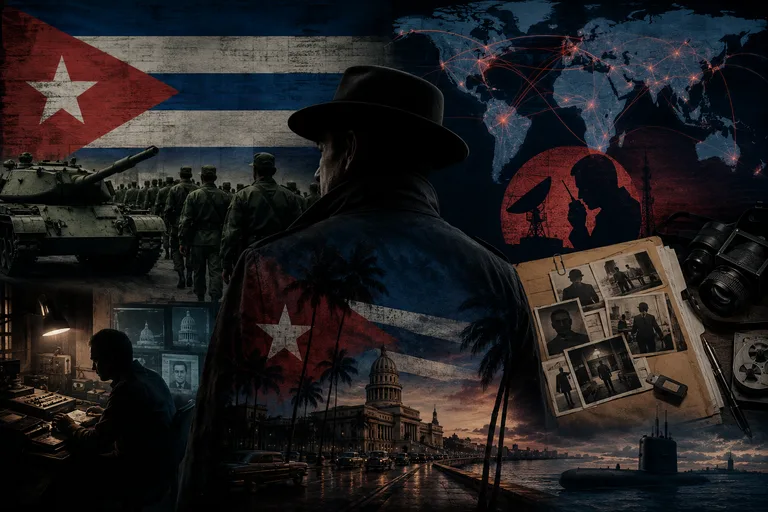
Cuba never needed to be the largest power in the world. It only needed the patience to place or extort the right person in the right room—and wait. -- YNOT!
Cuba is a small island with limited economic resources, but since Fidel Castro took power in 1959, it has operated an overseas military and intelligence apparatus far larger than its size would suggest.
Cuban soldiers fought in Africa and the Middle East. Cuban advisers trained foreign militaries, guerrillas, police forces, and intelligence services. Cuban diplomats were accused of operating under intelligence cover. Cuban agents infiltrated exile organizations, military installations, universities, and some of the most sensitive offices of the United States government.
The most important lesson is that these activities were not all the same.
A Cuban tank commander in Angola was not necessarily a spy. A military adviser in Ethiopia was not the same as an illegal agent living under a false identity in Miami. A diplomat expelled for activities incompatible with diplomatic status was not legally equivalent to a government employee convicted of passing classified information.
To understand Cuba’s overseas intelligence system, we must separate three interconnected activities:
- Open military intervention
- Military assistance, revolutionary support, and covert action
- Espionage, infiltration, intelligence collection, and influence operations
Together, these activities formed an overseas apparatus that allowed Havana to project power across Latin America, Africa, the Middle East, Europe, and, most importantly, inside the United States.
What Is Cuban Overseas Intelligence?
Following the revolution, Cuba established a foreign intelligence organization generally known as the Dirección General de Inteligencia, or DGI, later commonly shortened to the Dirección de Inteligencia, or DI.
A declassified CIA historical assessment described the DGI as Cuba’s agency for foreign espionage and subversion and placed it within the Ministry of the Interior. Its responsibilities extended beyond simply stealing military documents. The service collected political information, recruited foreign agents, infiltrated opposition groups, supported revolutionary movements, conducted influence operations, and protected Cuba’s interests abroad.
Cuba’s intelligence system was heavily influenced by Soviet training and methodology during the Cold War. But Cuban intelligence developed its own characteristics.
Its greatest strength was not advanced technology. It was human intelligence.
Cuban intelligence became particularly effective at identifying people who were ideologically sympathetic to the revolution, opposed to American foreign policy, interested in Latin American political movements, or emotionally receptive to the idea that helping Cuba represented a higher moral cause.
Money was not always necessary.
Ana Belén Montes, one of the most damaging Cuban agents ever uncovered in the United States, said she acted primarily because she opposed American policy toward Cuba and Central America. The FBI reported that she received little beyond reimbursement for expenses.
That ideological component is essential to understanding the Cuban model. Havana did not merely purchase secrets. It persuaded selected people that betraying their government was an act of justice.
How Cuban Intelligence Operates
The publicly exposed cases reveal several recurring methods.
Ideological recruitment
Cuban intelligence frequently sought people whose political beliefs could be transformed into operational loyalty.
The objective was not necessarily to recruit someone who already possessed classified information. A promising student, academic, junior government employee, activist, or diplomat could be recruited early and encouraged to seek positions that would eventually provide access.
According to the indictment of Marta Rita Velázquez, Cuban intelligence allegedly recruited Ana Montes before Montes joined the Defense Intelligence Agency. Velázquez was accused of helping position Montes for a future intelligence career rather than waiting until she already possessed valuable secrets.
Long-term placement
Cuba has repeatedly demonstrated patience.
An agent might remain in place for years or decades, gradually advancing into more influential positions. Víctor Manuel Rocha entered the U.S. Foreign Service, served on the National Security Council, became ambassador to Bolivia, worked at the U.S. diplomatic mission in Havana, and gained access to nonpublic and classified information while secretly serving Cuba.
Rocha admitted that his clandestine relationship with Cuba began in 1973 and continued until his arrest approximately half a century later.
Infiltration of organizations
Not every target was a government agency.
Cuban intelligence infiltrated Cuban exile organizations, political associations, humanitarian groups, universities, and organizations that Havana considered hostile.
The Wasp Network penetrated anti-Castro organizations in South Florida and sought information about American military facilities. Members entered organizations not only to collect information but also to influence decisions, identify members, observe internal disputes, and report future activities to Havana.
Diplomatic cover
Embassies, consulates, interests sections, and United Nations missions provide intelligence officers with access, mobility, communications, and diplomatic protection.
When a diplomat is suspected of espionage, the host government frequently cannot prosecute the person because of diplomatic immunity. Instead, the diplomat is declared persona non grata and ordered to leave.
An expulsion is therefore significant, but it is not the same as a criminal conviction. The government may possess classified evidence it cannot reveal publicly, or the expulsion may be based on an intelligence assessment rather than proof presented in court.
Illegal identities and civilian cover
Some Cuban officers operated without official diplomatic status.
The Wasp Network included Cuban intelligence officers living under false identities, along with agents using ordinary employment and community relationships as cover. Their occupations helped them enter military facilities, universities, exile organizations, and other targeted institutions.
Coded communications
The known cases include:
- Shortwave radio broadcasts
- Encrypted computer files
- Coded numerical messages
- False names
- Clandestine meetings
- Instructions delivered through handlers
- Meetings in third countries
- Information memorized rather than physically removed
Ana Montes memorized classified material at work, reconstructed it at home, encrypted it, and followed instructions received through coded shortwave broadcasts.
Walter and Gwendolyn Myers likewise used coded communications, shortwave radio, covert meetings, and travel outside the United States during their decades of service to Cuba.
What Cuban Overseas Intelligence Was Designed to Accomplish
Cuban intelligence operations generally served several strategic objectives.
Protect the Castro government
The first priority was regime survival.
That meant identifying exile organizations, dissidents, defectors, hostile military plans, covert operations, and political developments that could threaten the Cuban government.
Penetrate American decision-making
Cuba sought information about how Washington understood the island, what actions the United States might take, and which officials shaped American policy.
An agent inside the Defense Intelligence Agency, State Department, National Security Council, immigration system, or U.S. military structure could provide both information and insight into how decisions were being made.
Monitor the Cuban exile community
South Florida became one of Cuban intelligence’s most important operating environments.
Havana wanted to know:
- Which exile organizations were planning operations
- Who financed them
- Which groups had government contacts
- Which activists were influential
- Which aircraft or boats might travel toward Cuba
- Which Cubans might cooperate with American agencies
Support allied governments and movements
Cuban intelligence also assisted governments and revolutionary movements considered strategically or ideologically important.
This could include training, security advice, counterintelligence assistance, weapons, communications, logistical coordination, political organization, and liaison with Cuban military personnel.
Conduct influence operations
Intelligence is not limited to stealing secrets.
Influence operations attempt to shape political beliefs, public discussion, institutions, activist networks, media narratives, and government decisions. Diplomatic, cultural, educational, solidarity, and friendship organizations can all provide legitimate international engagement while also presenting opportunities for intelligence collection or political influence.
The existence of contact with Cuba does not automatically make an individual or organization an intelligence asset. The distinction depends on direction, secrecy, tasking, reporting, and the nature of the relationship.
The Americans Who Secretly Worked for Cuba
The strongest publicly documented record of Cuban espionage comes from the United States because the American legal system produced indictments, guilty pleas, trials, sentencing records, and declassified counterintelligence accounts.
Ana Belén Montes: The DIA’s Top Cuba Analyst
Ana Belén Montes became one of the most important Cuba specialists in the American intelligence community.
She joined the Defense Intelligence Agency in 1985 after being recruited by Cuban intelligence. Eventually, she became the DIA’s senior Cuba analyst, advising American policymakers about the very government she was secretly serving.
Montes did not regularly carry classified documents out of her office. She memorized information, reconstructed it at home, typed it into a computer, transferred it to encrypted media, and communicated with her handlers through coded shortwave transmissions.
She disclosed the identities of four undercover American intelligence officers and supplied other classified national-defense information to Cuba.
The FBI arrested her on September 21, 2001, ten days after the September 11 attacks, because she was about to gain access to information concerning planned American military operations in Afghanistan.
Montes pleaded guilty in 2002 to conspiracy to commit espionage and received a 25-year sentence.
Víctor Manuel Rocha: The Agent Who Became an Ambassador
Víctor Manuel Rocha’s case demonstrated the value of patience and institutional placement.
Rocha served in the State Department, on the National Security Council, at the U.S. Interests Section in Havana, and as United States ambassador to Bolivia. He had access to sensitive information and opportunities to influence American foreign policy.
He concealed his relationship with Cuba for decades and cultivated a public identity that helped protect him from suspicion.
His downfall came after an undercover FBI employee approached him while pretending to represent Cuban intelligence. Rocha made recorded statements describing his long service to Cuba and referring to the United States as the enemy.
In April 2024, Rocha pleaded guilty to secretly acting as an agent of Cuba and received the statutory maximum sentence of 15 years. He admitted beginning his clandestine service in 1973 and continuing until his arrest.
Walter Kendall Myers and Gwendolyn Steingraber Myers
Walter Kendall Myers worked in positions connected to the State Department and possessed access to highly classified information.
Together with his wife, Gwendolyn, he served Cuba for nearly 30 years.
Kendall Myers was identified in the case as Agent 202. Gwendolyn Myers used designations including Agent 123 and Agent E-634.
The couple communicated through coded shortwave broadcasts, clandestine meetings, and travel outside the United States. Gwendolyn helped receive messages, prepare information, and facilitate contacts with Cuban handlers.
Both pleaded guilty in 2009.
Kendall Myers received life imprisonment without the possibility of parole. Gwendolyn Myers received 81 months.
Mariano Faget Jr.: Operation False Blue
Mariano Faget Jr. was a senior Immigration and Naturalization Service official in Miami with access to sensitive information involving Cuban defectors and law-enforcement sources.
The FBI created a counterintelligence sting called Operation False Blue. Faget was deliberately given a fabricated story about the coming defection of a senior Cuban intelligence officer.
Within minutes, he passed the information to his friend and business associate Pedro Font, who was expected to meet Cuban diplomat José Imperatori.
Faget was convicted in 2000 of disclosing classified information, converting government information for personal use, lying on a security form, and lying about contacts with a Cuban official.
Imperatori was expelled from the United States, although he denied being a spy.
Carlos Alvarez and Elsa Alvarez
Carlos Alvarez was a psychology professor at Florida International University. His wife, Elsa Alvarez, worked as an FIU counselor and social worker.
Federal investigators accused the couple of secretly supplying information about South Florida’s Cuban exile community to Havana.
Carlos admitted that he had been a collaborator with Cuban intelligence beginning in 1977. The information was not described as classified military intelligence, but it included information about political attitudes, exile organizations, influential individuals, and contacts within the community.
Carlos pleaded guilty to conspiracy to act as an unregistered Cuban agent and received five years in prison.
Elsa pleaded guilty to concealing her husband’s activities and failing to report them. She received three years. The legal distinction is important: Carlos admitted collaboration with Cuban intelligence, while Elsa’s conviction concerned concealment and her related conduct rather than a traditional espionage charge.
The Wasp Network
The most extensive publicly exposed Cuban intelligence operation in South Florida was known as La Red Avispa, or the Wasp Network.
On September 12, 1998, the FBI arrested ten people connected to the network. The original federal announcement said they had been directed to infiltrate American agencies, military installations, and anti-Castro organizations.
The network sought information concerning:
- U.S. Southern Command
- Boca Chica Naval Air Station
- American military operations
- Cuban exile organizations
- Brothers to the Rescue
- Planned flights and maritime activity
- Individuals active against the Castro government
Five defendants went to trial and became internationally known as the Cuban Five.
Gerardo Hernández Nordelo
Gerardo Hernández, operating under the identity Manuel Viramontez, was a senior Wasp Network figure.
He was convicted of acting as an illegal foreign agent, espionage-related conspiracy, and conspiracy to murder in connection with the 1996 Cuban shootdown of two Brothers to the Rescue aircraft.
Prosecutors argued that Hernández helped obtain flight information and warned Cuban agents not to travel on specific Brothers to the Rescue flights before Cuban military aircraft shot down the planes, killing four men.
His murder-conspiracy conviction survived appellate review.
Ramón Labañino Salazar
Ramón Labañino operated under the identity Luis Medina.
He was identified as a Cuban intelligence officer and convicted of conspiracy to commit espionage and acting as an unregistered foreign agent. His assignments included obtaining information relating to American military facilities.
Antonio Guerrero Rodríguez
Antonio Guerrero worked at the Boca Chica Naval Air Station in the Florida Keys.
He gathered and reported information concerning the base, aircraft, military activity, facilities, and operations. He was convicted of conspiracy to commit espionage and acting as an unregistered Cuban agent.
Fernando González Llort
Fernando González operated under the identity Ruben Campa.
He was identified as a Cuban intelligence officer who supervised agents in the network. He was convicted of conspiracy and acting as an unregistered agent of a foreign government.
René González Sehwerert
René González infiltrated Brothers to the Rescue and other exile activities.
He was convicted of acting as an unregistered Cuban agent and conspiracy offenses. Unlike Hernández, Labañino, and Guerrero, he was not convicted of conspiracy to commit espionage.
The Five Additional Wasp Network Defendants
Five other people arrested in the 1998 operation entered guilty pleas rather than joining the five defendants at trial:
- Alejandro M. Alonso
- Nilo Hernandez-Mederos
- Linda Hernandez
- Joseph Santos-Cecilia
- Amarilys Silverio-Garcia
The original federal announcement identified all ten people arrested. Contemporary reporting on the verdict stated that five additional members had pleaded guilty and cooperated with prosecutors.
The Agents Who Escaped or Were Never Apprehended
Marta Rita Velázquez
Marta Rita Velázquez, also known as Marta Rita Kviele and by the alleged code name Barbara, was charged with helping Cuban intelligence recruit Ana Montes.
The indictment alleged that Velázquez introduced Montes to a Cuban intelligence officer in New York, accompanied her on a clandestine trip to Cuba for intelligence training, and helped her obtain employment at the Defense Intelligence Agency.
Velázquez left the United States and was living in Sweden when the indictment was publicly unsealed in 2013.
She has not been convicted. The allegations remain charges contained in an indictment, and she was never brought before an American court.
Juan Pablo Roque
Juan Pablo Roque was a former Cuban military pilot who entered the United States and became active in Brothers to the Rescue.
He flew with the organization, developed relationships inside the exile community, and had contacts with American law enforcement. On February 23, 1996—one day before Cuban fighters shot down two Brothers to the Rescue planes—Roque reappeared in Havana.
He publicly denounced Brothers to the Rescue and denied being a Cuban agent. American officials and prosecutors connected him to the Wasp Network, and he was later indicted on charges including failure to register as a foreign agent.
Because he returned to Cuba before the FBI dismantled the network, he was never tried in the United States.
Cuban Diplomats Expelled From the United States
Diplomatic expulsions represent another part of the record.
José Imperatori
José Imperatori was a Cuban diplomat connected by American investigators to the Mariano Faget case.
After Faget passed information from the False Blue operation to Pedro Font, who was expected to meet Imperatori, the United States declared Imperatori persona non grata and ordered him to leave.
Imperatori denied being a spy and was not criminally convicted in the United States.
Gustavo Machín Gómez and Oscar Redondo Toledo
In November 2002, the United States expelled Cuban first secretaries Gustavo Machín Gómez and Oscar Redondo Toledo.
The expulsions were linked publicly to the Ana Montes espionage case. Cuba rejected the accusations.
The Fourteen Cuban Diplomats Expelled in 2003
In May 2003, the United States expelled 14 Cuban diplomats—seven from the Cuban Interests Section in Washington and seven from Cuba’s United Nations mission in New York.
The State Department said they had engaged in activities harmful to the United States and outside their diplomatic responsibilities, diplomatic language generally associated with suspected espionage.
Among the senior officials publicly identified were Cosme Torres at the Cuban Interests Section and Adrián Francisco Delgado González at the United Nations mission.
These were diplomatic expulsions, not criminal espionage convictions. Cuba called the accusations false.
The 2019 United Nations Expulsions
In September 2019, the United States expelled two members of Cuba’s United Nations mission for what the State Department called influence operations against the United States.
Their names were not publicly released in the announcement. The remaining Cuban diplomats at the United Nations were subjected to tighter travel restrictions. Cuba again denied the allegations.
A More Recent Arrest: Tomás Emilio Hernández Cruz
In 2025, U.S. Immigration and Customs Enforcement arrested Tomás Emilio Hernández Cruz, whom the agency described as a former high-ranking Cuban intelligence officer.
The allegation was that Hernández Cruz had concealed his intelligence background and obtained American immigration status through fraudulent statements.
This case should not be misrepresented. He was arrested for alleged immigration fraud and concealment of his past—not publicly charged with conducting an espionage operation inside the United States.
Have Cuban Spies Been Caught in Other Countries?
Yes, but the public record outside the United States is much thinner.
In other countries, suspected Cuban operatives were more frequently expelled, quietly removed, returned to Cuba, or handled as diplomatic problems rather than prosecuted in open espionage trials.
Colombia: José Manuel Peña García
The strongest recent non-American example I found occurred in Colombia.
In March 2019, Colombian authorities detained and expelled Cuban citizen José Manuel Peña García.
He was reportedly discovered near the Colombian Air Force’s Palanquero base without authorization. Preliminary reports said authorities suspected him of collecting information for Cuban intelligence about the base’s operations.
Migración Colombia barred him from returning for ten years and stated that the expulsion was based on its authority to remove foreign nationals whose activities threatened national security.
Peña García was expelled rather than prosecuted in a public espionage trial. Therefore, he can accurately be described as a Cuban detained and expelled on suspicion of intelligence activity—not as someone convicted of espionage.
Mexico: José Ramón Pérez Ayala and Arturo Guzmán Nolasco
In September 1983, Mexican security officers arrested two Cuban officials:
- José Ramón Pérez Ayala
- Arturo Guzmán Nolasco
Pérez Ayala was accredited to the Cuban Embassy in Mexico. Guzmán Nolasco entered Mexico with a diplomatic passport and was described by sources as a suspected Cuban security officer.
The two were detained while attempting to meet Cuban exiles at a Mexico City bus station. They were informally accused of preparing to deliver explosives, although the Cuban Embassy denied that explosives existed and claimed the men had been entrapped.
Mexican authorities held the Cubans for approximately a week and then returned them to Cuban officials for transportation to Havana.
This episode appears closer to a suspected covert-action operation than a conventional case of stealing government secrets. It did not result in a public espionage trial or conviction.
Peru: Ambassador Carlos Zamora
In November 2025, Cuban ambassador Carlos Zamora ended his functions and permanently left Peru after a meeting involving Peru’s Foreign Ministry.
Peruvian and exile publications circulated allegations that Zamora had an intelligence background and had interfered in domestic political affairs. However, Peru’s official announcement did not publicly accuse him of espionage or explain the reason for his departure.
For that reason, Zamora should not be listed as a convicted or proven spy. He belongs in a separate category: a diplomat removed or recalled amid intelligence and political-interference allegations that were never publicly established in court.
Venezuela: Intelligence Partnership Rather Than “Spies Caught”
Venezuela represents a different model.
Cuban military, security, and intelligence personnel operated with the cooperation of the governments of Hugo Chávez and Nicolás Maduro. They were not necessarily clandestine foreign agents hiding from the host government. Many were invited advisers embedded in Venezuelan institutions.
Cuba helped train, reorganize, advise, and influence Venezuelan military, counterintelligence, and security structures. This may be described as extensive foreign intelligence penetration or security dependency, but it is not equivalent to Colombia discovering and arresting a Cuban operative.
The host government itself accepted the relationship.
The Military Side of Cuba’s Overseas Apparatus
Cuba’s intelligence expansion cannot be separated entirely from its military internationalism, but soldiers and spies should not be placed in the same category.
The best-documented direct Cuban combat deployments included:
- Algeria, during the 1963–64 conflict with Morocco
- Syria, during the period surrounding the 1973 Arab-Israeli war
- Angola, where Cuba conducted its largest foreign military intervention
- Ethiopia, during the war against Somalia
- Grenada, where armed Cuban personnel fought during the 1983 American-led invasion
- Congo/Zaire, where Cuban personnel supported revolutionary and military operations
Academic analysis frequently identifies Algeria, Syria, Angola, and Ethiopia as Cuba’s four major overt foreign military interventions. Declassified American records also document major Cuban deployments and advisory forces in Angola, Ethiopia, Nicaragua, Grenada, Congo, Libya, Mozambique, and South Yemen.
These military deployments gave Cuban intelligence additional opportunities to establish liaison relationships, gather information, train local services, monitor allied governments, and build networks that could remain after combat forces departed.
The Wider Geographic Reach
At different times after 1959, Cuba provided some combination of revolutionary training, weapons, military advice, political support, intelligence assistance, diplomatic coordination, or covert help in numerous countries.
The Latin American and Caribbean record includes:
Argentina, Bolivia, Brazil, Chile, Colombia, the Dominican Republic, Ecuador, El Salvador, Grenada, Guatemala, Haiti, Nicaragua, Panama, Paraguay, Peru, and Venezuela.
The African and Middle Eastern record includes:
Algeria, Angola, the Republic of Congo, the Democratic Republic of Congo/Zaire, Equatorial Guinea, Ethiopia, Ghana, Guinea, Guinea-Bissau, Iraq, Libya, Mozambique, Sierra Leone, Somalia, South Yemen/Yemen, and Syria.
The precise activity differed enormously from country to country. Some hosted Cuban combat troops. Others received military instructors. Some had relations with Cuban-supported guerrillas. Others contained Cuban diplomatic, political, or intelligence networks.
Declassified American assessments described Cuban international activity across Latin America, the Caribbean, Africa, the Middle East, and parts of Asia, but such Cold War assessments must be read as American intelligence judgments—not as criminal verdicts against every Cuban who served abroad.
Other countries—including Morocco, Israel, South Africa, Namibia/South West Africa, and Somalia—appeared as opposing forces or connected theaters in wars involving Cuban personnel. Their presence in the history does not mean that Cuba necessarily operated an independent intelligence network inside each one.
Why Most Known Cases Come From the United States
There are several reasons the American list is much longer.
First, the United States was Cuba’s most important intelligence target.
Second, South Florida contained a large Cuban exile community, anti-Castro organizations, military installations, immigration offices, political groups, and individuals with direct connections to Cuba.
Third, American courts produced public indictments, trial transcripts, plea agreements, and sentencing documents.
Fourth, other governments frequently handled suspected Cuban intelligence activity quietly. A diplomat could be expelled without a public explanation. A suspected operative could be deported under immigration law. An allied government might welcome Cuban intelligence advisers rather than investigate them.
Therefore, the absence of a public trial does not prove that Cuban intelligence was absent. But neither does political suspicion prove that a named person was a spy.
Proven, Accused, and Suspected Are Not the Same
A responsible history must preserve the distinction.
Convicted or admitted
This category includes people such as:
- Ana Belén Montes
- Víctor Manuel Rocha
- Walter Kendall Myers
- Gwendolyn Steingraber Myers
- Mariano Faget Jr.
- Carlos Alvarez
- Elsa Alvarez, for her related concealment offense
- Gerardo Hernández
- Ramón Labañino
- Antonio Guerrero
- Fernando González
- René González
- Alejandro Alonso
- Nilo Hernandez-Mederos
- Linda Hernandez
- Joseph Santos-Cecilia
- Amarilys Silverio-Garcia
Indicted but never tried
This includes:
- Marta Rita Velázquez
- Juan Pablo Roque
Expelled or removed over suspected intelligence activity
This includes cases such as:
- José Imperatori
- Gustavo Machín Gómez
- Oscar Redondo Toledo
- The 14 Cuban diplomats expelled in 2003
- The two Cuban United Nations diplomats expelled in 2019
- José Manuel Peña García in Colombia
- José Ramón Pérez Ayala and Arturo Guzmán Nolasco in Mexico
Accused but not publicly proven
This category includes diplomats and officials such as Carlos Zamora, whose departure from Peru generated intelligence allegations but no public espionage prosecution.
The Real Power of Cuban Intelligence
Cuban intelligence succeeded because it understood that access is frequently more important than technology.
It did not need to penetrate every government computer if it could recruit the analyst interpreting the information.
It did not need to control an American agency if it could place one patient, ideologically committed person inside it.
It did not need to destroy an exile organization if it could enter the organization, identify its members, understand its plans, deepen its divisions, and report its movements to Havana.
The most striking Cuban cases were not quick operations. They were investments measured in decades.
Ana Montes entered the Defense Intelligence Agency already committed to helping Cuba. Víctor Manuel Rocha built an entire diplomatic career while concealing his allegiance. Walter and Gwendolyn Myers operated for almost 30 years. The Wasp Network created identities, relationships, employment histories, and community connections designed to make its agents appear ordinary.
That is the central lesson of Cuban overseas intelligence:
Cuba compensated for limited money, technology, and conventional power with patience, ideology, placement, infiltration, and an extraordinary willingness to wait.
Its battlefield interventions attracted headlines. Its spies operated quietly.
And in intelligence, the operation that remains invisible is usually the one doing the greatest damage.
The Cuban Regime Cannot Be Reformed - The present Cuban regime has to end.
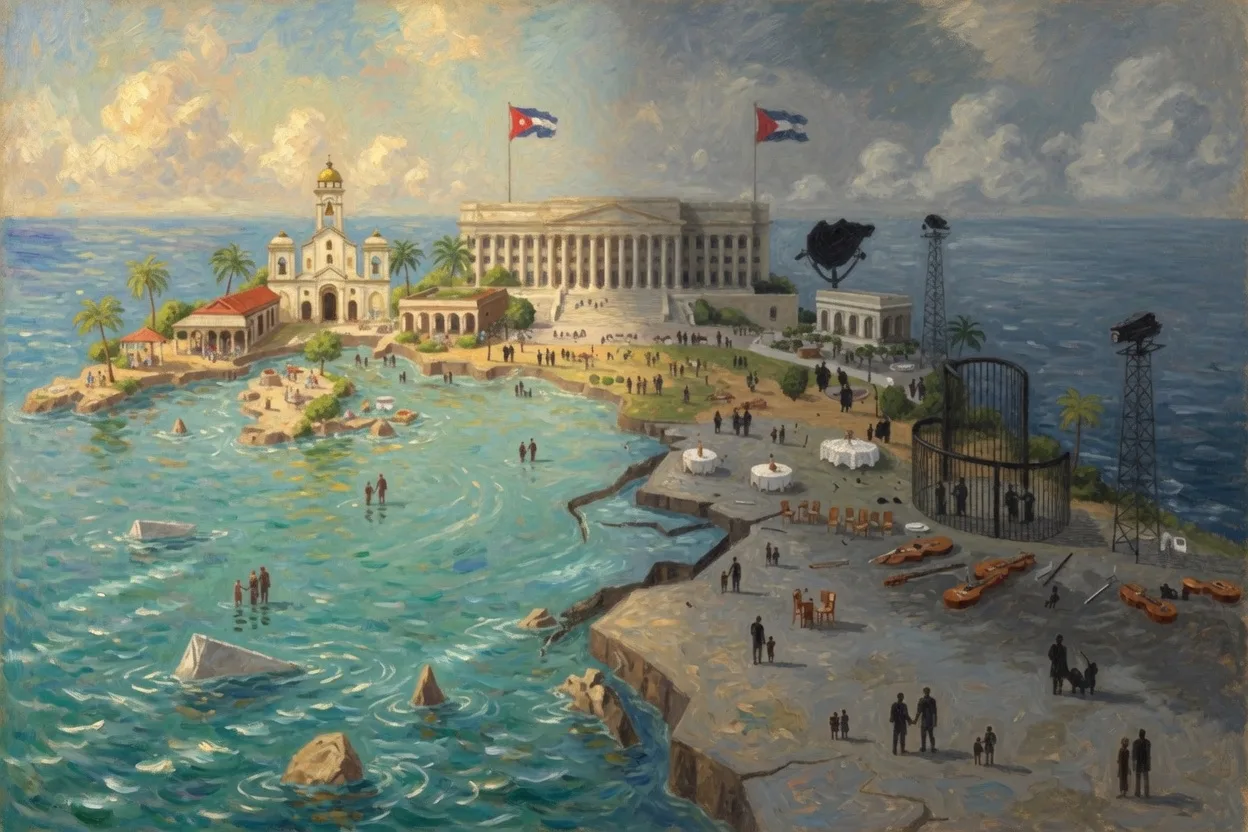
Cuba does not need more hotels built on top of prisoners. It needs the regime that destroyed its faith, family, culture, and future to finally end. --YNOT!
No negotiation. No cosmetic reform. No pretending that opening Cuba as a travel destination is the priority when you are dealing with a regime built on murder, repression, exile, fear, and the destruction of a people’s soul. A true Genocide of CUBA
And some people will ask, “What do you mean by that?”
Let me explain.
Cuba was not just an island. Cuba was a civilization of its own. It had its own culture, its own music, its own food, its own history, its own heroes, its own humor, its own faith, its own family structure, and even its own animals and countryside traditions. Family and religion were at the center of Cuban life. It was a unique island with a unique identity.
Then came Fidel Castro, his brother Raúl, and the revolutionary machine around them. They did not simply take over a government. They tried to take over the Cuban soul. They destroyed culture and replaced it with Marxism.
They attacked religion and replaced it with the worship of the state. They rewrote history and hijacked Cuba’s heroes.
They made loyalty to the revolution more important than loyalty to your mother, your father, your children, your church, or your conscience. They taught children to spy on parents.
They made Marxism more important than family. They made atheism and communism the official religion of the Cuban state. Musicians, writers, religious people, independent thinkers, business owners, farmers, students, soldiers, and ordinary citizens were jailed, tortured, silenced, exiled, or broken if they did not fit the regime’s view of the world.
They did not just control politics. They controlled memory. They controlled language. They controlled opportunity.
They controlled hunger. They controlled fear.
And I am telling you this because I lived it — not in Cuba, but in Miami.
Miami became the other Cuba. The Cuba that survived outside the island. The Cuba that carried the memories, the stories, the wounds, and the warnings.
I had a small construction company, and many of my workers were Cuban. They were good workers. Hard workers. They did not complain about work. They did not look for excuses. They showed up. They worked. They had pride.
And I heard their stories.
Over time, I learned something. I could tell who had been raised in Miami and who had been raised in Cuba.
The Cubans raised in Miami looked different. They were taller, healthier, more confident, more open. Many looked like the older Cuban generations I remembered — people raised with more food, more family stability, more freedom, more chance. But the ones raised under the regime in Cuba often carried something else. Not always visible at first, but it was there. The caution. The fear. The survival instinct. The habit of measuring every word. The instinct to look around before speaking. The quiet understanding that the government could ruin you. They were small, tiny, barely 5 feet tall.
And if they had been connected to the government, you could feel that too. And they were fatter, you could tell they were not starving most of their lives. They would tell you whatever you want to here, you could not trust them.
There was a difference between the Cuban who escaped the system and the Cuban who learned to survive inside it.
That is what communism does. It does not only make people poor. It makes people careful.
It makes people suspicious. It makes people afraid to tell the truth.
It makes people trade dignity for rice, silence for survival, and conscience for permission.
This is why the Cuban regime cannot simply be “opened up” like a tourist market.
Cuba does not need more hotels while Cubans are still prisoners.
Cuba does not need more foreign investment while the same military and political elite controls the economy.
Cuba does not need more photo opportunities for outsiders while Cuban families are still divided, censored, hungry, and afraid.
Cuba needs liberation. The regime has to end because it did not just steal money.
It stole generations. It stole history. It stole faith. It stole families. It stole the future from millions of Cubans.
And no, this is not hatred of Cuba. This is love for Cuba.
Because loving Cuba means telling the truth about what destroyed it.
And the truth is simple: The Cuban people are not the problem.
The Cuban regime is the problem.
And that regime cannot be negotiated into decency. It has to end.
——-
Cuba no necesita más hoteles construidos encima de prisioneros. Necesita que el régimen que destruyó su fe, su familia, su cultura y su futuro finalmente llegue a su fin. Sin negociación. Sin reformas cosméticas. Sin fingir que abrir Cuba como destino turístico es la prioridad cuando estás tratando con un régimen construido sobre el asesinato, la represión, el exilio, el miedo y la destrucción del alma de un pueblo. Un verdadero genocidio de Cuba.
Y algunos preguntarán: “¿Qué quieres decir con eso?”
Déjame explicar. Cuba no era solamente una isla. Cuba era una civilización propia. Tenía su propia cultura, su propia música, su propia comida, su propia historia, sus propios héroes, su propio humor, su propia fe, su propia estructura familiar, e incluso sus propios animales y tradiciones campesinas. La familia y la religión estaban en el centro de la vida cubana. Era una isla única, con una identidad única.
Entonces llegaron Fidel Castro, su hermano Raúl y la maquinaria revolucionaria que los rodeaba.
No simplemente tomaron el control de un gobierno. Intentaron tomar el control del alma cubana.
Destruyeron la cultura y la reemplazaron con el marxismo.
Atacaron la religión y la reemplazaron con la adoración al Estado.
Reescribieron la historia y secuestraron a los héroes de Cuba.
Hicieron que la lealtad a la revolución fuera más importante que la lealtad a tu madre, tu padre, tus hijos, tu iglesia o tu conciencia.Enseñaron a los niños a espiar a sus padres. Hicieron que el marxismo fuera más importante que la familia.
Hicieron del ateísmo y del comunismo la religión oficial del Estado cubano.
Músicos, escritores, personas religiosas, pensadores independientes, dueños de negocios, campesinos, estudiantes, soldados y ciudadanos comunes fueron encarcelados, torturados, silenciados, exiliados o destruidos si no encajaban con la visión del mundo del régimen.
No solamente controlaron la política. Controlaron la memoria. Controlaron el lenguaje. Controlaron las oportunidades.
Controlaron el hambre. Controlaron el miedo.
Y digo esto porque lo viví — no en Cuba, sino en Miami.
Miami se convirtió en la otra Cuba. La Cuba que sobrevivió fuera de la isla. La Cuba que cargó con los recuerdos, las historias, las heridas y las advertencias.
Yo tenía una pequeña compañía de construcción, y muchos de mis trabajadores eran cubanos. Eran buenos trabajadores. Trabajadores fuertes. No se quejaban del trabajo. No buscaban excusas. Llegaban. Trabajaban. Tenían orgullo. Y escuché sus historias.
Con el tiempo, aprendí algo. Podía distinguir quién había sido criado en Miami y quién había sido criado en Cuba.
Los cubanos criados en Miami se veían diferentes. Eran más altos, más saludables, más seguros, más abiertos. Muchos se parecían a las generaciones cubanas mayores que yo recordaba: personas criadas con más comida, más estabilidad familiar, más libertad y más oportunidades.
Pero los que fueron criados bajo el régimen en Cuba muchas veces cargaban con otra cosa. No siempre era visible al principio, pero estaba ahí. La cautela. El miedo. El instinto de supervivencia. La costumbre de medir cada palabra. El instinto de mirar alrededor antes de hablar. El entendimiento silencioso de que el gobierno podía destruirte. Eran pequeños, diminutos, apenas de cinco pies de altura.
Y si habían estado conectados con el gobierno, también se podía sentir. Y eran más gordos; se notaba que no habían pasado hambre la mayor parte de sus vidas. Te decían lo que querías oír. No se podía confiar en ellos.
Había una diferencia entre el cubano que escapó del sistema y el cubano que aprendió a sobrevivir dentro de él.
Eso es lo que hace el comunismo. No solamente empobrece a la gente. La vuelve cuidadosa. La vuelve desconfiada.
La hace tener miedo de decir la verdad. Hace que la gente cambie dignidad por arroz, silencio por supervivencia y conciencia por permiso.
Por eso el régimen cubano no puede simplemente “abrirse” como si fuera un mercado turístico.
Cuba no necesita más hoteles mientras los cubanos siguen siendo prisioneros.
Cuba no necesita más inversión extranjera mientras la misma élite militar y política controla la economía.
Cuba no necesita más oportunidades de fotos para extranjeros mientras las familias cubanas siguen divididas, censuradas, hambrientas y con miedo. Cuba necesita liberación.
El régimen tiene que terminar porque no solamente robó dinero.
Robó generaciones. Robó la historia. Robó la fe. Robó familias. Robó el futuro de millones de cubanos.
Y no, esto no es odio hacia Cuba.
Esto es amor por Cuba.
Porque amar a Cuba significa decir la verdad sobre lo que la destruyó.
Y la verdad es simple:
El pueblo cubano no es el problema. El régimen cubano es el problema.
Y ese régimen no puede ser negociado hasta convertirse en algo decente.
Tiene que terminar ahora
The Day After Díaz-Canel

It may happen in a single night, or it may take much longer. But the ending does not change. The curtain will rise, the drama will unfold, and history will make its decision. -- YNOT!
Wars are funny things. Everyone spends years talking about how they begin, and almost nobody spends enough time thinking about what happens the morning after.
History teaches us something simple: governments do not collapse in slow motion. They often appear strong right until the moment they break. Then suddenly, the impossible becomes inevitable.
If Cuba ever reaches the point of a foreign intervention or a violent internal collapse, the real question will not be how the operation begins. The real question will be what happens after.
Because once Miguel Díaz-Canel is gone—whether by resignation, exile, or death—the entire political structure that has held Cuba together for decades begins to wobble.
Díaz-Canel is not Fidel Castro. He is not even Raúl Castro. He is a manager, an administrator, a caretaker of a system built by other men. His authority comes not from personal charisma but from the institutions around him: the Party, the military, and the intelligence apparatus.
Remove Raul Castro and Díaz-Canel , and suddenly those institutions are forced to answer a terrifying question: Who is in charge now?
The Crab in the Boiling Pot
Cubans have a saying about crabs in a bucket. None of them can escape because the others pull them back down.
The regime has operated much the same way for decades.
No one is allowed to become too powerful. No one is allowed to become indispensable. Every faction watches the other. Every official keeps files on his colleagues. Every general wonders who may replace him.
That works during times of peace.It works when the system is stable.
It works when Havana controls the narrative.It stops working when the leader disappears.
Then the crabs begin climbing.
The Cangrejo’s Dilemma
And then there is “El Cangrejo”—the Crab.
If he survives whatever comes next, his choices become very limited.
The old game would be over.
There would be no Soviet Union to call. No Venezuela with endless oil money. No foreign patron willing to write blank checks. The networks that sustained the Cuban state for generations are weaker than they have ever been.
If the system collapses around him, survival may become his only political ideology.
His choices would likely narrow to three:
- Fight and go down with the old order.
- Disappear quietly and hope history forgets him.
- Make a deal and help build whatever comes next.
History suggests that many men choose the third option.
Not because they become democrats overnight.
Not because they suddenly discover freedom.
But because survival is a powerful motivator.
The Morning After
The danger is not simply the removal of a leader.
The danger is the vacuum.Who controls the military?
Who controls the police?
Who controls the ports, the airports, the food distribution, and the electrical grid?
Who tells millions of frightened people what happens next?
Those questions matter more than the first shot fired.
History is full of governments that fell in a single night and countries that spent years trying to rebuild afterward.
Removing a regime is difficult.Building a stable nation afterward is much harder.
Cuba’s Crossroads
One day Cuba will face a transition. It may come through reform. It may come through economics. It may come through internal pressure. Or it may come through events nobody can predict.
But if the old order ever truly falls, the people left standing will have to make choices very quickly.
Some will cling to the sinking ship. Some will run. Some will reinvent themselves.
And some of the old crabs may discover that the only way to survive is to stop pulling everyone else back into the bucket and finally help the country climb out of it.
Because the day after Díaz-Canel is not really about one man.
It is about whether Cuba remains trapped by its past or finally gets a chance to build its future.
The Really Big Problem with Cuba

Cuba’s greatest shortage may not be food, fuel, medicine, dollars, or electricity. After sixty years of dictatorship, Cuba’s greatest shortage may be trusted leadership. The prison door will open. The real question is: who knows how to rebuild the house? -- YNOT!
The big problem with Cuba is not simply that the dictatorship is old.
The big problem is that the dictatorship has been there so long that the Cuba before the revolution has practically disappeared from living memory.
Almost everyone who was an adult before Castro took power is dead. The people who remember a Cuba before the revolution are gone, or nearly gone. The people who knew the old institutions, the old political parties, the old business class, the old civic culture, the old newspapers, the old courts, the old normal life — most of them are no longer here to explain it.
That is the tragedy. A dictatorship does not only steal elections. It steals memory.
It steals experience. It steals leadership.
It steals the natural passing of power from one generation to the next.
So now Cuba has a strange problem. When freedom finally comes — and I believe it is coming — who is going to run the country?
That is not a small question. That is the question.
Because Cuba has been locked in a political refrigerator for more than sixty years. The island has not been allowed to develop normal democratic leaders. It has not been allowed to have real parties, real debates, real elections, real newspapers, real unions, real business associations, real mayors with power, real governors, or real national candidates.
The regime did not just imprison people. It prevented the next generation of leadership from being born.
Now look at the Cuban exile community in the United States. There are successful Cubans everywhere. Business owners. Lawyers. Doctors. Congressmen. Media people. Military people. Entrepreneurs. People with money, education, and experience.
But there is a problem. Many of them have political clout in Miami, Washington, or New Jersey.
That does not automatically mean they have political legitimacy in Camagüey, Santiago, Holguín, Matanzas, or Havana.
A Cuban-American politician may understand Cuba emotionally. He may understand communism. He may understand exile. He may understand Washington. But does the average Cuban on the island know him? Trust him? Follow him? See him as one of them?
That is much harder.
If you asked a typical Cuban in Cuba, “Who in the United States would you want to lead a free Cuba?” there may only be a few names that come up. Marco Rubio might be one. Maybe María Elvira Salazar. Maybe Carlos Giménez. Maybe Mario Díaz-Balart. But even then, that is a Cuban-American answer, not necessarily a Cuban-island answer.
And that is the difference.
The exile may have the money. The island has the suffering. The exile may have the connections. The island has the legitimacy.The exile may have the plan. The island has the scars.
And a free Cuba cannot be rebuilt by people who only understand one side of that equation.
Then you have the internal opposition. People like José Daniel Ferrer, Rosa María Payá, Berta Soler, Manuel Cuesta Morúa, Luis Manuel Otero Alcántara, Yoani Sánchez, and others who have spent years resisting the system from inside or directly against it.
These people have something the exile class cannot manufacture: they paid a price on Cuban soil.
They were watched. Threatened. Censored. Beaten. Jailed. Exiled. Silenced. Harassed.
That gives them moral authority. But moral authority is not the same as administrative capacity.
Running a country is not the same as opposing a dictatorship.
You can be brave and still not know how to rebuild the electrical grid.
You can be heroic and still not know how to reform the courts.
You can be a patriot and still not know how to stabilize the currency, feed eleven million people, rebuild agriculture, create property rights, reopen trade, handle foreign debt, deal with the military, and keep the country from becoming a playground for every foreign investor with a suitcase and a smile.
That is the danger. The day after freedom is not automatically freedom.
Sometimes the day after freedom is chaos wearing a flag.
That is why Cuba needs a transition plan now. Not later.
Now.
A free Cuba will need several groups working together.
It will need the internal opposition because they have legitimacy.
It will need the exile community because they have resources, education, connections, and capital.
It will need Cuban technocrats who understand how the island actually functions.
It will need business people who can rebuild commerce without turning the country into a fire sale.
It will need lawyers who can rebuild property rights without creating civil war over every house, farm, and hotel.
It will need young Cubans because they are the future.
It will need old Cubans because they remember what was stolen.
And yes, it may even need some people from inside the current system who did not commit crimes but know how the machinery works. Because if you throw out every person who knows how to run the power plant, the port, the hospital, the water system, and the food distribution network, then your revolution will be very pure — and very hungry.
That is the hard truth. Cuba does not only need liberation.
Cuba needs management. Cuba needs law.
Cuba needs order. Cuba needs reconciliation without forgetting.
Justice without revenge. Capitalism without looting.
Democracy without foreign puppets.
And patriotism without another caudillo riding in on a horse, a microphone, or a military truck.
The next leader of Cuba may not be one person.
It may need to be a transition council. A temporary government.
A coalition of island dissidents, exile leaders, business minds, legal experts, religious leaders, and younger Cubans who understand the internet age better than the Cold War age.
Because the great mistake would be to think that removing communism automatically creates a republic.
It does not.
A republic has to be built. Brick by brick. Law by law. Institution by institution.
And after sixty-plus years of dictatorship, Cuba’s greatest shortage may not be food, fuel, dollars, medicine, or electricity.
Cuba’s greatest shortage may be trusted leadership.
That is the big problem with Cuba.
The regime is dying. The revolution is old. The myths are exhausted.
The economy is broken. The people are tired.
Cuba will be free. I believe it will be free within the next five years.
But freedom is only the beginning.
The real question is this:
When the prison door opens, who knows how to build the house?
Here is the table of the named possible candidates / transition figures mentioned in the post. I would not frame all of them as “president material.” Some are better described as transition council, opposition legitimacy, exile connection, or civil society leadership candidates.
| Name | Base | Why Mentioned | Strength | Weakness / Problem | Best Possible Role |
|---|---|---|---|---|---|
| Marco Rubio | Cuban-American / U.S. government | Current U.S. Secretary of State; son of Cuban immigrants; major U.S. Cuba-policy figure. (State Department) | Highest U.S. political power, foreign-policy experience, strong anti-communist credibility | Seen as American, not island-based; may not have direct legitimacy inside Cuba | U.S. diplomatic sponsor / transition architect, not likely Cuban president |
| María Elvira Salazar | Cuban-American / Miami politics | U.S. Representative for Florida’s 27th District; chairs the House Western Hemisphere Subcommittee. (Representative Maria Salazar) | Media skill, Spanish-language communication, Cuba-policy platform | U.S.-based; may be viewed as Miami politics rather than Cuban island leadership | Public communicator / exile representative / international advocate |
| Carlos Giménez | Cuban-born Cuban-American / U.S. Congress | Represents Florida’s 28th District; official bio describes him as the only current Cuban-born member of Congress. (Congressman Carlos Gimenez) | Administrative experience as former Miami-Dade mayor; born in Cuba | Older U.S.-based political figure; limited direct island following | Reconstruction / municipal-government adviser |
| Mario Díaz-Balart | Cuban-American / U.S. Congress | Longtime U.S. Representative from South Florida with strong anti-Castro record. (Congressman Mario Diaz-Balart) | Deep Cuba-policy experience, family legacy, Washington influence | Exile-politics image; not island-based | Legislative / diplomatic adviser; exile political bridge |
| José Daniel Ferrer | Cuban opposition / UNPACU | Leader of UNPACU; repeatedly imprisoned; later went into exile in Miami after release. (NBC 6 South Florida) | Strong moral legitimacy; known dissident; suffered under the regime | Exile status complicates “inside Cuba” legitimacy; opposition leadership does not equal governing experience | Serious transition-council figure; possible national candidate |
| Rosa María Payá | Cuban exile / Cuba Decide | Founder of Cuba Decide; international democracy and human-rights activist. (The Dialogue) | Young, articulate, international network, symbolic link to Oswaldo Payá | More international/exile-based than island-organizational | Transition advocate / constitutional referendum leader |
| Berta Soler | Internal Cuban civil society | Leader of Damas de Blanco / Ladies in White, a movement advocating for political prisoners. (Front Line Defenders) | Tremendous moral authority; female dissident symbol; stayed in Cuba | Better known as rights activist than administrator | Human-rights / reconciliation / political-prisoner commission |
| Manuel Cuesta Morúa | Internal Cuban opposition | Cuban dissident, scholar, and political activist; advocates democratic change from within Cuba. (UN Watch) | Intellectual, institutional thinker, inside-Cuba democratic credibility | Less mass-popular name; may lack broad street following | Constitutional reform / democratic transition planner |
| Luis Manuel Otero Alcántara | Cuban artist / San Isidro Movement | Artist and dissident; detained since July 11, 2021, sentenced to five years; Amnesty has called him a prisoner of conscience. (Tom Lantos Human Rights Commission) | Powerful youth/culture symbol; connects with artists and younger Cubans | Imprisoned; activist-symbol role more than governing role | Cultural freedom minister / youth-symbol / transition council voice |
| Yoani Sánchez | Cuban independent journalism | Cuban journalist and co-founder of 14ymedio, Cuba’s first independent daily digital news outlet. (Oslo Freedom Forum) | Credibility in independent media, communication, truth-telling | More journalist than politician; may not want governing role | Free press / information reform / public transparency leader |
Cuba may not need one savior. It may need a transition council combining island dissidents, exile resources, technocrats, legal minds, and civil society figures.
Cuba After Raúl? “El Cangrejo,” the Castro Family, and the Quiet Battle Over Who Controls the Island Next
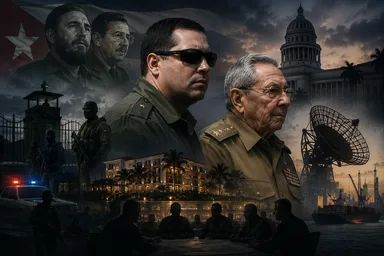
For more than sixty years, outsiders have tried to answer one deceptively simple question about Cuba:
Who really runs the country?
For decades, the answer seemed obvious.
First there was Fidel Castro.
Then there was Raúl Castro.
Today, officially, there is President Miguel Díaz-Canel.
But Cuba has never operated like an ordinary presidential democracy where political authority can be understood simply by reading an organizational chart.
Real power has traditionally existed at the intersection of the Communist Party, the Revolutionary Armed Forces, the Ministry of the Interior, state security, military-controlled businesses, and personal relationships extending back to the revolution itself.
And now another name has quietly entered the conversation:
Raúl Guillermo Rodríguez Castro.
He is better known by two nicknames:
“Raulito.”
And, more intriguingly:
“El Cangrejo” — “The Crab.”
He is Raúl Castro’s grandson.
He has no prominent elected office.
He is not Cuba’s president.
He is not publicly presented as the next leader of the Communist Party.
Yet according to a March 2026 BBC Mundo report, Rodríguez Castro has emerged as a possible participant in confidential contacts between Cuba and the United States at precisely the moment when Cuba is confronting one of the most serious economic and political crises of the post-revolutionary era.
That makes his story important for reasons that go far beyond one man.
Because the rise of El Cangrejo raises a much larger question:
Is Cuba preparing for life after Raúl Castro — or is the Castro system preparing to survive without Raúl?
The Man Standing Behind Raúl Castro
For years, photographs of Raúl Castro have often contained another figure.
He may be standing one step behind him. Sometimes he is wearing an olive-green uniform.
Sometimes dark glasses. Sometimes he appears to lean toward the former Cuban leader, apparently whispering instructions or information.
That man is often Raúl Guillermo Rodríguez Castro.
His public role has traditionally been described as remarkably simple:
He is his grandfather’s bodyguard.
But in a political system such as Cuba’s, being the personal protector of Raúl Castro is not necessarily a minor job.
It means controlling proximity. It means knowing who enters the room.
It means participating in travel, logistics and security.
It means being present during moments that most Cubans — and most government officials — never see.
BBC Mundo reported that various sources place Rodríguez Castro within the Cuban Ministry of the Interior, or MININT, with the rank of lieutenant colonel or colonel. Reports cited by BBC Monitoring have also claimed that Raúl Castro promoted him in 2016 to head the General Directorate of Personal Security, the organization responsible for protecting Cuba’s senior leadership.
If accurate, that would place El Cangrejo considerably closer to the center of power than the label “bodyguard” suggests.
Because in authoritarian systems, there is sometimes an enormous difference between the person with the impressive title and the person with access to the leader.
And access itself can become power.
The First Grandson
Raúl Guillermo was not simply another Castro grandchild.
He was reportedly Raúl Castro’s first grandson.
According to relatives interviewed by BBC Mundo, he developed an unusually close relationship with his grandfather from childhood.
At approximately eleven years old, he reportedly went to live with Raúl Castro.
From that point forward, his upbringing occurred within an environment radically different from that of the average Cuban child.
His cousin Carlos Rodríguez Halley described him as having grown up in something of a bubble, surrounded by military personnel and the institutions of the Cuban state.
He attended Los Camilitos, part of Cuba’s military-oriented educational system, and later studied accounting and finance at the University of Havana.
That biography matters.
El Cangrejo did not enter Cuba’s governing establishment as an outsider.
He was raised inside it. The revolution was not simply political history to him.
It was his family environment. The military was not an institution he encountered as an adult. It surrounded him growing up.
Raúl Castro was not merely the president of Cuba. He was his grandfather.
Why “El Cangrejo”?
Even his nickname has an unusual story.
According to his cousin, Raúl Guillermo was born with polydactyly — an additional finger.
He was operated on as a child, leaving only a small scar.
Within the family, the physical condition apparently led to the nickname:
El Cangrejo — The Crab. For years, the nickname belonged mostly to Cuba’s shadowy world of political insiders.
Now it has become internationally significant.
Because El Cangrejo may be moving from the background of photographs into the background of diplomacy.
The Washington Connection
In early 2026, reports began emerging that representatives connected to Washington and Havana had begun communicating.
Then Cuban President Miguel Díaz-Canel publicly confirmed that Cuba and the United States were engaged in dialogue.
The discussions came at an extraordinary moment.
Cuba was confronting an enormous economic and energy crisis.
The United States was increasing pressure on Havana.
And the Trump administration was publicly discussing Cuba in increasingly aggressive terms.
Within those reports emerged the name of Raúl Guillermo Rodríguez Castro.
Some accounts suggested that advisers connected to U.S. Secretary of State Marco Rubio had met with him during a gathering of Caribbean leaders in Saint Kitts and Nevis.
The Cuban government did not publicly confirm that meeting.
But it did not explicitly deny Rodríguez Castro’s involvement either.
Republican Congressman Mario Díaz-Balart subsequently said that Washington had communicated with “multiple people around Raúl Castro,” although he described the discussions as contacts rather than formal negotiations.
That wording may be the most important part of the entire story.
Not:
People around Díaz-Canel.
But:
People around Raúl Castro.
If that characterization is correct, Washington may be attempting to determine where power actually resides inside Cuba before negotiating what comes next.
Díaz-Canel Is President — But Is He the Final Authority?
Miguel Díaz-Canel became president in 2018.
Raúl Castro formally stepped away from frontline Communist Party leadership in 2021.
On paper, the transition was complete.
But power does not always move as cleanly as titles do.
Many analysts have argued that Raúl Castro retained considerable influence after leaving office, particularly through his relationships with Cuba’s military, Communist Party leadership and security establishment.
BBC Mundo quoted political scientist Armando Chaguaceda describing Cuba’s ruling elite as a relatively small group of elderly military and civilian leaders, with the Castro family remaining an important component of the structure.
This creates an unusual arrangement.
Cuba has an official president.
But behind that presidency sits an older revolutionary generation that still possesses enormous historical legitimacy and institutional relationships.
Raúl Castro may no longer occupy the presidency.
But Raúl Castro remains Raúl Castro.
And that distinction matters.
The Castro Family Becomes More Visible
There was an important difference between Fidel Castro and Raúl Castro.
Fidel cultivated an almost singular political persona.
According to historian Armando Chaguaceda, Fidel generally kept his family relatively removed from formal public political prominence.
The system revolved around Fidel himself.
Raúl’s family, however, became substantially more visible within the structures surrounding government, the military and the economy.
That difference may become increasingly important as the revolutionary generation disappears.
Fidel died in 2016.
Raúl is now an elderly man.
The men who fought the revolution in the 1950s cannot govern indefinitely.
Cuba therefore faces a transition unlike any in its modern history.
Eventually, there will be no Castro brother alive to personally embody the revolution.
The question is what survives afterward.
The party?
The military?
The security apparatus?
The economic structure?
The family?
Or some combination of all of them?
The Other Powerful Man in El Cangrejo’s Family
Raúl Guillermo’s connection to power does not come only through his grandfather.
His father was General Luis Alberto Rodríguez López-Calleja.
And that name opens another enormous chapter in understanding modern Cuba.
Until his death in 2022, Rodríguez López-Calleja headed GAESA — Grupo de Administración Empresarial S.A.
GAESA is the military-controlled conglomerate with extensive interests throughout Cuba’s economy.
Its businesses have been involved in sectors including:
tourism,
retail,
remittances,
hotels,
financial operations,
and port services.
BBC Mundo described Rodríguez López-Calleja as one of the most influential individuals inside the Cuban regime before his death.
Think about the family connections.
Raúl Guillermo Rodríguez Castro is simultaneously:
Raúl Castro’s grandson.
The son of the man who ran GAESA.
A figure reportedly connected to MININT.
A longtime member of Raúl Castro’s personal security apparatus.
And now potentially:
An intermediary in conversations involving the United States.
That combination explains why his emergence deserves attention.
GAESA: Where Military Power Meets Economic Power
To understand Cuba after Raúl, one must understand that modern political power is not simply about ideology.
It is also about control of institutions and money.
Over decades, Cuba’s Revolutionary Armed Forces developed a major role within the country’s economy.
GAESA became perhaps the clearest manifestation of this system.
Military-associated enterprises became deeply involved in tourism and other sectors that generated hard currency.
This created something unusual:
A socialist country in which a significant portion of strategically important commercial activity became linked to the military establishment.
That means the Cuban military is not simply responsible for defending the country.
It has also become intertwined with parts of the country’s economic infrastructure.
So when outsiders speculate about political transition in Cuba, focusing exclusively on the presidency can be misleading.
The more useful question may be:
Who controls the institutions capable of keeping the country functioning?
And among those institutions are the military, internal security services and military-linked economic enterprises.
The Three Pillars of Post-Castro Power
The emerging Cuban succession problem can perhaps be understood through three interconnected pillars.
The Communist Party
The Communist Party supplies ideological legitimacy and the formal political structure.
The Armed Forces and Security Apparatus
The military and MININT provide the coercive infrastructure necessary to maintain state authority.
The Economic Network
GAESA and related enterprises provide control over strategically important sections of the economy and access to hard currency.
For decades, these systems were ultimately connected through the authority of Fidel and Raúl Castro.
But what happens when neither brother remains?
Someone — or some coalition — must keep those pillars connected.
That is where individuals such as El Cangrejo become interesting.
He Doesn’t Need to Become President
One mistake when examining Cuban succession is assuming that Raúl Guillermo would need to become president to become important.
He may never become president.
He may never become first secretary of the Communist Party.
He may never seek a highly visible political position at all.
Power inside closed political systems can operate differently.
A person can exercise enormous influence through:
family relationships,
military connections,
control over security,
control over information,
control over access,
economic networks,
and influence over personnel decisions.
Sometimes the most important person in the room is not sitting at the head of the table.
He is standing behind the chair.
Cuba’s Succession Problem
Every revolutionary government eventually encounters the same problem.
Revolutions are created by individuals. States have to survive without them.
The Cuban Revolution was fundamentally shaped by a generation of men whose legitimacy came from participation in the struggle against Fulgencio Batista.
Fidel Castro.
Raúl Castro.
Che Guevara.
Camilo Cienfuegos.
Juan Almeida.
Ramiro Valdés.
Others from the Sierra Maestra generation.
Their authority was personal as much as institutional.
They were revolutionaries before they were bureaucrats.
But that generation is disappearing.
The next generation cannot claim the same revolutionary biography.
They did not fight Batista.
They did not land from the Granma.
They did not fight in the Sierra Maestra.
They inherited the system created by those who did.
That creates a fundamental legitimacy problem.
How does a revolutionary government remain revolutionary when the revolutionaries are gone?
The Chinese Model? The Vietnamese Model? Or Something Cuban?
Cuba therefore faces several possible futures.
One possibility is continued political continuity under the Communist Party combined with gradual economic liberalization.
China followed one version of that path after Mao.
Vietnam followed another.
The political monopoly survived while substantial portions of the economy became more market-oriented.
Cuba has experimented with limited private enterprise, foreign tourism and small businesses while maintaining political control.
But Cuba has another complication.
It exists only ninety miles from the United States.
It has one of the world’s largest politically active exile communities concentrated in South Florida.
And U.S.–Cuban relations have been intertwined with domestic American politics for generations.
There may therefore be no easy Chinese or Vietnamese blueprint.
Cuba’s transition will almost certainly be uniquely Cuban.
Washington May Already Be Thinking Beyond Díaz-Canel
The reported conversations involving people surrounding Raúl Castro suggest that Washington may already be considering the succession question.
Who can actually make an agreement?
Who could guarantee implementation?
Who controls the armed forces?
Who controls state security?
Who controls the economic institutions?
Who represents continuity?
Who might support reforms?
And perhaps most importantly:
Who can keep Cuba from collapsing while change takes place?
These questions become especially important if Washington believes Cuba is approaching a major economic or political inflection point.
A government can negotiate with a president.
But if the president does not control every power center, meaningful political change may require conversations with several factions simultaneously.
That may explain the references to “multiple people around Raúl Castro.”
“Raúl Without Raúl”
Perhaps the most interesting phrase associated with the entire episode came from Congressman Mario Díaz-Balart.
He warned against what he called:
“Raúl without Raúl.”
The phrase captures the central fear among some Cuban exiles.
Raúl Castro could leave the scene.
The old revolutionary leadership could disappear.
Cuba could announce reforms.
New leaders could emerge.
The names on the doors could change.
But the underlying power structure could remain largely intact.
The Communist Party.
The military.
MININT.
GAESA.
The security apparatus.
And perhaps members of the Castro family.
The revolution would survive its founders by transforming itself into an institutional system.
That is what “Raúl without Raúl” means.
Not necessarily another Castro serving as president.
Rather:
Castroism continuing after Castro.
BBC Mundo reported that Díaz-Balart specifically raised concerns about members of Raúl Castro’s family — including El Cangrejo — potentially retaining influence following some future political arrangement.
The Cuban Exile Community Is Watching Closely
For Miami’s Cuban exile community, this is not an abstract academic question.
For decades, generations of Cuban exiles have waited for the end of Castro rule.
But what exactly constitutes the end of Castro rule?
Fidel’s death?
That already happened.
Raúl leaving the presidency?
That happened too.
Raúl leaving Communist Party leadership?
That has happened.
Yet the political system remains.
So the definition of “the end of Castroism” becomes considerably more complicated.
If Raúl’s grandson remains powerful within the security establishment…
If the military maintains political influence…
If GAESA retains control over large parts of the economy…
If Communist Party rule continues…
Has the Castro era really ended?
Or has it simply evolved?
The Privileged World of Cuba’s Elite
El Cangrejo also embodies another contradiction within contemporary Cuba.
According to relatives and sources cited by BBC Mundo, Raúl Guillermo grew up with access to a world far removed from the daily experience of ordinary Cubans.
His cousin described an upbringing surrounded by military personnel and privilege.
His social circle reportedly included leading athletes and entertainers.
Such reports have contributed to longstanding criticism about the contrast between the lifestyle available to members of Cuba’s political elite and the shortages experienced by the population.
This contradiction has existed within many revolutionary systems.
The revolution begins by attacking privilege.
Eventually the revolution creates its own elite.
The names change.
The ideology changes.
But access remains one of the most valuable currencies in politics.
Cuba’s Greatest Political Mystery
The problem with analyzing Cuba is that outsiders rarely possess complete information.
Cuba’s political system is exceptionally opaque.
There are few reliable public organizational charts explaining who truly possesses influence.
Internal disagreements rarely occur openly.
Leadership succession is normally managed behind closed doors.
Political alliances are difficult to document.
Even experts studying Cuba sometimes must reconstruct relationships through photographs, appointments, family ties and appearances at official ceremonies.
Armando Chaguaceda summarized the problem well in the BBC report:
Cuba has long been a system in which what outsiders know is often little more than partial information surrounded by speculation.
That means claims about El Cangrejo must be treated carefully.
He may become enormously important.
He may remain an influential security figure without ever entering national political leadership.
His reported diplomatic role may prove temporary.
But the network surrounding him is unquestionably worth watching.
Cuba Is Approaching the End of an Era
For sixty-seven years, Cuba’s post-1959 political history has revolved around the revolution created by Fidel Castro and consolidated by his brother Raúl.
That era cannot continue indefinitely.
Biology will accomplish what decades of political pressure could not.
The revolutionary generation will disappear.
And Cuba will enter something genuinely new:
A post-revolutionary revolutionary government.
A system created by men who are no longer alive.
That transition could produce reform.
It could produce continuity.
It could produce internal conflict.
It could produce economic opening without political opening.
It could produce negotiations with Washington.
Or it could produce a new political structure that preserves much of the existing system while changing its public face.
Watch the People Behind the Leaders
For decades, understanding Cuba meant watching Fidel.
Then it meant watching Raúl.
Today it is tempting simply to watch Díaz-Canel.
But the more interesting story may be unfolding several feet behind him.
Watch the generals. Watch MININT.
Watch GAESA. Watch the Communist Party.
Watch the families. Watch the people controlling access.
And watch Raúl Guillermo Rodríguez Castro — El Cangrejo.
Because the most important question facing Cuba may no longer be:
Who replaces Raúl Castro?
It may be:
What replaces Raúl Castro?
And perhaps even more importantly:
How much of the system will actually need to change?
Cuba could someday wake up without Fidel Castro, without Raúl Castro and perhaps even without another Castro serving as its official leader.
Yet the institutions built during their rule could remain.
That is the real meaning behind the warning about “Raúl without Raúl.”
The Castro brothers may eventually disappear from Cuba.
The much larger historical question is whether the system they created disappears with them.
CUBA LINKS PAGE

Copyright
Copyright © [Year] [Author]. All rights reserved.
Generated from El Alma Cubana · YNOT Book Builder v0.9.6