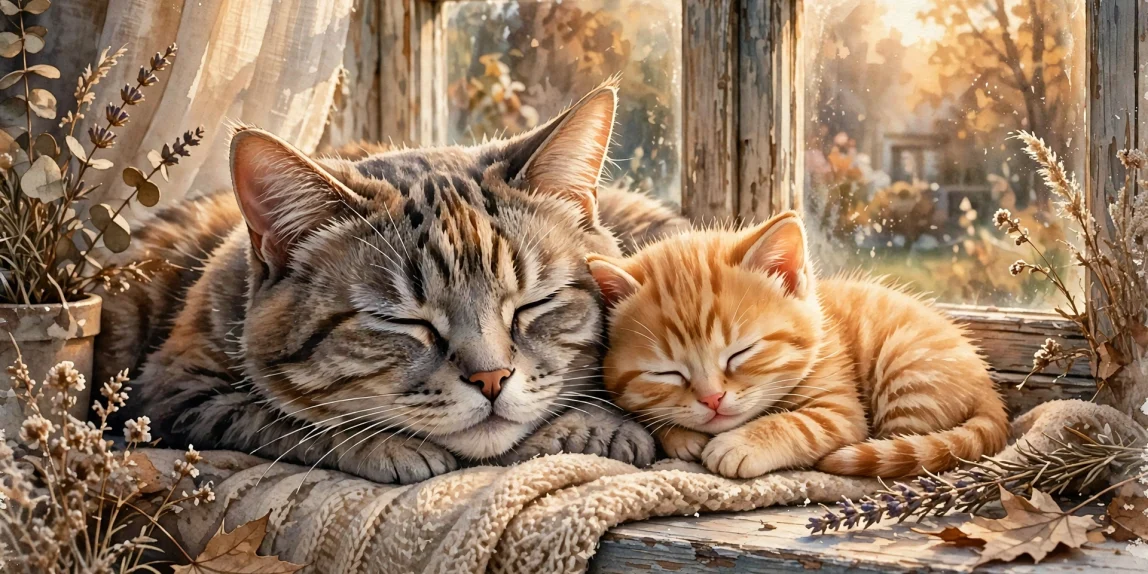
Think of it as Yoga for the brain, we are going to stretch a bit.
How Old Is Your Cat — Really?
A cat ages in dogleg turns, not straight lines — a kitten in spring can be a teenager by Christmas and a retiree while you are still wearing the same shoes. -- YNOT!
Every cat owner eventually does the math. You look at the animal asleep on your clean laundry, count the birthdays, and ask: how old are you, really? The charts give you a number in human years, and the number is fun — but handle it honestly. No blood test measures “human years.” It is a translation, not a birth certificate, a rough way of picturing where your cat stands in life. Here is the translation, stage by stage, and what each stage asks of you.
THE FAMOUS FORMULA, AND ITS FINE PRINT
Forget the old multiply-by-seven rule; that was always arithmetic for people who had never met a kitten. The traditional veterinary chart works like this: the first year counts as about 15 human years, the second adds about 9 more to reach 24, and every year after that adds about 4. Cornell’s Feline Health Center tells it slightly differently — about 16 at one year, 21 at two — which is your first clue that these numbers are estimates wearing a lab coat, not measurements.
The stage names on the pretty charts come from an older six-stage system: Kitten, Junior, Prime, Mature, Senior, and Geriatric. The current AAHA and AAFP guidelines, from 2021, use fewer, wider stages — kitten to one year, young adult 1 to 6, mature adult 7 to 10, and senior over 10. Same cat, same birthdays; the professionals just argue politely about where to draw the fences.
KITTEN: BIRTH TO 6 MONTHS, OR HUMAN 0 TO 10
No creature grows faster than a kitten: six months of cat is roughly ten years of human. In half a year the animal goes from blind and helpless to weaned, litter-trained, and climbing the curtains.
This is the stage of many vet visits — checkups, vaccinations, and deworming in the first months, and a talk about spaying or neutering before you have kittens of your own to do math on. Feed a proper kitten food; growth is construction work and needs materials. Handle the kitten gently and daily, play with toys and never with your hands — fingers taught as prey in June are still prey in December, only bigger — and remember that socialization learned now is manners kept for life.
JUNIOR: 7 MONTHS TO 2 YEARS, OR HUMAN 12 TO 24
The modern guidelines split this stage at the one-year line, calling the first half still kitten. Fair enough: an eight-month cat looks finished and is not. This is the teenager — full-sized body, half-finished judgment, energy that arrives at midnight like it pays rent.
Your jobs now are exercise, enrichment, and not letting the young athlete get fat on success. Keep up daily play, rotate toys before they become furniture, and move to a measured adult diet as your vet directs, usually around the first birthday. One good vet visit a year is the cadence from here through the prime years. Watch the habits forming now — scratching, litter box manners, carrier training — because a junior cat is writing the rules the adult cat will enforce on you.
PRIME: 3 TO 6 YEARS, OR HUMAN 28 TO 40
These are the easy years, and easy is a trap. The prime cat is healthy, settled, and apparently maintenance-free — which is exactly when owners stop looking. The cat still needs that yearly vet visit, a dental check, and a weight check, because the two great prime-age projects are quietly getting fat and quietly growing sore teeth.
Keep the play sessions coming even though the adult cat asks less often. This is also the perfect time for baseline bloodwork while everything is normal. Healthy numbers filed away at age five are worth gold at age twelve, when the vet asks the most useful question in medicine: compared to what?
MATURE: 7 TO 10 YEARS, OR HUMAN 44 TO 56
One correction: Tony’s chart prints this stage as 41 to 56, which borrows Cornell’s lower number and the traditional chart’s higher one. Pick one chart and stay with it — by the traditional count it is 44 to 56, solid middle age, and that is exactly how to think of the cat.
Nothing dramatic happens at seven, and that is the point. Metabolism slows, weight creeps, joints begin their long negotiation, and the early, silent versions of kidney trouble, thyroid trouble, diabetes, and dental disease can start here while the cat looks fine. Keep the yearly visit, add the screening blood and urine tests your vet recommends, and weigh the cat at home. A pound on a ten-pound cat is ten percent of the animal. You would notice ten percent of yourself.
SENIOR: 11 TO 14 YEARS, OR HUMAN 60 TO 72
The same mixed-chart warning applies here — you will see 57 to 75 printed, but the traditional math gives 60 to 72. The exact number matters far less than this stage’s new rule: the vet now twice a year, not once. Cats hide illness the way magicians hide cards, and six months of cat is two years of human. Problems caught between visits are problems caught early.
Watch the quiet changes, because in a senior cat the quiet changes are the symptoms: drinking more, urinating more, eating well but losing weight, jumping less, grooming less, yowling at night. Do not file any of it under “just getting old” until a vet has looked — kidney disease, an overactive thyroid, high blood pressure, and arthritis are all common now, all manageable, and all experts at disguising themselves as old age. Help the joints: a step up to the favorite chair, a litter box with one low side, food and water that do not require mountaineering.
GERIATRIC: 15 YEARS AND UP, OR HUMAN 76 AND BEYOND
The chart’s last word is Geriatric; International Cat Care calls the same cat a Super Senior — better manners, same birthday. Either way, a cat past fifteen is an old, old friend, and the job changes from prevention to comfort, dignity, and attention.
Keep the twice-yearly visits — more often if your vet asks — and make the house easy: warmth, soft beds on the floor instead of heights, litter boxes on every floor the cat uses, food that is simply easy to reach and eat. Expect more sleep, a thinner coat, some confusion, and loud commentary at 3 a.m.; mention all of it to the vet, because pain and blood pressure can sing that song too. And weigh the cat. In the geriatric years, the scale is often the first honest reporter in the house.
That is the whole chart, honestly read. The stages are real even when the arithmetic is approximate, and each asks something different of the human. Give each stage what it asks, and the cat will do the rest.
Do not count your cat’s years to grieve how fast they go. Count them to know what the cat needs next — that is what the years are for. — YNOT!