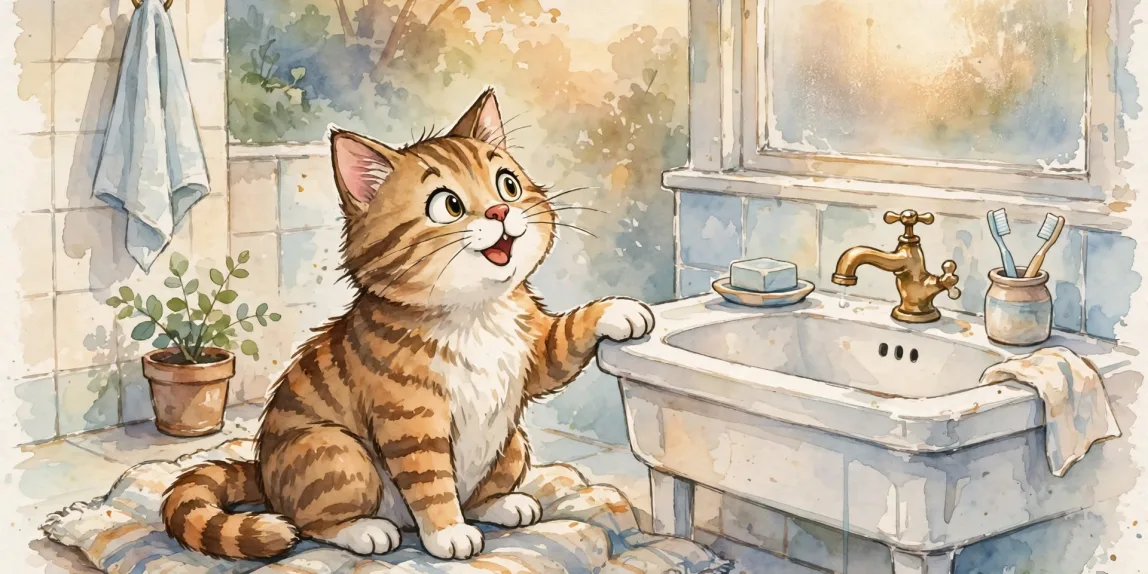
Think of it as Yoga for the brain, we are going to stretch a bit.
Why Your Cat Follows You Into the Bathroom
You think you have closed the bathroom door for privacy. Your cat thinks you have scheduled a meeting and forgotten to send her the invitation. She has never once been late. -- YNOT!
Every cat owner knows the scene, because every cat owner lives it. You get up in the morning, you head for the bathroom, and before the door is fully shut there is a cat in it — arrived from nowhere, at speed, like she was paged. She settles. She looks at you. And then, in this room and apparently only in this room, she starts to talk. Not the kitchen meow, which is business. Not the hallway meow, which is announcements. A whole conversation, back and forth, in a small tiled room, at an hour when you have not yet had coffee and are in no condition to be interviewed.
People ask why. Why the bathroom, of all rooms? Why the escort, the audience, the daily debriefing in the one room in the house where a human being might reasonably expect to be alone? The answer is not one answer. It is about five answers stacked in a trench coat, and every one of them makes perfect sense once you look at the bathroom the way the cat does. Let us take them in the order the cat would.
FIRST: THE CLOSED DOOR IS AN OUTRAGE
Start with the door itself, because half of this mystery is not about the bathroom at all. It is about the door being shut. A cat cannot abide a closed door inside its own territory. This is not curiosity in the idle sense; it is policy. The cat’s whole world is a map it patrols and keeps current — every room inspected, every surface confirmed, every smell in its place — and a closed door is a hole in the map. Something in there is happening without feline supervision, and that is not how the house is run.
It does not matter what the room is. Close a closet and the cat materializes. Close a spare bedroom that the cat has not entered since spring and watch it become, instantly, the most urgent destination in the house. The bathroom gets it worst because the bathroom door closes every single day, on a schedule, with the cat’s favorite person sealed inside it. From the cat’s side of the door, this is not a private moment. It is a daily territorial incident, and she has appointed herself the inspector. The paw under the door is not begging. It is a warrant.
YOU ARE NEVER MORE INTERESTING THAN WHEN YOU ARE SITTING STILL
Now consider what you are doing in there, from a cat’s point of view. The rest of the day, you are a moving target — cooking, working, carrying laundry, opening the refrigerator in a way that raises false hopes. You are weather. But in the bathroom, in the morning, you sit. You sit still, at cat height, facing one direction, for a predictable number of minutes, at a predictable time, every day of your life. You are, for those minutes, the most available human being on Earth.
Cats run on routine the way trains run on rails, and they keep your schedule better than you do. The morning bathroom visit is the single most reliable appointment in the house: same time, same room, same seated and stationary person, no competition from the stove or the television. A cat who wants your attention — and cats want more of it than their reputation admits — learns very quickly that this is the window. She is not following you into the bathroom. She is keeping an appointment she made weeks ago and has honored every day since. You are the one who keeps forgetting it is on the calendar.
And the smallness of the room works in her favor. A bathroom is an enclosure: one door, no through traffic, and — this matters in a multi-cat house — no other cats unless she lets them in. Out in the living room, your attention is public property, contested by every animal, screen, and sandwich in the building. In the bathroom, for a few minutes, she has you all to herself. Cats do not need constant physical contact to bond with you; simply occupying the same space, being in the room where you are, is companionship in Cat. The bathroom is just the smallest, quietest version of that room, with the door — once she has dealt with the door — keeping the rest of the world out for both of you.
IT IS ALSO THE ROOM WHERE WATER PERFORMS
Do not overlook the plumbing, because the cat has not. The bathroom is the one room in the house where water does tricks. The tap drips, or can be persuaded to. The faucet produces a fresh, running stream on request — and every cat who has ever supervised a bathroom knows that faucet water, straight from the tap, is a finer vintage than whatever has been sitting in her bowl. The toilet flushes with a sound like weather arriving. For an animal whose ancestors drank from streams and who still prefers its water moving, the bathroom is not a utility. It is a water park with one ride, and you hold the season pass.
The room is comfortable in the other ways, too. In winter it is often the warmest spot in the house — warm pipes, warm towels, laundry waiting in a pile that holds the heat. In summer the porcelain sink is a cool, cat-shaped hammock, which is why so many cats are discovered asleep in it, poured into the bowl like batter. And your scent is concentrated in that room — towels, clothes, the bath mat, you yourself at close range — which makes it some of the most thoroughly “yours” territory in the house. Watch the doorframe on your way out. The cat who rubs her cheeks along it is signing the guest book. If her litter box lives in the bathroom, add the simplest reason of all: she is not following you to work. You are both just keeping the same office hours.
SHE DOESN’T TALK TO OTHER CATS LIKE THIS
Now the talking, because that is the part that feels strangest — the cat who is a sphinx all day becomes a radio host in the bathroom. Here is the thing most people never learn: meowing is largely a language cats built for us. Adult cats communicating with each other work mainly in scent and body language — the rubbed cheek, the held tail, the slow negotiation of posture and smell. The voice is aimed at the humans. Kittens meow at their mothers; grown cats, by and large, meow at their people, because we are the ones too nose-blind and posture-illiterate to be reached any other way.
And within that language, each cat develops a private dialect with its own person — a set of sounds that this cat uses with this human, refined over months of finding out what works. Which is why the bathroom conversation feels like a conversation: because at the level that matters, it is one. She meows. You answer. She waits. She meows again. That is turn-taking, and it is real. She does not understand your sentences — she is not parsing your opinions about the weather — but she is reading your tone, your attention, your timing, the fact that when she speaks in this room, you speak back. A behavior that gets answered gets repeated, and a room where talking has always been answered becomes, in the cat’s filing system, the talking room. It is possible the tiles help, too — hard surfaces bounce sound around, and voices carry in a bathroom the way they do in a stairwell — but that part is a guess. The trained habit is not. She talks there because talking there has always worked.
You can test the turn-taking yourself, tomorrow morning, and it costs nothing. When she starts, answer her the way you usually do — and then wait. Don’t fill the silence. See whether she holds her note until you have finished yours before she takes her turn. Try a question, in a different tone than usual, and watch what comes back. It is not a scientific study. It is just a man or woman on a bathroom floor at dawn, finding out whether the cat has been having a conversation all this time. Most people who try it come away fairly convinced.
EVERY ROOM HAS A JOB, AND THIS ONE’S JOB IS YOU
The deepest reason is the one that explains the rest: cats are specialists in context. The house, to a cat, is not one place but a portfolio of places, each with its own rules and its own business — the map another chapter of this book calls her secret map of the house, drawn in scent and habit. The kitchen means feeding, and the cat is all business in the kitchen. The bedroom means sleeping, warmth, and the good blanket. The living room means the evening sprawl. And the bathroom, in the morning, means the meeting — the one reliable, private, seated, unhurried audience with her person that the day guarantees.
Read her while she is in there and she will confirm it in the other language, the silent one. The tail carried upright is the friendly flag, the feline hello. The slow blink — those long, lazy closes of the eyes — is trust, and it works both ways: researchers have found that cats slow-blink back at people who slow-blink at them, so you can answer in kind. Relaxed ears, forward and easy. And if you are lucky, the trill — that closed-mouth, rising little brrt — which is the sound a mother cat uses to call her kittens, repurposed by your cat to greet the creature she has apparently decided to raise. None of that is a cat demanding a service. All of it is a cat keeping company.
Because here is the truth the whole chapter has been circling: we assume a cat who seeks us out wants something — food, a door opened, a faucet turned on, a lap. Often enough she does, and she is not shy about itemizing it. But sometimes, and the bathroom at dawn is where it shows clearest, the cat does not want anything you can hand her. The attention itself is the thing wanted. The company is the entire request. She has built a small daily ceremony out of the only minutes when you are guaranteed to be still, and she attends it faithfully, and she will attend it tomorrow, whether or not you have come to terms with being the sort of creature whose day begins with a staff meeting.
You think you are going to the bathroom every morning. As far as your cat is concerned, you are attending your morning meeting with her — she called it, she chairs it, and she has never once been late. All she ever wanted was for you to show up. You always do. That is the whole friendship, and it is enough. — YNOT!