Think of it as Yoga for the brain, we are going to stretch a bit.
Keep the Claws — The Truth About Declawing
A cat’s claws are not a defect in the cat. They are standard equipment, installed at the factory — and the factory does not take returns. — YNOT!
Every year, good people walk into veterinary offices and ask to have their cat declawed, believing they are asking for something like a permanent nail trim. A tidy little procedure. The claws come off, the couch survives, everybody goes home happy.
Nobody sat them down and explained what the word actually means. That is not their fault. It is the fault of a polite word — “declaw” — that sounds like something done at a salon.
This chapter is the explanation nobody gave them. It is not a scolding. Most of the people who ever paid for this surgery loved their cats and were solving a real problem with the only tool anybody offered them. But a person deserves the facts before the anesthesia, not after.
IT IS NOT A MANICURE, IT IS CARPENTRY
Here is the fact that changes the conversation. A cat’s claw does not sit on the toe the way your fingernail sits on your finger. It grows directly out of the last bone of the toe. So to remove the claw permanently, the surgeon has to remove the bone.
The operation has a name — onychectomy — and the American Veterinary Medical Association calls it what it is: a surgical amputation. On a human hand, it would be cutting off every fingertip at the last knuckle. On a cat, it is usually the front paws. Ten toes. Sometimes all four feet, which makes eighteen.
It does not matter whether the tool is a scalpel, a clipper, or a laser. The laser is a fancier knife. The inventory of what leaves with the cat is the same.
There is a cousin operation called a tendonectomy, where the tendon that works the claw is cut instead. The claw stays, but the cat can no longer retract it or use it properly. The nails grow thick, still need trimming forever, and can curl and cause discomfort of their own. The AVMA and the feline practitioners’ association both decline to recommend it. It is not the gentle option. It is the same argument in a different hat.
NOBODY ASKS FOR THIS OUT OF MEANNESS
Let us be fair about the reasons, because the reasons are real.
The couch was expensive, and the cat is redecorating it one corner at a time. Grandma’s skin is thin, she is on blood thinners, and a scratch is not a small thing anymore. There is a baby coming, and somebody’s aunt has opinions. The landlord put a clause in the lease, in writing, with a deposit attached.
Every one of those is a genuine problem, and a person wrestling with one is not a villain. The only question this chapter asks is the practical one: does the surgery actually solve the problem it promises to solve? Because the evidence says, remarkably often, it trades the problem for a worse one.
WHAT 274 CATS HAD TO SAY ABOUT IT
In 2018, the Journal of Feline Medicine and Surgery published a study by Dr. Nicole Martell-Moran and colleagues. They examined 137 declawed cats against 137 cats with their claws, and went through two years of medical records for each.
The declawed cats were nearly three times as likely to have back pain. They were about seven times as likely to pee or poop outside the litter box. They were four to five times as likely to bite. And they were about three times as likely to over-groom — licking and chewing their own fur bald, which vets call barbering, and which is often a sign of a cat trying to manage discomfort.
It gets worse in the details. X-rays showed that in 63 percent of the declawed cats — nearly two out of three — fragments of the amputated bone had been left behind in the toe. Those cats did worse still. But here is the line that matters most: even in the cleanest surgeries, with the bone removed perfectly, the cats were still about three times as likely to bite and four times as likely to have litter box problems as cats that were never operated on.
Why the back pain? A cat walks on its toes. Shorten the toes and the whole machine compensates — weight shifts, gait changes, and the back pays for it. Vets who treat these cats describe some whose pain never entirely leaves: not limping, exactly, but guarded, stiff, careful with their own feet for the rest of their lives. A surgery done in kittenhood can send a bill that arrives in installments for fifteen years.
THE TRADE NOBODY WOULD SIGN
Now notice the irony, because it is the whole argument in one sentence. The two behaviors declawing makes more likely are biting and quitting the litter box.
Biting is worse than scratching — deeper, dirtier, and far more likely to send a person to a doctor. And a cat that stops using the box is the single most common reason cats get surrendered to shelters. We have a whole chapter in this book, The Litter Box Rebellion, about how hard that problem is to fix once it starts.
So the bargain, read carefully, goes like this: give up your couch corner, and in exchange receive a cat more likely to bite you and to pee beside the box. Nobody who saw those terms written out would sign. They were simply never shown the terms.
THE LAW HAS STARTED KEEPING SCORE
Most of the world reached this conclusion a while ago. Declawing for convenience is banned across the United Kingdom, most of Europe, Australia, New Zealand, Brazil, and Israel, and in most Canadian provinces. In those places it is treated the way it sounds once you know what it is: an amputation performed for furniture.
America is catching up, city by city and state by state. West Hollywood passed the first city ban in 2003; Los Angeles, San Francisco, Denver, Pittsburgh, and Austin followed. New York became the first state to ban it in 2019, Maryland in 2022, and as of this writing Virginia, Massachusetts, Rhode Island, California, and Washington, D.C. have joined them, with more legislatures chewing on the question every year.
Every one of these laws keeps an exception for genuine medical need — a tumor in the toe, a crushed bone, an infection that will not heal. That is a veterinarian treating a sick toe, and nobody in this book has a word to say against it. What the laws ban is the elective kind: healthy toes, healthy cat, worried couch.
THE CHEAP SEATS: POSTS, TRIMS, AND CAPS
Here is the good news, and it is genuinely good. Scratching is not bad behavior to be eliminated — it is maintenance, exercise, and a cat signing its name on the furniture in scent. You cannot talk a cat out of it. But you can choose where it happens, and that turns out to be most of the war.
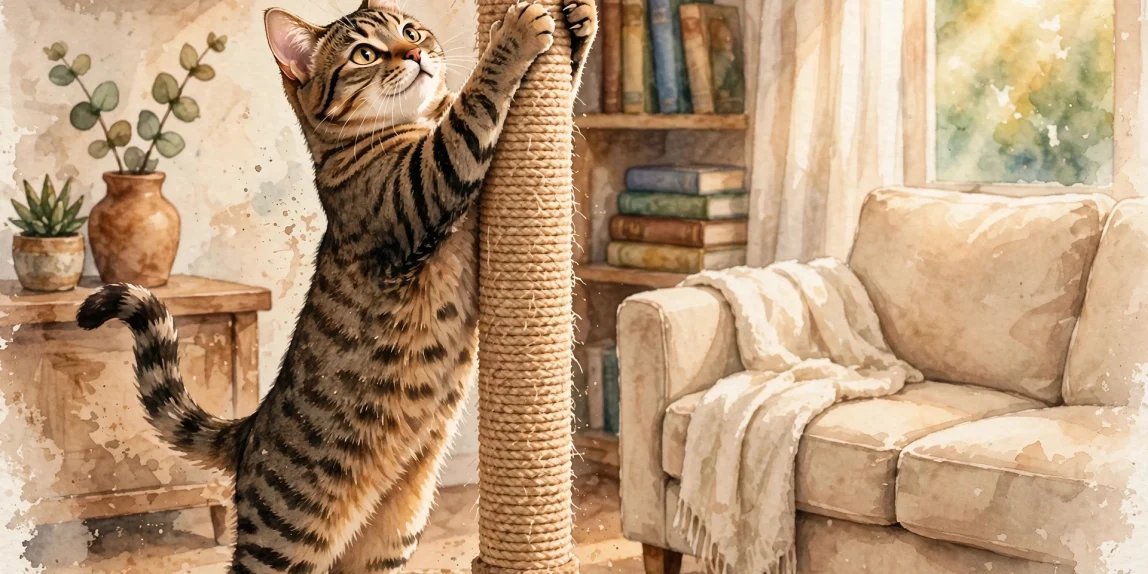
Put a proper scratching post where the cat already scratches — beside the couch corner, not in a distant room where nobody sins. We covered the whole campaign in the chapter about Saving Your Furniture, the one with the four-hundred-dollar door frames. The short version: the post must be tall, sturdy, and located at the scene of the crime.
Then there is the humble nail trim, which solves more of this problem than any surgery. A trimmed claw cannot shred upholstery or skin. It takes two minutes, and anyone can learn it. Press the toe gently and the claw slides out. You will see the white claw and, inside it, a pink vein called the quick — cut only the sharp tip, well clear of the pink. One paw is a perfectly good session. Follow with a treat. Quit while you are ahead, and in a few weeks the cat will regard the whole ceremony as a mildly eccentric ritual that pays in snacks. Every week or two keeps the points off.
For the cat who will not be trimmed and the couch that cannot wait, there are soft vinyl nail caps, glued over the claws like tiny boxing gloves. They fall off and are replaced every four to six weeks as the nail grows. Undignified? Slightly. Effective? Completely. And unlike the surgical option, a nail cap has never once caused back pain.
THE HARD CASES, HONESTLY
Fairness requires one more section. What about the owner whose immune system is compromised — the person in cancer treatment, or living with HIV — for whom a scratch is a medical event?
That person deserves a straight answer, and here it is: the Centers for Disease Control and Prevention does not recommend declawing, even for them. Its guidance for people with weakened immune systems is to keep the cat indoors, keep the claws trimmed, wash any scratch promptly, and avoid rough play. The reason is partly the irony from earlier — bites are medically more dangerous than scratches, and declawed cats bite more. Amputating the toes does not make the cat safer to live with. It can do the opposite.
If a household reaches the true last resort — every alternative honestly tried, a cat who will otherwise lose its home — that is a long conversation with a veterinarian, not a checkbox on a surgery form. It happens rarely. It should happen rarely.
IF YOUR CAT IS ALREADY DECLAWED
Then put the guilt down, because this section is not carrying any. For decades this surgery was routine, recommended, and bundled with spays like an oil change with a tire rotation. If your cat came to you declawed, or you had it done before anybody told you the terms, the cat is not keeping score, and neither is this book.
Just keep an eye out. A declawed cat who avoids the litter box may be telling you her feet hurt in the gravel — try a softer, finer litter and a box with a low side. Watch for reluctance to jump, stiffness, a back that flinches at a stroke. Mention the declaw at every vet visit, so pain gets considered when behavior changes. And keep her indoors: the defense system is gone, and she is counting on yours.
Most declawed cats live long, loved, ordinary lives. Yours can too. She has already forgiven everybody involved, which is more than the furniture ever did.
You cannot make a cat safer to love by removing the parts that make it a cat. Keep the claws, trim the tips, and spend the surgery money on a good scratching post. — YNOT!