Think of it as Yoga for the brain, we are going to stretch a bit.
Avoid The Hissing Phase: How to Introduce a Kitten
A hiss is not a declaration of war. It is a press release: “I am frightened, I am armed, and I would like this meeting adjourned.” — YNOT!
In a good home tonight, a ten-week-old kitten named Gus is sitting on one side of a closed door, and on the other side of that door a four-year-old cat is expressing his opinion of the entire arrangement. His two-year-old brother, meanwhile, is obsessed with the newcomer and would like the summit to begin immediately. Gus, being ten weeks old, is ready for anything and understands nothing.
Three cats. Three foreign policies. One hallway.
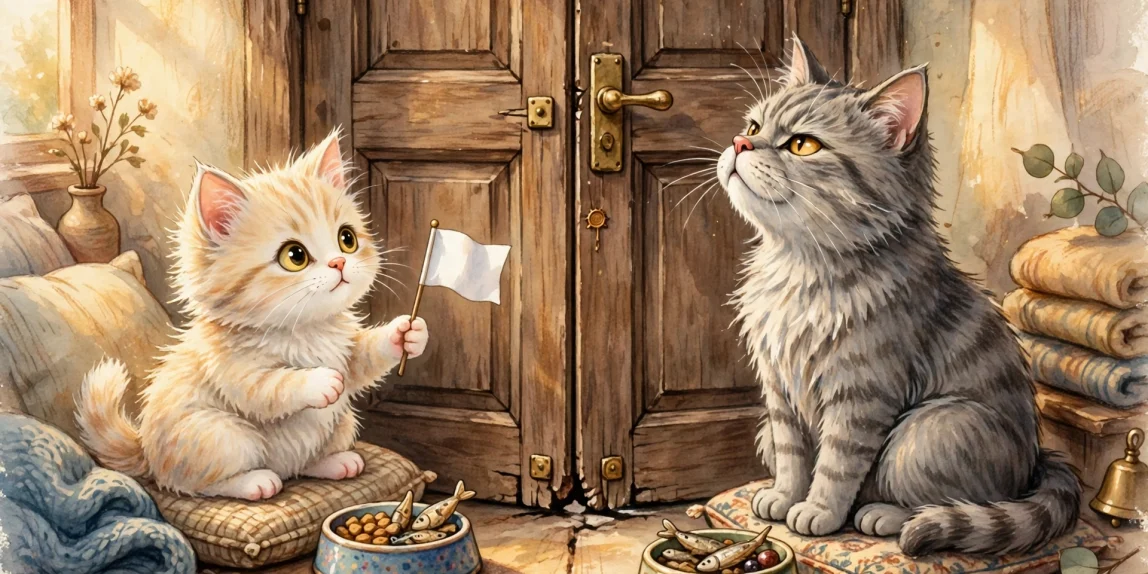
Now, I have lived long enough to know that introducing a kitten to a resident cat is not an introduction. It is a peace negotiation between two small, furry nations, each convinced it holds the deed to the house — and one of them is right, which is what makes it complicated.
The first cat may regard the second not as a companion, but as an invading army with whiskers. — YNOT!
THE DEMILITARIZED ZONE: SEPARATE ROOMS
Every successful treaty in history begins with the two sides not being in the same room, and cat diplomacy is no exception.
The kitten gets a room of his own — a bedroom, a bathroom, any defensible province with a door that closes — stocked with his own litter box, his own dishes, his own bed, and his own toys. This is not a prison. It is an embassy. Behind that door he can eat, sleep, and decompress without an occupying army watching him through the keyhole of history.
The resident cat keeps the rest of the country, undisturbed, his routine intact, his throne unchallenged. This matters more than people think. A cat who loses his territory and his routine on the same day has two grievances. A cat who keeps both has only one, and one grievance can be negotiated.
How long does this stage last? Until both sides are calm on their side of the border. Days, usually. The door stays closed, and the diplomacy begins through it.
EXCHANGING AMBASSADORS: THE SCENT PROTOCOL
Cats do not conduct foreign policy by eyesight. They conduct it by smell, and smell is where you do your best work.
Swap the bedding. Rub a soft cloth along the kitten’s cheeks and leave it near the resident cat; do the same in reverse. You are not tricking anybody. You are exchanging ambassadors — letting each nation learn the other’s scent in peace, at napping distance, with no whiskers attached to it.
This is the stage the careful owners get right. One household I heard of — Sox, five months, meeting Beetle, fifteen months — had the whole protocol running like a foreign ministry: separation, scent swapping, short carrier introductions, paws under the door. Paws under the door, by the way, is not a security failure. It is a diplomatic channel. Two cats batting softly at each other under a door are exchanging notes, and notes are how wars get avoided.
TRADE TALKS: DINNER ON OPPOSITE SIDES OF THE DOOR
When both cats can smell the other without filing a protest, open trade negotiations: feed them on opposite sides of the closed door.
Food is the universal argument. A cat eating dinner three feet from the enemy’s smell is learning the deepest lesson in all of cat politics — good things happen when that smell is around. Start with the bowls a respectful distance from the door and move them closer over days, an inch of diplomacy at a time.
If somebody refuses to eat, the talks are moving too fast. Move the bowls back, slow down, and let the diplomats catch up. There is no deadline in this process except the one in your head, and that one does not count.
THE SUMMIT: FIRST MEETINGS, SHORT AND SUPERVISED
Eventually — calm eating, relaxed scent-swapping, curious paws — you hold the summit. Open the door a crack, or use a gate or a cracked door with you as security council, and let them see each other briefly while excellent food or play is happening on both sides.
Expect a hiss. Budget for it. A hiss is not the summit collapsing; a hiss is a delegate stating a boundary for the record — I see you, I am nervous, keep your distance — and then, in most cases, going back to the chicken. What you are watching for is recovery: does the tension drain in seconds, or does it build? Seconds means proceed. Building means the meeting is adjourned for today, without shame and without a loser.
Short meetings, ended early while things are still boring, beat one long meeting ended by a chase down the hall. You are stacking up evidence, in both cats’ minds, that encounters end well.
SETBACKS, AND RESTARTING THE CLOCK
Here is where I must talk plainly, because there is a harder case in the reports: an adult cat still attacking an adopted youngster months after the introduction, and an owner asking, honestly, how do I get them to get along?
Months of warfare usually means the negotiations were skipped or rushed at the start — the cats were simply put together to “work it out,” which is the one method that reliably does not work. Cats do not work it out. They work it into a feud, and a feud, once daily, becomes a tradition.
The remedy is unglamorous and it works: restart the clock. Full separation, as if the kitten arrived this morning. Scent work. Door feeding. Short summits. It feels like going backwards, but it is not — you are not returning to zero, you are returning to the place where the process broke, and this time walking it instead of running it. If a cat is truly relentless, a veterinarian or a behaviorist is not an extravagance; some delegates need a mediator, and there is no dishonor in hiring one.
THE HONORABLE PEACE: RESPECTABLE NEIGHBORS
Set your expectations like an adult. Some pairs become devoted friends who sleep in a pile and wash each other’s ears. Some become agreeable roommates. And some sign a treaty of respectable neighbors — separate sunny spots, a shared hallway used at different hours, peace without affection.
That last outcome is not a failure. It is a perfectly honorable peace, and thousands of households run happily on it for twenty years. The goal was never a photograph of two cats in a heart shape. The goal is a house where nobody is afraid.
Timelines will vary the way weather varies: days for the easy pairs, weeks for the average, months for the hard cases, and every one of those is normal somewhere on the map. The only true deadline is your patience, so spend it slowly.
Gus and his brothers will get there — the obsessed two-year-old is already voting yes, and the four-year-old’s hiss is just the opening statement of a negotiation he will eventually lose to a kitten’s entire personality. Give the diplomats time. Furry nations have signed harder treaties than this one, in hallways smaller than yours.
Nobody ever signed a peace treaty by throwing the two armies into the same room. Peace is built a closed door at a time. — YNOT!