Think of it as Yoga for the brain, we are going to stretch a bit.
What Kind of Cat Is This? Cat’s Coat, Color, and Voice
Every cat arrives with a pedigree. Some are written on paper. The rest are written on the cat, and it is up to you to learn to read. — YNOT!
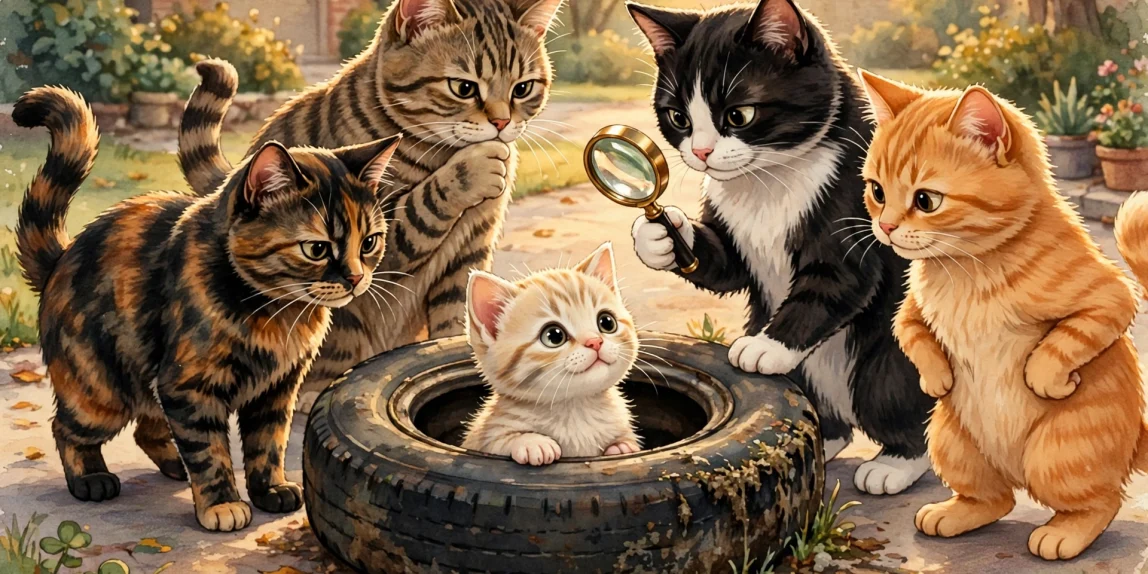
Somebody found a kitten inside a tire.
Not near a tire. Not under a tire. Inside one, the way a spare hides in a trunk, and she posted a picture to a cat owners’ group with the question every found-cat human has asked since the invention of the camera: “Anyone know what kind of kitten this is?”
Two thousand people answered. Two thousand. A kitten in a tire can draw a bigger crowd than most town councils, and every one of those good people had a theory.
Another fellow picked up a hitchhiker at a Motel 6 — a cat who cried outside his door until he let her in, then demanded lodging, supper, and snuggles like a traveling salesman who had memorized the routine. Interesting coloring, he said. Very vocal. “How do I know what kind of cat this might be?”
Now, I have lived long enough to know that “what kind of cat is this?” is really three questions wearing a trench coat. What will she look like grown? What will she act like? And the one nobody says out loud: did I just get somebody special? The answer to that last one is yes, and it has nothing to do with breed. But the first two questions can be read, at least in part, right off the animal. A cat is a book that walks. Here is how to read the cover.
THE COAT: A TABBY IS NOT A BREED, IT IS A UNIFORM
First lesson, and it saves more arguments than any other: tabby is a pattern, not a breed. Half the world thinks they own a tabby cat the way they think they own a Ford. What they own is a cat wearing the oldest coat in the business — stripes, swirls, spots, or ticking, arranged by a designer who has been at it for ten thousand years and sees no reason to change.
There are four main suits in the tabby wardrobe. The mackerel wears thin vertical stripes, like a tiny tiger who has heard the comparison and agrees with it. The classic wears bold swirls and a bullseye on each side, as if daring you. The spotted speaks for itself. And the ticked tabby wears a salt-and-pepper coat with barely a stripe to show, each hair banded in color like it was dipped three times.
And then there is the M. Look at the forehead of nearly any tabby and you will find a letter M written there plain as print. Legend says it stands for everything from the Madonna to Mohammed to plain old Maine. The cat is not saying. A cat with a letter on her forehead is a cat who has read the book and is keeping the ending to herself.
TORTOISESHELL, CALICO, AND THE LADIES’ CLUB
If the cat is a patchwork of black and orange — no white, just the two colors swirled together like a fire stirred with a stick — that is a tortoiseshell, and she is almost certainly a she. If the same colors come in big clean patches with plenty of white, that is a calico, and she is also, with rare exceptions, a lady.
This is not folklore; it is arithmetic. The orange gene rides on the chromosome that decides the whole arrangement, and it takes two of them to paint both colors on one cat. The rare male calico exists — about one in three thousand — and he is generally sterile, which the females regard as the least he could be, given the fuss.
Tortoiseshell owners will tell you about “tortitude,” a rumored extra helping of attitude served with the coat. Science has not proven it. Science has also not lived with one. I leave the matter where it belongs: with the witnesses.
TUXEDOS, POINTS, AND OTHER FORMAL WEAR
The black-and-white cat in the little suit is a tuxedo, dressed for a dinner he intends to be fed at. Tuxedo is a pattern, not a breed — any cat can put one on — but owners swear the formal wear comes with formal confidence, and the tuxedo cats of my acquaintance have never once dressed down for anybody.
If the cat’s ears, face, feet, and tail are dark while the body runs pale, that is colorpoint — the Siamese pattern, and it is painted by temperature. The coolest parts of the body darken; the warm parts stay light. A colorpoint kitten is born white as a page and develops his opinions gradually. It is the only coat in nature that works like a mood ring.
BODY, EARS, AND TAIL: THE FINE PRINT
Patterns are the headlines; the body is the fine print, and the fine print tells the truth.
A long, lean, elegant cat with big ears and a whip tail is built along oriental lines — likely some Siamese or similar blood back in the family tree, even if the tree is a shrub. A big-boned, broad-chested cat with a thick double coat and a tail like a feather duster is built cobby, northern style, the kind of cat bred by winters that kill the unprepared. Tufts on the ear tips and fur between the toes are snow equipment. That cat’s ancestors had opinions about weather.
Look at the tail while you are at it. A kink, a bob, a curl — tails carry signatures from old lines, some famous, some purely local. And look at the feet. Extra toes — polydactyl, the sailors called them ship’s cats and considered them luck — turn up wherever seafaring folk settled, which tells you the cat’s family traveled better than most people’s.
THE VOICE: SOME CATS NEVER STOP TALKING
Our Motel 6 hitchhiker was “very vocal,” and that is a clue as good as any stripe. Some lines of cats are conversationalists. The Siamese and his oriental cousins do not meow so much as hold forth — opinions on the food, the weather, your schedule, your failures. If a stray cat follows you narrating, there is talkative blood in her somewhere.
At the other end sit the strong silent types, cats who regard speech the way misers regard money. And in the middle is the great majority, who speak when there is profit in it: a door to open, a bowl to fill, a human to move from a warm chair. The technical term for a cat who talks only to be fed is a cat.
THE HONEST TRUTH: A PEDIGREE OF THE STREETS
Now here is the part the breed charts leave out. The great majority of the world’s cats — including, in all probability, a kitten found in a tire — are no particular breed at all. The official name is domestic shorthair or domestic longhair, and it sounds like a consolation prize until you understand what it means.
It means nobody designed this cat. She is the product of a hundred generations of cats who survived winters, outran dogs, charmed farmers, stowed away on ships, and picked their own mates in defiance of every human plan. The purebred cat is a novel written to order. The domestic shorthair is a folk song — passed down, changed a little by every singer, and belonging to everybody.
So what kind of kitten was in the tire? Read her coat and you can name her pattern. Watch her grow and you can guess at her ancestors. Listen to her and you will learn her intentions. But the breed line on her papers, if she ever gets papers, will say domestic shorthair, and there is not a pedigree in the world that says more.
A breed tells you where a cat came from. The cat will tell you the rest herself, in her own time, usually at 3 a.m. — YNOT!