Think of it as Yoga for the brain, we are going to stretch a bit.
Why Does My Kitten Bite Me & Will It Stop?
A kitten’s teeth are how it takes notes. The trouble starts when it takes them on you. — YNOT!
“How do I get Nanaki to stop play biting and scratching? This is my first cat and he’s only 7 weeks. Or is this normal?”
That question arrived in a cat owners’ group trailing a crying emoji, and it drew 227 answers, because every cat person alive has stood exactly where that new owner is standing — barefoot, at dawn, being hunted by something that weighs less than a sandwich.
So let us begin with the good news, and it is genuinely good: yes, it is normal. Nanaki is not broken, not vicious, and not plotting anything beyond what his whole species has practiced since there were ankles. He is a kitten. Biting is his homework.
Another owner in the same group has the advanced course of the same problem: a one-year-old who bites during play — quick snappy strikes, back legs kicking — and is getting stronger, and the bites are getting less funny. Same lesson, bigger student. Both of them need the same answer, so here it is, with the jokes where they belong and the rules where they bite. So to speak.
WHAT THE BITING ACTUALLY IS
A kitten is born with one trade to learn: hunting. He did not choose it; it came with the whiskers. And a creature learns to hunt the way a child learns to talk — by practicing on whoever is nearby, constantly, and badly at first.
In the litter, this is a school with instant grading. A kitten bites a brother too hard, the brother squeals and leaves, and the lesson lands: teeth end the game. Kittens taken from the litter young — and seven weeks is young — have missed some of those lessons. They arrive at your house enrolled but uneducated, and you, lucky human, are the faculty now.
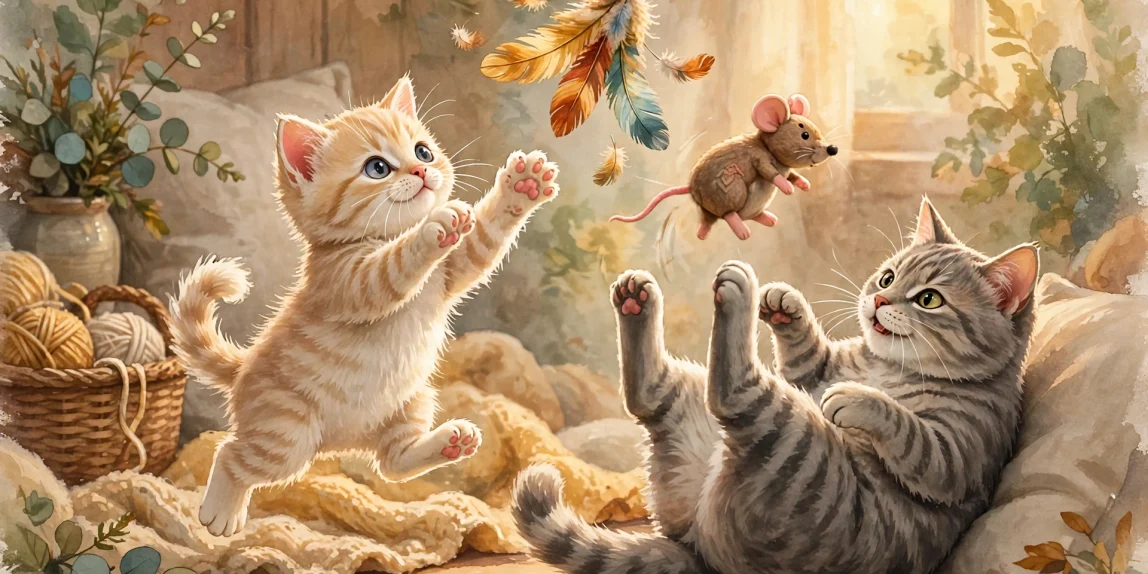
The famous back-leg kick deserves its own paragraph, because it frightens people. The kitten grabs with the front paws, bites, and rakes with the back feet — the bunny kick. On a toy, this is the finishing move a cat uses on prey. On your arm, it is the same move, and here is the strange truth: it is a compliment. You have been promoted from furniture to sparring partner. The cat is not attacking you. The cat is including you, in the only sport it knows, and it has no idea the equipment is registered on only one side.
THE FIRST RULE: YOUR HANDS ARE NOT TOYS
Every biting problem I have ever met was fed, at the start, by a hand. Somebody — usually a kind somebody, often a guest, frequently me — wiggled fingers for the baby kitten to chase, and it was adorable, because a seven-week-old’s bite is a rumor. Then the kitten grows. The teeth file their paperwork. The jaw gets strong. And the cat, who has learned in good faith that hands are prey, is suddenly in trouble for a rule nobody told him had changed.
So the law, from today forward, without exception: nobody plays with the kitten using hands or feet. Not you, not the kids, not Uncle Ray who thinks rules are for other people’s cats. Hands are for petting, feeding, and worship. Prey is provided separately, by management, on the end of a stick.
PROVIDE THE PREY: THE WAND TOY DOCTRINE
The instrument of peace is the wand toy — a feather or a scrap of cloth on a string on a stick. It puts distance between your skin and the action and gives the hunter a target he is allowed to murder. Use it twice a day if you can, in real sessions: let him stalk, chase, catch, and — this matters — win. A hunt that never succeeds makes a frustrated cat; a hunt that ends in a catch and a small meal afterward runs the ancient program clear through: hunt, catch, eat, groom, sleep.
When he grabs the toy and bunny-kicks it into the next county, praise be. That kick belongs there. That kick is the whole curriculum working as designed.
THE OUCH, THE FREEZE, AND THE EXIT
Teeth will still find skin sometimes, especially while the new law takes hold. When they do, speak brother-kitten: a sharp, high “Ouch!” — not a shout, a squeak — and then freeze. Go still and dull and fascinating as a chair. Then, calmly, the game ends. You stand up, the toy goes away, and the most interesting thing in the room becomes a closed door for thirty seconds.
Here is why this works and punishment does not. The kitten wants one thing: the game to continue. The instant teeth touch skin, the game dies — every time, without exception, without anger. A kitten can learn that arithmetic in a week. But punish him — swat, shout, spray bottle — and you have taught a different lesson entirely: that the big creature is dangerous and unpredictable. A frightened cat does not stop biting. A frightened cat starts biting first, and meaning it. Fear is the one teacher whose students all graduate to real aggression.
And do not pull your hand away fast — a retreating hand looks like fleeing prey and invites the pounce. Go still, let the jaws lose interest, then withdraw like a diplomat leaving a boring embassy.
KNOW THE DIFFERENCE: PLAY FACE VS. WAR FACE
Play biting has a look, and it is a loose one: ears up, body bouncy, the kitten breaks off, circles, comes back for more, tail doing nothing in particular. It is theater, and the actors are enjoying themselves.
Real aggression writes a different face. Ears flattened back against the skull. Growling or hissing. A body gone low and tense, pupils blown wide in a lit room, the tail lashing like a metronome — and after the bite, no bounce-back, no play. The cat is not sparring; the cat is warning, and warnings should be believed. A cat who truly bites in anger, often and without play around it, has something to say — pain, fear, a health problem — and the translator for that conversation is a veterinarian, not a toy. That one is not a training issue, and it is not a joke in this column or anywhere else.
WHEN WILL IT STOP?
Here is the honest forecast the new owner of Nanaki wants. The wildest of it — the dawn ambushes, the ankle warfare, the teeth in everything — peaks in the kitten months and ebbs as the cat matures, mostly gone or greatly civilized somewhere between one and two years of age. Spaying and neutering help the weather considerably; a neutered cat has fewer arguments to start with the world. And every week of consistent rules — wand not hands, ouch and freeze, games that end at teeth — moves the graduation date closer.
One day you will realize the ankle ambushes have stopped, and you will feel a small, stupid pang, because the tiny terrorist who hunted you from behind the couch grew up while you weren’t watching, into a cat who hunts a feather toy twice a day and then sleeps it off on your feet — which, I note for the record, remain unbitten.
Every kitten is a hunter in training and every owner is the training. Teach gently, end the game at teeth, and one day the tiger will retire to the rug. — YNOT!