Think of it as Yoga for the brain, we are going to stretch a bit.
Growing Old Together — Caring for the Senior Cat
An old cat does not ask for much. That is the trap. She asks for so little, so quietly, that you can miss the asking entirely — and she will not file a complaint. -- YNOT!
There is a poster going around that claims to list the five things senior cats wish you knew, written in a voice far too cute for its subject. But strip off the sugar and the five wishes are sound, because they are not really wishes. They are a maintenance schedule. I sleep more now, keep me company. My joints ache, give me steps. I get confused at night. My teeth hurt, so softer food. Play with me gently, and help me groom. That is the whole of senior cat care in five lines — the rest of this chapter is just the instructions for each.
The young cat’s problems arrive with trumpets: a kitten in trouble is a parade. The old cat’s problems arrive in a whisper, a quarter-inch at a time — the jump not attempted, the meal half-finished, the afternoon spent in a room she used to avoid. Nothing about it looks like an emergency, and that is exactly the danger. Your job in the senior years is not medicine. It is comfort engineering: noticing the whispers, and rebuilding the cat’s world, gently and in advance, so getting old costs her as little as possible.
I SLEEP MORE NOW — AND MOSTLY, THAT IS ALLOWED
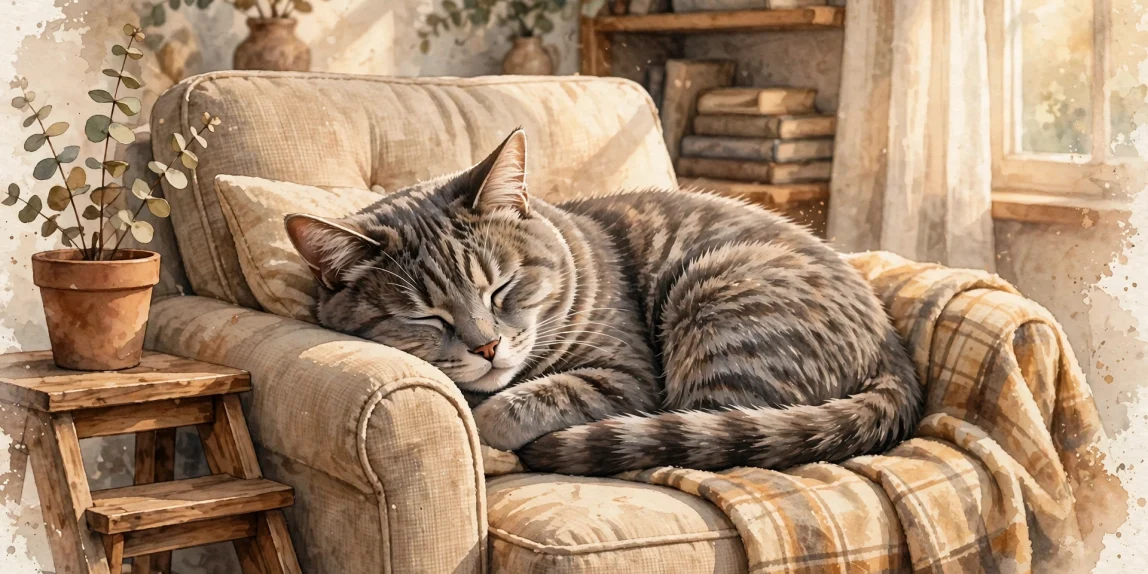
The first wish is the easiest to grant. An old cat sleeps more — where a healthy adult logs twelve to sixteen hours, the senior drifts well past that, and that is not a symptom. It is retirement. The fireside years are supposed to be mostly fireside. Grant the wish behind the wish, too: keep her company inside the sleep. She wants her person in the room, in the chair, in the ordinary arrangement — presence is the senior cat’s favorite entertainment, and it costs you nothing but sitting still, which the cat has been trying to teach you for a decade.
One caution. Sleep is also where a cat goes to hide pain, and the difference between retirement and retreat is the company test. The retired cat sleeps in the middle of things — on the good chair, in the sun patch, near the household traffic — and wakes up interested in dinner. The retreating cat sleeps in closets, under beds, in rooms with no view and no people, and is slow to be tempted out. Same hours, opposite meanings. The first is a wish granted. The second is a vet visit wearing a disguise.
MY JOINTS ACHE — THE DISEASE THAT NEVER LIMPS
The second wish is the important one, because arthritis is the great hidden condition of the old cat. When researchers X-rayed a hundred cats over the age of twelve — cats brought in for other reasons entirely — about ninety percent of them showed degenerative joint disease on the films. Ninety percent. And in almost none of their charts had anybody, owner or veterinarian, written it down. The disease is everywhere and the paperwork is empty, because cats do not perform pain the way dogs do. A dog limps theatrically and gets a diagnosis by Friday. A cat simply edits her life down to what doesn’t hurt, and calls it personality.
So learn the edited version. The arthritic cat stops jumping to the high places, or jumps in stages, counter to stool to shelf. She hesitates at the top of the stairs. She sleeps more, grooms less — the far end of her own back goes unwashed, because the twist costs too much — and she may begin missing the litter box, not from spite or senility but because stepping over a high wall has become a toll she sometimes declines to pay. She may go short-tempered about being picked up, or about a spot along the spine that used to be fine. Any one of these, arriving in an old cat, is a sentence worth reading aloud to a veterinarian.
And the veterinarian has tools: there are now pain medicines made specifically for arthritic cats, including a monthly injection, alongside joint diets and supplements worth discussing. What there is not, ever, is your medicine cabinet. Acetaminophen can kill a cat with a single pill; ibuprofen and its cousins wreck feline kidneys and stomachs. The cat’s liver cannot process what yours shrugs off. Human painkillers for a cat are not a kindness at a smaller dose. They are poison at any dose.
GIVE ME STEPS — REBUILDING THE HOUSE FOR OLD BONES
While the vet handles the chemistry, you handle the architecture, and architecture is where the second wish gets granted. Put steps or a ramp to the favorite heights — the bed, the window perch, the top of the world — so the old cat can keep her addresses without paying for them in pain. Give the litter box a low side, or cut one side down, and put a box on every floor she uses, because stairs and urgency are enemies. Raise the food and water bowls a few inches; a cat with a stiff neck and aching shoulders should not have to eat off the floor. Put night lights along her routes — old eyes adjust to darkness slowly, and the hallway at 3 a.m. is a senior obstacle course. Give her warm beds in draft-free corners, because old cats run cold and seek heat with a scholar’s dedication.
And above all: do not move the furniture. An earlier chapter mapped how your cat navigates by a memorized chart of the house; in old age that map stops being a preference and becomes the whole navigation system. The couch that moves six inches is, to failing eyes and a stiff body, a new and hostile country. Rearrange your life if you must. Leave her map alone.
MY TEETH HURT — FEED THE NOSE, SPARE THE JAW
The fourth wish arrives at the food bowl. The capstone chapter already gave the dental sermon — most cats over four carry some dental disease, and it climbs with age — so here is only the senior application of it: a mouth that hurts eats less, chews on one side, drops kibble, and may quit dry food entirely while still taking soft food eagerly. That pattern is not pickiness. It is a dental appointment asking to be made. In the meantime, feed the nose: warming food to about body temperature releases its smell, and smell is what an old cat, whose nose is also retiring, eats by. Softer food, smaller meals more often, and water — water everywhere, in more rooms than seems sane, because as the water chapter established, old cats dehydrate fastest and complain least, and every extra bowl is an argument she doesn’t have to win.
TWICE A YEAR — THE VET AS A TIME MACHINE
None of the above replaces the rhythm underneath it: from about age ten — the age the guidelines now call senior — the veterinarian stops being an annual event and becomes a twice-a-year one, with bloodwork and a blood pressure check in the rotation. A cat ages several of our years in one of hers, and the senior diseases are famous for being manageable early and miserable late. The water chapter named the warning trio — kidneys, thyroid, diabetes — and all three are caught by exactly this unglamorous schedule: a blood panel, a urine sample, a cuff on a leg, a number compared against last year’s number. You are not buying tests. You are buying the early chapter of a story that otherwise gets read to you in its final pages.
I GET CONFUSED AT NIGHT — AND SOMETIMES IT ISN’T CONFUSION
The third wish is the tender one. Old cats do get something like dementia — the researchers call it cognitive dysfunction — and it is common: studies find at least one sign of it in roughly a quarter to a third of cats between eleven and fourteen, and in more than half of cats past fifteen. Its calling card is the night: the cat awake at hours she used to sleep through — the cat-time chapter’s schedule, fraying at the edges — wandering, disoriented in a house she has known for years, and yowling, loud and lost-sounding, in the small hours.
But here is the discipline this book insists on: a new night yowl in an old cat is a vet visit first and a dementia assumption last. Pain yowls at night. A racing thyroid yowls at night. High blood pressure — the silent one, the one that can take an old cat’s eyesight — yowls at night. All three are treatable, and all three get missed when a household shrugs and says she’s just old, she’s just confused. Rule out the body’s alarms before you blame the mind. What is left, after the ruling out, is managed with patience: keep her world small, lit, warm, and exactly where she left it.
HELP ME GROOM — THE COAT, THE CLAWS, AND THE GENTLE GAME
The last wish is two wishes wearing one coat. Help me groom: the old cat cannot twist like she used to — the same stiff spine that ended the high jumps ends the full-body wash — so the far end of her goes dull and matted unless somebody takes up the brush. Take it up gently, a few minutes at a time, in the spots she can no longer reach, and make it a visit rather than a procedure. And check the claws while you are there, weekly. Old claws grow thick and brittle, get shed less, wear down less — and an unchecked old claw can curve all the way around and grow into the paw pad, a private agony in an animal who will not show you her feet. Trim the tips, or have the vet’s office do it, but do not let the calendar forget.
Play with me gently: the hunting engine outlives the chassis. The old cat still wants the game — she simply wants the senior edition of it. A wand toy moved slowly along the floor instead of leaping through the air. A short session instead of a marathon, ended while she is still winning. Play is not exercise at this age. It is proof, delivered daily, that the world is still interesting and she is still herself.
THE SCALES TELL TWO STORIES
Weigh the old cat, or at least keep honest hands on her ribs, because in the senior years the scale lies in both directions and both are messages. The fat senior is carrying her extra pounds on ninety-percent-arthritic joints; every ounce is rent charged to sore knees, and gentle slimming is joint medicine by other means. But the thin senior is the louder alarm. An old cat losing weight while eating — or eating eagerly and shrinking anyway — is reciting the warning trio again: thyroid, kidneys, diabetes, and a few darker possibilities behind them. Old cats are supposed to get dignified. They are not supposed to disappear. Weight going down in a cat over ten is never a compliment to her figure. It is a phone call.
We ask cats to grow old with us, and then act surprised at the terms. The terms are these: a slower house, a softer menu, a warmer bed, and somebody paying attention at the speed of a whisper. Pay it gladly. She paid attention to you, at full strength, for every year she had it. — YNOT!