Think of it as Yoga for the brain, we are going to stretch a bit.
THE LAST NOT-CORRUPT BRAZILIAN PRESIDENT
When you have to search through Forty Years of Scandals, Missing Money, Political Favors, and Presidential Excuses to find an honest man, there might be something wrong with the system. -- YNOT!
Some countries have a tradition of producing great scientists. Others produce great writers, musicians, philosophers, and inventors.
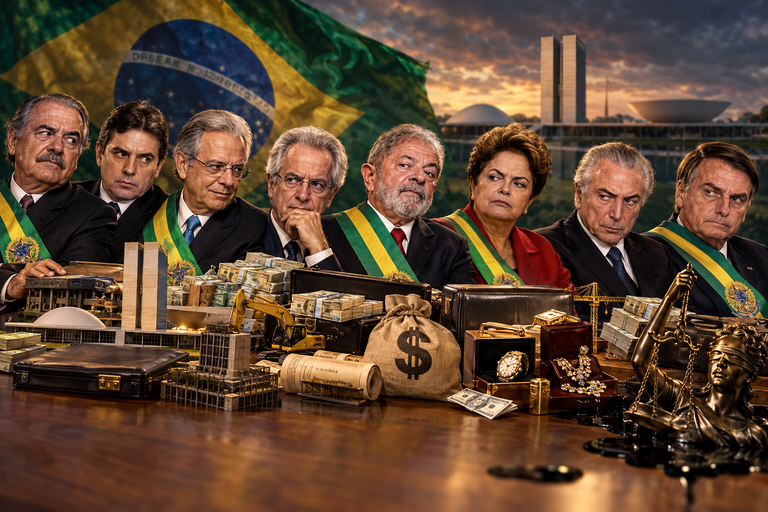
Brazil produces presidents who eventually require lawyers.
It is quite a remarkable achievement. Brazil is the world’s largest Portuguese-speaking country, possesses enormous natural resources, and has one of the largest economies on Earth. It has oil, gold, iron, agriculture, manufacturing, and enough natural wealth to make many nations envious.
Yet somehow, despite all those riches, Brazilian politics has repeatedly produced an abundance of corruption scandals.
Which raises an interesting historical question:Who was the last Brazilian president who managed to leave office without becoming personally entangled in a substantial corruption scandal?
I decided to go looking.
Surely it couldn’t be that difficult. After all, Brazil has had only eight different presidents since the restoration of civilian government in 1985.
How far back could we possibly have to travel?
As it turns out, quite a distance.
Before beginning, however, we must observe one important distinction. Being accused of corruption is not the same as being convicted. An investigation is not proof of guilt. A scandal involving members of a government does not automatically establish that the president participated.
And Brazil has produced enough accusations, convictions, overturned convictions, acquittals, and expired prosecutions to keep an entire legal profession comfortably employed.
So we shall examine the record, beginning with the present and proceeding backward.
THE PRESIDENTIAL ROLL CALL
1. LUIZ INÁCIO LULA DA SILVA — 2023 TO PRESENT
Allegations: Corruption, money laundering, improper benefits from construction companies, and political patronage.
Our journey begins with the current president, Lula da Silva.
He is an unusual figure in Brazilian history because he returned to the presidency after spending 580 days in prison.
Lula was convicted in corruption cases stemming from Operation Car Wash, the enormous investigation into bribery involving Petrobras, Brazil’s state-controlled oil company.
The allegations included receiving improper benefits from construction companies, particularly improvements to a beachfront apartment and a country property.
Prosecutors argued that these benefits were connected to corrupt arrangements involving government contracts.
Lula denied wrongdoing. In 2021, Brazil’s Supreme Federal Court annulled his convictions, finding serious legal defects, including improper jurisdiction and judicial bias. The apartment case was subsequently closed after the statute of limitations expired.
The annulments mean Lula has no valid conviction from those cases. They were not, however, a judicial determination that every alleged event had never occurred.
During his current presidency, corruption investigations have also reached individuals connected to his family, including his son. Those investigations are separate from the old Car Wash cases and do not establish wrongdoing by Lula himself.
There is something distinctly Brazilian about a political career that can travel from the presidential palace to prison and then back to the presidential palace.
In most countries, prison represents a rather serious obstacle to one’s political ambitions.
In Brazil, a favorable ruling from the Supreme Court can make the journey considerably shorter.
2. JAIR BOLSONARO — 2019 TO 2022
Allegations: Misappropriation of official gifts, money laundering, and abuse of presidential authority.
Bolsonaro was elected promising to confront the political corruption that had become synonymous with Brazilian government.
His administration subsequently faced investigations of its own.
The most direct financial allegations concerned expensive jewelry and luxury watches received as gifts from foreign governments, including Saudi Arabia.
Brazilian federal police accused Bolsonaro and associates of improperly retaining and attempting to sell valuable gifts that investigators believed belonged to the state.
Bolsonaro denied wrongdoing.
There is an important development here. In March 2026, Brazil’s prosecutor-general requested that the jewelry investigation be closed, arguing that the law governing ownership of presidential gifts was insufficiently clear to support criminal prosecution. The request did not itself constitute a final judicial acquittal.
Bolsonaro was also convicted in September 2025 for participating in a plot to overturn the 2022 election result. He received a sentence of 27 years and three months.
That conviction concerns an attempted coup, not corruption or personal financial enrichment.
This distinction matters.
One cannot take a conviction for one crime and simply substitute another because it makes a more entertaining headline.
Although, judging by modern political commentary, that practice appears to be increasingly fashionable.
3. MICHEL TEMER — 2016 TO 2018
Allegations: Bribery, influence peddling, obstruction of justice, and corrupt government contracts.
Temer became president after Dilma Rousseff’s impeachment.
He had barely settled into the presidential chair when corruption investigations began attracting considerable attention.
One famous incident involved a former presidential aide, Rodrigo Rocha Loures, who was filmed receiving a suitcase containing 500,000 Brazilian reais.
Investigators alleged that the money was connected to the JBS meatpacking company and that Temer was its intended beneficiary.
Temer denied the allegation. He also faced accusations involving improper payments connected to the Angra 3 nuclear power project.
In 2019, Temer was arrested during an investigation, although he was subsequently released.
In 2022, a federal court acquitted him of corruption and money-laundering charges in the Eletronuclear case. That acquittal should not be confused with a ruling covering every accusation ever made against him.
There is a certain elegance to the suitcase scandal. In many countries, politicians are accused of hiding money in complicated offshore structures. In Brazil, investigators sometimes encounter something considerably more traditional.
An actual suitcase. Perhaps banking technology has advanced faster than political imagination.
4. DILMA ROUSSEFF — 2011 TO 2016
Allegations: Budgetary manipulation, irregular campaign financing, and participation in an alleged political corruption organization.
Dilma Rousseff became Brazil’s first female president and succeeded Lula.
Her administration became embroiled in the Petrobras corruption scandal, although prosecutors did not establish that she personally accepted Petrobras bribes.
Rousseff was impeached in 2016 over accusations that her government had violated fiscal rules by manipulating budgetary accounts.
She denied wrongdoing and argued that her removal was politically motivated.
Her impeachment was not a conviction for personally stealing public money.
There was, however, a separate and more serious criminal allegation.
In 2017, Brazilian prosecutors accused Rousseff, Lula, and other Workers’ Party officials of participating in a criminal organization intended to facilitate corruption involving government institutions.
In December 2019, a federal judge summarily acquitted Rousseff and the other defendants in that case, finding that the prosecution had failed to establish the elements of the alleged criminal organization.
And there we have our first important discovery.
Dilma was removed from office, and corruption scandals surrounded her political party, but she was not convicted of personal corruption.
Apparently, even in Brazil, there is a difference between being an unsuccessful president, being accused of criminal conduct, and being proved guilty of it.
An important distinction that political opponents occasionally find inconvenient.
5. LUIZ INÁCIO LULA DA SILVA — 2003 TO 2010
Scandals: Mensalão vote-buying, Petrobras-related corruption, improper campaign financing, and alleged political kickbacks.
Lula’s first two presidential terms were marked by significant corruption scandals.
One of the most famous was the Mensalão scandal, which became public in 2005.
Members of Lula’s Workers’ Party were accused of arranging regular payments to allied legislators in exchange for congressional support.
In other words, a political system in which convincing a legislator to vote for your legislation allegedly involved less persuasion and more financial encouragement.
Several senior political figures were subsequently convicted, including Lula’s former chief of staff, José Dirceu.
Lula himself was not charged in the Mensalão prosecution.
Other corruption allegations involving Lula emerged after he left office, eventually producing the Car Wash convictions discussed earlier.
Those convictions were annulled in 2021.
There is something wonderfully ironic about politicians who promise to represent the working class while their political organizations are investigated for arrangements involving millions of dollars.
Ordinary workers must generally earn their money through actual work.
Politics offers alternative methods of acquiring financial support.
Not all of them are legal.
6. FERNANDO HENRIQUE CARDOSO — 1995 TO 2002
Allegations: Vote-buying connected to presidential reelection and irregular campaign contributions.
Now we arrive at Fernando Henrique Cardoso.
An economist and academic, Cardoso helped establish the economic policies that stabilized Brazil’s currency.
But even his administration encountered serious allegations.
In 1997, Brazil changed its constitution to permit presidents to seek consecutive reelection.
Soon afterward, recordings emerged in which legislators discussed receiving payments to support the constitutional amendment.
According to Brazilian congressional records, two deputies said they had received 200,000 reais each.
The scandal involved allegations against politicians and government allies, including Cardoso’s communications minister.
Cardoso denied personal involvement, and contemporaneous reporting did not establish that he personally authorized the payments.
Years later, former Odebrecht executives also made allegations about improper campaign contributions associated with Cardoso’s presidential campaigns. Those allegations did not result in a criminal conviction against him.
Think about the remarkable circumstances.
A constitutional amendment was supposed to improve Brazil’s democratic system by permitting reelection.
Instead, the process became associated with allegations that some legislators had been paid to support the change.
Democracy is supposed to be a system in which the people choose their representatives.
It becomes a considerably different arrangement when representatives are accused of selling their votes after the people elect them.
Nevertheless, Cardoso himself was not convicted of corruption.
Which brings us farther back.
7. ITAMAR FRANCO — 1992 TO 1994
Government scandal: The Budget Dwarves affair involving the diversion of congressional budget funds.
At last, we reach Itamar Franco. Franco assumed the presidency following the collapse of Fernando Collor’s administration.
Unlike several of his successors, Franco had an established public reputation for personal honesty. Contemporary newspaper profiles emphasized his integrity, and he was widely regarded as a politician who had not personally benefited from corrupt arrangements.
But his presidency was not entirely free of scandal.
During his administration, Brazil experienced the notorious Anões do Orçamento, or Budget Dwarves, affair.
Members of Congress were accused of manipulating federal budget allocations and directing public money toward fraudulent organizations and favored contractors.
The scandal produced congressional investigations and accusations involving substantial public funds.
Crucially, the scandal concerned legislators and related figures, not a proven personal bribery scheme involving Franco.
Franco also presided over the introduction of the Real Plan, which helped bring Brazil’s devastating inflation under control.
And something interesting happened when researchers and journalists examined his personal conduct.
They frequently described him as honest.
Not perfect.
Not necessarily a great political visionary.
But personally honest.
That, by Brazilian presidential standards, was becoming a rather noteworthy qualification.
If the question is where our search first reaches a president with a widely documented reputation for personal probity, without a comparable substantiated personal corruption case, Itamar Franco is a defensible stopping point.
But it would be unfair to the historical record to stop there without examining the men who came before him.
Because Brazil’s political troubles certainly did not begin in 1995.
8. FERNANDO COLLOR DE MELLO — 1990 TO 1992
Allegations: Influence peddling, improper payments, corruption, and money laundering.
Fernando Collor entered office promising to clean up Brazilian politics.
Then his own brother accused him of benefiting from a corrupt influence-peddling network involving campaign treasurer Paulo César Farias.
The scandal triggered nationwide protests and impeachment proceedings.
Collor resigned in December 1992.
In 1994, Brazil’s Supreme Court acquitted him in the criminal case arising from that original scandal because the evidence was insufficient.
But his legal troubles did not end there.
In a separate case involving events after his presidency, when he was a senator, Collor was accused of receiving approximately 30 million reais in bribes connected to BR Distribuidora, a former Petrobras subsidiary.
In 2023, the Supreme Court convicted him of corruption and money laundering and sentenced him to eight years and ten months in prison.
He was arrested in April 2025 to begin serving that sentence.
Collor’s political career offers an intriguing cautionary tale.
He entered the presidency promising to fight corruption.
He left amid corruption allegations.
Decades later, he was convicted in an entirely separate corruption case.
Apparently, fighting corruption and remaining free of corruption accusations are two quite different occupations.
9. JOSÉ SARNEY — 1985 TO 1990
Allegations: Political patronage, misuse of public resources, improper political financing, and corruption involving Transpetro.
José Sarney became Brazil’s first civilian president after the military regime.
His administration was investigated amid allegations of political favoritism, administrative irregularities, and misuse of federal resources.
A congressional investigation in 1988 examined alleged corruption involving ministers and presidential associates.
Investigators described politically motivated allocations of public funds, although they did not establish that Sarney personally received bribes in that inquiry.
Decades later, prosecutors accused Sarney of involvement in improper payments connected to Transpetro, a Petrobras subsidiary.
Those allegations concerned activities long after his presidency.
The prosecution was eventually terminated in 2019 because the applicable limitation period had expired.
Another investigation, concerning alleged attempts to obstruct Operation Car Wash, was closed for insufficient evidence.
Sarney arrived promising to guide Brazil into a new democratic era.
Unfortunately, changing a country’s political system does not automatically change the habits of everyone operating inside it.
Brazil had returned to civilian democracy.
Its corruption problems had not disappeared.
SO, WHO WAS THE LAST ONE?
After examining the modern presidential record, the name that stands out is Itamar Franco. Not because every politician in his administration was honest.
They weren’t. Not because his government was entirely free of corruption scandals.
It wasn’t. And certainly not because there exists some magical certificate proving that a politician has never done anything improper.
No such certificate exists.
But unlike the presidents surrounding him in this historical examination, Franco was repeatedly described by contemporary observers as a personally honest politician, and the record examined here does not establish a comparable personal bribery or embezzlement case against him.
That is not a judicial declaration that every other president was corrupt. Indeed, several were acquitted, never charged, or had their convictions invalidated.
It is simply an observation about how frequently corruption allegations have intersected with Brazil’s presidency.
And that observation raises a larger question.
WHEN CORRUPTION BECOMES PART OF THE POLITICAL SYSTEM
There is a point at which corruption ceases to appear exceptional and begins to seem like part of the political landscape.
Consider the recurring pattern. A politician promises to eliminate corruption.
He is elected. He appoints ministers, establishes alliances, and distributes positions throughout government.
Then come allegations involving public contracts, political financing, government appointments, or payments to legislators.
Sometimes the allegations are supported by evidence. Sometimes they collapse in court.
Sometimes the defendants are convicted.
Sometimes the clock simply runs out before the judicial system reaches a final determination.
And through it all, the machinery of government continues operating.
The underlying problem is larger than any individual president.
Brazil’s political institutions have long had to contend with coalition bargaining, patronage networks, opaque campaign financing, and enormous opportunities for private interests to profit from government decisions.
Petrobras became a particularly visible example because of its enormous economic importance.
But oil is hardly the only source of temptation.
Infrastructure, energy, transportation, construction, public financing, and government procurement can all create opportunities for dishonest arrangements.
Whenever politicians control access to contracts and financial resources, there is a risk that someone will attempt to turn public authority into private profit.
The problem is not uniquely Brazilian.
It is as old as government itself. The Romans had it.
The French had it. The Americans have had it.
And Brazil, blessed with substantial natural resources and a complicated political system, has experienced its own particularly expensive variations.
THE LAWYERS, THE CLOCK, AND THE COURTS
One of the most frustrating aspects of these scandals is how difficult it can be for ordinary citizens to distinguish the truth from political theater.
A president is accused. Headlines appear. Prosecutors announce investigations.
A judge may issue a conviction. Another court may overturn it. Years pass.
The statute of limitations expires. Eventually, everyone involved announces some version of victory.
The prosecution says the original allegations were serious.
The defense says the accused was vindicated.
The political opposition says the justice system failed.
And the public is left wondering what actually happened.
The legal distinctions are important. Courts must respect due process, impartiality, jurisdiction, and evidentiary requirements.
Without those protections, corruption investigations themselves can become instruments of political persecution.
But legal complexity also creates an unfortunate public spectacle in which the resolution of a case may have little resemblance to the simplicity of the original accusation.
To the ordinary citizen, it can resemble a sporting event where the final score is announced twenty years after the players have retired.
And sometimes the game ends because the clock has run out.
THE REAL TRAGEDY IS NOT THE POLITICIANS
Corruption has victims, even when those victims never learn precisely where the money went.
It is the taxpayer who finances the government contract.
The commuter who waits for the transportation project that never gets finished.
The patient whose hospital lacks equipment. The student attending a deteriorating school.
The small businessman who cannot compete against a company with political connections.
When public money is stolen or contracts are improperly awarded, someone eventually pays.
Usually someone who had absolutely nothing to do with the arrangement.
And that is what makes political corruption so destructive.
It is not merely a question of whether a president personally received a payment.
It is whether government institutions serve the public or become instruments for distributing benefits to the politically connected.
A president can be personally honest while overseeing a government troubled by corruption.
A president can also be falsely accused. And a president can be convicted only to have that conviction lawfully overturned.
These distinctions are precisely why serious investigations and independent courts matter.
THE FINAL QUESTION
We began with a simple question:
Who was the last Brazilian president without a substantial, documented personal corruption case comparable to those that have surrounded so many modern presidents?
Our historical search brought us to Itamar Franco, who governed from 1992 to 1994.
That is more than thirty years ago. His administration was not scandal-free, but his personal reputation was markedly different from the corruption controversies that later dominated Brazilian politics.
The larger lesson is not that every Brazilian president since Franco has been proven corrupt. The legal record clearly does not support that conclusion.
It is that corruption allegations have become so familiar in Brazilian presidential politics that a president’s reputation for personal honesty can seem like a historical curiosity.
Perhaps Brazil’s next great political innovation will be a president whose accomplishments are remembered more vividly than the investigations involving his administration.
That would be a welcome development.
After all, a country with Brazil’s enormous potential deserves a political system where honesty is not treated as a rare historical discovery.
And perhaps one day, when a Brazilian president leaves office, the most interesting question will be what he accomplished—not what the prosecutors are investigating.
And before someone rushes to tell me that the United States is just as corrupt, let me save them the trouble. Not even close. America certainly has its share of political scandals, but when it comes to the Olympics of Corruption, Brazil has practically made winning the gold medal a national tradition. In fact, if corruption were an Olympic sport, Brazil would probably find a way to bribe the judges just to make sure it won.
As for the United States and its own peculiar brand of political corruption—well, that is a story for another day.
DISCLAIMER Research conclusion: Itamar Franco is the strongest historical reference for the column’s premise, but it would be inaccurate to declare all his successors personally corrupt. The documented record distinguishes accusations against individual presidents, corruption within their administrations, acquittals, convictions, and cases that were annulled or time-barred. We tried to be accurate as possible if you disagree please let us know.