Think of it as Yoga for the brain, we are going to stretch a bit.
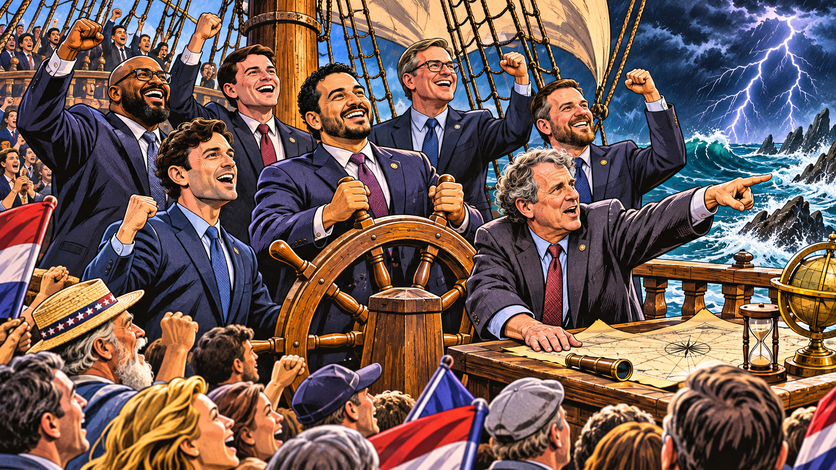
SHIP OF FOOLS THEORY – How Democracy Works
The trouble with democracy is not that fools are allowed to vote. It is that fools, wise men, scoundrels, and geniuses all get one vote apiece — and the fellow who promises the most usually gets to steer. --YNOT!
THE SHIP THAT EVERYBODY OWNS, BUT NOBODY KNOWS HOW TO SAIL
Imagine, if you will, a magnificent ship.
Not just any ship, but the greatest ship ever built. It has powerful engines, enormous sails, enough provisions to feed thousands, and a crew drawn from every walk of life.
The passengers come from different backgrounds. Some are rich, some poor, some educated, and some possess an education that seems to have done them precious little good.
Some have worked aboard ships all their lives. Others have never seen the ocean, except from the safety of a beach chair with a cold drink in their hands.
But every passenger owns an equal share of this magnificent vessel.
And every few years, they gather to elect a captain.
A noble arrangement, you might think.
The trouble begins when someone asks a rather inconvenient question:
Shouldn’t the captain know how to sail?
You would imagine this to be the first qualification.
Unfortunately, it is not.
One candidate steps forward with thirty years of maritime experience. He has studied navigation, understands the weather, knows the machinery, and has survived storms that would send an ordinary man running for his mother.
He explains that the voyage will be difficult.
There are dangerous reefs ahead. The weather is unpredictable. The engines need maintenance. Supplies must be conserved. And if the passengers want to reach their destination safely, everyone will have to make sacrifices.
His opponent steps forward. He has never captained a ship.
He couldn’t tell a compass from a dinner plate.
But he has magnificent hair, a beautiful smile, and a voice that could persuade a fish to purchase swimming lessons.
He promises sunshine every day. Free meals for everyone.
No taxes on the voyage. A shorter journey.
And, should the passengers elect him, he personally guarantees that the ocean will cooperate.
The passengers erupt in applause.
The experienced navigator tries to explain that no captain controls the weather.
The crowd boos.
The inexperienced candidate announces that the navigator is spreading fear and negativity.
More applause. Someone starts chanting. Someone else sells hats.
A committee forms to investigate the navigator’s political affiliations.
And when the votes are counted, the fellow who knows nothing about sailing wins by a comfortable margin.
Welcome aboard the Ship of Fools. Next stop: democracy.
Destination: wherever the wind takes us.
PLATO SAW THIS COMING 2,400 YEARS AGO
The ancient Greek philosopher Plato understood this peculiar human weakness long before television, social media, political consultants, or professional pollsters existed.
In The Republic, Plato described a ship whose sailors fight over the captaincy while ignoring the person who actually understands navigation.
The sailors know how to compete for control. They know how to flatter the shipowner.
They know how to organize factions, manipulate opponents, and seize the helm.
What they don’t know is how to sail.
The true navigator, meanwhile, studies the stars, the seasons, the winds, and the instruments required to guide the vessel.
Naturally, the sailors regard him as useless.
After all, what good is a man who knows how to steer when he doesn’t know how to win an election?
Plato wasn’t merely entertaining his students with a charming nautical story.
He had witnessed the political disasters of ancient Athens.
He lived in a society that celebrated public participation but could be swayed by persuasive orators, political rivalries, and disastrous collective judgments.
The Athenian expedition against Sicily became one of the most infamous military catastrophes of the ancient world.
Ambition, political persuasion, strategic miscalculation, and imperial overconfidence helped carry Athens into a disastrous campaign.
The city that proudly celebrated its collective wisdom discovered that a majority vote does not magically transform a foolish decision into a wise one.
The ocean does not care how many people voted to ignore the storm.
And neither does reality.
Plato’s great concern was that democracy could confuse persuasion with knowledge, popularity with wisdom, and public applause with sound judgment.
He was right to worry. But as we shall discover, his proposed cure was nearly as troublesome as the disease.
INTELLIGENCE IS NOT CHARISMA — BUT CHARISMA WINS ELECTIONS
Consider a question that ought to trouble every voter.
Why do we demand qualifications for almost every important profession except the one that governs the entire nation?
A physician must study medicine. A pilot must learn to fly.
An engineer must understand the forces that keep a bridge from falling into the river.
Even your neighborhood barber requires training and a license.
But someone seeking enormous political power may be judged principally by whether people like the sound of his voice.
Certainly, constitutional systems establish eligibility requirements for public office.
But eligibility is not the same thing as competence.
A person can satisfy every legal qualification to become president while possessing less understanding of economics than the fellow who repairs the office photocopier.
And there is no guarantee that a lifetime spent winning elections produces any particular talent for governing.
Winning elections and governing nations are two fundamentally different occupations.
Campaigning rewards telling voters what they want to hear.
Governing sometimes requires telling voters exactly what they don’t want to hear.
And there lies democracy’s uncomfortable contradiction.
We select our leaders through a competition that rewards many qualities other than the ones required to do the job.
It’s rather like selecting a surgeon based on his performance in a singing contest.
He might possess a magnificent voice.
But I would prefer someone who knows where my liver is.
THE SCIENCE OF ELECTING A FACE
If you think voters are too sophisticated to choose leaders based on appearance, science has some rather unpleasant news.
In 2005, Princeton researchers published a study examining how people judged political candidates from photographs.
Participants made rapid judgments about which faces appeared more competent.
Remarkably, those judgments predicted the winners in roughly seven out of ten races in some of the elections studied.
The participants didn’t need to know the candidates’ policies.
They didn’t need to examine their records.
They didn’t even need to know their names.
A face was enough to make a prediction substantially better than chance.
Now, this does not prove that voters make every political decision based on a handsome jawline. But it does suggest that appearances are powerful signals in a process supposedly devoted to evaluating ideas.
Then researchers in Switzerland conducted another revealing experiment.
They showed children photographs of political candidates and asked them to select the person they would prefer as captain of a boat.
The children had no idea they were looking at politicians.
Yet their selections predicted actual election outcomes. Think about that.
Children choosing a pretend boat captain and adults choosing political leaders showed disturbingly similar patterns.
Perhaps we shouldn’t be surprised. Human beings are social creatures.
We instinctively respond to confidence, facial expressions, posture, familiarity, and authority.
A confident speaker makes us comfortable.
A hesitant speaker makes us suspicious.
A simple explanation makes us feel informed.
A complicated explanation reminds us how little we understand.
And very few people enjoy being reminded of their ignorance.
So we naturally gravitate toward the fellow who announces that everything is simple.
Especially when he promises that solving the problem won’t cost us anything.
THE MAN WHO KNOWS EVERYTHING KNOWS NOTHING
One of the most dangerous men in politics is the fellow who has an immediate answer to every question.
Ask him about inflation. Simple.
Immigration. Simple.
International trade. Simple.
Healthcare. Simple.
National debt. Simple.
War and peace. Very simple.
Apparently, civilization has been struggling for thousands of years because nobody thought to ask this remarkable gentleman.
He knows exactly what is wrong. He knows precisely who is responsible.
And he assures us that everything can be fixed almost immediately.
Usually by placing him in charge.
The experienced economist, meanwhile, explains that inflation has multiple causes, policies involve trade-offs, and some proposed solutions could produce serious unintended consequences.
The crowd yawns. The charismatic candidate declares that he will make everything cheaper. The crowd cheers.
The economist starts explaining supply constraints.
Someone throws a tomato. And democracy marches proudly forward.
Psychologists have studied how people can overestimate their understanding of subjects in which they have limited expertise.
But the political problem runs deeper than individual overconfidence.
It is not simply that some politicians don’t understand what they don’t know.
It is that the political marketplace often rewards them for acting as though they know everything.
A candidate who acknowledges uncertainty may appear weak.
A candidate who expresses doubt may appear unprepared.
A candidate who changes his position after examining new evidence may be accused of inconsistency.
Meanwhile, the politician who repeats the same foolish idea for twenty years is praised for his principles.
We have created a strange world in which intellectual flexibility is considered weakness and stubborn ignorance is celebrated as leadership.
THE SOPHISTS HAVE RETURNED — WITH TELEVISION STUDIOS
The ancient Greeks had a name for professional persuaders.
They called them sophists. Many sophists were skilled teachers of rhetoric and argument. Plato, however, criticized those who used persuasive technique without sufficient concern for truth. He recognized something that remains painfully relevant today.
A person can become extraordinarily skilled at winning arguments without becoming particularly skilled at understanding reality.
Modern politics has industrialized this talent. We now have consultants who determine which words politicians should use. Pollsters who determine which opinions are popular.
Public relations specialists who manufacture favorable impressions.
Speechwriters who transform ordinary men into apparent visionaries.
And media professionals whose principal occupation is making sure their preferred side looks intelligent while the other side looks criminally insane.
Political campaigns employ people who understand human behavior exceptionally well.
Unfortunately, understanding how to persuade voters is not the same thing as understanding how to govern them.
A modern campaign can resemble a billion-dollar advertising agency attached to a political candidate.
Every word is measured. Every expression is rehearsed. Every controversy is tested for public reaction. Every complicated problem is reduced to something that will fit comfortably on a bumper sticker.
The average citizen receives political information packaged like a commercial for laundry detergent.
Our candidate restores prosperity! Our candidate makes the country safe!
Results may vary. Actual governance sold separately.
And unlike laundry detergent, there is rarely a convenient refund policy.
THE TELEVISION CANDIDATE BECOMES THE INTERNET CANDIDATE
The arrival of television fundamentally changed the presentation of political candidates.
When John F. Kennedy and Richard Nixon appeared in their famous 1960 presidential debates, Americans could judge their words, expressions, posture, and appearance simultaneously.
Kennedy looked comfortable before the cameras.
Nixon appeared less at ease during their first televised encounter.
A popular story claims Nixon won among radio listeners while Kennedy won among television viewers, although the evidence for that neat distinction is disputed.
Nevertheless, the larger historical development is undeniable.
Politics had entered the television age.
Candidates were no longer simply public speakers.
They were television personalities. Then came the internet.
Then social media. Then the political influencer.
And finally, the modern miracle of transforming a fifteen-second video clip into an apparently complete understanding of national policy.
Today, a politician can deliver an intelligent two-hour discussion about economics and receive modest attention.
But let him insult somebody, make an outrageous declaration, or produce a memorable facial expression, and millions of people may see it before lunch.
The algorithms do not possess a particular interest in competent government.
They are designed to capture attention. And human attention has always been unusually attracted to conflict, outrage, scandal, and spectacle.
We once worried that television was turning elections into beauty contests.
Now we have added a talent show, professional wrestling, and a circus.
And we wonder why the clowns are doing so well.
DEMOCRACY’S MOST PROFITABLE PRODUCT: THE IMPOSSIBLE PROMISE
A politician’s most valuable possession is not intelligence.
It is the ability to promise something that sounds wonderful without explaining how it will be accomplished.
Consider the perfect political campaign.
We will reduce taxes. Increase spending. Eliminate debt. Improve every government service. Raise wages. Lower prices. Protect every industry. Make everyone prosperous.
And accomplish all of this without inconveniencing anybody.
The crowd goes wild. An economist raises his hand.
“Excuse me, but how will you pay for everything?”
A campaign manager quickly identifies him as an enemy of progress.
The economist is escorted from the room. The candidate promises another tax cut. And the applause becomes deafening. The beauty of political promises is that they can be issued today while the consequences may not become apparent for years.
And when those consequences finally arrive, a politician can always blame his predecessor, his successor, the opposition, the economy, the weather, or some foreign country.
Responsibility is remarkably easy to distribute when nobody wishes to accept any.
We have developed an elaborate system in which every politician takes credit for sunshine and blames the other party for rain.
A successful politician knows how to sell tomorrow. A successful statesman knows how to prepare for it.
Unfortunately, tomorrow doesn’t vote. People do.
THE POLITICAL PARTY — WHERE THINKING GOES TO RETIRE
Here is another uncomfortable truth.
Most citizens do not independently examine every important political issue.
They rely upon political parties, trusted commentators, newspapers, friends, family, and familiar ideological communities.
This is understandable.
Nobody has enough time to become an expert in economics, constitutional law, military strategy, environmental policy, healthcare, international relations, and every other subject that government touches.
We have families to raise. Businesses to operate. Bills to pay.
And occasionally, if fortune smiles upon us, a little time to enjoy life.
So we take shortcuts. We identify with a political party.
Then we begin viewing political arguments through the comforting lens of that affiliation.
When our party does something questionable, we search for an explanation.
When the opposing party does precisely the same thing, we search for a prison sentence.
A political scandal committed by our candidate becomes a misunderstanding.
The identical scandal committed by his opponent becomes evidence of a conspiracy against civilization.
Our politicians change positions because they have evolved.
Their politicians change positions because they are dishonest.
Our candidates are passionate. Their candidates are dangerous extremists.
Our side defends democracy. Their side threatens democracy.
And both sides can become so consumed with defeating each other that they forget the ship belongs to everybody aboard.
I suspect that if the vessel were sinking, half the passengers would blame the port side while the other half blamed the starboard.
Neither group would bother to inspect the hole. Because admitting that the ship is sinking would require both parties to agree on something.
And that would be politically unacceptable.
WHEN DEMOCRACY GETS TIRED OF ITSELF
Plato feared something even more dangerous than bad political leadership.
He feared that democracy could eventually destroy the very freedoms that made it possible. His reasoning was disturbing. When political competition becomes a contest of extravagant promises, public frustration grows.
When institutions fail to deliver what politicians promise, citizens become angry.
When government becomes paralyzed by factional conflict, citizens become exhausted.
And when enough people conclude that democracy produces nothing but arguments, confusion, and disappointment, they may begin searching for a strong leader who promises to end the disorder.
Enter the man who claims to possess all the answers.
He promises to defeat corruption. Punish the guilty. Restore national greatness.
Eliminate political obstruction. And accomplish what ordinary politicians have failed to achieve.
There is often a catch. He requires more power.
He must be freed from inconvenient restrictions.
He must be protected from hostile institutions.
He must be permitted to overcome those who stand in the way of progress.
And eventually, a population exhausted by political conflict may begin surrendering safeguards that earlier generations considered essential.
The history of the Roman Republic offers a warning about the dangers of political violence, personal ambition, institutional weakness, and concentrated power.
Julius Caesar was hardly an ignorant amateur. He possessed extraordinary political and military ability.
But ability alone did not preserve republican government.
Indeed, extraordinary ability combined with extraordinary personal power can become a formidable threat to constitutional institutions.
The Roman Republic did not disappear because its citizens were uniquely foolish.
Its collapse involved decades of conflict, violence, elite competition, and institutional erosion.
And its eventual replacement demonstrated something important.
People who become desperate for order may accept forms of power they once would have rejected.
A frightened population can mistake the promise of stability for the preservation of liberty.
Democracy can survive ordinary political disagreement.
What it cannot survive indefinitely is a public that stops believing its principles apply when their preferred side loses.
PLATO’S SOLUTION — LET THE WISE MEN RULE
Plato believed the best government would be directed by philosopher-kings.
Individuals educated extensively in philosophy, mathematics, ethics, and the principles of good government.
People who loved wisdom more than wealth.
Knowledge more than popularity. Justice more than power.
It is an attractive proposition. Until someone asks: Who decides which men are wise?
There is the problem.
If the people cannot be trusted to select a competent captain, who gets to select the committee that selects one?
And what happens when the supposedly wise captain becomes corrupt?
Or arrogant? Or convinced that his superior intelligence entitles him to disregard everyone else?
History has provided no shortage of rulers who considered themselves exceptionally enlightened. Some of them produced exceptionally large cemeteries.
But expertise without accountability can become arrogance.
Intelligence without morality can become manipulation.
And authority without limits can become tyranny.
The philosopher-king may understand navigation.
But if he decides to sell the passengers into slavery, his impressive knowledge of the stars offers them precious little comfort.
This is where Plato’s diagnosis remains more convincing than his prescription.
Democracy is certainly capable of selecting incompetent leaders.
But replacing popular government with unaccountable experts does not guarantee wisdom.
It merely changes who gets to make the mistakes.
And potentially removes the public’s ability to correct them.
CHURCHILL AND THE LEAST BAD SYSTEM
Winston Churchill famously described democracy as the worst form of government, except for the alternatives that had been tried.
The remark endures because it captures a central political truth.
Democracy does not guarantee competent leadership. It does not guarantee honest politicians. It does not guarantee intelligent policies. It does not guarantee that the majority will make wise decisions.
What democracy can provide, when its institutions function properly, is something extraordinarily valuable.
The opportunity to remove leaders without removing their heads.
The ability to challenge government without committing treason.
The freedom to criticize political authority.
And a mechanism through which citizens can replace those who fail them.
These are not small achievements.
For much of human history, political succession involved armies, assassinations, royal bloodlines, imprisonment, and wars.
A peaceful transfer of power may appear rather ordinary to modern citizens.
Historically, it is anything but ordinary.
The great virtue of democracy is not that it consistently produces the best rulers.
It is that it can allow society to replace bad rulers without destroying itself in the process.
Of course, that virtue depends upon citizens, leaders, and institutions accepting the rules of the system even when the outcome disappoints them.
And that requires more wisdom than many politicians are willing to demonstrate.
THE REAL PROBLEM IS NOT THE CAPTAIN — IT IS THE PASSENGERS
Now we arrive at the part of this story that may offend nearly everybody.
The politicians are not entirely responsible for the condition of democracy.
Neither are the political parties. Nor the media. Nor the consultants. Nor the wealthy donors.
Nor the professional persuaders who spend their careers telling the public what it wants to hear.
Those people certainly bear responsibility. But democracy contains an uncomfortable feature. The passengers choose the captain.
And when we repeatedly choose candidates because they flatter our prejudices, entertain our anger, or promise us benefits without consequences, we cannot reasonably pretend to be astonished by the results.
We say we want honesty.
But punish politicians who deliver inconvenient truths.
We say we want competence. But frequently reward theatrical confidence.
We say we want unity. But applaud those who insult our political enemies.
We say we want responsible government. But demand spending increases and tax reductions without seriously considering the arithmetic.
We complain that politicians lie. Then reward the politicians who tell us the lies we most enjoy hearing.
A democracy cannot become substantially wiser than the political behavior it rewards.
And the public is not an innocent spectator in this arrangement.
It is a participant. We do not need every voter to possess a doctorate in economics.
We do not need every citizen to understand international trade agreements or military procurement. But we should expect citizens to recognize the difference between an argument and a slogan.
Between evidence and enthusiasm.
Between a record of accomplishment and a magnificent speech.
Between a difficult truth and a comfortable fantasy.
A responsible voter does not need to know everything.
But he should recognize when a candidate appears to know nothing.
And perhaps, just perhaps, we should become a little more suspicious of anyone who claims that every national problem has an obvious solution that only he has been clever enough to discover.
A BETTER WAY TO CHOOSE THE CAPTAIN
So how do we improve democracy without destroying the very freedoms that make it worth preserving?
I propose we begin with something unfashionable. Common sense.
Before trusting a candidate with public power, examine what he has actually accomplished. Not merely what he promises. Not how impressively he speaks.
Not how enthusiastically his supporters applaud.
What has he done?
Has he demonstrated judgment?
Has he managed serious responsibilities?
Does he understand the limitations of government?
Can he explain a difficult problem without inventing imaginary enemies?
Can he acknowledge mistakes?
Can he change his mind when facts change?
Can he surround himself with knowledgeable people without treating their expertise as a personal threat?
And, perhaps most importantly:
Does he understand that governing a nation is a responsibility rather than a personal reward?
We should also be wary of confusing formal credentials with competence.
A collection of diplomas does not guarantee wisdom.
A lifetime in government does not guarantee integrity.
And a person without traditional political experience is not automatically incapable.
Some brilliant leaders have entered public service from other professions.
Some career politicians have managed to spend decades in office without demonstrating any unusual talent beyond getting reelected.
The measure should be judgment, character, knowledge, achievement, and respect for constitutional limits. Not simply popularity. And not simply academic pedigree.
Experts should be expected to explain themselves clearly and submit their ideas to scrutiny.
Voters should be willing to listen. Politicians should be judged by results.
And political institutions should be strong enough to withstand the ambitions of any individual who happens to occupy high office.
That would not create a perfect democracy.
But it might produce a more seaworthy one.
THE MOST DANGEROUS PASSENGER IS THE ONE WHO REFUSES TO THINK
It is fashionable to blame democracy’s problems on ignorance.
But ignorance is not necessarily the greatest danger.
We are all ignorant about something.
The physician knows more about medicine than the mechanic.
The mechanic knows more about engines than the physician.
The economist understands markets better than the farmer.
The farmer may understand the realities of food production better than the economist.
Civilization succeeds because knowledge is distributed.
We depend upon one another.
The danger begins when people become unwilling to recognize the limits of their own understanding.
When political loyalty becomes more important than truth.
When disagreement becomes evidence of evil.
When a citizen refuses to examine facts because those facts might embarrass his favorite politician.
When the desire to win an argument becomes stronger than the desire to discover what is correct.
A person who does not know something can learn.
A person who mistakenly believes he knows everything has already closed the schoolhouse.
And a nation filled with people who refuse to learn is a very difficult ship to steer.
Especially when every passenger insists that he ought to be captain.
THE FINAL VOYAGE
So here we are, twenty-four centuries after Plato warned about the ship.
The ocean remains dangerous. The storms remain unpredictable. The machinery has become more complicated. The cargo has become more valuable.
And the consequences of selecting the wrong captain have become considerably greater.
We possess more information than any civilization in human history.
We can access extraordinary collections of human knowledge in seconds.
We have universities, research institutions, scientific discoveries, historical records, and technologies that would have appeared supernatural to the ancient Greeks.
Yet we remain remarkably susceptible to a handsome face, a confident voice, an attractive promise, and a convenient enemy.
We still confuse popularity with competence. We still confuse confidence with knowledge.
We still confuse winning an election with possessing the wisdom necessary to govern.
And we still allow political parties to convince us that the greatest danger aboard the ship is not the storm, the deteriorating engines, or the incompetent captain.
It is the passengers sitting on the other side. Perhaps the fundamental weakness of democracy is not that ordinary people possess the right to choose their leaders.
That right is worth defending.
Perhaps its weakness is that we too often exercise that right with the seriousness of an audience selecting the winner of a television talent show.
We cheer the loudest performer. We applaud the finest promises. We dismiss the warnings. And when the ship begins taking on water, we demand an investigation into who allowed the ocean to become so wet.
Plato thought the answer was to place philosophers at the helm.
I suspect a better answer is to teach the passengers how to recognize a competent navigator.
Because in a democracy, the passengers cannot escape responsibility for the voyage.
They own the ship. They select the captain. They pay for the fuel. They bear the consequences.
And when the vessel reaches the rocks, the water does not distinguish between Republicans and Democrats, conservatives and liberals, the wealthy and the poor.
Everyone gets wet.
The greatest danger to democracy is not that fools can become captains. It is that the passengers may become so devoted to their favorite fool that they refuse to notice the ship is sinking.
And the saddest part?
When the captain announces that the ship is not sinking but merely experiencing an unexpected opportunity for underwater navigation, half the passengers may stand and applaud.
The other half will accuse him of stealing their idea.
And somewhere below deck, the navigator will be quietly searching for a lifeboat.
FINAL THOUGHT
“Democracy is a marvelous invention. It allows every man a voice in choosing the captain, including those who cannot swim, cannot read a compass, and believe the ocean is a conspiracy. The tragedy is not that they may choose poorly. It is that, after voting to sail directly into a hurricane, they will spend the rest of the voyage blaming the weather.”
And that, ladies and gentlemen, is how democracy works.
Welcome aboard the Ship of Fools.
Life jackets are available. But only after a committee determines whether their distribution would be politically fair.