Think of it as Yoga for the brain, we are going to stretch a bit.
SO WHAT HAPPENS NEXT? Trump vs. the Democrat Congress
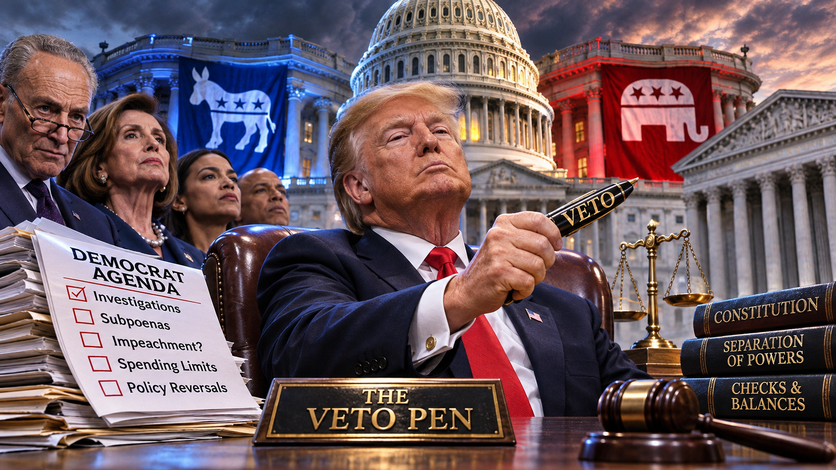
The Democrats Won the Election. Trump Still Holds the Veto Pen. And Washington Is About to Discover the Difference Between Winning Power and Exercising It. -- YNOT!
There is an old political truth that Washington discovers every few years, usually after spending several billion dollars learning it the hard way:
Winning an election is one thing. Governing afterward is quite another.
And so here we are.
The great Democratic wave of 2026 has arrived, washing Republicans out of the House of Representatives, sweeping them from control of the Senate, and leaving President Donald J. Trump standing in the White House like a stubborn old sea captain whose crew has just voted to throw him overboard.
Unfortunately for the crew, the captain still controls the engine room.
The Democrats are celebrating. Republicans are licking their wounds. Political commentators are announcing the end of Trumpism for approximately the seventeenth time.
And Donald Trump? He is apparently shopping for a new hat. This one says VETO.
It is a remarkably appropriate accessory for a man who has spent a lifetime turning the word no into a negotiating strategy.
But the question Americans should be asking is not whether Democrats won the election.
They did. Nor is it whether Republicans received a political beating.
They most certainly did. The question is considerably more interesting:
What happens when an opposition party wins control of Congress but discovers that the president it intends to defeat still possesses enough constitutional power to frustrate almost everything it wants to accomplish?
Welcome to the next two years of American politics.
It promises to be an entertaining spectacle, provided you do not require your government to accomplish very much.
THE BLUE WAVE — AND THE RED STOP SIGN
The election results were not subtle.
Democrats captured both chambers of Congress, flipping at least seven Republican-held Senate seats and winning dozens of House districts.
In the Senate, Iowa, Kansas, Ohio, Maine, North Carolina, South Carolina, and Texas all delivered Democratic victories.
Kansas elected a Democratic senator for the first time in nearly a century. Maine finally retired Susan Collins from the Senate. Texas, long considered a Republican fortress, elected Democrat James Talarico.
As of November 5, Democrats had secured at least 54 Senate seats, including the two independents who caucus with them. House counting continued, but Democratic control was already assured.
This was not merely a protest vote. It was a political earthquake.
Voters expressed frustration over economic pressures, rising costs, the war with Iran, and the direction of the administration.
Republicans had spent two years explaining why their policies were necessary.
The voters responded by explaining that explanations do not pay grocery bills.
And Democrats celebrated accordingly.
Representative Robert Garcia, the leading Democrat on the House Oversight Committee, delivered a message to the Trump administration consisting of two words: “Lawyer up.”
Representative Delia Ramirez suggested that Kristi Noem, Markwayne Mullin, Stephen Miller, Tom Homan, and Greg Bovino should clear their calendars.
Senator Ed Markey suggested that the number of anticipated subpoenas might require planting entire forests to replace the paper.
Apparently, the Democratic Party intends to fight deforestation by producing congressional subpoenas at a rate normally associated with industrial logging.
And I imagine the nation’s attorneys are already ordering new automobiles.
There is nothing quite as profitable as two branches of government preparing to sue one another.
But here is the unpleasant little detail hiding beneath all those Democratic victory speeches. The Democrats won Congress. They did not win the presidency.
And in America, Congress does not become president merely because it has more members. The legislative math is rather unforgiving.
Most legislation must overcome the Senate’s 60-vote filibuster threshold. Once passed, legislation ordinarily requires the president’s signature to become law.
A president can veto it.
Congress can override that veto, but only with a two-thirds vote in both chambers.
With all 100 senators voting, that means 67 Senate votes.
The Democrats do not possess anything close to that number.
Consequently, they can introduce bills, conduct investigations, control committees, challenge administration policies, and block presidential nominations.
They can also make the president’s life extraordinarily unpleasant.
But they cannot simply legislate Trump’s agenda out of existence.
The president still has something resembling a constitutional emergency brake.
And Trump has never been particularly reluctant to pull a lever.
PRESIDENT MR. VETO — THE ART OF SAYING NO
Trump understands something many newly elected politicians forget.
Power is not measured exclusively by how many votes you possess.
Sometimes it is measured by how many votes your opponents need from you.
Following the election, Trump made his position rather clear.
He told Fox News that Democrats could send him legislation he considered unacceptable, and he would veto it.
Then, after months of frustration, he expected them to come looking for an agreement.
He also indicated a willingness to work with Democrats.
To a conventional politician, these statements might appear contradictory.
To anyone familiar with Donald Trump, they are practically a business plan.
First, refuse. Second, wait. Third, make the other fellow explain why nothing is getting accomplished. Fourth, negotiate.
And finally, announce that the agreement was your idea all along.
Trump has conducted business negotiations, political fights, and much of his public life using variations of this method.
Sometimes it succeeds spectacularly. Sometimes it ends in litigation.
Occasionally, both occur before lunch.
The important point is that Trump does not need Democrats to approve every policy he pursues.
But Democrats will need Trump to approve much of the legislation they hope to enact.
That gives the president leverage. Not unlimited leverage.
Not immunity from political consequences.
But considerably more leverage than the television celebrations might suggest.
There is another advantage. Trump cannot legally seek another elected presidential term in 2028 under the Twenty-Second Amendment.
He therefore has no personal reelection campaign to protect.
The Democrats, meanwhile, will soon be campaigning to retain their congressional majorities and win the White House.
That creates an interesting imbalance. Trump is negotiating over his legacy.
Democrats are negotiating over their political future.
And a politician who needs the next election often has more to lose than one who does not.
THE GHOST OF NEWT GINGRICH — WHEN HISTORY REPEATS ITSELF
Anyone who believes divided government automatically produces catastrophe should revisit the 1990s.
In 1994, Republicans swept into control of Congress under Newt Gingrich and his celebrated Contract with America.
Bill Clinton was president. Democrats had controlled the House for four decades.
Suddenly, Washington belonged to the Republicans—or so they imagined.
Gingrich arrived with an ambitious agenda and the enthusiasm of a man who had just discovered that the government possessed both a checkbook and a television camera.
Clinton had other ideas. The resulting fight produced two federal government shutdowns in 1995 and early 1996.
Republicans believed the president would surrender.
Clinton believed the Republicans would eventually accept the political consequences.
The public grew tired of both sides, but Republicans absorbed much of the immediate blame.
And then something remarkable happened. They negotiated.
Clinton signed welfare reform.
The parties reached a balanced-budget agreement in 1997.
The federal government subsequently recorded budget surpluses.
Imagine that. Democrats and Republicans cooperating long enough to produce something other than another national debt increase.
Future historians may regard this as evidence that extraterrestrial life once visited Washington.
But the relationship did not remain peaceful.
In 1998, House Republicans impeached Clinton.
The Senate subsequently acquitted him.
And rather than delivering the crushing political victory Republicans anticipated, the confrontation helped rally Democratic voters.
Democrats actually gained House seats in the 1998 elections.
Gingrich soon departed as speaker.
Clinton completed his presidency with strong approval ratings.
The lesson was not that investigations are improper. The lesson was that political power can become a liability when voters believe it is being used more for revenge than governing.
Gingrich wanted to defeat Clinton. Instead, he helped provide Clinton with a politically useful adversary. History has a wicked sense of humor.
Especially when politicians fail to recognize themselves in it.
THE DEMOCRATIC SUBPOENA FACTORY
Now we arrive at the Democrats’ favorite new instrument.
The congressional subpoena.
Judging by their public statements, some Democrats intend to issue subpoenas with the enthusiasm of a printing company that has just received a federal contract.
Trump administration officials can expect investigations into immigration enforcement, government contracts, financial dealings, executive actions, and the conduct of senior officials.
Some of these investigations may uncover genuine misconduct.
Some may reveal important information about how federal agencies operate.
Others may become political theater.
And Washington has never suffered from a shortage of actors.
Congressional oversight is a legitimate constitutional responsibility.
The executive branch must be accountable for how it administers laws, spends public money, and exercises authority.
But there is a considerable difference between issuing a subpoena and enforcing one.
Congress may seek testimony and documents, vote to hold someone in contempt, refer criminal contempt matters to the Justice Department, or pursue enforcement in court.
It also possesses a historically recognized inherent-contempt authority, although using it against executive officials presents serious constitutional disputes.
The problem for Democrats is that the Justice Department remains part of the Trump administration.
A criminal contempt referral does not compel federal prosecutors to bring charges.
Civil enforcement can succeed, but legal proceedings may consume months or years.
And when the person being investigated is a member of the administration, the conflict can become a contest over executive privilege and separation of powers.
We have already seen this movie.
During Trump’s first presidency, congressional efforts to compel former White House counsel Don McGahn to testify produced a lengthy legal fight.
The courts eventually played their part.
But time was consumed.
And political time is something neither party can manufacture.
By January 2027, Trump will have approximately two years remaining in office.
An administration determined to resist congressional demands could attempt to delay cooperation through litigation and procedural challenges.
That does not mean congressional investigations are meaningless.
Public hearings can expose wrongdoing.
Witness testimony can shape public opinion.
Documents can create political consequences even when criminal charges never follow.
But Democrats should understand the difference between holding a subpoena and holding a conviction.
One is a piece of paper. The other requires a legal process.
And the legal process does not always move at the speed of a politician’s press conference.
IMPEACHMENT — THE WEAPON THAT MAKES THE MOST NOISE
There is also the matter of impeachment. Trump has already been impeached twice.
The Senate acquitted him both times.
A third impeachment would place him in a rather exclusive historical category, although I doubt he would request a commemorative plaque.
The Democratic House could approve articles of impeachment by a simple majority.
But removal from office would require a two-thirds vote of senators present.
Assuming all senators participate, that means 67 votes.
The Democrats do not have 67 votes.
Unless a substantial number of Republican senators conclude that removal is warranted, a third impeachment would almost certainly end in another acquittal.
Which raises the obvious question: What is the political purpose of beginning a process when the anticipated outcome is already known?
Democrats would argue that impeachment is a constitutional duty when serious presidential misconduct warrants it, regardless of whether conviction is likely.
That is a legitimate argument.
Republicans would argue that another impeachment might simply become a politically motivated attempt to undo an election.
That claim would have to be assessed against the actual evidence presented.
But politically, the danger for Democrats is undeniable.
If impeachment becomes the centerpiece of their agenda while Americans continue struggling with household expenses, voters may begin wondering whether Congress has mistaken political revenge for public service.
And Trump would undoubtedly exploit that perception.
He has spent years portraying himself as a man besieged by political enemies.
Handing him another impeachment without a realistic path to removal might furnish him with precisely the confrontation he wants.
A wise politician knows when to swing the hammer.
An unwise politician keeps swinging until the voters begin sympathizing with the nail.
THE POWER OF THE PEN — AND THE GOVERNMENT ALREADY IN PLACE
Here is where Trump may possess his greatest practical advantage.
Much of the administration’s agenda does not require new legislation.
Presidents direct executive departments, issue executive orders, implement laws, appoint officials, and exercise statutory authority.
Trump has spent the first half of his second term reshaping the executive branch.
His officials already occupy positions throughout the federal government.
His administration has established policy priorities involving immigration, energy, trade, regulation, and federal spending.
Democratic control of Congress does not automatically remove those officials or reverse those policies. Nor does it erase existing laws.
The Democrats may dislike how the administration exercises its authority.
They can investigate. They can legislate restrictions where constitutionally permitted.
They can challenge appropriations.
But they cannot transform the executive branch into a Democratic administration simply by winning Congress.
And then there is the money.
The 2025 One Big Beautiful Bill provided substantial multiyear appropriations for immigration enforcement, detention, personnel, and deportation operations.
Large portions remain available beyond a single fiscal year.
That means future attempts to restrict annual immigration-enforcement appropriations may not immediately eliminate resources already provided by existing law.
Congress retains important budgetary authority, but reversing previously enacted funding is not necessarily simple—particularly when the president can veto proposed changes.
The Democrats can threaten to close the financial faucet.
But some of the reservoirs are already filled. And the administration has the keys.
This is one reason immigration enforcement may become a central battlefield.
Democrats may find it easier to investigate the officials implementing immigration policy than to dismantle the statutory funding supporting it.
Trump, meanwhile, can continue pursuing policies authorized by law.
Of course, executive orders are not legislation.
They cannot override statutes, create unlimited spending authority, or place the president beyond judicial review.
Courts can invalidate unlawful executive actions.
Congress can revise the statutes that authorize them, subject to constitutional requirements.
But none of that changes the immediate political reality.
The president already operates the machinery.
Democrats are trying to regain control of the instruction manual.
THE SUPREME COURT — THE THIRD PLAYER AT THE TABLE
The Supreme Court will almost certainly become another battlefield.
Its current conservative majority stands at six justices to three.
Three of those conservative justices were appointed by Trump.
That does not guarantee the president favorable decisions.
Conservative justices do not always agree with one another, and the Court has demonstrated that it can rule against Trump administration positions.
Nevertheless, the judiciary will play a central role in disputes over presidential authority, agency actions, executive privilege, and congressional investigations.
Consider what happened to Barack Obama.
After Republicans captured the Senate in 2014, Obama increasingly relied on executive authority to pursue policies he could not advance through Congress.
His administration announced a major immigration initiative intended to protect millions of undocumented immigrants from removal.
Texas and other states challenged it. The courts blocked the program.
A divided Supreme Court left the injunction in place.
Then, when Justice Antonin Scalia died in 2016, Senate Republicans refused to consider Obama’s nominee, Merrick Garland.
The nomination expired. The lesson was rather straightforward.
A president may possess the pen.
But the courts determine whether the ink is legally valid.
And the Senate can determine who gets to sit on the bench.
For Trump, the judicial situation now works in two directions.
His administration will defend its policies before a Supreme Court with a conservative majority.
But a Democratic Senate can refuse to confirm many of his future judicial nominees.
If another Supreme Court vacancy arises before January 2029, Democrats could decide that Trump will not be permitted to fill it.
Imagine the political fireworks. The same institutional weapon Republicans used against Obama could now be pointed at Trump.
Washington has a remarkable talent for turning yesterday’s constitutional outrage into tomorrow’s governing precedent.
The rules do not change. Only the people complaining about them.
THE DEMOCRATS’ REAL WEAPON — THE SENATE
For all the attention given to subpoenas, the most consequential Democratic victory may be control of the Senate.
The House can investigate. The Senate can also determine whether many presidential appointments proceed.
Cabinet secretaries, federal judges, ambassadors, and numerous other executive officials require Senate confirmation.
Beginning January 3, 2027, Democrats will control the chamber responsible for deciding whether Trump’s nominees receive the necessary approval.
That is real power. A vacancy in a major department could become a political standoff.
A controversial judicial nominee might never receive a confirmation vote.
An administration seeking to replace departing officials could face prolonged delays.
Trump may be able to continue working with many existing appointees.
But replacing them becomes considerably more difficult.
And the president cannot veto a Senate refusal to confirm his nominee.
There is no constitutional provision requiring senators to approve someone simply because the president likes him.
This is where the Democrats can exercise influence without persuading Trump to sign anything.
It is also where they must exercise judgment.
Blocking nominees they consider unqualified or unacceptable is one thing.
Refusing every appointment simply to frustrate the president is another.
The distinction may matter to voters.
Because the American public generally prefers a functioning government, even when Congress appears determined to demonstrate that such a thing is theoretically impossible.
THE REPUBLICANS’ FINAL OPPORTUNITY — BEFORE JANUARY 3
There is another detail worth remembering.
The Democrats won the November election.
But they do not take control of Congress until January 3, 2027.
Until then, Republicans retain control of the outgoing House and Senate.
This creates a brief but potentially important legislative window.
Republicans may attempt to confirm additional nominees.
They may negotiate longer-term government funding.
They may try to complete legislation that would become much more difficult under Democratic leadership.
The current temporary federal spending legislation is scheduled to expire on December 11, 2026.
That creates an immediate budget decision for the outgoing Congress.
Republicans could seek agreements extending funding well into 2027, limiting some of the earliest budget confrontations with the incoming Democratic majority.
But such efforts require actual congressional votes.
An election defeat does not magically restore unity to a divided political party.
Republicans must still agree among themselves.
And Democrats may prefer to preserve their negotiating leverage for January.
The coming weeks therefore matter.
An outgoing Congress can accomplish surprisingly consequential things.
It can also accomplish absolutely nothing.
As Washington has repeatedly demonstrated, both outcomes are constitutionally permissible.
THE MONEY — WHERE EVERY POLITICAL WAR EVENTUALLY ENDS
For all the rhetoric about democracy, accountability, executive power, and constitutional principles, the most important confrontation may involve something considerably less philosophical.
Money. Congress controls federal appropriations.
The president cannot simply spend money that the law does not authorize.
At the same time, Congress cannot ordinarily force the president to accept new spending restrictions over his veto without the necessary votes to override it.
That gives both sides leverage. Democrats can refuse to approve spending legislation they oppose.
Trump can refuse to sign spending legislation he opposes.
Neither can guarantee that the other will surrender.
And that brings us to the most predictable weapon in modern American government.
The federal shutdown. Political leaders love threatening government shutdowns.
They speak about them with the excitement normally reserved for military campaigns.
But when the government actually closes, federal employees face disruptions, public services are interrupted, contractors feel the consequences, and taxpayers discover that the people paid to govern have temporarily abandoned the project.
The politicians then appear on television explaining why the suffering is entirely the other party’s fault.
This is apparently considered leadership.
The danger for Democrats is that voters may blame them for dysfunction once they control Congress.
The danger for Trump is that voters may blame him for refusing reasonable compromises.
The winner will not necessarily be the side with the stronger legal argument.
It may be the side that persuades the public that the other fellow is responsible.
That was Clinton’s advantage in 1995.
And it could become Trump’s advantage—or his undoing—in 2027.
The president has no reelection campaign.
But his party certainly does.
THE GREAT NEGOTIATION — WHERE DEALS MIGHT ACTUALLY HAPPEN
Despite the expected hostility, there are areas where cooperation remains possible.
Prescription drug prices are one example.
Trump has long attacked pharmaceutical companies over pricing.
Democrats have also made lowering drug costs a central priority.
There may be opportunities for agreements involving drug-pricing practices, health care affordability, and consumer costs.
Trade policy presents another possibility.
Both parties contain substantial factions skeptical of unrestricted globalization and willing to use federal policy to protect American industry.
Infrastructure, permitting reform, housing costs, and certain industrial policies could also create opportunities for negotiation.
None of these agreements is guaranteed.
But the political logic is obvious. Democrats need accomplishments they can present to voters.
Trump wants to cement his legacy.
And Republicans need to demonstrate that they can still govern after a serious electoral defeat.
A deal that allows each side to claim a victory is not impossible.
In fact, such arrangements are among the few remaining traditions of American government that might be worth preserving.
But there is a catch.
Compromise requires both sides to accept something less than total victory.
And modern American politics has become an industry dedicated to convincing voters that compromise is merely surrender wearing a necktie.
THE DANGER FOR DEMOCRATS — CONFUSING REVENGE WITH GOVERNMENT
The Democratic Party now faces a difficult decision.
It can spend the next two years investigating Trump.
Or it can attempt to build a governing record.
Ideally, it can do both. But that requires discipline.
The public did not elect Democrats simply to supply Robert Garcia with unlimited subpoena forms.
Voters expressed concerns about affordability, health care, the economy, and the direction of the country.
Investigations can be justified when there is legitimate evidence of wrongdoing.
But an investigation does not lower a utility bill.
A congressional hearing does not purchase groceries.
And a televised argument between two attorneys does little to make housing affordable.
Democrats have already identified policies they want to pursue, including restoring certain health insurance subsidies, reversing Medicaid changes, challenging tariffs, and reducing living costs.
Yet those goals face legislative and presidential obstacles.
The Democratic dilemma is therefore obvious.
They must demonstrate that their new majority can improve Americans’ lives while dealing with a president who may refuse much of their agenda.
If they succeed, they could build momentum toward the 2028 presidential election.
If they fail, Trump will have his argument ready.
He will say Democrats were given Congress and accomplished nothing except investigations.
And if Democrats spend two years producing headlines instead of results, that argument may find an audience.
Political revenge can be emotionally satisfying.
But it is rarely a substitute for competent government.
A politician who promises bread and delivers subpoenas should not be surprised when the public complains about being hungry.
THE DANGER FOR TRUMP — WINNING EVERY BATTLE AND LOSING THE WAR
Of course, Trump has his own problem.
The November election was a serious political defeat for his party.
He can argue that he was not personally on the ballot.
He can blame unfavorable economic conditions.
He can criticize Republican candidates.
He can insist that the country still supports his policies.
But election results are stubborn things.
Voters rejected Republican control of Congress.
A president who ignores that message entirely may discover that veto power is not the same as political popularity.
Trump can block legislation.
He cannot veto public dissatisfaction.
He can direct executive agencies.
He cannot order voters to approve of their performance.
And while he may personally have no 2028 reelection campaign to protect, his political legacy depends partly on what happens to the Republican Party after he leaves office.
If the next two years become nothing but confrontation, he may succeed in frustrating Democrats while damaging the prospects of his chosen successor.
That would be a peculiar victory.
He could win every procedural battle and still lose the political war.
The smart approach would be to identify a few areas of genuine cooperation, preserve his principal priorities, and avoid becoming the sole obstacle to legislation voters broadly support.
Whether Trump chooses that approach remains to be seen.
He has demonstrated considerable political survival skills.
He has also demonstrated that he enjoys a fight almost as much as winning one.
And occasionally more.
THE 2028 ELECTION — THE REAL GAME BEHIND THE GAME
The entire confrontation must be understood against the approaching presidential election.
Trump will not be the Republican nominee in 2028 under the Constitution’s current presidential term limit.
Someone else must inherit his political coalition.
Vice President JD Vance and other potential Republican contenders will have to explain what the party represents after Trump.
Democrats must identify a candidate capable of converting their congressional victory into a presidential one.
Both sides will spend the next two years constructing competing narratives.
Democrats will argue that they stopped presidential overreach, restored accountability, and protected Americans from policies they considered harmful.
Republicans will argue that Democrats obstructed the administration, pursued partisan investigations, and failed to deliver practical solutions.
Trump will argue that he fought Washington’s political establishment.
And Washington’s political establishment will undoubtedly argue that Trump fought Washington’s political establishment.
For once, everyone may agree on something.
The decisive question will be which version of the story ordinary Americans believe.
That is why every veto matters. Every subpoena matters. Every shutdown matters.
Every court ruling matters. And every legislative compromise matters.
The 2028 campaign has effectively begun.
It simply has not printed all its campaign posters yet.
THE IRONY OF THE LAME-DUCK PRESIDENT
There is something wonderfully ironic about this situation.
Trump has just suffered a congressional defeat that would ordinarily diminish a president’s political standing.
Yet the same defeat may make him more confrontational.
He does not need to worry about winning another presidential election.
He can concentrate on defending the policies already enacted, exercising the powers of his office, and shaping the legacy he intends to leave behind.
Democrats, on the other hand, now carry the burden of expectation.
They promised change. They promised accountability.
They promised results. They have won the power to investigate.
They have won the power to obstruct.
They have won substantial influence over spending and appointments.
But they have not won the power to compel a hostile president to sign their legislative program.
And the American public may not be terribly interested in the constitutional explanation.
Voters tend to judge politicians by what happens in their lives, not by how eloquently politicians explain why someone else prevented them from doing their jobs.
That may be Trump’s greatest remaining political opportunity.
If Democrats overplay their hand, they risk turning a weakened president into the very political victim they hoped to defeat.
If Trump overplays his hand, he risks turning a legitimate electoral rebuke into a lasting rejection of his movement.
Both sides have the capacity to destroy their own advantages.
Washington has never lacked the talent for that.
SO WHAT HAPPENS NEXT?
My suspicion is that the next two years will produce a great deal of noise and considerably less legislation.
Democrats will investigate. Trump will resist. Democrats will issue subpoenas.
The administration will challenge some of them.
Trump will issue executive orders. Opponents will sue.
The courts will intervene. Democrats will introduce legislation.
Trump will veto measures he dislikes. Congress will threaten spending restrictions.
The White House will threaten to reject them.
Government shutdowns will be discussed.
Impeachment will be discussed.
And the nation’s political commentators will continue announcing constitutional crises with the frequency normally associated with weather reports.
Some legitimate wrongdoing may be exposed.
Some useful legislation may pass. Some compromises may surprise us.
And much of the conflict will undoubtedly be manufactured for political consumption.
But the greatest mistake would be assuming that the November election settled the struggle for power.
It did not. It merely changed the battlefield.
Democrats now possess Congress. Trump possesses the presidency.
The judiciary remains independent.
The executive bureaucracy continues operating. Existing laws remain in force.
And the Constitution divides authority among institutions that were deliberately designed to frustrate one another when necessary.
That is not necessarily a defect.
The Founders understood that concentrated power could be dangerous, regardless of which political faction happened to possess it.
They designed a government in which ambition could counter ambition.
Unfortunately, they did not anticipate cable television.
THE FINAL VERDICT — THE MAN WITH THE VETO PEN
So who has the advantage?
The Democrats have the momentum. They have the electoral mandate.
They have the House. They have the Senate.
They have congressional committees, investigative authority, and the ability to block many presidential appointments.
That is substantial power.
But Trump retains the presidency. He retains the veto.
He retains executive authority within the limits of the law.
His administration controls the federal departments responsible for implementing existing policy.
And significant portions of his legislative agenda have already been enacted and funded.
The Democrats won the right to challenge Trump. They did not win the ability to govern without him.
That is the critical distinction.
Trump can prevent Democrats from achieving many of their legislative objectives.
Democrats can make it difficult for Trump to advance new ones.
Neither side can force the other to cooperate.
And neither side can afford to appear entirely responsible for Washington’s paralysis.
The president may be weakened politically.
But he is not powerless institutionally.
And a president who cannot run again may have considerably less incentive to surrender than his opponents expect.
The Democrats should remember what happened to Newt Gingrich.
Trump should remember what happened to Republicans in November 2026.
Both would be wise to remember what happened to the American public whenever Washington mistook political warfare for national leadership.
Because somewhere beyond the congressional hearings, the presidential speeches, the subpoenas, the vetoes, and the endless television arguments, there remains a country that must actually be governed.
And its citizens are growing rather tired of paying for a political circus in which every performer insists that the other fellow is the clown.
The Democrats won the election.
Trump still controls the veto pen.
And the American people are about to discover whether divided government can still produce useful legislation—or whether Washington has finally perfected the art of doing absolutely nothing at extraordinary expense.
A Final Observation
In Washington, winning an election gives you the keys to the building. But if your opponent still controls the locks, the electricity, and the bank account, you may discover that your magnificent victory has purchased you little more than the privilege of paying the rent.
And that, my friends, is how democracy works. Or at least how Washington has learned to operate it.