Think of it as Yoga for the brain, we are going to stretch a bit.
Cat First-Aid: Sticky Eyes, Fleas, and Porch Strays
The internet is a fine library and a poor veterinarian. Know which door you are knocking on. — YNOT!
Three posts came into a cat owners’ group within a few days of each other, and together they make up most of what frightens new cat people.
A tabby kitten with “sleepy and sticky” eyes, wanting only to cuddle his mama all day, and an owner asking, ever so gently, for gentle tips. A foundling kitten, bottle-fed for two days by its rescuer, in a state its new owner described with admirable restraint: “the fleas are so bad” — nine hundred and eighty-seven people answered that one, and the owner added the detail that breaks every cat person’s heart: “I don’t even know how old he is.” And a skinny cat on a porch, apparent mange, very friendly, whose finder cannot bring him inside and has no cage and asked the plainest question in the world: is there anyone who can help this poor cat?
Three cases. Let us take them one at a time — what you can safely do at home, and where the line runs between home care and this one is not a home remedy. That line is the whole article. Everything else is commentary.
CASE ONE: THE STICKY EYES
A kitten’s eyes get gunked for ordinary reasons — a mild irritation, a little infection that moves through litters like gossip through a church picnic — and for small causes, the home remedy is genuinely helpful.
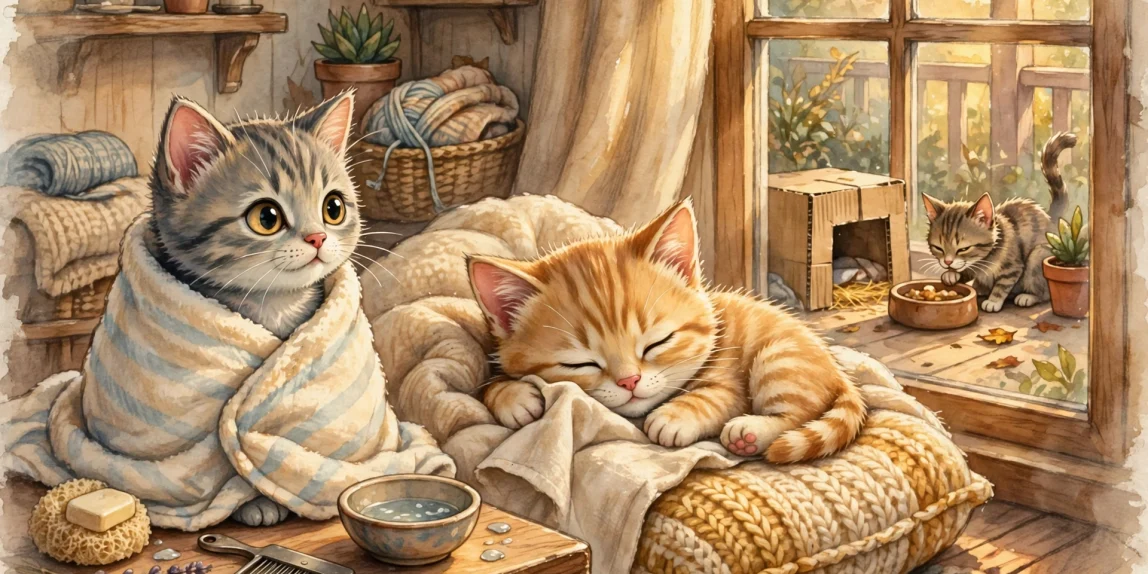
Take a soft cloth or a cotton ball, soak it in warm water — warm, not hot; test it on your wrist like a baby’s bottle — and wipe the eye softly, from the inner corner outward, a fresh side for each eye and each pass. Do this two or three times a day. You are not scrubbing; you are persuading. Crust softens, the eye opens, and the kitten looks at you like you have performed a miracle.
Now the red flags, and I want them in plain language, because eyes do not give second chances. Vet today if: the eye is swollen or bulging; the kitten cannot open it at all; there is thick yellow or green discharge; the eye itself looks cloudy, white, or filmed; the kitten is squinting in pain, not sleeping in comfort; or there is sneezing, no appetite, and a kitten going quiet and limp with it. A kitten who stops eating is a kitten on a clock — the small crash fast. Plain sticky eyes on an otherwise bright, eating, playing kitten: warm cloth, patience, watch it. Anything on the list above: the car keys. No drops you happen to have in a drawer, no medicine borrowed from another animal’s prescription — eyes are unforgiving of experiments.
CASE TWO: THE FLEAS ARE SO BAD
Our foundling first. Understand the stakes, because people underestimate them: on a tiny kitten, a heavy flea infestation is not an itch, it is a blood loss. Fleas drink, kittens have very little to spare, and severe flea anemia can kill a baby who looked merely scruffy at breakfast. So this case is urgent — but the urgency is of a particular kind, because the obvious medicine is the dangerous part.
Most flea products are made for adult cats of a certain weight, and many are flatly forbidden for young kittens. A kitten whose age you do not know is a kitten whose weight you must guess low. Put nothing on that kitten — no drops, no collars, no powders, no sprays, and under no circumstances anything made for dogs — until a vet or a rescue has told you what is safe for his size. This is the one place in cat-keeping where the treatment kills more readily than the disease.
What you can do tonight is the old, humble, effective method: a bath in warm water with a drop or two of plain blue dish soap — the kind rescuers have used for generations. The soap breaks the water’s hold and the fleas drown or flee to the head, where you pick them off. Keep the kitten warm — babies chill fast, and a wet, chilled kitten is in more danger than a dry, flea-bitten one — so keep it warm, quick, and kind. Then the flea comb: fine teeth, comb over a bowl of soapy water, drown what you catch, repeat daily. Slow work — but it is how kittens were saved for a century before chemistry arrived, and it still works.
Wash his bedding in hot water, vacuum like the landlord is coming, and keep him fed and hydrated — a foundling who is eating is a foundling who is fighting. Then get him weighed and aged by a vet or a rescue at the first opportunity, because once you know his age and weight, the safe modern flea treatments open up and the war gets much shorter. And check his gums while you hold him: they should be pink. Pale or white gums on a flea-covered kitten mean the fleas have taken too much blood — that is a vet-now emergency, tonight, not a wait-and-see.
CASE THREE: THE STRAY ON THE PORCH
The skinny fellow with the bad skin, who seems very nice, and whose finder cannot bring him in. I want to honor that finder for a second, because “help, but carefully” is exactly right, and a great many people get it wrong in both directions — chasing the cat off, or grabbing him bare-handed.
Here is what a porch can provide without anybody getting hurt. Food and water, set out regular as rent — plain cat food, fresh water, same spot, same times; a stray runs his life by that schedule within a week. Shelter: a sturdy box or a plastic bin on its side, out of the wind, with straw or an old towel inside — straw sheds water better than cloth if the weather turns wet. And distance: let him eat in peace. A cat who is fed unbothered starts, in his own time, unbothering himself.
What not to do. Do not grab him — a frightened stray can do real damage, and a bite from an unknown cat is a medical errand of its own. Do not put medicine in his food on a guess: the finder mentioned worm medicine in milk, and the instinct was kind, but milk upsets most adult cats’ stomachs and guessed medicine can harm more than help, and mange itself — that patchy, crusty, moth-eaten skin — is caused by mites and is a vet-and-rescue matter, full stop. There is no porch remedy for mange, and some of what looks like mange is something else entirely, including things a person can catch. Gloves if you must handle anything he’s slept on, and wash after. This one is not a home remedy; it is a phone call.
So make the calls — that is the real medicine in this case. Your local rescue organizations, the shelter, a trap-neuter-return group if your town has one (most do): they have the humane traps, the cages, the vet arrangements, and the experience of a thousand porch strays. A friendly cat like this fellow — and “he seems very nice” is the best news in the whole post — has every chance of being treated, fixed up, and quite possibly adopted into a house with a porch of his own, from which he may regard the world with the air of a man who has seen worse. Because he has.
THE LINE, DRAWN ONCE MORE
Warm cloth for sticky eyes, a soapy bath and a comb for fleas, food and shelter and phone calls for the stray — that is the honest reach of a kind person at home, and it is further than most people think. Past it runs the line: swollen eyes, white gums, a kitten not eating, medicine dosed by guesswork. On the far side of that line there are veterinarians, and they are not the enemy of the home remedy. They are the reason the home remedy works as often as it does.
Do the gentle thing tonight, make the right call tomorrow, and never be ashamed of asking. The asking is how every cat in this story got saved. — YNOT!