Think of it as Yoga for the brain, we are going to stretch a bit.
The Toe Beans Have a Job — Why Your Cat’s Paw Pads Matter
The cat walks on its toes its whole life and never once complains — because the part doing the walking was built like a good shoe, a soft glove, and a telephone line, all at the same time. -- YNOT!
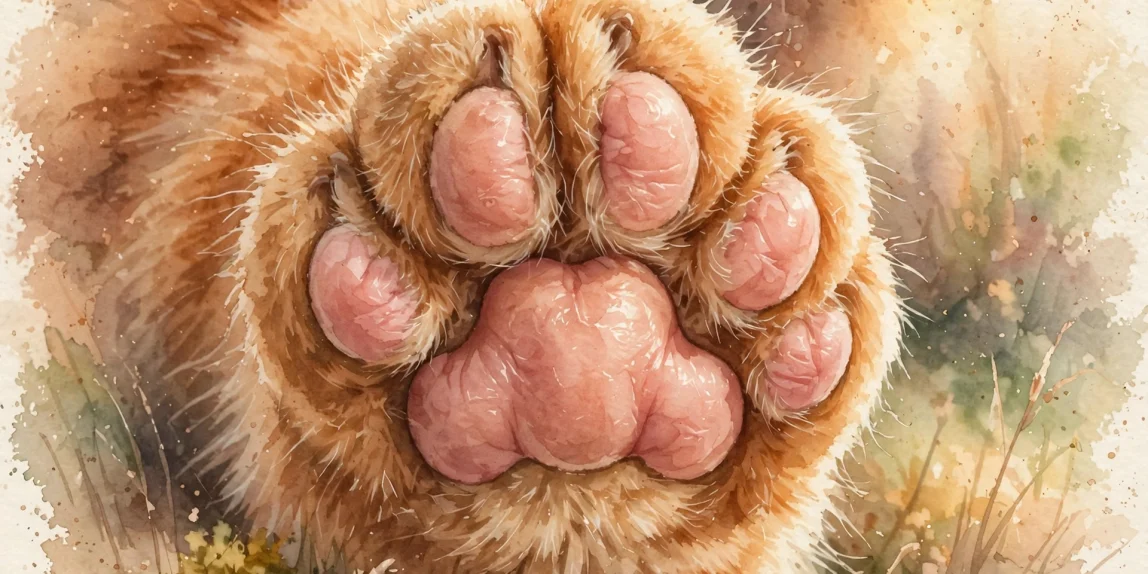
People who love cats have a weakness, and it is shaped like a jelly bean. The little pads on the bottom of a cat’s feet — the toe beans, in the language of the internet — look like candy somebody glued on as a joke. They are not a joke. They are some of the hardest-working equipment on the whole animal: cushion, silencer, sensor, and signature stamp, all in a patch of skin smaller than a postage stamp. Here is what those beans actually do all day, and the small amount of care they ask in return.
BUILT-IN SHOCK ABSORBERS, FACTORY INSTALLED
Start with the landings. A cat lives vertically — up the bookcase, down off the fence, off the top of the refrigerator when the negotiations fail — and every one of those arrivals lands on the pads. Inside each pad is a pocket of fat held in compartments of tough connective tissue, and that arrangement is a genuine shock absorber: it spreads the force of a landing so the bones, joints, and tendons above it do not have to take the whole bill at once. It does the same work at walking speed, step after step, year after year.
The pads are also why you never hear the cat coming. Thick, soft, hairless skin makes a quiet foot, and a cat walks up on its toes besides, which shortens the contact and lightens it further. Silence was not a courtesy feature. It was hunting equipment — the mouse was never supposed to get a warning — and it is now household equipment, which is why the cat is simply beside you at the refrigerator door, having arrived from nowhere, like a small verdict.
THE FEET ARE ANTENNAS
Here is the part most people miss: the pads are not just cushions, they are instruments. Pad skin is packed with nerve endings — pressure, texture, vibration, temperature — making the bottom of the foot one of the most sensitive surfaces on the cat. A hunting cat reads the ground the way you read a newspaper. The faint tremor of something small moving nearby registers through those pads. So does the difference between carpet and tile, warm floor and cold, safe ground and ground that is about to hurt.
This is also why so many cats object to having their feet handled, and why the objection should be respected. Grabbing a cat’s paw is not like holding a dog’s paw. It is closer to somebody grabbing your eyeball’s neighborhood — the wiring is that dense. Touch the feet gently, briefly, and on the cat’s terms, and most cats will allow the occasional inspection. Make a wrestling match of it and you will get the review the performance deserved.
GRIP IS A TEAM SPORT
The charts like to credit the pads with a cat’s grip, and the pads do their share: the pad surface is roughened with tiny projections that add traction for running, turning, and landing, and the extra pad up the back of the front leg — the carpal pad — works as a brake and an anchor when the cat stops suddenly or comes down a tree headfirst, the way cats insist on doing.
But let the record be honest: the climbing is done by the claws. Claws are the crampons, the grappling hooks, the whole mountaineering department. Pads give traction on the flat and the landing; claws give purchase on the vertical. When you watch a cat go up a tree, you are watching the claws work. When you watch it stick the landing on your kitchen counter, that is the pads earning their pay.
THE SWEATY TRUTH, IN SMALL PRINT
Cats barely sweat at all, and what little sweating they do happens mostly through the paw pads — the glands live there, in the hairless skin. That is why a nervous cat at the veterinarian’s office can leave a trail of damp little footprints on the steel table: heat and stress both turn those glands on, and the evidence walks right across the counter.
Keep the claim in proportion, though. Damp pads are a footnote in a cat’s cooling system, not the system. A hot cat cools itself the sensible way — it leaves. It finds shade, stretches out on the coolest floor in the house, rests instead of moving, and grooms, because saliva evaporating off the coat carries heat with it. So on a hot day, your job is not to admire the paw sweat. It is to make sure the cat has shade, water, and a cool room to be sensible in. The pads will handle their small part.
SCENT, COLOR, AND OTHER FINE PRINT
The paws also sign documents. Between the toes sit scent glands, and every scratch on the post — and every round of biscuit-making on your lap, which another chapter in this book covers in full — presses that scent into the world: I was here, this is mine, I live here. The cat’s feet are writing its name on the house all day long, in ink only other cats can read.
And a small gift for close observers: pad color usually matches the wardrobe. The same pigment that colors the coat colors the pads, and often the nose besides. White and ginger cats tend to pink pads, black cats to black or dark gray, gray cats to gray — and the multicolored cats, the calicos and tortoiseshells, may carry a mixed set, two pink beans and the rest dark, like a hand dealt from two decks. No health meaning to any of it. It is just the factory paint shop being consistent.
THE TEN-SECOND INSPECTION
Pads ask very little care, but they live where the trouble is — on the ground, in the weather, in whatever the street is serving. So once in a while, on the cat’s terms, take the ten-second look: pads whole and smooth, nothing stuck between the toes, no cuts, peeling, redness, or swelling, and the cat walking square on all four.
The known hazards are mostly human-made. Hot pavement burns pads exactly the way it would burn your palm — if you cannot hold the back of your hand on the ground comfortably, it is too hot for a cat to be standing on, and summer sidewalks fail that test more often than people think. Winter answers with road salt and ice melt, which dry and crack the pads and are worse news if the cat licks them off; wipe outdoor cats’ feet when they come in. Antifreeze is the emergency on the list: it tastes sweet, it is poison in tiny amounts, and a cat that walked through a spill and groomed its feet is a veterinarian call now, not tomorrow. Harsh floor cleaners belong in the same paragraph — rinse or wipe the paws, and let floors dry before the cat patrols them.
Two last chores, both minor. Long-haired cats grow tufts of fur between the toes that can mat, trap grit and litter, and turn the cat into a skater on smooth floors — a careful trim of that excess fur restores the grip the pads were built to give. And about balm, since the charts push it: a healthy cat maintains its own pads by grooming, and most cats need no cream at all. If pads look merely dry and the skin is whole, a pet-safe balm will not hurt — pet-safe being the whole point, because whatever goes on a cat’s feet goes in the cat’s mouth at bath time, and human lotions were never made to be eaten. Pads that stay cracked, split, or sore are not a moisturizer problem. They are a vet appointment wearing a disguise.
WHEN THE PILLOW IS TOO SOFT
Most pad trouble announces itself plainly: a cut from something sharp, a burn, a thorn or a splinter between the toes, a cat suddenly limping or holding one foot up or licking one paw like it owes the paw money. All of that earns a vet visit, sooner if there is blood, swelling, or a cat that will not bear weight.
But there is one condition the charts leave out, and it is the one named for this chapter’s whole subject. It is called pillow foot — plasma cell pododermatitis, in the long form — and it is an immune-system misfire, not an injury. The big pads swell up soft and spongy, sometimes changing color or developing sore, split patches, often on more than one foot at once, and the cat may limp on feet that look like little cushions. Nobody fully knows what sets it off, it is treatable, and it is not a home remedy situation: a pad that has gone pillowy is a pad a veterinarian should put a hand on. The moral of the whole chapter fits in one line — the beans are supposed to be firm little cushions, and any change in how they look or how the cat walks on them is information. Read it the way the cat reads the ground: promptly, and with respect.
A cat’s whole life happens at ground level, on four small feet it trusts completely. Keep those feet sound, and the cat will handle everything above them. — YNOT!