Think of it as Yoga for the brain, we are going to stretch a bit.
Knock Before You Start — Somebody May Be Sleeping in Your Car
The cheapest safety device ever fitted to a car is a knuckle. Knock on the hood before you start it — somebody may be home. -- YNOT!
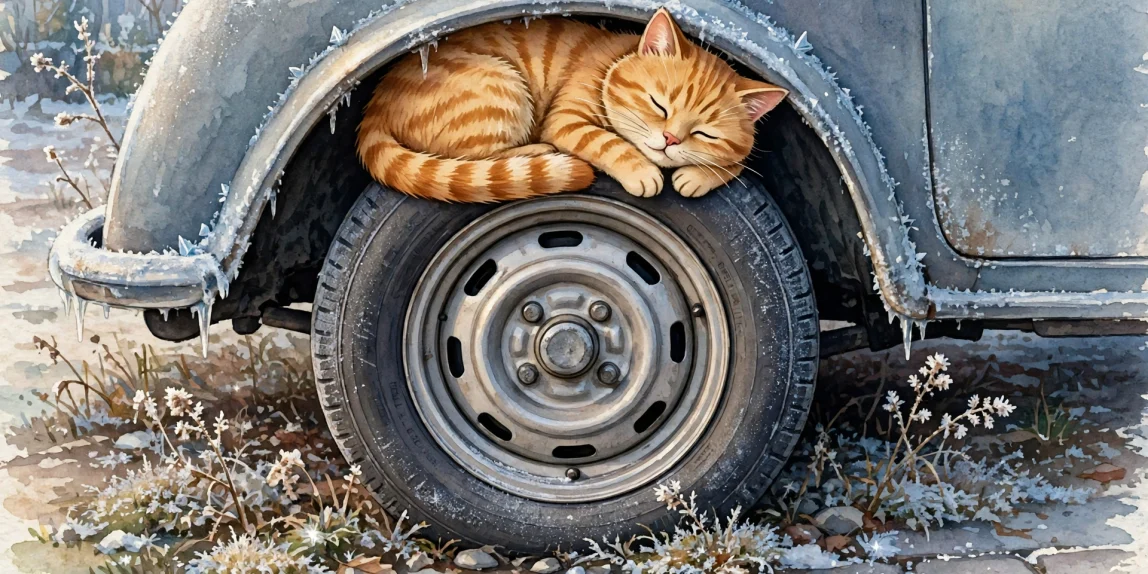
There is a picture going around the internet right now that every cat person should see once: a ginger tabby squeezed in on top of a car tyre, inside the wheel well, tucked up under the fender like a spare part the factory forgot to list. The cat is not stuck. The cat is asleep, in the place it chose on purpose — because when the cold season starts, a parked car is not a machine to a cat. It is real estate. And every winter, somebody turns a key and finds that out the hard way.
THE DAY I LEARNED TO KNOCK
I check my car in the winter. I have checked it for years, and it is not because I read it in a pamphlet. It is because one time I didn’t.
I got in, I started the car, and I heard something. That is the whole story and it is enough — a sound that does not belong to any engine ever built, coming from a part of the car where no sound should be. The cat got out and ran, and somehow, by luck I had not earned, it ran out with little damage. I have thought about that word “somehow” a lot since. Somehow is not a safety system. Somehow is a coin you flip with somebody else’s life.
So now it is a point of honor with me: in the winter, before I even get in the car, I either open the hood and look, or I bang on it like I am collecting a debt. Neighbors have seen me do it. Let them look. It takes five seconds, and I have already spent the other kind of five seconds — the kind where you sit in a running car listening to a sound you will hear in your head for years. You only need to hear it once. I am writing this chapter so that once can be mine instead of yours.
WHY A PARKED CAR IS A FIVE-STAR CAT HOTEL
Understand the cat’s side of it and the whole thing stops looking strange. A cat out in the cold is shopping for three things: warmth, shelter from the wind and wet, and a small enclosed place where nothing bigger can sneak up on it. A parked car offers all three, gift-wrapped.
The engine bay is the penthouse. An engine holds its warmth long after you park, and the space around it is dark, enclosed, and up off the frozen ground. The wheel wells are the rooms below — a cat can curl up right on top of a tyre, under the fender, exactly like the ginger in the picture, close to the leftover warmth and out of the weather. And underneath the car itself is the budget floor that still beats sleeping in the open: shelter from wind and rain, a roof against the frost, and ground that the car has kept a little less cold than the street around it.
Notice the trap inside the logic: the most attractive car on the street is the one driven most recently — a heated hotel with the vacancy sign lit. And a car that sat out all night may have collected a guest at any hour. The usual guests are the cats with no house to be kept in — strays and outdoor cats — and kittens, small enough to fit through gaps an adult cat would laugh at and not yet wise enough to know what an engine is. Nobody’s indoor cat is in your engine. Somebody’s nobody cat is.
THE SECOND BEDROOM, UNDER THE CAR
Most people, once you tell them, can picture the cat in the engine. The one they miss is the cat who never climbed anything at all — the one simply asleep underneath the car, on the ground, in the dark, where the driver will never see it.
I have seen how that one ends, and I did not see it happen to strangers in a news story; I have seen people do it. A cat asleep under a car. A driver gets in, starts up, and backs out — briskly, the way people do when they are late and the car is familiar — faster than a sleeping animal can wake, understand, and get clear of the wheels. From the driver’s seat you cannot see under your own car. That is not carelessness talking; it is geometry. The space under a car is the one piece of road the driver is blind to, and it is exactly the piece of road the cat chose for a bed.
A cat in an engine is in danger when the engine starts. A cat under the car is in danger when the car moves — and a cat deep asleep may not even be properly awake by the time it has to move. So the under-car cat gets its own rule, separate from the knock, and it is in the routine below: look before you get in, and when you do move, move off slow at first. Especially backing up. The first three feet are the dangerous ones.
THE TEN-SECOND ROUTINE NOBODY IS TOO BUSY FOR
Here is the whole safety system, and it is the same one the ASPCA, the AVMA, Cornell’s veterinary school, and the RSPCA all hand out, because there is only one and it works. It costs about ten seconds and no money, which makes it the best bargain in this entire book.
First, as you walk up to the car, look. Look under the car, and look into the wheel wells, on top of the tyres. You are not inspecting; you are glancing where a cat would be — and after a week it is automatic.
Second, bang on the hood. Not a polite tap — a good firm bang, with the flat of your hand or your knuckles, loud enough to be felt as well as heard through metal. Or do what I do when I am in any doubt at all: open the hood and look. A look is proof. A bang is a warning. Proof beats warning.
Third, once you are in, give a short honk of the horn — and then, the step everybody skips, wait a few seconds before you start. A cat deep asleep in a warm engine bay does not teleport out. It has to wake up and climb down out of a maze in the dark. The bang is the alarm clock; the pause is you holding the door.
Fourth, move off gently. Ease out, slow for the first few feet, slower still if you are backing up, and listen as you go. You are giving the under-car sleeper — the one who slept through the bang, the honk, and the engine — its last fair chance to clear the wheels. Ten seconds of routine and three feet of patience. That is the entire price of never hearing the sound I heard.
IF YOU FIND ONE — OR HEAR ONE
Suppose the routine works the other way and you find a cat — eyes shining back at you from the engine bay, or a shape that will not leave the wheel well. Rule one is carved in stone: do not start the car. Not to scare it out, not to move the car “just a little.” The fan belt and the moving parts are exactly the danger; the ASPCA has been saying for years that a cat under a hood can be injured or killed by the belt the moment the motor turns. A car with a cat in it is not a car. It is a waiting room. You will be late, and that is the end of the list of bad outcomes available to you, so take it.
Open the hood carefully and look — looking is free and safe. Then give the cat a way out and a reason: step back, leave it an escape route that is not past your legs, talk calmly if you talk at all, and let a strong-smelling dish of food set on the ground nearby make your argument for you. Most cats, given a quiet minute and an open road, fire themselves.
What you do not do is reach blindly into an engine bay. A hot engine burns, tight machinery is no place for fingers, and a trapped, terrified cat will bite the first warm thing that grabs at it — not out of meanness, out of terror, which is stronger. If the cat is stuck, wedged, or hurt, that is no longer your job anyway: call animal control, a local rescue, or a vet, and let people with gloves, towels, and experience do the reaching. If you did start the car and heard something — stop the engine immediately, the way I wish nobody ever had to learn to — and if the cat is injured, get it to a vet or get a vet’s help to it. A cat that runs off, as mine did, has had a lucky day. A cat that cannot run has had the other kind, and the clock on that kind is not forgiving.
GIVE THEM A BETTER HOTEL
The kindest version of this chapter is the one where the cat never picks your car at all. Keep your own cats in during cold weather — every authority in this chapter says so. And if your street has strays you feed and worry over, a simple outdoor shelter — a small, dry, insulated box with straw in it, tucked somewhere quiet — gives them a warm bed that does not have a fan belt in it. You might empty the engine bay in front of your house, and that is the one with your name on the key.
A car is the warmest bed on a cold street and the most dangerous one. Ten seconds of knocking is how you make sure nobody is sleeping in yours.