Think of it as Yoga for the brain, we are going to stretch a bit.
Jack Calloway: Admission by Omission
Jack Calloway had been retired long enough that the government had stopped sending him Christmas cards.
That was how he measured retirement.
At first there had been briefings. Then consulting contracts. Then phone calls beginning with, Jack, this is completely unofficial.
Eventually even those became rare. Calloway preferred it that way.
He had spent enough of his life in rooms without windows, listening to men explain why something that officially wasn’t happening urgently required three million dollars, two passports, a rented airplane and somebody who knew how to keep his mouth shut.
Retirement was quieter. Most mornings now involved coffee, newspapers and the Atlantic Ocean.
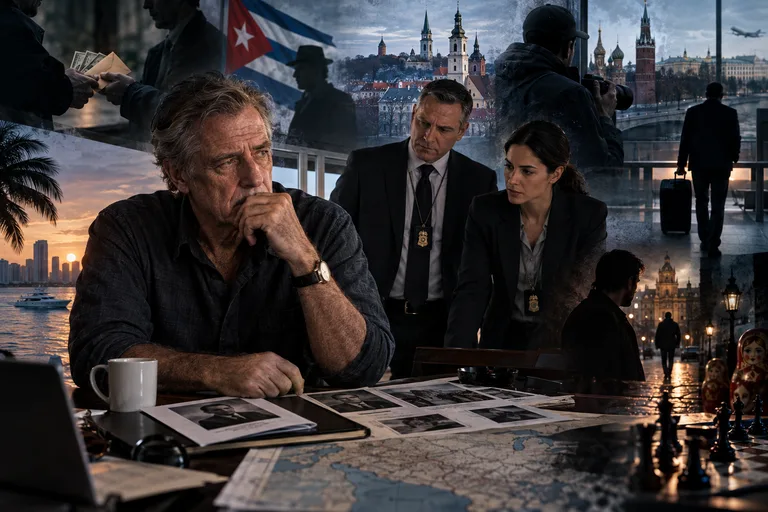
That Tuesday involved the FBI. There were two of them.
The first was Special Agent Daniel Mercer, late forties, gray suit, polished shoes and the deliberate expression of a man who had learned that showing surprise during an interview usually gave away more than asking another question.
The second was younger. Special Agent Elena Ruiz. Miami office. Counterintelligence.
Calloway knew before she showed identification.
Ruiz noticed him looking down. – “You always look at people’s shoes?”
“Only government people.”
“What do our shoes tell you?”
“That you didn’t come to sell me solar panels.”
Mercer put a thin black folder on Calloway’s kitchen table. – “We’d like to ask you about some Russians.”
Jack poured another cup of coffee. – “Everybody eventually does.”
“And some Cubans.”
Calloway stopped pouring.
That got his attention.
He sat down. – “Now you’ve made breakfast interesting.”
The first page contained names Calloway had already seen in the newspapers.
Yuri Khrameev.
Kirill Khrameev.
Oemis Romagoza Durruthy.
Yaidel Delgado Suarez.
Angel Eduardo Castro.
There were photographs beneath several names.
Jack looked at them without touching the paper.
The Justice Department had accused five men of participating in a Russian intelligence network involved in recruitment for surveillance, sabotage and murder-for-hire.
The allegations were ugly.
They were also familiar.
Not the names.
The method.
Jack turned the page.
That was where he stopped.
Two additional photographs.
The names beneath them were not the names Jack remembered.
But then, names had always been negotiable in that world.
He stared at the first picture.
Older now.
Heavier.
Less hair.
But the eyes were the same.
Jack finally spoke. – “Well.”
Mercer leaned forward. – “You recognize him?”
Jack kept looking at the photograph. – “I recognize the man he used to be.”
“Name?”
“The first one called himself Andrés Valdés when I knew him. Which means his name probably wasn’t Andrés Valdés.”
“And the Russian?”
Jack looked at the second photograph.
The Russian had the pale, almost colorless face of a man who could disappear into an airport crowd simply by putting on a cheap jacket.
“Misha.”
“Last name?”
“He gave me three.”
“Which was real?”
Jack looked at Mercer. – “Probably none.”
Mercer glanced at Ruiz.
Ruiz wrote something.
Jack pointed at the photographs. – “You’re looking for them?”
“We’re interested in finding them.”
“That’s FBI language for yes.”
Mercer ignored that. – “When did you last have contact?”
“Twenty years ago. Maybe longer.”
Mercer frowned. – “Then why did your name come up?”
Jack smiled slightly. – “That would be a better question for whoever gave you my name.”
Ruiz watched him for several seconds. – “Mr. Calloway, you seem surprisingly current on this.”
Jack leaned back. – “Current on what?”
“The Russian network. Lithuania. The recruitment. The people involved.”
“I read.”
“You’ve been retired for years.”
“So?”
“You keep pretty updated for somebody who’s retired.”
Calloway looked out the window.
A boat was moving slowly along the Intracoastal.
Somewhere across the water, a leaf blower started.
He looked back at her. – “Agent Ruiz, normal people listen to the news.”
“And you?”
“I listen to the stuff behind the news.”
“What does that mean?”
“The mistakes. The fake stories. The things people deny. The things they don’t deny. Who speaks. Who stays quiet. Which sentence gets repeated by six different ministries. Which detail suddenly disappears from tomorrow’s version.”
He took a drink of coffee. – “Russia does fake stories very well.”
Mercer asked. – “Disinformation?”
“Sometimes.”
Jack shook his head. – “But disinformation is the fancy word. Most of the time it’s simpler.”
“How simple?”
“Confusion.” It is not what they say, it is what they don’t say.
The $200 Photograph
Calloway tapped the Lithuania page. – “June 2025.”
Mercer nodded. – “Vilnius.”
“No,” Jack said. – “Before Vilnius.”
Ruiz looked up. – “What do you mean?”
“The important part didn’t happen in Vilnius. It happened before Vilnius.”
He pointed at the report. – “The photograph.”
According to the allegations, an American encountered Kirill Khrameev near the Estonia-Russia border.
The request appeared small.
Travel to an address near Vilnius.
Take some pictures.
Two hundred dollars.
Nothing dramatic.
No gun.
No bomb.
No secret codebook.
Just photographs.
The American did it.
Only afterward did the conversation allegedly change.
The man was introduced to someone described as a colonel.
The money became considerably larger.
The job became murder.
Approximately twenty-five thousand dollars.
The American refused.
Then came the next proposition.
Something easier.
Sabotage.
A warehouse.
Infrastructure.
Targets in countries supporting Ukraine.
Calloway pushed the page back across the table. – “That’s the whole business right there.”
Mercer frowned. – “Explain.”
“You think the murder offer is the important part.”
“It isn’t?”
“No.”
Calloway tapped the page again. – “The two hundred dollars is the important part.”
Ruiz stopped writing.
Jack continued. – “Nations have armies. Intelligence services have officers. Criminal organizations have soldiers. But none of those people can be everywhere.”
“So?”
“So they borrow people.”
“For two hundred dollars?”
“They don’t buy an assassin for two hundred dollars.”
Calloway smiled. – “They buy a photograph.”
He remembered Rotterdam. 1991
Rain that came sideways off the harbor and somehow found its way through every coat ever manufactured.
There had been a Russian there named Sergei.
Or Sergei was what everybody called him.
Sergei had once asked a dockworker to write down the numbers painted on three shipping containers.
Nothing more.
Fifty American dollars.
The dockworker did it.
Two weeks later Sergei asked him to report when one of the containers left the yard.
Another hundred.
Then Sergei wanted to know which security guard worked Thursday nights.
Another hundred.
Six months later the dockworker was passing information regularly.
He never considered himself a spy.
That was the elegance of it.
He considered himself a man occasionally making a few dollars answering stupid questions.
Jack looked at the agents. – “The first task is supposed to be harmless.”
Ruiz asked. – “Why?”
“Because the first task isn’t about the task.”
Mercer understood. – “It’s about the person.”
Jack nodded. – “Exactly.”
Could he follow instructions?
Would he take money?
Would he keep quiet?
Would he come back?
Would greed overpower suspicion?
Did he ask questions?
Did he photograph only what was requested, or did he improvise?
Did he brag afterward?
Every trivial assignment answered something.
Jack leaned back in his chair. – “The hundred-dollar job is often an interview where the applicant doesn’t know he’s applying.”
Ruiz looked again at the Lithuania document. – “So the photograph is recruitment.”
“Sometimes.”
“Then the larger offer comes later.”
“If you pass the audition.”
Orlando
Mercer asked. – “There were Cubans who worked the same way?”
Calloway laughed. – “There were Cubans who could teach a graduate course in it.”
Then he became quiet. – “There was one named Orlando.”
Ruiz waited. – “Last name?”
“No.”
“You don’t know it?”
“I knew several.”
“Which one was real?”
Jack looked at her. – “You haven’t been listening.”
Mercer smiled despite himself.
Jack continued. – “Orlando was anti-Castro. Genuinely, as far as I could tell. But people make a mistake when they think that tells you everything about a man.”
“What kind of mistake?”
“They confuse politics with profession.”
Orlando hated Castro.
That did not make Orlando a freedom fighter.
At least not exclusively.
Orlando was a mercenary.
If the target happened to be connected to Havana, Orlando could make the job ideological.
If the target was a drug dealer, Orlando could make it business.
If the target had money attached to his name, ideology became remarkably flexible.
There were years Orlando lived well.
Beautiful apartments.
Expensive watches.
Restaurants where the waiters knew what bottle to bring before he sat down.
Then there were years he disappeared.
Cheap rooms.
Borrowed cars.
Different names.
Once, during the cocaine wars of the 1980s, Jack heard that a Venezuelan narcotics organization had placed a million-dollar bounty on Orlando.
Jack never confirmed the figure.
With Orlando, confirmation had always been difficult.
That was another problem with men who lived outside official history.
Everything came as a story.
A prison escape.
A boat in the Caribbean.
A body in Caracas.
A warehouse in Panama.
A government minister who supposedly owed him a favor.
An intelligence officer who supposedly wanted him dead.
Jack had learned not to ask whether Orlando’s stories were true.
That was usually the wrong question.
The useful question was:
Which parts could be true?
Sometimes the answer was enough to ruin your evening.
Jack looked at the agents. – “People watch movies. Die Hard. James Bond. Whatever is playing now. They think dangerous men look dangerous.”
Ruiz asked. – “Don’t they?”
“Usually not.”
Orlando could look like somebody’s uncle.
White shirt.
Gold chain.
Coffee.
A plate of eggs.
He could talk about baseball for forty minutes.
Then, without changing his voice, he could explain that a man in another country had become a problem.
Not kill him.
Never that.
A problem.
Jack still remembered one breakfast.
Miami. 1986
Orlando had stirred sugar into Cuban coffee and said: – “Nuestro amigo necesita dormir.”
Our friend needs to sleep.
Jack had looked at him. – “How long?”
Orlando smiled. – “Long enough.”
Jack had left before finishing breakfast.
Ruiz asked. – “Did he kill people?”
Calloway looked at her. – “I never saw Orlando kill anybody.”
“That’s not what I asked.”
“No. That’s what I answered.”
Cubans
Calloway stood and walked to the refrigerator. – “You want water?”
Both declined.
He took one anyway.
“There are more Cuban intelligence connections in South Florida than most people ever wanted to admit.”
Mercer asked. – “Cuban government?”
“Sometimes.”
“Exiles?”
“Sometimes.”
“Organized crime?”
“Sometimes.”
Jack sat again. – “You’re trying to put them in separate drawers. That’s your first problem.”
He held up one hand. – “One man hated Castro.”
Another finger. – “Another man worked for Castro.”
A third. – “A third man didn’t give a damn about Castro but knew both of them and could arrange a boat.”
A fourth. – “Another sold information to whoever paid.”
He closed his hand. – “Then they all sat at the same restaurant.”
Ruiz said. – “You’re exaggerating.”
“Of course I am.”
A pause.
“Just not very much.”
Miami had always been like that.
Revolutions washed ashore there.
So did exiles.
So did intelligence services.
So did people pretending to be exiles while working for intelligence services.
Jack remembered men who could spend three hours denouncing communism and then make a telephone call to Havana.
He remembered others who had relatives in the Cuban government and genuinely despised the Cuban government.
He remembered businessmen who moved money.
Boat captains who moved people.
Mechanics who moved weapons.
Bartenders who moved information.
The smartest intelligence officers understood that these categories overlapped.
The stupid ones tried to draw organizational charts.
Jack said. – “Some Cuban operators were brilliant. Patient. Disciplined. They could maintain relationships for years.”
Mercer asked. – “And the others?”
“Idiots.”
Mercer raised an eyebrow. – “That’s comforting.”
“It shouldn’t be.”
“Why?”
“An idiot can still pull a trigger.”
Misha
The Russian was different.
Jack had met Misha in Prague.
The Cold War was supposedly over.
That was one of those things newspapers believed because politicians said it often enough.
Jack had been staying at a hotel near Wenceslas Square.
Misha was in the bar.
No introduction.
He simply occupied the stool beside Jack and ordered vodka.
Misha glanced toward him. – “American?”
Jack ignored him.
Misha switched to German.
Jack continued drinking.
Then French.
Finally Spanish.
Jack turned. – “You trying to sell me something?”
Misha smiled. – “I am trying to discover what language annoys you.”
“Apparently all of them.”
They became drinking acquaintances.
Not friends.
Jack had very few friends in those years.
Friends required honesty.
Misha dealt in things.
That was how he described his occupation.
Things.
Documents.
Information.
Introductions.
Automobiles.
Women.
Passports.
Computer equipment.
Currency.
Sometimes people.
Never drugs, he claimed.
Jack immediately assumed that meant drugs too.
One evening Misha explained the Russian intelligence system in a sentence Jack never forgot.
Misha lifted his glass. – “The Soviet Union disappeared. Nobody told the telephone numbers.”
The institutions changed names.
The networks remained.
A colonel became a businessman.
A case officer became a security consultant.
An embassy contact became an importer.
Old officers retired and introduced younger officers to people who owed them favors.
Files migrated.
Money migrated.
Loyalties became murkier.
But relationships survived.
Jack told Mercer. – “Governments collapse faster than address books.”
Mercer asked. – “You’re saying these networks go back decades?”
“I’m saying human networks don’t care what logo is on the building.”
Ten Rules
Mercer finally opened a legal pad. – “All right.”
Jack looked at him. – “All right what?”
“Suppose you were teaching this to new counterintelligence agents.”
“I wouldn’t.”
“Humor me.”
“You couldn’t afford me.”
Ruiz smiled.
Mercer did not. – “How does a network like this actually work?”
Calloway sighed.
He pulled Mercer’s yellow pad toward himself.
At the top he wrote:
DON’T LOOK FOR JAMES BOND.
Underneath it, he numbered the page.
Jack said. – “These aren’t instructions. They’re warning signs. There’s a difference.”
Then he began.
Start small. Nobody walks up to a stranger and begins with murder. Start with a photograph, an address, a license plate, a package or an introduction. The first assignment tests obedience more than usefulness.
Escalate gradually. A harmless favor becomes a paid favor. The paid favor becomes a secret. The secret becomes leverage. By the time the serious request arrives, the recruit has already crossed several lines.
Compartment everything. The photographer should not know the recruiter. The recruiter should not know the planner. The planner may never meet the person providing the money. Each person knows only enough to perform a role.
Use ordinary people. Professionals attract professional attention. A delivery driver, mechanic, bartender, student, small-time criminal or indebted businessman may move through places an intelligence officer cannot.
Make the language boring. People don’t always say assassination. They say work. They say construction. They say somebody needs a problem solved. Ordinary words create ambiguity.
Recruit through existing relationships. Family, nationality, business, prison, military service, ideology, debt and friendship are stronger than classified advertisements.
Money reveals appetite. The amount matters less than whether the person accepts it. Someone willing to take two hundred dollars today may reveal what he is willing—or unwilling—to do tomorrow.
Failure can still be useful. If someone refuses the major job, the network may offer something smaller: transportation, observation, logistics, vandalism or another supporting role.
Distance protects the sponsor. The farther the ultimate authority is from the person doing the work, the easier it becomes to deny responsibility.
Listen to the denial. Especially what is missing from it.
Mercer pointed at the last line. – “That one isn’t tradecraft.”
“It’s the most important one.”
Jack wrote underneath it:
ADMISSION BY OMISSION.
Ruiz said. – “Explain.”
Admission by Omission
Jack leaned back. – “People listen to statements. I listen to sentences that should have been there and weren’t.”
“A politician is accused of something. A government is accused of something. A company is accused of something. Most people listen to the words.”
Ruiz asked. – “You don’t?”
“I listen for the missing sentence.”
“What sentence?”
Jack looked directly at her. – “‘We did not do it.'”
He let the words sit.
“There are a hundred ways to answer an accusation without answering it.”
Jack looked almost offended. – “One of the worst mistakes in intelligence is turning an indicator into a conclusion.”
He pointed to Mercer. – “Write that down.”
Mercer did.
Jack continued. – “You collect indicators. Then you test them against everything else.”
The accusation.
The denial.
Travel.
Money.
Messages.
Relationships.
Timing.
Past behavior.
Operational mistakes.
Jack tapped the table. – “The truth usually isn’t hiding in one dramatic revelation. It’s hiding in twenty boring things that point in the same direction.”
The Fake Story
Ruiz returned to something Jack had said earlier. – “You mentioned fake stories.”
Calloway nodded. – “Russian information operations?”
“Russian, Cuban, American, Chinese, British, corporate, criminal. Everybody lies when lying is useful.”
“But Russia—”
“Russia industrialized confusion.”
He pointed toward the television in the next room. – “You think propaganda is convincing somebody that black is white.”
“It isn’t?”
“Sometimes. But that’s expensive.”
“What is cheaper?”
“Convincing them nobody knows what color anything is.”
That was the modern version.
Don’t necessarily prove your story.
Manufacture five stories.
Maybe twelve.
One says the victim committed suicide.
Another says Ukraine did it.
Another says organized crime.
Another says the victim was secretly CIA.
Another says the entire event never happened.
Another produces a supposed witness.
Another attacks the investigation.
Another releases authentic documents mixed with fabricated ones.
Jack said. – “You don’t need people to believe you. You just need them to stop believing anybody.”
Ruiz was silent.
Calloway continued. – “That’s why I still follow this stuff.”
“You miss it?”
“No.”
He answered too quickly.
Ruiz noticed.
Jack noticed that she noticed.
He smiled. – “I miss understanding what the hell was going on.”
“And now?”
“Now nobody understands what the hell is going on. We’ve democratized confusion.”
The Restaurant in Madrid
Mercer slid Valdés’s photograph forward. – “Tell us about him.”
Jack looked at it again.
Madrid. 1998
Valdés had arranged a meeting in a restaurant six streets away from where he actually intended to meet.
Jack arrived deliberately late.
The restaurant was empty.
A waiter handed him a matchbook.
Inside was written the name of another café.
Jack went there.
Another message. A hotel.
Then another.
Jack eventually found Valdés sitting outside a tiny bar nearly two hours later.
Jack sat across from him. – “You’ve become paranoid.”
Valdés smiled. – “No.”
He poured wine. – “I have become old.”
They talked about shipping.
At least technically they talked about shipping.
A vessel had departed Mariel.
Another had arrived in Las Palmas.
Cargo had been transferred. Documents did not match.
Somebody wanted to know why.
Nobody used the words intelligence, weapons or sanctions.
Men in that world rarely named the elephant.
They described the furniture around it.
At one point Valdés said something Jack remembered twenty-eight years later.
Valdés lowered his voice. – “The Russians always need Cubans because Cubans know how to look like they are not working for Russians.”
Jack had laughed. – “That doesn’t even make sense.”
“It doesn’t have to.”
Then Valdés became serious. – “Cubans travel. Venezuelans travel. Mexicans travel. Spaniards travel. Americans travel. Russians attract attention.”
“I think two men who had never held a fishing rod spent forty minutes discussing fishing.”
“What did it mean?”
“I never found out.”
“That doesn’t bother you?”
Jack looked at him. – “For about fifteen years.”
They Don’t Care
Ruiz returned to the photographs. – “You said these networks can cross nationalities.”
“They have to.”
“The targets too?”
“Especially the targets.”
Jack’s expression changed.
This part wasn’t amusing.
“People imagine assassination as ideological. Russian kills Ukrainian. Cuban kills Cuban. Serbian kills Croatian. Something nice and understandable.”
He shook his head. – “Real networks get messy.”
A Russian service might want a Russian dissident dead.
A criminal intermediary might recruit a Cuban.
The Cuban might know a Venezuelan.
The Venezuelan might hire an American.
Nobody at the bottom necessarily knows who sits at the top.
Sometimes the target is Russian.
Sometimes European.
Sometimes somebody whose only mistake was standing between somebody important and something they wanted.
Jack spoke more quietly now. – “They don’t care what passport the corpse has. They care about the objective.”
Mercer asked. – “You really believe these networks are that common?”
Jack looked at him. – “I believe networks for deniable work have existed since governments discovered it was inconvenient to get caught.”
Five Thousand Dollars
Ruiz asked. – “How much does it usually cost?”
“There is no usually.”
“Ballpark.”
Jack laughed. – “You’re trying to create an assassination price list?”
“I’m trying to understand the economics.”
“That’s better.”
Jack thought for a moment. – “Sometimes five thousand dollars changes somebody’s life.”
“In America?”
“Not necessarily.”
He continued. – “Sometimes it’s fifty thousand. Sometimes a hundred thousand. Sometimes considerably more.”
“And sometimes two hundred?”
“You’re still missing it.”
Jack leaned toward her. – “The two hundred isn’t payment for murder. It’s discovery.”
He tapped the Lithuania report. – “That’s what makes that case interesting.”
Two hundred dollars to learn whether someone will take photographs.
Twenty-five thousand allegedly offered later for murder.
In the U.S. case, prosecutors alleged that another recruit was promised roughly one thousand to fifteen hundred dollars for surveillance and later offered forty thousand dollars to make a dissident “disappear.”
Different people. Different operation. Same ladder. Small task. Payment.
Secret. Escalation.
Mercer asked. – “That’s tradecraft?”
Jack shook his head. – “That’s human nature.”
The Problem With Professionals
Mercer asked. – “Why recruit amateurs at all?”
Jack smiled. – “Because professionals know what murder costs.”
Ruiz laughed.
Mercer didn’t.
Jack continued. – “They also know what prison costs.”
Professionals had rules.
They asked questions.
They recognized surveillance.
They evaluated risk.
They knew when somebody was trying to use them as disposable material.
Amateurs were unpredictable.
That made them dangerous.
It also made them useful.
Jack said. – “A man behind on rent doesn’t think he’s joining a Russian intelligence operation. He thinks he’s taking a picture for five hundred bucks.”
Ruiz corrected him. – “Two hundred in Lithuania.”
Jack pointed at her. – “Good. You’re learning.”
The FBI’s Problem
The afternoon light had moved across the kitchen floor.
The coffee pot was empty.
Mercer’s legal pad was almost full.
They had come looking for two men.
Instead they had received a history lesson.
Finally Mercer returned to the reason they were there. – “If Valdés is alive, where would he go?”
Calloway shook his head. – “No.”
“No?”
“You’re asking the wrong question again.”
“What should we ask?”
“Who would still answer his telephone?”
Mercer stared at him.
Jack continued. – “You don’t find old intelligence people by hunting the old intelligence person.”
“Then how?”
“You find relationships that survived him.”
Family. Business partners. Old lovers. Old enemies.
People owed money. People owed favors.
People who remembered another name.
People who had received Christmas cards from countries they had never visited.
Not because any one of them necessarily knew anything.
Because networks left echoes.
Jack said. – “You’re looking for a man. You should be looking for the shape around the man.”
Ruiz slowly closed her notebook. – “And Misha?”
Jack looked again at the old Russian’s photograph. – “If that’s really Misha, he’s probably already disappeared.”
“You sound certain.”
“I’m not.”
“Then why say it?”
“Because I knew him.”
Mercer leaned forward. – “Would he know you’re talking to us?”
Jack smiled. – “If he’s still alive?”
“Yes.”
“Probably.”
Ruiz glanced instinctively toward the window.
Jack laughed. – “Don’t do that.”
“What?”
“Look out the window dramatically.”
“I wasn’t.”
“You were.”
One Last Story
They were preparing to leave when Jack spoke again. – “There was a man in Vienna.”
Both agents stopped.
Mercer turned. – “What man?”
“Doesn’t matter.”
Jack’s eyes had gone somewhere else. – “Late eighties. Soviet.”
He had been assigned to identify a suspected intelligence officer.
Then one evening Jack noticed the embassy man leave a restaurant.
A waiter cleared his table.
Another customer left ten minutes later.
Ordinary man.
Cheap suit.
Accountant, perhaps.
Jack followed the ordinary man.
That decision led eventually to three other people.
None were Soviet. One Hungarian. One Austrian. One Spaniard.
The Austrian ran a travel agency.The Hungarian imported machine tools.
The Spaniard owned two restaurants.
None looked like spies. That was the network.
The Soviet officer was simply the visible piece.
Ruiz asked. – “What happened?”
“Nothing.”
“Nothing?”
“We watched.”
“For how long?”
“Months.”
“And?”
Jack shrugged. – “The network changed behavior. People disappeared. One went home. One retired. Somebody above my pay grade decided we’d learned enough.”
Ruiz looked disappointed. – “That’s the ending?”
Jack smiled. – “That’s intelligence. Most stories don’t end with helicopters.”
The Door
Mercer put the photographs back into the folder. – “We may need to talk again.”
“I assumed so.”
“Will you?”
“If I know something useful.”
Ruiz stood. – “You still haven’t explained how someone retired twenty years ago knew about Lithuania before we mentioned it.”
Jack walked them toward the door. – “It was in the news.”
“Not all of it.”
Calloway opened the door.
Ruiz stopped. – “You have people who still talk to you.”
Jack said nothing.
“Don’t you?”
He smiled.
It was not an answer.
Which, she suddenly realized, was the answer.
Mercer stepped outside.
Ruiz followed.
Then Jack spoke. – “Agent Ruiz.”
She turned.
“One more rule.”
“You said ten.”
“I lied.”
She waited.
Jack leaned against the doorframe. – “When somebody gives you ten rules, always assume there’s an eleventh they aren’t telling you.”
“What is it?”
Calloway looked at the black folder under Mercer’s arm. – “Everybody thinks intelligence is about knowing secrets.”
He shook his head.
Ruiz asked. – “What is it about?”
“Knowing which secrets matter.”
Ruiz considered that.
Then she and Mercer walked toward their car.
Jack watched until they pulled away.
He closed the door.
Locked it.
Walked back into the kitchen.
For several seconds he stood perfectly still.
Then he picked up his cellphone.
Scrolled through contacts.
Stopped at a number he had not called in eleven years.
No name.
Just three letters.
MAD.
Madrid.
Jack stared at it.
He did not call.
Instead he opened the back of the phone, removed a small slip of paper he had kept inside the case and unfolded it.
There was another number.
Older.
European country code.
He entered it manually.
The phone rang four times.
Five.
Six.
Jack was about to disconnect.
Then somebody answered.
Nobody spoke.
Jack waited.
Finally he said. – “Misha?”
Silence.
Then a man’s voice.
Older than Jack remembered.
But unmistakable.
“John.”
Jack closed his eyes.
Almost thirty years vanished in one word.
Misha laughed softly. – “I wondered how long it would take.”
Jack looked through the kitchen window toward the water. – “FBI came by.”
“I know.”
That bothered Jack more than he allowed his voice to reveal.
“They’re looking for you.”
“Everyone is always looking for somebody.”
“And Valdés.”
This time the silence lasted longer.
When Misha finally answered, the humor was gone. – “Valdés is dead.”
“You sure?”
“I attended the funeral.”
“That doesn’t answer the question.”
Another small laugh. – “You have not changed.”
“Neither have you.”
“Oh, Jack.”
The voice became tired. – “We have all changed.”
Jack sat down. – “What’s happening?”
“You read newspapers.”
“I read what they leave out.”
“Yes.”
Misha remembered. – “You always did.”
“Lithuania.”
Silence.
“Brooklyn.”
More silence.
“The Cubans.”
Misha sighed. – “You called me after eleven years to tell me what I already know?”
“No.”
“Then why?”
Jack looked at the FBI folder’s faint rectangular imprint still visible in the dust on his kitchen table. – “Because two federal agents just showed me your photograph.”
Silence. Longer this time.
Then Misha said something Jack had not expected. – “They should not have that photograph.”
“Apparently they do.”
“No.”
Misha’s voice had changed.
Not fear.
Something colder.
Calculation.
“Jack. Listen carefully.”
Jack straightened. – “I’m listening.”
“The people in those newspapers?”
“Yes.”
“They are the people you can see.”
Jack said nothing.
Misha continued. – “You of all people should remember Vienna.”
Jack felt something move through him.
Not fear exactly.
Memory.
The cheap suit.
The travel agency.
The ordinary people.
The shape around the man.
“Misha—”
The telephone went dead.
Jack stared at the screen.
Call ended.
Twenty-seven seconds later the number no longer connected.
He tried twice.
Nothing.
Calloway sat alone in the kitchen.
Retired. Supposedly.
Outside, another boat moved slowly along the water.
A television in the other room continued talking about the Russian assassination network.
Five accused men.
Government statements.
Diplomatic reactions.
Experts.
Maps.
Photographs.
Everything visible.
Jack switched it off.
The room became quiet.
He thought about the two hundred dollars.
The photograph.
The twenty-five thousand.
The forty thousand.
The Cubans.
The Russians.
Orlando.
Valdés.
Misha.
Vienna.
And the people behind all of them whose names never appeared in newspapers.
Normal people listened to the news.
Jack Calloway had spent a lifetime listening for what the news left out.
Tonight, something was missing.
And Jack had learned a long time ago that sometimes the missing part of a story was the most dangerous part of all.
He picked up the telephone again.
Retirement, apparently, was over.
No one died in the making of this story, we believe. The Characters are all mostly fake, just don't read the news