Think of it as Yoga for the brain, we are going to stretch a bit.
Your Cat’s Secret Map of Your Home
You have a floor plan: so many rooms, so many doors. Your cat has a map of the same house — drawn in scent, height, and habit — and the two documents agree on almost nothing except the address. -- YNOT!
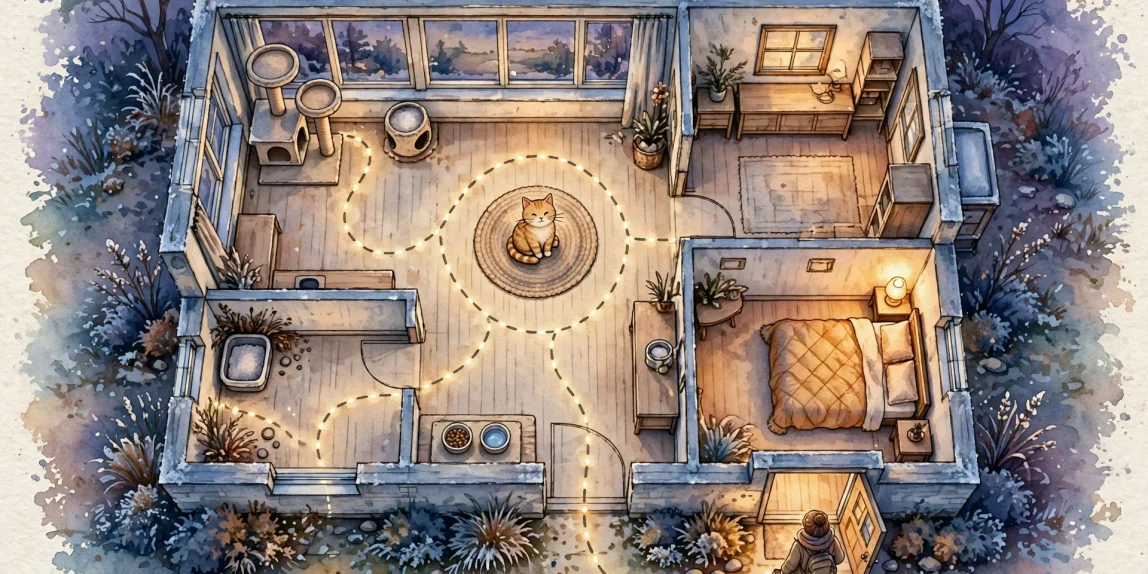
Somebody finally drew it, and every cat owner who sees the drawing nods: your cat has a secret map of your home, and it looks nothing like yours. Yours is measured in square feet. The cat’s is measured in safety, smell, and routine — watch towers and scent checkpoints, patrol routes and supply stations, one safe zone at the center of it all. This is not whimsy. The feline veterinarians’ own environmental guidelines — the AAFP and ISFM’s five pillars of a healthy cat home — read like a description of this map drawn by scientists: a safe place, resources spread out and kept separate, room to play the hunter, people who behave predictably, and respect for the cat’s nose. Five pillars, five layers of one map. Here is the map, layer by layer.
HEADQUARTERS: THE SAFE ZONE
Every map has a capital, and the cat’s is the safe zone: the core of the territory, the place where the cat sleeps its deepest sleep and retreats when the world gets loud. On the drawing it’s the bed, and in most houses that’s about right — the quiet, warm, human-scented center where the cat is off duty entirely. Outdoors, a cat’s territory has this same structure: a defended core where it eats, rests, and raises its young, with a wider home range patrolled around it. Your living room is that arrangement, scaled to carpet.
The safe zone is the first of the vets’ five pillars, and the rule of it is simple: the cat must be able to get there, and nobody drags a cat out of it. A retreat only works if it’s a retreat — a place where the cat is never pulled out for company, medicine, or a photograph. A cat with no safe zone is a country with no capital: technically still a country, but governing nothing, and nervous about it full-time.
THE WATCH TOWERS: THE MAP HAS A THIRD DIMENSION
Your floor plan is flat. The cat’s map is not. Layer two is vertical: the window perch, the cat tree, the back of the couch, the shelf — the watch towers, where the cat keeps watch over its world. Height is two kinds of good at once. It is surveillance: from above, the cat can survey the whole room and everything entering it. And it is safety: International Cat Care puts it plainly, that cats rest and watch over their surroundings from high places because that is where they feel safe. A hunter that is also prey-sized does its relaxing where nothing can sneak up on it.
Vertical space also multiplies the territory without adding a single room — which is why it is the cheapest peace treaty in a multi-cat house. Two cats who cannot share a floor can share a room at different heights, and cats are civilized about altitude: they time-share, taking turns at the good perch the way they take turns at everything, rather than fighting over it. Give the towers more than one way down, though. A perch with a single exit is a trap with a view, and a cat cornered on high ground by the household’s other cat has not been given territory. It has been given a siege.
SCENT CHECKPOINTS: WRITTEN IN INVISIBLE INK
Layer three is the ink itself, and this book has two other chapters on the ink — “The Nose Knows” covers the nose that reads it, and “Reading Your Cat” covers the rubbing that writes it — so this one stays short. The short version: the cat marks the map’s checkpoints — the couch corner, the doorway, the scratch post, your leg — with scent from glands in its cheeks and paws. The facial mark is the famous F3 pheromone, and its message is not “keep out.” It is “this is familiar, this is safe, this is ours.” Scratching signs twice, once visibly and once in scent from the paw pads, which is the Furniture chapter’s whole story.
Here is the fact that explains half of cat behavior: the ink fades. Scent marks decay with time, and a faded checkpoint is, to the cat, a page going blank. So the cat re-inks — after you come home smelling of elsewhere, after visitors, after cleaning day, the rubbing tour starts up again. That is not neediness. That is a cartographer maintaining the only copy of the map.
THE FAVORITE ROUTES: THE ROADS BETWEEN
Layer four is the roads: the patrol routes the cat walks on its rounds — through the hallway, past the washer, a stop at the garage door, a pause in the laundry basket, because a route may include a very small nap. Cats are circuit creatures. The rounds run at fairly regular times, dawn and dusk especially — the schedule chapter of this book, the one about cat time, is really about when the patrols go out — and the purpose is inspection: the cat is checking that the map still matches the house. Every checkpoint sniffed, every tower visited, every station confirmed in place.
Which is why moving the furniture is not redecorating. It is redistricting. A couch in a new place is a landmark moved; a blocked hallway is a road closed; and the cat’s response — the sniffing, the re-rubbing, the temporary unease that this book’s story of the departing couch is built on — is the sound of a map being redrawn under protest. Keep the roads passable. A hallway the cat must run a gauntlet through is a hallway it will eventually stop using, and a cat redrawing its map smaller is a cat telling you something.
RESOURCE STATIONS: THE SUPPLY DEPOTS
Layer five is logistics: the resource stations pinned across the map — the food spot, the water spot, the litter box, the cozy sleeping spots in the laundry and storage corners. The drawing makes them look like furniture placement. They are actually the welfare layer, and the vets’ second pillar is about exactly this: resources should be multiple, and they should be separated. Nobody dines well next to the toilet, cats included, so food lives away from litter. Water does better away from food — the water chapter of this book explains why, and why the bowls should outnumber the cats. Stations spread across the map, not clustered in one corner, because a cluster is one station with an audience.
In a multi-cat house, duplicate the depots: the working rule is one of each per cat, plus one extra, in different places. The reason is the quietest problem in cat keeping. A cat does not have to fight to control a resource — it only has to park in the doorway. The AAFP’s intercat tension guidelines list staring and blocking among the real signs of trouble between housemate cats, and litter-box guarding is the classic: one cat holds the hallway, the other cat quietly stops going, and the humans discover it as a “litter-box problem” in a cat who was never the problem. If a cat abandons part of the house, do not ask what is wrong with the cat. Ask whose flag is planted on the road.
REDRAWING THE MAP WITHOUT STARTING A WAR
So the practical part, because a map you understand is a map you can improve. Add a tower: one sturdy perch by a window doubles a watch post and a sun-warmed bed. Add a checkpoint where the cat already wants one: a scratch post by the front door gets used, because the door is already a checkpoint — posts exiled to spare rooms stand ignored, off the map entirely. Keep the routes open. And clean like a friend of the map: the fifth pillar is respect for the cat’s sense of smell, so wash the blankets in rotation, one at a time, instead of stripping every scent the cat owns in a single Saturday. A house scrubbed of all cat smell is, to the cat, a house that has been replaced by a similar house. When furniture must move — and it must, sometimes — expect the patrols and the re-inking, and give the cartographer a few days to finish the new edition.
AND THEN THERE IS YOU: THE MOVING LANDMARK
The last layer of the map is the one the drawing saves for its finale, and it is you. You are on the map — not as the owner, a rank the map does not recognize, but as its largest feature: a landmark that moves. This is why the cat follows you from room to room, keeping the landmark in sight. Why it checks on you — even in the bathroom, the one room where the landmark reliably sits still, with the added attractions of routine, curiosity, and a faucet of endless fascination. Why it stays close while you work, eat, or do nothing at all, and why it sleeps near you, or on you, given the chance: you are the safe place, walking around. Headquarters, the attachment research behind this book’s alone-time chapter says, is not only a location. For a bonded cat, it is a person.
Consider what you are, itemized on the cat’s map: the food station that refills itself, the warmest tower in the house, the checkpoint most worth re-inking, and the capital city, all in one piece of furniture that also opens cans. The cat is not being clingy, and it is not confused about who owns the house. It has simply drawn the map accurately, with the most important feature at the center. No matter where you go, you are always on their map. The compliment is enormous. It is also, the cat would want you to know, a responsibility of the landmark: be predictable, be findable, and try not to be moved without notice.
Learn the map your cat has drawn — the towers, the checkpoints, the roads, the stations, the safe warm center — and you will stop wondering why the cat does what it does. The cat was never wandering. The cat was making rounds in a country you happen to live in, with you as its capital. — YNOT!