Think of it as Yoga for the brain, we are going to stretch a bit.
Elon Musk — The American Dream From an Immigrant Kid in South Africa to Building Rockets, Electric Cars, and a Technology Empire
The American Dream doesn't guarantee success. It gives people the opportunity to pursue it. And sometimes, that opportunity turns an immigrant with a computer into an entrepreneur who builds rockets, changes industries, and helps shape the future. -- YNOT!
Everyone looks at billionaires. They look at the money.
The houses. The private jets. The companies they control.
And, of course, every mistake they make.
But very few people look at the 20, 30, or 40 years it took to get there.
The sacrifices. The failures. The sleepless nights.
The risks that could have destroyed everything.
And the years when nobody knew who they were.
Recently, I wrote about Jensen Huang, the Taiwanese immigrant who came to America as a little boy, attended a boarding school in Kentucky, washed dishes at Denny’s, and eventually founded NVIDIA.
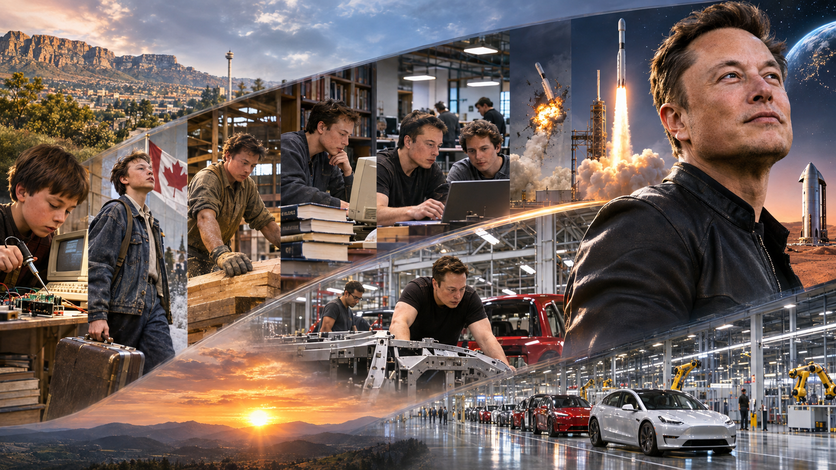
Today, I want to tell you another immigrant story. This one is about a boy from South Africa. A boy who was bullied at school, loved science fiction, taught himself computer programming, and dreamed of a future involving computers, space travel, and technology.
At 17, he left South Africa and moved to Canada.
He worked ordinary jobs, attended college, and eventually made his way to the United States. By 28, he had sold his first company and become a multimillionaire.
A few years later, he risked much of that fortune trying to accomplish things that many established experts believed were impractical.
Build a private rocket company. Challenge the automobile industry. Make electric vehicles desirable. Reduce the cost of space transportation.
And eventually make humanity a civilization capable of living on more than one planet.
His name is Elon Musk.
Now, before we get into his story, let me make something clear.
You don’t have to like Elon Musk.
You don’t have to agree with his politics, his personality, his management style, or the things he says on social media.
Some of his decisions have been brilliant. Others have been controversial, expensive, or simply wrong. But none of that changes the fact that he helped build several companies that have had an extraordinary influence on modern technology.
And understanding how he got there is considerably more interesting than simply arguing about his wealth.
Because, once again, this is a story about opportunity. And the American Dream.
A Boy Is Born in South Africa — 1971
Elon Reeve Musk was born on June 28, 1971, in Pretoria, South Africa.
His mother, Maye Musk, was born in Canada and worked as a model and dietitian.
His father, Errol Musk, was an engineer and businessman.
Elon was the oldest of three children.
He had a younger brother, Kimbal, and a younger sister, Tosca.
The family was relatively comfortable by South African standards.
His father had engineering and business interests, and the children had access to books and educational opportunities.
This wasn’t a story of a child born into extreme poverty.
There have been conflicting accounts about the family’s wealth, including stories concerning his father’s involvement in emerald trading. Those accounts have become controversial, and claims about how much financial help Elon received have been disputed.
The more important point is that Musk grew up with educational advantages but also experienced considerable personal difficulties.
His parents divorced when he was young. His relationship with his father became deeply troubled. And school was not an especially happy place.
South Africa in the 1970s was also a very different country from the United States.
It was governed under apartheid, a system of legally enforced racial segregation and political discrimination.
The society was deeply divided. Military service was compulsory for many white South African men.
And for a young boy increasingly fascinated by science, computers, and the future, the country did not offer the same technological environment that was developing in America.
Elon wanted something different.
The Kid Who Preferred Books to People
As a child, Elon Musk was unusually interested in reading.
He consumed science fiction, fantasy, encyclopedias, and books about technology.
He was particularly fascinated by stories involving space exploration and the future of civilization.
Books by science-fiction writers such as Isaac Asimov helped shape his imagination.
While other children were spending their afternoons playing sports or socializing, Elon often preferred reading.
He could become so absorbed in his thoughts that people sometimes had difficulty getting his attention.
But being intellectually curious didn’t make him popular.
He was bullied. And not just teased. He has described being subjected to serious physical violence by other boys. On one occasion, he was beaten badly enough to require hospital treatment. For a child, those experiences can be devastating.
Musk has described his childhood as emotionally difficult, particularly because of his relationship with his father.
Now, we should be careful about drawing psychological conclusions from childhood experiences.
Not every bullied child becomes an entrepreneur.
Not every difficult childhood produces extraordinary ambition.
And suffering does not automatically create success.
But Musk’s early experiences help explain something about his personality.
He became intensely interested in problems, ideas, and systems.
He developed an ability to concentrate on subjects for long periods.
And he was often willing to pursue interests that other people considered strange.
One of those interests was about to change his life.
Computers.
The 12-Year-Old Computer Programmer
In the early 1980s, personal computers were still relatively new.
There were no smartphones. No Google. No Facebook. No modern Internet.
Most families didn’t own a computer.
But Elon became fascinated with the possibilities.
At approximately ten years old, he acquired a home computer and began learning how to program.
He studied the manuals and taught himself BASIC.
At the age of twelve, he developed a simple space-themed computer game called Blastar.
The game involved a spacecraft fighting enemies.
It wasn’t revolutionary software.
But it was something he had created himself.
And then something interesting happened.
He sold the program’s source code to a computer publication for approximately $500.
Think about that.
At twelve years old, Musk had already experienced something that many adults never experience.
He had created a product using his knowledge.
Someone else thought that product had value.
And they paid him for it.
Five hundred dollars wasn’t going to make him rich.
But the amount wasn’t the important part.
The important part was discovering that knowledge could become a product.
And a product could become a business.
He could build something that didn’t previously exist.
And someone might pay for it.
That was his first real taste of entrepreneurship.
Leaving South Africa — The Canadian Connection
By his teenage years, Musk had become convinced that his future lay in North America.
He wanted to work in technology. He wanted access to advanced universities.
And he wanted to be close to the companies developing the next generation of computers and electronics.
The United States was his ultimate destination.
But immigrating directly to America was not necessarily easy.
Fortunately, his mother was Canadian-born.
That made Canadian citizenship available to him.
In 1989, when he was seventeen, Musk left South Africa for Canada.
His desire to avoid compulsory military service under apartheid was also an important factor in his decision.
He arrived without an established career or a clear path to Silicon Valley.
Although he came from an educated family, he still needed to find work and establish himself in a new country.
Like many immigrants, he relied on family connections while trying to make his way.
He spent time with relatives and worked several jobs.
Some involved physical labor. He worked on a farm.
He also took a job at a lumber mill in British Columbia, where one of his assignments involved cleaning an industrial boiler room.
It was dirty, physically demanding work. Not exactly the glamorous beginning people imagine when they think about the future founder of SpaceX.
But it provided money. And it allowed him to continue pursuing his education.
There is something worth remembering here.
Musk wasn’t working at a lumber mill because he dreamed of spending his life cleaning industrial equipment.
He was doing it because he had a larger objective. He wanted to get an education.
He wanted to work with technology. And he wanted to get to America.
The job was a means to an end.
From Canada to the University of Pennsylvania
In 1989, Musk began attending Queen’s University in Kingston, Ontario.
There, he studied for approximately two years.
He continued developing his interests in economics, physics, business, and technology.
But he still wanted to reach the United States. In the early 1990s, he transferred to the University of Pennsylvania. Penn offered something particularly attractive to Musk.
He could study both physics and economics.
And those two subjects became important parts of his approach to business.
Physics helped him understand the fundamental principles governing how things work.
Economics helped him understand how resources, incentives, businesses, and markets operate.
He eventually completed the requirements for degrees in physics and economics, with the degrees formally awarded in 1997.
Musk has often discussed the importance of reasoning from first principles.
The basic idea is simple. Instead of assuming something must be expensive because it has always been expensive, break it down into its fundamental components.
Ask what it is made from. Ask what the materials cost.
Ask what processes are actually necessary.
Then determine whether the conventional approach makes sense.
That method of thinking would later become particularly important in his approach to rockets and manufacturing.
But in the early 1990s, Musk wasn’t building rockets. He was watching something else happen. The Internet was beginning to transform the world.
And he wanted to be part of it.
Silicon Valley — A Young Man With an Idea
By 1995, Musk had completed his undergraduate studies and moved to California.
He had been accepted into graduate study at Stanford University.
But the commercial Internet was expanding rapidly. New companies were appearing almost every week. Netscape had helped introduce millions of people to the World Wide Web. Businesses were beginning to realize that the Internet could fundamentally change how customers found information, purchased products, and communicated.
Musk faced a decision. Continue toward a graduate degree? Or participate in the Internet revolution while it was still developing? He chose the Internet.
He abandoned his plans for graduate study at Stanford almost immediately.
And he joined his younger brother, Kimbal, in starting a company.
The company was called Zip2. The year was 1995. Elon was 24 years old.
Zip2 — Sleeping in the Office and Building a Business
Today, we take online business directories and digital maps for granted.
We open Google Maps. Search for a restaurant. Find a business. Read reviews. Get directions.
But in 1995, those capabilities were still emerging.
Musk and his partners recognized an opportunity.
What if businesses could have an online presence?
What if newspapers could provide readers with searchable city guides?
What if customers could use the Internet to find businesses, addresses, and local information?
That was the basic idea behind Zip2. The company developed software that helped newspapers and other publishers deliver local business information online.
But the early days were difficult. There was little money. Few employees. And plenty of competition.
Musk has described living and working under extremely modest conditions during this period.
He and Kimbal spent much of their time at the office, and Elon recalled sleeping there and using facilities elsewhere to shower.
They were trying to develop software while persuading customers that the Internet was going to matter.
And remember, in 1995, many businesses still viewed the Internet as a curiosity.
Convincing established companies to spend money on something they barely understood was not easy.
Eventually, Zip2 attracted investors and customers.
Major newspaper organizations began using its technology.
The company expanded.
And in 1999, Compaq Computer Corporation acquired Zip2 in a transaction worth more than $300 million.
Musk’s personal proceeds were approximately $22 million.
He was 27 when the acquisition closed, turning 28 later that year.
For the first time, he was wealthy. Very wealthy. He could have retired.
He could have invested his money and enjoyed a comfortable life.
He could have bought a large house, traveled, and never worked another day.
But he wasn’t finished. In fact, he was just getting started.
From Zip2 to PayPal — Banking on the Internet
After selling Zip2, Musk began thinking about another industry that the Internet might transform. Banking. In the late 1990s, online banking was primitive compared with what we have today.
Moving money between people was often inconvenient.
Banks operated largely through traditional branches and established payment systems.
Musk believed the Internet could make transferring money dramatically easier.
In 1999, he co-founded X.com, an online financial services company.
He invested a significant portion of his Zip2 proceeds into the new venture.
This was a very different kind of business. Financial services were heavily regulated.
Customers had to trust a company with their money. And competition from established institutions was substantial.
Meanwhile, another company called Confinity was developing online payment technology, including a service called PayPal.
In 2000, X.com and Confinity merged.
The combined organization eventually adopted the PayPal name.
But the merger was not harmonious. There were disagreements about management, technology, and business strategy.
In September 2000, Musk was removed as chief executive by the company’s board.
Think about that. He had helped establish a company. Invested his money.
Pursued a vision. And then lost control of its management.
That is one of the realities of entrepreneurship that people rarely discuss.
Founders don’t always remain in charge. Investors and directors have influence.
And business disagreements can become personal.
Nevertheless, Musk remained a major shareholder.
PayPal continued growing. In 2002, eBay acquired PayPal in a transaction valued at approximately $1.5 billion in stock.
Musk received roughly $165 million to $180 million in proceeds, depending on how the transaction is valued.
He was 31 years old. A decade earlier, he had been a young immigrant attending college.
Now he had helped develop and sell two major Internet businesses.
And he had accumulated a fortune. For most people, that would have been the end of the story. For Musk, it was the beginning of something much more dangerous.
What Do You Do With $170 Million?
Let me ask you something. Imagine you were 31 years old. You had approximately $170 million. Your financial future was secure.
You could live comfortably for the rest of your life.
What would you do?
Buy a yacht?
Build a mansion?
Travel?
Invest the money and enjoy your children?
There would be absolutely nothing wrong with any of those choices. You had earned the opportunity. But Musk had a different idea. He wanted to build rockets. Not model rockets. Not a small aerospace consulting company.
Actual rockets capable of carrying spacecraft into orbit. And eventually carrying people to Mars.
Now think about how ridiculous that must have sounded to many people in 2002.
The American space industry had been dominated by NASA and large aerospace contractors.
Developing orbital launch vehicles required enormous engineering expertise.
Rocket engines operated under extreme temperatures and pressures.
A single malfunction could destroy an entire vehicle.
Testing was expensive. Launching was expensive. And failures were spectacular.
Established aerospace companies had spent decades developing their capabilities.
Yet Musk believed a new company could design rockets more efficiently.
He wanted to reconsider the manufacturing and engineering process from the ground up.
That year, he founded Space Exploration Technologies Corporation.
Better known as SpaceX.
He committed substantial personal capital to the venture.
And began hiring engineers.
Building Rockets — A Very Expensive Way to Fail
Building a rocket company is considerably different from starting an Internet business.
If your software has a bug, you can often correct it and release an update.
If your rocket has a serious problem, it may explode. And you could lose millions of dollars in seconds. SpaceX began developing a small orbital rocket called Falcon 1.
The company assembled a team of talented engineers, including specialists with experience in rocket propulsion, aerospace manufacturing, and flight systems.
Musk was deeply involved in engineering and technical decisions.
But he was not building rockets alone.
SpaceX’s achievements depended on the work of engineers, technicians, manufacturing workers, launch crews, and managers.
And many of the people who joined the company were taking substantial professional risks.
In March 2006, SpaceX attempted its first Falcon 1 launch.
The rocket failed. In March 2007, the second launch also failed to reach orbit.
In August 2008, the third launch failed. Three attempts. Three failures.
Years of engineering work. Enormous amounts of money. And still no successful orbital flight. Imagine the pressure. Investors were skeptical.
Critics questioned whether the company could succeed.
Employees were exhausted. And the money was running out.
By September 2008, SpaceX was preparing its fourth Falcon 1 launch.
Another failure could have placed the company’s future in serious jeopardy.
On September 28, 2008, Falcon 1 successfully reached orbit.
SpaceX became the first privately developed liquid-fueled rocket to achieve Earth orbit.
It was an extraordinary technical milestone.
But the company still needed customers and reliable revenue.
Fortunately, NASA had begun developing partnerships with private companies to transport cargo to the International Space Station.
In December 2008, NASA awarded SpaceX a $1.6 billion contract for twelve cargo resupply missions.
That contract was crucial.
It provided the company with a major customer and a path toward continued development.
And it illustrates an important point.
SpaceX’s success involved both private entrepreneurship and public investment.
Musk supplied capital and direction.
The engineering team developed the technology.
And NASA provided development opportunities, contracts, technical requirements, and institutional support.
It wasn’t simply one man against the world.
It was an entrepreneurial company working within a larger American technological and industrial system.
And that combination worked.
Meanwhile, He Was Trying to Reinvent the Automobile
As if building a rocket company wasn’t difficult enough, Musk was also pursuing another opportunity.
Electric cars. Now, electric automobiles were not a new invention.
They had existed for more than a century.
But by the early 2000s, gasoline-powered vehicles dominated the automobile market.
Battery technology was expensive. Charging infrastructure was limited.
And electric vehicles generally had a reputation for limited range and poor performance.
In 2003, engineers Martin Eberhard and Marc Tarpenning established Tesla Motors.
They wanted to demonstrate that an electric vehicle could be desirable, fast, and technologically advanced.
In 2004, Musk became the company’s leading early investor and chairman.
He invested millions of dollars and became deeply involved in its product strategy.
This is an important historical distinction. Musk did not originally establish Tesla by himself. Eberhard and Tarpenning founded the company before he joined.
Other early leaders and engineers, including J.B. Straubel and Ian Wright, also played important roles.
A later legal settlement recognized all five as Tesla co-founders.
The company set out to develop a high-performance electric sports car.
That vehicle became the Tesla Roadster. But developing an automobile was much more complicated than developing a prototype. Cars had to meet safety requirements. Manufacturing systems had to be established. Suppliers had to deliver parts consistently. Battery systems had to function reliably.
And the company had to build vehicles at a cost customers were willing to pay.
The Roadster became expensive and difficult to manufacture.
That was an exceptionally difficult year to take over.
Because 2008 was also the year of the global financial crisis.
Credit markets were freezing.
Automobile sales were declining.
Investors were becoming cautious.
And Tesla was running short of money.
At the same time, SpaceX had nearly exhausted its available resources.
Musk was facing the possibility that both companies might fail.
Christmas 2008 — Almost Everything Was at Risk
Of all the periods in Musk’s business career, 2008 may have been the most consequential.
SpaceX was struggling to reach orbit. Tesla was struggling to survive financially.
The global economy was in crisis. And Musk had invested much of his fortune into these ventures.
The decisions he faced were extraordinarily difficult. Should he continue putting money into both companies?
Should he concentrate on one?
Should he try to sell assets?
Should he accept the possibility that his ambitions had exceeded his resources?
These were real business problems. Not theoretical discussions. Employees depended on the companies. Suppliers needed to be paid. Investors expected results.
And the technology still needed development.
Tesla eventually secured additional financing, including support from existing investors and Musk.
SpaceX received its major NASA cargo contract. Both companies survived.
The following years would bring additional investment, engineering progress, and eventually commercial success.
But survival had not been guaranteed. And this is the part of entrepreneurship that people often overlook.
When a company becomes enormously successful, we tend to look backward and assume its success was inevitable.
It wasn’t. In 2008, Tesla could have failed. SpaceX could have failed.
And Musk could have lost much of the money he had earned from his earlier businesses.
He had already achieved financial security.
Then he voluntarily put much of it at risk pursuing something far more ambitious.
That deserves to be part of the story.
From Failure to Industry Transformation
The years following 2008 transformed both companies.
At Tesla, the Roadster demonstrated that electric vehicles could deliver impressive performance.
In 2012, Tesla introduced the Model S.
It helped challenge the perception that electric automobiles had to be slow, unattractive, or technologically inferior to gasoline-powered cars.
Later came the Model X, Model 3, Model Y, and additional vehicles.
Tesla also developed battery technology, energy storage systems, charging infrastructure, and increasingly sophisticated manufacturing operations.
And perhaps one of Tesla’s most important contributions was the effect it had on other automobile manufacturers.
Companies that had previously treated electric vehicles as a niche market began investing billions of dollars in competing products.
That competitive pressure accelerated innovation throughout the automotive industry.
Meanwhile, SpaceX continued developing more advanced rockets. Falcon 9 became a major orbital launch vehicle. In 2015, SpaceX successfully landed a Falcon 9 first-stage booster after an orbital launch.
The achievement represented a major step toward routinely reusing expensive rocket hardware.
In 2020, SpaceX’s Crew Dragon carried NASA astronauts to the International Space Station.
An American commercial spacecraft was now transporting people into orbit.
SpaceX also developed Starlink, a satellite-based Internet network intended to provide broadband connectivity across large geographic areas.
None of these achievements happened without setbacks.
Rockets continued to fail during testing. Manufacturing problems delayed production.
Programs exceeded budgets and missed deadlines. But the overall direction was clear.
The companies were developing technologies that had previously been considered commercially impractical or extremely difficult to achieve.
And they were forcing established industries to reconsider long-standing assumptions.
The Billionaire Everyone Argues About
Eventually, Musk became one of the wealthiest people in the world.
And as his wealth and influence increased, so did the controversies surrounding him.
His management style became a frequent subject of criticism.
Workers and regulators raised concerns involving workplace conditions, discrimination, and safety.
His public statements sometimes created serious problems for his companies.
In 2018, Musk and Tesla settled securities-fraud charges with the SEC involving his public statements about potentially taking Tesla private.
His acquisition of Twitter in 2022, its transformation into X, and his increasingly visible political activities also made him an intensely polarizing public figure.
Some people see him as a visionary entrepreneur.
Others see him as reckless, confrontational, and excessively influential.
And those perspectives aren’t necessarily mutually exclusive.
A person can make extraordinary contributions to technology while also making serious mistakes.
A company can produce remarkable innovations while still being responsible for its treatment of employees, investors, customers, and the public.
We don’t need to pretend successful entrepreneurs are perfect. They aren’t.
But we also shouldn’t pretend that their accomplishments disappear because we dislike their personalities or political opinions.
SpaceX still developed reusable launch vehicles. Tesla still helped accelerate the electric-vehicle industry. PayPal still helped popularize online payments.
And Zip2 still helped demonstrate how the Internet could transform local business information.
Those are historical accomplishments.
They can be evaluated separately from Musk’s personal opinions and controversies.
The Difference Between Creating Wealth and Redistributing It
One of the things I find most interesting about entrepreneurs like Jensen Huang and Elon Musk is how their businesses create economic activity.
Consider Tesla. The company didn’t simply manufacture electric automobiles.
It created demand for batteries, electric motors, electronics, manufacturing equipment, software, charging systems, and supporting services.
Suppliers expanded. Workers were employed. Competing manufacturers increased their investment in electric technology. Other entrepreneurs developed businesses around charging infrastructure, battery recycling, software, and vehicle services.
Now consider SpaceX.
Its activities support a network of aerospace engineers, manufacturing companies, materials suppliers, software developers, satellite manufacturers, and launch-service customers.
The economic effects extend beyond one company’s payroll.
That is one of the most important characteristics of productive innovation.
A successful business creates opportunities for other businesses.
Of course, markets don’t distribute every benefit equally.
Successful companies can also become powerful enough to raise concerns about competition, labor practices, and political influence.
Those concerns should be addressed.
But we should distinguish between creating economic value and merely transferring existing wealth from one person to another.
Developing a useful new technology can expand what an economy is capable of producing.
That benefits people who may never own a single share of the company responsible for the innovation.
And that is why entrepreneurs, engineers, scientists, investors, and skilled workers are so important to a productive economy.
Was Elon Musk Really Self-Made?
This is a question worth discussing. Because the term “self-made billionaire” gets thrown around far too casually. Musk did not grow up without advantages.
His parents were educated. His father had business interests. He had access to computers and books at an early age. His Canadian-born mother gave him a path to Canadian citizenship. He attended respected universities.
And he eventually entered an American technology industry that offered access to investors, talented employees, and sophisticated financial markets.
All of those things mattered.
His family also provided some financial support during his early entrepreneurial years, although the extent of that support has been debated.
But those advantages did not guarantee his success.
Most people who grow up in educated families do not establish companies that become worth billions of dollars.
Most successful software entrepreneurs do not invest large portions of their fortunes into rockets and automobile manufacturing.
And most people who experience financial success at 28 do not voluntarily risk much of their money trying to change established industries.
Musk benefited from opportunity. He also took extraordinary risks. Both statements can be true. The American Dream doesn’t require someone to begin life with absolutely nothing.
It means people should have opportunities to use their abilities, improve their circumstances, and pursue ambitions that go beyond the circumstances of their birth.
Some people will accomplish extraordinary things.
Others will build smaller businesses, become skilled professionals, or provide better lives for their families.
Those are all legitimate forms of success.
The Immigration Lesson
There is another aspect of Musk’s story that I think deserves attention.
He was born in South Africa. He became a Canadian citizen. He studied at Canadian and American universities. He eventually became an American citizen in 2002.
And he established some of the most influential technology businesses of his generation in the United States. That is an American story.
But it is also a story about what happens when talent, ambition, education, and opportunity come together.
Musk didn’t invent the Internet. He didn’t invent electric automobiles. He didn’t invent rockets.
And he certainly didn’t develop every technology used by his companies.
Thousands of people contributed to those achievements.
What he did was recognize opportunities, organize resources, attract talent, make difficult decisions, and pursue ambitious technological goals.
He was able to do those things because he operated in an environment that offered access to capital, technical expertise, customers, universities, suppliers, and financial markets.
America provided that environment. And American institutions, including NASA, played important roles in helping some of those businesses succeed.
This is an important lesson. Entrepreneurs do not succeed in isolation.
They operate within economic systems.
A country that supports education, protects property rights, encourages investment, allows new companies to compete, and attracts talented people can generate extraordinary innovation.
And when those conditions deteriorate, the opportunities deteriorate with them.
Elon Musk’s First 40 Years — The Timeline
Let’s look at the progression. 1971: Born in Pretoria, South Africa.
Early 1980s: Develops an interest in computers and teaches himself programming.
1983: At approximately twelve years old, sells the code for his computer game, Blastar, for about $500.
1989: Leaves South Africa for Canada at age seventeen.
1989–1991: Attends Queen’s University in Ontario.
Early 1990s: Transfers to the University of Pennsylvania, studying physics and economics.
1995: Completes his undergraduate studies and moves to Silicon Valley.
1995: Co-founds Zip2 with his brother and business partners.
1999: Compaq acquires Zip2. Musk receives approximately $22 million.
1999: Establishes X.com, an online financial services company.
2000: X.com merges with Confinity, the company behind PayPal.
2002: eBay acquires PayPal for approximately $1.5 billion in stock.
2002: Musk founds SpaceX at age thirty-one.
2004: Becomes Tesla’s leading early investor and chairman.
2006: SpaceX’s first Falcon 1 launch fails.
2007: SpaceX’s second Falcon 1 launch fails to reach orbit.
2008: The third Falcon 1 launch fails.
2008: SpaceX succeeds on its fourth orbital launch attempt.
2008: Musk becomes Tesla’s CEO as the company faces serious financial difficulties.
2008: SpaceX receives a major NASA cargo resupply contract.
2010: Tesla becomes a publicly traded company.
2012: Tesla begins delivering the Model S, while SpaceX’s Dragon spacecraft reaches the International Space Station.
From birth in South Africa to establishing SpaceX took approximately 31 years.
And what he did after that would prove even more consequential.
What Can We Learn From This?
There are several lessons in Musk’s life that apply to business, technology, and economic opportunity.
First, education matters.
Musk’s knowledge of programming, physics, and economics helped him recognize technological opportunities.
He didn’t simply have ideas. He developed the knowledge required to evaluate them.
Second, experience matters. His early software businesses helped him learn about customers, financing, engineering teams, competition, and management.
Those skills became valuable when he entered more complex industries.
Third, capital matters. Money made from Zip2 helped finance X.com.
Money made from PayPal helped finance SpaceX and Tesla.
Each successful venture helped provide resources for the next.
Fourth, failure is part of business. The first three Falcon 1 launches failed.
Tesla encountered serious manufacturing and financial problems.
PayPal’s board removed Musk as CEO. None of these experiences guaranteed the next attempt would succeed.
Fifth, no entrepreneur succeeds alone.
Great businesses require talented employees, investors, customers, suppliers, and partners. The mythology of the lone genius makes a good movie.
But it rarely describes how major companies actually operate.
And finally, opportunity is not the same thing as a guarantee.
America offered Musk an environment where he could pursue ambitious projects.
But he still had to compete, attract investors, hire engineers, develop technology, and persuade customers.
Success remained uncertain. That is what makes the outcome remarkable.
Final Thoughts — The American Dream Is About Opportunity, Not Guarantees
I started this article by talking about billionaires.
How people see their wealth. Their mistakes. Their controversies. And their lifestyles.
But rarely examine the decades of work that came before the wealth.
Elon Musk is a particularly interesting example.
At twelve years old, he was programming a simple computer game.
At seventeen, he was leaving South Africa for Canada.
At twenty-four, he was establishing an Internet software company.
At twenty-eight, he had become wealthy through the sale of Zip2.
At thirty-one, he was investing in an industry he had never worked in professionally: orbital rockets.
At thirty-seven, he was trying to keep two companies alive during a global financial crisis.
And in the years that followed, those companies helped transform major parts of the automobile and aerospace industries.
None of this means Musk is always right.
None of it excuses bad decisions.
And none of it means every person who works hard will become wealthy.
But it does demonstrate something important.
Extraordinary accomplishments often require years of preparation, persistence, risk, and the willingness to pursue opportunities other people overlook.
A country cannot guarantee that everyone will succeed.
But it can create an environment where people have the opportunity to try.
It can encourage education. Support entrepreneurship. Attract talent.
Protect investment. Reward innovation. And allow people to build businesses that create opportunities for others.
That is one of the great strengths of the American economic system.
Not that everyone becomes rich.
But that individuals can pursue possibilities that might never have existed in the circumstances into which they were born.
Jensen Huang came to America as a little boy and eventually founded NVIDIA.
Elon Musk came to North America as a teenager and eventually helped build PayPal, Tesla, and SpaceX.
Their circumstances were different. Their personalities are different. Their companies are different.
And their achievements belong to thousands of people who worked alongside them.
But their stories share something important.
They were immigrants who found opportunities in North America and used those opportunities to build businesses that influenced the world.
And that is worth recognizing.
Whether you admire Elon Musk or dislike him, the story of how he arrived here, established his businesses, survived repeated failures, and helped advance major technologies is an extraordinary chapter in American entrepreneurship.
The American Dream was never a promise that everyone would become a billionaire.
It was the opportunity to pursue something greater than the circumstances into which you were born.
And sometimes, that means an immigrant kid who loved science fiction grows up to build real rockets.
Everyone looks at the billions they made and the mistakes they made along the way. Few look at the decades of work, sacrifice, failures, and risks it took to get there. Success may be measured in dollars, but the journey is a that of perseverance. -- YNOT!