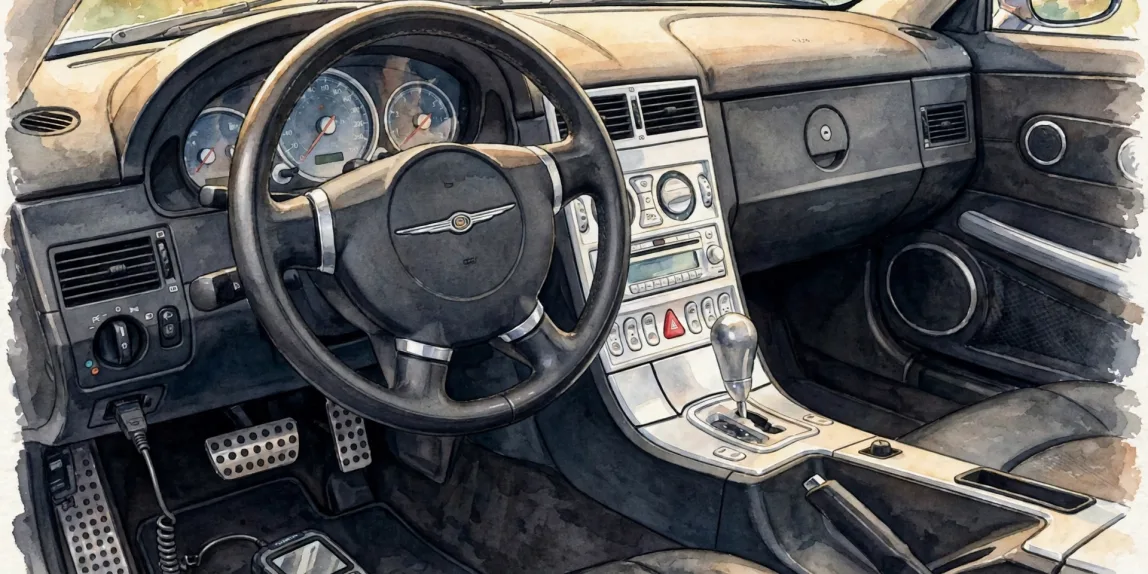
Think of it as Yoga for the brain, we are going to stretch a bit.
Scanners, Codes, and the SLK320 Trick
Almost every chapter in this part of the book starts the same way: read the codes first. This chapter is about the tool that reads them — because on a Crossfire, choosing the wrong scanner is the easiest way to be told “no fault codes found” by a car that is full of them.
The Crossfire is a Mercedes-Benz R170 wearing a Chrysler body, and its electronics never forgot that. A scanner that only speaks generic Chrysler will talk to the engine and almost nothing else. The fix is a selection trick every Crossfire owner should know.
Tell the Scanner It’s a Mercedes
If your scanner does not list the Chrysler Crossfire, select the Mercedes it actually is underneath:
Your car
Select this instead
Engine
Crossfire 2004–2008
2004 SLK320 (R170)
3.2L M112 V6
Crossfire SRT-6 2005–2006
2004 SLK32 AMG (R170)
Supercharged 3.2L M112 V6
The year mismatch is intentional. Mercedes ended R170 production in 2004; Chrysler kept building Crossfires on the same platform through 2008. In the scanner menus the path is usually Mercedes-Benz → SLK-Class → R170 → SLK320 → 2004 (some tools list the chassis simply as “170”).
Two cautions. Do not select the newer R171 SLK350 — a different generation of electronics entirely. And understand what the trick is: a diagnostic workaround, not a guarantee. Most modules will answer to the SLK320 profile; a few Chrysler-specific ones may not, and an unsuccessful connection to a module the Mercedes had and the Crossfire doesn’t (the SLK’s retractable-hardtop controller, for instance) is normal, not a fault.
Where the Connector Lives
The factory manual: the Data Link Connector “is located at the lower edge of the instrument panel near the hood release. The exposed connector terminals are protected by a plastic cover which flips open if access is needed.” It is a standard 16-pin OBD2 socket, powered by the car, so most handheld scanners need no batteries.
One trap for Mercedes shoppers: some older R170 Mercedes use a round 38-pin diagnostic connector, and adapters are sold for it. The Crossfire never had it — 16-pin only. Do not buy the 38-pin adapter for this car.
Why a Cheap Scanner Says “No Codes”
The Crossfire does not have one computer; it has a committee — engine, transmission, ABS, BAS, ESP, airbags, instrument cluster, climate control, body electronics, the convertible-top controller, and the SKREEM security module that decides whether your key may start the car. Each one stores its own fault codes.
They do not all share one wire. The diagnostic connector gives different systems different pins — the pin map documented in the Crossfire diagnostic connector reference:
Connector pin
System
7
Engine diagnostics
9
ABS / BAS / ESP
11
Automatic transmission
12
Convertible-top controller
13
Airbag controller
15
Instrument cluster and other systems
16
Battery power
A basic $25 code reader talks on pin 7 and stops there. So the BAS/ESP light can be glowing on your dash while the reader cheerfully reports NO FAULT CODES FOUND — not because the system is healthy, but because the reader never asked it. On this car, that distinction is everything.
The Four Classes of Scanner
Class A — Basic OBD2 readers (about $20–$60). Check-engine codes, misfires, oxygen sensors, emissions readiness, some live engine data. The Autel AL519 is the sensible example. Fine as far as they go; they cannot see ABS, airbag, or transmission faults. Not enough as your only Crossfire tool.
Class B — Mercedes-specific scanners (about $110–$220). This is the Crossfire sweet spot — tools built to talk to Mercedes modules, used through the R170 profile.
iCarsoft MB II (about $150) — the best-documented Crossfire scanner there is. The Crossfires.net technical wiki specifically recommends it with the R170 SLK320 selection, and owners report pulling engine, transmission, and airbag codes and live data with it. The safest purchase in this chapter.
iCarsoft MB V3.0 (about $190) — newer, with more service functions, but the Crossfire-specific owner evidence is thinner than the MB II’s. Before buying one for ABS/BAS work, get iCarsoft to confirm R170 ABS access in writing.
Foxwell NT530 with Mercedes software (about $159) — owners report good results with the Mercedes-Benz software package; the Chrysler package alone has proven insufficient. Confirm which software is in the box before you pay.
Launch CRP123 / Millennium 90 Pro (about $100–$150, older models) — the budget surprise: owners report reading engine, transmission, ESP, and airbag codes. Caveat from the same reports: airbag codes on 2007–2008 cars can be read but not reset with these.
Class C — Multibrand professional scanners (about $300–$600). The XTOOL D7 (about $350–$360) is the documented example — an owner reports it works very well on the SLK320 profile, and XTOOL has since added a direct Crossfire selection. Worth it if you maintain several cars, overkill for one.
Class D — Factory level. Chrysler’s own system was the DRBIII scan tool, and for certain Crossfire procedures Chrysler specified it with the CH9043 multiplexer cable and the CH9044 Crossfire software card. This is programming-and-module-replacement territory — good to know it exists, unnecessary for routine diagnosis. Modern shops use a DRBIII emulator for these cars.
Prices here are advertised prices as of November 2026 and they move; treat them as neighborhoods, not quotes.
Running a Scan, Step by Step
1. Connect. Ignition off, plug into the socket under the dash, then turn the key to ON/RUN without starting the engine. The dash lights come on; the scanner powers up.
2. Select the car manually. Do not trust automatic VIN detection — the tool may read the Chrysler VIN and load the wrong software. Choose Mercedes-Benz → SLK → R170 → SLK320 → 2004 yourself. (If 2004 is missing, the 2003 SLK320 profile is a reasonable stand-in.)
3. Run the full-system scan. Let it poll every module it can reach. A module that doesn’t answer because the Crossfire doesn’t have it is normal.
4. Record everything before touching “clear.” Photograph the screens. Write down the code number, which module reported it, and whether it is current, pending, or stored. Clearing codes erases freeze-frame evidence and resets emissions monitors — it is the last step of a repair, not the first step of a diagnosis. And remember the rule from every chapter of this book: a code names a suspect, not a culprit. Low voltage, a corroded connector, or a failing ground can set the same code as a dead part.
5. Use live data. RPM, coolant temperature, airflow, throttle position, fuel trims, oxygen sensors — and with a Mercedes-capable tool, transmission data and ABS wheel-speed signals. Watching a value misbehave beats guessing which part to buy.
6. Hands off the advanced functions. Do not attempt ECU coding, module initialization, key programming, or adaptations while the tool thinks the car is an SLK320, unless you have verified that exact procedure for the Crossfire. Reading is safe; rewriting a module under an approximate identity is how cars get bricked.
The Computer Route
If you would rather use a laptop: an ELM327-compatible USB or Bluetooth interface (the OBDLink MX+, about $140, is the quality option and supports the ISO 9141-2 protocol the Crossfire’s engine diagnostics use) plus OBD software — OBD Auto Doctor and Python-based tools among them, on Linux, Windows, or Mac — will read standardized engine data and log it over time. That is genuinely useful for tracking down an intermittent misfire. But a generic interface plus generic software is still a pin-7 conversation: for ABS, BAS, SRS, and transmission controllers, you need a tool with demonstrated Mercedes coverage.
When the Scanner Won’t Connect
Work this order before blaming the car:
Ignition fully at ON/RUN, scanner seated firmly in the socket, connector pins undamaged.
Battery healthy — low system voltage causes exactly this kind of nonsense (the factory diagnostic for a dead scan tool starts by demanding at least 11 volts at the connector).
Manual vehicle selection, per above — automatic detection failing is a scanner problem, not a car problem.
Check the socket’s power fuse. The factory manual’s own no-power diagnostic ends at: “Check Fuse 14 in the Underhood Accessory Fuse Block” — the diagnostic socket’s dedicated fuse (10 amp in the owner’s manual). No power at pin 16, no conversation.
If the engine answers but nothing else does, suspect the scanner’s limits before the car’s wiring.
What a Scanner Cannot Tell You
A scanner interrogates electronics. It cannot feel your brake pedal. The factory manual on a spongy pedal: “A spongy pedal is most often caused by air in the system. However, substandard brake hoses can cause a spongy pedal” — bleed the system, replace suspect hoses. A hard pedal or high effort points the other way, at the vacuum booster, its check valve, or a vacuum leak. Neither condition sets a code, and a clean scan says nothing about whether your brakes are safe. If the pedal feels wrong, the hydraulic system gets inspected — physically — before the car is driven. Low power-steering fluid, for the record, has nothing to do with brake assist on this car; the booster runs on engine vacuum.
The Verdict
Budget
Buy
Under $60
Autel AL519 — engine codes only, know the limit
Around $120
Launch CRP123 (original) if you can find one
Around $150
iCarsoft MB II — the documented Crossfire choice
Around $160
Foxwell NT530 — only with the Mercedes software included
Around $200
iCarsoft MB V3.0 — after confirming Crossfire ABS coverage
Around $400
XTOOL D7 — if several cars share your driveway
Before buying anything, put one question to the seller, in writing:
“Will this scanner read the ABS/BAS/ESP, transmission, and airbag controllers on a 2004–2008 Chrysler Crossfire using the 2004 Mercedes SLK320 R170 vehicle selection and its standard 16-pin diagnostic connector?”
A specific answer to that question is worth more than any box that advertises “ABS, SRS, and transmission support” — which may only mean those systems on newer cars with entirely different electronics. And do not assume newer is better: the Crossfire speaks an older Mercedes diagnostic dialect, and some modern CAN-bus tools barely speak it at all.
For basic engine codes, almost any reputable reader works. For real Crossfire diagnosis, the requirement is Mercedes R170 coverage — start with the SLK320 selection, record before you clear, and let the data accuse the part before your wallet does.
From the Author’s Driveway
This chapter was not written from a manual. On November 23, 2026, I plugged my own Foxwell scanner into my own 2005 Crossfire coupe, selected the Mercedes 170.465 SLK320 profile exactly as this chapter describes, and the car answered at module level — real VIN, real modules, real codes. The trick works, and here is what it found.
First lesson: entering through the Mercedes door, the codes wear Mercedes numbers. The engine reported P201A — the camshaft Hall sensor (B6/1) electrical fault, MIL on and stored — which is the P0341 family in Chrysler numbers, and P20CC-008, “rough road detection”: the speed signal from the ESP control module was implausible, stored and current. That second code does not accuse a part. It gives an instruction: read out the fault memory of the ESP control unit. So I did what the car told me to do.
Three different modules were all pointing at the same corner of the car. The transmission (EGS) reported P2400 — right rear wheel rpm signal via CAN implausible, stored and current. The shifter module (EWM) reported P1860 — the same right rear signal, stored and current — and P1861 for the left rear, stored only. When the engine, the gearbox, and the shifter all complain about one signal, you do not have three problems. You have one: the right rear wheel speed sensor, its wiring at the hub, or the ESP module that broadcasts the signal to everyone else.
The same scan turned up a second, completely separate fault: P1817-002, a reversing lamp short circuit to positive, stored and current, with P1817-003 (no supply voltage at terminal 15 for the reversing light) stored alongside it. That is the easy one — a 21W bulb in a twist-out socket. Pull it and look for a shorted filament or green corrosion in the socket before anything fancier.
The rest of the list read like history, not news. The CAN communication codes in the transmission and shifter (P2300, P1875) were stored only — the classic residue of past low-battery events. The transmission’s P220A (internal speed-sensor comparison) and P2222 (oil temperature sensor / starter lockout contact) were also stored only. P220A is the one to watch: if it ever comes back current, that is conductor-plate territory. The charging system, for the record, showed a healthy 14.4 volts running.
The order of work writes itself: ESP module readout first, then the right rear sensor and its wiring, then the reverse bulb and socket — then clear everything and see what returns. Half a list like this may never come back. Record before you clear, let the modules accuse the part, and let the data spend your money. That is the whole method of this chapter, demonstrated on the author’s own car.