Think of it as Yoga for the brain, we are going to stretch a bit.
The Wrecking Crew — Surviving the Teenage Cat
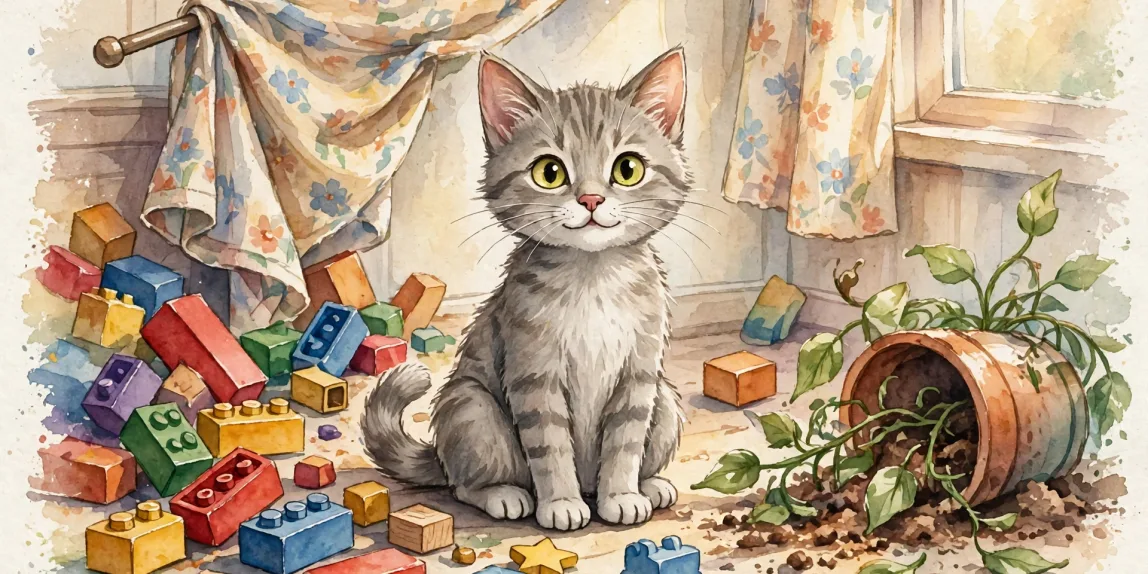
Nobody warns you that a kitten has a sequel. The tiny chaos you survived grows up, gets longer legs, learns where you keep the good stuff — and discovers that your home is not a home. It’s a demolition site with snacks.
— YNOT!
Here is a letter this book receives in spirit about once a week, most recently from a woman at the end of her rope: two young cats, and between them they have destroyed every Lego set she owns, two shower curtains, a regular curtain, two cat tents, and several pairs of shoes. Lego pieces have vanished entirely. She has done everything the internet recommends — the toys, the trees, the scratch posts, the puzzles are all bought and deployed. She tried a spray bottle. The cats’ response was to study her schedule and commit their crimes while she’s at work. She dreads going home. If this sounds like your house, this chapter is yours. The news is good, but it is not “buy another toy.” She already owns the toys. The problem was never the toys.
FIRST, KNOW WHAT YOU’RE LIVING WITH — A TEENAGER
Between roughly six months and eighteen months, a cat is an adolescent, and feline adolescence looks exactly like the human kind: peak energy, boundary testing, a body that’s nearly adult strapped to a brain that is still under construction. This is the age of maximum destruction — not because the cat is bad, and not because you failed, but because you are living with a creature whose entire job description, written by evolution, is to practice hunting, climbing, and dismantling the world for eight to ten waking hours a day. The wild kitten phase from a few chapters back was the trailer. This is the feature film, and it has a bigger budget.
Two things genuinely help, and the first is time: most cats downshift noticeably by about age two, and the cat you have at three is unrecognizably calmer than the one demolishing your curtains today. The second is neutering. An unneutered male is running on a hormone supply that fuels restlessness, roaming urges, and general mayhem; neutering removes that driver, and the large majority of males settle measurably afterward. It will not fix boredom — nothing surgical fixes boredom — but if your wrecking crew is intact, that is item one on the list, before any training advice in this chapter.
THE TOYS AREN’T THE PROBLEM — THE SCHEDULE IS
Look at the letter again: toys, trees, scratch pads, puzzles, hiding places — “everything that’s been recommended.” And the destruction continues. Here is the distinction nobody puts on the product packaging: a room full of toys is a gym nobody attends. A cat toy lying still is furniture. Prey moves — erratically, enticingly, away — and the only toy in your home that imitates prey properly is a wand toy with you on the other end of it. Interactive play, where you are the engine, is not enrichment frosting. It is the main drain on the tank, and a cat whose tank is full will spend that energy on your belongings, because your belongings are what’s available.
So the prescription is a schedule, not a purchase. Two or three real play sessions a day, ten to fifteen minutes each, wand toy, full hunt — stalk, chase, catch, and let the cat win often enough to stay in the game. Run the last session in the hour before bed and finish it the way this book keeps preaching: hunt, catch, eat, groom, sleep. A small meal after the final hunt tells the cat’s oldest wiring that the day is over. And rotate the solo toys — put half away and swap them every few days, because a toy that has sat in the corner for a month is invisible, and the same toy reappearing after a week in the closet is briefly, wonderfully new again.
THE BASE CAMP — CONTAINMENT IS NOT A CELL
Now the advice the whole thread gave our letter-writer, in chorus, and the advice this book endorses at full strength: while you are not home, the cats do not get the house. They get a base camp — one room, set up as their apartment: litter box at one end, food and water at the other, scratcher, bed, a window if the room has one, and the safe solo toys. Doors closed. Freedom is for supervised hours, and it expands as behavior earns it.
Understand what this is, because it is widely misunderstood as punishment. It is not a penalty box; the cats do not experience a well-stocked room as a tragedy, and most settle into it as their headquarters — cats are den-and-territory animals, and a defined home base suits their wiring better than an empty echoing house does. It is also, quietly, a safety measure. Our letter-writer’s missing Lego pieces worry her, and they should worry you: unsupervised young cats chew, bat, and occasionally swallow the world, and this book’s chapter on household dangers exists because the emergency vet’s foreign-body surgery schedule is full of exactly this age group. Base camp while you’re out is not you losing. It’s the arrangement every professional reaches for, because it works while everything else is still being learned.
CAT-PROOF THE TREASURES — IT’S NOT SURRENDER
The other half of the peace treaty is yours to sign: some things leave the battlefield. Display Lego goes behind glass or behind a door. Shoes go in the closet — a closet with a door that shuts, which is the only kind of shoe storage a teenage cat respects. Curtains get tied up out of climbing range while you’re out, or swapped for blinds in the war zone. Wobbly valuables get a dab of museum putty, the removable adhesive that keeps objects standing through earthquakes and, more impressively, through cats. None of this is defeat. Childproofing a house for a toddler is not the toddler winning; it’s the adults being realistic about the developmental stage currently in residence. Your cat is not a burglar you’re outwitting. It’s a teenager you’re outlasting, and the correct strategy for teenagers, feline and otherwise, is to remove the opportunities you can’t supervise and wait for the brain to finish.
And a word for the spray bottle, since our letter-writer tried it and it failed on schedule: it failed because punishment doesn’t drain the tank, doesn’t teach an alternative, and mostly teaches timing — which is how she ended up with cats who wait for her car to leave. This book made the whole case in the chapter on scaring a cat straight, and the short version stands: you cannot discipline energy. You can only spend it or contain it.
WHEN IT’S NOT TEENAGERS — THE EXCEPTIONS
Two flags before the reassurance. Destruction that arrives suddenly in an adult cat who was never like this is not adolescence — it’s a change, and changes get a vet visit, because pain and illness wear this costume. And destruction that happens only when you leave, paired with distress — crying at the door, over-grooming, litter box misses from a cat who’s reliable when you’re home — can be separation anxiety, which is real in cats despite their reputation, and worth a conversation with your vet rather than a bigger toy budget. But if what you have is two healthy teenagers with full tanks and an unsupervised house, you don’t have a behavior problem. You have a management problem, and management problems have solutions: drain the tank on a schedule, base camp while you’re gone, treasures behind doors, and the calendar quietly working in your favor.
Our letter-writer dreaded going home. The fix isn’t a different cat. It’s a smaller map, a fuller schedule, and a few months of patience — and then one day, sooner than the curtain budget suggests, you come home to a house that’s exactly as you left it, and a former demolition expert asleep in the middle of the rug like the whole war was somebody else’s idea.
You can’t punish energy out of a young cat, and you can’t bore it out either. You can only spend it, contain it, and outlast it — in that order, every day, until one morning the wrecking crew clocks in as furniture. — YNOT!