Most cats tolerate being picked up the way you tolerate a hug from a wet uncle. The Ragdoll built an entire breed out of the opposite opinion: picked up, it melts. A cat whose founding talent is relaxing is a cat that understood the assignment of domestic life better than most of us.
— YNOT!
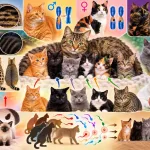
This book has spent thirty-seven chapters talking about cats in general — how they think, how they age, how they train us while we pretend otherwise. This chapter is the first portrait of one cat in particular: the Ragdoll, the big blue-eyed floppy aristocrat of the cat world, and the breed behind the color chart that started this chapter. If you have ever looked at a Ragdoll and wondered whether something that beautiful can possibly be real, the answer is yes — with paperwork. We’ll get to the paperwork.
THE FLOP THAT NAMED A BREED
The Ragdoll is a young breed, an American invention. In the 1960s, in Riverside, California, a breeder named Ann Baker was working with the kittens of a white longhaired cat named Josephine, and she noticed something odd about them: they were unusually placid, and when you picked them up, they didn’t brace, squirm, or supervise. They went relaxed — limp, like a rag doll. Baker did what any sensible person would do with a miracle. She named it, bred for it, and founded a breed on it.
Sixty years of selective breeding later, the temperament is the breed’s whole reputation: calm, gentle, quiet-voiced, and famously people-oriented. Ragdoll owners describe a cat that follows them from room to room, greets them at the door, comes when called, and — this comes up so often it might as well be in the breed standard — plays fetch. The honest fine print, which this book always prints: the flop is a tendency, not a contract. Plenty of Ragdolls melt in your arms exactly as advertised. Some would prefer to be admired from a respectful distance, like all cats everywhere. You are breeding for a disposition, not installing one.
BORN WHITE — THE COLOR ARRIVES LATER
Every Ragdoll kitten is born white. All of them, no exceptions, whatever they will eventually become. The breed carries the pointed gene — the same temperature-sensitive coloring that paints a Siamese — which means pigment develops where the body is coolest: the ears, face, legs, and tail darken into “points” while the warmer body stays pale. A newborn is a blank page because a newborn is warm all over. The color creeps in over the first weeks, deepens for years, and a Ragdoll is famously not finished until it is three or four years old — full size, full coat, full color. Owning a Ragdoll kitten means watching a photograph develop, very slowly, for about a thousand days.
That same pointed gene is why traditional Ragdolls always — always — have blue eyes. Blue eyes and points are genetically handcuffed together. If a cat looks like a Ragdoll but has green or gold eyes, you are looking at one of the newer mink or sepia lines (which some registries accept and others don’t, a quarrel we will leave to the registries), or at a beautiful cat who is not a Ragdoll at all. Hold that thought; it becomes important in a few sections.
THE RAGDOLL RAINBOW — SIX COLORS, THREE PATTERNS, TWO TWISTS
Ragdoll colors sound like a dessert menu, and there are only six of them, arranged with a logic that makes the whole rainbow easy to learn. There are three base colors: seal (deep brown, nearly black), chocolate (milk-chocolate brown), and red (the flame orange). Then a second gene — the dilute gene — waters each base color down: seal dilutes to blue (a soft grey), chocolate dilutes to lilac (a pinkish dove-grey), and red dilutes to cream. Six colors, three full-strength and three pastel.
On top of the color, the cat wears a white pattern, and there are three main settings. Colorpoint: no white at all — dark points, pale body, the classic look. Mitted: the points stay, but the cat has dipped its feet in milk — white paws like mittens, a white chin, and a white stripe running down the belly. Bicolor: more white still — white legs, white belly, and an inverted white V up the face, as if the cat walked through a snowdrift face-first. (A fourth, mostly-white pattern called Van exists at the extreme end of the same dial.)
Then come the two twists that can be layered over any of it. Lynx means tabby striping inside the points — bars on the legs, a lined face, a wildcat accent on a very un-wild cat. Tortie means the points are patched with red or cream, tortoiseshell-style — which, per the genetics in this book’s very first chapter, means the cat is almost certainly a female. Lynx plus tortie together makes a torbie. And that is the entire code. When a breeder describes a “blue lynx mitted,” you can now read it like a label: grey points, tabby-striped, white feet and chin. The rainbow is not decoration. It’s a language, and you are now fluent.
HOW TO SPOT ONE IN THE WILD
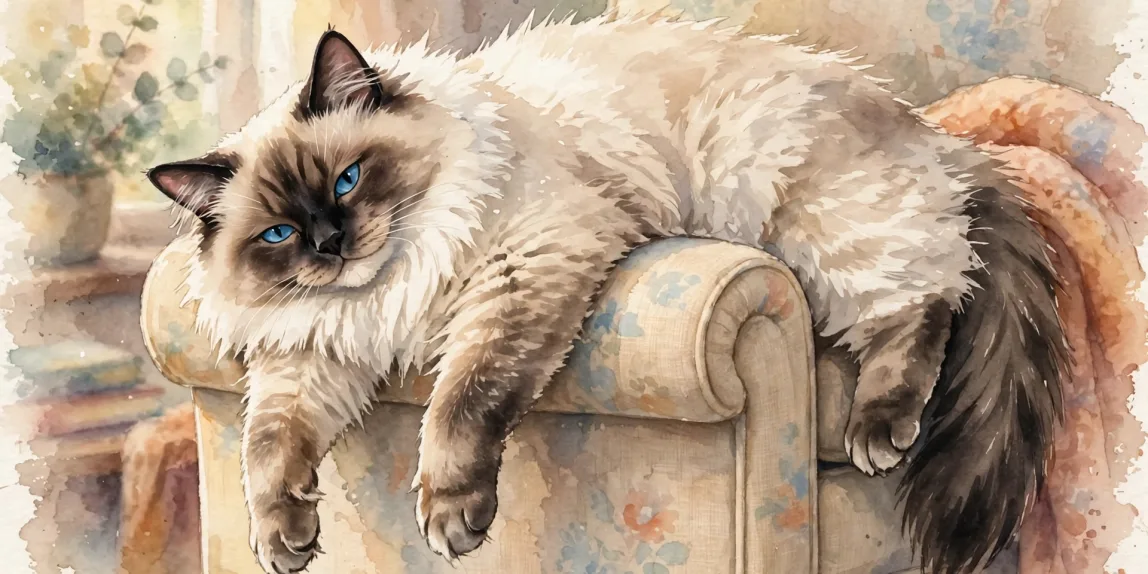
Suppose the cat is standing in front of you and the label is missing. The checklist runs like this. Blue eyes — non-negotiable in a traditional Ragdoll. A silky, semi-long coat that feels more like rabbit fur than cat fur, with a ruff around the neck like a small lion, tufts of fur between the toes, and a tail carried like a plume. A big, heavy-boned, rectangular body — this is one of the largest domestic breeds, with males commonly reaching fifteen to twenty pounds and females ten to fifteen, all of it under that slow three-to-four-year construction schedule. And the behavioral tell, the one the name promises: pick the cat up, and instead of reorganizing your face, it relaxes into your arms like it has been waiting all day for exactly this.
THE PAPERS PROBLEM — A RAGDOLL IS A PEDIGREE, NOT A LOOK
Now the part nobody wants to hear at the shelter. A breed, legally and logically, is not an appearance. It is a recorded ancestry — a pedigree registered with a body like TICA or the CFA. A cat with Ragdoll looks and no papers is, officially and without any insult intended, a domestic longhair. The internet’s own Ragdoll communities are blunt about this, and they are right: even DNA breed tests can only estimate ancestry from markers; they cannot certify a pedigree that was never recorded. Shelters label cats with breed names because “Ragdoll” gets a cat adopted faster than “large friendly longhair,” and everyone in the transaction understands the label is a hope rather than a fact.
Here is the thing, though, and this book will die on this hill: it does not matter to the cat, and it should not matter much to you. The domestic longhair who flops in your arms has the only trait on this entire page that anyone actually lives with. The papers matter if you are breeding, showing, or paying a pedigree price — in which case, demand them, and demand the health testing below while you’re at it. For a companion, judge the cat in front of you. The rainbow is a language, but the cat is the cat.
LIVING WITH ONE — THE FINE PRINT
Ragdolls are indoor cats, and not only because of the price tag. Their own owners say it best: the breed is too trusting for the street — friendly to everything, predators included, with what one owner diplomatically called “not the most defensive instincts.” A cat bred for sixty years to relax in the presence of strangers should not be asked to negotiate with traffic.
The coat is the other surprise. It looks like a grooming sentence and mostly isn’t: that silky, rabbit-like fur has little undercoat and mats far less than it threatens to. A weekly brush-through handles the coat; the real chores are seasonal shedding and the occasional sanitary trim around the rear plumbing, a glamorous task Ragdoll owners discuss with the weary solidarity of people who have all done it. On health, know one name: HCM, hypertrophic cardiomyopathy, a heart disease with a known genetic mutation in this breed and — this is the good part — a simple DNA test for it. A breeder who tests for HCM and shows you the results is a breeder doing the job. A breeder who has never heard of it is telling you something too. Add the standard big-cat advice — watch the weight, because a large, placid, indoor cat with a good appetite is an obesity story waiting for a plot — and you have the breed’s whole maintenance manual.
WHERE THE RAGDOLL PEOPLE GATHER
Ragdoll people are organized, numerous, and generous with photographs. On Reddit, r/ragdolls — “Ragdoll Kitty Galore!” — is the big room, around 146,000 members strong, where owners trade pictures, name requests, and hard-won advice on everything in this chapter; r/RagdollCats runs alongside it, and r/OneRagdollBraincell exists for the breed’s less dignified moments, which are frequent and beloved. On Facebook there are dozens of Ragdoll groups, many of them location-specific, and their owners will tell you their best use: breeder recommendations from people who have actually bought from the breeder. And behind the social layer sit the breed’s formal institutions — the Ragdoll Fanciers Club International (RFCI), with its worldwide breeder directory; the Ragdoll Fanciers Worldwide Club and Ragdoll International; and in Britain, the UK Ragdoll Cat Club, which also runs Ragdoll rescue and rehoming. If this chapter has done its job and you are now quietly pricing kittens, start in those rooms. The people there were all priced-and-lost before you.
That is the Ragdoll: a California idea from the 1960s, painted in six colors, built on the radical premise that a cat could be bred to relax. It should not have worked. It worked completely.
Every breed is a bet on what a cat should be. The Ragdoll bet everything on gentleness — and produced fifteen pounds of evidence that gentleness, bred true, is not weakness. It’s a feature. — YNOT!
© 2026 insearchofyourpassions.com - Some Rights Reserve - This website and its content are the property of YNOT. This work is licensed under a Creative Commons Attribution 4.0 International License. You are free to share and adapt the material for any purpose, even commercially, as long as you give appropriate credit, provide a link to the license, and indicate if changes were made.