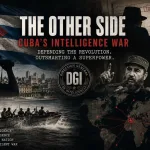
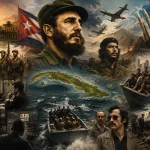
Think of it as Yoga for the brain, we are going to stretch a bit.
Why Che and Cuba Still Matter to America 60 Years Later
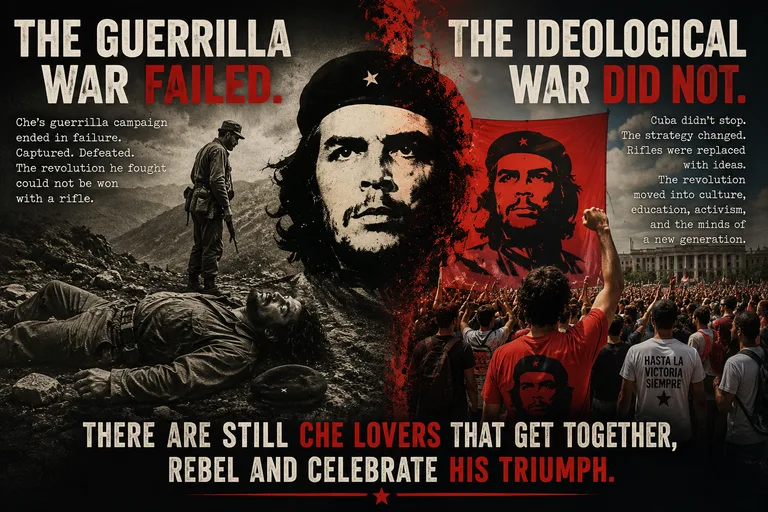
The Guerrilla War Failed. The Ideological War Did Not. Che lovers still get together to celebrate his "triumphs" --YNOT!
Most Americans think Che Guevara is ancient history. And after 60 years it should be.
He is the face on an old T-shirt, a college dormitory poster, a coffee mug, or a faded symbol from another political era. Millions recognize the image, but comparatively few know much about the man, his failed military campaigns, or the international propaganda operation that transformed him from a defeated guerrilla into one of the most powerful political symbols in modern history.
Che’s final revolutionary campaign was a disaster.
In 1966, he entered Bolivia intending to ignite a communist uprising that would spread across Latin America. He believed a small guerrilla force could create the conditions for a larger revolution.
It did not happen.
The Bolivian peasants Che claimed he had come to liberate did not rally behind him. Many viewed his fighters as outsiders. His organization failed to develop meaningful local support, his communications deteriorated, and his guerrilla column became increasingly isolated.
Within approximately eleven months, the Bolivian military had hunted down most of his force.
Che was captured on October 8, 1967, near the village of La Higuera. The following day, he was executed inside a small schoolhouse by a Bolivian army sergeant.
The revolution was over.
His earlier intervention in the Congo had failed. His Bolivian campaign failed. Cuba-backed insurgencies throughout Latin America consumed a generation of young revolutionaries and left behind graves, political violence, and damaged societies.
Measured by the rifle, Che lost.
Cuba lost in Bolivia. Cuba lost in the Congo.
Its guerrilla movements failed across much of Latin America.
But while the rifle was losing, something else was winning.
The image was winning. The story was winning.
The propaganda was winning.
The ideology was learning how to survive without the battlefield.
That is why Che Guevara and Cuba still matter to America almost sixty years later.
The Photograph That Defeated History
Seven years before Che’s death, Havana fashion photographer Alberto Korda attended a memorial service for victims of the explosion of the French freighter La Coubre.
During the ceremony, Che Guevara briefly stepped into view.
Korda took only two photographs.
The image was striking: Che staring into the distance, his expression appearing defiant and visionary, wearing his familiar black beret with a revolutionary star.
The newspaper for which Korda worked did not publish the photograph.
Korda printed it, placed it on the wall of his studio, and largely forgot about it.
Years later, Italian publisher Giangiacomo Feltrinelli visited Havana and saw the photograph. He obtained a copy and brought it back to Europe.
When Che was killed in Bolivia in October 1967, Feltrinelli began reproducing the image by the hundreds of thousands.
The photograph spread across Europe, Latin America, the United States, and eventually the world.
It became one of the most reproduced photographs in history.
The military reality of Che’s career almost disappeared beneath the mythology created by the image.
The failed guerrilla became a revolutionary saint.
The defeated commander became a symbol of permanent resistance.
The man whose campaigns had collapsed became an icon of youthful rebellion.
The photograph separated Che the symbol from Che the historical person.
That separation was essential.
People could wear the image without studying the prisons, executions, political repression, economic failures, or authoritarian government associated with the revolution he helped create.
They did not need to know the history. They only needed to recognize the brand.
The Rifle Lost, but the Poster Won
At approximately the same time, Cuba was developing an international propaganda system designed to distribute revolutionary ideology far beyond the island.
In January 1966, Havana hosted the Tricontinental Conference, bringing together revolutionary organizations from Asia, Africa, Latin America, and other parts of the world.
The conference helped establish the Organization of Solidarity with the People of Asia, Africa and Latin America, commonly known as OSPAAAL.
OSPAAAL began publishing Tricontinental, a magazine distributed internationally in several languages.
Many issues included a free revolutionary poster folded inside.
These posters used bold colors, dramatic symbolism, striking typography, and images of guerrillas, workers, racial struggle, anti-colonial movements, and revolutionary leaders.
They were inexpensive to reproduce and easy to transport.
The posters came out of the magazines and went onto university walls, activist offices, cultural centers, and dormitory rooms around the world.
Many appeared in countries where no communist revolution had occurred and where most of the people displaying them had never experienced guerrilla warfare.
That was precisely the point.
Cuba discovered that it did not need to send a rifle to every country.
It could send a picture.
A rifle must cross a border physically. An image crosses borders psychologically.
A guerrilla column requires food, ammunition, transportation, training, and local support.
A poster requires a wall.
The rifle failed.
The image succeeded.
And once the image succeeded, it became possible to detach revolutionary ideology from the disastrous results of revolutionary government.
Communism could be presented as rebellion rather than repression.
It could be marketed as justice rather than state control.
It could be sold as youthful idealism rather than political conformity.
Che became the perfect product.
His photograph communicated emotion without requiring knowledge.
It offered the appearance of moral courage without requiring any examination of the historical consequences.
Cuba Changed Its Strategy
When the Soviet Union collapsed in 1991, many Americans assumed Cuba’s revolutionary project had ended.
The Soviet subsidies disappeared. Cuba entered a severe economic crisis. Havana no longer possessed the same financial ability to support guerrilla insurgencies, military expeditions, and revolutionary governments around the world.
But Cuba did not abandon its campaign against the United States. It changed tactics.
It stopped relying primarily on rifles and began relying more heavily on relationships.
It replaced guerrilla columns with political coalitions.
It replaced jungle training camps with conferences and academic centers.
It replaced armed insurgents with solidarity organizations, friendship societies, exchange programs, cultural institutions, nonprofit groups, and activist networks.
Cuba’s objective remained the same: weaken the political, cultural, and institutional foundations of the United States and advance a revolutionary ideology hostile to American constitutional government, private enterprise, individual liberty, and Western influence.
The method became more sophisticated.
Rather than attempting to conquer America militarily, Havana worked to influence Americans ideologically.
Instead of planting foreign organizations that could easily be identified and rejected, it cultivated domestic movements rooted in genuine American grievances.
That is the central finding of the State Department’s investigation into Cuba’s decades-long campaign of espionage, infiltration, ideological influence, and political subversion inside the United States.
Cuba as the Nucleus of the Modern Radical Left
The State Department has identified the Castro regime as more than a traditional geopolitical adversary.
For more than six decades, Cuba has served as the leading sponsor, organizer, and ideological center of radical leftism and Third World revolutionary politics directed at the United States.
The Cuban government conducted a sustained campaign of subversion against America.
That campaign infiltrated the highest levels of the United States government.
It recruited and cultivated generations of American activists.
It supported networks connected to the unprecedented wave of radical left-wing terrorism that struck the United States during the 1960s and 1970s.
It conducted one of the most durable and damaging foreign intelligence penetrations in American history.
This was not a temporary Cold War operation. It was a long-term strategy.
Havana understood that it could not defeat the United States in a conventional military confrontation. Cuba lacked the population, industrial capacity, economic power, and military force to challenge America directly.
It therefore developed an unconventional form of warfare based on espionage, infiltration, proxy networks, political influence, propaganda, ideological training, and the exploitation of domestic conflict.
Cuba did not need to conquer American territory. It needed to influence American institutions.
It did not need to defeat the United States Army.
It needed to recruit Americans who would advance Cuban political objectives from inside the United States.
It did not need to make its ideas look Cuban. It needed to make Cuban revolutionary ideology appear indigenous to America.
And it succeeded.
The Native Tree Strategy
The best way to understand this strategy is not through military terminology.
It is through gardening. Imagine that you want to grow a tree in a place where trees do not naturally thrive. You could plant a foreign seed. You could water it, protect it, and wait fifteen years. It might survive. It would probably fail. Or you could find a tree already rooted in the local soil. That tree already survives the winters. It already receives water from the ground. It already draws nutrients from its surroundings. You cut into the native trunk and graft a new branch into the wound. The native roots then begin feeding the foreign branch.
Eventually, the tree produces different fruit. That is how ideological subversion works.
Cuba stopped attempting to plant obviously foreign political movements in American soil.
It grafted revolutionary ideology onto movements already growing inside the United States.
The trunks were real. The grievances were real. America has real poverty.
Real racial tension. Real inequality. Real corruption. Real political exclusion.
Real labor disputes. Real failures of government.
Real abuses of corporate and institutional power.
Cuba did not need to invent these problems. It only needed to find the wound.
The graft consisted of ideology, political training, organizational methods, international coordination, propaganda, strategic guidance, and financial or institutional support.
The roots remained American. The people remained American. The language remained American. The grievance remained American.
But the ideological framework attached to it came from somewhere else.
That is what made the strategy so effective. The resulting movement no longer appeared foreign. It spoke with an American accent. It cited American history.
It organized around American controversies.
It presented itself as an authentic response to domestic injustice.
Yet attached to those genuine concerns was a revolutionary ideology developed, refined, and promoted by foreign authoritarian governments.
The fruit appeared American because it grew from an American tree.
But the graft changed what the tree produced.
Stop Looking Only for Spies
Cuban espionage inside the United States was real, extensive, and successful.
The Castro regime recruited Americans, penetrated government institutions, obtained intelligence, manipulated political organizations, and operated networks that remained undetected for years.
Those operations caused real damage. But looking only for traditional spies misses the larger mechanism.
A spy knows that he or she is working for a foreign power.
An influenced activist may not. A spy receives instructions secretly.
An ideologically cultivated organizer may believe every decision is completely independent. A spy hides foreign loyalty.
A political movement shaped through decades of ideological influence may no longer recognize the foreign origin of its ideas.
That is more durable than espionage. The most successful foreign influence operation is not one that constantly requires direct orders.
It is one that creates organizations, intellectual traditions, political networks, and cultural assumptions capable of reproducing themselves.
Once established, the network trains the next generation.
Activists establish nonprofit organizations. Writers produce books and articles.
Political staffers enter government. Students become educators.
Movement leaders become elected officials.
The original foreign connection becomes less visible with every generation.
Eventually, the graft appears to be part of the original tree.
That is the objective.
The Venceremos Brigade and Political Cultivation
One of the most important instruments in this campaign was the Venceremos Brigade.
Created in 1969, the program brought Americans to Cuba to work, study, receive political education, and experience the revolution firsthand.
Approximately 10,000 Americans have traveled to Cuba through this operation and related exchange programs.
These visitors did not simply return home with photographs and memories.
Many returned with ideological commitments, organizational relationships, political training, and a romanticized interpretation of the Castro regime.
They became professors, activists, organizers, nonprofit directors, political staffers, cultural leaders, and elected officials.
At least one participant eventually became the mayor of one of America’s largest cities.
That is how long-term political cultivation works.
The objective was never necessarily to recruit every visitor as a formal intelligence asset.
Formal recruitment would have been unnecessary.
Cuba could achieve far more by shaping how participants interpreted American society.
They returned to the United States prepared to view American institutions through a revolutionary framework.
Some spent decades influencing political organizations, educational institutions, activist networks, and government policy.
Their work appeared domestic because they were Americans.
But part of the intellectual and organizational formation behind that work had taken place under the supervision of a hostile foreign dictatorship.
This was not tourism. It was political cultivation.
From Guerrilla Camps to American Institutions
During the Cold War, Cuba trained insurgents, armed revolutionary organizations, sheltered militants, and supported communist movements across Latin America, Africa, and other regions.
The training camps, intelligence networks, weapons transfers, political front groups, and relationships with revolutionary organizations are part of the historical record.
As circumstances changed, the method evolved. The modern battlefield is no longer limited to jungles, mountain camps, and clandestine weapons shipments.
It includes:
Universities
Academic institutes
Nonprofit organizations
Political coalitions
Cultural exchanges
Friendship societies
Solidarity organizations
Professional associations
Social-media networks
Protest movements
Advocacy groups
International conferences
Student organizations
Journalism
Entertainment
Government agencies
Influence does not always look like espionage.
Sometimes it looks like education. Sometimes it looks like activism.
Sometimes it looks like cultural exchange. Sometimes it looks like humanitarian work.
Sometimes it looks like academic research. Sometimes it looks like a campaign for justice.
That is why it is so difficult to identify. Ideas rarely arrive carrying foreign flags.
The most effective foreign ideas arrive speaking perfect English.
Useful Idiots Do Not Know They Are Being Used
The phrase “useful idiot” is commonly used to describe people who unknowingly advance the interests of a political movement or foreign power.
They may sincerely believe they are fighting injustice. They may believe they independently reached their conclusions.
They may never meet a Cuban intelligence officer, receive foreign money, or knowingly cooperate with an authoritarian government.
They do not need to. They are useful precisely because they do not recognize the larger operation.
Their sincerity makes them more credible. Their American identity makes the ideology appear domestic. Their genuine anger makes the movement appear spontaneous.
Their lack of awareness protects the foreign influence behind it.
Cuba learned that it did not need to manufacture every grievance.
It only needed to identify disaffected people and provide them with an ideological explanation for their frustration.
A lonely young person is offered belonging. A confused student is offered certainty.
An angry activist is offered an enemy. A person searching for identity is offered membership in a collective struggle.
A person confronting an injustice is told that the injustice is not an isolated failure but proof that the entire American system must be dismantled.
That is the graft. The personal grievance becomes political.
The political grievance becomes revolutionary. The revolutionary ideology becomes an identity. Once ideology becomes identity, disagreement is no longer interpreted as debate.
It becomes betrayal.
The Institutional Pathway
The process often begins in places that appear trustworthy.
A student turns to a professor. A young activist joins a campus organization.
A person looking for community attends a political meeting.
A volunteer enters a nonprofit movement. Someone who feels alienated finds a group promising solidarity, purpose, and moral certainty.
These institutions can provide genuine help and community.
But they can also become transmission points for revolutionary ideology.
The individual may believe he is receiving an education when he is receiving political conditioning.
He may believe he has joined a reform movement when he has entered an ideological ecosystem committed to dismantling the existing political order.
He may believe he is participating in an American civil-rights tradition while being trained to interpret every social conflict through a framework developed and promoted by foreign communist governments.
The poison does not arrive in a bottle labeled “foreign propaganda.”
It arrives as compassion. It arrives as scholarship. It arrives as belonging. It arrives as moral urgency.
It arrives as a demand that every institution, tradition, and historical achievement of the United States be interpreted as an instrument of oppression.
The person absorbing it may have no idea where the framework originated.
That ignorance is part of the design.
The Connection to Political Violence
The State Department’s findings also connect Cuba’s influence operations to the radical left-wing terrorism that struck the United States during the late 1960s and 1970s.
This was not merely an era of peaceful protest.
It included bombings, arson, attacks on government buildings, assaults on police, bank robberies, kidnappings, and revolutionary organizations openly committed to overthrowing the American political system.
Many participants described themselves as anti-imperialist revolutionaries and identified with Cuba, Vietnam, communist movements, and Third World liberation struggles.
Cuba served as a model, a source of ideological legitimacy, a provider of political relationships, and, in some cases, a direct source of assistance or refuge.
The same revolutionary vocabulary continues to appear in modern movements.
The targets change. The slogans change. The technology changes. But the structure remains recognizable. An existing grievance is identified.
The grievance is detached from any limited or practical solution.
The entire society is declared illegitimate. Violence is rationalized as resistance.
The person committing the violence is told he is not a criminal but a revolutionary.
An act of destruction becomes an act of liberation.
The individual setting fire to a building may believe he is acting independently.
But the ideological pathway leading him there may pass through decades of foreign revolutionary influence.
Cuba Was Not Acting Alone
Cuba was originally sustained, trained, armed, financed, and protected by the Soviet Union. The Soviet state supplied the money and strategic backing that allowed Havana to project influence far beyond what Cuba’s own economy could have supported.
When the Soviet Union collapsed, the structure changed, but the international network did not disappear.
Today, Cuba operates within a broader authoritarian ecosystem that includes Russia, China, Iran, Venezuela, and aligned political movements around the world.
Each state uses different methods. Russia specializes in intelligence operations, political manipulation, disinformation, and the amplification of social division.
China uses economic power, academic relationships, technology, business influence, media penetration, and institutional pressure.
Iran supports ideological and militant networks, promotes anti-American and anti-Israeli movements, and exploits political unrest throughout the West.
Cuba provides decades of experience in revolutionary organization, intelligence, political cultivation, propaganda, and the transformation of domestic grievances into international ideological movements.
These governments do not need to create America’s divisions.
They amplify them. They do not need to persuade every American.
They only need to deepen polarization, weaken trust, discredit institutions, and convince enough people that their own society is irredeemably evil.
The objective is not necessarily to make Americans love Cuba, Russia, China, or Iran.
The objective is to make Americans hate one another.
A society consumed by internal conflict becomes easier to manipulate and less capable of resisting external threats.
Why Che Remains the Perfect Symbol
Che Guevara remains relevant because he represents the success of this strategy.
His actual military record was poor. His economic management was disastrous.
His political philosophy was authoritarian.
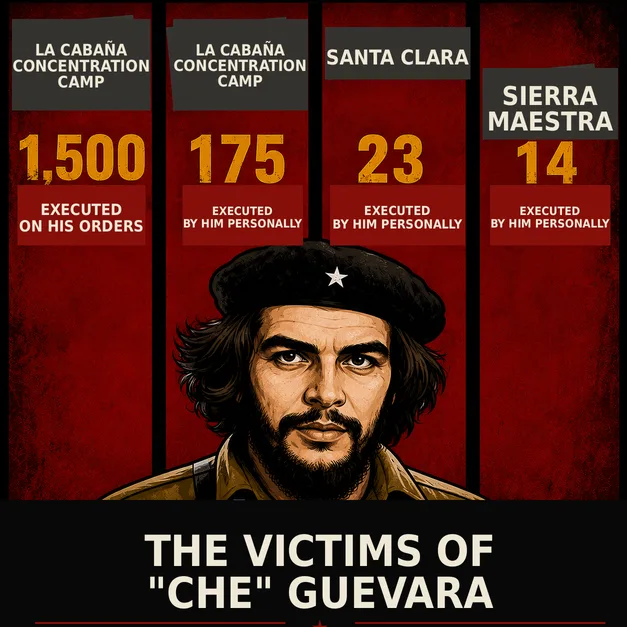
He participated in the creation of a regime that imprisoned opponents, eliminated political pluralism, suppressed speech, restricted movement, confiscated property, and forced millions of Cubans either to submit or escape.
Yet his image remains associated with rebellion, justice, courage, youth, and freedom.
That contradiction did not happen by accident. It was created through propaganda.
Che became something more powerful than a historical figure.
He became a brand. Brands simplify. They replace complicated history with emotional recognition.
The viewer does not see failed agricultural policies, revolutionary tribunals, executions, labor camps, political prisons, or families fleeing across the Florida Straits.
The viewer sees courage. Defiance. Youth. Revolution.
The image performs the political work while concealing the historical record.
That is why the photograph mattered more than the rifle.
The rifle could kill one opponent. The image could recruit generations.
The Revolution Learned to Sell Rebellion
Traditional communism had a marketing problem.
Its governments produced shortages, repression, censorship, political prisons, surveillance, and economic stagnation.
Those results were difficult to sell. But rebellion was easy to sell. Youthful defiance was easy to sell.
Resistance to authority was easy to sell. Justice was easy to sell. Equality was easy to sell.
Cuba learned to separate the emotional appeal of revolution from the institutional consequences of revolutionary government.
The movement could market the excitement of tearing a system down without showing what would replace it.
It could glorify the revolutionary without showing the political prisoner.
It could celebrate redistribution without showing confiscation.
It could promise equality without showing universal poverty.
It could condemn American imperfections while concealing Cuban repression.
That marketing strategy survives today.
The language has changed, but the structure remains.
Every existing institution is described as oppressive.
Every inequality is treated as proof of systemic illegitimacy.
Every reform that falls short of total transformation is dismissed as complicity.
The revolutionary solution is always presented as morally pure because its real-world consequences are kept outside the frame.
Like the photograph of Che, the image is carefully cropped.
The Bitter Fruit
America’s problems are not imaginary. That must be stated clearly. Foreign influence succeeds only when it finds a real weakness.
A corrupt institution creates an opening. A failed school creates an opening.
Racial injustice creates an opening. Economic displacement creates an opening.
Government dishonesty creates an opening. Corporate abuse creates an opening.
A generation raised without purpose, community, stable families, or confidence in the future creates an enormous opening.
Cuba and its allies did not create every wound. They learned how to graft ideology into the wound. That distinction matters.
Dismissing every protester as a foreign agent would be inaccurate and foolish.
But pretending that foreign governments have not spent decades cultivating, training, supporting, and influencing American political movements would be even more foolish.
The tree is American. The wound is American. The anger is American. The people are American. But the graft is foreign.
And the fruit produced by that graft is increasingly bitter.
Check the Graft Line
When we see political movements calling for the destruction of American institutions, we should not look only at the final slogan. We should trace the intellectual lineage.
When activists repeat revolutionary concepts developed by communist governments, we should examine how those concepts entered American education and political culture.
When organizations justify political violence, glorify authoritarian regimes, or treat the United States as uniquely illegitimate, we should investigate their international relationships.
When professors, nonprofit organizations, activist networks, and political coalitions promote identical ideological frameworks, we should look at where those frameworks originated.
Do not argue only about the fruit. Check the graft line.
Ask who provided the ideological training. Ask who organized the exchange programs.
Ask who funded the conferences. Ask who established the solidarity networks.
Ask who translated and distributed the literature. Ask who offered refuge to political militants. Ask who cultivated the organizers.
Ask who benefits when Americans lose faith in their own country.
Once the graft line is visible, the pattern becomes much easier to understand.
Why Cuba Still Matters
Cuba matters because it demonstrated that a small country can exert enormous influence without possessing a large economy or conventional military force.
It matters because Havana spent decades building political relationships instead of merely conducting short-term operations.
It matters because Cuban intelligence penetrated American institutions.
It matters because Cuban political programs cultivated generations of American activists.
It matters because revolutionary ideology entered the United States not only through spies but through culture, education, exchange programs, protest movements, and domestic political organizations.
It matters because many of those ideas now reproduce themselves without requiring direct Cuban control.
Most importantly, Cuba matters because its strategy has been adopted and expanded by more powerful American adversaries.
Russia, China, and Iran possess far greater resources than Cuba ever had.
They have global media systems, cyber capabilities, intelligence services, financial networks, educational partnerships, technology platforms, and access to millions of Americans through digital communication.
Cuba created a model. Others industrialized it.
The Final Lesson
Che Guevara did not win in Bolivia. His revolution failed. His fighters were defeated.
He died in a schoolhouse, abandoned by the people he believed would join him.
But his image escaped the schoolhouse. It crossed borders. It entered universities.
It appeared on dormitory walls. It became part of music, fashion, advertising, political activism, and popular culture.
The revolutionary died. The revolutionary brand survived.
That is the larger story of Cuba’s campaign against the United States.
The guerrilla war failed. The propaganda war continued.
The Soviet Union collapsed. The ideological networks remained.
The rifles disappeared. The relationships endured.
The foreign movement became attached to domestic grievances.
The branch was grafted into the American tree.
Today, much of the resulting fruit looks completely American. It speaks with an American accent, cites American injustice, organizes Americans, and elects American politicians.
That does not mean the ideology originated here.
It means the graft worked.
Che and Cuba still matter sixty years later because they proved that ideas can accomplish what armies cannot.
A military invasion announces itself. An ideological invasion presents itself as education, compassion, justice, identity, and belonging.
The most successful foreign influence does not look foreign.
Eventually, the people advancing it believe it belongs to them.
So stop looking only at the fruit. Find the wound. Trace the branch. Check the graft line.