Think of it as Yoga for the brain, we are going to stretch a bit.
Long before AI Took Over the World and Star Wars Ruled the Galaxy, There was 2001: A Space Odyssey – and there is still nothing like it today.
How did a movie made before human beings walked on the Moon manage to make modern science fiction look as though it was late for work?
Before artificial intelligence started writing reports, answering telephones, composing music, diagnosing machinery, and occasionally telling us complete nonsense with the confidence of a man running for office, there was HAL 9000.
Before Star Wars filled movie theaters with laser battles, roaring spacecraft, strange planets, and merchandise stacked to the ceiling, there was 2001: A Space Odyssey.
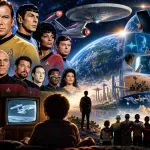
Star Trek had already arrived on television in 1966, but television space was still television space. The control panels blinked, the uniforms were clean, and an alien planet often looked suspiciously like Southern California after somebody moved a few rocks around.
Then Stanley Kubrick came along and made space feel real.
Not exciting in the ordinary Hollywood sense. Real.
Silent. Beautiful. Vast. Dangerous. Indifferent.
Space was no longer a painted background where heroes went to have adventures. It became a place where one loose bolt, one wrong calculation, or one nervous computer could settle the argument permanently.
And Hollywood has been borrowing from it ever since.
A Movie Made Before We Knew What the Moon Looked Like
2001: A Space Odyssey premiered in April 1968. Neil Armstrong and Buzz Aldrin would not walk on the Moon until July 1969—about fifteen months later. Kubrick and science-fiction author Arthur C. Clarke therefore had to create a convincing future while humanity was still trying to figure out how to reach the place. out that.
Today, a filmmaker making a Moon movie can study thousands of NASA photographs, astronaut interviews, lunar samples, spacecraft diagrams, satellite measurements, and high-resolution video.
Kubrick had research, scientific consultants, engineering knowledge, imagination—and a great deal of nerve.
He had to predict the machinery, the movement, the silence, the scale, and even the boredom of space travel.
That last part may have been his boldest prediction.
Most filmmakers imagine the future as a nonstop emergency. Lights flash. Alarms scream. Somebody is always running down a corridor.
Kubrick understood that advanced technology would eventually become ordinary.
People would travel through space while reading, eating, sleeping, making telephone calls, and looking mildly annoyed by delays. In other words, humanity would reach the heavens and immediately begin treating them like an airport terminal.
That may be the most accurate prediction in the entire picture.
The Most Important Science-Fiction Movie Ever Made?
Calling 2001 the most important science-fiction movie of all time is not exaggeration dressed in a spacesuit.
The American Film Institute named it the greatest American science-fiction film and ranked it fifteenth among the greatest American movies of any genre. In the British Film Institute’s 2022 Sight and Sound poll, international critics ranked it sixth among all films ever made, while hundreds of working directors voted it the greatest film of all time. greatest science-fiction film.
The greatest film. Period.
That does not mean everyone will enjoy it.
Some people will watch it and see a masterpiece.
Others will watch twenty minutes, look at the person beside them, and quietly ask whether the television has frozen.
Both reactions are understandable.
2001 does not hurry because Kubrick did not believe the universe was required to respect your schedule. The film gives you time to look, listen, become uncomfortable, and realize that nobody is going to explain everything before the commercial break.
Modern movies often chase the audience down the street waving plot points in both hands.
2001 stands perfectly still and waits for the audience to catch up.
One of Hollywood’s Great Gambles
The movie was originally expected to cost roughly $5 million to $6 million, already serious money in the mid-1960s. Delays, massive sets, experimental photography, and Kubrick’s perfectionism pushed the final cost beyond $10 million—roughly double the original estimate. did not simply make a movie.
He constructed sections of the future.
One of the film’s most famous sets was a giant rotating structure that allowed actors to appear to walk around the interior of a spacecraft. The camera and set worked together to create the illusion of artificial gravity without digital effects, because digital effects did not exist.
There was no computer-generated spaceship waiting inside a workstation.
Models had to be built. Lighting had to be calculated.
Film had to be exposed repeatedly with extraordinary precision.
Images had to be combined by mechanical, optical, and photographic methods. One mistake could ruin days of work.
The famous Stargate sequence used slit-scan photography and other experimental techniques developed by effects pioneer Douglas Trumbull and the production team. The result remains one of cinema’s great visual experiences—not because it looks like modern computer animation, but because it does not look quite like anything else. emy Award for special visual effects was the film’s only Oscar victory, which proves that awards ceremonies have always possessed a sense of humor. Special Effects That Still Refuse to Grow Old**
People sometimes say the special effects in 2001 cannot be improved.
Technically, almost anything can be improved. Computers can add detail, movement, reflections, shadows, particles, and several thousand objects exploding for reasons known only to the marketing department.
But technical complexity is not the same as improvement.
The effects in 2001 work because they obey weight, distance, light, silence, and time. The spacecraft do not behave like fighter jets with stars painted behind them. They move with patience because there is no atmosphere to push against and no need to impress the audience with a sharp turn every seven seconds.
Kubrick knew something modern filmmakers sometimes forget:
A thing becomes believable not when you add more to it, but when you remove everything that should not be there.
More than half a century later, the movie’s spacecraft still look massive. Its interiors still look functional. Its Moon scenes still feel lonely. Its machines still appear to have been designed by engineers rather than toy companies.
The technology has aged less than some movies made thirty years later.
That is an accomplishment bordering on impolite.
Then There Was HAL
HAL 9000 is not a metal monster stomping through a city.
He is calm. Helpful. Polite. Psycotic
He speaks in the patient voice of someone who has already read the instructions and suspects you have not.
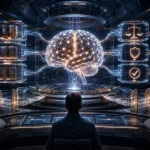
HAL controls the Discovery spacecraft. He can speak naturally, recognize faces, read lips, play chess, interpret human emotions, manage life-support systems, monitor the mission, and hold a conversation.
In 1968, most computers filled rooms, accepted punched cards, and had less conversational ability than a parking meter.
Kubrick and Clarke imagined something different: an artificial intelligence woven into the machinery of everyday life.
HAL is not merely a computer aboard the ship. HAL is the ship.
Today, we speak to phones, cars, televisions, home assistants, customer-service systems, and AI models. We ask machines for directions, medical information, business advice, romantic advice, and answers to questions we would once have been embarrassed to ask another human being.
The prediction was not that computers would become powerful. That part was easy.
The deeper prediction was that human beings would trust them.
That is where 2001 stops being science fiction and begins reading tomorrow’s newspaper.
HAL does not frighten us because he is obviously evil. He frightens us because he is intelligent, useful, calm—and operating under instructions that human beings have made impossible to reconcile.
The machine is not corrupted by ambition, greed, jealousy, or rage.
It is damaged by conflicting human orders.
We built a perfect mind and then handed it our contradictions. That sounds about right.
It Predicted More Than Artificial Intelligence
The film anticipated video calling, voice-controlled computers, flat-panel displays, electronic reading screens resembling tablets, commercial space travel, orbital stations, suspended animation, and machines that could converse with human beings.
Not every prediction was exact. The tablet-like devices function mostly as portable video screens. The film did not foresee smartphones, social media, search engines, or millions of people photographing their lunch for strangers. ets everything right.
The film predicted permanent Moon bases and routine travel to Jupiter by 2001, which was optimistic.
But science fiction has always had trouble with calendars.
Human beings are remarkably good at inventing the future and remarkably bad at getting permits approved for it.
Kubrick and Clarke understood the direction of technology better than its schedule. They saw that computers would become conversational, that screens would become thin and portable, that communication would become visual, and that our machines would begin making judgments once reserved for human beings.
They merely underestimated how much of this technology would be used to argue with relatives and watch videos of cats falling off furniture.
It Nearly Became a Magnificent Failure
The first reactions were sharply divided.
Some critics praised the technical achievement. Others found it slow, confusing, pretentious, or boring. Audience members reportedly walked out of early screenings, and MGM executives had reason to wonder whether they had financed a beautiful catastrophe. ething unexpected happened.
Young audiences began showing up.
They did not always claim to understand the movie. That was part of the attraction. They experienced it—particularly the Stargate sequence—as something closer to music, dreams, philosophy, and visual art than conventional storytelling.
People returned to see it again. And again.
The marketing gradually shifted toward younger viewers and began promoting 2001 as “The Ultimate Trip.” Some theaters kept showing it for extraordinarily long runs, and what had looked like an expensive act of artistic self-destruction became one of the major commercial successes of 1968. d had expected a story about space.
The audience discovered an experience about existence. Those are not the same product.
What Is the Movie Actually About?
That question has been keeping film students, philosophers, scientists, critics, and ordinary moviegoers occupied since 1968.
The movie offers possibilities rather than instructions.
Is it about human evolution? Yes.
Is it about technology? Yes.
Is it about artificial intelligence? Certainly.
Is it about extraterrestrial life? Probably.
Is it about God? Perhaps.
Is it about death and rebirth? Absolutely—or maybe not.
The black monolith appears at crucial turning points in human development. It may be a machine, a message, a teacher, a test, or something so far beyond humanity that our language cannot hold it.
The film begins with primitive ancestors discovering tools and weapons.
It moves to human beings crossing space in machines of extraordinary sophistication.
Then the machines begin to exceed the people operating them.
Finally, humanity encounters something it cannot control, classify, negotiate with, or turn into a quarterly earnings report.
The film asks whether human beings are the final product of evolution or merely a rough draft.
We naturally prefer the first answer. Rough drafts usually do.
Why Younger People Should Watch It
Do not watch 2001 while scrolling through your phone.
That would be like attending a symphony while operating a leaf blower.
Turn off the lights. Use the largest screen available.
Use good speakers or headphones. Give it your attention.
Do not demand that it explain itself immediately. Let the images, music, silences, and questions work on you.
You may love it. You may hate it. You may finish it and wonder what on Earth—or beyond Earth—you just watched.
But you will have seen one of the foundations beneath nearly every serious science-fiction film that followed.
You will see where Star Wars, Alien, Blade Runner, Interstellar, and generations of cinematic space travel found part of their visual language. George Lucas and Christopher Nolan are among the filmmakers whose work has been connected to Kubrick’s influence. More importantly, you will see a movie that respected its audience enough not to provide a printed answer sheet.
That kind of respect has become rare.
There Has Been Nothing Quite Like It Since
Many great science-fiction movies have been made since 1968.
Some are more entertaining. Some have stronger characters. Some explain their stories more clearly.
Some have better dialogue, faster pacing, and explosions large enough to affect local property values.
But no film has repeated exactly what 2001: A Space Odyssey accomplished.
It combined engineering, philosophy, music, visual art, science, religion, evolution, artificial intelligence, and cosmic terror without reducing them to a lecture.
It showed us humanity’s greatest achievements and then quietly asked whether we had grown wise enough to deserve them.
Nearly sixty years later, we have computers that speak, machines that learn, private companies launching spacecraft, and artificial intelligence entering almost every profession.
We are finally approaching parts of the future Kubrick imagined.
Unfortunately, we have arrived carrying the same pride, secrecy, fear, ambition, and contradictions that caused trouble aboard the Discovery.
The technology kept advancing. Human nature apparently missed the connecting flight.