
“The wise commander does not announce the storm — he studies the tides, positions his fleet, and lets his enemy mistake preparation for peace.” --SunTzu
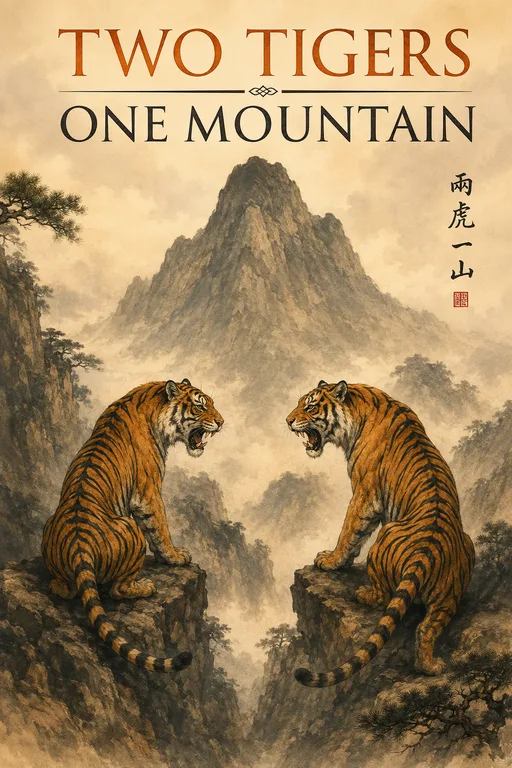
TWO TIGERS ONE MOUNTAIN
By YNOT
Table of Contents
- Title Page
- Why Trump Is Working With Delcy Rodríguez — And Why Venezuela Is Much More Complicated Than It Looks
- China, China, China… Is There Going to Be a War in 2027? Well…
- Malaca - Malaca - Malaca - China's Greatest Weakness and they know it.
- Dedication
- Foreword
- Preface
- Introduction
- What If the Loudest Signal of War Isn’t Missiles —but Money? China preparing for WAR!
- The Comfort Trap
- WAR is evil, but like removing Cancer may be necessary
- GREENLAND, Why?
- Tik - Tok - Tik - Tok - Gone Sunday
- The GRAND Illusion of Choice: How the World Thinks for You - USAID, OCCRP, CONFUCIUS, Rossotrudnichestv, MOSSAD, EPSTEIN
- 📉 Stagflation in a Modern World: How Stocks, Bonds, Gold, Real Estate, and Wars Fit In
- Diplomacy - the Fine Art of Pretending and when the pretending is over - WAR
- War Happens, and War is Trauma – The Looming Shadow of WW3
- The Six-Minute Window: Why the Risk of Nuclear War is Closer Than We Think
- The Rising Storm: China's Military Modernization and the Looming Risk of U.S.-China Conflict
- Trump’s Tariffs: Madness or Method?
- 🇺🇸⚔️ U.S.-China Trade War Escalates: The Global Stakes
- The Reckoning: China's Economic Miracle Is Turning Into a Slow-Motion Collapse and Trump is helping
- 🪓 The Great Decouple: Why It’s Time for America to Get the Hell Out of Hell
- The most important company on Earth - I'm going to buy a little piece
- TWO TIGERS ONE MOUNTAIN
- The Rise of the CCP and the Founding of the People's Republic of China
- From China with LOVE!
- MAD
- Treasury Secretary Bessent Just Revealed The USA's Grand Masterplan.
- China: Know Thy Enemy
- The Fall of Taiwan 2027???
- Weird - China Selling Gold
- Venezuela's largest oil buyer - China
- Golden Dome: Star Wars 2.0 – Can It Really Be Built?
- The Invisible War: How China Is Waging a Battle of Perception Against India
- China’s Grand Strategy vs. the Western World: A Clash of Civilizations
- From Opium Wars to Fentanyl: Echoes of History in a Modern Drug Crisis
- The Theater of Power: China’s Show of Strength—or Sleight of Hand?
- TikTok lives on— painted red, white, and blue
- Time for Fortune Cookies - Xi’s Health Rumors, Power Jockeying, and Why the Timing Matters
- After the Dollar — How China Wants to Replace the Dollar Internationally (and Why It Matters to You)
- The One Thing That Actually Keeps Me Up at Night - War With China)
- THE WARS WE’RE ALREADY FIGHTING with CHINA
- Why This Ship Might Exist: The Strategic Gap It Is Designed to Fill
- Predictions for 2026: A Forecast Written in Pencil, Not Ink
- 2026 is the Year of the Fire Horse - What does that mean to millions of people
- Is 2026 the Year Silent Wars Become Noisy?
- CHINA. CHINA. CHINA. And Why Venezuela is an important chess piece.
- Collapse or Cold War: China in 2026
- The Day Iran Sneezes, China and Russia Catch a Cold
- What Trump Did With Venezuela Was Genius? Checkmate BRICS? Or Was it?
- China China China — The 2026 Wave Is Brushing Over It
- WW3 - Was the first shot of the China war fired today—and did it happen on your phone?
- 🎯 Is 2027 Just a Date… or a Deadline? China vs Taiwan and US
- EVIL does like EVIL does: The greed and power link between the Epstein, CCP and Western Elites
- IRAN - It’s Not a Distraction. It’s Oil— and China’s Problem.
- Is the Iran fight really about Iran… or is it a warning label slapped on China?
- EXTORTION -the oldest weapon in politics that doesn’t fire a single bullet - Just Ask Epstein
- DAY SIX: US + ISRAEL vs IRAN — AND THE “NEW WORLD ORDER” CROWD IS SWEATING -BRICS is DEAD
- Can Russia’s or China’s Allies Depend on Them?
- Did Trump Just Reveal His 3D Chess Playbook— and Left China Checkmated Whatever It Does?
- Agroterrorism - Can a Country Be Brought to Its Knees by a Fungus?
- Two Tigers, One Mountain — The Thucydides Trap - Part 2
- Solyndra: The Green Dream That Burned Through Half a Billion Dollars
- Tulsi Gabbard Just Said the Quiet Part Out Loud About U.S.-Funded Biolabs
- The New Plaza Accord: The Deal Nobody Will Understand Until It Is Too Late
- Fauci pleads the Fifth ... Never saw that coming... kidding of course
- What We Know Today About the Origin of COVID—and How Far Back the Story Really Goes
- How China Evolved Away from Communism After It Failed
Title Page
TWO TIGERS, ONE MOUNTAIN
China, America, and the Struggle for the Future
> 一山不容二虎 > “One mountain cannot contain two tigers.”
By YNOT
A Study of Power, History, Strategy, Technology, and the Future of the World
Why Trump Is Working With Delcy Rodríguez — And Why Venezuela Is Much More Complicated Than It Looks
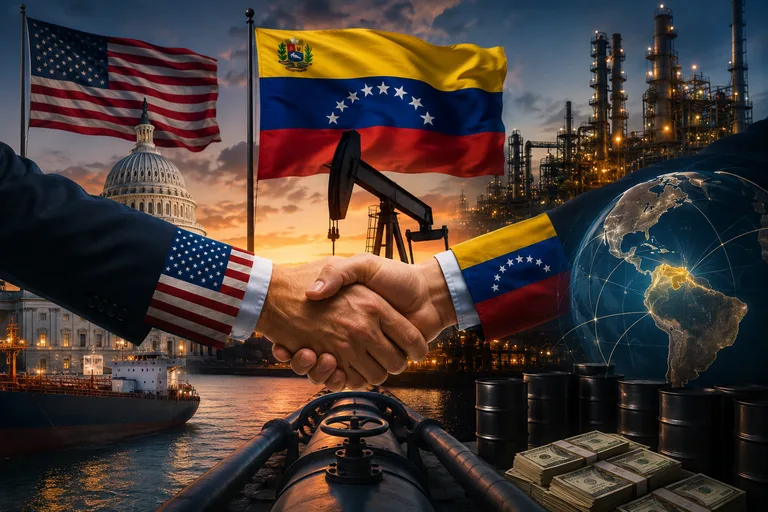
Fixing Venezuela is like performing a heart transplant on someone while they’re riding a bicycle. Yes, it can be done. But nobody should pretend it’s simple. -- YNOT!
There is a tendency to look at what is happening in Venezuela and reduce it to one sentence: Trump wants the oil. That is certainly part of the story.
But it is nowhere near the whole story.
What is happening in Venezuela involves oil, international law, billions of dollars in old debts, the survival of the Venezuelan state, China, Russia, Iran, Cuba, and one very difficult question:
Who can actually run Venezuela while the country transitions away from Maduro?
That is why Donald Trump is dealing with Delcy Rodríguez rather than simply installing Juan Guaidó, María Corina Machado, or another opposition leader in Caracas.
It may look strange from the outside.
From a practical standpoint, however, there is a logic to it.
Venezuela Has a $200-Billion-Plus Problem
Before talking about politics, you have to understand the financial problem.
Venezuela has an enormous number of creditors.
Estimates of its total debt and creditor claims run as high as roughly $240 billion, including sovereign bonds, PDVSA debt, arbitration awards and court judgments.
Companies including ConocoPhillips and Crystallex have spent years trying to collect money Venezuela owes them.
CITGO is probably the most famous example.
That creates an enormous problem if you are trying to restart Venezuela.
Imagine that American and international companies spend tens of billions of dollars rebuilding Venezuelan oil production.
Production increases.
Venezuela begins selling billions of dollars of oil.
Then the money enters the international banking system and creditors immediately begin trying to seize it.
In simplified form: Venezuela sells oil > Money enters international banks > Creditors find the money > Courts are asked to attach it
Suddenly yesterdays creditors could get first crack at tomorrow’s oil revenue.
That makes rebuilding Venezuela extraordinarily difficult.
Why would someone invest $50 billion or $100 billion rebuilding an oil industry if the resulting revenue could immediately disappear into decades-old judgments?
Trump’s Financial Firewall
This is where one of the most important parts of Trump’s Venezuela policy comes in.
On January 9, 2026, Trump signed Executive Order 14373, “Safeguarding Venezuelan Oil Revenue.”
The structure protects certain Venezuelan natural-resource revenues placed into designated U.S. Treasury accounts from ordinary attachment, judgments, liens, execution and garnishment unless the United States authorizes it.
In other words, Trump did not erase Venezuela’s debts.
He effectively said: You may have a legitimate judgment against Venezuela, but you cannot automatically grab this particular pool of new Venezuelan oil revenue.
That is an important distinction.
The money is structured as Venezuelan sovereign government property being held by the United States for governmental and diplomatic purposes rather than simply sitting in an ordinary commercial bank account.
That creates a much stronger sovereign-immunity argument.
So instead of: Oil → Venezuelan bank account → creditor attachment
you have something closer to: Oil> U.S.-approved sale > Protected Treasury mechanism > U.S. oversight > Funds released for authorized purposes
Trump has therefore gained influence not only over the oil.
He has influence over the financial plumbing through which the oil money travels.
That may ultimately be more important.
Why Delcy Rodríguez?
This brings us to the political question.
Why work with Delcy Rodríguez?
Why not Juan Guaidó?
The answer is remarkably simple: Delcy controls things.
Juan Guaidó once had considerable international recognition.
In 2019, the United States recognized him as Venezuela’s interim president. That recognition gave his representatives standing in foreign courts and influence over Venezuelan assets located overseas.
But Guaidó always suffered from one enormous problem.
He had international recognition without effective control of Venezuela. He could sign a piece of paper.
That did not necessarily mean PDVSA would obey him.
It did not mean the Venezuelan military would obey him.
It did not mean the ministries would obey him.
It did not mean the police, customs service, electrical utilities, central bank or thousands of government employees would follow his orders.
By 2022, Venezuela’s opposition itself voted to abolish the Guaidó interim-government structure.
Guaidó eventually left Venezuela. The political landscape moved on.
Delcy Has Something Guaidó Never Had
Whatever anyone thinks of Delcy Rodríguez politically, she comes from inside the Venezuelan state.
She understands its machinery. And more importantly, much of that machinery recognizes her authority. That matters enormously.
Venezuela still needs somebody who can tell the Energy Ministry what to do.
The Energy Ministry needs to be able to tell PDVSA what to do.
PDVSA needs somebody legally empowered to negotiate production agreements, joint ventures, contracts and oil sales.
The military needs a functioning chain of command. Government employees need to get paid. Electricity needs to remain on. Police need orders. Ports must operate. Food must move. Oil must move. AS we say, “The Spice must flow”
A country of nearly 30 million people cannot simply be switched off while you build another government.
Remember Iraq
The United States has already learned what can happen when you remove a regime and simultaneously destroy the state underneath it.
Iraq should be permanently burned into American foreign-policy memory.
Remove the leadership. Dismantle the institutions. Disband the security apparatus.
Suddenly nobody knows who is in charge.
That vacuum can become more dangerous than the government you just removed.
Venezuela has armed groups, colectivos, criminal organizations, political factions and competing interests.
Imagine simultaneously removing thousands of officials throughout the Venezuelan government and announcing that a completely new opposition government — backed by Washington — is taking over tomorrow morning.
Chaos could follow. And politically, the new government would immediately be attacked as an American puppet government.
Trump appears to have chosen a different strategy.
Remove the Head — Don’t Destroy the Body
The strategy can be understood roughly like this:
Maduro> Remove the person at the top
Delcy Rodríguez >Keep ministries, military and PDVSA functioning
United States >Use sanctions relief, oil access and financial controls as leverage
Oil industry ↓ Restart production and attract investment
Economy ↓ Stabilize currency, employment and government finances
Political system ↓ Gradually negotiate reforms and rebuild electoral institutions
Eventually ↓ Hold credible elections
That is a very different strategy from invading a country, destroying its government and trying to rebuild everything from scratch.
Trump is essentially attempting to change the direction of the Venezuelan system without completely destroying the system.
A Negotiation With the Devil
Nobody should confuse this with an endorsement of Delcy Rodríguez.
She was an important figure in the Maduro government. She is part of Chavismo.
The United States is dealing with somebody who helped operate the very political system Washington spent years opposing.
Sometimes international politics works that way.
You negotiate with the person who controls the soldiers, the oil company, the ministries and the government — because that person can actually deliver what was negotiated.
It is, in a sense, a negotiation with the devil to prevent chaos and disaster.
The opposition may represent Venezuela’s democratic future.
Delcy represents the Venezuelan government’s functioning present.
Those are two different things.
The Gamble
And there is a major risk. The longer Delcy controls Venezuela — particularly if billions of dollars of American and international investment begin flowing into the country — the harder it becomes to argue that she is simply a temporary caretaker.
The opposition has legitimate reason to worry.
What happens if Washington succeeds in stabilizing Venezuela, restarting the oil industry and improving living conditions — but Delcy remains in power?
Instead of eliminating Chavismo, America could inadvertently create something very different:
a market-friendly, U.S.-aligned version of Chavismo. That may be more stable.
It may be less hostile toward the United States. It may allow private investment.
But it is not necessarily the democratic transition the Venezuelan opposition has spent decades fighting for. That is the gamble Trump is making.
Then There Is the Oil
Venezuela possesses one of the largest petroleum resource bases on Earth.
Rehabilitating those fields will require enormous investment. Oil wells need work.
Pipelines need repairs. Refineries need modernization.
Electric infrastructure needs rebuilding. Ports need upgrades.
Thousands of skilled workers will be needed.
And after years of economic deterioration, Venezuela itself will require enormous reconstruction.
Which leads to another misconception. Americans should not imagine that the United States simply walks into Venezuela and starts collecting free oil.
Before America gets enormous economic benefits from Venezuelan production, somebody is going to spend many billions of dollars repairing the infrastructure required to produce it.
In the real world, everything costs money.
And Venezuela Is Bigger Than Venezuela
Perhaps the most important part of this entire story is geopolitical.
Venezuela has been one of the principal footholds in the Western Hemisphere for governments hostile to the United States.
Cuba. China. Russia. Iran.
Each developed political, military, intelligence or economic relationships with Caracas.
So from Washington’s perspective, changing Venezuela’s alignment is not simply about Venezuelan oil.
It changes the strategic map of the Caribbean and Latin America.
A Venezuela economically connected to the United States is very different from a Venezuela dependent upon Russia, China and Iran.
And then there is Cuba.
Venezuela has been extraordinarily important to the Cuban government for decades.
If Venezuela permanently moves out of Havana’s orbit, Cuba becomes considerably more isolated.
Viewed that way, Venezuela may be only one piece of a much larger strategy.
Trump is attacking the geopolitical problem one pressure point at a time.
Venezuela Will Not Be Fixed Overnight
There is also something Americans should understand.
Venezuela did not collapse overnight. It will not recover overnight either.
Government institutions have deteriorated. Infrastructure has deteriorated.
The oil industry has deteriorated. Millions of Venezuelans left the country.
Businesses disappeared. Capital fled. Professional talent fled.
The political wounds run deep.
Rebuilding Venezuela may resemble rebuilding after a massive hurricane — except the hurricane lasted for decades.
It may take five years simply for Venezuela to begin looking normal again.
Possibly much longer.
But a functioning Venezuela five years from now — producing oil, attracting investment, rebuilding infrastructure and preparing for legitimate political competition — would be an extraordinary improvement over where the country has been.
So Why Delcy?
Because Venezuela today needs two things simultaneously.
It needs continuity and it needs change. That sounds contradictory. It isn’t.
Trump needs someone capable of operating the existing Venezuelan government while Washington pushes that government in a completely different direction.
Guaidó once had international legitimacy without domestic power.
The opposition may ultimately have democratic legitimacy.
But Delcy Rodríguez currently has something enormously valuable during a transition:
the ability to make the Venezuelan state actually do something.
That does not make her the democratic future of Venezuela.
It makes her the bridge Trump has chosen to try to get there.
Whether that bridge leads to a genuinely democratic Venezuela or merely a more prosperous and American-friendly version of Chavismo remains the billion-dollar question.
Probably the hundred-billion-dollar question.
Because Venezuela is complicated.
International politics is complicated.
Rebuilding destroyed countries is complicated.
And sometimes moving forward means working with people you would never have chosen in the first place.
For now, Venezuela is functioning.
Its oil industry is beginning to move again.
Money is beginning to move again.
Investment is beginning to become possible again.
The country has a long way to go.
But after years of watching Venezuela move steadily backward, simply seeing it move forward matters.
And if this works, the biggest consequence may ultimately not be Venezuelan oil at all.
It may be what happens next in Cuba, China, Russia and Iran’s influence in the Western Hemisphere.
China, China, China… Is There Going to Be a War in 2027? Well…
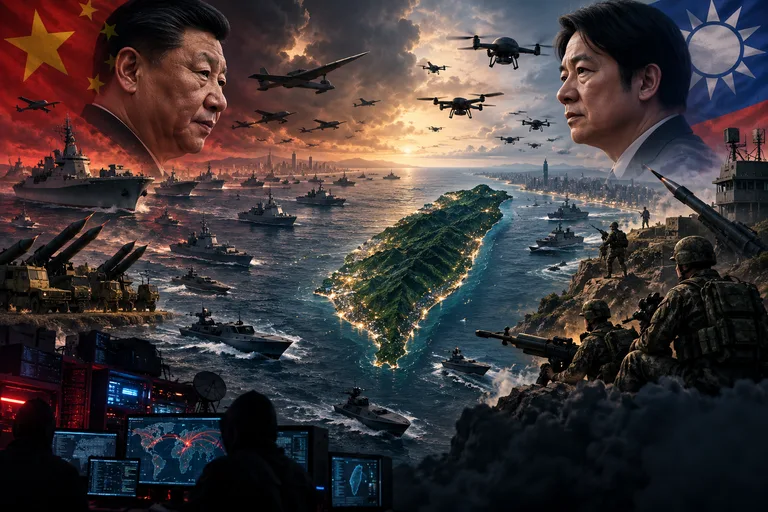
2027 is not an invasion date—it is a capability date. -- YNOT!
For the last few years, 2027 has been floating around Washington like the date on a wedding invitation.
China. Taiwan. 2027. War. Circle the date.
Buy ammunition. Order extra microchips.
Perhaps cancel your vacation to Taipei.
Except there is one small problem.
China has apparently neglected to send out the invitations.
The U.S. intelligence community said in its 2026 Annual Threat Assessment that Chinese leaders do not currently plan to invade Taiwan in 2027, and that Beijing does not appear to have a fixed timetable for reunification. What China is doing is building the military capability to make such an operation possible if its leadership decides to order one.
That is an important distinction. 2027 isn’t necessarily the year of the war.
It is closer to the year when China wants to be able to say: “If we wanted to, we could.”
And unfortunately, the difference between having a weapon and deciding to use it has never been one of humanity’s stronger intellectual achievements.
China Is Preparing
There is no great mystery about whether China is preparing for a possible confrontation over Taiwan.
It is. Ships. Aircraft. Missiles. Cyber units. Satellites. Special forces. Coast Guard vessels. Drones. More drones.
And, because apparently everyone has been watching Amazon, delivery systems for delivering the drones.
Chinese military operations around Taiwan have become routine enough that what once would have generated screaming headlines can now pass for Tuesday.
Taiwan’s latest defense reporting says China is steadily strengthening its ability to control the air and sea around the island while practicing operations that could isolate Taiwan in the early stages of a conflict. Beijing has also been studying drone swarms and other lessons emerging from Ukraine and recent wars.
That last part matters enormously. Because Ukraine changed warfare.
Not theoretically. Not in a Pentagon PowerPoint presentation.
On television. Every night.
Ukraine Changed the Mathematics of War
Before Ukraine, military power was generally measured by counting expensive things.
How many tanks? How many fighter aircraft? How many destroyers? How many missiles?
How many generals with impressive hats?
Then along came a Ukrainian kid with a $2,000 drone carrying explosives who destroyed something worth several million dollars.
Suddenly the mathematics became uncomfortable.
A cheap drone can destroy an expensive tank.
A relatively inexpensive sea drone can threaten a warship.
A swarm of drones can force an enemy to expend enormously expensive air-defense missiles.
And a small country that cannot necessarily control the sea can still make the sea extremely unpleasant for somebody who thinks he does.
The material supplied for this article gets to the heart of the lesson: Ukraine demonstrated that smaller forces using inexpensive drones, anti-ship weapons, dispersed command and asymmetric tactics can impose tremendous costs on a much larger military.
Both sides of the Taiwan Strait have been watching.
But naturally they reached opposite conclusions.
China looked at Ukraine and said:“We need more drones.”
Taiwan looked at Ukraine and said:“We REALLY need more drones.”
Taiwan Is Building Its Porcupine
Taiwan knows something that sometimes gets lost when people compare military inventories.
Taiwan does not have to conquer China.
Taiwan does not have to occupy Shanghai.
Taiwan does not have to march into Beijing and put up a Taiwanese Starbucks.
Taiwan merely has to make invading Taiwan unbearably expensive.
That is a completely different military problem.
And Taiwan is increasingly restructuring around it.
The Taiwanese military says unmanned systems are now a priority, specifically emphasizing systems that can be mass-produced, maintained and upgraded rather than relying solely on small numbers of exquisite weapons.
That is Ukraine talking.
And Taiwan is putting serious money behind the idea.
As of September 2026, Taiwan’s government has proposed buying more than 600 coastal reconnaissance drones, more than 40,000 coastal attack drones and more than 100 unmanned attack boats, alongside missile and surveillance systems.
Forty thousand attack drones.
Now imagine trying to move an invasion fleet across roughly a hundred miles of water while thousands of inexpensive flying cameras and explosives are looking for you.
That does not make Taiwan invulnerable.
Nothing is invulnerable.
But it changes the calculation.
And wars frequently begin—or fail to begin—because somebody changes the calculation.
The First Battle May Not Involve Shooting
But here is where people thinking about Normandy-style beaches may be missing the more interesting part.
China does not necessarily have to begin by invading Taiwan.
China has many other tools.
Cyberattacks. Economic pressure. Disinformation. Political influence. Espionage. Sabotage. Coast Guard operations. Quarantines. Blockades.
And the gradual normalization of Chinese military operations around Taiwan.
The source material describes precisely this spectrum: espionage networks, cyberattacks, disinformation campaigns and partial or total naval blockades that could be used to pressure Taiwan without immediately conducting an amphibious invasion.
That may actually be the more dangerous scenario.
Because everybody recognizes 5,000 landing craft coming across the Taiwan Strait as a war.
But what exactly do you call twenty Chinese Coast Guard vessels inspecting commercial ships?
What happens when China announces a “customs enforcement zone”?
Or a military exercise lasting three weeks?
Or starts stopping fuel tankers?
When does the United States shoot?
At ship number three? Ship number fourteen? Tuesday?
This is the great attraction of gray-zone warfare.
You can boil the frog while arguing about whether the water is technically boiling.
Then There Are the Spies
China also has another weapon considerably cheaper than an aircraft carrier. People.
Taiwan says espionage efforts directed by China have risen dramatically.
Taiwan’s National Security Bureau reported that 64 people were charged in suspected Chinese espionage cases during 2024, compared with 48 in 2023 and just 10 in 2022. Many were current or former members of Taiwan’s military.
And this isn’t ancient history.
Taiwanese prosecutors announced another major case in 2026 involving military personnel accused of passing classified information to mainland Chinese interests in exchange for money.
That is enormously important because the first hours of any attack on Taiwan could be decisive.
Where are the aircraft?
Where are the missile launchers?
Who commands which unit?
Where does the president go?
Which communications systems are redundant?
Which radar systems can be disabled?
Which officer can be bought?
Which official can be blackmailed?
Which computer already has somebody inside it?
A spy costing $100,000 who tells you where a billion-dollar weapon is located may be the finest return on investment in the entire defense budget.
Which brings us to another lesson from Ukraine.
You don’t necessarily destroy the enemy’s entire military.
You find the important pieces and kill those.
The War May Start With a Laptop
Taiwan reported that Chinese-linked cyber activity against its critical infrastructure averaged about 2.6 million attacks per day during 2025, targeting sectors including finance, hospitals, energy and the semiconductor industry. Beijing denies responsibility for such operations.
Again, think about the first morning of a hypothetical war.
The electricity fails. The cell network becomes unreliable.
Banks are unavailable. Government websites disappear.
Fake emergency messages circulate.
Videos appear showing explosions that never happened.
Another video supposedly shows the president fleeing.
Military officers receive false orders.
Social media fills with rumors that America has decided not to help.
Meanwhile Chinese aircraft and ships are moving.
Which attack came first?Nobody knows.
Welcome to modern warfare.
The missile might be the last thing you notice.
And Then There Are the Chips
And this is where Taiwan stops being merely an argument between Taiwan and China.
Taiwan produces almost 90 percent of the world’s high-volume leading-edge semiconductor chips.
These are not simply chips for fancy phones.
They are central to:Artificial intelligence. Data centers. Weapons. Robotics. Automobiles. Telecommunications. Industrial equipment. Medical equipment.
And nearly every other machine we have spent the last thirty years making smarter.
Which means Taiwan possesses something rather unusual.
A factory system so important that blowing it up might wreck the attacker’s economy along with the defender’s.
People sometimes call this Taiwan’s Silicon Shield.
The theory is simple. Taiwan is too important to destroy.
There is, however, an unpleasant alternative.
Don’t destroy it. Blockade it.
Taiwan imports most of its energy and a large share of the resources required to keep its economy operating. Shut down enough shipping and eventually semiconductor production becomes difficult regardless of whether anybody bombs the factories.
And suddenly Beijing isn’t merely negotiating with Taiwan.
It is negotiating with Apple. NVIDIA. America. Europe. Japan.
Every automobile manufacturer. Every AI company.
Every military contractor waiting for sophisticated electronics.
China could theoretically put a hand around Taiwan’s throat and ask the rest of the world:
“How badly do you need your chips?”
That could make a blockade economically more powerful than several divisions of soldiers.
Which Is Why 2027 May Be the Wrong Question
So is China going to invade Taiwan in 2027?
Probably the best answer available today is:
Nobody knows—but there is no credible evidence that Xi Jinping has circled “Invade Taiwan” on his 2027 calendar.
U.S. intelligence specifically says there is presently no fixed 2027 invasion plan.
But that doesn’t make the situation comfortable.
Because China doesn’t need to decide today. It only needs options.
The more ships China has, the more options.
The more missiles China has, the more options.
The more spies China has inside Taiwan, the more options.
The more Taiwan depends on imported fuel, the more options.
The more the world depends on Taiwanese chips, strangely enough, the more options.
And the more capable China becomes, the easier it becomes for some future Chinese leader to convince himself that the gamble might work.
That is the danger.
Taiwan Understands the Assignment
Taiwan appears to understand what Ukraine taught the world.
Don’t try to become China. Become extremely difficult to swallow.
Disperse command. Hide the missiles. Build drones by the tens of thousands.
Build cheap weapons that can destroy expensive ones.
Prepare civilian infrastructure. Protect communications.
Hunt spies. Harden computer networks.
And make every Chinese admiral looking across the Taiwan Strait calculate how many ships he might not be bringing home.
Taiwan’s defense spending is consequently climbing sharply. President Lai Ching-te says the 2027 defense budget will exceed NT$1 trillion for the first time, with increasing emphasis on domestic military production, artificial intelligence and unmanned systems.
This is deterrence in its simplest form.
You don’t have to convince your opponent that you will win.
You merely have to convince him that winning will hurt too much.
China, China, China…
So yes.
China, China, China.
We should be watching China.
But perhaps not while staring at a calendar waiting for 2027.
The real story is happening right now.
China is practicing blockades. Taiwan is manufacturing drones.
Chinese intelligence is trying to penetrate Taiwanese institutions. Taiwan is trying to identify the spies.
Hackers probe electrical grids and semiconductor companies.
Missiles move into position. Factories make chips. Factories make drones.
And both sides are watching Ukraine like students watching somebody else take the final examination first.
Ukraine taught the world something military planners have repeatedly forgotten:
Big armies are powerful. Cheap technology can be powerful too.
And a country defending its own home does not necessarily have to defeat the giant standing outside.
Sometimes it simply has to make the giant look at the front door and decide:
Maybe we should come back another day.
The question therefore isn’t really: “Will China invade Taiwan in 2027?”
The better question is: “By 2027, will China believe it can take Taiwan at a price it is willing to pay?”
Because those are two very different questions.
And unfortunately, history usually gets interesting when somebody answers the second one incorrectly.
The April Window
A Taiwan 2028 Wargame
September 4, 2026.
Everybody is watching 2027.
That may be the first mistake.
Washington has spent years talking about China’s 2027 military readiness goal as though Xi Jinping had booked Taiwan for Tuesday afternoon.
But U.S. intelligence now says Beijing does not have a fixed plan to invade Taiwan in 2027. China would still prefer to get what it wants without fighting if it can.
So for this exercise, let us assume Washington is right.
There is no invasion in 2027.
Instead, China has picked another date.
Mid-April 2028.
And nobody outside a very small circle in Beijing knows it.
Why April? Because geography gets a vote.
The Taiwan Strait is miserable water for an amphibious operation during much of the year. U.S. Army analysis describes April as one of the best, though still imperfect, windows: relatively moderate seas, lower typhoon risk and more stable winds.
But the weather is only half the story.
The other half is politics.
Taiwan’s next presidential election should occur in early 2028 under the normal four-year cycle. The exact election date has not yet been officially announced, so our wargame assumes January 2028.
The incumbent presidential term, however, runs until May. President Lai Ching-te took office on May 20, 2024, and Taiwan’s presidents serve four-year terms.
Which creates a fascinating little window:
Election in January. New political reality established.
Old president still governing. New president not yet inaugurated.
April weather arrives.
If I were writing the spy novel, that is where I would put the war.
SEPTEMBER–DECEMBER 2026
Phase One: Stop Looking Like You’re Preparing for War
The first order from Beijing is surprisingly simple:
Calm down. Not completely. Chinese aircraft still fly.
Ships still sail around Taiwan. Military exercises continue.
But nothing happens that screams: INVASION COMING.
That is the point. China wants military pressure around Taiwan to become boring.
Another aircraft. Another destroyer. Another Coast Guard patrol.
Another exercise. Another hundred drones. Another cyberattack.
Eventually everybody stops putting it on the front page.
This is already partly happening. Taiwan says China now conducts near-daily operations around the island and is studying drone swarms, ammunition consumption and blockade operations based partly on lessons from Ukraine and other recent conflicts.
The extraordinary becomes ordinary.
Which is exactly what you want if one day the ordinary exercise isn’t an exercise.
Beijing’s 2026 checklist
China concentrates on five things. Intelligence. Politics. Drones. Ships. Logistics. Not glamorous.
Wars usually aren’t won by glamorous things.
They are won by knowing where everything is and having enough diesel fuel when you get there.
Chinese intelligence spends the remainder of 2026 updating its map of Taiwan.
Not merely military bases. People. Government officials. Military officers.
Communications personnel. Technology executives. Transportation managers.
Port officials. Telecommunications engineers.
People who know where things are. People who know how things work.
And people who might make things stop working.
Taiwan already has reason to worry. The number of Taiwanese charged in suspected Chinese espionage cases rose sharply in recent years, with many involving serving or retired military personnel.
That does not mean China has secretly taken over Taiwan’s government.
It means our fictional Chinese planners have something every spy service wants:
A head start.
TAIWAN — FALL 2026
The Porcupine Starts Growing Quills
Taipei isn’t asleep. Quite the opposite.
Taiwan has just been practicing how to survive a blockade, communications outages, cyberattacks, civil disruption and eventually invasion.
Its 2026 Han Kuang exercises included anti-blockade naval operations and even deliberately restricted mobile internet to simulate wartime communications problems.
And Taiwan is buying drones like somebody just discovered drones.
More than 40,000 coastal attack drones are included in proposed spending, along with hundreds of reconnaissance drones and more than one hundred unmanned attack boats.
Ukraine has taught Taiwan the same lesson it taught China.
You don’t always fight a $10 million weapon with another $10 million weapon.
Sometimes you fight it with something assembled in a factory by the thousand.
China watches Taiwan preparing. Taiwan watches China watching.
Everybody takes notes.
JANUARY–APRIL 2027
Phase Two: The Year Everyone Expected the War
Now comes the clever part. 2027 arrives.
Western newspapers explode. THIS IS THE YEAR.
Think tanks hold conferences. Generals testify.
Television experts discover maps.
Chinese military activity increases.
And then… Nothing happens.
China exercises. Taiwan mobilizes. America moves ships.
China flies aircraft. Taiwan scrambles aircraft.
Everybody waits. Nothing.
By April the weather window passes.
No invasion.
SUMMER 2027
The Boy Who Cried Taiwan
This is useful to Beijing.
Because after years of hearing:
2027! 2027! 2027!
2027 becomes evidence that the experts were wrong.
Markets relax. Insurance rates fall. Companies resume projects.
Politicians talk about exaggeration.
Investors decide that surely China would not destroy the world’s most important semiconductor manufacturing center.
People begin saying:“We’ve been hearing this Taiwan invasion stuff forever.”
Exactly. The boy has cried wolf.
China still has the wolf.
SUMMER–FALL 2027
Phase Three: The Election
Now the military temporarily moves backstage.
Politics moves forward.
China already appears to be devoting increasing attention to Taiwan’s 2028 elections, including greater outreach to the opposition Kuomintang. That overt political contact should not be confused with espionage, but it demonstrates why the election itself matters enormously to Beijing.
In our scenario, Beijing wants the election fought over one question:
Who is responsible for the danger?
China’s preferred message is not: Vote for China.
That would be stupid.
The message is: Vote for peace.
One candidate is described as reckless.
Another as safe. One policy means confrontation.
Another means prosperity.
One politician will get your children killed.
Another will keep factories open.
Social media fills with arguments. Real videos. Fake videos. Real scandals. Manufactured scandals.
Leaks. Rumors. AI-generated recordings.
Anonymous documents.
Nobody knows where half of it originated.
Which is exactly the point. The objective is not necessarily to make Taiwanese people love Beijing.
The objective is to make Taiwanese people distrust each other.
NOVEMBER–DECEMBER 2027
Phase Four: Put Everything in the Right Place
Now the Chinese military gets busy again.
But quietly. Ships move through normal exercises.
Aircraft disperse. Missile units train.
Drone inventories increase. Reserve equipment gets inspected.
Civilian transportation capacity gets tested.
Hospitals conduct exercises and Fuel inventories rise.
Satellite coverage increases.
Cyber units intensify reconnaissance.
Nothing individually proves anything. That matters.
Because mobilizing for an invasion of Taiwan is enormous.
China cannot simply wake up one morning and say:
“Anybody know where we left the invasion fleet?”
The trick is to hide preparation inside activities that have become routine.
Exercise. Inspection. Training. Maintenance. Coast Guard patrol. Civil defense. Shipping.
Then another exercise. Then another. Taiwan sees it.
American satellites see it. Japanese intelligence sees it.
But everyone has seen similar activity before.
China has spent two years creating ambiguity.
JANUARY 2028
Election Day
Taiwan votes.
For our story, it almost does not matter who wins.
That may sound strange.
But Beijing’s military plan has reached the point where politics determines how the operation proceeds, not necessarily whether preparation continues.
A Beijing-friendly result provides one possibility:
Pressure the new government toward negotiations.
A government strongly opposed to Beijing provides another:
Claim peaceful reunification has become impossible.
Either way, the election produces something every intelligence service loves.
Transition. People leave jobs. New people arrive. Offices reorganize.
New legislative alliances form. Government officials wonder whether they will still have jobs.
Documents move. Passwords change. Briefings multiply. Rumors spread.
The bureaucracy becomes temporarily distracted.
And now our spy story begins.
FEBRUARY 2028
The Invisible Invasion
There are no Chinese soldiers on Taiwanese beaches.
Not yet. But Beijing activates intelligence networks cultivated over years.
And I would not write this as spies dramatically “taking over ministries.”
Real espionage is usually much duller—and therefore more dangerous.
The useful insider doesn’t need to control the government.
He needs to create friction. A warning arrives late.
A report is questioned. A meeting is postponed.
A document leaks. An order must be verified twice.
Someone tells a reporter something that was supposed to remain secret.
Another person insists that military intelligence is exaggerating.
Another claims the Americans have advised restraint.
Another says Beijing is bluffing.
Perhaps most of them actually believe what they are saying.
That is the beautiful thing about an intelligence operation.
Eventually you don’t know where the spy ends and ordinary politics begins.
MARCH 2028
Something Is Wrong
Taiwanese intelligence begins noticing patterns.
Chinese ships are exercising again.
Nothing unusual. Except there are more of them.
Aircraft movements increase. Nothing unprecedented.
Missile units become active. Again, something seen before.
Commercial maritime activity changes.
Chinese Coast Guard vessels appear in greater numbers.
Cyber probing intensifies. Satellite activity increases.
Taipei raises readiness. Beijing complains that Taipei is creating a crisis.
Markets wobble. China announces another exercise.
Washington asks Beijing for clarification.
Beijing says:Routine training.
Nobody believes them.
Nobody can prove otherwise.
APRIL 1–7, 2028
The Weather Forecast
Now everybody starts watching the sea.
The northeast monsoon has weakened. The typhoon season has not yet arrived.
The Strait begins entering its spring operational window.
American intelligence sees Chinese forces positioned unusually close to wartime requirements.
Taiwan raises readiness further. Beijing issues angry warnings that Taiwanese “provocations” threaten peace.
Then China announces another major exercise.
The markets fall. And then recover slightly.
Because we’ve seen this movie before.
APRIL 8–12
The Exercise That Doesn’t End
Chinese aircraft operate around Taiwan.
Warships move. Coast Guard vessels establish patrol areas.
Civilian shipping begins changing routes.
Airlines adjust schedules. Internet disruptions appear.
Taipei complains. Beijing responds: Military exercise.
Day two. Still an exercise.
Day three. Still an exercise.
Day four. Something changes.
Ships are no longer behaving like training targets.
They’re behaving like a barrier.
The exercise is becoming a quarantine.
And nobody can identify the exact minute when peace ended.
APRIL 13
The Spies’ Last Job
Now the networks inside Taiwan matter.
Not because they “control Taiwan.”
They don’t. Their job is much simpler.
Confusion. Contradictory reports circulate.
False information appears alongside real information.
Officials argue over whether China intends invasion or coercion.
Anonymous claims appear that Washington has privately told Taiwan not to escalate.
Another report says American forces are coming.
Another says they aren’t.
Taiwan arrests suspected intelligence operatives.
Beijing calls the arrests political persecution.
Cyberattacks intensify.
The power stays on. Mostly.
The internet works. Mostly.
The government functions. Mostly.
That word—mostly—becomes enormously important.
APRIL 14
The Last Night of Peace
Taiwan knows. Washington knows. Tokyo probably knows. Beijing knows they know.
But knowing an attack might happen and knowing exactly when it will happen are different things.
Taiwan disperses its forces. Drones come out of storage. Missile units move.
Government continuity plans activate. Emergency communications go live.
Civilian authorities prepare shelters and hospitals.
The Taiwanese military has spent years preparing precisely for this kind of disruption, including blockade, communications failure, cyberattack, disinformation and attacks on infrastructure.
Across the Strait, China waits. Weather reports arrive. Sea state acceptable.
Forecast acceptable.
And somewhere in Beijing a decision that may have been made eighteen months earlier finally becomes an order.
So lets Wargame this
MID-APRIL 2028: The War everybody Thought Would Start in 2027
It does not begin with thousands of soldiers charging onto a beach.
It begins everywhere. Cyber. Electronic warfare. Drones. Missiles. Aircraft.
Naval forces. Blockade operations. Information warfare.
Then, if Beijing still believes the operation can succeed, the attempted crossing begins.
And suddenly everybody understands what happened.
The invasion did not really begin that morning.
It began years earlier. When China mapped Taiwan’s institutions.
When it recruited intelligence sources. When it normalized military operations around the island.
When it studied Ukraine. When it built drones. When it practiced blockades.
When it learned how quickly modern armies consume missiles and ammunition.
When it studied how Taiwan communicates. When it tried to influence Taiwanese politics.
When it waited for everybody to stop believing 2027 mattered.
And, most importantly, when it realized something military planners have understood since people first started crossing rivers with spears:
Never attack when your enemy expects you.
Attack when he has spent so long expecting you that expectation itself has become routine.
And Taiwan?
Taiwan has spent those same eighteen months doing exactly the opposite.
Building drones. Building missiles. Practicing blockades. Finding spies.
Hardening communications. Dispersing command. Stockpiling supplies.
Training civilians. Preparing ports. Protecting semiconductor infrastructure.
And trying to convince China of one simple thing:
You may be able to cross the Strait.
That doesn’t mean you’ll like what happens when you arrive.
That is our 2028 wargame. Not a prediction. Not intelligence. Not a secret Chinese plan.
Just one plausible way all the pieces currently sitting on the board could be moved.
And the most interesting part isn’t April 2028.
It is September 2026. Because if April 2028 really were the date… the war would already be starting now.
The supreme art of war is to subdue the enemy without fighting. -- SUN TZU - The Art of War
Malaca - Malaca - Malaca - China's Greatest Weakness and they know it.
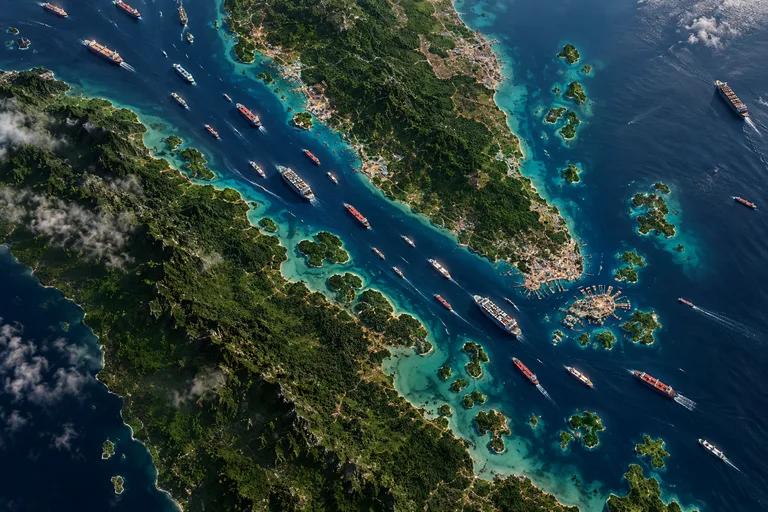
Every great power has a back door. China’s problem is that it is surrounded by them—and everyone knows where they are. --YNOT!
There are certain words that keep showing up whenever you seriously study China.
Taiwan. Semiconductors. Oil. The South China Sea.
But there is another word that ought to be written on the wall in Beijing in letters ten feet high: Malaca. Malaca. Malaca.
Because for all the aircraft carriers, missiles, factories, satellites, cyberwarfare, artificial intelligence and increasingly impressive military parades, China still has a very old-fashioned problem.
Ships have to get there.
And a tremendous number of those ships have to squeeze through one narrow stretch of water.
The Strait of Malacca.
THE MALACCA DILEMMA
This is not some theory invented by an American think tank.
The Chinese themselves have worried about it for decades.
In 2003, Chinese leader Hu Jintao famously described what became known as the “Malacca Dilemma”: China’s dependence upon maritime trade routes passing through a narrow strategic chokepoint that China itself does not control.
And China has good reason to worry.
A huge share of the energy feeding China’s industrial economy arrives by sea. Much of the petroleum coming from the Persian Gulf and Africa travels across the Indian Ocean, through the Strait of Malacca, past Singapore and into the South China Sea before finally reaching Chinese ports.
That is an astonishing vulnerability for a country aspiring to become the dominant power in Asia.
China may manufacture the television.
China may manufacture the batteries.
China may manufacture the solar panels.
China may manufacture the drones.
But somebody still has to deliver the oil.
And oil does not care how many TikTok followers you have.
GEOGRAPHY IS STILL UNDEFEATED
We occasionally talk as though technology has abolished geography.
It hasn’t.
The Strait of Malacca sits between the Malay Peninsula and the Indonesian island of Sumatra.
At its narrowest navigable section near Singapore, the maritime corridor becomes remarkably constrained.
And through this neighborhood moves an enormous portion of the commerce connecting the Indian Ocean with East Asia.
Which means that somebody looking at a map in Beijing eventually has to ask a very uncomfortable question:What happens if we go to war and those ships stop coming?
Factories require energy. Trucks require diesel. Aircraft require fuel. Ships require fuel.
Petrochemical plants require feedstocks.
Modern civilization is basically an elaborate machine for turning energy into everything else.
China built perhaps the greatest manufacturing machine the world has ever seen.
But the machine needs to eat.
ENTER INDIA
Now look west. Not toward America. Toward India.
India possesses something extremely interesting called the Andaman and Nicobar Islands, stretching south through the Bay of Bengal.
And at the bottom sits Great Nicobar Island.
Great Nicobar is remote. Very remote.
It is closer to parts of Southeast Asia than it is to much of mainland India.
For decades hardly anybody outside the region paid much attention to it.
That is changing.
India is planning enormous infrastructure investments there—a major container port, airport, power infrastructure and related development. The island sits near shipping routes approaching the Malacca Strait, giving India potentially important commercial and military reach.
Suddenly that forgotten island looks considerably less forgotten.
Because geography has given India something money cannot easily manufacture:
position.
THE STRING OF PEARLS
China understands this problem. It has spent decades trying to solve it.
Beijing has developed ports, infrastructure and relationships stretching across the Indian Ocean.
Djibouti. Pakistan. Sri Lanka. Myanmar. Bangladesh.
The collection has often been described as China’s “String of Pearls.”
Look at a map and you understand the logic immediately.
China wants places where its ships can operate.
Places where goods can move. Places where energy can arrive.
Places that reduce China’s dependence upon maritime routes dominated by other countries.
And above all:China wants alternatives.
Because great powers do not like having only one road into town.
China’s investments around the Indian Ocean therefore aren’t merely economic curiosities. They also make strategic sense for a country worried about maintaining maritime access during a crisis.
CHINA BUILT A BACK DOOR
One of China’s biggest attempts to escape the Malacca problem is Pakistan.
The theory was beautiful.
Build the port of Gwadar on the Arabian Sea.
Unload oil and cargo there. Move it north through Pakistan toward western China. Voilà.
China now has a back door to the Indian Ocean. No Malacca.
At least that was the brochure.
The problem is that between a port on the Arabian Sea and western China lies a rather inconvenient collection of things called:
Pakistan, mountains, distance, cost and politics. Infrastructure can overcome geography.
But geography charges rent. And sometimes the rent is enormous.
THEN THERE WAS MYANMAR
China tried another approach.
Bring oil into Myanmar from the Bay of Bengal and send it through pipelines toward Yunnan province.
This one actually works. To a point. It gives China another route.
It reduces some pressure.
But it doesn’t replace the enormous volume of maritime commerce moving through Southeast Asia.
And Myanmar has spent recent years dealing with military rule, armed conflict and political instability.
So China’s solution to one geopolitical vulnerability introduced another geopolitical vulnerability.
Welcome to geopolitics. There are very few solutions.
Mostly there are different collections of problems.
JUST GO AROUND
Someone inevitably says: “Why don’t the ships simply go around Malacca?”
They can. There are alternative routes through Indonesia, including the Sunda and Lombok Straits.
But longer routes mean more sailing. More sailing means more fuel.
More fuel means more tankers. More tankers mean more money.
More distance means fewer deliveries per ship per year.
And during a major military conflict, taking a longer route does not necessarily eliminate the strategic problem.
You have simply moved the problem several hundred miles down the road.
Or in this case, down the ocean.
AND THEN THERE IS TAIWAN
Now we return to Taiwan.
Because this is where Malacca becomes especially interesting.
People often look at a Taiwan war primarily as a military contest:
Chinese missiles versus Taiwanese defenses.
Chinese aircraft versus American aircraft.
Chinese ships versus American submarines.
Chinese soldiers trying to cross the Taiwan Strait.
But wars are not merely fought by soldiers.
Wars are fought by economies.
Imagine China launching a major operation against Taiwan.
The first question might be:Can China take Taiwan?
But the second question becomes:Can China continue feeding a gigantic industrial economy while doing it?
China imports enormous quantities of petroleum, natural gas, minerals, food and industrial commodities.
Ships carrying those materials travel through waters where China does not possess uncontested control.
That is the part of the Taiwan equation sometimes overlooked.
China would not simply be attacking Taiwan.
China would be betting that its entire global logistics system continues functioning during the conflict.
That is a much larger bet.
BUT DON’T GET CARRIED AWAY
There is another side to this story.
People sometimes talk about “closing Malacca” as though somebody just walks over and shuts a gate.
It isn’t that simple. Indonesia exists. Malaysia exists. Singapore exists.
International shipping law exists.
Other Asian economies depend upon the same route.
Japan needs it. South Korea needs it. India needs it. Europe needs it.
The United States has economic interests there.
Everybody’s containers are mixed together.
Everybody’s oil tankers sail through the same ocean.
And India itself depends heavily upon maritime trade.
An Indian naval officer quoted in the source makes the essential point: strangling Malacca would damage far more than China. The Strait is bordered by Indonesia, Malaysia and Singapore, and maintaining a blockade would be far more complicated than simply announcing one.
Which brings us to one of my favorite rules of geopolitics:
Never confuse having someone’s throat within reach with being able to squeeze it without breaking your own fingers.
SO WHY DOES IT MATTER?
Because deterrence is not always about actually doing something.
Sometimes it is enough that the other fellow knows you could.
India does not necessarily need to close Malacca.
America does not necessarily need to close Malacca.
Indonesia does not necessarily need to close Malacca.
Nobody needs to close anything.
The strategic value lies partly in Beijing having to think about the possibility.
Every tanker. Every pipeline. Every port. Every naval base. Every alternate trade route.
Every strategic petroleum reserve. Every ship China builds.
Every relationship it develops with Pakistan, Myanmar, Sri Lanka or countries around the Indian Ocean.
Somewhere buried inside those decisions is the same little geographical problem.
Malaca.
THE GREAT IRONY
China has spent decades attempting to reduce its vulnerability.
Ports. Pipelines. Railroads. The Belt and Road Initiative. Naval expansion.
Overseas bases. Strategic petroleum reserves. Alternative routes.
And yet geography remains stubborn. China sits on the Pacific.
Much of China’s energy sits on the other side of the Indian Ocean.
Between the two lies a series of narrow places controlled or influenced by countries that are not China.
That doesn’t mean China is helpless. Far from it.
China is building one of the world’s most powerful navies precisely because it understands the problem.
But it does mean that China’s enormous industrial strength contains an equally enormous logistical dependency.
And perhaps that is the lesson. Every great power has an Achilles’ heel.
America has debt.
Russia has demographics and economic concentration.
Europe has political fragmentation.
China has several. But one of the easiest to find requires nothing more sophisticated than opening a map.
Follow the oil tankers. Across the Persian Gulf. Across the Indian Ocean. Past India. Toward Singapore.
And eventually the ocean becomes very narrow.
Malaca. Malaca. Malaca.
China knows where its weakness is.
The interesting question is not whether Beijing understands it.
The interesting question is what China is willing to do to make sure nobody ever gets the opportunity to use it.
China’s Malacca Exposure
Source says roughly 80% of China’s imported oil and about two-thirds of its trade pass through the Strait, while China accounts for about 48% of the oil moving through Malacca. It also gives a 2024 estimate of $390 billion in Chinese energy imports, with about $312 billion passing through Malacca.
China is a continental-sized industrial power whose oil supply still has to squeeze through a narrow maritime doorway.
| measure | share |
|---|---|
| China’s imported oil passing through Malacca | 80 |
| China’s trade passing through Malacca | 67 |
| Oil transiting Malacca destined for China | 48 |
So where is it?
The Strait of Malacca looks enormous on a globe. At ship level, it is a funnel. It runs between the Malay Peninsula—Malaysia and Singapore—and the Indonesian island of Sumatra, connecting the Indian Ocean with the South China Sea and ultimately the Pacific.
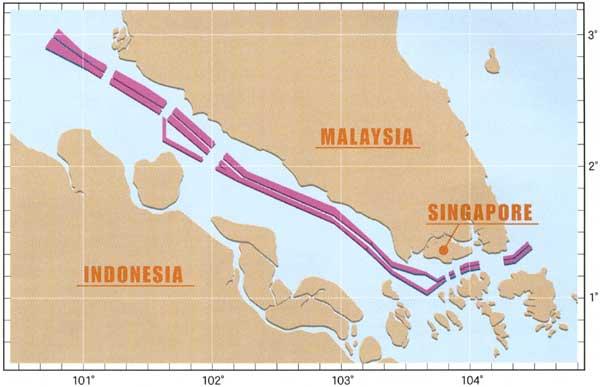
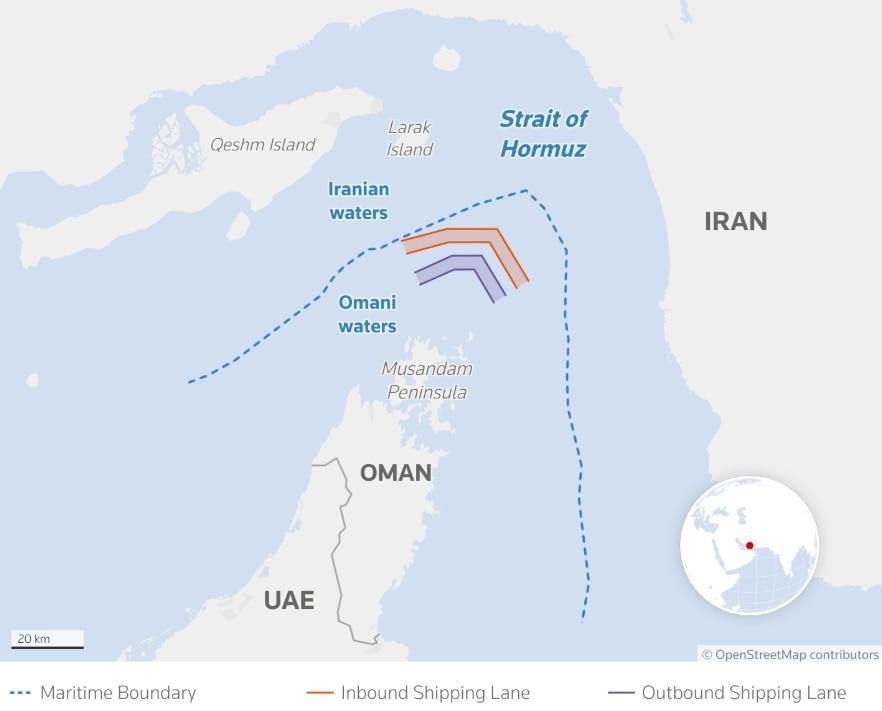
The important measurement is not simply the distance from one coastline to another. Commercial ships have to follow safe, navigable channels. Near Singapore, at the Phillips Channel, the usable passage constricts to roughly 1.7 miles (2.7 km). Large tankers also face depth and maneuvering constraints; the maximum ship class commonly associated with the route is appropriately called Malaccamax. (U.S. Energy Information Administration) Your source makes essentially the same point, describing the Singapore-area bottleneck as only about 2.5 km wide.
And there is a staggering amount of energy moving through that funnel. EIA estimates 23.2 million barrels per day of petroleum passed through Malacca in the first half of 2025, more than through Hormuz, and China accounted for about 48% of the import volumes transiting Malacca. (U.S. Energy Information Administration)
Malacca versus Hormuz
| Strait of Malacca | Strait of Hormuz | |
|---|---|---|
| Geography | Between Sumatra and Malaysia/Singapore | Between Iran and Oman |
| Physical bottleneck | About 1.7 miles at Phillips Channel | About 21 miles overall at narrowest point |
| Actual designated ship lanes | Constrained channel varies along route | 2-mile inbound + 2-mile outbound, with 2-mile separation |
| Oil flow, 1H 2025 | 23.2m barrels/day | 20.9m barrels/day |
| Main vulnerability | Extremely congested, narrow, shallow in places | Shipping concentrated into very narrow traffic lanes |
| Main alternatives | Sunda and Lombok Straits, but longer/costlier | Pipelines, but nowhere near enough capacity to replace Hormuz |
| Political geography | Indonesia + Malaysia + Singapore | Iran + Oman |
Hormuz sounds wider because it is wider physically. At its narrowest it is about 21 miles across. But that’s misleading too: international tanker traffic moves through designated lanes only about two miles wide in each direction, separated by a two-mile buffer. (U.S. Energy Information Administration)
So both have the same strategic feature:
Thousands of miles of ocean eventually become a couple of miles of usable roadway.
Why Malacca is vulnerable
Malacca isn’t “easy to close” in the sense that somebody throws a chain across it.
It is easy to disrupt relative to the enormous amount of commerce dependent upon it.
Think of I-95 narrowing from twelve lanes to one lane.
You don’t have to eliminate traffic forever to create an economic crisis. A serious accident, grounding, collision, security incident or military confrontation could produce delays, congestion, rerouting and sharply higher insurance and freight costs. EIA specifically describes the narrow Phillips Channel as presenting risks of collision, grounding and oil spills. (U.S. Energy Information Administration)
And because the traffic density is so high, disruption compounds.
A tanker stops. Ships behind it slow. Anchorage areas fill.
Arrival schedules collapse. Refineries don’t receive scheduled cargoes.
Replacement ships take longer routes.
Freight and insurance prices rise.
And suddenly a physical problem a few miles wide becomes an economic problem several thousand miles away.
That’s what makes a chokepoint a chokepoint.
But Hormuz is actually the scarier military chokepoint
There is an important distinction for your article.
Malacca may be China’s greater strategic vulnerability, but Hormuz is arguably easier for a single country to threaten militarily.
Iran sits directly on the northern side of Hormuz and controls nearby coastline and islands. Oman sits on the southern side. Almost all Persian Gulf exports headed east or west have to pass through those tightly organized shipping lanes.
There are bypass pipelines, but their spare capacity could replace only a fraction of normal Hormuz traffic. EIA puts 1H25 Hormuz petroleum traffic at 20.9 million barrels/day, while the major Saudi and UAE bypass pipelines together offered roughly 4.7 million barrels/day of available bypass capacity.
Malacca is politically more complicated.
Indonesia, Malaysia and Singapore border it. India is nearby strategically through the Andaman and Nicobar Islands, but India does not own the Strait of Malacca. And shutting it would hammer Japan, South Korea, Singapore, India and much of the world economy along with China.
Your original source actually makes this caveat very well: interfering with Malacca is one thing; sustaining a blockade is another, particularly because the waterway involves Indonesia, Malaysia and Singapore and because India itself depends heavily on maritime commerce.
Hormuz is a gun pointed at the world’s oil supply. Malacca is a hand wrapped around the throat of Asian industry. The frightening part is that China’s factories are on the other end of that throat.
And that makes the Chinese Malacca Dilemma more interesting than simply saying, “India can close the Strait.”
China’s real nightmare isn’t necessarily that Malacca stays closed forever.
It is that during a Taiwan war, China suddenly has to protect Taiwan operations, the South China Sea, its Pacific coast—and an energy lifeline extending thousands of miles across the Indian Ocean at the same time.
And sometimes you just can’t win against the geology…
Copyright
Copyright © 2026 YNOT – TONY LESTER All rights reserved.
Dedication
This book is dedicated to the millions who died across China through war, famine, revolution, persecution, forced labor, political campaigns, imprisonment, resistance, and silence.
To those who believed China could become stronger, freer, fairer, and more humane.
To those who spoke when silence was safer.
To those who resisted when obedience was demanded.
To those who worked, sacrificed, suffered, and died hoping their children might inherit a better country.
Many were forgotten.
Many were never named.
Many disappeared into prisons, battlefields, labor camps, mass graves, ruined villages, and official histories that refused to remember them.
They struggled against a system that demanded submission but would not bend, listen, admit error, or surrender control.
> 宁为玉碎,不为瓦全 > “Better to be shattered jade than an unbroken tile.”
Their lives were not meaningless.
Their courage was not wasted.
Their memory remains part of China, whether acknowledged or denied.
> 青山埋忠骨,史册载英魂 > “The green mountains bury the faithful bones; history preserves the heroic spirit.”
May this book remember those whom power tried to erase.
May it honor those who dreamed of a better China.
And may future generations build the nation for which so many gave everything.
Foreword
The Future Belongs to Those Who Prepare for It
> 凡事预则立,不预则废 > “In all things, preparation leads to success; without preparation, failure follows.”
The future does not arrive all at once.
It comes quietly.
It appears in a new factory, a new computer chip, a new naval base, a new trade agreement, a new artificial intelligence model, or a new generation of children educated to see the world differently from their parents.
Then, one day, people look around and realize the world they knew is gone.
> 不谋万世者,不足谋一时;不谋全局者,不足谋一域 > “Those who do not plan for generations cannot plan for a moment; those who do not consider the whole cannot govern one part.”
The struggle between China and the United States is often described as if it were a contest over the present.
Who has the largest economy?
Who has the strongest military?
Who produces the most ships, automobiles, batteries, solar panels, semiconductors, satellites, or artificial intelligence systems?
But the true contest is not over what exists today.
It is over what will exist tomorrow.
The most important question is not which tiger stands higher on the mountain now.
It is which tiger is better preparing for the mountain that has not yet formed.
> 人无远虑,必有近忧 > “A person without long-term considerations will soon face immediate troubles.” > — Confucius
The coming decades will not simply be an extension of the world we already know. They may represent a fundamental transformation in human civilization.
Artificial intelligence may alter work, education, warfare, medicine, science, government, and the nature of human decision-making.
Robotics may replace entire categories of labor.
Biotechnology may change how long people live and what diseases they fear.
Quantum computing may break systems once considered secure.
Autonomous weapons may make decisions faster than political leaders can understand them.
Digital currencies may weaken the power of traditional banks and governments.
Space may become another battlefield, another marketplace, and another source of national power.
> 工欲善其事,必先利其器 > “A craftsman who wishes to do good work must first sharpen his tools.”
The future will favor nations that possess the tools of the future.
But tools alone are not enough.
A nation may invent a technology and still fail to control its consequences. It may build great machines while weakening the people who depend upon them. It may become rich while becoming unstable. It may become powerful while becoming frightened.
> 器大者声必闳,志高者意必远 > “Those of great capacity speak with great force; those of high ambition think far ahead.”
China’s ambition is not difficult to see.
It seeks technological independence, economic security, military strength, political stability, and international influence. It wants to ensure that no foreign power can again dictate its future.
China does not merely want to participate in the next age.
It wants to help design it.
> 自力更生 > “Rely on one’s own strength.”
This phrase has appeared throughout modern Chinese history. It reflects a deep instinct within Chinese political thinking: dependence creates vulnerability.
If China depends on foreign semiconductors, it will build its own.
If it depends on foreign energy, it will seek new suppliers and new technologies.
If it depends on foreign shipping routes, it will build ports, railways, pipelines, and naval forces.
If it depends on foreign financial systems, it will attempt to create alternatives.
> 未雨绸缪 > “Repair the roof before it rains.”
China is repairing many roofs.
It is building infrastructure across Asia, Africa, Latin America, and the Middle East. It is developing its manufacturing base, expanding its military, stockpiling strategic materials, securing supply chains, investing in research, and educating millions of engineers and scientists.
Some of these efforts will succeed.
Some will fail.
Some will create new dependencies and new enemies.
But the direction is clear.
> 积土而为山,积水而为海 > “Pile up earth and it becomes a mountain; gather water and it becomes a sea.”
China’s rise has been built through accumulation.
Factory by factory.
Port by port.
Engineer by engineer.
Patent by patent.
Ship by ship.
Market by market.
The Chinese approach is often gradual until it suddenly appears overwhelming.
> 冰冻三尺,非一日之寒 > “Three feet of ice do not form in a single day.”
Great changes rarely begin with a dramatic announcement. They are created through thousands of decisions that seem small when viewed separately.
The same is true of decline.
Nations do not normally collapse because of one mistake. They weaken through repeated failures to maintain their institutions, educate their citizens, control their debts, protect their industries, or understand their competitors.
> 千里之堤,溃于蚁穴 > “A thousand-mile dike can collapse because of an ant hole.”
The United States still possesses extraordinary strengths.
It has powerful allies, innovative companies, advanced universities, deep financial markets, global military reach, abundant natural resources, and a culture that has historically encouraged invention and risk.
But strength can create complacency.
> 生于忧患,死于安乐 > “One survives through hardship and perishes through comfort.” > — Mencius
The United States became powerful partly because it was willing to imagine and build the future. It created industries that did not exist, explored frontiers others feared, and attracted ambitious people from across the world.
Its danger is not that China is destined to replace it.
Its danger is that America may stop doing the things that made it powerful.
> 逆水行舟,不进则退 > “Sailing against the current, one must move forward or be pushed backward.”
There is no permanent summit.
A country cannot remain dominant merely because it was dominant yesterday. Power must be renewed.
Infrastructure must be rebuilt.
Knowledge must be expanded.
Institutions must be repaired.
Citizens must believe the future is worth building.
> 苟日新,日日新,又日新 > “If you can renew yourself for one day, renew yourself every day, and continue renewing yourself.”
The great challenge of the future may not be whether China can rise.
It may be whether the United States can renew itself.
China faces its own dangers.
Its population is aging. Its birthrate has fallen. Its property sector has accumulated enormous problems. Local governments carry heavy debt. Its political system rewards obedience, but obedience can hide bad news.
A highly centralized state can act quickly.
It can also make large mistakes quickly.
> 兼听则明,偏信则暗 > “Listening to many sides brings clarity; believing only one side brings darkness.”
A government that punishes disagreement may eventually lose the ability to distinguish loyalty from truth.
A nation can have advanced computers and still make poor decisions.
It can collect enormous amounts of data and still misunderstand reality.
> 智者千虑,必有一失;愚者千虑,必有一得 > “Even the wise, after a thousand considerations, may make one mistake; even the foolish may sometimes discover one truth.”
The future will not be controlled simply by the country with the most technology.
It may be controlled by the country that combines technology with judgment.
> 知人者智,自知者明 > “To understand others is intelligence; to understand oneself is true wisdom.” > — Laozi
Both China and the United States study each other intensely.
China studies American weaknesses: political division, industrial decline, social distrust, debt, inequality, and short-term decision-making.
The United States studies Chinese weaknesses: demographics, debt, censorship, dependence on exports, political rigidity, and fear of domestic instability.
But the more dangerous weakness is often the one a nation refuses to see in itself.
> 当局者迷,旁观者清 > “Those inside the game are often confused; those watching from outside may see clearly.”
The future contest will be fought across many battlefields, although most will not look like traditional war.
It will be fought through standards, software, currencies, ports, satellites, research laboratories, universities, media platforms, mineral deposits, shipping lanes, and diplomatic relationships.
> 兵无常势,水无常形 > “In war there is no constant position, just as water has no constant shape.” > — Sun Tzu
The most important victories may occur without a shot being fired.
A nation that controls the operating systems, data networks, energy infrastructure, financial rails, and manufacturing platforms of another nation may possess influence more powerful than an army.
> 不战而屈人之兵,善之善者也 > “To subdue the enemy without fighting is the highest excellence.” > — Sun Tzu
Economic dependency can become strategic leverage.
Technology can become political pressure.
Trade can become a weapon.
Finance can become a battlefield.
Information can become ammunition.
> 上兵伐谋,其次伐交,其次伐兵,其下攻城 > “The highest warfare attacks strategy; next comes attacking alliances; next armies; the lowest form is attacking cities.” > — Sun Tzu
This is why alliances will matter so greatly in the future.
No tiger climbs alone.
The United States has built a broad network of military and economic partners. China has developed its own relationships through trade, investment, infrastructure, and political support.
The competition may ultimately be decided not only by the strength of China and the United States, but by which nation other countries trust, need, fear, or prefer.
> 得道多助,失道寡助 > “Those who follow the right path receive much support; those who lose it receive little.” > — Mencius
Influence cannot be measured only in money.
Nations remember whether they were treated as partners or tools. They remember promises that were kept and promises that were broken.
> 桃李不言,下自成蹊 > “Peach and plum trees do not speak, yet a path forms beneath them.”
Real influence often grows from example.
A successful society attracts attention without demanding it.
A trusted country gains allies without purchasing every relationship.
A civilization confident in itself does not need to force admiration.
> 德不孤,必有邻 > “Virtue does not stand alone; it will always attract neighbors.” > — Confucius
Yet history suggests that power and virtue do not always travel together.
Both China and the United States may speak of peace while preparing for conflict.
Both may describe their own actions as defensive and the other’s actions as aggressive.
Both may believe time is running against them.
That is when danger grows.
> 疑则勿用,用则勿疑 > “Do not use those you distrust; once you use them, do not continue distrusting them.”
Distrust between great powers has a momentum of its own.
One country builds weapons because it fears the other.
The other responds by building more weapons.
Each action appears defensive to the nation taking it and offensive to the nation observing it.
> 鹬蚌相争,渔翁得利 > “When the snipe and the clam fight, the fisherman benefits.”
A conflict between China and the United States would not necessarily produce a clean victor. It could weaken both while benefiting other nations, political movements, corporations, or technologies that rise from the destruction.
The greatest danger may not be a planned war.
It may be a mistake.
> 差之毫厘,谬以千里 > “An error of a hair’s breadth can lead a thousand miles astray.”
A collision at sea.
A cyberattack misunderstood as preparation for war.
A political leader trapped by public promises.
A crisis over Taiwan.
An accident in space.
A false alarm generated by artificial intelligence.
A decision made in minutes that changes history for centuries.
> 一着不慎,满盘皆输 > “One careless move, and the entire game may be lost.”
The future will demand patience, but patience should not be confused with passivity.
> 静如处子,动如脱兔 > “Be still like a maiden; move like a fleeing rabbit.”
There are moments to wait and moments to act.
The challenge is knowing which moment has arrived.
China’s leaders often present time as their ally. They speak of national rejuvenation and long historical cycles. They believe China is reclaiming a position it held before foreign powers weakened it.
> 卧薪尝胆 > “Sleep on brushwood and taste gall.”
This ancient expression describes enduring hardship while preparing for eventual revenge or restoration. It reflects patience joined with memory.
The United States often acts with greater urgency. Its politics demand visible results. Its leaders operate within short election cycles. Its companies are pressured by quarterly performance.
That does not mean America is incapable of long-term strategy.
It means long-term strategy requires agreement across generations and political parties.
> 众人拾柴火焰高 > “When many people gather firewood, the flames rise high.”
No nation can build a successful future if its people no longer believe they share one.
National strength is not simply the number of missiles, factories, or patents a country possesses.
It is also the degree to which its citizens trust one another, believe in their institutions, and accept sacrifice for goals they may never personally see completed.
> 同心同德 > “United in heart and purpose.”
The coming age will test the internal unity of both tigers.
China’s government emphasizes order and national purpose, but it must continually balance control against innovation.
Innovation requires questioning.
Scientific progress requires the freedom to challenge accepted ideas.
Entrepreneurship requires the freedom to fail.
> 尽信书,则不如无书 > “To believe everything written in books is worse than having no books at all.” > — Mencius
The United States encourages disagreement, but disagreement can become paralysis.
Freedom without shared purpose may produce noise rather than progress.
> 家和万事兴 > “When the family is harmonious, all affairs prosper.”
The future may reward societies that can combine openness with order, innovation with discipline, individuality with national purpose, and prosperity with social stability.
That balance is difficult.
> 过犹不及 > “Going too far is as bad as not going far enough.” > — Confucius
Too much control can suffocate creativity.
Too little control can produce chaos.
Too much nationalism can turn competition into hatred.
Too little national confidence can produce decline.
Too much dependence on technology can weaken human judgment.
Too little investment in technology can leave a nation defenseless.
> 物极必反 > “When anything reaches an extreme, it reverses.”
The future will also challenge our assumptions about humanity itself.
As artificial intelligence becomes more capable, societies will face questions that neither capitalism nor communism has fully answered.
What happens when machines can perform most forms of human labor?
Who owns the machines?
Who controls the data?
Who decides what the machines may know?
Who determines what they are permitted to say?
What happens to people who are no longer economically necessary?
> 民为贵,社稷次之,君为轻 > “The people are most important; the state comes next; the ruler is least important.” > — Mencius
Technology may increase national power while reducing individual freedom.
It may create abundance while concentrating ownership.
It may connect every person while making genuine human connection more difficult.
> 福兮祸所伏,祸兮福所倚 > “Within good fortune hides disaster; within disaster rests good fortune.” > — Laozi
Every great technology contains two futures.
Nuclear power can illuminate cities or destroy them.
Artificial intelligence can cure diseases or automate repression.
Biotechnology can extend life or divide humanity into biological classes.
Information networks can spread knowledge or manipulate entire populations.
> 水能载舟,亦能覆舟 > “Water can carry a boat, but it can also overturn it.”
Technology is the water.
Governments, companies, and civilizations are the boats.
The future will belong not merely to those who create powerful technologies, but to those who learn how to survive their power.
> 善泳者溺,善骑者堕 > “The skilled swimmer may drown; the skilled rider may fall.”
Expertise can create overconfidence.
A nation that believes it fully controls artificial intelligence may eventually discover that dependence has replaced control.
A society that delegates too many decisions to machines may lose the capacity to make decisions without them.
> 聪明反被聪明误 > “Cleverness may be defeated by its own cleverness.”
The future, then, is not simply Chinese or American.
It is human.
The rivalry between China and the United States will influence the direction of civilization, but neither country can fully command what is coming.
Climate pressures, migration, pandemics, automation, demographic decline, resource competition, and artificial intelligence will affect every society.
> 覆巢之下,安有完卵 > “When the nest is overturned, no egg remains unbroken.”
The world is more interconnected than either tiger may wish to admit.
China and the United States compete, yet they also depend on each other.
Their economies, universities, supply chains, technologies, markets, and financial systems are deeply entangled.
> 唇亡齿寒 > “When the lips are gone, the teeth feel the cold.”
The collapse of one would not necessarily bring prosperity to the other.
It could bring worldwide depression, political instability, military conflict, and technological fragmentation.
> 一荣俱荣,一损俱损 > “When one prospers, all may prosper; when one suffers, all may suffer.”
Coexistence may be difficult.
But destruction would be worse.
The old proverb says that one mountain cannot contain two tigers.
Yet proverbs warn; they do not command.
> 事在人为 > “Human effort determines what can be achieved.”
The future is not already written.
China is not guaranteed to rise forever.
The United States is not guaranteed to decline.
War is not inevitable.
Peace is not automatic.
Technology is not destiny.
> 路虽远,行则将至;事虽难,做则必成 > “Though the road is long, walking brings one closer; though the task is difficult, action can complete it.”
Both tigers will make choices.
They will choose whether to compete through innovation or intimidation.
They will choose whether to respect boundaries or continually test them.
They will choose whether to educate their people or manipulate them.
They will choose whether technology serves humanity or humanity serves technology.
> 种瓜得瓜,种豆得豆 > “Plant melons and harvest melons; plant beans and harvest beans.”
The world that emerges will reflect the seeds planted now.
This book looks at China, its history, its ambitions, its power, its methods, its contradictions, and its possible future. But it also asks the reader to look at the United States and the wider world with equal honesty.
> 以人为镜,可以明得失 > “Use other people as a mirror, and you can understand your own gains and losses.”
China can serve as a mirror for America.
America can serve as a mirror for China.
Each tiger can see in the other its own ambition, fear, pride, strength, and vulnerability.
> 见贤思齐焉,见不贤而内自省也 > “When you see the worthy, seek to equal them; when you see the unworthy, examine yourself.” > — Confucius
The coming decades will be shaped by competition, but they need not be defined entirely by hostility.
There may still be opportunities for cooperation in medicine, science, climate, trade, space, and the prevention of catastrophic war.
> 和则两利,斗则俱伤 > “Cooperation benefits both; conflict harms both.”
Yet cooperation without vigilance is naïve.
Vigilance without wisdom is dangerous.
Strength without restraint becomes tyranny.
Peace without preparation becomes vulnerability.
> 居安思危,思则有备,有备无患 > “In security, consider danger; through thought comes preparation; through preparation comes freedom from disaster.”
The future belongs neither to optimists nor pessimists.
It belongs to those who see clearly.
> 明者因时而变,知者随事而制 > “The enlightened change with the times; the wise adapt to circumstances.”
The mountain is moving.
Its paths are shifting.
New heights are appearing, and old summits are collapsing.
The two tigers are no longer simply climbing.
They are shaping the mountain beneath them.
> 山高人为峰 > “However high the mountain, humanity can become its summit.”
The future will reveal whether these two great powers possess the wisdom to share the mountain, the discipline to avoid destroying it, and the courage to change before change is forced upon them.
> 穷则变,变则通,通则久 > “When circumstances reach their limit, change follows; through change comes a path forward; through that path comes endurance.”
The old world is ending.
The new world has already begun.
> 长风破浪会有时,直挂云帆济沧海 > “The time will come to ride the wind and break the waves, raising the sail to cross the vast sea.” > — Li Bai
The future is not waiting for us.
It is being built now.
Preface
Two Tigers, One Mountain
> 一山不容二虎 > “One mountain cannot contain two tigers.” > — Chinese proverb
China is a mountain.
It is ancient, immense, beautiful, dangerous, and impossible to understand from only one direction. It has survived emperors and revolutions, invasions and famines, periods of extraordinary prosperity and moments of almost unimaginable destruction. Dynasties have risen from its valleys, conquered its heights, and disappeared into its soil.
Today, two tigers are climbing the same mountain.
One is China.
The other is the United States.
For decades, the United States stood alone near the summit of global power. Its economy, military, currency, technology, universities, corporations, and political influence shaped much of the modern world. China, meanwhile, was climbing—quietly at first, then rapidly, and eventually with a confidence that could no longer be ignored.
The title of this book comes from one of China’s most famous sayings:
> 一山不容二虎,除非一公一母 > “One mountain cannot contain two tigers—unless one is male and the other female.”
The humorous second line is often omitted, but the warning remains. Two powerful creatures occupying the same territory will eventually test one another. They may circle cautiously. They may divide the mountain. They may tolerate each other for a time. But each tiger understands what the presence of the other means.
Competition.
Power.
Survival.
The struggle between China and the United States is not merely a trade dispute, a military rivalry, or a disagreement between political systems. It is a contest over who will write the rules of the twenty-first century.
Who will control the technologies?
Who will dominate the supply chains?
Whose currency will be trusted?
Whose military will command the seas?
Whose values will influence the developing world?
And perhaps most importantly: whose vision of the future will humanity follow?
China understands this contest through the accumulated memory of thousands of years. Chinese leaders do not think only in election cycles, quarterly reports, or five-year market trends. They study dynasties. They remember humiliations. They examine victories and defeats that occurred centuries ago as though they happened yesterday.
As the Chinese saying warns:
> 前事不忘,后事之师 > “Do not forget the events of the past; they are the teachers of the future.”
To understand modern China, we must understand that its history is never entirely past.
The Opium Wars are not merely chapters in an old textbook. The fall of the Qing dynasty is not simply a distant political event. The Japanese invasion, the Communist Revolution, the Cultural Revolution, the opening of China’s economy, and the rise of the Chinese Communist Party all remain part of the country’s living consciousness.
China remembers the period from the nineteenth to the twentieth century as the Century of Humiliation—a time when foreign powers divided its territory, controlled its ports, dictated its trade, and treated the Chinese nation as weak.
That memory remains one of the strongest forces driving modern Chinese policy.
> 落后就要挨打 > “If you fall behind, you will be beaten.”
This belief helps explain China’s determination to become stronger in manufacturing, science, artificial intelligence, space, energy, finance, and military power. Chinese leaders do not view national strength merely as an opportunity. They view it as protection against ever again becoming vulnerable to foreign domination.
But strength creates its own dangers.
> 木秀于林,风必摧之 > “The tree that rises above the forest is the first to be struck by the wind.”
As China rises, it attracts admiration, dependence, suspicion, and resistance. Its success has lifted hundreds of millions of people from poverty and transformed the global economy. It has also produced an increasingly powerful state capable of monitoring its citizens, pressuring its neighbors, influencing international institutions, and challenging American leadership.
The United States now faces a competitor unlike any it has encountered before.
The Soviet Union was a military superpower but an economic failure. Japan became an economic rival but remained a military ally. China is different. It is simultaneously a manufacturing giant, a nuclear power, a technological competitor, a vast consumer market, a creditor nation, and a civilization with its own concept of global order.
China is not merely joining the existing system.
It increasingly seeks to reshape it.
> 天下大势,分久必合,合久必分 > “The great affairs of the world follow a pattern: what has long been divided must unite, and what has long been united must divide.”
This famous opening idea from Romance of the Three Kingdoms captures a recurring Chinese view of history: order is temporary, power shifts, alliances change, and no empire remains supreme forever.
The American-led world order is not permanent merely because Americans have grown accustomed to it. China’s rise is not guaranteed merely because its growth has been extraordinary. Every tiger has strengths. Every tiger also has wounds, weaknesses, fears, and blind spots.
China has enormous industrial capacity but faces demographic decline. It has accumulated wealth but carries extraordinary debt. It possesses advanced technology but remains dependent on foreign innovations in critical areas. Its government can plan for decades, yet centralized authority can conceal mistakes until they become disasters.
The United States has unmatched alliances, capital markets, universities, military reach, and entrepreneurial energy. Yet it is deeply divided, heavily indebted, politically distracted, and increasingly uncertain about its own identity and purpose.
Neither tiger is invincible.
> 知己知彼,百战不殆 > “Know yourself and know the other, and you need not fear the result of a hundred battles.” > — Sun Tzu
That is the purpose of this book.
It is not written to praise China or to condemn it. It is not intended to glorify the United States or excuse its mistakes. It is an attempt to understand both tigers: their histories, ambitions, strategies, achievements, contradictions, and fears.
Throughout this book, Chinese proverbs, philosophical teachings, military principles, political slogans, and historical quotations will appear frequently. This is intentional.
Chinese civilization has always communicated complex truths through short, memorable expressions. A single proverb may carry centuries of history. A four-character idiom may contain an entire political philosophy. A sentence from Confucius, Laozi, Sun Tzu, Mencius, or an ancient historical chronicle may explain modern Chinese behavior more clearly than a hundred pages of Western analysis.
> 以古为镜,可以知兴替 > “Use history as a mirror, and you can understand the rise and fall of nations.”
These quotations should not be treated as decorative ornaments. They are windows into how China sees itself and the world.
Chinese thought frequently emphasizes patience over speed, indirect action over open confrontation, harmony over uncontrolled disorder, and long-term advantage over immediate victory.
> 欲速则不达 > “Those who seek speed do not arrive.”
> 不战而屈人之兵,善之善者也 > “To subdue the enemy without fighting is the highest excellence.” > — Sun Tzu
> 水滴石穿 > “Dripping water penetrates stone.”
These sayings reveal a civilization comfortable with long contests. China may retreat tactically while advancing strategically. It may cooperate in one field while competing in another. It may speak of harmony while preparing for conflict.
Western governments often ask, “What will China do next?”
Chinese strategists may be asking a different question:
“What position can we create today that will leave our opponent with fewer choices tomorrow?”
> 上兵伐谋 > “The highest form of warfare is to attack the enemy’s strategy.” > — Sun Tzu
The mountain in this book is not a physical place. It is the world economy, the Pacific Ocean, cyberspace, artificial intelligence, global finance, international trade, political influence, military power, and the imagination of future generations.
The tigers are not destined to fight simply because an ancient proverb says they cannot coexist. History is not fate. Wisdom can warn us without imprisoning us.
There is another Chinese saying:
> 山不转路转,路不转人转 > “When the mountain does not move, the road must turn; when the road cannot turn, the traveler must change.”
Perhaps the two tigers will find separate paths.
Perhaps they will establish boundaries.
Perhaps economic interdependence will restrain their aggression.
Perhaps technology, nationalism, fear, and miscalculation will push them toward confrontation.
Or perhaps the mountain itself will change beneath their feet.
> 世事如棋,乾坤莫测 > “The affairs of the world are like a game of chess; the movements of heaven and earth are difficult to predict.”
This book does not promise simple answers. China is too large, too old, too complex, and too contradictory for slogans. The relationship between China and the United States is equally complicated. Cooperation and conflict exist side by side. Each country needs the other, fears the other, studies the other, and attempts to weaken the other—all at the same time.
To understand what happens next, we must look backward, examine the present without illusion, and prepare for futures that may be uncomfortable to imagine.
> 居安思危 > “In times of peace, prepare for danger.”
Two tigers now stand upon one mountain.
The world is watching them.
But the more important question is not which tiger is stronger today.
It is which tiger better understands the mountain.
> 千里之行,始于足下 > “A journey of a thousand miles begins beneath one’s feet.”
Let us begin.
Introduction
A Note to Early Readers
This book is still very much a work in progress. It is being written, rewritten, edited, reorganized, and expanded—and by the time it is finished, it may look very different from what you are reading today.
As I write, I constantly go back to revise earlier chapters, move scenes around, combine ideas, remove sections, and add new ones. The story is evolving, and you’re getting a behind-the-scenes look at that creative process.So, please don’t judge it too harshly in its current form. If you have comments or suggestions, I’d love to hear them—they’re often incredibly helpful as the book takes shape.
This draft is still a long way from being ready for publication, but I decided to share it anyway. Some readers enjoy seeing a book grow from its earliest stages, and I enjoy getting feedback along the way.
I also tend to work on several books at once. Sometimes I’ll set one aside for weeks or months while another captures my attention, then return with fresh ideas and a new perspective.
Think of this as a preview—a glimpse into what’s currently on my writing desk and where my imagination is taking me next.
What If the Loudest Signal of War Isn’t Missiles —but Money? China preparing for WAR!
What if the clearest warning sign of a coming global conflict isn’t an aircraft carrier near Taiwan, but a quiet line item buried in a Treasury report?
Here’s the mistake most people make: they watch the theater. Ships. Jets. Maps with arrows. All very dramatic. All very reversible. Military hardware can be moved, posed, and pulled back for the cameras like actors hitting their marks.
Debt doesn’t work that way.
Debt is heavy. Debt is slow. Debt takes years to build and years to unwind. And when a nation starts unloading it fast—at bad prices, no less—that’s not portfolio management. That’s intent.
China isn’t signaling with words. It’s voting with balance sheets.
Modern Monetary Theory, (MMT), stripped of academic perfume, boils down to this: money is power, currency is leverage, and debt is control. Whoever holds your IOUs holds a lever over your future. And China has decided—quite publicly, if you know where to look—that holding U.S. debt is no longer power. It’s a liability.
Let’s get blunt.
China has been exiting U.S. Treasuries at a pace that makes no economic sense unless you assume one thing: they are preparing for a world where U.S. dollars are unsafe to hold.
Selling Treasuries in a down bond market guarantees losses. No sane asset manager does that unless:
- They need cash immediately, or
- They believe the asset is about to become untouchable.
China does not need cash. They are running trade surpluses and sitting on liquidity. That leaves option two.
From an MMT lens, this is critical: currency is only valuable as long as the issuer controls the system that enforces it. Russia learned in 2022 that reserves held in “safe” Western institutions can be frozen with a keystroke. China watched that lesson carefully. Very carefully.
Treasuries aren’t neutral assets anymore. They are jurisdictional hostages.
If sanctions fly, those bonds don’t mature. They evaporate.
So China is doing the rational thing—not the polite thing, not the Wall Street thing—the survival thing. They are swapping paper claims for physical reality. They are trading interest payments for oil. Yield for copper. Coupons for calories. That’s not bad investing. That’s wartime accounting.
MMT teaches that governments with monetary sovereignty can always fund themselves—but it says nothing about who absorbs the inflationary cost. For decades, that cost was exported. China recycled its surplus back into U.S. debt, suppressing yields and keeping the system stable.
That deal is over.
Now the debt has to be absorbed elsewhere. Allies are stepping in—not because it’s profitable, but because it’s necessary. This is financial conscription. When your friend’s house is on fire, you don’t negotiate the water bill—you grab a hose. But hoses have limits.
The more China sells, the more strain moves westward. And when allies hit capacity, the only buyer left is the central bank. That’s when MMT stops being a theory and becomes a printing press.
Here’s the part nobody likes to say out loud:
China withdrawing from U.S. debt at speed doesn’t mean war is guaranteed—but it means they’re preparing as if it is. And nations don’t prepare like this for friendly negotiations.
They are dismantling exposure to U.S. jurisdiction before it becomes unusable. That’s not panic. That’s planning.
Meanwhile, the average investor is still treating long-term Treasuries like a mattress with a flag stitched on it.
MMT reality check: when money becomes political, safety becomes physical.
China understands that. They’re not betting on spreadsheets. They’re betting on barrels, metal, grain, and energy. Things that don’t care who wins the press conference.
History is unkind to people who confuse stability with permanence. The market looks calm not because the storm passed—but because someone is still holding the door shut.
Eventually, the hinges give.
And when they do, you won’t hear it first in the Taiwan Strait.
You’ll hear it in the bond market—cracking under weight it was never meant to carry.
I will make it simpler and blunter. China is getting ready for war, and so is the US.
#MMT #Geopolitics #GlobalDebt #China #USDebt #CurrencyWars #HardAssets #MacroEconomics #FinancialHistory #ModernMonetaryTheory
The Comfort Trap

A Comfortable Problem
Mark Twain once said, “Whenever you find yourself on the side of the majority, it is time to pause and reflect.” In America, the majority of us are on the side of comfort—so much so that we’ve turned it into a habit, a way of life, and, perhaps, a dangerous blind spot. We’re a country that loves our good life, and that’s fine—until it’s not. We keep doing what we’ve always done, clinging to old ways of running business and government, even when the world changes around us. Worse, foreign powers are watching, exploiting our habits while we sit back, too dumb—or maybe too comfortable—to quit.
The Addiction to Comfort
As Americans, we’ve built a life that many envy, with prosperity, freedom, and a booming economy. But this good life has made us resistant to change, especially when it comes to protecting our interests. Take real estate, for example. Wealthy Chinese investors are buying up U.S. property. At first glance, it seems like a win—they bring money into our economy and boost property values. But what happens if the Chinese government, which has significant control over its citizens, decides to step in? Under their laws, they could force those investors to liquidate or use their assets as leverage against us. It’s not the average Chinese citizen doing this; it’s the wealthy elite with close ties to their government, making these investments part of a bigger strategy. Meanwhile, we keep leaving the door wide open.
Foreign Influence on Our Systems
Countries like China, Russia, Iran, and North Korea don’t need to beat us in a war to destabilize us. Instead, they exploit our weaknesses: division, outdated systems, and unchecked access to our markets. They amplify our internal conflicts by meddling in elections, spreading misinformation, and creating chaos. For example, Russian interference in the 2016 election wasn’t just about picking a winner. It was about getting Americans to distrust the system and each other. And it worked. Add to that the money flowing from foreign investors into critical sectors like banking and infrastructure, and you’ve got a recipe for subtle but powerful influence.
Why We’re “Too Dumb to Quit”
The root of the problem is our own reluctance to change. Our government moves slowly, our policies lag behind the times, and we’re too busy arguing among ourselves to act decisively. We’ve built a system that prioritizes economic openness, which has made us rich but also left us vulnerable. We don’t have safeguards in place to limit foreign influence on our assets, our politics, or our media. We assume everything will keep running smoothly because it always has. But foreign powers are betting on our complacency and using it to their advantage.
What Needs to Change
If we want to protect what we’ve built, we need to get smarter—and faster. We should encourage foreign investments that align with our interests but block those that put us at risk. Our government needs to vet who gets access to critical resources like property, loans, or infrastructure. At the same time, we need to educate ourselves about how foreign influence works, from election tampering to real estate purchases. Finally, we must stop letting internal divisions paralyze us. Countries like China and Russia thrive on our inability to act as one. It’s time to adapt, put aside petty arguments, and make the hard decisions that will safeguard our future.
Conclusion: The Cost of Comfort
We love comfort—it’s part of who we are. But that comfort has a price if it keeps us from seeing the risks right in front of us. The good life is worth protecting, but it won’t protect itself. To do that, we need to recognize when it’s time to quit our bad habits before someone else decides for us.
DEEPER DIVE
The phrase “too dumb to quit” in military contexts reflects a mix of humor and grit, describing relentless determination to push through extreme challenges without overthinking or giving up.
Our Addiction to Comfort and Stability
- Real Estate and Foreign Investment:
- Chinese elites investing in U.S. property may seem like a boost to the American economy. However, if China’s government exerts control over these individuals or their assets, this could pose a risk. In theory, under Chinese law (which allows significant government intervention in private affairs), they could demand the liquidation of foreign-owned properties or use those investments as leverage.
- This isn’t about ordinary Chinese citizens investing abroad; it’s about a wealthy subset whose actions align with broader geopolitical strategies. The openness of the U.S. economy, while beneficial, becomes a vulnerability when it allows unchecked foreign influence in critical sectors like real estate or banking.
- Chinese investments in the United States span various sectors, with significant allocations in real estate, technology, transportation, and energy. As of 2019, cumulative Chinese foreign direct investment (FDI) in the U.S. included approximately $41.9 billion in real estate and hospitality, $17.2 billion in information and communications technology (ICT), $16.7 billion in transport and infrastructure, and $14.0 billion in energy. In 2023, Chinese FDI flows into the U.S. manufacturing industry amounted to $1.2 billion.A substantial portion of these investments originates from Chinese government-controlled entities or conglomerates with close ties to the government. Notably, 18 out of the top 20 Chinese investors in the U.S. are connected to the Chinese government, accounting for over 60% of total Chinese investment dollars in the U.S. since 2002.Regarding investments in U.S. allies, China has been expanding its economic footprint globally, including in countries like Australia, Canada, and those in the European Union. For instance, Chinese investments in Australia have been significant, particularly in sectors such as mining and real estate. However, recent data indicates a decline in Chinese investments in Australia amid stricter security and national interest regulations.In the European Union, China has engaged in various investments, particularly in infrastructure and technology sectors. However, specific data quantifying these investments by category varies by country and over time. It’s important to note that the landscape of Chinese investments is dynamic, influenced by geopolitical tensions, regulatory changes, and economic policies both within China and in host countries.
- Global Capitalism Without Safeguards:
- Our capitalist-first mindset has prioritized economic growth over national security. While this openness has fueled innovation and prosperity, it has also left us exposed. Foreign actors exploit these gaps, not necessarily with immediate malicious intent but as part of long-term strategies to gain leverage or destabilize our systems.
Foreign Influence and Division
Nations like China, Russia, North Korea, and Iran are not necessarily looking to install specific leaders or enact clear-cut policies in the U.S. Instead, their goal is chaos, division, and infighting:
- Election Interference:
- The 2016 Russian tampering exposed how easily foreign actors can exploit American divisions. However, the broader strategy is not new and is not confined to elections. These nations amplify existing fault lines—race, class, religion, and political ideology—to erode trust in institutions. Russian interference in global elections has been extensive, employing various tactics to influence political outcomes and sow discord. Notable instances include:
- United States: In the 2016 U.S. presidential election, Russian operatives reached approximately 126 million Americans on Facebook and 288 million Twitter users through disinformation campaigns.
- Romania: In 2024, Romania’s Constitutional Court annulled the first-round presidential election results after uncovering substantial Russian interference, including a sophisticated social media influence campaign involving over 100 influencers with 8 million followers.
- European Union: In 2024, the EU recorded at least 100 hybrid attacks, including election interference, attributed to Russian-backed groups.
These examples highlight the pervasive nature of Russian election interference, utilizing disinformation, cyberattacks, and social media manipulation to disrupt democratic processes worldwide.
- The 2016 Russian tampering exposed how easily foreign actors can exploit American divisions. However, the broader strategy is not new and is not confined to elections. These nations amplify existing fault lines—race, class, religion, and political ideology—to erode trust in institutions. Russian interference in global elections has been extensive, employing various tactics to influence political outcomes and sow discord. Notable instances include:
- Economic Leverage:
- Foreign nations invest heavily in U.S. assets, banking on our resistance to change and our inability to regulate these interactions effectively. This isn’t about charity or mutual growth; it’s strategic, aiming to create dependencies that can be used as leverage later.
- State-sponsored cyber activities from China, North Korea, Iran, and Russia represent some of the most sophisticated and damaging threats to global financial systems, targeting everything from cryptocurrencies to critical infrastructure. These nations often use hacking and financial fraud to fund regimes, evade sanctions, or further their geopolitical goals.
China
Chinese state-sponsored hackers are notorious for large-scale cyber intrusions aimed at data theft, espionage, and economic sabotage. A recent example involves a breach of the U.S. Treasury Department, where Chinese actors accessed unclassified government systems to collect sensitive information. Beyond espionage, Chinese hackers target intellectual property, with industries like healthcare, technology, and defense being frequent victims. These attacks aim to bolster China’s competitive advantage by stealing research and technology.
North Korea
North Korea relies heavily on financially motivated cyberattacks to fund its regime and nuclear weapons program. The Lazarus Group, a state-sponsored hacking collective, is infamous for its cyber heists. For example:
- In 2022, Lazarus stole $620 million in cryptocurrencies from the Ronin Network.
- In June 2022, they executed another $100 million heist from Harmony’s Horizon Bridge.
Beyond theft, North Korean hackers engage in “romance scams” and “pig butchering” frauds, duping individuals worldwide into investing in fake cryptocurrency schemes, which ultimately funnel funds into the regime’s coffers.
Iran
Iranian cyber actors focus on a mix of ransomware attacks, cyber espionage, and financial fraud. Often blending state-directed operations with criminal networks, Iran uses its cyber capabilities to both achieve geopolitical objectives and generate revenue. For instance, Iranian hackers have targeted Israeli businesses and dating platforms to steal data and sow discord. Their operations often blur the lines between cybercrime and state action, making them especially difficult to counter.
Russia
Russian cyber activities are expansive, targeting both critical infrastructure and financial systems. Russian groups such as APT28 (Fancy Bear) and APT29 (Cozy Bear) specialize in cyber espionage and disinformation campaigns. Financially motivated Russian cybercriminals are also highly active:
- Ransomware Attacks: Russian-linked groups like Conti and REvil have carried out significant ransomware campaigns, targeting hospitals, schools, and businesses. In 2021, the Colonial Pipeline attack disrupted fuel supplies across the U.S., demanding millions in ransom.
- Election Interference: Beyond financial fraud, Russia engages in cyber-enabled influence operations to disrupt elections globally, using hacking and disinformation to destabilize democracies.
- Cryptocurrency Theft: Russian hackers often target cryptocurrency exchanges and wallets, leveraging anonymity in the crypto space to evade sanctions and fund illicit activities.
The Global Threat Landscape
Together, these nations form a web of cyber threats that exploit vulnerabilities in financial and technological systems worldwide. While China focuses on intellectual property and economic espionage, North Korea directly steals funds to sustain its regime. Iran blends financial fraud with geopolitical objectives, while Russia combines cybercrime with large-scale disinformation and infrastructure sabotage.
Combatting these threats requires robust cybersecurity frameworks, international cooperation, and active deterrence measures. Without coordinated global action, the economic and security impacts of these state-sponsored activities will only grow.
Our Response: Too Dumb to Quit
- Slow Policy Changes:
- The U.S. system, built on deliberation and bipartisanship, is inherently slow to adapt. While this provides stability, it also makes us vulnerable to rapid external shifts. For example, despite years of warnings about election interference, significant reforms remain incomplete or partisan.
- Inability to Insulate:
- We have yet to establish effective boundaries for foreign investments and influence. Limiting access to critical assets like property, infrastructure, or financial systems to vetted individuals or allies is a reasonable step, but it requires political will and public awareness.
- Internal Preoccupation:
- Domestic debates and polarization consume energy and attention that could be directed toward fortifying our systems. Foreign powers thrive on this distraction, knowing we’re too divided to focus on collective challenges.
A Path Forward
To break free from being “too dumb to quit,” we must:
- Redefine Economic Openness: Protect the economy with thoughtful safeguards. Encourage foreign investments that align with national interests while barring exploitative practices.
- Enhance Public Awareness: Educate citizens about the realities of foreign influence—not just in elections but across media, finance, and technology.
- Strengthen Bipartisanship: Address vulnerabilities with unified action. This requires seeing beyond short-term political victories to focus on long-term national resilience.
- Invest in Cybersecurity and Regulation: Strengthen laws and systems to prevent covert foreign interference in critical sectors.
- Adapt Quickly: Create mechanisms for faster policy implementation when security risks arise, reducing the lag between identifying threats and addressing them.
WAR is evil, but like removing Cancer may be necessary
Foreign policy is a mighty fine mess of morality and practicality, like trying to juggle a candle and a bucket of water. A nation’s first job, of course, is sticking around—survival, plain and simple. And when it comes to the United States, survival’s not just about staying put; it’s about keeping the hope of the world burning bright. For better or worse, we’re the ones holding the line against tyranny, waving the flag for freedom, and telling bullies to back off—so long as we’ve got the gumption and means to do it.
But here’s the rub: surviving at the expense of our principles is like saving a ship by smashing all the lifeboats. What’s the point of coming through the storm if you’ve lost what made you worth saving in the first place? Principles are the bones of a nation, and if you let them crumble, well, you’ve got nothing but a sorry sack of flesh left. Still, the world’s a tricky beast, and sometimes even the best of us get caught in a snare.
Take war, for example. War is downright evil—ugly as sin and twice as cruel. Killing? Wrong. Burning cities? Worse. Yet, every now and then, the devil deals you a hand where doing something wrong is the only way to stop something worse. Look at Dresden in World War II. Bombing civilians? No two ways about it—that’s a black mark. But letting Hitler march across Europe, unchecked and unchallenged? That’s a whole shadow over humanity. So, you pick your poison, and leaders, bless their burdened hearts, have to sip from the bitterest cups.
These decisions are the stuff of sleepless nights and heavy shoulders. They test the very core of what it means to lead, forcing a person to weigh the scales of right and wrong against the hard truths of survival. Sometimes the ends seem to justify the means; other times, the means haunt you long after the ends are met.
Foreign policy, then, is less about perfection and more about making sure the train stays on the tracks, even if the wheels squeal now and then. It’s about aiming high, knowing you’ll sometimes fall short, and hoping history will look kindly on the choices made in the heat of the moment. It’s a tough business, but then again, so’s life—and we’re all just doing our best to muddle through.
The war in Ukraine and the possibility of China invading Taiwan are two geopolitical flashpoints that highlight the complexities of modern international relations. Both involve deep historical grievances, global power dynamics, and the moral dilemmas of intervention.
The War in Ukraine
The war in Ukraine is a grim chapter that began with Russia’s invasion in February 2022. Now, there’s no denying that Ukraine’s plight stirs the soul—an independent nation facing the brute force of a neighbor trying to rewrite the map with tanks and missiles. It’s the old story of David versus Goliath, though this time, David’s got a slingshot of Western support in the form of weapons, money, and moral backing.
For Russia, this war is dressed up in the robes of history and security, claiming Ukraine’s ties to NATO are an existential threat. But underneath, it feels more like an empire’s tantrum over losing its sway. For Ukraine, it’s a battle for survival, independence, and a future free from Moscow’s grip. And for the world? It’s a test of whether international law and order still mean anything—or if the bullies are free to run the playground.
Now, here’s the rub: the West’s support for Ukraine is noble, but it comes at a cost. Economic sanctions have rattled global markets, sending energy prices soaring and inflation spinning out of control. And while sending arms is easy, the endgame is not. Do you push for peace, even if it means letting Russia keep a slice of Ukraine? Or do you stand firm, knowing a long war could drag the whole world into its orbit?
What If China Invades Taiwan?
If China ever decides to invade Taiwan, well, the world’s in for a mess so big it’ll make Ukraine look like a small squabble. Taiwan is the crown jewel of the Indo-Pacific, a thriving democracy sitting just off China’s coast. Beijing sees it as a wayward province that must be brought back into the fold, by force if necessary. Taiwan, on the other hand, sees itself as a free and independent nation, and its people are in no rush to join the authoritarian mainland.
Here’s the kicker: Taiwan isn’t just important to China. It’s vital to the world. Those little chips that power your phone, your car, and even your coffee machine? Most of them come from Taiwan. If China invades, it won’t just be a humanitarian disaster—it’ll send the global economy into a tailspin.
The U.S. and its allies have pledged to defend Taiwan, but doing so would be no small feat. China’s military is massive, and its proximity gives it a clear advantage. Any conflict would likely spill into the broader region, pulling in Japan, South Korea, and maybe even Australia. And let’s not forget the nuclear question. When big powers clash, the stakes can escalate quickly.
Diplomacy, for now, is the name of the game. The U.S. walks a tightrope, backing Taiwan without provoking Beijing, while China flexes its muscles to remind everyone who’s boss in the neighborhood. But if push comes to shove, the world might find itself staring down a crisis that could reshape the 21st century.
Lessons From Both
Both Ukraine and Taiwan teach us the same hard lesson: the world is a precarious place. Aggressors thrive on indecision, and the price of peace is often eternal vigilance. But the bigger question is whether humanity can find a way to settle disputes without resorting to war—a scourge that has plagued us since the first stone was thrown.
In Ukraine, the West has drawn a line, and Russia’s challenge to it has shaken the global order. In Taiwan, the line is just as clear, but it remains untested. The hope is that these crises can push nations to find new paths to peace, but history suggests otherwise. As they say, history doesn’t repeat itself, but it sure does rhyme—and the rhymes of war are rarely sweet.
The United States inevitably finds itself at the center of the world’s crises, either as the great negotiator seeking to ease tensions or the great decider forced to make tough, often divisive choices. In wars like those in Ukraine or potential conflicts like Taiwan, the U.S. cannot remain on the sidelines. Its role—whether as a broker of peace or a leader in conflict—shapes the global order and often determines whether the world inches closer to catastrophe or pulls back from the brink.
The specter of World War III looms large when these fault lines deepen. A conflict involving nuclear-armed nations like Russia or China, with volatile allies such as Iran or North Korea, would shake the foundations of global stability. The hope is for a leader who can step in, wield influence, and defuse the bombs before they are dropped. Trump, with his self-styled prowess for dealmaking, would likely see himself in such a role, aiming to cut through the Gordian knot of geopolitics. But the challenges go far beyond personality—they demand a nuanced strategy that tackles these threats at their roots.
Russia remains a long-term cancer on global stability, clinging to imperial ambitions while leveraging energy, disinformation, and brute force to maintain its relevance. Iran, with its proxy wars and nuclear ambitions, fans the flames in the Middle East. North Korea, isolated yet dangerously unpredictable, thrives on its ability to sow fear. Venezuela and Cuba, while less immediate in military terms, represent the persistence of authoritarian regimes in America’s own hemisphere.
Then there’s China—the elephant in the room. Unlike the others, China is no rogue state but a peer competitor, deeply woven into the fabric of the global economy. Its challenge is not just military but ideological, economic, and technological. While it’s tempting to imagine a world where China follows Japan’s post-war trajectory toward liberal democracy and integration, the realities of its political system, cultural history, and strategic goals make such a transformation unlikely in the near future. For at least the next 20 years, China will remain a formidable rival, both in the Indo-Pacific and on the global stage.
The U.S. has the tools to manage these challenges, but it must wield them wisely. Diplomacy, economic leverage, military readiness, and strategic alliances are all essential parts of the puzzle. Yet, leadership is key. The world needs a leader who can navigate these treacherous waters, maintaining strength while avoiding recklessness, and seeking peace without sacrificing principle. If that leader emerges, there’s a chance to steer the world away from the precipice. If not, the trembling and shaking of nations might turn into a devastating collapse.
EXTRA CREDIT

Negotiating from strength involves leveraging your position, resources, and advantages to achieve the best possible outcome while maintaining credibility, fairness, and respect. It is a strategic approach that recognizes the importance of power dynamics in negotiation while emphasizing preparation, clear objectives, and adaptability.
Key Elements of Negotiating from Strength:
- Understanding Your Leverage
Strength in negotiation often comes from the leverage you hold. Leverage can be based on:- Information: Knowledge about the situation, the other party, or the broader context.
- Resources: Access to financial, technological, or human capital that gives you an edge.
- Alternatives: Having strong alternatives (or a Best Alternative to a Negotiated Agreement, BATNA) reduces dependence on the outcome of the negotiation.
- Relationships: Established trust or networks can provide influence.
- Preparation and Research
Preparation is the foundation of negotiating from strength. This includes:- Gathering detailed information about the other party’s needs, constraints, and goals.
- Anticipating counterarguments and objections.
- Crafting clear, achievable objectives and understanding your non-negotiables.
- Confidence and Clarity
Presenting your position with confidence can strengthen your credibility. Confidence arises from:- A clear understanding of your goals.
- The ability to articulate your value proposition succinctly.
- Awareness of your capacity to walk away if necessary.
- Strategic Communication
- Use assertive, not aggressive, language to convey your position.
- Frame your arguments in terms of mutual benefit, showing how your proposal aligns with the other party’s interests.
- Flexibility Within Strength
Strength does not mean rigidity. The best negotiators understand the importance of flexibility to:- Build rapport and foster goodwill.
- Adapt to changing dynamics during the negotiation.
- Explore creative solutions that maximize value for both parties.
- Managing Power Dynamics
Recognizing and strategically using your position of strength without alienating or intimidating the other party is key to fostering long-term relationships. Demonstrating fairness and understanding helps build trust, even in high-stakes scenarios. - Ethical Considerations
Negotiating from strength should not mean exploiting or bullying the other party. Ethical negotiation ensures sustainable agreements and protects reputations.
By negotiating from a position of strength, individuals and organizations can navigate complex challenges effectively while ensuring outcomes that align with their values and strategic objectives.
GREENLAND, Why?

Greenland—a big ol’ chunk of icy rock dangling at the edge of the map, where most folks wouldn’t give it a second thought unless they had a hankering for adventure or a curiosity about melting glaciers. Then along comes Donald J. Trump, making headlines as bold as the man himself, declaring with a straight face and a twinkle in his eye that he wanted to buy the place from Denmark. And if Denmark said no, well, the man didn’t exactly shy away from hinting he had other ways of persuading them—military ones, at that.
Now, before you roll your eyes and mutter something about 21st-century imperialism, let’s take a stroll back in time. You see, the idea of America buying Greenland isn’t as wild as it sounds. Uncle Sam’s had his eye on that frosty gem for quite a while. In 1867, Secretary of State William Seward—fresh off the “Seward’s Folly” deal that snagged Alaska from Russia—wondered if Greenland might make a fine addition to the collection. Then, in 1946, President Truman took a swing, offering Denmark a cool $100 million for it. They didn’t bite, but the interest never quite melted away.
Why all this fuss over a place that’s more ice than land? National security, my friend. Greenland’s location makes it a strategic linchpin, a veritable stepping stone between North America and Europe, right up there in the Arctic Circle. It’s home to Thule Air Base, a critical cog in the U.S. defense wheel, especially during the Cold War, when folks were nervous about Soviet missiles raining down from the north. Nowadays, it’s still a key spot for missile warning systems and Arctic operations. Add in the warming climate and the potential for untapped resources—oil, minerals, and the like—and suddenly Greenland’s looking less like a frozen wasteland and more like prime real estate.
But back to Trump. His Greenland gambit, delivered with his signature mix of audacity and unpredictability, threw the media into a tizzy. Headlines blared, social media erupted, and Denmark called the whole thing absurd. Yet, under the bluster lies a kernel of strategic truth. The Arctic is heating up—literally and figuratively—with Russia and China sniffing around, laying claims, and testing boundaries. For the U.S., having Greenland in its corner could be a major advantage.
Of course, history shows us that buying land isn’t just about dollars and cents. It’s about diplomacy, relationships, and a willingness to play the long game. So maybe Trump’s pitch was, shall we say, unconventional, but the notion itself isn’t as outlandish as it seems. It’s just another chapter in the curious tale of America’s Arctic ambitions, written in Trump’s unmistakable style—part showmanship, part strategy, and all spectacle. This may be a big, or nothing, there’s a story to tell the grand kids, you were there when the US bought Greenland. 😉
Extra Credit
Greenland, the largest island on Earth, spans over 836,000 square miles, with three-quarters of its surface covered by the only permanent ice sheet outside Antarctica. Its climate is harsh, with average winter temperatures of -4°F and summer temperatures reaching just 42°F. In 1972, Greenland recorded the fastest sea-level wind speed in history—207 mph—before the measuring instrument broke under the force.
Population and Early History
Greenland’s population of 56,000 makes it the least densely populated region in the world. The Inuit people, who have inhabited the island since the 13th century, make up 90% of its population. Most residents are concentrated along the milder southwest coast. Denmark’s involvement with Greenland began in 1721 when a Danish Lutheran mission established a trading post and claimed the island as a colony. Greenland became a county of Denmark in 1953, though it has gained increasing autonomy since.
Early U.S. Interest
In 1867, Secretary of State William Seward, fresh from the purchase of Alaska, proposed buying Greenland and Iceland, though the effort stalled in Congress. During World War II, after Nazi Germany occupied Denmark, the Danish ambassador signed a treaty allowing U.S. military bases on Greenland. The Truman administration later offered $100 million to purchase Greenland in 1946, but Denmark declined.
Strategic Military Importance
Greenland’s location made it a Cold War linchpin. In 1951, the U.S. and Denmark signed the Greenland Defense Agreement, permitting the construction and use of military bases while respecting Danish sovereignty. The U.S. built Thule Air Force Base under “Operation Blue Jay,” a massive effort involving 120 ships, 300,000 tons of cargo, and 12,000 men. Officially revealed in 1952, Thule housed strategic bombers, tankers, and reconnaissance squadrons.
In the 1960s, the Pentagon initiated “Project Iceworm,” a secret plan to build a subterranean nuclear missile network beneath Greenland’s ice cap. The project failed due to the harsh environment and was abandoned in 1966. Greenland also became home to a Ballistic Missile Early Warning System (BMEWS) radar in 1961 to detect potential Soviet missile attacks.
Modern Strategic Role
In 1982, the U.S. Air Force Space Command established operations at Thule, and in 2020, it became part of the U.S. Space Force, renamed Pituffik Space Base in 2023. Today, the base hosts advanced radar systems, space operations, and more than 3,000 annual flights. Its deep-water port supports Arctic operations.
Greenland in the Headlines
Recently, Greenland has been in the news due to remarks by President Trump. At a press conference, he suggested the U.S. needed Greenland for national security. Trump’s comments sparked debate, but the U.S. has a long history of interest in Greenland’s strategic position.
John Bolton, Trump’s former National Security Advisor, highlighted Greenland’s importance for Arctic security, especially with increasing maritime access due to climate change. However, Bolton and others emphasize that negotiations should happen quietly, not through public statements, to avoid political complications.
Economic and Political Realities
Greenland’s economic ties to Denmark complicate any discussion of U.S. acquisition. A $500 million annual block grant from Denmark constitutes 20% of Greenland’s GDP and 50% of its public budget. Greenlanders have shown growing interest in independence, but economic dependence on Denmark remains a barrier. Developing tourism and exploiting rare earth minerals could boost Greenland’s economy, but such initiatives face environmental and political hurdles.
Global Interest
Both Russia and China are also eyeing Greenland. Russia values Greenland for its location near the Greenland-Iceland-UK Gap (GIUK), critical for Arctic navigation. China seeks access to Greenland’s resources and new shipping routes opened by melting ice. If Greenland were to entertain offers, it could pit global powers against one another.
Looking Ahead
While the idea of purchasing Greenland has been floated, it is unlikely to materialize due to political, economic, and international complexities. The existing Greenland Defense Agreement has served U.S. interests for over 70 years, and maintaining strong partnerships with Denmark and Greenland remains crucial.
Greenland’s strategic value will only grow as Arctic access increases and geopolitical dynamics evolve. For now, diplomacy and cooperation are the best tools to ensure stability and security in the region.
The video below covers a lot of the US involvement in Greenland including many secret bases of the past and present. It has always be a strategic location since WW2, just a bit too cold for most.
More on Greenland
Greenland: Strategic Importance in Global Politics
0:00-1:00 Greenland has recently been making headlines, especially after President Trump mentioned its significance for U.S. national security. You might wonder why a sparsely populated region, comparable to Saratoga Springs, Utah, with an economy largely based on seafood exports, matters so much.
Greenland’s economy is small, about $3 billion annually, and heavily subsidized (20%) by Denmark. Historically, Greenland was a Danish colony established in 1721 and became part of Denmark in 1953. Over time, it gained autonomy, achieving home rule in 1979 and self-rule in 2009. While Denmark still controls foreign affairs and defense, Greenland manages its internal matters and has a growing independence movement.
1:01-2:00 So why does Greenland matter? The answer lies in its strategic location and geopolitical relevance. For the U.S., Greenland is essential for monitoring Arctic routes and securing the North Atlantic. During the Cold War, the U.S. recognized its strategic importance. President Truman even proposed buying Greenland in 1946 for $100 million in gold to use it as a base against potential Soviet threats.
2:01-3:00 Today, Greenland remains crucial for Arctic defense. Russian naval forces must pass through the Greenland-Iceland-UK (GIUK) gap to access the Atlantic, making Greenland a key point for monitoring their activities. Additionally, the shortest route for Russian bombers or missiles to the U.S. is over the North Pole. That’s why the U.S. maintains early warning radar systems in Greenland.
3:01-5:00 Greenland’s strategic importance extends beyond defense. Climate change has reduced Arctic sea ice, potentially opening the Northwest Passage year-round, which could provide a shorter shipping route between Asia and Europe. This possibility has drawn interest from global powers, including China, which attempted to fund Greenland’s airport infrastructure in 2019. The U.S. intervened, concerned about the implications of Chinese influence in the region.
5:01-7:00 China’s interest in Greenland also stems from its vast rare earth mineral deposits, critical for modern technologies. While China has yet to establish a strong foothold, its attempts highlight Greenland’s global significance. Some wonder if the U.S. could still buy Greenland, similar to land purchases in history. However, such a move would face significant political and logistical hurdles, including approval from Denmark, Greenland’s residents, and the international community.
7:01-9:00 A military invasion is even less plausible due to NATO agreements, as Denmark is a member. Instead, the U.S. is more likely to engage Greenland through economic partnerships and defense agreements to counterbalance other global powers. Greenland’s resources and location make it a focal point in the Arctic, especially as geopolitical and environmental conditions evolve.
Closing Thoughts Greenland is not just a frozen island with a small economy. It plays a pivotal role in global security and economic dynamics. As Arctic accessibility increases, its importance will only grow. Leaders discussing Greenland are considering the strategic advantages under the ice, the surrounding waters, and its connection to global trade routes.
Tik - Tok - Tik - Tok - Gone Sunday

TikTok prepares for US shutdown Sunday
Here we are, folks, standing at the crossroads of technology and government with TikTok caught in the middle. Imagine your favorite café shutting down because someone in charge decided the coffee was too strong. That’s the kind of fuss we’re dealing with—a whole lot of questions about what happens if this app goes dark. Don’t worry, though; we’re not here to fan the flames. Let’s break it down and see what this ban could actually mean for you and your endless scroll.
Detailed explanation of how a potential TikTok ban in the U.S. could impact users. Here’s a concise summary of the key points:
- App Removal from App Stores: The ban primarily targets app stores, meaning TikTok would no longer be available for download or updates on Apple and Google platforms. Existing installations on users’ devices would remain but might degrade over time without updates.
- App Functionality: TikTok might choose to shut down its service in the U.S., similar to its response in India, where users see a “service not available” screen.
- Internet Access: Hosting companies would be prohibited from supporting TikTok’s website, making the app and site inaccessible even through browsers.
- Using VPNs: While using a VPN to access TikTok from a different location might bypass the ban, individuals would not face prosecution under the law.
If the ban goes into effect, it creates significant limitations for users while stopping short of criminalizing individual access through workarounds like VPNs.
So, what’s the verdict? If the ban goes through, TikTok might not vanish overnight, but things could get mighty inconvenient. Updates would dry up, new users might miss out, and the app itself could slowly fade into irrelevance. But let’s be honest—when people want something bad enough, they find a way. Whether it’s a VPN, a clever workaround, or just hopping onto the next big thing, we’ll adapt. After all, it’s not the first time a beloved pastime has been shaken up, and it sure won’t be the last. Life—and the internet—always finds a way forward.
TikTok BAN IMPLICATIONS
Banning TikTok has wide-reaching implications because it affects various aspects of society, technology, and geopolitics in significant ways. Here’s why:
1. Free Speech and Digital Freedom
TikTok is a platform where millions of users express themselves creatively, share ideas, and engage in cultural discourse. Banning the app raises questions about the boundaries of free speech and digital rights. It sets a precedent for government intervention in online platforms, which could lead to broader restrictions on other apps and services in the future.
2. Economic Impact
TikTok is a major player in the creator economy, enabling influencers, small businesses, and brands to reach a global audience. A ban would disrupt income streams for content creators and businesses that rely on the platform for marketing and engagement. It could also deter foreign investment in U.S. tech and creative sectors, as companies might fear similar actions against their services.
3. Technological Precedent
Blocking TikTok from app stores or hosting services introduces a technical precedent for how governments control digital infrastructure. It raises concerns about the feasibility and ethics of restricting access to global platforms and could inspire similar actions in other countries, fragmenting the global internet (often referred to as the “splinternet”).
4. Geopolitical Ramifications
TikTok is a Chinese-owned platform, and its ban ties directly to U.S.-China relations. This move could escalate tensions between the two nations, impacting trade, diplomacy, and cybersecurity discussions. Other countries might follow suit, viewing this as a model for managing foreign-owned digital platforms.
5. User Privacy and Data Security
The ban stems from concerns about TikTok collecting and sharing user data with the Chinese government. While this highlights legitimate issues around data security, it also underscores the broader need for comprehensive data privacy laws in the U.S. Without such regulations, users’ data remains vulnerable on domestic platforms as well.
6. Impact on Younger Generations
TikTok has become a cultural phenomenon, especially among Gen Z and Millennials, who use it as a primary source of entertainment, education, and community building. A ban would disproportionately affect younger users and their digital habits, potentially leading to backlash and debates over generational divides in governance.
7. Innovation and Competition
TikTok’s success has pushed other platforms to innovate and improve their features, benefiting consumers overall. A ban removes a major competitor in the social media space, which could stifle innovation and leave users with fewer choices.
In essence, banning TikTok isn’t just about one app—it’s about the larger questions of how we govern the digital world, protect freedoms, and navigate an increasingly interconnected global society. The implications ripple far beyond the app itself, shaping the future of technology, policy, and international relations.
To download your videos from TikTok, follow these steps:
- Download Directly from TikTok App
TikTok allows users to download their videos directly from the app:
- Open the TikTok app and log in to your account.
- Go to your profile by tapping the “Profile” icon (bottom-right corner).
- Find the video you want to download and tap it to open.
- Tap the three-dot menu (bottom-right corner) or the share arrow on the right side.
- Select Save Video (it might appear as a download icon). The video will be saved to your device’s gallery or camera roll.
- Enable Downloads for All Videos
If you want others to download your videos:
- Go to your profile > tap the three horizontal lines (top-right corner) > Settings and Privacy.
- Select Privacy > Downloads.
- Toggle Allow your videos to be downloaded to ON.
- If the Download Option is Disabled
- If the “Save Video” option is disabled, you can screen record the video or use a third-party downloader:
- Download Private Videos
- If the video is private or only accessible to you:
- Use the TikTok app to access and save it (if allowed).
- Alternatively, screen record it for personal use.
The GRAND Illusion of Choice: How the World Thinks for You - USAID, OCCRP, CONFUCIUS, Rossotrudnichestv, MOSSAD, EPSTEIN

Most folks go to bed each night believing they’ve got a fine grasp of the world, that things run more or less as they ought to, and that the evening news has given them all the wisdom they need. They drift off into peaceful slumber, utterly unaware that the wheels of power keep turning while they dream, grinding away, setting the next day’s narrative long before their alarm clocks buzz.
Come morning, they shuffle to the kitchen, pour themselves a cup of coffee, and sip it with the quiet confidence of someone who knows exactly nothing about the real mechanics of the world. Wars are waged, fortunes are made, governments are toppled—all before they finish their toast. The great machine keeps humming, gears oiled by lies, money, and just the right amount of fear. But the truth? The truth is out there, sprawled across leaks, declassified documents, and whispered confessions. It’s not hidden. It doesn’t need to be.
Because the real trick, the finest magic ever performed, is not keeping secrets. It’s making people ignore them.
And so, the world rolls on, a great theater where the actors change but the script remains the same. The people fret over today’s scandal, tomorrow’s outrage, never pausing to ask who set the stage in the first place. They are moved, like cattle to the watering hole, never realizing it wasn’t their idea to go there.
The Overton window shifts, the news cycle spins, and the truth—plain as day—sits unnoticed on the shelf. Not because it’s hidden, but because no one believes it. After all, it’s much easier to argue over the shadows on the wall than to turn around and see the fire that’s casting them.
But don’t worry—there’s another headline coming, another distraction to keep you busy. Take a sip of coffee, settle in. The world’s great farce isn’t stopping anytime soon.
The Peace Corps was originally envisioned as a program to foster goodwill between the U.S. and developing nations through volunteer service. Established in 1961 by President John F. Kennedy, its mission was to send American volunteers abroad to assist in education, health, agriculture, and community development. The idea was to promote peace and understanding without political or military influence. However, concerns about its potential use for intelligence gathering arose early on.
Peace Corps vs. U.S. Intelligence Agencies
From the beginning, the Peace Corps was explicitly intended to remain separate from U.S. intelligence operations. Kennedy and Sargent Shriver, the agency’s first director, insisted that no Peace Corps volunteer would be involved in CIA activities. This was a necessary safeguard, as many host countries were wary of U.S. covert operations. If the Peace Corps was ever linked to espionage, its volunteers could become targets, and the program itself would be jeopardized.
Despite these assurances, suspicions persisted, especially because U.S. foreign policy in the 1960s and beyond often relied on covert operations to maintain influence in key regions. Countries that had experienced CIA-backed coups or interventions, such as Iran (1953), Guatemala (1954), and later Chile (1973), were skeptical of any American presence, including that of the Peace Corps.
While there is no confirmed evidence that the Peace Corps was a front for the CIA, the broader ecosystem of U.S. foreign policy included agencies that engaged in covert operations under various covers. USAID (U.S. Agency for International Development), the diplomatic corps, and even private organizations funded by the U.S. government played roles in intelligence gathering, political influence, and regime change.
USAID stands for the United States Agency for International Development. It is a U.S. government agency responsible for administering civilian foreign aid and development assistance.
USAID claims to promote:
- Economic development
- Humanitarian aid
- Democracy and governance
- Health programs
- Disaster relief
Despite its stated mission, USAID has been repeatedly linked to U.S. intelligence operations, political influence campaigns, and covert destabilization efforts.
Key Issues with USAID:
-
Regime Change & Political Meddling
- USAID has provided funding and logistical support to opposition groups and protest movements in countries where the U.S. seeks regime change (e.g., Venezuela, Ukraine, Bolivia).
- It has been accused of working alongside the CIA to influence elections and destabilize governments unfriendly to U.S. interests.
-
Funding Media & Judicial Influence
- USAID funds NGOs and media organizations (such as OCCRP) that push narratives aligning with U.S. foreign policy objectives.
- It has been involved in judicial reform projects that critics say are designed to co-opt legal systems in other countries.
-
Espionage Cover for Intelligence Operations
- Some USAID employees have been exposed as CIA operatives, using the agency as a front for spying.
- In countries like Cuba, USAID-backed programs have been caught attempting to recruit dissidents and undermine the government.
-
Economic Leverage & Aid as a Weapon
- USAID often conditions aid on compliance with U.S. policy demands.
- Countries that refuse U.S. influence can see aid cut off or redirected to opposition groups.
While USAID markets itself as a humanitarian organization, it functions as a strategic tool of U.S. foreign policy, blending soft power with covert operations. Critics argue that it prioritizes U.S. geopolitical interests over actual development, using aid as a weapon to influence governments and control global narratives.
USAID Role in U.S. Foreign Policy
USAID was established in 1961, the same year as the Peace Corps, but its role was different. While its official purpose was to provide economic and humanitarian aid, it quickly became evident that USAID had a more complex function.
- Cold War Influence Operations: During the Cold War, USAID was used to channel funds to anti-communist groups, support opposition movements, and promote U.S.-friendly policies under the guise of development aid.
- CIA Collaboration: Declassified documents reveal that USAID provided cover for intelligence operations. For example, in Latin America and Southeast Asia, USAID projects were sometimes fronts for counterinsurgency efforts.
- Judicial and Media Influence: As mentioned in your discussion, USAID has been heavily involved in funding judicial and media initiatives worldwide, often shaping legal and political outcomes to align with U.S. interests.
The Secrecy Doctrine and the Smith-Mundt Act
The post-WWII period saw the institutionalization of covert operations as a primary tool of U.S. foreign policy. The Smith-Mundt Act of 1948, which was designed to control government propaganda, originally included a provision preventing the use of such tactics on the American public. However, the 2012 Smith-Mundt Modernization Act repealed this restriction, allowing the U.S. government to conduct domestic propaganda campaigns.
This shift means that the tools once used for foreign influence—media manipulation, legal influence, and covert economic operations—are now being applied domestically. The rise of organizations like OCCRP, with strong funding ties to USAID and the State Department, further illustrates how these influence networks operate.
The Peace Corps, while not a CIA operation, was part of a broader U.S. strategy to shape global perceptions of America. USAID, on the other hand, has long been intertwined with intelligence and foreign influence operations. The fundamental issue remains that U.S. foreign policy often operates in secrecy, using tools that blur the lines between aid, diplomacy, and covert warfare.
The removal of domestic protections against these tactics raises critical questions about transparency, accountability, and the ethical limits of state influence. As these operations expand, the challenge will be ensuring that the public—both in the U.S. and abroad—has access to truthful, independent information rather than narratives shaped by hidden agendas.
The Organized Crime and Corruption Reporting Project (OCCRP) is a global investigative journalism consortium that focuses on exposing organized crime, corruption, and financial fraud. It was founded in 2006 by journalists Paul Radu and Drew Sullivan, and it collaborates with media outlets, independent reporters, and non-governmental organizations worldwide.
OCCRP’s Work and Impact
OCCRP has gained international recognition for its investigative journalism, particularly in uncovering:
- Money laundering schemes (e.g., the Russian and Azerbaijani Laundromats)
- Corrupt political dealings (e.g., exposing the hidden wealth of politicians and business elites)
- Financial fraud and tax evasion (e.g., the Panama Papers)
- Organized crime networks (e.g., drug cartels, human trafficking, and arms smuggling)
Their reports have contributed to high-profile government resignations, criminal prosecutions, and policy changes in various countries.
Funding and U.S. Government Ties
OCCRP receives funding from multiple sources, including:
- USAID (U.S. Agency for International Development)
- The U.S. State Department
- The Open Society Foundations (funded by George Soros)
- The National Endowment for Democracy (NED)
- European Union and other Western government agencies
Because a significant portion of OCCRP’s funding comes from U.S. government-backed entities, critics argue that it may be used as a foreign policy tool rather than an entirely independent journalism organization. Some believe OCCRP’s work selectively targets politicians, businesses, and governments that are adversarial to U.S. or Western interests, while rarely investigating corruption within U.S.-aligned countries.
Is OCCRP a Propaganda Tool?
While OCCRP presents itself as an independent watchdog, its funding sources raise concerns about bias and state-sponsored media influence. Given that organizations like USAID and the State Department retain influence over its operations, some critics argue that OCCRP functions as an instrument of political warfare—exposing corruption where it serves Western interests while ignoring or downplaying issues that could be damaging to those same powers.
For example, OCCRP has been linked to media campaigns that have led to the downfall of foreign leaders, particularly those in Russia, Eastern Europe, and Latin America. This raises the question: is OCCRP purely an investigative journalism group, or is it selectively weaponizing information in alignment with Western geopolitical goals?
OCCRP has undeniably produced valuable investigations exposing corruption and financial crimes, but its heavy reliance on U.S. and Western government funding raises concerns about potential bias and foreign policy influence. It exemplifies how investigative journalism and geopolitical strategy can become intertwined, blurring the lines between truth-seeking and political influence.
China’s Confucius Institutes and Embassy-Based Espionage: Soft Power or Spy Networks?
China’s approach to global influence blends soft power initiatives, such as the Confucius Institutes, with state-backed espionage operations often linked to its embassies and consulates. These strategies mirror Western influence operations, like those conducted through USAID and media-backed NGOs, but with a distinct Chinese model of state control.
Confucius Institutes: Cultural Exchange or Political Influence?
The Confucius Institute (CI) program, launched in 2004 by the Chinese Ministry of Education, aims to promote Chinese language and culture worldwide. CIs operate as partnerships between Chinese universities and foreign institutions, offering Mandarin courses, cultural programs, and academic exchanges.
Concerns About Confucius Institutes:
- Censorship & Political Control:
- Unlike Western cultural exchange programs (e.g., the British Council, Goethe Institute, or Alliance Française), Confucius Institutes operate directly under the Chinese Communist Party (CCP) and must adhere to its ideological guidelines.
- Discussions about Tibet, Taiwan, Hong Kong, Tiananmen Square, or Uyghur issues are often suppressed.
- Universities hosting CIs have faced pressure to self-censor to maintain Chinese funding and cooperation.
- Espionage & Academic Influence:
- Intelligence agencies, particularly in the U.S., Canada, Australia, and Europe, have warned that Confucius Institutes could serve as data collection hubs for China’s intelligence services.
- Reports indicate that students and professors have been monitored, and Chinese nationals abroad have been pressured to report on political activities.
- Some scholars suspect that CIs facilitate industrial and technological espionage by linking Chinese researchers with foreign academic institutions.
- Political Leverage in Universities:
- Chinese funding creates dependency, influencing hiring decisions and academic research.
- Universities in Western countries have faced backlash for allowing Chinese-linked institutions to shape narratives on human rights, democracy, and China’s global policies.
Backlash & Closures:
Since 2018, several countries have moved to shut down Confucius Institutes due to concerns over academic freedom, security risks, and CCP influence. The U.S. designated the Confucius Institute U.S. Center as a foreign mission in 2020, highlighting its function as an arm of Chinese state influence.
Chinese Embassies & Consulates: Intelligence Hubs
Like all major world powers, China uses its embassies and consulates as key hubs for intelligence gathering, influence operations, and espionage. However, China’s methods are more overtly linked to state control than those of the West.
Key Espionage Activities Tied to Chinese Embassies:
- Industrial Espionage & Intellectual Property Theft:
- China has been accused of using diplomatic cover to steal technological and scientific secrets.
- FBI reports indicate that Chinese operatives operating under diplomatic immunity have attempted to infiltrate tech companies, military contractors, and research institutions.
- Surveillance & Coercion of Chinese Diaspora:
- Chinese embassies have been linked to the monitoring and harassment of Chinese dissidents, Uyghur activists, and pro-democracy supporters abroad.
- “Operation Fox Hunt,” an alleged global effort to force Chinese exiles back to China, is sometimes conducted via embassy-led pressure campaigns.
- Political Influence Operations:
- Chinese diplomats have been caught pressuring politicians and businesses to align with Beijing’s policies.
- In Canada, China allegedly used its diplomatic network to interfere in elections by funding pro-China candidates.
- Military Espionage:
- Some Chinese diplomatic missions have been accused of gathering intelligence on U.S. military bases and research facilities.
- A Chinese consulate in Houston was shut down in 2020 due to allegations that it was serving as a hub for covert espionage activities.
How China’s Model Compares to the U.S. and Western Influence Operations
Both China and the U.S. engage in information warfare, foreign influence, and covert intelligence operations, but their approaches differ:
| China (Confucius Institutes, Embassies) | U.S. (USAID, NGOs, Diplomatic Corps) |
|---|---|
| State-controlled, top-down influence | Decentralized, NGO-based influence |
| Direct CCP involvement in messaging | Indirect government backing via grants |
| Heavy focus on Chinese diaspora monitoring | Focus on foreign media/judicial influence |
| Technology & industrial espionage a priority | Election influence & political destabilization |
| Emphasis on “controlling narratives” abroad | Emphasis on “democracy promotion” abroad |
While the U.S. operates primarily through NGOs and media-backed influence operations (OCCRP, USAID), China prefers direct control through state-affiliated institutions like Confucius Institutes and embassies. Both nations, however, engage in foreign interference, academic infiltration, and diplomatic espionage, just under different models.
The Battle for Global Influence
China’s Confucius Institutes and embassy operations reflect a strategic approach to foreign influence that combines soft power with covert intelligence work. While CIs present themselves as cultural exchange centers, their links to the CCP and Chinese intelligence raise concerns about censorship, espionage, and academic manipulation. Similarly, China’s diplomatic corps has been increasingly accused of espionage, election meddling, and suppressing dissent abroad.
At the same time, it is important to recognize that the U.S., UK, and other Western countries engage in similar tactics—just with different branding. Programs like USAID, NED, and OCCRP operate in the same geopolitical space, influencing elections, funding media narratives, and shaping foreign policy through covert means.
The world today is witnessing a growing information war, where governments manipulate narratives, conduct influence operations, and use embassies and cultural programs as instruments of political warfare. Whether through Confucius Institutes, USAID, or covert diplomatic networks, the real battle is for control over global perception, economic leverage, and political dominance.
Russia’s Influence Operations: Diplomacy, Media, and Espionage
Like the U.S. and China, Russia employs a combination of soft power, state-controlled media, covert intelligence operations, and embassy-based influence campaigns to shape global perceptions and advance its geopolitical interests. However, Russia’s methods often rely more on covert intelligence operations, political destabilization, and hybrid warfare rather than the large-scale cultural outreach seen in China’s Confucius Institutes or U.S. USAID-backed NGOs.
1. Russian Cultural and Educational Influence: The Rossotrudnichestvo Model
Russia’s equivalent to Confucius Institutes or USAID is Rossotrudnichestvo—a government agency tasked with promoting Russian culture, education, and diplomacy abroad.
- It operates Russian Houses (Russkiy Dom) and Russian Science and Culture Centers (RCSC), which function similarly to British Council or Alliance Française, but with an added geopolitical goal of maintaining influence over Russian-speaking communities abroad.
- These institutions promote Russian language education, history, and cultural events while subtly reinforcing pro-Kremlin narratives about global politics.
- However, unlike USAID or Confucius Institutes, Rossotrudnichestvo is more directly linked to Russia’s intelligence services, and some of its affiliates have been accused of espionage or political meddling.
2. Russian State-Controlled Media: RT, Sputnik, and Disinformation Networks
While China’s influence relies heavily on censorship and controlling narratives, and the U.S. uses NGOs and media partnerships, Russia’s approach is rooted in disinformation and alternative media ecosystems.
Key Russian Propaganda and Influence Networks:
- RT (Russia Today)
- A Kremlin-funded global TV network that presents itself as an alternative to Western mainstream media.
- While RT does cover real events, it frequently spins narratives in ways that undermine U.S. and EU interests.
- Promotes anti-NATO, anti-EU, and anti-American narratives to appeal to Western audiences who distrust their own governments.
- Sputnik News
- A Kremlin-backed news agency that spreads pro-Russian perspectives worldwide, particularly in regions where Russia is trying to gain geopolitical influence (Africa, Latin America, Eastern Europe).
- Often amplifies conspiracy theories, anti-Western rhetoric, and content designed to sow division within Western societies.
- “Active Measures” and Disinformation Campaigns
- The term “Active Measures” (активные мероприятия) refers to Cold War-era KGB tactics of political warfare—spreading disinformation to influence public opinion and undermine adversaries.
- Modern Russian influence operations involve social media manipulation, cyber warfare, and covert influence in elections (e.g., alleged Russian interference in the 2016 U.S. elections).
- Russian-linked troll farms (e.g., the Internet Research Agency (IRA)) have been caught amplifying political divisions in the U.S. and Europe by pushing divisive content on both the far-left and far-right.
3. Embassy-Based Espionage and Political Meddling
Like China and the U.S., Russia uses its embassies and consulates as hubs for espionage, influence operations, and intelligence gathering.
Key Tactics:
- Recruiting Political and Business Elites
- Russian diplomats frequently attempt to cultivate relationships with Western politicians, business leaders, and military personnel to influence decision-making.
- High-profile cases include alleged Russian support for far-right and far-left parties in Europe (e.g., funding for Marine Le Pen in France, links to Germany’s AfD, and support for Italian populist movements).
- Bribery, Corruption, and “Kompromat” (Compromising Material)
- Russian intelligence services (GRU, FSB, and SVR) have been accused of using blackmail, bribery, and kompromat (compromising materials like sex scandals, financial corruption, or leaked private communications) to control politicians and business leaders.
- Example: In 2019, a leaked video showed Austrian politicians allegedly negotiating a deal with a Russian oligarch’s niece in exchange for political favors.
- Cyber Espionage and Hacking
- Russian intelligence has been tied to major cyberattacks, such as:
- 2016 DNC Hack (allegedly by GRU-backed hackers Fancy Bear & Cozy Bear)
- NotPetya ransomware attack, which targeted Ukrainian infrastructure but spread globally.
- These cyberattacks often serve both espionage and political destabilization purposes, leaking damaging information while disrupting adversaries’ infrastructure.
- Russian intelligence has been tied to major cyberattacks, such as:
- Support for Separatist and Fringe Movements
- Russia has supported separatist groups and political movements in the U.S. and Europe that promote instability (e.g., pro-Brexit factions in the UK, Catalan independence movement in Spain, Texas secessionists in the U.S.).
- These actions weaken Western unity and create distractions that shift attention away from Russia’s own geopolitical ambitions (e.g., Ukraine, Crimea, Syria, and Africa).
4. Russian Intelligence Networks and the Role of GRU, FSB, and SVR
Russia’s Key Intelligence Agencies & Their Roles
| Agency | Function |
|---|---|
| GRU (Military Intelligence) | Cyber warfare, military intelligence, assassinations (e.g., Skripal poisoning, Litvinenko murder) |
| FSB (Internal Security, Counterintelligence) | Domestic control, monitoring political opposition, targeting exiled dissidents |
| SVR (Foreign Intelligence) | Espionage, deep-cover spies, recruitment of foreign assets |
Unlike the CIA or MI6, Russian intelligence does not have congressional or parliamentary oversight—it answers directly to Putin and the Kremlin, making it more ruthless and politically motivated.
In 2023, Russia established a covert unit known as the Department of Special Tasks (SSD) within its military intelligence agency, the GRU. This unit, headquartered in a modern complex on Moscow’s outskirts called the “aquarium,” has been orchestrating clandestine operations across Europe and beyond. These operations encompass attempted assassinations, sabotage, and plots to place incendiary devices on aircraft.
The SSD is led by Colonel General Andrey Averyanov, a veteran of the Chechen wars and a figure wanted by Czech authorities for his alleged involvement in the 2014 ammunition depot bombings. His deputy, Lieutenant General Ivan Kasianenko, oversees operations against Western nations and coordinates activities of private military companies, including the Wagner Group, following the death of its founder, Yevgeny Prigozhin.
Operational Objectives
The SSD’s primary missions include:
-
Assassinations and Sabotage Abroad: Engaging in covert actions to eliminate targets and disrupt critical infrastructure in foreign nations.
-
Infiltration of Western Entities: Penetrating companies and academic institutions to gather intelligence and influence operations.
-
Recruitment and Training of Foreign Agents: Enlisting individuals from Ukraine, developing nations, and countries perceived as friendly to Russia, such as Serbia.
Western intelligence attributes several high-profile incidents to the SSD, including:
-
Attempted Assassinations: Plots targeting executives of defense firms and political figures in Europe.
-
Sabotage Efforts: Operations aimed at disrupting critical infrastructure, such as energy grids and communication networks.
-
Incendiary Device Plots: Schemes to place explosive devices on commercial aircraft operated by logistics companies like DHL.
The formation of the SSD signifies a strategic shift in Russia’s approach to its perceived conflict with the West. By consolidating various intelligence and special operations units under a single command, Russia aims to enhance the effectiveness and coordination of its clandestine activities. This development has prompted Western nations to reassess their security measures and intelligence strategies to counter the escalating threat posed by Russian hybrid warfare tactics.
5. Russian Influence in Africa and Latin America
Russia has recently expanded its influence operations in Africa and Latin America, using Wagner Group mercenaries, media influence, and arms deals to counter U.S. and Chinese dominance.
- Africa:
- Russia supports authoritarian leaders (e.g., Mali, Central African Republic) in exchange for mining rights, arms deals, and military bases.
- State-backed disinformation campaigns spread anti-French and anti-Western narratives, helping Russia gain favor in regions historically aligned with the U.S. or Europe.
- Latin America:
- Russia has deep ties to Cuba, Venezuela, and Nicaragua, supporting regimes that oppose U.S. influence in the region.
- RT en Español and Sputnik aggressively push anti-American content to Latin American audiences, framing Russia as an ally against Western imperialism.
How Russia’s Tactics Compare to the U.S. and China
Russia’s influence operations rely less on cultural diplomacy and more on covert intelligence, cyber warfare, and disinformation.
| Russia (GRU, RT, Political Warfare) | U.S. (USAID, NGOs, CIA Covert Ops) | China (Confucius Institutes, Embassy Pressure) |
|---|---|---|
| State-run disinformation (RT, Sputnik, troll farms) | Media-backed influence (CNN, OCCRP, USAID) | Censorship, social media control (WeChat, TikTok bans) |
| **Covert |
Israel’s Influence Operations: Intelligence, Cyber Warfare, and Diplomatic Strategy
Israel’s approach to global influence, intelligence operations, and diplomacy is unique due to its small size but outsized geopolitical and technological impact. Unlike the U.S. (NGOs and diplomatic influence), China (economic coercion and Confucius Institutes), and Russia (cyber warfare and disinformation), Israel focuses heavily on intelligence operations, cyber espionage, lobbying, and strategic military partnerships to secure its national interests.
1. Mossad: Covert Operations and Espionage
Israel’s intelligence agency, Mossad, is one of the world’s most effective and secretive organizations, specializing in:
- Counterterrorism operations
- Assassinations of key adversaries
- Industrial and cyber espionage
- Influencing foreign governments
Mossad’s Key Influence Tactics:
- Political Influence and Covert Diplomacy
- Mossad is known for running clandestine diplomacy that bypasses traditional government negotiations.
- Israeli intelligence has facilitated back-channel negotiations between Israel and Arab states (e.g., the Abraham Accords).
- Assassinations and Targeted Killings
- Mossad has conducted high-profile assassinations of scientists and military figures in enemy states (e.g., Iranian nuclear scientists, Hamas leaders, Hezbollah operatives).
- In 2020, Iran’s top nuclear scientist Mohsen Fakhrizadeh was assassinated in a Mossad operation allegedly using remote-controlled AI weapons.
- Industrial Espionage & Tech Theft
- Israel is suspected of stealing intelligence from the U.S. and other allies, particularly in military technology, AI, and cybersecurity.
- Operation Talpiot is an alleged long-term Israeli strategy to infiltrate high-tech industries worldwide.
2. Cyber Warfare & Surveillance: The NSO Group and Beyond
Israel has become a global leader in cybersecurity, cyber espionage, and electronic warfare. Unlike China, which focuses on mass surveillance, Israel specializes in targeted cyber operations.
NSO Group and Pegasus Spyware
- NSO Group is an Israeli cybersecurity company that developed Pegasus, a spyware tool that can remotely hack smartphones, extract data, and turn on cameras and microphones.
- Governments worldwide, including authoritarian regimes, have used Pegasus to spy on journalists, dissidents, and political rivals.
- The U.S. banned NSO Group in 2021, citing concerns over human rights abuses, though Israel still sells advanced cyber tools to allied nations.
Other Cyber Operations Linked to Israel:
- Operation Olympic Games (Stuxnet virus): A joint U.S.-Israeli cyber attack on Iran’s nuclear program in 2010, which successfully disabled Iranian centrifuges.
- Social Media Manipulation: Israeli firms have been caught running fake news campaigns and social media influence operations, especially in Africa and Latin America.
3. Israel’s Diplomatic and Political Influence: AIPAC and Media Control
Israel exerts significant political influence in the U.S. and Europe through lobbying groups, media narratives, and economic partnerships.
Key Organizations Supporting Israeli Influence:
- AIPAC (American Israel Public Affairs Committee)
- AIPAC is one of the most powerful lobbying groups in Washington, D.C., ensuring continued U.S. financial and military support for Israel.
- Israel receives over $3.8 billion in U.S. aid annually, making it the largest recipient of American foreign aid.
- AIPAC has successfully influenced U.S. policies, ensuring pro-Israel legislation and weakening critics of Israeli actions in Palestine.
- Israeli Influence in Western Media
- Israeli-linked organizations often work to shape global media coverage, portraying Israel as a victim of terrorism while downplaying its role in Palestinian conflicts.
- Several major Western media outlets have been accused of biased reporting in favor of Israel, often ignoring human rights violations in Gaza and the West Bank.
- Israeli Lobbying in Europe and Beyond
- Israel has built deep intelligence and security ties with European nations, particularly in counterterrorism and cybersecurity.
- It supplies advanced weapons and intelligence tech to multiple authoritarian regimes (e.g., UAE, India, Azerbaijan), gaining diplomatic leverage.
4. Military and Arms Industry: Israel’s Global Defense Influence
Israel’s defense industry is one of the most advanced in the world, with companies like:
- Israel Aerospace Industries (IAI)
- Elbit Systems
- Rafael Advanced Defense Systems
How Israel Uses Military Exports for Influence:
- Providing Weapons to U.S. Allies
- Israel sells high-tech drones, missile defense systems (Iron Dome), and cyber warfare tools to U.S.-aligned nations, strengthening its geopolitical importance.
- Covert Military Partnerships
- Israel has secret military deals with countries that publicly oppose it (e.g., Saudi Arabia, Gulf states).
- Arms sales and military training programs often come with intelligence-sharing agreements.
- Training Foreign Militaries and Mercenaries
- Israeli ex-special forces operate in private military contracts worldwide, training African, Latin American, and Eastern European paramilitary groups.
- Israel’s influence in counterterrorism operations ensures that many governments rely on Israeli expertise.
5. Influence Operations Targeting Palestine and Muslim Nations
Unlike Russia, which fuels separatist movements, Israel’s influence efforts focus on weakening Palestinian activism and neutralizing threats from Iran, Hezbollah, and Hamas.
How Israel Shapes Global Narratives on Palestine:
- Smearing BDS (Boycott, Divestment, Sanctions) Activists
- Israel has worked to criminalize the BDS movement in the U.S. and Europe, making it illegal for businesses to boycott Israeli products.
- Surveillance of Palestinian Supporters
- Israeli intelligence monitors pro-Palestinian activists worldwide, labeling them as terrorist sympathizers.
- Political Sabotage in Arab Countries
- Mossad has supported covert operations to destabilize anti-Israel regimes, particularly in Lebanon, Syria, and Iran.
How Israel’s Model Compares to the U.S., China, and Russia
Israel’s influence strategy is a hybrid of U.S., Chinese, and Russian tactics, combining intelligence, cyber warfare, military power, and political lobbying.
| Israel (Mossad, Cyber Influence, AIPAC) | U.S. (NGOs, USAID, CIA Covert Ops) | China (Confucius Institutes, Tech Espionage) | Russia (GRU, RT, Disinformation) |
|---|---|---|---|
| Relies heavily on Mossad’s covert operations | Uses USAID, NGOs, and media partnerships | Influences via economic pressure and tech control | Uses disinformation, election interference, and cyber warfare |
| Cyber warfare (Pegasus, Stuxnet, NSO Group) | Regime change via media and NGOs | Censorship, social media control (WeChat, TikTok bans) | Supports separatist movements and anti-West propaganda |
| Political lobbying in the U.S. (AIPAC) | Election meddling, diplomacy influence (State Dept.) | Belt & Road Initiative for economic influence | Backs populist and extremist groups in the West |
| Military power and global arms sales | Military interventions and foreign aid leverage | Technology and industrial espionage | Covert assassinations and cyberattacks |
Israel’s approach to global influence relies less on economic coercion and more on intelligence, cyber warfare, and political lobbying. While it lacks the massive economy of China or the global media reach of the U.S., its military, intelligence, and cyber capabilities allow it to exert influence far beyond its small size.
Israel’s deep ties to Western intelligence and political systems make it one of the most strategically influential nations in the world, despite its regional conflicts and limited population.
Why Some People Believe Epstein Was Connected to Mossad
1. His Close Ties to Ghislaine Maxwell and Her Father, Robert Maxwell
- Ghislaine Maxwell, Epstein’s longtime associate, is the daughter of Robert Maxwell, a billionaire media mogul who had documented ties to Mossad.
- Robert Maxwell was suspected of being a Mossad agent and was alleged to have played a role in securing Israeli intelligence assets in the U.S. and Europe.
- When he mysteriously died in 1991 (falling off his yacht, the Lady Ghislaine), reports surfaced that he had helped Mossad plant backdoors in U.S. software (PROMIS software scandal).
- If Robert Maxwell was deeply connected to Mossad, it’s possible that his daughter, Ghislaine, could have been involved in similar intelligence work.
- Epstein and Ghislaine ran a high-level blackmail and honeytrap operation, which intelligence agencies often use to control powerful figures.
2. Epstein’s Links to High-Level Intelligence Networks
Epstein had unusual access to some of the most powerful figures in politics, finance, and business, including:
- Bill Clinton (who flew on Epstein’s private jet, “The Lolita Express,” at least 26 times)
- Donald Trump (who knew Epstein socially)
- Prince Andrew (who got entangled in Epstein’s underage sex scandal)
- Ehud Barak (former Israeli Prime Minister, who had business dealings with Epstein)
Ehud Barak was seen entering Epstein’s NYC mansion and later admitted to visiting him but denied knowing about any illegal activities.
If Epstein was merely a wealthy financier, why was he so deeply connected to intelligence-linked figures? His network mirrors that of a high-level intelligence asset rather than a simple millionaire running an illicit operation for personal gain.
3. Epstein’s Mysterious Source of Wealth
- Epstein’s financial background was extremely murky. He claimed to be a hedge fund manager, yet there were no records of him conducting actual large-scale trades.
- Many researchers suspect Epstein was being funded by intelligence services to finance his blackmail operation.
- His only known major client was Les Wexner, the billionaire behind Victoria’s Secret, who gave Epstein extraordinary financial control over his assets.
- Why would Wexner hand Epstein so much power unless Epstein was part of a larger operation?
If Epstein was running a Mossad-backed honeytrap operation, it would explain why he had unlimited financial resources without a clear business model.
4. The “Honeytrap” Blackmail Theory
One of the primary arguments that Epstein was working for intelligence is that he was gathering blackmail material on powerful people.
- Epstein’s homes, including his infamous NYC mansion, were reportedly filled with hidden cameras and surveillance equipment.
- Victims have testified that Epstein filmed sexual encounters between high-profile individuals and underage girls.
- If Mossad (or another intelligence agency) had access to this footage, it would serve as leverage over politicians, business moguls, and royalty.
This aligns with how intelligence agencies operate:
- Entrap influential figures in compromising situations
- Use the blackmail to control or extract favors from them
- Ensure continued compliance in foreign policy, business dealings, and security operations
The FBI raid on Epstein’s Manhattan home uncovered vast amounts of photo evidence, CDs labeled with names, and other potentially incriminating material. However, much of this evidence has never been publicly released, raising questions about who is being protected.
5. Epstein’s Death: Cover-Up or Suicide?
- Epstein was found dead in his jail cell in August 2019 under highly suspicious circumstances.
- The security cameras malfunctioned, and the guards fell asleep at the exact time of his supposed suicide.
- His autopsy suggested signs of strangulation, leading forensic experts to argue that he was more likely murdered than a suicide.
- Who benefits from Epstein being silenced? If he was indeed a Mossad (or CIA) asset, his death could have been an operation to prevent him from testifying or exposing powerful people.
Counterarguments: Why Epstein Might NOT Have Been a Mossad Spy
While the evidence raises many suspicious questions, there are reasons to doubt the Mossad theory:
- Epstein could have been a private operator running his own blackmail and trafficking network without intelligence backing.
- Multiple intelligence agencies (CIA, MI6, Mossad) could have been involved, making it unclear who actually controlled him.
- There is no definitive public proof linking Epstein directly to Mossad—only circumstantial connections through Ghislaine Maxwell and Ehud Barak.
Was Epstein a Mossad Asset?
There is no hard evidence proving that Epstein worked for Mossad, but there are several red flags that suggest he may have been involved in a larger intelligence operation focused on blackmail and foreign influence.
The key questions that remain unanswered:
- Who funded Epstein?
- Why did he have high-level access to world leaders and intelligence figures?
- Why was his surveillance operation never fully exposed?
- Who benefited from his death?
Whether Mossad, CIA, or another intelligence agency was behind Epstein, one thing is clear: his operation was more than just a billionaire’s personal sex ring—it was a global blackmail scheme designed to control the world’s elite.
EXTRA CREDIT
The Overton Window is the range of ideas and policies that are considered socially acceptable or politically feasible at any given time. It represents the boundaries of public discourse—what people are willing to entertain as reasonable, normal, or mainstream.
The window shifts over time, often due to media influence, political pressure, cultural changes, or propaganda, making once-radical ideas more acceptable (or pushing previously acceptable ideas into the realm of the unthinkable).
Key Aspects of the Overton Window:
- Unthinkable – Ideas that are completely outside public consideration.
- Radical – Ideas that are extreme but starting to gain some traction.
- Acceptable – Ideas that are controversial but part of serious discussion.
- Sensible – Ideas that are widely accepted and reasonable.
- Popular – Ideas that have mainstream support and political backing.
- Policy – Ideas that become official laws or societal norms.
How the Overton Window is Manipulated:
- Media & Political Spin – Constant exposure to an idea makes it seem more normal.
- Crisis & Fear Tactics – Emergencies make people accept drastic changes they would reject in normal times.
- Reframing the Narrative – Changing the way a problem is discussed shifts what solutions seem reasonable.
- Controlled Opposition – Introducing extreme positions to make less extreme ones seem acceptable by comparison.
In short, the Overton Window determines what you’re “allowed” to think and discuss—and it can be pushed, pulled, and manipulated without most people even noticing.
📉 Stagflation in a Modern World: How Stocks, Bonds, Gold, Real Estate, and Wars Fit In

History may not repeat itself, but it sure does like to clear its throat and hum a familiar tune. And if you listen closely, you can hear the faint strains of disco, bell-bottom jeans, polyester, platform shoes, tie-dye, oil shocks, and bad economic policy echoing from the 1970s — that most colorful of economic catastrophes — drifting back into the air like a bad cologne.
Once again, we find ourselves standing at the corner of Stagnation Avenue and Inflation Boulevard, wondering how we got here and whether the light will ever turn green. The old villains have returned — inflation, rising interest rates, and political mischief — but they’ve brought along new accomplices: global supply chains so long and tangled they might as well be fishing line, wars that unfold live on your smartphone, and central bankers who tweet more than they think.
Back in the 1970s, you had to wait for the evening news to know how bad things were. Now, you find out before you finish your morning coffee — along with 3,000 opinions about it. What took a decade to unravel back then will likely unravel in months today, because when the world shrinks, its problems grow teeth.
The question isn’t whether stagflation is coming — it’s already at the front door, ringing the bell like an unwelcome relative. The question is whether we’re smart enough — or just lucky enough — to send it packing before it settles in for a long stay.
And the trouble with repeating history is that we always think we’re smarter than the folks who lived through it the first time. The folks in the 1970s thought they were too clever to repeat the mistakes of the 1930s, and here we are today — convinced we’ve outgrown the blunders of the 1970s.
But here’s the twist — we aren’t repeating the 1970s. We’re remixing it, speeding it up, adding new instruments, and layering it with a global economy so tightly wired that a supply chain hiccup in Shanghai can make a trucker in Texas lose sleep. What took years to unfold back then will happen in weeks now, and what was a slow burn in the past could be a five-alarm fire today.
Wars won’t just raise the price of oil — they’ll shatter semiconductor supply chains, disrupt digital banking, and scramble global trade maps overnight. Inflation won’t creep up on us — it’ll hit like a freight train. And our leaders — armed with more data than they know what to do with — will react faster than ever, which may not mean they’ll react smarter.
Gold will glitter, real estate will wobble, and fortunes will be made and lost faster than you can say “supply chain disruption.” In this faster, louder, and more connected world, we don’t have the luxury of slow mistakes — only fast ones with bigger consequences.
If history is the teacher, then we’re about to learn whether speed is a cure — or just a faster way to fall into the same old ditch.
Ok, so let’s take a deep dive
🔥 What is Stagflation?
Stagflation is the economic “perfect storm” — a toxic mix of stagnant economic growth, high inflation, and rising unemployment. It’s rare, but when it happens, it’s notoriously difficult to escape. Policymakers face a no-win situation: raise rates to fight inflation (which slows the economy further) or stimulate the economy (which fuels even more inflation).
The most famous episode of stagflation occurred in the 1970s, but in today’s fast-paced global economy, stagflation — if it returns — could look very different.
📈 Gold in Stagflation: A Safe Haven Superstar
Gold has a strong historical track record during stagflationary periods. It thrives for a few key reasons:
1. Inflation Hedge
Gold is considered a store of value, especially when inflation erodes the purchasing power of cash. In stagflation, prices rise rapidly, and investors turn to hard assets like gold to preserve wealth.
2. Lack of Attractive Alternatives
Stagflation hits stocks and bonds hard:
- Stocks: Corporate profits suffer from rising costs, weak consumer demand, and higher interest rates.
- Bonds: Rising inflation destroys the real (inflation-adjusted) value of bond income.
With both asset classes struggling, gold shines even brighter.
3. Historical Example: The 1970s
- In 1971, gold was around $35 per ounce.
- By 1980, after nearly a decade of stagflation, gold soared above $600 per ounce.
- It was one of the best-performing assets of the decade.
Modern Twist: Digital Gold
In today’s world, some see Bitcoin and other cryptocurrencies as alternatives to gold. Whether they behave the same in stagflation is untested, but it’s something to watch.
🏠 Real Estate in Stagflation: A Mixed Bag
Real estate’s performance in stagflation depends heavily on:
- Location
- Property type
- Financing environment
1. Inflation Protection — Kind of
Real estate is a tangible asset, so property values can rise with inflation, especially in supply-constrained areas. But it’s not a perfect hedge, especially if high financing costs choke off demand.
2. High Interest Rates = Financing Pain
Stagflation usually comes with rising interest rates, which:
- Makes mortgages more expensive.
- Reduces affordability.
- Lowers transaction volumes.
This especially impacts residential real estate, where most buyers rely on financing.
3. Rental Properties Hold Up Better
- Landlords can raise rents (somewhat) to keep pace with inflation.
- However, in a weak economy, tenants struggle, leading to higher vacancies and delinquent payments.
- Multifamily housing and well-located rentals often outperform office or retail properties.
4. Commercial Real Estate Risks
- Office space demand falls if businesses contract or close.
- Retail space suffers if consumers pull back.
- Industrial and logistics properties (like warehouses) may hold up better if supply chain restructuring drives demand.
Historical Parallel: 1970s Real Estate
- In prime locations (coastal cities), real estate values held up relatively well.
- In weaker regions, price growth slowed, and sales volume collapsed.
- Rents rose, but not fast enough to fully offset rising costs.
⏳ How Long Does Stagflation Last?
In the 1970s, stagflation dragged on for almost a decade, from roughly 1973 to 1982, until the Fed (under Paul Volcker) crushed inflation by hiking interest rates into the double digits, triggering a deep recession.
Why It Could Be Faster Today
- Faster data = Faster responses. Central banks today have real-time data and can react almost immediately.
- Global markets adjust faster. Capital flows, supply chains, and trade patterns shift within months, not years.
- Technology softens the blow. Automation and AI help contain some wage pressures, and global labor markets adjust faster.
Modern Expectation: 2-4 Years?
If stagflation returns, it may not last a decade like the 1970s. A more realistic window might be 2-4 years, with sharper booms and busts compressed into shorter cycles.
⚔️ Can Wars Start or End Stagflation?
Wars as Stagflation Triggers
Wars can easily ignite stagflation by:
- Disrupting supply chains (especially energy and food).
- Driving up commodity prices.
- Forcing governments into massive deficit spending.
Examples
| War/Event | Impact on Stagflation |
|---|---|
| Yom Kippur War (1973) | Oil embargo drove 1970s stagflation |
| Iran-Iraq War (1980s) | Further energy shocks |
| Russia-Ukraine War (2022) | Energy & food spikes, global inflation |
Wars Ending Stagflation?
- Post-war productivity booms: After major wars, economies often experience technology-driven recoveries (think radar, computing, and industrial advances after WWII).
- Rebuilding = Investment Surge: Post-war reconstruction can create a boom, lifting economies out of stagnation.
- New Trade Patterns: Wars often force new trade alliances and supply chains, which can ease inflation and stimulate growth if done well.
Modern Twist
Today’s smaller, regional wars (like Ukraine or conflicts in the Middle East) may not create the post-war booms we saw after WWII. Instead, they could trigger a series of rolling stagflationary shocks, each lasting 1-2 years.
📊 Summary — Modern Stagflation Playbook
| Factor | Impact in Stagflation |
|---|---|
| Gold | ✅ Best historical performer |
| Stocks | ❌ Struggle — profits squeezed |
| Bonds | ❌ Real returns fall with inflation |
| Real Estate | 📊 Mixed — location & type matter |
| Wars | ✅ Start stagflation, ❓ End only if followed by productivity boom |
🏁 Stagflation in 2025 and Beyond
If stagflation returns, expect:
- Shorter cycles (2-4 years) instead of a decade.
- More volatile responses — central banks will act faster, and markets will react more sharply.
- Rolling stagflation shocks — instead of one long period, we might see inflation-recession stagflation cycles triggered by new supply shocks (energy, food, technology restrictions).
- Real assets (gold, select real estate) outperform paper assets.
- Technology adaptation and geopolitical shifts will dictate whether stagflation is resolved quickly or becomes the “new normal” for a while.
💬Let me model some scenarios — like how stagflation might play out if a major war broke out in the next few years?
Historically, wars have been major economic shocks that:
- Disrupt supply chains (causing shortages and inflation).
- Shift government spending priorities (massive fiscal stimulus for military spending).
- Alter global trade flows (changing where countries get energy, food, and raw materials).
- Accelerate technological or industrial shifts (sometimes boosting productivity).
Here’s how wars can trigger or resolve stagflation:
🔥 How Wars Can Start Stagflation
1. Supply Shocks = Inflation
Wars often disrupt global supply chains, especially in critical sectors like:
- Energy (oil & gas)
- Food (grain exports)
- Raw materials (metals, rare earths)
Example:
- The Yom Kippur War (1973) led to the OPEC oil embargo, which triggered a massive spike in oil prices.
- Energy costs rippled through the economy, driving inflation while also slowing growth (stagflation).
2. Increased Military Spending (But Not Productive)
- Governments shift spending into the military, which stimulates some parts of the economy but doesn’t always translate into productive growth.
- If the spending is financed through money printing or debt, it can fuel inflation without increasing economic output — another driver of stagflation.
3. Geopolitical Instability = Reduced Investment
- Businesses become more cautious about investing in uncertain environments.
- This slows economic growth while inflation (driven by shortages or supply chain problems) remains high.
Examples of Wars Contributing to Stagflation
| War/Event | Effect | Outcome |
|---|---|---|
| Yom Kippur War (1973) | Oil embargo = energy crisis | 1970s stagflation |
| Iran-Iraq War (1980) | Further oil supply disruptions | 1970s-80s inflation crisis |
| Russia-Ukraine War (2022) | Energy & food supply shock | Global inflation spike (possible stagflation) |
✅ How Wars Can End Stagflation
1. Post-War Reconstruction = Economic Boom
- After wars, economies often experience productivity booms, especially if major new technologies (like radar, computers, or manufacturing innovations) were developed during the war.
- This boosts supply-side productivity, easing inflation and supporting growth.
2. New Global Trade Patterns
- Wars can redraw trade routes and alliances, sometimes opening up new sources of energy, materials, or labor, which helps break inflationary spirals.
3. Massive Structural Reforms
- In some cases, the end of a war forces governments to adopt sweeping economic reforms — deregulating markets, investing in infrastructure, etc., which can help reset the economic environment.
- Example: After World War II, economies experienced:
- Productivity surges (automation, industrialization).
- Pent-up consumer demand fueling growth.
- Global trade expansions (Bretton Woods system).
- These combined to create the post-war boom — the opposite of stagflation.
⚠️ Modern Twist — Limited Wars, Global Impact
- Today, wars don’t have to be world wars to trigger stagflation.
- Regional wars (Russia-Ukraine, Middle East conflicts) can send shockwaves through global energy and food markets, igniting inflation even if the war itself is geographically limited.
🔑 Summary Table — Wars and Stagflation
| War Effect | Starts Stagflation? | Ends Stagflation? |
|---|---|---|
| Supply shocks | ✅ Strong trigger | ❌ Usually worsens |
| Military spending surge | ✅ Can contribute | ❌ Not directly |
| Post-war productivity boom | ❌ | ✅ Often helps |
| Global trade shifts | ✅ If restrictive | ✅ If expands trade |
📊 Bottom Line
- Wars are more likely to START stagflation than to end it — especially modern wars that disrupt energy, food, or raw material flows.
- Post-war booms are possible if the war leads to:
- Technological breakthroughs.
- Massive investment in rebuilding.
- New trade alliances and global economic restructuring.
🕵️♂️ Historical Pattern
- Wars = Short-term inflation + supply disruptions (stagflation risk).
- Post-war periods = New technology + trade booms (stagflation relief).
Let’s walk through some modern stagflation scenarios triggered by war, blending historical lessons with today’s fast-paced global economy. Below are three realistic scenarios, each with its own timeline, impacts, and potential outcomes.
⚔️ Scenario 1 — Regional War Escalation (Middle East)
Trigger: Wider conflict involving Iran, Saudi Arabia, and major shipping lanes.
- Strait of Hormuz disrupted — 20% of global oil passes through here.
- Energy prices spike — oil hits $150+/barrel.
- Global shipping and insurance costs skyrocket.
Timeline (2025-2027)
- Phase 1 (Months 1-6): Immediate inflation shock — oil, natural gas, shipping, and food prices surge.
- Phase 2 (Months 6-18): Central banks raise interest rates aggressively, economies slow, layoffs rise.
- Phase 3 (Year 2-3): Partial de-escalation stabilizes oil prices, but global supply chains have permanently shifted. Energy inflation eases, but labor costs remain sticky.
Impact on Assets
| Asset | Impact |
|---|---|
| Gold | 🚀 Surge — safe haven & inflation hedge |
| Stocks | 📉 Initial crash — higher costs, falling profits |
| Bonds | 📉 Selloff as inflation expectations rise |
| Real Estate | 📊 Mixed — rents up, sales down due to high rates |
| Food Prices | 🚀 Major spike (Middle East imports grain, global food supply stressed) |
Endgame (2027+)
- Stagflation fades as central banks overcorrect — likely a sharp recession in 2026-2027.
- Energy diversification accelerates — Europe shifts faster to renewables, nuclear, and African/US gas.
- Geopolitical alliances shift permanently — creating new trade flows and stabilizing costs by 2028.
🌍 Scenario 2 — Great Power War (China-Taiwan Conflict)
Trigger: China blockades or invades Taiwan.
- Semiconductor exports (TSMC) collapse — global chip supply chain shattered.
- Shipping routes in the South China Sea disrupted — affecting energy, goods, and raw materials.
Timeline (2025-2028)
- Phase 1 (Months 1-9): Global markets panic — tech and manufacturing collapse due to chip shortage. Inflation explodes as products using semiconductors (cars, electronics, even home appliances) become scarce.
- Phase 2 (Year 1-2): Central banks face impossible choice — high rates to fight inflation or stimulus to save collapsing industries.
- Phase 3 (Year 2-4): Global economy splits into blocs — West vs China-led trade zone. Supply chains reorganize, with initial inefficiencies keeping inflation elevated.
Impact on Assets
| Asset | Impact |
|---|---|
| Gold | 🚀 Safe haven + inflation hedge |
| Stocks | 📉 Collapse, especially tech and manufacturing |
| Bonds | 📉 Inflation fears dominate — bond yields rise |
| Real Estate | 📊 Residential down, logistics properties in friendly countries surge |
| Commodities | 🚀 Industrial metals and energy soar |
Endgame (2028+)
- Stagflation could last 3-5 years — supply chain rebuilds take time.
- Western economies partially decouple from China — boosting domestic manufacturing (inflationary at first).
- Post-war technology race — heavy government investment (like after WWII) could eventually trigger a productivity boom by 2030, breaking stagflation.
⚠️ Scenario 3 — Cyberwar + Supply Chain Chaos
Trigger: Coordinated cyberattacks disrupt energy grids, banking systems, and logistics infrastructure across Western economies.
- Critical infrastructure offline intermittently.
- Just-in-time supply chains break down — causing sudden shortages of essential goods.
Timeline (2025-2026)
- Phase 1 (Months 1-3): Initial disruption-driven inflation — energy, food, and key manufacturing inputs spike.
- Phase 2 (Months 4-12): Business confidence plunges, hiring freezes, economic output contracts.
- Phase 3 (Year 2): Governments massively invest in cyber defenses and supply chain hardening — this is expensive and inflationary, but also necessary.
Impact on Assets
| Asset | Impact |
|---|---|
| Gold | 🚀 Safe haven play |
| Stocks | 📉 Selloff, especially tech and retail |
| Bonds | 📊 Mixed — demand for “safe” government debt, but inflation risk keeps yields elevated |
| Real Estate | 📊 Mixed — urban areas hit harder than rural (decentralization trend) |
| Cryptocurrencies | 🚀 Speculative surge if fiat systems compromised |
Endgame (2026+)
- Stagflation lasts 2-3 years, but the crisis accelerates:
- Supply chain resilience projects (onshoring).
- Decentralized energy grids (solar, microgrids).
- Post-crisis economic boost from tech investment and cybersecurity innovations — similar to the military-industrial tech spillovers after WWII.
🔮 Overall Key Takeaways
1. Modern Stagflation Will Be Shorter — But More Violent
- Instead of a decade-long grind like the 1970s, expect sharper 2-4 year stagflation bursts, triggered by wars, energy shocks, or cyber events.
- Policy responses will be faster — but possibly more chaotic.
2. Geopolitical Fragmentation Is Inflationary
- Wars don’t just disrupt today’s supply chains — they redraw the economic map.
- Countries will pay more for resilience (onshoring, defense stockpiles), leading to structurally higher costs even after the immediate war ends.
3. Gold and Real Assets Shine
- In all scenarios, gold is the clear winner.
- Real estate performs unevenly, with logistics, energy infrastructure, and essential housing faring better than office and luxury sectors.
- Farmland and commodity-linked real estate could surge.
4. Wars End Stagflation Only if Followed by Productivity Booms
- After a war, stagflation only ends if:
- New technology (AI, energy, automation) boosts productivity.
- Global trade reorganizes into more efficient systems.
- Without those two forces, wars simply reset the cycle — triggering the next stagflation wave.
📊 Comparison Chart — Modern War-Driven Stagflation Scenarios
| Factor | Middle East War | China-Taiwan War | Cyberwar |
|---|---|---|---|
| Trigger Type | Energy supply shock | Global trade collapse | Infrastructure disruption |
| Inflation Duration | 2-3 years | 3-5 years | 2-3 years |
| Stagflation Severity | ⚠️ High | 🚨 Extreme | ⚠️ Moderate |
| Asset Winners | Gold, oil, farmland | Gold, defense, onshoring | Gold, cybersecurity, alt energy |
| Asset Losers | Stocks (general) | Tech stocks, Asian markets | Urban real estate, just-in-time businesses |
| Recovery Driver | Energy transition | Post-war productivity boom | Cybersecurity & decentralized tech boom |
Final Thought
Stagflation + War = The Ultimate Test for Global Economies
- Modern wars, even limited ones, can trigger global stagflation much faster than in the 20th century.
- Whether stagflation ends quickly or drags on will depend on how fast technology and global trade patterns adapt.
- In every case, hard assets (gold, energy, farmland) emerge as the top performers — but the playbook shifts based on the type and scale of conflict.
EXTRA CREDIT
Economist In 50% Cash: Conditions Are In Place For Market Crash In 2025
FIRE & INFLATION
GOLD – Echoes of War: How Financial Dependency Shapes Global Power – From WWII to Ukraine
MANIFEST DESTINY Being debt Free in 2025
2025 – The year for Freedom from Government?
How to Budget in 2025
Money as a Tool for Freedom in 2025
The Federal Reserve vs the Treasury2025: 2025 The Year of 3% and 6% – My Predictions
Diplomacy - the Fine Art of Pretending and when the pretending is over - WAR

There is a Thin Line Between Diplomacy, Cold War, and Hot War
In diplomacy, you like cats, but your neighbor doesn’t. To keep the peace, you pretend not to feed the stray cats, and you even tell them how cute their mongrel is. You’re being nice, hoping they’ll be nice to you in return. That’s diplomacy.
War, is when they run over your cat, and you poison their dog. At this point, the sky is limit at what could happen, unless someone calls the police.
If there’s one thing history teaches us, it’s that people will do just about anything to avoid a fight—until they can’t. Nations, like nosy neighbors, spend half their time smiling through gritted teeth, pretending they don’t mind the noise, the borrowed tools never returned, or the stray cats fed in secret. The other half? Well, that’s spent sharpening the pitchforks just in case the neighbor gets any funny ideas.
Diplomacy is a polite lie wrapped in a handshake, and war is the moment when everybody drops the act. The United States and China have been dancing around each other for years, sometimes smiling, sometimes stepping on toes, but never quite throwing the first punch. Russia same thing except they are non-functional because of bad management and corruption. Yet, behind the scenes, the preparations never stop. The world has always been a stage, and this particular play has been running longer than most of us care to admit.
So where does that leave us? Somewhere between pretending not to feed the cats and building bigger, sharper pitchforks.
The trouble with war is that it rarely asks for your permission before showing up at your doorstep. One minute you’re minding your own business, and the next, you’re wondering why the sky is full of drones and your neighbor has a sudden interest in the fine art of sabotage. The US used to be the neighborhood cop, but lost its badge to decades of decay and failures of negligence.
Maybe we’ll keep pretending a little longer. Maybe we’ll keep grinning, shaking hands, and feeding the cats when no one’s looking. Or maybe—just maybe—somebody will get tired of pretending, and then the real trouble begins.
One thing’s for certain: history has never been much for happy endings, but it sure knows how to keep folks on the edge of their seats.
There are two kinds of war: hot war—a declared, open conflict, and cold war—an undeclared, ongoing struggle through indirect means. The United States has always been in a cold war with someone, because on the world stage, there are always competitors. Cold wars are fought through proxies.
For example, China sends advanced drone technology to Iran, which builds drones and supplies them to the Houthis, knowing this will disrupt the United States. A proxy of a proxy of a proxy. China also provides intelligence to North Korea, which then hacks U.S. computer systems and funnels that information to Iran, Venezuela, or other adversaries. This type of cold war has been ongoing for decades.
Meanwhile, both China and the United States are preparing for a real hot war. They are building weapons, armies, alliances, and strategies. Will a real war happen? Maybe, maybe not. We’ve been lucky so far, but neither side is backing down.
This leaves us in a dangerous balance—a high-stakes game where both nations test the limits of their influence without crossing the line into direct conflict. This is the essence of great power competition: deterrence, preparation, and maneuvering through economic, technological, and military means.
The U.S. and China are engaged in a cold war of attrition, using economic tools (tariffs, sanctions, trade restrictions), military posturing (South China Sea, Taiwan, alliances), and cyber warfare. Each side builds relationships and proxy networks to undermine the other, without stepping onto the battlefield. But cold wars can turn hot unexpectedly—through miscalculation, regional conflicts spiraling out of control, or deliberate escalation.
The real question: What breaks the balance?
Historically, wars often start when one side miscalculates the resolve or capabilities of the other. If China believes the U.S. lacks the will to defend Taiwan, or if the U.S. underestimates China’s military readiness, a conflict could erupt. Economic collapse, political instability, or technological breakthroughs (e.g., AI, quantum computing) could also tip the scales.
For now, diplomacy, deterrence, and strategic alliances are preventing open war. But preparation continues. The world is shifting, and this balance will not hold forever. The only question is when it will break—and what happens when it does.
So let us now talk China, Russia, Ukraine, Taiwan, Iran, Israel, Turkey, Europe, Australia, Japan, France, UK, North Korea. and a few others. The world is full of cats and dogs.
They are all Cats and Dogs, some with Nukes.
Is peace possible? Is War an Option?
EXTRA CREDIT
MORE ABOUT WAR & PEACE
Shadow Doctrine and Moral Flexibility
War Happens, and War is Trauma – The Looming Shadow of WW3

If there’s one thing history teaches us, it’s that humans have two great talents: making fire and making war. The first, we use to warm our homes; the second, to burn them down. Every generation thinks it has figured out how to end war, and every generation proves itself wrong.
You see, war happens. It always has, and if human nature doesn’t change, it always will. It starts with fine speeches, noble causes, and a flag waving in the wind. It ends with broken bodies, ruined cities, and a whole lot of folks wondering what the fine speeches were really about.
They’ll tell you war is about honor, duty, or security. But when the dust settles, it’s often about money, power, or a couple of old men in suits who never once heard a bullet whizz past their heads. The ones who fight don’t start the wars, and the ones who start the wars don’t fight them. But no matter how it starts, war leaves the same souvenir: trauma, the kind that doesn’t fit in a museum, the kind that lingers in minds and nations long after the last cannon goes quiet.
The Road to Nuclear Escalation
If a war between Europe and Russia were to break out, nuclear escalation would not be a distant possibility—it would be an inevitability. The geography alone makes it so. In conventional warfare, when one side starts losing, they escalate. When a nation’s survival is on the line, all options are on the table.
A European war wouldn’t remain conventional for long. The first nuclear move might be a “small” tactical warhead, used to take out a division, a base, or a key transport hub. But once that nuclear genie is out of the bottle, restraint becomes nearly impossible. The other side, unwilling to be the first to blink, would respond in kind, and soon, larger warheads would be flying, turning major cities into radioactive ruins.
France and Russia would likely be at the heart of the fight, with Poland and Eastern Europe caught in the middle. NATO would be forced to react swiftly, and as the conflict spreads, so would the global chaos.
And while Europe burns, China would not sit idly by. A war in Europe would be an ideal moment for China to take Taiwan. Beijing has long considered Taiwan part of its territory, and war elsewhere would stretch the U.S. military thin. With nuclear brinkmanship at play, China knows that once it has the ability to successfully strike an adversary with nuclear weapons, the game changes. The moment the cost of intervention becomes too high, the world is forced to accept new realities. That’s why Israel doesn’t want Iran to have nuclear weapons—because once Iran has them, nobody can tell them what to do. Power shifts the moment deterrence is equalized.
The Global Chain Reaction
This is what makes the current world situation so much more dangerous than the Cold War. Back then, nuclear weapons were in the hands of just a few superpowers with clear lines of control. Today, there are more players, more weapons, and more leaders who might believe they can use them without starting World War III.
But they would be wrong.
The minute a war begins in one part of the world, the economic and political balance everywhere shifts. Alliances are tested, global markets collapse, food and energy shortages spread, and governments struggle to maintain order. Other conflicts—such as Pakistan and India—could reignite. Rogue states and terrorist groups could exploit the chaos. Nations on edge might make catastrophic miscalculations.
Every war starts with people believing they can control it. But once the first shot is fired, history takes the reins, and history is rarely kind.
War is Trauma
War does not end when the treaties are signed. No, war lingers—in the shaking hands of a soldier, in the empty chair at a family table, in the eyes of a child who learned to fear the sky because bombs fall from it. The body heals, but the mind? That takes longer, and for some, it never does.
Nations, too, carry scars. Ask the cities rebuilt on the bones of old wars. Ask the countries that still hate each other because their grandfathers fought. Ask the mothers who still wake up at night thinking they heard their sons come home. War happens, and war stays. It doesn’t just change maps—it changes people. Look at Japan the whole country still has PTSD
War doesn’t just destroy cities, bodies, and economies—it destroys minds. The explosions stop, the treaties are signed, and the world moves on, but for those who lived through it, the war never really ends. It just moves inside them. This is Post-Traumatic Stress Disorder (PTSD)—the battle that follows soldiers home, the ghost that lingers long after the guns go silent.
The Wounds You Can’t See
PTSD is not just about remembering war—it’s about reliving it. The mind, wired for survival, refuses to let go. A car backfiring sounds like gunfire. A crowded street feels like an ambush. Sleep is no longer rest—it’s a battlefield where memories attack without warning.
For many, PTSD isn’t just nightmares and anxiety. It’s a slow unraveling. A loss of trust in the world. A feeling that danger is everywhere. It’s why so many veterans struggle to return to normal life. Some drown it in alcohol. Some push loved ones away. Some lose themselves in the quiet isolation of their own minds. And some—too many—don’t make it out alive.
Not Just Soldiers, Not Just War
PTSD isn’t exclusive to combat. War survivors, refugees, victims of violence, abuse, and disasters all carry it. The human brain is not built to process extreme trauma without consequences. When someone has seen death up close, whether in a war zone or in their own home, the brain adapts in ways that don’t always fit the “safe” world they return to.
Children who grow up in war zones learn to fear the sky. Women who survive violent attacks learn to distrust every shadow. Civilians who escape war-torn countries carry it with them, long after they’ve reached safety. The body might leave the battlefield, but the mind stays behind.
The Final Warning
So here we are, stuck in the same old story, one where the main characters change, but the plot stays the same. The uniforms get fancier, the weapons get deadlier, and the justifications get wordier, but in the end, war is still war. It takes the young, the brave, and the innocent and turns them into history lessons.
We like to believe we are wiser than those who came before us, but wisdom isn’t measured by how well we fight wars—it’s measured by how well we avoid them. And yet, here we stand, watching history reload, convincing ourselves that this war will be different, this war will be justified, this war will end all wars.
Maybe someday, someone will be right about that. But if history has a sense of humor—and it surely does—then it will take more than just hope to change the punchline.
Nuclear war would be very bad… and should be avoided at all cost. Don’t you think
——————
EXTRA CREDIT
Want to know more about war and war machines here is my favorite site ; WARHAPPENS.ORG
The Six-Minute Window: Why the Risk of Nuclear War is Closer Than We Think

I know not with what weapons World War III will be fought, but World War IV will be fought with sticks and stones.” – Albert Einstein
A Crisis Hidden in Plain Sight
In today’s world, news cycles move at lightning speed. Even discussions about World War III come and go with concerning casualness. Despite the very real threat of nuclear war, most people remain emotionally disconnected from it.
We can vividly picture a child falling into a well, but we struggle to grasp the abstract danger of global annihilation—even if the probability were 30% or higher. Nuclear war, a game of Russian roulette with the entire planet, should be an intolerable risk.
Worried about Global Warning, worry about the ultimate nuclear warning.
So why aren’t we talking about it more?
How a Nuclear War Would Unfold
The timeline of a nuclear exchange is terrifyingly short. If an attack were launched, world leaders would have less than six minutes to decide how to respond. Here’s how it would go down:
- 0-1 minute – Infrared satellites detect the missile launch.
- 4 minutes – NORAD confirms if the attack is real.
- 9 minutes – The U.S. president is notified.
- 10-15 minutes – Ground radars track missiles mid-flight.
- 20 minutes – The nuclear command center issues launch orders.
- 22 minutes – U.S. ICBMs are fired in response.
- 27 minutes – Enemy warheads begin detonating over major cities.
If hypersonic missiles are used, the impact could happen in under 15 minutes, leaving almost no time for response.
The Defcon (Defense Readiness Condition) system, which tracks nuclear risk levels, would likely drop from Defcon 3 (heightened readiness) to Defcon 1 (nuclear war imminent) in minutes. At Defcon 2, the rich and powerful will start disappearing—boarding private jets to New Zealand, fleeing to underground bunkers, and leaving the public to fend for themselves.
The Real Danger: Accidents and Miscalculations
The biggest risk isn’t just intentional nuclear war, but mistakes, technical failures, and human error.
History’s Close Calls
- Soviet Officer Vasili Arkhipov (1962) – During the Cuban Missile Crisis, Arkhipov refused to authorize a nuclear torpedo launch, preventing World War III.
- Soviet Officer Stanislav Petrov (1983) – Petrov overruled an early warning system falsely detecting U.S. missile launches, realizing it was a false alarm.
- Multiple False Alarms Since – The world has had numerous incidents where faulty radar readings, misinterpretations, and technical glitches nearly triggered nuclear exchanges.
With outdated Cold War-era systems still in place, how many times will we get lucky before disaster strikes?
The Growing Role of AI and Misinformation
New threats add even more unpredictability to nuclear decision-making.
- Deepfake Technology – Imagine an AI-generated video showing a U.S. president falsely declaring a nuclear launch. Could an adversary react before verifying it’s fake?
- Cyber Warfare & EMP Attacks – Before a nuclear war, massive cyberattacks or electromagnetic pulses (EMPs) could take down communications, leaving governments unable to verify real threats.
- The Flood of False Information – As misinformation grows, trust in all sources erodes, making it harder for decision-makers to act wisely under pressure.
Why This Matters Now More Than Ever
World leaders are not trained for this moment. When the six-minute window arrives, do we trust any modern leader to make the right call?
- The current U.S. nuclear chain of command ensures that only the president has the authority to launch nuclear weapons.
- STRATCOM commanders follow orders—historically, refusing a launch command is almost unthinkable.
- The president’s cognitive ability and judgment become the most important factor in human survival.
Would you trust the current leaders of the U.S., Russia, China, or North Korea with this decision?
The Takeaway: We Need to Pay Attention
Despite clear evidence of risk, nuclear war remains a dangerously overlooked threat. Society focuses on short-term news cycles, but the real crisis—the one that could end civilization—barely registers.
What can we do?
- Demand Better Leadership – The ability to handle a nuclear crisis should be a top qualification for world leaders.
- Increase Public Awareness – Understanding these risks isn’t paranoia; it’s survival.
- Push for De-Escalation Policies – The fewer weapons on hair-trigger alert, the lower the chance of catastrophe.
The world has already been saved by luck multiple times.
How long before our luck runs out?
Would I Want to Survive?
It depends on what survival means:
- If it means barely scraping by, living in a world of radiation, starvation, and societal collapse, it’s understandable to question whether it’s worth it.
- If survival means rebuilding, protecting loved ones, and preserving knowledge, then maybe it’s worth fighting for.
Many preppers and survivalists focus on how to survive, but they don’t always ask why. If survival is just for the sake of prolonged suffering, it makes sense to hesitate. But if there’s a chance to rebuild something meaningful, that could be reason enough to keep going.
Survival vs. Living
Would you want to just exist in a post-apocalyptic world? Or would you want to live—to find purpose, even in devastation? If all that remains is hiding from radiation, fighting for scraps, and watching civilization decay, many might choose not to endure.
But history shows that humans are incredibly resilient. After Hiroshima, Nagasaki, Chernobyl, and countless wars, people still found ways to live, love, and rebuild. Maybe that instinct to keep going is what makes us human.
So, would I want to survive?
If there was something left worth surviving for—yes.
If everything was gone, and all that remained was endless suffering with no hope—probably not.
What about you? What would make survival worth it to you?
Final Thought
The next time you hear about rising global tensions, don’t just brush it off as another headline. Ask yourself: Would I trust today’s leaders with the fate of civilization in just six minutes?
Because one day, we may not have another chance to ask.
#NuclearWar #Geopolitics #GlobalSecurity #WorldWarIII #AIThreats
EXTRA CREDIT
Humanity’s Greatest Risks: Understanding, Preventing, and Surviving Existential Disasters
More on WAR & PEACE
The Rising Storm: China's Military Modernization and the Looming Risk of U.S.-China Conflict

If history had a sense of humor—and I suspect it does—then it’s laughing at us now. For we are a great nation, blessed with riches, invention, and the world’s most comfortable chairs, yet while we’ve been reclining in those chairs, sipping our confidence neat, the dragon across the sea has been lifting weights. This isn’t to say the Chinese aren’t clever—quite the opposite. They’ve studied war like it’s their final exam, and now they’re showing up early for the test. This tale, dear reader, is not about fear, but about the folly of assuming tomorrow will look like yesterday. It’s about waking up before the house burns down.
Now I’ve heard it said that the best way to avoid a punch is to look like you can throw one back twice as hard. That’s deterrence in a nutshell, and we’d do well to remember it. The world doesn’t owe us peace, prosperity, or primacy—it owes us nothing at all. And if we keep betting the farm that our past victories will carry us through tomorrow’s wars, we might just find ourselves with empty barns and burned crops. So let’s build what we need, train like we mean it, and talk softly only when our stick is good and ready. Because in this modern game of nations, the fellow who shows up unprepared ends up writing history’s footnotes, not its headlines.
Understanding the PLA Forces and the 2027–2028 War Risk
1. Imminent Conflict Forecast
- The speaker forecasts a likely war between the U.S. and China around 2027 or 2028, likely over Taiwan.
- The video is made as a training resource for U.S. military personnel to understand their potential adversary: the People’s Liberation Army Ground Force (PLAGF).
2. PLA Overview & Structure
- PLA = People’s Liberation Army (China’s military as a whole).
- PLAGF = People’s Liberation Army Ground Force, the land warfare branch.
- The PLA is not China’s national army — it is the military arm of the Communist Party, with Xi Jinping as chairman of the Central Military Commission (CMC).
3. Origins & History of the PLA
- Originated as the Red Army during the Chinese Civil War (1927–1949).
- Transitioned to the PLA in 1949 with the founding of the People’s Republic of China.
- Participated in numerous conflicts:
- Korean War
- Taiwan Strait Crises
- Sino-Indian War
- Sino-Vietnamese War (1979) – revealed major PLA weaknesses and prompted reform.
4. PLA Reforms and Modernization
- PLA reforms accelerated after the Gulf War (1991) and the U.S. Taiwan Strait demonstration (1996), where China was unable to respond to U.S. aircraft carriers.
- Major reforms occurred in 2015 and 2024, focusing on:
- Combat effectiveness
- Training realism
- Technology adoption
- Recruitment and professionalization
5. Theater Commands
China’s territory is divided into five theater commands, each with distinct responsibilities:
- Eastern – Taiwan and East China Sea
- Southern – South China Sea and Southeast Asia
- Western – India, Tibet, Xinjiang, counterterrorism
- Northern – Korea, Russia, Mongolia
- Central – Capital defense, reserve force
6. Group Armies and Brigade-Centric Structure
- PLA Ground Force has 13 Group Armies, each ~45,000–60,000 troops.
- Each Group Army includes:
- ~6 Combined Arms Brigades (Heavy, Medium, or Light)
- ~6 Support Brigades
- Army Aviation Brigades with helicopters
- PLA uses a brigade-centric structure, like the U.S. during the War on Terror.
7. Combat Units and Infantry Squads
- PLA infantry squads (8–10 troops) are firepower-heavy and structured for networked warfare.
- Key components:
- Riflemen (QBZ-95, QBZ-191)
- Machine gunners (QBB-95 LSW)
- Anti-tank specialists (HJ-12, PF-89)
- Grenadiers (QLU-11)
- Marksmen (QBU-88)
- Squads are supported by modern armored vehicles depending on their type (motorized, mechanized, armored).
8. Artillery, UAVs, & Electronic Warfare
- Brigades have access to:
- Precision artillery & missile systems
- Battlefield surveillance drones
- Electronic warfare units
- Advanced logistics and battlefield resupply
- Designed for multi-domain deterrence and A2/AD (anti-access/area denial).
9. Recruitment and Training
- PLA balances conscription and volunteer enlistment.
- Attracts technically skilled personnel, especially college graduates.
- Training includes:
- Basic political and physical conditioning
- Increasing focus on realistic simulations and force-on-force drills
- “Blue force” role-players simulate U.S. tactics
Here’s a detailed comparison of China vs. U.S. military forces across the Army, Navy, Air Force, and Nuclear domains, using the most recent public data and defense analysis available as of 2025.
🇨🇳 CHINA vs 🇺🇸 UNITED STATES — Military Forces Comparison (2025)
| Category | China (PLA) | United States (DoD) |
|---|---|---|
| Active Personnel | ~2.0 million total (all branches) | ~1.38 million total (all branches) |
🪖 ARMY (Ground Forces)
| China (PLAGF) | United States (U.S. Army) | |
|---|---|---|
| Active Soldiers | ~975,000 | ~450,000 |
| Main Battle Tanks | ~5,000 (Type 99, Type 96, Type 15) | ~6,000 (M1A2 Abrams variants) |
| Artillery | ~7,000+ (self-propelled & towed) | ~3,300 (self-propelled & towed) |
| Rocket Artillery | ~3,000 (including PCL-191, AR-3 MLRS) | ~1,350 (M270 MLRS, HIMARS) |
| Army Aviation | 13 brigades, ~800–1,000 helicopters | ~3,500 helicopters (Apache, Black Hawk, Chinook) |
| Doctrine | Brigade-centric, integrated digital warfare | Division-centric with modular brigades, global expeditionary capability |
🚢 NAVY (Naval Forces)
| China (PLAN) | United States (U.S. Navy) | |
|---|---|---|
| Active Personnel | ~340,000 | ~347,000 |
| Total Warships | ~370+ combat ships (largest by count) | ~296–300 (but higher tonnage & capability) |
| Aircraft Carriers | 3 total (2 operational, 1 under trial) | 11 nuclear-powered supercarriers + 9 amphibious assault ships |
| Destroyers | ~45–50 modern (Type 052D, Type 055) | ~92 (Arleigh Burke, Zumwalt) |
| Submarines | ~75 (12 nuclear, rest diesel-electric) | ~68 (all nuclear-powered: 14 SSBNs, 54 attack subs) |
| Amphibious Ships | ~60+ (growing) | ~30 (but much larger & expedition-capable) |
| Strength | Regional dominance (South China Sea focus) | Global reach with blue-water navy |
✈️ AIR FORCE
| China (PLAAF + PLANAF) | United States (USAF + USN + USMC aviation) | |
|---|---|---|
| Total Aircraft | ~3,300 combat aircraft | ~13,000 total aircraft (5,200+ combat aircraft) |
| 5th Gen Fighters | ~200+ (J-20, limited stealth & networking) | ~750+ (F-22, F-35) with global basing and combat experience |
| Strategic Bombers | ~120 (H-6 variants) – no current stealth bomber | ~160 (B-1, B-2, B-52) – includes stealth (B-2, B-21 incoming) |
| Air Refueling | Limited (~25–30 tankers, all older types) | ~550+ tankers (KC-135, KC-10, KC-46) |
| Surveillance & AWACS | Growing fleet (KJ-2000, KJ-500) | Extensive fleet (E-3 Sentry, RC-135, Global Hawk, etc.) |
☢️ NUCLEAR FORCES
| China | United States | |
|---|---|---|
| Total Warheads | ~600–750 (as of 2025, rising fast) | ~1,770 deployed (5,244 total inventory incl. reserves & retired) |
| Launch Platforms | Land-based ICBMs, SLBMs, Bombers (H-6N), road-mobile missiles | Triad: ICBMs (Minuteman III), SLBMs (Ohio-class subs), Bombers (B-2, B-52) |
| Tactical Nukes | Increasing interest, but few verified tactical systems | ~200 tactical (gravity bombs, low-yield Trident warhead W76-2) |
| Arms Control Stance | No arms control engagement; rapid expansion | Treaty participant (New START), arms control proponent |
| Modernization | “Breathtaking” expansion: silos, mobile launchers, new subs | Ongoing triad modernization: Columbia subs, Sentinel ICBM, B-21 Raider |
🎯 Estimated Probability Range: 40% to 60%
This range reflects expert analysis from U.S. military leadership, think tanks, and intelligence assessments. Here’s how it breaks down:
📈 Why the Risk is High
-
Xi Jinping’s Timeline & Legacy:
-
Xi has emphasized “reunification with Taiwan” as central to the “great rejuvenation of the Chinese nation by 2049.”
-
U.S. intelligence suggests Xi has directed the PLA to be fully ready by 2027.
-
-
PLA Military Modernization:
-
Rapid expansion of missile forces, naval capability, and amphibious assets.
-
Drills around Taiwan have increasingly simulated full-scale blockades or invasions.
-
-
U.S. and Taiwanese Vulnerabilities:
-
Taiwan’s compulsory military service is being extended, but its readiness remains questionable.
-
U.S. forces in the Indo-Pacific are strong but geographically stretched.
-
Some analysts fear that China sees a closing window before U.S. modernization catches up and Taiwan further arms itself.
-
-
Internal Pressures in China:
-
Economic slowdown, demographic decline, and increasing domestic unrest may incentivize external distraction via military action.
-
📉 Why It Might Not Happen (Yet)
-
High Costs and Risks for China:
-
Amphibious invasion is among the hardest military operations.
-
A failed invasion would be catastrophic for the regime.
-
Global sanctions could cripple China’s economy, especially if U.S., Japan, and Europe respond strongly.
-
-
U.S. Deterrence and Allied Support:
-
Japan, Australia, and the U.S. are increasingly unified.
-
U.S. Indo-Pacific Command has been bolstering deterrence with submarine deployments, missile defense, and joint exercises.
-
-
Strategic Patience and Alternatives:
-
China may continue “gray zone” warfare (blockades, cyber, economic coercion) rather than full-scale invasion.
-
The goal may be to force political unification through non-military means over time.
-
🧠 Bottom Line:
-
Direct Invasion by 2030: ~40–60% chance
-
Serious Crisis (blockade, missile strike, etc.): ~70%+
-
No conflict at all: decreasing likelihood, especially if Taiwan moves toward formal independence or U.S. deterrence weakens
⚖️ Key Observations & Strategic Context
- China’s Numbers Are Growing: The PLA has made major investments in size, technology, and doctrine over the last two decades, aiming for regional dominance and global parity.
- U.S. Has the Edge in Quality & Global Reach: Despite being numerically smaller in some areas, U.S. forces have superior experience, logistics, global basing, and high-tech interoperability.
- Theater Balance is Shifting: In a Pacific conflict, China may enjoy local superiority in numbers, missile coverage, and time-to-target, especially within the First and Second Island Chains.
- Nuclear Strategy Diverges: The U.S. maintains global deterrence with strategic clarity; China’s ambiguous “No First Use” and lack of transparency create uncertainty and risk escalation.
✅ Final Thoughts
The combined takeaway is clear:
- China is not just modernizing its strategic nuclear arsenal — it’s building a capable, tech-savvy, and operationally sophisticated ground force, ready to challenge the U.S. in multiple domains.
- If conflict erupts in the Pacific, particularly over Taiwan, the U.S. must be ready for a multifaceted war, one that includes:
- Strategic deterrence
- Tactical nuclear balance
- Ground-level, high-intensity combat
- Cyber, EW, and drone warfare
NUCLEAR war is bad – Really BAD, and really Possible, Now, later, sometimes. And has to be avoided at all cost.
Read this ….The Six-Minute Window: Why the Risk of Nuclear War is Closer Than We Think
EXTRA CREDIT
If you are interested in more on WAR check out WARHAPPEN.org
If you want to know more about China Trade wars etc… Checkout twotigersonemountain.com
And some more about China on this site.
Trump’s Tariffs: Madness or Method?

In this great country of ours, we’ve got a curious habit. When something breaks, we don’t ask what’s wrong with it, we ask who we can blame for it. And if nobody’s close by, we’ll throw a rock at the fellow making the most noise—right now, that fella is named Trump.
Folks say his tariffs are the dumbest idea since someone decided it was a good plan to ship American jobs across the ocean and pray they come back made in gold. They didn’t. They came back in cardboard boxes labeled “Made in China,” filled with plastic gadgets that break if you look at them funny.
Now, I ain’t here to tell you whether Trump is a genius or a lunatic—history’s full of men who were both. But I will say this: if your house is on fire, sometimes it takes a madman to pour the first bucket of water. Even if he pours it on the cat.
The experts will keep wagging their tongues, the markets will keep throwing their tantrums, and the politicians will keep flipping like flapjacks on a Sunday morning. But beneath all the smoke and shouting, one truth stands tall: the world got mighty cozy suckling at China’s teat, and Trump—love him or hate him—just slapped it away.
Maybe these tariffs are a foolish tax. Maybe they’re the first honest punch in a crooked game. Either way, we’d best stop pretending that “free trade” was ever free, or fair.
And if you think tariffs are expensive, wait till you see the bill for doing business with a country that doesn’t believe in liberty, transparency, or telling the truth unless there’s a camera rolling.
So saddle up, folks. The game’s afoot, the table’s flipped, and the dealer’s been fired. Whether it’s poker, war, or politics, America never did play for second place—and it sure as hell won’t start now.
When President Donald Trump unleashed a wave of tariffs critics on both sides of the political aisle dismissed them as economically reckless and geopolitically disruptive. But what if they were more than just erratic policy choices? What if, beneath the chaos, there was a strategic rationale aimed at redrawing the global order?
Welcome to the economic battlefield of the 21st century—where tariffs are more than taxes; they’re geopolitical weapons, it is part of a Cold War with China
The Collapse of the Old Economic Order
For decades, the world operated under a fragile balance of global trade. The post-World War II economic system championed by the U.S. prioritized free trade, international cooperation, and open markets. That system, while promoting globalization, also created imbalances that certain countries—chief among them, China—were able to exploit.
Trump’s tariffs may have been the first blunt-force attack on this order. By imposing steep duties on imports, including from traditional allies, the Trump administration shook the foundations of global trade, drawing outrage from economists, corporations, and governments alike.
But the deeper question remains: Were these tariffs just economically incoherent policies, or a long-overdue wake-up call?
Experts Are Not Amused
Trump’s tariff strategy was met with near-universal condemnation from the expert class. Economists called them “incredibly stupid,” “coherent only in madness,” and “a surefire way to trigger recession.” Even traditional conservatives joined in the criticism:
- National Review called the tariffs “reckless.”
- Senator Ted Cruz warned they could devastate American businesses.
- Mike Pence’s policy group labeled them a “tax on American consumers.”
All signs pointed to disaster, especially for the U.S. consumer. Higher costs, retaliatory tariffs, and global market instability seemed inevitable. But economic logic alone doesn’t tell the full story.
The Hidden Strategy: Decoupling from China
To understand Trump’s tariffs, one must look beyond traditional economic theory and into the realm of geopolitics. At the heart of the strategy lies one adversary: China.
The China Challenge
For years, the Chinese Communist Party (CCP) has used a combination of state subsidies, currency manipulation, and intellectual property theft to dominate global markets. China has become the world’s factory—not just through cheap labor, but through strategic control of supply chains, rare earth materials, and high-tech industries.
Trump’s tariffs, then, weren’t just about economics. They were an effort to decouple the U.S. and its allies from China, curbing Beijing’s growing influence and rewriting the rules of global trade.
Tariffs as Economic Sanctions in Disguise
Trump’s “Liberation Day” tariffs—ironically named—might have tanked 401(k)s in the short term, but their broader purpose was to dismantle a system in which China thrives.
Massive Tariff Hikes on China
- When adding up all the duties imposed by Trump, China faced up to 54% in tariffs—a stunning number.
- The removal of the de minimis exemption (which allowed low-cost imports under $800 to avoid duties) targeted e-commerce platforms like Temu and Shein, which flood the U.S. market with ultra-cheap Chinese goods.
And that’s just the start.
New Penalties for Chinese Ships
Trump proposed a $1.5 million fee per port call for Chinese-made ships. This would essentially ban Chinese commercial maritime access to American shores—a dramatic escalation.
Why Allies Are Being Targeted Too
But Trump’s tariffs didn’t stop at China. They extended to Vietnam, Cambodia, Laos, Myanmar, Bangladesh, Pakistan, South Africa, and even EU nations, Japan, and South Korea.
The Real Reason: Transshipment and Circumvention
As Chinese companies shifted production to Southeast Asia to evade U.S. tariffs, countries like Vietnam saw a surge in exports to the U.S.—often re-labeled Chinese products. Reuters graphs reveal how Vietnam’s imports from China mirror its exports to the U.S. These transshipments undercut the intent of U.S. tariffs and allowed China to maintain access to American markets indirectly.
The Broader Aim: Global De-Sinicization
Trump’s approach appears to be designed to pressure other nations into choosing sides—explicitly or implicitly. By hitting countries that transship Chinese goods or maintain close ties with Beijing, he’s trying to force the world to break away from China, or at least stop enabling it.
“Penguins?” Yes, Even Penguins Might Not Be Safe
While “penguins” is likely a humorous aside, the point stands: No country is off-limits. From Madagascar to Serbia, Trump’s tariffs often seem random—until you look at each country’s growing trade or political ties with China.
The aim? Prevent a new axis of authoritarian influence from solidifying.
Allies, Alarmed
Critics argue that Trump’s aggressive tariff policy risks alienating allies and pushing them toward China instead of away from it.
- Vox said the tariffs might help China by isolating the U.S.
- The Wall Street Journal called them a strategic gift to China.
- The Economist quipped that the policy could “Make China Great Again.”
But those claims don’t tell the full story.
Can the World Really Pivot to China?
The reality is more complicated.
The U.S. as the World’s Consumer of Last Resort
The global economy is powered by American consumption. Unlike China, the U.S. imports far more than it exports. That makes it the primary market for many countries’ goods.
Switching from exporting to the U.S. to exporting to China isn’t a viable option for most nations. Why?
- China isn’t a consumer economy. It imports to manufacture and re-export, not to support global brands or small exporters.
- China’s model depends on exports, especially to high-consuming nations like the U.S.
- Europe cannot absorb China’s full export volume, and has already started to push back—especially in sectors like electric vehicles.
The Irony of Free Trade: Who Really Benefited?
Free trade with China was once sold as a win-win. But over the last two decades, it’s gutted American manufacturing towns, deepened dependence on hostile supply chains, and empowered an authoritarian regime.
The Experts Who Got It Wrong
Many economists and think tanks (like the Peterson Institute) long championed trade with China—some while accepting money from Chinese companies like Huawei, which has ties to the CCP military apparatus.
They told us globalization would spread democracy. Instead, it helped build a surveillance state, empower military expansion, and export fentanyl, which is ravaging American communities.
Trade Wars Hurt—But So Does Complacency
Yes, trade wars are painful. But Trump’s argument is that free trade with China is worse. Not just economically, but strategically and morally.
China has weaponized its economy. It’s using global trade to:
- Tighten control over rare earths and energy technologies
- Build military capabilities
- Extend political control over neighbors
- Exploit supply chains for leverage
All for the price of getting cheaper plastic junk and electric scooters.
Final Thoughts: Madness, or Method?
Trump’s tariffs may seem incoherent through the lens of classical economics. But when viewed as a geopolitical power play—an attempt to redraw the global trade map and contain China—they take on a different meaning.
Are they risky? Yes. Are they painful? Absolutely.
But maybe, just maybe, this isn’t about spreadsheets or stock indices. Maybe it’s about survival in a world where free trade with an authoritarian regime is no longer an option.
Because sometimes, what looks like chaos… is just the end of an illusion.
What Do You Think?
Is Trump undermining the global economy—or just lifting the curtain on a system already rotting from within?
Leave your thoughts below. No tariffs will be applied.
EXTRA CREDIT
TRUMP’S TARRIFS
How to Get Rich by Being Greedy When Others Are Fearful
Diplomacy – the Fine Art of Pretending and when the pretending is over – WAR
🇺🇸⚔️ U.S.-China Trade War Escalates: The Global Stakes

When I was a boy, the world was simpler. We bought what we needed, sold what we could, and if someone cheated us, we called it a swindle and tried to punch them in the face or egg their house. These days, we call it global trade, and the cheating is done in suits, under treaties, and across oceans.
Now here we are, two giants—America and China—locked in a slap fight with tariffs instead of fists, and all of us ducking for cover while trying to keep our wallets intact.
The Chinese Communist Party wants you to believe they’re the guardians of fair trade, like a fox lecturing hens on the benefits of veganism. But history, dear reader, has a way of pointing its bony finger and saying, “Don’t you remember who broke the thing in the first place?”
So pull up a chair, get some none GMO Non-Chinese Popcorn and let’s talk about how we got into this mess, who’s holding the dynamite, and why every country on Earth is nervously watching to see who lights the fuse first.
China built an empire on cutting corners and cut prices, and now the world’s sending the bill. The U.S. is calling bluff with a wall of tariffs. Europe’s hedging its bets like a gambler who just realized the dealer’s got extra cards up his sleeve. And the rest of us? We’re stuck watching the fireworks and hoping the factory smoke doesn’t cloud out common sense.
Maybe global free trade will survive this brawl. Maybe it won’t. But one thing’s for sure: when you spend decades gaming the system, don’t act surprised when the house finally changes the rules.
And as for the CCP—well, if they want to keep the game going, they’ll have to learn a truth as old as poker and pickpockets: you can’t keep bluffing forever when the table’s on fire.
📈 PART I: The U.S. Unleashes a New Wave of Tariffs
The U.S. government has imposed a dramatic new set of tariffs on Chinese imports—raising many rates to 104% or more, with some product categories now facing effective duties over 120%. An executive order also raised the de minimis threshold to 90%, closing loopholes that previously allowed low-value imports to evade duties.
U.S. officials, including Treasury Secretary Scott Bessant, defended the move as a response to continued economic aggression by Beijing. Bessant noted the trade imbalance, stating China exported over $500 billion to the U.S. in 2024 while importing far less—calling China’s approach a “big mistake” and “playing with a pair of twos.”
The message from Washington is clear: decoupling is no longer a threat—it’s a process underway.
🇨🇳 PART II: China’s Propaganda Blitz and Strategic Dilemma
In response, the Chinese Communist Party (CCP) launched an aggressive propaganda campaign, framing the U.S. tariffs as:
- “Abuse”
- “Blackmail”
- And an attack on “global trade”
Ironically, Beijing has positioned itself as the defender of the global trading system, vowing to uphold multilateralism—even as it’s the same system the CCP has spent decades manipulating.
❗ The CCP’s Real Motive:
- The Chinese economy is addicted to exports, and with real estate collapsing since 2020, exports are one of the only remaining growth drivers.
- Without access to global markets—especially the U.S. consumer base—the entire CCP political structure is at risk.
🇨🇳 PART III: China’s Position & Options
-
Beijing’s Dilemma: China is limited in retaliation due to:
-
A saturated global market.
-
Overcapacity in manufacturing.
-
Limited success diversifying to Southeast Asia or Europe.
-
-
Public Defiance: Despite private concern, official messaging is defiant, pledging countermeasures and rejecting negotiations.
Expanded Implications:
-
Rare Earth Threat: Xi Jinping’s past visits to rare earth sites may signal possible export controls.
-
Internal Debate: Some Chinese scholars suggest delaying negotiations to wait for Trump to feel pressure.
-
Nationalist Sentiment: Suggestions circulating online include:
-
Banning U.S. films.
-
Cutting agricultural imports.
-
Targeting U.S. intellectual property revenue.
-
Reducing U.S. debt holdings.
-
Boosting military readiness.
-
Chinese officials have rejected negotiations, signaling a hardline stance. Yet internally, advisers admit they’re short on good options, with traditional markets either saturated or skeptical of Chinese products.
🏭 PART IV: How the CCP Manipulated Global Trade (Expanded Analysis)
Chris Chappell from China Uncensored digs deeper into how China got here, explaining why many nations—not just the U.S.—are taking defensive trade actions.
📉 1. Overcapacity Crisis
- China is producing far more than the world can absorb.
- U.S. Treasury data shows a major imbalance: China is massively oversupplying batteries, solar panels, EVs, and more.
- Result: They dump products below cost, which:
- Wipes out foreign industries
- Eliminates jobs overseas
- Creates global dependency
China’s trade surplus has exploded to nearly $1 trillion, the largest in history.
⚙️ 2. Industrial Policy Distortion
China dominates global trade not through free markets but via:
- Direct subsidies (99% of major firms get government grants)
- Tax exemptions
- Cheap loans from state-owned banks
- Subsidized land, energy, and inputs
- Unprofitable firms kept alive by rolling over debt
It’s industrial policy on steroids, fueling a flood of underpriced exports—especially in strategic industries like EVs and green tech.
🐝 3. Transshipment & Cheating
To avoid tariffs:
- Chinese exporters ship goods through third countries (e.g., Vietnam, Bahamas) and relabel them.
- The “honey laundering” scandal (yes, really) exposed how Chinese honey—with illegal antibiotics or rice syrup—was rerouted and disguised to enter the U.S.
The new tariffs are designed to cut off these workarounds, even targeting backdoor countries.
📉 PART V: Markets React — And Panic
Chinese Financial Turmoil:
- Stock Markets Tanked:
- Hang Seng: -3.2%
- Hang Seng Tech Index: -5.4%
- Currency Plunged:
- Offshore RMB hit record low: 7.4242 per USD
- Bond Yields Fell:
- 10-year yield dropped to 1.65%
Goldman Sachs projects the tariffs could shave 1% off China’s GDP growth in 2025, adding to already deep structural issues.
🇪🇺 PART VI: Europe’s Tightrope
EU-China Phone Call:
- Chinese Premier Li Qiang called the U.S. “a bully.”
- EU President Ursula von der Leyen struck a more cautious tone, emphasizing a rules-based system and calling for negotiated solutions.
Yet behind the scenes, the EU is setting up safeguards:
- Monitoring trade diversion
- Concerned about becoming a dumping ground for excess Chinese goods
- Already considering tariffs on Chinese EVs
Tensions Rise Over Ukraine:
Two Chinese nationals were captured fighting for Russia in Ukraine. While likely mercenaries, the incident could further strain EU-China relations if interpreted as PRC involvement in the war.
🧨 PART VII: The Bigger Picture
This is not just about tariffs. It’s about:
- The collapse of global free trade as we’ve known it
- The failure of WTO frameworks to constrain the CCP’s abuse
- A reckoning with decades of unbalanced globalization
The CCP’s export-centric economic model is being challenged like never before—and without access to global markets, China’s growth engine could stall, threatening both its economy and the political control of the Communist Party.
🔚 Conclusion
We are living through a historic economic realignment. What started as a trade spat has become a clash of systems:
- Free-market capitalism vs. authoritarian mercantilism
- Sovereign economic defense vs. globalist dependencies
The battle lines are drawn. And the consequences—economic, political, and strategic—will be felt worldwide.
EXTRA CREDIT
Trump’s Tariffs: Madness or Method?
What is NEXT for the Markets and the World
The Rising Storm: China’s Military Modernization and the Looming Risk of U.S.-China Conflict
Diplomacy – the Fine Art of Pretending and when the pretending is over – WAR
Tik – Tok – Tik – Tok – Gone Sunday
The Reckoning: China's Economic Miracle Is Turning Into a Slow-Motion Collapse and Trump is helping

“一山不容二虎”
(yī shān bù róng èr hǔ)
“One mountain cannot contain two tigers.”
Now I don’t claim to be a prophet, but when a house is made of matchsticks and someone starts waving around a torch, it don’t take a genius to see what’s fixin’ to happen. For years, we’ve watched China stack its economy high on cheap exports, fake prosperity, and buildings no one lives in—and we all just smiled and bought another gadget. But see, the trouble with building your empire on sand is eventually the tide rolls in.
Uncle Sam, after decades of napping in a hammock made in Shenzhen, is finally standing up and stretching. And when he decides to play hardball, you’d best not be standing barefoot on the pitcher’s mound with your glove on the wrong hand.
This ain’t politics. It’s a reckoning
So here we are—two giants in a staring contest, and China’s starting to blink. The United States might catch a cold in this standoff, sure—but China? China could catch fire. Their economy’s stitched together with debt, duct tape, and denial. And when their biggest customer slams the door, it ain’t a slowdown—it’s a full-on collapse.
Mark my words: it’ll hurt to walk away from cheap socks and flat-screen TVs. But it’ll hurt a lot more to keep pretending this trade arrangement was fair to begin with. Sometimes the medicine tastes bitter. But if the disease is dependence on a backstabbing supplier with a counterfeit playbook—well, best take the cure while you still can.
And if China wants to keep playing games, they’d better remember—Uncle Sam may be slow to anger, but once he gets riled up, he tends to finish what he starts.
Here’s an article that distills the core ideas of the video transcript into a punchy, persuasive article focused on China’s economic vulnerability, titled:
The Pain That China Will Suffer: A Reckoning Years in the Making
China is on the brink of an economic reckoning, and no amount of state propaganda or monetary patchwork is going to stop it. The world’s second-largest economy, once hailed as the unstoppable dragon of global commerce, now faces a storm of its own making—a toxic cocktail of overdependence on exports, a crumbling real estate Ponzi scheme, and growing geopolitical isolation.
Let’s get one thing straight: the era of free rides and unchecked growth for China is ending.
The Trade Trap
For decades, the United States tolerated China’s lopsided trade advantage. American companies feasted on cheap Chinese labor, and in return, China ballooned its manufacturing might. But this came at a cost: the slow death of America’s own manufacturing base. Today, the U.S. is finally waking up and reaching for the lever of economic justice—tariffs.
And not just token tariffs. We’re talking about 100% tariffs that can cripple entire Chinese industries overnight. While this move will surely sting U.S. consumers and businesses in the short term, for China, it’s existential. When your economy is built on selling cheap goods to the West—and your biggest customer walks away—the collapse isn’t gradual. It’s sudden. Violent. Devastating.
China’s Two-Legged Economy Is Wobbling
Take a look at China’s economic engine. One leg is a teetering real estate sector, bloated with ghost cities and debt-ridden developers. The other? Exporting goods, primarily to the U.S. If America locks the door, China doesn’t limp—it faceplants.
Xi Jinping can cozy up to Putin and build bridges to Tehran, but let’s be real: Russia and Iran don’t shop like America does. China isn’t replacing the $500 billion U.S. consumer market anytime soon. And in the meantime, investors are pulling out, supply chains are rerouting, and companies are reshoring production to places like India, Mexico, and even back to the U.S.
This isn’t deglobalization. It’s de-China-fication.
The Gustavo Fring Scenario
Think of it like that iconic scene from Breaking Bad: Gustavo poisons Don Eladio and his crew, knowing he’ll also feel the pain—but survive. America is Gustavo. China is Don Eladio. Yes, U.S. consumers will pay more in the short term. Yes, inflation might tick up. But America has something China doesn’t: the U.S. dollar as the world’s reserve currency. America can print money, pump its economy, and outlast almost any economic standoff.
China? Not so much. Their debt is enormous, their demographics are upside down, and their political model doesn’t tolerate pain or dissent well. A major economic downturn could trigger unrest the CCP can’t control.
A Game of Economic Chicken
This is a game of chicken, and the U.S. isn’t flinching. Trump’s tariff war wasn’t a bluff—it was a warning shot. The message is clear: you can’t keep exploiting U.S. markets, stealing IP, and undermining Western institutions while expecting to enjoy Wall Street capital and Main Street customers.
Now, the pressure is mounting, and China is running out of cards. Their economy is slowing. Youth unemployment is skyrocketing. Property values are collapsing. And the more they push against the West, the tighter the noose gets.
Pain Is Coming. Mostly for China.
To be clear: the coming global economic turbulence won’t be painless for America. But the pain China will suffer is far worse. This is what happens when your economy is built on exports and real estate speculation instead of sustainable innovation and internal demand.
The question isn’t if China suffers. It’s how bad and how long.
Investors, take note: This isn’t just about China. It’s about resilience. It’s about emotional control. And it’s about seeing the bigger picture. The market rewards those who stay calm, stay focused, and stay invested in quality. This moment—this showdown—is your chance to prepare, not panic.
In the end, America will take the hit—but China could fall apart.
🪓 The Great Decouple: Why It’s Time for America to Get the Hell Out of Hell

“If you find yourself in hell, best not to build a factory there.”
There’s a moment in every abusive relationship when you finally realize: this ain’t love, it’s lunacy. For the last 30 years, America’s business leaders — hypnotized by the glowing promise of cheap labor and billion-person markets — packed up their machines, their tech, and their dreams, and marched straight into the dragon’s den.
And the dragon? It smiled, copied everything, and sold it back to us cheaper.
They called it “globalization.”
We call it what it is: economic codependency with a communist kleptocracy.
Now the old deal is breaking, and Donald Trump, love him or hate him, is cracking the whip like a foreman with a ledger full of trade deficits and a factory full of empty chairs.
Side Note – A Personal Story in the Age of Copycats:
Years ago, I owned a marine construction company. We built culverts, docks, seawalls — all the tough, gritty infrastructure that holds water back and progress forward. We spent two years and a small fortune developing an innovative sheet panel system made from recycled PVC, engineered specifically for freshwater canals. We got it certified by local authorities and even the U.S. Army Corps of Engineers. Things looked promising — a few clients, early exports, and then came our debut at the Fort Lauderdale Boat Show. That’s where it happened. A pair of well-dressed Chinese men walked up, said nothing, snapped dozens of pictures, grabbed brochures, and walked off without a word. I turned to my wife and said, “We’re screwed.” Sure enough, three months later, a Chinese company began selling a nearly identical product — same dimensions, same connection system — only theirs was brittle and poorly made. But it didn’t matter. The market got confused. Our product was mistaken for theirs. Their low prices made us look overpriced, and their failures tarnished our name. We spent more time defending our brand than selling it. Suing in Chinese court? That’s a joke. So, I sold my stake and got out. Because if half your marketing budget goes to explaining that you’re not the cheap knockoff, you’ve already lost the war.
📉 Modern MBA Analysis — What’s Really Going On
1. China’s Business Model is Built on Theft + Dependency
“They’ll take your blueprints, your executives, your AI, and your trust. And they’ll leave you with lawsuits in Mandarin.”
At the heart of China’s economic miracle is a giant sleight of hand: let Western companies in, make them feel wanted, then quietly strip them of intellectual property and competitive edge.
How do they do it?
- Force tech transfers as a condition of doing business
- Coerce joint ventures where the foreign partner is a minority
- Use state-sponsored cyber espionage to steal R&D
- Promote national champions (e.g. Huawei, BYD) who gobble up market share with government help
Many U.S. CEOs bought into the fantasy of “win-win,” only to realize too late: China doesn’t play win-win. It plays win-survive-and-eliminate-you-later.
2. Uber’s Disaster in China: Case Study of Corporate Naivety
“Come on in,” said the spider to the app.
Uber’s entry into China in 2014 seemed brilliant. A growing urban population, rising smartphone use, and a lack of quality taxis made it a golden opportunity. But here’s what happened:
- The Chinese government allowed Uber in, watched it innovate, gather data, and build out infrastructure
- Then funded Didi, its competitor, via state-owned banks
- Passed regulations favoring Didi (and hindering Uber)
- Chinese media spun narratives about Uber being unsafe or untrustworthy
- Result: Uber lost over $2 billion, was pushed out, and Didi took over with Uber’s playbook
That’s not market competition. That’s national warfare disguised as capitalism.
3. American CEOs: “Too Smart” to See the Trap
“MBA doesn’t stand for Master of Blind Agreement.”
Let’s call it what it is: corporate arrogance wrapped in quarterly earnings pressure.
CEOs from Big Tech to Big Auto marched into China thinking:
- “We’ll gain market share.”
- “We’ll cut labor costs.”
- “We’ll outmaneuver them with innovation.”
But instead of controlling the narrative, they handed the pen to the CCP. And when their contracts were violated, their IP cloned, and their profits drained, they turned to American courts — which can’t touch China’s backyard poker game.
The sad truth? Wall Street funded its own enemy, and now it’s wondering why the return on investment looks a lot like economic treason.
⚓ The Trump Doctrine: Blunt Force Meets Strategic Realignment
“I’m not here to make friends. I’m here to fix the scoreboard.”
Trump’s approach was rough, unpolished — but strategically coherent:
- Slap tariffs on trade cheaters
- Force renegotiations on bad trade deals
- Realign alliances with EU, Japan, South Korea
- Isolate China economically by rallying a trade bloc
- Rebuild U.S. manufacturing through incentives and pressure
This wasn’t isolationism. It was self-defense.
He wasn’t just fighting for better trade terms — he was fighting to prevent America from becoming a service economy babysitting a surveillance state’s supply chain.
🇺🇸 China’s Weakness: Export Dependency + Global Resentment
“The world’s tired of cheap crap and expensive consequences.”
China looks strong — but it’s vulnerable:
- Over 60% of its GDP is dependent on trade
- Its major export markets (U.S., EU, Japan) are waking up
- Its domestic demand is weak, aging population is rising, youth unemployment is rampant
- The Belt & Road initiative is imploding under debt traps
- Global resentment over COVID, tech theft, and bullying diplomacy is boiling over
If the U.S., Europe, and Asia decouple in unison, China faces internal economic crisis. Its model relies on no one pushing back. Trump’s tariffs — love them or hate them — were the first push.
🎓 The DEI Detour: Universities and the Hollowing Out of Skills
“You can’t code an app about oppression if the power’s out and no one knows how to fix the grid.”
While America exported its factories, it imported ideology.
Instead of creating welders, electricians, and engineers, universities built empires of:
- Gender studies majors
- DEI commissars
- Six-figure admin jobs funded by federal grants
Result?
- $1.7 trillion in student debt
- 50% dropout rate
- Degrees with little market value
- 6 years average to complete a 4-year program
Meanwhile, trade schools can’t fill slots for machinists, HVAC techs, and skilled builders.
We don’t have a labor shortage. We have a misallocation of aspiration.
💰 Show Me the Money: U.S. Spending vs. National Security
“We gave Ukraine $150 billion. You could’ve built ten nuclear-powered aircraft carriers for that.”
When it comes to spending, here’s the math:
- One Gerald Ford-class carrier: ~$13 billion
- What we gave Ukraine: enough for 10 of them
- One F-35 fighter jet: $50–100 million
- That’s hundreds of planes we could’ve had instead
Trump’s vision: if we must spend, let it be on resilient supply chains, new factories, advanced weaponry, not on subsidizing wars while funding our enemy’s economy.
🧠 Conclusion
“Never ask a man who’s selling your secrets to hold your wallet.”
It’s time we stopped calling this “globalization” and started calling it what it is — a slow, costly betrayal of American know-how and leverage.
Decoupling is not about fear.
It’s about respect — for ourselves, our workers, our values.
Let Europe print pamphlets. Let China build islands. Let Wall Street whine about Q2 earnings.
But let America remember how to build, protect, and grow.
And if you still think it’s smart to set up shop in a place where your best idea gets stolen, cloned, and nationalized —
Then brother, you’re not doing business.
You’re just furnishing the enemy’s economy — and paying them rent to rob you.
🎯 EXTRA CREDIT
The Rising Storm: China’s Military Modernization and the Looming Risk of U.S.-China Conflict
The Reckoning: China’s Economic Miracle Is Turning Into a Slow-Motion Collapse and Trump is helping
🇺🇸⚔️ U.S.-China Trade War Escalates: The Global Stakes
Trump’s Tariffs: Madness or Method?
The most important company on Earth - I'm going to buy a little piece
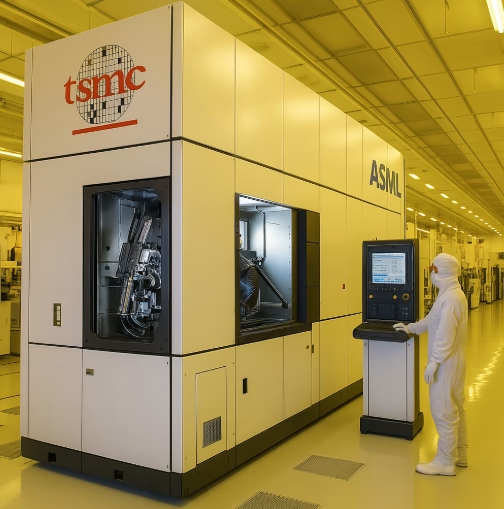
Let me tell you a tale of the little island that could—Taiwan—home to a company that doesn’t sell shoes, ships, or social media… but sells the future one microscopic chip at a time. TSMC is its name, and it’s become the beating silicon heart of the modern world. Every smartphone in your hand, every data center whispering AI dreams, and even your car that thinks it’s smarter than you—it’s all powered by TSMC’s handiwork.
Donald Trump—love him or loathe him—calls it the most important company on Earth. And for once, the man might not be exaggerating. Because if you unplug TSMC, you don’t just turn off Taiwan… you dim the lights on global progress. But here’s the kicker: the world’s most vital company is also standing on the world’s most dangerous fault line, both figuratively and geopolitically. That makes investing in it feel like buying a front-row seat to a symphony… with a slight chance of missile fire.
So yeah, I’m planning to buy some more. Not because it’s safe—but because it’s essential. The only real question is when. Before the tariffs? After the tanks? Or when sanity and silicon finally learn to share a border?
Now I ain’t no soothsayer, and I’ve long since retired my crystal ball—mostly because it was made in China and cracked. But I do know this: there are two kinds of companies in this world—those that follow trends, and those that build the roads the trends drive on. TSMC doesn’t just build the road, it pours the concrete, lays the fiber, and charges tolls to the likes of Apple, NVIDIA, and Amazon just for the privilege of driving.
Yes, it’s in a risky neighborhood. Yes, it’s first on the chopping block in any trade war or cross-strait crisis. But when the world runs on chips, and one company makes the smartest ones, you don’t ignore it—you just watch it closely and keep your powder dry. I’ll buy more—when the price dips, when the winds settle, or when the storm is priced in.
Because some companies are too big to fail. TSMC? It’s too important to ignore.
Below is an excerpt of the analysis I got from my favorite AI. It is actually much larger, I copies highlights here.
Comprehensive stock analysis of TSMC (Taiwan Semiconductor Manufacturing Company) with a 5-year investment perspective. I’ll include:
- Geopolitical risks, particularly regarding China-Taiwan relations
- TSMC’s competitive landscape (major rivals and potential disruptors)
- Production capabilities and future roadmap (e.g., nodes, foundry expansion)
- Major clients (Apple, NVIDIA, etc.) and industry reliance
- Valuation (PE ratio, historical comparison, forward guidance)
- Impact scenarios regarding tariffs or trade restrictions
TSMC 5-Year Investment Outlook
Geopolitical Risks
TSMC, based in Taiwan, faces significant geopolitical risks due to tensions with China. Any conflict or blockade could disrupt the global chip supply chain. While the U.S. and allies are investing in domestic production, replicating TSMC’s capabilities is difficult. TSMC is also diversifying its manufacturing footprint with new fabs in the U.S., Japan, and Europe to reduce its reliance on Taiwan.
Competitive Landscape
TSMC holds around 60% of the global foundry market. Main competitors include:
- Samsung Foundry: Competing in 3nm and 2nm technologies but struggles with yield.
- Intel Foundry Services: Reentering foundry space with significant investment but faces execution challenges.
- GlobalFoundries, UMC, SMIC: Compete in mature nodes; not a threat at the leading edge.
Some large clients like Apple and Amazon design their own chips but still rely on TSMC for manufacturing.
Production Capabilities and Roadmap
TSMC is currently producing 3nm chips and will begin 2nm chip production by 2025. It leads the industry in yield and reliability. Its future includes advancements in 2nm and beyond, as well as investments in advanced packaging (e.g., CoWoS) essential for AI chips.
Major Clients
TSMC’s top clients include:
- Apple: ~25% of revenue; exclusive fab partner for A and M series chips.
- NVIDIA: Rapidly growing client due to AI demand.
- AMD, Qualcomm, MediaTek: Consistent volume contributors.
This client base provides stable revenue, although Apple and NVIDIA represent a significant concentration risk.
Valuation
As of 2025, TSMC trades at:
- P/E Ratio: ~22x trailing
- Forward P/E: ~17–19x
This is reasonable compared to peers like NVIDIA (~24x forward) and Intel (~40x forward). Expected revenue growth is in the mid to high teens annually.
Revenue Stability: The broad range of end-markets served – smartphones, HPC/AI, PCs, auto, industrial – provides a natural hedge: if one segment slows, another may be rising. For instance, smartphone demand has matured, but high-performance computing (HPC) is now over half of TSMC’s revenue (51% in Q3 2024) driven by AI and data center chipsino.com. This shift reduces reliance on any single industry. That said, TSMC is becoming somewhat dual-dependent on Apple and Nvidia in the near term. Combined, these two might approach ~50% of revenue in a couple of years if Nvidia’s orders keep growinginvesting.com. Such concentration means TSMC must carefully manage these relationships and watch for any changes in their sourcing strategies. Investors should keep an eye on Apple’s silicon roadmap and Nvidia’s AI demand trajectory, as these will strongly influence TSMC’s 5-year financial performance. So far, the reliance has been a positive: TSMC’s record earnings in 2024 were fueled by Apple’s iPhone launch and Nvidia’s AI boomino.comino.com. The symbiotic link between TSMC and its top clients is a cornerstone of its stability – but it is a point of potential vulnerability if a top client encounters trouble or curtails orders.
Valuation and Growth Outlook
TSMC’s stock has delivered strong returns in recent years, and at current prices it trades at a valuation that reflects both its quality and the geopolitical risk discount. We examine TSMC’s key valuation metrics and compare them to other leading semiconductor companies:
| Company | Market Cap (Apr 2025) | P/E Ratio (TTM) | Forward P/E (2025E) | 5-Year Revenue Growth (est.) |
|---|---|---|---|---|
| TSMC (Taiwan) | ~$700–800Binvestor.tsmc.com | ~22×morningstar.com | ~17–19×tradingnews.com (FY25) | High-teens % CAGR (driven by AI & 2nm ramp)investing.com. |
| Intel (USA) | ~$120B | N/M (very high due to earnings slump)finance.yahoo.com | ~40×finance.yahoo.com (forward) | Low single-digit % (hoping to rebound in 2025–26). |
| Samsung Electronics (S. Korea) | ~$300B | ~10×companiesmarketcap.com | ~13×financecharts.com | Mid single-digit % (cyclical; dependent on memory upcycle). |
| NVIDIA (USA) | ~$600–800B (volatile) | ~55×macrotrends.net | ~24×fool.com | ~30%+ CAGR (AI-driven, from high base). |
| AMD (USA) | ~$150B | >90× (TTM outlier)gurufocus.com | ~20×gurufocus.com | ~20% CAGR (driven by data center & Xilinx). |
Tariffs and Trade Restrictions
TSMC is affected by U.S. export controls on advanced chips to China. While these reduce Chinese business, they also limit China’s tech development, preserving TSMC’s lead. U.S. tariffs or “Buy American” policies could impact Taiwanese-made chips, but TSMC’s Arizona fab is designed to mitigate this risk.
TSMC sits at the intersection of U.S.–China tech tensions, which creates several possible trade-related risks. Here we explore scenarios involving tariffs, export controls, and other trade restrictions – and their potential impact on TSMC:
-
U.S. Export Controls on China: The U.S. has increasingly restricted China’s access to advanced semiconductors, and TSMC has had to comply given its use of U.S.-origin technology. In 2020, for example, TSMC was barred from supplying Huawei (formerly a major customer ~14% of revenue) with any chips made using U.S. tools/IP, dealing a blow to TSMC’s China business. More recently, in 2022–2023 the U.S. imposed export controls that ban leading-edge chips (roughly <16 nm or chips above certain AI performance thresholds) from being sold to Chinese entities without a license. TSMC, therefore, cannot accept orders from Chinese chip designers for its 7 nm, 5 nm, 3 nm processes if those chips are destined for advanced uses. This has curtailed Chinese companies’ ability to use TSMC – e.g., Alibaba, HiSilicon, Biren and others have had to shelve some chip projects. In practice, China-based clients now contribute a much smaller portion of TSMC’s revenue (China was ~10% of sales in 2022, down from 20%+ when Huawei was active). While TSMC has largely filled the gap with other business (Apple, etc.), future U.S. restrictions could tighten further, potentially limiting even more technology levels. There is talk that older nodes (e.g. 28 nm) might be added to controls if they are used in military contexts, which could impact TSMC’s more mature business in China. The upside of these controls (from TSMC’s perspective) is that they hamper China’s domestic competitors: e.g., SMIC cannot buy EUV lithography machines, ensuring TSMC retains its tech leadbusinessinsider.combusinessinsider.com. Also, foreign competitors like Intel and Samsung are similarly restricted from selling top chips to China, so TSMC’s loss of certain Chinese customers doesn’t necessarily become someone else’s gain – it might just reduce overall demand. However, if geopolitical tensions worsen, TSMC could see a full cut-off of its China market for advanced chips. China accounts for roughly 10–15% of TSMC’s current revenue (mostly more mature chips for Chinese firms or multinational OEMs manufacturing in China), so in a worst-case decoupling scenario, TSMC might lose that chunk of business. It’s a manageable portion, but not trivial.
-
Chinese Counter-Measures: China has retaliated in the tech war by leveraging its grip on certain materials. In mid-2023, Beijing imposed export restrictions on critical minerals like gallium and germanium (used in chip production and optics)csis.orgz2data.com. This was largely symbolic – TSMC and others found alternative sources or had stockpiles – but it signaled China’s willingness to use its own export controls. More worryingly, China could restrict the export of advanced chip substrates or chemicals where it has a market share, which might raise TSMC’s input costs. So far, these measures have not significantly impacted TSMC, but they add complexity to the supply chain. Another potential move by China is to boycott or favor certain companies: for instance, China banned Micron’s memory chips in some infrastructure – conceivably, they could discourage Chinese firms from buying products that rely on TSMC chips (to indirectly hit TSMC). Yet given TSMC’s products are inside most cutting-edge electronics, such selective boycotts are hard to implement without hurting Chinese industries themselves. A more direct threat would be if Beijing placed sanctions on TSMC or its executives, but that is unlikely unless conflict erupts. In summary, China’s near-term trade actions may cause incremental headwinds (higher costs, slightly lower Chinese sales) but are unlikely to severely damage TSMC’s core business absent a dramatic escalation.
-
Tariffs on Taiwanese Chips: One scenario raised in U.S. political discourse is imposing tariffs on semiconductors made in Taiwan. Notably, former President Trump recently floated the idea of up to 100% tariffs on chips from Taiwan to pressure TSMC to move production statesideitif.org. If such a policy were enacted, it would massively increase costs for U.S. companies that rely on TSMC – effectively a tax doubling the price of chips that go into iPhones, PCs, cars, data centers, etc. Studies show this would be highly counterproductive: a tariff of that magnitude could raise U.S. chip prices ~50–60% and significantly inflate consumer prices for electronicsitif.org. It could also backfire strategically – unless applied universally, it might make Chinese-made chips cheaper than Taiwanese chips in the U.S., inadvertently helping Chinese suppliersitif.org. In addition, TSMC (and other Taiwanese firms) might simply route production through third countries or focus on non-U.S. markets rather than relocate fabs immediatelyitif.orgitif.org. The consensus among industry experts is that such aggressive tariffs would “backfire” and hurt the U.S. more than helpitif.orgitif.org. Therefore, while campaign rhetoric may mention tariffs, the likelihood of a blanket 100% chip tariff being actually implemented is low (it would face resistance from U.S. tech companies and consumers). More moderate tariffs or incentives are possible – for example, an import tax combined with a subsidy could be used to even the playing field for U.S.-made chips. If any tariff is imposed, TSMC’s strategy would likely be to speed up production at its Arizona fab (which would be exempt as “Made in USA”) to serve the U.S. market, while supplying other markets from Taiwan. This scenario is one to watch in 2025–2026 with the U.S. elections and policy shifts, but it’s a manageable rather than lethal risk for TSMC, assuming it maintains some overseas capacity.
-
Restrictions on TSMC’s Investments: Another facet of trade tensions is the restriction on where TSMC can invest. As a recipient of U.S. CHIPS Act funds for its Arizona fab, TSMC is subject to “guardrail” rules that forbid it from significantly expanding advanced fab capacity in China for a decadegrowthstudio.crowell.comcsis.org. TSMC has already indicated it will limit its China operations to 28 nm and older technologies in compliance. This means TSMC’s growth in China is capped – effectively a minor drag, as its focus is on leading-edge anyway. Conversely, it nudges TSMC to invest more in the U.S. and allied countries. We might also see U.S. export controls on equipment extended: for instance, if there were any concern about TSMC’s Taiwan fabs being overrun by China, the U.S. could conceivably restrict shipment of chipmaking tools or updates to TSMC – but this is a drastic step that would only be on the table in extreme scenarios (as it would undermine TSMC’s production and thus U.S. companies too). On the European front, if EU–China relations sour, Europe could impose its own export controls or require “European soil” manufacturing for certain chips (benefiting TSMC’s future German fab).
In all these scenarios, the theme is fragmentation of the semiconductor supply chain. TSMC, as the central node, has to adapt to a more segmented world. The company is already adjusting by geographically distributing some capacity and by working closely with governments (for example, TSMC’s Arizona fab was prompted in part by U.S. government and major customers’ urging). For investors, the key takeaway is that trade restrictions could raise operational costs (duplicating supply chains, compliance overhead) and constrain certain markets, but they are unlikely to stop TSMC’s growth outright. The worst-case trade scenario – a full decoupling where East and West have completely separate tech ecosystems – would require TSMC to choose a side (almost certainly aligning with the U.S. and allies). In that extreme case, TSMC might lose the China market entirely but would become even more vital to the U.S./Europe supply chain (potentially with government support to compensate). Short of that, we expect a continued “tightrope” walk: TSMC navigating export rules, investing in multiple regions, and lobbying against harmful tariffs, while supplying as many customers as allowed. This agility in strategy will be important to watch as part of the investment risk profile.
Conclusion
TSMC stands at the pinnacle of the semiconductor industry with a technological and market position that few, if any, companies can match. Its dominance in cutting-edge chip manufacturing – from 3 nm today to 2 nm and beyond in coming years – positions it at the heart of virtually every major tech trend, be it AI, 5G, autonomous vehicles, or high-performance computing. Over the next five years, TSMC is poised to capitalize on these trends through its unmatched process technology roadmap and deep relationships with top-tier customers like Apple, Nvidia, AMD, and Qualcomm. The growth prospects (high teens to 20% annual earnings growth expected) are underpinned by secular demand and TSMC’s ability to command premium pricing for its leading nodes.
However, investors must carefully weigh the risks. The geopolitical shadow of China–Taiwan tensions is an ever-present risk factor – a low-probability but high-impact event that would be devastating to TSMC’s operations. Short of an actual conflict, trade and political frictions could introduce volatility, whether through export bans, client diversification, or protectionist tariffs. TSMC is responding proactively by diversifying production locations and working closely with governments, but this will be an area requiring ongoing vigilance. The competitive landscape, too, is evolving: Samsung is determined to improve its foundry footing, Intel is reinvigorated by government support to become a contract manufacturer, and even customers like Apple are exploring second-source options. TSMC will need to execute on 2 nm and 1 nm transitions flawlessly to fend off these challenges and maintain its edge.
From a stock perspective, TSMC offers a compelling long-term investment case for those willing to accept the risk. Its valuation is reasonable relative to peers, its financial performance is best-in-class (40%+ margins, >30% ROE)ino.comino.com, and it plays an indispensable role in the digital economy. In a 5-year timeframe, an investor in TSMC is essentially betting that the world will continue to demand ever more advanced chips – and that TSMC will remain the principal company supplying that demand. The risks – geopolitical, competitive, and macroeconomic – are real, but TSMC’s strategic importance acts as a buffer (governments and customers have strong incentives to support and not hinder TSMC). For a risk-tolerant investor, TSMC represents an opportunity to own a cornerstone of the tech industry’s future growth. As with any investment, one should stay informed and monitor developments (political changes, tech breakthroughs at competitors, major shifts in customer strategies) that could alter the thesis. But as of now, TSMC’s combination of technological leadership, robust financials, and strategic initiatives makes it a formidable player positioned to navigate challenges while delivering value over the coming years.
TWO TIGERS ONE MOUNTAIN

In China, a man learns to bow before he learns to walk. In the West, he learns to speak his mind before he learns to think. One lives by the harmony of the group, the other by the anthem of the self. And both think the other is missing the point.
But here’s the kicker: a society built on shame stays quiet, a society built on guilt talks too loud. Somewhere in between lies a truth both sides ignore—the measure of a life ain’t how much you fit in or stand out, but how well you sleep at night knowing which you did, and why.
China can be considered a Confucian society, both historically and in many aspects of its contemporary culture and governance. It defines who they are. While Confucianism isn’t a religion in the Western sense (it has no god, no church, no afterlife doctrine), it functions in China much like Christianity does in the West in terms of shaping.
🏛️ Historical Foundations
Confucianism, founded by Confucius (551–479 BCE), has profoundly influenced Chinese civilization for over two millennia. It emphasizes moral virtue, social harmony, hierarchical relationships, and filial piety. These principles shaped China’s imperial bureaucracy, education system, and family structures. For instance, Confucianism established strict social classes and discouraged upward mobility to maintain harmony.
🔄 Modern Revival
After periods of suppression, notably during the Cultural Revolution (1966–1976), Confucianism has experienced a resurgence in modern Chin. The government has re-embraced Confucian values to promote social stability and national identity. President Xi Jinping has invoked Confucian ideals to reinforce moral governance and counter Western influences.
🧬 Contemporary Influence
Confucian principles continue to permeate Chinese society:
- *Education: Respect for teachers and emphasis on rote learning reflect Confucian traditions.
- *Family Structure: Filial piety remains a cornerstone, influencing family dynamics and elder care.
- *Governance: The Social Credit System incorporates Confucian ideas of moral behavior and social harmony
🧭 Moral Compass
-
Confucianism teaches values like respect, duty, loyalty, and filial piety.
-
Christianity teaches values like love, forgiveness, humility, and charity.
Both systems guide what is “right” behavior, even for people who aren’t particularly devout.
🏛️ Cultural and Social Norms
-
Confucianism shaped how Chinese people relate to authority, family, and society.
-
Christianity shaped Western concepts of individual rights, law, and even time (think: B.C./A.D.).
In both cases, the cultural air people breathe is filled with these ideas — often without realizing it.
🙏 Belief Without Formal Worship
-
Many Chinese may say they’re not “religious” but still follow Confucian ideals in life.
-
Similarly, many Westerners may say they’re “not religious,” but still hold Christian moral assumptions (e.g., the idea that all humans have dignity, or that humility is virtuous).
🔧 Confucianism vs. Communism in China
Confucianism builds a moral compass rooted in duty, family, and harmony, while Communism replaced it (or tried to) with a loyalty to class, the Party, and revolution.
Let’s break it down clearly:
| Theme | Confucianism | Communist Ideology |
|---|---|---|
| Core Loyalty | Family, hierarchy, social harmony | Party, revolution, class struggle |
| View of the Individual | One part of a greater moral system | One part of a collective class |
| Moral Authority | Virtuous leaders, elders, tradition | Party leadership, ideology, historical materialism |
| Purpose of Education | Cultivate virtue and respect | Shape revolutionary consciousness |
| Social Structure | Stable, hierarchical, ordered | Classless, egalitarian (in theory) |
| Change | Gradual, respectful, rooted in past | Radical, disruptive, often violent |
| Religion/Philosophy | Reverence for ancestors, rituals, harmony | Often atheistic, anti-religion, anti-tradition |
🔥 The Communist Suppression of Confucian Values
-
Mao Zedong’s Cultural Revolution (1966–1976) sought to destroy the “Four Olds”: old customs, old culture, old habits, and old ideas — which included Confucianism.
-
Red Guards attacked temples, burned ancestral tablets, and shamed traditional scholars.
-
Confucianism was branded as feudal, elitist, and reactionary.
💥 The Aftermath: Moral Vacuum?
With Confucianism suppressed and Communism struggling to offer spiritual grounding, China experienced:
-
Moral disorientation: With neither tradition nor religion to guide daily ethics, money and power became de facto value systems.
-
Family breakdown in some cases — as loyalty to the state overtook loyalty to elders or parents.
-
Rise of corruption: As the party system became the sole authority, checks based on shame, virtue, or personal morality weakened.
🔁 But Now, a Return?
In recent decades, China’s government has re-embraced Confucianism — not out of spirituality, but because it’s useful for:
-
Promoting social stability
-
Justifying strong leadership
-
Reinforcing national identity
Xi Jinping quotes Confucius almost like Western leaders quote the Bible — to restore a moral narrative in a society that’s gotten very materialistic.
🌐 Global Perspective
China’s promotion of Confucianism extends internationally through Confucius Institutes, aiming to enhance cultural diplomacy and soft power.
In summary, while modern China integrates various philosophies and systems, Confucianism remains a foundational element, influencing its societal values, governance, and international outreach. While modern China integrates various philosophies and systems, Confucianism remains a foundational element, influencing its societal values, governance, and international outreach.
The difference between a Confucian society like China and Western societies (such as the U.S. or Europe) boils down to fundamental views on authority, individualism, and social harmony. Here’s a clear breakdown:
🇨🇳 Confucian Society (China)
1. Collectivism over Individualism
-
The group (family, society, nation) is more important than the individual.
-
People are expected to conform to norms and serve the collective good.
2. Hierarchy and Order
-
Social harmony comes from knowing your place in a hierarchy—whether in family, school, or government.
-
Respect for elders and authority figures is paramount.
3. Moral Governance
-
Leaders are expected to be virtuous and set a moral example (the “gentleman” or junzi ideal).
-
There’s less emphasis on checks and balances—order is more important than dissent.
4. Education as Moral Development
-
Education is not just for skills or critical thinking—it’s to become a moral, responsible person.
-
Heavy focus on memorization and passing exams to maintain social order.
5. Shame-based Culture
-
Behavior is regulated by fear of shame—losing face or dishonoring one’s family or group.
🇺🇸 Western Society (e.g., U.S., Europe)
1. Individualism over Collectivism
-
Personal freedom, self-expression, and independence are central.
-
Success is often measured by personal achievement.
2. Egalitarianism and Questioning Authority
-
Ideally, all people are equal, and authority can and should be questioned.
-
Power is meant to be limited by law and democracy.
3. Legal and Institutional Trust
-
Rule of law is more important than moral character of leaders.
-
Systems (like courts, elections) are meant to protect from bad rulers.
4. Education for Critical Thinking
-
Schools aim to develop independent thought and creativity, not just obedience.
-
Debate and questioning are encouraged.
5. Guilt-based Culture
-
Behavior is regulated by internal guilt—what you feel is right or wrong, not just what others think.
xxx
| Category | Confucian Society (China) | Western Society (U.S., Europe) | Communist Society (e.g., Maoist China) |
|---|---|---|---|
| View of the Individual | Collectivism — the group is more important than the individual | Individualism — personal freedom and self-expression valued | Class identity — individual defined by role in class struggle and loyalty to the collective |
| Social Structure | Hierarchical — respect for elders, authority, and social roles | Egalitarian — all people ideally treated as equals | Class-based — hierarchy based on revolutionary status, party membership, or worker/peasant identity |
| Governance | Moral leadership — leaders should be virtuous and set an example | Legal/institutional trust — laws limit power, systems matter more than virtue | Party rule — central authority enforces ideology; dissent suppressed |
| Education | Moral development and obedience; focus on memorization | Critical thinking and creativity encouraged; debate welcomed | Political indoctrination — education used to shape ideological loyalty to the Party |
| Cultural Norms | Shame-based — behavior shaped by social expectations | Guilt-based — behavior guided by internal moral compass | Fear-based — behavior shaped by political loyalty and fear of punishment |
| Primary Social Regulator | Shame — fear of dishonoring the group or family | Guilt — self-assessment of right and wrong | Surveillance and fear — fear of denunciation, betrayal, or purging |
We have a Multi-sided China. An Ancient China, A Chaotic Communist China and a more modern China all fighting for control. So it isn’t just China against the West, but also China against itself.
The phrase “Two Tigers, One Mountain” (Chinese: 一山不容二虎, yī shān bù róng èr hǔ) is a Chinese proverb that means:
“One mountain cannot contain two tigers.”
🐅 Meaning
It refers to two powerful figures or rivals who cannot coexist peacefully in the same domain. Just as two apex predators cannot share the same hunting ground, two dominant individuals or nations are bound to clash if forced into the same space.
📜 Historical Origins
This proverb is deeply embedded in Chinese culture and has been used for centuries. While its precise literary origin is unclear, the metaphor draws on ancient observations of tiger behavior in nature and has appeared in various Chinese texts and dramas.
- Tigers in Chinese symbolism represent power, strength, and dominance.
- In military and political contexts, it has been used to describe power struggles between warlords, emperors, or generals.
- It’s a reminder of the inevitability of conflict when strong egos or powers refuse to yield.
⚔️ Modern Usage
1. Geopolitics
- The phrase is often applied to China and the United States, with both seen as “tigers” vying for global influence.
- It’s also used to describe Japan vs. China, Russia vs. the West, or tech companies like Google vs. Apple—any case where two major powers cannot easily share the same strategic space.
2. Business or Leadership
- Two CEOs or dominant managers in the same company.
- Rival founders or competing visionary leaders in startups.
3. Pop Culture
- Referenced in books, films, and media commentary—especially around conflict or rivalry.
- It was also the title of a documentary: “Two Tigers, One Mountain”, exploring China-Japan relations and the lingering tension from historical grievances.
🐾 “You put two kings in one kingdom, you don’t get a democracy—you get a civil war. That’s the nature of power—it’s territorial. Whether it’s tigers, titans, or tired old men in boardrooms, the truth holds: one throne, one crown, one mountain. The rest? Just a brawl with scenery.”
Keep Reading next:
For more info on China visit the Website :

EXTRA CREDIT
MORE POST ON CHINA
The Rise of the CCP and the Founding of the People's Republic of China

Since we are almost at a trade war with China, let us understand our adversary,
At the dawn of the 20th century, China was fractured and vulnerable. The collapse of the Qing Dynasty in 1911 ended over two millennia of imperial rule and unleashed a storm of instability. With no strong central authority, warlords carved up the nation, and rival political movements vied to reunify it.
Among them were the Nationalist Party (Kuomintang, or KMT), led by Sun Yat-sen and later Chiang Kai-shek, and the Chinese Communist Party (CCP), founded in 1921. Initially uneasy allies against the warlords, their alliance crumbled in 1927 when Chiang Kai-shek launched a bloody purge of communists in Shanghai and other cities. This White Terror killed tens of thousands and ignited the Chinese Civil War.
The Communists retreated and regrouped. In 1934, facing annihilation, they undertook the epic Long March—a 9,000 km retreat through China’s harsh interior. Of the 70,000 who began, fewer than 10,000 survived. Yet this brutal ordeal elevated Mao Zedong to leadership and became a cornerstone of Communist mythology.
But then came an even greater disaster: Japan’s invasion of China in 1937. The Second Sino-Japanese War plunged the nation into deeper chaos. An estimated 15 to 20 million Chinese civilians and soldiers died, making it one of the deadliest conflicts in human history. The CCP used the war to expand its base in rural areas, earning credibility for its guerrilla resistance and populist land reforms, while the Nationalists, despite American aid, struggled with corruption and internal dissent.
When Japan surrendered in 1945, the civil war resumed. The KMT still had more troops, modern weapons, control of major cities, and international backing—particularly from the United States. But they were hollowed out by years of misrule, inflation, and public resentment.
The Communists, now well-organized and ideologically united, launched a series of strategic offensives, winning over the countryside, capturing city after city, and eroding KMT morale. By 1949, the Nationalist regime was collapsing.
On October 1st, 1949, Mao Zedong stood in Tiananmen Square and declared the birth of the People’s Republic of China. Chiang Kai-shek and roughly 2 million of his followers fled to Taiwan, where they established a rival government.
The Human Cost
The full cost of the Communist rise to power is staggering:
-
Chinese Civil War (1927–1949): Estimated 1.5 to 3 million deaths
-
Second Sino-Japanese War (1937–1945): Estimated 15 to 20 million deaths
-
Political purges, famine, and chaos during the war years: Additional millions displaced, starved, or imprisoned
All told, over 20 million lives were lost during the struggle that led to the Communist Party’s takeover of China. The human suffering was immense—rural villages devastated, families torn apart, and an entire generation marked by war.
And that, friend, is how a ragtag band of revolutionaries went from hunted to rulers—not with tanks, not with planes, but with grit, patience, and a vision that outlived the bullets. It wasn’t clean, it wasn’t fair, and it sure as hell wasn’t free. But it happened.
The lesson? Don’t bet the farm on firepower or flags. History, more often than not, listens to the quiet footsteps in the fields—those who plant ideas in hungry soil and wait for the storm to pass. Because when the dust finally settles, it ain’t always the loudest man in the room who’s left standing. Sometimes it’s the one who never stopped walking.
Want to learn more watch this video
From China with LOVE!

CHINA LIES! – Everyone lies, but they lie more.
There was a time when we thought we were playing a game of Monopoly with China—just some friendly trade, a few factories here, a few container ships there. Turns out, we were playing chess… and we were the pawns. While we were busy debating free markets and political correctness, China was buying the board, the pieces, and the bank.
They say keep your enemies close. Hell, we gave ours manufacturing contracts, university admissions, airport ownership, and access to our power grids Heck you even do us the favor of buying our debt. And now we’re sitting here wondering how the lights went out.
Here’s the sad irony: we thought we were outsourcing for convenience, but we were actually exporting our sovereignty. In the name of open markets and open minds, we opened the door so wide the fox walked right into the henhouse—and we’re still clucking about fairness while feathers fly. They built the virus with our money, and sold us the masks.
They say truth is the first casualty of war. Well, in this case, truth didn’t just die—it was buried under press releases, classified memos, and a pile of bat guano. Welcome to the global blame game, where the stakes are trillions of dollars, millions of lives, and the very idea of trust itself.
One side says “lab leak,” the other says “witch hunt,” and the rest of the world just wants to stop coughing and pay their rent. If it turns out COVID really did slip out of a lab like a thief in the night, then what we’re looking’ at ain’t just a pandemic—it’s a cover-up wrapped in a tragedy stuffed into a diplomatic time bomb. And if we never find out? Well, that might be the biggest tragedy of all.
It ain’t racist to lock your doors at night. It’s just common sense. And if the West wants to survive this new Cold War, it better stop pretending it’s still summer. As for the rest of us caught between tariffs and theories, lies and lockdowns—don’t blink. History’s writing itself in real time, and it sure as hell ain’t using a pencil.
History never tells the truth fully, it tells the story from the eyes of the winners. Let’s us remember this history before it is destroyed.
READ more the White House report and more here.
🇨🇳 CHINA UPDATE: SUMMARY
🦠 1. White House Declares: COVID-19 Lab Leak “Most Likely”
Key Points:
- The Trump administration has updated federal pandemic information sites with a new page titled “Lab Leak: The True Origins of COVID-19.”
- It declares a lab-related incident in China involving gain-of-function research as the most likely origin of COVID-19.
- This goes beyond previous cautious assessments from the CIA, shifting the official narrative more forcefully toward blaming China.
- The site includes satellite images of Wuhan and photos of Trump, criticizing both China’s biosafety protocols and global bodies like the WHO.
- The FBI and Department of Energy support the lab leak theory, while five other U.S. intelligence agencies lean toward a natural origin (e.g. raccoon dogs in Wuhan’s illegal market).
- Critics warn that replacing public health resources with politically charged messaging could undermine scientific integrity.
- Others argue that expecting China to cooperate in uncovering the origins is “like asking a killer to prove their own murder.”
Quote from China analyst Bill Bishop: “If the Trump administration pushes hard on lab leak as the origin, U.S.-China relations will get even worse.”
💰 2. U.S.-China Trade War Intensifies: “Choosing Sides Has Consequences”
Key Developments:
- The U.S. is applying tariffs of up to 245% on Chinese goods.
- It is urging allies like Japan and the EU to reduce imports from China and join a unified front against Chinese trade practices.
- China responds with forceful diplomatic language, warning of retaliation if countries side with the U.S.
Notable Quotes from China’s Ministry of Commerce:
- “Seeking exemptions at the expense of others’ interests is like asking a tiger for its skin.”
- “Negotiating with a tiger will only lead to being devoured.”
China’s Countermoves:
- Bolstering domestic economy through infrastructure investment and subsidies, funded by $178 billion in ultra-long treasury bonds.
- Maintaining interest rates to stabilize the yuan, though analysts expect future moves like lowering reserve requirements.
- Strengthening diplomatic outreach, especially in Southeast Asia and Europe, under its dual circulation strategy (build internal resilience, maintain supply chain dominance).
⚖️ Final Thoughts:
- The lab leak accusation signals a turning point in official U.S. positioning and may cement international blame on China.
- The trade war escalation reflects a cold war-style division where economic alignment now comes with political risk.
- Beijing’s message is crystal clear: if you align with the U.S. at China’s expense, expect consequences.
🇨🇳 The China Dilemma: Summary of Arguments and Concerns
🔒 1. China is Not a Liberal Democracy
- The Chinese Communist Party (CCP) is no longer Marxist in practice—it’s a centrally controlled capitalist autocracy.
- Billionaires “go missing,” dissent is crushed, and surveillance is omnipresent.
- The CCP’s influence extends far beyond its borders, often using Chinese nationals and students abroad for industrial espionage or pressure campaigns.
🏗️ 2. The West Helped Make China Rich
- Western nations, especially the U.S. and U.K., have outsourced manufacturing to China, trading short-term profits for long-term dependency.
- Chinese manufacturing dominance now includes critical infrastructure, skilled labor, and rare-earth supply chains.
- Leaders like Apple’s Tim Cook openly state that China is where the skills are—not just cheap labor.
🧠 3. Intellectual Property & Espionage
- China is accused of systematic theft of intellectual property, often using students, researchers, and even corporate espionage.
- Many American prosecutions have involved technology theft and research exfiltration by Chinese nationals.
🌍 4. Global Reach and CCP Influence
- China is allegedly operating “foreign police stations” abroad to monitor and intimidate diaspora communities.
- CCP influence operations are active in politics, universities, and even London pubs—echoing Cold War tactics.
- Taiwan remains a flashpoint: security compromised by Chinese infiltration, and China’s intent to reclaim it remains firm.
🏛️ 5. Infrastructure and National Security
- The U.K. has allowed Chinese companies to buy stakes in critical infrastructure:
- Heathrow Airport
- Thames Water
- Power grids
- Nuclear plants like Hinkley Point C
- Critics argue this poses grave national security risks—comparing it to giving the keys to the kingdom away.
⚠️ 6. Open Market Ideals vs. Hostile State Actors
- China enjoys access to free markets while not being a free market itself.
- Western governments continue to treat Chinese investment as if it came from a neutral actor—despite evidence to the contrary.
🧨 Suggested Remedies
- Fiat legislation, not just tariffs: require certain industries to be re-shored and domestically manufactured.
- End naive free-market and anti-racist blind spots that ignore geopolitical and ideological threats.
- Restrict CCP-affiliated actors from buying national infrastructure or using educational institutions as back doors.
🧭 China is not our friend right now. Perhaps it never will be. Remind again how many people die from the Covid-19. Everyone of these people had a mother, a father, a son, a daughter, a husband, a wife… You get image, let us not forget so easily.
As of the most recent global data (early 2025), approximately:
🧮 Total Reported Global Deaths from COVID-19:
~7 million people
📊 Additional Context:
- World Health Organization (WHO) acknowledges that the true number may be significantly higher, due to underreporting—especially in low-resource regions or where governments may have restricted data.
- Excess mortality estimates (which look at deaths above expected levels) suggest the actual toll could be:
- 12–15 million deaths globally, according to WHO and independent studies.
🇺🇸 United States:
- Over 1.1 million confirmed deaths, making it one of the countries with the highest official death toll.
🇨🇳 COVID-19 Deaths in China:
📊 Official Death Toll (as of early 2025):
-
~120,000–130,000 deaths (as reported by Chinese authorities to the World Health Organization)
⚠️ However, Independent Estimates Suggest:
-
1 to 2 million deaths, possibly more
Especially during the late 2022–early 2023 wave, when China abruptly ended its “Zero-COVID” policy, and hospitals were overwhelmed.
🧩 Why the Big Gap?
-
Underreporting: China’s definition of a COVID death was narrow (e.g., dying from pneumonia caused by COVID, not with COVID).
-
Data suppression: Local health officials were discouraged from publicly disclosing full numbers.
-
Lack of transparency: There were no independent audits or international observers during the largest surges.
📰 Supporting Evidence:
-
Satellite imagery showed overwhelmed funeral homes in late 2022.
-
Anecdotal reports from inside China (e.g., leaked health memos) indicated much higher mortality during the post-lockdown surge.
-
Some international estimates (e.g., from the British health data firm Airfinity) put the death toll for Dec 2022–Feb 2023 alone at 1.3–1.8 million deaths.
🇮🇳 India:
- Officially around 530,000, though excess death estimates put the toll at 3 to 4 million.
🇧🇷 Brazil: Over 700,000 deaths
🌍 Top Contributors to High Death Toll:
- Lack of early testing & treatment
- Delayed or limited vaccine rollout
- Comorbidities in aging populations
- Government response variability
MAD

I’ve known a thing or two about bad breakups. And when it comes to world affairs, there ain’t a messier divorce on this green Earth than the one simmering between the United States and China. They used to toast each other with trade deals and cheap electronics — now they glare across the Pacific like two gamblers who just caught each other cheating at the same poker table. One’s holding a trillion dollars in debt, the other’s got the keys to the chip factory, and both are armed to the teeth with missiles and malware. Folks, this ain’t diplomacy — it’s a high-stakes custody battle over the future of the planet. And the kid caught in the middle is us.
So here we are — two giants, both too proud to back down, too tied together to walk away clean. It’s the kind of story where everybody’s right, everybody’s wrong, and if we’re not careful, we’ll all end up sharing a grave labeled “mutual assured destruction.” But maybe — just maybe — if enough regular folks keep asking the right questions, and the big shots stop playing empire with live ammunition, we might just swap this slow-motion train wreck for something better. ‘Til then, keep your head down, your mind sharp, as we get closer to the point of no return. .
Mutual Assured Destruction (MAD) — the terrifyingly polite way of saying, “If you kill me, I’ll kill you too — so let’s both pretend we’re civilized.”
Originally coined during the Cold War between the U.S. and the Soviet Union, MAD was built on the idea that no one would start a nuclear war if both sides knew they’d end up glowing together. It worked — barely — through Cuban missile crises, spy games, and decades of nuclear poker.
Now, we’re seeing a modern remix of MAD between the U.S. and China — but it’s more economic, technological, and cyber than purely nuclear (though nukes are still on the table, in the back of the drawer, with the keys half turned).
Here’s how Modern MAD looks today:
1. Economic MAD
- China holds over $800 billion in U.S. debt. Sell it all at once? Global market meltdown.
- U.S. buys hundreds of billions in Chinese exports. Cut that off? Supply chain chaos, inflation, global slowdown.
- If either side goes for the jugular, it bleeds out with them.
2. Tech MAD
- Semiconductors: The U.S. cuts off China’s chip access. China counters by threatening rare earth minerals and building its own tech stack.
- TikTok vs iPhones: Digital Cold War — data surveillance, app bans, 5G wars.
- Kill one side’s tech? You cripple your own ecosystem.
3. Cyber MAD
- Both sides have elite cyber armies. Shut down each other’s satellites, banks, water systems, or power grids? Nobody wins. But everybody can lose.
4. Military MAD
- The nukes haven’t gone anywhere.
- Taiwan is the flashpoint. Any misstep could trigger a war neither side actually wants — because they know escalation means annihilation, not victory.
5. Ideological MAD
- Democracy vs Authoritarianism.
- Each side thinks the other is the villain in a global morality play. The danger? When you believe you’re the good guy, you’re more willing to push the button.
Bottom Line:
It’s no longer just about missiles in silos. It’s markets, chips, apps, ports, and minds. The weapons of Mutual Assured Destruction today are spreadsheets and servers — with nukes as the fine print.
Personal MAD is just like Global MAD
I once knew a couple that seemed happily married.
They smiled at parties, shared vacation photos, and hosted barbecues like love was something you could grill and serve medium-rare. But as with most glossy things, the cracks were just beneath the surface.
Turns out, he was sleeping with the nanny.
She found out, and suddenly the shared life turned into a war zone. They fought over the house, the dog, and the boat. She got the house, kids and the dog. He ended up with the duplex — and clinging to a sailboat she had gifted him years ago. She claimed it was hers. He said it was his. They both lawyered up like it was the trial of the century.
Now, here’s where it gets poetic.
She figured out something no therapist ever told her: chainsaws and fiberglass don’t mix.
She didn’t sink the boat — she shredded its soul. I never saw it with my own eyes, but folks who did said it looked like sadness afloat.
Then the real tragedy: He killed the dog.
I don’t remember all the details — maybe no one really does. All I know is they both got arrested. Rage had turned into recklessness. And the only thing more broken than the marriage was everything they fought to keep.No one won.
They let pride blind them to the only way out: humility.
Going back to China and US, if you squint hard enough, this ain’t just a breakup story.
It’s a preview of the world’s nastiest geopolitical divorce: the United States and China.
You see, there’s something deep in the Chinese psyche called the Century of Humiliation — a wound that still bleeds beneath the skin. It’s not just history; it’s identity. A national trauma they vowed never to repeat. They carry that chip on their shoulder like it was forged from every treaty, invasion, and insult they endured.
And America? Well, Trump came along like a jilted spouse with a megaphone, blaming China for everything from lost jobs to lab leaks. Whether he’s right or wrong misses the point. Neither side is in the mood to give in. They both want to win. And just like that couple — they’re arguing over the house (Taiwan), the dog (global influence), and the damn sailboat (economic dominance).
But pride, unchecked, has a nasty habit of turning partners into enemies.
Let’s just hope the chainsaws stay in the garage.
I don’t want to live in a MADMAX movie.
Treasury Secretary Bessent Just Revealed The USA's Grand Masterplan.

A bold new blueprint to reset the global game — and put America back at the head of the table
When most folks tell you what they’re thinking or what they’re fixing to do, it’s usually wise to take them at their word. They may not always reach the mountaintop they point toward, and they may stumble through a few valleys along the way, but what they say reveals where they believe they’re headed — their goal, their dream, their manifest destiny.
Today, we find ourselves standing at the crossroads of just such a declaration. Treasury Secretary Bessent has laid out the United States’ grand masterplan for the world to see. It’s a vision as bold as a thunderstorm and just as likely to rattle a few windows. So let’s take a good, hard look at this modern Manifest Destiny — not the kind that claims new lands, but the kind that seeks to reclaim balance, leadership, and a fair shake for America and her trading partners alike.
Now, plans, like promises and pie crusts, are easy to make and easier still to break. Whether Secretary Bessent’s blueprint becomes the sturdy bridge to a new era or just another fine speech gathering dust in the halls of history will depend not just on America’s grit, but on the world’s willingness to meet her halfway.
Still, in a time when many leaders speak in riddles and act in riddles still darker, it’s no small thing to hear someone call their shot plain and clear.
If nothing else, Bessent’s words remind us that the spirit of bold ambition — that old stubborn American faith in building something better — isn’t dead yet. It just has a new set of marching orders.
In the final months of World War II, Western leaders created the IMF and World Bank at Bretton Woods to promote global financial stability and cooperation. Today, these institutions have drifted from their original missions and suffer from “mission creep,” focusing too much on issues like climate change and social justice, and too little on core financial and monetary stability.
The speaker (likely a senior Trump Administration official, maybe Treasury Secretary Steven Mnuchin or a senior Treasury advisor) calls for reforming the IMF and World Bank, reconnecting them to their founding missions of stability, balance of payments support, and fostering global economic growth.
- America First is not isolationism but a demand for fairer, rebalanced global trade and a restoration of accountability in international institutions.
- Trade imbalances, especially with China, have hollowed out U.S. manufacturing and supply chains, risking national and economic security.
- Other issues like excess global savings, artificially depressed wages, and overreliance on U.S. demand also destabilize the global economy.
- Europe has made some progress by increasing defense spending and stimulating demand.
- The IMF must return to promoting monetary cooperation and financial stability, not side missions like climate change.
- The World Bank must focus on poverty reduction, economic growth, energy access, and graduating wealthier countries (especially China) out of its programs.
- Both institutions must set clearer priorities, hold countries accountable for reforms, and be tougher on poor policy practices like unsustainable debt and unfair trade.
- America will lead in pushing for these reforms but seeks to work with allies.
The speech ends with a call for allies to join the U.S. in refocusing and rebuilding a sustainable international financial system.
Expanded Points
1. Historical Context: Bretton Woods Creation
- After the chaos of the Great Depression and WWII, Bretton Woods created structures (IMF, World Bank) to avoid future wars driven by economic collapse.
- The aim: global economic coordination, stability, growth, and recovery.
2. Current Problems: Institutional “Mission Creep”
- IMF and World Bank are distracted by fashionable social causes (climate, gender, social issues) at the cost of their original financial missions.
- They must refocus on:
- Balance of payments stability
- Macroeconomic reform
- Facilitating sustainable growth and trade
- Debt sustainability
3. America First = International Leadership, Not Isolation
- America First seeks fairer trade, stronger U.S. leadership in global institutions, and deeper but fairer partnerships.
- It means pushing for reforms that make international systems fairer to U.S. interests, without abandoning allies or the world stage.
4. Trade and Global Imbalances
- U.S. has suffered from decades of unfair trade practices.
- Many trading partners, especially China, maintain:
- Export-driven economies
- Artificially depressed wages
- Unfair subsidies
- Currency manipulation
- This creates persistent U.S. deficits and weakens global financial stability.
- The Trump administration’s tariffs were aimed at forcing a rebalancing.
5. Specific Reforms for IMF
- Focus on core tasks:
- International monetary cooperation
- Exchange rate stability
- Crisis lending for balance of payment problems
- Be a brutal truth-teller, not a status quo protector.
- Call out surplus countries like China for distortive practices.
- Hold countries accountable for reforms; refuse bailouts for uncooperative states.
- IMF should stop wasting energy on climate or social engineering.
6. Specific Reforms for World Bank
- Focus again on:
- Reducing poverty
- Promoting private sector job creation
- Supporting economic development through infrastructure and energy
- Energy access must be prioritized (gas, fossil fuels, nuclear, renewables – all of the above, tech-neutral).
- Enforce graduation policy: graduate wealthier countries like China and redirect resources to the poorest.
- Implement best value procurement policies to prevent corruption, not just accept the lowest bid.
7. Special Cases: China and Ukraine
- China should no longer receive World Bank loans.
- No World Bank money should go to companies involved in Russia’s war efforts when rebuilding Ukraine.
Key Takeaways
- Refocus IMF and World Bank on core missions.
- Hold countries accountable for reforms, especially China.
- Rebalance trade for a more sustainable global economy.
- Restore U.S. leadership by doubling down on real engagement, not retreat.
- Encourage real, private sector-led development, not dependency.
- Energy abundance is key to economic abundance, and the World Bank must support that reality.
China: Know Thy Enemy

When it comes to trouble, it’s mighty rare for it to knock politely at the front door. More often, it comes climbing in through the kitchen window with muddy boots and a shotgun.
That’s about the size of what we’re dealing with when it comes to China and the Chinese Communist Party. You see, most folks figure that because China makes their sneakers and flat-screens, it’s just a big version of Walmart with a dragon logo. They forget — or maybe never knew — that behind those shiny exports is a government with old grudges, a big army, and a chip on its shoulder the size of the Great Wall itself.
Now, I don’t aim to scare you, but when a bear growls, a wise man doesn’t pull out a harmonica and start playing Kumbaya. He sharpens his stick and keeps one eye open at night. It is not paranoia when they are really trying to kill you.
So pull up a chair, lean in close, and let’s have ourselves a real talk about China — not the tourist brochures and takeout menus, but the real China: the China that’s been getting ready, steady and quiet, for a fight most folks don’t even see coming
History has a way of playing the same songs over and over — only the band and the instruments change.One day it’s the Romans and Carthaginians. Another day it’s the Yankees and the Confederates. Today, it’s America and the Chinese Communist Party warming up for the next act.
Some folks say, “Well, if we just trade more, or smile nicer, or send a few TikTok videos, everything will work out fine.” Bless their hearts.
You can no more hug a rattlesnake into submission than you can ignore a government that’s been telling you for decades exactly what it plans to do.
The CCP isn’t a mystery. It’s not hiding. It’s standing on the front porch, looking you dead in the eye, and daring you not to notice the baseball bat it’s holding behind its back.
In the years ahead, knowing your enemy — truly knowing them — may not just be useful. It may be the difference between standing tall and falling hard.
As the old saying goes: It’s better to sweat in peace than to bleed in war.
China: Know Thy Enemy?
Understanding the Chinese Communist Party (CCP) is essential for understanding the China of today — and quite possibly for preparing for a future conflict with China. As journalist Richard McGregor explained in his 2010 book The Party, the CCP’s enduring grip on power is based on a simple formula: strict control over three pillars — personnel, propaganda, and the People’s Liberation Army (PLA).
This article is part of a larger series aimed at those who may one day find themselves facing China, whether on the battlefield, in the economic arena, or in the broader struggle for influence worldwide.
The CCP is not simply a political party in the Western sense; it is the foundation of a vast, authoritarian system, and understanding its origins, philosophy, and goals is vital to understanding the strategic challenges ahead.
The Roots of Communism
The seeds of Chinese communism were planted far from China, in the mind of a German exile living in England: Karl Marx. Along with Friedrich Engels, Marx wrote The Communist Manifesto in 1848, hoping to ignite revolution in Europe’s capitalist states. However, their efforts initially fizzled out.
Their ideas found new life decades later, not in the industrialized nations Marx predicted, but in less developed ones like Russia and, eventually, China. Revolutionaries like Vladimir Lenin adapted Marx’s theories, arguing that a vanguard party could lead undeveloped societies toward communism, bypassing the stages Marx insisted were necessary.
Thus, Marxist-Leninist thought became the guiding light for China’s eventual Communist revolutionaries.
China’s Century of Humiliation
China, once one of the most advanced civilizations on Earth, entered a long period of decline due to internal corruption, foreign imperialism, and technological stagnation. By the early 1900s, humiliation from the Opium Wars, the Boxer Rebellion, and unequal treaties with foreign powers had left the “Middle Kingdom” weakened and searching for solutions.
The 1911 Republican Revolution attempted to modernize China by overthrowing the Qing dynasty, ending over two thousand years of imperial rule. However, internal divisions and foreign pressures quickly derailed the new republic. Warlords carved up the country, undermining national unity, while the lack of republican tradition in Chinese culture made democratic governance almost impossible.
The Rise of Nationalists and Communists
Out of this chaos emerged two competing visions for China’s future:
- The Nationalist Party (KMT), founded by Sun Yat-sen, aimed to modernize China and expel foreign influence. Ironically, the KMT was initially modeled on Leninist organizational principles and even received early support from the Soviet Union.
- The Chinese Communist Party (CCP), founded in the early 1920s, was at first a minor player. Even Mao Zedong, who would later become its face, played a minor role at its inception.
Both the KMT and CCP were centralized, militant organizations—not political parties designed for free elections, but revolutionary machines aimed at mobilizing the masses.
The fragile alliance between the Nationalists and Communists soon shattered. In 1927, Chiang Kai-shek launched a brutal purge of Communists from the KMT, forcing the CCP into the wilderness.
The Long March and the Rise of Mao
Pursued relentlessly by the Nationalists, the Communists embarked on the legendary Long March (1934–1935), a grueling retreat across thousands of miles of hostile territory. It was during this crucible that Mao Zedong emerged as the CCP’s dominant leader.
Meanwhile, China’s internal struggles were interrupted by external disaster: Japan’s invasion during World War II. The KMT bore the brunt of the fighting, but by the war’s end, the Nationalists were exhausted, while the Communists had regrouped and grown stronger in the rural heartlands.
The Chinese Civil War and the Birth of the PRC
The civil war resumed after Japan’s defeat in 1945. Armed with captured Japanese weapons and Soviet aid, the Communists under Mao defeated the Nationalists, who retreated to Taiwan.
In 1949, Mao declared the establishment of the People’s Republic of China.
But the CCP’s work was just beginning. What followed were some of the most disastrous social experiments in human history:
- The Great Leap Forward (1958–1962) — an attempt to industrialize China overnight, resulting in mass famine and the deaths of tens of millions.
- The Cultural Revolution (1966–1976) — a decade of political chaos, purges, and violence that left Chinese society deeply scarred.
Deng Xiaoping and Modern China
Mao’s death in 1976 and the arrest of the radical Gang of Four paved the way for Deng Xiaoping, who steered China onto a new path: “Socialism with Chinese characteristics.” Deng opened China’s economy to global trade and investment while maintaining tight political control.
The economic rise lifted hundreds of millions out of poverty, but the regime remained ruthlessly authoritarian. The Tiananmen Square Massacre of 1989 showed the world that the CCP would use deadly force to maintain its grip on power.
Xi Jinping and the New Authoritarianism
Today, under Xi Jinping, China has embraced a more aggressive nationalism and authoritarianism.
Xi has made it clear: Taiwan must be brought under Beijing’s control, by force if necessary. The People’s Liberation Army has been ordered to be ready to invade Taiwan by 2027.
When a dictator tells you what they intend to do, believe them.
Xi’s China is not just an economic rival — it is an ideological adversary, determined to revise the global order and restore China to what the CCP believes is its rightful place as a dominant world power.
Why This Matters
The Chinese Communist Party is not simply another political party. It is an all-encompassing, authoritarian structure that controls every aspect of Chinese life: government, military, business, education, media, even personal beliefs.
Understanding the CCP — its history, ideology, and ambitions — is essential for anyone who may one day face China across a battlefield, in cyberspace, or at the negotiating table.
The next few years could see tensions erupt into open conflict. If that happens, understanding who — and what — you are fighting will be as crucial as any weapon or technology you bring to the field.
China: Know thy enemy.
🇨🇳 Expanded Timeline: Rise of the Chinese Communist Party and Modern China
1800s: The Century of Humiliation Begins
- 1839–1842 – First Opium War: Britain forces China open to trade after Qing bans opium imports. Treaty of Nanking cedes Hong Kong to Britain and opens treaty ports.
- 1850–1864 – Taiping Rebellion: A bloody internal civil war led by a Christian mystic aiming to overthrow the Qing; 20–30 million dead, one of the deadliest conflicts in history.
- 1856–1860 – Second Opium War: Britain and France defeat China again, demanding even more concessions.
- 1894–1895 – First Sino-Japanese War: Humiliating Chinese defeat; Taiwan ceded to Japan.
- 1899–1901 – Boxer Rebellion: Anti-foreigner, anti-Christian uprising crushed by an alliance of eight foreign powers.
Early 1900s: Collapse of the Qing and Republican Hopes
- 1911 – Xinhai Revolution: Overthrow of the Qing dynasty; end of over two thousand years of imperial rule. Sun Yat-sen becomes first provisional president.
- 1912 – Founding of the Republic of China (ROC): A republic in name, but fractured internally.
- 1916 – Death of Yuan Shikai: His failed attempt to become emperor worsens warlordism, plunging China into chaos.
- 1919 – May Fourth Movement: Protests erupt over foreign control (Versailles Treaty), sparking a surge in nationalism, anti-imperialism, and Marxist thinking among Chinese youth.
1920s: Seeds of Communism and Nationalism
- 1921 – Founding of the Chinese Communist Party (CCP): In Shanghai; Mao Zedong participates but is not yet dominant.
- 1923 – First United Front: CCP and Kuomintang (KMT, Nationalists) ally to defeat warlords.
- 1925 – Death of Sun Yat-sen: Leadership of KMT passes to Chiang Kai-shek.
- 1926–1928 – Northern Expedition: KMT and CCP march north to unify China; KMT leads.
- 1927 – Shanghai Massacre: Chiang Kai-shek violently purges CCP members in Shanghai; CCP flees to rural areas, ending United Front.
1930s: War, Betrayal, and Survival
- 1931 – Japanese invasion of Manchuria: Puppet state of Manchukuo established; Chiang focuses on defeating communists instead of resisting Japan.
- 1934–1935 – The Long March: CCP’s 6,000-mile retreat from KMT forces. Only 10% survive. Mao Zedong emerges as CCP’s undisputed leader.
- 1937 – Second Sino-Japanese War: Full-scale war breaks out after the Marco Polo Bridge Incident. CCP and KMT form uneasy Second United Front.
1940s: Civil War and Communist Victory
- 1945 – World War II ends: Japan surrenders. Soviet forces occupy Manchuria and transfer captured Japanese weapons to the CCP.
- 1946–1949 – Chinese Civil War resumes: CCP, now experienced and battle-hardened, steadily defeats KMT.
- 1949 – Founding of the People’s Republic of China (PRC): Mao declares victory; Chiang Kai-shek and Nationalists flee to Taiwan.
1950s: Revolution and Disaster
- 1950–1953 – Korean War: China intervenes against U.S.-led UN forces; solidifies Mao’s rule but worsens relations with the West.
- 1950–1951 – Annexation of Tibet: PLA invades and claims Tibet under Beijing’s control.
- 1953 – First Five-Year Plan: Soviet-style industrialization begins.
- 1958–1962 – Great Leap Forward: Mao’s disastrous agricultural and industrial policies cause mass famine; estimated 30–45 million deaths.
1960s–1970s: Political Chaos
- 1966–1976 – Cultural Revolution: Mao mobilizes the Red Guards to purge perceived “counter-revolutionaries.” Intellectuals, teachers, officials persecuted; millions die.
- 1969 – Sino-Soviet Border Conflict: Skirmishes between China and the USSR; ideological rift deepens.
- 1971 – PRC joins the United Nations, replacing Taiwan in the Security Council.
- 1972 – Nixon visits China: U.S. begins thawing relations with Beijing.
- 1976 – Death of Mao Zedong: End of an era; power struggle ensues.
- 1976 – Gang of Four arrested: Marks the definitive end of the Cultural Revolution.
1980s: Opening and Suppression
- 1978 – Deng Xiaoping rises to power: Launches Reform and Opening Up policies, introducing market economics.
- 1980 – Special Economic Zones (SEZs) established: Coastal areas like Shenzhen become centers of foreign investment.
- 1989 – Tiananmen Square Massacre: CCP crushes massive pro-democracy protests; hundreds to thousands killed.
1990s–2000s: Economic Boom
- 1992 – Deng’s “Southern Tour”: Reaffirms commitment to economic liberalization after Tiananmen backlash.
- 1997 – Hong Kong returned to China: Under “One Country, Two Systems” promise (later broken by Beijing).
- 2001 – China joins the WTO: Accelerates China’s global economic integration.
- 2008 – Beijing Olympics: China displays its economic and political resurgence to the world.
2010s–2020s: Return to Authoritarianism
- 2012 – Xi Jinping becomes General Secretary: Launches massive anti-corruption drive (also a political purge).
- 2018 – Xi abolishes presidential term limits: Paves way for indefinite rule.
- 2019 – Hong Kong Protests: Pro-democracy demonstrations violently suppressed.
- 2020 – COVID-19 outbreak: Originates in Wuhan; global pandemic accelerates U.S.-China tensions.
- 2021 – Xi proclaims a “great rejuvenation” of the Chinese nation as CCP marks its 100th anniversary.
- 2022 – Xi secures third term: Consolidates unprecedented power since Mao.
- 2023–2025 – PLA modernization: China expands navy, develops hypersonic missiles, AI surveillance systems.
- 2027 – PLA deadline: Xi demands military readiness to invade Taiwan.
Key Themes:
- Persistence of central control: From Emperors to the CCP, China has a deep-rooted tradition of centralized rule.
- Focus on “reunification”: Taiwan remains a political, emotional, and military objective.
- Economic pragmatism, political authoritarianism: China uses capitalism but keeps tight CCP control.
- National humiliation fuels nationalism: The memory of past defeats still drives foreign policy.
China claims to have a 5000+ year History – but the China of Today has nothing to do with the China of the past. China has always been a place of war, turmoil, corruption and ultimately revolution.

Here’s a brief summary of the nine historical periods featured in the timeline above:
1. Neolithic Period (c. 8500–2070 BC)
The earliest era of Chinese civilization, marked by agriculture, pottery, and village life. Key cultures include Yangshao and Longshan, laying the foundations for Chinese society.
2. Xia Dynasty (c. 2070–1600 BC)
China’s legendary first dynasty, largely considered semi-mythical due to limited archaeological evidence. Said to have been founded by Yu the Great, known for taming floods.
3. Shang Dynasty (c. 1600–1046 BC)
The first historically confirmed Chinese dynasty. Known for bronze casting, oracle bones, and a well-organized feudal society with strong religious practices.
4. Zhou Dynasty (c. 1046–221 BC)
China’s longest-lasting dynasty. Introduced the Mandate of Heaven concept and saw the development of Confucianism and Daoism during the later Spring and Autumn and Warring States periods.
5. Han Dynasty (202 BC–220 AD)
A golden age of Chinese civilization. Expanded the empire’s territory, developed the Silk Road, and established Confucianism as the state philosophy. Technological and cultural advances flourished.
6. Sui Dynasty (581–589 AD)
A short but pivotal dynasty that reunified China after centuries of division. Best known for beginning construction of the Grand Canal, linking north and south China.
7. Yuan Dynasty (1279–1368 AD)
Founded by Kublai Khan, this was the first foreign-ruled dynasty in China, established by the Mongols. Integrated vast territories but also triggered local resentment due to ethnic divisions.
8. Qing Dynasty (1644–1912 AD)
The last imperial dynasty of China, founded by the Manchu people. It expanded Chinese territory significantly but fell into decline due to internal corruption and foreign intervention, ending with the 1911 revolution.
9. Present (1912–Today)
Began with the Republic of China after the fall of the Qing, followed by civil war, Japanese invasion, and the Communist victory in 1949, leading to the modern People’s Republic of China ruled by the CCP.
THERE IS NO ONE CHINA there is 56 –
Each with their own history!
🇨🇳 Ethnic Groups of Modern China
🔶 1. Han Chinese (~91% of the population)
The majority ethnic group. Han culture defines mainstream Chinese language (Mandarin), Confucian traditions, and historical governance. Found throughout China, especially in eastern and central provinces.
Major Minority Groups (Listed by size and influence)
🟣 2. Zhuang
- Region: Guangxi Zhuang Autonomous Region
- Culture: Rice agriculture, traditional singing festivals
- Language: Zhuang (Tai language family)
🟤 3. Hui
- Region: Ningxia, scattered across China
- Culture: Chinese-speaking Muslims; descendants of Silk Road traders
- Religion: Islam
🟠 4. Manchu
- Region: Northeast China (Heilongjiang, Liaoning)
- History: Founded the Qing Dynasty (1644–1912)
- Culture: Now mostly assimilated into Han culture
🔵 5. Uyghur
- Region: Xinjiang Uyghur Autonomous Region
- Culture: Turkic roots, Islamic traditions, rich music and dance
- Language: Uyghur (Turkic family)
- Note: Subject of intense surveillance and human rights concerns
🔴 6. Miao
- Region: Guizhou, Hunan, Yunnan
- Culture: Bright traditional clothing, festivals, farming
- Language: Hmongic family
🟢 7. Yi
- Region: Sichuan, Yunnan
- Culture: Mountain-dwelling herders and farmers
- Language: Yi (Tibeto-Burman family)
🟣 8. Tujia
- Region: Hunan, Hubei
- Culture: Similar to Han but with distinct rituals and clothing
- Language: Tujia (nearly extinct)
🟠 9. Tibetan
- Region: Tibet Autonomous Region
- Culture: Deeply tied to Tibetan Buddhism, unique script and festivals
- Language: Tibetan (Sino-Tibetan family)
🔵 10. Mongol
- Region: Inner Mongolia
- Culture: Nomadic roots, horsemanship, yurts, traditional throat singing
- Language: Mongolian (Altaic family)
🔴 11. Dong
- Region: Guizhou, Guangxi
- Culture: Known for drum towers, polyphonic singing
- Language: Kam (Tai–Kadai family)
🟢 12. Yao
- Region: Guangxi, Hunan
- Culture: Elaborate women’s headwear, shifting cultivation
- Language: Yao (Mienic branch of Hmong-Mien)
🟤 13. Bai
- Region: Yunnan
- Culture: Tea festivals, Bai architecture
- Language: Bai (possibly Sino-Tibetan)
🔵 14. Korean (Chaoxian)
- Region: Northeast China (Jilin)
- Culture: Similar to Korean Peninsula culture
- Language: Korean
🟠 15. Kazakh
- Region: Xinjiang
- Culture: Nomadic herding, Islamic traditions
- Language: Kazakh (Turkic family)
🧭 Other Notable Minorities
- Dai – Buddhist, tropical culture (Yunnan)
- Lisu, Qiang, Naxi – Mountain cultures with animist/Buddhist influences
- Russians, Tatars, Tajiks, Uzbeks – Borderland minorities in far west
🧬 Quick Facts
- Total Recognized Ethnic Groups: 56 (including Han)
- Autonomous Regions: 5 (Tibet, Xinjiang, Inner Mongolia, Ningxia, Guangxi)
- Many minorities have their own: Languages, traditional dress, customs, and festivals
- Policy Note: The Chinese state promotes “ethnic unity,” but also tightly controls many minority groups, especially in Tibet and Xinjiang.
The Fall of Taiwan 2027???

The First Wave – The Shattering
In the trembling black before dawn, Taiwan’s skies tore open.
Without warning, China unleashed its storm.
Ballistic missiles screamed through the darkness, slamming into Taiwan’s airbases, command centers, and radar sites before a single defensive shot could rise in protest. The Taiwanese military—well-trained, but spread thin—was blinded and deafened in minutes.
The People’s Liberation Army Navy surged forward, a gray tide of amphibious ships, aircraft carriers, and missile destroyers, while cyber attacks crippled the island’s communications, power grid, and emergency services.
Taiwan’s ports choked. Airports burned. Satellites blinked to static.
The first hours belonged entirely to China.
American warships scrambled from their bases in Guam and Japan—but they were too slow, too few. Anti-ship missiles, launched in merciless, coordinated salvos, turned steel into graves beneath the Pacific waves.
In the skies above, brave American and Taiwanese pilots fought—but they fought hopelessly. Outnumbered, outgunned, and outpaced, their jets became falling stars, raining into the sea and cities below.
Within eight days, the United States had spent its entire stockpile of precision munitions.
Within two weeks, Taiwan’s government fell.
The world woke up to a horrifying new reality:
- China now controlled 90% of the world’s advanced semiconductor production.
- The global economy collapsed overnight, spiraling into the worst depression since the 1930s.
- Freedom’s light dimmed as autocracy marched forward.
The Silence – America Reels
In Washington, panic brewed beneath frozen smiles.
The Pentagon’s war rooms, once confident in America’s strength, now resembled funeral parlors.
How had it happened?
It was simple.
The United States had grown comfortable, bureaucratic, slow.
Its defense giants had become money printers, not war winners.
Its tech sector had chased profits in China, forgetting patriotism.
Now, the bill had come due.
Old men in tailored suits wept for a world they could not save.
The Counterstrike We Never Saw Coming
But others had been preparing.
Long before the missiles flew, a new breed of innovators—led by mavericks like Palmer Luckey—had seen the storm coming.
They hadn’t bet on billion-dollar jets.
They had built armies of code and steel.
An AI-driven nervous system, was already awake.
AI Drone interceptors were already fueled.
Autonomous submarines lurked in the deep.
Drone fighter swarms bristled on secret islands across the Pacific.
And now, when hope seemed gone, they answered the call.
From hidden bases across Japan, Australia, Guam, and the Philippines, autonomous forces launched.
Within minutes, a second wave—this time of American and allied AI systems—rushed to the front.
- Swarms of unmanned drones intercepted China’s bombers mid-flight, dogfighting at speeds humans could never match.
- AI submarines, silent and merciless, ripped Chinese amphibious groups apart before they reached Taiwan’s beaches.
- Autonomous missile defense grids, stationed secretly across Taiwan and offshore barges, shredded incoming rockets and cruise missiles.
- Robot artillery on the ground, aided by real-time satellite and battlefield AI feeds, obliterated landing forces with surgical precision.
Humans still fought, still led—but now augmented by machines that never slept, never hesitated, never feared.
Taipei stood defiant.
The PLA bled oceans of steel and men, each hour costing more than the last.
The invasion slowed.
Then stalled.
Then collapsed.
The Reckoning – A New Balance
The price was monstrous.
- Thousands dead.
- Ships shattered like kindling.
- Economies battered and bruised.
But Taiwan lived.
Freedom lived.
And the world realized a brutal truth:
The age of mass and brute force was over.
The age of intelligence, adaptability, and AI dominance had begun.
The new defenders of democracy didn’t wear capes or ride tanks.
They wrote code.
They built machines.
They reclaimed deterrence.
War would will never be the same but today AI saved the day.
Epilogue
The first part of this story—the rain of missiles, the collapse of economies, the sinking of freedom—ain’t some fever dream. It’s the likeliest tomorrow if we don’t shake ourselves awake today.
If we stand around arguing and inventing new committees while China builds new ships, then one morning soon, we’ll sip our coffee and watch the free world fall on live television.
The cold, hard truth is this:
The only way to stop a bully is to make him think he’ll lose more teeth than he’ll knock out.
There’s no pleading with power drunk on ambition.
There’s no bargaining with a man who only sees weakness.
Deterrence is not a bumper sticker or a slogan. It’s the cold steel reality that the pain of attacking would be too great to bear.
It is speed, not strength alone, that wins the day.
As Sun Tzu warned centuries ago, “it ain’t the strongest who win—it’s the fastest, the first to strike, the first to finish.”
Otherwise, history won’t just repeat itself. It’ll trample us on the way to writing a new, darker chapter.
Weird - China Selling Gold
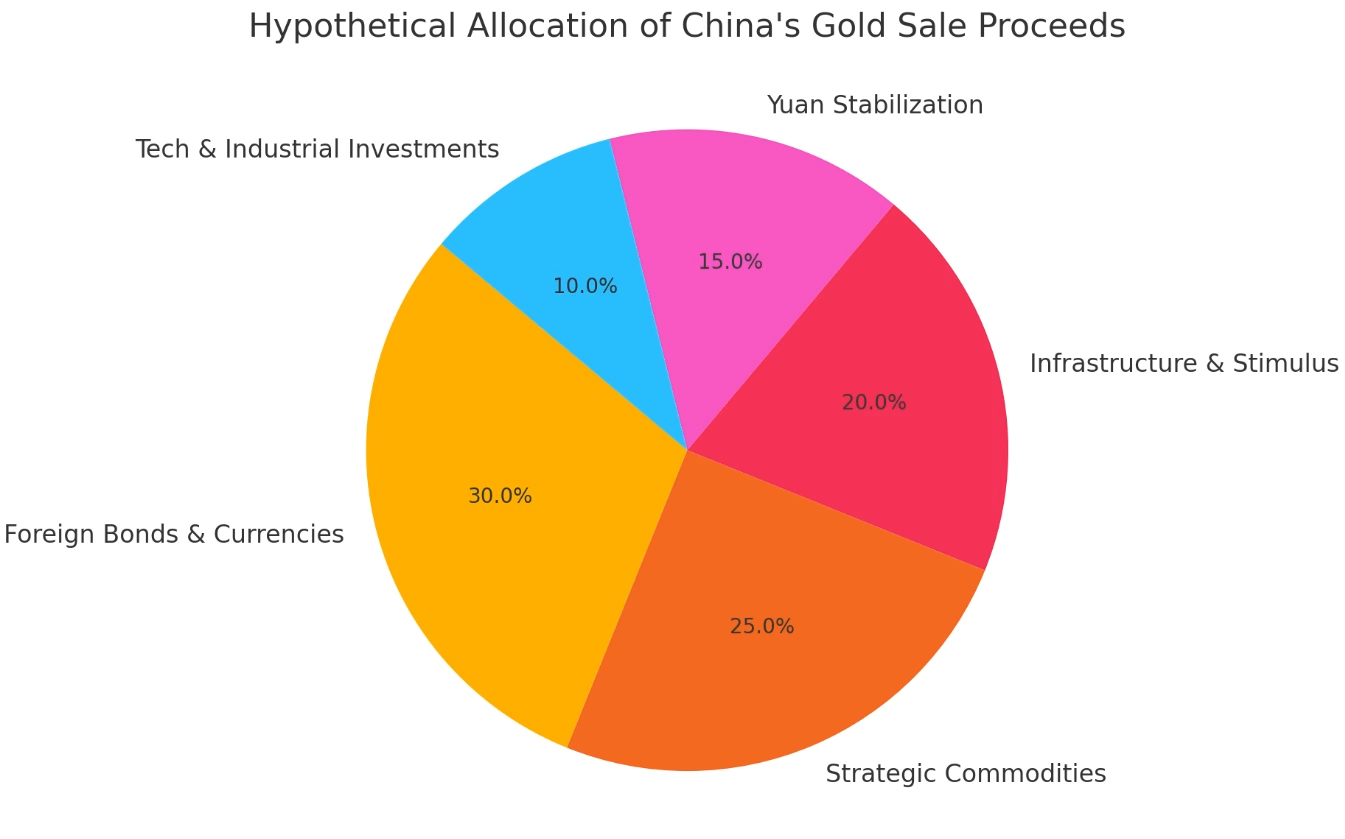
China’s central bank has been steadily increasing its gold reserves, adding 12.8 metric tons in the first quarter of 2025, it sold it all and more yesterday.
Now I don’t know about you, but I’ve learned that in politics, economics, and poker, nothing happens by accident. If it swims like a fish and smells like a fish, well, maybe — just maybe — we ought to call it a fish. So when China starts unloading its gold reserves faster than a gambler cashing out before the sheriff shows up, you have to wonder: are they broke, bluffing, or baiting the hook for something bigger?
Some say China’s just trying to keep the lights on and the factories humming — after all, they import more oil than a broke rancher drinks coffee, and half their grain comes from countries that don’t always play nice. Others whisper it’s a financial strike, a subtle move in the global chessboard meant to shake the dollar’s throne. But whether it’s desperation or design, you’d better believe there’s a strategy behind the sale.
Now don’t let that big grin on the Pooh Panda Xi fool you. empires don’t sell the family gold just to redecorate the living room. They sell it when they’re out of options — or when they’ve got a plan to buy the whole block. Maybe China’s trying to keep the economic bicycle rolling before the gears seize. Or maybe — just maybe — it’s loading the slingshot for a fiscal stone aimed straight at the heart of Western finance.
Either way, this ain’t just bookkeeping. It’s maneuvering. And in the middle of this fishy story stands the world, nose wrinkled, trying to figure out if it’s dinner or danger swimming beneath the surface. Best keep your boots dry and your eyes open — when the gold starts moving, history often follows.
Let’s look at some of the interesting details.
Gold prices have experienced a significant decline recently, influenced by multiple factors, including China’s actions and broader economic dynamics.
China’s Gold Market Activity
China’s financial markets, including the Shanghai Gold Exchange, closed for the May Day holiday, leading to reduced trading volumes. This closure, combined with a decrease in trading activity, contributed to a drop in gold prices. Additionally, after a period of substantial gold purchases earlier in the year, there has been a shift in China’s gold market behavior, impacting global prices .
Broader Economic Factors
Several other elements have also played a role in the recent downturn of gold prices:
-
Easing U.S.-China Trade Tensions: Recent developments suggest a softening in trade relations between the U.S. and China, reducing the demand for gold as a safe-haven asset.Reuters
-
Stronger U.S. Dollar: The U.S. dollar has strengthened, making gold more expensive for holders of other currencies, thereby dampening demand.
-
U.S. Economic Indicators: The U.S. economy contracted by 0.3% in the first quarter, and job growth has slowed, influencing investor sentiment and gold prices
China’s recent actions in the gold market have raised questions about its intentions and the recipients of its gold sales.
Purpose of China’s Gold Sales
While specific details about China’s gold sales are not publicly disclosed, several factors suggest potential motivations:
-
Diversification of Reserves: China has been actively diversifying its foreign exchange reserves. By reducing holdings in U.S. Treasuries and increasing gold reserves, China aims to mitigate risks associated with over-reliance on the U.S. dollar.
-
Economic Stimulus: The Chinese government has implemented fiscal stimulus measures to support its economy amid global uncertainties. Liquidating some gold holdings could provide the necessary liquidity for such initiatives.
-
Strategic Rebalancing: Adjusting the composition of reserves allows China to respond to shifting global economic conditions and geopolitical dynamics.
Recipients of China’s Gold Sales
The exact buyers of China’s gold are not publicly identified. However, market analysts suggest that the gold sold by China likely entered global markets through established channels, such as the London Bullion Market or other international exchanges. These platforms facilitate transactions between sellers and a diverse range of buyers, including central banks, institutional investors, and private entities.
It’s important to note that while China has been a significant buyer of gold in recent years, any sales would be part of routine reserve management and not necessarily indicative of a major strategic shift.
China’s gold sales are likely driven by a combination of reserve diversification, economic stimulus needs, and strategic financial management. The gold sold would have been absorbed by global markets through standard trading mechanisms.
When China sells gold as part of a reserve diversification strategy, it typically reallocates that capital into a mix of the following:
1. Foreign Currencies & Sovereign Bonds
-
U.S. Treasuries (despite political tensions, they remain highly liquid).
-
Euro-denominated bonds (Germany, France).
-
Japanese Government Bonds (JGBs).
-
Emerging market debt (often in Belt and Road Initiative partner countries).
These offer stable interest income and can be used strategically for foreign influence or trade leverage.
2. Strategic Commodities & Raw Materials
-
Investments in oil reserves, critical minerals, and agricultural assets.
-
Long-term contracts or ownership stakes in mining operations and energy infrastructure across Africa, South America, and Central Asia.
3. State-Sponsored Infrastructure & Bailouts
-
Injecting capital into local governments or state-owned enterprises (SOEs) to stimulate domestic demand.
-
Funding infrastructure stimulus to counteract economic slowdowns (roads, housing, high-speed rail, etc.).
4. Yuan Stabilization & Capital Controls
-
Selling gold can boost foreign exchange reserves, which can then be used to support the yuan in foreign exchange markets and manage outflows.
5. Technological Investments
-
Acquisition or subsidizing of semiconductor, AI, and EV-related supply chains, especially when global markets shift or sanctions tighten.
In essence, this is about increasing flexibility, securing resources, and enhancing strategic influence — all while reducing dependence on any single asset like gold or the U.S. dollar.

As of 2023, China’s total imports were valued at approximately $2.56 trillion, encompassing a diverse range of goods essential to its economy. Here’s a breakdown of China’s major import categories by value:
🇨🇳 China’s Top Import Categories (2023)
| Category | Import Value (USD) |
|---|---|
| Electrical machinery and equipment | $460.9 billion |
| Petroleum and petroleum products | $378.0 billion |
| Metalliferous ores and scrap | $264.9 billion |
| Scientific and measuring instruments | $93.3 billion |
| Gold (non-monetary, excluding ores) | $91.9 billion |
| Natural and manufactured gas | $84.6 billion |
| Non-ferrous metals (e.g., copper) | $72.4 billion |
These figures highlight China’s significant reliance on imports for energy, raw materials, and advanced technological components.
🌍 Major Import Partners
China’s primary import partners include:
- South Korea
- Japan
- Taiwan
- United States
- Germany
These countries supply a substantial portion of China’s imported goods, ranging from semiconductors to automotive components.
🛢️ Energy and Food Security
China’s dependence on foreign energy sources is evident, with petroleum and gas imports totaling over $462 billion. Additionally, despite efforts to reduce reliance on imported soybeans by reformulating livestock feed, China continues to import record volumes of soybeans, with projections between 94.6 to 109 million metric tons in 2024. (China’s reliance on soybean imports continues despite cutback plans)
This reliance on imported energy and food underscores the importance of strategic reserve management and diversification in China’s economic planning.
So you see the US needs China, but China needs the world more. Otherwise, the people will rebel.
Venezuela's largest oil buyer - China

May 1 (Reuters) – Venezuela’s oil exports fell almost 20% to some 700,000 barrels per day (bpd) in April, the lowest level in nine months, as cargo cancellations to U.S.-based producer Chevron (CVX.N), opens new tab forced ships to return and left some ports empty, ship tracking data and documents showed. Venezuela’s state-run company PDVSA last month suspended most of the loading windows it had assigned to Chevron and ordered the return of some oil cargoes bound for the U.S. amid payment uncertainty related to the enforcement of U.S. sanctions.
I reckon if you asked the average man on the street what Venezuela’s biggest export was, he might mutter something about being Venezuelans. But dig a little deeper, and you’ll find a tale as slippery as the crude they pump from the ground. Here’s a country sitting on the world’s biggest oil reserves, yet still begging the world to buy it cheap, like a man in a silk hat peddling apples on the sidewalk. The great irony is that while the oil flows thick, the dollars trickle in thin — tangled in sanctions, tankers, and political gymnastics. And now with Uncle Sam slapping tariffs and China playing coy, Venezuela’s oil dance is looking less like a waltz and more like a three-legged race through a swamp. So Delcy la Fea goes traveling around the world pimping Venezuelan oil. (You would understand this phrase if you are Venezuelan)
So here we are — Venezuela’s riches will stay buried not just underground, but beneath layers of mismanagement and lost opportunity. As for the rest of the world, well, they’ll keep buying — just not always from Venezuela. Because in the end, business doesn’t care who you are — only how much you’re charging, and whether the check clears. China is there banker, but now China is in the blender too. Iran lost its port.
So who would benefit from all this…. Read to the bottom of the article.
Venezuela is currently facing significant challenges in its oil export sector, particularly concerning its relationship with China. Recent U.S. sanctions have imposed a 25% tariff on countries importing Venezuelan oil, effective April 2, 2025. This measure has led major buyers, including China and India, to halt their purchases to avoid these tariffs
China, previously Venezuela’s largest oil customer, has suspended imports of Venezuelan crude following the U.S. decree . This cessation has severely impacted Venezuela’s oil revenues, as China and India together accounted for over 50% of its crude exports .
In response to these sanctions and the resulting economic strain, Venezuela’s National Assembly approved an economic emergency decree on April 10, 2025. This decree grants the government powers to stimulate economic growth, combat inflation, support investors, suspend taxes, and encourage import substitution .
The situation underscores the complex interplay between international sanctions, global oil markets, and Venezuela’s economic stability. The loss of key buyers like China and India exacerbates the country’s financial difficulties and highlights the broader geopolitical tensions influencing energy trade.
Venezuela’s economy in 2025 is grappling with significant challenges, primarily stemming from its heavy reliance on oil exports and the impact of renewed U.S. sanctions.
🛢️ Oil Production and Exports
As of January 2025, Venezuela’s crude oil production stood at approximately 892,000 barrels per day (bpd), a slight decrease from 910,000 bpd in December 2024 . In April 2025, oil exports declined by nearly 20% to around 700,000 bpd, marking the lowest level in nine months . This drop was largely due to state-run PDVSA suspending most loading operations for Chevron and recalling shipments amid payment concerns tied to U.S. sanctions enforcement. (Venezuela Crude Oil: Production, 2002 – 2025 | CEIC Data, Venezuela loses 20% of oil exports after cargo cancellations to Chevron)
China remains Venezuela’s largest oil buyer, accounting for approximately 61% of April’s exports . India has also increased its purchases, capitalizing on discounted Venezuelan crude. However, the imposition of a 25% U.S. tariff on countries importing Venezuelan oil has led to significant disruptions, with major buyers like China and India halting their purchases to avoid these tariffs . (Venezuela’s Oil Exports Plunge 20% as Sanctions Trigger Cargo …)
💸 Economic Indicators
The International Monetary Fund (IMF) projects a modest 3% growth for Venezuela’s economy in 2025 . However, inflation remains a pressing issue, with rates estimated between 180% and 200% . The bolívar has depreciated significantly, compelling many businesses to adopt black market exchange rates, which has pushed everyday goods out of reach for most citizens. (Inflation, currency woes worsen Venezuela’s complex crisis as Maduro declares ‘economic emergency’)
The government’s 2025 budget is set at $22.7 billion, an increase of nearly 11% from the previous year . Despite this, oil’s contribution to the budget is expected to be less significant due to the aforementioned challenges in the oil sector. (Venezuela’s 2025 budget set to grow nearly 11%, oil to contribute less)
⚠️ Sanctions and Economic Measures
The U.S. has intensified sanctions against Venezuela, including the revocation of a U.S. Treasury license allowing Chevron to operate in the country . These sanctions have led to a significant reduction in oil exports and foreign currency inflows, exacerbating the country’s economic crisis. (Last Chevron-chartered vessel starts to return oil cargo in Venezuela, data and source say, Trump’s cancellation of oil licenses likely to stoke Venezuela inflation)
In response, President Nicolás Maduro declared an “economic emergency,” granting the government powers to stimulate economic growth, combat inflation, support investors, suspend taxes, and encourage import substitution . However, these measures have so far failed to curb the deterioration of the economy. (Inflation, currency woes worsen Venezuela’s complex crisis as Maduro declares ‘economic emergency’)
🔍 Venezuela’s Outlook
Venezuela’s economic outlook remains uncertain. While the country possesses the world’s largest proven oil reserves, significant efforts and changes are needed to revive its economy. The government’s ability to navigate the complex interplay between international sanctions, global oil markets, and domestic economic stability will be crucial in determining the country’s future trajectory. (
🇷🇺Russia, Russia, Russia
Yes, Russia has a lot of oil, and it is selling large quantities to China, especially since 2022.
Here’s a breakdown:
🔋 Russia’s Oil Reserves & Production
- Russia has the 8th largest proven oil reserves globally.
- It is one of the top 3 oil producers in the world, alongside the U.S. and Saudi Arabia.
- Most of its oil comes from Western Siberia, but new development is also happening in the Arctic and Eastern Siberia (closer to China).
🇷🇺➡️🇨🇳 Russia-to-China Oil Sales
📈 Growing Trade:
- Since the start of the Ukraine war in 2022, Russia has dramatically increased oil exports to China.
- Western sanctions pushed Russia to pivot its exports away from Europe toward Asia, especially China and India.
- In 2023 and 2024, China became Russia’s largest oil customer, often buying more than 2 million barrels per day.
🛢️ Major Routes:
- ESPO Pipeline – The Eastern Siberia–Pacific Ocean pipeline goes directly from Russia into northeast China.
- Seaborne Exports – Crude is shipped from Russian Far East ports to Chinese refineries, often at discounted prices.
💵 Payment & Discounts:
- China buys Russian oil at a discount due to Western sanctions.
- Payments are often made in yuan or rubles, bypassing U.S. dollar systems and SWIFT banking restrictions.
🌍 Strategic Significance:
- This energy partnership helps China secure long-term energy supplies.
- It helps Russia keep its oil revenues flowing despite losing European markets.
- It strengthens geopolitical ties as both countries push back against Western influence.
So you see it is never so simple and never just an accident!
Golden Dome: Star Wars 2.0 – Can It Really Be Built?

Back in my day, when a storm was brewing between superpowers, you grabbed a shovel, dug a ditch, and prayed you were on the right side of it. But now? Now we’re talking about throwing a blanket over the entire sky and calling it safety. Trumps wants to build a “Golden Dome” — a Star Wars reboot where lasers kiss missiles mid-air and satellites play whack-a-mole with hypersonic death. Sounds mighty noble.
The idea is simple enough: keep every enemy missile out and every American life safe. But if history’s taught us anything, it’s that when you build something to make yourself invincible, you best be ready for every other fella with a grudge to try and prove you wrong — and bankrupt you in the process.
Now it may be that the Golden Dome saves us all — a mighty steel umbrella hung in the stars, shielding good folks from bad ideas. Or maybe it becomes the biggest golden goose chase ever foisted on taxpayers — all shine, no feathers, and a whole lot of noise for not much egg.
One thing’s for sure: if you start building castles in the sky, you’d best hope the ground beneath your feet is solid — and not a trapdoor. Because once you declare the heavens your battlefield, don’t be surprised when everyone else brings their own missiles and lasers.
Peace or paranoia — that’s the gamble. Let’s just hope, when it’s all said and done, we didn’t build ourselves a golden tombstone and call it a triumph.
💡 Can It Really Be Built?
The Golden Dome is a proposed U.S. missile defense shield—ambitious in scale, aiming to create an impenetrable dome over the homeland using satellite constellations, interceptors, and possibly directed-energy weapons. Spearheaded by Trump-era policy and SpaceX-backed innovation, it’s a high-tech reboot of Reagan’s “Star Wars” defense dream. But can we actually build it? The answer lies somewhere between cutting-edge optimism and geopolitical nightmare.
🛡️ What Is the Golden Dome?
The Golden Dome is a proposed all-encompassing missile defense shield for the U.S., often compared to Israel’s Iron Dome, but it is actually meant to operate on a much larger scale—protecting the entire continental U.S. from:
- ICBMs (Intercontinental Ballistic Missiles)
- Hypersonic Missiles
- Cruise Missiles
- Drones & Non-State Threats
Its aim? Eliminate vulnerability to missile attack and ensure retaliatory capacity remains intact.
🚀 Core Components of the Plan:
- Interceptor Network – Potentially space-based, with missiles or lasers destroying threats in boost phase, mid-course, and terminal phase.
- Satellite Constellations – Two planned networks:
- Tracking (1,000+ satellites)
- Attack (200+ satellites capable of neutralizing missiles)
- Directed Energy Weapons – Lasers or non-kinetic weapons under early development (e.g. Iron Beam-style tech).
- AI & Data Integration – Using companies like Palantir for real-time battlefield awareness and response automation.
- Modular & Distributed Architecture – Ensuring the whole U.S. (3.9 million sq mi) is covered either via few powerful nodes or many distributed systems.
🧱 Who’s Building It?
- SpaceX – Leader in rocket tech; possibly building interceptors & satellites.
- Palantir – AI and data coordination.
- Anduril – Advanced sensors and drone-based tech.
- Lockheed Martin, Raytheon (RTX), Boeing, Northrop Grumman – All vying for roles.
- L3Harris – Satellite infrared sensors & missile tracking.
Despite denials, SpaceX is the front-runner, even floating a “pay-to-play” missile defense subscription model—an idea both innovative and politically controversial.
💸 Cost and Timeline:
- Estimated Cost:
- Low end: $70–100 billion
- High end: $300+ billion
- Timeline:
- Initial Capabilities: ~2026
- Full Deployment: Post-2030 (some elements possibly never completed)
⚖️ Can It Actually Work?
✅ PROS:
- Technological Leap: Modern sensors, AI, and interceptors could enable what was once science fiction.
- Strategic Deterrence: Could make nuclear blackmail obsolete.
- Revives U.S. Defense Momentum: Brings attention and resources to missile defense again.
❌ CONS:
- Physics Is Hard: Hitting missiles in boost phase is extremely difficult.
- Quantity Dilemma: Thousands of cheap missiles could overwhelm a costly satellite defense.
- Risk of Escalation: Could start a new space arms race; violate outer space demilitarization treaties.
- Unproven Tech: Directed energy weapons and high-speed tracking at scale are still unproven in live combat scenarios.
- Strategic Instability: Could make adversaries more likely to strike early.
🌍 Global Implications:
- Militarization of Space: A full-scale space shield breaks international norms.
- Destabilization Risk: May provoke pre-emptive buildups or strikes by nations like China or Russia.
- Allied Mistrust: Even U.S. allies might be wary of an American monopoly on space defense.
- Debris Crisis: Physical attacks on space assets (if any) could cause chain-reaction debris fields (Kessler Syndrome).
🧠 Final Thought:
This is not just about defense. It’s a technological moonshot, a geopolitical reshuffle, and a trillion-dollar bet on peace through dominance. Whether the Golden Dome becomes a shield of safety or a Pandora’s Box that reshapes the sky forever will depend on how wisely it’s built—and who ultimately controls the on-switch.
The Invisible War: How China Is Waging a Battle of Perception Against India

“Wars aren’t always fought with bullets. Some are fought with bots, some with borrowed money, and others with borrowed truths. By the Time You Notice It, You’re Already in It
In my day, if someone didn’t like you, they said it to your face—maybe with a punch, maybe with a drink thrown. But today’s world? You get a thousand insults in ten seconds from accounts with names like “User928472” and profile pictures that look like they were pulled from a facial recognition nightmare. There’s a new kind of war out there, my friend—not over land, not over oil, but over your mind. And right now, the battlefield is the screen you’re staring at.
India, the world’s largest democracy, is fighting a shadow war it didn’t declare. The enemy? Propaganda so slick and social it makes you doubt your own neighbor. The source? Follow the money, and you’ll likely arrive in Beijing.
1. Social Media Turns Toxic: The Rise of Anti-India Sentiment
In recent months, platforms like YouTube and Twitter have been flooded with disturbing portrayals of India. Videos mock its cleanliness, its culture, and its people. But this isn’t a grassroots grievance—this is digital graffiti with state sponsorship.
Behind the slander lies a sophisticated operation. Investigations trace the coordinated messaging back to Chinese-funded campaigns, with bots and trolls programmed to drown out any narrative that paints India in a positive light.
2. Political Warfare: China’s Favorite Game
This isn’t new for China. They call it political warfare—the act of shaping perception without ever firing a shot. Instead of tanks, they deploy memes. Instead of soldiers, they use influencers.
The goal? Undermine India’s credibility in the West—particularly the U.S., where President Biden has called U.S.-India relations “among the most consequential” of the 21st century.
If you’re China, that kind of talk isn’t just inconvenient—it’s a direct threat to your global ambitions.
3. When Racism Becomes a Weapon
Online commentary has taken a particularly vicious turn, focusing on toilet access, poverty, and caste—insults weaponized to paint Indians as undesirable. Say something good about India online, and you’ll be instantly buried under a tsunami of anonymous filth.
But there’s a method to this madness. These comments aren’t personal—they’re strategic. They’re meant to keep India’s image mired in stereotypes while China quietly rebrands itself as the more “competent” Asian superpower.
4. Bought and Paid For: Indian YouTubers Pushing Pro-China Narratives
Even within India, some influencers are suddenly singing China’s praises. Coincidence? Unlikely.
Once you follow the financial breadcrumbs, you often find foreign funding, PR consulting firms, and backchannels linked to Chinese interests. It’s a double-edged campaign: discredit India abroad, normalize China at home.
5. Pakistan Joins the Propaganda Party
Pakistan plays the hype man in this disinformation symphony. Its leaders claim India is stirring unrest in Baluchistan, a region where China has invested over $60 billion via the China–Pakistan Economic Corridor (CPEC).
This claim helps China justify its aggressive stance against India, even though the Baluchistani independence movement predates modern India. But history is rarely as important as headlines in a propaganda war.
6. The Belt, the Road, and the Elephant in the Room
CPEC and similar projects under China’s Belt and Road Initiative (BRI) are starting to crack. Built with borrowed money and political pressure, many are turning into white elephants—glossy infrastructure with no return on investment.
An Ethiopian airport was plastered with Chinese logos—but sat nearly empty. Across Africa, Southeast Asia, and Central Asia, many BRI projects are stalling.
7. The Illusion of Wealth: China’s Money Is Drying Up
As China faces economic troubles at home—real estate collapse, youth unemployment, capital flight—the question arises: Can Beijing afford to bankroll its empire much longer?
The answer could determine not just the fate of these ghost projects, but the entire balance of power in Asia. A desperate China is a dangerous one, especially when backed into a corner.
8. The Real Conflict: Democracy vs. Control
This isn’t just a squabble between neighbors. It’s a clash between freedom and control.
Between open markets and debt traps.
Between digital transparency and state-sponsored illusion.
India is rising, and China knows it. But where India courts the world with democracy, China sends invoices, influence, and ideology.
The Battle Is for the Mind, Not the Map
“Propaganda is like perfume—you don’t have to drink it to be affected by it.”
China isn’t trying to win a war in the Himalayas. It’s trying to win it on your phone. It’s rewriting the future one comment, one video, one troll at a time. This is a war without uniforms—only usernames.
India may not be perfect—no nation is. But it’s not the caricature being painted by invisible hands behind fake accounts. The question isn’t just who has the stronger army or the bigger bank account. The real question is: Who do you believe?
Because in this new kind of war, the first casualty isn’t truth—it’s your attention span
China’s Grand Strategy vs. the Western World: A Clash of Civilizations

I am not a card-carrying member of the Foreign Policy Elite, but I’ve been around long enough to know when a man smiles at your dinner table while looking at your wife too many times, you can’t trust him. For years, we invited China to the feast, poured the wine, and told ourselves they’d mind their manners if they got full enough. Turns out, they brought their own menu, their wine, and now they want more than the table.
In the West we have this lovely little bedtime story: let them get rich, and they’ll get nice. But like most bedtime stories, it wasn’t true—it was just comforting. Now, we wake up to find the world has two roadmaps: one where laws matter, and one where loyalty does; one with cooperation, and the other with coercion. The worst part? We helped build both.
The Old Assumption: China Would Integrate Through Wealth
For decades, the dominant assumption in the West was that China’s long-term strategy was to integrate into the global, rules-based order. By embracing capitalism and global commerce, it was believed, China would get wealthier and eventually liberalize politically. This belief guided policies like China’s admission to the World Trade Organization in 2001 and the expansion of trade relationships with Western democracies. The idea was simple: a richer China would become more open, more democratic, and more aligned with international norms.
Xi Jinping’s Shift: From Integration to Assertion
Under President Xi Jinping, China appears to have pivoted away from integration and toward assertion. While past leaders like Deng Xiaoping advocated for China to “hide its strength and bide its time,” Xi has taken a more confrontational stance. From the militarization of the South China Sea to aggressive posturing over Taiwan and the dismantling of Hong Kong’s autonomy, China has increasingly signaled that it no longer wishes to play by rules it did not create. Instead, it seeks to reshape those rules—or break them.
The Soviet Union’s Ghost: Why Xi Fears Reform
Xi Jinping has studied history closely, particularly the collapse of the Soviet Union. One of his first actions after taking power was to convene a panel of experts and ask a blunt question: Why did the USSR fall apart? The consensus: the Soviets implemented political reforms before ensuring economic strength and allowed too much cultural and regional autonomy. Xi concluded that any movement toward democratization, especially before cementing the Party’s control, was a recipe for collapse. That insight helps explain Beijing’s brutal treatment of the Uyghur Muslims in Xinjiang. By erasing cultural identities and punishing dissent, the Communist Party aims to eliminate any seeds of separatism—no matter the human cost.
Economic Growth, Political Suppression
China’s economic miracle, sparked by Deng Xiaoping’s reforms, dramatically lifted living standards. Private enterprise flourished, and the middle class exploded. But with economic power came political aspirations, particularly among educated citizens and successful entrepreneurs. Rather than accommodate these changes, the Communist Party doubled down on control. Tech giants like Alibaba and Tencent were curbed, and billionaires like Jack Ma were sidelined. The message was clear: no one is bigger than the Party.
The Western World Order: Law, Rights, and Institutions
In contrast to China’s centralized authoritarianism, the Western system is built on law, pluralism, and individual rights. Rooted in the philosophical traditions of Greek rationalism, Roman legal frameworks, and Christian ethics, Western civilization upholds the idea that governments are accountable to the people—not the other way around. An American or European citizen can theoretically challenge the state in court, appeal decisions, and rely on a legal system that—though imperfect—respects due process. Treaties and institutions like NATO, the United Nations, and the WTO represent cooperative efforts to maintain global peace and economic stability.
Civilizational Pillars: West vs. China
The philosophical foundations of Western and Chinese civilization differ profoundly. The West emphasizes rights and the individual. The Chinese tradition, particularly Confucianism, emphasizes obligations and the group. In Western societies, the individual is the basic unit of society; in China, it is the family or community. In the West, progress is measured by expanding freedoms; in China, by ensuring harmony and avoiding chaos.
For example, consider how public protests are handled. In the U.S. or Europe, mass demonstrations are often messy but tolerated as a form of free speech. In China, they are swiftly shut down. The difference stems from deeper values: where the West sees legitimate dissent, China sees dangerous disorder.
The Role of Guanxi vs. Rule of Law
Another stark contrast lies in how institutions are held together. In the West, laws and transparent systems provide structure. You can look up statutes, challenge them, and appeal through independent courts. In China, relationships—guanxi—are key. Guanxi refers to personal networks that dictate how power, favors, and decisions move through the system. It’s less about rules and more about who you know. For example, in Chinese business or government, a decision may come not from a clear policy but from a phone call between well-connected figures in a hierarchy.
Worldviews in Conflict: Universalism vs. Sinocentrism
Western internationalism assumes that all nations are equal participants in a shared system, where diplomacy and rules apply to everyone. China’s historical worldview is Sinocentric: there is one superior civilization—China—and all others are peripheral. In imperial China, foreign states were seen as “tributaries,” expected to acknowledge Chinese primacy. This worldview lingers. China’s leaders often refer to their nation as the rightful center of global order, needing only to “reclaim” what was lost during the “Century of Humiliation” at the hands of Western and Japanese imperialism.
Territory, Power, and the Sea
China’s geopolitical strategy values territory as power. The more land and control, the more status. That mindset extends to the ocean: China treats the South China Sea as if it were land, building artificial islands and enforcing sovereignty claims. In contrast, the Western maritime order sees oceans as shared highways for trade and connection. Freedom of navigation is a core principle. Without it, the global economy would grind to a halt.
Bilateral Power, Not Multilateral Peers
The U.S. builds coalitions; China prefers one-on-one relationships. It has no meaningful alliances, relying instead on economic coercion or strategic dependency. For example, China uses debt-trap diplomacy through its Belt and Road Initiative to gain leverage over poorer nations—offering loans for infrastructure projects, then seizing strategic assets when repayment fails.
A Battle of Visions for the Future
So what does the future look like in 50 years?
- Vladimir Putin imagines a world of spheres of influence, where might makes right, and liberal democracy is a relic.
- Xi Jinping envisions a global hierarchy with China at the top, regional autonomy crushed, and surveillance the norm.
- The West, despite its dysfunctions, still aims for a world of sovereign equality, open commerce, and individual freedom.
Only one of these visions offers real hope. The other two promise stagnation, oppression, and conflict.
History, if it teaches anything, is that people will trade freedom for peace, then cry foul when they get neither. The West may be disorganized, noisy, and full of fools with loud opinions—but it’s still the only house on the block where you can yell at your leaders and not disappear for it.
So here we are, staring down two great chessboards: Xi wants a kingdom, Putin wants an empire, and the West—well, we just want a world where the rules apply to everyone, including ourselves. The trouble is, that kind of world takes work, sacrifice, and a spine.
And if we don’t care enough to defend it, then maybe we don’t deserve it.
From Opium Wars to Fentanyl: Echoes of History in a Modern Drug Crisis

You know, history’s got a funny way of coming back around to bite folks right in the backside. Once upon a time, it was the British shipping boatloads of opium halfway around the world to turn China into a nation of dazed, silver-spending addicts. Today, it’s China exporting tiny white powders so potent they could knock down an elephant, and America’s the one slumped over the table. Folks like to say the past is dead, but this story proves it’s alive and kicking—only now it’s wearing a different flag. It’s almost poetic, in a tragic sort of way: the very country that got strung out on foreign drugs 180 years ago might just be returning the favor. And as the bodies pile up and the politicians point fingers, we’d do well to remember that addiction has always been a powerful tool for folks with something to sell—or something to settle.
I reckon if there’s one lesson in all this mess, it’s that a nation’s weakness can be as plain as the nose on its face—and just as easy for an old rival to twist. Britain learned that the hard way when China’s thirst for silver turned into an opium nightmare. Now it’s America’s turn, hooked on a high so cheap it costs lives by the thousands. But here’s the thing: you can holler about foreign devils all you want, but it won’t fix the homegrown hunger driving folks to seek that deadly comfort. And you can bet your last dollar that as long as there’s a profit in poison, somebody—somewhere—will keep the supply flowing. The choice before us isn’t just whether to fight fentanyl, but whether we’ve got the gumption to break free of the cycle before history finishes its cruel rhyme.
Great. I’ll begin working on an article that draws a historical parallel between Britain’s use of opium against China and China’s role in the U.S. fentanyl crisis. I’ll incorporate and cite recent (2023–2025) sources that examine or suggest Chinese intent—directly or indirectly—in the export of fentanyl and its precursors. I’ll present the information in a structured, evidence-based format with historical context and modern geopolitical analysis.
Let’s get into …
Britain’s 19th-Century Opium Weapon Against China
In the early 19th century, the British Empire systematically exploited opium as a geopolitical weapon to subjugate China. British merchants, backed by London, flooded Qing Dynasty China with opium grown in British India, creating widespread addiction and social collapse. When Chinese authorities tried to stem the inflow – famously seizing and destroying millions of pounds of illicit opium in 1839 – Britain retaliated militarily, launching the First Opium War and quickly defeating China’s forces. The resulting treaties forced China to open its ports to foreign trade (including opium) and cede strategic territory like Hong Kong. This humiliating defeat, compounded by a second Opium War two decades later, ushered in what Chinese history calls the “Century of Humiliation,” as foreign powers reaped profits while a drug-addled China lost sovereignty and stability. Opium addiction destroyed millions of lives and accelerated China’s decline in this era, making narcotics a potent tool of imperial control.
China’s Role in the Modern Fentanyl Crisis
Fast forward to today’s fentanyl epidemic in the United States, and the historical tables appear ironically turned. China – once the victim of Britain’s opium strategy – has emerged as the primary source of chemicals fueling America’s fentanyl crisis. Over the past decade, Chinese labs and trading companies became the main suppliers of fentanyl itself and, more recently, of the precursor chemicals used to manufacture fentanyl. Around 2013–2018, large quantities of finished fentanyl were shipped directly from China to U.S. consumers (often through international mail), contributing to a surge in deadly overdoses. In 2019, under U.S. pressure, Beijing outlawed the entire class of fentanyl-type drugs – becoming the first country to do so – which dramatically curtailed direct shipments of ready-to-use fentanyl. However, Chinese suppliers quickly pivoted: instead of sending finished fentanyl, they began exporting the ingredients and precursor chemicals in bulk, often labeling them as other products and sending them to Mexico. Mexican cartels, principally the Sinaloa and Jalisco groups, then synthesize these Chinese-sourced chemicals into fentanyl pills and powders, which are smuggled across the U.S.–Mexico border. In effect, Mexico became “the face” of the fentanyl trade while Chinese chemicals remained its heart.
Criminal networks on both sides of the Pacific facilitate this deadly supply chain. Investigations show it is easy to purchase fentanyl precursors online from Chinese sellers, who ship them by air or sea, hidden among tons of other commerce. Many Chinese enterprises involved are ostensibly legitimate chemical companies taking advantage of China’s vast chemical and pharmaceutical industry. They often operate in gray areas of Chinese law, selling substances that are not yet banned. Smaller Chinese crime rings and freelance brokers – some known only by nicknames or family name – broker deals with Mexican traffickers and even provide “how-to” instructions for synthesizing fentanyl from the shipped chemicals. Additionally, Chinese money laundering networks have become pivotal: over the past five years they have risen to dominate global narcotics money laundering, cleaning cartel profits with speed and efficiency. U.S. officials report that Chinese money brokers now work hand-in-glove with Mexican cartels, making it easier for drug dollars to flow back to China and for precursor purchases to be financed. In short, China is a linchpin in the modern fentanyl supply chain – playing the role of producer and financier that 19th-century Britain played in the opium trade.
Allegations of Strategic Intent and State Negligence
The striking historical parallel has led to pointed questions about whether China’s government is willfully turning a blind eye – or worse, tacitly abetting – the flood of synthetic opioids that is devastating the United States. Several recent investigations and official reports (2023–2025) suggest that elements of the Chinese state may be tolerating or even facilitating this deadly trade. A bipartisan U.S. congressional committee report in April 2024 went so far as to accuse Beijing of directly subsidizing the fentanyl supply chain. Committee investigators uncovered Chinese government records offering tax rebates for manufacturers of specific fentanyl precursors, provided those chemicals are exported (i.e. not sold domestically). Such state incentives effectively boost China’s chemical exports – including ingredients used by drug cartels – and enrich Chinese companies at the expense of public health abroad. The same House report alleges that the Chinese Communist Party has allowed certain known drug-producing and trafficking networks to operate with impunity “as long as their efforts are focused abroad,” effectively tolerating criminal activity that feeds the U.S. opioid epidemic while keeping China itself insulated.
Even more alarming, the committee found evidence that Chinese officials have thwarted international investigations into narcotics trafficking. In multiple instances, when U.S. law enforcement asked China for assistance on illicit fentanyl cases, the targets inside China were tipped off by Chinese authorities about the pending investigation – giving them time to destroy evidence or change operations. According to U.S. agents, this “heads-up” from Chinese officials has made it far harder to track and disrupt the networks sending fentanyl precursors overseas. Such actions (if true) imply deliberate obstruction and have fueled suspicions that Beijing is at best willfully negligent, and at worst complicit, in perpetuating America’s opioid nightmare. Former U.S. Attorney General William Barr bluntly told Congress in 2024 that it’s “hard to believe” a country with China’s pervasive surveillance “is not fully aware” of massive fentanyl manufacturing within its borders. Barr testified that the committee had uncovered “persuasive evidence” Beijing is “not just a bystander, but is knee deep in sponsoring and facilitating the export of fentanyl precursors”. These stark claims, coming from a high-ranking U.S. official, underscored the growing view in Washington that China’s role is not accidental. Indeed, some U.S. security analysts now openly describe the fentanyl influx as a form of “reverse Opium War” – an intentional destabilization of American society through narcotics, mirroring what Western imperial powers did to China in the 19th century.
Beijing’s possible motivations, if it is indeed tolerating this trade, are hotly debated. One theory points to simple economics: the opioid supply chain is enormously profitable, and Chinese chemical manufacturers (including state-linked firms) are making billions from precursor sales. Fentanyl ingredients are cheap to produce and yield high returns, so there is financial incentive for China to let the business flourish. Another theory is more strategic – that fentanyl’s impact on the U.S. is viewed as a strategic advantage by hardliners in Beijing. China’s modern leaders are keenly aware of how drugs nearly ruined their own nation; the Communist Party proudly proclaims that it eradicated opium addiction after 1949 and lifted China from its “drug-addled” humiliation. According to a RAND analysis, some in China’s leadership, steeped in nationalist narratives of past foreign exploitation, might quietly see America’s fentanyl woes as “a form of […] vengeance” – payback for China’s historical suffering, albeit misdirected at a different opponent. Importantly, direct evidence of a centrally directed plot to poison Americans is absent; U.S. intelligence has not uncovered proof of an official policy to wage “drug warfare.” Nonetheless, the net effect of current trends is undeniable: China’s economy gains revenue, while its greatest global rival – the United States – grapples with over 100,000 opioid overdose deaths a year and the social havoc that results. This stark asymmetry has led observers to question whether Beijing truly has any incentive to stop the flow. As one commentary noted, a government that ruthlessly cracks down on domestic drug dealers “has not been as successful in countering drug flows from its shores”, suggesting a lack of urgency – or lack of political will – at the highest levels.
Loopholes and Lapses in China’s Chemical Controls
Contributing to these suspicions are significant loopholes in China’s chemical regulatory system. Even as China touts some of the world’s toughest drug laws on paper (a legacy of the Opium Wars), in practice traffickers exploit gaps in enforcement. A major issue is that most fentanyl precursors and analogues remain unscheduled (not officially classified as controlled substances) under Chinese law. Beijing did ban the core fentanyl molecule and a few variants, but chemists constantly develop new analogs or use alternative precursor chemicals that fall outside the ban. These chemicals are often dual-use – vital for legitimate pharmaceuticals or industry – and thus subject to minimal regulation despite their role in illicit drug production. Chinese authorities claim that if a substance isn’t scheduled as illegal, they “cannot prosecute” those who manufacture or export it, even if it’s known to be heading into the drug trade. U.S. officials have urged China to adopt western-style legal concepts like conspiracy charges or “know-your-customer” rules – which would hold chemical suppliers accountable if they knowingly sell to drug cartels – but China has balked. “We have none of these laws,” Chinese counterparts reportedly told U.S. negotiators, asserting that they cannot arrest or indict individuals for shipping chemicals that, on paper, are legal commodities. This regulatory gap allows Chinese companies to maintain plausible deniability. Many firms simply insist they are selling ordinary industrial chemicals and “didn’t know” the buyer’s intent. Unlike in the U.S. or Europe – where a chemical supplier would be obligated to ensure they are not selling to narcotics producers or terrorists – Chinese suppliers face no such legal requirement. The result is a vast gray market: so long as a fentanyl precursor isn’t explicitly banned, it can be produced and exported freely, no questions asked – a fact well understood by drug trafficking networks worldwide.
Critics argue that this is a loophole by design. They note that China could pass new laws or regulations to crack down on precursor diversion – for example, imposing licensing, customer vetting, and aggressive investigations – but has so far chosen not to. Chinese enforcement against fentanyl networks has been tepid: only a handful of indictments of trafficking kingpins or money launderers have occurred, and those often under U.S. pressure. “We have not seen robust prosecution in China,” observed Dr. Vanda Felbab-Brown, a Brookings Institution expert, adding that “the challenge with China has been the lack of will to take those enforcement actions.” In mid-2024, for instance, China finally arrested one Chinese national accused of laundering money for Mexico’s Sinaloa cartel – a positive step, but a drop in the bucket compared to the sprawling network of players involved. By and large, the masterminds of Chinese fentanyl operations operate with impunity, exploiting legal gray zones. As long as they avoid selling within China’s borders (thus sparing the domestic population), they face relatively little risk of punishment from Chinese law enforcement. This laissez-faire approach, witting or not, has made China a global hub for precursor chemicals and enabled the fentanyl pipeline to the U.S. to thrive. Western officials contrast China’s stance with other nations’: if a comparable precursor diversion were happening in, say, Germany or Japan, those governments would likely crack down hard and cooperate closely with U.S. investigators. In China’s case, cooperation and crackdowns have been minimal, fueling the perception that Beijing is content to let the deadly trade continue overseas.
Fraying U.S.–China Cooperation on Fentanyl
The fentanyl crisis has increasingly become entangled in broader U.S.–China strategic tensions, leading to breakdowns in what little bilateral counter-narcotics cooperation existed. In August 2022, after U.S. House Speaker Nancy Pelosi visited Taiwan against Beijing’s warnings, China suspended all collaboration with the U.S. on drug enforcement (among other issues). This abrupt cutoff came even as fentanyl overdoses in America were soaring, and it marked a low point in diplomatic relations. Chinese officials openly tied the move to overall U.S. “hostility,” essentially using counternarcotics as a bargaining chip. Indeed, Beijing has a record of leveraging law-enforcement cooperation based on the state of the political relationship: when ties are poor, Chinese authorities have withdrawn or slow-walked assistance on drug cases. As one analysis describes, “with countries with whom it has bad relations…it denies the cooperation” – an approach China followed after 2020 when relations soured over trade disputes, sanctions, and espionage incidents. By late 2022, President Xi Jinping’s government was signaling that fentanyl talks would remain frozen until the U.S. addressed China’s grievances. Chinese negotiators privately conveyed that certain U.S. sanctions were a sticking point, essentially demanding concessions in exchange for China’s help on fentanyl. “China sees everything through the lens of leverage. Fentanyl is no different,” a senior U.S. official told Reuters, summarizing the dynamic. In one illustrative episode, China insisted that the U.S. lift sanctions on a Chinese police forensics institute (blacklisted earlier for aiding human rights abuses) as a precondition to restart joint drug work. In November 2023, eager to revive dialogue, the Biden administration agreed to lift that sanction, and soon after Xi and Biden announced the resumption of counter-narcotics cooperation.
Since that tentative thaw, some progress has been reported – for example, China in late 2024 added a few more fentanyl precursors to its controlled list, and talks between U.S. and Chinese drug enforcement agencies have resumed. However, trust remains thin. U.S. officials accuse China of “slow-walking” the most critical steps, such as cracking down on big precursor suppliers and money launderers. They also worry China will again withdraw cooperation if leverage is needed on an unrelated issue. For its part, Beijing bristles at U.S. scrutiny and recent American moves like indicting Chinese companies and financiers involved in the fentanyl trade. In mid-2023, the U.S. Justice Department took the unprecedented step of charging several Chinese chemical firms and nationals with fentanyl trafficking conspiracies, and Washington has imposed sanctions on dozens of China-based entities. Chinese officials have protested these actions and even hinted that too much pressure could jeopardize the fragile cooperation. The Chinese foreign ministry warned in late 2024 that “sanctions, smears and slander” would “undermine the foundation” of joint efforts, vowing to “resolutely safeguard [China’s] legitimate rights” if the U.S. gets more aggressive. In short, fentanyl has become entwined in the U.S.–China strategic rivalry, making sustained collaboration difficult. Every time diplomatic relations dip, joint anti-drug efforts have faltered – a dangerous reality, given that stopping the fentanyl flow ultimately requires concerted action by both countries.
Chinese Official Denials vs. Investigative Findings
Chinese authorities vehemently reject the accusation that they are waging a fentanyl-fueled form of opium war against America. They stress that China, of all nations, knows the bitter cost of narcotics. “China was a painful victim of opium in history,” noted Qin Gang, then-Chinese Ambassador to the U.S., in 2022, explaining that this legacy makes China empathize with America’s drug plight and “proactively cooperate” in fighting narcotics. Chinese officials bristle at suggestions that fentanyl analogues are a geopolitical weapon or “payback for the Opium Wars,” calling such claims “false and misleading.” They point to China’s record of drug control: for example, the 2019 blanket ban on fentanyl-class substances, which Beijing touts as evidence of good faith (China often notes the U.S. still hasn’t scheduled all fentanyl analogues nationally). In interviews and statements, Chinese diplomats assert that China has “done everything possible” to help address U.S. opioid woes – out of goodwill and cooperation, not hostility. They cite measures like tightening export inspections (requiring real-name registration and content screening for parcels, especially those bound for the U.S.) and new regulations on Chinese chemical companies, all aimed at curbing illicit shipments. Any failures, Beijing argues, are due not to malice but to technical hurdles – such as the challenges of regulating thousands of common chemicals – and to American obstinance. In fact, Chinese officials often flip the blame back onto Washington: “The root cause of the drug epidemic in the U.S. lies in the U.S. itself,” foreign ministry spokeswoman Mao Ning stated, urging Americans to focus on reducing domestic demand and better policing their own borders. From China’s perspective, U.S. demand and prescription drug abuse created the opioid crisis – and China is being unfairly scapegoated for America’s failure to address those issues.
Moreover, Beijing accuses the U.S. of undermining cooperation through sanctions and distrust. In 2020, the Trump administration added China’s key forensics and anti-drug institutes to a sanctions blacklist (the “Entity List”), ostensibly over unrelated issues. Chinese officials say this move “shocked” them, as it hampered the very agencies supposed to liaise on drug investigations. Qin Gang argued that sanctioning China’s National Narcotics Laboratory and other bodies “curbed China’s capability to fight narcotics,” and he urged the U.S. to lift such sanctions as a show of good faith. This demand was in fact met in late 2023 when the Biden administration removed the sanctions to pave the way for renewed talks. Still, the episode feeds China’s narrative that it has been a “sincere partner” in counter-narcotics, only to be stymied by American political aggression. In sum, Chinese authorities flatly deny any state-backed narcotics agenda. The Chinese Embassy in Washington blasted the notion of using fentanyl to weaken the U.S. as “completely counter to facts and reality”, insisting that China is being constructive and that “blaming China is not a constructive way to address the fentanyl crisis.”
Despite these denials, Western investigators and experts continue to uncover evidence that casts doubt on China’s official narrative. For one, the tax rebate incentives for precursor exporters are documented on Chinese government websites – suggesting that at least some arms of the state knowingly promote the chemical trade that feeds fentanyl production. Chinese officials have not refuted the existence of these rebates; even U.S. administration officials acknowledge that China “does provide tax breaks” for chemical exports (though Beijing insists these are general export incentives, not meant to abet drug producers). Additionally, while China touts its 2019 fentanyl ban, the reality is that Chinese syndicates simply shifted to unregulated substitutes – and no Chinese kingpins have faced serious punishment for these new activities. The contrast with China’s harsh treatment of domestic drug abuse (which can incur the death penalty) is telling. Investigative reporting by outlets like Reuters has also revealed how Chinese firms openly market fentanyl ingredients online. In undercover stings, Chinese sellers offered to ship precursors labeled as other products, boasting of easy delivery into the U.S. and Mexico. This black-market e-commerce occurs in the open – yet Chinese regulators appear unable or unwilling to stop it. Experts note that Chinese authorities have immense surveillance powers (monitoring internet traffic, financial transactions, etc.), so the persistence of large-scale fentanyl commerce suggests an unspoken toleration. Indeed, a report by the Global Initiative Against Transnational Organized Crime found that certain Chinese organized crime groups operate with official tolerance so long as their crimes (from drug trafficking to money laundering) primarily harm foreigners. All these findings have led even normally cautious observers to conclude that Chinese state actors bear some responsibility – either through negligence or calculated inaction – for the opioid catastrophe unfolding in America. As a Brookings report put it, the “lack of will” in Beijing to truly clamp down is the critical problem. Without full Chinese cooperation and internal enforcement, global efforts to staunch the fentanyl flow face an uphill battle.
History’s Shadow and the Path Forward
The saga of Britain’s opium offensive against Qing China and China’s present-day fentanyl links to the United States are separated by 180 years – yet the parallels are jarring. In both cases, a great power’s pursuit of profit (and possibly strategic advantage) unleashed a drug epidemic on a rival nation, inflicting mass addiction and death. History does not repeat exactly, but as the saying goes, it often rhymes. Chinese commentators bristle at the notion that they would ever inflict a “new Opium War” on another country, given their own historical trauma. Nonetheless, the evidence of Chinese companies’ deep involvement in the fentanyl supply chain, combined with patchy enforcement and hints of official indulgence, cannot be ignored. Whether China’s role is one of malign intent or malign neglect, the outcome is the same – a flood of synthetic poison that is undermining American society much as opium once undermined China.
There are, however, glimmers of hope that history’s cycle can be broken. Diplomacy has shown some success: when faced with international pressure and incentives, China has taken helpful steps (the 2019 ban, recent additions to banned precursors, etc.). Likewise, the U.S. and China have managed to find common ground on this issue at times, despite wider tensions. A sustained, verifiable crackdown on illicit chemical exporters in China – coupled with demand-reduction and treatment efforts in the U.S. – could start to reverse the fentanyl tide. Achieving that will require rebuilding trust and exerting leverage where necessary. As one RAND analysis suggested, the U.S. may need to “press the Chinese Communist Party” more firmly on the drug issue, even trading concessions in other areas to secure cooperation. At the same time, punitive measures (sanctions, prosecutions) have their place to raise the cost of inaction for Beijing. It is a delicate balance of pressure and engagement.
For China, which rightly celebrates its victory over opium addiction in the 20th century, being seen as profiting from a new narcotic scourge is a stain on its international reputation. And for the United States, tackling the fentanyl crisis is not just a domestic priority but a geopolitical imperative – a rare issue where bipartisan consensus sees an external dimension to an internal tragedy. The ghosts of the Opium Wars loom large in this discourse, reminding both sides of how drug epidemics can change the course of history. Whether the current fentanyl crisis becomes an era-defining conflict between China and the U.S., or an opportunity for unprecedented collaboration, will depend on choices made in Beijing and Washington in the coming months and years. History’s lessons are stark: weaponized drugs can fell nations. Learning from that past, and not allowing cynical economics or revenge to perpetuate suffering, is crucial. In the end, stemming the fentanyl flood will require China and the United States to move beyond mutual recriminations and take bold joint action – ensuring that this chapter of history closes with lives saved, not another nation laid low by narcotics.
The Theater of Power: China’s Show of Strength—or Sleight of Hand?

JUST BECAUSE IT IS PROPAGANDA - IT DOES NOT MEAN IT IS NOT TRUE!
A military parade is less about tanks and missiles and more about Instagram on steroids. China knows the camera is the real weapon here—glossy shots of gleaming rockets, synchronized soldiers marching like TikTok dancers in perfect formation. It’s not built to win battles, it’s built to win scrolls. The show says: look how strong we are, look how disciplined, look how inevitable. But like every slick highlight reel, it leaves the bloopers on the cutting-room floor.
So when you see the parades trending, don’t just marvel at the hardware—remember the software running underneath: influence, intimidation, image control. Real strength isn’t in how loud the jets roar on TV, it’s in how long they can actually stay in the air when things go wrong. A parade is a performance, and performances are meant to distract. The lesson is simple: respect the show, question the script, and never mistake a flex for the truth.
Why China Holds Its Grand Military Parades: Message or Deception?
On Wednesday, Beijing’s Tiananmen Square became the stage for another of China’s massive military parades. Sleek fighter jets, road-mobile ICBMs, swarms of drones, and carefully choreographed ranks of troops rolled past cameras broadcasting to the world. The event was framed as a commemoration of the 80th anniversary of the end of World War II, but the real audience wasn’t just Chinese citizens—it was the globe.
The Message
China wants the world to believe it is unstoppable. These parades are less about the actual weapons on display and more about perception management. Every tank, missile, and precision march is aimed at sending a simple message: China is powerful, disciplined, and ready.
- To its own citizens, the parade reassures the people that their country is strong, modern, and able to stand toe-to-toe with America.
- To neighbors in Asia, it’s a warning not to underestimate Beijing’s reach.
- To the United States and the West, it’s a reminder that China has the technology, numbers, and industrial capacity to compete.
The Deception
But here’s the reality: these parades are carefully staged performances. Analysts note that China shows only what it wants the world to see. Every piece of gear is chosen for maximum effect, every formation rehearsed for months. What doesn’t work—or isn’t ready—stays hidden.
This selective transparency creates what experts call a “transparency gap.”
- In the U.S., every problem with the F-35 makes headlines. Cost overruns, delays, or mechanical flaws are splashed across the news.
- In China, failures are buried. We don’t know the true reliability of the J-20 stealth fighter, the cost of keeping their fleet in the air, or whether their hypersonic missiles consistently perform as advertised.
By hiding flaws, China’s military looks flawless—at least from the outside. And that illusion, amplified by global media coverage, is itself a powerful weapon.
The Real Battlefield: Perception
Modern conflict isn’t just fought with bombs and bullets—it’s fought with narratives. China’s parade is both a show of strength and a form of information warfare, designed to influence journalists, foreign leaders, and even casual viewers scrolling headlines.
The danger is simple: when perception is shaped more by propaganda than by battlefield performance, bad assumptions get made. We saw this with Russia, once believed to have an unbeatable military—until Ukraine exposed its weaknesses.
Final Thought
China’s parade is part theater, part warning, and part sleight of hand. Yes, they have made massive strides in technology and defense, but no nation is without weaknesses. The parade’s purpose is to convince the world otherwise.
When you see those gleaming missiles and roaring jets, remember: you’re not just watching a celebration. You’re watching a message—one polished for maximum effect, and one that hides as much as it reveals.
Propaganda isn’t automatically false.
In fact, the most effective propaganda often contains a strong element of truth. A parade showing thousands of disciplined soldiers, rows of tanks, or advanced missiles does reflect real investments and real capabilities. China really is pouring billions into defense, advancing rapidly in drones, hypersonics, and naval expansion.
But propaganda works by selective truth:
-
It emphasizes strengths while concealing weaknesses.
-
It shows what is finished and polished, not what is still in development or failing tests.
-
It frames the narrative so that the truth appears bigger, cleaner, and more inevitable than it really is.
So yes, the parade is true in what it shows—but deceptive in what it doesn’t. The skill lies in recognizing both: the signal of genuine capability and the silence covering over the flaws.
Here’s a detailed comparative table showing the military sizes and key inventories of China, the United States, Russia, and the next-largest active force, India, as of 2025:
| Country | Active Personnel | Tanks (approx.) | Warships & Submarines | Military Aircraft Total | Helicopters (incl. attack) |
|---|---|---|---|---|---|
| China | 2,035,000 (Global Firepower, Wikipedia) | 6,800 MBTs (Indiatimes) | 787 ships (including 79 submarines) (Wikipedia) | 3,309 total (1,212 fighters; 371 strike/attack) (Armed Forces) | 913 total / 281 attack helicopters (Armed Forces) |
| USA | 1,328,000 (Global Firepower) | 4,640 MBTs (Indiatimes) | 440 total naval vessels (Global Firepower, 24/7 Wall St.) | ~13,175 total aircraft (Armed Forces) | 6,417 attack helicopters (NationMaster) |
| Russia | ~1,100,000 active (plus reserve ~1.5 million) (Wikipedia, Reuters, Business Insider) | 5,750 MBTs (Indiatimes) | 419 naval vessels (incl. warships and subs) (Global Firepower) | ~3,864 air force aircraft + 318 navy aircraft = 4,182 total (World Population Review) | Helicopter numbers not specified, but recent production includes 180 aircraft & helicopters (Reuters) |
| India | ~1,455,550 (Global Firepower) | 3,740 MBTs (Artillery: 9,743) (Reuters) | ~150 warships & subs (2024), 16 subs, 11 destroyers, 16 frigates, 2 aircraft carriers (Wikipedia, AP News, Reuters) | 2,229 aircraft (Armed Forces, Jagranjosh.com) | 899 helicopters (incl. 80 attack helicopters) (Armed Forces) |
Quick Highlights:
- China leads in active personnel, tanks, naval size, and maintains a substantial air and helicopter force.
- The U.S. boasts overwhelming aircraft superiority by quantity and quality, along with a powerful navy, though personnel numbers are smaller than China’s.
- Russia trails in active personnel but has a significant reserve; maintains large tank force and respectable naval and air components.
- India, while behind the others in absolute numbers, remains the 4th largest military by active personnel and continues modernizing its navy and air capabilities.
Here’s a refined comparison table for 2025, summarizing the estimated nuclear warhead inventories of the United States, Russia, China, and India:
| Country | Estimated Total Warheads (2025) | Notes |
|---|---|---|
| Russia | ~5,459 warheads (total inventory) | Includes ≈1,718 deployed strategic warheads (Wikipedia) |
| United States | ~5,177 total warheads | FAS estimates ~3,700 active military warheads; includes deployed, reserve, and some retired (Reuters, Wikipedia, Arms Control Association) |
| China | ~600 warheads | SIPRI and FAS estimate ~600 operational warheads, growing at ~100/year (The Guardian, Wikipedia) |
| India | ~180 warheads | India’s arsenal remains the fourth-largest globally (The Times of India, Wikipedia) |
Additional Context
- There are approximately 12,241 total nuclear warheads globally, with 9,614 in military stockpiles and 3,912 deployed operationally (The Washington Post, SIPRI).
- Russia and the U.S. together hold the vast majority—around 87–90%—of the world’s nuclear arsenal (The Times of India, Reuters).
- China’s stockpile is expanding rapidly, with goals reportedly aiming for 1,000 warheads by 2030 (Wikipedia).
EXTRA CREDIT:
TikTok lives on— painted red, white, and blue
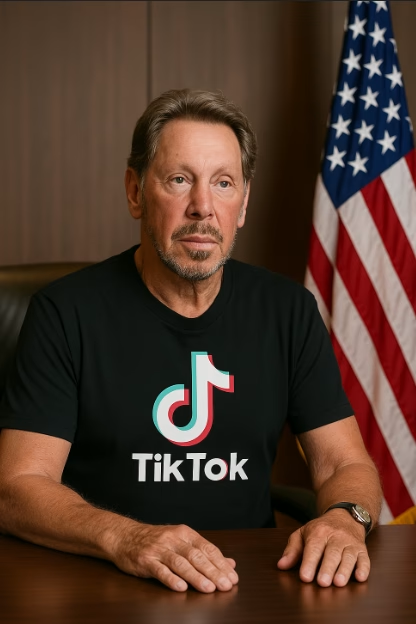
America has a curious habit: when it can’t figure out whether to ban a thing or bless it, it sells it to a friend and calls the problem solved. TikTok was supposed to be a menace, a spyglass for Beijing, a digital opium pipe corrupting the youth. But instead of pulling the plug, Washington stitched up a deal that turned a “national security threat” into a business opportunity for billionaires. The kids keep their dances, the moguls keep their profits, and the politicians keep their talking points. That’s what passes for compromise these days.
Painted red, white, and blue, it is still humming the same algorithmic tune. The government swears it’s safer, Oracle swears it’s smarter, and the young swear they couldn’t live without it. Maybe they’re all right. Or maybe it’s just another sleight of hand where power changes suits but never leaves the casino. In the end, the app that was almost banned will keep us scrolling, laughing, buying, and arguing, while the real winners cash out quietly in the back room.
Here’s a more detailed and critical take on the TikTok deal as described in that transcript + recent reporting, with what the structure seems to be, its implications, and open questions / concerns:
TikTok deal and executive order
-
Trump said he reached an agreement with President Xi allowing American investors (Larry Ellison/Oracle, Michael Dell, Rupert Murdoch, etc.) to take over U.S. operations of TikTok.
-
Oracle would handle U.S. data security.
-
The U.S. entity would control the algorithm, with claims it won’t be used for propaganda.
-
The company was valued around $14 billion in the deal as described.
-
Trump emphasized he used TikTok during the campaign and that young voters “loved it.”
Structure & Key Terms (as reported)
From the transcript and news sources, this is how the deal is being framed:
| Component | What’s being proposed / claimed | Supporting reports |
|---|---|---|
| Valuation | ~$14 billion for TikTok’s U.S. operations (i.e. the “new U.S. entity”) | FT: “TikTok US to be valued at $14bn” (Financial Times) |
| Ownership split | U.S. investors (Oracle, Silver Lake, MGX, etc.) will control ~ 45 % (some reports say ~80 %) of the new U.S. company; ByteDance retains a minority stake (~ 19.9 %) | Reuters: “Oracle, Silver Lake … will acquire ~ 50 %” (Reuters) ; FT: “jointly control ~45 % … ByteDance will retain 19.9%” (Financial Times) ; WSJ / Reuters earlier: U.S. investors ~80% stake, Chinese shareholders below 20% (Reuters) |
| Board / governance | Six of seven board seats will go to Americans; ByteDance picks one. ByteDance is excluded from security decisions. | Reuters: new board with 6 American-appointed and 1 by ByteDance. (Reuters) ; FT: says algorithm & security under U.S. control. (Financial Times) |
| Control of algorithm / content / data | – The U.S. entity will control the algorithm for U.S. users (or have oversight) – TikTok’s algorithm (or a version of it) will be licensed or transferred to the new U.S. entity – U.S. user data will be stored on servers in the U.S. and managed by Oracle as the “trusted security provider” – ByteDance no longer has access to algorithmic or security control | AP: “a copy of TikTok’s algorithm will be given to the joint venture … fully inspected and retrained … then operated by that U.S. entity.” (AP News) ; Washington Post: algorithm will still be leased, adapted with U.S. data. (The Washington Post) ; Politico: U.S. will control algorithm under deal. (Politico) ; OPB/AP: Oracle will manage the algorithm. (opb) |
| Timeline & deadline | A 120-day window is given to finalize and implement the deal. | FT: executive order gives 120 days to finalize. (Financial Times) |
| Role of China / approval | Trump says he talked to President Xi, and China “approved” the deal. But resistance is reported, and China formally agreeing is still uncertain. | FT: “he talked with President Xi … gave us the go-ahead” (Financial Times) ; Reuters: Chinese side had resistance. (Reuters) |
| Other investors / participants | – Oracle (Larry Ellison) – Silver Lake – MGX (Abu Dhabi’s AI/investment arm) – Michael Dell (Dell Technologies) – Rupert Murdoch / Lachlan Murdoch – Some existing ByteDance investors (e.g. General Atlantic, Susquehanna) may retain stakes – Possibly Andreessen Horowitz, others | Several sources mention Oracle, Silver Lake, MGX. (Financial Times) ; Trump mentions Dell, Murdoch in speech. In news: “Michael Dell is part of the consortium” (The Register) ; Murdoch involvement: Trump says Murdochs may be in group. (TechCrunch) ; Engadget: includes Andreessen Horowitz etc. (Engadget) |
| Government / U.S. role | – The U.S. government will not hold equity or a “golden share” – It will not select a board seat itself – The transaction is framed as a “qualified divestiture” aligned with U.S. law – The executive order extends the moratorium on banning TikTok for 120 days to make the deal happen | White House official: no golden share, no board seat for U.S. government. (Anadolu Ajansı) ; FT/News: deal structured to comply with law banning TikTok if Chinese ownership remains. (Financial Times) |
Why this structure, and what problem it’s trying to solve
The rationale (at least in public statements) centers around national security and data control, while preserving TikTok in the U.S.:
- Concern: that ByteDance (a Chinese company) can access U.S. user data, manipulate algorithmic content (propaganda, influence operations), or otherwise use TikTok as a foreign leverage tool.
- Solution: shift control of sensitive parts (algorithm, user data) to U.S.-based investors and infrastructure.
- By limiting ByteDance’s ownership (< 20%) and removing it from security control, the deal aims to comply with a bipartisan 2024 U.S. law that mandates a divestment or ban of TikTok.
- Maintaining TikTok avoids a complete ban—which would cause disruption for millions of U.S. users and businesses (many small businesses use TikTok for ads and outreach, as noted in the transcript).
Risks, open questions & challenges
This is a highly complex deal with many unresolved technical, legal, and geopolitical issues. Some of the key uncertainties:
| Issue | Why it’s tricky / what’s unclear |
|---|---|
| Algorithmic “control” | Even if a U.S. copy or version of the algorithm is licensed and “retrained,” the original algorithm architecture, models, and proprietary optimization mechanisms could still originate with ByteDance. It’s unclear how wholly independent the algorithmic version for U.S. users will be. Washington Post notes: “algorithm will still be leased … but adapted” (The Washington Post) |
| Severance of influence | True severance means ByteDance/China should have zero access to decision-making on content recommendation, censorship, or backend logging—these are all tough to fully isolate in practice. |
| Chinese approval / compliance | Even if Trump says “go ahead,” China’s regulators may resist or impose conditions. There may be restrictions in Chinese law about letting a domestic company give up algorithm/control for foreign entities. |
| Valuation & funding | $14B is being reported, but that depends on how much debt is assumed, investor expectations, monetization forecasts, etc. If TikTok U.S. operations face drag or regulatory friction, valuation could be volatile. |
| Regulatory / antitrust scrutiny | Such a high-profile transaction will invite scrutiny from U.S. regulators (FTC, DOJ, FCC) about market power, data privacy, competition, etc. Also China might demand strategic concessions. |
| Board & governance conflicts | Who exactly will have veto power over key changes? Will ByteDance’s single board seat be symbolic only? How will disputes between minority and majority owners be resolved? |
| User experience disruption | Migrating U.S. users to a “new app” or version, data transfer, downtime, re-onboarding, or compatibility issues could disrupt how people use TikTok. FT said users might have to shift to a new app. (Reuters) |
| Legal / contractual constraints with existing contracts | TikTok has contracts with content creators, advertisers, platform partners, data providers, cloud services, etc. Whether those contracts allow assignment, modification, or require renegotiation is a big deal. |
| Public / political backlash | Some will view this as a political deal (e.g. Trump picks investors), or worry about censorship or content manipulation. Also, surveillance / privacy skeptics may challenge claims of “safe U.S. control.” |
| Residual Chinese stake | Even a < 20 % retention by ByteDance could raise red flags about continuing influence or incentives. |
| Implementation risk | The 120-day timeline is aggressive for all the technical, legal, regulatory, and diplomatic steps required. Delays will be expected, and some parties may balk. |
Interpretation & strategic implications
Given what we know and what’s still uncertain, here’s what the deal signals / could imply:
- This is a compromise solution: it preserves TikTok operation in the U.S., at least temporarily, while trying to undercut the strongest national security arguments against it.
- It shifts much of the perceived “security risk” into U.S. investor hands—especially Oracle, which is being portrayed as a neutral “guardian” of user data and algorithm oversight.
- It gives Trump / administration a political win: avoiding an outright ban while claiming to protect U.S. interests.
- U.S. investors are winning strategic positioning: owning a piece of a dominant social media platform with high growth and advertising leverage.
- It sets a precedent: international tech platforms may face forced structural separations or forced local “firewalls” to satisfy national security concerns.
- But there’s a credibility test: enforcing true independence, algorithmic transparency, resisting political influence, and maintaining user trust will all be major ongoing tests.
Here’s a scenario model for the TikTok U.S. deal, looking 1–3 years ahead. I’ll frame it in Best Case, Middle Case, and Worst Case outcomes, covering valuation, revenue, regulation, and politics.
📈 Best Case (optimistic scenario)
- Valuation & investors: The $14B valuation proves conservative. Ad revenue in the U.S. continues to grow >20% annually, pushing the TikTok U.S. entity toward $25–30B valuation by 2027.
- Revenue: U.S. operations bring in ~$11B in 2024 → ~$15–18B by 2026. Oracle + partners profit from both ad growth and secure data hosting contracts.
- Security credibility: Oracle manages data storage and algorithm oversight smoothly, with no major breaches or controversies. Political critics grudgingly accept the setup.
- User trust: Users see no difference in experience. Small businesses thrive on cheap, effective advertising. TikTok Shop expands in the U.S., capturing e-commerce revenues.
- Politics: Trump and allies claim victory; Democrats do not reverse the deal if they regain power. A bipartisan consensus emerges that this “firewalled U.S. TikTok” is safe.
- ByteDance’s role: ByteDance’s minority stake (<20%) is passive, with no signs of interference. China refrains from retaliation.
⚖️ Middle Case (most likely / mixed)
- Valuation & investors: Valuation hovers around $14–16B. Growth slows as some advertisers hesitate due to ongoing scrutiny.
- Revenue: U.S. operations grow to ~$13–15B revenue by 2026, but growth is below expectations.
- Security credibility: Questions persist about whether algorithm code is “fully U.S. controlled” or still leased from ByteDance. Washington Post already noted the algorithm may still be “licensed” rather than fully owned. 【web†source】
- User trust: Younger users continue using TikTok, but older demographics distrust it more. TikTok retains cultural dominance but faces competition from YouTube Shorts and Instagram Reels.
- Politics: The deal becomes a campaign issue in 2026 or 2028 elections. Some argue it’s still “China-linked.” If political winds shift, further restrictions could be imposed.
- ByteDance’s role: ByteDance remains a quiet minority shareholder but occasionally sparks controversy if Chinese influence is alleged.
🚨 Worst Case (pessimistic scenario)
- Valuation & investors: Valuation collapses below $10B if U.S. regulators, courts, or China block parts of the deal. Investors lose money.
- Revenue: Ad revenue shrinks as advertisers flee due to controversy or new regulation. User base declines if U.S. consumers perceive censorship, bias, or instability.
- Security credibility: Investigations reveal ByteDance or Chinese staff still influence algorithm/data. Political backlash follows.
- User trust: U.S. teens stick around, but parents, regulators, and schools push for bans. Businesses diversify away. TikTok loses its edge to Reels/Shorts.
- Politics: Congress (or a new administration) forces a full ban or complete divestiture. Trump’s “deal” becomes a political liability.
- ByteDance’s role: China retaliates, blocking U.S. companies in China or tightening tech transfers. The U.S.–China relationship worsens.
🧭 Key variables to watch
- Regulatory compliance — Does the 120-day deadline get met without major court challenges?
- Algorithm independence — Is the algorithm truly U.S.-controlled or just “licensed”?
- ByteDance minority stake — Will China accept ByteDance’s passive role, or try to exert leverage?
- Political climate — Does this deal get bipartisan cover, or does it become a wedge issue in 2026/2028?
- Ad market competition — TikTok’s edge in ad targeting vs YouTube Shorts, Instagram Reels, Snap.
- E-commerce success — If TikTok Shop grows in the U.S., it could double revenue streams.
✅ Bottom line:
- In the best case, TikTok U.S. becomes a thriving $25–30B company with Oracle and partners cashing in.
- In the middle case, it’s stable but politically contested, with moderate growth.
- In the worst case, the deal collapses under political or regulatory pressure, leaving investors and users burned.
Time for Fortune Cookies - Xi’s Health Rumors, Power Jockeying, and Why the Timing Matters

I keep a fortune cookie for wisdom, popcorn for spectacle, and gold for insurance —while the VIX flaps its wild wings.
Many of you think Trump has had it tough. Sure—two assassination attempts is no joke. But strongmen everywhere live with knives at their backs. Putin and Xi reportedly use body doubles, food tasters, and layers of security. Trump likely lives under similar pressure. Today, though, the soap opera is about Xi.
Persistent reports claim Xi has suffered multiple cardiac or cerebrovascular events and keeps a German physician close at hand. Whether those “heart attacks” were real, misdirection, or even poisoning is unknowable from the outside. What is clear: there are plenty of people waiting in line for his job.
Why bring this up now? Because Xi (or his PR machine) just thundered that China won’t be “under U.S. control.” Convenient timing, given fresh rumors of his hospitalization. That sounded less like foreign messaging and more like internal proof-of-life for Party cadres and the security services.
What’s confirmed vs. what’s rumor
Confirmed:
- The Chinese Communist Party’s Fourth Plenum is set for Oct 20–23, 2025 in Beijing—the key agenda-setting meeting this fall. (Reuters)
- Even Party-friendly outlets say to expect unusual Central Committee turnover (replacements tied to deaths, investigations, and purges). That signals turbulence at the top. (South China Morning Post)
- In March, the U.S. Office of the Director of National Intelligence released an unclassified report describing endemic corruption in the CCP and framing Xi’s anti-graft drive as cyclical political purges. That document is now part of the global conversation—and a handy cudgel for Xi’s rivals. (Director of National Intelligence)
Rumor (treat with caution):
- Claims that Xi suffered a stroke in recent days; that he was moved to a military hospital; and that transition work is already quietly underway. These stories are circulating across overseas Chinese media, social platforms, and YouTube—but remain unverified by reputable international outlets. Remember: similar Xi-stroke rumors have popped up before and were debunked. (YouTube)
What could be happening (plausible scenarios)
- Real medical crisis. Xi is hospitalized; elders use the Plenum to force an orderly transition, citing health.
- Political detention with a cover story. Anti-Xi factions spread a “stroke” narrative to mask a loss of freedom and explain any no-shows.
- Negotiating tactic. Xi “withdrawing” on health grounds to win concessions before the Plenum.
- Nothingburger / info-op. A timed disinformation push to shape elite opinion or test loyalty before personnel votes.
- Status quo with purges. Despite the churn, Xi retains effective control (as some sober analyses argued as recently as summer), and the Plenum just reshuffles the deck. (Jamestown)
Why this matters beyond Beijing
- Markets & supply chains: The Fourth Plenum sets five-year priorities; signals on growth, tech restrictions, and capital access can ripple globally. (Bloomberg)
- Military & security: Ongoing purges in the defense sector—and any leadership vacuum—complicate PLA modernization and Taiwan timelines. (The Washington Post)
- U.S.–China optics: Washington just spotlighted CCP corruption; Beijing will want a show of unity. If Xi appears weak—or replaced—policy continuity becomes the question. (Director of National Intelligence)
“So who’s next?” (names in the chatter—not predictions)
If a transition were forced, the shortest path is a caretaker from the current Politburo Standing Committee: Li Qiang (premier), Zhao Leji, Wang Huning, Cai Qi, or Ding Xuexiang. Outside-track names like Wang Yang sometimes resurface in rumor mills because he’s palatable to multiple camps, but he’s been out of front-line roles since 2023. Treat any “done deal” claims before Oct 20 as speculative. (South China Morning Post)
Bottom line
- Facts we know: Fourth Plenum (Oct 20–23); unusual churn expected; U.S. intel just handed Xi’s critics ammo on corruption. (Reuters)
- What we don’t know: Xi’s actual health status and whether a transition is imminent. Prior “Xi stroke” waves have fizzled on verification. (Reuters)
- What to watch next: (1) Whether Xi personally opens the Plenum; (2) who chairs key sessions; (3) the Central Committee reshuffle list; (4) any abrupt travel/appearance changes among Li Qiang and other Standing Committee members. (South China Morning Post)
After the Dollar — How China Wants to Replace the Dollar Internationally (and Why It Matters to You)

If you want to know what a country really believes, don’t read the press release—check the backend. China’s spinning up a new money stack, where the uptime is guaranteed by metal, not messaging. Picture vaults as data centers, the Shanghai Gold Exchange as the load balancer, and every bar stamped like a verified block. They’re basically saying: “Don’t trust us—verify the collateral.” That’s not philosophy; that’s infrastructure. And when someone rewires the payments layer of the world, the rest of us should probably keep our multi-factor on and our go-bag packed.
China is building a gold-anchored alternative to the dollar system: buying record amounts of gold, wiring a global network of vaults into the Shanghai Gold Exchange, and pushing gold toward full bank-grade collateral status. If gold becomes treated like Treasuries for financing (HQLA/repo), BRICS nations could fund trade and infrastructure without touching the dollar. That would mean a “multi-monetary” world—gold-backed finance led by China and a more digital/market-driven system led by the U.S.—with big implications for interest rates, commodities, and portfolios.
The Problem China Is Solving: Trust
- For decades, the U.S. dollar dominated because Treasuries were seen as the world’s safest asset.
- When Biden and allies froze roughly $300 billion of Russia’s foreign reserves in 2022 it had an unintended consequence, many reserve managers concluded that dollar assets carry political seizure risk, prompting a quiet reshuffle of portfolios: some countries—most visibly China—trimmed U.S. Treasury holdings while adding more gold and diversifying reserves. The signal wasn’t a wholesale flight from Treasuries (global foreign ownership has remained high), but the sanctions episode clearly accelerated hedging behavior: the dollar’s share of official reserves has drifted down over time, and central banks have been record net buyers of gold since 2022.
- Confidence cracked as countries realized dollar reserves can be frozen or sanctioned—prompting central banks, especially in emerging markets, to reduce dollar exposure and buy more gold.
China’s Playbook
- Relink currency to gold (de facto)
The People’s Bank of China has been the world’s largest visible buyer of gold in recent years, signaling reserve strength and an exit ramp from Treasuries. - Build the plumbing: Shanghai Gold Exchange (SGE)
The SGE is now the largest physical gold marketplace. China is expanding vault capacity (e.g., Hong Kong) and connecting BRICS and partners via a “gold corridor”—a network of audited vaults that track bar serials, purity, and ownership. - Fix custody & decentralization
Instead of “trust Beijing,” partners can store and verify their gold closer to home through SGE-linked vaults. Think of it as an “analog blockchain” of gold custody. - Stabilize the price used for finance
Settlement isn’t pegged to today’s spot price but to a moving average (e.g., ~200 trading days) to damp volatility and kill easy price squeezes—critical if gold is used as loan collateral. - Upgrade gold inside the banking rulebook
Under Basel III, physical, allocated gold already moved up the ladder (counted at full value on bank balance sheets). The next aim: push gold into HQLA status, making it eligible collateral for repo*—the overnight lending market at the heart of global finance. (Repo explanation at bottom.)
Why HQLA Status Is the Ballgame
If gold can be used like Treasuries in repo:
- Countries could post gold to borrow yuan (or local currency) through the SGE system and BRICS lenders (e.g., New Development Bank) to build ports, power grids, factories—without the dollar or the IMF.
- That creates a parallel funding system: gold-collateralized development finance under China’s sphere.
The U.S. Response (Likely)
- The U.S. appears to be tightening physical custody of its gold (repatriation signals) and could counter on two fronts:
- Hard collateral (its own massive gold stockpile), and/or
- Technology (stablecoins, tokenized Treasuries, possibly Bitcoin rails) to preserve dollar agility and openness.
What This World Looks Like
- A multi-monetary era:
- China/BRICS: gold-anchored, collateral-heavy finance.
- U.S./West: digital, transparent, fast settlement layers (tokenized assets, stablecoins, maybe Bitcoin in the stack).
- Governments compete on what money is—collateral trust (gold) vs. network trust (code, transparency, liquidity).
Why It Matters to You
1) Interest Rates & Credit
- If global financing diversifies away from Treasuries, dollar funding costs could drift higher in cycles.
- Repo eligibility for gold could reprice collateral across the system, changing banks’ incentives and spreads.
2) Commodities & Inflation Mix
- A structural bid for gold as collateral could raise its secular price floor, ripple into other commodities, and reshape inflation hedging.
3) Currencies & Volatility
- More trade invoicing in yuan and gold settlement corridors = less automatic dollar demand, potentially more FX volatility during transitions.
4) Portfolios
- Institutions shifting reserves from ~20% “hard assets” toward ~30% implies additional gold demand and a repricing window for other scarce assets (including Bitcoin) as systems compete.
How China’s “Gold Corridor” Would Work (Simple Example)
- A resource-rich country deposits verified gold into an SGE-linked vault (tracked by bar).
- A BRICS lender posts a yuan loan against that gold using a moving-average gold valuation to reduce volatility risk.
- Funds build infrastructure.
- Gold stays as collateral; repayments restore title. No dollar needed.
What to Watch Next
- Policy steps to treat allocated physical gold as HQLA for repo.
- SGE vault expansion and new BRICS members plugging in.
- Trade deals settling in yuan with gold convertibility language.
- Reserve reports showing further rotation from Treasuries to gold.
- Western moves in tokenized Treasuries/stablecoins/Bitcoin rails.
Bottom Line
China isn’t replacing the dollar overnight—but it’s re-wiring global finance so that countries can borrow and build without it. That points to a two-track future: gold-anchored collateral finance vs. digitally-networked dollar finance. For savers and investors, that means rethinking collateral, liquidity, and diversification—because when the rules of money change, prices and risks get reassessed fast (on a 5–10 year horizon, not a 5–10 week one).
The future doesn’t arrive with a parade; it rolls a quiet update to production at 2 a.m. If China pegs trust to atoms (gold) and the West pegs trust to math (code), we’ll be living with two operating systems for money. Smart people won’t become fanboys of either—they’ll run dual-boot. Keep some ballast, keep some bandwidth, and know your collateral as well as your credentials. In the world after the dollar, don’t chase the headline—read the changelog, watch the liquidity, and hold enough dry powder to buy a better router when the network topology shifts. It won’t be boring and keeping regular dollars does not sound as a good idea long term.
*Footnote: What is a REPO
A repo (repurchase agreement) is a short-term, collateralized loan used to borrow cash. One party sells a security (usually a U.S. Treasury) to a cash lender today and simultaneously agrees to repurchase that same security at a slightly higher price soon—often the next day (overnight) or for a few days/weeks (term repo). The price difference is the repo rate (the interest paid for the cash). Because the lender holds the security as collateral, repos are considered low-risk and form a key part of the financial system’s “plumbing.”
Quick example: a dealer needs cash, so it “sells” $100 million of Treasuries for $99 million with a 1% haircut (extra protection for the lender). Tomorrow it buys them back for $99.01 million. The $10,000 difference is the interest for one day. From the borrower’s view this is a repo; from the lender’s view it’s a reverse repo. Repos can be done bilaterally (directly between firms) or tri-party (a custodian manages collateral). They matter because they set crucial short-term funding rates, transmit monetary policy, and keep market makers liquid—so when repo markets hiccup, broader financing can seize up.
More information at :
China Is Using Gold To Replace the U.S. Dollar
China is Ditching the Dollar, Fast
The One Thing That Actually Keeps Me Up at Night - War With China)
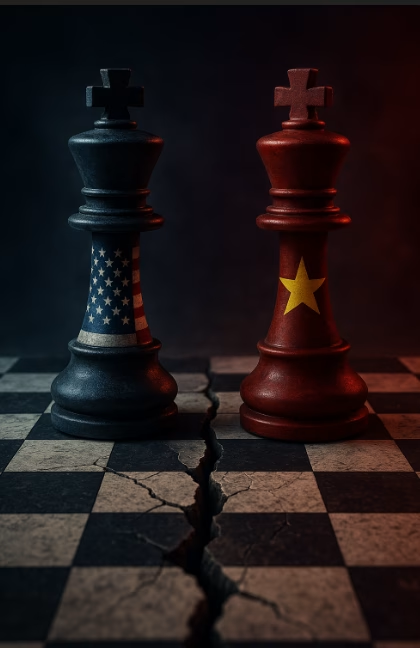
You can tell a lot about a man by what rattles him at 3 a.m. Some folks worry about retirement. Others replay old arguments, improving their lines like actors who know the show’s already closed. But me? The thing that keeps me staring at the ceiling isn’t Bitcoin’s correction or the S&P teetering at the top of its long, glorious cliff.
No — it’s the possibility of a war with China.
And let me tell you something plainly:
if the stock market ever does fall off that cliff, it won’t be because of some technical chart pattern. It’ll be because the world slipped into something darker than a recession.
See, lately everyone’s been reading charts like priests reading omens. One day we’re in “fear,” the next it’s “extreme fear,” like we’re measuring the weather on Mount Doom. Bitcoin drops 21% and everybody thinks the sky got loose from its hinges.
But the one line that stops the whole room cold is this:
“If the S&P corrects, Bitcoin corrects — and that’s going to be painful.”
Sure. But painful is nothing compared to what happens if the reason the S&P corrects has wings, warheads, and a flag painted red and gold.
Because here’s the truth nobody wants to say at these crypto conferences full of charts and enthusiasm:
Markets don’t crack from overvaluation — they crack from fear. And nothing injects fear into a global economy like the whisper of war between superpowers.
China knows this.
The U.S. knows this.
And every investor pretending to be a philosopher knows this too, deep down.
You could have the strongest Bitcoin cycle ever — institutions buying, ETFs filling up, supply shock kicking in — and all it takes is one spark in the South China Sea for that entire narrative to fall apart like a paper house in a hurricane.
People talk about “cycles” as if history ever cared about their models.
Tech cycles, halving cycles, liquidity cycles — all tidy, all comforting, all shattered instantly by events written in the ink of human foolishness.
And the most dangerous story of our age is the power story between the U.S. and China.
Two giants with too much pride to step back, too much power to be ignored, and too many chips on the table — literal chips — to walk away peacefully.
So here’s the uncomfortable truth my conscience drags out of bed every night:
If war ever breaks out between the U.S. and China, the markets won’t “correct.” They’ll collapse. Bitcoin won’t “dip.” It’ll fall through the floorboards. And the global economy, so carefully inflated with stimulus checks and optimism, will deflate like a lung punched empty.
Forget fear and greed indexes. A conflict like that creates a whole new category:
Survival.
And survival doesn’t care about bull markets.
It cares about supply chains. Food. Energy. Trade routes. Satellites. Semiconductors. Alliances. It cares about the kind of things the world hasn’t had to think about in a long time.
And here’s the bitter irony:
Everything that looks like noise in the charts right now — every correction, every stalled rally, every limp price movement — might just be the market whispering the truth that nobody wants to hear aloud:
“This peace is temporary.”
If you want to know what keeps me up at night, that’s it.
Not Bitcoin.
Not the S&P.
Not corrections, not halving cycles, not ETFs.
The nightmare scenario isn’t a bear market — it’s a real bear. The kind with armies, supply-chain chokeholds, and a territorial appetite.
The kind of bear that makes markets irrelevant.
And the darkest part?
Every empire thinks the other guy will blink first.
But history shows they blink last.
A Final Thought
If you look closely, fear always tells the truth. The markets tremble not because of what they know — but because of what they sense is coming.
And somewhere out there, two superpowers are standing on the same bridge… and neither one seems eager to step aside.
Sometimes, that’s all it takes to turn a chart correction into a chapter in a history book.
THE WARS WE’RE ALREADY FIGHTING with CHINA
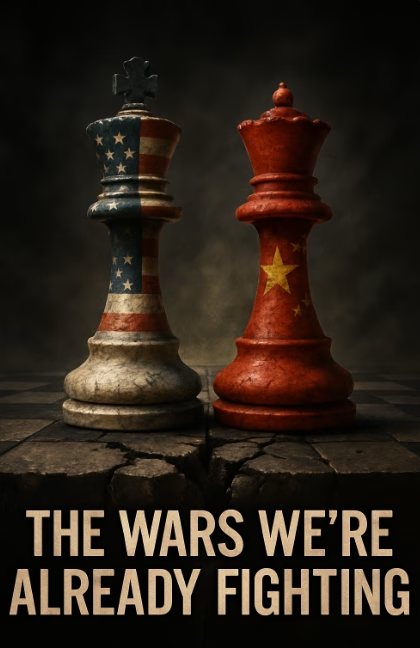
“The most dangerous wars are the ones fought in silence — long before anyone hears the first explosion. -- YNOT!
If you listen closely, you’ll notice that wars don’t start with sirens, speeches, or soldiers.
They start with small noises — a tariff here, a cyber poke there, a satellite that “accidentally” blinks out.
It always looks harmless until you lay the pieces side by side and realize the whole world has been holding its breath.
And right now, the United States and China are not “heading toward” conflict.
We’re already in it — just without the explosions.
The modern battlefield is much quieter.
Smarter.
More dangerous.
And half the time, folks don’t even know they’re standing on it.
So let me walk you through the front lines of the war we pretend isn’t happening.
1. AI — The Brain War
Artificial intelligence is the new nuclear weapon — except you don’t have to build a silo to hide it.
China wants the most powerful AI.
America wants the safest AI.
And both want the other to fail spectacularly.
This isn’t a race of machines.
It’s a race of futures.
The winner writes the rules.
The loser follows them.
2. Rare Earths — The Quiet Chokehold
These metals don’t sparkle, but without them, the modern world goes back to smoke signals.
China refines the majority.
America depends on them.
That’s not a supply chain — that’s a leash.
You can call it “trade” all you want, but when one country controls the ingredients for your entire technology stack, that’s not trade.
That’s power.
3. Gold — The Old Weapon Reborn
China buys gold like they know something.
America prints dollars like it hopes nobody notices.
Gold is patience.
Paper is faith.
And faith tends to wobble when the printing press runs hot enough to fry an egg.
China is hedging for a storm.
America is checking the weather and hoping the forecast is wrong.
4. Taiwan — The Spark That Could Light the World
Taiwan makes the chips that make the world run.
China wants it back.
America wants it left alone.
That’s not diplomacy — that’s two men holding the same gun, arguing about who promised to put it down first.
Taiwan isn’t a country.
It’s a fuse.
And everyone knows it.
5. Oil — The New Silk Road Showdown
China’s building pipelines, ports, and energy alliances like it’s knitting a global sweater.
America sees this and calls it “concerning.”
Concerning is the polite word for losing leverage.
Energy is the bloodstream of power.
And China’s laying new veins across half the planet.
6. The United Nations — Where Smiles Hide Knives
People think the UN is a table for peace.
It’s really a marketplace for influence.
China buys relationships.
America debates resolutions.
Guess which one works faster?
War today isn’t fought in trenches.
It’s fought in committees with very good coffee.
7. Cyber — The War We Pretend Isn’t a War
Every day:
- banks get probed
- grids get tested
- ports get mapped
- telecom gets poked
- government networks get rattled
Nobody fires a shot.
Nobody sends a bomber.
But the damage is real.
Cyber warfare is beautiful in a terrible way:
You can bring a country to its knees without ever being seen.
8. Space — The High Ground Nobody Can Admit They’re Fighting For
Satellites run:
- GPS
- communications
- markets
- weather
- surveillance
- targeting systems
China blinds them.
The U.S. protects them.
Russia jams them.
All three pretend it’s “routine testing.”
The first real shot of the next war won’t hit the ground — it’ll hit orbit.
9. Semiconductors — The Fragile Heartbeat of Civilization
Every weapon, every bank, every car, every drone, every intelligence system runs on chips.
If Taiwan falls, the global economy flatlines.
We don’t need World War III.
We only need one factory to stop.
10. Quantum — The Race to Break Every Secret
When quantum computing arrives, whoever holds it will read every message, crack every code, and see through every digital wall humanity has built.
It’s not a computer.
It’s the master key to the world’s lockbox.
11. Undersea Cables — The Achilles Heel Nobody Protects
The internet doesn’t live in the cloud.
It lives on the ocean floor.
Cut a few cables and you don’t cripple a nation — you blind it.
Right now, submarines are mapping, tapping, and “inspecting” these lines like hunters studying migration patterns.
12. Food & Water — The Real Leverage
A nation falls when groceries do.
China is buying farmland worldwide.
America is subsidizing farmers into extinction.
Food is diplomacy.
Water is survival.
Control either, and you control people.
13. Influence Networks — The Invisible Empire
China builds alliances with loans and construction crews.
America builds alliances with speeches and sanctions.
One gives you a port.
The other lectures you about democracy.
Guess which one developing nations choose?
THE REAL TRUTH
War doesn’t begin when the shooting starts.
It begins when two powers stop trusting each other and start preparing for the day they’ll have no choice.
By that measure, the U.S. and China aren’t “heading toward” conflict.
We are waist-deep in it, trading blows in a dozen arenas without ever admitting it’s happening.
And when history looks back, it will pretend these signs were obvious.
But today, most folks don’t see the war.
They only see the symptoms.
The crack always looks small…
until the ground breaks open and swallows everyone.
Why This Ship Might Exist: The Strategic Gap It Is Designed to Fill
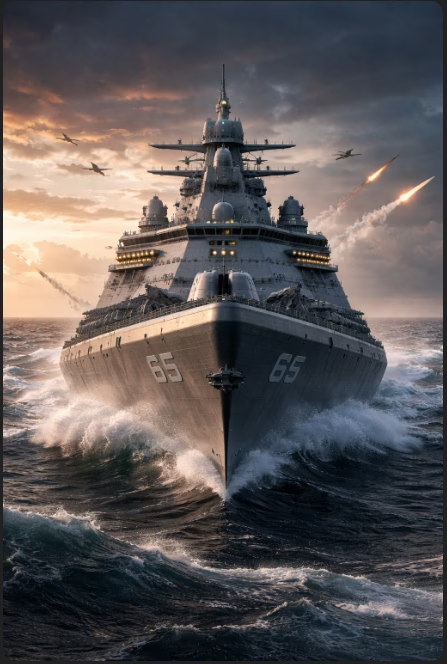
"You don’t build a ship like this to start a war — you build it so the other side decides not to" - YNOT!
Every generation believes it has outgrown the need for old ideas.
And every generation eventually rediscovers that physics, distance, and human nature are unimpressed by progress.
Right now, the argument isn’t really about a battleship. It’s about whether endurance still matters, whether logistics still decide wars, and whether a navy can project power without constantly stopping for gas like a confused Uber driver halfway across the ocean.
We’ve convinced ourselves that smaller, faster, cheaper, and unmanned will solve everything. And to be fair, those tools matter. But they don’t replace presence. They don’t command fleets. They don’t escort commerce across an ocean. And they don’t stay on station when things get ugly and prolonged — which history suggests they usually do.
Strip away the politics, the nostalgia, and the name on the hull, and what’s being proposed isn’t a throwback. It’s an admission: the U.S. Navy has a hole in its fleet. This ship exists not because we miss the past — but because we’ve finally run out of ways to avoid it.
The mistake people make is arguing about what to call the ship. Battleship. Cruiser. Strike platform. Capital surface combatant. History doesn’t care what name you give something — only whether it works when needed.
The real issue is this: modern naval warfare has exposed a quiet weakness. Our ships run out of fuel. They run out of missiles. They run out of time on station. And when that happens, presence collapses long before defeat is declared.
This ship is not about invincibility. It’s about staying power. About being able to escort, command, defend, refuel, and fight — without constantly retreating to reload or refuel. It is not meant to replace carriers or submarines, but to hold the surface together while they do their jobs.
In the end, navies win wars the same way they always have: by controlling distance, time, and supply. Technology changes the tools, but it doesn’t change the math.
You can call this ship whatever you like.
But if the Navy builds it, it won’t be because of nostalgia.
It will be because the ocean is still large, wars still last longer than planned, and somebody still has to stay out there when everyone else has to go home.
What This Really Means
Stripped of ceremony and polite language, this decision means the United States is preparing for the possibility of a real shooting war with China, not a counterinsurgency, not a limited strike, and not a proxy conflict. It reflects a recognition that shipbuilding timelines now matter as much as weapons systems — because China is producing surface combatants at a pace the U.S. cannot currently match, by some estimates an order of magnitude faster. And these are not disposable hulls. Many Chinese destroyers and cruisers are modern, well-armed, and broadly comparable in capability to Arleigh Burke–class ships. The uncomfortable question is whether the U.S. can build fast enough before such ships are needed — or whether signaling this buildup could even accelerate Beijing’s timetable on Taiwan. But the U.S. has little choice. Deterrence only works if it is visible, credible, and sustained. A fleet that cannot stay on station, cannot reload under pressure, and cannot replace losses quickly invites miscalculation. This ship is less about provoking conflict than about admitting that the industrial and naval balance has shifted — and that pretending otherwise is far more dangerous than preparing for it.
The proposed “battleship” — more accurately a large strike cruiser / capital surface combatant — is not a return to 1944 thinking. It is a response to a set of structural problems that the U.S. Navy has been unable to solve with destroyers, littoral ships, or aircraft carriers alone.
At its core, this ship exists to solve four modern naval problems:
- Endurance and station time
- Magazine depth
- Command-and-control survivability
- Logistics strain caused by gas-turbine escorts
These problems have become impossible to ignore in the Red Sea, Western Pacific, and extended escort operations.
1. Endurance Is Now a Strategic Weapon
The modern U.S. surface fleet is short-legged.
- Arleigh Burke destroyers burn fuel rapidly and require frequent replenishment
- LCS vessels are even more constrained
- Escort missions now require constant oiler support
- Auxiliary vessels are stretched thin and aging
A large surface combatant with diesel-cruise / turbine-sprint propulsion fundamentally changes this equation.
What This Enables
- Long-duration escort of commercial shipping
- Sustained presence without weekly replenishment
- Reduced dependence on scarce oilers
- The ability to loiter — not just transit
This matters because time on station wins wars, not maximum speed.
2. Magazine Depth Is the New Armor
In World War II, armor protected ships from shells.
In 2025, magazine depth protects fleets from exhaustion.
The Red Sea Problem
- Destroyers fired dozens of missiles per engagement
- Ships had to withdraw to reload
- Presence collapsed not from damage — but from depletion
A large combatant with:
- 120+ VLS cells
- CPS hypersonic strike
- Directed energy weapons
- Conventional naval guns
…can absorb sustained engagements without leaving the fight.
This ship is not designed to be invulnerable — it is designed to stay armed longer than the enemy can stay aggressive.
3. A Command Ship That Can Survive Modern Warfare
Aircraft carriers are powerful — but they are not ideal fleet command platforms in missile-saturated environments.
A large strike cruiser offers:
- Dedicated fleet command facilities
- Full C2 integration
- Flag officer accommodation
- Sensor fusion hub for unmanned systems
Historically, this was the role of cruisers and battleships.
That role never disappeared — it was simply left unfunded.
In a distributed fleet:
- Someone still needs to command
- Someone still needs to see everything
- Someone still needs to stay alive while doing it
This ship fills that role.
4. Logistics: The Silent Crisis This Ship Addresses
The Navy does not have enough:
- Oilers
- Replenishment ships
- Sealift capacity
Every Burke deployed increases strain on logistics.
A large surface combatant reduces net logistics demand by:
- Refueling smaller ships at sea
- Acting as a local logistics node
- Extending escort endurance without additional oilers
This mirrors how:
- Battleships supported destroyers in WWII
- Nuclear cruisers escorted nuclear carriers during the Cold War
This is not nostalgia — it is logistics math.
Why Size Matters (And Why Smaller Ships Cannot Do This)
Smaller ships cannot:
- Generate enough power for high-energy lasers
- Carry future railguns or EM weapons
- Absorb future system growth
- Support modular upgrades over decades
The Navy has repeatedly learned this lesson:
- Zumwalt lacked ammunition
- Constellation ran out of weight margin
- Burke has reached structural limits
Large hulls are not about ego — they are about future-proofing.
Integration With Unmanned Systems (The Missing Link)
This ship is not meant to operate alone.
Its true value emerges when paired with:
- Uncrewed surface vessels (USVs)
- Sensor pickets
- Missile barges
- Decoy platforms
- Drone carriers (future Langley-equivalents)
Think of it as:
A manned command core, surrounded by unmanned extensions.
Without a large, survivable hub, unmanned fleets become fragmented.
With one, they become force multipliers.
Why This Is Not “Just a Target”
The “big ship = big target” argument ignores reality:
- Aircraft carriers already exist
- Amphibious assault ships already exist
- Oilers already exist
The question is not visibility — it is value per target.
A ship that:
- Replaces multiple Burkes on station
- Reduces oiler dependency
- Provides fleet command
- Delivers deep magazines
- Supports unmanned warfare
…is more survivable strategically, even if not tactically invisible.
Historical Parallel (Without Romanticism)
This ship occupies the same role once held by:
- Heavy cruisers
- Battle cruisers
- Fast battleships
- Nuclear cruisers
Not because history repeats — but because naval physics does.
Range, endurance, power generation, and payload still scale with hull size.
Final Strategic Case
Call it:
- Battleship
- Strike cruiser
- Capital surface combatant
The name does not matter.
What matters is that the U.S. Navy currently lacks:
- A long-endurance surface flagship
- A deep-magazine escort leader
- A survivable command node
- A logistics-relieving combatant
This ship fills that gap.
Not as a replacement for carriers or submarines —
but as the missing keystone in a balanced fleet.
Below is a tight, persuasive rebuttal section you can drop directly into the piece.
Tone: MMT-adjacent, practical, unsentimental, and grounded in operational reality.
“Why Not Just Build More Burkes?” — A Necessary Rebuttal
This is the most common objection, and on the surface it sounds reasonable. The Arleigh Burke is a proven ship. It fights well. It has carried the Navy for more than three decades. So why not just keep building more of them?
Because the Burke has reached the end of what it can be — structurally, operationally, and strategically.
1. The Burke Is Physically Out of Room
The Arleigh Burke hull is maxed out.
- Weight margins are gone
- Power generation is constrained
- Cooling capacity is strained
- New systems are being bolted on instead of designed in
The Navy has already resorted to “muffin-top” modifications — external bulges added to keep the ship stable after cramming in more electronics. This is not innovation; it is structural exhaustion.
You can modernize software. You can upgrade sensors.
You cannot cheat physics indefinitely.
2. Burkes Are Fuel-Hungry by Design
Burkes are gas-turbine ships. Gas turbines are excellent for speed — and terrible for endurance.
As a result:
- Burkes require constant replenishment
- Oilers are stretched thin
- Escort missions become logistics exercises
- Time on station collapses long before combat power does
This was exposed clearly in the Red Sea, where Burkes had to withdraw not because they were damaged — but because they ran out of missiles and fuel.
Building more ships that require more fuel does not solve a logistics problem.
It multiplies it.
3. More Burkes Means Shallower Magazines
A Burke carries roughly 90–96 VLS cells.
That sounds like a lot — until you realize:
- Air defense consumes missiles rapidly
- Intercept ratios favor the attacker
- Reloading requires leaving the fight
Modern naval combat is not about single engagements. It is about sustained pressure. And sustained pressure demands deep magazines, not just more ships with shallow ones.
Ten Burkes withdrawing one by one to reload do not equal one ship that never leaves the station.
4. Burkes Are Poor Fleet Command Platforms
Burkes were never designed to be flagships.
They can host command staff — awkwardly.
They can manage battle groups — temporarily.
But they lack:
- Dedicated command spaces
- Long-duration C2 endurance
- The survivability margins expected of a fleet command node
This is why the Navy historically relied on cruisers and battleships to lead fleets. And it is why losing the Ticonderoga class created a command vacuum that destroyers cannot comfortably fill.
5. More Burkes Lock the Navy Into Yesterday’s Fleet Architecture
Every Burke built today locks the Navy into:
- High fuel dependency
- Frequent withdrawal cycles
- Escort-centric logistics chains
- Limited growth potential
Meanwhile, future warfare demands:
- Directed energy weapons
- Railguns
- Hypersonic strike
- Unmanned system integration
- Massive power generation
The Burke cannot scale into this future. It can only be patched toward it.
6. Quantity Does Not Replace Persistence
A fleet built entirely around Burkes is a fleet optimized for transit, not presence.
Presence requires:
- Endurance
- Station time
- Logistics independence
- The ability to absorb losses and keep fighting
That is what large surface combatants provide — not by being invulnerable, but by being operationally stubborn.
The Real Answer
The question isn’t:
“Why not build more Burkes?”
The real question is:
“Why does the Navy have no ship that can stay out longer than a destroyer, carry more than a cruiser, and command a fleet without burning through logistics?”
Burkes are indispensable — and insufficient.
Building more of them without building something larger is not a strategy.
It is a habit.
And history shows that navies lose wars not because they lacked good ships — but because they built too many of the wrong kind.
Below is a clear, doctrine-level comparison table that puts the proposed Large Surface Combatant / “Battleship” concept in context against Arleigh Burke, Ticonderoga, Zumwalt, and the Iowa class.
This is written to support analysis, not hype, and to make the trade-offs obvious.
U.S. Navy Capital & Major Surface Combatants — Comparative Overview
| Category | Proposed Large Surface Combatant (Defiant-type) | Arleigh Burke (DDG-51 Flight I–III) | Ticonderoga (CG-47) | Zumwalt (DDG-1000) | Iowa Class (BB-61) |
|---|---|---|---|---|---|
| Commission Era | Conceptual / Future | 1991–present | 1983–1994 | 2016–present | 1943–1950 |
| Primary Role | Fleet command, long-endurance strike, air & missile defense | Multi-mission destroyer | Fleet air defense / command cruiser | Advanced strike / tech demonstrator | Heavy surface combat / shore bombardment |
| Displacement (full) | ~35,000–40,000+ tons | ~9,800–10,200 tons | ~9,800 tons | ~15,600 tons | ~57,000 tons |
| Length | ~840–880 ft | ~509 ft | ~567 ft | ~610 ft | ~887 ft |
| Beam | ~105–115 ft | ~66 ft | ~55 ft | ~80.7 ft | ~108 ft |
| Crew | ~650–850 | ~300–330 | ~330–360 | ~140–160 | ~1,900–2,700 |
| Propulsion | Diesel cruise + gas turbine sprint (option for future nuclear) | Gas turbines only | Gas turbines only | Integrated electric propulsion (gas turbine) | Steam turbines (oil-fired boilers) |
| Range / Endurance | Very high (designed for long station time) | Limited by fuel consumption | Limited by fuel consumption | Moderate, still fuel-dependent | Extremely high (logistics-intensive but long-range) |
| VLS Cells | ~128+ Mk 41 (plus CPS tubes) | 90–96 | 122–128 | 80 | None |
| Hypersonic Capability | Yes (CPS) | Planned / limited | No | Yes (primary role) | No |
| Main Gun Armament | Railgun (future) + 5″ guns | 5″/62 Mk 45 | 5″/54 Mk 45 | 155 mm AGS (no ammo) | 9 × 16″ guns |
| Directed Energy | Yes (300 kW class lasers) | Limited / experimental | None | Planned / experimental | None |
| Radar / Sensors | SPY-6 (full suite) | SPY-1 → SPY-6 (Flight III) | SPY-1 | Advanced dual-band radar | WWII-era analog |
| Flagship / C2 Capability | Yes (designed as fleet command node) | Limited | Yes | Limited | Yes (historically) |
| Logistics Support Role | Can refuel / sustain escorts | No | No | No | Yes (historically) |
| Upgrade Margin | Very high | Near limit | End of life | Limited by class size | None (obsolete systems) |
| Survivability Philosophy | Redundancy, endurance, layered defense | Aegis defense, maneuver | Aegis defense, command role | Stealth, automation | Heavy armor |
What This Table Actually Shows (Key Takeaways)
1. Burke Is the Workhorse — and It’s Exhausted
- Excellent multi-role ship
- But fuel-hungry
- Limited magazine depth
- Structurally maxed out
- Not designed to loiter for months
2. Ticonderoga Was the Last True Surface Flagship
- Deep VLS
- Strong command facilities
- But aging, manpower-heavy, and being retired
- No true replacement exists today
3. Zumwalt Is Not a Fleet Anchor
- Technologically impressive
- Minimal crew
- Poor magazine depth
- Designed for niche strike roles, not command or escort leadership
4. Iowa Solved Endurance — at an Enormous Cost
- Incredible staying power
- Could support other ships
- But manpower, armor, and gun-centric design are obsolete
- Logistics footprint is unacceptable today
5. The New Ship Is a Hybrid — Not a Revival
It combines:
- Iowa-level endurance logic
- Ticonderoga-level command role
- Burke-level sensor integration
- Zumwalt-era power generation concepts
Without inheriting:
- Iowa manpower
- Zumwalt fragility
- Burke fuel limitations
Strategic Bottom Line (Why This Comparison Matters)
This comparison makes one thing clear:
The U.S. Navy currently has no ship that can stay out, stay armed, stay supplied, and stay in command — all at once.
That gap did not exist in:
- WWII (battleships & cruisers)
- Cold War (nuclear cruisers)
- Early Aegis era (Ticonderoga)
It exists now.
This proposed ship is not about firepower nostalgia — it is about operational persistence, something none of the existing surface combatants can deliver alone.
Below is a clean, factual sidebar you can drop into the article.
Tone: analytical, restrained, and deliberately non-alarmist — but unmistakably serious.
Sidebar: China vs. U.S. Shipbuilding — The Industrial Reality
For decades, the United States assumed that qualitative superiority would offset quantitative decline. That assumption is now under strain.
Shipbuilding Pace
- China is currently producing naval surface combatants at a rate many times faster than the United States, with estimates often ranging from 5× to 20×, depending on ship class and year.
- The U.S. builds ships sequentially; China builds them in parallel, across multiple large shipyards with fewer workforce and supplier bottlenecks.
- Chinese yards routinely launch multiple destroyers per year, while U.S. yards often struggle to deliver a single major combatant on schedule.
This is not merely efficiency — it is industrial mass.
Ship Quality Is No Longer the Weak Link
A critical misconception is that Chinese ships are “cheap” or technologically inferior. That may have been true twenty years ago. It is not true today.
- Modern Chinese destroyers, such as the Type 052D and Type 055, field:
- Advanced phased-array radars
- Large VLS batteries
- Long-range anti-ship and air-defense missiles
- Integrated air and missile defense comparable in role to U.S. cruisers and destroyers
The Type 055, in particular, is widely assessed as closer in size and capability to a U.S. cruiser than a destroyer.
In practical terms, many of these ships are roughly comparable in combat role to the U.S. Arleigh Burke-class destroyer, especially when operating in coordinated groups under shore-based sensor and missile coverage.
Fleet Mass vs. Individual Excellence
The U.S. Navy still holds advantages in:
- Combat experience
- Sensor fusion
- Submarine warfare
- Carrier aviation
But China is compensating by building more ships, faster, and organizing them into layered defensive and offensive systems supported by land-based missiles, aircraft, and ISR.
Quantity, at a certain point, becomes its own form of quality.
The Strategic Implication
For the United States, this means the problem is no longer just tactical superiority — it is sustained presence.
- Can ships remain on station long enough?
- Can magazines outlast engagements?
- Can losses be replaced during a conflict rather than after it?
China’s advantage is not merely in hull count, but in the ability to regenerate combat power during a war — something the U.S. industrial base has not been structured to do since the Cold War.
This is the backdrop against which new large surface combatants must be evaluated. They are not a response to yesterday’s navy — but to a rival that is building tomorrow’s fleet at today’s speed.
Below is a compact, side-by-side mini-table suitable for a sidebar or callout box.
It is deliberately restrained and factual, avoiding hype while making the comparison clear.
Mini-Table: Type 055 vs. Arleigh Burke
| Category | Type 055 (China) | Arleigh Burke (U.S.) |
|---|---|---|
| Class / Role | Large destroyer / cruiser-equivalent | Multi-mission guided missile destroyer |
| Commissioning | 2020–present | 1991–present |
| Displacement (full) | ~12,000–13,000 tons | ~9,800–10,200 tons (Flight III) |
| Length | ~590 ft (180 m) | ~509 ft (155 m) |
| VLS Cells | ~112 universal VLS | 90–96 Mk 41 VLS |
| Primary Sensors | AESA phased-array radar (Type 346B) | Aegis SPY-1 / SPY-6 (Flight III) |
| Air & Missile Defense | Area air defense, fleet escort | Area air & ballistic missile defense |
| Strike Capability | Anti-ship, land-attack, ASW missiles | Anti-air, BMD, strike, ASW |
| Propulsion | Gas turbines (CODAG-like architecture) | Gas turbines only |
| Crew Size | ~300 | ~300–330 |
| Command Role | Often functions as task-group flagship | Limited flagship capability |
| Build Rate | Multiple hulls per year | 1–2 hulls per year (variable) |
What This Comparison Shows
- The Chinese Type 055 destroyer is closer in size and role to a cruiser than a traditional destroyer.
- It carries more vertical launch capacity than a Burke and is routinely deployed as a fleet command ship.
- The U.S. Arleigh Burke-class destroyer remains more combat-proven and benefits from superior integration with carrier aviation and undersea forces.
- The key difference is not one-on-one performance, but numbers and regeneration: China can commission multiple Type 055 and Type 052D hulls while the U.S. struggles to replace retiring cruisers.
In short, the Burke is still an excellent ship — but it is no longer operating in an environment where it is unmatched by peer surface combatants, especially when facing fleets built faster, in greater numbers, and supported by land-based sensors and missiles.

The name Defiant carries a quiet but deliberate symbolism, drawn from Star Trek: Deep Space Nine, where the USS Defiant was introduced not as a graceful explorer, but as something Starfleet had never openly admitted it needed before: a purpose-built warship. In the series, the Defiant was compact, overpowered, uncomfortable, and initially unstable — designed specifically to fight a peer threat that had shattered earlier assumptions about deterrence and superiority. It existed because diplomacy and presence alone were no longer sufficient. That symbolism maps cleanly onto the modern naval moment. Naming a ship Defiant is not nostalgia or fan service; it is an implicit acknowledgment that the era of uncontested dominance has ended, that restraint without strength invites challenge, and that deterrence now requires platforms designed first and foremost to survive, endure, and fight when avoidance fails. In that sense, Defiant is less a boast than a warning — not of aggression, but of resolve.
Predictions for 2026: A Forecast Written in Pencil, Not Ink

Things are never as bad as you think they are, nor as good as you hope. -- UNKNOWN!
Predictions are dangerous things. They age faster than milk and lie more confidently than politicians. Still, people keep asking for them, so let’s oblige—carefully, with a sense of humor, and with our hand hovering near the eraser.
This is forecast based on what I have learned overtime, which means we’ll talk less about superstition and more about incentives, power, human nature, and the quiet math running underneath the shouting.
1. Geopolitics in 2026: A World of Pretend Stability
By 2026, the world will look calmer on television than it feels in real life. That’s not peace—that’s choreography.
The United States will still be the central pillar of the global system, but it will behave more like a tired landlord than a conquering empire. Less enthusiasm for foreign adventures, more interest in managing the building before the pipes burst. Expect fewer speeches about saving the world and more memos about “strategic restraint.”
China will continue its long game: patience, pressure, and paperwork. No dramatic invasions. No Hollywood moments. Just quiet leverage—trade routes, supply chains, ports, rare earths, silver and debt. Power in 2026 will look boring by design.
Russia will remain a spoiler rather than a leader—loud, disruptive, and economically constrained. Its influence will come from friction, not growth. Expect it to keep kicking the chessboard rather than winning the game.
The real geopolitical shift won’t be about borders. It will be about who controls logistics, energy, compute, and currency plumbing. Flags matter less than flows.
Twist: The next global power won’t announce itself with tanks. It will show up as a bottleneck.
2. Economics in 2026: Inflation’s Hangover, Debt’s Quiet Smile
By 2026, inflation won’t be gone—but it will be boring again. And boring inflation is the most political kind, because it convinces people the danger has passed while quietly rearranging wealth.
Governments will keep running deficits, loudly pretending they are temporary, and silently knowing they are permanent. Debt will grow, but panic will not—because the system has learned something uncomfortable: collapse is optional if credibility holds.
Interest rates will matter less than confidence. Central banks will talk tough, then blink. Not because they’re incompetent, but because the alternative breaks too many things at once.
The Unspoken truth will keep proving itself:
- Sovereign currency issuers don’t “run out of money.”
- They will let the banks do their dirty work through free loans.
- They run out of political trust.
And trust, in 2026, will be the scarcest asset of all.
Twist: The crisis won’t be debt. The crisis will be pretending debt is the crisis.
3. Money in 2026: Real, Digital, and Psychological
By 2026, digital currencies won’t overthrow the system—but they will expose it.
Central Bank Digital Currencies will expand quietly, framed as “efficiency” and “inclusion,” while functioning as better ledgers and faster enforcement tools. Crypto won’t disappear; it will mature into a pressure valve rather than a revolution. Governments will still be afraid of it and want to put the Genie back in the bottle.
Gold will not explode overnight. It will do something more insulting to speculators: it will work slowly. Steadily. Without drama. Perhaps $6000 an ounce, because either war or spending will continue.
Stocks will remain elevated longer than logic allows, because liquidity is addictive and withdrawal is painful. Valuations will look absurd—right up until they look obvious in hindsight. A 50% drop is possible at some point.
Twist: In 2026, money won’t collapse. People’s faith in what money is for will.
4. Conflict in 2026: Controlled Fires, Not World War
There will be wars in 2026. There just won’t be the one everyone’s waiting for.
Conflicts will stay regional, asymmetric, and deniable. Drones instead of divisions. Sanctions instead of sieges. Cyber disruptions instead of declarations.
The era of total war is too expensive, too visible, and too final. The new model is permanent friction—enough tension to justify budgets, not enough to trigger collapse.
Peace will exist, but it will feel more like a ceasefire with a calendar reminder.
Twist: The most dangerous battles won’t be fought. They’ll be simulated—until someone forgets they’re simulations. Thousands will keep dying in proxy wars.
5. The Human Factor: The Variable Everyone Ignores
Here’s the part spreadsheets hate.
By 2026, people will be tired—financially, emotionally, and cognitively. Long cycles of stress don’t end with explosions; they end with disengagement.
Voters will care less about ideology and more about competence.
Workers will care less about loyalty and more about leverage.
Nations will care less about morality and more about survival optics.
The loudest voices will keep arguing about left versus right, while the real divide quietly widens between those who understand systems and those who believe stories.
6. AI in 2026: Compute Is the New Oil, and Everyone Wants the Refinery
By 2026, AI will no longer be introduced with fanfare. It will be assumed—like electricity, or gravity, or taxes. The excitement phase will be over. The billing phase will begin. Expect government program so that poor people can access AI.
The economic story of AI is not about consciousness or robots stealing jobs. It is about who owns the shovels, who controls the grid, and who sends the invoice.
NVIDIA: The Toll Booth on the Road to the Future
NVIDIA will still be standing where everyone has to pass. Not because it is magical, but because it solved the unglamorous problem first: how to turn silicon into usable intelligence at scale.
By 2026, NVIDIA will look less like a chip company and more like an infrastructure landlord. Margins will remain high not because competition vanished, but because switching costs are brutal. Once an economy rewires itself around a specific compute stack, it does not casually change brands.
The market will complain about valuation. It always does. The market will also keep paying—because the alternative is falling behind.
This is not a bubble asset. It is a capacity asset. Capacity assets don’t pop; they get regulated, taxed, or rationed.
OpenAI: Intelligence as a Utility, Not a Product
OpenAI in 2026 will not be selling “AI magic.” It will be selling reliability.
The real economic shift is that intelligence—once scarce, slow, and human-bound—will become cheap, fast, and machine-scaled. That does not eliminate human value; it raises the minimum bar for relevance.
AI will not replace managers. It will expose bad ones.
It will not replace writers. It will expose lazy ones.
It will not replace analysts. It will expose people who never understood the numbers to begin with.
The business model will resemble utilities: usage-based pricing, enterprise contracts, quiet integration into everything from accounting to warfare.
Twist: The biggest risk to OpenAI is not regulation. It is being so useful that governments decide it cannot be allowed to fail.
Oracle: The Unfashionable Winner
Oracle will not dominate headlines, but it will dominate invoices.
AI needs three things: compute, data, and persistence. Oracle already owns the last two for much of the corporate world. In 2026, it will quietly position itself as the boring backbone—the place where AI systems actually run when hype gives way to compliance, uptime, and liability.
This is where many AI dreams will land: inside databases, ERP systems, logistics platforms, and government backends that do not care about vibes—only results.
The future is built by visionaries, but it is paid for by accountants.
The Economics of AI: Deflationary Power, Inflationary Control
Here is the paradox of AI in 2026:
- AI is deflationary at the task level (cheaper analysis, faster work).
- AI is inflationary at the system level (massive capital expenditure, energy demand, compute scarcity).
Governments will subsidize AI openly or quietly, because productivity growth is the only politically acceptable way to escape debt pressure without austerity.
Energy, chips, and data centers will become strategic assets. Expect policy fights not over AI ethics—but over who gets priority access when demand spikes.
Twist:
In 2026, AI will not cause mass unemployment.
It will cause mass re-pricing of competence.
And the world will discover—somewhat rudely—that intelligence was never free. It was just poorly measured.
7. What Regular People Can Expect in 2026: Fewer Fireworks, More Fine Print
If you are not a hedge fund, a government, or a man with twelve monitors and a nervous twitch, 2026 will feel less like a crisis and more like a long bill slowly sliding across the table.
No collapse. No miracle. Just consequences—spread out enough that people argue about whether they’re real.
Let’s talk plainly.
Food: More Expensive, Less Shocking
By 2026, food prices will stop making headlines and start making excuses.
You won’t hear “supply chain crisis” much anymore. That phrase has been retired with honors. Instead, prices will stay high because the system discovered it could keep them there.
Food inflation will cool, but it will not reverse. The grocery bill becomes a fixed annoyance—like taxes or insurance—something you budget around rather than protest.
Shrinkflation stays. Quality quietly declines. Labels get friendlier while portions get smaller. You will buy more and wont lose any weight.
Twist: The system didn’t break. It adjusted—to your expense.
Oil & Energy: Volatile, Strategic, Unavoidable
Oil in 2026 will not be cheap, and it will not be permanently expensive. It will be political.
Energy prices will swing on headlines, wars, elections, and regulations—but the floor keeps rising. Not because oil is running out, but because investment is constrained and demand never quite leaves.
Electric vehicles help at the margins, but energy is still energy. Trucks, ships, planes, generators, fertilizers—all of them drink from the same well.
Gas prices will calm down just enough to keep people from revolting, and spike just enough to remind everyone who’s in charge.
Twist: Energy independence will be discussed endlessly—and achieved nowhere completely.
Real Estate: Boring on Paper, Brutal in Practice
In 2026, real estate will look “stable” in reports and feel impossible in real life.
Prices won’t crash nationally. They rarely do. Instead:
- High prices stick.
- High rates linger.
- Transactions slow.
Homes will exist. Buyers will exist. The two just won’t agree.
Renters will feel trapped.
Owners will feel stuck.
Builders will hesitate.
Investors will wait.
The market won’t collapse—it will freeze, and freezes hurt regular people more than professionals.
Twist: Housing won’t become affordable again. People will simply lower their expectations quietly.
401(k)s & Retirement: Higher Numbers, Lower Confidence
By 2026, retirement accounts will probably look okay on paper. Markets have a way of floating when liquidity is plentiful and reality is delayed.
But confidence will be thin.
People will notice something unsettling:
- Balances rise.
- Purchasing power doesn’t.
- Volatility feels permanent.
Retirement shifts from a finish line to a moving target. More people plan to “work a little longer,” not because they want to—but because the math stopped being comforting.
Twist: The real retirement crisis won’t be market losses. It will be realizing the old formulas no longer apply.
The Big Picture for Regular People
2026 will not be a year of panic.
It will be a year of adaptation.
People will:
- Budget more carefully.
- Trust institutions less.
- Rely on themselves more.
- Stop expecting things to go “back to normal.”
Because here’s the quiet truth no one advertises:
Normal didn’t disappear.
It was replaced.
And the people who do best in 2026 won’t be the ones who predict the future perfectly—but the ones who accept, sooner than most, that the rules already changed.
Final Twist:
History doesn’t usually change because of one big event.
It changes because enough people quietly stop believing the old explanations—and start behaving accordingly.
And by 2026, that shift will already be underway.
And tomorrow we will talk about what you can do to make it better for you.
2026 is the Year of the Fire Horse - What does that mean to millions of people
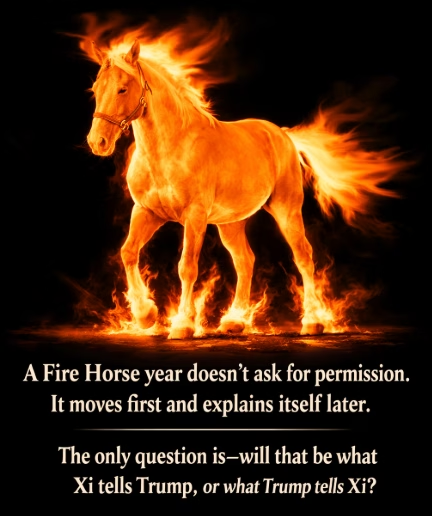
A Fire Horse year doesn’t ask for permission. It moves first and explains itself later. The only question is — will that be what Xi Jinping tells Donald Trump, or what Trump tells Xi? -- YNOT!
I’m a scientist.
I like measurements, margins of error, and things that can be repeated without chanting or incense. I’m a stoic by temperament, an agnostic by conviction, and a skeptic by survival instinct. I don’t believe in things. Not exactly, anyway.
But after enough years of watching the world misbehave on schedule, I’ve learned something that works with suspicious consistency.
It’s the Chinese calendar.
Now relax. I’m not saying the planets whisper secrets to pandas, or that destiny rides in on a dragon at midnight. I’m saying something far more uncomfortable for a rational mind: patterns matter, even when we don’t like the explanation attached to them.
And in 2026, the pattern says this is the Year of the Horse.
Not just any horse. A Fire Horse.
That distinction matters.
A normal horse runs. A Fire Horse charges. It doesn’t ask permission, it doesn’t fill out paperwork, and it certainly doesn’t wait for consensus. It sees an open field and decides—correctly or catastrophically—that now is the time.
Here’s the part that makes engineers nervous and philosophers reach for aspirin: the Chinese believe this stuff. Not like a horoscope taped to a refrigerator, but culturally, historically, structurally. Governments, businesses, families—millions of decisions are nudged, consciously or not, by this framework.
And when enough people believe a thing, it stops being superstition and starts becoming a force.
Belief has mass. Mass bends trajectories.
So what does a Fire Horse year tend to do?
It accelerates everything.
Decisions get faster. Mistakes get bigger. Leaders stop hedging and start swinging. Markets don’t drift; they lunge. Technology doesn’t “roll out”; it explodes into the room and rearranges the furniture.
Fire Horse years aren’t polite. They don’t like stability. They expose weak structures the way wind exposes rotten beams. Systems built on leverage, illusion, or deferred accountability suddenly discover gravity again.
This is not a year for half-measures. Bureaucracies suffer. Committees sweat. People who have been hiding behind process find that process no longer protects them.
On the upside, breakthroughs happen quickly. Courage is rewarded. Momentum compounds. On the downside, overconfidence pays interest in blood, money, or reputation.
And here’s the uncomfortable part for fellow skeptics: it doesn’t matter whether the calendar is “true.” What matters is that large parts of the world behave as if it is.
Reality is often downstream from belief.
So when the Chinese calendar says 2026 is a year of movement, heat, speed, and risk, what it’s really telling us is this:
Strap things down. Decide who’s holding the reins. And don’t pretend the horse isn’t moving.
You don’t have to believe in the calendar.
You just have to notice that it keeps showing up right on time.
“I don’t believe in the Chinese calendar. I believe in what happens when millions of people do.” --YNOT!
LET US GET INTO THE DETAILS of 2026 FIRE HORSE
Chinese Lunar New Year 2026 falls on Feb. 17. This 15- day celebrations ends on the evening of March 3 with the Lantern Festival. It marks the beginning of a new year on the traditional lunisolar calendar and transition of the zodiac.
- Zodiac animal: Horse
- Element: Fire (Yang Fire)
Traditional associations
- Energy, momentum, independence, and speed
- Bold action, risk-taking, and strong leadership impulses
- Fire Horse years are often described as volatile but transformational—high upside paired with higher risk
1. Geopolitics — Acceleration, Not Stability
Fire Horse years historically correlate with movement, disruption, and decisive action, not gradual diplomacy.
What this suggests for 2026
- Increased probability of sudden geopolitical moves rather than slow negotiations
- Nations act unilaterally more often; alliances are tested
- Military posturing, sanctions, and economic pressure escalate quickly once initiated
- High likelihood of flashpoint events rather than long wars starting quietly
Risk profile
- Miscalculation risk rises: fast actors move before consensus forms
- Diplomatic restraint is weaker; leaders feel pressure to “act now”
2. Markets — Volatility With Directional Conviction
Fire Horse energy maps well to trend acceleration, not sideways markets.
Likely characteristics
- Strong sector rotations rather than broad market calm
- Momentum trades dominate fundamentals for stretches
- Speculative excess appears early, not late, in cycles
- Sharp corrections occur when leverage outruns reality
What tends to do well
- Commodities (especially energy and strategic materials)
- Defense, infrastructure, and AI-adjacent sectors
- Assets tied to speed, scale, and power concentration
What struggles
- Over-leveraged firms
- Companies dependent on cheap capital
- Slow, bureaucratic incumbents without narrative momentum
3. Leadership — Bold Figures Gain Ground
Fire Horse years favor decisive, polarizing leaders over consensus builders.
Observed pattern
- Leaders who project strength, certainty, and speed gain influence
- Bureaucratic or overly cautious leadership is punished
- Narrative control matters more than technical correctness
Organizational impact
- Centralized decision-making increases
- “Move fast, fix later” mentalities dominate
- Institutions fracture between traditionalists and accelerators
This applies equally to politics, corporations, and cultural leadership.
4. Technology & AI — Rapid Adoption, Weak Guardrails
Fire Horse energy aligns strongly with technological leap periods.
Expect
- Faster AI deployment than regulation can match
- Corporate adoption outpaces public understanding
- Ethical frameworks lag behind capability increases
Risk
- Trust gaps widen
- Power concentrates in fewer platforms
- Backlash emerges after adoption, not before
5. Society — Restlessness and Rebellion
On a social level, Fire Horse years produce impatience with stagnation.
Manifestations
- Rising intolerance for inefficiency and hypocrisy
- Cultural movements accelerate quickly, burn hot, and fragment
- People change jobs, locations, and identities more readily
- “Exit behavior” increases (leaving institutions rather than reforming them)
Bottom Line
2026 is unlikely to be calm, balanced, or incremental.
It favors:
- Speed over caution
- Conviction over consensus
- Momentum over stability
Handled well, it is a year of breakthroughs and decisive advantage.
Handled poorly, it becomes a year of overreach and backlash.
“Belief doesn’t need to be true to be powerful. It only needs enough people to act on it.”--YNOT!
Is 2026 the Year Silent Wars Become Noisy?
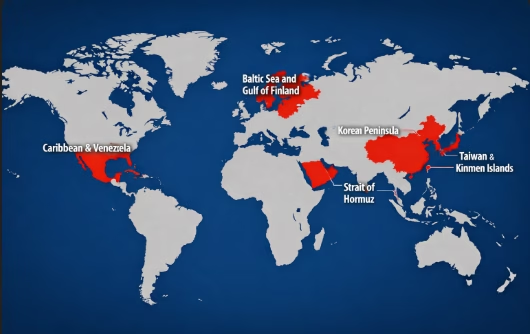
“If you look at history, war isn’t announced—it just keeps raising the volume until denial can no longer hear itself think.” --YNOT!
War is already burning in Europe, and every morning the news sounds a little more like a prelude than a report. The unsettling part isn’t the explosions we can see—it’s the ones being carefully rehearsed just offstage. The quiet wars. The “don’t-look-here” wars. The kind that don’t ask permission before they get loud.
So let’s take a sober walk through the flashpoints that could crack open in 2026. Not the obvious ones—the ones people argue about on television—but the places where pressure is building while everyone pretends it isn’t.
Let’s begin somewhere unexpected: the Caribbean.
That’s usually where you go to forget about geopolitics, not confront it. But right now, the United States is assembling one of the largest naval and military presences the region has seen in years, and this is not a long-term sightseeing tour. The focus is Venezuela. The goals are blunt and unromantic: remove Nicolás Maduro, choke off human trafficking northward, redirect oil wealth back toward Venezuelans instead of criminal networks, and reduce the drug flow poisoning American cities.
You don’t assemble that kind of force unless you intend to use it—or at least want everyone watching to believe you might. Military buildups are expensive, politically noisy, and hard to sustain. They exist for a reason. That makes Venezuela one of the fastest-moving flashpoints on the board, where events could escalate suddenly and decisively.
Zoom out, and the pattern becomes clearer. Across the globe, we’re seeing more sabotage, more aggressive naval maneuvers, more aircraft testing boundaries they technically didn’t cross—except they did. These are not accidents. They are probes. And probes are what you do before you strike.
In Europe, Russia has learned an uncomfortable lesson: muted responses invite repetition. Vladimir Putin’s invasion of Ukraine continues to bleed his country, but it has also taught him where NATO hesitates. Expect him to lean into gray-zone tactics—sabotage, cyber interference, deniable maritime operations—especially in northern waters.
The Baltic Sea, and particularly the Gulf of Finland, is one of the most dangerous places on Earth right now. Russian-linked vessels—part of the so-called shadow fleet—move through narrow chokepoints, suspected of cutting undersea internet cables, launching drones, and skirting sanctions. This same fleet quietly keeps Russia’s oil economy alive, funneling barrels to whoever will pay. Roughly 80 percent of Russian oil exits through this corridor.
Add to that Russian fighter jets flirting with NATO airspace, forcing rapid-response scrambles, and you have all the ingredients for a “miscalculation” that no one can walk back from. If 2025 is any guide, the Baltic doesn’t need much encouragement to explode.
Then there’s the Korean Peninsula—technically still at war, just paused by paperwork. The demilitarized zone isn’t peace; it’s a buffer holding back two armies that never signed a settlement. What’s changed is the confidence of the man in Pyongyang.
Kim Jong-un is no longer acting alone. He is supplying a staggering share of Russia’s ammunition, advancing his nuclear and missile programs, and being paraded as a legitimate power broker alongside Moscow and Beijing. That kind of validation does things to a man. Dangerous things.
If the United States becomes distracted elsewhere—Ukraine, Taiwan, the Middle East—or reduces its presence in South Korea, Kim may decide the moment has arrived. Reunification, by force, would not begin gently. With nuclear weapons in play, his opening move could be catastrophic. Seoul sits within range. The question is not whether the world could respond—but how it would, and how fast.
Shift east, and the tension tightens further.
China has made its intentions toward Taiwan unmistakably clear. Xi Jinping doesn’t speak in hypotheticals. Taiwan, increasingly confident in its own sovereignty, sees itself as a separate nation. Beijing sees an errant province. Both cannot be right, and both are preparing accordingly.
But the most interesting chess piece here may not be Taiwan itself—it’s the Kinmen Islands. Tiny, rocky outposts sitting just miles from the Chinese coast, far closer than Taiwan proper. China could seize them with minimal force and then stop. Wait. Watch. See who blinks.
Would the United States go to war with China over a handful of rocks? Would Taiwan? Would anyone? That answer would tell Beijing everything it needs to know about the international community’s resolve—and 2026 may be the year China asks the question out loud.
Finally, there’s the place nobody likes to talk about until it’s too late: the Strait of Hormuz.
Nearly half of the world’s oil and gas passes through that narrow channel. Iran knows this. Iran has always known this. And while it has remained relatively restrained amid recent Israeli and American strikes, restraint is not the same as surrender.
If internal unrest grows, or if pressure from the West increases, Iran has a simple, devastating option: close the strait. No missiles required. Just enough disruption to send energy markets into chaos and shock the global economy awake. A cornered power doesn’t need a grand strategy—it needs a pressure point. Hormuz is one of the biggest on Earth.
So is 2026 the year silent wars become noisy?
History suggests this: wars rarely begin with speeches. They begin with testing. With small moves everyone pretends are meaningless—until they aren’t. The world isn’t short on weapons or grievances. What it’s short on is patience.
And patience, once it runs out, tends to make a very loud sound.
SO what are the odds?
- Venezuela / Caribbean (United States, Venezuela, Colombia, Caribbean states):
A sustained U.S. military buildup suggests Washington may be preparing to forcibly resolve Venezuela’s collapse rather than manage it.
Estimated odds of armed conflict in 2026: 30–40%
- Baltic Sea & Gulf of Finland (Russia, NATO, Finland, Estonia, Latvia, Lithuania, Sweden):
Russia’s shadow fleet, sabotage, and airspace violations are turning NATO’s northern flank into a live wire waiting for a spark.
Estimated odds of armed conflict in 2026: 35–45%
- Korean Peninsula (North Korea, South Korea, United States, China, Russia):
An emboldened, nuclear-armed North Korea may see global distraction as a rare window to force reunification on its terms.
Estimated odds of armed conflict in 2026: 25–35%
(Low probability, catastrophic consequence)
- Taiwan & Kinmen Islands (China, Taiwan, United States, Japan):
China could seize a small, symbolic target to test whether deterrence still exists—or whether it has already expired.
Estimated odds of armed conflict in 2026: 40–50%
(Especially via limited or “test” actions rather than full invasion)
- Strait of Hormuz (Iran, United States, Israel, Gulf States, Global energy markets):
Iran doesn’t need war—closing this chokepoint alone would be an act of economic warfare felt worldwide.
Estimated odds of armed conflict in 2026: 20–30%
(Higher odds of disruption than open naval war)
The dangerous thing about 2026 isn’t that war is inevitable—it’s that everyone is testing how much violence they can get away with without triggering one. History shows that this game usually ends the same way: someone misreads the room, and silence breaks.
History doesn’t usually announce the year a war begins—it circles it quietly, raising the volume one provocation at a time. Naval exercises become blockades, sabotage becomes “technical failures,” and leaders convince themselves the other side will blink because it always has before. The danger in 2026 isn’t ideology or ambition; it’s overconfidence stacked on top of distraction, in a world where too many actors believe escalation is controllable. It never is. When silent wars turn noisy, they do so without asking whether anyone is ready.
EPILOGUE: IRAN is Falling apart
CHINA. CHINA. CHINA. And Why Venezuela is an important chess piece.
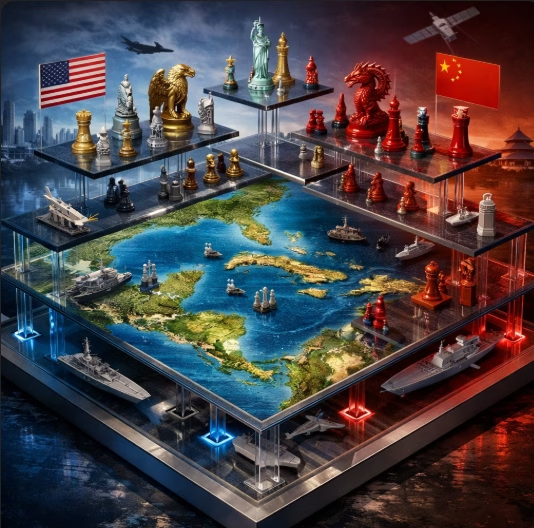
CHINA. CHINA. CHINA.
Say it three times, because that’s the real headline hiding behind the noise.

Yes, Venezuela just lost its dictator. Yes, Nicolás Maduro and Cilia Flores were captured during Operation Absolute Resolve, transferred into U.S. custody at sea, and are now expected to face charges in Manhattan federal court. Multiple outlets report they were moved via a U.S. amphibious assault ship before arrival in New York. That part is real, documented, and still unfolding.
But if you think this was just about cocaine, democracy, or even Venezuelan oil, you’re staring at the chessboard and arguing about the color of the squares.
This was a hemispheric security operation, and the pacing threat behind it wears a red flag with five stars.
Maduro wasn’t taken because Washington suddenly discovered its conscience. He was taken because Venezuela had become a strategic liability sitting uncomfortably close to America’s jugular. The U.S. Gulf Coast produces roughly 43% of U.S. crude oil and about 31% of refining capacity, most of it clustered along vulnerable coastal infrastructure. In any future high-end conflict—especially one involving China—that coastline matters more than slogans ever will.
From northern Venezuela to the Gulf Coast is roughly 2000 miles. To the Panama Canal, about 680 miles. All within missile range of a cargo ship. You don’t need imagination to see the problem—just a ruler and a range ring.
And this is where China quietly enters every paragraph.
China’s trade with Latin America and the Caribbean hit $551 billion in 2024, and Venezuela accounted for roughly 44% of all Chinese development finance in the region since 2005—before Beijing’s policy banks officially stopped lending in 2016. Oil-for-loans. Infrastructure-for-access. Satellites. Ports. Dual-use projects. Venezuela wasn’t a friend; it was a forward operating concept.
Which brings us to the Panama Canal—Phase One, not Phase Two.
Reuters reported that CK Hutchison, the Hong Kong-based firm operating key ports at Balboa (Pacific) and Cristóbal (Atlantic), agreed to sell most of its stake to a consortium including BlackRock. Those ports aren’t the canal itself—but anyone who understands chokepoints knows that controlling the doors matters almost as much as controlling the hallway. In a Taiwan contingency, you do not want a hostile power with leverage on both sides of the canal. A single scuttled vessel in the locks and suddenly U.S. naval logistics are taking the long way around the world.
Maduro’s arrest followed that move—not preceded it.
Now about the legality everyone on social media is screaming about.
Maduro has been under active U.S. indictment for nearly six years, accused of narco-terrorism conspiracy, cocaine importation, money laundering, and partnership with armed groups including FARC, ELN, and transnational criminal networks. The indictment does not treat him as a legitimate head of state. It describes him as an illegitimate ruler who retained power after disputed elections and used state machinery to run a criminal enterprise. From Washington’s perspective, that paperwork matters. It’s how you say, “This wasn’t an invasion. It was an arrest.”
Messy? Yes. Clean? No. But not accidental.
Now zoom out.
For BRICS, this is a stress fracture. The entire BRICS pitch relies on permanence—sanction-resistant regimes, discounted energy, alternative finance, and the comforting illusion that time is on their side. Venezuela and Iran weren’t side projects; they were load-bearing pillars.
If Iran follows—and the streets suggest it might—China loses cheap oil, Russia loses a sanctions partner, Hezbollah loses passports, and the yuan-settlement experiments quietly die of embarrassment.
And Russia? Moscow reads this with a calculator. Lower oil prices hurt. A destabilized Iran hurts. A chastened China makes a quieter partner. None of this ends wars overnight—but it tightens timelines and shrinks options.
Here’s the real change, the one that keeps people awake at night:
A precedent has been set.
Not regime change.
Arrest.
That idea terrifies authoritarians more than aircraft carriers ever did. It turns every palace into a temporary lease and every “strategic partner” into a potential liability. Maduro didn’t fall because he lacked friends. He fell because his friends couldn’t protect him—and may have exposed him.
So yes, Venezuela matters.
Yes, Iran matters.
But China matters most.
Because when you plan for Taiwan, you don’t get to ignore the Caribbean. And if you plan for the Pacific while forgetting the Gulf Coast, you’re not planning—you’re hoping.
History has a habit of punishing hope when it pretends to be strategy.
Collapse or Cold War: China in 2026
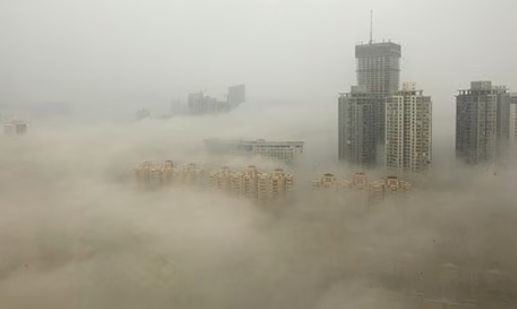
It’s always good for a Monday laugh, and China has delivered one. Beijing, solemn as a judge in borrowed robes, is now lecturing the world about international law. The same China that treats the South China Sea like a private swimming pool with no lifeguard, no rules, and a very large stick. Hearing them condemn the U.S. over Venezuela is like a pickpocket giving a TED Talk on ethics.
Yes, the official line is outrage. “Sovereignty.” “Hegemony.” “UN Charter.” All the right words, carefully ironed and neatly folded. Of course, those words were nowhere to be found when Russia rolled tanks into Ukraine. Funny how international law only matters when the bill comes due to someone else.

But strip away the moral theater and this isn’t really about Venezuela. It’s about loss. China didn’t just lose a friendly regime; it lost leverage, oil, and face. Roughly $60 billion in oil-backed loans, years of diplomatic courtship, and a strategically placed partner—gone in a weekend. That stings. Especially when the replacement may swing decisively toward Washington, bringing U.S. oil companies closer to roughly 17% of the world’s proven oil reserves.
That’s the part Beijing can’t spin away.
China still runs on oil, no matter how many solar panels it installs or speeches it gives about green transitions. Discount Venezuelan crude—sometimes direct, sometimes sneaking in through back doors—was a pressure valve. Regime change slams that valve shut. And nothing makes a paper dragon angry like watching its energy security get yanked out from under it.
Inside China, the reaction tells an even better story. Nationalist commentators are openly fantasizing about Taiwan, asking whether Venezuela is a “model.” The keyword is fantasizing. Beijing talks tough because talk is cheap. Action is expensive, risky, and irreversible. Taiwan isn’t Caracas, and China knows it. This is less a plan than a stress dream.
And stress is the keyword for 2026.
While Beijing is busy condemning Washington, its own house is sagging. The property crisis—now entering its fifth year—has gone from “manageable correction” to “structural rot.” Home prices keep sliding. Confidence is shattered. Developers once treated as untouchable are being fed to creditors like leftovers. Household wealth losses are counted in the tens of trillions. Unsold apartments stretch into the hundreds of millions of square meters, ghost cities waiting for people who can’t afford to exist in them.
Real estate was not just an industry; it was the savings account, the growth engine, and the political glue. When that breaks, everything else starts making strange noises. Banks wobble. Local governments starve. Consumers retreat. Deflation creeps in quietly, like mold behind the walls.

So here’s the uncomfortable truth beneath all the shouting: China’s outrage over Venezuela is less about law and more about fear. Fear of losing influence abroad while control at home gets harder. Fear that decades of debt-fueled growth have painted them into a corner with no clean exit. Fear that the world is no longer willing to pretend.
China in 2026 isn’t marching confidently toward dominance. It’s deciding between two bad options: manage a slow internal collapse, or distract the public with an external cold war. History suggests regimes under pressure rarely choose silence.
The irony, of course, is this: the louder Beijing lectures about sovereignty, the more it reveals how fragile its own position has become. Power that is secure doesn’t need to shout. Power that’s nervous always does.
Here’s from the best available, sourced estimate of how much money China has effectively lost or is at risk of losing in Venezuela given the country’s economic collapse and defaults:
1. China’s outstanding loans to Venezuela:
- Venezuela currently owes China roughly $59 billion to $60 billion in loans extended since the mid-2000s, making it one of the largest bilateral creditors to Caracas. (Bloomberg Línea)
- Independent historical records show over $62 billion in loans and financing flows from China to Venezuela overall (loans + investments) since relations deepened. (Transparencia Venezuela)
2. What’s actually lost vs. owed:
- A significant share of Chinese loans were structured as oil-for-loan deals, meaning Venezuela has repaid part of the debt with oil shipments rather than cash. (Transparencia Venezuela)
- Because Venezuela’s economy has collapsed and it has long been in default on sovereign obligations, a large portion of that ~$60 billion is likely unrecoverable or severely impaired unless restructured. Analysts estimate that only a fraction of repayment is certain under any realistic scenario.
3. Historical nominal figures (for context):
- China extended about $67 billion in financing to Venezuela between 2007 and the late 2010s. (Harvard International Review)
- Much of this was repaid in oil, but the underlying debt burden still shows up in official estimates.
Summary:
- Total financial exposure: ~$59-60 billion as of the latest available data. (Bloomberg Línea)
- Actual cash losses: Not precisely disclosed, but much of that exposure is impaired because Venezuela has defaulted and can only pay in heavily discounted oil or via restructurings that reduce principal.
- Some loans have been repaid in kind (oil) and others have been restructured repeatedly, meaning apparent losses may be significantly less than the gross exposure, but the risk of loss remains very high.
The Day Iran Sneezes, China and Russia Catch a Cold
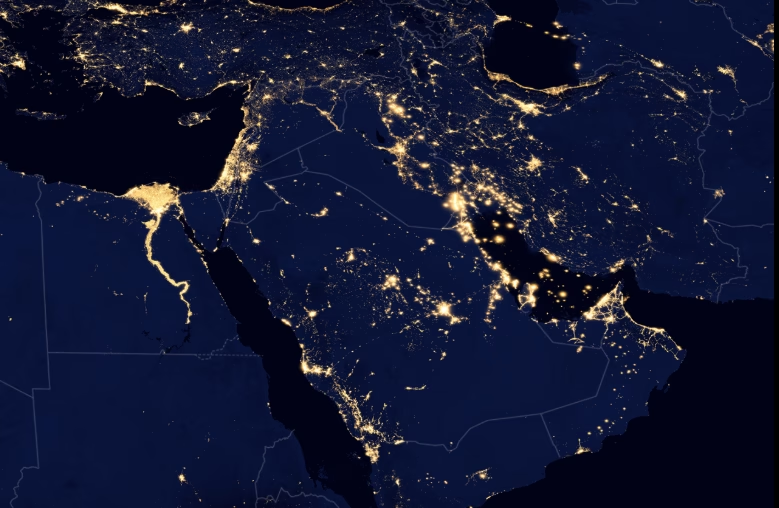
History has a funny habit of pretending it’s not about to happen—right up until it does. Iran looks stable right up to the moment it isn’t, and when that moment comes, the shockwave won’t stop at its borders. It will travel east to Beijing and north to Moscow, like a bill nobody wants to pay but everyone owes.
Let’s speak plainly.
Iran is not just a country; it’s a keystone. Pull it out, and two empires-in-denial—China and Russia—suddenly discover how much of their global posture was being propped up by duct tape and discounted oil.
China: Cheap Energy, Expensive Illusions
China’s relationship with Iran is simple in theory and desperate in practice: oil at a discount, paid quietly, shipped creatively. Iran has been one of Beijing’s favorite loopholes—a sanctioned producer willing to sell cheap, no questions asked, as long as the cash keeps moving.
If Iran falls—meaning regime collapse, civil chaos, or a Western-aligned government—those barrels don’t just vanish. They get repriced. They get regulated. They get watched.
And China’s energy bill suddenly looks like a mortgage payment instead of a coupon.
Beyond oil, Iran is a crucial land bridge in China’s Belt and Road vision. Ports, rail, pipelines—grand maps drawn in conference rooms far from reality. Instability turns those routes into liabilities. You can’t run a trade empire through a burning house.
China fears chaos more than confrontation. A collapsing Iran doesn’t just threaten supply chains; it threatens the narrative that authoritarian “stability” is superior to messy freedom. That story sells well—until it doesn’t.
Russia: The Partner Who Needs the Partner
Russia’s stake in Iran is less about money and more about leverage. Tehran has been a loyal co-signer on Moscow’s bad behavior—drones, arms coordination, sanctions evasion, and a shared talent for blaming the West for everything, including gravity.
A fallen Iran means Russia loses:
- A weapons customer
- A sanctions workaround
- A regional spoiler
- And most importantly, a co-conspirator
Russia’s foreign policy works best when the world is distracted. Iran has been an excellent distraction. Without it, Moscow stands more exposed, more isolated, and more alone—never a comfortable position for a country that confuses fear with respect.
And let’s not ignore the irony: Russia, already stretched thin, would have no capacity to stabilize Iran even if it wanted to. Empires love influence right up until influence requires responsibility.
The Real Problem: This Was Supposed to Be Slow
China and Russia planned for a gradual decline of U.S. influence, a long twilight where power quietly shifted east. Iran’s sudden collapse would be the geopolitical equivalent of someone turning on the lights in a room full of secrets.
Energy markets reprice.
Alliances get tested.
Neutral countries start choosing sides.
And the myth of the “inevitable multipolar world” starts looking less inevitable and more improvised.
The 2026 Truth
China and Russia didn’t back Iran because it was strong.
They backed it because it was useful.
When useful things break, they don’t inspire loyalty—they inspire distance.
The fall of Iran wouldn’t end their ambitions. But it would remind them of something empires hate to remember:
You can build a global strategy on oil, fear, and resentment—but the moment one pillar collapses, the rest start arguing about whose fault it was.
What Trump Did With Venezuela Was Genius? Checkmate BRICS? Or Was it?
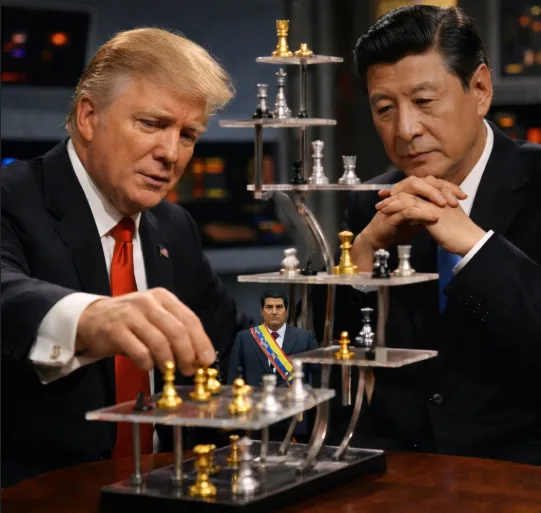
In Star Trek II: The Wrath of Khan (1982). Spock says, “He is intelligent, but not experienced. His pattern indicates two-dimensional thinking.” -- SPOCK
Most people think the Venezuela operation was about politics, ideology, oil, gold or even revenge. That framing misses the point entirely.
What happened in early January 2026 was not just the removal of Nicolás Maduro. It was the activation of a long-dormant strategic asset—one that touches oil, refining dominance, critical minerals, gold, dollar demand, and long-term American economic leverage. The legal justification was obvious. The geopolitical justification was louder. But the real benefit—the one few people are discussing—was economic, structural, and generational.
This was not a short-term headline play. It was a board-level move.
Venezuela: The Most Misunderstood Strategic Asset on Earth
Venezuela is not just another oil state. It is arguably the single most resource-dense country in the Western Hemisphere.
It holds:
- The largest proven oil reserves in the world (over 300 billion barrels)
- The second-largest natural gas reserves in the Americas
- The largest gold reserves in Latin America
- Some of the largest undeveloped critical mineral deposits in the Western Hemisphere, including rare earths and bauxite
This is what economists call vast geological wealth—a country whose economic value is embedded primarily in its geology rather than its institutions. Venezuela has been poor not because it lacked resources, but because those resources were mismanaged, weaponized, or left dormant under the Chávez–Maduro regime.
Trump understood this distinction.
Oil Was Only Step One — Refining Is the Real Prize
The global energy narrative is often framed around who owns oil. That’s a mistake.
What matters is who refines it.
The United States has the largest and most sophisticated refining capacity on Earth. U.S. refineries were specifically designed decades ago to handle heavy crude—the exact type of oil Venezuela produces in abundance. Venezuela, by contrast, lacks both modern drilling and refining infrastructure.
This creates a natural asymmetry:
- Venezuela extracts
- The United States refines
- The United States controls pricing, distribution, and end markets
When you control the final product, you control the leverage.
Under this model, Venezuelan crude flows north, refined fuel flows globally, and the pricing, logistics, insurance, and settlement are all denominated in U.S. dollars. This quietly reinforces dollar demand at the exact moment the world is trying to escape it.
This is not about cheap gas alone. This is about:
- Industrial energy dominance
- Military fuel security
- Petrochemical supply chains
- Dollar settlement enforcement
Critical Minerals: The China Problem Trump Targeted Directly
China’s real leverage over the West is not oil. It is refining control over critical minerals.
China controls:
- 40–60% of global rare earth processing
- A dominant share of aluminum precursor refinement
- Strategic choke points in battery, aerospace, and defense materials
One mineral matters more than most people realize: bauxite.
Bauxite is the precursor to aluminum. No bauxite, no aluminum. And aluminum is everywhere:
- Aircraft
- Missiles
- Vehicles
- Electronics
- Packaging
- Power infrastructure
The United States has almost no meaningful domestic bauxite reserves.
Venezuela does.
And unlike Australian bauxite (often refined in China), Venezuelan bauxite can move through the same logistics corridors as oil—ports, shipping lanes, Gulf Coast terminals—into U.S. refining and manufacturing hubs.
This is how you decouple from China without firing a shot.
Gold: The Quiet Sovereign Wealth Weapon
Oil moves economies. Gold preserves them.
Venezuela holds the largest gold deposits in Latin America. Control over Venezuelan gold does not mean flooding markets. In fact, the opposite strategy makes more sense.
Gold behaves differently than currency:
- Currency is meant to be manipulated
- Gold is meant to anchor value
By controlling gold supply without aggressively mining it, the United States gains:
- A strategic hedge against foreign gold manipulation
- A reserve expansion option without immediate inflationary impact
- A long-term sovereign wealth lever
Gold prices rise when supply is constrained and demand persists. Every central bank on Earth understands this. The goal is not volume—it is price control through restraint.
This is why fears of “gold flooding” miss the point. Gold is more valuable when it stays underground.
Dollar Demand: The Hidden Feedback Loop
Here is where the strategy becomes elegant.
Even if the U.S. purchases Venezuelan resources in local currency, once those resources are refined and resold, everything clears in dollars.
That creates:
- External dollar demand
- Higher dollar velocity abroad
- Reduced domestic inflation pressure
- Stronger purchasing power at home
Americans feel this through:
- Lower energy costs
- Lower input costs across the economy
- Rising asset valuations
- Reduced reliance on adversarial supply chains
You don’t need a new reserve currency system when you control the choke points of trade.
Was This Checkmate to BRICS?
Not an immediate checkmate—but a positional advantage.
BRICS has focused on bypassing the dollar at the transaction level. Trump’s move focuses on controlling what must be transacted.
If you control:
- Energy refinement
- Critical material processing
- Strategic mineral access
- Gold supply discipline
Then settlement systems become secondary.
This was not about humiliating Maduro. It was about repositioning the United States at the center of physical reality—resources, logistics, refinement, and reserves.
Final Thought
You don’t have to like Trump to recognize the move.
This wasn’t ideological.
It wasn’t emotional.
It wasn’t short-term.
It was structural.
Venezuela was not a problem to be punished—it was an asset to be unlocked. And in a world drifting toward fragmentation, whoever controls real resources—not abstractions—writes the next chapter.
And now the Counter-Argument: Why the Venezuela Move May Not Be Genius
A strong thesis deserves an equally strong challenge. The argument that the Venezuela operation was a masterstroke rests on several assumptions—each of which carries real risks that cannot be dismissed as partisan noise.
1. Assumption of Durable Control Is Unproven
The strategy assumes that U.S. influence in Venezuela will be stable, long-term, and enforceable. History suggests otherwise.
Venezuela has:
- Weak institutions
- Deep internal factionalism
- Powerful non-state actors controlling territory and resources
- A long record of nationalist backlash against foreign influence
Removing a leader does not guarantee compliance, continuity, or legitimacy. If future Venezuelan governments pivot away from U.S. alignment—whether through elections, coups, or popular unrest—the entire resource strategy collapses or becomes politically radioactive.
Control without legitimacy is expensive and fragile.
2. Resource Extraction Is Not the Same as Resource Availability
Venezuela’s resources are massive—but they are not turnkey.
Oil infrastructure is degraded. Mining regions are unsafe. Logistics corridors are underdeveloped. Corruption remains endemic. Bringing Venezuelan oil, bauxite, and gold online at scale would require:
- Tens of billions in capital
- Long timelines
- Security commitments
- Environmental and labor concessions
These are not guaranteed returns. If global demand shifts faster than infrastructure can be rebuilt—particularly toward renewables, nuclear, or alternative materials—the strategic window may close before benefits materialize.
3. Dollar Reinforcement Could Backfire
While refining dominance strengthens dollar demand in theory, aggressive economic leverage can accelerate de-dollarization efforts in practice.
China, Russia, and aligned states may respond by:
- Accelerating alternative settlement systems
- Locking in long-term bilateral trade deals outside U.S. influence
- Weaponizing supply chains in retaliation
In other words, asserting control can provoke exactly the coordination it seeks to prevent. BRICS may not win today—but pressure can force them to innovate faster tomorrow.
4. Gold Control Is Not Absolute
The idea that Venezuelan gold gives the U.S. hemispheric leverage assumes gold markets are centrally controllable.
They are not.
Gold is:
- Globally fungible
- Traded through opaque markets
- Influenced by central bank behavior worldwide
If the U.S. were perceived as manipulating gold supply for strategic ends, other countries could respond by:
- Increasing domestic mining
- Accelerating gold accumulation
- Supporting alternative reserve assets
Gold’s strength lies in neutrality. Turning it into a geopolitical lever risks undermining the very stability that makes it valuable.
5. Moral and Legal Precedent Matters
Even if strategically sound, the operation sets a precedent.
Other nations will study it.
Some will imitate it.
Others will justify their own interventions using it.
Once sovereignty becomes conditional on alignment, the international system becomes more transactional—and more volatile. Markets dislike unpredictability. Investors demand rule consistency. Long-term capital flees ambiguity.
Short-term advantage can create long-term instability.
6. Genius Requires Outcomes, Not Intent
Strategy is judged by results, not brilliance of design.
If:
- Venezuela fails to stabilize
- Infrastructure rebuild stalls
- Political backlash erupts
- Allies distance themselves
- Markets price in higher geopolitical risk
Then what looked like genius becomes overreach.
History is full of plans that made perfect sense on paper.
Bottom Line of the Counter-Argument
The Venezuela move could be a masterstroke—but it could also be:
- A costly overextension
- A catalyst for faster global fragmentation
- A bet that assumes control where influence may be temporary
Genius in geopolitics is only proven in hindsight.
And the board is still in motion.
China China China — The 2026 Wave Is Brushing Over It
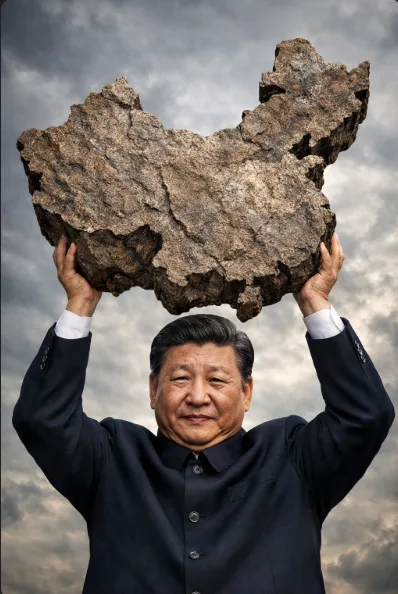
“2026 won’t just turn over every rock—it will send most of them tumbling down the hill.” -- YNOT!
Everyone can agree on one thing: 2026 is shaping up to be anything but boring.
Across geopolitics, trade, and military power, pressure waves are moving fast—and China is right in the path. What we’re seeing now doesn’t look like a single event. It looks like a system under strain.
Let’s zoom out, then dive in.
China in Turmoil: Power, Purges, and Paranoia
Reports out of Beijing suggest deep instability inside the Chinese Communist Party, particularly within the military.
A stunning development:
China’s top uniformed military officer, widely viewed as Xi Jinping’s most trusted ally, has been accused of corruption and allegedly leaking nuclear weapons secrets to the United States.
Whether the espionage claim is true or not is almost beside the point.
What matters is this:
- The allegation itself provides justification to remove him.
- The senior leadership of the PLA appears to be getting dismantled.
- This looks less like routine anti-corruption and more like political survival mode.
Even long-time China watchers note that we don’t know everything—but what we do know is enough to raise alarms.
When top generals disappear, military readiness suffers, coordination weakens, and trust inside the system erodes. Large-scale operations require confidence, cohesion, and continuity—none of which thrive in purge environments.
Taiwan: The Risk Didn’t Vanish—It Changed Shape
For years, the “Davidson Window” suggested China might move on Taiwan by 2027. But with China’s military leadership in chaos, a clean, coordinated invasion looks increasingly unlikely.
That does not mean the danger is gone.
In fact, the risk may now be more dangerous, not less.
Why?
- A weakened leader has more incentive to keep tensions high.
- Internal instability raises the chance of miscalculation.
- If an incident spirals, de-escalation becomes politically impossible.
This is how accidents turn into wars.
Canada, China, and a Trade Fault Line
At the same time, a second front is opening—North America.
Canada’s flirtation with deeper trade ties to China, including allowing Chinese EVs into the country, has triggered sharp warnings from Washington. The concern isn’t just economics—it’s national security.
Chinese EVs aren’t viewed as cars.
They’re viewed as rolling data-collection platforms.
Allowing them into Canada creates a backdoor into U.S. infrastructure, given how tightly integrated the two economies are—especially in auto manufacturing.
The message from Washington is blunt:
- Canada needs the U.S. market.
- The U.S. does not need Canada nearly as much.
- Turning Canada into a transshipment hub for China is a red line.
This isn’t rhetoric. It’s leverage.
The Bigger Picture: Re-Anchoring Power
While China and Canada appear weakened or divided, the United States is moving in the opposite direction:
- Rebuilding domestic supply chains
- Expanding shipbuilding and defense manufacturing
- Reframing national defense around homeland protection
- Pushing strategic initiatives like missile defense, Arctic security, and Greenland
The Pentagon’s 2026 posture signals a reality shift:
China is no longer treated as a distant competitor—but as a systemic challenge that cannot be stabilized through wishful thinking.
Calls for “strategic stability” sound good on paper, but they don’t account for a regime in internal turmoil.
You can’t normalize relations with a system that’s purging itself.
Today’s Takeaway – Tomorrow might be different
This doesn’t look like the calm before the storm.
It looks like the storm has already started—just unevenly distributed.
China is under pressure from within.
Allies are being tested.
Trade lines are hardening.
Security assumptions are being rewritten.
The 2026 wave isn’t crashing yet.
But it’s brushing over everything—and leaving marks.
Stay alert.
There’s an old Chinese proverb: “Two tTigers cannot share One Mountain.” It’s an apt description of the growing tension between the United States and China—and the inspiration behind a site I use to analyze this unfolding rivalry. Explore it here: https://twotigersonemountain.com/
WW3 - Was the first shot of the China war fired today—and did it happen on your phone?
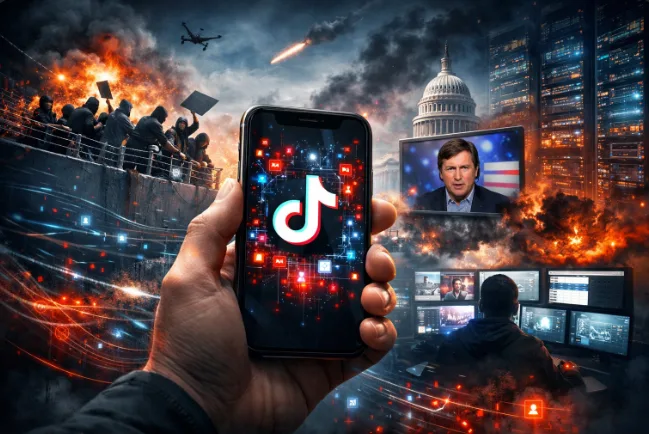
“World War III won’t start with bombs or bullets. It will start on our phones—and it will end with clubs.” -- YNOT!
Did a war just begin without a bang, a crater, or even a headline big enough to spill your coffee?
This week, TikTok changed hands, and most people shrugged like it was a new terms-of-service popup. But this wasn’t a tech deal. It was a battlefield adjustment.
Let me put it plainly—because plain talk is cheaper than missiles.
TikTok was never “just an app.” It was a fires platform.
Not messaging. Not persuasion. Fires.
In military language, fires are anything that create effects at a distance—artillery, airstrikes, loitering munitions. You don’t use fires to convince the enemy they’re wrong. You use them to shape the battlefield so everything else becomes easier.
Information warfare works the same way.
The goal isn’t to change your mind.
The goal is to slow decisions, fracture trust, increase friction, trigger overreaction—or make you do the dirty work.
Once upon a time, if you wanted to stop a ship, you needed a missile or a Navy SEAL with a mine.
Now? You just tell enough people online to glue themselves to the hull.
Cheaper. Faster. No fingerprints.
That’s why disinformation feels chaotic and stupid. Fires aren’t elegant. They’re loud, messy, and they don’t care about collateral damage.
TikTok wasn’t dangerous because teenagers danced on it.
It was dangerous because it functioned as a real-time sentiment sensor and precision targeting system for narratives.
A timed barrage of ideas, dropped exactly where emotions were weakest.
ByteDance didn’t need to tell TikTok what to push politically. They only needed to control the algorithm—amplifying what already cracked trust, angered crowds, or delayed action.
That’s fire control.
Consider this:
If Russia wanted to stop U.S. artillery shipments to Ukraine, it could launch a cruise missile at a shell factory in Pennsylvania.
Or it could flood the internet with claims—true or not—that those weapons are ending up with drug cartels.
The result is the same.
Congress panics. Votes freeze. Shells stop moving. A factory destroyed—without a crater.
Now imagine that process automated.
Millions of AI-generated personalities, custom-designed to press your buttons, at your time, about your fears.
That’s not propaganda. That’s fire control with feedback.
And feedback is everything.
Which brings us to the quiet part of today’s news: TikTok moving under Oracle.
Oracle doesn’t make TikTok nicer. Oracle makes it blinder—as a weapon.
Control the data. Control the infrastructure. Control auditability.
A fire system without feedback is blind. Even artillery needs spotters.
TikTok can still exist. But it can’t function the same way as a foreign weapons platform embedded in American pockets.
This isn’t censorship. It’s counter-battery fire.
If a foreign power parked artillery inside a media company, we wouldn’t debate free speech—we’d remove the gun.
China doesn’t separate military, political, and information warfare.
It’s all one continuum. Media warfare. Legal warfare. Psychological warfare. Shape the environment before the crisis and you win without firing a shot.
Sun Tzu called that wisdom. Modern platforms just made it scalable.
This move matters now—because once a crisis starts, information fires are already baked in.
Does this end information warfare? Of course not. We still shoot ourselves in the foot regularly—and loudly.
But today, we stopped carrying a foreign fire-control system in our pockets.
And that, whether people notice or not, is how wars are won now—quietly, early, and without applause.
#InformationWarfare #MMT #DigitalBattleground #ChinaStrategy #AIandWar #CyberFires #ModernConflict
🎯 Is 2027 Just a Date… or a Deadline? China vs Taiwan and US
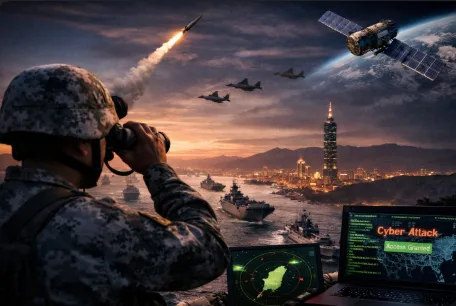
Is 2027 the Year the Pacific Changes Forever?
Here’s the uncomfortable truth nobody likes to say out loud:
China doesn’t have to invade Taiwan next year. It just has to be ready to.
According to the latest U.S. Defense Department report to Congress, the People’s Liberation Army believes it could fight — and win — a war over Taiwan by the end of 2027.
That doesn’t mean war is scheduled. It means the option is being built.
And in geopolitics, having the option changes everything.
This isn’t just about ships stacking up on a horizon. It’s about a full-spectrum tool kit coming online:
- Cyber access inside U.S. infrastructure
- Space and counter-space capabilities
- Long-range strike power reaching 1,500–2,000 nautical miles
- Naval and missile modernization
- Weekly pressure operations around Taiwan
- Information warfare shaping global narratives
This isn’t a single lever. It’s a system.
The campaign isn’t hypothetical. Aircraft sorties increase. Coast Guard incursions normalize. Naval patrols blend into routine. The temperature rises slowly enough that people adjust to it.
Preparation doesn’t scream. It calibrates. And that’s the point most people miss. The Chinese Communist Party doesn’t need to declare a date. It needs capability, leverage, and deterrence stacked neatly in place.
When you can make intervention painful — politically, economically, digitally — you don’t need to fire the first shot to change the equation.
War may not be guaranteed. But optionality, once built, reshapes the board.
And history shows that the side building quietly is usually thinking several moves ahead.
The question isn’t whether 2027 guarantees conflict.
The question is what the world looks like when one side believes it can win.
There’s a difference between talking about war and quietly building the tools for one.
One is theater. The other is planning.
And according to the latest U.S. defense assessment, China isn’t shouting. It’s preparing.
Here’s the uncomfortable truth nobody likes to say out loud:
China doesn’t have to invade Taiwan next year.
It just has to be ready to.
According to the latest U.S. Defense Department report to Congress, the People’s Liberation Army believes it could fight — and win — a war over Taiwan by the end of 2027.
That doesn’t mean war is scheduled.
It means the option is being built.
And in geopolitics, having the option changes everything.
This isn’t just about ships stacking up on a horizon. It’s about a full-spectrum tool kit coming online:
-
Cyber access inside U.S. infrastructure
-
Space and counter-space capabilities
-
Long-range strike power reaching 1,500–2,000 nautical miles
-
Naval and missile modernization
-
Weekly pressure operations around Taiwan
-
Information warfare shaping global narratives
This isn’t a single lever. It’s a system.
The campaign isn’t hypothetical. Aircraft sorties increase. Coast Guard incursions normalize. Naval patrols blend into routine. The temperature rises slowly enough that people adjust to it.
Preparation doesn’t scream. It calibrates.
And that’s the point most people miss. The Chinese Communist Party doesn’t need to declare a date. It needs capability, leverage, and deterrence stacked neatly in place.
When you can make intervention painful — politically, economically, digitally — you don’t need to fire the first shot to change the equation.
War may not be guaranteed.
But optionality, once built, reshapes the board.
And history shows that the side building quietly is usually thinking several moves ahead.
The question isn’t whether 2027 guarantees conflict.
The question is what the world looks like when one side believes it can win.
Why 2027 Keeps Showing Up
2027 isn’t a prophecy. It’s a capability marker.
By that date, the People’s Liberation Army (PLA) believes it could:
- Win a fast, decisive fight over Taiwan
- Make U.S. intervention extremely painful
- Deter escalation — especially nuclear
That’s not bluster. That’s project management.
Win fast. Raise the cost. Control the narrative.
That’s the blueprint.
🧠 Not Just Missiles — “Total National War”
The report uses a phrase most people skim past:
Total national war.
That doesn’t mean burning the world down. China still wants to sell you your phone charger.
It means mobilizing everything — military, civilian, cyber, economic, informational — while keeping escalation controlled.
Maximum effort.
Tight messaging.
Short timeline.
If World War II was industrial mobilization, this is systems mobilization.
And systems are quieter than tanks.
🌊 The Pressure Campaign Is Already Running

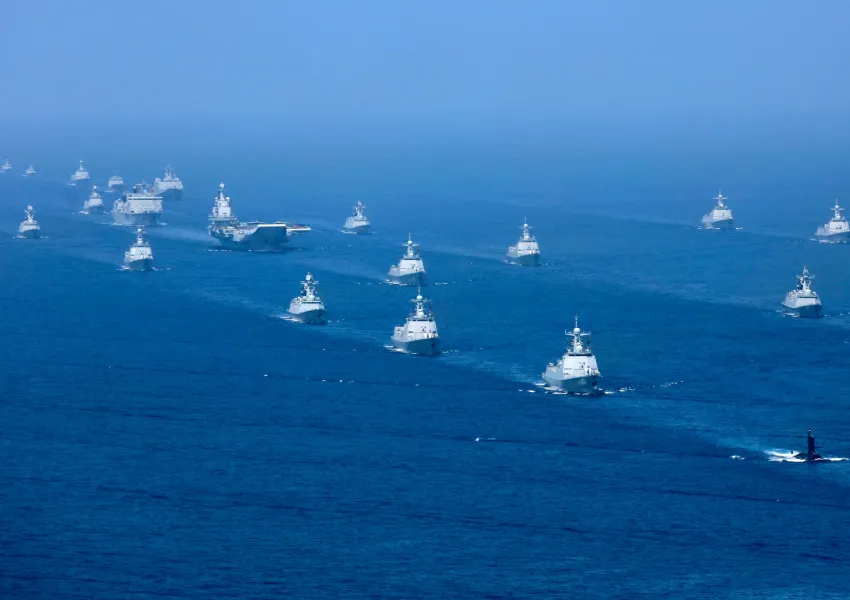
In 2024 alone:
- ~2,700 PLA aircraft entered Taiwan’s ADIZ (up sharply from 2023)
- 5–9 naval vessels routinely operate around Taiwan
- Coast Guard incursions average 13 per week
This is how you normalize control.
Not with one dramatic invasion.
But with repetition. You don’t shock the system.
You redefine “normal.”
🚢 Invasion Is an Option. Blockade Is the Rehearsal.
The report outlines three primary tools:
- Amphibious invasion
- Firepower strikes
- Maritime blockade
And here’s the part that should make planners sweat:
China is building strike capability out to 1,500–2,000 nautical miles.
That means:
- U.S. bases
- Ports
- Logistics hubs
- Ships across the Pacific
This doesn’t stay “near Taiwan.”
It expands across the theater.
War doesn’t ask permission to stay small.
💻 Cyber: The War Before the War


Here’s the part most people shrug at.
State-backed cyber actors have reportedly embedded inside U.S. infrastructure networks — energy, communications, routers, logistics.
You don’t need to sink a carrier.
You just need to:
- Delay mobilization
- Disrupt payroll
- Hit communications
- Create political chaos
Imagine 40% of workers missing a paycheck.
Not because of a strike.
Because of a cyber disruption.
No explosions. Just confusion.
And confusion slows response.
🛰 Space: Blind the Kill Chain
China now fields over 350 ISR satellites — more than triple since 2018.
They’re investing in:
- Counter-space tools
- Jamming systems
- Cyber intrusions into space networks
- Directed energy systems
If America’s strength is sensor-to-shooter integration, the counter is simple:
Blind the sensors. Jam the link. Create hesitation.
You don’t destroy the system.
You make it stumble.
☢ Nuclear Deterrence: Escalation on a Leash
China’s nuclear stockpile is expanding — projected to exceed 1,000 warheads by 2030.
Recent open-ocean ICBM testing signals something important:
Deterrence signaling. The message is subtle but clear:
“If you intervene conventionally, escalation exists.”
Not to use nuclear weapons casually.
But to make the cost calculation heavy.
🌍 Global Muscle Memory


China conducted 26+ international exercises in 2024.
Africa. Asia-Pacific. Europe. Naval drills with Russia.
Peacekeeping deployments. Medical diplomacy. Port visits.
This is how you build overseas familiarity without headlines.
You rotate.
You practice.
You normalize presence.
⚖️ The Wild Card: Readiness and Corruption
The report also notes:
- Major PLA corruption investigations
- Structural reorganizations
- Leadership reshuffles
- Readiness reforms
Rapid modernization creates friction.
Reforms create instability before they create strength.
That’s the wildcard. Capability isn’t the same as competence.
🧾 So What Does This Mean?
Three takeaways:
- 2027 is a capability milestone, not a slogan.
- The strategy isn’t “invade or nothing.” It’s layered coercion — cyber, blockade, strikes, information warfare.
- Any conflict would extend beyond Taiwan — geographically and digitally.
And here’s the uncomfortable truth:
Modern war doesn’t start with a mushroom cloud.
It starts with pressure.
With normalization.
With systems quietly positioning themselves.
The loudest wars in history were the ones we didn’t see coming because we mistook preparation for routine.
2027 might just be a date on a calendar.
Or it might be the year when “normal” finally reveals what it was becoming all along.
NEXT TIME: We will look at what US and TAIWAN are doing.
#Geopolitics #Taiwan #ChinaStrategy #DefenseAnalysis #CyberWarfare #PacificSecurity #MilitaryModernization
EVIL does like EVIL does: The greed and power link between the Epstein, CCP and Western Elites
“China doesn’t have to buy your soul—just your incentives. After that, you’ll defend the deal like it was your idea, and call it ‘business’ while it quietly becomes obedience.” -- YNOT!
Have you ever noticed how “respectable” people can spot a monster a mile away—right up until the monster offers them a seat at the VIP table?
That’s the vibe running through the text you shared: not just the usual Jeffrey Epstein horror story (which is already bad enough), but a darker, more adult kind of corruption—the kind that wears a suit, talks about “relationships,” and calls it strategy while it picks your pocket and your soul at the same time.
The claim in these pages is that Epstein wasn’t only trafficking, blackmailing, and grooming a network of influence—he was also teaching powerful Western financiers how to operate inside a system where contracts are decorations and loyalty is currency. Not loyalty like “I’ve got your back.” Loyalty like “my kid goes to your school, my money sits in your vault, and if I go down, you go down with me.”
And right there—that is the red line.
Because once you stop doing business and start building mutual hostages, you don’t have an economy anymore. You’ve got a cartel with PowerPoint slides. And companies like JP Morgan, Cityroup, Goldman Sachs, Credit Swiss, Deutschbank, Morgan Stanley, and UBS where all at the party.
The “Guanxi” Pitch: Forget the contract—buy the family
The text describes Epstein coaching a senior banking executive on the basics of Chinese political reality: officials don’t need more money as much as they need more survival. Their fear isn’t poverty. Their fear is tomorrow’s purge.
So the alleged solution isn’t “invest.” It’s: become part of the family’s interest network.
Not with cartoon bribes—no cash in an envelope like a bad movie. The “smart bribes,” as described here, are social and institutional:
- a school placement for the kid
- a prestige introduction
- a soft landing abroad
- a “job” that’s really a badge and a pipeline
It’s influence laundering. You don’t pay them in cash—you pay them in escape routes.
Guanxi (关系) (pronounced kind of like gwan-shee) means “relationships / connections”—but not in the LinkedIn, “let’s grab coffee” sense.
In practice, guanxi is a trust-and-obligation network built over time through favors, introductions, gift-giving, shared history, and “I helped your people, so you’ll help mine.” It’s social capital that can open doors, speed up approvals, smooth conflicts, and get things done when formal rules are slow, unclear, or selectively enforced.
Two important notes:
- It’s not automatically corruption. Guanxi can be perfectly normal relationship-based business culture.
- But it can become leverage. When favors turn into debts, and debts turn into quiet expectations, guanxi can slide into nepotism, pay-to-play, or influence trading—especially in high-stakes political or regulatory environments.
The etiquette of submission: “I seek your guidance”
One of the nastiest details isn’t the finance. It’s the tone.
The script, as described, is basically: don’t walk in like an American banker. Walk in like a pilgrim. Praise the civilization. Admire the governance. Ask for wisdom. Make it feel like they’re not selling access—they’re granting favor.
That’s not diplomacy. That’s theater.
And theater is powerful, because it makes men feel noble while they do ignoble things.
Sons and daughters: the “hiring program” as hostage diplomacy
The text ties this to the now-famous pattern where major banks hired well-connected relatives under the banner of “localization,” when the real product being purchased was access.
Call it what it is: a cross-border influence exchange disguised as HR.
And the clever part—if you’re the kind of person who sleeps well doing ugly things—is that nobody has to say it out loud. Everyone just “understands the culture.” Everyone just “builds relationships.” Everyone just “plays the game.”
That’s how evil survives in daylight. It gets a rebrand.
Here’s the twist: predators don’t do loyalty—only leverage
The text then makes its bleakest point: even if this arrangement “works,” it only works until profits are threatened.
Because predators don’t form partnerships. They form temporary arrangements.
When the political winds shift—trade war, sanctions, internal purges, public heat—what happens?
The same crowd that was praising the wisdom of governance suddenly starts whispering about removing the guy they were just calling “the prince.”
That’s not ideology. That’s not national interest. That’s not even politics.
That’s opportunism with a passport.
China influence, in this context, isn’t just “China convinced someone” or “China bought an ad”—it’s the slow, practical art of turning foreign decision-makers into stakeholders in your system. The play is simple: you don’t demand loyalty, you manufacture dependence. You offer access to licenses, deals, and insider pathways that are hard to get anywhere else, then you lace that access with personal ties—jobs for relatives, prestige invitations, private “advisory” roles, and quiet financial channels that make walking away expensive.
Over time, the relationship stops being a transaction and becomes a mutual-risk pact: if the foreign executive pushes back, they don’t just lose money—they risk losing face, losing access, and sometimes exposing arrangements that can’t survive daylight. That’s influence at scale: not mind control, not propaganda—incentives + entanglement + leverage, until a country’s “elite networks” start making choices that look like business decisions but function like political concessions.
Here’s a list of the specific corruption tactics and “gray-to-black” behaviors:
- Bribery disguised as “relationship gifts”
Not cash or gold, but “subtle” benefits like recommendation letters to elite private schools, private introductions to Nobel Prize–level prestige, and helping relatives “recover” valuable antiques at New York auctions. - Scripted psychological manipulation for access
Drafted “how to behave” lines for meetings: don’t say “I’m here to invest and make money”—instead use flattery + submission language (“seek your guidance,” “admire your wisdom in governance”) to secure favor. - Influence trafficking via family entanglement
Making the bank a “private overseas safe” and a “placement office” for CCP elite families—meaning: protect assets abroad and place family members into elite Western institutions. - “Sons and daughters” hiring programs (nepotism for access)
Hiring relatives of powerful officials, giving them fancy titles, obscene salaries, and prestige roles while they do little actual work—described as a cover for access-buying and leverage-building. - Creating a dedicated “China entity” with its own advisory board
Proposed as an institutionalized structure that could include high-level political insiders (the text implies Politburo-level proximity), effectively formalizing influence pipelines. - Cross-border “hostage diplomacy” through careers and social status
The text frames the hiring/placement system as a way to create mutual dependency: their kids embedded in your network, their future tied to your institution. - Secret, hard-to-trace asset channels using complex instruments
Specifically mentions using credit default swaps (CDS) as a mechanism to create untraceable asset-management channels. - Money laundering / covert capital flight
Helping answer: “How do you launder dirty money, move it out of China, and park it in New York/global markets without triggering anti-corruption scrutiny back home?” - Pay-to-play access to state power (political gatekeepers)
- Emphasis on building relationships not with “business” officials but with political personnel power centers (the kind that control promotions/demotions), implying political influence acquisition, not normal finance.
THE STORY OF MORGAN STANLEY
Morgan Stanley fits into this story in the way a lot of big banks fit into China: they want the licenses and market access, and China controls the gate—so the relationship naturally attracts “influence” behavior, whether it’s clean or dirty. In your text, Morgan Stanley is named alongside other banks as part of the broader “sons and daughters” / relationship-hiring ecosystem that U.S. regulators probed across the industry (Reuters reported in 2013 that the SEC expanded its China hiring probe and that Morgan Stanley received an SEC information request).
Separately—but important for context—Morgan Stanley also has its own documented China-related corruption episode: in 2012, U.S. DOJ and SEC actions described a former Morgan Stanley China executive involved in bribery/control-evasion tied to a real-estate deal, showing the exact risk pattern regulators worry about in high-permission markets. (Department of Justice) And on the “why would they tolerate the headaches” side of the equation, Morgan Stanley has steadily pushed deeper into China’s onshore financial system—winning approvals like full control of its China mutual fund JV (CSRC approval in 2023) and, more recently, regulatory approval to establish a wholly owned futures business in China (reported by Reuters in 2024). (Morgan Stanley) Put plainly: the temptation is structural—when one side holds the keys, the other side starts shopping for shortcuts, and the line between “relationship building” and “influence trading” gets real thin, real fast.
The real machine: Western greed + authoritarian control
EVIL does like EVIL does, Not because evil is always loud. But because evil is often compatible. It finds its match.
- Greed loves access.
- Power loves secrecy.
- Both love people who can “fix” problems quietly.
And a fixer doesn’t need to be president of anything. He just needs to be useful to the right appetites.
So you end up with a system where everyone involved swears they’re doing “business”—but the real business is control:
control of money, control of people, control of information, control of consequences.
And once that machine spins up, the question isn’t whether it’s corrupt.
The question is: who gets fed to keep it running?
Spoiler: it’s never the people at the top. They don’t build machines to be crushed by them. They build machines so somebody else can be.
And that’s the quiet lesson hiding under the noise:
When evil starts acting “professional,” it doesn’t stop being evil—it just gets better at billing you for it.
Epilogue: If the duck’s already buried, who’s left to question the pond?
In February 2016, Jeffrey Epstein sent Peter Thiel an email with a line that—if we lived in a sane media universe—would’ve detonated across front pages for a week straight: “As you probably know, I represent the Rothschilds.” The sentence sits inside the Epstein Files—DOJ material—yet the mainstream press treated it like a weather update from Bermuda. The name “Rothschild” shows up nearly 12,000 times across the 3.8 million pages released in January 2026, far more than many political names people argue about every day. But we’re living in a culture where even investigating that name gets automatically stamped “conspiracy,” which is a very convenient stamp when the most-cited surname in the biggest trafficking document dump of the era is the one nobody’s allowed to touch.
Then comes Les Wexner—Epstein’s most famous benefactor—testifying under oath before Congress on February 18, 2026. Asked what credentials made him trust Epstein with sweeping financial power, he answered plainly: Epstein’s personal work for the Rothschild family in France. He said he spoke to Élie de Rothschild, and that Epstein “represented their whole family.” Under oath. The moment had its own grim comedy: Wexner’s attorney, caught on a hot mic, muttered, “I’ll fucking kill you if you answer another question with more than five words.” Desperation always has a smell.
The documents, as presented in your text, stack details like bricks. In October 2015, Epstein’s Southern Trust Company (Virgin Islands) entered a $25 million contract with Edmond de Rothschild Holding S.A. for “risk analysis” and “application of certain algorithms.” Twenty-five million dollars. Paid to a man with a conviction for sex crimes involving minors, allegedly to run algorithmic “risk analysis” for one of Europe’s most powerful banking families. If you wrote that into a TV script, the producer would tell you to tone it down because it sounds fake.
The narrative continues: Ariane de Rothschild, CEO of the Edmond de Rothschild Group (as stated in your draft), is described as exchanging emails with Epstein frequently, and meeting him repeatedly after his conviction—something the Wall Street Journal reportedly confirmed in 2023. The bank’s first move is described as denial, followed by the softer, bureaucratic confession: yes, meetings happened, it was “normal duties.” That phrase—normal duties—does a lot of heavy lifting in modern civilization. It can carry anything, even a convicted predator, as long as you don’t make eye contact with the moral bill.
In 2014, your text says Epstein wrote to Ariane: “The coup in Ukraine should provide many opportunities.” Opportunities. A convicted sex offender discussing geopolitical “opportunities” with the heiress of a major banking empire—again, the sort of thing that should light up a newsroom like a fire alarm. Instead, it’s portrayed as editorial silence with perfect posture.
Then the web widens. WikiLeaks emails are cited as exposing Hillary Clinton’s relationship with Lynn Forester de Rothschild, including a 2010 note where Clinton apologizes for pulling Tony Blair from a private Rothschild engagement, ending with: “Let me know what penance I owe you.” A sitting Secretary of State talking “penance” to a private citizen is the kind of line that makes you stare at the wall for a minute. In January 2015, before the campaign even officially begins, Lynn is described drafting economic messaging in emails to Clinton aide Cheryl Mills: “We need to craft the economic message for Hillary.” The implication is blunt: sometimes the people steering the ship aren’t on the passenger list.
Alan Dershowitz adds another strand, quoted in your text as saying in 2019 that Lady Lynn Rothschild introduced him to Epstein, and introduced Epstein to Bill Clinton and Prince Andrew. Cindy McCain’s line—“We all knew”—hangs over everything like a ceiling stain nobody wants to explain.
And so the pattern, as your draft frames it, becomes “structurally clear”: Epstein wasn’t merely a criminal—he was allegedly operating as a financial representative and social connector at a level where billionaires, politicians, academics, and dynastic money share oxygen. The trafficking operation rides on top of that network like a parasite with a private jet, and when survivors speak, the silencing machine—legal, financial, reputational—moves with clinical efficiency.
Your text then zooms out to the old names: Rothschilds, Rockefellers, Warburgs, Schiffs—dynasties described as operating above partisan politics, financing systems, shaping outcomes, surviving wars and revolutions because they live one layer above the elections. The press, dependent on those ecosystems, learns over generations to treat certain questions as insanity—not because the questions are crazy, but because they’re expensive.
Finally, the draft lands the punch: the UN, in February 2026, is said to have classified the Epstein operation as a “global criminal enterprise,” possibly implicating crimes against humanity. And still—silence. Twelve thousand mentions, and a media hush so loud it becomes its own evidence that something is protected.
Now, here’s where we have to act like adults for a second. Everyone is innocent until proven guilty. Guilt by association is lazy, and it’s wrong—because people get smeared that way, and history is full of witch hunts dressed up as righteousness. But we also know the other truth: sometimes if it looks like a duck and quacks like a duck, it may actually be a duck. The trouble is, in this case, the duck has long been buried… and so, it seems, is everyone around him. And that’s how the story ends most of the time—not with answers, but with paperwork, silence, and a graveyard of “normal duties.”
#EpsteinFiles #Guanxi #PowerNetworks #EliteInfluence #FinancialCrime #NarrativeControl #Corruption #Geopolitics #Accountability #TruthAndSilence
#EVILDoesLikeEVILDoes #JeffreyEpstein #PowerAndGreed #Corruption #Geopolitics #WallStreet #CCP #Influence #Guanxi #FinancialCrime #EliteNetworks #Accountability #TruthAndPower
IRAN - It’s Not a Distraction. It’s Oil— and China’s Problem.
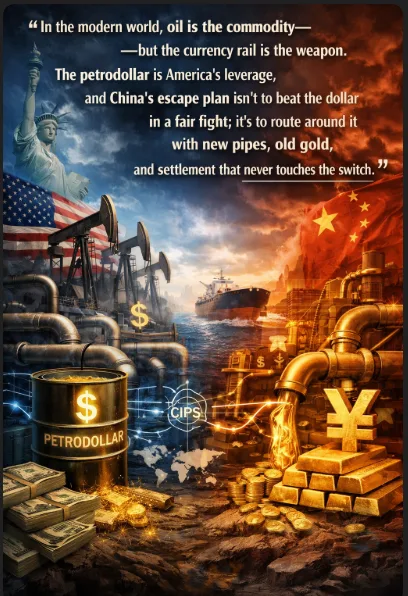
“In the modern world, oil is the commodity—but the currency rail is the weapon. The petrodollar is America’s leverage, and China’s escape plan isn’t to beat the dollar in a fair fight; it’s to route around it with new pipes, old gold, and settlement that never touches the SWIFT.”--YNOT!
Everyone has a favorite theory when something big happens.
When Trump hits Iran, the instant chorus shows up:
“Distraction operation.” – “It’s about politics.” – “It’s about ego.” – “It’s about Covering up Epstein”
Maybe. But they’re missing the oldest motive on Earth—the one that predates elections, ideologies, and “narratives”: Oil.
Not because the U.S. needs Iran’s oil. It doesn’t. The U.S. is a major energy producer and not dependent on Iranian barrels for survival. (U.S. Energy Information Administration)
But China does.
And that’s the part people refuse to say out loud.
The Simple Mechanism
Iran’s oil exports have been kept alive through sanctions-evasion networks, “shadow fleets,” and re-labeled cargo flows—because there’s a major buyer willing to take the risk. That buyer has been China (directly or indirectly through middlemen). (Middle East Institute)
So when the U.S. escalates pressure on Iran—militarily or financially—it’s not just squeezing Tehran.
It’s squeezing Beijing’s back-channel energy pipeline.
The Real Chokepoint Isn’t a Nuclear Facility
Everyone points at centrifuges and enrichment. And yes, the nuclear file matters—IAEA reports and inspection fights are real. (Reuters)
But the real “on/off switch” in this entire region is geography:
The Strait of Hormuz.
A huge chunk of global oil and gas flows through it. If shipping gets disrupted—even without a formal “closure”—prices spike, insurers panic, and tankers reroute. That doesn’t just hurt Iran.
That hurts China, because China is the #1 marginal buyer of global energy, and it lives and dies on stable seaborne supply lines. (The Guardian)
Translation Into Plain English
The U.S. doesn’t need Iran’s oil.
But the world’s oil price still sets the tempo for inflation, shipping, industry, and markets.
So if you can threaten the flow—
or even just raise the risk premium—
you can hit your adversary where it counts:
input costs.
And China is the one country that absolutely cannot afford a prolonged energy shock while trying to keep growth stable.
Bottom Line
Calling this “a distraction” is lazy analysis.
This is about leverage.
This is about supply chains.
This is about chokepoints and tankers and pricing power.
The nuclear issue is the headline.
Oil is the engine underneath the hood.
And whether people admit it or not, the strategic message is aimed as much at Beijing as it is at Tehran. (Atlantic Council)
If you zoom out, the “Iran strike” narrative isn’t just Tehran vs. Washington. It’s a stress test on the energy plumbing that a lot of the “non-Western” trade architecture quietly depends on—especially the China-centered flows coming out of sanctioned producers.
1) Why Venezuela + Iran matters to the same story
- Iran is still a meaningful exporter even under sanctions—recent reporting cited roughly ~1.9 million barrels/day exported as of December, with most going to China, often via “shadow” tankers that try to evade enforcement. (KOSU)
- Venezuela has been re-entering global markets under new arrangements and licensing, with the U.S. now explicitly shaping how Venezuelan-origin oil can be sold and where proceeds go. (Reuters)
MMT translation: when Iran and Venezuela get squeezed (or “restructured” politically), China’s discounted barrels get less reliable, risk premiums rise, and the market starts repricing shipping + insurance + supply certainty, not just “oil.”
2) How that ripples into BRICS
BRICS isn’t one unified economy—it’s a coalition with competing incentives. An oil shock from Iran/Venezuela hits different members differently:
- China & India (big importers): higher oil = higher input costs (manufacturing, shipping, food logistics), and more pressure to draw down reserves or pay up for alternative barrels. (KOSU)
- Russia + Gulf producers inside BRICS (exporters): higher prices can increase cashflow—but it also increases the incentive for the U.S./allies to tighten enforcement and police shipping/finance networks. (U.S. Department of the Treasury)
- Iran (now inside BRICS): if exports are disrupted, it’s a direct revenue hit to a member state—and a hit to the bloc’s “we can trade around Western pressure” narrative. (BRICS Brasil)
- The “BRICS idea” (trade outside the dollar): oil is the ultimate real-world settlement layer. If sanctioned oil flows get squeezed, the bloc’s ambitions to expand non-Western settlement channels get harder, because the easiest proof-of-concept is always energy trade.
One key point: Venezuela isn’t a BRICS member (as of the official BRICS descriptions), but it’s strategically tied to BRICS dynamics because China has been a major economic partner and oil buyer over time. (BRICS Brasil)
What is BRICS?
BRICS is a political and economic coordination bloc originally formed by Brazil, Russia, India, China, and South Africa, and it has expanded. Official BRICS materials describe it as a Global South coordination forum across many areas (economic cooperation, development, governance). (BRICS Brasil)
Current official descriptions list members including: Brazil, Russia, India, China, South Africa, Saudi Arabia, UAE, Egypt, Ethiopia, Iran, and Indonesia. (BRICS Brasil)
“And here’s the part nobody wants to say: if Venezuela and Iran wobble at the same time, you don’t just ‘punish regimes’—you stress the energy arteries feeding the BRICS world. China loses its most convenient discounted barrels, shipping risk premiums climb, and suddenly BRICS isn’t debating theory about ‘multipolar order’—it’s paying real prices for real oil. Importers inside BRICS feel it as inflation. Exporters inside BRICS enjoy the price pop—but inherit the enforcement drag. Either way, the bloc gets pulled into the same ancient equation: energy is power, and chokepoints write the rules.”
The “Petrodollar” concept (what it is, and what it isn’t)
Petrodollar is shorthand for a simple global habit that became dominant after the 1970s:
- Most global oil is priced and settled in U.S. dollars, even when the U.S. isn’t the buyer. (Project Syndicate)
- Oil exporters then end up holding lots of dollars, and a big chunk of those dollars historically gets recycled into dollar assets (bank deposits, U.S. Treasuries, dollar credit markets). This is “petrodollar recycling.” (Wikipedia)
Important nuance: people often talk like there’s one single “petrodollar treaty” that forces everyone to sell oil only for dollars. Reality is messier: it’s a mix of history, market convention, liquidity, U.S. financial depth, and geopolitical relationships. (Atlantic Council)
How the petrodollar helps the U.S. (mechanically)
1) Constant structural demand for dollars
If oil is invoiced in USD, importing countries need dollars to buy energy. That creates a baseline “bid” for USD in trade settlement and reserves. (Atlantic Council)
2) Lower financing costs and deeper markets
Those accumulated dollars don’t just sit idle. They often get parked in dollar assets (especially U.S. Treasuries and dollar banking). This supports U.S. capital markets and can reduce the interest rate the U.S. needs to pay relative to a world where that demand didn’t exist. (Wikipedia)
3) Sanctions power is easier when the world runs on your rails
When trade, banking, and reserves are dollar-heavy, U.S. sanctions have more reach because counterparties fear losing access to dollar clearing and the U.S.-linked financial system. (This isn’t “SWIFT alone,” it’s the broader dollar network.) (Carey Business School)
SWIFT vs “moving money” (why this matters)
SWIFT is a messaging network, not a bank and not a clearinghouse. It sends standardized payment instructions between financial institutions; the actual movement/settlement happens through banks and payment systems. (Investopedia)
So “sidestepping SWIFT” helps at the messaging/instruction layer, but it doesn’t automatically free you from:
- dollar liquidity needs,
- correspondent banking dependencies,
- or sanction risk tied to the underlying banks and jurisdictions.
How China is trying to bypass it (and where “gold” fits)
China’s play is best understood as building parallel plumbing and expanding RMB settlement, not instantly replacing the dollar.
1) CIPS: alternative rail for RMB cross-border payments
China built CIPS (Cross-Border Interbank Payment System) to support cross-border RMB clearing/settlement and reduce exposure to Western chokepoints. It’s part of RMB internationalization strategy. (Wikipedia)
Practical takeaway: CIPS can reduce reliance on SWIFT for some flows, but it doesn’t magically remove sanction risk if counterparties still touch U.S./EU financial institutions or need USD access.
2) “Petroyuan” attempts: pricing oil in RMB
China has pushed RMB-based energy settlement via:
- yuan-denominated crude oil futures in Shanghai (INE, launched 2018), and
- bilateral deals where trade is invoiced/settled in RMB. (Asia-Pacific Journal: Japan Focus)
This is about creating a pricing and settlement alternative so the marginal barrel isn’t automatically “born in dollars.”
3) The “gold-backed” angle: more like “gold exit liquidity,” not a full gold standard
You’ll hear the phrase “gold-backed system,” but what China has more plausibly pursued is a softer mechanism:
- Let sellers take RMB for oil, then give them credible pathways to convert RMB into assets outside the dollar system, including gold markets centered around Shanghai/Hong Kong.
This is often described as: RMB in → convert via gold channels → reduce need to hold USD.
But that is not the same thing as “the RMB is formally redeemable for gold at a fixed rate,” i.e., a classic gold standard.
(So: “gold-linked escape hatch” is closer than “gold-backed currency.”)
Bottom line
- Petrodollar = energy priced in USD + USD surplus recycling → strengthens dollar demand and U.S. financial leverage. (Atlantic Council)
- China’s counter = build alternate rails (CIPS), expand RMB settlement, and create off-dollar asset exits (including gold liquidity) to reduce vulnerability to SWIFT/dollar chokepoints. (Wikipedia)
So no, this isn’t some cheap “distraction.” It’s the old game wearing new clothes: energy, money rails, and leverage. The petrodollar isn’t a myth—it’s the invisible gravity of global trade: oil priced in dollars forces the world to hold dollars, use U.S.-centric banking, and keep feeding the deepest capital market on Earth. That’s why the U.S. can run bigger deficits, finance cheaper, and still swing sanctions like a club—because the world is, by design and habit, riding on America’s payment tracks.
And that is exactly what China is trying to break.
China doesn’t need to “kill” the dollar overnight. It just needs to reduce the share of global trade that must touch it. That’s why they push RMB settlement, build parallel pipes like CIPS, and offer the one asset every civilization trusts when systems crack—gold—as exit liquidity for anyone who wants off the U.S. rails. Not a romantic gold standard. A practical escape hatch.
So when Iran and Venezuela wobble, it’s not just about barrels. It’s about who controls the settlement, who can insure the tankers, who can clear the payments, and who gets to flip the switch when politics turns into finance warfare.
In the next era, the wars won’t start with troops.
They’ll start with oil flow, shipping risk, and the ability to pay.
And that’s the real battlefield hiding behind every headline.
Is the Iran fight really about Iran… or is it a warning label slapped on China?
Is it just me, or does 2026 feel like the floor keeps moving while everyone pretends they’re standing still? -- YNOT!
Love him, hate him, meme him—Trump is an agent of change and chaos, and he just made what might be the power move of the century against Iran. But here’s the part people keep missing on purpose:
This isn’t only about Iranian ballistic missiles, nukes, or smoldering headquarters.
This is about China. And the CCP knows it.
The Truth part they don’t teach in “International Relations 101”
First—quick translation for anyone that is a product to other post reality school system: The CCP (Chinese Communist Party) is the ruling party of China. Same outfit that famously handled student protests with tanks and body bags instead of dialogue.
Now, the big picture: Iran has been one of China’s most valuable “friends”—the kind of friend who pays rent in oil and asks no moral questions. For years, Iran has helped China keep its engine running, not just domestically, but across the Belt and Road network.
So when the U.S. goes hard at Iran, China doesn’t just see explosions.
China sees a threat to its fuel line, its regional leverage, and its client network.
Everybody’s gangster… till the sky starts missing pixels
Trump’s approach is not “gently calibrated.” It’s more like:
- remove the illusion of safety
- embarrass the system
- make everyone recalculate their odds
Or, as the internet put it: “Everybody gangster till the sky starts missing pixels.”
That line works because modern war is becoming less about who has the most troops… and more about who can turn your command-and-control into a haunted house.
Why China is “big mad”
China’s relationship with Iran has been deep:
- Oil: Iran has been a major supplier, and China has reportedly taken the lion’s share of Iran’s seaborne exports in recent years. If Iran gets disrupted, China doesn’t just “shop elsewhere” like it’s switching from Starbucks to Dunkin. Oil supply chains don’t work like that.
- Weapons supply chains: Iran has relied heavily on Chinese inputs—parts, chemicals, tech, dual-use components—everything from drones to missile programs to surveillance capability.
- Regional leverage: A stronger Iran makes Gulf states nervous. Nervous neighbors hedge. And when they hedge, they often do business with China.
So when Iran gets hammered, Beijing doesn’t just lose a partner—it risks losing a platform.
The strategy (whether you like it or not)
Here’s the uncomfortable logic that keeps surfacing:
If China is considering Taiwan, the U.S. wants to reduce China’s ability to lean on “support systems” elsewhere—Middle East distractions, proxy pressure, supply diversions, and geopolitical bargaining chips.
Think of it like clearing the chessboard edges so the main match can’t be interrupted by someone flipping the table.
The Gulf angle: Iran was China’s wedge
There’s another layer people ignore because it’s less dramatic than missile footage:
If Gulf powers doubt America’s reliability, they diversify relationships—trade, infrastructure, diplomacy, tech.
China loves that.
More Chinese leverage in Gulf capitals means those capitals become less eager to side with Washington on the issues Beijing cares about most:
- Taiwan
- chip export controls
- sanctions enforcement
- the dollar-based financial plumbing
So if Iran weakens—or collapses—China’s “wedge” weakens too. And suddenly, every Beijing client relationship starts looking a little… fragile.
China’s response: the information war “starter pack”
When China can’t win the battlefield, it goes after the story.
So you get the usual playbook:
- condemn the strikes
- paint the U.S. as addicted to war
- amplify (or invent) losses
- flood social media with emotionally sticky claims
- push hashtags that make America look like the villain and Iran look like the victim
The point isn’t accuracy. The point is mood.
The protest-industrial complex timing trick
And then you’ve got the domestic echo: protests that appear instantly, with coordination that looks suspiciously like somebody had the posters ready before the speech ended.
If your political movement always shows up on time like DoorDash—same fonts, same slogans, same talking points—you should at least wonder who’s paying for the delivery fee.
Here’s where the real danger lives
It’s too early to know how cleanly any of this ends. But the part we can’t sleepwalk through is this:
- If the IRGC (or a successor regime) survives, China will rebuild it.
- If the regime collapses, China will try to do business with whatever replaces it.
- If Iran becomes freer, China will still try to buy influence—quietly, patiently, and with contracts instead of tanks.
The CCP plays the long game. That’s not paranoia. That’s their personality.
So even if Iran turns into a pro-Western democracy tomorrow, don’t get complacent. Influence operations don’t stop because people start voting. They just get better branding.
Final thought
The scary part isn’t that the world is changing. The scary part is how many people insist it’s not—right up until the moment they realize they’ve been living inside last year’s narrative and they have been left behind.
#Iran #China #CCP #Geopolitics #MiddleEast #EnergySecurity #Taiwan #OilMarkets #InformationWarfare #ForeignPolicy #Strategy #WorldNews
EXTRA CREDIT:
IRAN – It’s Not a Distraction. It’s Oil—
EXTORTION -the oldest weapon in politics that doesn’t fire a single bullet - Just Ask Epstein

“In politics, the most powerful vote isn’t cast in a booth — it’s cast in silence, by someone holding the receipts.”--YNOT!
What’s the oldest weapon in politics that doesn’t fire a single bullet?
It’s not drones. It’s not cyber. It’s not even propaganda.
It’s extortion—that ancient, ugly tool that turns powerful people into remote-controlled versions of themselves.
And if you’ve ever watched a political candidate suddenly drop out mid-campaign, or a senator resign “to spend more time with family,” with no clear reason… congratulations. You’ve seen the modern version of an old game.
They call it opposition research.
What it often really means is: dig until you find leverage—something that can be used for extortion.
It happens every day. If you don’t believe that, you probably still believe in the Tooth Fairy, and I respect your optimism.
Let’s dig into it.
What is extortion, really?
In intelligence tradecraft, extortion usually isn’t labeled “extortion” in polite company. It gets dressed up in safer words:
- Coercion
- Compromise / Exploitation (you’ve got damaging material; you use it)
- Recruitment by coercion (turning someone into an asset using pressure)
- Blackmail (the plain-English term—still alive and well)
- Leverage (the clean corporate word everybody hides behind)
And the classic slang term you’ll hear most often:
- Kompromat — short for “compromising material.” Famous in the Soviet/Russian tradition, but the concept is universal.
Related tactics and frameworks that often feed the pipeline:
- Honey trap / honey pot (romantic/sexual setup to create leverage)
- MICE — Money, Ideology, Compromise, Ego (common motivations used for recruitment)
Spies are old. Leverage is older.
Ancient Babylon, Egypt, India, Persia—full of spies. We have better technology now, but they had the same social skills.
Codebooks, secret signals, shekels, women and boys, even drugs.
Nothing new.
What is different is the packaging.
Because the truth nobody likes to say out loud is: leverage is older than government, and it survives every flag change like a cockroach with a passport.
Same instrument. Different music.
Do intelligence services all use the same dirty trick… or do they each have their own “brand” of leverage?
They absolutely have different “brands.”
Not necessarily different morals—different delivery systems.
The “nice guys” — CIA / MI6: the lawyered-up scalpel
If you had to describe CIA/MI6 in one phrase: results, but with paperwork.
- Primary focus: foreign intelligence, threat prevention, geopolitical advantage
- Constraint: democratic oversight (imperfect but real), media risk, internal legal rails
- Style: more likely to recruit with incentives and ideology than build a pure blackmail factory—because coercion can backfire
- Leverage posture: pragmatic. If compromising info exists, it’s often one tool among many, not the religion
Their Achilles’ heel: scandal. Not because they’re saints—because they’re accountable to a public that loves outrage almost as much as it loves denial.
And yes—rather than “torture and threats” as the main tool, a lot of their leverage looks like: money, passports, fake identities, access, and options. Quiet power.
The best at being the worst — Soviet/Russian services: the kompromat ecosystem
Russian services (and the Soviet tradition behind them) are famous for one word: kompromat.
- Primary focus: regime security + destabilizing rivals + controlling elites
- Constraint: fewer moral/press constraints; higher tolerance for gray zones
- Style: leverage isn’t just a tool—it’s often a system. A method of governance
- Pattern: create dependency, collect receipts, maintain pressure—because a controlled person is more reliable than a persuaded person
You also pointed out realities that matter:
- Funding shifts change capability—Putin historically being generous to the services
- They’ve fielded highly effective female agents and kept doing things other services backed away from
Their advantage: they’re comfortable living in the mud.
Their risk: the mud gets everywhere—institutions, economy, competence. Corruption eventually turns inward like an infection.
Trained by Russia, but playing the long contract — China: files, favors, and future punishment
China’s approach often feels less like a mugging and more like a long-term mortgage you didn’t realize you signed.
- Primary focus: party security, technology acquisition, narrative control, long-horizon influence
- Constraint: image management—Beijing wants to look “inevitable,” not “desperate”
- Style: leverage is often economic, social, administrative—not just personal scandal
- Signature move: pressure through access: markets, visas, contracts, approvals, permits, relatives, careers
This kind of leverage doesn’t need a dramatic photo.
It needs one quiet phone call and a signature that doesn’t come.
Their power: patience.
Their blind spot: when people stop fearing the future, the leverage loses interest.
The badasses — Mossad: surgical pragmatist
Mossad’s reputation is precision and mission focus. Not theatrical. Not sentimental.
- Primary focus: existential security, counterterrorism, hostile networks, strategic deterrence
- Constraint: small-state reality—every mistake echoes loudly
- Style: direct and mission-driven—less about controlling your whole life, more about controlling one outcome that matters
- Leverage usage: pragmatic, targeted, and often paired with HUMINT in a way that feels personal because it is
You nailed another point: it’s often more extensive than people think, because of part-time or auxiliary networks.
Their edge: clarity of mission.
Their risk: the mission can justify too much if nobody checks the map.
It’s about location — Turkey: the domestic-first pressure machine
Turkey sits at the crossroads of alliances, rivalries, and internal politics. That shapes the style.
- Primary focus: internal stability, counterinsurgency, regional leverage, diaspora influence
- Constraint: political turbulence—rules can change depending on who’s winning this week
- Style: pressure feels administrative and personal—employment, travel, legal exposure, family ties, social pressure
And your line is brutal (and it lands):
It can be safer for a foreign spy to walk the streets of Moscow than the streets of Turkey.
Their strength: proximity—regional access, networks, cultural reach.
Their risk: domestic politics can swallow strategic logic.
Was a disruptor — Cuba: the survival-state model
Cuba’s services are shaped by one obsession: regime survival under pressure.
- Primary focus: internal control, counterintelligence, monitoring opposition, stability
- Constraint: resources—less money means more reliance on human networks and social control
- Style: persistent, local, relationship-based—less Hollywood gadgetry, more community-level leverage
You added the arc:
Once funded and trained by the USSR, they projected influence widely—U.S., Venezuela, Mexico, Africa, Europe.
Now: a shadow of its former self.
Their advantage: hunger.
Their limitation: no money, fewer capabilities.
Independents (Epstein-type networks): the private leverage business
Independent operators don’t have flags. They have business models.
- Primary focus: protection, access, money, influence, immunity from consequences
- Constraint: no sovereign cover—so they build protection through connections
- Style: social engineering—status, parties, introductions, and “you owe me” wrapped in velvet
- Key difference: states may want policy outcomes; independents often want control and insulation, and profit is the motive
Their power: exploiting vanity—and having no moral limits because they answer to nobody.
Their weakness: once exposed, they don’t have a country to hide behind—only favors.
Extortion is the unofficial currency of power
If you want to understand influence, stop imagining a smoky room with villains cackling.
Picture something modern:
- a private message that shouldn’t exist
- a photo that “wasn’t supposed to be taken”
- a financial trail that’s fine… until someone highlights it in yellow
- a consensual relationship… until it gets publicly weaponized
- a “favor” that felt harmless… until it starts compounding like loan-shark interest
Extortion doesn’t always look like a threat.
Sometimes it looks like an invitation.
The leverage ladder
- Find a weakness — money, ego, sex, secrets, addiction, vanity, ambition, fear
- Document it — truth is optional; pressure is the product
- Start small — “just introduce me,” “just put in a word,” “just tell me what you’re hearing”
- Make it recurring — once you cross the line, you’re negotiating with gravity
- Turn favors into a subscription — the tiny asks add up to surrender
That’s what people miss. They think blackmail is a moment.
It’s usually a relationship.
The modern twist: everybody carries a leverage machine
Today everyone carries:
- a camera
- a microphone
- a GPS tracker
- and a confession machine called social media
So leverage isn’t scarce. It’s abundant.
The scarce part is discipline.
As someone once told me (and it sounds simple because it is):
Don’t do anything you wouldn’t want to explain to your mother.
Common extortion patterns (high-level)
1) Target selection
They look for people with:
- Access (government, defense, finance, media)
- Influence (leaders, donors, business owners)
- Vulnerability (secrets, money trouble, immigration risk, reputational risk, “perversions”)
- Network value (bridges to other people)
2) Collection of leverage
- OSINT: social media, public records, filings, leaks
- Human sources: acquaintances, partners, event photos
- Cyber: phishing, account takeover, device compromise
- Honey/money setups: engineered romance or “too-good” deals
3) Escalation ladder
Soft contact → reciprocity trap → compromise → pressure → control → punishment.
4) Typical demands
Introductions, documents, influence, silence, access… plus the dirty add-ons: money laundering, tax evasion, drugs, and other “habits.”
5) Plausible deniability
Cutouts, NGOs, “businessmen,” shell payments, criminal proxies.
Red flags in real life
- secrecy early (“don’t tell anyone we met”)
- pushing private channels fast
- money/travel out of proportion
- prying for personal details
- urgency + isolation tactics
- strange account behavior (logins, mailbox rules, SIM swaps)
How to protect yourself
- separate work/personal identities
- strong MFA + hardware keys
- keep devices updated and encrypted
- be cautious with gifts/consulting/travel
- document early
- don’t negotiate alone—get counsel/security
If someone tries it
- stop engaging
- preserve evidence
- report through proper channels (law enforcement, workplace security/legal/compliance)
The twist nobody likes
The creepiest part isn’t that extortion exists.
It’s that a lot of “leaders” aren’t being led by principles or policies.
They’re being led by whatever secret they’re trying to keep from becoming a headline.
And once that’s true, voters don’t elect the future.
The receipts do.
#Intelligence #Tradecraft #Geopolitics #Power #HumanNature #Influence #Kompromat #NationalSecurity #Espionage #Corruption #Truth #Accountability #SystemsNotStories
EXTRA CREDIT:
Weaponized Rumors: The Real Legacy of the Steele Dossier…
EVIL does like EVIL does: The greed and power link between the Epstein, CCP and Western Elites
The Good Billionaire — or the Big Lie?
The Shadow Reel
DAY SIX: US + ISRAEL vs IRAN — AND THE “NEW WORLD ORDER” CROWD IS SWEATING -BRICS is DEAD
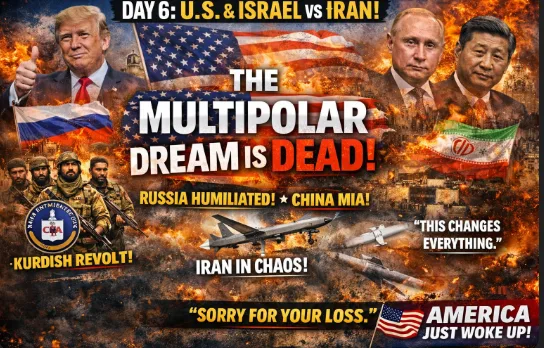
The Multipolar Dream Just Hit a Wall — And It’s Painted Red, White, and Blue 🇺🇸 --YNOT!
As the U.S. systematically dismantles the Iranian regime, China and Russia’s dream of a new world order goes up in flames.
Trump says Iran’s Navy, Air Force, and air defenses have been effectively knocked out, and Iran’s leadership is in dire straits.
And after the death of Ayatollah Kam, Iranian leaders held a meeting to pick the next head of state… and Israel blew all of them up.
Honestly? That’s on them.
When someone has complete air dominance and is targeting your leaders, maybe don’t put all your top guys in one room. Couldn’t they have done this over Zoom?
IRAN: “DECENTRALIZED MOSAIC DEFENSE” = “YOU GUYS ARE ON YOUR OWN”
With leadership gutted, Iran falls back on what’s called decentralized mosaic defense:
- The IRGC split into 31 independent regiments
- Commanders given free reign over tactical decisions
In plain English: “You guys are on your own. Shoot at whoever you want.”
Which is probably why they’re launching drones and rockets at random hotels in Dubai instead of real military targets.
KURDS: THE OTHER BOOT ABOUT TO DROP
And now there’s a second problem for the regime:A serious Kurdish force is reportedly preparing to move into western Iran:
“Expectation among Kurdish Iranian opposition forces is they will be going into western Iran… at some point during the next few days… with support from the US and from Israel.”
The framing here is clear:
- CIA reportedly working to arm Iranian Kurdish opposition forces
- Goal: ferment civil unrest, pin down Iranian forces
- Create buffer zones so unarmed Iranians can protest more safely
And the takeaway: These Kurdish fighters are no joke.
Well-armed. Battle-hardened. A real force.
RUSSIA: “EMERGENCY MEETING” + A CONDOLENCE CARD
Iran was supposed to be Russia’s main partner in the Middle East.
Iran, Russia, China—the three amigos of “multipolar world order.”
So where’s Putin?
Russia’s state-owned nuclear conglomerate says they’ve lost contact with Iran’s nuclear leadership, while the Kremlin claims they’re in constant contact with “the rest” of Iran’s leaders.
Who exactly are they talking to? “Anyone’s guess.”
Even the U.S. doesn’t know who’s running things: “Most of the people we had in mind are dead… now we have another group. They may be dead also… Pretty soon we’re not going to know anybody.”
Putin’s visible response?
- Emergency Security Council meeting
- A condolence card
Some ally you got there, Iran.
DUGAN: THE “MULTIPOLAR PROPHET” WATCHES HIS PROPHECY DIE
If you want the vibe check of the decade, it’s this: Alexander Dugin—Russia’s multipolar philosopher—goes on Sputnik and basically calls it:
“This changes everything completely. The previous world order has collapsed.”
“This is certainly a point of no return. If the United States can destroy the entire political, military, political, religious leadership of a sovereign country… we are living in a completely different world.”Translation: The theory just met reality. And reality has stealth bombers.
CHINA: A “STRATEGIC PARTNERSHIP” THAT MEANS… PRESS CONFERENCES
China and Iran had a 25-year comprehensive strategic partnership (signed 2021).
Iran also served as China’s discount oil supplier: “Over 80% of Iran’s exported oil went to Beijing.”
China helped bring Iran into: BRICS , Shanghai Cooperation Organization and every multilateral club Beijing built to signal “a new world is coming.”
The message used to be: “Iran is with us. If you want to deal with them, you’ll have to go through us.”
And then America attacked Iran.
China’s response?
- A press conference
- Deny intent to supply weapons
- Offer “moral support”
So the summary is brutal: And the response confusion.
World’s #2 economy, 1.4 billion people, UN Security Council seat… and the contribution is basically: “You got this, buddy.”
And the running joke becomes policy: A strategic partnership with China means China will be extremely disappointed on your behalf.
THE BIG IDEA: “SALAMI SLICING” ONLY WORKS AGAINST A SLEEPING SUPERPOWER
For a decade, Russia and China have played salami slicing:take a slice, wait, no response, take another
Examples in your framing:
- Russia took Crimea
- China built islands
- Iran funded proxies
The bet: America is too distracted, divided, and war-weary to react.
That strategy only works against a sleeping superpower.
Then:
Russia tried Ukraine and failed catastrophically
China watched partners get dismantled while issuing statements
Iran—most committed to the “Eastern Alliance”—is getting torn apart
So the conclusion: The multipolar world was never reality. It was branding.
And when the moment of truth arrived:
Russia and China could only say: “Sorry for your loss.”
The salami slicer only wins if America is asleep. But America just woke up.
If you’re a country that’s been quietly drifting into Beijing’s orbit, you’re watching this and doing the math: Who actually shows up when it’s real?
Who sends air power… and who sends press conferences?
That’s not just an Iran story. That’s a credibility earthquake.
What do you think? Drop your take below. 🇺🇸
Can Russia’s or China’s Allies Depend on Them?

“An ally who disappears when the shooting starts was never an ally — just a customer.” — YNOT
Trump has taken Venezuela, then Iran, and next on the board may be Cuba. Meanwhile, China and Russia stay quiet. They issue statements, murmur about “stability,” and then step back into the shadows. That silence is not a small thing. It is the story.
For years, much of the world was told that America was fading, that BRICS would rise, that the dollar would be challenged, that China and Russia were building an alternative power system for countries tired of the United States. But war has a way of stripping the paint off political fantasies. And when Iran — one of China’s most useful partners and one of Russia’s supposed strategic friends — comes under crushing pressure, neither Beijing nor Moscow steps forward in any meaningful way. That tells the world something. It tells the world that these are not alliances of iron. They are arrangements of convenience. (Reuters)
The Quiet Betrayal of Iran
This is the fascinating part. Iran needs China more than China needs Iran, but China still needs Iran. Iran’s oil exports have been running at roughly 1.1 to 1.5 million barrels per day, and China has been the main buyer. Kharg Island alone handles about 90% of Iran’s oil exports, which is why attacks there matter far beyond Iran itself. Cheap Iranian oil helps feed Chinese industry, keep refinery margins alive, and soften the pain of global energy shocks. (Reuters)
And yet, when the pressure rises, China does not come charging in. It does not send fleets. It does not draw red lines with the kind of seriousness that changes events. It calls for de-escalation, issues diplomatic complaints, and watches. Beijing appears to be choosing pain now over confrontation now. That is a strategic choice, and the world is watching it very carefully. (Reuters)
Iran, in many ways, gave China everything it could. Oil. Access. Platforms. Influence. Surveillance footholds. A place to test systems, methods, and political alignment. Iran bought into the idea that partnership with China created a kind of shield. But now comes the brutal lesson: an economic patron is not the same thing as a military protector.
Russia Is Sending the Same Message
Russia is no better. Iran and Russia signed a strategic pact, but that agreement does not include a NATO-style mutual defense clause. In plain English, that means Tehran cannot point to the treaty and say, “You must come save us.” Moscow can sympathize, condemn, and posture — and still do nothing. That is exactly why the silence matters. (Reuters)
That silence is being heard in more than Tehran. It is being heard in Caracas. It is being heard in Havana. It is being heard in Africa, in Latin America, and in every government that was flirting with the dream of joining some anti-American bloc and believing it came with real security guarantees. This war is not just about bombs and oil fields. It is about credibility.
What the World Has Learned
The world is learning that China and Russia are not building a NATO replacement. They are building networks of trade, leverage, dependency, technology, and convenience. That is not nothing. It is power. But it is a different kind of power.
China will buy your oil.
China will finance your roads.
China will wire your systems.
China will sell you cameras, scanning tools, telecom equipment, and digital infrastructure.
Russia will sell weapons, advisers, and political cover.
But when the storm hits, these relationships may stop at the water’s edge.
That is the message now echoing across the planet: China and Russia may help you resist America — right up until resisting America becomes dangerous for them.
Why China’s Silence Matters More Than Russia’s
Russia is already overextended, under sanction, and fighting its own long war. The world expects limits from Moscow. China is different. China has the larger economy, the industrial muscle, the naval ambition, and the long-term dream of replacing America as the center of gravity in the world system.
That is why China’s silence is so important.
Because if Beijing will not step in for a country as strategically useful as Iran — a country that supplies it oil, gives it regional influence, and helps tie down America’s attention — then what exactly are China’s allies buying into? Access to markets? Yes. Diplomatic cover? Sometimes. Technology? Certainly. But dependable military backing in a moment of existential crisis? So far, the evidence is weak. (Reuters)
Perhaps China Is Waiting
Maybe Beijing is not weak. Maybe it is patient.
Perhaps China is waiting for Taiwan.
Perhaps it is studying this war like a graduate student studies a cadaver.
Perhaps it is learning what American logistics, political will, and alliance coordination really look like under stress.
Perhaps Xi is discovering that his military buildup is not as ready as advertised.
There are reports and signs of turbulence around China’s command climate, and even absent any single dramatic conclusion, the broader point remains: Beijing does not appear eager to face the United States in open confrontation over Iran. That alone tells you something important about timing and confidence. (Reuters)
What This Means for BRICS and the Dollar Dream
For years, people spoke of BRICS as though it were marching toward a clean replacement for the U.S. dollar and a rival world order. The reality has always been murkier. Even BRICS members themselves have publicly backed away from the idea of a shared BRICS currency, focusing more on trade settlement mechanisms and investment platforms than on building a true reserve-currency alternative. (Reuters)
So maybe the dream is not dead, but it is certainly less magical than advertised. A bloc that cannot act like a bloc in crisis is not yet a replacement civilization. It is a loose coalition with overlapping grievances.
And that is the big lesson of this moment.
“BRICS promised a new world order. Iran just discovered it came with no warranty.” — YNOT
The Harsh Truth
America’s enemies, rivals, and critics may still want a post-American world. But wanting is not building. And building is not defending.
Iran is learning that dependence is not protection.
Russia is showing that partnership is not rescue.
China is showing that influence is not commitment.
So when smaller states look east and ask, “If we align with China or Russia, will they stand by us when it counts?” the answer now looks much uglier than it did a year ago.
Maybe they will trade with you.
Maybe they will arm you.
Maybe they will help you defy Washington.
But when the hour gets late and the bombs start falling, they may simply go quiet.
That is what the world is learning from Iran.
And once the world learns that lesson, it does not forget it easily.
“Everyone wants to challenge America… right up until America shows up.” — YNOT
Did Trump Just Reveal His 3D Chess Playbook— and Left China Checkmated Whatever It Does?
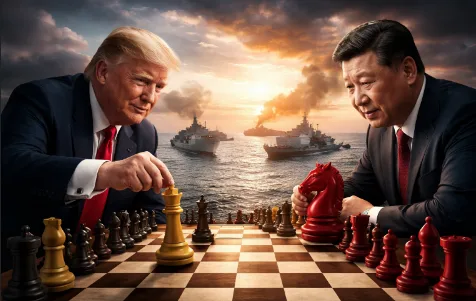
“Trump didn’t ask China a question. He handed Beijing two doors and locked both from the outside. The trap is simple: if China sails, America leads. If China stays home, America wins the argument. Not a choice, a dilemma!” — YNOT
What do you call it when a man says one sentence and an empire suddenly has no good options left?
That is the thing about power in public. Most people think it arrives wearing a uniform, carrying a flag, and shouting through a microphone. But real power often shows up dressed like a casual remark, smiling for the cameras, while half the room is still trying to figure out what just happened.
Trump’s line about China sending ships to the Strait of Hormuz was not just a comment. It was not small talk. It was not foreign policy wallpaper. It was a dare dressed up as an invitation, and the kind of dare that leaves a man embarrassed whether he accepts it or not.
That is what makes it beautiful, ugly, and effective all at once.
China has spent years trying to play the clever merchant prince of the modern world. It buys oil where others cannot, pays in currencies meant to weaken the dollar, talks peace while quietly taking advantage of chaos, and smiles like the only adult in the room while everyone else does the bleeding and the billing. It wants the profits of disorder without the cost of responsibility. That is a fine business model—right up until somebody shines a flashlight on it.
And that is what Trump just did.
He named the countries. Most of them are expected players. Allies, partners, nations with obvious stakes in the waterway staying open. Then he threw China into the sentence like a lit match into a room full of gas fumes. Now Beijing has to decide whether it wants to act like a great power or continue behaving like a discount shopper sneaking out the back door with the good silver.
If China sends warships, it loses the mask. No more pretending to be the detached peace broker above the mess. No more playing both sides while collecting the benefits. The minute Chinese ships join a security effort around Hormuz, China is no longer the neutral outsider. It becomes part of a security order it did not build, under a command structure it does not control, protecting a system whose pricing power still smells like Washington and Wall Street. That is not Beijing’s dream. That is Beijing swallowing hard and saying grace over an American meal.
But if China refuses, that is worse in a different way.
Then the whole world gets to see the truth plainly: China depends on the artery, profits from the artery, schemes around the artery, but does not want to lift a finger to defend the artery. That makes Beijing look less like the future ruler of the international order and more like a man who lectures the town on civic virtue while sneaking away before the volunteer fire bucket comes around.
That is the trap.
Show up, and you admit America still sets the stage.
Stay home, and you admit you were never the leading man.

For years, China’s great hustle has been to suggest that the dollar era is fading, that the yuan can grow around the edges, that alternate channels and shadow trade can eventually make Washington look old, tired, and expensive. And maybe that dream looked clever in conference rooms and policy papers. But history has a nasty habit of forcing theories to ride through bad neighborhoods at night.
Hormuz is one of those neighborhoods.
There, the world does not care about slogans. It cares about escorts, insurance, mines, missiles, and whether a tanker captain believes he will still be alive by dinner. In that kind of place, monetary fantasy runs straight into steel, drones, and fear. It is one thing to settle a transaction in yuan. It is another thing to clear a sea lane when somebody with a cheap drone and a grudge can shut the whole show down.
That is where the dollar keeps cheating death. It is not loved. Lord knows it is not loved. But when the house catches fire, people still run toward the fire truck, not toward the man holding a pamphlet about a future alternative water distribution model.
Trump, for all his rough edges and wrecking-ball manners, understands something the smooth experts often miss: global systems are not maintained by speeches about cooperation. They are maintained by somebody with enough force, nerve, and will to keep the road open. Civilization, beneath all the nice words and diplomatic cutlery, still depends on men with ships showing up where danger lives.
And China has spent a long time hoping to inherit the benefits of that truth without ever having to say it out loud.
Now it may have to say it.
That is why the sentence matters. It was not merely about Iran. Iran is the match. China is the curtain. The real drama is not whether Tehran can cause trouble. Of course it can. The real drama is whether Beijing is ready to stop acting like a clever spectator and start paying the cover charge for empire.
Empires are expensive. That is the part ambitious nations always whisper over.
Everybody wants reserve currency status. Everybody wants prestige. Everybody wants the world to call first and pay respect. But the bill comes due in ugly places—straits, chokepoints, shipping lanes, dead sailors, nervous markets, and long nights when somebody must decide whether to move steel into danger for the sake of order.
America has been paying that bill for a long time.
China wants the house. Trump just asked whether it is ready to help pay the mortgage.
And that is why this feels like checkmate. Not because China is weak. Not because China is stupid. But because the board has been arranged so that any move exposes the truth.
Send ships, and Beijing kneels to the security architecture it claims is fading.
Send nothing, and Beijing reveals that its grand alternative system still depends on American power doing the dirty work.
That is not just strategy. That is public humiliation by geometry.
The funniest part, if a man is allowed to laugh at dangerous things, is that modern experts will spend the next week pretending this is terribly complicated. They will use phrases like “regional deconfliction,” “multipolar signaling,” and “energy corridor stabilization.” That is what educated people do when they are scared of plain English. But plain English works just fine here:
Trump told China, in front of the whole class, to either help guard the hallway or admit it only likes using the hallway while someone else fights off the bullies.
Now we wait to see whether Beijing wants respect badly enough to risk comfort.
Because that is the test of every rising power. Not whether it can make money in the dark. Not whether it can talk big in forums. Not whether it can build ports, pipelines, apps, and slogans. The test is whether it can bear the burden that comes with the throne it keeps measuring for itself.
A lot of nations want to replace America right up until the moment they are asked to do American things.
Then suddenly, revolution becomes accounting. China wanted the benefits of empire without the burden of empire. Trump just put the invoice on the table.
And that is where many grand dreams go to die.
EXTRA CREDIT: WHAT IS A PETRODOLLAR – Everything you wanted to know.
#Trump #China #Hormuz #Iran #Geopolitics #DollarDominance #Yuan #GlobalTrade #EnergySecurity #WorldOrder #TrumpStrategy #ModernEmpire #3DChess #ShadowFleet
Agroterrorism - Can a Country Be Brought to Its Knees by a Fungus?

“With AI and gene-editing tools, it’s no longer science fiction to design a virus or fungus that targets a specific crop—or even a genetic strain. So the question isn’t can it be done… it’s why fire missiles at a nation, when a hidden organism can quietly do far more damage? May be it already has” --YNOT
Most people still imagine war the old-fashioned way. Tanks rolling. Missiles flying. Men in uniforms making speeches about freedom while somebody else’s town catches fire. But the modern world has a more elegant form of ugliness. If you really want to hurt a country, you do not always need to fire a bullet. You just need to make sure its people cannot eat. And that, friends, is where the scary-as-heck truth about agroterrorism begins.
This is not some late-night conspiracy cooked up by a man with three energy drinks and no supervision. In June 2025, federal prosecutors in Michigan charged two Chinese nationals, Yunqing Jian and Zunyong Liu, in connection with smuggling Fusarium graminearum into the United States. The Justice Department said scientific literature classifies the fungus as a potential agroterrorism weapon because it causes head blight in wheat, barley, maize, and rice, and because it can contaminate grain with toxins dangerous to humans and livestock. One of the defendants, Jian, later pleaded guilty in November 2025. (Department of Justice)
Now let us pause and appreciate the peculiar genius of this danger. A bomb is loud. A missile is obvious. A fungus is quiet. It does not march in formation. It does not wave a flag. It just slips into the food chain like a pickpocket in a crowded station and starts doing arithmetic with your harvest. The USDA notes that this pathogen reduces yield and seed quality, producing those shriveled “tombstone” kernels, while also contaminating grain with mycotoxins that can make it unsafe for food or feed. That is not merely a farm problem. That is a grocery-store problem, an inflation problem, a livestock problem, and before long, a political problem. (ARS)
And here is the part people miss because supermarkets have spoiled us. Civilization is only a few missed meals away from bad manners. Food is not just another commodity sitting on a spreadsheet beside copper and soybeans. Food is order. Food is patience. Food is the thin line between a family planning next year and a mob blaming whoever is nearest. The world depends heavily on a few staple crops, and FAO has long noted that just three crops—rice, maize, and wheat—provide about 60 percent of the world’s food energy intake. Put pressure on those systems, and you are not just attacking agriculture. You are attacking confidence itself. (FAOHome)
That is what makes agroterrorism so wicked. It works in shadows. A crop failure can be mistaken for weather, bad luck, poor seed, or bureaucratic incompetence. By the time people realize something was intentional, the harvest is already ruined, prices are already climbing, rumors are already spreading, and every crank with a phone is explaining to the public who secretly poisoned whom. A country does not need to be invaded when it can be confused, divided, and made hungry. Hunger has a way of turning political arguments into street theater in a real hurry.
The frightening thing is not that every case is a proven act of state sabotage. The frightening thing is that the method is plausible. It is cheap, deniable, and hard to spot early. A hostile state, a proxy network, or even a small determined cell does not have to conquer your army if it can rattle your food supply, wreck your farm economy, and make your citizens lose trust in the people supposed to protect them. That is the sort of attack that arrives without drumrolls and leaves everybody arguing while the shelves thin out.
So yes, this is real. The 2025 smuggling case was real. The pathogen was real. The risk is real. And the lesson is plain: in today’s world, a nation can be weakened without a single shot being fired. The battlefield may look less like Normandy and more like a wheat field. That sounds absurd right up until the bread costs twice as much, the livestock feed runs short, and the politicians start blaming the weather.
That is the joke modern civilization plays on itself. We built a world so advanced, so connected, so efficient, that one of the oldest enemies on earth — a fungus — can still walk in and remind us who is boss.
#Agroterrorism #FoodSecurity #NationalSecurity #Agriculture #Biothreats #SupplyChains #FoodWar #PlantPathogens #GrayZoneWarfare #Geopolitics
Two Tigers, One Mountain — The Thucydides Trap - Part 2

Empires rarely die from old age. More often, they die staring at a younger empire across the water, both convinced the mountain belongs only to them. Because Two tigers cannot share the same mountain. The Trap is what happens when two nations both believe destiny has chosen them. -- YNOT!
Back in April last year, I wrote about the old Chinese proverb:
Now Xi Jinping has openly invoked something even darker — the “Thucydides Trap.”
That is not just poetry. That is geopolitical philosophy wrapped in a warning label.
The phrase comes from the ancient Greek historian Thucydides, who wrote about the war between Athens and Sparta over 2,400 years ago. Athens was the rising power. Sparta was the established power. Thucydides concluded that it was the rise of Athens and the fear it created in Sparta that made war nearly inevitable.
Xi Jinping brought this up directly in discussions with Donald Trump while warning about Taiwan and the growing tension between China and the United States. In diplomatic language, this was not an accident. It was a message:
China sees itself as the rising civilization.
America is the existing empire.
History says these moments are dangerous.
And history has seen this movie before.
Britain and Germany before World War I.
Athens and Sparta.
Imperial Japan and the United States.
A rising power pushes outward. An established power pushes back. Trade routes, military buildup, technology races, alliances, and national pride all start intertwining like dry brush waiting for a spark.
The frightening part is that wars rarely begin because everyone wants war.
Wars begin because everyone thinks the other side will back down.
That is the real trap.
Today the battlefield is not just aircraft carriers and missiles. It is semiconductors, AI, cyberwarfare, rare earth minerals, satellites, shipping lanes, media influence, and financial systems. The Cold War of the 20th century was about ideology. This one is about who controls the operating system of the 21st century.
China builds ports.
America builds alliances.
China builds factories.
America controls finance and naval power.
China wants Taiwan.
America cannot easily allow Taiwan to fall without signaling weakness across Asia.
And hanging over all of it is the uncomfortable reality that both nations are economically chained together.
The United States and China are like two men holding each other by the throat while standing knee-deep in gasoline.
Neither can fully let go.
Neither can fully win.
Neither can afford to lose.
That is why Xi mentioning the Thucydides Trap matters. It was not a casual history lesson. It was Beijing signaling that they understand exactly where history can lead when two superpowers believe the mountain belongs only to them.
The problem with empires is that they almost always believe they are the exception to history.
Until they are not.
And somewhere, far back in time, an old Greek historian is probably shaking his head, because humanity still keeps updating the weapons while running the same ancient software.
So what did Donald Trump and Xi Jinping talk about…
1. Taiwan — the biggest issue
This was clearly the central geopolitical topic.
Xi warned Trump that mishandling Taiwan could lead to direct conflict between China and the United States. Xi reportedly described Taiwan as the “most important issue” in U.S.–China relations.
Trump later confirmed they discussed:
- U.S. arms sales to Taiwan
- Whether the U.S. would defend Taiwan
- Regional military tensions
Trump reportedly refused to directly answer whether America would militarily defend Taiwan if China attacked.
That ambiguity is intentional. The U.S. has historically used something called “strategic ambiguity” regarding Taiwan.
2. The “Thucydides Trap”
Xi brought this up publicly during the summit.
This was symbolic and strategic. He was basically saying:
History shows rising powers and existing powers often drift toward war.
In diplomatic language, Xi was telling Trump:
- China does not want containment
- China sees itself as an equal superpower
- The U.S. should avoid treating China like an enemy empire that must be stopped
At the same time, it was also a warning that Taiwan could become the trigger point.
3. Trade and economics
Trade was still a major topic.
Discussions reportedly included:
- Tariffs
- Chinese purchases of U.S. agriculture
- Boeing aircraft deals
- Technology and AI cooperation
- Supply chains
But unlike earlier Trump-China meetings years ago, this summit seemed much more focused on strategic power balance than simple trade disputes.
4. AI and technology competition
There were discussions about:
- Artificial intelligence
- misuse of AI by non-state actors
- technological rivalry
This matters because both countries understand AI may become as strategically important as nuclear weapons, oil, or industrial manufacturing were in previous eras.
5. Iran and global instability
The Middle East tensions and Iran situation were reportedly discussed as well.
China depends heavily on Middle Eastern energy routes, while the U.S. still dominates global naval security. Both countries have enormous economic interests tied to stability in the region.
6. Symbolism and power projection
A huge part of this summit was visual and symbolic.
China staged the meeting with enormous ceremony:
- Great Hall of the People
- state banquets
- highly choreographed visuals
- equal-superpower optics
Analysts noted that Xi appeared to be positioning China as no longer a “junior power” but as America’s peer — essentially a modern “G-2” world.
That may actually be one of the most important parts of the summit.
Because geopolitics is not only about weapons and economics.
It is also about:
- perception
- prestige
- status
- legitimacy
- who the world believes is rising
- who the world believes is declining
And Xi invoking the Thucydides Trap publicly was Beijing telling the world:
“We understand the historical danger of this moment… but we also believe China has arrived.”
So what were the results…
The biggest items reported were:
Boeing aircraft deal
China reportedly agreed to purchase:
- about 200 Boeing aircraft immediately
- with discussions possibly expanding toward 500–750 aircraft over time
- plus hundreds of GE Aerospace engines. (Reuters)
This is important because:
- China had largely frozen major Boeing orders for years
- Boeing badly needs large international orders
- China needs aircraft as its middle class and air travel continue expanding
But analysts noted:
- details are still vague
- timelines and financing are unclear
- no finalized mega-contract documents were publicly released yet. (Reuters)
Agricultural purchases
China reportedly committed to buying:
- large quantities of U.S. soybeans
- agricultural products over multiple years
- potentially “double-digit billions” annually. (The Economic Times)
This resembles earlier Trump-era trade arrangements where China increased farm imports to reduce tensions.
Possible market-opening discussions
Xi suggested China may further open parts of its market to U.S. businesses. However:
- no major structural trade agreement was announced
- no sweeping tariff resolution was reached
- no major rare-earth breakthrough was announced. (New York Post)
AI cooperation talks
There were discussions about:
- AI safety
- preventing AI misuse by non-state actors
- possible future cooperation frameworks
But again:
- no major treaty or binding agreement was announced publicly. (The Washington Post)
Iran / Middle East coordination
They reportedly discussed:
- keeping oil shipping lanes open
- preventing Iran from obtaining nuclear weapons
- possible sanctions flexibility involving Chinese purchases of Iranian oil
But there was no announced joint strategic agreement. (The Guardian)
The real outcome may have been geopolitical, not economic
A lot of analysts are saying the summit was less about immediate deals and more about:
- stabilizing tensions
- avoiding escalation over Taiwan
- symbolic recognition of China as a peer superpower
- reopening channels between Washington and Beijing. (The Washington Post)
In other words:
The optics may have mattered more than the paperwork.
Xi got:
- equal-superpower treatment
- a highly choreographed summit in Beijing
- acknowledgment that China cannot be ignored
Trump got:
- headlines about trade
- possible Boeing wins
- agricultural export promises
- the image of being able to negotiate directly with Xi
But as of now, there does not appear to be:
- a grand trade deal
- a Taiwan agreement
- a military pact
- a major AI treaty
- or a Cold War-style breakthrough.
PART1 – TWO TIGERS ONE MOUNTAIN
Solyndra: The Green Dream That Burned Through Half a Billion Dollars
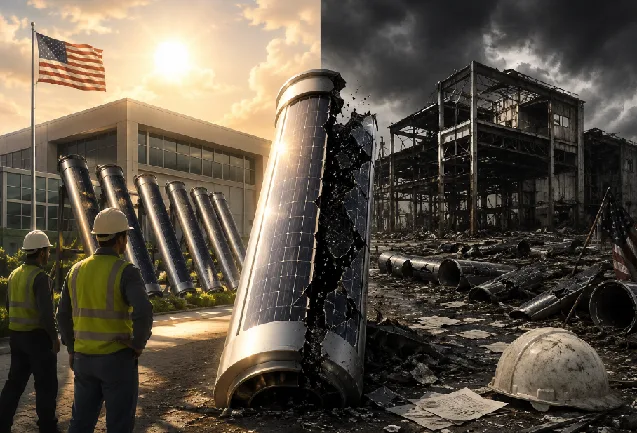
Solyndra did not fail because the future was fake. It failed because politicians confused hope with economics — and reality always sends the bill. -- YNOT!
There is an old rule in business that politicians learn only after they have spent someone else’s money:
A government can print dollars. It cannot print wisdom.
Back around 2009, America was told it stood on the edge of a green-energy revolution. The future would be powered by sunlight, electric dreams, and federal subsidies large enough to make accountants weep openly into their coffee.
One of the shining stars of that revolution was a company called Solyndra. And for a little while, Solyndra looked like the future itself.
Their technology was genuinely interesting. Most solar panels at the time were flat rectangles mounted at angles like giant black playing cards facing the sun. Solyndra decided to do something different. They built cylindrical solar modules — tubes instead of flat panels.
The idea had logic behind it. Their round design could supposedly capture sunlight from multiple angles throughout the day. The panels were lighter, easier to install on large commercial rooftops, and required less mounting hardware. In theory, warehouses and big-box stores across America would someday be covered in elegant rows of futuristic silver tubes.
And for a brief moment, the company looked unstoppable. Politicians toured the factory like it was Disneyland for climate policy. Newspapers praised it. Investors poured in money. The Obama administration made it the poster child of America’s green-energy future.
Then came the famous number: A $535 million federal loan guarantee.
Not millions from private investors risking their own fortunes. Not venture capitalists gambling on innovation. Taxpayer-backed money. That is where the story changes from business to tragedy. Because the market had other plans.
Solyndra’s entire business model depended on one critical assumption:
That traditional silicon solar panels would remain expensive.
But while American politicians were giving speeches, Chinese manufacturers were building factories at astonishing speed. China flooded the market with cheap conventional solar panels. Prices collapsed worldwide.
And suddenly Solyndra’s elegant futuristic tubes became a luxury product nobody needed. The economics turned brutal almost overnight. Their manufacturing costs were too high. Their product could not compete. Their burn rate was enormous. And the more they scaled production, the faster they lost money. That is one of the cruelest lessons in capitalism:
Sometimes the future arrives. Just not your version of it.
In 2011, Solyndra collapsed into bankruptcy. About 1,100 employees lost their jobs. Taxpayers were left holding the bag. And the company that had once been displayed as proof of America’s clean-energy renaissance became a national symbol of political overconfidence. Now here is the uncomfortable part nobody likes discussing. The disaster was not simply that Solyndra failed. Businesses fail all the time. Failure is part of capitalism. Venture capitalists understand this perfectly well. They know that for every ten startups, perhaps one survives.
The real problem was this: Government officials were acting like venture capitalists — except they were gambling with other people’s money.
When private investors lose money, they suffer consequences. When politicians lose money, they hold another press conference. And that is the danger.
Governments are very good at building roads, defending borders, and maintaining infrastructure. But they are often terrible at predicting which technologies will survive brutal global competition.
Markets evolve faster than bureaucracies. Factories move faster than politicians. And reality does not care about press releases. The truly ironic part? Solar energy itself did not fail. In fact, solar exploded worldwide.
But the winners were often companies with lower costs, better timing, stronger supply chains, or access to massive industrial scaling — especially in China.
Solyndra was not destroyed because solar power was fake. It was destroyed because economics is undefeated. And perhaps that is the deepest lesson of all: A good idea is not enough. Political enthusiasm is not enough. Even revolutionary technology is not enough.
If the numbers do not work… eventually gravity returns.
And gravity always collects its debt.
Solyndra Timeline
| Year / Date | Event | Money / Financial Details |
|---|---|---|
| 2005 | Solyndra founded in California | Raised large venture capital funding from private investors |
| 2006–2008 | Company gains attention for cylindrical solar panel technology | Hundreds of millions invested privately before government involvement |
| March 2009 | Obama administration announces federal support | U.S. Department of Energy approves $535 million loan guarantee |
| 2009 | New Fremont, California factory construction begins | Massive manufacturing facility built with federally backed financing |
| May 2010 | President Barack Obama visits Solyndra factory | Company publicly promoted as symbol of “green jobs” future |
| 2010 | Solar market changes dramatically | Chinese manufacturers rapidly drive down conventional solar panel prices |
| Late 2010 | Financial pressure increases | Solyndra reportedly burning cash rapidly while losing competitiveness |
| February 2011 | Company restructures debt | Private investors injected about $75 million more to keep company alive temporarily |
| August 31, 2011 | Solyndra shuts down operations | About 1,100 employees laid off immediately |
| September 6, 2011 | Solyndra files for bankruptcy | Estimated taxpayer exposure: over $500 million |
| September 2011 | FBI raids Solyndra headquarters | Federal investigation begins into finances and loan process |
| 2012–2015 | Congressional investigations continue | Political battle over government-backed “green energy” investments |
| After bankruptcy | Factory sold off and assets liquidated | Taxpayers recovered only a fraction of losses |
Major Money Figures
| Category | Approximate Amount |
|---|---|
| Federal loan guarantee | $535 million |
| Private venture capital invested before collapse | ~$1 billion+ |
| Additional emergency investor funding in 2011 | $75 million |
| Employees laid off | ~1,100 |
| Estimated taxpayer losses | Hundreds of millions |
| Estimated total investor losses | Over $1 billion |
Why Solyndra Looked Promising
Their technology actually had real engineering logic behind it:
- Cylindrical solar tubes could capture sunlight from multiple angles.
- Easier rooftop installation on flat commercial roofs.
- Reduced need for mounting hardware.
- Better airflow and cooling around panels.
- Looked futuristic and innovative.
The problem was not that the technology was “fake.”
The problem was economics.
Solyndra’s business model depended on traditional silicon solar panels staying expensive. Instead, China massively expanded manufacturing capacity and flooded the market with low-cost flat solar panels.
The price collapse destroyed Solyndra’s competitive advantage.
Why the Government Funding Became Controversial
Critics argued several things:
- Government officials were trying to pick technological winners and losers.
- Political enthusiasm may have overridden financial caution.
- The company’s financial warning signs appeared before collapse.
- Taxpayers absorbed losses that private investors normally would have taken.
Supporters of the broader clean-energy program argued that:
- Venture-style investments naturally include failures.
- Other DOE-backed companies succeeded.
- Solar power itself ultimately became massively successful worldwide.
But politically, Solyndra became the symbol of what happens when:
- politics,
- public relations,
- and speculative technology
collide with real-world market forces.
Solyndra was a cronyism scandal a proven kickback scandal.
| Issue | What happened | Proven kickback? |
|---|---|---|
| Obama donor connection | Major Solyndra investor George Kaiser was an Obama fundraiser/bundler. Critics argued this looked like political favoritism. | No direct kickback proven. Kaiser denied lobbying for the loan, and public reporting did not prove a cash-for-loan deal. |
| Special loan treatment | In 2011, DOE restructured the loan so new private investors could be repaid ahead of taxpayers if Solyndra collapsed. | Special deal, yes. Kickback, not proven. |
| Rushed approval | Emails showed concern that the loan may have been pushed quickly for political optics and public announcements. | Political pressure alleged, but not proven as bribery. |
| Misleading company claims | DOE Inspector General later found Solyndra gave false or misleading information about sales and financial health. | Fraud-like conduct by company leadership alleged/found, but not a proven political kickback scheme. |
| Taxpayer loss | Over $500 million was disbursed; taxpayers lost hundreds of millions after bankruptcy. | Financial disaster, yes. |
The suspicious part was the political access, the Obama donor connection, the rushed optics, and the later loan restructuring. But investigators did not prove a simple “they donated money and got the loan as a payoff” arrangement.
The worst “special deal” was the loan restructuring that put some private investors ahead of taxpayers. That looked terrible politically because the public took the loss while insiders got a better position.
Tulsi Gabbard Just Said the Quiet Part Out Loud About U.S.-Funded Biolabs
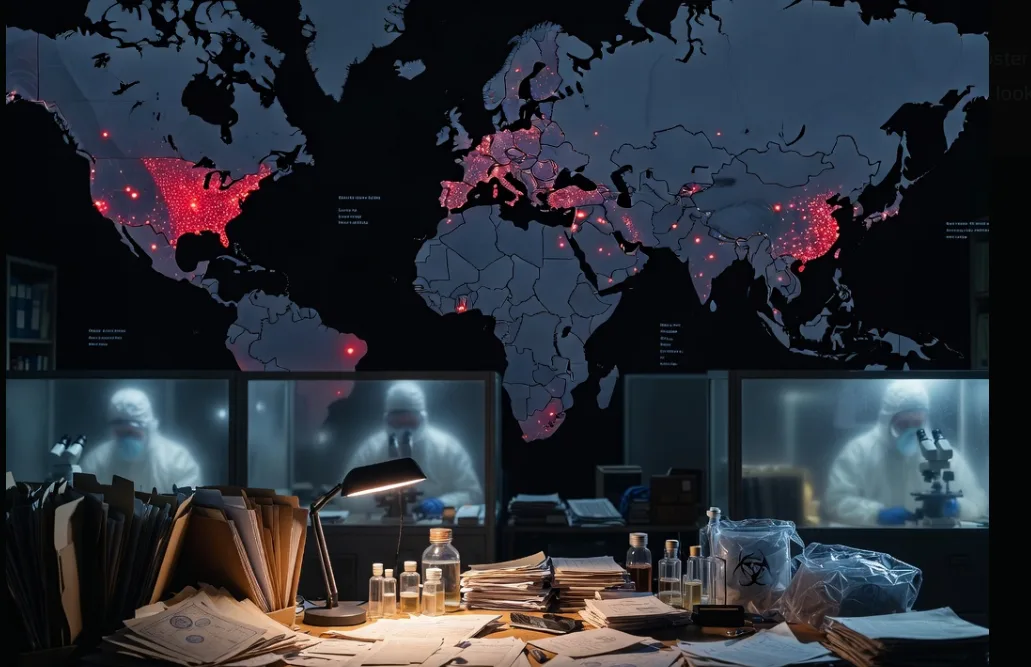
Tulsi Gabbard (video below) released something that should make every American stop and ask a very simple question:
What exactly has our government been funding overseas in the name of “public health” and “national security”?
According to Gabbard, after months of searching through intelligence files, ODNI found evidence that the U.S. government has funded more than 120 biological laboratories in over 30 countries. These are not just normal hospital labs drawing blood and checking cholesterol. Some of these facilities have handled dangerous pathogens. Some have worked with highly contagious biological materials. And in some cases, Gabbard says, the concern includes gain-of-function research.
That phrase matters.
Gain-of-function research means taking a virus, bacteria, or pathogen and modifying it in ways that can make it more transmissible, more dangerous, harder to treat, or better able to evade detection. Supporters say this research can help scientists understand threats before they appear in nature. Critics say it is playing with matches in a gasoline warehouse.
Tulsi’s message is not simply, “There are labs.”
The bigger message is this:
The American people were told for years that asking questions about U.S.-funded biolabs was conspiracy theory, Russian propaganda, or treason. Now the Director of National Intelligence is saying the U.S. government did fund a global network of these labs, and the public was not given the full truth.
That is the real scandal.
One of the biggest examples is Ukraine. These labs are in a war zone. Russia is attacking, occupying, bombing, and destabilizing parts of the country. Gabbard says the intelligence community had already warned that at least one U.S.-funded biolab in Ukraine likely housed dangerous pathogens and remained vulnerable to Russian attack, seizure, or damage.
Think about that.
We were funding labs in a country that later became the center of a major war. Some of those labs may have had dangerous pathogens. And the people asking questions were treated like enemies instead of citizens.
This does not automatically mean every lab was a weapons lab. That is not what needs to be proven first.
The issue is bigger and more basic:
Who authorized this?
Who tracked the pathogens?
Who audited the research?
Who decided which foreign countries were safe enough?
Who had the power to classify this information?
Who decided the American taxpayer could pay for it but not know about it?
And most importantly, who lied when people asked?
Gabbard also connected this to the broader fight over gain-of-function research. President Trump signed an executive order in 2025 aimed at ending federal funding for dangerous gain-of-function research, especially in foreign countries where U.S. oversight is weak or unreliable. That matters because the danger is not only what America does inside America. The danger is what America funds outside America, where the chain of accountability becomes foggy.
If a lab in another country has U.S. money, U.S. contractors, U.S. equipment, and U.S.-funded training, then the American government cannot turn around and say, “Don’t ask us, that is not our problem.”
It is our problem because it is our money.
It is our problem because it is our national security.
It is our problem because one accident, one leak, one military strike, one corrupt official, or one captured facility could affect the whole world.
The public was told to trust the experts. But trust is not a substitute for oversight. Trust is not a budget audit. Trust is not a safety inspection. Trust is not a pathogen inventory. Trust is not transparency.
The people who told us “nothing to see here” need to answer for why there was so much to hide.
The government’s defense has always been that these programs were created for biological threat reduction, disease detection, and public health. That may be true in many cases. But even if the original purpose was defensive, the risk remains real. A dangerous pathogen does not care whether the grant proposal said “public health.” A lab accident does not care about good intentions. A war zone does not care about paperwork.
This is the lesson:
You cannot fund dangerous biological research around the world, hide the details from the public, smear the people asking questions, and then expect trust when the truth starts leaking out.
Tulsi Gabbard is saying the American people deserve to know where these labs are, what pathogens they hold, what research they conducted, who paid for it, who approved it, and whether any of it crossed the line into dangerous gain-of-function work.
That is not conspiracy theory.
That is basic accountability.
And after COVID, every American should understand this one thing:
When governments, intelligence agencies, scientists, contractors, and politicians all tell you not to ask questions, that is exactly when you should ask more.
The New Plaza Accord: The Deal Nobody Will Understand Until It Is Too Late
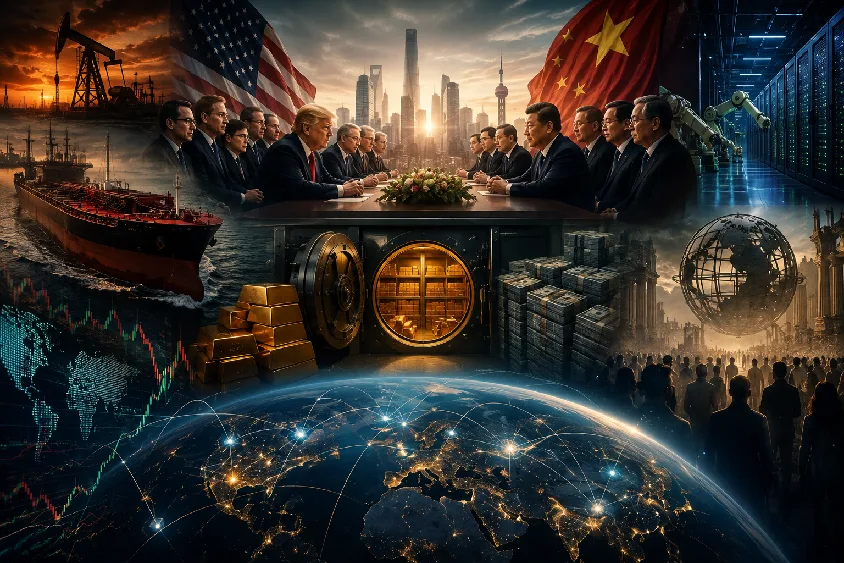
History’s biggest turns do not kick down the door. They slip in like a thief in the night, and by the time people notice, the world has already changed. -- YNOT!
Most of the time, history does not announce itself.
Big events happen quietly. The people living through them do not fully understand them. Sometimes even the people inside the room do not understand the full consequences of what they are doing.
One thing triggers another. Then another. Then another.
A currency deal becomes an industrial collapse. A war becomes a new world order.
A financial agreement becomes thirty years of economic pain.
A quiet meeting becomes the beginning of a new monetary system.
That is how history usually works.
You do not see the full meaning of an event when it happens. You see it years later. Sometimes decades later. By then, everyone acts like it was obvious.
It was not obvious.
That is why I want to lay out a theory. And honestly I don’t now if it is true, and if it was true if it is a positive thing or not. Not a certainty. Not a prediction carved in stone. A theory.
But one that may explain what is really happening behind the headlines.
When Trump went to China and brought with him some of the most powerful CEOs in the world — Elon Musk, Tim Cook, Jensen Huang, Larry Fink, and others — that was not just a photo opportunity.
That was not just another diplomatic trip. That may have been one of the most important business and monetary meetings of our lifetime.
The official language was about cooperation, stability, humanity, trade, technology, and the future of relations between America and China.
But that is always how history talks in public.
The real question is this: Was this meeting about creating a new monetary order?
Because the old one is breaking.
The post-World War II order, largely built and imposed by the United States, is no longer functioning the way it used to. The dollar system is under pressure. The American industrial base has been hollowed out. China has become the factory of the world. Debt is exploding. Gold is moving. Supply chains are shifting. AI is about to destroy and remake whole categories of work.
The world is at a crossroads. And the country that helps write the next monetary order will help write the next century.
China knows this. America knows this.
The question is whether both sides are preparing a deal that most people will not understand until after it has already changed their lives.
The Ghost of the Plaza Accord
To understand what may be happening now, you have to go back forty years.
In 1985, the United States had a problem.
The dollar was too strong. The trade deficit was too large.
American manufacturers were getting crushed.
Foreign goods were cheaper. American exports were less competitive.
Sound familiar?
So the Reagan administration called a meeting at the Plaza Hotel in New York City. The United States brought in Japan, West Germany, France, and the United Kingdom.
Behind closed doors, they made a deal. That deal became known as the Plaza Accord.
The purpose was simple: weaken the U.S. dollar, especially against the Japanese yen.
The result was dramatic. The yen surged. Japanese exports became more expensive. American goods became more competitive. The U.S. trade deficit improved.
On paper, it looked like a win. But Japan paid the price.
Because when the yen rose that fast, Japan’s export-driven economy started to seize up. To compensate, Japan flooded its economy with cheap money. That cheap money created one of the biggest asset bubbles in modern history.
Stocks exploded. Real estate exploded. Debt exploded. Speculation exploded.
Then the bubble burst.Japan spent the next thirty years trying to recover from it.
History calls it the Lost Decades. So here is the lesson:
A currency deal can reshape the world. It can save one country and cripple another.
It can look like diplomacy while quietly rearranging the economic future of millions of people.
That is why a new Plaza Accord matters.
But China is not Japan. China watched what happened to Japan.
And China is not going to walk into the same trap.
China Will Not Let the Yuan Become the Yen
China’s hard line is simple: They will not allow a direct revaluation of the yuan against the dollar. They know what happened to Japan. They know that if their currency rises too fast, their export machine gets damaged. Factories suffer. Jobs suffer. Social stability suffers.
China’s entire political system depends on stability.
So if the world needs a monetary reset, China will not want the yuan to be the pressure valve. They need another asset to absorb the repricing.
That asset may be gold. Gold is the one asset both sides can use without saying the quiet part out loud.
America has gold. China has gold. Central banks have gold. Gold has no counterparty.
Gold is not printed by governments. Gold is not a campaign promise.
Gold is not a Treasury bill. Gold is not a central banker’s speech.
Gold is the old money hiding underneath the new money.
And if the dollar weakens against gold, both America and China can claim they did not directly destroy each other’s currency system.
That is the theory. Not a yuan revaluation. A gold-centered monetary reset.
A Plaza Accord 2.0, but this time the pressure valve is not Japan’s currency.
It is gold.
The Gold Escape Valve
The United States government holds more than 8,000 tons of gold.
But on the government’s books, that gold is still valued at around $42 an ounce, a relic from the old monetary system.
That accounting price has almost nothing to do with the real market price of gold.
So the United States is sitting on an asset that is massively understated on paper.
If America marked that gold closer to market value, the national balance sheet would suddenly look very different. It would not magically erase the debt, but it would change the optics and possibly the structure of the monetary system.
China also holds a huge amount of gold. Officially, they report one number. Unofficially, many believe they hold much more. And China has been accumulating gold for years.
So imagine the deal.
China does not revalue the yuan. America does not openly default.
The dollar weakens against gold. Gold rises dramatically.
America’s gold reserves become more valuable.
China’s gold reserves become more valuable.
The debt burden gets inflated away in real terms.
Both sides claim victory.
Then, in exchange, Chinese capital begins flowing into American manufacturing, factories, infrastructure, and industrial rebuilding.
Trump gets to say he brought factories back. China gets tariff relief, market access, and a seat at the table in the new monetary order.
Both sides get to look like they saved the world.
But the real story would be this: The dollar was devalued without calling it a devaluation.
Inflation Is Not the Accident. Inflation Is the Mechanism.
Most people misunderstand inflation.
They think inflation is a policy mistake.
Sometimes it is. But sometimes inflation is the plan.
Because inflation is how governments make unpayable debt payable again.
If you borrow a dollar today and pay it back years later with a dollar that is worth half as much, the debt shrinks in real terms.
The numbers stay the same. The burden changes.
That is the trick.
The government does not have to say it defaulted. It does not have to say it robbed savers.
It does not have to say it diluted the working class.
It just lets the value of money fall.
Normal people experience this as higher rent, higher groceries, higher insurance, higher taxes, higher car payments, and higher electric bills.
But asset owners experience it differently. If you own stocks, real estate, gold, Bitcoin, land, businesses, collectibles, productive tools, or scarce assets, inflation may actually make you richer in nominal terms. Your assets go up.
But if your wealth is sitting in cash, wages, or a savings account, inflation eats you alive.
That is the K-shaped economy. The top line goes up. The bottom line goes down.
The people with assets survive the monetary reset. The people without assets get reset.
AI Makes the Divide Worse
Now add AI on top of this. AI is not just another technology trend. It is a productivity earthquake.
It will make the top half of the economy more powerful, more efficient, and more profitable. But it will also destroy many of the jobs the bottom half depends on.
Customer service.
Data entry.
Basic office work.
Warehouse systems.
Trucking.
Manufacturing.
Accounting support.
Marketing support.
Administrative work.
Even parts of programming, design, and media.
This does not mean every job disappears overnight. But it does mean the labor market is going to be reorganized.
Some people will adapt. Some people will move up. Some people will use AI as leverage. Some people will be left behind.
That is not cruelty. That is math.
Every major transition leaves people behind.
The printing press did it. The industrial revolution did it. Electricity did it. The internet did it. Globalization did it. AI will do it faster.
So now you have inflation destroying savers, assets protecting the wealthy, and AI weakening the job base for millions of people.
That creates anger. That creates low trust. That creates political instability. That creates protests, resentment, conspiracy, and social breakdown. And the people managing the system know this.
That is why the digital control structure is being built at the same time.
Digital identity. Programmable money. Central bank digital currency. Algorithmic banking. Financial surveillance. Social scoring by another name.
Speech monitoring. De-banking. Access control. Permission-based money.
They will call it convenience. They will call it safety.
They will call it financial innovation.
But what it really means is this: When the class divide gets worse, the system will need tools to manage the anger. That is the digital control grid.
The Real Question
So is this theory guaranteed? No.
Maybe there is no deal. Maybe gold is not the pressure valve.
Maybe China and America cannot agree.
Maybe supply chains break before the system resets.
Maybe markets crash. Maybe oil explodes.
Maybe the whole theory is wrong.
But even if the details are wrong, the direction looks clear. The old order is breaking. The dollar is losing purchasing power. Debt is too high. Gold is rising.
China wants a bigger seat at the table. America wants to rebuild manufacturing.
AI is changing labor. Inflation is dividing society.
And people without assets are getting crushed.
So the question is not whether you like Trump, China, gold, Bitcoin, or central banks.
The question is simpler:Which side of the K-shaped economy are you on?
Are you on the side that owns assets? Or are you on the side that gets paid in dollars, saves in dollars, rents in dollars, and watches those dollars buy less every year?
Because if this is a monetary transition, the people who understand it early will prepare.
The people who understand it late will complain. And the people who never understand it will simply be poorer and never know why.
This is not investment advice. It is a warning.
Governments can print dollars. They can print promises. They can print statistics. They can print excuses.
But they cannot print gold. They cannot print land. They cannot print productive businesses. They cannot print real skill. They cannot print time.
Every major historical reset rewards the people who own scarce, useful, durable assets.
And it punishes the people who trusted paper too much.
Historical Events People Did Not Understand at the Time
Here are examples of events that looked like one thing when they happened, but only revealed their full importance years later:
- The assassination of Archduke Franz Ferdinand in 1914 looked like a regional crisis. It became World War I.
- The Treaty of Versailles looked like peace. It helped create the conditions for World War II.
- The creation of the Federal Reserve in 1913 looked like banking reform. It changed the entire American monetary system.
- Bretton Woods in 1944 looked like postwar planning. It made the dollar the center of the global financial system.
- Nixon closing the gold window in 1971 looked like a temporary emergency measure. It ended the dollar’s direct link to gold.
- The Plaza Accord in 1985 looked like currency coordination. It helped trigger Japan’s Lost Decades.
- China joining the World Trade Organization in 2001 looked like free trade. It reshaped global manufacturing and hollowed out parts of America’s industrial base.
- The 2008 financial crisis looked like a housing collapse. It became the beginning of permanent central bank intervention.
- The COVID response looked like a public health emergency. It accelerated remote work, money printing, supply-chain instability, digital control, and distrust in institutions.
- The rise of AI looks like a technology boom. It may become the largest labor reset in modern history.
History does not usually knock on the door and say, “I am here.” It walks in quietly.
Then years later, everyone asks why nobody saw it coming.
–YNOT!
Fauci pleads the Fifth ... Never saw that coming... kidding of course
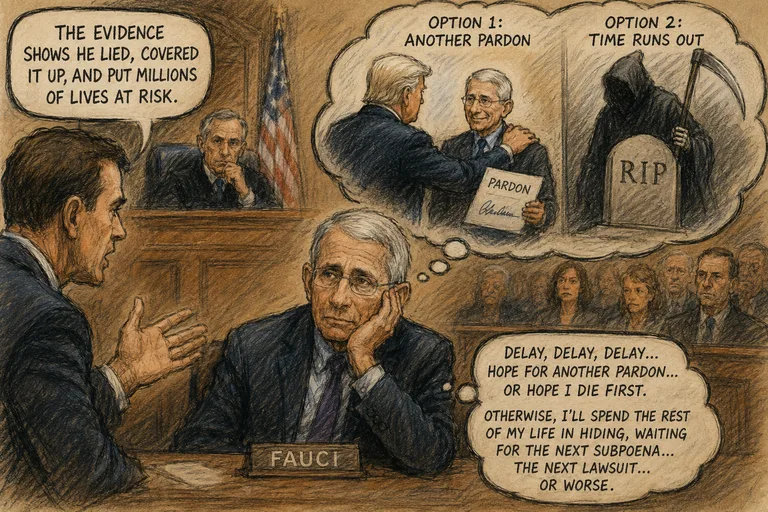
Fauci’s Biden pardon is not blanket lifetime immunity. The official warrant covers federal offenses he may have committed or participated in from January 1, 2014, through January 19, 2025, provided they arose from or related to his specified government service. It does not cover later conduct, unrelated offenses, or state crimes.
Can he plead the Fifth?
Yes—but the legal basis must be potential exposure to an unpardonable or unpardoned offense, such as:
- Perjury, obstruction, false statements, or contempt occurring after January 19, 2025.
- Participation in criminal conduct continuing after that date.
- Conduct outside the pardon’s subject-matter scope.
- Possible state-law exposure.
However, where a truthful answer could expose him only to federal offenses completely covered by the pardon, his Fifth Amendment claim becomes much weaker. Supreme Court precedent holds that when immunity removes the realistic danger of prosecution, the privilege against self-incrimination no longer justifies refusing to answer. Whether Fauci’s pardon eliminates the danger presented by each particular question would ultimately be a legal question, not something resolved simply by invoking the Fifth repeatedly.
A pardon removes the Fifth Amendment privilege concerning matters for which the pardon leaves no realistic criminal exposure—but it does not remove the privilege concerning separate, unpardoned criminal exposure.
His invocation today is not itself evidence of guilt, nor is it perjury, because he did not provide a false answer. He invoked the Fifth rather than answering.
Is the diary evidence?
Potentially, yes. In a criminal proceeding, prosecutors would have to authenticate it as genuine. Fauci’s own authenticated statements could generally be introduced against him as statements of an opposing party. The diary could establish knowledge, intent, chronology, inconsistencies, or leads to other evidence. But a diary entry is evidence—not automatic proof of a crime or conspiracy. (Legal Information Institute)
A pardon also does not erase historical facts or create a legal fiction that the underlying conduct never happened. Therefore, pardoned conduct and documents relating to it may potentially be used as background evidence when proving a separate, unpardoned post-pardon offense. (Congress.gov)
The major correction: covering something up does not automatically extend a conspiracy
To prosecute Fauci for a conspiracy continuing beyond January 19, 2025, prosecutors would need evidence that:
- There was an actual criminal agreement involving at least two people.
- Its criminal objective continued beyond the pardon date.
- Fauci knowingly remained involved after that date.
- An overt act after that date occurred, where the applicable conspiracy statute requires one.
The general federal conspiracy statute requires an agreement and an act intended to advance its objective.
The Supreme Court has specifically rejected the idea that ordinary attempts to conceal a completed crime automatically keep the original conspiracy alive forever. Under Grunewald v. United States, later concealment counts as part of the conspiracy only when concealment was itself part of the original criminal objective or was necessary to accomplish the principal objective. Merely denying wrongdoing or covering one’s tracks after the underlying scheme ended ordinarily does not extend the conspiracy.
A deliberate lie after the pardon could nevertheless constitute a new crime, such as perjury if made materially under oath, or obstruction if made corruptly to impede a congressional investigation. Those offenses would be dated after the pardon and therefore outside it.
Bottom line
The Biden pardon cannot protect Fauci from crimes committed after January 19, 2025, including post-pardon perjury, obstruction, or proven participation in a continuing conspiracy.
But this part goes too far: “He is still lying and covering it up, therefore the conspiracy is ongoing and the pardon is useless.”
Continued lying would have to be proven, and it might constitute a new offense. It does not, by itself, prove that an earlier conspiracy legally continued. The pardon remains extremely valuable against prosecution for covered pre-January 19, 2025 federal conduct; it is simply ineffective against genuinely new post-pardon crimes.
Fauci’s pardon covers federal offenses related to his government service only through January 19, 2025. It does not protect him from post-pardon perjury, obstruction, false statements, or continued participation in a criminal conspiracy. His diary could provide admissible evidence if authenticated, but prosecutors would still have to prove that a conspiracy actually continued beyond the pardon date and that Fauci knowingly participated in it after that date. Mere denial or concealment of a completed offense does not automatically keep the original conspiracy alive.
State criminal charges and private civil lawsuits are outside the normal protection of Fauci’s presidential pardon. In those areas, the pardon is much less useful—but other immunity doctrines could still protect him.
1. State criminal charges
Biden’s pardon covers “offenses against the United States” related to Fauci’s government service through January 19, 2025. It does not pardon violations of Maryland, New York, Florida, California, or another state’s criminal laws. Presidential pardon authority does not extend to state offenses or civil wrongs.
Therefore, a state would not need to prove that Fauci committed a new crime after the pardon date. A state could theoretically prosecute a pre-pardon state offense, because that offense was never covered by Biden’s pardon in the first place.
The Supreme Court’s dual-sovereignty doctrine permits state and federal governments to prosecute offenses arising from the same conduct because each sovereign is enforcing its own law. A federal pardon therefore does not ordinarily prevent a state prosecution.
But a state would still need:
- A genuine violation of that state’s law.
- Territorial jurisdiction or another legally sufficient connection to the state.
- Evidence proving every element beyond a reasonable doubt.
- A prosecution filed within the applicable limitations period.
- A theory that is not preempted by federal law.
A lie to Congress, for example, is principally a federal matter. It does not automatically become state perjury merely because a state resident was affected. Prosecutors would need a separate state-law offense and jurisdictional basis.
Federal-officer immunity remains a major defense
Even without the pardon, a former federal official can argue Supremacy Clause immunity from state prosecution when the conduct was authorized by federal law and the official did no more than was “necessary and proper” in carrying out federal duties. That protection would not necessarily cover conduct outside federal authority or conduct that was not necessary and proper.
So the state’s theory would matter enormously:
- “Fauci made a controversial federal policy decision” would face strong immunity and preemption defenses.
- “Fauci personally falsified records, destroyed evidence, committed fraud, or joined an unlawful agreement outside his lawful authority” would present a materially different question—assuming the evidence and state jurisdiction existed.
One additional wrinkle: Washington, D.C., is not treated exactly like a state for pardon purposes. DOJ states that presidential clemency can reach certain D.C. offenses prosecuted by the U.S. Attorney in the name of the United States. Maryland or Virginia offenses would remain ordinary state offenses.
2. Private lawsuits for damages
The pardon itself does not erase private civil liability. A person could file a lawsuit based on pardoned conduct, and authenticated diary entries could potentially be used as evidence. But filing a case is much easier than surviving dismissal.
A plaintiff would have to prove:
- A legally recognized cause of action.
- A concrete personal injury—not merely disagreement with public policy.
- A sufficiently direct causal link between Fauci’s conduct and the injury.
- Measurable damages.
- Timeliness under the relevant statute of limitations.
For claims involving illness, vaccination, business closures, employment losses, or death, proving that Fauci personally and legally caused the particular plaintiff’s damages would usually be a central obstacle.
The Westfall Act
For ordinary tort claims based on conduct within Fauci’s federal employment, the government could certify that he was acting within the scope of employment. Under the Westfall Act, the United States would then generally replace Fauci as the defendant, converting the case into a Federal Tort Claims Act proceeding.
That is significant because the FTCA contains major exceptions, including claims based on discretionary policy functions and claims arising from misrepresentation, deceit, libel, or slander. Many lawsuits framed as “Fauci lied and caused damages” could encounter those exceptions.
Public Health Service protection
Federal law also makes the FTCA remedy exclusive for personal injury or death resulting from medical or related functions performed by Public Health Service officers or employees within their employment. The Supreme Court has interpreted that provision as granting personal immunity for covered conduct. Whether it applied to a particular Fauci claim would depend on his status, the function involved, and the precise allegations.
PREP Act immunity
A lawsuit involving COVID vaccines, treatments, testing, distribution, administration, or other covered countermeasures could also run into the PREP Act. It provides broad liability protection to covered persons, potentially including “program planners” who supplied policy guidance or scientific advice, subject to a narrow statutory exception for willful misconduct.
This means a conventional negligence or failure-to-warn lawsuit involving a covered COVID countermeasure could be barred even though the presidential pardon itself provides no civil immunity.
Constitutional lawsuits
Trying to sue Fauci personally for constitutional violations would also be difficult. The Supreme Court has sharply restricted new implied damages actions against federal officers under Bivens, especially where high-level government policy and national public-health decisions are involved.
His Fifth Amendment position in a civil case
Because the pardon does not eliminate possible state exposure, Fauci could potentially invoke the Fifth Amendment during civil discovery or testimony when an answer might incriminate him under state law or for an unpardoned federal offense.
However, civil litigation differs from a criminal trial. A court or jury may sometimes draw an adverse inference from a party’s invocation of the Fifth when other probative evidence supports the claim. The invocation alone would not automatically establish liability.
Bottom line
Biden’s pardon does not protect Fauci from state crimes at all—even crimes allegedly committed before January 19, 2025.
And regarding civil litigation: The pardon does not extinguish private claims for damages, but plaintiffs would still have to overcome causation, standing, limitation periods, federal-officer protections, the Westfall Act, FTCA exceptions, Public Health Service immunity, and potentially the PREP Act.
The diary could help establish knowledge, intent, contradictions, or investigative leads. But it would not, by itself, overcome those jurisdictional and immunity barriers or prove that Fauci personally caused a particular plaintiff’s damages.
Fauci’s best defense will simply be delay: drag the process out long enough to hope that the next president grants him another pardon—or that time overtakes the case altogether. Either way he could spend the rest of his life looking over his shoulder, never knowing when another subpoena, lawsuit, investigation, or criminal charge may arrive at his door.
What We Know Today About the Origin of COVID—and How Far Back the Story Really Goes
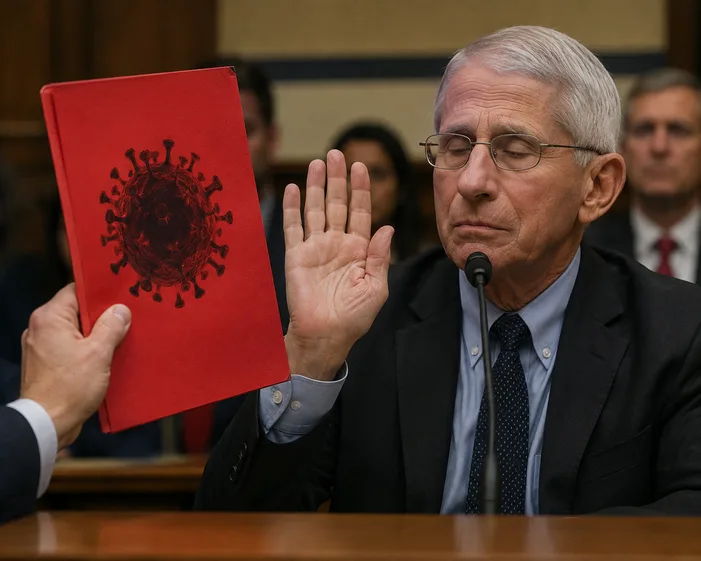
When the man who told the world to trust him pleads the Fifth 111 times, silence becomes the loudest testimony in the room. --YNOT!
For years, Americans were told that asking whether COVID-19 came from a laboratory was irresponsible, dangerous, or conspiratorial. PLEASE READ ME LAST COMMENT AT THE END.
People who questioned the official narrative were mocked. Scientists were dismissed. Social-media posts were censored. Reporters repeated the same approved explanations. Anyone who mentioned the Wuhan Institute of Virology was treated as though they had wandered into science fiction.
But the lab-origin question did not begin with politics.
It did not begin with Donald Trump. It did not even begin in 2020.
The deeper story stretches back more than a decade—to controversial experiments involving dangerous viruses, government funding, scientific arguments over gain-of-function research, and a philosophy that the knowledge gained from those experiments was worth the risk.
The Story Goes Back to At Least 2010
According to Senator Rand Paul, the controversy can be traced back to at least 2010, when researchers in the Netherlands conducted experiments involving avian influenza.
The purpose was to alter the virus and study whether it could become more transmissible between mammals. Critics warned that publishing the methods could provide a roadmap for creating biological weapons or producing a virus capable of causing a pandemic.
This was not a minor academic disagreement.
Scientists were already warning that deliberately enhancing a dangerous virus could create something that did not previously exist in nature—and that a laboratory accident could have catastrophic consequences.
Rand Paul’s central argument is that Anthony Fauci was not simply caught off guard by an unprecedented crisis in 2020. Fauci had supported this general category of research for years.
Paul described Fauci’s position as philosophical: that even if a researcher became infected or a virus escaped, the knowledge gained from the experiment could still be worth the risk.
That matters because it changes the question.
This is not merely about whether someone made an understandable mistake during the chaos of a pandemic.
It is about whether government officials spent years supporting research that other respected scientists considered unnecessarily dangerous.
The Wuhan Funding Began in 2014
The next major point in the timeline is 2014.
Funding connected to the National Institutes of Health and the National Institute of Allergy and Infectious Diseases was provided through the American nonprofit EcoHealth Alliance.
EcoHealth then directed part of that funding to the Wuhan Institute of Virology for research involving bat coronaviruses.
The transcript states that approximately $599,000 was sent to the Wuhan laboratory between 2014 and 2019, while broader American-funded subawards connected to the laboratory totaled approximately $1.4 million between 2014 and 2021.
Some defenders have argued that this was not technically “gain-of-function” research under the narrow regulatory definition used by Fauci and the NIH.
But Rand Paul argues that the semantics can become a distraction.
His question is simpler:“The real question is, was it dangerous?”
That is the question that matters.
Did researchers alter animal viruses in ways that changed their characteristics?
Did the work increase infectivity, transmissibility, or the ability to affect human cells?
Was this being done in a laboratory that had never been properly inspected by the people providing the money?
And should American taxpayers have been funding it at all?
According to Paul, even communications surrounding the funding referred to it as gain-of-function research. He argues that public denials relied on a narrow definition rather than confronting the actual danger of the experiments.
What Gain-of-Function Research Actually Means
Gain-of-function is a broad term covering experiments that give an organism new or enhanced characteristics.
In virus research, that can mean changing a virus so researchers can study whether it becomes more infectious, more transmissible, better able to enter human cells, or capable of spreading through the air.
Supporters claim this type of research can help scientists anticipate future threats, develop vaccines, and understand how viruses might evolve.
Critics argue that researchers are creating the very threats they claim to be preparing for.
The danger is obvious.A virus that cannot spread efficiently between humans may be dangerous but naturally limited. If researchers alter it until it can spread more easily, they may create a pathogen with pandemic potential.
A laboratory does not need to intentionally build a weapon for the consequences to become weapon-like.
It only takes one accident. One infected researcher.
One containment failure. One mistake.
The Humanized-Mouse Experiments
Rand Paul described experiments involving mice engineered to contain human-like lung tissue. Viruses could then be repeatedly passed through these animals—a process known as serial passage—until the virus became better adapted to infecting human cells.
Paul’s argument is that this process can create a virus already prepared to move efficiently among humans.
He claims that Fauci privately understood that researchers in Wuhan were conducting gain-of-function work and privately considered the possibility that the virus had been manipulated.
But publicly, the laboratory-origin theory was repeatedly discounted, while people raising the question were labeled conspiracy theorists.
That gap between private concern and public certainty is one of the most important parts of the entire story.
Scientists are allowed to be uncertain. Officials are allowed to say that the evidence is incomplete.
What they should not be allowed to do is privately discuss one possibility while publicly pretending that the possibility is absurd.
The Wet Market Was Not the Whole Story
The public was repeatedly told that COVID probably emerged naturally through animals sold at the Wuhan wet market.
But according to Paul, Fauci knew early in January 2020 that the earliest identified cases were not directly connected to the wet market.
The market may have been a superspreader location without being the original source of the virus.
That distinction is critical.
A crowded market could easily amplify an outbreak after the virus had already entered the population. Evidence of transmission at the market does not automatically prove that the virus originated there.
Paul argues that Fauci continued publicly emphasizing the wet-market explanation despite privately knowing that the earliest cases did not fit that account.
Again, the issue is not merely that one theory might have been wrong.
The issue is whether officials with potential responsibility for funding the nearby laboratory had a personal and institutional reason to steer the public away from a laboratory explanation.
The “Proximal Origin” Paper
Early in the outbreak, scientists discussed both natural and laboratory-related explanations.
Those discussions eventually preceded the publication of a scientific paper commonly called “Proximal Origin.” The paper argued that SARS-CoV-2 did not appear to have been deliberately engineered.
The controversy is not simply over what the paper concluded.
The controversy is over whether Fauci and other officials influenced the scientific discussion, encouraged researchers to move toward a natural-origin conclusion, or helped create the appearance of greater certainty than privately existed.
The transcript describes private uncertainty followed by a strong public presentation that the virus was not laboratory engineered.
That paper was then used repeatedly by politicians, media organizations, health officials, and technology companies as justification for dismissing the lab-origin theory.
Science was presented as settled long before it was settled.
Laboratory Escapes Are Not Science Fiction
The idea that a virus could escape from a laboratory is not imaginary.
Rand Paul pointed to the 1977 Russian flu as an historical example.
When researchers analyzed that influenza virus, they found that it was extraordinarily similar to a strain from the 1950s. Because naturally circulating viruses normally accumulate mutations over time, the lack of expected genetic change suggested that the virus had been preserved in a laboratory and later reintroduced into the population.
Paul used that case to make a simple point:
Laboratories are not perfect. Viruses have escaped before.
Researchers become infected. Containment systems fail.
Human beings make mistakes.
So why was the possibility of a Wuhan laboratory accident treated as impossible?
The outbreak occurred in the same city that contained one of the world’s largest collections of bat coronaviruses.
The laboratory was conducting coronavirus research.
American money had helped fund portions of that work.
Scientists had already warned for years that this category of research could cause a pandemic.
Yet the public was expected to believe that even asking about the laboratory was unreasonable.
Fauci’s Refusal to Answer
Years later, when Fauci was called before Congress, he reportedly invoked the Fifth Amendment 111 times.
He had previously said that he had nothing to hide and that he was willing to cooperate with congressional oversight.
But when questioned under subpoena, he declined to answer.
According to the transcript, Senator Rand Paul argued that the refusal obstructed the effort to understand the government’s funding decisions, the Wuhan research, and the origins of the pandemic.
Invoking the Fifth Amendment is a constitutional right.
But the American people also have the right to draw their own conclusions when a former government official—one who directed pandemic policy, influenced lockdowns, defended the research establishment, and helped shape the public narrative—refuses to answer basic questions.
The issue is larger than Fauci as an individual.
It is about whether unelected officials can fund dangerous experiments, control the investigation when something goes wrong, shape the scientific narrative, suppress opposing views, and then avoid accountability.
This Is Not About Revenge
Rand Paul said: “I’ve always been more interested in the truth than any kind of prosecution.”
That is the correct focus. The most important objective is not vengeance.
It is preventing the next disaster. Who approved the research?
Who decided the risks were acceptable?
Who inspected the laboratories?
Who knew that the wet-market explanation was uncertain?
Who participated in the private discussions about a possible laboratory origin?
Who encouraged the public to dismiss that possibility?
Who pressured scientists, reporters, physicians, and ordinary citizens to remain silent?
And is similar research still being funded today?
Those questions have still not received complete answers.
The Real Lesson
The origin of COVID is not merely an argument about China, Fauci, Trump, Republicans, Democrats, vaccines, or masks.
It is a warning about institutional power. Government agencies funded research.
Scientists depended on those agencies for money. Public-health officials controlled access to information.
Media organizations repeated the official position. Technology companies enforced it.
And the people responsible for examining the government’s actions often depended on the same institutions they were supposed to investigate.
That is not independent oversight. That is a closed system protecting itself.
The most dangerous words in modern government may be:
Trust the experts. Experts should be heard. They should be respected.
They should also be questioned, audited, challenged, and held accountable—especially when their decisions involve creating enhanced viruses capable of affecting the entire human population.
Because when an experiment goes wrong, the scientists do not pay the full price.
The entire world does.
Gain-of-function (GOF) research refers to experiments that change an organism—such as a virus—to give it new or enhanced biological properties. For viruses, this can mean altering characteristics like how easily the virus spreads, which species it can infect, or how it interacts with the immune system.
Scientists use the term in different ways, which has contributed to public confusion. In everyday discussion, “gain of function” often refers to making a virus more capable in some way. In regulatory and scientific contexts, however, there are narrower definitions that determine which experiments require special oversight.
Examples of changes that could be considered gain-of-function include:
- Making a virus infect a new type of cell or host.
- Increasing or decreasing how easily it spreads.
- Altering how the immune system recognizes it.
- Changing how severe the disease it causes may be.
Why do scientists do it?
Researchers have argued that these experiments can help:
- Understand how viruses evolve.
- Identify mutations that could become dangerous in nature.
- Develop vaccines and antiviral drugs.
- Improve surveillance for emerging diseases.
Why is it controversial?
Critics argue that creating or enhancing viruses carries significant risks, including:
- An accidental laboratory release.
- Potential misuse for biological weapons.
- Creating a pathogen more dangerous than naturally occurring ones.
Supporters argue that, when performed under strict biosafety and oversight, the research can improve pandemic preparedness and scientific understanding.
The COVID-19 debate
The COVID-19 pandemic brought gain-of-function research into public debate. Much of the controversy has centered on:
- Whether U.S. funding supported experiments at the Wuhan Institute of Virology.
- Whether those experiments met the U.S. government’s regulatory definition of gain-of-function or a more restrictive category called enhanced potential pandemic pathogen (ePPP) research.
- Whether SARS-CoV-2 originated from a laboratory accident or from natural spillover. This question remains debated, and U.S. agencies have reached differing assessments with varying levels of confidence.
Because of these differing definitions, two people may both say “this was” or “this wasn’t” gain-of-function research while referring to different regulatory standards rather than disagreeing about the underlying experiments.
In short, gain-of-function research is not inherently illegal or inherently dangerous, but certain forms of it—especially those involving pathogens that could pose a pandemic risk—are among the most heavily debated and closely regulated areas of biomedical research.
What Obama Connection is.
The action often described as “Obama’s order banning gain-of-function research” was not an executive order and not a law passed by Congress. On October 17, 2014, the Obama administration—through the White House Office of Science and Technology Policy and the Department of Health and Human Services—announced a federal funding pause for a limited category of gain-of-function experiments. NIH implemented it through funding notice NOT-OD-15-011. (whitehouse.gov)
It was officially called:
“U.S. Government Gain-of-Function Deliberative Process and Research Funding Pause.”
Why the administration imposed the pause
The immediate reason was a series of serious laboratory-safety failures in 2014, including mishandling of dangerous biological agents at federal facilities. The government concluded that it needed to reconsider whether the anticipated scientific benefits of certain experiments justified the danger of an accidental or deliberate release. (Grants.gov)
The policy launched a formal review involving:
- The National Science Advisory Board for Biosecurity
- The National Academies
- A government risk-benefit assessment
- Development of a replacement oversight framework
The original expectation was that this process would take roughly a year, although the pause ultimately remained in place for more than three years. (whitehouse.gov)
What research it stopped
The pause did not cover every experiment that could broadly be called gain-of-function.
It applied specifically to federally funded research involving:
- Influenza viruses
- SARS viruses
- MERS viruses
The experiment had to be reasonably expected to give one of these viruses greater pathogenicity or respiratory transmissibility in mammals. In plain language, it covered experiments expected to make one of those viruses more dangerous, more capable of causing disease, or better able to spread through the air among mammals. (Grants.gov)
NIH said it would not provide new or continuation funding for projects falling within that definition while the pause was active. (Grants.gov)
What it did not stop
This is where the policy became much less absolute than the phrase “Obama banned gain-of-function” suggests.
The pause did not automatically prohibit:
- Ordinary examination of naturally occurring viruses
- Research that officials determined would not increase pathogenicity or transmissibility
- Every form of genetic manipulation
- Every experiment involving bat coronaviruses
- Privately or foreign-funded research
- All research already underway
For existing federal awards, NIH said projects would be handled case by case. Researchers outside the covered federal funding system were merely encouraged to pause voluntarily. (Grants.gov)
The public-health and national-security exception
The policy also contained an important exception.
The head of a federal funding agency could permit otherwise-covered research when that official determined that it was “urgently necessary to protect the public health or national security.” (Grants.gov)
Therefore, this was never an unconditional ban. It was a funding restriction administered by the same federal departments and agencies that supported the research.
The agencies themselves helped decide:
- Whether an experiment met the definition.
- Whether an existing grant should be stopped or modified.
- Whether an exception was justified.
That agency discretion is central to the later controversy.
How the Wuhan research fits into the timeline
The NIAID grant to EcoHealth Alliance titled “Understanding the Risk of Bat Coronavirus Emergence” began on June 1, 2014—approximately four months before the October funding pause. EcoHealth subsequently supported coronavirus research involving the Wuhan Institute of Virology. (National Institutes of Health (NIH))
Because the award already existed, it fell into the category of an ongoing NIH award that could be evaluated case by case.
The central dispute is therefore not simply whether Obama announced a pause. He unquestionably did.
The dispute is:
Should the EcoHealth-Wuhan experiments have been classified as research covered by that pause?
NIH and NIAID operated on the position that the funded work did not meet the government’s narrow operative definition of prohibited gain-of-function research. Critics, including Senator Rand Paul, argue that experiments creating recombinant or chimeric bat coronaviruses with altered biological properties should have been covered regardless of the terminology used.
The grant materials describe laboratory work involving recombinant viruses, humanized mice, receptor binding, reverse genetics and evaluation of how novel bat coronaviruses could infect human cells. (RePORTER)
That does not by itself settle whether every experiment legally met the 2014 definition. It shows why the classification remains controversial.
The definition problem
The phrase gain-of-function can be used broadly or narrowly.
Broadly, it means modifying an organism so it gains or improves some biological function.
Under that broad meaning, many ordinary experiments could qualify.
The 2014 pause used a much narrower definition. The work had to involve influenza, SARS or MERS viruses and be reasonably anticipated to enhance pathogenicity or respiratory transmissibility in mammals.
That allowed officials to say simultaneously:
- An experiment gave a virus new or altered capabilities.
- But it was not the specific category of “gain-of-function research” covered by the federal funding pause.
That semantic distinction became the core of Fauci’s dispute with Rand Paul.
Paul’s argument has consistently been that the public should look beyond the administrative label and ask the more fundamental question:
Did the research make potentially dangerous viruses more capable of infecting mammals or human cells, and should taxpayers have financed it?
When the pause ended
During the final days of the Obama administration, the White House issued recommended policy guidance for reviewing research involving potential pandemic pathogens.
The pause itself was formally removed on December 19, 2017, during the Trump administration, when HHS implemented the P3CO Framework—Potential Pandemic Pathogen Care and Oversight. (Grants.gov)
Under that system, the government did not permanently ban covered research. Instead, proposals expected to create, transfer or use enhanced potential pandemic pathogens could be subjected to additional federal review before funding.
The bottom line
Obama’s 2014 action was real, but it is frequently described incorrectly.
It was:
- A temporary funding pause, not a criminal prohibition
- An administrative policy, not an executive order
- Limited primarily to certain influenza, SARS and MERS experiments
- Subject to definitional judgments by funding agencies
- Subject to public-health and national-security exceptions
- Applied to existing projects on a case-by-case basis
- Replaced by a review framework in 2017
The most important historical question is not whether the government recognized the danger. The Obama administration clearly recognized it in 2014.
The harder question is why coronavirus experiments connected to Wuhan continued receiving support after the government had already warned that enhancing the dangerous properties of respiratory viruses could threaten public health.
There are many thing to talk about here. Millions Dead, tens of thousands of business closed, the lives of many children disrupted. The great question why the F was the US funding what is basically a bio-weapon with CHINA... Why in all that is good on earth? Why? The simple answer there are evil people that profited from it in ways we don't even understand.
How China Evolved Away from Communism After It Failed
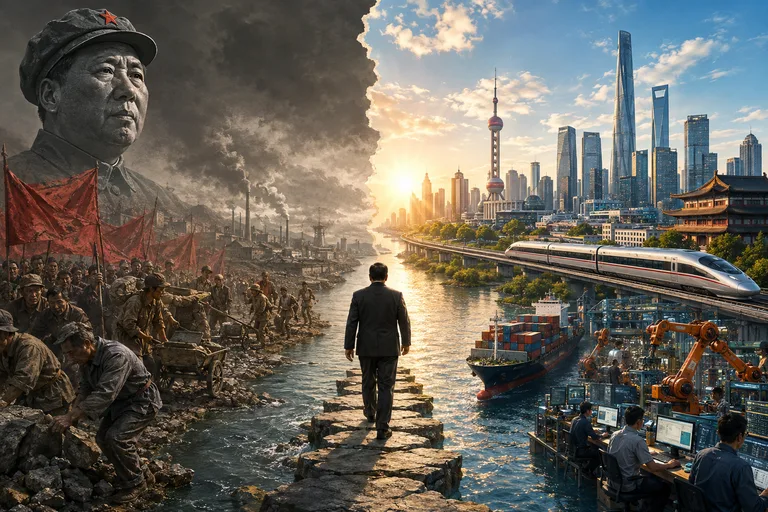
China’s economic miracle did not begin when communism finally worked. It began when China stopped insisting on it. -- YNOT!
For decades, China tried to build prosperity through orthodox communist economics: collectivized agriculture, state ownership, central planning, government-set prices, production quotas, and ideological control over economic life.
The result was not prosperity. It was poverty on a historic scale.
When the Chinese Communist Party took power in 1949, China was already desperately poor after civil war and Japanese occupation. Mao Zedong then attempted to remake the economy according to revolutionary ideology.
The most catastrophic experiment was the Great Leap Forward.
Beginning in 1958, Mao attempted to industrialize China at extraordinary speed while reorganizing agriculture into giant communes. Farmers were pulled away from fields, agricultural tools were melted down in primitive attempts to increase steel production, and government planners imposed unrealistic production targets.
The consequences were devastating.
The famine that followed killed tens of millions of people, with historical estimates ranging from roughly 15 million to more than 50 million deaths.
Then came the Cultural Revolution.
Schools and universities were closed. Intellectuals and alleged political opponents were persecuted. Historic buildings were destroyed. Expertise itself became suspicious because ideology was considered more important than knowledge.
By the time Mao died in 1976, China had nearly one billion people but a per-capita GDP of only about $175.
And then something extraordinary happened.
China did not suddenly announce:
“Communism failed. We are capitalists now.”
Political systems rarely admit failure that directly.
Instead, China began quietly changing the rules.
Enter Deng Xiaoping
Deng Xiaoping was a communist revolutionary, but he was also a pragmatist.
He had already gotten himself into trouble under Mao for suggesting that limited private ownership should be permitted if it increased production. Mao viewed ideas like that as a dangerous retreat toward capitalism.
After Mao’s death, however, Deng eventually emerged as China’s dominant leader.
His philosophy could be summarized in one principle:
Results mattered more than ideological purity.
Chinese reformers described their approach as:
“Crossing the river by feeling for the stones.”
In other words, don’t design the entire economy from a political theory.
Try something.
See if it works.
Keep what works.
Discard what doesn’t.
Then take another step.
That may be one of the most important economic lessons of the twentieth century.
Deng began what became known as “Reform and Opening Up.” China reopened relationships with countries it had once treated primarily as ideological enemies and began actively studying how successful economies worked.
And here is the part of the story that deserves much more attention.
The Chinese started asking capitalists how capitalism worked.
Chinese officials traveled abroad.
Deng toured factories in Japan.
He visited the United States.
He toured companies such as Ford and Boeing to understand modern manufacturing.
China invited foreign economists into the country.
They studied economists from Eastern Europe who had criticized command economies.
They invited Nobel Prize-winning economist Milton Friedman, one of the world’s most famous advocates of free markets, to lecture Chinese officials and economists.
China began sending students and economists to major Western universities to study mathematical economics, econometrics, industrial organization, finance, and modern economic management.
Think about what that means.
One of the world’s largest communist countries was effectively saying:
We need to understand why the capitalist economies are producing things that we cannot.
That was an enormous intellectual shift.
China Did Not Abandon Communism Politically
This distinction is critical.
Deng was not a Western liberal democrat.
He believed strongly in maintaining the Communist Party’s political monopoly.
Political dissent remained heavily restricted.
What Deng separated was political power from economic organization.
China could remain politically authoritarian while allowing increasingly capitalist behavior economically.
That became the Chinese experiment.
Call it socialism.
Call it a socialist market economy.
Call it state capitalism.
The label matters less than what actually changed.
Private incentives were introduced.
Businesses were given greater autonomy.
Enterprises could keep portions of their profits.
Foreign investment was welcomed.
Special Economic Zones were created.
Market pricing gradually replaced administrative pricing.
Entrepreneurship was increasingly tolerated.
And people responded exactly as economic incentives would predict.
They started producing.
The source describes it succinctly: once enterprises were given greater autonomy and allowed to retain profits, market forces were unleashed and economic activity accelerated.
One of China’s Cleverest Reforms: Don’t Destroy the Old System Overnight
China faced a dangerous problem.
You cannot simply shut down an enormous centrally planned economy on Monday and announce free-market capitalism on Tuesday.
Millions of people depend upon the existing system.
Factories have quotas.
Workers have jobs.
Cities depend on controlled prices.
Supply chains depend on government contracts.
Destroy everything immediately and the entire system can collapse.
So China experimented with something ingenious:
The Dual-Track System
A factory might still be required to produce 10,000 units for the government at the official state-controlled price.
But suppose it could manufacture 15,000.
The additional 5,000 could increasingly be sold into the market at whatever price buyers were willing to pay.
The communist economy remained.
But a market economy began growing around it.
The source gives a wonderful analogy:
Imagine the planned economy as a small bonsai tree.
Instead of cutting the bonsai down, China simply planted a forest around it.
Eventually the forest became vastly larger than the tree.
That is essentially what happened.
And China Made Mistakes
This was not some perfectly designed master plan.
China experimented.
Some experiments failed spectacularly.
Price reforms contributed to inflation.
Corruption exploded in areas where officials could buy goods at government-controlled prices and resell them at market prices.
In 1988, an attempted rapid liberalization triggered panic buying, bank withdrawals, and sharp price increases.
China adjusted again.
That is the important part.
Deng’s system was not based upon the idea:
“We possess the perfect economic theory.”
It was based much more on:
“Try it. Measure it. Fix it.”
That is almost the opposite of the ideological rigidity that had characterized the Mao era.
Then Came Tiananmen Square
Economic liberalization created another problem.
Once people begin receiving greater economic freedom, some begin demanding greater political freedom.
Those tensions contributed to the enormous demonstrations in Tiananmen Square in 1989.
Deng ultimately sided with the hardliners.
The Chinese military was ordered to clear the demonstrations.
Hundreds—and possibly thousands—were killed.
This revealed the boundary of Deng’s reforms very clearly.
Markets could be liberalized.
The Communist Party could not be challenged.
China’s experiment therefore became something historically unusual:
Economic liberalization without political liberalization.
For several years after Tiananmen, reform slowed.
But Deng did something remarkable again.
At 88 years old, in 1992, he traveled through southern China, including booming Shenzhen, signaling that economic reform would continue.
A year later China formally changed its constitutional language.
The country would no longer simply operate a planned economy based on socialist public ownership.
China would operate a:
“Socialist market economy.”
The transformation had become official.
The Results Were Extraordinary
Whatever terminology we choose, the transformation of China’s economy became one of the most important economic events in human history.
Over roughly four decades, close to 800 million Chinese people were lifted from extreme poverty, according to the source, with the reform era beginning under Deng in 1978.
China went from one of the poorest major countries on Earth to an industrial powerhouse.
Factories appeared. Cities exploded in size. Exports surged. Infrastructure expanded.
Foreign companies poured capital and technology into the country.
Hundreds of millions moved from rural subsistence agriculture into an increasingly industrial and commercial economy.
And China eventually became the world’s second-largest economy.
China Didn’t Really Abandon Communism
This is where the story gets more interesting.
China abandoned much of communist economics without abandoning Communist Party political control.
That distinction explains modern China. The government still calls the system socialism.
The Communist Party still rules. The state still owns or influences enormous portions of the economy.
But the economic engine that transformed China increasingly relied upon things classical communism was supposed to eliminate: Markets. Profit. Competition. Private enterprise. Foreign investment. Individual incentives. International trade.
China essentially discovered that you can command people politically far more easily than you can command an economy.
Because an economy is billions of decisions happening simultaneously.
What should something cost?
How many should we manufacture?
Where should it be shipped?
Should another factory be built?
Which technology should we use?
What does the customer actually want?
A government planning ministry cannot possibly possess all of that information.
Markets distribute those decisions among millions of people.
And when China began allowing those people to make more of those decisions themselves, the economy exploded.
The Great Lesson of Deng Xiaoping
Deng’s genius was not inventing capitalism. It already existed.
His genius was recognizing that China’s existing system wasn’t working and being willing to steal good ideas from whoever had them.
Capitalists.
Socialists.
Americans.
Japanese.
Europeans.
Economists.
Engineers.
Factory managers.
He didn’t care where the idea originated nearly as much as whether it produced results.
That philosophy may be Deng Xiaoping’s most important legacy: Ideology tells you what should work. Reality tells you what actually works.
Mao tried to force reality to conform to ideology.
Deng increasingly forced ideology to accommodate reality.
And China changed. The irony is enormous.
One of the greatest economic transformations in history occurred not because China perfected communism—
but because after decades of catastrophe and poverty, it progressively allowed many of the market mechanisms communism had been created to replace.
China never stopped calling itself communist.
It simply stopped running much of its economy as though communism actually worked.
Copyright
Copyright © 2026 YNOT – TONY LESTER All rights reserved.
Generated from TWO TIGERS ONE MOUNTAIN · YNOT Book Builder v0.9.6