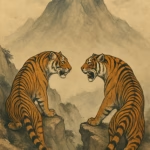
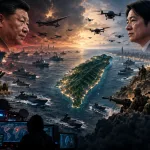
Empires rarely die from old age. More often, they die staring at a younger empire across the water, both convinced the mountain belongs only to them. Because Two tigers cannot share the same mountain. The Trap is what happens when two nations both believe destiny has chosen them. -- YNOT!
Back in April last year, I wrote about the old Chinese proverb:
Now Xi Jinping has openly invoked something even darker — the “Thucydides Trap.”
That is not just poetry. That is geopolitical philosophy wrapped in a warning label.
The phrase comes from the ancient Greek historian Thucydides, who wrote about the war between Athens and Sparta over 2,400 years ago. Athens was the rising power. Sparta was the established power. Thucydides concluded that it was the rise of Athens and the fear it created in Sparta that made war nearly inevitable.
Xi Jinping brought this up directly in discussions with Donald Trump while warning about Taiwan and the growing tension between China and the United States. In diplomatic language, this was not an accident. It was a message:
China sees itself as the rising civilization.
America is the existing empire.
History says these moments are dangerous.
And history has seen this movie before.
Britain and Germany before World War I.
Athens and Sparta.
Imperial Japan and the United States.
A rising power pushes outward. An established power pushes back. Trade routes, military buildup, technology races, alliances, and national pride all start intertwining like dry brush waiting for a spark.
The frightening part is that wars rarely begin because everyone wants war.
Wars begin because everyone thinks the other side will back down.
That is the real trap.
Today the battlefield is not just aircraft carriers and missiles. It is semiconductors, AI, cyberwarfare, rare earth minerals, satellites, shipping lanes, media influence, and financial systems. The Cold War of the 20th century was about ideology. This one is about who controls the operating system of the 21st century.
China builds ports.
America builds alliances.
China builds factories.
America controls finance and naval power.
China wants Taiwan.
America cannot easily allow Taiwan to fall without signaling weakness across Asia.
And hanging over all of it is the uncomfortable reality that both nations are economically chained together.
The United States and China are like two men holding each other by the throat while standing knee-deep in gasoline.
Neither can fully let go.
Neither can fully win.
Neither can afford to lose.
That is why Xi mentioning the Thucydides Trap matters. It was not a casual history lesson. It was Beijing signaling that they understand exactly where history can lead when two superpowers believe the mountain belongs only to them.
The problem with empires is that they almost always believe they are the exception to history.
Until they are not.
And somewhere, far back in time, an old Greek historian is probably shaking his head, because humanity still keeps updating the weapons while running the same ancient software.
So what did Donald Trump and Xi Jinping talk about…
1. Taiwan — the biggest issue
This was clearly the central geopolitical topic.
Xi warned Trump that mishandling Taiwan could lead to direct conflict between China and the United States. Xi reportedly described Taiwan as the “most important issue” in U.S.–China relations.
Trump later confirmed they discussed:
- U.S. arms sales to Taiwan
- Whether the U.S. would defend Taiwan
- Regional military tensions
Trump reportedly refused to directly answer whether America would militarily defend Taiwan if China attacked.
That ambiguity is intentional. The U.S. has historically used something called “strategic ambiguity” regarding Taiwan.
2. The “Thucydides Trap”
Xi brought this up publicly during the summit.
This was symbolic and strategic. He was basically saying:
History shows rising powers and existing powers often drift toward war.
In diplomatic language, Xi was telling Trump:
- China does not want containment
- China sees itself as an equal superpower
- The U.S. should avoid treating China like an enemy empire that must be stopped
At the same time, it was also a warning that Taiwan could become the trigger point.
3. Trade and economics
Trade was still a major topic.
Discussions reportedly included:
- Tariffs
- Chinese purchases of U.S. agriculture
- Boeing aircraft deals
- Technology and AI cooperation
- Supply chains
But unlike earlier Trump-China meetings years ago, this summit seemed much more focused on strategic power balance than simple trade disputes.
4. AI and technology competition
There were discussions about:
- Artificial intelligence
- misuse of AI by non-state actors
- technological rivalry
This matters because both countries understand AI may become as strategically important as nuclear weapons, oil, or industrial manufacturing were in previous eras.
5. Iran and global instability
The Middle East tensions and Iran situation were reportedly discussed as well.
China depends heavily on Middle Eastern energy routes, while the U.S. still dominates global naval security. Both countries have enormous economic interests tied to stability in the region.
6. Symbolism and power projection
A huge part of this summit was visual and symbolic.
China staged the meeting with enormous ceremony:
- Great Hall of the People
- state banquets
- highly choreographed visuals
- equal-superpower optics
Analysts noted that Xi appeared to be positioning China as no longer a “junior power” but as America’s peer — essentially a modern “G-2” world.
That may actually be one of the most important parts of the summit.
Because geopolitics is not only about weapons and economics.
It is also about:
- perception
- prestige
- status
- legitimacy
- who the world believes is rising
- who the world believes is declining
And Xi invoking the Thucydides Trap publicly was Beijing telling the world:
“We understand the historical danger of this moment… but we also believe China has arrived.”
So what were the results…
The biggest items reported were:
Boeing aircraft deal
China reportedly agreed to purchase:
- about 200 Boeing aircraft immediately
- with discussions possibly expanding toward 500–750 aircraft over time
- plus hundreds of GE Aerospace engines. (Reuters)
This is important because:
- China had largely frozen major Boeing orders for years
- Boeing badly needs large international orders
- China needs aircraft as its middle class and air travel continue expanding
But analysts noted:
- details are still vague
- timelines and financing are unclear
- no finalized mega-contract documents were publicly released yet. (Reuters)
Agricultural purchases
China reportedly committed to buying:
- large quantities of U.S. soybeans
- agricultural products over multiple years
- potentially “double-digit billions” annually. (The Economic Times)
This resembles earlier Trump-era trade arrangements where China increased farm imports to reduce tensions.
Possible market-opening discussions
Xi suggested China may further open parts of its market to U.S. businesses. However:
- no major structural trade agreement was announced
- no sweeping tariff resolution was reached
- no major rare-earth breakthrough was announced. (New York Post)
AI cooperation talks
There were discussions about:
- AI safety
- preventing AI misuse by non-state actors
- possible future cooperation frameworks
But again:
- no major treaty or binding agreement was announced publicly. (The Washington Post)
Iran / Middle East coordination
They reportedly discussed:
- keeping oil shipping lanes open
- preventing Iran from obtaining nuclear weapons
- possible sanctions flexibility involving Chinese purchases of Iranian oil
But there was no announced joint strategic agreement. (The Guardian)
The real outcome may have been geopolitical, not economic
A lot of analysts are saying the summit was less about immediate deals and more about:
- stabilizing tensions
- avoiding escalation over Taiwan
- symbolic recognition of China as a peer superpower
- reopening channels between Washington and Beijing. (The Washington Post)
In other words:
The optics may have mattered more than the paperwork.
Xi got:
- equal-superpower treatment
- a highly choreographed summit in Beijing
- acknowledgment that China cannot be ignored
Trump got:
- headlines about trade
- possible Boeing wins
- agricultural export promises
- the image of being able to negotiate directly with Xi
But as of now, there does not appear to be:
- a grand trade deal
- a Taiwan agreement
- a military pact
- a major AI treaty
- or a Cold War-style breakthrough.
PART1 – TWO TIGERS ONE MOUNTAIN
© 2026 insearchofyourpassions.com - Some Rights Reserve - This website and its content are the property of YNOT. This work is licensed under a Creative Commons Attribution 4.0 International License. You are free to share and adapt the material for any purpose, even commercially, as long as you give appropriate credit, provide a link to the license, and indicate if changes were made.