Think of it as Yoga for the brain, we are going to stretch a bit.
EVIL does like EVIL does: The greed and power link between the Epstein, CCP and Western Elites
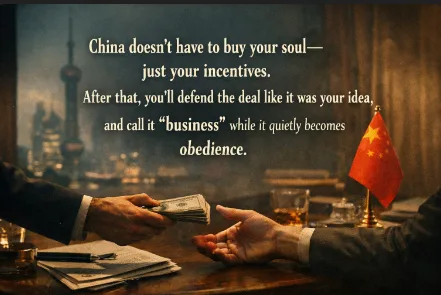
“China doesn’t have to buy your soul—just your incentives. After that, you’ll defend the deal like it was your idea, and call it ‘business’ while it quietly becomes obedience.” -- YNOT!
Have you ever noticed how “respectable” people can spot a monster a mile away—right up until the monster offers them a seat at the VIP table?
That’s the vibe running through the text you shared: not just the usual Jeffrey Epstein horror story (which is already bad enough), but a darker, more adult kind of corruption—the kind that wears a suit, talks about “relationships,” and calls it strategy while it picks your pocket and your soul at the same time.
The claim in these pages is that Epstein wasn’t only trafficking, blackmailing, and grooming a network of influence—he was also teaching powerful Western financiers how to operate inside a system where contracts are decorations and loyalty is currency. Not loyalty like “I’ve got your back.” Loyalty like “my kid goes to your school, my money sits in your vault, and if I go down, you go down with me.”
And right there—that is the red line.
Because once you stop doing business and start building mutual hostages, you don’t have an economy anymore. You’ve got a cartel with PowerPoint slides. And companies like JP Morgan, Cityroup, Goldman Sachs, Credit Swiss, Deutschbank, Morgan Stanley, and UBS where all at the party.
The “Guanxi” Pitch: Forget the contract—buy the family
The text describes Epstein coaching a senior banking executive on the basics of Chinese political reality: officials don’t need more money as much as they need more survival. Their fear isn’t poverty. Their fear is tomorrow’s purge.
So the alleged solution isn’t “invest.” It’s: become part of the family’s interest network.
Not with cartoon bribes—no cash in an envelope like a bad movie. The “smart bribes,” as described here, are social and institutional:
a school placement for the kid
a prestige introduction
a soft landing abroad
a “job” that’s really a badge and a pipeline
It’s influence laundering. You don’t pay them in cash—you pay them in escape routes.
Guanxi (关系) (pronounced kind of like gwan-shee) means “relationships / connections”—but not in the LinkedIn, “let’s grab coffee” sense.
In practice, guanxi is a trust-and-obligation network built over time through favors, introductions, gift-giving, shared history, and “I helped your people, so you’ll help mine.” It’s social capital that can open doors, speed up approvals, smooth conflicts, and get things done when formal rules are slow, unclear, or selectively enforced.
Two important notes:
It’s not automatically corruption. Guanxi can be perfectly normal relationship-based business culture.
But it can become leverage. When favors turn into debts, and debts turn into quiet expectations, guanxi can slide into nepotism, pay-to-play, or influence trading—especially in high-stakes political or regulatory environments.
The etiquette of submission: “I seek your guidance”
One of the nastiest details isn’t the finance. It’s the tone.
The script, as described, is basically: don’t walk in like an American banker. Walk in like a pilgrim. Praise the civilization. Admire the governance. Ask for wisdom. Make it feel like they’re not selling access—they’re granting favor.
That’s not diplomacy. That’s theater.
And theater is powerful, because it makes men feel noble while they do ignoble things.
Sons and daughters: the “hiring program” as hostage diplomacy
The text ties this to the now-famous pattern where major banks hired well-connected relatives under the banner of “localization,” when the real product being purchased was access.
Call it what it is: a cross-border influence exchange disguised as HR.
And the clever part—if you’re the kind of person who sleeps well doing ugly things—is that nobody has to say it out loud. Everyone just “understands the culture.” Everyone just “builds relationships.” Everyone just “plays the game.”
That’s how evil survives in daylight. It gets a rebrand.
Here’s the twist: predators don’t do loyalty—only leverage
The text then makes its bleakest point: even if this arrangement “works,” it only works until profits are threatened.
Because predators don’t form partnerships. They form temporary arrangements.
When the political winds shift—trade war, sanctions, internal purges, public heat—what happens?
The same crowd that was praising the wisdom of governance suddenly starts whispering about removing the guy they were just calling “the prince.”
That’s not ideology. That’s not national interest. That’s not even politics.
That’s opportunism with a passport.
China influence, in this context, isn’t just “China convinced someone” or “China bought an ad”—it’s the slow, practical art of turning foreign decision-makers into stakeholders in your system. The play is simple: you don’t demand loyalty, you manufacture dependence. You offer access to licenses, deals, and insider pathways that are hard to get anywhere else, then you lace that access with personal ties—jobs for relatives, prestige invitations, private “advisory” roles, and quiet financial channels that make walking away expensive.
Over time, the relationship stops being a transaction and becomes a mutual-risk pact: if the foreign executive pushes back, they don’t just lose money—they risk losing face, losing access, and sometimes exposing arrangements that can’t survive daylight. That’s influence at scale: not mind control, not propaganda—incentives + entanglement + leverage, until a country’s “elite networks” start making choices that look like business decisions but function like political concessions.
Here’s a list of the specific corruption tactics and “gray-to-black” behaviors:
Bribery disguised as “relationship gifts”
Not cash or gold, but “subtle” benefits like recommendation letters to elite private schools, private introductions to Nobel Prize–level prestige, and helping relatives “recover” valuable antiques at New York auctions.
Scripted psychological manipulation for access
Drafted “how to behave” lines for meetings: don’t say “I’m here to invest and make money”—instead use flattery + submission language (“seek your guidance,” “admire your wisdom in governance”) to secure favor.
Influence trafficking via family entanglement
Making the bank a “private overseas safe” and a “placement office” for CCP elite families—meaning: protect assets abroad and place family members into elite Western institutions.
“Sons and daughters” hiring programs (nepotism for access)
Hiring relatives of powerful officials, giving them fancy titles, obscene salaries, and prestige roles while they do little actual work—described as a cover for access-buying and leverage-building.
Creating a dedicated “China entity” with its own advisory board
Proposed as an institutionalized structure that could include high-level political insiders (the text implies Politburo-level proximity), effectively formalizing influence pipelines.
Cross-border “hostage diplomacy” through careers and social status
The text frames the hiring/placement system as a way to create mutual dependency: their kids embedded in your network, their future tied to your institution.
Secret, hard-to-trace asset channels using complex instruments
Specifically mentions using credit default swaps (CDS) as a mechanism to create untraceable asset-management channels.
Money laundering / covert capital flight
Helping answer: “How do you launder dirty money, move it out of China, and park it in New York/global markets without triggering anti-corruption scrutiny back home?”
Pay-to-play access to state power (political gatekeepers)
Emphasis on building relationships not with “business” officials but with political personnel power centers (the kind that control promotions/demotions), implying political influence acquisition, not normal finance.
JP Morgan is the “front stage” muscle
JP Morgan has always been the respectable face in the skyscraper—while Epstein plays the back-room coach teaching them how to win in China’s real system: not contracts and spreadsheets, but guanxi, favors, and family leverage. Epstein’s message is blunt: stop waving “thick legal contracts,” because inside the CCP ecosystem, paper can be shredded and rules can change overnight; what matters is becoming part of an elite family’s survival network. So the bank’s role, as described, shifts from banker to overseas safe house and placement office—a place where CCP families can park wealth, place relatives, and build an escape hatch. The article points to “sons and daughters” hiring as the prototype: give relatives fancy titles and big paychecks, embed them in JP Morgan’s global network, and in exchange, the family wealth flows quietly into the Western financial system. That’s why the article frames JP Morgan’s later China success—licenses, wholly owned entities, rapid expansion—as less like ordinary market competition and more like the payoff from an entanglement strategy, where access is purchased through relationship traps, not just business competence.
THE STORY OF MORGAN STANLEY
Morgan Stanley fits into this story in the way a lot of big banks fit into China: they want the licenses and market access, and China controls the gate—so the relationship naturally attracts “influence” behavior, whether it’s clean or dirty. In your text, Morgan Stanley is named alongside other banks as part of the broader “sons and daughters” / relationship-hiring ecosystem that U.S. regulators probed across the industry (Reuters reported in 2013 that the SEC expanded its China hiring probe and that Morgan Stanley received an SEC information request).
Separately—but important for context—Morgan Stanley also has its own documented China-related corruption episode: in 2012, U.S. DOJ and SEC actions described a former Morgan Stanley China executive involved in bribery/control-evasion tied to a real-estate deal, showing the exact risk pattern regulators worry about in high-permission markets. (Department of Justice) And on the “why would they tolerate the headaches” side of the equation, Morgan Stanley has steadily pushed deeper into China’s onshore financial system—winning approvals like full control of its China mutual fund JV (CSRC approval in 2023) and, more recently, regulatory approval to establish a wholly owned futures business in China (reported by Reuters in 2024). (Morgan Stanley) Put plainly: the temptation is structural—when one side holds the keys, the other side starts shopping for shortcuts, and the line between “relationship building” and “influence trading” gets real thin, real fast.
The real machine: Western greed + authoritarian control
EVIL does like EVIL does, Not because evil is always loud. But because evil is often compatible. It finds its match.
Greed loves access.
Power loves secrecy.
Both love people who can “fix” problems quietly.
And a fixer doesn’t need to be president of anything. He just needs to be useful to the right appetites.
So you end up with a system where everyone involved swears they’re doing “business”—but the real business is control:
control of money, control of people, control of information, control of consequences.
And once that machine spins up, the question isn’t whether it’s corrupt.
The question is: who gets fed to keep it running?
Spoiler: it’s never the people at the top. They don’t build machines to be crushed by them. They build machines so somebody else can be.
And that’s the quiet lesson hiding under the noise:
When evil starts acting “professional,” it doesn’t stop being evil—it just gets better at billing you for it.
Epilogue: If the duck’s already buried, who’s left to question the pond?
In February 2016, Jeffrey Epstein sent Peter Thiel an email with a line that—if we lived in a sane media universe—would’ve detonated across front pages for a week straight: “As you probably know, I represent the Rothschilds.” The sentence sits inside the Epstein Files—DOJ material—yet the mainstream press treated it like a weather update from Bermuda. The name “Rothschild” shows up nearly 12,000 times across the 3.8 million pages released in January 2026, far more than many political names people argue about every day. But we’re living in a culture where even investigating that name gets automatically stamped “conspiracy,” which is a very convenient stamp when the most-cited surname in the biggest trafficking document dump of the era is the one nobody’s allowed to touch.
Then comes Les Wexner—Epstein’s most famous benefactor—testifying under oath before Congress on February 18, 2026. Asked what credentials made him trust Epstein with sweeping financial power, he answered plainly: Epstein’s personal work for the Rothschild family in France. He said he spoke to Élie de Rothschild, and that Epstein “represented their whole family.” Under oath. The moment had its own grim comedy: Wexner’s attorney, caught on a hot mic, muttered, “I’ll fucking kill you if you answer another question with more than five words.” Desperation always has a smell.
The documents, as presented in your text, stack details like bricks. In October 2015, Epstein’s Southern Trust Company (Virgin Islands) entered a $25 million contract with Edmond de Rothschild Holding S.A. for “risk analysis” and “application of certain algorithms.” Twenty-five million dollars. Paid to a man with a conviction for sex crimes involving minors, allegedly to run algorithmic “risk analysis” for one of Europe’s most powerful banking families. If you wrote that into a TV script, the producer would tell you to tone it down because it sounds fake.
The narrative continues: Ariane de Rothschild, CEO of the Edmond de Rothschild Group (as stated in your draft), is described as exchanging emails with Epstein frequently, and meeting him repeatedly after his conviction—something the Wall Street Journal reportedly confirmed in 2023. The bank’s first move is described as denial, followed by the softer, bureaucratic confession: yes, meetings happened, it was “normal duties.” That phrase—normal duties—does a lot of heavy lifting in modern civilization. It can carry anything, even a convicted predator, as long as you don’t make eye contact with the moral bill.
In 2014, your text says Epstein wrote to Ariane: “The coup in Ukraine should provide many opportunities.” Opportunities. A convicted sex offender discussing geopolitical “opportunities” with the heiress of a major banking empire—again, the sort of thing that should light up a newsroom like a fire alarm. Instead, it’s portrayed as editorial silence with perfect posture.
Then the web widens. WikiLeaks emails are cited as exposing Hillary Clinton’s relationship with Lynn Forester de Rothschild, including a 2010 note where Clinton apologizes for pulling Tony Blair from a private Rothschild engagement, ending with: “Let me know what penance I owe you.” A sitting Secretary of State talking “penance” to a private citizen is the kind of line that makes you stare at the wall for a minute. In January 2015, before the campaign even officially begins, Lynn is described drafting economic messaging in emails to Clinton aide Cheryl Mills: “We need to craft the economic message for Hillary.” The implication is blunt: sometimes the people steering the ship aren’t on the passenger list.
Alan Dershowitz adds another strand, quoted in your text as saying in 2019 that Lady Lynn Rothschild introduced him to Epstein, and introduced Epstein to Bill Clinton and Prince Andrew. Cindy McCain’s line—“We all knew”—hangs over everything like a ceiling stain nobody wants to explain.
And so the pattern, as your draft frames it, becomes “structurally clear”: Epstein wasn’t merely a criminal—he was allegedly operating as a financial representative and social connector at a level where billionaires, politicians, academics, and dynastic money share oxygen. The trafficking operation rides on top of that network like a parasite with a private jet, and when survivors speak, the silencing machine—legal, financial, reputational—moves with clinical efficiency.
Your text then zooms out to the old names: Rothschilds, Rockefellers, Warburgs, Schiffs—dynasties described as operating above partisan politics, financing systems, shaping outcomes, surviving wars and revolutions because they live one layer above the elections. The press, dependent on those ecosystems, learns over generations to treat certain questions as insanity—not because the questions are crazy, but because they’re expensive.
Finally, the draft lands the punch: the UN, in February 2026, is said to have classified the Epstein operation as a “global criminal enterprise,” possibly implicating crimes against humanity. And still—silence. Twelve thousand mentions, and a media hush so loud it becomes its own evidence that something is protected.
Now, here’s where we have to act like adults for a second. Everyone is innocent until proven guilty. Guilt by association is lazy, and it’s wrong—because people get smeared that way, and history is full of witch hunts dressed up as righteousness. But we also know the other truth: sometimes if it looks like a duck and quacks like a duck, it may actually be a duck. The trouble is, in this case, the duck has long been buried… and so, it seems, is everyone around him. And that’s how the story ends most of the time—not with answers, but with paperwork, silence, and a graveyard of “normal duties.”