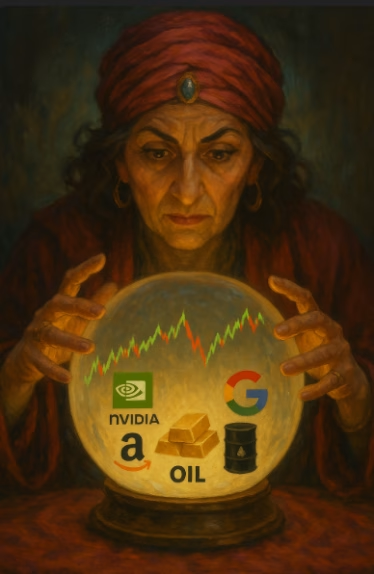
Think of it as Yoga for the brain, we are going to stretch a bit.
The Market Doesn’t Care about You —And That’s Why It Works
"In the short run, the market is a voting machine; in the long run, it is a weighing machine." - Warren Buffett
The stock market is a strange beast—part oracle, part carnival mirror. It doesn’t care about your feelings, your politics, or your Aunt Martha’s “can’t lose” hot tip. It sits there, quiet as a mule in the shade, digesting the hopes, fears, and half-baked theories of millions, then spits out a single number that tells you exactly nothing—unless you know how to listen. And the trick, my friend, is learning to listen without your heart getting in the way of your head.
Hello, can you hear me? I love the stock market. I love it, not only because of its investment potential. I think it’s one of the best ways to make money—if you know what you’re doing.
But I also love the fact that it’s totally unemotional. You may have your opinions. You may have your facts. But the stock market does its own thing. It is a beast with its own mind. It is the combined knowledge of everyone, plus their opinions, all merged into one force that ultimately produces a single number. And it’s also a speculative, mathematical model of the universe—as far as we know—everything we know.
“In the short run, the market is a voting machine; in the long run, it is a weighing machine.” That is Warren Buffet’s way of saying that in the short term, stock prices are driven by popularity and emotion, but over time, they reflect the true value of a business.
The question is: How do we, as humans, control our emotions and make decisions based not on what we like, but on what really is?
And in the end, the market is like a river—steady in its chaos, always moving, and utterly indifferent to whether you sink or swim. You can stand on the shore and shout at it, but it won’t change course for you or anyone else. Learn its currents, ride them with a cool head, and you might just make it to shore richer than when you started. Forget that lesson, and the market will be happy to take your money—without even saying thank you.
One Clarification…. When you buy a stock for $300 and it goes down to $100, it is now worth $100. Don’t think it is coming back because you over paid for it. If it is at $100, it is worth that now.
The Futures Market – Where Tomorrow’s Bets Trade Today
The market may post a “final score” at the closing bell, but in truth, it never really sleeps. Stock traders might pack up at 4 p.m., yet in today’s world, money moves 24/7/365. One of the clearest examples of that is the futures market.
What are futures?
Futures are standardized contracts to buy or sell something—stocks, oil, gold, wheat, even stock indexes—at a set price on a set date in the future. They were originally designed to help farmers, miners, and manufacturers lock in prices ahead of time, but today they’re just as popular with traders and hedge funds who want to speculate on where prices are headed.
Why is it important?
Because futures trade nearly around the clock, they act like an overnight heartbeat monitor for the financial world. When you hear about the “Dow futures” or “S&P 500 futures” moving before the market opens, that’s the futures market telling you how traders think tomorrow’s market might behave.
The catch:
Futures don’t predict the future with certainty—they reflect sentiment and positioning. A jump in S&P futures at 3 a.m. might vanish by the time the stock market opens, but it still gives investors a sense of the current mood.
In short: the futures market is where the next day’s game is already being played before the referee even blows the whistle.