Think of it as Yoga for the brain, we are going to stretch a bit.
Nepal’s Gen Z Rebellion Against a Communist Prime Minister – Shangri-La
Most people don’t know where Nepal is. And no, it isn’t Naples, Italy, with its pizza ovens, nor Naples, Florida, with its golf carts and beach condos. Nepal sits high between India and China, a land of mountains, monarchs, and lately, mismanaged politics. If geography is destiny, Nepal drew the short straw: caught between two giants, it has often been ruled by men who promised heaven and delivered headaches. Shangri-La it aint.
The Story:
K.P. Sharma Oli was one of them. Born in 1952, he grew up hard, lost his mother to smallpox, and later spent 14 years behind bars for his communist activism. Out of prison, he helped found the Communist Party of Nepal (Unified Marxist–Leninist) and climbed the ladder to become prime minister—four times over. He promised jobs and stability. What the people got was corruption, economic malaise, and creeping authoritarianism.
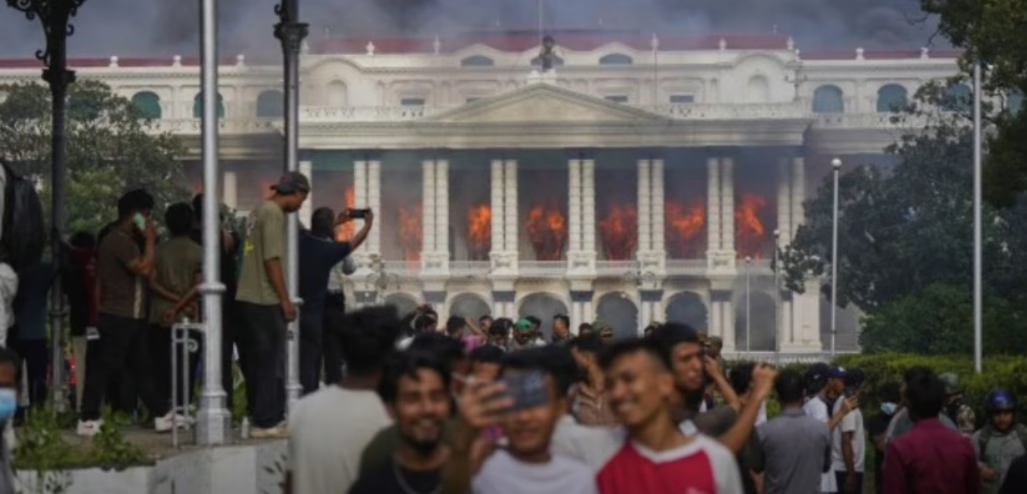
The final straw? Oli’s government banned Facebook, YouTube, and X, hoping to silence dissent and tighten his grip on power. Instead, the move lit the fuse. Nepal’s Generation Z, already weary of unemployment and graft, poured into the streets. They stormed parliament, burned buildings, and faced down water cannons and bullets. At least 19 died, but their message rang louder than any ban could mute.
In the end, Oli resigned—toppled not by foreign enemies or rival politicians, but by the very youth he tried to muzzle. They ran the finance minister into the river naked, and some others may be dead. Many government buildings are on fire.
If there’s a moral here, it’s this: you can dam a river, but you can’t cork a volcano. Social media might look like trivial chatter to old men in high offices, but to a restless generation it’s oxygen. Take it away, and don’t be surprised when they set the palace on fire to breathe again. Nepal’s story isn’t just about one communist prime minister’s fall; it’s a reminder that when leaders try to silence the young, the young eventually write the ending themselves—with smoke, fire, and the promise of something new.
And China is scared for the same thing…
Video at bottom of post… Glad you read this far.
EXTRA CREDIT:
Is Nepal Shangri-La?
The idea of Shangri-La—a mystical, hidden paradise in the Himalayas—isn’t directly Nepal, but Nepal is often wrapped up in the imagery. Here’s the background:
Origin of Shangri-La
The term comes from the 1933 novel Lost Horizon by James Hilton.
In the book, Shangri-La is a fictional utopian valley in the Himalayas, isolated from the outside world, where people live long, peaceful lives.
Hilton never specified an exact country—but he drew inspiration from Tibetan Buddhist culture and travel accounts of explorers in the Himalayas.
Nepal’s Connection
Geography: The descriptions—snow-capped peaks, hidden valleys, Buddhist monasteries—fit well with Nepal and Tibet.
Mystique: Nepal, with its remote Himalayan valleys and traditions, was often romanticized by Western explorers as “mystical” and “untouched,” making it a natural stand-in for Shangri-La.
Tourism: Nepal (along with Tibet and Bhutan) has leaned into this myth in tourism, promoting itself as a land of spiritual retreat and hidden beauty.
Reality vs. Myth
Shangri-La is not a real place—it’s a Western literary invention.
But many have speculated locations:
Tibet (Kunlun Mountains) is the strongest candidate, since Hilton based much of it on accounts of the region.
Nepal and Bhutan are often imagined as Shangri-La in the popular imagination, thanks to their dramatic Himalayan landscapes and Buddhist culture.
✅ So, while Shangri-La isn’t literally Nepal, the myth has been closely associated with it—enough that when people say “Shangri-La,” they often picture the Himalayas of Nepal.
Would you like me to show you a map overlay of the Himalayan region, marking Nepal, Tibet, and Bhutan, to see where people imagine Shangri-La could be?
NEPAL Geography & People
Location: Landlocked between India and China, nestled in the Himalayas.
Mountains: Home to Mount Everest, the world’s tallest peak.
Population: ~30 million, with rich ethnic diversity—groups include the Newar, Gurung, Magar, Tharu, Sherpa, and many others.
Religion: Historically a Hindu kingdom; today officially secular, but Hinduism and Buddhism remain deeply influential.
Ancient & Medieval History
Nepal’s Kathmandu Valley has been inhabited for millennia, flourishing as a center of Buddhism and Hinduism.
By the Middle Ages, Nepal was divided into small kingdoms (like Malla dynasties), each with vibrant art, temples, and architecture still visible in Kathmandu, Patan, and Bhaktapur.
Unification & Monarchy
In the mid-1700s, King Prithvi Narayan Shah of Gorkha unified Nepal into a single kingdom.
The Shah dynasty ruled for centuries, though under British influence after Nepal’s defeat in the Anglo-Nepalese War (1814–1816).
Nepal remained independent but ceded territory to the British East India Company.
Rana Oligarchy (1846–1951)
Power shifted from the monarchy to the Rana family, who ruled as hereditary prime ministers for over a century.
They kept Nepal isolated from the outside world, limiting modernization and foreign contact.
Democracy, Monarchy, and Turmoil (1951–2006)
The Rana regime ended in 1951, restoring the Shah monarchy under a constitutional framework.
Political instability and royal takeovers followed, with frequent swings between democracy and autocracy.
In the 1990s, multi-party democracy was established.
Civil War & Republican Transition
From 1996 to 2006, Nepal endured a brutal Maoist insurgency, costing over 17,000 lives.
The monarchy’s credibility collapsed after King Gyanendra’s attempt at absolute rule in 2005.
In 2008, the monarchy was abolished, and Nepal became a Federal Democratic Republic.
Modern Era
The Constitution of 2015 declared Nepal a secular, federal republic with seven provinces.
Politics have been dominated by shifting alliances between the Communist parties (CPN-UML, Maoist Centre) and the Nepali Congress.
Nepal continues to face challenges:
Earthquakes and natural disasters (notably 2015).
Dependence on remittances, as millions of Nepalis work abroad.
Balancing India and China’s influence while pursuing development and stability.
✅ In short: Nepal is a small but resilient nation—a Himalayan kingdom turned republic—with a history shaped by kings, insurgents, and now restless youth demanding democracy and opportunity.