Think of it as Yoga for the brain, we are going to stretch a bit.
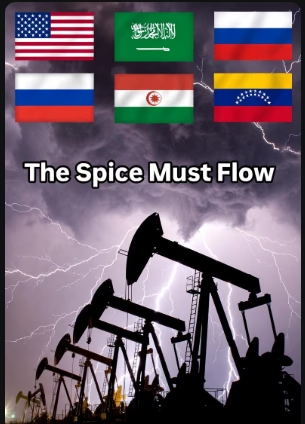
The Spice must flow – OIL, VENEZUELA, US, RUSSIA, CHINA, ARABIA, CANADA
Geopolitics is just energy logistics pretending to be ideology. -- YNOT!
Everyone loves $1.99 a gallon. It feels like winning a small, unexpected lottery. You pull into the gas station grinning, as if the pump personally likes you today. Politicians smile. Voters relax. Someone somewhere declares victory.
But cheap gasoline has a way of asking uncomfortable follow-up questions.
If oil is so cheap, why isn’t everyone drilling like there’s no tomorrow? Why aren’t rigs popping up like Starbucks? Why do oil executives sound calm—almost bored—when prices drop?
Because oil is not a short game. And America, whether it admits it or not, is playing a very long one.
Oil executives will tell you—truthfully—that today’s price barely registers in long-term planning. A project that comes online in 2024 might have been discovered in 2004. The Gulf of Mexico doesn’t care about your gas receipt this morning. Exploration, appraisal, development—this business moves in decades, not election cycles.
That’s why the industry didn’t panic when prices fell. They cut costs, optimized capital, squeezed more output from fewer rigs, and kept going. A decade ago, shale needed $70–$80 oil to break even. Today, it’s less than half that. Longer laterals. Better spacing. Smarter completions. Fewer rigs doing more work. The rig count dropped because efficiency rose—not because demand disappeared.
And demand, inconveniently, refuses to die.
The International Energy Agency once told the world oil demand would peak by 2030. Now it says 2050. OPEC politely calls this a “rendezvous with reality.” Translation: people still want to drive, fly, heat homes, and power data centers. A lot of them.
Which brings us back to the part most people miss.
Oil is not oil.
America’s shale revolution produces mostly light crude—thin, easy-flowing, almost polite oil. But America’s refineries, especially along the Gulf Coast, were built decades ago to process heavy crude—thick, stubborn, gloopy stuff that requires expensive, complex equipment.
You cannot simply swap one for the other. Refineries are not blenders. They are billion-dollar machines optimized for specific chemistry. Rebuilding them would take years and fortunes no one wants to spend.
So here’s the paradox: the United States produces more oil than ever—and still imports massive amounts of it.
Not because it lacks oil.
Because it lacks the right kind of oil.
Today, roughly 70% of U.S. oil imports are heavy crude. And that heavy crude comes from very few places.
Canada is the big one now. Venezuela used to be the other.
And Venezuela matters not because of what it pumps today—but because of what it sits on.
Venezuela has the largest proven oil reserves on Earth, larger than Saudi Arabia. Almost all of it is heavy crude—exactly what American refineries are designed to consume. It’s close. It’s accessible. It fits the plumbing.
There is only one other country on the planet with comparable heavy-oil reserves.
Russia.
Suddenly, interest in Venezuela looks less like a moral crusade and more like supply-chain math.
Which explains why Chevron—quietly, carefully—has stayed in Venezuela for nearly a century. Not loudly. Not politically. But patiently. Operating within sanctions. Talking with administrations. Playing the long game.
Chevron executives say it plainly: Venezuelan oil is sought after by U.S. refiners. It’s in the Western Hemisphere. It’s near the Gulf Coast refining complex. And in a world where energy security has become national security, geography matters again.
This same long-view thinking shows up everywhere else too.
In Iraq, where American companies are asked to replace Russian stakes.
In deepwater, where standardized designs have halved capital costs.
In AI, where decades of seismic and geological data are waiting to be fed into smarter models—not to replace humans yet, but to make better decisions faster.
In data centers, where the real bottleneck isn’t chips—it’s power. Hence Chevron’s move into off-grid, gas-fired gigawatt-scale power dedicated to AI infrastructure.
Oil companies are no longer just fuel suppliers. They are becoming energy logistics firms for an electrified, data-hungry world.
And that’s the part cheap gasoline hides.
Low prices don’t mean oil is unimportant. They mean the system is working—for now. The rigs are fewer, the wells are better, the capital is tighter, and the planning horizon stretches far past today’s headlines.
Geopolitics, like refining, is about compatibility. About what fits where. About infrastructure you can’t easily replace.
So when leaders talk about drugs, sanctions, partnerships, or national security, listen politely—but check the refinery maps. Check the crude grades. Check the timelines.
Because oil doesn’t argue.
It just flows where the system allows it.