Think of it as Yoga for the brain, we are going to stretch a bit.
Nicolás Maduro — how the bus driver got the keys
“I was sitting in my backyard wondering what happened to all the iguanas. Maybe the cold killed them. Maybe people did. They’d gotten out of hand, and somehow—by nature or by man—the trend reversed. Venezuela feels the same way. I don’t know if the U.S. did the right thing, and we won’t know the consequences for years. But from where I’m sitting, it looks a lot like someone finally decided to clean up the iguanas.” -- YNOT!
Venezuela did not drift into its current condition by accident. It was driven there carefully, with hands on the wheel, eyes on the mirrors, and loyalty checks at every stoplight. These are not side characters. They are the inner circle — the people who learned the system from Hugo Chávez, improved it for personal survival, and then locked it in place.
Let’s go one by one.
Nicolás Maduro ‘El Burro’— how the bus driver got the keys
Nicolás Maduro did not rise because he was brilliant, popular, or feared. He rose because he was useful.
Maduro started as a union organizer in the Caracas metro system. That matters. Union politics is where you learn three skills that last a lifetime: how to control meetings, how to punish dissent quietly, and how to survive by loyalty rather than competence.
He became close to Hugo Chávez not because Chávez trusted his ideas, but because Maduro never challenged him. Chávez liked revolutionaries on TV, but he preferred obedience behind closed doors.
Chávez made Maduro foreign minister in 2006. That job wasn’t about diplomacy — it was about loyalty. Maduro traveled, smiled, repeated Chávez’s lines, and never freelanced.
When Chávez got cancer, he faced a problem every strongman faces eventually: Who do I trust not to stab me while I’m gone?
He chose Maduro.
In December 2012, Chávez went on television and did something unusual for a revolutionary: he pointed at his successor and told the country who to vote for if he died. That was not democracy. That was estate planning.
Chávez died in March 2013.
Maduro ran weeks later, narrowly “won,” and never faced a fair election again.
From that moment on, survival — not ideology — became the job.
Diosdado Cabello – “El Hombre del Maletín”
— The man with the Briefcase
Diosdado Cabello is the most misunderstood man in Venezuelan politics.
People think Maduro is the strongman. He isn’t. Cabello is the insurance policy.
A former military officer and Chávez confidant, Cabello has held nearly every powerful institutional role: National Assembly president, party vice president, media boss, power broker. His real power is not public. It’s archival.
Cabello is widely believed — inside and outside Venezuela — to possess detailed knowledge of corruption, drug trafficking, and internal betrayals. Whether every rumor is true doesn’t matter. What matters is that everyone thinks he knows.
That makes him untouchable.
Maduro governs, but Cabello balances him. They don’t trust each other. They don’t need to. They coexist like two men sharing a lifeboat, each convinced the other has a knife.
Delcy Rodríguez — “La Fea,” the enforcer in heels
Delcy Rodríguez earned the nickname “La Fea” (see Below) She is sharp, confrontational, and entirely unembarrassed by power. The one chosen to hide and sell the gold to Russia.
A trained lawyer and longtime Chávez loyalist, she became foreign minister and later vice president. Her role is simple: confrontation without apology.
She attacks foreign governments, insults diplomats, shrugs off sanctions, and says the quiet part out loud. In a system that survives on defiance, that makes her valuable.
Delcy does not soften the regime. She hardens it. When Maduro wants deniability, she handles the dirty language. When the regime wants to show it doesn’t care what the world thinks, she is sent forward.
Delcy Rodríguez has been called “La Fea” by Jaime Bayly as a pop-culture reference to the telenovela character “Betty, la fea,” implying a resemblance. She has also been called the Black Widow.
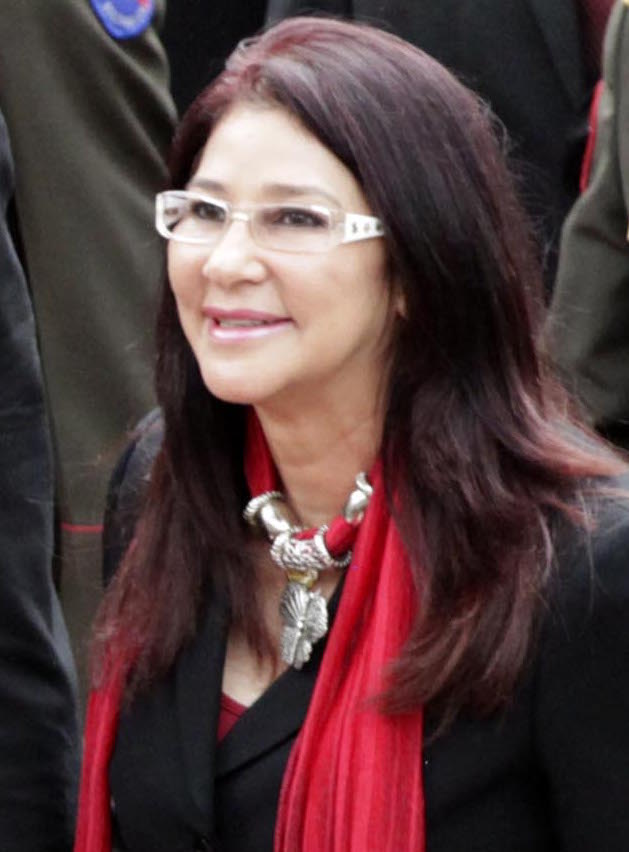
Cilia Flores — the gatekeeper
They say behind every great man is a great woman. The opposite is true as well. If Maduro is bad, Cilia is worse. Cilia Flores is often described as ‘Maduro’s wife,’ but that misses the point. She was the engine behind his ascent—clearing obstacles, silencing problems, and making sure the rise happened, not by chance, but by design.”
She is a former National Assembly president, a lawyer, and the person who controls access — personal, political, and legal — to Maduro himself.
Her influence is quiet but decisive. Ministers rise and fall through proximity. Loyalty is measured not just to Maduro, but to Cilia. When her nephews were convicted in the United States for drug trafficking, the regime did not flinch. It closed ranks.
In systems like this, family is not decoration. It is infrastructure.
How the system actually works
Chávez built a revolution powered by oil and charisma. Maduro inherited a wrecked economy and kept power by force, patronage, and fear.
Elections still happen — like stage plays where the ending is known and the audience is watched closely. Institutions still exist — like furniture in an abandoned house.
The military is paid. The courts obey. The opposition is allowed to exist just enough to be blamed for everything.
And the inner circle stays intact because each member knows too much about the others to leave.
The quiet truth
Maduro did not seize power. He was handed it — by a dying man who mistook loyalty for competence.
The others stayed because chaos is dangerous, but collapse is worse. They are not ruling a country anymore. They are managing a stalemate.
And that’s the final irony: Venezuela is not run by a grand plan or a master strategy.
It’s run by people who cannot afford to lose — and know exactly what happens if they do.
NEXT
TIMELINE
Below is a clean, chronological timeline distilled from the material you provided. It strips away repetition and commentary while preserving the causal flow: background → rise → consolidation → collapse → repression.
Nicolás Maduro — Timeline of Rise, Rule, and Regime Consolidation
1962–1980s: Origins
Nov 23, 1962 – Born in Caracas, Venezuela.
Son of a trade union leader and a homemaker.
Education ends after high school.
He spend years in Cuba being trained and making connections with Castro Regime. Cuba push Chavez to put him in power. Some even suggest that Castro’s had Chavez kill to put Maduro in power so they could control him.
Works various jobs; becomes a Caracas Metro bus driver, later central to his “man of the people” image.
1980s–1990s: Radicalization and Entry into Politics
Becomes active in trade union activism representing metro workers.
Joins leftist, anti-imperialist movements aligned with socialism.
Early supporter of Hugo Chávez and the Bolivarian Revolution, before Chávez takes power.
Ideologically aligned with Castro-style communism and authoritarian socialism.
1998–2006: Institutional Rise Under Chávez
1998 – Elected to the National Constituent Assembly, which rewrites Venezuela’s constitution after Chávez’s election.
2000–2006 – Serves in the National Assembly.
2005–2006 – Becomes Speaker of the National Assembly.
Builds reputation not for charisma or ideas, but for loyalty, discipline, and obedience.
2006–2013: Foreign Minister and Trusted Insider
2006–2013 – Appointed Foreign Minister by Chávez.
Becomes Venezuela’s international defender of:
Anti-U.S. policy
Bolivarian socialism
Strengthens ties with Cuba, Russia, China, and Iran.
Develops alliances with military leadership and Cuban advisers.
Learns and helps refine electoral manipulation, centralized vote control, and turnout inflation.
2012–2013: Succession
Oct 2012 – Chávez, dying of cancer, publicly names Maduro Vice President and successor.
Mar 2013 – Chávez dies.
Maduro becomes Interim President.
Apr 14, 2013 – Maduro declared winner of a presidential election amid allegations of fraud.
2013–2017: Consolidation of Power
Begins systematic control of:
National Electoral Council (CNE)
Courts and Supreme Tribunal
Military and security services
Election methods alleged to include:
Phantom voters and inflated registries
Centralized vote transmission and manipulation
Intimidation at polling sites
Vote-buying via food subsidy programs (Carnet de la Patria)
Opposition media suppressed; protests repressed.
Economy begins rapid collapse.
2017: Exposure of Electoral Fraud
2017 regional elections – Vote reporting pauses when opposition leads surge.
Smartmatic, voting machine provider, states turnout numbers were inflated by over one million votes.
Smartmatic cuts all ties with Venezuela.
CNE assumes total control of election machinery with no independent oversight.
2018: Disputed Reelection
May 2018 – Maduro declared reelected for a 6-year term.
No full precinct-level results released.
International observers restricted or barred.
Major opposition figures banned, jailed, or exiled.
2019–2023: Narco-State Allegations and Sanctions
U.S. and allies intercept drug-running vessels linked to Venezuelan and Colombian networks.
2015 – Maduro’s nephews arrested and later convicted in the U.S. for trafficking 800 kg of cocaine.
U.S. Treasury and DOJ sanction senior Venezuelan officials.
Allegations grow around Cartel de los Soles, involving:
Drug trafficking
Gold and mineral smuggling
Fuel smuggling and arms trafficking
Venezuela increasingly described as a narco-transit safe haven.
2024: Disputed Election and Crackdown
July 2024 presidential election – Official results declare Maduro the winner.
Opposition tallies claim Edmundo González won over 60%.
CNE refuses to release detailed polling data.
Massive post-election repression:
Arbitrary arrests
Torture allegations
Enforced disappearances
Over 2,000 detained after protests.
Armed civilian groups (colectivos) used to intimidate and repress.
2025: International Escalation
Jan 2025 – NGOs report ~1,700 political prisoners remain detained.
Aug 2025 – U.S. offers $50 million reward for information leading to Maduro’s arrest on drug trafficking charges.
Maduro denies all allegations; claims U.S. regime-change efforts.
Venezuela remains under heavy sanctions, economic collapse continues.
Present Condition
Venezuela transformed from a leading oil producer into one of the poorest nations in Latin America.
Defined by:
Hyperinflation
Food and medicine shortages
Mass migration
Political repression
Regime survival depends on:
Electoral control
Military loyalty
Patronage networks
Repression and fear
Bottom Line
Maduro did not seize power through brilliance or popularity. He inherited a system built by Chávez, perfected its tools of control, and now maintains power through institutional capture, coercion, and survival politics, while the country beneath him collapses.