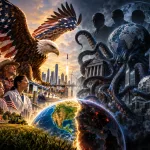
Think of it as Yoga for the brain, we are going to stretch a bit.
Terrorism Designations: The Legal Alchemy That Turns Politics into Prosecution
"Many times, we applaud the destination while quietly pretending we didn’t notice the road that led there was full of slippery slopes."-- YNOT!
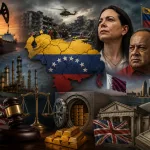
If there is one move that made this operation possible—not just thinkable, but executable—it is this: reclassifying the Venezuelan regime from a bad government into a terrorist-linked criminal enterprise.
That sounds like wordplay. It is not. In U.S. law, labels are levers.
Why This Matters So Much
Under normal circumstances, sovereignty is a shield. A thick one. Heads of state enjoy immunity, even when they’re corrupt, brutal, or incompetent. International politics tolerates monsters as long as they wear suits and control territory.
Terrorism designations smash that shield.
Once an organization—or a state apparatus—is formally tied to terrorism, the legal universe changes. You are no longer dealing with diplomacy. You are dealing with counterterrorism law, which was written after 9/11 with one guiding principle:
When terrorism is involved, normal rules slow you down—and slowing down gets people killed.
That mindset is embedded in statute.
From Regime to Racketeering Syndicate
The critical step was not calling Nicolás Maduro “illegitimate.” That’s politics. Countries argue about legitimacy all the time.
The critical step was tying him—and the Venezuelan state—to narco-terrorism.
Specifically:
Cocaine trafficking as a state-enabled enterprise
Revenue used to sustain power, suppress opposition, and destabilize neighbors
Direct operational overlap with designated criminal and terrorist networks
By designating entities like Cartel de los Soles as terrorist-linked organizations—and asserting that the state itself was inseparable from those networks—the U.S. effectively said:
“This is not a government we disagree with. This is an organization committing crimes that trigger counterterrorism authorities.”
That sentence is a legal nuclear key.
What the Designation Actually Unlocks
Once terrorism is invoked, the U.S. government gains access to authorities that do not exist in normal foreign policy.
Here’s what flips on:
1. Extraterritorial Reach Becomes Normal
Drug trafficking tied to terrorism allows U.S. courts to assert jurisdiction anywhere the activity touches U.S. interests—financial systems, shipping lanes, communications infrastructure, or narcotics markets.
Suddenly, geography is no longer protection.
2. Joint Operations Become Lawful
Without terrorism designations:
CIA = intelligence only
Military = overt force only
Law enforcement = domestic or extradition-based
With terrorism designations:
CIA can run covert actions
Military assets can be used under intelligence authorities
DOJ, DEA, FBI can integrate directly into planning
This is how you legally fuse intelligence, military, and law enforcement into one operation without violating U.S. statutes.
3. Use-of-Force Threshold Drops
You no longer need a declaration of war or congressional authorization for force in the traditional sense. Counterterrorism authorities allow:
Capture missions
Kill-or-capture planning
Preemptive action against imminent threats
The legal framing shifts from “Should we intervene?” to “Is this a lawful counterterrorism action?”
That’s a much narrower question—and much easier to answer yes.
The Quiet Role of the DOJ (The Part Nobody Mentions)
This doesn’t work unless prosecutors sign off.
The Department of Justice has to believe it can:
Sustain indictments
Defend jurisdiction
Argue that the designation is not arbitrary
Otherwise, the entire operation becomes legally radioactive.
This is why terrorism designations are not just executive whim. They are built to survive court challenges years later, when the politics have changed and no one wants to defend yesterday’s decisions.
In other words: this was designed to hold up in a hostile future administration.
Why This Scares Other Governments
Here’s the reason China, Russia, Iran, and others react so violently to this logic:
Because it erases a comfortable fiction.
For decades, authoritarian regimes assumed that as long as they:
Controlled territory
Maintained diplomatic relations
Avoided direct war with the U.S.
They were safe from personal consequences.
Terrorism designations say the opposite:
“If your state functions like a criminal enterprise, we will treat it like one.”
That is not a threat. It is a legal theory.
And legal theories, once accepted, spread.
The Truth Hiding Underneath
Most people think the danger here is that the United States acted too aggressively.
The deeper danger—for those watching carefully—is that the action was carefully legalized.
Empires don’t fall because they break rules.
They fall because they rewrite them and pretend nothing changed.
Last night didn’t prove the U.S. is reckless.
It proved the U.S. has learned how to make extreme actions look procedural.
And once terrorism becomes the lens, the question is no longer who is in charge.