Think of it as Yoga for the brain, we are going to stretch a bit.
So what’s really going on with Greenland—and what’s already there?
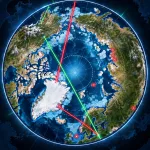
“When the polar bear and the penguin are standing side by side, you’re not looking at nature — you’re looking at politics. Someone dragged the South Pole north, parked missiles behind it, and called it ‘security.’ That’s how you know this isn’t about defense anymore… it’s about China”-YNOT!
If this feels less like diplomacy and more like someone trying to renegotiate the lease while standing in the living room, you’re not wrong.
The short answer
Greenland isn’t a blank, frozen Monopoly square. It’s already spoken for—politically, militarily, and culturally. What’s happening now is not a scramble for access. It’s a struggle over ownership, leverage, and who gets to rewrite the rules when the weather turns cold.
What Greenland actually is
Greenland is a semi-autonomous territory within the Kingdom of Denmark. It governs most of its internal affairs, runs its own parliament, and receives substantial annual subsidies from Copenhagen to keep the lights on in a place where the sun sometimes forgets to show up for months.
Culturally, it is Inuit at its core. Politically, it has been inching—slowly and carefully—toward greater independence. Economically, it survives more on transfers than trade.
Which matters, because anyone talking about “buying” Greenland is really talking about inheriting the tab.
What’s already there (and this is the part that gets skipped)
The United States is not knocking on the door from the outside. It already has a key.
At the top of the island sits Pituffik Space Base (formerly Thule). It is not symbolic. It is operational, critical, and deeply embedded into North American missile defense and space surveillance.
Thanks to a 1951 defense agreement, Washington already enjoys:
Permanent basing rights
Missile-warning radar coverage
Arctic air and space domain awareness
Strategic control over the GIUK gap (Greenland–Iceland–UK)
In plain English: the U.S. already has the access it needs.
Which raises an awkward question—if access is secured, why demand the deed?
The minerals myth
Yes, Greenland has rare earths. Lots of them. On paper.
But paper doesn’t drill holes through ice, ship diesel that won’t gel, or power mines through three months of darkness. There are zero active rare-earth mines on the island today, not because of ideology, but because the math is brutal.
Mining there isn’t capitalism. It’s geopolitics wearing a hard hat.
Any project that moves forward will do so only with:
Massive subsidies
State-backed guarantees
Strategic—not commercial—pricing
In other words, Europe wouldn’t be “developing resources.”
It would be paying protection money in the form of infrastructure.
Why this rattles NATO
NATO was built on a simple promise: allies don’t threaten each other’s borders. Not with tanks. Not with sanctions. Not with a raised eyebrow and a map.
When Donald Trump says that anything short of U.S. control of Greenland is “unacceptable,” the problem isn’t tone. It’s precedent.
Once borders become negotiable inside the alliance, Article 5 stops being insurance and starts being a variable-rate loan.
That’s why oil prices twitch.
That’s why Brussels panics.
That’s why even polite countries suddenly start saying impolite things.
The real cost nobody is pricing
If Greenland ever changed hands, Washington wouldn’t be buying an asset.
It would be assuming:
Ongoing social subsidies
Infrastructure deficits
Healthcare, housing, and logistics in extreme conditions
A population that never asked to be “acquired”
America’s track record with distant territories suggests this would age poorly.
What this is really about
This is not a mining story.
This is not a security story.
This is a contract story.
After 1945, the United States wrote the operating system of the West:
No forced border changes.
No coercion among allies.
Rules over raw power.
Threaten that framework, and you don’t just scare Denmark.
You reprice the entire alliance.
And once the mortgage goes variable, everyone starts checking the exits.