Think of it as Yoga for the brain, we are going to stretch a bit.
The Grand Illusion: Tanker Wars and the Shadow Fleet
“They call it trade when it favors them, and piracy when it does not. The ocean knows no such words and cares not who rides it." -- YNOT!
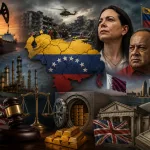
For much of the world, attention has been fixed on the very public U.S. pressure campaign against Venezuela’s leadership. But while headlines focused on politics in Caracas, a quieter—and arguably more consequential—conflict has been unfolding at sea.
Oil tankers.
In just the latter half of December, the United States seized multiple vessels accused of transporting sanctioned Venezuelan oil. Since then, the pace has accelerated. Russia has attempted to place sanctioned tankers under its legal protection. Naval escorts have been dispatched. The United States has boarded anyway. Ukraine, half a world away, has simultaneously begun striking tankers linked to Russian oil exports.
What we are witnessing is not a single event, but the opening phase of a global tanker war—a contest over oil, legality, navigation, and power projection that reaches far beyond Venezuela.
This post examines how the shadow fleet came to exist, why it matters, how sanctions are being enforced in increasingly kinetic ways, and what it may mean if freedom of navigation quietly shifts from a right into a privilege.
What Is the Shadow Fleet—and Why Does It Exist?
The so-called shadow fleet is not a fleet in the traditional sense. It is a loose, opportunistic ecosystem of aging oil tankers operating on the margins of global maritime law.
Its existence is a direct response to sanctions—specifically unilateral sanctions, not universal UN embargoes. In most cases, these ships are not violating international law simply by carrying Russian, Iranian, or Venezuelan oil. Instead, they are circumventing restrictions imposed by the United States and its allies.
Because no country owns the high seas, enforcement does not usually occur through force. It occurs through denial:
No insurance
No port access
No maintenance or classification services
No financing
No flag protection
International shipping depends on globally distributed services—insurance, registration, ports, repairs. Cut enough of those links, and even a legally floating ship becomes economically useless.
The shadow fleet exists to bypass those choke points.
These vessels avoid sanctioning states, seek alternative insurers, hop flags of convenience, and operate ships that are often well past their intended service life. Many were slated for scrap before being revived for one last, high-risk run carrying sanctioned oil.
By late 2025, estimates suggested hundreds of large tankers linked to Russia, Iran, and Venezuela, with total carrying capacity exceeding 100 million deadweight tons. Broader definitions push the global shadow fleet into the thousands of vessels.
This system works—until it doesn’t.
From Regulation to Force: The Escalation
For years, enforcement focused on indirect pressure. Europe in particular leaned on environmental inspections, insurance verification, and port state controls to quietly sideline shadow tankers within its own waters.
That approach has limits.
You cannot enforce environmental regulations on the high seas. You cannot detain vessels indefinitely outside your jurisdiction. And you cannot strangle a global shipping network using paperwork alone.
What has changed—dramatically—is that the United States has begun boarding and seizing tankers beyond its territorial waters.
This is the line that matters.
Is This a Blockade—or Something Else?
In December, U.S. leadership publicly used the word blockade to describe actions against Venezuelan oil shipments. That word is legally loaded.
A blockade is traditionally a belligerent act—an act of war. Under international law, blockades prevent all vessels, neutral or otherwise, from entering or leaving specified ports using military force.
But here’s the paradox:
What the U.S. is doing does not look like a classic blockade, even if the rhetoric says otherwise.
Instead, U.S. forces appear to be relying on existing legal mechanisms under maritime law—particularly cases involving:
False or dual flagging
Stateless vessels
Flag-state consent to board
AIS violations
Hot pursuit doctrines
In other words, the U.S. is not declaring open war at sea—but it is aggressively exploiting the administrative fragility of the shadow fleet.
Ships that lack proper registration, lose their flag status, falsify identity, or are dropped by flag states become legally vulnerable. Stateless vessels are fair game.
The shadow fleet survives on paperwork. And paperwork is brittle.
Case Study: The Tanker That Tested the System
One tanker in particular crystallized the stakes.
A massive crude carrier—capable of transporting roughly two million barrels of oil—ran a long, suspicious route from Iran toward Venezuela. It repeatedly disabled its tracking systems, conducted hundreds of suspicious rendezvous events, and attempted to evade enforcement.
When U.S. forces moved to board, the ship refused.
Then came the maneuver.
The tanker shut off its transponder, re-emerged days later claiming to be Russian-flagged, and even painted a Russian flag on its hull. Moscow demanded the U.S. stand down and reportedly dispatched naval assets in response.
The U.S. boarded anyway—using helicopters.
The ship was seized without casualties. Russian naval assets withdrew. The tanker now sits under Western control.
Legally, the case is murky. Strategically, it is crystal clear.
Russia attempted to test whether flagging alone could shield shadow fleet assets. The answer, at least in this case, was no.
Ukraine’s Kinetic Sanctions
While the United States applies pressure through seizures, Ukraine has pursued a more direct strategy.
Ukrainian drones have struck tankers linked to Russian oil exports in the Black Sea and beyond—sometimes within sight of Russian ports. These attacks have become so frequent they barely register as headlines anymore.
The lesson is sobering:
Disrupting civilian maritime traffic is cheap and easy.
Protecting it is expensive and hard.
Even a technologically inferior actor can impose meaningful costs on global trade using asymmetric tools. The implication for future conflicts—especially involving energy chokepoints—is profound.
The Economics of Unfree Navigation
At first glance, the numbers seem small. A handful of tankers seized. Dozens struck. Out of thousands globally.
But shipping is a margin business.
Oil transport requires massive capital investment. Tankers are expensive. Cargo is valuable. Profit margins are thin. A single seizure wipes out years of returns.
If transporting sanctioned oil risks losing a $30–60 million asset to earn a few million in profit, the math deteriorates quickly—even if the probability of interception is low.
This is the real power of interdiction.
You don’t need to stop everything. You just need to make the trade uneconomic.
Who Wins, Who Loses
Venezuela faces intensified pressure. Its shadow export route is narrowing. U.S.-approved channels may soon be the only viable option.
Iran remains dependent on shadow logistics to survive economically. Any rise in transport risk compounds internal instability.
Russia has deeper resources, but now faces two fronts: legal pressure from the West and kinetic disruption from Ukraine. Reflagging vessels as Russian may clarify ownership—but it also raises escalation risks.
The United States gains leverage—but risks rewriting norms it once championed.
The Bigger Question: Freedom of the Seas
Freedom of navigation is not ancient. It is modern. And ironically, it was the United States that once pushed hardest to establish it as a global principle.
Yet today, the U.S. has never formally signed the very maritime convention it largely enforces.
That leaves room for reinterpretation.
If freedom of navigation becomes conditional—selectively enforced, selectively ignored—then every major naval power will take note.
The tanker war may be about oil today.
But it is really about who decides what rules apply on the high seas tomorrow.
And once that illusion breaks, the consequences will ripple far beyond Venezuela.