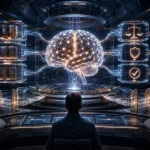
Think of it as Yoga for the brain, we are going to stretch a bit.
Is Your Brain an LLM… With Hormones? 🧠🤖🧪🔥
If we want AI to think like us, we may have to give it feelings—and a little pain— this will put a soul behind the smarts. --YNOT!
Is your brain basically a fancy LLM… or is an LLM just a brain with the soul ripped out?
Isn’t it funny how we can build a machine that talks like a professor, and it still can’t remember where it put its keys—because it never had keys, never had a childhood, and never once got embarrassed in front of a girl in 10th grade?
Let’s compare the human brain to a Large Language Model (LLM) like ChatGPT. They do rhyme. But they’re not the same song.
The Similarities: Why LLMs Feel Like “Mind”
1) Both are prediction engines
At the core, your brain and an LLM do the same basic hustle:
Given context → predict what comes next
Brain: “That look on his face means trouble.”
LLM: “That sentence structure usually ends with this word.”
The brain predicts sensory input and outcomes. LLMs predict tokens. Same shape of problem: pattern completion.
2) Both learn by adjusting “weights”
LLMs store learned patterns as weights in a neural network.
Brains store learned patterns as synaptic strengths, shaped by plasticity—neurons that repeatedly co-activate become more linked.
Different hardware, similar idea: experience changes the system’s internal wiring.
3) Both compress reality
Neither stores the world like a video file.
The brain stores compressed meaning: “Dogs are friendly… except that one.”
LLM stores compressed statistical structure: how words relate across massive text.
Both create internal representations that let them generalize, guess, fill gaps, and sometimes hallucinate.
The Differences: Where the Soul-Work Happens
1) Your brain has a body. An LLM has a keyboard.
Your brain is attached to:
hunger
pain
pleasure
fatigue
sex hormones
adrenaline
dopamine
cortisol
Meaning: your brain’s “compute” is always being biased by survival and social stakes.
An LLM has none of that. It doesn’t want anything. It doesn’t fear anything. It doesn’t care if it’s wrong—unless we trained it to sound apologetic.
2) Brains learn continuously; LLMs mostly learn in batches
Your brain learns while running—no “pause, backprop, resume.”
That’s why backpropagation is biologically awkward: it assumes clean forward passes, backward passes, synchronized updates. Brains are messy, asynchronous, local, and always-on.
Which is why predictive coding is such a tempting bridge:
It fits the biological vibe: local autonomy, continuous processing, distributed updates.
3) Memory in humans is emotional; memory in LLMs is statistical
This is the big one, and it’s where people get fooled.
LLMs “remember” by weights and context windows. They’re like: “Statistically, people who say X often say Y.”
Humans remember by meaning + emotion + chemistry.
You don’t just store facts—you store importance.
And importance is not logic. Importance is hormones.
Emotions & Hormones: The Brain’s “Weighting System”
If you want the cleanest analogy, it’s this:
LLMs
weights change based on gradient signals (during training)
“importance” is encoded indirectly through repeated patterns in data
Brains
synapses change based on activity and neuromodulators
emotion tells the brain: “Save this. Burn this in.”
When adrenaline hits (stress/fear), your brain doesn’t say: “Shall we calmly record this event?”
It says: “WRITE THIS IN ALL CAPS.”
That’s why you remember:
the car accident
the betrayal
the moment you got humiliated
the day you fell in love
Not because you’re a better archivist—because your chemistry slapped a big red “PRIORITY” label on it.
Dopamine tends to mark learning as reward-relevant (“do that again”). Cortisol/adrenaline mark learning as threat-relevant (“never do that again”).
Over time, that becomes your “weights”—not in a spreadsheet, but in the way you flinch, trust, pursue, avoid, repeat.
So yes: emotions and hormones act like a dynamic weighting system, turning ordinary moments into permanent architecture.
An LLM can simulate the sentence “that changed my life.”
Your brain can simulate the feeling—and the feeling changes future decisions.
That’s the difference between data and destiny.
Why Predictive Coding Feels Like a Clue
Predictive coding says the brain is less like a camera and more like a betting machine:
higher levels predict what lower levels will see
lower levels send back error when reality disagrees
learning reduces error over time
That’s why you can walk into a room and instantly “sense” something is off without knowing why: your brain’s prediction model is arguing with the sensory feed.
LLMs also reduce error, but mostly through training. Brains reduce error while living, while sweating, while falling in love, while panicking, while bargaining with themselves at 2:00 AM like a defendant with no lawyer.
The Bottom Line
LLMs are impressive because they mimic the surface structure of thought: language, associations, fluency.
But your brain isn’t just a text generator.
It’s a survival engine with a memory system that’s bribed by dopamine, threatened by cortisol, and occasionally hijacked by pride.
An LLM can tell you what a heartbreak is.
Your brain can ruin an entire Tuesday because of one tone of voice that sounds like 2009.
And that, right there, is the punchline:
The brain doesn’t just learn what’s true.
It learns what hurt.