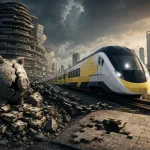
“I no longer fear death — I fear eternity spent with the same cast of characters.” -- YNOT!
If mankind ever succeeds in abolishing death, he will discover shortly thereafter that he has abolished far more than funerals. He will have canceled bankruptcy for the rich, retirement for the powerful, rebellion for the young, and urgency for the rest of us. We speak of immortality as though it were a spa treatment — a pleasant extension of the weekend — when in fact it is a constitutional amendment to reality itself.
We assume the world would simply stretch out, like a Sunday afternoon that refuses to end. But eternity is not a longer afternoon; it is a different species of time. Every institution we have built — inheritance law, elections, marriage vows, even ambition — is engineered around the uncomfortable but reliable habit of human expiration. Remove the expiration date, and the entire machinery begins to smoke.
If no one ages and no one dies, evolution slows to a polite shuffle, wealth compounds like mold in a cellar, dictators settle in like permanent furniture, and revolutions grow tired waiting for biology to do its quiet housekeeping. Love loses its deadline. Risk loses its teeth. Procrastination becomes a lifestyle. A man might study the violin for two centuries and still insist he is “just getting started.”
We like to think immortality would make us wise. It may instead make us crowded, cautious, and terribly bored.
So before we cheer the conquest of death, we ought to ask a less glamorous question: not whether we can live forever — but whether the structures of civilization, and the wiring of the human mind, were ever designed to carry the weight of forever at all.
If humans were biologically immortal — no aging, no natural death — civilization would not simply “continue longer.” It would reorganize itself at every level: biology, economics, politics, psychology, and morality.
But immortality would not suddenly make us wiser, kinder, or less inclined to fight and steal. Wars would still happen — perhaps more of them. Grudges would last centuries. Wealth would compound into dynasties without end. Imagine members of Congress sitting in their seats for hundreds of years; it is difficult enough to move the furniture now.
And what if living forever came with conditions — avoiding disease at all costs, hiding from sunlight, isolating from risk? Would eternal life become a carefully managed existence, safe but narrow, long but restrained? I do not wish to die tomorrow, nor in two hundred years. But I wonder whether the Earth could sustain people who never leave it — and whether we, psychologically and socially, could sustain ourselves under the weight of forever.
Let’s analyze it structurally.
1. Biology: Evolution Would Slow to a Crawl
Natural selection depends on generational turnover. If no one dies:
- Genetic change slows dramatically.
- Cultural evolution replaces biological evolution almost entirely.
- Risk behavior may decrease (if death is still possible through accidents or violence).
- Or paradoxically increase (if people become reckless from boredom).
If reproduction continues at current rates, population explodes. So either:
- Births are strictly limited, or
- Resources collapse.
Immortality forces fertility control.
2. Economics: Wealth Freezes at the Top
Compounded returns + infinite lifespan = extreme wealth concentration.
Imagine:
- The richest individuals never dying.
- Capital compounding for 200–500 years.
- No inheritance resets.
The world becomes aristocratic by math alone.
Economic mobility would shrink unless laws force:
- Wealth expiration
- Heavy redistribution
- Or artificial resets
Otherwise, first movers dominate permanently.
3. Politics: Power Becomes Eternal
Term limits wouldn’t matter if leaders can hold influence indefinitely.
- Dictators could rule for centuries.
- Even democracies would ossify.
- Revolutions become harder because elites never age out.
Institutions rely on turnover. Immortality freezes hierarchies.
Unless society enforces mandatory retirement, influence would calcify.
4. Culture: Depth Increases — Innovation May Slow
On one hand:
- Artists could master crafts over centuries.
- Scientists could pursue 300-year research agendas.
- Knowledge accumulation would be immense.
On the other hand:
- Generational rebellion fuels innovation.
- Cultural shifts depend on old ideas fading.
Without death, intellectual paradigms may stagnate.
Thomas Kuhn’s “paradigm shifts” often occur when old scientists die. That mechanism disappears.
5. Psychology: Meaning Would Change
Scarcity creates urgency. Death creates meaning.
If life is infinite:
- Deadlines disappear.
- Risk tolerance changes.
- Procrastination could become existential.
Would love feel the same if you have eternity?
Would ambition exist without a ticking clock?
Or would people:
- Take 200 years to study one subject?
- Spend 50 years learning violin casually?
Time preference collapses. Discount rates approach zero.
6. Environment: Extreme Pressure
Even modest fertility would eventually overwhelm Earth.
Immortality requires:
- Colonizing space
- Radical resource efficiency
- Or strict reproductive laws
Otherwise ecological collapse is inevitable.
7. War & Crime
If death is impossible biologically but still possible through violence:
- Violence becomes more terrifying.
- Security becomes obsessive.
- Long-term grudges could last centuries.
If no one can die at all:
- Punishment systems collapse.
- Prisons become eternal.
- Moral systems require redesign.
8. Relationships
Marriage “till death do us part” becomes meaningless.
Would people:
- Marry for 40-year contracts?
- Form rotating partnership systems?
- Avoid attachment altogether?
Attachment psychology evolved under mortality.
9. Religion & Philosophy
Most religions are structured around:
- Death
- Afterlife
- Judgment
- Salvation
Immortality would radically alter theology.
Some faiths would adapt.
Others would collapse.
New belief systems would emerge around transcendence beyond immortality.
10. The Hidden Question
Would boredom become the greatest threat?
The human brain evolved for survival in finite time.
If nothing ends:
- Do stories matter?
- Does achievement matter?
- Does sacrifice matter?
Or does consciousness itself change?
Two Possible Worlds
World A: Controlled Immortality
- Strict birth licensing
- Wealth expiration laws
- Rotational governance
- Space expansion
- High intellectual culture
Stable but regulated.
World B: Uncontrolled Immortality
- Population explosion
- Wealth aristocracy
- Political ossification
- Environmental collapse
- Social stagnation
Unstable and stratified.
Final Thought
Death is terrible individually.
But structurally, it may be one of the engines of renewal.
Remove death, and you remove:
- Generational reset
- Evolutionary pressure
- Economic redistribution
- Political turnover
- Existential urgency
The world might become older, slower, heavier.
Or it might become infinitely wiser.
The real question is not:
“What if we never died?”
It’s:
“Are we designed — biologically and psychologically — to handle forever?”
© 2025 insearchofyourpassions.com - Some Rights Reserve - This website and its content are the property of YNOT. This work is licensed under a Creative Commons Attribution 4.0 International License. You are free to share and adapt the material for any purpose, even commercially, as long as you give appropriate credit, provide a link to the license, and indicate if changes were made.