Think of it as Yoga for the brain, we are going to stretch a bit.
Is the Iran fight really about Iran… or is it a warning label slapped on China?
Is it just me, or does 2026 feel like the floor keeps moving while everyone pretends they’re standing still? -- YNOT!
Love him, hate him, meme him—Trump is an agent of change and chaos, and he just made what might be the power move of the century against Iran. But here’s the part people keep missing on purpose:
This isn’t only about Iranian ballistic missiles, nukes, or smoldering headquarters.
This is about China. And the CCP knows it.
The Truth part they don’t teach in “International Relations 101”
First—quick translation for anyone that is a product to other post reality school system: The CCP (Chinese Communist Party) is the ruling party of China. Same outfit that famously handled student protests with tanks and body bags instead of dialogue.
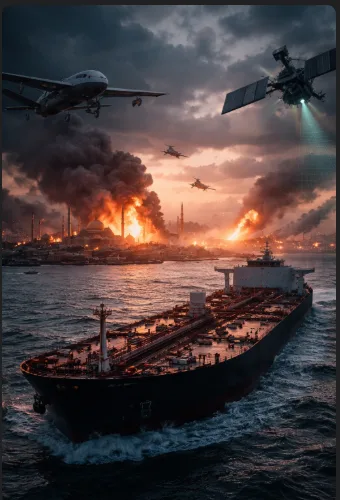
Now, the big picture: Iran has been one of China’s most valuable “friends”—the kind of friend who pays rent in oil and asks no moral questions. For years, Iran has helped China keep its engine running, not just domestically, but across the Belt and Road network.
So when the U.S. goes hard at Iran, China doesn’t just see explosions.
China sees a threat to its fuel line, its regional leverage, and its client network.
Everybody’s gangster… till the sky starts missing pixels
Trump’s approach is not “gently calibrated.” It’s more like:
remove the illusion of safety
embarrass the system
make everyone recalculate their odds
Or, as the internet put it: “Everybody gangster till the sky starts missing pixels.”
That “pixel” part is what happens when you see something slides over you… but your eyes can’t grab a shape. All you catch is a blackish disruption in the sky, like reality buffered for half a second and then refused to explain itself.
Then you hear Boom! And a Stealth Bomber did its job.
That line works because modern war is becoming less about who has the most troops… and more about who can turn your command-and-control into a haunted house.
Why China is “big mad”
China’s relationship with Iran has been deep:
Oil: Iran has been a major supplier, and China has reportedly taken the lion’s share of Iran’s seaborne exports in recent years. If Iran gets disrupted, China doesn’t just “shop elsewhere” like it’s switching from Starbucks to Dunkin. Oil supply chains don’t work like that.
Weapons supply chains: Iran has relied heavily on Chinese inputs—parts, chemicals, tech, dual-use components—everything from drones to missile programs to surveillance capability.
Regional leverage: A stronger Iran makes Gulf states nervous. Nervous neighbors hedge. And when they hedge, they often do business with China.
So when Iran gets hammered, Beijing doesn’t just lose a partner—it risks losing a platform.
The strategy (whether you like it or not)
Here’s the uncomfortable logic that keeps surfacing:
If China is considering Taiwan, the U.S. wants to reduce China’s ability to lean on “support systems” elsewhere—Middle East distractions, proxy pressure, supply diversions, and geopolitical bargaining chips.
Think of it like clearing the chessboard edges so the main match can’t be interrupted by someone flipping the table.
The Gulf angle: Iran was China’s wedge
There’s another layer people ignore because it’s less dramatic than missile footage:
If Gulf powers doubt America’s reliability, they diversify relationships—trade, infrastructure, diplomacy, tech.
China loves that.
More Chinese leverage in Gulf capitals means those capitals become less eager to side with Washington on the issues Beijing cares about most:
Taiwan
chip export controls
sanctions enforcement
the dollar-based financial plumbing
So if Iran weakens—or collapses—China’s “wedge” weakens too. And suddenly, every Beijing client relationship starts looking a little… fragile.
China’s response: the information war “starter pack”
When China can’t win the battlefield, it goes after the story.
So you get the usual playbook:
condemn the strikes
paint the U.S. as addicted to war
amplify (or invent) losses
flood social media with emotionally sticky claims
push hashtags that make America look like the villain and Iran look like the victim
The point isn’t accuracy. The point is mood.
The protest-industrial complex timing trick
And then you’ve got the domestic echo: protests that appear instantly, with coordination that looks suspiciously like somebody had the posters ready before the speech ended.
If your political movement always shows up on time like DoorDash—same fonts, same slogans, same talking points—you should at least wonder who’s paying for the delivery fee.
Here’s where the real danger lives
It’s too early to know how cleanly any of this ends. But the part we can’t sleepwalk through is this:
If the IRGC (or a successor regime) survives, China will rebuild it.
If the regime collapses, China will try to do business with whatever replaces it.
If Iran becomes freer, China will still try to buy influence—quietly, patiently, and with contracts instead of tanks.
The CCP plays the long game. That’s not paranoia. That’s their personality.
So even if Iran turns into a pro-Western democracy tomorrow, don’t get complacent. Influence operations don’t stop because people start voting. They just get better branding.
Final thought
The scary part isn’t that the world is changing. The scary part is how many people insist it’s not—right up until the moment they realize they’ve been living inside last year’s narrative and they have been left behind.