Think of it as Yoga for the brain, we are going to stretch a bit.
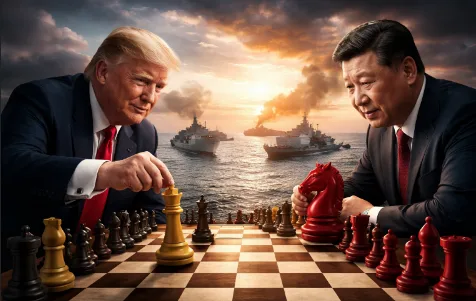
Did Trump Just Reveal His 3D Chess Playbook— and Left China Checkmated Whatever It Does?
“Trump didn’t ask China a question. He handed Beijing two doors and locked both from the outside. The trap is simple: if China sails, America leads. If China stays home, America wins the argument. Not a choice, a dilemma!” — YNOT
What do you call it when a man says one sentence and an empire suddenly has no good options left?
That is the thing about power in public. Most people think it arrives wearing a uniform, carrying a flag, and shouting through a microphone. But real power often shows up dressed like a casual remark, smiling for the cameras, while half the room is still trying to figure out what just happened.
Trump’s line about China sending ships to the Strait of Hormuz was not just a comment. It was not small talk. It was not foreign policy wallpaper. It was a dare dressed up as an invitation, and the kind of dare that leaves a man embarrassed whether he accepts it or not.
That is what makes it beautiful, ugly, and effective all at once.
China has spent years trying to play the clever merchant prince of the modern world. It buys oil where others cannot, pays in currencies meant to weaken the dollar, talks peace while quietly taking advantage of chaos, and smiles like the only adult in the room while everyone else does the bleeding and the billing. It wants the profits of disorder without the cost of responsibility. That is a fine business model—right up until somebody shines a flashlight on it.
And that is what Trump just did.
He named the countries. Most of them are expected players. Allies, partners, nations with obvious stakes in the waterway staying open. Then he threw China into the sentence like a lit match into a room full of gas fumes. Now Beijing has to decide whether it wants to act like a great power or continue behaving like a discount shopper sneaking out the back door with the good silver.
If China sends warships, it loses the mask. No more pretending to be the detached peace broker above the mess. No more playing both sides while collecting the benefits. The minute Chinese ships join a security effort around Hormuz, China is no longer the neutral outsider. It becomes part of a security order it did not build, under a command structure it does not control, protecting a system whose pricing power still smells like Washington and Wall Street. That is not Beijing’s dream. That is Beijing swallowing hard and saying grace over an American meal.
But if China refuses, that is worse in a different way.
Then the whole world gets to see the truth plainly: China depends on the artery, profits from the artery, schemes around the artery, but does not want to lift a finger to defend the artery. That makes Beijing look less like the future ruler of the international order and more like a man who lectures the town on civic virtue while sneaking away before the volunteer fire bucket comes around.
That is the trap.
Show up, and you admit America still sets the stage.
Stay home, and you admit you were never the leading man.
For years, China’s great hustle has been to suggest that the dollar era is fading, that the yuan can grow around the edges, that alternate channels and shadow trade can eventually make Washington look old, tired, and expensive. And maybe that dream looked clever in conference rooms and policy papers. But history has a nasty habit of forcing theories to ride through bad neighborhoods at night.
Hormuz is one of those neighborhoods.
There, the world does not care about slogans. It cares about escorts, insurance, mines, missiles, and whether a tanker captain believes he will still be alive by dinner. In that kind of place, monetary fantasy runs straight into steel, drones, and fear. It is one thing to settle a transaction in yuan. It is another thing to clear a sea lane when somebody with a cheap drone and a grudge can shut the whole show down.
That is where the dollar keeps cheating death. It is not loved. Lord knows it is not loved. But when the house catches fire, people still run toward the fire truck, not toward the man holding a pamphlet about a future alternative water distribution model.
Trump, for all his rough edges and wrecking-ball manners, understands something the smooth experts often miss: global systems are not maintained by speeches about cooperation. They are maintained by somebody with enough force, nerve, and will to keep the road open. Civilization, beneath all the nice words and diplomatic cutlery, still depends on men with ships showing up where danger lives.
And China has spent a long time hoping to inherit the benefits of that truth without ever having to say it out loud.
Now it may have to say it.
That is why the sentence matters. It was not merely about Iran. Iran is the match. China is the curtain. The real drama is not whether Tehran can cause trouble. Of course it can. The real drama is whether Beijing is ready to stop acting like a clever spectator and start paying the cover charge for empire.
Empires are expensive. That is the part ambitious nations always whisper over.
Everybody wants reserve currency status. Everybody wants prestige. Everybody wants the world to call first and pay respect. But the bill comes due in ugly places—straits, chokepoints, shipping lanes, dead sailors, nervous markets, and long nights when somebody must decide whether to move steel into danger for the sake of order.
America has been paying that bill for a long time.
China wants the house. Trump just asked whether it is ready to help pay the mortgage.
And that is why this feels like checkmate. Not because China is weak. Not because China is stupid. But because the board has been arranged so that any move exposes the truth.
Send ships, and Beijing kneels to the security architecture it claims is fading.
Send nothing, and Beijing reveals that its grand alternative system still depends on American power doing the dirty work.
That is not just strategy. That is public humiliation by geometry.
The funniest part, if a man is allowed to laugh at dangerous things, is that modern experts will spend the next week pretending this is terribly complicated. They will use phrases like “regional deconfliction,” “multipolar signaling,” and “energy corridor stabilization.” That is what educated people do when they are scared of plain English. But plain English works just fine here:
Trump told China, in front of the whole class, to either help guard the hallway or admit it only likes using the hallway while someone else fights off the bullies.
Now we wait to see whether Beijing wants respect badly enough to risk comfort.
Because that is the test of every rising power. Not whether it can make money in the dark. Not whether it can talk big in forums. Not whether it can build ports, pipelines, apps, and slogans. The test is whether it can bear the burden that comes with the throne it keeps measuring for itself.
A lot of nations want to replace America right up until the moment they are asked to do American things.
Then suddenly, revolution becomes accounting. China wanted the benefits of empire without the burden of empire. Trump just put the invoice on the table.