Think of it as Yoga for the brain, we are going to stretch a bit.
How Did Iran Get Here— And Now What?
"Nothing mortal travels so fast as these Persian messengers. They teach them three things only, riding and archery and truth-telling. But of all men the Persians most welcome foreign customs." — various by Herodotus
How do you take one of the oldest civilizations on earth, run it through monarchy, revolution, hostage-taking, holy war, proxy terror, and nuclear brinkmanship, and then still have people say, with a straight face, that all of this is just one big misunderstanding? This post is built from your pasted draft and argument.
Every time Iran is back in the headlines, the same tired sermon crawls out of the basement. America caused everything. America offended everybody. America sneezed in 1953, and somehow that explains every bomb, every hostage, every militia, every burning flag, every chant of “Death to America” ever since. That story is neat, simple, and wrong in all the convenient places.
Yes, Operation Ajax happened. Yes, the CIA helped remove Mosaddegh in 1953. But people tell that story like Iran was a flawless democracy, the Shah was a cartoon villain sent in by Washington, and history would have turned into a peace festival if only America had behaved better. Real history is uglier and less flattering to everybody. Mosaddegh was not some gentle saint of constitutional order. He was centralizing power, clashing with the existing constitutional system, ruling by decree, and moving Iran toward a dangerous political breakdown in the middle of the Cold War. Britain and the United States were not playing checkers over tea. They were looking at Soviet pressure, oil, geography, and the possibility of losing a strategic country to Moscow.
Then came the Shah. And here is where people start cheating. Because the Shah was not fiction. He was real. He modernized Iran. He expanded women’s rights. He secularized education. He pushed development. Tehran, for a time, looked more like a rising modern capital than a shrine to medieval rule. But he was also autocratic. He used repression. He bred resentment. And when you modernize a country faster than its culture, clergy, radicals, and wounded pride can stomach, you do not get gratitude. You get gasoline.
That gasoline caught fire in 1979.
And this is the hinge of the whole story. Not 1953. Nineteen seventy-nine.
The Shah fell. Khomeini returned. A coalition of Marxists, students, clerics, dreamers, and fools helped tear down one order without the faintest clue what would replace it. What replaced it was not freedom. It was not dignity. It was not some poetic uprising of the oppressed. It was a theocratic machine with prison walls, firing squads, morality police, compulsory veils, purges, and a governing philosophy that mixed religion, power, grievance, and death into one hard black brick.
That regime told the world exactly what it was from the start. Not subtly. Not once. Repeatedly. “Death to America.” “Death to Israel.” Those are not misunderstood policy critiques. Those are not awkward translation issues. Those are not campus discussion prompts. That is a creed.
Then came the hostage crisis, and with it one of the great lessons of modern foreign policy: weakness is read as permission. For 444 days, the United States looked like a giant begging outside a locked door. Iran learned what every thug learns sooner or later. If your opponent is afraid to hit back, you can make a career out of insult.
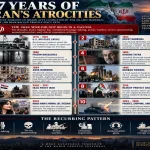
After that, the pattern never really changed. The faces changed. The slogans got updated. The methods got more sophisticated. But the pattern held. Iran built influence not by becoming admirable, but by becoming dangerous. Hezbollah. Militias. Terror finance. proxy warfare. Bombings. Kidnappings. Missiles. Training camps. Shadow wars. The regime learned it could wound stronger nations indirectly and then pretend it had nothing to do with the blood on the floor.
The West, meanwhile, often behaved like a man trying to negotiate with a rattlesnake by discussing its childhood.
Some presidents understood that force deters. Some believed goodwill would soften zealots. Some talked like accountants at a funeral. Some talked like the funeral might be for the other guy. And through all of it, the Iranian regime kept doing what ideological regimes do: survive, spread, radicalize, intimidate, and wait for weakness.
That is the part polite people hate to say out loud. Iran’s ruling regime does not fundamentally think like a normal state. A normal state wants trade, calm, investment, and a long weekend. This regime has often acted like revolution is its export business and chaos is its marketing department. It uses grievance as fuel, religion as cover, terror as leverage, and negotiation as delay.
So now what?
Now we arrive at the question everybody tries to avoid. Not how did we get here. We know how we got here. Pride, ideology, failed judgment, foreign meddling, internal repression, and a revolution that promised justice and delivered fear. The real question is what comes after a regime that has spent decades feeding on conflict.
Because history does not hand out clean choices. It hands out invoices.
If the regime weakens, there is danger. If it survives, there is danger. If it lashes out through proxies, danger. If it races for greater military power, danger. If the Iranian people rise, there is hope, but hope in that neighborhood tends to arrive with broken glass and funerals attached. The world wants a fairy tale ending. History usually offers a bill, a compromise, and a warning.
And here is the warning: when a regime builds its identity on hatred, it does not become peaceful just because outsiders become sentimental. You do not cure fanaticism with flattering language. You do not stop a death cult by sending it better stationery. At some point, reality must be spoken plainly. A government that survives by terror abroad and repression at home is not misunderstood. It is understood perfectly well. People just prefer softer words because softer words make them feel civilized.
But civilization is not the art of pretending evil is complicated when it is merely persistent.
Iran is not its regime. That matters. The Persian people are not reducible to the men who rule them. They carry one of the deepest cultural histories on earth. They deserve better than clerics with missiles and slogans. The tragedy is not only what the regime has done to its enemies. The deeper tragedy is what it has done to its own people.
So now what?
Now comes the oldest answer in politics and the hardest one to live by: tell the truth about what you are facing, stop rewarding the behavior that keeps producing disaster, and remember that history does not care how noble your intentions sounded in the faculty lounge. It only cares what happened after the speeches were over.
And that, as usual, is the part nobody likes—because the truth is never half as fashionable as the lie, but it ages a whole lot better.
Here’s a Iran timeline that goes all the way back to the Persian Empire.
One useful note before we start: “Persia” was the common Western name for the country for centuries, while “Iran” was the traditional internal name; the government officially asked foreign countries to use Iran in 1935.
Ancient Persia
c. 550 BCE — Cyrus the Great founds the Achaemenid Empire, the first great Persian Empire.
330 BCE — Alexander the Great defeats the Achaemenids; Seleucid Greek rule follows.
247 BCE–224 CE — The Parthian (Arsacid) Empire rules Iran.
224–651 CE — The Sasanian Empire becomes the last great pre-Islamic Persian empire.
637–651 CE — The Arab Muslim conquest breaks Sasanian rule and begins Iran’s long Islamic era.
Islamic and Imperial Iran
821–1501 — Iran passes through a long chain of Persian, Turkic, and Mongol-ruled dynasties, but Persian culture and identity survive.
1501–1736 — The Safavid dynasty reunifies Iran and makes Twelver Shiism the state religion, one of the biggest turning points in Iranian history.
1736–1747 — Nader Shah seizes the throne and briefly restores Persian military power.
1750–1779 — The Zand dynasty rules much of Iran after Nader Shah’s death.
1794–1925 — The Qajar dynasty takes control; Iran weakens under internal dysfunction and foreign pressure. (See Below: Colonial Times)
1905–1911 — The Constitutional Revolution creates a constitution and a parliament, the Majles, to limit royal power.
Modern Iran
1921 — Reza Khan takes power in a coup.
1925 — The Pahlavi dynasty is formally established.
1935 — The state officially asks foreign governments to use the name Iran instead of Persia.
1941 — Allied occupation forces Reza Shah to abdicate; Mohammad Reza Shah takes the throne.
1951 — Mohammad Mosaddegh becomes prime minister and nationalizes Iran’s oil industry.
1953 — A U.S.- and U.K.-backed coup removes Mosaddegh and restores the shah’s authority.
1963 — The shah launches the White Revolution, a major modernization and reform program.
1978–1979 — The Iranian Revolution topples the monarchy and creates the Islamic Republic.
1979–1981 — The U.S. embassy hostage crisis turns Iran’s rupture with the United States into a permanent political fact.
1980–1988 — The Iran-Iraq War devastates the country and militarizes the new regime.
1989 — Ayatollah Khomeini dies; Ali Khamenei becomes Supreme Leader.
2002–2003 — Undeclared nuclear sites at Natanz and Arak come to international attention, beginning the long modern nuclear standoff.
2009 — The Green Movement erupts after the disputed presidential election.
2015 — Iran signs the JCPOA nuclear deal with world powers.
2018–2019 — The U.S. leaves the JCPOA, and Iran begins backing away from parts of the deal.
2022 — The death of Jina Mahsa Amini ignites the Woman, Life, Freedom protest movement.
2020s — Iran remains defined by clerical rule, sanctions, internal unrest, and an unresolved nuclear confrontation with outside powers.
Colonial Times
Iran was never formally colonized by Great Britain, but during the 19th and early 20th centuries it lived under something just shy of it—a constant, suffocating pressure. Britain saw Persia less as a country and more as a strategic piece on the board, a buffer protecting its crown jewel, India. Through loans, trade deals, and “concessions,” British influence seeped into Iran’s economy and politics, controlling everything from banking to oil exploration, often in partnership—and rivalry—with Russia. The Qajar rulers, weak and cash-strapped, sold off rights to resources and industries, trading sovereignty for survival, while ordinary Iranians watched their country slowly become a marketplace for foreign powers. By 1907, Britain and Russia had even divided Iran into spheres of influence without asking the Iranians themselves—a quiet reminder that a nation can lose control of its destiny long before it loses its flag.
The short truth is this: Iran is not some new angry country that appeared in 1979. It is an ancient civilization with imperial memory, Islamic identity, Shiite state structure, modern nationalist wounds, and a government that still lives in argument with both its own people and the outside world.