Think of it as Yoga for the brain, we are going to stretch a bit.
The Line We Pretend Not to See – APE – HUMAN – AI
We can create something powerful… are we wise enough to decide whether we should? The Question is bigger than the Answer -- YNOT!
There was a time—not so long ago in the grand theater of human foolishness—when a man looked at a chimpanzee, looked at a human being, and decided the difference between them was not a boundary… but an opportunity.
This man, the Russian, Ilya Ivanov, was not a madman in the way we like our villains. He wore the respectable coat of “science.” He had credentials, funding, and a government willing to look the other way so long as results came back stamped with progress.
And so he set out to do something that should have stopped him cold the moment it crossed his mind: to create a human–chimp hybrid.
Now, if you listen carefully, you can almost hear the modern world whisper: “Well… did it work?”
That’s the wrong question.
The Problem Was Never Whether It Would Work
It didn’t work. Biology, in one of its rare acts of mercy, stepped in and said no. Humans and chimpanzees, despite sharing a surprising amount of DNA, are separated by just enough complexity to make such a creature unlikely—if not impossible.
But that’s not the story. The story is that someone tried.
And not just someone—a trained scientist, backed by institutions, operating under the banner of knowledge. Because once a man begins to believe that ability equals permission, he has already crossed the line. The only thing left is to find out how far he can go before something stops him—nature, law, or catastrophe.
Progress Without a Compass
We like to think of progress as a straight road leading upward. But history shows it’s more like a drunken wander through a field full of cliffs.
Every generation inherits new tools:
The atom was split before it was understood.
The genome was mapped before it was morally digested.
Machines now think—at least well enough to make us nervous.
And every time, the same quiet assumption slips in:
If we can do it, we probably should.
That assumption has caused more trouble than ignorance ever did.
Because ignorance says, “I don’t know.”
But ambition says, “I’ll find out—no matter the cost.”
The Dangerous Question
The most dangerous question in science is not “What is possible?”
It is: “Why not?”
“Why not try?”
“Why not push further?”
“Why not test the boundary?”
Because “why not” has no brakes. It assumes that the absence of a rule is the same as permission. It treats silence as consent.
And nature, history, and human dignity are rarely consulted in that conversation.
Where Is the Line?
That’s the question no laboratory can answer.
There is no formula that tells you:
When curiosity becomes cruelty
When discovery becomes desecration
When progress becomes regression wearing a lab coat
The line is not in the science. The line is in us.
It lives in restraint. In humility. In the quiet voice that says:
“Just because I can… doesn’t mean I should.”
The Truth We Avoid
Here is the uncomfortable truth: Human beings are far more advanced in what we can do than in what we should do. Our tools evolve faster than our wisdom.
And when that gap gets too wide, history tends to correct it—with consequences.
The Cost of Crossing
Ilya Ivanov failed in his experiment. But in another sense, he succeeded.
He showed us something far more important than whether a humanzee could exist. He showed us how easily the human mind can justify stepping over a line that should never have been approached.
The real danger isn’t that science goes too far. The real danger is that we don’t recognize when it already has.
And by the time we do… the cost is usually written in something far more permanent than ink.
The New Frontier: Minds Without Bodies
If you think the story of Ilya Ivanov belongs safely buried in the past, think again.
We have simply traded fur and flesh for code and silicon.
Today, the question is no longer: “Can we combine human and animal?”
It is: “Can we replicate—or surpass—the human mind itself?”
And just like before, the room fills with the same dangerous whisper: “Why not?”
Building Something We Don’t Fully Understand
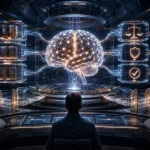
Modern artificial intelligence is not like a hammer or a wheel. It is not a tool that simply extends the hand. It extends the mind.
Systems are now being built that can:
Write, reason, persuade
Learn patterns we don’t explicitly teach
Make decisions in ways we don’t fully trace
That last one should give you pause. Because for the first time, we are creating something that can act intelligently without fully explaining itself.
And yet, development races forward. Faster models. Bigger systems. More autonomy.
Not because we fully understand them—but because we can build them.
The Same Old Mistake in a New Suit
The pattern hasn’t changed. Only the technology has.
Then: “Let’s see if we can create a hybrid.”
Now: “Let’s see if we can create intelligence.”
Then: Ethics came after the experiment.
Now: Ethics struggle to keep up with deployment.
Then: A boundary was tested in biology.
Now: A boundary is being tested in consciousness, agency, and control.
And once again, the guiding principle risks becoming: Capability first. Consequences later.
The Illusion of Control
There is a quiet assumption in all of this—that because we build it, we control it.
History disagrees.
We did not fully control:
The atom once it was weaponized
The markets once they became algorithmic
The internet once it reshaped society
And now we are building systems that think faster than we do, scale instantly, and operate globally. The idea that we will always remain firmly in control is… optimistic.
Where Is the Line This Time?
With Ivanov, the line was physical, visible, undeniable.
With AI, the line is abstract.
Is it when machines make decisions for humans?
When they replace judgment instead of assisting it?
When we stop understanding how conclusions are reached?
Or when we begin to trust them more than ourselves?
The problem is not that we lack answers. The problem is that we are asking the questions after we’ve already started building.
The Same Question, Louder Than Ever
The humanzee never came to life—but the impulse behind it never died. It evolved.
Today, it wears a cleaner face, speaks in technical language, and is funded on a scale Ivanov could never have imagined.
But at its core, it asks the same question humanity has always struggled with:
If we can create something powerful… are we wise enough to decide whether we should?
And if history is any guide, we tend to answer that question only after the experiment is already underway.
EPILOGUE
By the year 2050—perhaps sooner—we will likely possess the capability to build sentient, AI-driven beings that rival, and in some ways surpass, human intelligence.
They may not be purely mechanical. Some will incorporate biological components—engineered neural tissue, hybrid systems that blur the line between organism and machine. The boundary between life and technology will not disappear, but it will become increasingly difficult to define.
And then comes the question that follows naturally—almost inevitably:
If we can build a more capable vessel… will we try to move ourselves into it?
Not just our data. Not just our memories.
But our consciousness—or something close enough that we convince ourselves it is the same thing.
If that moment arrives, it will not simply be another technological milestone. It will mark a turning point in the human story:
The shift from evolving by nature to evolving by design.
And in doing so, we may bring about what could be called the final evolution of Homo sapiens—not extinction, but transformation into something new… something we may no longer fully recognize as ourselves.
The question, as always, will not be whether we can. It will be whether we understand what we are becoming before it is too late to turn back.