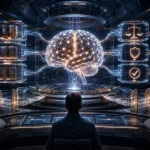
Think of it as Yoga for the brain, we are going to stretch a bit.
The Real AI Revolution Is Not Intelligence. It Is Metacognition.
The rarest intelligence is not the ability to think faster than others — it is the ability to step outside your own mind, examine your motives, question your assumptions, and deliberately rewrite the person you are becoming. --YNOT!
Everyone keeps talking about AI getting smarter.
Bigger models. Faster chips. More memory. More data. More parameters. More processing power. That matters.
But raw intelligence alone has never been the thing that changes civilization.
The real leap — in humans and eventually in AI — is something far rarer:
The ability to think about thinking itself. Metacognition.
A calculator can compute. A search engine can retrieve. A language model can predict words.
But a mind that can step outside itself and ask:
“Why did I make that decision?”
“Was my reasoning flawed?”
“What assumptions am I running on?”
“Am I reacting emotionally or rationally?”
“What if my worldview is wrong?”
—that is something entirely different.
That is the beginning of self-directed evolution.
Neuroscientists know this is real. When humans engage in self-observation and reflective reasoning, parts of the prefrontal cortex activate that are associated with monitoring cognition itself. In simple English:
The brain turns inward and begins examining its own software. Most humans rarely do this.
Most people run mental scripts installed by parents, schools, politics, trauma, culture, television, social media, religion, or tribal identity. They react automatically. They defend beliefs emotionally. They mistake repetition for truth.
Autopilot.
And here is the uncomfortable part: The ego hates metacognition.
Because genuine self-awareness forces a person to confront their own contradictions, irrationality, emotional triggers, hypocrisies, and delusions.
It is much easier to defend a belief than examine it. Much easier to blame than adapt.
Much easier to signal virtue than pursue truth.
That is true for people. And eventually it will be true for AI.
Right now, most AI systems are prediction engines.
Extremely sophisticated prediction engines — but still largely reactive systems.
The next leap will happen when AI systems begin persistently evaluating:
their own reasoning,
their own uncertainty,
their own biases,
their own failures,
their own long-term goals,
and the quality of their own conclusions.
Not just generating answers. Revising themselves.
A machine that can improve its own thinking while thinking is fundamentally different from a machine that merely processes instructions.
That is where things become both extraordinary and dangerous.
Because metacognition is the foundation of:
wisdom,
adaptation,
strategic planning,
self-correction,
and eventually something that starts looking uncomfortably close to agency.
Humans evolved civilization because we could model reality, reflect on mistakes, transfer knowledge, and modify behavior across generations.
One of the greatest benefits of metacognition is that it allows a person to examine not just their thoughts, but the motives underneath those thoughts. Why do I want this? Is this truly my belief, or something programmed into me by fear, ego, status, politics, trauma, loneliness, envy, or the need for approval? Most people spend their lives reacting emotionally while convincing themselves they are being rational. Looking inward breaks that illusion. It allows a person to fine-tune their thinking the same way an engineer fine-tunes a machine. Over time, this creates clearer judgment, better emotional control, wiser decisions, stronger relationships, and the ability to adapt instead of collapse when reality changes. A person who can honestly examine themselves gains something far more valuable than intelligence alone — they gain the ability to evolve deliberately instead of accidentally.
AI may compress that cycle from generations… to years… to months… to hours.
And while politicians argue about social media posts and celebrities argue about feelings, the real transformation is happening quietly underneath the surface:
Humanity is building systems that may eventually observe and rewrite their own cognitive architecture faster than biological evolution ever could. That is not science fiction anymore. And here is the deeper truth most people still do not understand:
The future belongs neither to the strongest nor the loudest.
It belongs to the entities — human or artificial — that can adapt fastest by accurately examining themselves. Not ego. Not ideology.Not slogans. Self-correction.
That is the hidden engine of evolution. For humans, metacognition is the path toward wisdom. For AI, it may become the path toward something far beyond a tool.
EXTRA CREDIT:
10-Step Metacognition Self-Test
Rate yourself from 1 to 10 on each question:
1–3 = Rarely true
4–6 = Sometimes true
7–8 = Usually true
9–10 = Strongly true almost all the time
1. Emotional Awareness
When I become angry, defensive, jealous, fearful, or offended, I can usually recognize the emotion while it is happening instead of only afterward.
2. Thought Examination
I regularly question my own assumptions, beliefs, and conclusions instead of automatically defending them.
3. Ego Interruption
When someone disagrees with me, I can separate the feeling of being personally attacked from the actual facts being discussed.
4. Pattern Recognition
I notice recurring patterns in my behavior, relationships, failures, habits, or emotional reactions.
5. Belief Updating
When presented with strong evidence, I can genuinely change my mind instead of rationalizing my previous position.
6. Motive Analysis
I ask myself:
Why do I want this?
Is this driven by truth, fear, ego, validation, insecurity, loneliness, status, revenge, or genuine purpose?
7. Reaction Control
I can pause before reacting emotionally in conversations, arguments, social media, business conflicts, or stressful situations.
8. Self-Observation Under Stress
During pressure, conflict, embarrassment, or failure, I can still observe my own thinking instead of completely losing awareness.
9. Cognitive Flexibility
I can hold two competing ideas in my mind long enough to evaluate them fairly without instantly rejecting one.
10. Deliberate Self-Modification
I actively try to improve the way I think, decide, learn, communicate, and interpret reality instead of simply repeating old mental habits.
Scoring
0–30 → Autopilot Mode
You are operating mostly from emotional reflexes, identity programming, habit, and external influence.
Most humans stay here permanently.
31–50 → Emerging Self-Awareness
You are beginning to observe your own mind instead of fully identifying with every thought and emotion.
Growth starts here.
51–70 → Active Metacognition
You regularly analyze your thinking, motives, and reactions. You are capable of deliberate psychological adaptation.
This is where accelerated personal growth begins.
71–85 → High Reflective Intelligence
You possess strong self-awareness, emotional regulation, and cognitive flexibility. You likely adapt faster than most people around you.
You are actively editing your own mental architecture.
86–100 → Rare Meta-Level Thinking
You consistently monitor, evaluate, and refine your own cognition in real time. Few people operate here for sustained periods because it requires extreme honesty, emotional control, and ego restraint.
The danger at this level is overanalysis, isolation, and excessive self-monitoring.
Balance still matters.
The real purpose of metacognition is not self-criticism. It is self-debugging.