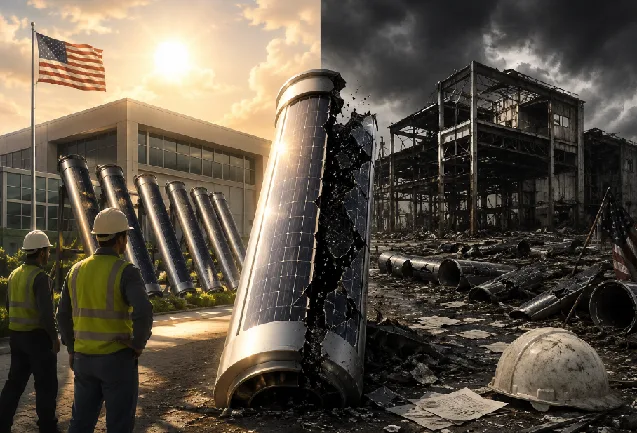
Think of it as Yoga for the brain, we are going to stretch a bit.
Solyndra: The Green Dream That Burned Through Half a Billion Dollars
Solyndra did not fail because the future was fake. It failed because politicians confused hope with economics — and reality always sends the bill. -- YNOT!
There is an old rule in business that politicians learn only after they have spent someone else’s money:
A government can print dollars. It cannot print wisdom.
Back around 2009, America was told it stood on the edge of a green-energy revolution. The future would be powered by sunlight, electric dreams, and federal subsidies large enough to make accountants weep openly into their coffee.
One of the shining stars of that revolution was a company called Solyndra. And for a little while, Solyndra looked like the future itself.
Their technology was genuinely interesting. Most solar panels at the time were flat rectangles mounted at angles like giant black playing cards facing the sun. Solyndra decided to do something different. They built cylindrical solar modules — tubes instead of flat panels.
The idea had logic behind it. Their round design could supposedly capture sunlight from multiple angles throughout the day. The panels were lighter, easier to install on large commercial rooftops, and required less mounting hardware. In theory, warehouses and big-box stores across America would someday be covered in elegant rows of futuristic silver tubes.
And for a brief moment, the company looked unstoppable. Politicians toured the factory like it was Disneyland for climate policy. Newspapers praised it. Investors poured in money. The Obama administration made it the poster child of America’s green-energy future.
Then came the famous number: A $535 million federal loan guarantee.
Not millions from private investors risking their own fortunes. Not venture capitalists gambling on innovation. Taxpayer-backed money. That is where the story changes from business to tragedy. Because the market had other plans.
Solyndra’s entire business model depended on one critical assumption:
That traditional silicon solar panels would remain expensive.
But while American politicians were giving speeches, Chinese manufacturers were building factories at astonishing speed. China flooded the market with cheap conventional solar panels. Prices collapsed worldwide.
And suddenly Solyndra’s elegant futuristic tubes became a luxury product nobody needed. The economics turned brutal almost overnight. Their manufacturing costs were too high. Their product could not compete. Their burn rate was enormous. And the more they scaled production, the faster they lost money. That is one of the cruelest lessons in capitalism:
Sometimes the future arrives. Just not your version of it.
In 2011, Solyndra collapsed into bankruptcy. About 1,100 employees lost their jobs. Taxpayers were left holding the bag. And the company that had once been displayed as proof of America’s clean-energy renaissance became a national symbol of political overconfidence. Now here is the uncomfortable part nobody likes discussing. The disaster was not simply that Solyndra failed. Businesses fail all the time. Failure is part of capitalism. Venture capitalists understand this perfectly well. They know that for every ten startups, perhaps one survives.
The real problem was this: Government officials were acting like venture capitalists — except they were gambling with other people’s money.
When private investors lose money, they suffer consequences. When politicians lose money, they hold another press conference. And that is the danger.
Governments are very good at building roads, defending borders, and maintaining infrastructure. But they are often terrible at predicting which technologies will survive brutal global competition.
Markets evolve faster than bureaucracies. Factories move faster than politicians. And reality does not care about press releases. The truly ironic part? Solar energy itself did not fail. In fact, solar exploded worldwide.
But the winners were often companies with lower costs, better timing, stronger supply chains, or access to massive industrial scaling — especially in China.
Solyndra was not destroyed because solar power was fake. It was destroyed because economics is undefeated. And perhaps that is the deepest lesson of all: A good idea is not enough. Political enthusiasm is not enough. Even revolutionary technology is not enough.
If the numbers do not work… eventually gravity returns.
And gravity always collects its debt.
Solyndra Timeline
Year / Date
Event
Money / Financial Details
2005
Solyndra founded in California
Raised large venture capital funding from private investors
2006–2008
Company gains attention for cylindrical solar panel technology
Hundreds of millions invested privately before government involvement
March 2009
Obama administration announces federal support
U.S. Department of Energy approves $535 million loan guarantee
2009
New Fremont, California factory construction begins
Massive manufacturing facility built with federally backed financing
May 2010
President Barack Obama visits Solyndra factory
Company publicly promoted as symbol of “green jobs” future
2010
Solar market changes dramatically
Chinese manufacturers rapidly drive down conventional solar panel prices
Late 2010
Financial pressure increases
Solyndra reportedly burning cash rapidly while losing competitiveness
February 2011
Company restructures debt
Private investors injected about $75 million more to keep company alive temporarily
August 31, 2011
Solyndra shuts down operations
About 1,100 employees laid off immediately
September 6, 2011
Solyndra files for bankruptcy
Estimated taxpayer exposure: over $500 million
September 2011
FBI raids Solyndra headquarters
Federal investigation begins into finances and loan process
2012–2015
Congressional investigations continue
Political battle over government-backed “green energy” investments
After bankruptcy
Factory sold off and assets liquidated
Taxpayers recovered only a fraction of losses
Major Money Figures
Category
Approximate Amount
Federal loan guarantee
$535 million
Private venture capital invested before collapse
~$1 billion+
Additional emergency investor funding in 2011
$75 million
Employees laid off
~1,100
Estimated taxpayer losses
Hundreds of millions
Estimated total investor losses
Over $1 billion
Why Solyndra Looked Promising
Their technology actually had real engineering logic behind it:
Cylindrical solar tubes could capture sunlight from multiple angles.
Easier rooftop installation on flat commercial roofs.
Reduced need for mounting hardware.
Better airflow and cooling around panels.
Looked futuristic and innovative.
The problem was not that the technology was “fake.”
The problem was economics.
Solyndra’s business model depended on traditional silicon solar panels staying expensive. Instead, China massively expanded manufacturing capacity and flooded the market with low-cost flat solar panels.
The price collapse destroyed Solyndra’s competitive advantage.
Why the Government Funding Became Controversial
Critics argued several things:
Government officials were trying to pick technological winners and losers.
Political enthusiasm may have overridden financial caution.
The company’s financial warning signs appeared before collapse.
Taxpayers absorbed losses that private investors normally would have taken.
Supporters of the broader clean-energy program argued that:
Venture-style investments naturally include failures.
Other DOE-backed companies succeeded.
Solar power itself ultimately became massively successful worldwide.
But politically, Solyndra became the symbol of what happens when:
politics,
public relations,
and speculative technology
collide with real-world market forces.
Solyndra was a cronyism scandal a proven kickback scandal.
Issue
What happened
Proven kickback?
Obama donor connection
Major Solyndra investor George Kaiser was an Obama fundraiser/bundler. Critics argued this looked like political favoritism.
No direct kickback proven. Kaiser denied lobbying for the loan, and public reporting did not prove a cash-for-loan deal.
Special loan treatment
In 2011, DOE restructured the loan so new private investors could be repaid ahead of taxpayers if Solyndra collapsed.
Special deal, yes. Kickback, not proven.
Rushed approval
Emails showed concern that the loan may have been pushed quickly for political optics and public announcements.
Political pressure alleged, but not proven as bribery.
Misleading company claims
DOE Inspector General later found Solyndra gave false or misleading information about sales and financial health.
Fraud-like conduct by company leadership alleged/found, but not a proven political kickback scheme.
Taxpayer loss
Over $500 million was disbursed; taxpayers lost hundreds of millions after bankruptcy.
Financial disaster, yes.
The suspicious part was the political access, the Obama donor connection, the rushed optics, and the later loan restructuring. But investigators did not prove a simple “they donated money and got the loan as a payoff” arrangement.
The worst “special deal” was the loan restructuring that put some private investors ahead of taxpayers. That looked terrible politically because the public took the loss while insiders got a better position.